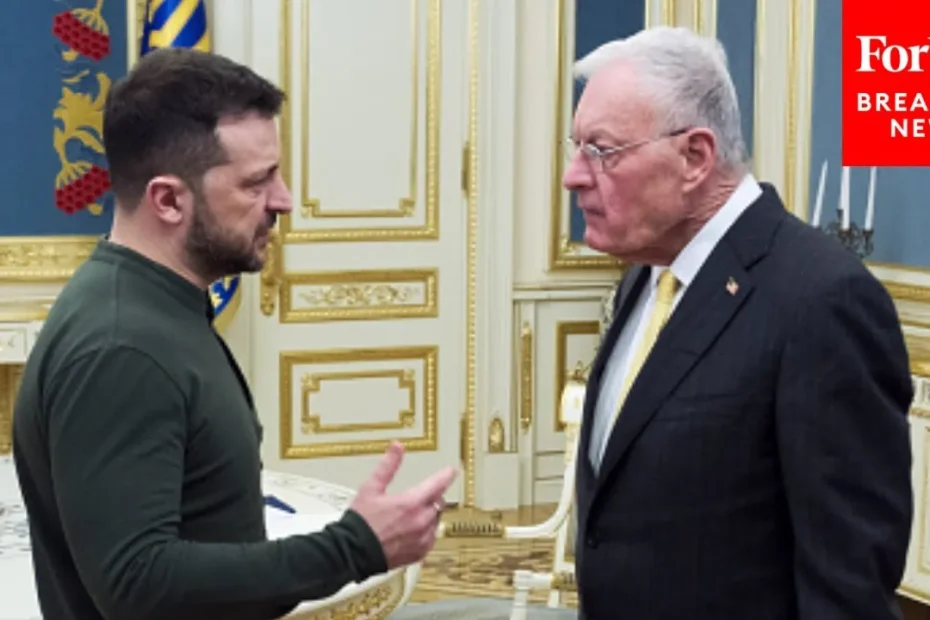
Read the full transcript of Special Envoy for Ukraine and Russia Keith Kellogg’s keynote address at a Council on Foreign Relations event on Russia’s invasion of Ukraine, and is followed by the Q&A session. [March 6, 2025]
Listen to the audio version here:
TRANSCRIPT:
KEITH KELLOGG: Well, thank you to the Council and President Froman for the invitation to speak to you today. And thank you to the audience for joining this conversation. I see some friends in the audience that have been here before, Elliot, Doug, the rest of the team out there. And today, I think we’re going to be discussing what is arguably the most complex foreign policy challenge the administration is faced with, and that’s the Russia-Ukraine War. The largest war in Europe since the end of World War II.
The Scale and Gravity of the Conflict
KEITH KELLOGG: President Trump recognizes this and has acknowledged the gravity and complexity of bringing peace to this war. In a December press conference at Mar-a-Lago, President Trump remarked that ending the Russia-Ukraine War would be, quote, “even more difficult than resolving the ongoing Israeli-Hamas War and the turmoil in the Middle East,” end quote. President Trump’s assessment is well-founded.
The Russia-Ukraine War has become the largest land war in Europe since World War II. The death and destruction is what could be called industrial grade. After three years of war, combined casualties on both sides have surpassed one million individuals. Think of it this way. Just on the Ukrainian side alone, more soldiers have been killed than the United States lost in the Vietnam War and the Korean War combined.
Russia has over 490,000 soldiers deployed to Ukraine, a force that is larger than today’s active United States Army. Russia has destroyed Ukrainian cities like Mariupol, a city the size of Denver proper. The city of Izium, a city that I visited, a city of 70,000, now holds less than 20,000, where when I was there, cooking was done in the streets because of no electrical power. The hospitals were running on generators.
Russia’s actions have been a catalyst for a broader crisis throughout Europe to include ongoing refugee, energy security, food scarcity, inflation, and defense readiness issues across the entire continent.
I’ve seen the destruction of Russia’s war firsthand, having visited Ukraine, including the Donbass region. While the kinetic action and direct military engagement of this war is bound to Russian and Ukrainian territory, this war is ultimately being waged by a competing alliance structure who are all proxies to this war.
Russia’s war effort has led to a deepening of alliances with the Chinese, the Iranians, and the North Koreans, where the Europeans are supporting Ukraine by proxy in a simple fear that if Russia is not stopped in Ukraine, the war will spill over to the rest of Europe. Recently spending three days at the Munich Security Conference talking to them, their fears and concerns were palpable.
The Trump Administration’s Approach
So when we discuss the complexity of this war, it comes from an understanding that bringing this war to a conclusion not only requires mitigating the root causes of the Russia-Ukraine war itself, but it ultimately entails the United States and European allies confronting a global adversarial alliance structure. Our allies in Europe claim they will pick up any slack in support, but also openly proclaim that the United States must be involved.
In this foreign policy crisis, President Trump has been clear that the United States’ primary objective in this war is to stop the killing and get both sides to the table and implement an enduring peace structure. America has funded this war with over $170 billion. This year alone, with the most recent tranche of over $60 billion, is an amount larger than we funded the United States Marine Corps this year.
Donald J. Trump is a peacemaker, and he is the president of peace. President Trump has committed to the American people that he will put the interests and security of our citizens first, and he will keep our nation out of endless wars.
I’m reminded of what Professor Paul Kennedy from Yale University wrote in a seminal work, The Rise and Fall of the Great Powers, when he noted that great powers historically fail when they involve themselves in strategic overreach. He called it imperial overreach. But I’ll make it simple so you don’t have to buy the book. When a nation is concerned about filling somebody else’s potholes when they have their own potholes, they fail.
Ushering in peace between nation states was the legacy of his first administration, and this is the same mission he is bringing into the second administration and towards this war. This war did not start on Donald Trump’s watch. I believe he’s absolutely right. It would not have started if he was in office, and the strategy of the previous administrations, “as much as it takes, as long as it takes,” to me was not a strategy but a simple bumper sticker.
Peace Through Strength
Despite the past, President Trump is working hard to bring a peaceful resolution to this war. You can see the high priority he is placing on this goal when you look at how many senior individuals he has asked to pitch in and help negotiate peace, from Marco Rubio to Howard Lutnick to Scott Bessent to me to Mike Waltz. He had worked out more in the last 45 days than we saw in the previous years, and we’ve only been at it for 45 days, but we’ve already had teams in Moscow and in Kyiv. And we all want the same thing. We are working as a team to explore every avenue we can for peace.
But as we know, and as this administration knows, peace is only possible through strength, which brings us to where we are today, how the Trump administration is deploying strength in this urgent moment to bring a peaceful resolution to this devastating war.
To start, President Trump’s America First approach towards engagement abroad is a driving force behind this administration’s approach to the war, which is notably different than the preceding administration and the broader U.S.
President Trump has already engaged President Putin. He’s engaged President Zelensky. We have found from previous approaches, you cannot avoid talking to your adversaries or friends alike. President Trump has elevated the United States’ priority as bringing peace to both sides rather than framing this war as one side winning over the other, an approach that would only serve to drag America into an endless proxy war to the detriment of our own national security interests.
When President Trump was asked in May 2023 town hall, if he wanted, quote, “Ukraine or Russia to win this war,” he responded by saying, “I just want everybody to stop dying.” This statement was not only a public commitment to peace and a commitment to keep our nation out of an endless war, but it was a proactive signal that the United States would serve as a positive force in bringing a resolution to this conflict.
Recent Diplomatic Efforts
We saw this very approach towards the war play out in the recent Oval Office meeting between Presidents Trump and Zelensky last Friday. And I had a ringside seat standing right behind the Vice President and Secretary Rubio. What happened was two nation state leaders coming into a meeting with objectives that were clearly not in alignment with one another. And there was a disconnect publicly between the goals of the two administrations.
President Zelensky approached this engagement with President Trump as an effort to get the United States to continually fund Ukraine, to give Ukraine an advantage over Russia. President Zelensky clearly wanted President Trump to side publicly with the United States against Russia. It would have negated an objective interlocutor role.
President Trump, however, was not approaching as a matter of one side gaining an advantage over the other, but was instead focused on peace, stating, quote, “President Zelensky is not ready for peace if America is involved because he believes our involvement gives him a big advantage in negotiations. I don’t want advantage. I want peace,” end quote.
The Human Cost
There is the human cost of this war which deeply resonates with President Trump. The casualties of this war have surpassed one million. And on average, this war is costing approximately 600 soldiers killed in action per day. Short of U.S. efforts to end this war and stop the killing, Ukraine is quickly approaching the lost generation. That is a term that Britain used and experienced from the bloody trench warfare in World War I.
Just about a year ago, at this time, I was with President Trump as we traveled on a campaign trip to Iowa, and we discussed the war. He is not new to the issue of conflict resolution. He understands the damages of war and what it brings. And I just returned from Ukraine, where I did a visit to a Ukrainian military hospital in Irpin, where you see physically the toll that this prolonged war has had on the Ukrainian soldiers. One item became very clear. It’s the urgent need to stop the killing.
KEITH KELLOGG: The visit to Irpin, one that treats soldiers with combat-related amputations, was both uplifting and depressing. Uplifting in seeing soldiers recovering from grievous injuries with a positive attitude, yet at the same time, it was depressing because their physical losses were absolutely catastrophic. This is where President Trump is coming from. He sees the war from both a human dimension and from an American strategic view.
Strategic Approach to Russia Relations
There is also a broader strategy at play in President Trump’s approach to this war that is informed by the realization that the United States needs to reset relations with Russia. Not engaging with both allies and adversaries is essential in diplomacy. In the previous administration, a mistaken approach was taken in which the United States failed to engage with Russia and leveraged strong diplomacy coupled with credible deterrence to end the war.
Nation-state leaders, particularly during times of war, have a primary duty to engage in direct diplomacy with each other and exhaust every lever of statecraft to resolve conflicts and keep our nation out of endless wars. For the President of the United States to not engage with the leader at war has had immense ramifications for our national security. The continued isolation and lack of engagement with the Russians as the war in Ukraine continued is no longer a viable or a sustainable strategy and is certainly not a responsible approach diplomatically for the United States to continue.
These reasons, the human cost of this war, the need to reset relations with Russia to secure American’s vital national interest, and ultimately to stop U.S. entanglement in an endless proxy war are the driving reasons why President Trump’s approach and the framing of this war is distinct from the broader conventional approach that we see publicly to the war.
Bringing Both Sides to the Table
So what you are seeing now, what you are witnessing, are urgent efforts by the Trump administration to bring both sides to the table in order to get to a peace settlement. And bringing both sides to the table means applying pressure points and incentives, sticks and carrots, on both sides to get them to the table and agree to peace terms.
There are aggressive movements from the administration underway to apply pressure points towards the Russians and obviously to the Ukrainians as well. The seizing of frozen Russian sovereign assets to rebuild and rearm Ukraine, maximum pressure sanctions on Russian energy are a few of the tools the President is leveraging to get Russia to a peace deal.
Look at the current sanctions, especially against the Shadow Fleet that carries 70 percent of the oil, illicit oil, that comes out of Russia. We sanctioned those vessels by name. 70 percent of that oil comes through the Baltic Sea. The President has been clear that all options are on the table to end this war.
For Ukraine, the President is also applying both pressure points and incentives to get Ukraine to the table. The critical mineral field is an important part of this effort to get Ukraine to the table.
Trump’s Transactional Diplomacy
And President Trump approaches diplomacy and engagements in a very transactional manner, with economics as the foundation and driving force behind international affairs in President Trump’s “America’s first” transactional diplomacy model.
The transactional diplomacy approach is why, in his discussions with foreign leaders, the first question that is often asked, as I found the very first time we were in the Cabinet Room when a foreign official came in, was “what is the trade imbalance between our two nations?” That is the same underpinning of the proposed critical minerals deal between the United States and Ukraine.
It sets a foundation in which the United States can receive the direct return on its investment in Ukraine. The United States has been Ukraine’s leading partner in supporting Ukraine’s defensive war from Russia to the extent of over a hundred and seventy billion dollars. This deal, the critical minerals deal, in one sense is a mechanism in which the American taxpayer can begin to be recuperated from the costly financial sustainment of this war.
More broadly, however, this critical minerals deal also offers a partnership deal between the United States and Ukraine which can underpin a security architecture for Ukraine going forward. If the United States has direct economic interest in Ukraine, then the United States has a direct invested interest to protect its economic interests as well, which serves in fact as a de facto guarantee, a security guarantee for Ukraine.
You will continue to see strong efforts from the United States to bring both sides to the table in order to reach an enduring and sustainable peace effort. We are at the early stages and very candidly the road will be bumpy, all peace negotiations are, but failure to end this war, now over three years old, could be consequential, not just in Europe, but the world as well. And thank you for having me and I await your questions and the discussions.
Q&A Session
INTERVIEWER: Thanks to all of you for joining this morning and thank you for your remarks. For all of you here, we’re going to have about 25 minutes of conversation before we open it up to questions from all of you. So this meeting is on the record and I see my fellow reporters in the gathering here.
There are a lot of very specific questions. I know you don’t want to talk in specific terms, but we’ve seen just such a flurry of news in the past 24 to 48 hours from the administration, including the CIA director just yesterday going on Fox News and announcing that Intel sharing with Ukrainians was being cut off. My network, CBS, is reporting that’s all intelligence sharing, including targeting data for US provided weapons like HIMARS. There is some defensive intelligence being allowed for Ukrainians to protect themselves.
Last night, European command also issued a statement to CBS saying that there is a cause to security assistance to Ukraine, including what was already in train from the Biden administration. So that’s on top of the pause of the 3.85 billion that President Trump just issued. What is the intention here? What is the specific ask that Ukraine has to deliver on for all of this to be lifted?
KEITH KELLOGG: Margaret, thank you for the question. I believe that the push is to get them to engage in diplomatic activities, give us their, for lack of a better term, their term sheet to get this to the table and say this is an approach to going forward. We know that both sides are going to have disagreements and agreements as well.
So I think it’s like a forcing function that you want to get there. It’s sort of like, the Russians may say, “well, for you to get involved in the talks, we want you to sell us Alaska back.” That probably won’t happen. But the same thing is going to be with the Ukrainians. So it’s more than anything, it’s a forcing function to get to the realization that we want to go to a peace discussion, a peace deal.
Look, my experience in the reading of history and studying the Russian War, in fact, there’s a great book by a guy named Alexander Wirth that comes right down to it. The one thing you never want to do with the Russians is get into an attrition war. I mean, this is the same nation that in World War Two lost 70,000 troops dead in Stalingrad in six months and continued to fight. So you have to kind of think about how they look, how we want to approach this, and you don’t want to get into a war like that. So, again, bottom line is it’s a forcing function to get them to the table.
INTERVIEWER: But that’s a pretty major concession to Russia to constrain Ukraine’s ability to target and hit Russian forces. This pressure really seems to be directly impacting potentially what they can do on the battlefield.
KEITH KELLOGG: Very candidly, they brought it on themselves, the Ukrainians. I mean, when we were in the Oval Office last week on Friday, and I’ll give you the background a little bit of it, when we talked with President Zelensky before that meeting, there were 13 U.S. senators that said, “hey, Adams.” And we said, OK, this is like stage managing. This is what you want to say. It’s basically going to come in. We have a precious metals deal. You’re going to sign the deal. You’re going to have lunch, have a press conference, that’s your stage right. And you’re good to go.
We continue to go. What happened became a very combative press conference that went on for almost 50 minutes. That caught…
KEITH KELLOGG: Everybody was a little bit by surprise. I was right there. And I think what happened is we said, wait a second, this is not what we thought this was going to be. You don’t negotiate peace discussions in public. You don’t try to challenge the President of the United States in the Oval Office, suggesting that he needs to side with you and not the Russians. You don’t become an independent interlocutor in a situation like that. And Zelensky was forewarned. It’s not like President Zelensky was not made aware of what we wanted from the Ukrainians. This sets the next stage. It opens up and goes forward.
So I don’t blame the President of the United States at all. I think he made a decision, as he is the Commander-in-Chief under Article 2, Section 2, that he wanted to do. And it starts by saying, okay, if this is what you want to do, we’re going to play it with real politics.
INTERVIEWER: So President Zelensky has at least twice now said that he is willing to sign that deal, that he left the White House without signing it when he was kicked out. He’s also offered some public remarks that seem somewhat contrite, conciliatory. What does he need to do to turn the intelligence and weapons back on? Or is that off the table entirely? Is the U.S. position now that we do not support Ukrainian military operations against Russia?
KEITH KELLOGG: No, let me address the second part of the question first. Look at what President Trump said in the State of the Union. He was very magnanimous. He was very magnanimous in the Oval Office. And very clearly, there’s a pause. He didn’t say it was over. He said it was a pause.
How long is the pause? Well, here’s where I’ll answer the first part of the question now, because it’s a great question. Look, my experience working with him is sort of like if all of you have a contract – you sign a contract for a car, for a house. Before you go forward, you have a signed contract. And part of it now is, okay, sign. The reason he came to the White House was to sign a document that was going to say, this is us going forward. It’s not signed.
My point would be, and my personal belief would be, you don’t move forward until you get a signed document, period. When we had a precious metals deal, he had an option to sign that when I was in Ukraine, and they didn’t do it. They had the option to do it last week and didn’t do it.
INTERVIEWER: But he’s offering to do it.
KEITH KELLOGG: There’s a difference between offering to do it and doing it.
INTERVIEWER: What’s the hold up now? Sign the document. Can he DocuSign it? Can he email it?
KEITH KELLOGG: That’s a great question. Because that seems pretty quick to resolve.
INTERVIEWER: But it’s like, who’s going to sign it? Is it Secretary of State Marco Rubio? Is he the chief diplomat in relation to Ukraine?
KEITH KELLOGG: I think the protocol is, sign a document. And then once you sign the document that you want to go forward, that you’re serious about it, then I think you can move forward. And I think we’ve seen too many starts and misses as we go forward on this. I think that’s part of the issue – how serious are you to get to peace discussions? When you look at the public comments, and you look at the private discussions, it’s one of those things where it’s over to you. You figure it out.
And by the way, this is not something that is unusual. When I was in Kiev two weeks ago, I was very clear to President Zelensky about the outcome if we didn’t have a signed agreement. I was blunt and clear that this was a thing that could have happened. Sometimes, and I will be very honest with you, some people always misread the room with President Trump. You better understand when you deal with President Trump where he’s going. And what happened is President Zelensky misread the room last Friday. And I think he misread what I was telling him when I was in Kiev as well.
Strategic Negotiations
INTERVIEWER: That sounds personal at this point, rather than strategic.
KEITH KELLOGG: No, I think it is strategic. It’s not personal at all. I think what it is, it shows a negotiating style. It shows an understanding of what you’re presented with. And it’s basically, that’s how negotiations work. Negotiations are a lot of times personal. I mean, when you go back historically, when you look at negotiations, how they’ve been solved, they are done personally.
Go back to what happened in the Treaty of Portsmouth and Teddy Roosevelt, between then the Russians and the Japanese. It was his personal involvement on a personal level that caused the Treaty of Portsmouth to eventually be signed. When you look at Henry Kissinger and Le Duc Tho or whoever’s out there, negotiations are always personal. But I think there are underlying themes behind them.
INTERVIEWER: But to be clear, once we get through the protocol and the signing of this economic agreement, which is what the Treasury Secretary calls it, not a minerals deal, does the intelligence switch back on?
KEITH KELLOGG: That’s up to the President of the United States.
INTERVIEWER: So it’s not necessarily do this, and this is the result?
KEITH KELLOGG: No, it’s up to the President of the United States. I am not the President. I didn’t get a single electoral college vote. It’s up to the President, and he’s the Commander-in-Chief, he’s the President, and I would never, ever speak for the President. It’s gonna be his call.
INTERVIEWER: Well, I’m asking that because it’s confusing, frankly. I had the Treasury Secretary on Face the Nation on Sunday, and he had previously described the minerals and economic deal. He said I was wrong when I called it a minerals deal. He said it’s an economic partnership deal. But he said that initially was a building block towards peace. After the Oval Office confrontation, he said now we need peace before we see the economic deal. That was Sunday.
I know things change really quickly, and there are a lot of cooks in the kitchen, but what is the position now? It still sounds like it’s an open question if US military and intelligence support for Ukraine will ever be turned back on. Is that right?
KEITH KELLOGG: Well, I look at the word and define the word “pause.” Pause – the President of the United States did not say it is ended. He said it is paused. That is transitional. And he is the one who makes the decisions. None of us in the administration should ever try to speak for the President. That’s his call. And I will leave it up to him to make the decision when he thinks it’s equitable or when a pause should be lifted.
But to me, Margaret, I think you’ve got a great team of advisors around him, from Marco Rubio to Scott, to Howard, to Mike Walsh, to that whole team that you see there. It’s a synchronized team. We’re all in sync together. We’re all talking about it. The lines of communication are open, but we all say, one guy owns this. One guy runs this ship. I’m a westerner, and as a westerner, I don’t know if you’ve ever heard the term, “you ride for the brand.” If you ride for the brand, the trail boss is Donald J. Trump, then you ride for the brand. You’re with him.
Administration Coordination
INTERVIEWER: So you are based, you have an office at the State Department.
KEITH KELLOGG: And at the White House.
INTERVIEWER: And at the White House. Steve Witkoff, the envoy to the Mideast, is also now involved in the Russia portion of this. He also has an office at the State Department.
KEITH KELLOGG: And in the White House.
INTERVIEWER: And in the White House. Okay, how much coordination is there between the two of you? Or is this completely parallel?
KEITH KELLOGG: No, Steve’s a great guy, and we’ve got a really good relationship. And my deputy, John Cole, and Morgan Ortega, we’re working well together. We talk well together. My offices in the State are on the seventh floor, his is on the fifth floor. I know where his offices are in the White House. And we’re in sync together, because…
KEITH KELLOGG: We understand the importance behind it. I think what’s happened is, because of the relationship that Steve has on the Russia side, which actually started because of MBS, Mohammed bin Salman, the Crown Prince in Saudi, who brought in Kirill Dmitriev, who was the interlocutor with Russia. He runs the Sovereign Wealth Fund. So he brought them together.
It made a lot of sense strategically to say, “Okay, Steve, you run this lane really hard, and I’ll run this lane really hard.” We’re closely aligned, talking about it, comparing notes, and providing that information. And Marco Rubio made a great point when he was asked about the Special Envoys. The beauty that Steve and I have is that’s all our focus is. I’m focused on this and he’s focused on that. We build our teams out that way, and it makes it really effective. So that’s a long answer to a short question, but Steve and I are in sync. We’re together, we talk, we’re on speed dial with each other. And our messages are basically coordinated.
INTERVIEWER: So Envoy Whitcoff was on Face the Nation recently, and when I was asking him about this three and a half hour meeting he had with Vladimir Putin, which I think all of us would love to be a fly on the wall for that one. He said he went by himself, there was no foreign service or intelligence officer with him. There were translators, he said two in the room. Were those US translators?
KEITH KELLOGG: I don’t know. When he did that interview—
INTERVIEWER: You said he didn’t have anyone to go with, probably not.
KEITH KELLOGG: That’s what he said.
INTERVIEWER: Yeah, so were there notes from that meeting? Is there any record? I wonder, because that’s an extraordinary amount of time with Vladimir Putin.
KEITH KELLOGG: Yeah, there were notes that Steve brought back. So we are aware, it’s sort of like a quid pro quo, where you want to go and what you want to do. And the discussions that were made.
INTERVIEWER: It’s their term sheet, essentially?
KEITH KELLOGG: Well, I use the term “term sheet,” and in generalization, yes. But it’s like when I made that comment about how they want Alaska back – nope, not gonna happen. But we have an indication of where the Russians are, and we want to do the same thing with the Ukrainians as well. To me, we have a wonderful opportunity to get there.
Peace Framework Discussions
INTERVIEWER: So Andrei Witkoff said on a different network, but I read the transcript, that the framework for a peace deal between Ukraine and Russia is the Istanbul Protocol Agreement. Is that the framework you are working with?
KEITH KELLOGG: No. Here’s why. We both work from different perspectives. That came out of the Russians saying, maybe you go there. To me, when you look at the Istanbul Accords, that happened 30 days after the invasion. And the demands in Istanbul were fairly significant on a very weakened Ukraine.
Here’s where I will agree with what Steve said. Steve said it’s a departure point. I think that’s a good term to use. It’s a departure point. But I think you have to look at those accords critically. I don’t believe that is an equitable framework. And I think we have to develop something entirely new. You can start from that position if you want with the Russians. But that is going to be something up to the negotiation teams going forward.
I know that President Erdogan would obviously like to use that as a starting point. But I think any reasonable person has to look at what those Accords actually said. And you read each one of them quite clearly, what was demanded. Even though Ukraine at the time was agreeable to some of the conditions there, you have to look at the timeframe when that was done.
That was when the battlefield was in flux. It was 30 days after the start. They were still fighting in Bucha. They were still trying to evict Russians from Kharkiv and the regions around Kharkiv. It was a pretty strenuous fight. So you have to go to today. You can’t go back three years ago.
INTERVIEWER: The Institute for the Study of War issued an analysis of that, saying the draft protocol leaves Ukraine helpless in the face of future Russian threats and aggression. It sounds like you agree with that assessment.
KEITH KELLOGG: Yeah, I think I do. It also restricted any bilateral security agreements.
INTERVIEWER: So this is not the Trump administration position?
KEITH KELLOGG: I think Steve made the comment as a general comment. It is not the Trump administration policy because they haven’t made their policy. The president hasn’t stated where we’re going to be because we haven’t got to that point yet. That’s where I use the term “term sheet.” We know what the term sheets are going to be and then you can pivot from an own point.
Defining Credible Deterrence
INTERVIEWER: In your remarks, you use the phrase “a credible deterrence to end the war.” In your mind, and you have a military background, obviously, what does that mean? Because that could be interpreted as a security guarantee.
KEITH KELLOGG: I think when you look at it, there’s a tendency to default to kinetics. When you talk about a security guarantee, that means 50,000 or 100,000 or 80,000 troops right on the border, right on the line of contact. It is more complete than that.
I think when you talk about security guarantees, it’s not only the kinetic piece, the military piece, which is clearly important, but it’s also the economic piece, the sanctions. What do you do with the frozen Russian assets? There’s 300 billion in Belgium right now. What are you going to use those for? Primarily, it’s oligarchs’ money.
INTERVIEWER: Do you want to seize that?
KEITH KELLOGG: I think President Putin needs to understand those assets can be seized as long as the Europeans are willing to do it. And that’s going to be left to the Belgians to want to do that.
But it’s also diplomatic as well. And part of this process is unusual in the sense that we were not confronted with this four years ago. Four years ago when you looked at North Korea, which was like a quad chart. The North Koreans were over here. The Iranians were over here. The Russians were over here. And the Chinese were over here. Well, now they’re all together.
You actually have a defense arrangement between the Russians and the North Koreans. North Koreans are fighting outside of Kursk right now. Conceptually, you could see that if there’s a war in the Korean Peninsula where over 20,000 U.S. troops are, you could see Russian troops fighting because that’s part of the agreement. We weren’t confronted with that four years ago. It’s a brand new arrangement.
What President Trump did before is he kept them all segmented. It’s sort of like a game of whack-a-mole. Every time a mole would come up, you whack it down. Well, all the moles came up. And now we’ve got to figure out how we address this. That’s where you made the comment about geostrategic considerations. This is not just a European problem. This is a global problem. And I think we have to approach it that way.
You can’t just isolate Europe. So those are going to be the issues going forward. And I think the President appreciates that. And it’s something that we appreciate. Steve does. I do. Secretary of State Rubio does as well. We’ve got to manage this, stage manage this in a way that protects U.S. equities into the future.
INTERVIEWER: So does credible deterrence mean that the Trump administration would backstop European peacekeeping forces? That came up in the Oval with the Prime Minister of the U.K., and it wasn’t clear what the U.S. answer was.
KEITH KELLOGG: Well, I think that’s part of the discussion we’re having with the Europeans as well, when you talk about what does backstop look like, define your terms. And I think back in my Jesuit education days, when I had a…
KEITH KELLOGG: The Europeans were very clear when I was in Munich. They said, “We support Ukraine as long as you’re there.” And they said, “Well, what does that mean?” I think that’s leading up to the diplomatic side with the Presidents and Prime Ministers and Chancellors of Europe. What does that look like? The economic side, what do sanctions look like? What are frozen assets going to be? And then we also looked at the military side as well.
Look, I made that comment a minute ago, and it’s pretty interesting to me when you look at it and isolate it to one issue. When you look about the sanctions the US put on, we actually sanctioned the Shadow Fleet as a whole.
INTERVIEWER: Sorry, the Shadow Fleet. Are you talking about the sanctions on Iran?
KEITH KELLOGG: No, the Shadow Fleet was the fleet that carries the illicit oil coming out of Russia. That’s going to some of our allies out there, like India. And 70% of the illicit oil is, in fact, going through the Baltics on that fleet. We have sanctioned each individual ship by name. USS Kellogg, USS Smith, whatever it is out there.
In 2018, 2019, we did something very similar with the North Koreans. We actually sanctioned their fleet that was moving coal from Korea to China. And we used US Coast Guard assets. And we’ve got 10 world-class cutters that can do that. You actually start interdicting the fleet. And there’s ways to do that with the allies. And you start shutting that down. Those are the kind of things that you do economically that would really make everybody understand, stand up and say, “OK, they’re serious about this. Bring them to the table.” This is what you’re going to do. But those are the kind of options that we have to have.
INTERVIEWER: So is putting further sanctions on Russia an option at this point? We haven’t heard, at least, that they’ve been offering any concessions.
KEITH KELLOGG: You know, Margaret, it’s not so much more options. It’s the enforcement of the options. I think what’s happened, when you look at it, if you ranked the sanctions, I think if it was between 1 to 10, we’re probably at a 7. The problem is with enforcement, we’re probably at a 3. And so that’s why I keep going back to that one example to make a point.
If you’re serious about the sanctions and you do it, not only the Russian sovereign assets, but there’s other things that you can do, if you want to do it as allies. And by the way, some of the allies are actually doing that in the Baltics. They’re actually intercepting some of those vessels. Now, people come out and say, “Well, there’s international laws. There’s international rules.” But you can seize or board some of those vessels to kind of make the point. So the sanctions are there. I think the most important thing is the enforcement of sanctions, not necessarily the sanctions themselves.
INTERVIEWER: You think the Trump administration needs to enforce sanctions against Russia more strongly, or you’re saying other countries?
KEITH KELLOGG: Well, I think we recognize the opportunity to do so. And I would remind everybody, the war’s been going on for three years. We’ve been in office for 45 days. You know, we kind of know where we’re at. We’ve figured it out. And this is where we’re going.
Economic Partnership with Ukraine
INTERVIEWER: I want to take some questions from those in the audience as well. But as we gather those, can you quickly tell us what is in the economic partnership deal at this point?
KEITH KELLOGG: Well, the deal, you know, when we talk about, I’m going to be honest with you, if a precious metal hit me in the face, I probably wouldn’t know what it was. But I do know what they are. And I think part of it is just not only oil infrastructure, but the rebuilding of that infrastructure. But also, you’re looking at some precious metals. And I use titanium as an example. You know, titanium is something they export, we import it. And it’s designed for a lot of things that we use in the defense establishment.
And when I was talking to the president about it, I said, one of the things we probably ought to do before we really lock ourselves down is get the U.S. Geological Service to actually inventory that. Because the last time that those precious metals were even inventoried was done in the Soviet days. So you kind of take a little bit of a leap of faith in what’s actually out there.
We do know that it’s called the Ukrainian Crescent. And it’s on the western part of the Dnieper River. That there’s a huge crescent of those precious metal areas that are there. Some of them are also way in Russian territory, Russian occupied territory now.
And I think the most important is an economic security deal. What I mean by that, we try to get across to President Zelensky and his team, look, when you get involved economically with somebody, I don’t care if it’s setting up McDonald’s hamburger franchises, or the precious metals, when you invest yourselves diplomatically, militarily, economically in the future of this country. And that’s what we’re trying to get across to them. This is something that is a big deal for us, because President Trump is a transactional leader, and transactional starts with economics. And so we thought this was a good start for Ukraine and for an alliance that will continue to build with the United States and Ukraine.
Q&A Session
INTERVIEWER: Michael Gordon here in the front row has the first question here in Washington.
AUDIENCE QUESTION: Thank you, Michael Gordon, Wall Street Journal. Sir, you’re a retired Army General, and you’re familiar with the battlefield situation in Ukraine. What is the concrete effect of the abrupt end of military resupply to Ukraine and the end of the provision of intelligence and targeting data? The Ukraine may take some time for their military supplies to run down, but the cutoff in intel does have an immediate effect. In your judgment, what’s been the effect to date? And what’s going to be effective if it continues for another week or two or three?
KEITH KELLOGG: Well, Michael, thanks for the question. I think the best way I can describe it is sort of like hitting a mule with a two by four across the nose, got their attention. It is significant, obviously, because of the support that we give. Okay, but it’s one way to get your attention to do it. But it’s a pause. It’s not an end. And it’s then up to them to do it.
And I know that the allied partners that have anything to do with U.S. support as well are kind of paused as well. So I think anytime as a military person, anytime you displace assets, primarily from the intelligence community, it’s pretty significant. And I’ll use unclassified reports. There are certain reports that allow certain aircraft that allows people to see deep that we basically said this unclassified reports on the news that have been withheld out there. So it’s like, okay, what do we see with their aviation assets, Russian aviation assets? What does it mean? And I think that’s important.
But it’s sort of like, okay, we’re trying to get your attention. Okay, this is serious. This is what the support means. They understand it. You know, we had John Ratcliffe’s counterpart, Mel Uke was here last week. He knows, Ratcliffe knows. I made it very clear when I was in Kyiv, the potential for this, it was almost like, “Okay, we hear you.” Well, okay, no, we’re serious. We’re deeply serious about this. And it’s not to let them know that it wasn’t that we’re not serious. We let them know that this president is very serious about it. And we’re going to end this war. And this is one way to make sure you understand we’re serious about it.
So is it hard? Of course it is. But it’s not like, Michael, it’s not like they didn’t know this was coming. They got fair warning it was coming. I told them. And they were told last week as well.
INTERVIEWER: It sounds like you’re saying there, you know, there is going to be a significant impact on the battlefield. Do they have enough gear to get them until the summer?
KEITH KELLOGG: Yeah, I think we’re okay. I think the pipelines, you know, they have an ability with the assets they’ve got to continue to prosecute the fight to
KEITH KELLOGG: But let’s be clear about it. As a military person, I don’t care who you’re supporting. I don’t care if it’s Uganda or Rwanda or whomever – if you take away support like that, of course it’s important. We know that. But that’s one of the reasons why it was done.
It’s almost like a personal example. I’ve got two granddaughters, and their nickname for me is Pop Pop. Sometimes when I talk to them, I’ll stray, and they grab me like this and say, “Pop Pop, listen to me.” This is one of those “listen to me” moments. We’re serious about this. And you need to understand we’re serious about this. This is one of the ways we made sure they understood. And I think as a result, they realized we’re serious. And they need to get serious about it as well.
Michael, to go back a week, that 50 minutes in the Oval Office was entirely preventable. President Trump was very magnanimous for the first 30 minutes. I’d ask you to go back and look at the tape, not once, but two or three times. Everything was fine until that went south real quick.
Q&A Session
AUDIENCE QUESTION: Thank you very much, General Kellogg. Jill Daugherty from Georgetown University. I wanted to ask you about Russia. I believe you said that the administration has seen a change in Moscow. Could you define exactly what that change is? Because at least publicly, it appears that President Putin has the same demands now that he had three years ago, which would be essentially territory – they keep what they’ve got even if they don’t hold it. Zelensky goes, and no NATO, and there are probably others. But can you tell us specifically, what is the change in Moscow?
KEITH KELLOGG: That’s a great question. I think leaders have to talk with one another. President Biden didn’t talk to Putin for over two years. President Trump has. Some of the changes are that we’re talking – that doesn’t sound like much, but it’s important that you’ve got leaders talking.
The second is, of course they’re going to make their term sheet large. That’s why I made that comment about who knows what they’re going to ask about. But that’s a starting point, not an endpoint.
I go back to the start of the SALT negotiations years ago. I asked the leaders who were running the SALT negotiations – Ed Rowney was one of the guys who led that. And he said, understand how you negotiate with the Russians. When Americans come into a room to negotiate, we walk halfway across the room. The Russians come in, they stand on the side of the wall. So what do the Americans do? We go another quarter way across the room. We understand how to negotiate; we know what’s going to happen.
But the fact is that they’re talking is very important. And I think that’s the first step. So when you say there’s a change, they’re willing to talk about it. It’s not necessarily what the terms and conditions are.
Look what President Trump has said about that. He’s been pretty good about what he said. He’s said basically all options are on the table for the United States, where it wants to go. And he’s made that very clear to President Putin when he talked to him, when Steve Whitkoff talked to him as well.
I think the very fact that you’re starting to talk is important, because you don’t know where they’re at until you get that term sheet. We’ve got a preliminary understanding of where they’re coming from and what they want to do. We have the same from the Ukrainians. Then you put them together and say to our President, “Okay, Mr. President, this is what it looks like right now. This is where we think, as a team, you can give and take and where you want to go.”
Are we down to the absolute end state? No. But remember what President Trump said. He actually talked about the potential of getting territory back from the Russians. He said that. That’s a public comment from him.
It’s almost like, remember the President said he was going to end the war in 24 hours? We didn’t say what day, what year. So I think this is good that they’re talking, and I think both sides talking is very important to get there.
Let’s be very candid about this. There’s no love between Ukraine and Russia right now. But this war is a war that – and I’ve been over there – the loss of humans is critical.
In fact, I actually talked to President Trump on the campaign trail a little over a year ago. We talked about this thing, the lost generation. It’s real. If you look at the demographics of Ukraine, I can show you where the demographics and the loss of military age men, at this time 25 to 35 years old, has gone down considerably. Plus the amount of people that have left their country right now, middle-aged men, military-aged males as well. We’re talking over 100,000. The Brits still feel that. They still talk about the lost generation. We don’t want Ukraine to be in that position where you’ve got a lost generation.
But again, it’s a long answer to a short question. The fact is, we’re getting the broad parameters of where the Russians are looking at, what they want to do. The president will see that, but you’ve got to get both sides. You’ve got to say, “Okay, this is what it looks like, this is the ground view,” and then put it together and say, “Where do you think this is going to go from both sides?”
We expect the Russians to be here. We expect the Ukrainians to be here. We want them to be here to end this war. And there’s long-term benefits for everybody – not only for the stability of Europe, but it’s for us at a geostrategic level. It’s a chance to break up this axis that we currently see that is global in nature, which is a real threat to the United States of America.
INTERVIEWER: Terry had a virtual question, I think.
AUDIENCE QUESTION: Thanks very much, General, for the discussion here. Steve Pfeiffer. I’m affiliated with Stanford University and a former American ambassador to Ukraine. Sir, you talked about carrots and sticks. It does seem like the United States is applying some very heavy sticks against Ukraine with the cutoff of intelligence and the suspension of arms. Can you talk a little more, though, about the sticks we’re applying on Russia? Because at least publicly, the Russians seem to be the much more recalcitrant party with a very inflexible negotiating position.
You mentioned sanctions on shadow tankers. Has the Trump administration sanctioned additional tankers? You said something about seizing assets. Are we now moving to seize the Russian frozen bank assets? What are the sticks we’re trying to apply on Moscow to get Russia to become more accommodating? Because right now, it does look like we’re leaning pressure really on the Ukrainians, but not on the Russians. Thank you.
KEITH KELLOGG: Thanks for the question. I challenge you with this. It’s almost a binary question with a binary answer. Do we have a term sheet from the Russians, broadly, and do we have a term sheet from the Ukrainians? The answer is yes and no.
So when you look at applying the pressures, we understand the pressures, but we kind of understand the pressures we can apply. Again, I remind everybody, we’ve only been at this for 45 days, but we know what pressures we can apply and where they want to go. They reached out fairly fast. Steve Woodcock went to Moscow, was able to talk with Putin for three hours. There was a call that was made…
KEITH KELLOGG: …between President Putin and President Trump. And we offered, when you talk about the pressures, the fact is, when Ukrainians came last week, they had an invitation to sign a document in the Oval Office. They came to Washington, D.C., had that invite, and frankly, walked out of here with nothing. So I challenge your notion about who’s being more reasonable right now, because when you look at what is happening, I don’t see it the same way. I think that we’re going to get there. I think the options are to apply more pressures. I think that’s good. I don’t think it’s been done. But I think the opportunity is there to do it, and that’s going to be up to the President of the United States.
INTERVIEWER: Okay. Do we have time for one more, Kerry? Okay. I’m going to wrap on time up here. But it sounds like you have a lot of people here who want to talk to you. I’m going to leave it here for us today. Thank you all virtually for tuning in. Thank you, General Kellogg, as well, for your time and for taking questions. The video and transcript of the symposium will be posted on CFR’s website, and you can join for Session 2, Ukraine and the Future of European Security, beginning 15 minutes from now. Thank you.
Related Posts
- Transcript: President Trump Remarks at Wheeler High School in Marietta, GA
- Transcript: What It’s Really Like Inside Trump’s World w/ Maggie Haberman & Jonathan Swan
- Transcript of Rolling Stone Interview: Zohran Mamdani
- Transcript of Tucker Carlson Interview: The Mishal Husain Show
- Transcript: President Trump Speaks at FIFA Reception in New York City