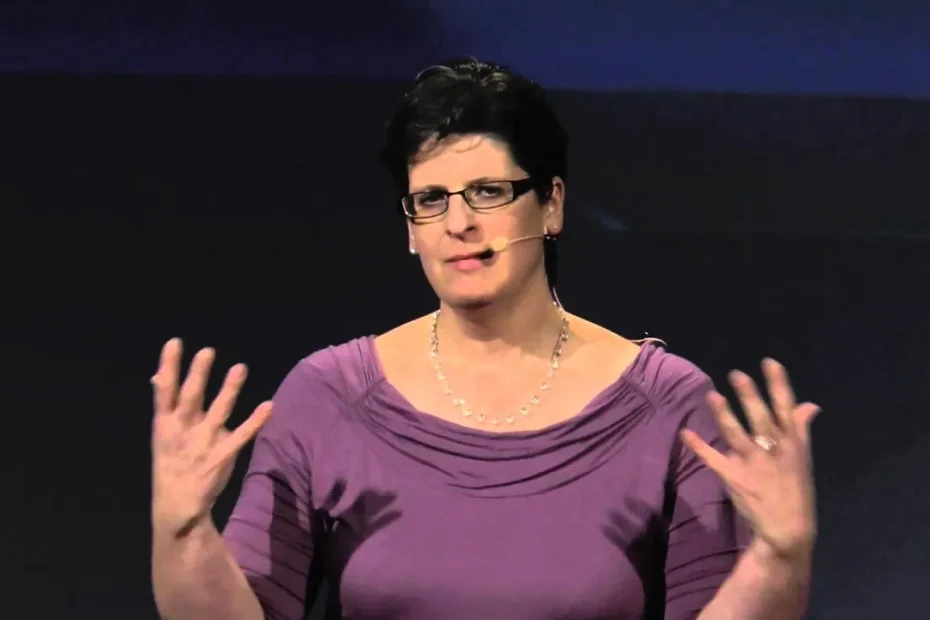
Read the full transcript of Heidi Hass Gable’s talk titled “Gifted, Creative And Highly Sensitive Children” at TEDxLangleyED 2015 conference.
Listen to the audio version here:
TRANSCRIPT:
HEIDI HASS GABLE: My name’s Heidi, as Maria let you know, and I am gifted. Not only was I a gifted child, I guess I’m still gifted because it is a lifelong kind of thing. It’s how my brain works. However, I’m not all that comfortable saying that, especially not to a group like this. It’s kind of embarrassing. I would rather deny it. I would rather apologize for it. I certainly don’t want to brag about it.
Why is that? The word is a very powerful word, and there’s a lot of connotations that go along with that. Things like that it’s arrogance, that I’m bragging that I think I’m better than somebody else is. I don’t feel that way, but the word brings with it some of those meanings.
There’s also a feeling of just even the choice of the word, a gift. I’m not sure it’s always a gift. Actually, I’m sure it’s not always a gift. However, it gives off this idea that I think I’m more special than somebody else. Everyone has a gift. Everyone has something to bring to the world. Yes. However, that doesn’t mean that everyone is gifted.
My Personal Journey with Giftedness
So, if I don’t like this word and I hate admitting it and I’m kind of embarrassed, why am I standing here and talking to you about it? Because about 16 years ago, I started a long-term, up-close, action research study called Parenting. Parenting three kids who are gifted, and they’re all gifted in different ways.
I’ve had to learn about this idea of gifted and what it is and what it isn’t in order to advocate for them and to understand myself and to understand them and to try and figure out how to be the parent that they need me to be. It has not been an easy journey, but I’ve learned some things.
Understanding Giftedness
Some of the things I’ve learned. Gifted is identified, gifted students are identified by their performance on a cognitive test usually. So, when students perform in, sometimes it’s the 97th or 98th percentile or above, they receive this little gifted label and the letter that goes along with it and they get an IEP and the parents get to come in and meet with the teachers twice a year.
There are, hopefully, some programs or opportunities or things for them to do that will support how their mind works and give them an opportunity to feel good about themselves. It doesn’t happen in all districts. Unfortunately, there are these connotations that gifted is this wonderful thing. Sometimes boards of education have made decisions to cut gifted programs because, you know, they’re going to be okay, so they’ll be a little bit bored, but they’ll be okay. Not so much what my experience has been.
What I’ve learned about gifted is that I think that intelligence piece is just one symptom or one dimension of what is really going on and it’s a bigger picture and it’s about intensity and it’s actually a physiological difference in the brain where your brain is more intense. You feel things more intensely. You want to learn.
The Five Areas of Over-Excitability
Dabrowski is a researcher who identified five areas of what he called over-excitability, those five areas.
One is intellectual, so it’s just a drive to learn things and understand things and to have questions about them.
Also, there is a psychomotor aspect, so that’s physical. I need to move and do things and, you know, sometimes I’m twitching or stretching something under my desk or, you know, those little red cheeses that were out there on the break. The wax from those, my middle one, all the other kids in class would collect it and he would sit behind his desk and create creatures out of this wax, the cheese wax, but he needed something to fiddle with.
There’s a creative aspect, so this huge, huge imagination and an ability to see how things are alike and make connections. When you get famous for that, we call you a creative genius. When you’re the class clown, you probably get in trouble for it and you’re called a behavior problem and sent to the principal’s office.
There’s also sensory intensity and that’s just that whole, you know, the seam on my shirt is going to drive me insane or everything is too loud, everybody please stop singing or the smells, just that whole being bombarded by it.
And also emotional. Emotional is one of the big ones, feeling deeply, deeply, deeply, deeply. It’s like you can’t handle the woes of the world. You have to turn the TV off sometimes because you just can’t take it.
Those are true all the way through life and all of them, if we start to look at them, you think about it and look, the gift that makes sense, that intellectual piece, but then there’s also kids that are identified as ADHD, there’s a crossover with that and there’s even with autism, there’s an aspect of that sensory that comes into there.
Adolescence and Anxiety
What I noticed when my kids turned into adolescents was I saw them become so anxious and start to really, didn’t want to go to school anymore, stomach aches, headaches, calling in the middle of the day, “I’m in the bathroom, I’m not going back to class, come get me, please, please, please come get me.”
It’s a very, very difficult thing as a parent to turn and have to deal with and what I heard from the school was, “You have to get them to school every day. You have to, otherwise you are enabling the anxiety and it’s going to get worse.” And that didn’t work for me and I’ll tell you why.
It wasn’t just a random, I’m being a helicopter parent or what’s the newest one, a snow plow parent.
I had been working with my kids deeply and for years around attachment and I knew from work, from talking with Gordon Neufeld, working with Gordon Neufeld trained psychologists, kids need the trust and the relationship and the sense of attachment in order to develop a healthy psychological maturity as an adult. They go together, period.
And what I knew was, I didn’t know what to do about the anxiety and not wanting to go to school, but I knew that I was going to break the bond and the trust that my kids had in me if I forced them to go. Remember, these are not four-year-olds that you can pick up, cuddle, carry in, drop off and leave. They’re adolescents, hundred pound kids. I was going to have to manhandle them to get them out of the house and into the school. That wasn’t okay with me and so I said no.
When Traditional Education Fails
And that was really, really hard because I really wanted to be a partner with the educators and with the school. What I noticed around the same time, my kids were in fantastic programs with caring, innovative educators who were doing cross-curriculum, project-based learning, bringing in university students and people to talk with the kids and to teach them things. Amazing projects. I was like, wow, I want to do those ones.
They were doing formative assessments. They weren’t doing letter grades. They were working with the kids to give them options on how they’re going to show their learning. All the right stuff was happening and it still wasn’t working for my kids. So there was something systemic there that just wasn’t going to work for them.
So when it came down to it and they said, “That’s it,” at different times my two eldest both said, “I can’t do it anymore.” And I let them stay home. And they stayed home for the better part of a year each.
The De-Schooling Process
We tried to do some online learning, tried to do some even just one-on-one, “Hey, let’s go down to the park, we’ll take some pictures and talk about ecosystems.” No. Why not? Because it’s school. So there was something in that where my kids just needed to de-school. And so that’s what we did.
I had no expectations for them around learning. I didn’t force them to do anything. They watched movies. They played Minecraft. They researched how to load mods. My son rebuilt his computer about three times. Learned how to load it from CD and add drivers and load all the software back on. That was his thing, my little one.
And after a year, you know, at the beginning he didn’t want to see anyone. He didn’t want to go out. He didn’t go to his friends’ houses. He didn’t want to go to grandparents’ house because people were going to ask him questions. He didn’t want to be out in the world. It was unhealthy and scary as heck for me as a parent because I go, okay, well where is this going to go to? But I needed to trust the process and keep…
Talking with him and working with him. And so, a year later, he’s back in school. He’s in a different kind of school where it’s entirely self-directed. Public school, but the adults are there in order to support learning and to provide lots of rich opportunities. But kids aren’t forced to do anything. The adults are in the room only to support and mentor and be a source of whatever kind of wisdom they need. The kids have to choose what they’re going to do.
And he loves it. And he’s back. My kid is back. He’s laughing. He’s doing things. He learned Magic: The Gathering by himself. Decided he wanted to join a group of probably about 19 to 25-year-olds, most of them guys. He went by himself and joined this group down in the mall. He plays Friday Night Magic. Absolutely adores it.
He started a group at school. They had to go through a democratic process in order to get a place to play it. He was willing to take those kind of risks. He’s at his grandparents’ house. He’s at his friend’s house. He’s on Skype. He’s interacting. He’s back.
Understanding the Real Issue
So when I look at it, I’m like, okay, well, what happened? And what it comes down to for me is that particularly with these intense kids, for so long you’ve had this message, “You’re too loud. You’re asking too many questions. You don’t fit in.” And even if nobody ever says that to you, you have a sense in it yourself that people are talking about different things than you’re talking about and that the assignments that the teacher is giving don’t make sense. And maybe there’s stuff happening in the personal life, whatever else that looks like. That child’s sense of self has been compromised.
When we look at anxiety, it’s different than existential crisis. Anxiety would have been he doesn’t want to go to school. We have to show him that it’s okay to go to school. There’s nothing to be afraid of. But for my child, there was something to be afraid of. He would have had to swallow so much of himself in order to fit in and do what he was told. He just couldn’t do it. Put it together with everything else that was going on in his life, he couldn’t do it.
We have these kids in all of our schools, in all of our communities. They’re dropping out, they’re not coming to school, they’re anxious, and we’re telling them, “Just come to school and it’ll be fine.” It’s not going to be fine unless we’re doing something different.
Putting Children Before Curriculum
And sometimes that’s going to have to mean that we put curriculum second, behind the kids. We have to give up the curriculum and that takes a level of trust that we will be there to coach them and that they will take the lead on learning.
The assumption that the best way for kids to learn is from an adult is not necessarily true. Kids do amazing stuff on their own when we give them opportunity and help them do that.
What if we focused on a social environment and a democratic environment where they all get to participate and they get to choose what they’re learning? It’s kind of scary, but it’s being done now in BC at my kid’s school.
We need to, I think in all schools, all districts, lift the opportunity for the kids who don’t fit to find their own path. I found it very difficult to find a school, an online school, anything, that allowed kids to create their own path. Not having to say, “You’re in grade 6, therefore you have to learn medieval societies and this in math and that in English.” Sometimes that doesn’t work for kids.
Measuring Success Differently
We need to use a positive self-concept as one of our measures of success. Not provincial exams. Those can be secondary. You need to have that as long as there’s options for not doing it. But we need to have this idea of what is a child’s self-concept and how do I identify when kids are falling away from that and cannot find who they are?
Because they need that in order to create brain integration and be able to psychologically mature and have healthy relationships and healthy boundaries and good jobs and meaningful roles within our society.
There are ways of doing it now. You can buy canned reports. There’s the Pierce-Harris Student Self-Concept Survey. Buy a whole bunch of them and do them with all your middle schoolers. Identify the kids that are falling down in those areas and even when we don’t know what to do, figure out what we need to stop doing.
That’s what I would like to ask from all of the districts and all the educators here because we heard from Kim. The relationship is great, but there’s some kids who need even one step further of the freedom to learn in the way that they want and be supported and to find out who they are.