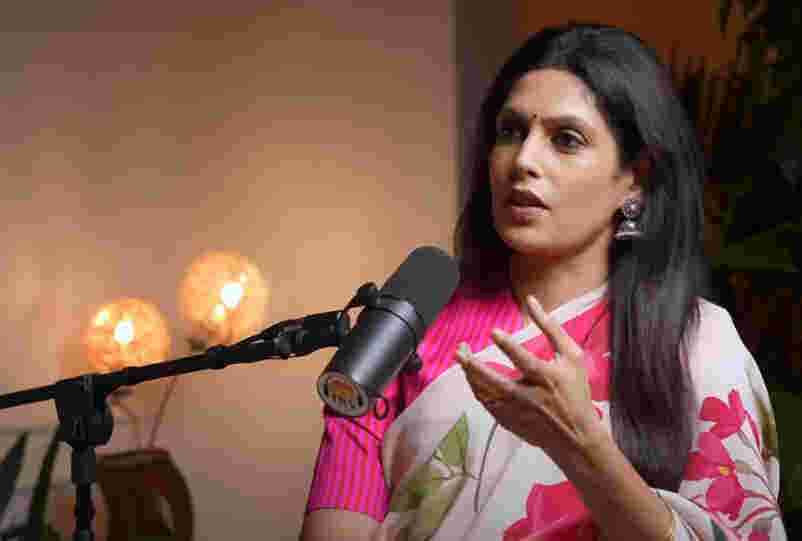
Read the full transcript of journalist Palki Sharma Upadhyay on the The Ranveer Show Podcast. (May 11, 2024)
Listen to the audio version here:
TRANSCRIPT:
Introduction and Initial Conversation
RANVEER ALLAHBADIA: Welcome to TRS once again, Palki Sharma.
PALKI SHARMA UPADHYAY: Thank you so much for having me here and lovely to see you.
RANVEER ALLAHBADIA: I’m so happy that I’m seeing you again because the last time you were here, I didn’t know you personally and as I told you in that room, our waiting room, that I was deeply intimidated but I had to put on a brave front to speak to the Palki Sharma. And I feel like over this last year, I’ve had some fun conversations with you. So now I know you’re a normal human.
PALKI SHARMA UPADHYAY: Intimidated is a word that you’ll have to explain now.
RANVEER ALLAHBADIA: Do you not think that your public image is a little intimidating?
PALKI SHARMA UPADHYAY: I’ve been told this a few times. I don’t know why though. And I think I’m a nice person. I’m not intimidating. Maybe I’m shy. I think that comes across as, I don’t know.
RANVEER ALLAHBADIA: My angle for you being intimidating was the depth of the knowledge you have. In terms of as a podcast, I got intimidated because of the possibility that I may not be able to do justice to the depth of your knowledge. That was the…
PALKI SHARMA UPADHYAY: I’ll try to take it as a compliment.
Personal Life and Public Perception
PALKI SHARMA UPADHYAY: I hope this one’s more like relaxing for you, this conversation.
RANVEER ALLAHBADIA: It already is because I feel the ice has broken over this last one year. But also, I think people assume that you are always thinking and speaking geopolitics because you’re the face of India from a geopolitical narrative perspective. And you don’t just become that face of India easily. But that’s not true, right? You’re not always…
PALKI SHARMA UPADHYAY: Of course, to borrow your term, I am a normal human being. I do other things.
RANVEER ALLAHBADIA: What do you do for fun?
PALKI SHARMA UPADHYAY: I read. Okay. I cook. I try to paint. It doesn’t come out so great, but I like it sometimes.
RANVEER ALLAHBADIA: Are you aware of the international fan following you have?
PALKI SHARMA UPADHYAY: I wouldn’t say fan following, but our viewership is quite good and I’m always grateful.
RANVEER ALLAHBADIA: You don’t look at it as a fan following?
PALKI SHARMA UPADHYAY: No, I think when you say the things that matter to people, they watch you. Fans, I don’t know, are… I think we have a discerning audience. When we make sense, they appreciate it. When we do not make sense to them or they disagree with our point, they question it. I think that’s a healthy relationship.
Praise and Recognition
RANVEER ALLAHBADIA: I’m going to say something that’s going to make you a little bit awkward, but it’s a very heartfelt sentence. I truly believe that you’re the top of the world of journalism in India. You’re so much at the top that you’re the face of it for people outside of India. But I think for you, you’re just doing your job.
PALKI SHARMA UPADHYAY: I’m just doing my job. Okay. Yeah. But thank you so much for saying that. Very kind of you.
RANVEER ALLAHBADIA: You don’t feel that what I said is true?
PALKI SHARMA UPADHYAY: I don’t know. How do you measure what is… Also, not many people are doing what I’m doing, I guess. That could explain the reach.
Yes, we have a wider global reach compared to some of our peers because not many people are doing international news in India.
RANVEER ALLAHBADIA: Fair. Also, the way you do it has this emotion of bravery and directness associated with it. That’s what a lot of social media users pick up on for sure, because a lot of clips get made because of your work. That’s what spreads out on social media. And I truly believe that social media is a massive part of modern day media careers. You have to crack that algorithm to reach that pinnacle of relevance, according to me. And that may be my own social media bias, because I’m a creator myself, but no other Indian journalist comes up as much as you on algorithms, or also in conversations with people like Balaji Srinivasan that I’ve had on the show, you know, or any of the geopolitical observers, the diplomats, everyone speaks about you. Kudos.
PALKI SHARMA UPADHYAY: Yes. Thank you. But I should say here that when we do our stories, when we pick our stories, when we write our stuff, we are not thinking algorithms. We are thinking stories. I wouldn’t even say content. We are thinking only stories.
Approach to International Journalism
PALKI SHARMA UPADHYAY: Yes, we are trying to bring a fresh perspective. And you mentioned about India, but I would say that. So for instance, Africa, Africa is a very big market for us, because we get a lot of response from Africa, because we’re looking at Africa from a completely different point of view. We’re not seeing it as an exotic land. First of all, we’re not seeing it as a country, it’s a continent, there are 54 countries, we tend to bunch it all together, and think of it as a monolith, it is not.
Every country has different ethnicities, different stories, different issues. And you know, in international press, it all sort of gets bundled as one problem riddled land. You know, you only look at coups and wars and floods and famines. But we try to do other things, we’re looking at how Netflix is, for instance, focusing on Africa, because there’s a young population that is going to be the next big workforce, that is going to be the next big market. So I think that is what is connecting us to a lot of people. Because we are looking at the other side, I mean, every story has many, many, you know, facets.
Views on War, Borders, and Conflict
RANVEER ALLAHBADIA: The thing is, I’m talking to a senior journalist here.
PALKI SHARMA UPADHYAY: I think borders give our world a structure, you can’t have a borderless world. If you’re going to, if you’re going to administer, forget countries, I’m saying within countries you have states, within states, you have districts, within districts, you have villages, and they’re all marked by borders. The rules are different. But for the ease of administration, you need structures in place, so that you can assign duties to specific individuals who can take care of their role.
Wars happen because of political ambitions of people who are in power, or when one side thinks that they’ve been wronged, and they fight back. Wars happen because of many reasons. I’m not, I’m not sure borders, per se, trigger wars. I think, for instance, in the case of our northern neighbors, China, their refusal to accept borders, their refusal to even respect what the other side is bringing to the table, is what is leading to a clash or a conflict, right? So I think borders, we’ve made the borders, but we have to respect them, and in life also, not just in journalistics.
Impact of Books on Worldview
RANVEER ALLAHBADIA: Maybe it’s a bit of an artsy opinion that I had, and I felt like reading Sapiens changed my viewpoint on the world, because in truth, from a very human lens, we’re still hunter-gatherers in our head. And like, have you read Sapiens?
PALKI SHARMA UPADHYAY: I’ve read Sapiens.
RANVEER ALLAHBADIA: Did it have any effect on you?
PALKI SHARMA UPADHYAY: It’s a good book.
RANVEER ALLAHBADIA: Did it change how you look at journalism at all? You can say no.
PALKI SHARMA UPADHYAY: I read very long back, I’m not sure. And I read so much. I think everything that I read informs my opinion and shapes my perspective. I’m not sure I would be able to pinpoint what Sapiens did for me.
RANVEER ALLAHBADIA: For me, it was a book that really shifted how I looked at the world, because my job is to talk to a lot of people. And they say that if you want to talk to a lot of people, you truly only have to speak to one person on a very deep level. And then that message can be broadcasted. It’s a trick for public speaking as well, which is why personally for me, Sapiens was very important. The question I have for you is, what are those like three or four books that you’ve read in your life that actually shifted the direction of the railway tracks in terms of how you look at the world or how you look at your own job or life?
PALKI SHARMA UPADHYAY: It’s very hard for somebody who’s reading all the time. And I’ve been reading for as long as I can remember to say, pick three or four books.
RANVEER ALLAHBADIA: That’s why the right person to answer.
PALKI SHARMA UPADHYAY: I think one of the books that has profoundly impacted my understanding of life is the Mahabharata. It’s magical. It has so many, it has a very complex plot. And there are stories within stories and there are characters with many layers and there’s no perfect right or wrong. There’s so much going on there. And every time you go back to reading a part of it or a story from it, you take out a little more from that story. So that is one.
RANVEER ALLAHBADIA: Is there a version of it that you’d recommend to people, especially international viewers who’ve not heard of it?
PALKI SHARMA UPADHYAY: They should read the Mahabharata. We read Shakespeare.
RANVEER ALLAHBADIA: By the Mahabharata, do you have a book in mind?
PALKI SHARMA UPADHYAY: No. Sorry.
RANVEER ALLAHBADIA: Okay. I’d recommend the Amar Chitra Katha comic books to get the story and then to get the essence, Amiga Nathra’s book on the Mahabharata. But moving on. Next.
PALKI SHARMA UPADHYAY: Okay. One of my, I don’t know, one of the authors that I read, so I’ll tell you about my reading phases.
RANVEER ALLAHBADIA: Sure, sure. Go for it.
PALKI SHARMA UPADHYAY: In middle school, I was reading a lot of classical literature, Thomas Hardy, Jane Austen. The Hardy boys and stuff that you grow up reading. Then there was a time when I was reading a lot of Ayn Rand and I thought it was groundbreaking, some of that stuff on capitalism and Atlas Shrugged and The Fountainhead, fantastic books.
Then I started reading nonfiction and I was, when I started, I felt that the world is so big that I pick up one thread and I lose another and I’m, because I’m not, you know, in school I did not study history or in college. But as I delved into books, I realized that I’m really enjoying what is it that is driving our world and how people are taking lessons from history. And so I started reading, say, about Europe or about West Asia or, you know, all sorts of books on geopolitics and history.
There was a phase when I read a lot of Murakami, who remains one of my favorite writers as well. Um, yeah, Gone with the Wind, I thought was, I mean, I read it so long, so long ago. So, so the thing is that I’m now reading with my children and I’m discovering things that I may not have noticed then, like we just read The Hitchhiker’s Guide to the Galaxy and it was good fun, you know, all three of us reading together. So I’m not sure I can pick one book or four books that may have changed my perspective on anything. But I think everything that I’ve read has gone into shaping my worldview.
RANVEER ALLAHBADIA: Creating the Palki Sharma.
PALKI SHARMA UPADHYAY: You make it sound like it’s something.
RANVEER ALLAHBADIA: It is something, ma’am. Like the thing is that you are making me awkward. You said sorry, sorry about that, but I got to do it today. Okay. It’s very rare to see you in the guest seat, right? How do you feel sitting in the guest seat?
PALKI SHARMA UPADHYAY: I feel like I’ve been trapped this time, but well done.
RANVEER ALLAHBADIA: Yeah. Okay. I’m liking this a lot more than our last conversation already.
PALKI SHARMA UPADHYAY: I’m glad. The vibe is different.
What Drives the World
RANVEER ALLAHBADIA: Yeah. You said something interesting while you were talking about the books. You said that you understood what really drives our world forward, right? You said something along those lines just now. What really drives our world forward? Is it the human need for growth? Is it human ego? Is it the need for power and money? Or is it something else?
PALKI SHARMA UPADHYAY: I would like to believe it’s the pursuit of power and happiness. That we chase either power or happiness or what we think is going to make us happy. Some people think that it’s money. Some people think that it’s land. Some people think that it’s more power. Some of us are just happy having a two-bedroom flat and a basic car, and some of us want a lot more than that. And that is what drives the world, ambition, desire. Sometimes it makes us do things which are not right, but I guess most people are law-abiding and that is what keeps the balance in our world. So I would like to have a more positive opinion on this.
Current Geopolitical Situation
RANVEER ALLAHBADIA: Do you have a positive opinion on where the geopolitical situation of the world is currently?
PALKI SHARMA UPADHYAY: So we have wars, obviously. We have two big wars happening and more than 30 other conflicts that nobody talks about because I mean there are 8 million people displaced in Sudan. Nobody’s baby, so no one is bothered. There’s a lot of billions of dollars of aid for Israel and Ukraine. I guess that’s also politics. So yes, but we are clearly in a phase where it is a multipolar world. It is not just the US. It is not just Russia. It’s not just China. And I think more and more countries have figured out that they can stand up for themselves and they don’t necessarily have to do what the big powers are telling them to. That is one thing.
The second thing and that’s a very interesting concept that I read about power that, you know, back in the day, two kingdoms were at war or two nation-states were at war. So the power rested with the state or the ruler. But in this information age, what we’ve seen is power diffusion. So power rests with non-state actors as well. It could be a terrorist group. They too wield power. It could be an NGO. It could be a civil society movement. It could be a tech company, absolutely. So a state may be working with you, but an NGO may be attacking you and your legitimacy, you know, by coming up with ratings, press freedom, religious freedom, so on and so forth.
The Role of Soft Power in International Relations
PALKI SHARMA UPADHYAY: So I think increasingly governments, we spend a lot on our military, but we are not looking at these other forces of power that are at play and that are also shaping how the world looks at us and how we look at ourselves.
RANVEER ALLAHBADIA: Versus America or China, which actually focus on these factors?
PALKI SHARMA UPADHYAY: I’m not sure China has been able to do it very successfully. They’ve spent a lot of money, yes, with, you know, you could say it’s soft power. So China’s soft power is not so great because no one believes what they’re saying. They spent a lot of money on Confucius Institutes and, you know, it didn’t sort of work out the way they thought it would. The US has done way better because the world is still thinking of that as the ideal way of life, you know, their value system, their society is still, it is not ideal, but it’s seen as such. So, yeah, so they’ve been able to successfully wield soft power.
But if you look at their expenditure again on military versus all of this, it’s a fraction. India has done quite okay, you know, we’ve promoted yoga and Ayurveda and so on. But if you look at the larger scheme of things, we are way behind. And it’s very important to talk about this now because these non-state players are basically attacking your legitimacy.
And I don’t know if you’ve read Joseph Nye, who’s written about soft power a lot. He says, legitimacy is a power reality in our world.
RANVEER ALLAHBADIA: You know, let’s break that down a little bit. This is the first time I’m hearing a geopolitical themed podcast guest saying that, always conversations about hard power. Yeah. And I’m yet to be convinced that soft power plays that significant a role, though some would argue that media is a part of soft power.
PALKI SHARMA UPADHYAY: Absolutely. So, okay. So, I’ll take it from where I left, about legitimacy, right? When someone is questioning your legitimacy as a democracy, when they’re questioning whether now you won the election, but even that win is being questioned. They’re saying that your voters did not make an informed choice. So that is taking away from your, for want of a better word again, legitimacy. How are you going to secure it?
RANVEER ALLAHBADIA: I think the word you’re looking for is what.
PALKI SHARMA UPADHYAY: What’s that?
RANVEER ALLAHBADIA: It’s a Hindi word, which basically means street cred.
PALKI SHARMA UPADHYAY: Oh, right. Yeah. Okay. I didn’t know this. So I’ve learned something too.
Media’s Role in Soft Power
PALKI SHARMA UPADHYAY: So, no. So the point is that, that you have to build resources to secure it. And it comes at a cost. And we in India, I think, are not ready to bear that cost. And you mentioned media. Media is very much a part of it. You know, every year they come up with this press freedom index, we are 189 or somewhere. What about our press presence index? Where are we in the global space?
We’re not there. And we are, it’s not for want of talent or resources. We are a very talented country. We have resources. I think what we lack is vision. And in principle, everyone agrees with the idea of having a global media presence. But you know, the joke is that, I’ll switch to Hindi for this. Budget is Jaljeera and dream is Aljazeera. So it’s not possible.
RANVEER ALLAHBADIA: Wow. So yeah, that’s where we’re at. Layered journalism joke. But nice. Press presence index. It means how widespread are your news portals. The news portals that come out of India on a global scale. Just Palki Sharma right now.
PALKI SHARMA UPADHYAY: I wouldn’t say that. But I think we are nowhere in the picture compared to the rest of the world.
RANVEER ALLAHBADIA: Could you give an example other than Aljazeera, BBC?
PALKI SHARMA UPADHYAY: BBC, RT, CNN, France 24, Channel News Asia, some big players, some not so big players, but they’re there. And I’m only talking about, sorry, video. Washington Post writes anything, we’re looking at it. New York Times writes anything, we’re looking at it.
RANVEER ALLAHBADIA: Why aren’t those citizens looking at our stuff?
PALKI SHARMA UPADHYAY: Because we are not doing it in that way.
RANVEER ALLAHBADIA: You’re saying that the flaw is that we don’t have a vision with what we’re doing in the long term.
PALKI SHARMA UPADHYAY: Yeah.
RANVEER ALLAHBADIA: What’s the vision you have?
PALKI SHARMA UPADHYAY: I think we have to build a credible and impactful global media presence. We have to build that voice. You said that you think that military power is important. Let me give you an example from recent history. So in 2008, Russia invaded or attacked Georgia, took away two provinces, and declared that they are independent states now. The world did not recognize them. And Russia kept saying that we’ve done the same that the West did with Kosovo, which also did not have UN backing, but that was seen as a legitimate move.
When Russia goes into Ukraine, it is called the Russian invasion. When the U.S. goes into Iraq, it is called a global war on terrorism. How does that work? Because the American media has worked over time to tell the world that this is for the global good. Right? That is what soft power, that is what media presence gives the country. If you don’t have it, your intentions will be questioned and your reach will always be limited. And let me add here, when we talk about wars, you know, in today’s information age, battlefields are not actually fields anymore. They’re here in the mind. Right?
There’s a battle of ideas. Donald Trump said famously, I think it was him or someone else who said that, and he said this for the U.S., which is doing so much already, that in the global battle of ideas, we are sitting on the sidelines. I think that’s also true for India.
RANVEER ALLAHBADIA: Media narratives shape up human viewpoints. That is a conclusive statement for what you said. Media narratives play a role in how we perceive the world. But the truth is what’s happening in the ground and what’s happening in each individual human’s head. And there’s no way you’ll be able to find out the second. You’ll never know exactly what’s happening in every single human’s head in the world.
PALKI SHARMA UPADHYAY: You don’t have to know.
RANVEER ALLAHBADIA: Isn’t that what soft power?
PALKI SHARMA UPADHYAY: No. Soft power is attraction. Hard power is might. You know, so your economy, even your technology, military, you can use it as a coercive force. But you don’t have to force anyone to watch Hollywood movies or Bollywood movies for that matter. That is your pull. That is your attraction.
RANVEER ALLAHBADIA: How sexy you are, soft power, as a country.
PALKI SHARMA UPADHYAY: I wouldn’t use the word, but yeah.
RANVEER ALLAHBADIA: How sexy is your country on a global scale and your culture? Like Korea, South Korea.
PALKI SHARMA UPADHYAY: Yeah, K-pop. They’ve spent so much money on K-pop.
RANVEER ALLAHBADIA: Is South Korea a good example of a country where soft power significantly outweighs hard power?
PALKI SHARMA UPADHYAY: I don’t know about… You don’t have to… It has to be… So I’ll tell you one more thing. Soft power plus hard power is said to be smart power. And country should aim for smart power. You can’t have one without the other. So you have to have a mix of that. That is one.
And second, Bollywood is our soft power. But are you being able to convert that power into some favorable outcome?
RANVEER ALLAHBADIA: Better perception of India in an international viewer’s head.
PALKI SHARMA UPADHYAY: Yeah. So Bollywood is presenting us as a fun-loving, singing, dancing society. But what is the conversion? So Hollywood is making endless movies about the Iraq war or the Afghanistan war and showing how their troops are so courageous and how when aliens attack the world, then it’s the American forces that go and fight them. They’re building a narrative, constantly building a narrative.
Are we being able to build a narrative? And I’m not saying narrative has to be lies. It has to be rooted in some truth. Obviously, people will not buy lies. But it has to shape the world’s opinion of you and your opinion of yourself. Both are equally important.
RANVEER ALLAHBADIA: Because of what? Why should it shape? Why should the world have a good opinion of you? What does it lead to?
PALKI SHARMA UPADHYAY: It leads to a lot of things. So if you say that India is a country which is not safe, too much red tapism, very hard to do business. How will an investor look at India?
RANVEER ALLAHBADIA: Because big decisions are made by human beings at the end of the day.
PALKI SHARMA UPADHYAY: And who have a perception and perception matters.
RANVEER ALLAHBADIA: Gotcha.
PALKI SHARMA UPADHYAY: So where you are actually wrong, you should fix that problem. But where your perception is based in someone else’s prejudice or a situation that is not true anymore. Maybe back in the day, India had snake charmers. But we are not a land of snake charmers. We are a land of coders now. Yesterday, we did a report on how Indian companies have the highest AI adoption rate. This is the new India. So the world should see it as it is.
The Future of Media and Content Creation
RANVEER ALLAHBADIA: I sense that changing. Or maybe that’s just an optimistic viewpoint. Again, this could totally be a bias. And please correct me if you disagree. I truly believe that individual content creators, and I count you one on many levels as well. Because you crack the social media algorithms, are going to become the new media companies. And it’s not a belief that I hold alone. A lot of the people I end up meeting at business conferences are also believers.
In fact, that thought entered my head through my interactions with the world. Now, as my career moves forward, as long as I stay out of trouble, I think I have more influence. So my voice has a larger stage. So what I truly want to tell the world as a human being is coming out. I’d argue that maybe you’re also doing the same. Because your fame levels on an international scale are also increasing very steadily and very quickly, according to me. So you’re getting a larger stage. You’re reaching out to more international consumers. You’re actually leading the charge from the front. All this that we spoke about. You’re changing the perception of India. This is becoming a Palki Sharma celebration podcast.
PALKI SHARMA UPADHYAY: Fantastic. I’m liking it. You’ve touched on so many things. Individuals obviously matter. Individuals are central to what we do. In storytelling, in content creation, whatever you call it. It’s about people. From people to people.
And I might forget, there are two parts to this. Why individuals matter. Let me first address that. Someone spoke about the paradox of plenty. There’s an explosion of content in our world today. There is so much going around. So when information or content is plentiful, what becomes scarce is attention. People are overwhelmed with what they see. So they don’t know what to focus on. So they will turn to cue givers. People who give them a cue. It could be editors. It could be influencers. It could be thought leaders who are basically telling them this is important. Focus on this and the rest is clutter or background noise. And these are people who build credibility.
So if you have credibility, people will come to you to listen to your point of view and to focus on things that you say are important. That is why individuals have that attraction. Right. That is one part.
The second part, will they be media companies? How can individuals scale it? Individuals with a vision and with potential should ideally create institutions that outlast them. That imbibe their ethos, their ideas, their vision. And that is translated into their teams. So ideally, we should have 10 more of you. And many more people doing what I’m doing. Because we are not here forever. And that is what all of us should aim for.
RANVEER ALLAHBADIA: In my content creation journey, I’ve known this and I’ve tried doing this. But it doesn’t work as effectively as one face and one voice. And one, for lack of a better word, icon putting out his or her opinions. In the modern day, I feel people listen a lot more to human beings because of a trust factor than institutions. And I say this while I agree with you. That something should outlast.
PALKI SHARMA UPADHYAY: I think when we have different people, we’ll all find our tribe. Right. I have a lot of very, very bright colleagues who are doing their own thing. And I’ve spent many years doing what I’m doing. So I found an audience that connects with me. And I’m of a very firm belief. And when we look at numbers and sometimes they’re not as good and sometimes they are good. You have to look at the big picture. And you have to keep doing the thing that you believe in.
What you’re doing today, had you done it, say, in 2010. I don’t know if you would have found takers. This is an idea whose time has come now. And it has clicked. And this idea will not always be relevant. People evolve. Content evolves. So I think it’s important to create institutions. It may not appear successful now. But someone has to be at it for a product to be ready, say, five years down the line.
RANVEER ALLAHBADIA: When do your ratings fall? I can’t visualize that reality.
PALKI SHARMA UPADHYAY: When we talk about women’s issues.
RANVEER ALLAHBADIA: Really?
PALKI SHARMA UPADHYAY: Yes. And they fall all the time. And it’s one of my pet peeves. I mean, it distresses me no end.
RANVEER ALLAHBADIA: Because men mostly follow geopolitics. Is that the reason?
PALKI SHARMA UPADHYAY: Not just geopolitics. And that is, again, the sad part. And through your very wide audience, I want to ask a question to everyone who’s watching us. Please help me understand.
Gender Disparity in News Consumption
PALKI SHARMA UPADHYAY: What are women watching? Typically, and this is not limited to India, somewhere in the range of 80% of the news audience is male.
RANVEER ALLAHBADIA: What?
PALKI SHARMA UPADHYAY: Yes. And that is unfortunate. So we are trying to do stories. And we are constantly debating. So we are trying to do pay parity. We are talking about abortion. Not because, you know, we started off because I feel very strongly about these things. And I think they should be done. But then I also ask myself that, wouldn’t women be interested in investment and wars and politics and elections? Because it impacts their lives too. Would they only be interested in stories about domestic violence and pay parity and so on? Ideally, they should be interested in. So, yeah, that’s a problem.
So the men don’t like it. And the women, I’m not sure they’re watching it. But we are doing the stories because we think we should do the stories. So yesterday, after a lot of debate, again, we did something on how Nepal is prioritizing mental health of new mothers. Nobody likes stories like this. Viewership drops. We can see it in the live. But we do it because we do it.
RANVEER ALLAHBADIA: One for the dinner table. One for the soul.
PALKI SHARMA UPADHYAY: One for the soul. Yeah. Yeah.
RANVEER ALLAHBADIA: What do women watch?
PALKI SHARMA UPADHYAY: I don’t know. I wish I knew.
RANVEER ALLAHBADIA: As a female human, what do you think? And why is it happening this way?
PALKI SHARMA UPADHYAY: So I’ve met a lot of in my interactions. But, you know, you should not universalize your experience. Maybe they say this to me because they’re talking to me. But they say that they’ve watched stories. I meet a lot of women, including students in colleges, professionals, on the flight today, you know, who say we watch you. It’s very inspiring and so on and so forth. And I don’t usually have enough time to. And I don’t want to sort of surprise them by asking them questions about what specifically did you watch and what did you like and why didn’t you watch this? But I’m very curious and I would want to know.
And I think and it’s important for the women also, because if you are an active audience, then the business takes you seriously. And then you get your voice gets represented.
RANVEER ALLAHBADIA: So actively make an effort to follow the news.
PALKI SHARMA UPADHYAY: Ideally, everyone should watch the news because it affects your life and it is telling you what’s happening in your world. Maybe we are not doing it in a convincing way. So we are trying to reinvent our approach all the time to see where we find the right mix.
Palki Sharma’s Impact and Oxford Experience
RANVEER ALLAHBADIA: Let’s do the whole Palki Sharma celebration thing again. In my eyes and based on what I hear around me, a lot of the people who watch you watch you for your directness. You’re very direct. You’re very upfront. That’s one of your identities in the world, including the famous speech and all that happened recently. My first thought when I was watching that speech was all these other white people in the room. Did they come up and diss you after? Like what happened once the cameras went off?
PALKI SHARMA UPADHYAY: Before and after.
RANVEER ALLAHBADIA: On your face?
PALKI SHARMA UPADHYAY: So, okay, first of all, let me say that this speech is from last year, last summer. And I have been into public speaking for a very long time. I have been on the stage. I’ve been a journalist. I’ve been an anchor. I can do it. But on that day at Oxford University, I felt pressure and tension.
RANVEER ALLAHBADIA: First time in your career?
PALKI SHARMA UPADHYAY: I wouldn’t say the first time because you’ve been in typical situations, but it should not have been a tense moment. It was a debate in a college campus.
RANVEER ALLAHBADIA: The vibe was bad.
PALKI SHARMA UPADHYAY: It was borderline hostile. And it was not a nice feeling because I felt that. That the audience had very strong preconceived notions about India. And when people against the motion exaggerated India’s problems or made completely baseless remarks, you know, some of them actually said that I’m speaking here. You should listen to all the speeches. I’m speaking here at a risk. And my family is worried that when I land in India, I will be arrested for saying what I’m saying. It’s been a year. Who’s been arrested?
And when they said these things, there were claps and cheers. And then here I am giving data and facts on India’s progress. And there is pin drop silence. And the most disheartening part of it was that. That the people maligning India are your fellow Indians. Who are standing. You don’t have to agree with everything that’s happening in your country. You know, within a family, you have disputes, you debate, you disagree. But are you going to go to a foreign university? And some of these people are members of parliament. They are associated with political parties. It’s quite sad, you know.
And I figured that day that by the way, we lost the debate. But if you have to one — if you have to win a debate there in such a setting or if you have to find. People who will cheer you, you will have to take an anti-India line. You will have to say bad things about your country.
RANVEER ALLAHBADIA: If anyone is extremely pro-Modi or extremely anti-Modi. I always look at that situation with a bit of social media algorithms at play.
PALKI SHARMA UPADHYAY: Yeah. And you know, in settings like these, you’re basically told that if you’re not saying something anti. I wouldn’t even say Modi, your country. Then you’re not a true journalist. To be a true journalist, you have to diss India. How does that work?
RANVEER ALLAHBADIA: Because as of now. The Western bloc is the most powerful from a soft power perspective. What we spoke about a little earlier.
PALKI SHARMA UPADHYAY: They are. They control the narrative. Yes.
RANVEER ALLAHBADIA: I mean, I’ve wondered the same thing. The whole Veer Das speech was controversial. And for some reason, I’m also a poster boy of being very, very pro-BJP and pro-Modi. My angle on human beings and this is after doing 700 podcasts. Is that if you have very, very strong opinions about something. Then are you even ready for a conversation? And my other angle is that no matter what your opinions are, no matter how anti-BJP or anti-Modi you are. Don’t diss India on a global stage. It’s the equivalent of scoring an own goal in football or like a purpose misfield in cricket, which shouldn’t happen. I think that’s a national duty. That’s how I look at my role as an Indian on a world stage.
PALKI SHARMA UPADHYAY: I mean, see, yeah, you could argue that it was a debate at the end of the day and they had to present their side. But there’s a way to do it. And I would say that every Indian outside of India is India’s grand ambassador. Yeah. Right. So you can’t. You can’t make baseless claims.
RANVEER ALLAHBADIA: You are negatively affecting the soft power of your own motherland when you diss India on a global stage. At least — at least talk about it in a more nuanced manner than blindly saying, oh, I’m going to get arrested for what I’m saying.
PALKI SHARMA UPADHYAY: I think it stems from something else also. It stems from the fact that for whatever you do, and this is again the battlefield here and the independence that we got in 1947 versus the independence that some of our fellow citizens are still seeking mentally from colonial powers. You know, you still need validation for your systems from the West. You still need them to say that, yes, this is right and this is wrong. This is a perfect democracy. This is not a perfect democracy. This is freedom of speech and this is not freedom of speech.
I’ve been saying this for many days now on American campuses, on European campuses, there have been protests. You should look at the pictures. Have you seen the pictures? These are cops in full military riot gear, cracking down on students who’ve set up tents. In Europe, they actually had a bulldozer like a bulldozer trying to break up a protest. Had this happened in Delhi or Dhaka, there would have been endless lectures on how these governments are draconian. They’re not respecting poor students’ freedom of speech.
But when it happens in Europe, and I’m not supporting the protesters. I mean, they have to know where the limits are. But that is true for all protesters everywhere. You can protest only within what your law permits. When you block highways in India, then it’s supposed to be a protest for a righteous cause. But when you block highways in Canada, police will come and beat you up. And that should be okay because you are affecting law and order. How do these double standards work? Because the West is telling us what is right and what is wrong. And some people here believe that that is the way it should be. That is what I’m challenging.
Palki Sharma’s Experience in Israel
RANVEER ALLAHBADIA: I have to ask you about your experience in Israel from a very human perspective. Because I remember when we were trying to schedule this particular episode, we got to know that you’re in Israel. And my first thought was, wow, that’s insanely brave. Can you take us through your human perspective from the time you got there till the time you left? Everything you saw, step by step.
PALKI SHARMA UPADHYAY: So I’ll start from when the attack happened. It was a Saturday. And I remember distinctly, we just had lunch. And I settled with my book. And then, you know, what we do every time we start something, we look at our phone. And I saw it was trending. And then I saw the videos. And I thought they’re fake because how is this even possible?
Then I called office and I was told that, yes, something like this has happened. So I said, let’s call the team. We should track it and we should do Vantage tonight. And you know, the thing about being in a newsroom when news is developing is that it’s a very different atmosphere. Because information is pouring in from all sides. And people are typing and saying something. And you’re constantly updated no matter what you’re doing. And it’s a very charged environment. And the more we learn, the more disbelief I remember feeling that how is it possible? Because Israel is a country I’ve been to in the past and I’ve seen a much happier side of Israel.
And so around four o’clock, I think I called the embassy. And I said that, how can I get there? And they said, we are still figuring it out. But by evening, to their credit, I heard from them that we are opening in the morning, Sunday morning, to give visas to those who want to go. And when we landed there at 8 a.m. on Sunday, we saw so many people from the Indian press. And the same evening, we were on a flight. And I remember talking to my children and my daughter was very upset. And my son, before saying bye to me, he said, are you going to get bombed? So I said, no. So he said, are you 100 percent sure? I said, yes. He said, then go have fun. But I think that’s his way of trying to not sound too serious, but also tell me that.
But yeah, anyway, so we land there. And that’s the thing I noticed on the flight, that while everyone else is leaving the country, and I’ve seen it in more than one war. There are two sets of people who enter a country, journalists and soldiers. Everyone else is leaving. The difference is that soldiers are trained and equipped and we are just chasing stories. And at the airport, we heard the first siren. The Ben Gurion airport had come under, they faced some sort of fire and we all were made to run into a shelter. And that’s a very, very hard entry into a war zone. And there were three of us and it was quite shocking, obviously.
RANVEER ALLAHBADIA: Was there any fear inside you when you were on your way there?
PALKI SHARMA UPADHYAY: No. No.
RANVEER ALLAHBADIA: You were just sure of doing your job?
PALKI SHARMA UPADHYAY: Yeah, I was very sure that I have to go and do this. And I think more than that, I was very sure in Israel’s ability to make sure that this will end quickly. I don’t know. Maybe because I have a lot of friends there. That’s the side of Israel that I’ve seen. It hasn’t turned out that way. And it’s become very, very chaotic and unfortunate now. But I remember, like, we’re having breakfast in the morning and then you hear a thud and something has fallen. And you’re trying to go into the areas where the attacks happened and the Hamas guys came in. Through a friend, we were trying to meet somebody whose sister was taken hostage. And they said, you can come, we’ll talk to you.
Experiences in Israel During Conflict
PALKI SHARMA UPADHYAY: And while we’re on our way, they call us and say, no, actually, we’re not in a position to talk. Because it’s a tough, you know, it just happened like a day before. So you saw a lot of raw human emotion. And at that time, you’re not really processing.
I remember one of the shows we did was from a part of Jerusalem, which has more Arabs. And you would see a lot of if you see the international frames, you’ll see the Al-Aqsa Mosque in the background. And it’s a very nice TV friendly frame. But that area is a little tense. And we saw a lot of young men who were offering their prayers and then standing and listening to what is being said.
RANVEER ALLAHBADIA: By you?
PALKI SHARMA UPADHYAY: By everyone. And we had a much smaller crew, obviously, just me and two other people. And we I think it was there or somewhere. We did a story on how Hamas should be declared a terrorist group and so on. And and it was our driver got very worked up. And they said that you have to wrap and leave because you don’t know. It was very volatile. And at that point, you’re just thinking from one story to the next and getting your show done.
And then there was a day when, you know, you had this alert system where you knew when missiles are falling and it went red. And people said that the Hezbollah has entered. It was it turned out to be a false alert and there was some some glitch in the alarm system. But when it happened and then the flight started getting canceled. So even the people I knew in Israel said that take the first flight out. Go. If the Hezbollah enters, then it’s going to be a very long drawn war. We don’t know what’s going to happen. The last time it happened in 2006, we were all basically we spent a couple of months underground and don’t stay here. And it was very — so you are managing your family that is also trying to be supportive, but also worried.
You are trying to deliver your best. It’s very easy for people who sit here and say, what did you do? Indian journalists when they just stood in one place, did a PTC, did a show. This is not journalism. Look at what we have in terms of resources compared to what again, the Western press had. And look at what we’ve been able to deliver. And I’ve seen I will not name names, but there are reporters from India who were sent there who did not have money for a cab. And they were hitchhiking with some milk delivery van just to go to a place.
Why is that guy doing it? Because he’s passionate about the story. So no combat training or training for reporting in a conflict zone, not completely inappropriate gear. Just for the love of what you do. So I think we should cut some slack to a lot of and I’m not counting myself there because I’m much better supported by my organization. But there are a lot of people who were just out on the out on a limb trying to cover a war because they want to cover a war. That’s my takeaway from and it just, you know, when a week later when you’re sitting in your office and typing something and somebody drops something in on the same floor, it unsettles you. Because you forget that you are in Delhi and not in Tel Aviv.
RANVEER ALLAHBADIA: What does a bomb feel like when it bursts near you?
PALKI SHARMA UPADHYAY: I’ve not seen an explosion, but I’ve seen missiles. You know, their systems are very strong. But you know, you’re — one moment you’re doing a PTC and then there’s a siren and you’re told to run. And everyone, I forget the name of the village where we were, but when the siren went off, we tried to sit under a pomegranate tree. And the people inside the house started calling saying come inside. They did not know us. And everyone has like a shelter. So it’s a different world, you know, where you’re always telling your children that you may have to spend the night in the shelter. It’s not easy. It’s a tough existence.
RANVEER ALLAHBADIA: What do you learn about human beings after being in a war-torn land?
PALKI SHARMA UPADHYAY: You need a lot of grit to survive and we take our lives for granted. And I’m not saying this for the current Israeli leadership that is making some decisions just for the purpose of staying on in power. I’m speaking about the people I know, the people I’ve interacted with over the years. They’re very, very strong. And they have survived despite everything. I mean, this is a country that no one gave a chance. 30 years back, their biggest export was oranges. Now they are the startup capital of the world. They’re doing so much. They have so much enterprise. You can learn a lot from what they’ve been able to accomplish.
Navigating Sensitive Topics in Journalism
RANVEER ALLAHBADIA: You know, just speaking about Israel is such a polarizing thing. No matter what you say, one side of the audiences is going to get pissed off. People have very strong opinions on this Israel-Palestine thing. Do you have to calculate your words when delivering them on a podcast?
PALKI SHARMA UPADHYAY: I just did. I said I’m not speaking for the leadership. I’m speaking for the people. Because you cannot overlook the fact that on the other side, and I have, by the way, lived, I have spent time in Ramallah as well. I’ve seen that side as well. People per se are not a problem. It is the leaders who have certain expectations and who use people as cannon fodder. Right? The people of Gaza are suffering; more than 30,000 civilian deaths is a very big number. There is bound to be anger and there is bound to be a pushback. These are human lives we’re talking about. And it is very unfortunate. It should not have gone on like this.
And the world has no strategy. What are the Americans doing? Until recently, they were dropping aid packets on Gaza and giving weapons to the Israelis. You fire these weapons and these guys will run and then we’ll give them aid. It makes no sense. Right?
RANVEER ALLAHBADIA: Geopolitical strategy along with great PR.
PALKI SHARMA UPADHYAY: I don’t think the PR is working.
I think it’s because of the election. Because in the US, for Joe Biden’s party, the Muslim American voters are very, very big. And the liberal youth, they are big supporters of Biden. And that number is shrinking because of the support to Israel in the Gaza war. So there’s a lot of political calculations at play.
PALKI SHARMA UPADHYAY: But I’m saying that it’s not a black and white equation. It’s not possible to say that this side is right or that side. It’s a very long drawn conflict. But that does not mean that cooler heads should not prevail. And you can’t keep fighting endlessly. You have to find a way to resolve this.
RANVEER ALLAHBADIA: You spoke about the taxi driver who got upset with you. And the guys who were standing around you in Jerusalem who were gauging what you were saying on the news. Did their opinions affect your opinion on the matter?
PALKI SHARMA UPADHYAY: No, I said what I had to say. I knew where they were coming from. And it was, I’m talking about the first week after the attack. So the sentiment was very different from what it is right now. At that point, Israel was clearly the victim of an unprovoked attack and a very heinous one at that. So I did not use any of these qualifiers. Now I see that it should not have gone this far. There should have been. What is the strategy? You can’t carry on urban warfare like that bomb and then send your soldiers on the ground and just indiscriminately kill. That’s not how it works. Unfortunately, I don’t have a solution. If someone were to ask me what is going to work, I don’t know.
RANVEER ALLAHBADIA: What are your Israeli friends saying about the conflict now?
PALKI SHARMA UPADHYAY: They want Netanyahu to go.
RANVEER ALLAHBADIA: That’s the general sentiment.
PALKI SHARMA UPADHYAY: That is the general sentiment. He is not a popular leader. They want their people to be brought back. There are so many hostages still in Gaza. And when every bomb that Israel drops there puts them at risk. And, you know, you cannot erase a group. You cannot. These are people we’re talking about, you know, so you have to find a way to engage. And it’s not going to be easy. But but where do you draw the line?
And what is your I mean, every every war in every conflict, you have to figure out what is what is the goal? What are you trying to achieve? What is Russia trying to achieve? Is it Ukrainian land or is it Ukraine’s capitulation and agreement that they will not join NATO? What is Israel looking to achieve? Eradication of Hamas seems like a very broad and honestly unattainable goal. Because you may kill the Hamas leaders, but you will radicalize so many more who may call themselves something else. So it’s not ending. All people in Palestine or the Palestinian territory should not be punished for the horror that Hamas perpetrated.
Geopolitical Perspectives and Solutions
RANVEER ALLAHBADIA: So there’s no way to predict geopolitical scenarios when they are this tense. You can’t predict where they’re going. But I’m asking the student of history and you this. If history truly repeats itself, do you have any guesses about where it’s going or how a solution can be found or not at all?
PALKI SHARMA UPADHYAY: No, a solution is always going to be found through a conversation. After the Yom Kippur War there was a solution. You know, there was a talk. Right. And both sides came to the talking table. So a solution has to be found. The only thing is that what makes it tricky. OK, let me come out of that. That let me look at the other side of this. India versus China. What, 20 rounds of talks since the Galwan clash. We are willing to talk. But the other side is not sincere in that conversation. They’re coming to the talking table, but they’re not doing anything. What do you do then? That’s a different kind of impasse. So I think there’s no one size fits all solution. You have to see what kind of a customer you’re dealing with. And you have to act accordingly.
In this case, maybe they co-opted some of the, you know, a lot of things are going good for Israel. After the Abraham Accords, Arab powers giving them recognition. The Saudis were very close to or were working on on, you know, recognizing Israel and establishing some sort of a diplomatic relationship. And and right after the attack, there was a lot of anger against the Hamas leadership, including from they may not have said it publicly, but but you saw that that there was pressure. In hindsight, a more astute leader would have capitalized on that and worked with them.
But here there was — there was this urge to show that that we can use brute force. There was an intelligence failure. And to overcompensate for that, you use brute force and you don’t know where to draw the line. How far are you going to go? First you say North Gaza. Then you say, OK, you can move to the south. Then people went south. Now they’re attacking Rafa. It’s a it’s a city where they have what, 1.4 million Palestinians. Where will they go? Who is going to take them? This is not a solution.
RANVEER ALLAHBADIA: What was the most horrific thing or the most troubling thing in your whole tenure in Israel? What do you experience?
PALKI SHARMA UPADHYAY: I wouldn’t say horrific, but the most poignant moment was when a friend of mine called me for a Shabbat dinner, whose husband went to fight, whose son went to fight, whose very old mother had to leave her home because that was the area that was tense and came to stay with her. And, you know, in the day they’re going to funerals, in the evening they’re looking at the news. Just the, again, the strength of these people moved me that in the middle of all of this, they are following customs and they’re trying to take it one day at a time when their whole world seems to have collapsed around them. It was very moving.
China and Xi Jinping
RANVEER ALLAHBADIA: You briefly brought up the India-China situation. There’s two ways of approaching this topic. I can get into specifics and ask you specific questions, or I can ask you the more macro style of things because I anticipate that there’s a lot of people watching this podcast who don’t follow the news as well. You’ve reported on China for a long time now. So it’s a very macro question. But what is the emotion, generally speaking, that Chinese people have towards Xi Jinping right now? And him as a leader, in many ways, he is the big boss right now in China. Fair to say?
PALKI SHARMA UPADHYAY: He’s the only boss. Right. Decision maker. Chairman of all things. That’s what they call him. He heads every body worth heading.
RANVEER ALLAHBADIA: Equivalent of a Chinese Putin?
PALKI SHARMA UPADHYAY: Yeah.
RANVEER ALLAHBADIA: Xi Jinping, what’s your reading of his psychology and how he’s looking at ties with India?
PALKI SHARMA UPADHYAY: OK, so I don’t know how much of Chinese history you’ve read. One of the biggest fears of the Communist Party in the last century was to not go the way Soviet Russia did. Communist regime that imploded. Right. So they decided Mao did whatever he did, the Cultural Revolution and the crazy experiments that he did, which made the Chinese miserable, but nobody could question. I’m talking about broad, Deng Xiaoping. And he gave the slogan. Hide your strength and bide your time. Do your work, basically. Don’t upset the apple cart. Just focus on what you have at hand and work on the economy. And China saw a lot of progress in that period.
Then in the first 10 years of this century, the Chinese say it was a lost decade. They could not do as much as they wanted to. So this is a China that we’ve seen. And the Chinese kept telling the world that we are going to have a peaceful rise. We will not upset anyone. Then comes Xi Jinping, who starts a crackdown on corruption and puts millions of people in jail or out of work in the name of fighting graft, including top people in the military. And that crackdown still goes on. They call it the tigers and flies. So he says that he will go after the big players, the tigers, and he will swat the flies, the smaller local level corrupt guys. But the Chinese regime, and this is not limited to Xi Jinping, has always been worried about people demanding their political rights.
China’s Internal Challenges and Global Strategy
PALKI SHARMA UPADHYAY: So it is not a very commonly known fact that China’s expenditure on internal security is more than their expenditure on external security or military forces. They are scared of protests. That is why the firewall, that is why the tight curbs on what information goes to people. In the age of the internet, it’s not easy to always stop everything.
Tight curbs on psychology. So that is one challenge for him. The second challenge is the debt bubble. Local governments grew because they took a lot of debt. That debt became unsustainable. The property market, that bubble has burst. Some very big players have gone under. Evergrande, Country Garden, others, they’ve struggled. There are people who put their life savings into homes, did not get the homes. The money is nowhere to be found. The builder has gone bust. There is a lot of anger there.
Then the banks cannot take any more loans. China’s debt is unsustainable. So is America’s, but this is a more peculiar case. So one reading is that, and while all of this is happening and there is a lot of internal chaos, this guy goes around poking everyone. Philippines, Vietnam, India, US, Japan, Australia, picking fights with everyone, left, right and center. They have a lot of money. They have the biggest Navy in the world. They have a big military infrastructure, but it’s an untested military.
Nobody knows. Just having weapons does not ensure victory. The US saw it in Vietnam, the US saw it in Afghanistan. You could say those are different conflicts, but I’m saying that that’s not enough. What are you going to do? Then he wants to take Taiwan. So I think one reading is that, and I also subscribe to that thought that he overplayed his hand, tried to do everything too soon. China isn’t there yet and the pandemic did not help him at all.
So they tried to do their own soft power thing and hard power. They tried to mix it with this BRI. They gave loans to a lot of countries, but those loans became debt traps. So those countries are regretting. So basically you’ve spent money, you built a force, but nobody likes you. Your own people don’t like you and your neighbors don’t like you and the rest of the world doesn’t trust you. It’s not an ideal situation to be in. Having said that, there is no credible or significant challenge to his power in today’s China right now.
RANVEER ALLAHBADIA: And so?
PALKI SHARMA UPADHYAY: And so we’ll have to wait and see what happens.
RANVEER ALLAHBADIA: The only people who are capable of making predictions are the people who study situations day in and day out.
PALKI SHARMA UPADHYAY: I’m not making predictions. I’m just giving you my reading of the situation.
RANVEER ALLAHBADIA: Ma’am, you’re in pole position to give the readings.
PALKI SHARMA UPADHYAY: Thank you. And you insist on calling me ma’am.
RANVEER ALLAHBADIA: It’s either bro or ma’am. So you choose.
Britain Post-Brexit and Its Implications
RANVEER ALLAHBADIA: Okay, moving on. The one topic that we don’t get to hear about a lot from a geopolitical perspective in India is Britain post the Brexit. Like that’s not something that reaches the geopolitical news consumer in India a lot. And I say that because of our research team, which brought this up. What is your opinion on where Britain is going in the near future and the Brexit in general? Also with a little bit of context.
PALKI SHARMA UPADHYAY: So Brexit is when they exited the European system and it hasn’t really worked. It was quite chaotic.
RANVEER ALLAHBADIA: Does it matter for India at all?
PALKI SHARMA UPADHYAY: You could say because now Britain is looking to build trade partnerships with others. We’ve had this free trade agreement discussion going on for a very long time. Last year, Rishi Sunak was expected to seal it and come and watch an India England match in Delhi. But it didn’t work out. So I think both sides are holding their ground.
So you could say yes, but but it’s not done well for Britain. I mean, they have — they have suffered and their economy is struggling. And they’re looking at an election. And the current Conservative Party or the Tories, as they’re called, have been in power for upwards of 13 years, I think, 13 or 14 years. And there is very strong anti-incumbency now. They should have an election by January 2025. That’s the deadline. But they’re most likely going to have it earlier.
And they’ve just had local body elections in which some of the old bastions of the Conservative Party went to the opposition. So they are in a bad shape. So Brexit, yes, has only added to the chaos. They’re talking about immigration. They have this Rwanda plan. I don’t know if you followed that. So basically, the government said that we will pay Rwanda an X sum of money to take asylum seekers away. So if you are — if you end up in the UK as an illegal immigrant slash asylum seeker, they don’t want you. They are going to put you on a plane, send you to Rwanda, and they’re going to give the Rwandan government some money to figure out what to do with you, slash rehabilitate you, slash give you a new life.
Now, someone who’s, say, leaving Afghanistan or Syria does not want to go to Rwanda. This has raised questions on whether it’s right in terms of human rights and so on. And does it violate or run afoul of any international conventions? It got stuck in courts. But as things stand, I think they’re going to have the first flight off to Rwanda in a couple of months from now. So it’s in a flux. Their health system is not being able to meet the requirements of the society. NHS is very, very, I mean, getting a doctor’s appointment is very hard in the UK. And I know from personal experience, I know somebody who told me they were in Manchester and they wanted an ambulance and it took more than 24 hours to come. So that tells you that how how broken the system is. So at this point, they very much need markets like India and they want to have.
So Brexit, to give a short answer to your question, has not panned out the way it was promised to the people who voted for it. It has led to chaos and it has not helped the British economy.
The Future of Europe and Immigration Challenges
RANVEER ALLAHBADIA: If we widen the lens a little bit, the narratives that you hear in urban India about Europe are pretty dystopian. You hear about this whole immigration problem, how the locals are not happy with the immigrants or the refugees in the last five to 10 years. How true is that? What’s your viewpoint? What’s the general future of Europe? Is it actually kind of the death of this long term empire? That’s one of the narratives. Or is that just a cool thing to say for the non-European world?
PALKI SHARMA UPADHYAY: So it’s not an empire anymore. It is definitely a richer society. They have better institutions because they spent centuries looting the rest of the world. And so if there is good infrastructure, it is thanks to our money. You want to see an old Indian artifact, you will have to go to the British Museum of Loot, pay money and watch your own heritage. Right.
But OK, let’s just say that what is gone is gone. So they are — they are better endowed than us in terms of resources. Immigration is a complex subject. You know, on a human level, if someone is running away from war, we would want to help them. But is your taxpayer ready to pay for because these are also societies where you get a lot of benefits. If you don’t have a job, you get you get money, you get handouts from the government, you get housing and so on. And where is that money coming from? The taxpayer’s pocket.
Right. So if you add people who are not actively contributing to your society or your economy, just adding to the burden, then at some point the taxpayer is going to get up and say, what’s going on here? That is one thing. The second is the cultural makeup. These are not multi-ethnic. Some of them are not there. They’re used to seeing white people. You can’t say that for London anymore. But so you’re seeing pockets in Europe where you don’t see white Europeans. And that unsettles some of them. They call it xenophobia, which it is. But in some it’s for instance, in France, I think close to 10 percent of the population is Muslim.
A lot of these people came from Algeria when France used to be the colonizer and there was this war and these people fought on the French side. They had to come. Now you have second, third generation of those people. They’ve not been able to completely integrate in the French society. So they feel alienated. Hostility. Hostility. They don’t feel that they don’t feel that they’re part of the system.
RANVEER ALLAHBADIA: I was in France last year where my Arab cab driver said that we don’t speak to the white people. They don’t talk to us.
PALKI SHARMA UPADHYAY: So, yeah, maybe that’s. So I’m saying that there are many layers to it. Right. There are people who came as legit immigrants, but their children have not been assimilated into the society as they should have been. Then there are people who are running away from wars, wars that the West may have contributed to. If Afghanistan is in a bad shape, it’s because you guys came and dropped what you call the mother of all bombs and did not think twice.
So where are those people going to go? When the Ukrainians come to Europe? You welcome them because they look like you. Blue eyed, golden haired. But when Arabs come, then you are not so sure. That’s one side of it. And all of these are realities. You can’t say one is correct and one is not. So there is the economic angle to it. There is social and cultural angle to it. And then there is a third dimension. Germany, which used to be the growth engine of Europe, is now sluggish. It’s going to stagnate. They use a term called Donerflation. They have these Doner kebabs and the price has gone up. And the opposition is saying that we should give a four million dollar, four million euro subsidy so that kebabs can be subsidized because it’s a German way of life and so on and so forth. Basically, there is inflation, there is not enough growth and it’s an aging society.
So going forward, they will not have enough workers. So unless they take people in from outside, they will not be able to keep the growth engine going. Ideally, they would like to take in people who add value and do not add to the burden. But that’s not a choice that you can always make. And somewhere you’d have to make up for your all your historical, you know, they’re doing Italy is doing a deal with Tunisia, like appointing them as a bodyguard. You don’t let anybody from Africa come into Italy. So they’re just throwing money at the problem. UK is giving money to Rwanda, Tunisia is giving, Italy is giving it to Tunisia.
That’s not working out as they would like it to work out. So people are still getting on board boats, risking their lives. Boats capsize, people die just in the hope of finding a life in Europe. That is a very sad reality. You’ll have to look at all of it together to get a sensible picture of what’s happening vis-a-vis immigration.
RANVEER ALLAHBADIA: Wasn’t there a phase in history where, I think this is pre-Crusades. I actually don’t know when, because I’ve not studied medieval European history. But Europe was majority Muslim at one point or parts of it.
PALKI SHARMA UPADHYAY: Parts of it.
RANVEER ALLAHBADIA: Spain was it. There is a theory I’ve read where they say that it’s becoming an extension of Arabia again.
PALKI SHARMA UPADHYAY: That’s xenophobic trope.
RANVEER ALLAHBADIA: I have no biases here.
PALKI SHARMA UPADHYAY: No, I mean, what do you mean by becoming an extension of Arabia? Europe has benefited from the riches of the rest of the world. And now Europe will have to accommodate the rest of the world. That is what it boils down to. I mean, look at Iran, for instance. They had oil reserves. There was a time when what five odd big oil companies, all of them based in the West, had control over all the majority of the known reserves. And they tried to divide everything that was there amongst themselves. Took all the money, plundered these lands. Now they can’t turn around and say that everything that’s happening there is your problem, not ours.
Iran’s Geopolitical Significance
RANVEER ALLAHBADIA: Have you been to Iran?
PALKI SHARMA UPADHYAY: No.
RANVEER ALLAHBADIA: Would you go there for the sake of work?
PALKI SHARMA UPADHYAY: Yes, absolutely. Why wouldn’t I?
RANVEER ALLAHBADIA: Iran has suddenly become geopolitically very significant in the last two, three years. They’ve always been geopolitically significant. But they’re in the news a lot more in the last two, three years, including this recent Israel-Iran missile strike. We had Abhijit Chavda on the show who basically broke down the whole missile strike. And he said that it was more, it seemed to him like it was more of a show of power rather than an actual kind of attack. It was an attack that was easily intercepted by the Iron Dome of Israel.
So specifically with Iran, what’s happened in the last two, three years that they’ve risen to this point of geopolitical relevance. And also, I remember just the phase that preceded this current one of being in the news. There was a lot of protest going on in Iran at the time of the football World Cup and a little bit before that. Is that linked to this phase?
PALKI SHARMA UPADHYAY: No.
RANVEER ALLAHBADIA: Not at all?
PALKI SHARMA UPADHYAY: Okay, let me give you an overview of Iran. I think we’re covering countries and regions one by one.
PALKI SHARMA UPADHYAY: So Iran was, under the Shah, was completely pro-West, right? Very liberal. Iran is a Shia-majority country. Some of the other Arab powers are Sunni-majority. So there’s the sectarian divide. Post the 79 revolution, Khomeini came to power. The mullahs came to power, the clergy, and they dismantled everything that the Shah stood for and they made it a very, for want of a better word, they turned it into a regressive society. They took away a lot of freedoms from women. So it became the Islamic law prevailed. I wouldn’t say that Iran has become relevant now.
Iran has been a relevant legit player because Iran is oil-rich. So it had a lot of oil money. But back in the day, Iran had a war with Iraq under Saddam Hussein. If you talk about the current Iran or the past, say, 10 years, they entered into something called the JCPOA, the nuclear deal with America and some other powers, which said that Iran is not going to enrich uranium to make a bomb.
Iran’s Nuclear Deal and Regional Influence
PALKI SHARMA UPADHYAY: And it will allow international inspectors to come, in lieu of which the West is going to lift certain sanctions. And because the Iranian economy was in the doldrums and it was not, you know, inflation is still very high. So the regime thought and then Iran also had these phases of hardliners coming to power and then moderates coming to power. So that was the phase where a moderate president was in power, although whoever is in power is essentially appointed by the supreme leader.
And they had these different rings of power, all of which are controlled by this one man who is the Ayatollah. So. But under Donald Trump, the Americans walked out of that deal unilaterally. They said we don’t because Iran and Israel have this thing going forever. One says that you have no right to exist. The other says we will wipe you off the face of the earth. But there was never a direct clash between the two. So this is Iran versus the rest of the world, the West.
Within the region, Iran has really spread itself thin. It has proxies everywhere. They have Hamas. They have Hezbollah in Lebanon. They have the Houthis in Yemen. They have a force in Syria. So they have their actors fighting regimes all over the region. Obviously, everyone has issues with them.
This is where things are. In the middle of all of this, a 21-year-old girl is killed for not wearing the hijab properly, which triggered a lot of protests. It was called the anti-hijab protests. It started, I think, in 2022. Hundreds of people were arrested. Many were killed. So you see, it’s been on the boil. Iran and Saudi Arabia have their own enmity.
Saudi sees itself as a leader of the Muslim world. Sunni kingdom, home to the two biggest pilgrimage sites for Islam, Mecca and Medina. So I think a lot has been happening there. And to the point where the strike with Israel, it was a performative strike. So you wanted to tell your people that we’ve struck them, but you did not want any damage to be caused because you did not want the reprisal from the other side.
RANVEER ALLAHBADIA: Very complex. And kind of simple at the same time.
Global Power Dynamics and Influence
RANVEER ALLAHBADIA: I can’t believe I’m asking you this next question. But it’s a topic that’s been brought up on the show a lot and I have no opinion on the topic, but I’d love to know Palki Sharma’s opinion on the topic. Do you believe in the Illuminati?
PALKI SHARMA UPADHYAY: Oh, no, no, no, no.
RANVEER ALLAHBADIA: In short, the extended version of that question is, do you believe that there is a core set of people from traditionally very, very, very rich families that are actually the decision makers from a power perspective or from a geopolitical movement perspective? Do you think it’s run by a few rich people?
PALKI SHARMA UPADHYAY: Yes and no. There are people who benefit. Obviously, if you if you come from an influential, rich family, then you will get a. You will hit the ground running. You will get some sort of support. You will have an advantage over others. We call it nepotism in Bollywood. We see it in dynasty politics and politics and so on and so forth and even in business. Right. Having said that, I think we have enough and more examples of people who are completely self-made. And that is the beauty of our world at this moment, where if you really have an idea and the conviction to see it through to its conclusion, then you will make it big.
Global Arms Trade and Warfare Evolution
RANVEER ALLAHBADIA: You know, at the start of the episode, we spoke about those conflicts that are not reported upon. And we speak about the Israel conflict and the Ukraine conflict. But there’s also other things happening in the world. There’s ammunition being used everywhere. Where is that ammunition made from a majority perspective? Because the traditional narrative is that it’s all American. A lot of it is American. Is that true?
PALKI SHARMA UPADHYAY: So the American military industrial complex is very strong and all of these wars help them. But the fact is that most of the world cannot afford those weapons. There are many players in the defense market. You should look at the CPRI report that comes out every year that talks about the biggest defense buyers and suppliers.
America, of course, is a very, very big player. They don’t just sell weapons. They also give weapons to a lot of partners like Taiwan, like Israel has been getting military aid from the US for as long as I can remember. So that is one thing. Africa, the Russians have a very big presence. The Wagner Group is very big in Africa. The Chinese are trying to make inroads. India is trying to sell. We’ve done a deal with the Philippines on Brahmos. We have other players. We have some African partners as well who are buying because Armenia has bought some weapons from us. So Indian weapons are effective and also cost effective.
You have drones coming out of Iran, the Shahid drones. You have drones coming out of Turkey, the Bayraktar 2. So there are a lot of players in this market and increasingly you can use a $200 drone to beat a big machine. So it’s a very, very, it’s not a level playing field anymore.
Yes, a lot of weapons are being used, but they’re coming from all sorts of places.
RANVEER ALLAHBADIA: It’s not a level playing field anymore simply because of drone warfare being a reality.
PALKI SHARMA UPADHYAY: That and sometimes, you know, we spend so much money on tanks and ships and submarines and given the way things are going, sometimes they become sitting ducks. So warfare is evolving very fast.
I will not be able to give you specific terminology for how it is changing. And I guess you need all sorts of things to secure your assets. But I remember reading somewhere that, you know, America and France and Russia and China, they’re top dogs in this game. But smaller dogs also bite. So how are you going to secure yourself from those and those bites will also hurt?
RANVEER ALLAHBADIA: Who benefits financially off of wars?
PALKI SHARMA UPADHYAY: The weapons makers.
RANVEER ALLAHBADIA: That’s it?
PALKI SHARMA UPADHYAY: No, that’s not it. We did a story on, again, I come back to Gaza. There are seven checkpoints or exit points out of the Gaza Strip. One is Rafah, which opens into Egypt. And ever since the war began, there were people who were facilitating the entry of Gazans into Egypt for a fee. And then reports say that it was streamlined and one Egyptian company was asked to do all of it, whose owner happens to be close to the Egyptian president. The government of Egypt has denied it. But enough and more reports say that this company is making millions of dollars a day.
Getting people out of Gaza, I think, five thousand dollars for an adult and two thousand five hundred or eight hundred for a child is the fee to come out of the Gaza Strip. They are making money off of war. When aid trucks go into Gaza, there are Palestinian groups that say we will offer you security and support. But we want a share of the aid and that share is taken and sold in the black market. So war has its own economy that evolves. It’s not just the weapons makers.
RANVEER ALLAHBADIA: From a very macro perspective and based on your study and observation, is there a part of you that believes that there’s some human beings who truly wish for at least the current conflicts to stay lit up instead of calm down?
PALKI SHARMA UPADHYAY: The Israeli prime minister. He is prime minister as long as the war is on.
RANVEER ALLAHBADIA: That’s it.
PALKI SHARMA UPADHYAY: No, that’s not it. I’m sure there are others. There are people who — wars continue because they’re serving someone’s purpose.
US Politics and Global Leadership
RANVEER ALLAHBADIA: Almost at the end of this episode, we cannot complete a geopolitics special without speaking about America. Any long term predictions for the presidential elections?
PALKI SHARMA UPADHYAY: The US is going to have an old white man as their president.
RANVEER ALLAHBADIA: That’s it.
PALKI SHARMA UPADHYAY: That is a very accurate prediction. Both the people in the fray are old and white. It’s a horrible choice that they have.
RANVEER ALLAHBADIA: Why?
PALKI SHARMA UPADHYAY: That’s their politics. It’s Joe Biden or Donald Trump. Right. Where is the diversity? Where is the youth representation? And on first post on my show Vantage, we’ve done a lot of stories where we we talk about. So, again, you know, to be able to say where is a society or a country going? In one answer is trying to attempt too much.
And the US has a lot of things going for it, but they have a lot of challenges as well. Immigration is a challenge. Abortion rights are a challenge. You know, when half of your population is not given the right of their on their own body to choose what they want. It is a problem. How do you call yourself a first world country, a developed country when you are going to impose such regressive laws on on your women? Where is the freedom of choice? And this is not a pro-life argument. I mean, what about the life of the woman? So that is a that is a very significant part of the conversation now, in this US election.
There is gun violence that remains a big concern. And again, the gun lobby is very strong. They make so much money and they’ve sort of sold this idea that people need to be armed to be safe that. But the US also has a lead on a lot of things, say, in terms of technology. You know, we say that chips are the new oil. And while your Taiwan and other countries are manufacturing chips and there are other countries that are creating technology to manufacture chips, the design is happening in the US. So they still companies like Nvidia, they’re very big, they’re very powerful. So they still have a lead on a lot of things.
RANVEER ALLAHBADIA: If the growth of the USA were in your hands, who would you like to see as the president? Other than these two guys?
PALKI SHARMA UPADHYAY: It’s not my choice to make. It’s not my choice.
RANVEER ALLAHBADIA: Do you follow American politics?
PALKI SHARMA UPADHYAY: Of course I do.
RANVEER ALLAHBADIA: Very closely?
PALKI SHARMA UPADHYAY: Yes, we have a show called First Post America that that is doing the build up to the upcoming US election. We’re covering it in a big way.
RANVEER ALLAHBADIA: How about the next election? Who would you like to see contest?
PALKI SHARMA UPADHYAY: I would like to see a woman leader, not just in the US, but in a lot of other. How many times you know, you see, you see all these soundbites every day. I wonder to myself that all these grown men are fighting like kids and saying all sorts of atrocious things about each other. One is calling the other a dictator. Somebody saying something bad mouthing, calling names. Women leaders are not doing any of this. They are governing their countries.
We don’t have enough of them. We saw it during the pandemic. Some of the best managed countries and societies were led by women. And not just in politics, I would then take my argument a little further. And I would say that we need more women leading in all spheres of life because they bring their own touch to it. And it’s very important. Politics boils down to policy and policy boils down to the human being’s story. People.
RANVEER ALLAHBADIA: Yes. Okay. That’s it. That’s today’s podcast. Much more relaxed than the last time. And I’m done with my intakam loop, my redemption loop, redemption arc since the last one, because I was not able to do justice to the last conversation. But I feel like I’ve done a better job this time. So, Palki Sharma, thank you for your time. You’re always welcome back to the studio. And you’re always welcome to give all of us all the geopolitical updates. I just hope you weren’t bored in today’s conversation.
PALKI SHARMA UPADHYAY: Oh, no, not at all. These are things that I talk about all the time.
RANVEER ALLAHBADIA: As I said earlier, you’re the forefront of the soft power angle in the story of modern day India. So thank you for what you do for our country. And thank you for your time today. I hope to have you on the show again.
PALKI SHARMA UPADHYAY: Thank you. Thank you for having me here. And it’s a pleasure talking to you as always.
RANVEER ALLAHBADIA: Thank you. Thank you so much.
Closing Remarks
RANVEER ALLAHBADIA: That was the podcast for today, ladies and gentlemen. I hope you enjoyed this human conversation with the iconic Palki Sharma as much as I did. If you’re someone who’s new to the channel, make sure you go and check out the rest of our podcast library. There’s a lot of evergreen podcasts. And as for this particular one, I truly hope that Palki Sharma will be returning to the Ranveer show very soon. Because there’s always a lot happening in the modern geopolitical climate of the world. There’s always a lot happening in terms of India’s soft power. Palki Sharma is going to be back on TRS. But until then, do check out the rest of this five year old library. Lots of love. We’ll see you very soon.
Related Posts
- Larry Johnson: Trump’s Colossal Mistake (Transcript)
- Jeffrey Sachs: US & Israel Attack Iran – War Is Spreading Across the Region (Transcript)
- Diary Of A CEO: w/ Security Expert Gavin de Becker (Transcript)
- Is AI Hiding Its Full Power? w/ Geoffrey Hinton (Transcript)
- U.S. & Israel Strike Iran – What Happens Next? w/ Dr. Roy Casagranda (Transcript)