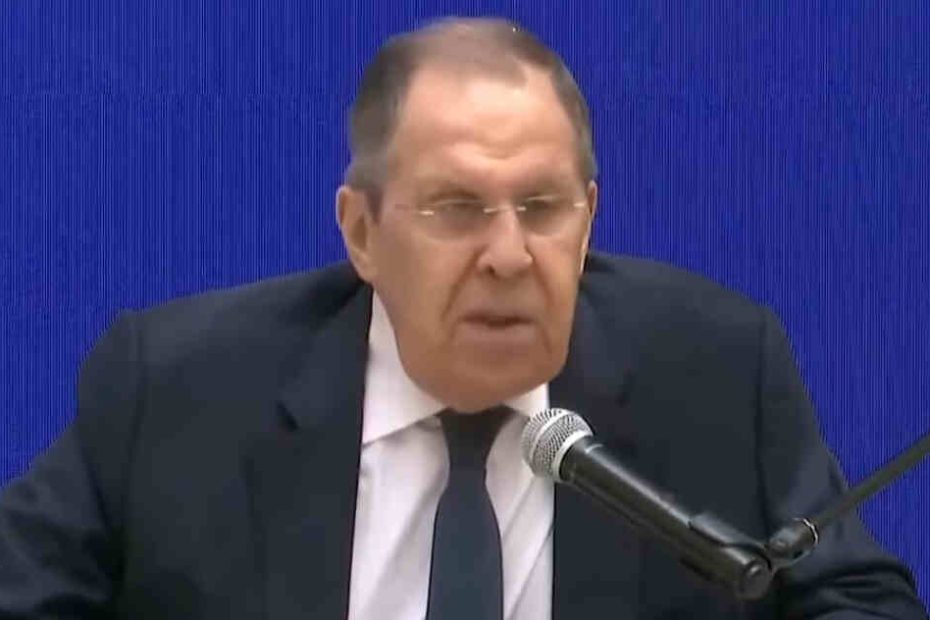
The following is the full transcript of Russian Foreign Minister Sergey Lavrov’s remarks ahead of the proposed call between Putin and Trump to end the Ukraine War at a Diplomatic Club meeting, Moscow, May 15, 2025.
Listen to the audio version here:
Introduction
SERGEY LAVROV: Today, there are many extraordinary solutions that are creative and innovative based on strong principles, and a careful balance of attention so that crises do not emerge again later. Of course, everyone is now talking about Ukraine, based on the interesting developments that occurred in Istanbul, literally at this moment. But do not forget the tragedy of Gaza, and more broadly, the tragedy of Palestinian territories, as well as Middle Eastern problems created by aggressive and reckless policies of NATO countries that rely on military power without consideration, merely when they hate something or someone elsewhere.
Western Interventions and Their Consequences
Remember how they destroyed Iraq, and then it turned out that destruction was for nothing, because there were no weapons of mass destruction there. What can you do? Tony Blair cried a little in his memoirs, and that was it. They destroyed Libya just to take revenge against Gaddafi for his independent policy, and at the same time to cover up the known fact that he had loaned money to one of the candidates in the presidential election in France, and this candidate who later became president really did not want to reveal the fact that he had received money from a foreign country.
There are several examples like this, and all of this has been done under extraordinary statements about the need to protect democracy, human rights, and much more. Besides the ongoing direct crises, I also want to mention Yemen in this context, the problem with the Houthi movement, and there are also situations that require negotiation skills.
Take Iran’s nuclear program, for example, and consider the whole range of other problems that occur in the process of geopolitical transformation of the world in the course of geopolitical struggles when ambitions combine.
Asia-Pacific Geopolitics
Take, for example, what is happening in the Asia-Pacific region, which has been referred to by the West as the Indo-Pacific region to give policy a clear anti-China orientation, hoping to create opportunities to pit India and China against each other. This policy, President Putin recently mentioned it again, is the classic journey, divide and conquer.
Speaking about the Asia-Pacific region, there are several very important geopolitical areas here. One of them is Central Asia, around which many diplomatic processes are taking place. The Central Asia Plus One format, in my opinion, has been successful. The total has exceeded a dozen. So many people want to develop relations with our Central Asian friends.
Look at what is happening in Southeast Asia and its surroundings. Western friends, as happens around the world, generally want to play the leading role here. They also want to destroy the central role of Asia, a role that has satisfied everyone for years and is based on the creation of a truly unified space by Asian countries and their dialogue partners, in the political field and in military cooperation, especially in the field of defense. Everything is based on rules that have been agreed upon and accepted by Asian friends themselves.
All dialogue partners when they join this format promise to abide by these rules, rules of consensus, rules of finding common ground. All of this, our western friends are slowly beginning to undermine and are trying to bring some Asian friends into open confrontation instead of unifying formats. Different groups, groups of four. NATO Secretariat leaders are now seriously testing that as a defense against friendly countries, they are forced to restore their infrastructure in Southeast Asia, in Southern Taiwan, in the South China Sea and so on, just because supposedly it is from there that direct threats to NATO countries are emerging.
The fact that this is, well, that this is, to be informed, true fantasy and not even a very interesting kind, I would say, does not need to be proven, but in this context, yes, of course, there are also such regional processes.
Middle East Relations
I mentioned Iran’s Nuclear Program, but there are processes between all Gulf states, Iran and the Gulf Cooperation Council, which includes six Arab monarchies. There is also a process of normalization of relations taking place between them. We support this too.
Eurasia’s Unique Position
So, if we look at our Eurasian continent, where, as I have already mentioned, most civilizations continue to exist. Chinese, Indian and now Ottoman civilizations are also experiencing revival. We hope these revival processes, which are taking place and occurring in our time, will be harmonized and carefully relate to other sub-state trends so that all these processes, each of which has been formed, influenced and improved over centuries and millennia, will not confront or compete with each other.
Instead, we hope these processes, which have developed over such a long time, will finally be developed together in a form of existence where individual paths and their histories are respected and where they can coexist, supporting and assisting each other in a connected and harmonious way.
There is truly no other continent like Eurasia, a vast society where many different civilizations have interacted, related and still maintained their unique identities and continuing aspirations in the modern era. At the same time, it is important for us to know that Eurasia is the only continent without a unified pan-continental structure.
Africa, for example, has the African Union, which is a great friend. Yes, there are also different formats there, but above it is the pan-continental African Union. In Latin America and the Caribbean, there are also many different integration processes but there is also the pan-continental pan-regional enterprise CELAC, the Latin American and Caribbean Community. But, in Eurasia, there is nothing like that, without different structures or integration plans that exist to unite the vast and different regions.
European Integration and Euro-Atlantic Structures
In Eurasia, there is space for such integration processes, which need to coordinate and harmonize the often complex and sometimes different aspirations of many truly great powers and civilizations that are in the western part of Eurasia and all these processes are consistently based on the Euro-Atlantic concept.
This includes NATO, of course, as well as the OECD which was built as a Euro-Atlantic structure. And, strangely, this also includes the European Union. I will explain now.
Of course, the European Union was built to unite efforts and promote more effective economic development among European countries. It is easier to do it together. And, by accelerating economic development, they intended to solve social problems that Europe was experiencing in many areas. But, in recent years, the European Union has developed into a Euro-Atlantic structure because everything it does is coordinated with the Atlantic Alliance. A few years ago, if I am not mistaken, an agreement was signed between the European Union and NATO where the EU provides its resources including territory, transport infrastructure and equipment against our country. This has been discussed openly for the entire Eurasian continent there are very useful initiatives for European countries and other countries.
This has been openly discussed – the initiative by the first president of Kazakhstan to create a conference on interaction and confidence-building measures in Asia. This initiative has been actively developed. Now after many years during which Kazakhstan led this structure, Azerbaijan is at the present time chairing this conference and there is in fact an ongoing process of gradually transforming this conference into an organization. Here we see the manifestation of that very tendency toward unification and we welcome it.
Toward a Pan-Continental Eurasian Structure
But ultimately the discussion should probably be about moving, as is happening in Africa and Latin America, toward the creation of a pan-continental structure. Maybe it doesn’t need to be called an organization. It’s a pan-continental process. But the main thing is that it should be open to all Eurasian countries without exception, not just Europe, the European part of the continent, not just the Asian part of the continent, but for all countries and associations that have a clearly defined Eurasian context.
It’s not a simple process but you always have to start somewhere and as a rule things like this usually begin with reflection and we are very grateful to our Belarusian friends who a couple of years ago, Alexander Grigoryevich Lukashenko, the president of Belarus, initiated an annual conference on Eurasian security. Two have already taken place. The third is scheduled for this fall. The conference will be held annually and Russia, together with Belarus, in the context of these discussions, is proposing to begin developing a charter, the Eurasian Charter of Multipolarity and Diversity in the 21st century, inviting, I want to emphasize again, all countries located on the Eurasian continent without exception, including the western part of Eurasia, when our colleagues from that area, from the western part of the continent, are ready to engage in dialogue, not with disdain as they have been doing lately, not from a position of superiority and without the arrogance they regularly display toward Russia and other countries.
And we’ll be ready for a conversation based on the principles to which they agreed when joining the United Nations. The main principle is the sovereign equality of states and all the other principles of the charter are absolutely appropriate and fully relevant. The only problem is that the West either does not observe them at all, as in the case of the sovereign equality of states, or acts, as we say, however it pleases. That is, when it suits them, they single out one principle, completely forgetting about the others. Well, for example, regarding Kosovo, everyone knows they said it was the self-determination of the Kosovar people. In the case of Crimea, they said it was a violation of territorial
But why isn’t that considered self-determination? There was a referendum in Crimea, but there wasn’t one in Kosovo. Now, regarding Ukraine, all our Western colleagues, and even some non-Western ones, are speaking in unison. And the UN Secretary-General, by the way, with whom I have spoken several times, he keeps saying, we support resolving the crisis based on the UN Charter and the territorial integrity of Ukraine.
But you’re the Secretary-General, you should probably read the entire Charter. And what about the principle of self-determination, which was deemed acceptable in Kosovo, and was recognized as absolutely modern and applicable by the International Court of Justice? The court stated that the secession of a part of a state into an independent entity does not require, is not necessarily dependent on, the consent of the central authorities. That’s written right there. And the Secretary-General should not forget about the principle of self-determination.
All the more so since he represents a country that was once a colonial power. And the process of decolonization, of liberation from the oppression of colonial powers, was based on the international legal principle of the self-determination of peoples. And back in 1970, the UN General Assembly declared that, yes, everyone must explicitly respect the territorial integrity of states, but only those states whose governments observe the principle of self-determination of peoples, and as a result, represent the entire population living in the respective territory.
Did the colonial powers in the middle of the last century truly represent the peoples of the African continent? Of course not. And the peoples decided that since everything aligned here, there is the right of nations to self-determination, and ultimately there is justice. And the authorities that did not satisfy the colonial peoples ceased to be such.
The 2014 Ukrainian Government and Representation
And who can say that the government that came to power in Ukraine in 2014, as a result of a coup d’état, represented the people of Crimea, Donbass, or now represents those who have practiced Russian culture for centuries, whose ancestors founded these cities, factories, plants, ports, and who have now been declared non-indigenous to Ukraine, with the Russian language banned in all spheres? Where is there even a single solitary voice at all from the Western camp?
Whenever the West considers any situation at the UN, when they speak, or simply during other events, no matter which country it is, Russia, China, by the way, even India, Venezuela, Iran, any country, human rights are always present in the moral lectures that the West constantly delivers. Just out of curiosity, starting from 2014, go online and scroll through everything you can possibly find. If you find even a single statement from any Western leader criticizing human rights in Ukraine, well, maybe, yes, perhaps our friends from Hungary consistently defend the rights of the Hungarian national minority. They do make such statements.
But as for those who consider themselves leaders of the free world, France, Britain, Germany, well, I’m not even talking about Poland, the Baltics, and so on. Never. And, of course, the European bureaucracy, Ursula von der Leyen and the like, when we call for the principles of the UN Charter to be upheld, including the principle that requires respect for human rights, regardless of race, gender, language, or religion, and language and religion are exactly what is categorically prohibited by law in Ukraine, they simply, quite simply, ignore it.
And when we say, well, at least try to influence your clients, when they wake up in the morning and are still capable of hearing something, demand that they repeal these laws. But Ursula von der Leyen, Kaja Kallas, and other such figures say, Ukraine is defending European values. That’s all there is to it. So, that means Europe supports Nazism, because Nazism is thriving in Ukraine, it’s legalized, it’s celebrated in holidays, dedicated to collaborators who fought on the side of Nazi Germany.
The Istanbul Negotiations and Western Interference
Why am I going into such detail about this right now? By the way, many people have been fussing about this lately, especially in Europe, particularly regarding the meeting in Istanbul. I’ll finish with what I started. At first, Zelensky was making some statements demanding that Putin come in person. Well, what a pathetic man. It’s obvious to everyone, except probably himself and those who are pulling his strings. Then his senior comrades explained to him that he shouldn’t behave so foolishly and that negotiations are necessary.
By the way, as you know, over the past three or four days, the West has somehow pushed the word ceasefire into the background. We explained in great detail, by the way, they asked Macron about it. He gave some interview here three days ago, and they asked him, he said, negotiations and a meeting are needed, but everything must be done to make a ceasefire the main priority, and Ukraine should approach the negotiations from a position of strength. That’s a straightforward admission. Why is a ceasefire needed? To pump up Ukraine so that it can eventually come to the negotiations from a position of strength.
But Macron was told that this is not what it’s about right now. The Americans supported our president’s proposal. We need to give negotiations a chance. No one can guarantee that everything will go smoothly without any problems. On the contrary, there will definitely be problems. Just as there were three years ago in Istanbul, when the already initial principles were ready to be put into a formal agreement. But the British forbade the Kiev regime from continuing this process, which could have resulted in a settlement.
And now, by the way, the British are once again leading Zelensky like skilled, experienced guides through the tangled jungle of world politics. Some advisor to the British Prime Minister on national security has already been assigned to Zelensky to make sure he doesn’t blurt out something unnecessary and completely ruin his own reputation, as well as the reputation of those who are coaching him.
Human Rights and Ukraine’s Constitutional Obligations
But you see, they say that something needs to be done quickly, because the Americans really want to achieve results. They have far more on their plate than just Ukraine. The simplest result is to declare that not even because there’s a war going on, not because anyone is putting pressure on Ukraine, whether it’s the West, China, Brazil, Africa, or any other country or group of countries, but simply because there is the UN Charter, which explicitly and unequivocally states fundamental human rights, including language and religion.
Simply because there is a whole series of conventions on the rights of national minorities in which Ukraine participates. Conventions both under the auspices of the UN and under the auspices of the Council of Europe. And in addition to all that, there is also the Constitution of Ukraine, you won’t believe it, which specifically states the obligation of the state to respect the rights of Russians, highlighted separately, as well as other national minorities. And it lists in education, in the media sphere, everywhere.
But why don’t the Western curators of the Kiev regime now advise, or even insist, that they announce the repeal of all those laws that violate the UN Charter, international conventions, and even the Constitution of Ukraine itself? Now that would be a real result. And this shouldn’t cost the Americans or the Europeans anything at all. America is always promoting the slogan of human rights. And here, it’s simply about bringing the regime back to normalcy. This isn’t a concession, it’s fulfilling what you signed up for and what people once believed you would do.
Well, I’ve probably spoken more than I planned, let’s switch to an interactive format. Who is our moderator?
Q&A Session Begins
MODERATOR: Dear Sergei Viktorovich, distinguished ladies and gentlemen, Your Excellency. The Diplomatic Club is, above all, a platform for dialogue, and the discussion will take place in an interactive format. There are people with microphones present in our hall. I suggest you ask your questions. Please raise your hand if you have a question in the audience. Now I see a hand raised in the back row. Please go ahead.
AUDIENCE QUESTION: Hello, esteemed colleagues. My name is Denis. I am a representative of the Public Association for Patriotic Tourism. I am absolutely delighted that the Diplomatic Academy of the Club of Foreign Ambassadors has resumed its work. Sergei Viktorovich, thank you very much for this.
Well, the next question is that we talked a lot today about soft power, about the impact of soft power through the prism of tourism. And my question is as follows. Patriotic tourism is not a thing of the past. It is very much a part of the present. And I would like to ask you, perhaps the Russian Ministry of Foreign Affairs has projects aimed at attracting new visitors to our main museums, because our Western partners, as we know, claim that they were the ones who prevailed in the Great Patriotic War, in the Second World War, excuse me, right? But it It was us who prevailed. We were the first in space.
And Elena Nikolaevna, I was just at the Atom Museum, and it is simply a magnificent, innovative museum. And we would really like our foreign partners to fully understand and to clearly recognize that it is Russia that truly serves as the technical and cultural engine for the entire world. Through the lens of our modern museums, such as the Atom Museum and the Center for Cosmonautics and Aviation, we would like the whole world to know us precisely as the driving force that leads our world toward a bright future.
The Diplomatic Value of Understanding History
SERGEY LAVROV: It seems to me that any ambassador is quite objectively interested in ensuring that his citizens, the citizens of his country, and especially the leaders of his country, are properly informed and know more about the history of the state in which they are accredited. There are many representatives of the diplomatic corps here, and as far as I understand, they are very well aware of the importance of this work, besides the fact that it is simply interesting for a normal person to get acquainted with history. But it is also important so that this knowledge can later be applied. History repeats itself, and not necessarily as a farce. Sometimes it repeats itself as a lesson from which we can draw some ideas for today.
If you have any ideas about how to organize special events for ambassadors… For example, we have a practice where we don’t suggest visiting museums collectively, but as for trips around the country, yes, we do that regularly, several times a year. A route is announced, and interested ambassadors then form a group for a few days. There, they meet with the regional leadership, visit enterprises that form the backbone of the economy in a particular federal subject, and of course get acquainted with the local sites and attractions.
Because patriotism, I hope that patriotic tourism is not only, although it is an essential element, not only about monuments connected. Right now, perhaps, the main symbol of patriotism is the victory in the Great Patriotic War, but patriotism is also simply history. It’s the history of your own people, which is embodied in so many different forms. In architecture, of course, in painting, and simply in nature.
Almost a year ago, we held a BRICS meeting of foreign ministers with Gleb Nikitіn. What they saw in Nizhny Novgorod, they will never forget. I hadn’t been there for a very long time. And I was, of course, genuinely inspired by how it is being transformed, and with such great care and attention. It is becoming modern, but it does not lose its antiquity and the spirit that still permeates the nature, the churches, and many other sites in this part of Russia. That’s why we are fully in favor. If you have any suggestions on how we can further encourage the diplomatic corps based on your experience, please share them.
AUDIENCE QUESTION: Thank you very much.
SERGEY LAVROV: And now, excuse me, before we begin, I was told that the Nizhny Novgorod Treasury will now be enriched with a collection, part of which Mr. Dudakov is kindly showing us some pieces from it here. And, of course, this will also become a kind of magnet.
Artificial Intelligence and Generational Perspectives
AUDIENCE QUESTION: Thank you very much, Sergey Viktorovich. My name is Maria Ramos. I am the ambassador of Bolivia. Thank you very much for your perspective. It is very important to listen to what is happening in the world right now. And you mentioned at the beginning of your presentation, you mentioned artificial intelligence. And, of course, there are many questions I would like to suggest, perhaps, that we deal with this within the framework of the Club, because I feel that the issue is not only about illiteracy regarding artificial intelligence, but also about the clash of perspectives between my generation and the younger generations. That’s why it would be interesting if some experts could talk about this, since I very much share your perspective regarding diplomacy and artificial intelligence.
SERGEY LAVROV: Yes, I also catch myself thinking that time is passing, and today’s youth, and not just the youth, but children as well, they perceive everything differently now. And for them, many things that seem like science fiction to us at their age are just as ordinary as having semolina porridge for breakfast. It’s impossible to get by without them.
If we’re talking about this topic, about how generations create new ways of life, who knows, maybe when today’s kids who open iPhones, smartphones, Huawei devices, and everything else in kindergarten as if they’re at home, just like they do at home. And yet we say we have these old Russian proverbs. When older people meet, they often discuss the youth and say, yes, things aren’t the same now. Back then, the grass was greener and the water was wetter. And in about 50 years, today’s boys and girls will meet and say, back in our day, at least there was artificial intelligence, but now there’s nothing at all.
But this is very important. This is a very important topic. And I’ll tell you, in our ministry, we have a department that deals with information security, cybersecurity, but this is already more than just artificial intelligence. And right now, we want to reform this department. We have planned a special board meeting within the next month or month and a half. My staff are preparing it right now.
This absolutely needs to be kept in mind because it touches on such fateful issues as the security of the state, but also the issue of the state’s development. It’s no coincidence that our president a couple of years ago, I think at some economic forum, said that whoever leads in advancing artificial intelligence in practical fields will be the leader. Well, I think there will be several such countries.
But of course, this needs to be used in diplomacy because in the past, you had to run around the corridors. When I started my career, you had to run around the corridors. A typist would type something for you, and God forbid you made a mistake somewhere. You had to cover it up with that white stuff. I can’t even remember what it was called, and then type it all over again. That’s how it was. Of course, working with a real typist is better than with any artificial intelligence. That has to be acknowledged as well. But of course, the process was very long and drawn out. Now everything happens instantly.
This speed in finding what you need, of course, should be appreciated. We should do everything we can to improve this process. But when you get what you need, I mean facts, facts from past history or something recent, like for example, how did the Ukrainian crisis develop? Now very often, you have to remind the French, the Germans, the British who are, in all honesty, simply lying, blatantly, obviously lying.
Macron, for example, not so long ago, just a month ago, publicly stated that Putin refused to implement the Minsk agreements. You see, even things that happened just a couple of years ago, when his predecessor admitted that he never intended to implement anything. That’s how they twist things around.
But having these facts, having refreshed your knowledge, literally at the press of a button, without having to dig through and flip through files, thousands of pages, that’s very important. But then once you’ve gotten or refreshed these facts, it’s your own mind that has to do the work, of course.
Question on Western Russophobia
MODERATOR: Thank you very much, Sergey Viktorovich. We have more questions from the audience.
AUDIENCE QUESTION: Thank you very much for the privilege of being here. My name is Louis Francois and I am from the Embassy of Cameroon. I know how much Russia has contributed to the world in sports, culture and science. And I just don’t understand what this hatred, this Russophobia from the West towards Russia is all about. There we see Russophobia. It’s already like a symptom, or hatred as a symptom.
In your opinion, what is the reason for such behavior or this approach? Yes, I understand. We are Africans, after all. Maybe they look at us as if we are inferior, as some kind of lower race. But you are white-skinned. You look like them. You are very smart. You invest in science and sports. But why is there such hatred toward you? Thank you very much.
SERGEY LAVROV: You know, there are actually many different opinions and perspectives on this matter. And I also mentioned some historical examples. When Napoleon, the famous and ambitious great emperor of France, assembled and united almost all of Europe into his massive army to attack Russia, the Russian Empire, as it was known at the time. How it all ended is well known.
After the First World War, yes, people often say that Germany was deeply offended. It was thoroughly humiliated. And that’s why the seeds were sown for it to seek revenge. Well, in the end, it doesn’t really matter how it happened. What truly matters is what came out of it.
Again, just like what happened earlier with Napoleon, almost all of Europe, united together under the banners of the Third Reich, was gathered and launched a massive attack against the Soviet Union during this period of history. And everyone took part in the attack. The Spanish, the French, they participated in the blockade of Leningrad. It wasn’t just the Germans. Practically all the leading European countries, which simply surrendered to Hitler and didn’t defend their own homelands, were just drinking coffee on the Champs-Elysees.
Of course, there were great people in France, whom you also mentioned recently, Charles de Gaulle and those who led the resistance. We recently celebrated another anniversary of the great Normandy-Niemen Regiment. All of this should be appreciated. It should be valued. But these were people who, despite the authorities of their countries at the time, joined the resistance. It was precisely they who defended the national pride of France itself. That’s the point.
Current Western Coalition Against Russia
But now, in the present moment, we are witnessing almost the same thing. When the Biden administration has managed to unite all of Europe and, in addition, brought in its satellites in Asia, Japan and South Korea, those whom they consider to be obedient executors of their will, and has directed all these states against Russia as well. Well, first and foremost, of course, in the form of financing the Kiev regime, in the form of supplying it with the most modern types of weaponry, including those for strikes deep into Russian territory.
And all of this is also happening under Nazi slogans. Because the most experienced, as they say, combat units of the armed forces of Ukraine are the Nazi battalions Azov and Aidar, which are now raising their heads and whom Zelensky is very afraid of. They openly wear Nazi insignia, Nazi flags and tattoos. Torchlight processions continue in Ukraine in honour of the birthdays of Bandera, Shukhevich and other traitors who shot Russians, Poles and even Ukrainians themselves. So when we talk about denazification, this is what we mean.
And why is this happening? Why is the West so relentless in its desire to inflict a strategic defeat on us on the battlefield? Well, probably they don’t like the fact that Russia is independent.
Divergence Between US and European Approaches
Right now they are diverging in their views. Europe and the United States, the Trump administration. Of course they also want to make America great and number one and nothing else. Any administration in the U.S. will promote that position. But the current administration at least has returned to normalcy.
Whenever there are any contradictions, politicians and diplomats all the more so are obliged to talk. Even when there were absolutely irreconcilable contradictions during the Cold War years, there was always dialogue. But Biden simply cut it off. And then obediently following Biden, all of Europe, all of Europe went along and broke off relations. Not diplomatically, but practically.
I was amazed a year ago when once again, these ideas were being discussed. It was still the Biden administration. And there were some events in the European Union, another round of summits, meetings of foreign ministers, and they were adopting some texts regarding Ukraine. Now I can’t even remember what exactly was mentioned there. And I just asked my staff about this.
And I said, let’s—and you know, before back in those years, during that earlier period, first of all, we used to have Russia-EU summits. And these meetings were actually held twice a year on a regular basis. And we regularly held meetings every six months. My meetings with the ambassadors of the European Union were just like the ones we have with the ambassadors of the African Union. Soon we’ll have an event with Latin America, with Asia, and of course, with the CIS, our closest neighbors.
And we invited all the ambassadors of the European Union, as well as the official representative of the European Council to a special meeting with the Minister of Foreign Affairs to openly talk about Ukraine and to ask any questions they wanted to. And yet they collectively refused, not because I am proud or easily offended or particularly sensitive. Well, it’s just that when you work in any country and the Minister of Foreign Affairs invites you to an open conversation, but you don’t go as an ambassador, then you’re simply—I know a few words, but haha. This is such a disgrace. You understand? It’s a disgrace for any diplomat. So that’s why right now, we’re not communicating with them, but they’re not communicating with us either. Sometimes when a specific issue comes up.
Historical Perspective on Russian Conflicts
So going back to your question, historians will probably be answering it for a long time to come. In our Russian history, well, there have been quite a few wars, most of which notably, we did not start. But all those wars that came to us from the East, the Tatar-Mongol yoke being the most famous, somehow, we were in the end able to come to human agreements. And in the end, we ultimately reached an agreement.
And by the way, it was, in fact, roughly the same with the Russo-Turkish wars. I just thought about it now. On the eastern flank, quite a lot of blood was shed. But in the end, somehow, a mutually respectful balance was achieved. But on the left, on the western side, those guys never settled down.
Current US-Europe Relations and Russia
But I think once, again, they recently confirmed, somewhere I read this, and it seems true, that since they sensed the disunity that is starting to appear between the US and Europe, and not only because of Ukraine, but simply because the Trump administration, first of all, wants to remove obstacles to mutually beneficial economic cooperation with Russia. We are not against it, but only if it is truly mutually beneficial and fair.
And recently, at a meeting with Delovaya Rossiya, the President explained under what conditions those who left the Russian market can return. Of course, we will not do this to the detriment of Russian business. Nevertheless, we are ready for this. And Trump is interested in this, just as he’s interested in developing normal, mutually beneficial relations in the areas of economy, finance, and logistics with any country.
Right now, it seems the visit to Saudi Arabia, Qatar, and the United Arab Emirates is going very successfully. And in addition, in the Trump administration, as they themselves say, they have other priorities as well. This includes the Iranian nuclear program. Of course, it also includes relations between the Arabs and Israel, and of course, the People’s Republic of China, which, according to doctrinal documents in the United States, has been declared the main challenge, the challenge to Washington’s goal of always being number one, so that no one is stronger than them in anything, neither in the economy nor in finance nor in military affairs.
And that is why European affairs are, so to speak, taking a backseat. And there is clearly a desire for this, even, I believe, representatives of Donald Trump’s administration have publicly stated as much. Well, we made an offer. If you don’t want it, that’s fine. Let Europe handle it themselves. We have other matters that are more important.
But there is, in fact, a considerable amount of evidence that neither Berlin, nor Paris, nor Brussels, and especially London, really want any kind of peace in Ukraine. They are deciding that, since the United States is seemingly stepping back from active support, which, by the way, will also affect NATO, Europe needs to start thinking about itself. Macron has already come up with some kind of European army and is ready to put his nuclear warheads into the common pool.
And in this situation, according to our information, they are still having direct conversations among themselves. They believe that the mobilization of Europe against Russia must not be stopped. And in this sense, Ukraine is an invaluable tool. So, they are already talking over there. Of course, there are plenty of mercenaries there. And not just mercenaries, there are also instructors working under the guise of mercenaries, who are actually active duty servicemen from NATO countries. And now they also want to bring in stabilization forces there. You see, but it’s already been explained so many times that this would be absolutely unacceptable for Russia. And yet, they keep pushing this forward. We have a word for this. They’re asking for it. And at the same time, they say, look, Macron, just the day before yesterday, he had an interview on TF1. He said, we must not enter into a direct confrontation with Russia. Otherwise, there will be a third world war, and we don’t want that.
So, we won’t go to the front line, but just a little further back on Ukrainian territory. This will deter Russia, because after defeating Ukraine, it supposedly wants to attack Europe. And this is the president speaking. And not just the president of some country that appeared yesterday, but the president of a country with centuries of history, culture, and traditions. Well, that’s the problem.
Conclusion
So, that’s just how it is in general, you know. We actually have a saying for this kind of situation, too. But honestly, it’s really impossible to fully understand it just with reason alone. That’s just how it is.