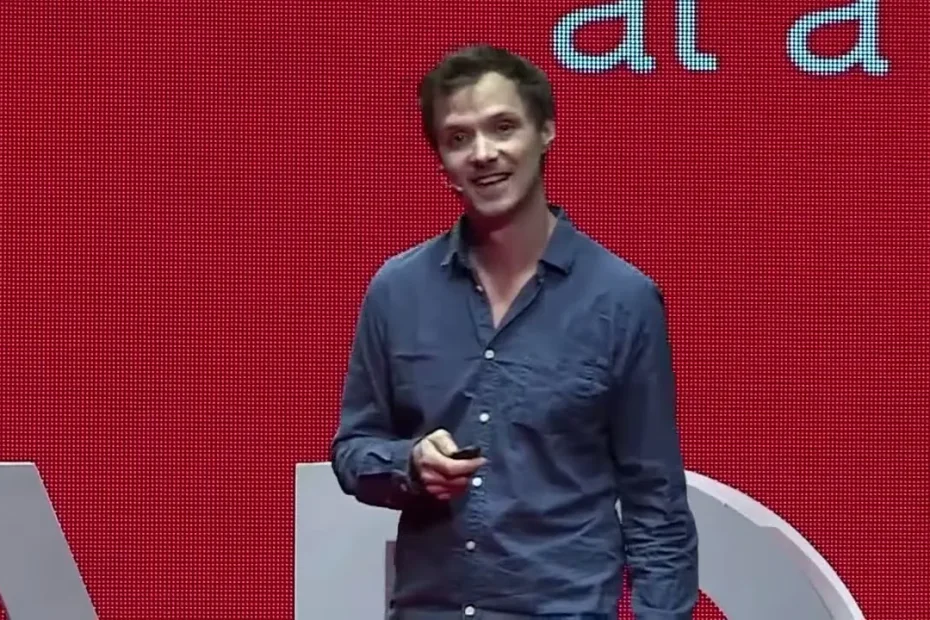
Read the full transcript of journalist Thomas Graham’s talk titled “The Genius of the Filipino Poor” at TEDxADMU 2017 conference.
Listen to the audio version here:
TRANSCRIPT:
A Parachute Journalist
THOMAS GRAHAM: I arrived in the Philippines about five years ago on a short-term assignment to write business and investment reports on this country. One day, one of the men I was interviewing called me a parachute journalist. I thought, what’s a parachute journalist? He says, “Yeah, you’re one of these foreigners who come to our country, you write a quick report and then you leave. You don’t really understand the Philippines.” I thought, how dare you? I studied at a top university in Europe and these reports go into prestigious international magazines.
I thought, you know what, I’m going to show these Filipinos that I really do understand your country. So what did I do? The next day, I went to Green Hills and I bought the finest barong tagalog I could find. And the following day, I showed up at my interview and I expected the gentleman I was interviewing to be very impressed with my new attire. Instead, after about two minutes, he looked at me with a slightly confused and concerned look on his face. He said, “But sir, you do realize if you wear a barong tagalog, you really should wear an undergarment.”
So imagine, air conditioning on max, there I am in this beautifully embroidered and yet rather transparent barong tagalog. In fact, don’t imagine it too much. Now after that day, I decided never to wear a barong tagalog again. So I was this guy. I was dressed in a suit and I was interviewing other people in suits or barongs all across Metro Manila. I was going from the business districts to Malacañang.
Disconnected Reality
One day, on the way to Malacañang, I was on Rojas Boulevard, stopped at traffic lights and some kids looked inside the window and they saw something of interest. “Americano,” they said. As I was composing myself once more, some other kids started tapping on the window and calling me “Joe.” Now I was a bit confused. I thought maybe there’s some case of mistaken identity here. So I said to the driver, “Can I wind down the window and tell these kids that I’m neither Joe nor Americano? I’m Tom from England.”
But the way he responded to me was very revealing. He said, “Oh, sir, I don’t recommend you do that. If you wind down your window, these kids will probably rob you.” So I didn’t wind down the window and I went back that evening to my 34th floor condominium in Salcedo Village. But I had this thought in my head, I said, why would anyone bother reading my reports if I’m that disconnected from the ground? I’d had enough of writing these kind of false reports and I wanted to really write a report which told a more authentic story of this country and a story which would give me hope.
Meeting Tony Meloto
And so people started telling me, you’ve got to meet this guy. Now this is Tony Meloto. If you’re not familiar with who Tony Meloto is, I’m sure you are familiar with the organization that he started, Gawad Kalinga. So I did a bit of research on GK. I fixed up an interview, expected it to last about 30 minutes. Three hours later, I’m staring back at this clipboard of questions and Tony had challenged me to see this country in an entirely different light.
In particular, he said, “Tom, you talk a lot about inclusive growth. The only way we’re going to achieve inclusive growth in this country is if we unleash the genius of the Filipino poor.” The genius of the poor? If there’s genius in the poor, then why are they poor? It didn’t make sense. Tony said to me, “Don’t take my word for it, go and discover it for yourself. It’s time you ditch that suit and tie.”
So I thought about it for a short while and I thought, okay. So I spent one year living in the communities of Gawad Kalinga. And that journey, it was a life-changing journey for me. And there’s two key reasons why this one-year journey had such a major impression on me.
Discovering Bayanihan
The first is Bayanihan. Now let me tell you how I first discovered what Bayanihan was. So remember I had that car and a driver. I had to give all of that up and I had to start taking jeepneys. Now think about it. What could possibly go wrong if a Brit takes a jeepney for the first time? I’ve already messed up with the Barong Tagalog, right? What could go wrong?
Maybe you think I don’t know where the jeepney’s going. But don’t you worry. I did my research. I learned the words “ibaba” and “ilalim.” I learned other words. I learned “bayad po.” I even learned “para po.” And the strangest thing for me, which I learned coming from London, was that if the driver can’t hear you when you say “para po,” you have to start whacking the roof. Very strange.
Anyway, I thought I was well prepared. And my baptism of fire for taking jeepneys, my very first jeepney experience was along Commonwealth Avenue. In case you’re not familiar, this is eight lanes of pure chaos. The highway of hell. So I stopped the jeepney, and you may think I’m quite tall, so probably I couldn’t find a comfortable seat, but I was okay. I found a nice little seat squished between a couple of plump ladies at the back. It was actually quite comfy.
And then after about a minute, I thought, I haven’t paid yet. I did what any Brit would do in that situation. I’m sat at the back, got a backpack on, and I jump up.
And then I turn around. And as I turn around, I whack the lady in the face with my bag. And I’m going about 40 miles an hour right now along the highway of hell, and I’m making my way from the back all the way to the front, treading on people’s toes, whacking someone else in the face. And I finally get to the driver at the front.
But don’t worry, I remembered my line. I put my hand on his shoulder, and I said, “Bayad po.” The driver looks around a bit confused. But anyway, I give him 10 pesos. He gives me 2 pesos change. And then I have to go all the way back. So I finally make my way to the back of a jeepney. And I have the impression I am the least popular person in the history of taking jeepneys ever to take a jeepney.
But I’m looking back at everyone else in the jeepney, thinking, you know what? It’s not my fault. It’s a stupid system. In London, we have an electronic card. We pay the driver. It’s so easy, and it’s safe. And a moment later, another lady gets on, and she easily sits opposite me. And I’m thinking to myself, you know what? She is going to have exactly the same problem I had.
And then she did something which surprised me. She also said, “Bayad po.” She picked out 10 pesos from her pocket, and she passed it to the person next to her. And that person passed it to the person next to them. And I’m watching this, thinking, oh, so that is how you do it in the Philippines. Because, of course, it’s possible to pay for a jeepney on your own. I mean, I managed it. But it’s a lot easier if you do it together, right? And this is the spirit of Bayanihan, how I first discovered it.
And if I think back to that first interview with Tony Meloto, he said to me, “The Philippines has no excuse to be poor.” And I thought, of course it has a lot of excuses to be poor. It has health problems, infrastructure, education, corruption. I could go on and on and on. And yet today, I know he’s absolutely right. Because we don’t have that spirit of Bayanihan in the UK. You guys have it. It’s beautiful. And yet there’s so much inequality. But what’s more, I saw in the communities of Gawad Kalinga I visited, I saw how slums really were being transformed, one community at a time, into colorful and peaceful communities like this.
Understanding Walang Iwanan
So that’s the first value, Bayanihan. The second is Walang Iwanan. Now, when I first came across this expression, I checked it out in the dictionary, and I was like, okay, no one left behind. Okay, that makes sense. I can understand that. But it took several months to fully grasp what Walang Iwanan means.
So towards the end of my one-year journey in these communities, it was Christmas time, and a major typhoon had just struck the Philippines. And I was stuck on an island in one of the affected areas, all on my own.
Finding Christmas Spirit in Unexpected Places
And all of my family and my friends had gone back to Europe. My Filipino friends, of course, were with their families. So for the first time in my journey, I felt a little bit left behind. So I asked a friend, “What can I do this Christmas time?” It was Christmas Eve. He said, “Why don’t you go to the local GK village?” And I thought, well, okay, it’s better than being on my own at Christmas time. I wasn’t super excited about it, I’ve got to be honest. I was feeling a bit miserable. He said, “Don’t you worry, I’m going to sort it out.”
So he had Globe, and he sent a message to a community that had Smart or something similar. And probably because the typhoon had struck, that message never got there. So I jump on the back of a habal-habal, or a motorbike, and I make my way from the touristy area of the island to the far side of the island. And I jump off the habal-habal at about 6 p.m. on Christmas Eve. “Merry Christmas, guys!”
Now, one of the first expressions I learned in the Philippines when I arrived here was, “most people, most people.” You can imagine the situation. There was three or four minutes of panic. Where did this guy come from? Why is he not with his family? What do we do with him now? And the Kapitbahayan president of that community, he came up to me and he said, “Tom, we weren’t going to celebrate Christmas this year. We lost everything in the typhoon. But now you’re here, we’re going to make a party.“
So, there was one gentleman in the community, he was a fisherman. Earlier that day, he’d caught a squid. So he put the squid on the barbecue. And the other guy, he had a Nokia phone, not a smartphone, but one from, like, 2001. And it played music. That was the important thing. And he said, “Don’t you worry, sir, I’d be DJ.” And we had someone else. There was no power in the community, right? But we had someone with a flashlight. And he spent three hours flashing on-off, on-off, on-off, on-off. And it was the disco lighting.
And this was me, Christmas Eve, in Bantayan Island in Cebu. This was before the Pampuay came out. But it really is more fun in the Philippines, right? If you can create so much fun out of so little resources. And it’s so much more than that.
A Humbling Realization
Because that night, I went to sleep in one of the community houses. And I was sleeping on the floor in a Gawad Kalinga house. The bed was not the mattress I was used to, of course. It was a plank of wood. But unfortunately, this plank of wood hadn’t been cut for Caucasian dimensions. What did that mean? It was too short. So there I am, trying to sleep on this plank of wood, and my legs are dangling off the end.
And after a couple of hours, I started to feel a bit sorry for myself again. I thought, “You know what? If I could have just stayed in a resort tonight, I’d be so much more comfortable.” And I went to the CR. And on the way to the CR in that house, I saw the mother and father lying on the floor. Now, oof. I didn’t realize that was a difficult situation for me.
Then I went back to the room, and I looked up, and I realized I couldn’t see the stars. Now, why was that significant? Because I was in the only house in the entire community that still had a roof. So I was in the best house in the community, and I was sleeping in the matrimonial bed of the best house in the community. And for the next two hours, I couldn’t sleep either. But not because I was physically uncomfortable. I was very emotionally challenged by these people.
And it got me thinking, if someone is to show up on my doorstep on Christmas Eve from a faraway country in the east, and say, “Hey, can I come in? Can I have dinner with you tonight? Can I sleep in your bed, by the way?” What would I do? I’d say, “I don’t know you. I don’t owe you anything.” I’d give them a mince pie. That’s what we give at Christmas. And then I’d say, “On your way.” And if they didn’t leave, I might well call the police. That’s the reality.
This community had challenged me to become a better version of myself because I learned what “walang iwanan” meant. Because “walang iwanan,” from the translation, meant me as a relatively rich person giving a little bit of what I have for the poor. This community had nothing. And yet in that moment, that one moment of my journey where I was left behind, they gave me everything that they possibly could at that moment.
Bringing the Spirit Back Home
So, these stories appear in the book I wrote, “The Genius of the Poor.” And after we published that book, it was time to get back to reality. I had to get a pension plan. I had to get a serious job. And I had to go back to London.
And you know what? If I had stayed any longer in London, I would have probably got depressed. Where was the “walang iwanan,” the “bayanihan,” the genius of the poor in London? I couldn’t access it, and I was getting sad. You know what English people do when we get sad? We go to the pub.
So I was down the pub, I was drinking beer, and there was one particular day I was drinking probably on pint number three or four, and I was getting increasingly emotional about my time in the Philippines. I was starting to sound like Tito Tony himself. My friend, he put his arm around my shoulder, and he said, “Look, Tom, if it really makes you feel any better, I will double my subscription to Oxfam. This is a really sincere offer.”
And yet, it made me realize I don’t want him to double his subscription. That’s not what this is about. I don’t want him just to listen to my stories or to read my book. I want him to come and experience these communities for himself. So that’s where I got my next idea. I thought, I’m going to set up a social tourism platform. MAD Travel. We’re going to create fun and fulfilling experiences in Gawad Kalinga communities and other communities all across the Philippines.
Conclusion
Not just for foreigners, let me say. Because just like the butterfly, who perhaps doesn’t know quite how beautiful his own wings are, I wonder if it’s time that Filipinos themselves are reminded of the potential for genius all around you. Thanks very much. Thank you.