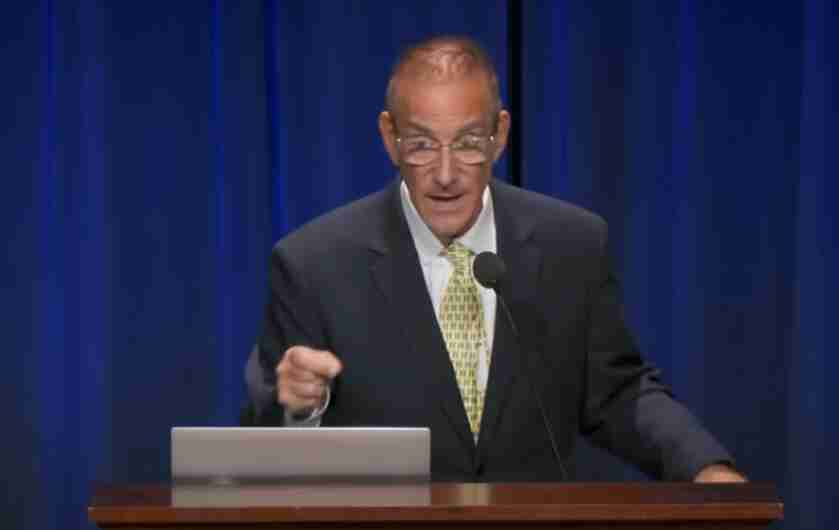
Read the full transcript of radio host Larry O’Connor’s lecture titled “The Media and the 2024 Election” which was given on October 22, 2024, on Hillsdale College’s campus in Hillsdale, Michigan.
TRANSCRIPT:
The Media’s Role in Modern Politics
LARRY O’CONNOR: I would love to be able to talk about this presidential election and not include the media, but it seems impossible, doesn’t it? They have become a major player in the actual political game and the election process. I don’t think that’s what our founders expected, actually. As Megan just said, I do host a morning radio program in Washington, DC.
It’s four hours long, so I’m not kidding. I could make this night very, very thorough. Considering the topic at hand, I like to tell people that the middle of June to the end of July this year was the longest four years of my career, starting with the debate and ending with Brat Summer.
I do have a few examples of some of the egregious behavior we’ve seen from the media. And I promise you right now, as depressing as this may begin to look, there is a happy ending. When I get to the end of my presentation, I hope that you’re going to leave here with some hope of your own about where we’re headed right now and the fact that we, the people, have actually taken back our freedom of the press, because that freedom in the First Amendment is, in fact, intended for us.
Personal Background
Before we get too deep into it, I do want to thank everybody who brought me here. It truly is an honor. I’m a Michigan boy. I was born in Detroit. I grew up right outside Detroit in Wayne County, the city of Plymouth, Michigan. Township, actually, of Plymouth, Michigan.
When I was 13 years old, I moved to Orange County, California. Ronald Reagan was president. And I believe when he was running for re-election, he called Orange County where good Republicans go to die. B-1 Bob Dornan was my congressman.
So you can imagine coming of age as a teenager in that setting with Fast Times at Ridgemont High in the movie theaters and Newport Beach right outside my window, I became a conservative Republican. I then did pursue a theater career. And of course, that naturally led me to talk radio and political activism.
I really am grateful to Hillsdale for accepting me and bringing me here. My day yesterday teaching my course for the first time, the first day of the class, was, in fact, my first time in a college classroom. I took a year off after high school to go to New York to sort of get theater out of my system because I just wanted to be there on Broadway. And that year is still going on. So I’m one of those rarities that actually did not get a college degree, but somehow I’ve been able to feed myself and my children all this time.
Acknowledgments
Thank you to the legendary Dr. Arnn, of course, and the board of trustees here, including Chairman Emeritus Brodbeck, which I didn’t expect him to be here. And I’m very honored to have him here tonight. As well as current chairman Pat Sajak, who is my neighbor in Annapolis, where I live. He’s not really my neighbor. We live in the same zip code. He’s in the neighborhood where you can buy a lot of vowels.
Thank you so much to Professor Miller, director of the Dow Journalism School, for accepting me here as a barely high school graduate. And Matt Bell and his team for all the incredible hospitality to make Meredith and I feel so well at home. And most importantly, Scott Bertram for opening up his beautiful radio-free Hillsdale studio for me. I’ve been broadcasting my morning show back to DC every single morning from here. You’re all welcome to watch. I start at 4:30. No? I don’t blame you.
The True Purpose of the Press
I do want to start with a disclaimer, an important one. I really do love the press. No, really. When your voice cracks, you know you’re being earnest. I do. I love the press. I love what the press is supposed to be. I love the press envisioned by our founders in terms of what their role is in our democratic process, in our constitutional republic. They do have a vital role. They’re there to serve us, believe it or not. And I love that concept.
My three years working with Andrew Breitbart, when he literally changed the media landscape as we know it, he instilled in all of us that the press is not really the enemy. It’s the corporations who have allowed the press to do what they’ve done to us over the years that have really become the problem. So understand, this is not an attack on the press.
I know these days when you actually start to raise a mirror up to who the media has become, and you start to point out their flaws and point out their biases, point out the propaganda that they’re throwing at us every day, that suddenly you’re the enemy of the press, that you’re a threat to the First Amendment.
Understanding the First Amendment
Well, let’s start with the First Amendment, shall we? Because I don’t know about you, it seems kind of weird that the First Amendment includes freedom of the press. Think about the First Amendment for a minute. And I know I’m about to humble myself trying to describe the First Amendment to a room like this. This is Hillsdale, for God’s sake.
But the First Amendment includes, obviously, our freedom of speech and expression. It includes our freedom to practice our faith without encumbrances by the federal government, at least. Our right to assemble, our right to petition the government, those are all our rights.
But then you’ve got the freedom of the press. Why in the hell did the founders include a freedom for reporters in the First Amendment where all the other freedoms are for us? Why did they create a freedom or acknowledge a God-given freedom that the government can’t infringe upon for journalists and owners of newspapers?
Well, of course, they didn’t. You see, the freedom of the press is not about reporters. The freedom of the press is also about us. It is about we, the people.
Madison’s Original Text
I found it instructive to see Madison’s original proposed text for this freedom. Let’s read it together:
“The people shall not be deprived or abridged of their right to speak, to write, or to publish their sentiments; and the freedom of the press, as one of the great bulwarks of liberty, shall be inviolable.”
Inviolable is a word we should use more often. I like that. James Madison is trying to make sure that the people shall not be deprived of their right to publish their sentiments.
Thomas Paine: The Original Anonymous Blogger
Who was the most influential journalist, even before we had that word, at the time James Madison conceived of those words? There’s a picture of him over in your heritage room. I saw it when I got my tour. Thomas Paine.
And when you got that pamphlet when he was making the case for the revolution, it said, “Common Sense by Thomas Paine.” Oh, no it didn’t. Thomas Paine did not put his name on that first publication. Thomas Paine, my friends, was an anonymous blogger.
You betcha he was. He was an individual who had an opinion. And whether you were using a printing press at a newspaper, as I believe Thomas Paine did, although it wasn’t an official publication, or he was printing a pamphlet in a printing press that he purchased in his horse stall or his barn, doesn’t matter. The right of the people to publish their sentiments. Freedom of the press was not conceived so that reporters were protected. Freedom of the press was conceived because we need the press to be free.
Hamilton’s Defense of Press Freedom
And if you’re going to get all Hamilton on me, because I know Hamilton’s super popular right now. Although honestly, if you talk to any left-winger liberal, I mean, they do love the hip-hop singing Hamilton on Broadway. But when you actually show them what the real Alexander Hamilton was like, they’re not so fans, you know?
But he had something to say about the First Amendment as well. People don’t know this, but after the Washington administration, Alexander Hamilton took a very important case. It was that of a newspaper publisher named Harry Croswell. He was a Federalist. He supported John Adams. He hated Thomas Jefferson. And so he used his newspaper, The Wasp. We got to bring that back, by the way. What a great name for a newspaper.
He wrote daily diatribes about President Thomas Jefferson. It got so bad that he was arrested and convicted by a New York court of law. I want to read you the charge. This is what he was convicted of. This is actual language from the conviction:
“Mr. Croswell was convicted of being a malicious and seditious man, and of depraved mind and wicked and diabolical disposition, and also deceitfully, wickedly, and maliciously devising, contriving, and intending toward Thomas Jefferson, Esquire, President of the United States of America, to detract from, scandalize, traduce, and vilify, and to represent him, the said Thomas Jefferson, as unworthy of the confidence, respect, and attachment of the people of the said United States.”
That was the criminal charge against this newspaper man in New York. I’d like to see Jake Tapper live up to this standard.
Truth as a Defense
Now, he rightfully appealed all the way up to the New York State Supreme Court, and he was represented by Alexander Hamilton. Alexander Hamilton’s defense was that Croswell printed the truth and that American law, derived from natural rights and Roman common law, should reject the English legal precedent, that the truth is not defense in a libel case.
It’s still a distinction right now between libel cases in England and how libel and defamation is treated here in America. They lost. The Supreme Court found for the state of New York, and they upheld the conviction of this newspaper man, for basically publishing mean tweets about Thomas Jefferson.
But Hamilton and freedom of the press and freedom of speech and the First Amendment ended up winning in the long run. Because a year later, the New York legislature amended its own libel laws. And they actually adopted Hamilton’s language from his arguments before the Supreme Court. And in the Supreme Court, they said that truth was not libel where published with good motive and justifiable ends.
Over time, the rest of the states and even the federal government incorporated Alexander Hamilton’s reasoning, thus enshrining truth as a defense, as a cornerstone for freedom of the press.
The First Amendment Is About “We the People”
So both Madison and Hamilton, at least on this one idea, were of like mind. The fact is Madison and Hamilton and all the other founders in Philadelphia in 1789 did not ensure the freedom of the press so a future Jim Acosta could get a press pass and grandstand at a press conference about immigration law. And it was not so a future president couldn’t send out mean tweets about George Stephanopoulos.
Because every time those things happen, we’re told that’s an infringement and an attack on the freedom of the press. No. This wasn’t about reporters, and it wasn’t about publishers, and it wasn’t about future broadcast networks or websites. As everything in the Constitution and the Bill of Rights comes down to, it was about we, the people. We, the people, need a freedom of the press.
Because we cannot survive as a constitutional republic unless we have a fair and uninfringed press in this country. And that’s why I am passionate about this. Because I’m afraid that we’ve walked down a path where we do not have that anymore.
The Dangers of Censorship
We, the people, need to be informed and trust the information that we’re getting. And we need to ensure that the government is not meddling and standing in the way to ensure that we aren’t getting dangerous news, dangerous facts, or dangerous information, or categorizing any of that information as disinformation or misinformation.
Yesterday’s disinformation about whether a vaccine is effective, or whether a mask can work, or whether social distancing is effective, is today’s scientific fact. But at the time, people’s rights were infringed upon if they dared to go to Facebook and say, “I don’t think these masks are working.” Or if they posted and said, “You know, listen, if you’re sick, my doctor prescribed this ivermectin, and it really worked wonders for me. If you’re concerned, maybe ask your doctor about it.”
Posts like that got censored at the direction of the federal government. This is why the freedom of the press and freedom of expression is important, because those publications that you would put on Facebook or on Twitter, what did Madison want? Our right to speak, write, or to publish sentiments. It’s like he saw social media coming. You publish every day. And yet, they infringed upon it in a dastardly way. So if you’re not passionate about it, you’re not paying attention.
Media’s Impact on the Presidential Election
Now, how did all of this affect this presidential election? Well, I have three examples that I brought to you, and I’m going to tell you a secret. I put the basic framework of this presentation together about three months ago when I found out I was going to give it. And I had some really great examples of what the media had done.
And then I realized, wait a minute. This is going to be old news by the time I arrived the last week of October, two weeks before the presidential election. So I kid you not, I had the framework of this presentation, my opening that you just saw, and my closing. But the center of it, which you’re about to experience, I put together today. Because I knew that we would have glaring examples of media malfeasance that you would immediately recognize. So let’s start with number one, 60 Minutes.
The Media and the 2024 Election (continued)
I hope you’re not applauding 60 Minutes other than what I know you’re about to see. So 60 Minutes, by the way, I think most people, and Dr. Miller, I think you’d say like a crown jewel of the journalism of the last 40 years, right? I mean, 60 Minutes, it’s the prize. Every journalist in America, if they’ve made it, they’ve made it on 60 Minutes.
They even set themselves apart. I don’t know if you noticed, and we’ll get into this in a minute, they didn’t have CBS News put out a statement about this scandal. They put out their own statement because they’re above CBS News.
Well, Kamala Harris sat for a 42-minute interview with 60 Minutes. The American people saw half of it. And what you’re about to see on the top is an answer to a question about Benjamin Netanyahu, the Biden administration’s relationship with him, and the engagement of Israel defending herself against an existential threat on their border with the Hamas terrorists trying to destroy them.
Of course, I don’t work for 60 Minutes, so the question wasn’t framed like that. But take a look at what the actual answer to the question was.
The 60 Minutes Controversy
“But it seems that Prime Minister Netanyahu is not listening.”
“Well, Bill, the work that we have done has resulted in a number of movements in that region by Israel that were very much prompted by or a result of many things, including our advocacy for what needs to happen in the region.”
Well, I think that clears it up for all of us, doesn’t it? I mean, it is funny, but it’s also terrifying. It’s just like a lot of my colleagues in talk radio call that word salad, right? Which I get, and it’s funny, but it’s actually not fair to salad.
Because, I mean, you know, if you really think about it, salad has some nutritional value. You walk away with something, even if it’s just roughage, right, to plow through the system, as my grandma used to say. You need your roughage, Larry, eat that.
I mean, I’m sorry, I get no cleansing from that. It’s the opposite of roughage. I’m a little stopped up, you know?
So 60 Minutes released that, I guess unknowingly, or it was some intern from a school not nearly as stalwart as Hillsdale, who put that out on social media Sunday morning. This wasn’t going to air until Monday night. And, of course, we all saw it, and, well, we reacted the way we all just reacted. Monday night comes along, and 60 Minutes broadcasts the interview.
“But it seems that Prime Minister Netanyahu is not listening.”
“We are not going to stop pursuing what is necessary for the United States to be clear about where we stand on the need for this war to end.”
So I would love to tell you that that was at the end of her word salad answer that you saw. I would love to tell you that it was at some point in the interview she said, “Oh, you know what, let me rephrase that? Because I want to say it really clear so that the American people really know what I’m saying here.” I would love to tell you that.
I would love to reveal the scandal that that was actually an answer to a question five minutes later. I’d love to be able to tell you any one of those things, but I can’t. There’s only a handful of people who could tell you that, and they work at 60 Minutes.
And they refuse to tell you. This has been out for about 10 days now. And former employees of CBS News, including a brilliant independent investigative journalist, Sheryl Attkisson, who was so good for CBS News that they fired her, and Catherine Herridge, same thing.
They both said, listen, this is outrageous. And even when I worked at CBS News, even though we had our problems, we would never do anything like that. No one I worked with would ever do anything like that.
Media Accountability
And there is a precedent for 60 Minutes and CBS News writ large to release the full transcript of the interview, if not the entire video, so that the American people can actually see. And I don’t know, I mean, I understand 60 Minutes is doing a show, and they’re in the business of editing the interview, and selling ratings, and selling ads. We’re all in that business.
It’s a commercial business. But maybe it’s me. I could be, you know, sort of naive.
But this is a woman who wants to be President of the United States. This is one of her few one-on-one interviews. And 60 Minutes has, there’s no other word for it, deceptively edited an answer to a question about our most important ally in the Middle East, who is facing an existential threat in the middle of a war where her position and the president’s position at this time is at the very least ambiguous.
And 60 Minutes refuses to release that transcript or release the full video. And this isn’t about Kamala Harris being president. It really isn’t.
And it’s not about 60 Minutes and their journalistic ethics or integrity, if they have any left. I take you back to the Constitution. This is about we, the people.
This is why we need a free and uninhibited, unabridged, independent press. Because we are about to vote, and we deserve to know. And 60 Minutes and CBS News are deliberately keeping you from knowing.
Now, I don’t know what kind of business that is, but I don’t think that’s the news business.
CBS News Response
Now, here’s the statement from 60 Minutes that they finally released. They waited 10 days, actually. This statement just hit yesterday.
They waited to put out a statement. It begins, “Former President Donald Trump is accusing 60 Minutes of deceptive…” Now, I love that the, you know, journalism, the lead.
The lead is very important. Journalism students here, right? The lead is, what’s the lead? What is this really about? What is 60 Minutes communicating to you? Donald Trump’s accusations. That’s what’s motivating all of this.
This is Trump’s fault. By the way, there were many people making these accusations well before Donald Trump repeated them, including former colleagues of these people who wrote this statement at CBS News. “Deceitful editing of our October 7th interview with Vice President Kamala Harris. That is false.”
Well, you just saw the video. Do you think that it’s false that this was deceitfully edited? It seems pretty accurate.
And again, there’s only one way to know, and that is to show us. If you’re 60 Minutes, and you’re trying to prove that Donald Trump is lying, this is a great gotcha moment, right? I know, of course it’s not false. Here, we’ll prove it. Boom. But they won’t. You’ve got to take their word for it.
You’ve got to trust 60 Minutes. Trust us. We’re 60 Minutes.
We’re CBS News, same company who employed Dan Rather. We wouldn’t lie about something in the middle of a presidential election. “60 Minutes gave an excerpt of our interview to Face the Nation that used a longer section of her answer than that on 60 Minutes.”
Same question, same answer. How do we know that for sure? Trust them. But a different portion of the response.
“When we edit any interview, whether a politician, an athlete, or a movie star, we strive to be clear, accurate, and on point. The portion of her answer on 60 Minutes was more succinct, which allows time for other subjects in a wide-ranging 21-minute long segment.”
Isn’t that amazing? So 60 Minutes decided that what you first saw wasn’t succinct. You know what? Let’s make it more succinct. Well, you know what? The timing isn’t that different. They could have kept that original answer in that we first saw.
It was, I think, about, what, 12 seconds longer? Was it really just to make it more succinct? Or was it to make Kamala Harris look better? “Remember, Mr. Trump pulled out of his interview with 60 Minutes and the vice president participated. Our longstanding invitation to former President Trump remains open. If you’d like to discuss the issue facing the nation and the Harris interview, we would be happy to have him on 60 Minutes.”
So now they’re using it to book a guest. And all this statement serves is to validate Donald Trump’s decision in the first place to not sit for an interview with 60 Minutes.
Media Bias in News Coverage
But let’s not let CBS News off the hook. You’ll remember that CBS News just moderated the vice presidential debate, right, between J.D. Vance and, uh, what’s his name again? Is it Tim? One of those debate moderators is the host of CBS Evening News, Nora O’Donnell. This is how she began her program last night:
“Election day is just over two weeks away, and the fight for every single last undecided vote in battleground states is intensifying. Vice President Kamala Harris is targeting disaffected Republican voters by hitting the trail with Liz Cheney in the crucial blue wall states of Pennsylvania, Michigan, and Wisconsin. Cheney was a powerful Republican congresswoman, and today she called Harris a responsible adult. As for former President Donald Trump, he was back in North Carolina again pushing false claims about FEMA and immigrants. That’s after he spent the weekend slinging a crude insult at Harris, engaging in lewd locker room talk about the late golfing legend Arnold Palmer, and staging a campaign stunt at a Pennsylvania McDonald’s.”
You know, I don’t know if you picked up on it, but it almost appears as though Nora O’Donnell and the team at CBS News treat the two candidates slightly differently. Did you notice?
The most important thing about that segment that you just saw is the title that I put on that slide. That was the moderator at the vice presidential debate.
I’m not sure why this has suddenly become a thing, but why have we ceded control of our presidential and vice presidential debates, and even debates at the governor’s level, at the state level? Why have we ceded control of these all-important interactions between the people who want to run the free world to a professional teleprompter reader?
Rethinking Presidential Debates
I mean, what’s the skillset that Nora O’Donnell brings to the table to moderate a debate, the one chance that we get to see our candidates who want to be our commanders-in-chief? I got a strange notion, maybe it’ll catch fire.
I think if you want to be president of the United States, you should be competent enough to craft a set of questions for your opponent. And the two of you should be able to sit down like civilized adults, or stand at podiums if you must, and take turns asking each other the questions that you would like your opponent to answer. And if you’re incapable of doing that, maybe you shouldn’t be president.
I think one thing, and I told you I’ve got some good news coming out of this, I do believe that this election cycle will see the end of the major networks and the media personalities having this role. I think that ABC News and CBS News have absolutely ceded that control.
The ABC News Fact-Check
All right, so that brings us to example number two. We’re not going to let ABC News off the hook. Let’s go to ABC News, shall we? You might remember this from the debate:
“Never been anything done like this at all. They’ve destroyed the fabric of our country. Millions of people let in. And all over the world, crime is down, all over the world except here. Crime here is up and through the roof. Despite their fraudulent statements that they made, crime in this country is through the roof. And we have a new form of crime, it’s called migrant crime. And it’s happening at levels that nobody thought possible.”
“President Trump, as you know, the FBI says overall violent crime is actually coming down in this country, but Vice President Harris.”
“Excuse me, the FBI…”
All right, so I’m going to let you finish, David, I am. But I just wanted to pause there because I think my favorite part of that fact check that David Muir threw out there was, “as you know.” Did you catch that? Did you catch the patronizing condescending?
Which is more than just a fact check. It’s more than just David Muir preening and strutting around like a peacock on set and showing how smart he is and how he has the gifted fact. But that fact check prefaced with, “as you know,” also sends the message to the viewers that Donald Trump knows the truth, but he’s lying to you.
So I’m not only going to deliver the truth because I’m an anchor and my professional skillset is to read a teleprompter, but I’m also going to convey to everyone watching that this man is a fraud and a liar. Donald Trump is lying to you. It’s a remarkable little twofer there, isn’t it? It’s kind of a bank shot. He sank two balls at once.
Trump responded: “They were defrauding statements. They didn’t include the worst cities. They didn’t include the cities with the worst crime. It was a fraud, just like their number of 818,000 jobs that they said they created turned out to be a fraud.”
“President Trump, thank you.”
The Media’s Reaction to the Presidential Debate
I’ll let you respond. Remember that moment? Remember, by the way, that was the debate that everybody, all the geniuses in Washington, D.C., and all the analysts and all the experts and the conventional wisdom told you that Kamala Harris cleaned Trump’s clock, right? She won it hands down. It was terrible.
Trump got demolished. Isn’t it funny how within three days she wanted another debate? If you win your big presidential debate, why are you asking for a rematch, right? And Trump’s like, nah, I think my work here is done. And I know we are all suspect of the polls and I know none of us should be overconfident, but I’ve got to tell you, right now, in my lifetime, at least since I’ve been paying attention to politics, and probably the first presidential election I really paid attention to was 1988 when George Bush was running for Ronald Reagan’s third term.
He didn’t really fulfill Ronald Reagan’s third term, but that’s what he ran on. And I’ve done some digging and I’ve done some analysis of polls two weeks before election day. And you probably remember this too if you go back and think of our nominees going backwards.
Trump, Trump, Romney, McCain, Bush, Bush, Dole, Bush re-election, which brings us to ’88, right? Those are the Republican nominees. Did you know that Donald Trump, right now, two weeks before election, in the national polls as well as the battleground states, is better positioned than any Republican candidate two weeks before election day than George Bush in 1988? That is a fact, that is a fact. That is where we are right now.
Current Polling Status
He is currently leading in every single battleground state. Romney was not leading in every battleground state and the national poll numbers were about where they are right now. Obama was up by about a point, a little more than a point, but of course we don’t elect presidents with a national election, so who gives a crap? George W. Bush, you’ll remember famously, was, you know, 2000 was on the bubble and I remember everyone predicting that Kerry was going to win in 2004 because he was doing so well in the battleground states.
That’s why they were so stunned at Ohio. Remember when Ohio was a battleground state? Trump, right now, is in very good shape if we believe the polls, which is a huge caveat, but let’s face it, in our adult lifetime, the polls are always wrong, but they’re wrong in the direction of the Democrats, not in the direction of the Republicans, right? The reason I tell you this is because this debate that you just saw a clip from where Kamala Harris cleaned his clock and absolutely ran away with it and everyone agreed, it’s unbelievable, not even close, that’s when the polls started to change. Go back and look, she had a commanding lead the first week of September when this took place.
And that’s, go back and look at the graphs right now. Everybody was wrong about this debate. Well, a lot of people were wrong.
The Role of Alternative Media
People in my field and talk radio, we kind of saw it for what it was. We saw Donald Trump actually bringing up issues and saying things that no one had to Kamala Harris until now and often didn’t even say in any of our media outlets. This was not a debate.
This was a chance for Donald Trump on a national stage, on every network to make his case. And he said things that made sense to a lot of voters, including what you just saw. We talk radio hosts also saw that answer from Donald Trump about the crime statistics and we knew exactly what he was talking about.
So did you. If you read Town Hall, if you read The Federalist, if you read Daily Caller, if you read Daily Wire, if you read Daily Signal, if you read foxnews.com, if you read any of the alternative new media right of center publications that have exploded in the last 15 years, you knew that major cities were not interfacing with the FBI crime statistics database. You knew that on a city by city basis, crime was up, violent crime was up.
The Truth About Crime Statistics
You knew that the FBI had actually estimated many cities instead of actually report true facts. You also knew the last reference that Donald Trump just made that the Bureau of Labor Statistics actually put out a revised number on jobs that increased the number of job losses by a million over the last year. They had gotten the jobs numbers off by a million jobs during the Biden presidency and then they just adjusted it.
Oops, sorry, we made a, how do you lose a million jobs? Were they under someone’s bed? So Trump tells the truth about crime and violent crime. David Muir interrupts him and says, as you know, you lying sack, that crime is actually down. The Biden administration, every member of the cabinet, including Pete Buttigieg, I think he had it tattooed on his butt, that crime is actually down.
Kamala Harris, you saw during that clip, Kamala Harris is shaking her head, no, that’s not true, David, save me. Everybody in the Biden administration was running on the fact that crime was down. Last week, the FBI quietly adjusted their crime statistics. For the same year, 2022, crime was not down 2.1%, as we were told, crime was up 4.5%, a six percentage point swing.
That includes 198,000 property crimes. It includes 80,000 violent crimes. It includes 33,000 robberies and 37,000 aggravated assaults. It includes 7,700 rapes. By the way, I like that the FBI does this.
That’s 7,700 rapes by the legal definition and another 5,000 rapes with the revised definition because we have two definitions of sexual assault now, apparently, but that’s a total of 12,000 sexual assaults that the FBI just neglected to report. The bottom line is Donald Trump was right in real time about those crime statistics. David Muir, ABC News, with that fact check, so-called, was wrong. ABC News has not corrected the record.
Independent Research Reveals the Truth
I don’t know about you, I think crime is kind of a major issue right now in this presidential campaign. This, by the way, was not discovered by any mainstream media outlet.
You see that logo right there, it says Crime Prevention Research Center. It’s a nonprofit group run by a man named John Lott. He’s a statistician. He wrote a seminal book called “More Guns, Less Crime.” He’s just a numbers guy. He’s not actually, I mean, he’s now become a political activist because they’ve tried to destroy him.
But he came into this world of analytics based on just being a data guy. He loves the numbers. And he started to discover, it’s like, wait a second, areas of the country where gun ownership is commonplace and where states and jurisdictions don’t have infringements on the Second Amendment, suddenly crime is down, violent crime is down.
But in the Democrat-run states and cities that do whatever they can to infringe on the Second Amendment, it’s almost like the criminals know that they’re going to get someone who’s unarmed. And crime was up. That’s what became John Lott’s sort of claim to fame.
He created this Crime Prevention Research Center to go in and analyze crime statistics and other political statistics and merge the two and come up with some analysis. And all he did was go to the FBI crime database to pick up some numbers. And he said, wait a minute, these numbers have changed from the last time I went there.
Oh, yeah, yeah, the FBI changed their crime statistics from 2022. They didn’t have a press conference telling everyone that the numbers were different. They didn’t put out a press release. They just quietly did it. And it took this guy to find it.
Not a major legacy newspaper like the New York Times and Washington Post. Not a major network. Not a cable news outlet. None of them did it because none of them cared. None of them wanted to know the truth because they’re not in the business of news. They’re in the business of David Muir sitting on the stage telling Donald Trump he’s a liar.
The Media and Biden’s Health
Example number three, and I’ll be honest, I was going to go all in on McDonald’s with him. But honestly, that’s a whole other presentation. What a Rorschach test of how we the people and the media saw that McDonald’s event and how we all walk away with two very different impressions of what happened. But I felt like I would be remiss since the overall theme of this presentation is the American media and the 2024 election.
I am going a little bit back in time to early July because we can’t talk about the media’s participation in this election without focusing on Joe Biden’s health. And I’ll be honest, I don’t have a whole lot to say about this. I’m going to let these guys do the talking for me.
Start your tape right now because I’m about to tell you the truth. And F you if you can’t handle the truth. This version of Biden is the best Biden ever. She knows so long as she was denied. In fact, I think he’s better than he’s ever been. President Biden has a photographic memory.
His understanding and mastery of a complicated geopolitical situation, remarkable. He is sharp, intensely probing and detail-oriented and focused. Jackie, are you here? Where’s Jackie? I didn’t think she was going to be here.
By the way, for those of you who don’t know, that was him asking for a Congresswoman to stand up in the crowd who had just died a month before. Congresswoman Walorski, I believe her name is from Indiana. Great, great. Yeah, thank you. Great, great Congresswoman, by the way. She was a champion for veterans affairs and it’s disgusting what he did.
I was sitting, you know, two feet from him across the table and he was, you know, intense. He’s had trouble walking sometimes. Yeah, so did FDR. He wanted GD war. But he’s totally focused and he’s very sharp. I’m sorry, I meant to just play this.
But did you catch that? He has trouble sometimes, so did FDR. He had polio. Trouble walking, he was confined to a wheelchair. I have a special hatred for Joe Scarborough. I don’t hate anyone, but, right? And we both do morning shows. He makes a lot more than I do.
Media’s Defense of Biden
They say he’s sharp in meetings and so on. Very lucid, very well informed. Biden is state lead, he comes with gravitas. There hasn’t been, as far as I know, a single claim that Biden made a mistake. Ageism is an issue. Americans have a rich history of holding people’s physical characteristics against them.
Okay, you can ask African Americans. He’s older. That doesn’t mean that he is unfit and there’s a lot of ageism there. Now this age attack, this obsession by the right. Joe Biden may not be able to speak for himself the way that he used to. They want to think to take on government if we get out of line, which they’re talking again about.
And that’s him lying around. I think people should be speaking up for Joe Biden. Americans and reporters in the media are just judging him by a physical appearance and it’s horribly unfair. Age is an asset. He showed exactly how with it he is. The flip side of this coin is that he has a tremendous amount of wisdom and experience.
Have you heard any concerns from anyone who has met with President Biden about him seeming a little slower? No. More wild speculation from a bunch of people who have probably never been in the room with Joe Biden and certainly don’t have medical degrees that I’m aware of. You don’t get paid for performance to be president.
You don’t, the job is not a job of endurance. I don’t see Donald Trump out bike riding like Joe Biden. It’s the Hillary’s email. All they have is that he’s old. He can clear a dementia bar and that’s probably a win. The media are not fair and they’re getting less and less fair and things are frightening.
Media Dismissing Concerns About Biden
You have a Wall Street Journal running a horribly sourced piece saying that Biden is unfit. Dubious Wall Street Journal report about the president’s acuity. Shoddy story by the Wall Street Journal questioning Biden’s mental fitness. Wall Street Journal story had a lot of flaws, as you said, but Sinclair, they didn’t do any original reporting. They didn’t follow up. They didn’t do any work.
The hero of the day is Hirsch Goldberg-Poland and he is not here with us, but he’s still being held by Hamas. But a huge part of the Mueller report talks about Russian disinformation tactics. And one of the themes this election cycle is that Joe Biden is too old to lead.
And so everyone is seizing upon this and it is a classic disinformation tactic. And I think the best thing that we can do is to prepare the American people for this false narrative. That’s my favorite.
This is all Russian disinformation about Biden’s health. And great job. Grabian’s a great organization. They aggregate video clips. Tom Elliott is a great guy and he put that montage together and I think it’s brilliant, right? And it’s funny, I love that you got a kick out of it. He’s still president right now.
The Media’s Coverup
So it kind of takes the humor out of it, doesn’t it? What you saw there was the media engaged in probably one of the most scandalous coverups of our time. The media is supposed to root out coverups, not participate in them. They’re supposed to investigate the government engaged in a coverup, not actually be an asset and a player engaged in that coverup.
But there’s no other description of what you just saw. And I also hope you noticed a couple of other things. Anyone who was pointing out what was obvious to every single human being watching this man over the last three years, we were accused of ageism or ableism.
Oh, you just don’t like people who have a disability or who are different than you or look different than you or who are older than you. It’s like, I actually, I don’t think I ever mentioned the president’s age. My dad is 87. He’s got issues. I don’t want him to be the president, but he’s not in as bad a shape as this guy is, right? It wasn’t about his age. But if you mentioned it, there was something wrong with you.
The Media’s Complicity in the Biden Coverup
You were a bigot. There was another thing that I hope you noticed. One publication, one mainstream publication dared to step out, do some actual reporting and write an article about members of Congress who were actually saying, something’s going on with Joe Biden.
He’s lost his step. It was the Wall Street Journal. And did you see them all circle the wagons and attack the Wall Street Journal for actually reporting on the truth? And everything that you just saw there was the chorus that we heard from the media, from these legacy brands, from the broadcast networks, from the newspapers, right up until the moment it was true, when they all collectively decided that they had to throw him under and they had to move.
And why did they all collectively decide that? Because they saw in that debate in June, it wasn’t just, let’s be clear. What happened with Joe Biden being removed from the ticket after that debate was not because Joe Biden is incapable of being president. And it wasn’t because the media thought that he was incapable or debilitated in any way or had cognitive or physical disabilities.
The fact that it happened in that debate tells you exactly why they did what they did. It wasn’t about Joe Biden. It was about Donald Trump.
Donald Trump looked great in that debate. It was probably, and everyone’s takeaway from that debate was how bad Biden was. Go back and watch that debate.
Trump was magnificent in that debate. He was controlled. He was disciplined. He was on point. He was on message. It’s because they cut his mic off, but you know, we’ll take it.
We’ll take it. They saw what we all saw, which was he is going to win this election. And so they threw a Hail Mary.
Now it turns out, we’ll see if their Hail Mary connects. We’ve got two weeks and then over time to find out if it does. But I’m hoping that the truth comes out at some point about this coverup.
We all lived through it. We all saw it with our own very eyes. And the media was not just complicit. They were not just witnesses. They weren’t just lazy. They participated.
And it is a scandal. It is a scandal in every one of those organizations. And every one of those people you just saw is fully and gainfully employed and still respected in the industry as a sober analyst and pontificator on American politics.
They should all be laughed out of the room. Thank you.
The Media’s Double Standard
Oh, and one other addendum to this. While you just saw what you just saw, which is a montage of reactions really over the course of the first six months of this year, while that happened and we all lived and witnessed it, meanwhile, this was this Sunday, this Sunday on Meet the Press:
“Speaker, just to be very clear, he hasn’t released all of his medical records. He released two letters. Should he release the results of the cognitive test?”
“It’s unnecessary. He’s on display every minute. So it’s unnecessary.”
“You can see that he didn’t release his medical records. You don’t want to know things like his cholesterol level, whether he’s dealing with any issue that we may not know about if he’s going to be commander in chief. And he also said he would release cognitive tests.”
“Kristen, listen to your question. Should he release that? The American people, Kristen, the American people don’t care about the cholesterol level of Donald Trump. They care about the cost of living and the fact they cannot pay for groceries because Kamala Harris and Joe Biden’s policies have put them in that situation. The medical records are irrelevant. Let’s talk about things that the American people-“
I like Mike Johnson a lot, by the way, and he is very good at that.
So now suddenly Kristen Welker and Meet the Press are demanding that Donald Trump release his health records and his cognitive tests. My favorite part was, “So you concede that he hasn’t released his health records.” Where the hell was she? Where was this woman during the last three and a half years?
“Don’t you think the American people have a right to know Donald Trump’s cholesterol level?” It’s almost, again, it takes a professional eye like mine. It’s very subtle, but hopefully you’re learning something here about the difference.
The Good News: Americans Are Losing Trust in Mass Media
The good news is, it’s time for the good news. You ready for the good news? There’s one thing we agree on, and I’m sorry if this is a little small.
This is a Gallup poll. The blue line is Democrats. The red line is Republicans. Isn’t that funny? If you go back and look at the election results of the 1984 election, Democrats were always red because they’re lefty pinkos, and if you look in Europe right now, the Liberal Party, the Progressive Party, the Socialist Party, they’re always colored red when they do the British parliamentary elections, and the Conservative Party’s always blue, and then they flipped it. Wonder why? Anyway, it’s like the Democrats didn’t like being associated with Marxism. Own it.
Blue line is Democrats. Red line’s Republicans. The dotted line is Independents, whoever the hell they are.
The question on this Gallup poll is, what is your trust in mass media? Now, all the way to the left, the year is 1972. Uncle Walter and David Brinkley, and only three networks, and it was almost the same, although even then, Republicans sort of could see what was going on, and then by 1976, during the Carter administration, and then the Reagan administration, the precipitous decline. Even Democrats have started to get the picture.
If you look at 2012 and 2016, that’s when you see the biggest drop. That was the end of the Obama presidency and the coverage of the Clinton-Trump election. By the way, that’s when the Democrats really shoot up.
Isn’t that funny? Isn’t that funny? They had reached about 50% at the end of the Obama presidency, and then they shot up. They loved what they were seeing. But now, listen, the fact that Republicans are now down at 12% trust in mass media is not surprising, and frankly, makes me feel hope for my party, which isn’t always there.
Democrats, though, I think the real telling number here is half of the Democrats get it, too, even they get it, even they see it. It’s not about delivering news and information that people agree with. A lot of people think that.
The Power of Talk Radio and Alternative Media
A lot of people think that we’re all siloed now and we’re just listening to an echo chamber and we’re just listening to people in the media that are telling us what we want to hear. I don’t think that’s the case. I really don’t.
I’ve been able to grow my radio station in Washington, D.C., and my show over the last 12 years in D.C. Last time I checked, I don’t know if you know this or not, Washington, D.C., not the reddest part of the country. And yes, we have listeners in Virginia and the rural parts of Virginia, but we also have listeners in Maryland, which is a very blue state. We deliver news and information, and yes, our analysis, and yes, our perspectives, but I respect my audience enough to tell them what my perspective is, but I still can’t lie to them.
We lead with news, we lead with facts, then we deliver our analysis, and then we do something that you’ll never see Anderson Cooper do. I give out my phone number, and if you disagree with what I said, call in and let’s talk about it. That’s the power of talk radio, and I think that’s what we really want.
I mean, I’d love to call Jake Tapper during his show, wouldn’t you? And certainly that George Stephanopoulos. So the one thing that we’re all starting to agree on in the immortal yet crass words of my mentor and friend, Andrew Breitbart, when he was speaking to the major corporate media, he said, “The American people don’t hate you because you’re biased. They hate you because you suck.”
And I think that’s where we are, and if we can agree on anything this Thanksgiving around the dinner table with our liberal brother-in-law, it’s that, and the other reason why this is good news is because I still believe in free market economics, and that doesn’t just have to do with making money and selling things. Economics is a broader picture about human behavior, and when this exists right now in the news and information environment that we’re all living in, that means there are opportunities, opportunities for excellence, and opportunities to actually deliver to the American people what they really do crave.
The New Media Landscape
The good news is we are now living in a time where we don’t need CBS, ABC, and NBC, or the Washington Post, or the New York Times, or the Detroit Free Press, or the Chicago Trib, and I’m not going to name them all. We don’t need them to get the information that we want.
This is the greatest time to be living if you crave news and information. We all have a supercomputer in our pockets, and because of that, we have now really fulfilled that great mantra of the early 60s when television exploded. The medium is the message.
It was right about television, it was, but now it’s times 1,000 when it comes to the internet, when it comes to podcasts, spoken word content, and streaming video, which is really just, believe it or not, dawning. We’re on a precipice right now of streaming video content where you can get whatever television shows you want on your phone, on your tablet, on your computer, and now on your smart television without the gatekeepers that you always used to have.
Look at this headline from The Hollywood Reporter. It’s the month of July where YouTube has now become the number one delivery system for television. Did you know that? Your kids do, but there’s something even better about that because when you go to YouTube to watch a television streaming show, whether it’s a movie, or whether it’s CBS, or NBC, or whatever else you want to watch, you’re also going to see recommendations on the right side of your panel.
Let’s say you like watching conservative news content, and you’re watching, let’s say, Fox News, or Newsmax, or something like that. Well, on the right side of the page, you’re going to be given other suggestions that fit with what your tastes might be, and it’s going to be things that you may never have heard of. Like, I didn’t know Megyn Kelly does a daily show on YouTube, a video show. Right, did you? This Ben Shapiro kid, I’ve heard my kids talk about him, but he seems popular, right? Andrew Klavan, now he’s more my age, and he’s bald, so maybe I’ll look at him, and these are all great, great shows.
The Rise of Independent Media
So, where you used to just watch the channel that you liked all day long, if you’re watching on YouTube, you’re now getting content pushed to you that YouTube thinks you might enjoy as well. Which brings us to another headline from the very same month that YouTube became the number one distributor for television content. The same month.
Megyn Kelly’s YouTube channel had more views than NBC News and CBS News combined in that same month.
So, we have consumers seeking out news and information. They’re finding this platform, this medium of video streaming direct to your device. You’re watching maybe what you used to watch, but suddenly you’re getting introduced to other content, and before you know it, Megyn Kelly is beating NBC News and CBS News combined on YouTube. And this is just the beginning.
By the way, how sweet is it for Megyn Kelly after NBC trashes her and throws her out? And they give her this deal, I think she got a $30 million payout, not bad.
But they thought that she was done. She said, here was the calculation. Because listen, this is how corporations think. They think to themselves, all right, we’ll give her the buyout, she’s done, no one else is going to hire her. Not after what she did, right? Because she dared to actually think for herself over at NBC News. We were going to put her in a box, right? We figured she’d cash out like Joe Scarborough did.
And Fox News will never hire her back, so it’s good. We pay her off, we neutralize her, Megyn Kelly is done. And then Megyn Kelly plugs in a microphone to her computer, plugs in a camera, talks straight into the lens, and starts doing what she’s doing.
And a year later, she’s beating NBC News and CBS News combined. That’s a beautiful thing.
The Podcast Revolution
Which brings us to one last note on the medium is the message. Have you noticed this election season how podcasts have exploded? Specifically with Donald Trump, and to a lesser degree, Kamala Harris, going on all these shows and these people that you’ve never heard of, right? It’s like, what is that? But Donald Trump will sit for over an hour talking to these people, and they don’t even talk about politics all the time. And it reaches a huge audience that’s out there that grabs this content, and it does make a difference.
Well, it was just announced today. Well, first, let me show you. These are the top five podcasts as of today. The first two are true crime podcasts. They’re not even politics or news-oriented. They’re sort of like the old serial dramas, and they’re done in a very dramatic way about murders. You ever see the Hulu show, Only Murders in the Building? You ever watch it? It’s very funny.
Anyway, these are podcasts that are based on that. They tell the true story of a crime, and it’s serialized over the course of the year. Number three is where you venture into news, politics, pop culture conversations.
Joe Rogan, he does a long-form interview podcast where he will sit and talk to somebody, sometimes for three hours. He’s had Elon Musk on. He’s had big people on, right? The next one is The New York Times.
So this guy, Joe Rogan, is beating The New York Times. Now, The New York Times, daily, it’s only about 20 minutes long, and it’s really just people listen to it on their way into work so that they can hear the news and headlines through the filter of The New York Times. They don’t really inject opinion, but they do because they’re The New York Times.
But it’s news delivered in The New York Times fashion. But it’s really straight news, not opinion. Number five is opinion.
The Changing Media Landscape
Tucker Carlson. So three of the top five podcasts are news and opinion podcasts. And two of those three are right-of-center opinion podcasts, Joe Rogan and Tucker Carlson.
That’s a sea change. And those shows would not exist if corporate media had their say. But these are independent productions, just like Megyn Kelly. Plug that microphone in. Plug that camera in, and let’s see if the market will show up.
Which brings us to today’s news that just broke about four hours ago. This Friday, Donald Trump will sit for God knows how many hours with Joe Rogan to talk about God knows what. And this is a big deal for two reasons.
Number one, Joe Rogan has a daily audience on average of about 14 million for his podcast. I suspect this episode might exceed those numbers. Joe Rogan also has, of that audience, a lean toward younger listeners, a younger audience, younger viewers, a very diverse audience. And it leans more male. It’s kind of the wheelhouse for Donald Trump’s target voters that he’s really been building here in the final days of this campaign.
Strategic Media Appearances
And he’s been open to the idea of Donald Trump as president. He’s also had some negative things to say about Donald Trump as well, which actually also tells you something about Donald Trump and conveys a message to the voting public and Joe Rogan’s listeners, that Trump’s willing to come in here and sit and even take some hard questions from Joe Rogan. So that’s a good thing for his campaign.
What I think is even better about this is that Kamala Harris is now, this is a checkmate move. Joe Rogan, during this interview, is going to say, “I’d love to have Kamala Harris here.” And Donald Trump is going to say, “I think she should come here. I think, Joe, I think you’d be really, really fair to her. And I’ll be honest, I think if I were her, I would, I mean, look at me, I’m here.”
And Kamala Harris, this is a lose-lose proposition, because we’ve seen Kamala Harris in an interview. And that’s who will show up if she shows up. And if she doesn’t show up, well, that’s why it’s checkmate.
Bypassing the Gatekeepers
It’s a big deal. But that last little narrative that I laid out for you is to show you things are changing. And they’re changing because technology has allowed it to change, so that now we can bypass the gatekeepers and get information.
But more importantly, the content creators, like Joe Rogan, like Tucker Carlson, like Megyn Kelly, they can also bypass those gatekeepers. Because the gatekeepers work in both directions, to you, to we, the people trying to get information, but also to the people trying to deliver information, where they can now deliver information that maybe they weren’t allowed to deliver before, or in a way that they weren’t allowed to deliver it.
And ultimately, you have the power and you have the control, and your children and your grandchildren have that power and control. If you want the news, if you want the information, you can seek it out. You can get it. And the way the trends are going, that’s exactly what we’re doing.
And that is a good thing. James Madison would be proud.
Related Posts
- Transcript: President Trump Hosts a Cabinet Meeting, Jul. 31, 2026
- Transcript: President Trump’s Remarks at Sen. Lindsey Graham’s Funeral
- Transcript: Trump’s Michigan Rally Speech Ahead of Midterm Elections
- Transcript of Nick Fuentes Interview ft. Hunter Biden – Channel 5
- Transcript: Trump Remarks at White House Correspondents’ Association Dinner