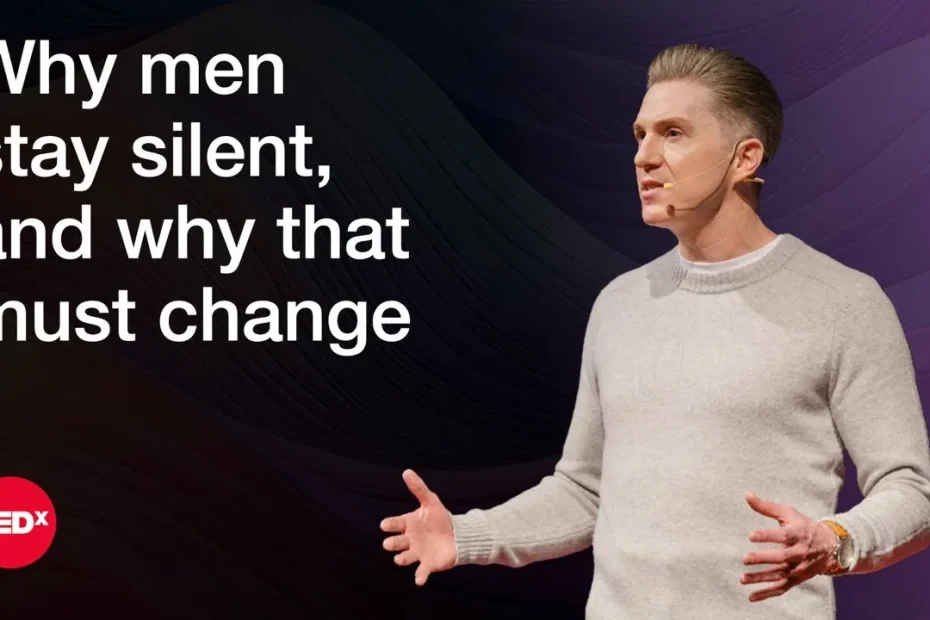
Read the full transcript of men’s mental health counsellor and advocate Dustin Hogan ‘s talk titled “The Silent Crisis of Men’s Mental Health” at TEDxGrandviewHeights conference on Feb 26, 2025.
Listen to the audio version here:
TRANSCRIPT:
Introduction: A Hidden Struggle
DUSTIN HOGAN: Every day as a counselor, I work with men struggling with their mental health, but what’s most important to know is that the guys who reach out to me, they know that they need help. But this isn’t the norm for most men. So many men are struggling and know that something isn’t quite right, but they don’t know who they can talk to, or worse yet, they don’t think they should be talking about their challenges.
Why is this? Well, it’s because the stigma around men’s mental health is very real. And the stigma that us men face when it comes to seeking support for our mental health has created a silent crisis. And I don’t say this because I do this work every single day as a men’s mental health counselor. I say this because I know. I say this because I’ve lived it.
My Personal Journey
You see, at just 14 years old, I knew that something wasn’t quite right. And no, I’m not talking about body hair showing up in places I didn’t think it could grow. But at 14 years old, my days were filled with crippling anxiety. And at that time, I also started to deal with depression that sent my mind spiraling into thoughts of self-destruction, feelings of hopelessness and worthlessness.
My days were filled with anxiety, and sometimes I’d even talk about it. But what I wouldn’t talk about with anybody were the dark thoughts that plagued me. It’s like I was trapped inside my own mind and terrified to let anybody into that part of me. My thoughts that something is so wrong with me, I can’t tell a single person. Otherwise, they’re gonna judge me, fear for me, or be concerned all of the time.
And you see, this is the case for so many men who come through my doors. They’ve been struggling with their mental health for years in silence, but only now they’re reaching out to get the help and the support that they need because they’re at absolute rock bottom and they don’t see a way out.
The Deadly Impact of Stigma
The stigma around men’s mental health has created a silent crisis, a crisis that is quite literally killing us. And I see this every single day with the guys who reach out to me for support. The stigma that us men must always appear strong, unemotional, and self-reliant. That asking for help as a man is to admit weakness and like we’re a failure.
So what ends up happening? Well, many men continue to bottle things up the same way that I did. They continue to stuff it down, to man up, to tough it out. But sometimes, manning up isn’t the solution. And this was all too familiar to me.
Hitting Rock Bottom
It’s September 2018 and while away on a work trip is when I hit my absolute rock bottom. Staring in the mirror of the hotel that I was staying at, it must have been 1 a.m. Tears are just pouring down my face, vibrating with anxiety, surrounded in a dark cloud of mental and emotional pain.
And as I stood there staring at myself in the mirror, all I could think was, how am I going to make it through the next 40 to 50 years of my life like this? This is no way to live. This is mental and emotional torture.
Those tears in that moment were nearly three decades of bottling things up. My feelings that something is so wrong with me and I can’t tell a single person because they’re gonna think that something is wrong. And there I was in that moment, a man in his late 30s, somebody who never really let anybody in. Somebody who could show up to the world like everything was okay but was filled with so much shame, so much self-hatred. If my family, if my friends truly knew my thoughts, that they would abandon me.
So I did like so many men do. I continued to bottle things up. But as painful as those tears were in that moment, they actually began my path to finally opening up. Because I realized I could no longer live like that. When my desire to heal became more important than my need to appear strong, when the stigma no longer mattered, my healing could finally begin.
Redefining Masculinity
So here today with all of you, I want to show you what it’s like for men to get support in a society where mental health stigma reigns supreme. But it’s going to require each of us to actually redefine what it means to be a man in today’s world. To build a culture where connection and compassion are the default and vulnerability, we see that as a strength, not a weakness.
So when I stand here today and say to all of you that the stigma around men’s mental health is killing us, I’m not exaggerating. Because each and every year here in Canada and across the United States, close to 55,000 people, people like you, people like me, end their own lives. And what’s even more tragic is the staggering 75% of these people who end their lives every single year are our sons, our brothers, our fathers, our uncles, our grandpas, our friends, our men.
You see, as men we’ve been chained by the misleading ideas of man up, tough it out, and boys don’t cry. And unfortunately these ideas, they wrongfully brand silence as strength, they paint a lack of emotional vulnerability as a badge of honour, but this could not be further from the truth. Because as men, we don’t have to be silent to be strong.
Breaking the Silence
Truth be told, in the work that I do every single day as a men’s mental health counsellor, I’ve yet to meet a guy who admits, “Yeah man, I have a good cry every Tuesday and Thursday, sometimes on Sundays if my football team loses.
And if I do cry, I use sandpaper because that’s what men are supposed to do, isn’t it?”
The truth is, we’ve all faced the sting of disappointment, we felt the weight of stress, and the fear of failure, and yet as men, so often we feel stuck, trapped inside an invisible cage, unable to share our feelings. Why is this?
And you see, I see this every single day with the guys that I work with. This idea that us men must always appear strong, unemotional, and like nothing gets to us.
Hope for Change
But I actually have hope, standing here right today with all of you. I have hope that as a society, we’ll actually be able to create a shift doing exactly what we’re doing right here, right now, talking about things. Because I believe that this is the first place for us to start.
The way that each of us can start to break down the stigma, is by actively engaging in vulnerable conversations. And for us men to recognize, dude, vulnerability is a strength, it’s not a weakness.
It took me a really long time to get to this point, because like so many of you men, I continue to soldier on to push through my pain. With a simple, yet very courageous act of being vulnerable, of stopping, of talking with friends, talking with family, asking for help, that’s what actually starts the process of healing.
Healing From the Inside Out
But we’ve got to recognize what’s actually happening here, because healing begins from the inside out. It first starts by embracing vulnerability, recognizing that to be vulnerable as a man, is to be strong as a man. And then what happens next? We start talking, we start sharing our stories, we start connecting.
Because when we move from isolation to connection, everything, and I mean everything, changes. It changes because now we’re healing with, we’re healing with our therapists, we’re healing with friends and family, we’re even healing with complete strangers. Because to me, healing with, that’s the best kind of healing. Because we’re taking that very brave step to say that it’s okay to not be okay.
But we have to recognize that for us guys, being vulnerable, sharing our stories, man that is hard. That is like really hard. Because we’re terrified that people are going to judge us, or worse, we’re terrified that the people that we love the most, you’re going to see us differently. We’re terrified that the people that we love, are going to love us less. See us as less of a man, see us as weak, see us as a failure. Because the stigma around men’s mental health tells us that we shouldn’t feel the things that we feel. That we just need to toughen up.
But standing here today, I’ve actually got some really good news. Because what I found for myself, and the men that I work with every single day, has actually been the complete opposite. Because when I started to share my stories, people felt closer to
It sparked connections in a way that I could only imagine. But what’s most important, is that when we share our stories, it actually gives courage to other people to share their stories as well. Because vulnerability encourages vulnerability. And to me, that’s exactly where we need to begin, in order to redefine what it means to be a man in today’s world.
Masculinity of the past has been driven by outdated ideals. Ideals like stoicism, not showing any emotion. Ideals like control and toughness. This idea that we need to be a lone wolf. But we must not let our past dictate our future. We must break down the stigma, and create space for us men to fully express ourselves. Because only then, can we as men build healthier, more meaningful lives.
And the real good news, is when our lives as men are healthier and more meaningful, it actually creates a positive ripple in the lives of everybody around us. And that is my life’s mission. To support men in becoming the best version of themselves. To connect with others. To do better. To be better. To build a world of vulnerability and safety. Because to be vulnerable as a man, that takes a lot of courage. And that’s a world that I want to live in.
The Courage to Reach Out
But it’s also really important for us to recognize that for us men, taking that first step is often the hardest. Every single day I pick up the phone, and so often I’ll hear the slow, steady breathing of a man on the other end who’s reached out for the very first time. And as I sit there, patiently waiting for him to start speaking, he eventually says, “Man this is the hardest call I’ve ever had to make.”
Man, I want you to recognize reaching out is the hardest step. I know, because it was hard for me. But when I took that first hard and courageous step to reach out, to ask for help, to recognize that my struggles don’t mean I’m broken, they mean I’m human, everything changed. Because my crisis was no longer silent.
And I see this every day with the guys that reach out to me for support. And I salute them. Because when we as men share our stories, and we listen to the stories of others, silence actually shifts to opportunity. An opportunity to grow, an opportunity to heal, an opportunity to become better men.
Creating Safe Spaces
So the big question here today is, how do we do all of this? Well first we’ve got to start by celebrating and creating spaces where us men can share without fear of judgment. This could be in a therapist’s office, could be in a peer support group, could be with trusted friends and family. The real good news is these spaces and places can be created anywhere. I am so grateful for those in my life who’ve created those spaces for me. Thank you.
And if the hardest part for us men is to reach out and ask for support, well the hardest part for those that love us is to listen without judgment. To listen without fear, to listen without advice or trying to fix us. Just to listen. And to encourage the men in your life to reach out and get the support that they need. To stick by them. To recognize they’re still the same person, they’re maybe just navigating the most difficult part of their life.
So to me this is what breaking down the stigma around men’s mental health is going to require of each of us. So together let’s end the silent crisis of men’s mental health and break down the stigma. And it happens one conversation and one man at a time. Thank you.