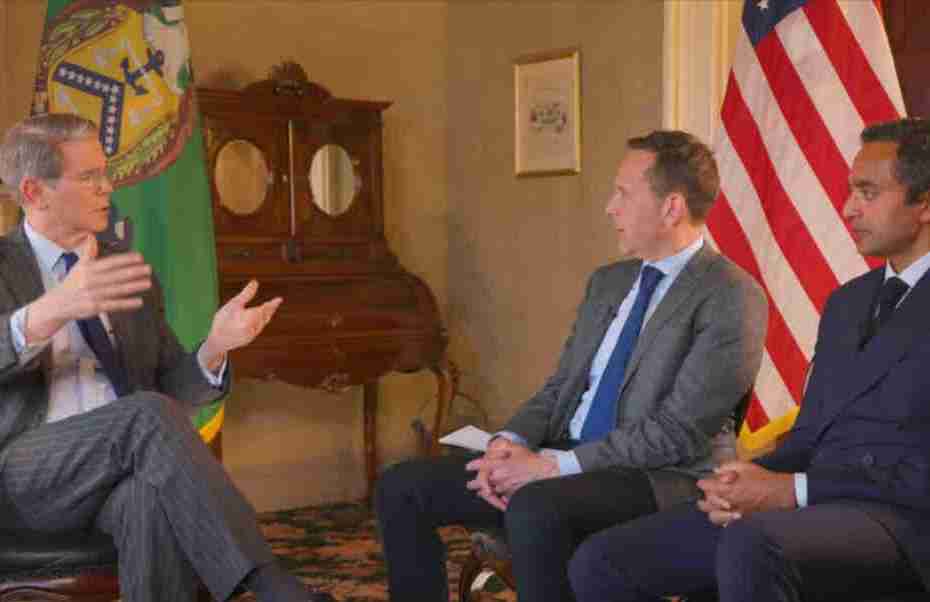
Read the full transcript of Treasury Secretary Scott Bessent’s interview on All-In Podcast, Mar 19, 2025.
TRANSCRIPT:
Introduction and Background
INTERVIEWER: Well, today’s a really important day. We’re joined by the 79th Secretary of the Treasury, Scott Bessent. And this is an opportunity that we wanted to take as part of a longer form way of explaining to people not just how the economy works, but in a little bit more detail where are we in this moment in time? Where are we with deficits, tariffs, the budget, economic, monetary, fiscal policy? How do we make sure that we all understand the plan to make America great again? So Scott, thank you for joining us.
SCOTT BESSENT: Good. Thanks for having me.
INTERVIEWER: I actually want to start with let’s go back in the way back machine. So South Carolina, your father was a real estate developer. Tell us where the passion for finance came from.
SCOTT BESSENT: Well, I don’t know where finance in particular came from. As you mentioned, my dad was a real estate developer and he was kind of boom bust kind of guy. So I think that’s where my passion for risk management came from. But I was very fortunate. Went to Yale, wasn’t sure what I wanted to do. 1980 when I got there, probably you all can imagine this, but there used to be these things called punch cards. And we’d just gone. The Yale computer system had just gone from punch cards to screens.
I was going to think of being a computer science major, maybe a journalist because people actually used to read newspapers. So punch cards in newspapers from the Wayback Machine. And I got an internship just for an individual and he taught me the investment business really well.
INTERVIEWER: And who is that?
SCOTT BESSENT: His name is Jim Rogers. He’s famous. He was George Soros’ first partner. He had just completed an around the world motorcycle trip and written a book called Investment Biker. Fascinating guy. And I did the investment business and I thought this is really what I like because it’s quantitative. So I had to use my quantitative skills. But you’re also constructing a narrative and it’s also like human emotions.
Early Career in Finance
INTERVIEWER: And you were trading equities, bonds, everything, currencies.
SCOTT BESSENT: Well, I started out with equities and I did that for several years and then I actually ended up at Soros Fund Management. Worked for a fellow who’s my mentor, Stan Druckenmiller, who’s incredible. I think he’s on more than 40 years now, never a down year. And when you’re sitting next to him, what am I doing all day?
INTERVIEWER: And notorious for going all in several times in his career.
SCOTT BESSENT: All in?
INTERVIEWER: All in.
SCOTT BESSENT: All in.
INTERVIEWER: Only when he’s right.
SCOTT BESSENT: Yes, well, but he is the best at changing his mind of anyone I’ve ever seen.
INTERVIEWER: So Druckenmiller has that famous adage, invest, then investigate.
SCOTT BESSENT: Well, he has several and I’m trying to get him to write a book because he has so many of these great things. Maybe you all could press him, but invest, investigate. It takes courage to be a pig, right? And then I was hooked on markets because again, it was quantitative, it was qualitative and it’s real time. You get real time feedback all the time and you could have a long term view, but then you’re trying to gauge the short term against that.
I loved it. And for 35 years I’ve gotten to do what’s called macro investing. So eventually I was trading currencies, bonds, commodities, the equities, some credit. And I got to travel around the world meeting leaders and trying to figure out what the next move was in policy.
INTERVIEWER: I think this is important because I’ve spoken with folks who trade in macro. And a big part of the role of being a macro investor, macro trader, is really knowing where central bank action is going to be, really knowing how government bonds are going to move and spending time with economists, not just central, but around the world, and learning a little bit about how capital is flowing all over the world. Is that kind of the right way to describe that role of being a macro investor?
SCOTT BESSENT: Just for folks, it’s a lot of that. There’s another great macro investor called Bruce Kovner and he had this saying that he said, you know, I succeeded because I could imagine a different future and believe it could happen. So the keys to believe it could happen and then manage the risk. So, you know, could you imagine what would happen if the Iron Curtain came down? What would happen? I mean, you all do as venture capitalists, but like, you know, how could the world live in a different state?
Breaking the Bank of England
INTERVIEWER: Okay, well let’s hold that idea and double click for us to ’92. It’s probably one of the most famous moments where the broader world at large met macro trading. And this is really where you and Druckenmiller and Soros basically broke the back of the Bank of England. And it’s really an interesting window into assessing all of these things. So can you give us the conditions on the ground at that moment and what new reality you saw for England? And then it would be great from there we’ll contrast and compare to America today.
SCOTT BESSENT: So it’s a great historical example and it also kind of brings in three dimensions. So I was the analyst, Stan was the portfolio manager, and then in a way, George was the risk manager. So I was running the UK office, I was on the ground in the UK and I had this light bulb go off and I thought the fulcrum thought or my differentiated view was that the UK had just had a big housing boom. And UK mortgages at that time, they didn’t have long term mortgages.
The UK had hooked into something called the exchange rate mechanism. They had to balance versus the deutsche mark. They had to stay within a band. I noticed that if they raised, or I thought if they raised rates to try to stay in the band and protect the currency, it would be unsustainable because British homeowners would get bankrupted.
Stan’s great feat of analysis was figuring out that these bands set up this incredible asymmetric bet because I can push them up against one side of the band and their mandate is just to push me back to the other side. So we just lose two and a half percent. And Stan tells this great story, like telling George Soros, “Oh, well, you know, here’s what I want to do.” And he says, he told him, and George says, “Well, how much do you want to do?” And he said “Probably 100% of the fund.” And he said, Soros gave me this really sour look and he thought that he had said something wrong. He goes, “Well, why wouldn’t you do three times that deal.”
So anyway, we pushed them against the band. The Bank of England, the British government had to buy this unlimited amount of pounds and they started raising interest rates. And this was September of 1992. And eventually they just weren’t able to sustain the pressure from the high rates and came out. And then the asymmetric risk reward was, we made about 20 something percent in a day.
And back to what was really Stan’s genius. I don’t know if either of you play backgammon, but in backgammon there’s the move after the move. And so Stan, we’d made all that money and we were kind of euphoric. Okay, now what? Because there’s going to be the trade after the trade. So we made that much in a day, but then it was actually the trade after the trade. And this isn’t well publicized. I think we made another 20% during the rest of the year.
Current Economic Situation
INTERVIEWER: So in that moment, what you’re really observing is that the real economy is somewhat dislocated, maybe meaningfully dislocated from the financial economy in your operating. And I think you’ve said this now many times. And you’ve basically used the terminology, the Main Street, Wall Street dichotomy. How do you observe the moment in 2025, the maybe. What rhymes with the early 90s or other periods where you’ve been trading actively?
SCOTT BESSENT: Well, look, I think it goes back to something that’s unsustainable is unsustainable. And one of the reasons I’m sitting here now is about 18 months ago I went to see President Trump. I’d known the Trump family for 30 years. I’d never known the president that well. But to tell him that I want to get involved in the campaign because I was so alarmed with what the Biden administration was doing with the debt and deficit.
Endless stimulus, endless spending, endless spending, but endless spending when we were in solid economic territory or not in a war, first time ever. And I thought it was very cynical because I actually thought, well, we’re going to spend, spend, spend, and then there’ll be no choice but to raise taxes. So you’d go into this equilibrium that you could just never get out of and you become kind of a European style social democracy, the malaise.
And I also think that we’re very cynical on immigration because if you take kind of the stated number 12 million, the president’s number 22 million, I don’t know what the truth is, kind of lean toward the President. But it was, oh, we’re going to let all these people across the border. You can’t ever make them problems too big to make them go home. But I like to stay in my finance lane. So the finance lane was we’re going to just go to the point of no return and kind of inflict these, the progressive financial values on the country. There’ll be no way out.
INTERVIEWER: You had very meaningful wage suppression in that period and you had an equity market that was incredibly well bid just because the money supply was just always there.
SCOTT BESSENT: Well, it was always there. And you had these distributional aspects because back to your question, Wall Street versus Main Street, that it was driving me crazy when Vice President Harris said, “I’m going to fight for the middle class” and she’d eviscerated the middle class or these policies, inadvertent, intentional, had eviscerated the middle class and really the bottom 50%. So we’re in this because purchasing power.
INTERVIEWER: Goes down, inflation went up.
SCOTT BESSENT: Well, if you didn’t have assets, right.
INTERVIEWER: That’s really important. I think people don’t understand this, that if you had stocks, if you had assets, your assets inflated. But if you didn’t, the cost of everything inflated, but you didn’t have the ability to purchase because your wages don’t go up.
Economic Inequality and Inflation
SCOTT BESSENT: Yeah. Not only did inflation go up, but if you look, Jason Trinity has this thing, I think he calls it The Everyman Index. CPI went up about 22% during the period, but the Everyman Index was up over 30, 35% because the bottom 25%, the bottom 50% of wage earners have a different basket than we do. And it inflated much faster. Used car prices, car insurance, rent, groceries. And not only is it unfair, but.
INTERVIEWER: It’s just unstable and creates civil issues, societal issues. But sorry, as you guys got into looking at this and I remember Stan talking about this in the summer of ’23, I think it was, and what was the point of view on what should have been done at that point in time? And then how much farther did it go? How much longer did it last?
SCOTT BESSENT: Well, I think what happened, the Democrats will tell you that the big spending bills were needed for rescue. And I would say in March of ’21, the economy didn’t need rescue, it was already in recovery. So these were rescue size packages. And even Larry Summers, I remember there was a great debate between Larry Summers and Paul Krugman. And Summers I think said, look, this is at least 900 billion, a trillion too much.
And the Federal Reserve was summer of ’23, ’22, Federal Reserve was very slow off the mark and we ended up again, imagine top 10% has assets, stock market is flying, you’re in the bottom 50%, you have no assets, but you have debt. So credit cards are up, mortgages, impossible to buy a house. House prices had gone through the roof due to Covid. So it really did end the American dream. But we’ve been suffering these distributional effects.
The American Dream Today
INTERVIEWER: Scott, what is the American dream today, do you think?
SCOTT BESSENT: Look, I think the American dream is what it’s always been. But after World War II, I think 90% of American families, the children made more than the parents. Now I think it’s 50-50, but it’s to own a home, it’s financial security, it’s to some level of comfort, it’s purpose in your work, it’s to be able to support your family, to be able to have choices, to not have to work two jobs.
I made a remark at the Economic Club of New York last week, two weeks ago, and Mike Pence decided he was going to troll me because I said the American dream is not built on cheap goods. And he said, well, yes it is. And I just say with Vice President Pence, this “let them eat flat screens” economic policy doesn’t, isn’t what people want. They don’t want the baubles from China. It’s like the old.
The Importance of Progression
INTERVIEWER: They want progression. People want progression. I mean, I remember reading there’s a study – I think Jonathan Haidt had some work on this a long time ago where happiness is measured by your change in net worth or income per year. It doesn’t matter what your absolute levels are by all these sociologists, economic kind of surveys that they do. That feeling like you’re having some progression in life is what folks are looking for.
And I wonder whether solving for that, we created a system – and I’d love your read on this – that we said everyone should own a home. That’s the American dream. And in order to do that, people put most of their net worth into a home. 60%, I think, of middle class net worth is tied up in a single asset. And then in order to get them to feel like they’re progressing, we’ve created a system of loans and a system of economic and fiscal policy that ultimately drives the value of the home up every year. Now we’re kind of in an unsustainable housing bubble. Most people can’t even afford to buy a home. What did we get wrong there? And how does that affect what the American dream should look like going forward?
SCOTT BESSENT: Well, I think a lot of it’s scarcity because what you’re talking about is like out in San Francisco, super tight zoning laws. So there’s scarcity for homes. If you think like Ivy League education, all of a sudden you gave all these people access to Ivy League education. You brought in international students. But the number of degrees awarded, Harvard, Yale, Princeton, probably hasn’t changed very much since the 1950s. So you created just this demand for scarce things which leads to this anxiety. But you also created, I think, a sense of hopelessness.
INTERVIEWER: I will never be able to pay down my student loan. I will never be able to afford a home. I can never see my income growing to give me access there.
SCOTT BESSENT: Yeah.
Economic Data Reliability
INTERVIEWER: So is that a deregulation solution? I think the first part of it is it’s a data problem because in order for the government – the one thing that struck me about this Trump 2.0 administration is I think you have a better beat on the fact that this data is not as reliable as other administrations would say they were. In order to do whatever it is they wanted to do anyway. So it was sort of like, let me just find the data that justifies what my action is. And part of why you can’t, I think, tell this story is do you trust the GDP numbers? Do you trust non-farm payrolls? Do you think these are reliable enough for you to act on behalf of the United States?
SCOTT BESSENT: No. Look, they’re subject to big revisions over time. And I thought one of the big mistakes the Biden administration made, and thank goodness they made it, was they refused to go with what the American people were feeling. They said, “No, it’s a vibe session and you really don’t understand.”
I was on Meet the Press yesterday and there was something that said, “Well, the American people don’t believe Donald Trump’s doing enough on the economy.” And I told the host, “You know, the one thing I’m not going to answer is that they don’t know what they’re talking about. I have to have respect for how they feel.” And then we need to go back and look at what is causing this anxiety. So that’s what we’re going to do.
INTERVIEWER: So let’s peel the onion back. What do you think is causing this anxiety? Where are the levers that maybe the federal government can control in releasing some of the pressure? And what are more market functions that just need to clear up some of these?
The Three-Legged Stool Approach
SCOTT BESSENT: Well, look, I think we’re trying to do three things and I think you may have talked about it last week or the week before.
INTERVIEWER: The three legs on the stool.
SCOTT BESSENT: Three legs on the stool. And from the outside, you intuited that very well. I would do just a little refinement on that.
INTERVIEWER: That’s what I was going to ask you. Yeah, just tell me where I was right and wrong.
SCOTT BESSENT: But you were adjacent to everything. So on one, we are trying to bring down this massive federal debt, cut the spending, but in a controlled way. You can’t do it all at once.
I don’t like to repeat private conversations with the president, but I’ll repeat this one because I think it really illustrates where his head was at. First time I went to see him at Mar-a-Lago, he said, “Scott, how are we going to get these debt and deficits down without causing a recession?” And that’s exactly where we are now. How are we going to get the debt and deficits down without causing a recession? And I said, “Sir, when you win, you didn’t get us here. We’re going to set a goal by 2028. We want to get back to the long-term average. We’re going to deflate it slowly.”
INTERVIEWER: Long-term average being about 3% deficit.
SCOTT BESSENT: To GDP, about 3, 3.5% deficit to GDP. And you know, the U.S. we don’t have a revenue problem, we have a spending problem because we are averaging right about 18% revenue. And I’m talking about federal government, federal government only. We’re at about 18%. And Biden administration blew it out, blew the spending out to 25%. Normally it’s about 21, 21.5%.
We have the 2% inflation, nominal GDP, real GDP is 1.8%. So we get nominal GDP 3.8% and it all works out. I had one of the heads of one of the Singapore sovereign wealth funds here last week. Guess what Singapore spends in terms of spending to GDP deficit?
INTERVIEWER: 3%.
SCOTT BESSENT: They have no deficit, but they spend 18%.
INTERVIEWER: 18%.
SCOTT BESSENT: 18%. And he said, “You know, we have a lot in common with the Trump administration. We like small government, we don’t like illegal immigration, and we like personal safety,” which I thought was very interesting.
The Debt Challenge
INTERVIEWER: So let me just understand. So deflating government spending is key, but the big challenge has been that we have now accumulated 30 some odd trillion dollars nearly of debt. And the interest on that debt has started to grow. We now have to pay $1.2 trillion in interest payments per year. So that starts to consume more of the spending budget that we have at the federal level, which means we can spend less on the rest of the federal government’s programs, meaning you have to cut a lot more than you otherwise would have, which is what makes it so difficult and so painful.
Is it realistic that you can get Congress to act in the way that Congress needs to act to get to the level that we need to get to, given the high interest payments and the high debt level that we have?
SCOTT BESSENT: Yeah. And with this Republican Congress, and I’m not sure what a deficit hawk is, but I think I would qualify as one. And a lot of the Republicans, I actually have to coax them. You can’t do this all at once. I was with one of the Congressional Budget Committees two weeks ago and they really want to cut this fast. And I said, you do realize every $300 billion we cut is about a percent of GDP.
So we are trying to land the plane well. The plan, because that’s really what I would like to talk about today, I think there are three plans here. Plan one, we’re going to delever the government via the spending. We are also going to shed excess labor from the government. So on that side, and then on the other side, we’re going to deregulate the financial system. The regulated financial system’s really been in what I call a regulatory corset for a long time.
As we deregulate that, then the private sector can re-leverage. So government deleveraging, private sector releveraging, and the employment or the folks who lost their government jobs will be picked up by the private sector.
INTERVIEWER: This is really important and I think this is the most critical thing. I’m really glad we got the chance to talk today because I hear so much about the conversation on any one of these topics independent of the others. And there’s a relationship between them that I think is critical to understand on how this administration is aiming to drive an economic recovery that is not inflationary, is sustainable, and also will allow people to have the American dream in a way that they can’t have access to today.
Addressing the Affordability Crisis
SCOTT BESSENT: Yeah. And so part of fixing the affordability crisis is what can we do. And we can come back and talk about it if you want, but where can we get prices down – like eggs are easy. But the other side of getting prices down is getting real wages up.
So on getting real wages for working people up, it goes back to the Main Street versus Wall Street. And the second plan is to reorder the international trading system and bring manufacturing jobs back to the US and reinvigorate the middle class through tariffs. Well, to use tariffs where needed to bring other countries into line.
INTERVIEWER: Create an economic incentive to onshore for some industries and some supply chains.
SCOTT BESSENT: Well, so there’s tariffs, then I think there are three other things we can do which are the centerpiece of the administration. We can have low and predictable taxes. We can substantially slash regulations because regulations are the equivalent of…
INTERVIEWER: That will drive investment dollars, private investment dollars and predictability.
SCOTT BESSENT: In regulations and then cheap energy.
Tax Cuts and Deficit Reduction
INTERVIEWER: Right. And what is the relationship between the tax cuts and getting to 3%, three and a half percent deficit as a percentage of GDP, especially because the CR unfortunately gave folks a get out of jail free card because we kept the $2 trillion cap for the next…
SCOTT BESSENT: Yes, but you got to have… I’ve been in this building, I think this is my seventh week. President Trump has been back at the White House for eight weeks. So you actually do need time.
INTERVIEWER: Yeah.
SCOTT BESSENT: So a lot of people weren’t happy about the CR. But shutting down the government wouldn’t have been effective either politically or economically.
INTERVIEWER: So does tax cuts get made up with tariffs, or does tax cuts get made up with cutting government spending?
SCOTT BESSENT: Well, tax cuts will… So tax cuts and deregulation will change the growth trajectory, grow GDP. If trend line has been 1.8%, if you can move the growth to 3% or above, then you really change the trajectory. And if you can keep expenses flat or do the unthinkable and cut expenses, then you can really…
INTERVIEWER: So this is important. So government revenue as a percentage of GDP can go lower if you have lower expenses and a faster growing economy?
SCOTT BESSENT: Yes.
INTERVIEWER: I think that’s really important for folks to understand that relationship. And so in isolation, tax cuts might reduce revenue, but when done with reduced government spending and deregulation and a reordered international trade model, you theoretically will accelerate economic growth in this country, increase government revenue overall, even with a lower tax rate. That’s kind of the theory.
CBO Scoring Issues
SCOTT BESSENT: Yeah. And I’ll tell you, shame on me. I was in the investment business 35 years. I talked very confidently about CBO scoring, and it turns out I didn’t really know about CBO scoring. When you’re on this side of the wall, you realize how crazy it is.
INTERVIEWER: So just quite a gameable system.
SCOTT BESSENT: Yeah, it’s very gameable. And one of the most gameable parts of it is in normal CBO scoring. So we’re saying that we want to renew the tax cuts, right? We’re actually just renewing the current tax regime that somehow after they expire, then they go back to the old rate. Spending never changes. Spending never has to get renewed.
And I think when I look and think about a mental model and how do systems work, how do they break down? One of the things that has caused this spending bulge is this idea that you never had to rescore spending.
INTERVIEWER: Oh, it’s nuts. And the incentive model is when you have a constituency that you represent as an elected representative that’s earning from that spending, they’re telling you, if you want to get reelected, make sure my earnings stay and get me more. And then every year, you’ve got a set of elected representatives whose primary objective in a democratic system is to go in and get more money for their constituents. How do we solve that fundamental problem? How do you think about that?
SCOTT BESSENT: You gotta deal with…
INTERVIEWER: Do you actually think that’s true? Do you think that most politicians are here to just get money for their constituents? That’s a good question.
SCOTT BESSENT: I mean it’s OPM, it’s other people’s money.
INTERVIEWER: But they, Danny DeVito had that movie.
SCOTT BESSENT: But you would regard that as being a good politician. Like you brought home the bacon for your district because the cr. A lot of people didn’t like it. But one of the things that a lot of people didn’t like, there were no earmarks in it. But how dare they. Totally.
INTERVIEWER: The Christmas tree bill that kind of shows up at the 11th hour where everyone gets a little bit.
SCOTT BESSENT: Yeah.
Deregulation and Financial Growth
INTERVIEWER: Can you talk about. So we talked about this deregulation as this one very important lever, right. So how do we add 50, 100 basis points of growth back in. We’re going to do it through deregulation. How do you undo the financial corset? As you said, what are the sort of three or four big ideas that you’d like to affect?
SCOTT BESSENT: So we are re-examining all the bank regulations and why are they there? Why do banks have to, I can’t remember, it’s 5 or 7% to hold treasury bills. What are the regulations? Why do… I had a whole group of community bankers or small banks here last week. And why do they have to hold the same amount of capital that JP Morgan and Wells Fargo and Citi hold when they don’t have the complexity they don’t have?
Why do the regulators… One of these small bankers said, “Well, you know, Bank of America does it this way.” Well, Bank of America has a trillion dollars in deposits. This was $183 million bank.
INTERVIEWER: Yeah, well, when you look at the regulatory overhang of some of these things, Basel I, Basel II, you have all of these frameworks and then as a result, all these organizations that are running around trying to help you administer this complexity, all it does is just lower economic activity in the end.
SCOTT BESSENT: But it’s… I know you all talk about incentives a lot. Back to incentives. What’s a regulator’s incentive? Just to keep tightening the corset. They don’t care about growth, they don’t care about the common sense.
INTERVIEWER: Turn off every risk at their job. If you had to create a metric then to say, okay, here’s how we’re going to measure this undoing of the financial corset. Is it sort of the lending velocity by private lenders so that the private re-leveraging can occur, is that a good way to think about that or is rates a way to think about it?
SCOTT BESSENT: Well, it doesn’t have to be rates, but if we do all the things I was just talking about, if we deregulate, if we have cheap energy, if we shed excess labor from the government, if we get government spending down, then rates, inflation should come down. Rates should come down.
INTERVIEWER: Yeah.
SCOTT BESSENT: But on the question of how are we going to measure it, I don’t have any problem with private credit. Yeah. I actually think it’s exciting, the dynamic. It’s dynamic.
INTERVIEWER: It meets the business where it is. Yeah, I agree.
SCOTT BESSENT: And the strength of the US financial system is the depth and now the breadth. But you could see that what’s happened that so much lending is being pushed outside the regulated banking system that tells you it’s over regulated, right?
INTERVIEWER: Yeah.
SCOTT BESSENT: Right. So now once we, so one test will be how has bank lending, especially small regionals, small banks, community banks come undone? And these small banks, the small banks and community banks, they’re 70% of ag loans.
INTERVIEWER: Right.
SCOTT BESSENT: They’re 40% of small business loans. And that’s one of the reasons Main Street’s been stifled.
Working with the Fed and Regulatory Reform
INTERVIEWER: So can you talk about then how you will work with the Fed in sort of the change of all of this financial measurement? Do you need to, and do you need to work with Congress too to make these changes and also just generally maybe your thoughts on just the Fed in this process of helper foe, like where do they stand?
SCOTT BESSENT: Well, the Fed, I 100% support the Fed’s autonomy in monetary policy. I don’t agree with it all the time, but how it is, it’s how it is. And so, and I said I won’t comment on perspective policy. I can talk about their mistakes in the past which have been numerous.
But I think like with any system as it expands beyond sort of the core, I actually think that some of the things they’ve done in regulation, some of the things they’ve done in kind of climate and DEI, some of the things, maybe even non-standard monetary policy threatens their independence. And I want them to stay strong, robust and independent of monetary policy.
On regulation, I think that they have been much too harsh on especially the smaller banks, medium banks. So there’s three main bank regulators, there’s the Fed Office of Controller of the Currency OCC and the FDIC. And then there are other regulators, the SEC, CFTC, but the banking regulators at the federal level are those three.
Here at Treasury we have something called FSOC, Financial Stability Oversight Council and I chair that. And via that the President’s Working Group, which is another convening mechanism that I plan to just keep pushing for safe, sound and smart deregulation. Like, why are we doing this? Why are we doing that? Again, there’s a capital charge to banks for buying treasury bills.
INTERVIEWER: Totally.
SCOTT BESSENT: So I actually think there’s a chance that if we take treasury. It’s called the supplementary leverage ratio. If we take that away, it becomes a binding constraint on banks. We might actually pull treasury bill yields down by 30 to 70 basis points. Every basis point is a billion dollars a year.
INTERVIEWER: Can we talk about that for a second? So I think, and I’ve said this for a year probably, but one of the biggest mistakes that I think Janet Yellen affected was this continued issuance of money on the short end of the curve to finance these deficits, which gives you, you inherit an incredibly difficult challenge. I think over the next nine months, I think there’s like 9 or 10 trillion that has to get refinanced. Do you want to talk about that?
SCOTT BESSENT: Yeah. Look, I thought that when rates were low, you’re supposed to turn out rates.
INTERVIEWER: Exactly.
SCOTT BESSENT: And instead the Treasury for the past few years has pulled rates in. And I think part of that was to keep rates lower, that they changed the issuance schedule when rates move back up towards 5%. I have maintained that policy, but I’m maintaining it because… Back to David’s question. When are you going… When are we going to see the results from this getting the government spending under control? And I don’t think the markets recognize it yet. Again, if we don’t, they’re not sure what to believe.
INTERVIEWER: I mean, we hear this commentary a lot. Like, what do you really… There’s just a lot of uncertainty. There’s a big spectrum of opinions there.
SCOTT BESSENT: Yeah, the central value tendency. You’re right, the central value tendency, like what’s the center of it? Because the range of outcomes is so, so broad. And like, we know, we know there’s a problem there. We know there’s waste, fraud and abuse. Quantify it.
INTERVIEWER: Quantify it.
SCOTT BESSENT: So I think as we are more able to quantify it, we will get credit for it.
Working with Congress on Deficit Reduction
INTERVIEWER: So let me go back. So outside of waste, fraud and abuse, as it’s termed, I want to go back to the question I asked earlier. How much does this administration need Congress to act to get to 3 to 3.5% deficit to GDP and how… What’s your read on the Congress and how willing and able they are to take the action that’s needed here?
SCOTT BESSENT: Yeah, I think there are a lot of headlines, especially after the CR, about the Democrats being in disarray and media likes to write about disarray. I think the under or untold story here is Republicans have, for a change, actually been very disciplined. And I think a lot of that President Trump is kind of shepherding the party, shepherding the movement.
Imagine you said, oh, that Mike Johnson will never get reconciliation instructions out of… He’s got such a slim majority. Well, he did it.
INTERVIEWER: He did it. Yeah.
SCOTT BESSENT: That he’ll never be able to pass a clean CR. He did it.
INTERVIEWER: He did it.
SCOTT BESSENT: So let’s see what happens with the budget. So we need Congress to be our partners on the budget. They’re very engaged, the House and the Senate, that everybody recognizes that if we don’t get this done, it’s going to be the biggest… It’s pass fail. It’s the biggest tax hike in history.
INTERVIEWER: Where does DOGE come in?
Department of Government Efficiency (DOGE)
SCOTT BESSENT: Well, DOGE, that’s the cost cutting. And it’s the first time we’ve really ever had business people looking at it. This Clinton Gore Commission that we hear a lot of like, or hear a lot about, I think it was a bunch of business school professors and…
INTERVIEWER: But here you’ve got real CEOs, you got Lutnick, you got Burgum, you got Elon. I mean, this cabinet is stock full of experienced operators that can go in and identify where there’s an opportunity for saving the taxpayers money and still getting the results.
SCOTT BESSENT: Well, it’s sad. And we had this crypto council meeting the other day. I was sitting, I was looking, it was myself, Secretary Lutnick and Kelly Loeffler. Everybody was a market person, like, forget business.
But with DOGE, I am completely aligned with what Elon’s doing. And everyone says, well, do you have to do it so fast? You have to do it. Like I said, I’ve only been in this business for seven weeks. I’ve only been in D.C. for eight weeks. But the thing I can tell you is if you don’t move fast, the vested interest will weigh you down, the quicksand will come up or the claws get the claw.
Yeah, everybody’s got lobbyists, everybody’s got, I mean, think about it. Within a 10 mile radius of here, 25% of the GDP of the US pulsates through here. Pulsates every day. And everybody wants to just skim a little. I said to Elon, we were in a meeting and I said, you know, people are mad at you because you’re moving their cheese. And he goes, “It’s not their cheese, it’s the American people’s cheese.”
INTERVIEWER: 100% every dollar spent goes into someone’s pocket and that person’s going to fight tooth and nail to get that dollar to keep flowing into their pocket. And it’s very like there is no winning in Elon’s role. Every single time he takes action, there are people that are going to come after him, that are going to come after the administration.
And obviously gets recast, reclassified in the media as being something different. But there’s nothing but downside as you make these changes to individual organizations that participate. And then it takes a while for the flow of that money to find its way or those individuals to find their way back into the productive private economy.
That’s where I think there’s a big gap and a big challenge in the perception of the actions that are going on with the changes right now is everyone sees the cuts, but they don’t see the benefits. And that’s nine months, 12 months, 15 months down the road. And that’s a really hard thing to reconcile for most.
SCOTT BESSENT: Yeah. And I’d say there are a couple of things too. Is one like everyone’s hearing cuts and they think their government services.
INTERVIEWER: That’s right. That’s right.
SCOTT BESSENT: And super important. They’re not, I keep saying it’s the Department of Government Efficiency, not government extinction, not government elimination. And can we make it run much better with fewer people, with fewer costs?
And I don’t want to demonize any of these federal employees because I tell you, in this building, I’ve been so impressed with the quality of the people, I would have hired them in my private firm. They are great public servants. I need you to stay for the weekend. I need a 25 page memo in 72 hours. Super high quality. I actually think what, when all this is done, there will have been two big savings. One will be on these contractors.
INTERVIEWER: We were just talking about this. We were with Elon just now. We were just with Elon in the West. Incredible stat. He said, I’m not going to name the firm so that I don’t want to. But he said this one organization gets 98% of their revenue.
SCOTT BESSENT: It was in a newspaper. So we can say it. It’s Booz Allen.
INTERVIEWER: So we were talking about this, but then we were going through the numbers on the other firms and it’s just the whole thing, it’s shocking.
SCOTT BESSENT: What kind of risk management is that, by the way?
INTERVIEWER: Yeah, yeah, but.
SCOTT BESSENT: But it tells you that… That they didn’t manage the risk.
INTERVIEWER: That’s right.
SCOTT BESSENT: Tells you how entrenched they believe they were.
INTERVIEWER: And how good it is for them.
SCOTT BESSENT: And how good it is.
INTERVIEWER: You’re absolutely right.
SCOTT BESSENT: And the way the drift works, you can only have six-month contracts, but there are people who have had 46-month contracts.
INTERVIEWER: Incredible.
SCOTT BESSENT: They’ve been in situ for 20 years.
INTERVIEWER: Incredible.
SCOTT BESSENT: And it’s this whole—I’m so happy.
INTERVIEWER: There is transparency and visibility into this, if for nothing else. The administration providing this level of insight and data I think is so important for taxpayers and individuals in this country to see, to recognize and importantly to understand just how much of this grift is going on. It’s frightening and I’m glad that it’s—
SCOTT BESSENT: Like being addressed and the American people can see if they want to.
Addressing Entitlements and Government Reform
INTERVIEWER: So this is what I was going to ask you. Let’s just say that somehow the Borg slows this whole thing down. What people say is that the conventionalism, well, the only place to look will be things like entitlements. Good question. Yeah. Do you think that that’s true?
SCOTT BESSENT: Well, I think that now that the cat’s out of the bag, that the American people are not going to stay with this. Maybe again here, maybe in the northeast corridor, there’s some pushback. But when I’ve seen the polling data, the rest of the country does not want this to stop and this administration is not going to stop.
The courts, they’re trying to throw sand in the gears with the courts and how some judge can say, “Oh, all these workers have to come back in.” But I also think we move really quickly now. I think when we start putting out some of the anecdotes and the messages and talk about what’s happening, I’ll talk about it. I’ll be talking about it soon.
But there’s one very large department that everybody deals with on April 15th, that their help desk is fully staffed 24/7, 365 days a year. They’re the same number of people on Christmas Eve as they have on April 14th.
IRS Reform and Technology Integration
INTERVIEWER: Wow. This, by the way, is something that I’ve seen being a lightning rod. Theoretically, every dollar you spend on the IRS, you get $3 back or whatever it is. That’s not necessarily true. Like, I just want to be clear that there’s—you can still get all your tax revenue at the federal level, but you don’t need to waste.
SCOTT BESSENT: Well, look, I mean, I’d be the ultimate chump if I said, “Oh, we’re going to cut spending, but I also cut revenues with the IRS,” which Treasury controls. My three goals are very simple: revenue enhancement, privacy and customer service.
INTERVIEWER: Totally. You know, there’s a body of knowledge that says if we just fed in—and by the way, four or five of these companies can do this now—if we just fed in this entire federal tax code into these AI models, what you can give to Americans is a very guaranteed, resolute ability to file taxes with the assurance that there is no waste, fraud, and abuse. And now all of a sudden, you take this incredible weight off of people’s shoulders. You know, sometimes it is said that you get audited for almost political reasons. It seems like, you know, people that—
SCOTT BESSENT: Not almost. We have a big—we had a big announcement on Tuesday, and we brought in the two Hunter Biden whistleblowers who—they have a lot to say about who gets audited, who doesn’t. They’re going to be sitting in this building working on IRS matters and understanding exactly how these audits get triggered, how these political witch hunts happen, and trying to change the ethos of the building. And again, 99% of the people at the IRS are good people, just like all these other agencies where they’re bad folks.
Social Security and Sovereign Wealth Fund
INTERVIEWER: But to your point, this is where technology can create very reliable guardrails for the American citizens. Where it’s like, okay, well, if this model says, I owe $1,000 in tax, this is it. I’m not trying to change anything. I’ve fed it all the way. Software first. Software first. And you just know.
Let me go back to entitlement. I talked last week on our podcast about Social Security. Social Security has a $2.7 trillion balance, which is just basically a Treasury bond that’s owed that they can’t trade out of. Should Social Security have invested in the S&P or invested in equities? And why don’t we turn Social Security into a sovereign wealth fund and invest it for the benefit of all Americans going forward?
SCOTT BESSENT: Yeah, I think there’s the optimal. Then there’s the possible. George W. Bush tried to privatize Social Security. And I saw your numbers. Listen to your numbers going way back.
INTERVIEWER: 1971.
SCOTT BESSENT: 1971. And with 15, 16 trillion that we have, I don’t know what the numbers are since W. tried it. Yeah, they’d be substantial. We wouldn’t be thinking about a problem in a few years. But I think now you got to play the hand you’re dealt.
I think we are dealt the Social Security hand, and I think maybe we could re-engineer it if we could create the sovereign wealth fund and have that on the other side. There are a lot of philanthropists who are looking at baby bonds. So if you can create some kind of an investment account for newborns, then that would run on a parallel track to Social Security. So that would be compounding. The other thing would be a safety net.
INTERVIEWER: But it’s still sitting in Treasuries on the other side. And that’s where there’s an opportunity not just to drive up returns, but participate in the American economy and give all Americans today the ability to know that they have some participation in the American economy, rather than having their retirement funds being sitting as a loan to the federal government for spending, which I think could be a big, dramatic change. I don’t know if they need to be independent, but I would—I think it’s a real opportunity for us. Are you excited by the idea of the sovereign wealth fund?
SCOTT BESSENT: I am. I’m excited by the idea. This is President Trump. Everything he does isn’t in a straight line, but I guarantee you he has a destination in mind. And the idea that he’s going to be the first president in generations who is going to—he wants to create assets for the American people, not just debt.
INTERVIEWER: Yeah.
SCOTT BESSENT: So he wants to take the debt down. And then this idea of assets. There was a lot of talk about this economic deal we’re going to do with Ukraine that would have gone in the sovereign wealth fund, right? Government has big stake in Fannie Mae and Freddie Mac.
INTERVIEWER: Yeah. When it comes out of conservatorship, where does that go?
SCOTT BESSENT: Where does that go? Doug Burgum did great work when he was governor of North Dakota. North Dakota has the equivalent of two state sovereign wealth funds for, I don’t know, are they 7, 8, 900,000 people? I think they had $25 billion.
INTERVIEWER: Right.
SCOTT BESSENT: And Alaska permanent.
INTERVIEWER: Alaska permanent.
SCOTT BESSENT: The Alaska permanent. But all that’s from the natural resource money going in. So to the extent we start—the other day when the sovereign wealth fund was announced, President Trump surprised me in the Oval and said, “Could you make a few remarks?” And I said, “Well, we’re going to mobilize the asset side of the balance sheet and all the gold.” Said he’s going to revalue the gold.
I can say today we’re not revaluing the gold, but what we are going to do—Doug Burgum at Interior, every other department head is looking for the assets that we can mobilize. So if we have energy leases, federal government owns—back to the housing shortage—federal government owns a lot of land in downtown urban areas. Can we—or in suburban adjacent things in Nevada and Utah, can we use that land?
Privatization and Debt Management
INTERVIEWER: Do you see a wave of privatizations as a way to sort of both pay down the deficits and debts? And also just that’s important to me. Like why put it in a sovereign wealth fund versus pay down the debt? Help kind of do the finance math for us.
SCOTT BESSENT: Oh, you think you get a higher return, right?
INTERVIEWER: Anything that beats our current return, our current interest rate?
SCOTT BESSENT: Yeah, I mean not, not that in keeping score, not that I watch it closely, but the 10-year Treasury today is 4.28.
INTERVIEWER: 4.28.
SCOTT BESSENT: So it’s responding well. Can we do better? Yeah, can we do better than 4.28? And I think with this group and this cabinet and if we can put in—right now we’re working on the study group for the sovereign wealth fund and we want to do best practices. We’re talking to people around the world, we’re talking to investment people, we’re talking to a lot of the other big sovereign funds and we’re going to do best practices. And we want this to be a legacy of that.
INTERVIEWER: Totally. Lincoln. Dan Loeb made this comment that the Australian superannuation, they’ve got 30 managers and they have as much on their balance sheet today in their fund than Social Security does, about $3 trillion and they have 7% of our population.
SCOTT BESSENT: It’s incredible.
INTERVIEWER: It’s incredible.
SCOTT BESSENT: It’s incredible. And I was with one of the Middle Eastern funds and I said something about oil revenue. “We haven’t had an injection into the fund in 20 years.”
INTERVIEWER: Why was this such a miss for America? What happened in the United States was that we took every excess dollar we had and we invested it in the future. We bought in, we built infrastructure. What happened that kept us out of this model where others were so successful and clearly have now gotten ahead of us and their people have a greater kind of safety net than we do?
SCOTT BESSENT: Yeah, I think it was just this idea of it was supposed to be a safety net, not some kind of prosperity ramp.
Energy Policy and Investment
INTERVIEWER: The Old Age and Survivors Disability Insurance Fund, that’s what it’s called, right? Under Social Security. You’ve mentioned cheap energy as a critical part of this holistic program. I think three times now. Where do we make mistakes in that path? Where energy gets out of control. What do we need to do to make sure that energy actually—the incremental cost of the electron basically goes to zero?
SCOTT BESSENT: Well, I think the biggest challenge we’re having right now is trying to get private sector to lock in for some things that might not have a payoff for five, 10 years. And how do we avoid student body left, student body right with administrations coming and going? So we’re trying, we’re working on that.
INTERVIEWER: Well, this is an incredibly nuanced and I think an important point because we have this very vibrant, as you know, tax equity and transferability market that allows a lot of these organizations to make these five and ten year investment cases. And you know, for all the issues with the IRA of which there are many, I think the one narrow aspect that it did was it calmed the markets about the future of those specific ITC credits and transferability.
And it’s a critical thing because there was a report, you probably saw it, but FERC said 90 plus percent of our incremental electrons as of December were from sources that were leveraging these ITC credits and that transferability. So to your point, we have this very delicate balancing act of making sure.
SCOTT BESSENT: We, there’s the tax side, but then the regulatory side with fossil, it’s tougher because it crosses a lot of state lines. There’s a lot more permitting, a lot less permitting for solar farm, for wind, for geothermal.
INTERVIEWER: Yeah, yeah.
SCOTT BESSENT: And nuclear, nuclear is going to be a big part of it, but it’s not going to happen tomorrow.
INTERVIEWER: We got to fix the supply chain and the regulatory.
SCOTT BESSENT: Well, we got to fix the supply chain, we got to fix the regulatory. We’ve got to decide which model are we going to go with. And I’m told that you two probably know more about nuclear than I do, but he loves it.
INTERVIEWER: I hate it. Okay, well no, I don’t hate it. I mean, I like nuclear. I just think it’s 10 years. He’s a loser. Don’t listen to him. It’s just not an investable thing.
SCOTT BESSENT: Well.
INTERVIEWER: It’s important because the question is when it becomes one, that’s when we know we fix the problem.
SCOTT BESSENT: But, but to the point that it’s not investable, that’s where the government needs to step.
INTERVIEWER: I 100% agree with you.
SCOTT BESSENT: Like that’s where we have to bridge to the technology. We have to do the time arbitrage. And also I’m told, especially with the smaller plants that you need to cluster them and you’ve got to find somebody who wants to cluster them and all that.
National Security Aspects of Treasury
INTERVIEWER: Let me ask you one more question as we kind of get to the end. But what’s been the most surprising thing for you in this role since you’ve been in office?
SCOTT BESSENT: The national security aspect. I would say 40-50% of my day, Treasury does a lot of national security work, whether it’s CFIUS in terms of foreigners who want to buy US assets, whether it’s sanctions, whether it’s OFAC, anti-money laundering. We’ve just designated the Mexican cartels as foreign terrorist organizations.
President Trump over the weekend launched a very aggressive missile strike on the Houthi assets. Well, underneath that we’d already been working for several weeks on their bank accounts, or anyone who is adjacent to them. The Iranian supply the Houthis with their ecosystem.
Previous to my getting here, Treasury had disrupted the ecosystem so much that the Iranians used to hand them cash. Now they’re just handing them oil tankers and telling them to try to sell it. So there is the ability to break that down.
Behind-the-Scenes Moments
INTERVIEWER: When you go home and you’re talking to your kids, you’re talking to your husband and you’re like, “this was so cool.” There must be these moments where you’re like, “this was so cool.” Do you have any anecdotes that you’re comfortable sharing where you’re just like, “I can’t believe I’m doing this job”?
SCOTT BESSENT: Well, there have been several, but a good example, my family was actually there because after the inauguration I asked President Trump, “May I bring my family in, say hello, get a photo?” And we’re sitting in the Oval. So myself, my 11-year-old daughter, my spouse, 15-year-old son, President Trump’s having a great conversation with him. And then he said, “Oh, Scott, while you’re here, let me call in these other two people and we need to discuss this.” So they actually got to see government being done live.
I have to say, I think the moment with President Trump, Vice President Vance, President Zelensky was kind of a once in a lifetime thing in the Oval Office. I hope it’s once in a lifetime. But I was sitting there in the front row of history, Vice President, Secretary Rubio, myself on the sofa and watching President Zelensky do what I thought was the biggest diplomatic own goal in history.
INTERVIEWER: I think you said it very well on TV afterwards. It really was based on… And you said because you were there, you tried to negotiate with him in Kyiv. It was a very escalated… I think you used the word escalated or high decibel conversation.
SCOTT BESSENT: High decibel, yes. My job for 35 years was to be outside the room, try to put my ear to the door, maybe lift myself over the transom, figure out what the leaders needed to do, were going to do and then how it would affect the market.
And now it’s fantastic and amazing and stimulating and a little scary being the person in the room who has to ask: What should we do? What can we do? How’s it going to affect the markets? How’s it going to affect the real economy? What’s it going to do to working people in America?
Addressing Housing Affordability
INTERVIEWER: So how do we fix affordability?
SCOTT BESSENT: We’re just going to have to go through and identify where the problem is and what’s the solution. Are the insurance markets broken?
INTERVIEWER: Right.
SCOTT BESSENT: What can we do? I’ve been involved in the house building business. There’s been no technological change in house building in 50 years, maybe 60. Some of the building codes go all the way back to the Chicago Fire.
So what can we do? The way we categorize housing, it’s stick built or modular. Is there something in the middle? Prefab is the more that comes out of a factory, the more that it’s standardized. Neighborhoods from DC to Bethesda to Potomac – you could be in contiguous neighborhoods, and if they’re different municipalities, they’d all have different building codes. Not zoning – building. And why is that? They’re adjacent. Why do the houses have to be different?
So is there some kind of window guidance that the federal government can give in terms of the more that comes out of the factory, the cheaper it’ll be, the faster we can make it, things like that.
INTERVIEWER: Is there pressure that you could apply or influence you can apply? One of the things you mentioned earlier was just, take San Francisco. There is an artificial constraint that’s created by the zoning paradigm. And it’s not clear how you unlock that. Is it up to private citizens to sort of have regime change at the local level? But how do we unclog that part of it to marry up with this kind of stuff? Because it would be great if you could just build up in many places.
SCOTT BESSENT: Well, I think there are a lot of things where you can look around and find what’s interesting that’s being done somewhere. I lived in Greenwich, Connecticut for a while, maybe the richest suburb in America. There’s a ton of multifamily there. Very expensive, very nice multifamily. There’s some affordable housing, but Greenwich is not all 10 acres and a horse farm.
The State of Connecticut has put in a law that every municipality has to allocate 10% of vacant land to multifamily. And if the zoning board won’t give you a hearing, you as a developer, you as a nonprofit for housing can go over the top and go to Hartford and then Hartford will give you the authority. Well, no town wants the state doing that on their behalf. So now the towns negotiate.
I think there are a lot of things that can be done. Again, on insurance, I’ve been thinking about whether there’s something the federal government could do for California. Everyone’s paying homeowners insurance. Then there’s reinsurance on top of that. Then I think the California reinsurance company is called FAIR on top of that?
INTERVIEWER: Well, it’s a separate plan, but…
SCOTT BESSENT: Yeah, but it’s stacking it. So is there something we could do where you put another layer of private money in there and then the federal government is the fifth risk tranche?
INTERVIEWER: Right.
SCOTT BESSENT: But if the federal government comes in, can we mandate proper hygiene down here?
INTERVIEWER: Changes in the building code?
SCOTT BESSENT: Well, changes in the building code, changes in brush cutting, material choices.
INTERVIEWER: Yeah, makes sense. Great.
SCOTT BESSENT: So I think there’s a lot if we…
Energy and Affordability
INTERVIEWER: And obviously energy, I mean, just getting back to affordability.
SCOTT BESSENT: Right.
INTERVIEWER: Energy costs come down.
SCOTT BESSENT: That’s what they took the words out of my mind. Energy costs are energy costs. But then there’s also for food, the transportation cost of getting it to the grocery store, everything that’s made out of petroleum products. So I think we can do that and I think there’s a lot to do.
INTERVIEWER: Yeah.
SCOTT BESSENT: And it shouldn’t be too hard. We’re actually going to be announcing it in about 10 days. We’re going to have an affordability czar. But it’s going to be someone with a lot of experience in supply chains figuring out what are a lot of the quick fixes we can do. Because back to the question, what really has people anxious? Inflation for now is actually pretty quiet. But the affordability has gotten so away from everyone that how can we bring that down?
INTERVIEWER: Yeah, good. For all our friends at home who talk a lot about climate change and carbon free, I think one of the things that I always point out to people is the cheapest way of driving energy production in this country is there’s a low carbon or carbon free alternative that’s out there that’s actually cheaper than standing up new plants. And there’s an acceleration. I don’t know how much this administration thinks about that relationship, but it seems to me like if we can unlock energy production costs come down and this economy transitions.
SCOTT BESSENT: Well, it transitions. And I think it’s also not being dogmatic. I saw what the Biden administration did with EVs. I have an EV. I can’t wait for it to come off lease, but also have a hybrid. And I think I fill it up maybe three times a year. But this administration had a jihad on hybrids because they didn’t pass the purity test.
INTERVIEWER: They were picking winners and losers in a way that a lot of us were left scratching our heads. I think cheap energy solves a lot of problems.
SCOTT BESSENT: I think it will. And cheap energy is energy security, too, 100%. Because that’s why Europe’s kind of over a barrel, literally. And it’s why the Russian war machine hasn’t, again, literally run out of gas.
INTERVIEWER: And to the extent that we believe we’re in an existential arms race for technical supremacy, it’s really on one dimension, which is AI and that is so needy of energy. So if we don’t pull all of these issues together and realize that we need to basically take the incremental cost to zero, whatever we do, we need to create the incentives and package it all together. I mean, we can’t compete manufacturing without energy without a bunch of money, but we certainly can’t compete without energy.
SCOTT BESSENT: Yeah. I mean, we’re not going to crush labor like China and some other countries have done. So we got to crush the energy price point.
Insights on President Trump
INTERVIEWER: Right, exactly right. And when you’re in the Oval, what are the truths and misconceptions of the president, meaning the outside and what people know or don’t know?
SCOTT BESSENT: Oh, how about this? We had a lot of foreign leaders come in, and I knew someone in one of their entourages. I won’t tell you which one. But afterwards he comes up to me and goes, “holy crap.” Because he’s really smart. President Trump has perfect recollection because he was talking about something that had happened in that country 30 years ago.
So President Trump listens. He is judicious. He is just taking it all in. He likes to see how people react. It’s just incredible executive skills. And the other thing, too, that he’s tough. But I went in and I showed him something the other day, and I said, “Well, this is going to cause some layoffs.” He said, “Well, let’s try to fix it.”
INTERVIEWER: Yeah.
SCOTT BESSENT: So I always say he really regards himself as the mayor of America. 330 million people.
INTERVIEWER: He wants to be personable to everyone.
SCOTT BESSENT: And he cares deeply about all of them. And he doesn’t care whether you’re Elon Musk or the guy cutting the Rose Garden. You’re his constituent.
INTERVIEWER: Great. Well, Scott, thank you so much for taking the time. This has been wonderful, a pleasure, and we really appreciate the insight. We wish you the best. And thanks for the service. And thanks for doing the role.
SCOTT BESSENT: Good. Thanks. Appreciate it.
INTERVIEWER: Thank you.
Related Posts
- Larry Johnson: Trump’s Colossal Mistake (Transcript)
- Jeffrey Sachs: US & Israel Attack Iran – War Is Spreading Across the Region (Transcript)
- Diary Of A CEO: w/ Security Expert Gavin de Becker (Transcript)
- Is AI Hiding Its Full Power? w/ Geoffrey Hinton (Transcript)
- U.S. & Israel Strike Iran – What Happens Next? w/ Dr. Roy Casagranda (Transcript)