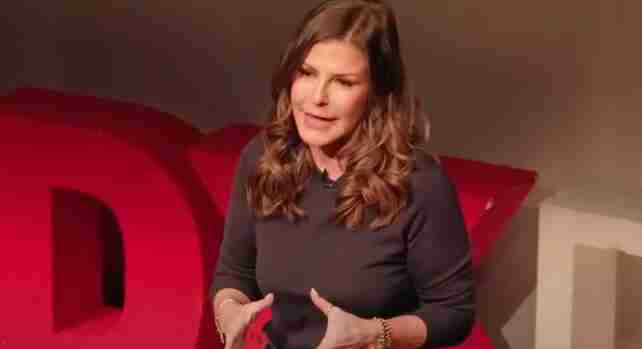
Read the full transcript of Emma McSkelly’s talk titled “Turning Childhood Loss & Trauma into a Superpower” at TEDxDoncaster 2024 conference.
Listen to the audio version here:
TRANSCRIPT:
The Impact of Childhood Experiences
EMMA MCSKELLY: The apple never falls far from the tree, chip off the old block, like father, like son, like mother, like daughter. We’ve all heard these phrases over and over in our lives. I’ve heard them throughout my life, but what if I was to tell you around half of us want to be nothing like our parents. And half of us, our greatest fear is being exactly like them.
When I was five years old, I was scared of the world and all the grownups in it. By six years old, coming home to an obstacle course of used syringes and semi-conscious bodies was very much the norm. My dad had left years before and mum was struggling to make ends meet. We were hungry a lot and I remember going to the priest house with mum to ask for food more than once.
When I was seven years old, my mum died from a heroin overdose. My brother and I were there when she died and so were five or six other heroin addicts. They wrapped her in a rug and they left her whilst they got the drugs out of the house and themselves. We’d seen mum out of it so many times, it wasn’t unusual to see her with her eyes rolled to the back of her head and a needle still in her arm, so we just wouldn’t have known any different.
Fear as a Guiding Force
From that moment on, the fear of abandonment was firmly tattooed on my heart. Imagine if you could transform that fear from an obstacle into a dynamic force guiding your life. Embracing fear could be your passport to freedom. Fear was certainly the vehicle that kept me and my brother safe.
We developed highly sophisticated fear antennas that would later become our guiding light. Now, I’m not the only child to feel like that. There are so many orphaned, abandoned and adopted children who’ve gone on to use the fear that was so finely tuned in their formative years as a force for good. But here’s the thing, you don’t need to suffer great tragedy or be abandoned to feel any of this.
You can feel all of this as a child living in a seemingly ordinary home. Parents may have been emotionally distant, controlling or simply absent. I believe that fear and adversity experienced in childhood, or indeed at any time in life, yes, it’s an obstacle, but it can also become your North Star and be used as a superpower. Understanding and decoding fear can lead to unexpected triumphs and propel us on extraordinary journeys.
Surviving Teenage Years
Fear can be an ally on the path to personal and professional fulfilment. When I was a teenager, it didn’t feel like fear was my ally. Several times I became unhoused. I never slept on the streets, but on those occasions, I’d always head to the accident and emergency department.
Not because I was injured, but I was scared to sleep rough and I figured a busy A&E waiting room was the safest place for a 15-year-old girl to spend the night. I can see some worried faces. This story gets better, I promise. At 16 years old, I was a ward of the court.
I was living on my own in a bedsit in a dodgy part of town. They called it assisted living, where a social worker would check on me once a week. My biggest fear then was being stuck in my hometown. I knew that if I continued to live in these environments that had let me down so badly, I just wouldn’t survive.
Escaping and Exploring the World
I knew I needed to get out and I knew it needed to be as far away as possible. I just didn’t know how. I thought hard about the military. I thought that would give me the discipline, the routine, the sense of community and belonging that I so desperately needed.
I also knew I wouldn’t last five minutes. There was no internet back then and the digital age and the possibilities and opportunities it affords us today were still years away. I used to hang out in WH Smith in the town centre, reading the magazines that I couldn’t afford. I came across a high society magazine called The Lady and in the back were classified ads for jobs working overseas.
I took the first one that replied and next I was on a flight to Norway to au pair for a family. I wasn’t the world’s greatest au pair. The family were brilliant and I was in this house at the side of a lake and I got snowboard every weekend but the main part of my job was to cook and teach the children English. Well, one, I couldn’t cook and two, the kids started speaking in the most strongest northern accent that you’ve ever heard.
It was a real turning point in my life, into feeling fear, understanding its nuances, the different emotions it evokes and the different feelings it gave me in the pit of my stomach. Four years later, I was on a flight to Australia. With no plan and no working visa, desperate to stay, I decided to ignore all immigration laws. I overstayed my visa by seven years.
Now, just in case there are any Australian government officials in the audience or immigration officers, I must make it clear, I handed myself in. I was excluded from Australia for three years and I’ve since returned. Lucky me, one of the most questionable fears I walked so boldly into was not a crime but a serious immigration offence. Not punishable by prison but by simply being removed from a country and a home I’d grown to love.
Career Growth and Global Experiences
After the first year or so in Australia, doing what every expat, backpacker, traveller and illegal immigrant does, I quit working in bars and on fruit farms and I went to work for Channel 10, one of the largest television networks in Australasia.
I sold, produced and starred in many TV commercials and by the time I left, I was ranked in the top three sales performers in the country.
From there, I went to Thailand and then to Stockholm for two years to work for TV4, then onto Discovery Channel in Miami and I can’t remember them all but basically, I spent 14 years living and working in some incredible places. People used to say to me, “You’re so brave for going to these places alone.”
I did not think that was brave. The bravest thing I ever did was come back at 32 years old, broke, fearful and with nothing more than a passport full of stamps and a heck of a lot of amazing memories, I came back. I got to know my father again, a father not without fault, a father who had made many mistakes, a father who’d run at breakneck speed from every fear he’d ever felt but also a kind, compassionate, wise and funny man whose advancing years and terminal cancer diagnosis had afforded him the insight and wisdom to understand his wrongs. His impact on me was profound.
Over the next four years, I got to know him, I really got to know him. I laughed with him a lot, I cried with him, I argued with him also a lot and I eventually nursed him and I got to soak up all that family history, emotion, insightfulness and wisdom that only impending death can give you. 12 weeks of the day after he died, I started my first ever company. With no experience in auctions, never been to an auction, didn’t know anything about auctions, NCM Auctions was born.
Building a Successful Business
I think it was fear of failure, fear of poverty, fear of survival, success really was my only option. Twelve years later, my company now employs 26 people, turns over in excess of seven million pounds a year and has been named by the Financial Times as one of the fastest growing companies in Europe. See, I told you it got better. This company was built on fear.
Today, I employ a group of incredibly talented people. Some of those have never even travelled to London before. I’ve had the privilege of taking these people to business projects in remote parts of Africa, we’ve been to Australia, America and Europe and I’ve loved having them on the journey with me and watching them face their fears and grow. This is the part, I think, that I was going to talk about my business for a couple of minutes but it was a bit boring and it would have been a sanitised version.
It wasn’t about my real fears and it certainly wouldn’t have been about putting on a front because that would be in direct conflict to this businesswoman persona I’ve carefully curated. I used to have masks that I would put on for business, for my friends, even for myself. I built a life, I thought I was building a life that protected me from being vulnerable. I built this multi-million pound company so I never had to feel as vulnerable as I did when I was a child again.
Embracing Authenticity
Ten years ago, I would not have stood here and told my story. I would have found the whole thing really cringy. But we all have a story, every one of us. And if I hide some of it, I’m not being authentic, not really.
So today, I say mine without shame, without fear of judgement. Actually, that’s not true, a little bit of fear of judgement. My most recent fear and also my greatest achievement was becoming a mum to my cherished and wonderful daughter, Marlo. I shouldn’t look because I’ll cry.
The crippling fear and anxiety that I felt during the first 12 months of life was paralysing. It was like nothing I’d ever felt before. The fear of not being good enough, of not having a roadmap on how to be a good mum, not having a good example, it tore me apart. But unlike every other time in my life, I was 40 now, I had resources.
Before I spent a single penny on a fast car or a fancy house, I invested in my mind. I sought out the most qualified Harley Street psychotherapist I could find. And over the next five years, I unpacked decades worth of fears. I began to understand why I am the way I am.
I became more aware and perhaps more importantly, not perhaps, definitely more importantly, I massively reduced the risk of passing on my fears and my trauma to this incredible daughter I’ve been blessed with. So I say to you today, in order to understand fear, you need to walk many times into its deepest bowels. You need to wrestle with every feeling it brings up and every bodily sensation it gives you and break it down to the fear that is useful, the fear that will help you thrive, the fear that you don’t ignore but you use as a green light to go for it. You see, fear is invaluable.
Understanding Different Types of Fear
It keeps us safe. It keeps us from extinction. Back in caveman days when we’re hunting on the savannah and the hunters had a spiking cortisol, eyes dilated and our bodies flooded with adrenaline, this sent a signal to our brains, it was time to feel fear. And good thing too, because it’s highly likely a saber tooth tiger approaching.
And this emotion signals to us to either run or fight. It signals to us to survive. We need that intuitive fear. You see, in its most basic form, it can mean live or die, fight or fly, kill or be killed.
But not all fear is a threat. Not all fear is out to kill us. There is another type of fear that gives us, if we really look deep, a tiny spark. A tiny spark of what if. There’s a slight giddy feeling to it. It’s a glimmer of what if this went right. Imagine if I pulled this off. That is the fear that I urge you to tune into from today.
The type of fear we feel when we accept a job that we think we’re not good enough to do. Or the fear we feel walking into an event. A fear we’re going to say something stupid, look stupid or be out of our depth. The fear of love.
Of love itself. Because accepting love can leave us open to being hurt, vulnerable and exposed. Our bodies and brains don’t distinguish between these two very different types of fear. But all fear is trying to tell you something.
It’s so much more than sight, sound, touch and taste. It’s an intangible. Recognising these two very different types of fear has given me some incredible life experiences. I’ve travelled the world.
Life-Changing Experiences
I’ve camped for six months with a group of Israeli, Brazilian and Canadians on remote islands off the coast of Australia. I’ve trekked the foothills of the Himalayas and stayed on a houseboat in war-torn Kashmir which was on every government red list not to travel to. Which wasn’t very clever, but still. I’ve sold phones door to door in the Blue Mountains with two aristocrat girls who were on a gap year and became lifelong friends.
I’ve sailed around the peninsula of Australia, Croatia and the Mediterranean more than once. Fear may have driven me on that journey, but it’s never stopped me being happy and it didn’t stop me having an incredible amount of fun. These experiences shaped me. And if I had not walked into those fears, those experiences, I would not have had.
A Call to Action
So I say to you today. I believe that each and every one of us has the power and the agency to decode our own fears and turn them into a force for positive change. Understanding and decoding fear can propel us on extraordinary journeys. Fear can become a motivator pushing you beyond your comfort zone.
So as I leave you today, consider your own journey. What fears haven’t you faced? Be it that relationship that’s no longer serving you, that job that leaves you empty and hollow, that career or country you’ve always hankered after. Maybe it’s bigger than that.
Maybe it’s too wild, too audacious to even say out loud. Whatever it is, I ask you to feel it. If the answer to the question of the what if is tantalizing and exciting, then feel it and just go for it. Now, I’m not suggesting we all pack our bags and move to Australia to understand and ignore immigration laws, to understand fear at its core.
When I look back now, some of the choices that I made were reckless, foolish and risk seeking. But they did instill in me a sense of competence and confidence and a deep and thorough understanding of fear itself and the different types that can lead to extraordinary experiences. Understanding fear is a lifelong journey, but it is one that I embrace and recognize. I don’t bury or run from it when it comes along.
I question and I contemplate what it’s here to teach me. I’ve never done much public speaking before. And the couple of times I have, I’ve been solely focused on business. I’ve never told my story to anyone but my close group of friends and my therapist.
I am Emma McSkelly and I just spent the last 17 minutes tackling one of my biggest fears.