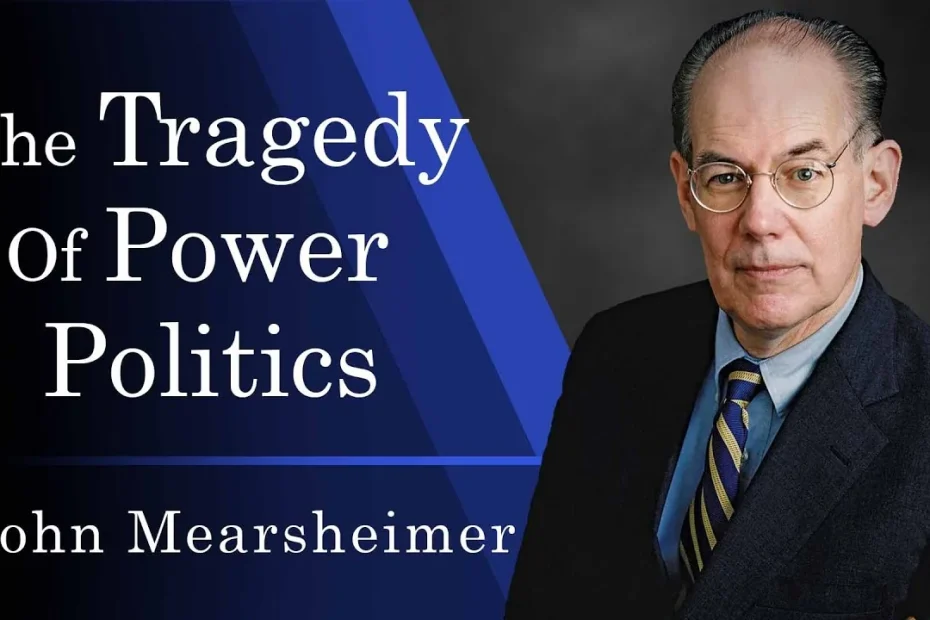
Read the full transcript of a conversation between interviewer John Anderson and interviewee political scientist Professor John Mearsheimer on Ukraine, Taiwan and The True Cause of War [Dec 8, 2023].
John Mearsheimer is the R. Wendell Harrison Distinguished Service Professor of Political Science at the University of Chicago. He’s taught there since 1982. His books include the widely read “Tragedy of Great Power Politics,” and more recently, “The Liberal Dreams and International Realities,” and “How States Think: The Rationality of Foreign Policy” with Sebastian Rosato.
Listen to the audio version here:
TRANSCRIPT:
Understanding Realism vs. Liberalism
JOHN ANDERSON: Well, John, thank you so very much for joining us. We really appreciate your time. You’re coming from Chicago in the afternoon. I’m coming from my farm in Northwest New South Wales early in the morning, and it’s very kind of you to give us your time. Can you kick us off? Your approach to international relations might be called realism as opposed to liberalism. Can you tell us what that means and how you go about viewing this very troubled world we live in, which we’re going to talk about quite a bit?
PROFESSOR JOHN MEARSHEIMER: Sure. Realists believe that power is the currency in international politics, and that states care above all else about the balance of power. The reason states care about the balance of power is because they operate in a world where there’s no higher authority that can come to their rescue if they get in trouble. And at the same time, they can never be sure that a really powerful state in that system won’t come after them, won’t attack them.
If that happens, of course, there’s no one that they can turn to. So what that mandates is that states be as powerful as possible relative to the other states in the system. This is what drives the concern about the balance of power.
What drives many people in the West crazy about realism is the fact that it says that all states behave that way, democracies as well as authoritarian states as well as communist states. All states, in effect, are locked in an iron cage and behave roughly the same way.
As you can imagine, most people in the West who are quite liberal want to believe that there’s a difference between liberal democracies on one hand and authoritarian states on the other. But that’s not the realist view. That is the liberal view.
Let me just lay out very quickly the most prominent liberal theory because I think it’ll be quite clear how it contrasts with realism. That theory is democratic peace theory. It argues that in a world where you have lots of democracies, those democracies will not fight each other. In other words, those democracies, when they think about each other, won’t worry about the balance of power the way realists say they will. But because they’re liberal democracies, they will live in peace. A realist would not accept that argument. But in the liberal West, that’s obviously going to be an argument or a theory that is very attractive.
So I think in capsule form, that summarizes the difference between realism and liberalism.
Power, Morality, and Strategic Interests
JOHN ANDERSON: For me, John, I understand what you’re saying. I get it clearly as two different models, but it immediately raises the question then, does that mean that power is always or might is always right, that power is always about, if you like, authority over others, or does it leave room for higher ideals versus lower ideals? Another way of putting it, is there such a thing as a good nationalism, or is it always competitive and inclined to bear its fangs?
PROFESSOR JOHN MEARSHEIMER: Well, I like to argue that there are instances where doing the right thing, the moral thing, the correct thing from an ethical point of view is consistent with what’s the correct thing to do from a realist point of view.
In other words, if you go to war against Adolf Hitler, that’s the morally correct foreign policy as well as the strategically correct foreign policy. And here we’re talking about the United States during World War II. So the arrows are lined up in a very important way.
But you sometimes run into circumstances where doing the strategically correct or the realist way of acting is in conflict with what is correct from a moral point of view. And the realist argument is that in those cases, you will act according to the dictates of realism.
Going back to World War II, the United States, as you know very well, formed a very close alliance with Joe Stalin and the Soviet Union and worked closely with the Soviet Union to defeat Nazi Germany. Having a close alliance with the Soviet Union is not the ethically correct thing to do. But from a strategic point of view, it made eminently good sense. So we did it. And we, in the process, dressed up Joseph Stalin as a burgeoning democrat, and we were hardly ever critical about the Soviet Union because of its political system. We did all of this because the Soviets were our allies. We needed them to defeat Nazi Germany.
So a lot depends on whether ethical considerations and strategic considerations are in sync or out of sync.
Post-War American Leadership
JOHN ANDERSON: Let’s think that one through a little bit. I hear what you’re saying, and it makes perfect sense. But then I sometimes say to people that at its best, America after the Second World War as a leader of the allies, the victorious side if you like, in many ways behaved, I would have thought you could say very wisely and ominously. You might simply say realistically in relation to both the rebuilding of Europe, think the Marshall Plan, think putting the place back together, strings attached to the thirteen billion, which was a lot of money in those days.
Then you think of Japan, MacArthur there and his role in rebuilding the place and in giving it a democracy and an economy and a way forward, in contrast to the appalling Treaty of Versailles and the way in which it set us up for further disasters. That looks enlightened, it looks humanitarian, it looks wise. Was it simply pragmatic or did it reflect the higher ideals of American leadership at that time?
PROFESSOR JOHN MEARSHEIMER: Well, I think that from a strategic point of view, the United States did an excellent job managing the Cold War. The United States successfully contained the Soviet Union, and eventually the Soviet Union fell apart. And one could argue in a very important way, the United States won the Cold War.
We avoided a great power war with the Soviet Union, and more importantly, we avoided a nuclear war with the Soviet Union. This is not to deny that we did a number of foolish things along the way. I think most importantly, getting into the war in Vietnam was a big strategic mistake on the part of the United States. But I think that by and large, the United States managed the Cold War very well.
Did we always behave in an ethical or moral way? No. We didn’t. And one could point to all sorts of instances where that was not the case. As you well know, the United States overthrew a good number of democracies around the world because it didn’t like those democracies.
If you look at the American bombing of North Korea during the Korean War, it is truly astonishing how much damage we did to North Korea and how many people we killed. A similar case can be found in Vietnam where the Americans killed lots of Vietnamese civilians. So it’s not completely positive picture from an ethical point of view. But, again, I think that strategically, the United States did an excellent job of managing the Cold War.
Democracy and Security
JOHN ANDERSON: It’s an interesting question, isn’t it? I suppose at one level, you could at least perhaps argue that being an American is safe. Being a Russian or a Chinese person under the regimes that they have suffered over the last fifty or sixty or seventy years has at times been anything but safe. You’re not safe from your own leadership. Broadly speaking, the West, the democracies have at least provided some degree of security and freedom for their own people.
PROFESSOR JOHN MEARSHEIMER: Oh, absolutely. The argument that a good realist would make is that realism is a theory of international politics or a theory of foreign policy. It explains how states interact with each other. It has hardly anything to say about domestic politics.
I often make the case that I thank my lucky stars that I live in a liberal democracy. I would not want to live in a country that is not a liberal democracy, and I worry today that the United States is doing a lot to erode its status as a liberal democracy. But I’m a big proponent of liberal democracy.
My argument is that when you start talking about foreign policy, liberal foreign policies get you into a hell of a lot of trouble, and you’re much better off acting as a realist in the international system. So I see a quite clear firewall between domestic politics and international politics.
The Role of Nationalism
JOHN ANDERSON: Is that an argument for a good and a sound nationalism, if I can put it that way, in an age when nationalism’s got a bad name, for good reason, in many ways. But is there an argument to be made for a right nationalism, a good nationalism?
PROFESSOR JOHN MEARSHEIMER: Yes. And before I unpack my views on this subject, let me just say that we’re now inside the state. We’re talking about nationalism as a force inside a country like Australia or the United States.
My basic view is that liberalism alone does not provide the necessary glue to hold the society together. Liberalism is predicated on the assumption that people cannot agree about first principles. And this is why liberalism preaches tolerance. The reason you have to have tolerance to make a liberal society work is because people do not agree about important questions involving the good life. So in any liberal society, you’re going to have centrifugal forces that are going to tend to pull that society apart.
The question then becomes, what provides the glue to hold the liberal society together? And nationalism is a very important glue because nationalism says that all of the people in Australia are part of a nation. They’re part of a tribe. They have something in common, and that something should hold them together in the face of these centrifugal forces that attend liberalism.
So my argument is that a country like Australia and a country like the United States is a liberal national state. It’s a liberal nation state. You need liberalism plus nationalism to make countries like Australia, the United States, and other liberal democracies in the West work.
What’s happened since the end of the Cold War, in my opinion, in the West, is that we have moved towards what I would call unbounded liberalism. It’s liberalism all the time. And nationalism, and this is reflected in your comments, John, is treated as an evil force. I think this is a major mistake.
I fully understand that nationalism has a potential dark side to it. There’s no question about that. But at the same time, it has a potential positive side to it. And I think it’s very important to marry nationalism together with liberalism and to understand that nationalism helps liberalism work. And liberalism actually goes a long way towards controlling the dark side of nationalism. So I believe that these two forces together can work quite well.
Modern American Foreign Policy
JOHN ANDERSON: I think that’s a really valuable set of insights. Can I ask you a really big hypothetical? I’m a bit of an admirer, as you’ve probably gathered, of the leadership that America provided after the Second World War. I think it worked so much better than what we saw after the First World War, and then during the Cold War, as you said. But if you stop and think back of those giants who saw victory at the end of the Second World War and then were magnanimous in rebuilding Europe and Japan. If those people still, if you like, controlled the thinking, the mindset, were leading in Washington today, do you think America would have handled both the Ukrainian situation, the Russian situation as it broadly speaking applies now, and the rise of China in more effective ways?
PROFESSOR JOHN MEARSHEIMER: I think if you look at how the United States has dealt with China since 2017 when Donald Trump jettisoned the policy of engagement and moved the United States towards a policy of containment. If you look at how we have behaved since then, I think it is remarkably similar to how the policymakers in the United States reacted to the Soviet Union as a threat in Europe after 1945.
I don’t think that those policymakers who were in charge in the late forties and early fifties were right at every turn. I think, by and large, they did an excellent job of containing the Soviet Union. They created NATO. They built the necessary military forces to contain the Soviet Union. And as I said before, they avoided a conflict between the United States and the Soviet Union in Europe, which would have been a total disaster. So they did a fine job, but not a perfect job.
I think if you look at the United States since 2017, there surely have been some bumps along the road. But, I think, by and large, the United States has done a good job of dealing with China, and I think we will continue to do a good job.
Ukraine and Russia is a very different issue. I tend to think that had the policymakers who were in charge in the late forties and early fifties been around when we were getting deeper and deeper into Ukraine, they would have avoided it, and we would not be in the mess that we’re in today.
I think it’s very important to understand that China is a much greater threat to the United States than Russia is. And in a world like that, it’s most important that the United States pivot fully to Asia and not get bogged down in a war in Eastern Europe that matters little for the strategic balance of power.
The Strategic Implications of the Ukraine War
PROFESSOR JOHN MEARSHEIMER: Right? And furthermore, from an American point of view, from a realist point of view, you want the Russians on your side against the Chinese. You don’t want to drive the Russians into the arms of the Chinese. Remember, you have three great powers in the present system, the United States, China, and Russia. And in a world where you’re the United States and your principal rival is China, you want the Russians on your side of the ledger.
But the Ukraine war has pushed the Russians into the arms of the Chinese, and it’s made it very difficult for the United States to pivot fully to Asia to deal with its principal rival. And to give you an example, John, that I think illustrates the problem here, in the early part of the Cold War, as you well remember, the United States had both China and the Soviet Union as adversaries. What we did starting in 1972 under President Nixon was we peeled the Chinese off from the Soviets, and the Chinese became allies of the United States against the Soviet Union. That made eminently good strategic sense. And what we should have done long before 1972 was work to have decent relations with the Chinese so we didn’t help to push the Chinese and the Russians or Chinese and the Soviets closer together.
The Roots of the Ukraine Crisis
JOHN ANDERSON: So that’s my basic thinking about Ukraine, which I tend to look at in a very different way than American policy towards China since 2017. To be fair to you, I think it’s what, eight or nine years ago, you delivered a lecture. It attracted a staggering 21 million YouTube views, in which you argued that if America and the EU continue to draw Ukraine away from Russia, then Ukraine would be destroyed. You plainly saw a long time ago that the West was setting itself up for trouble here. I think you’ve even gone so far as to say that in a way, what Russia did when it decided to invade was actually rational.
That doesn’t mean that we like it or approve of it, but that it was rational. Can you fill us in on your thinking about this? Because it goes to the heart of the issue I raised about whether or not those leaders after the Second World War would have been wiser in their approach to it. Maybe we’ve just become too smug and too slow to read realpolitik.
PROFESSOR JOHN MEARSHEIMER: Well, I think that’s exactly what happened here. I think you have to go back to the 1990s to understand what’s going on in Ukraine. There was a big debate in the Clinton administration about whether to move NATO eastward, whether there would be NATO expansion or not.
And inside the Clinton administration, there were a good number of people who were adamantly opposed to expanding NATO because they fought in realist terms. They believed that the Russians would see this as a threat. And as NATO got closer and closer to Russia’s borders, it would all blow up in our face. And they fought tooth and nail to prevent it. This included people like George Kennan. It included Secretary of Defense, Bill Perry, who has said he thought about resigning from the Clinton administration over this very issue.
But these realists were opposed by a good number of liberals, and this included the president himself, Tony Lake, who was his national security adviser, Richard Holbrooke, and a number of others who believed that NATO expansion was a good thing. They had a more liberal mindset and thought that this would help promote democracy and economic prosperity in Eastern Europe. It would not be threatening to the Russians because they would see us as a benign hegemon, and we would live happily ever after.
But what happened is the realists lost, the liberals won, and we started to expand NATO. We got away with a big tranche of expansion first in 1999. That’s when Poland, Hungary, and the Czech Republic came in. Then we got away with another big tranche of expansion in 2004. This is when the Baltic states, Romania, Bulgaria, Slovenia, Slovakia all came in. But then in 2008, the trouble started. Because in April 2008, we thought in terms of a third big tranche. And this time, we said explicitly that NATO was going to bring Georgia and Ukraine into the alliance.
The Russians made it unequivocally clear that this was not going to happen, and Putin made it unequivocally clear at the time that it was a move that would lead to the destruction of Ukraine. Now very importantly, John, at the NATO summit in Bucharest in April 2008 where this policy decision was made, Angela Merkel and Nicholas Sarkozy, the leaders respectively of Germany and France, were unequivocally opposed to bringing Ukraine into NATO. And Angela Merkel has said that the reason that she was opposed was because she thought that Putin would view it as a declaration of war.
So if you think about it here, you have all these policymakers and prominent individuals like Kennan in the nineties, and then you have Angela Merkel and Nicholas Sarkozy who were saying this is not a smart thing to do. And Bill Burns, who’s now the head of the CIA and in April 2008 was the US ambassador to Moscow, wrote a memo to Condoleezza Rice, then the Secretary of State, basically telling her that this is the brightest of red lines, and it’s going to lead to unending trouble if we continue to pursue bringing Ukraine into NATO.
The West’s Response to the Ukraine Crisis
So there were a lot of people who were opposed, and I joined that bandwagon in effect. Right? Because I wrote this famous article in 2014 after the crisis in Ukraine broke out saying that it was the West’s fault in effect for expanding NATO eastward. But what happened here is that we doubled down at every turn. It’s really quite remarkable.
After the crisis broke out in February of 2014, instead of backing off, reevaluating the situation, we doubled down. And we have done that at every turn since then. And the end result is that we’re now in this horrendous war that turns one’s stomach when you think of what is happening to Ukraine. And my bottom line here is that this decision to expand NATO into Ukraine was irresponsible in the extreme because of the consequences for the Ukrainian people, consequences that flowed from this decision for Ukraine as a functioning society. I mean, it’s being destroyed.
I believe this could have been avoided had we not expanded NATO or tried to expand NATO into Ukraine. Had we backed off, but we didn’t do that. And now we’re paying the price. Actually, to be clear, it’s the Ukrainians who are really paying the price, and this is what makes this such a terrible situation.
JOHN ANDERSON: Now your point is that don’t you think that if we had had the leaders who were in charge in the late 1940s and early 1950s that they would have been more sagacious and that they would have avoided this disaster.
PROFESSOR JOHN MEARSHEIMER: I think a good case could be made that that’s true. Again, you don’t want to underestimate how many people have been opposed to this policy of bringing more and more countries, including Ukraine, into NATO from the get-go. There’s been a lot of resistance. It’s just that the other side has won at every turn.
Russia’s Failed Democratic Experiment
JOHN ANDERSON: To pick that up a little bit more, it seems to me that we forget that Russia experimented with democracy. After the fall of the Berlin Wall and, you know, openness and all the rest of it that emerged for a brief time in Russia, they tried democracy. And as Constantine Kissner said to me on the series of talks that you and I are engaged in, it was a disaster because they didn’t know how to do it. There was no support. The corruption rapidly emerged.
And, you know, the average Russian household, which had known a dull conformity and very low living standards, at least had security and at least felt safe and had bread in their pocket. And then democracy produced chaos and corruption, and the disappearance of your daughters into the slave trade at the extremes, and your sons not getting a place at university, getting a job, and it all fell apart.
So you referenced that desire of liberals, as you put it, to expand into Europe and to bring them into, you know, democratic free economy sort of status with the rest of Europe. But surely, the real starting point would have been to have stood more effectively with those people in Russia trying to make democracy work. But perhaps we were consumed by a mindset that said, oh, well, we’ve won the Cold War. We can take a peace dividend. We can all live happily ever after, rather than being utterly realistic, perhaps to use an expression that you might think of or use, and getting in there beside Russia and trying to help them, support them in their attempts to make a democracy work. Or am I being just naive and unrealistic?
PROFESSOR JOHN MEARSHEIMER: No. No. Not at all. Not at all. I think there’s no question that in the 1990s, there was an opportunity. This is the first decade after the collapse of the Soviet Union, to promote democracy in Russia, much the way we’ve promoted democracy in Eastern Europe. We did a terrible job. There’s just no question about that.
One might argue that we did this on purpose because we wanted to keep Russia weak forever. I actually don’t believe that is the case. We just did it in a ham-fisted way. We didn’t know what we were doing. There were limits to how much we could intervene because Russia was a major power, and it was not particularly happy about us violating its sovereignty and coming in and trying to run its politics. But, nevertheless, much of what we did led to disaster.
And, of course, one of the reasons that Putin is so popular today is that he came in, and in very important ways, rescued the situation. Putin, of course, succeeded Yeltsin. Yeltsin was incompetent in the extreme, and Putin has been very competent. And Russia’s in much better shape today than it was in the 1990s. But, of course, it’s not a liberal democracy today, and we wish it was. But I think we did not do anywhere near as much as we might have to realize a more positive outcome.
But there’s another dimension to this that we want to keep in mind, and that is that we did not do much to integrate Russia into a new security architecture in Europe. Russia was very weak in the 1990s. It was not a threat to anyone. In fact, it was a threat to itself. And this presented a real opportunity, I think, for us to work with Russia to see if we could integrate it into some sort of security arrangement in Eastern Europe.
But we did not do that. And on that front, we just continue to keep the Russians outside of NATO and push NATO further and further eastward up towards Russia’s borders. And as I said in an earlier comment, this was destined to lead to really big trouble as I predicted and many other people predicted and as we’re now seeing happen in the Ukraine war.
The Current Balance Between Liberalism and Realism
JOHN ANDERSON: Well, it is what it is. Horrendous to contemplate how disastrously this could all still unfold in coming times in Ukraine. But give us a feel for what you think is the prevailing sort of approach, the balance between liberalism and realism in Washington today in relation to the situation we now find ourselves in in Ukraine?
PROFESSOR JOHN MEARSHEIMER: Well, my view is that during the unipolar moment, which ran from roughly 1990, maybe 1991 to 2017, when the United States was, by definition, the only great power in the system, we were able to pursue a liberal foreign policy. I call it liberal hegemony. The United States was in a position where it didn’t have to worry about rival great powers. It didn’t have to worry about the balance of power because it was Godzilla.
And therefore, it could run around the world promoting democracy, promoting economic intercourse, and spreading institutions here, there, and everywhere. This was liberal hegemony, what it was all about. But what happened around 2017 is that the world transitioned from unipolarity to multipolarity. One cannot underestimate the importance of this transition in the distribution of power. Because once you move from unipolarity to multipolarity, great power politics is now back on the table.
You have three great powers in the system. And one of them, by the way, happens to be China, which is a peer competitor to the United States and can cause all sorts of trouble in East Asia for the United States. This world that we now live in, this multipolar world, is very different than the unipolar world. This is why so many young people, not older people like us, John, who grew up in the Cold War where great power politics was alive and well because it was a bipolar system. But for people younger than us who came of age in unipolarity when the United States dominated the system, great power politics is a way of thinking about the world that’s foreign to them.
They’ve never really experienced it because they didn’t live during the Cold War. But we’re back in a world where great power politics is front and center, both in Asia and in Europe, in Asia with the China-US competition and in Europe with the US-Russian competition, mainly over Ukraine. Now in that world, the world that we operate in today, realism is going to trump liberalism. There’s one qualification to that, and that is the war in Ukraine. And my argument is that the war in Ukraine is a vestige of unipolarity.
The Multipolar World and Its Challenges
PROFESSOR JOHN MEARSHEIMER: It’s a vestige of liberal hegemony. It all started back in the 1990s with NATO expansion. It really began to cause trouble, this NATO expansion, in April of 2008, and then it all blew apart in February 2014. But you notice all those dates are before 2017 when the world became multipolar. So my argument is that this crisis or this war in Ukraine is a vestige of unipolarity.
And in a multipolar world, what the United States should do is everything it possibly can to shut this war down, work to improve its relations with the Russians, and concentrate on dealing with China, which is a pure competitor and which is the real threat. But my bottom line here, just to simplify it, is that we now live in a realist world. That liberal world that existed in the unipolar moment is in the rearview mirror.
The Dangers of a Multipolar System
JOHN ANDERSON: And I suspect that the lesson of history would have to be that a multipolar world is actually an even more dangerous world.
PROFESSOR JOHN MEARSHEIMER: I think that’s correct.
I mean, if you think about the situation we face today, we have the possibility of a great power war in East Asia between the United States and China, and we have the possibility of a great power war in Eastern Europe between the United States and Russia. We, in effect, have two cold wars. And I would argue that in the case of the US-China competition, that cold war, the one that we now see in East Asia, is more dangerous than the cold war that existed in Europe during the period from 1947 to 1989. Now you say to yourself, why do I say that? Why am I saying that this situation in East Asia is more dangerous than the situation in Central Europe during the Cold War?
Well, during the Cold War, when we thought about the possibility of NATO and the Warsaw Pact fighting in the center of Europe, everybody realized that this would be a war between two massive military forces that were armed to the teeth with thousands of nuclear weapons. And the end result, if that war started, was there was a good chance that we would all be incinerated. And given that possible outcome, nobody would want to start a war. War was so horrible. The thought of war was so horrible that the likelihood was very, very small.
If you think about East Asia today, we’re talking about a possible conflict breaking out over the South China Sea, over the East China Sea, or over Taiwan. These are wars that in scale would be much smaller than a war would have been in Central Europe during the Cold War. It’s easy to imagine a war breaking out over the South China Sea or over Taiwan or over the East China Sea.
So what I’m saying here is because the consequences of a US-China war would not be as great as the consequences of a US-Soviet war in Central Europe during the Cold War, the likelihood of war in East Asia today is greater than it was in the Cold War. And I want to be clear here.
I’m not saying it is likely that we’re going to have a war in East Asia and that we should all get ready for a war to break out. That’s not my point. My point is that it is more likely that you’ll have a war in East Asia than it was you would have a war in Central Europe during the Cold War. And point number two is you now have two great power competitions, two Cold Wars, one in Europe and one in East Asia. Whereas during the Cold War, it was a bipolar world and you had one Cold War involving the United States and the Soviet Union.
So we live in very dangerous times, certainly much more dangerous times than existed during the unipolar moment when there was only one great power and therefore no great power competition.
American Willpower and Commitment
JOHN ANDERSON: Sobering, to say the least. Can I ask you about American willpower, if you like, in the face of all of this? You really do have to believe in yourself and your freedoms, in your way of life, I suppose, to make the liberal model work. Perhaps the realist model is a little different if it goes to the very question of your survival and your need to secure safety, not just to dream about a better world, but does America have the commitment and the willpower in your view to say, you know, we will pay a high price if necessary to ensure security and to ensure some degree of global order?
I know that’s a very big question, but we look at some of the numbers around declining defense expenditure, declining preparedness, the number of American or the amount of American hardware that’s laid up or being repaired or not being replaced, the recruitment problems. Do they reflect in your view a major culture that’s perhaps losing confidence in itself to the point where it may not be able to be, let alone idealistic, realistic about what needs to be done?
PROFESSOR JOHN MEARSHEIMER: No. Not at all. I think the United States foreign policy elite is committed to running the world. And the idea that we’re going to pull our horns back is almost unthinkable to me. I actually thought during the unipolar moment, we should pull our horns back. I would have pulled out of Europe if I were running American foreign policy. But the American foreign policy elite doesn’t think that way. The American foreign policy elite, again, is committed to running the world.
But to put it in slightly different terms, the fact is that the United States faces a peer competitor in China, and the United States is not going to let China dominate Asia. I’ve had a serious debate with Hugh White of Australia, who I have enormous respect for, although I disagree with him in fundamental ways about whether the United States had the willpower or the staying power to deal with China, and he believed that we did not. I think he was wrong, and I think the evidence is on my side that the United States is in East Asia to stay for the foreseeable future.
I mean, where your question often gets brought up, has to do with Taiwan, and people want to know whether the United States will defend Taiwan. And my answer to that is the United States will defend Taiwan. Joe Biden has said this four times, and there’s no question given the strategic importance of Taiwan, that we will defend it. And that just shows how committed we are to preventing China from dominating Asia.
So I think, given the attitudes inside the foreign policy elite in the United States and given the structure of the system and how important it is for the United States not to let a peer competitor dominate any other region of the world, we’re going to be involved all over the globe for the foreseeable future. And again, I want to make it clear, I don’t think this is always a good case, but I’m much more of an outlier than I am a member of the mainstream when it comes to this issue.
Military Capacity and Strategic Challenges
JOHN ANDERSON: In some ways, you’ll understand why as an Australian, I find that a reassuring set of comments. Can I ask then, is military capacity keeping pace with that commitment of the foreign affairs establishment in Washington, if I can put it that way?
PROFESSOR JOHN MEARSHEIMER: Yeah. Well, I mean, I think that is the sixty-four thousand dollar question as we used to say when I was a kid.
JOHN ANDERSON: Yeah.
PROFESSOR JOHN MEARSHEIMER: Is the United States pursuing a smart strategy for dealing with China, for dealing with Russia? Is it spending its money wisely? You know, is it in a good position to fight a war should one break out? I mean, I think that if you look at what’s happening in Ukraine, it’s quite clear that the United States made a number of mistakes in terms of managing the defense establishment since the end of the Cold War.
For example, it’s now quite clear from the Russia-Ukraine war that you want to have a powerful industrial base that can pump out lots of artillery and lots of artillery rounds and so forth. And one of the principal reasons that the Russians are in very good shape in the Russia-Ukraine war is because the Russians have significant manufacturing capability when it comes to weaponry, and they can pump out huge numbers of artillery tubes and tanks and so forth. The Ukrainians, of course, don’t have that. But the West, and here we’re talking mainly about the United States, doesn’t have that capability either. We do not have the ability to produce large numbers of artillery tubes.
We’re talking about reestablishing that capability, but we don’t have it. So the United States has a defense establishment, a military establishment, that is now learning lessons in Ukraine. Drones is another example. I mean, I don’t think we fully appreciated just how important drones are for waging modern warfare, and we’re moving quickly to try to rectify that problem. But we have a number of shortcomings that have to be fixed, if we’re going to contain China in smart ways.
And I’m sure the Australians who are watching the war in Ukraine are deriving similar lessons and thinking about how to fashion their military forces moving forward, and furthermore, how the United States and Australia can work together to deal with specific scenarios that might occur in the future. So I don’t want to be Panglossian here and talking about where the United States is today. I think the United States, because we’re coming out of the unipolar moment where we didn’t worry about great power war, has a military that’s got some problems. But I think those problems will be fixed. And I think the United States will, in the end, do a fine job of containing China moving forward.
Technology and Military Power
JOHN ANDERSON: One of the interesting lessons I would have thought out of Ukraine, which must have been noticed in Beijing, is that notwithstanding everything that you’ve said about the wind down of manufacturing capacity and keeping up supply chains and so forth, the technological edge of Western weaponry, American in particular, is still very evident, and that must be of real concern, I would have thought, in those places that are dependent upon Russian technology and that includes Beijing. The technological race is still something that the Americans have tended to lead.
PROFESSOR JOHN MEARSHEIMER: I think that when it comes to weaponry, there’s no question that the quality or the sophistication of the weaponry really matters. If you’re fighting World War II, you’d much rather have a Panther tank or a T-34 than an American Sherman. So the quality matters for sure.
But as you know, the quantity matters as well. I mean, one of the reasons that the Soviets did so well in World War II is they were pumping out T-34 tanks like nobody’s business, and the Germans could not pump out Panther tanks or Tiger tanks anywhere near as fast, and quantity matters. So there is a quantity-quality trade-off here, and you want to make sure that you have the quantity and the quality.
And I am sure that the Russians, when they look at the United States, worry about technology. And let’s just go back to the early 1980s when the Soviet Union saw itself in trouble vis-a-vis the American military. Remember, Marshal Ogarkov was greatly concerned that the United States was on the cutting edge of all these new technologies that were just coming out, and the Russians, for their part, were way behind the power curve in terms of developing these technologies. And Ogarkov believed that if the Russians didn’t or the Soviets didn’t catch up with the United States in some meaningful way, the American military would be far superior to the Soviet military. So even back then, this sort of qualitative edge that you’re referring to mattered greatly, and it matters today.
I want to say just one additional point on this, John, and this is to move away from the Russian-American case or the Soviet-American case during the Cold War and focus on China. When we talk about the security competition between the United States and China today, it’s very important to understand that that security competition has two dimensions to it. One is the military dimension, which we have been talking about, but there’s also an economic dimension that involves high-end technologies, cutting-edge technologies.
And what the United States is profoundly concerned about today with regard to China is that China looks like it might be able to outperform the United States when it comes to developing sophisticated technologies. So we are waging a wicked security competition with the Chinese, not over all forms of economic intercourse, but over intercourse that involves sophisticated or cutting-edge technologies.
So there you can see where we worry greatly, not only that those sophisticated technologies that the Chinese are developing will be used in their weaponry, but more importantly, I would argue, that if they beat the United States in terms of developing these sophisticated technologies, their economy will grow much faster than ours. And the end result is that the power balance will shift between the two countries in China’s favor because those sophisticated technologies are so important for driving gross national product.
So it’s very important to understand that technology has an economic dimension, which has a security dimension, as well as a pure military dimension in terms of the weaponry that you develop.
JOHN ANDERSON: I think this is an incredibly important area. The Australian Strategic Policy Institute, ASPI, a think tank which is not particularly liked in Beijing, I have to say, recently published some material indicating that in around forty vital and important technology areas, China is leading in well over half. Translating that technology, of course, into actual production and useful things is a different matter, but nonetheless, AI for example, there’s a lot of argument over who’s leading in that area. And, of course, the winner will be in a position of unbelievable power.
The Future of American and Chinese Economic Models
JOHN ANDERSON: So you’re right, I think, to alert us to this very real danger. In the end, do you think the American free enterprise model, if I can put it like that, will see the advancement of those technologies with the right settings, pick up to the point where the central command model that’s reemerged in China will not be able to emulate it? I mean, after all, there’s a parallel there with the illustration you just gave with the Russians worried about not being able to keep up with American technology. They didn’t have the economic strength. They didn’t have the free enterprise sort of motivation to provide that basis and that drive and that capability.
China seems to be moving towards that command economy sort of model, which kills the development, even of carefully thought out technology into useful economic models. So how do you think that race will play out?
PROFESSOR JOHN MEARSHEIMER: I would just preface my remarks by saying you want to understand that economics is not my forte. Geopolitics is. So what I say should be taken with a grain of salt.
I think based on all the conversations I’ve had with everybody—in fact, I was recently in Hong Kong at a big conference that involved all sorts of investment bankers—lots of people believe that the Chinese have shot themselves in the foot by moving away from a more market-oriented economy to a command economy.
You know, over the years, people have said that China is a great threat because it’s a communist country. And I have said, we should only wish that China were a communist country because if it were a real communist country, it would have a command economy, and it would look like the Soviet Union. The problem with China is that it had something of a market economy.
It was state capitalism. And you turn the Chinese people loose in terms of developing sophisticated technologies, they’re definitely going to give the United States and the West more generally a run for its money. This is a country that’s filled with highly sophisticated and clever people who are really very good at developing high-end technologies. But, anyway, I think Xi Jinping, based on everything I read and what I hear people saying who study these things, has made a mistake in moving away from a more capitalist economy.
I would also note that if you look at what the Americans are doing, the Americans are also moving away from a market economy, and you see a lot more state capitalism. I mean, you see the state getting more and more involved in managing the economy for the purposes of waging this economic or technological competition. So the United States is moving in an interesting direction, and it will be interesting to see how that works out and to see what Xi Jinping and his successors do in China. But I think that not suffocating the market is of enormous importance for making sure that you end up on top in this competition, or at least the other side doesn’t end up on top.
The 2024 US Presidential Election and Foreign Policy
JOHN ANDERSON: Well, looking a little further ahead, 2024 promises to be a very interesting, if that’s the word, political year in America. And it looks very much from an Australian perspective as though it’ll be a rerun between the two candidates from last time.
President Trump, as you mentioned earlier in the conversation, was a great disruptor. He was also, I think, again speaking from an Australian perspective, inclined to want to embrace the idea of isolationism again in America. What sort of impact do you think next year’s presidential race might have? Both the race itself and then even beyond on America’s engagement with the rest of the world and their willingness to really tackle some of these hard issues.
PROFESSOR JOHN MEARSHEIMER: Let me make a couple points.
One is I don’t think that Trump was an isolationist. You want to remember that it was Trump who jettisoned engagement policy toward China and adopted a containment policy toward China. Trump believed that China was a real threat and that the United States had to contain, if not roll back, China. And that’s not isolationism. Isolationism is going home.
You might have thought that the United States had an isolationist impulse and that we were not going to be in Asia for Australia or for our other allies. That’s not true, and that’s not what Donald Trump thought. Donald Trump did want to pull out of Europe, and he did want to have good relations with the Russians. I personally think that was the smart policy as I tried to make clear before. I would have pulled out of Europe, pivoted fully to Asia, and I think that’s what Trump was trying to do.
Now I think one might get the sense that Trump was an isolationist even though he talked about containing China because he treated America’s allies so badly. I think one of Trump’s real liabilities was that he was not good at working with allies. I think Biden is much better at working with allies. But Trump’s basic instincts were not at all isolationist. And as I said to you before, you want to remember that the American foreign policy establishment is committed to running the world.
Isolationism is not in the blood. Now my final point is that Donald Trump and Barack Obama both ran on the platform that they were going to fundamentally alter American foreign policy, and they were going to reduce our commitments around the world. They were going to get out of the forever wars, not start any more forever wars, and so forth and so on. And they were both elected. Both of them were defeated in the end by the foreign policy establishment.
Obama said in a famous exit interview with the Atlantic Monthly right before he left office in 2017 that he had been defeated by the blob, which is the euphemism we use for the American foreign policy establishment. President Obama, despite the fact that he was elected to fundamentally change American foreign policy, did not do so. I would argue that the same was true with President Trump except for China policy. And the reason that happened was not because of President Trump. It was because the underlying structure of the system went from unipolarity to multipolarity just as Trump was coming into office.
But if you think about Trump’s relations with the Russians, just think about it. Trump said he wanted to have good relations with Vladimir Putin. He wanted to have good relations with Russia. Trump made it clear he wanted to put an end to NATO and get out. Well, NATO expansion continued under Trump.
Trump was the one who, in December 2017, decided to arm the Ukrainians. Obama wouldn’t arm them. Obama said, we’ll train the Ukrainians, but the last thing we want to do is arm them. Trump armed the Ukrainians. Right?
And by the time Trump left office, our relations with the Russians were worse than they were when Obama left office. This is despite Trump’s intention of improving relations with the Russians. Now you ask yourself, why was that the case? It’s very simple. Trump was no match for the blob. He was no match for the foreign policy establishment. And if he gets reelected in 2024, the idea that he’s going to come in and fundamentally alter American foreign policy is extremely unlikely. It just doesn’t work that way. Presidents do not have that kind of power. They can make some changes for sure, but fundamentally altering foreign policy, I don’t think so.
And I don’t think Trump’s going to get out of Ukraine, and I don’t think Trump is going to do much different on China than Joe Biden is doing. In fact, if you look at what Joe Biden has done since becoming president, he’s followed in Donald Trump’s footsteps. Joe Biden, when he was vice president, and Joe Biden, when he was head of the Senate Foreign Relations Committee, was an arch proponent of engagement with China. When President Trump moved into the White House in January 2017, one of the first things he did was flush engagement down the toilet bowl. He got rid of it completely.
Four years later, when Biden replaces Trump in the White House, does he go back to engagement, which he had been a proponent of when he was vice president and head of the Senate Foreign Relations? No. He does not. What Biden does is he actually follows in Trump’s footsteps. And indeed, one could argue, he puts in place a tougher containment policy toward China than Donald Trump did.
And the reason this is the case is because the structure of the system left him with no choice. We now lived in a multipolar world. Biden had little maneuver room. He did what he had to do, and he didn’t behave the way he had acted when he was in a unipolar world. So you see the constraints that are on any president are really quite marked, and Donald Trump will have not a whole heck of a lot of maneuver room should he get reelected.
Prospects for Peace in a Dangerous World
JOHN ANDERSON: Well, you’ve given us a fascinating range of things to think through. Can I ask you this? It’s a sort of “are you an optimist or are you a pessimist” question. Given the environment we now live in, surely realism has to win out over ideological fervor and the vibe, so to speak. Do you think realism will be effective enough to contain those enormous dangers that we’ve talked about?
This is your very blunt assessment that these are much more dangerous times than the actual Cold War when it was a bipolar competition. Do you think we can make it through this period into calmer waters?
PROFESSOR JOHN MEARSHEIMER: Well, I think there is no question that we’re going to have, for as far as the eye can see, an intense security competition between the United States and China. And I believe that there will be crises along the way, crises involving the South China Sea, the East China Sea, and Taiwan. I think that’s unavoidable.
The really important question is whether we can manage those crises and avoid a war. I mean, I think a war over Taiwan or even a war over the South China Sea would be a disaster. I think the problem is that once the war started, it would probably be very hard to shut down just like we’re seeing in Eastern Europe with the Ukraine war. It’s very hard to shut that war down. So that’s what I really worry about, that security competition morphing into a war.
Do I think that with good management, we can get through the next however many years or however many decades without a war? I think there’s a serious possibility that that’s true, but I think there’s a nontrivial chance that we will end up in a war. You want to remember what I said before, John. The problem in East Asia is that it’s easy to imagine a conflict in the South China Sea or in the East China Sea or over Taiwan or even a conflict up in the Himalayas between India and China. It’s much different than during the Cold War when it was really hard to imagine fighting a war in Central Europe because it would have been so horrible.
So my point again is the fact that you have these scenarios that could very well happen that are not that horrible, not as horrible as a war in Central Europe makes one very nervous. Now a possible counter to that argument is, look, we live in a nuclear world, and even a minor conflict in the South China Sea or a minor conflict over Taiwan runs the risk of escalating to the nuclear level. And that threat should go a long way towards preventing a great power war in East Asia. I think that’s an argument that has a lot of punch. I don’t dismiss that argument for one second.
Right? The presence of nuclear weapons makes war less likely. But, again, you can even imagine a war in the South China Sea where nuclear weapons are employed because those are nuclear weapons being employed out in the ocean. And that’s not the same as nuclear weapons being employed in Central Europe or being employed on the Chinese mainland. So, again, maybe war is more likely than a lot of people who believe in the nuclear revolution recognize.
So I’m trying to say here that it’s a complicated matter where it’s almost impossible to come up with firm probabilities as to how likely it is that we will have a war. Again, I think it’s axiomatic that we’re going to have security competition, and it will be intense security competition most of the time. But whether or not you get a war, I don’t know for sure. But I do think, and this is my bottom line, there is a nontrivial chance that the United States will end up fighting China in the decades ahead.
JOHN ANDERSON: Thank you very much indeed for your time and for your extraordinary insights. You’ve given us a great deal to think about.
PROFESSOR JOHN MEARSHEIMER: Thank you, John. It was my pleasure being on your show.
Related Posts
- Transcript: President Trump Addresses the 81st Session UN General Assembly
- Maggie Haberman: Trump’s ‘Unreality Bubble’ Meets the Midterms (Transcript)
- Transcript: President Trump Remarks on Healthcare, Sep. 18, 2026
- Transcript: Jonathan Swan’s Dive into Trump’s Reality: The Weekly Show
- Transcript: President Trump Remarks in Dublin, Ireland – Sep 12, 2026