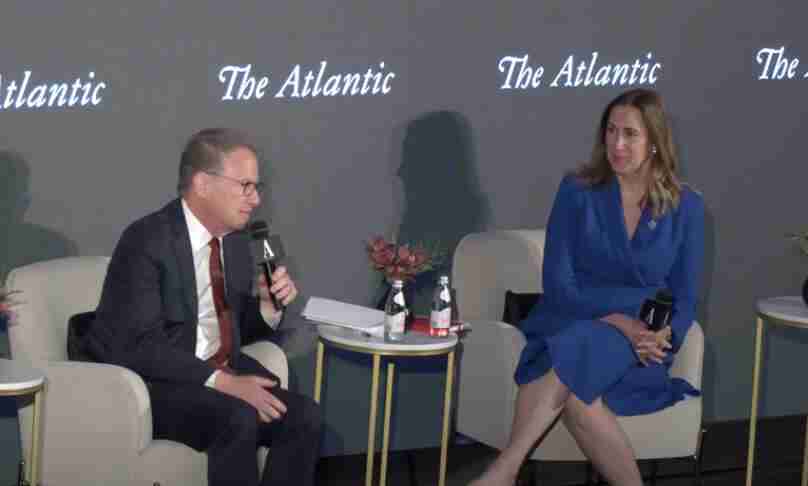
Read the full transcript of a conversation between Kirsten Hillman, Ambassador of Canada to the United States, and The Atlantic’s Jeffrey Goldberg on “What’s Next for the U.S.-Canada Relationship?”, at The Atlantic Festival 2025, April 30, 2025.
Listen to the audio version here:
The Changing Dynamics of U.S.-Canada Relations
JEFFREY GOLDBERG: Thank you very much for joining us today. I’m sure most of you could intuit that in Washington journalism until three months ago, the subject of Canada was not particularly controversial. I mean, we visit, we like Tim Hortons, we like hockey. It’s just the world’s longest peaceful border. It’s just not that controversial. And Canadians, sorry to engage in a stereotype, are pretty mild mannered. And so it has not been a subject of overwhelming journalistic interest or controversy.
Obviously, things have changed. I was talking to Ann Applebaum, and Ann said something to me that struck me. She said that Donald Trump has achieved the impossible. He’s made Canadians angry. And so I want to start with that. Madam Ambassador, are you angry at the way Canada is discussed by the President of the United States?
KIRSTEN HILLMAN: Well, first, thank you for having me. In my polite Canadian manner. I think Canadians, including myself as a Canadian, have gone through a range of emotions. I think sort of surprise, disbelief, confusion, sadness. It’s like the seven stages of grief.
But I think angry, frustrated, angry sometimes because we are unsettled by a behavior in particular with respect to the tariffs that is having serious and immediate impacts on our well being economically. It’s having big impacts here as well, but it’s having impacts on our well being. And Canadians are like, well, can we just talk about this? Because we don’t think this makes sense for you. For us. This isn’t how good friends work together. Let’s get down and talk to it. And we will. But I think, yes, I think Canadians have become very seized of this issue, very seized indeed.
Explaining Trump to Canada
JEFFREY GOLDBERG: How do you explain Trump to your colleagues in Ottawa? How do you explain, do you tell them, oh, he means it. He literally wants to make Canada a state. Do you take him seriously? But not literally. Do you take him not seriously? And not literally? I mean, one of your main roles as the senior Canadian representative in the American capital is to explain America to your bosses and they then explain it to the Canadian people. How do you explain it?
KIRSTEN HILLMAN: So, a few things. One, I think that it’s clear that the President of the United States and his administration are seeking to transform in particular their economic relationship with the world and therefore very much with us. We have the single biggest trading relationship with you of any country in the world. We’re your biggest customer. We buy more from you than China, Japan, the UK and France combined. Like, it’s a huge relationship in all ways, not just economic. And the president and his administration are seeking to change that in ways that I think are quite consequential.
And so that’s the first thing I say, and that is what it is. It will change, and therefore we will change, and therefore we will move into something different than we have been in for a few generations. In terms of taking the President seriously. Donald Trump is the President of the United States. Of course we take him seriously. Of course we take him seriously. He’s a man with enormous influence and power over this country and the world. And so, yes, he has to be taken seriously.
Trump’s Comments on Canada
JEFFREY GOLDBERG: I had the opportunity to talk to the president last Thursday, and I raised some of these issues with him. I want to just read you one passage and maybe get you to comment on what you think he means. And then we could talk about tariffs.
KIRSTEN HILLMAN: Uh.
JEFFREY GOLDBERG: Oh, yeah. No, no, no. It’s going to be fine. It’s going to be totally painless. This is Trump speaking. “I left some very smart people from other countries today, and I have them all the time, you understand?” He speaks in a shorthand patois and I think maybe one of the things I’ve been most successful with is foreign relations.
Me [INTERJECTS]: I think the Canadians would disagree.
Trump: Well, the Canadians, here’s the problem I have with Canada. We’re subsidizing them to the tune of $200 billion a year. And we don’t need their gasoline, we don’t need their oil, we don’t need their lumber, we don’t need their energy of any type. We don’t need anything they have. I say it would make a great 51st state. I love other nations. I love Canada. I have great friends. Wayne Gretzky’s a friend of mine. I mean, I have great friends. I said to Wayne, I’m going to give you a pass, Wayne. I don’t want to ruin his reputation in Canada. I said, just pretend you don’t know me. But they’re great people. You know, they do 95% of their business with us. Remember, if they’re a state, there’s no tariffs, they have lower taxes. We have to guard them militarily.
Me: You seriously want them to become a state?
Trump: I think it would be great.
I respond: A hell of a big Democratic state.
Trump: A lot of people say that, but I’m okay with it, if it has to be, because I think, you know, actually, until I came along.
Then I respond because I was losing my mind: I’m no political genius, but I know which way they’re going to vote. They have socialized medicine.
Trump says: You know, until I came along. Remember that the Conservative is leading by 25 points.
My colleague Ashley Parker says that’s true.
And Trump said: Then I was disliked by enough of the Canadians that I’ve thrown the election into a close call.
Right. I don’t even know if it’s a close call. But the Conservative, they didn’t like Governor Trudeau too much. And I would call him Governor Trudeau, but he wasn’t fond of that.
And then we changed the subject because I didn’t feel like it was going anywhere interesting. I want you to break this down for me, starting from the beginning. “Here’s the problem I have with Canada. We’re subsidizing them to the tune of $200 billion a year.” True, untrue? Explain the context.
The Reality of U.S.-Canada Trade Relations
KIRSTEN HILLMAN: So, as I said, Canada, United States have the biggest bilateral trading relationship in the world. We sell back and forth in goods and services, two and a half billion dollars a day. Two and a half billion dollars a day. It’s enormous. I mean, it’s hard to conceive of for most of us what that looks like in that relationship.
For those who are looking at this through the perspective of balanced trade, which the President most certainly does, in other words, that we sell as much as we buy. Canada has a trade deficit. In other words, we buy more than we sell of manufactured goods, of electronics, certainly services. So stuff that Americans make and manufacture, the things that the President is very deeply concerned about ensuring stay here for good jobs for Americans. We buy more of that from you than you buy from us. And we are about one tenth your size.
So just to put that in perspective, and actually another thing to put in perspective is in manufactured products for the United States, more than half of what you manufacture in the United States you export. So selling your manufactured products to other countries is very important for the jobs that the President wants to create. And I think 77% of your economy runs on services. Again, we are a huge service consumer of American services.
But a third of what we sell you is energy, and a lot of that is oil. And the Canadian oil that we sell is transported down to the Gulf coast where it’s refined. It is, frankly, according to many Canadian experts, sold at a discount. And that has to do with the fact that we only have so many pipelines and we can only get it to so many places. That product is then refined and resold at three times the price into the United States to third country markets, keeping your manufacturing costs down. The manufacturers that rely on that energy, keeping the price of the pump for Americans down.
So yes, we sell you more energy than you sell us. That is absolutely true. And because a third of what we sell you is energy overall, we have a trade deficit, but it’s about $60 billion, not $200 billion. But if you want to balance the trade, if the United States wants to balance trade with Canada, the only way to really do that, we can’t buy that much more from you. We are 41 million people. There’s only so much we can buy. We will have to sell you less energy. And I don’t actually think that’s what the administration wants. And I think proof of that is in the fact that when the tariffs were put on to products of all nations, the tariffs put on Canadian energy were some of the lowest of all.
The Value of Canadian Resources to the U.S.
JEFFREY GOLDBERG: Right, so when he says we don’t need anything that you make, that is self evidently untrue.
KIRSTEN HILLMAN: Well, I think that it is. First of all, I believe that the US benefits from the Canadian energy relationship, from our manufacturing relationship. We sell you critical minerals, we sell you uranium, we sell you all sorts of products that if you weren’t buying them from us, and if you don’t have them in the ground, if you don’t actually have them, then you’re going to buy them from someone else. And is it going to be Belarus or Venezuela? Where is this going to come from? Why wouldn’t you buy it from us? An ally, a steadfast ally and friend, an ideologically aligned country that wants democracy and rule of law.
So what does need mean? Does it mean the United States could survive without affordable Canadian energy? Probably. Does it mean that the price of all sorts of things would go up for Americans? Yes, it does. Does it mean you might buy it from Venezuela? Probably. Is that what, is that the objective? I don’t think so.
I think what the President is looking for is a conversation around making sure that the US is getting the best out of all these relationships. And I am eager for that conversation because I think when we dig into the facts, we’re going to see that we are a source of strength and he’s going to, you know, his people and he will see the degree to which we’re a source of strength for Americans.
Understanding the Administration’s Approach
JEFFREY GOLDBERG: Do you believe this is a fact based administration.
KIRSTEN HILLMAN: I believe it can be. I do. And seriously, I believe that the President is attuned to the effects of his policies on American people. I do.
JEFFREY GOLDBERG: Let me ask you this. You were before you came to Washington five years ago. I mean, you actually came as ambassador to the previous Trump administration. You’re an economist. You are Canada’s chief trade representative. Does the President understand economics?
KIRSTEN HILLMAN: I think the President has a very specific vision of what he’s trying to do in America. I think there are a lot of people that don’t feel that the means by which he is seeking to do that make sense or are traditional. But he’s undaunted. I mean, I think that’s really clear. The President believes in putting in place policies, in particular tariffs to draw investment into the United States and manufacturing into the United States. And he believes that that is going to work. And I am not here to question that. I am here to say, if that is the policy that the United States wants to adopt, there are ways in which in applying that policy to Canada, you are actually undermining your own policy.
The Impact of Tariffs on U.S.-Canada Trade
JEFFREY GOLDBERG: Can you spend a minute or two, I know it’s not very long, explaining necessarily from a Canadian perspective, the flaws in not a specific policy, a general notion of tariffs that the Trump administration is propounding.
KIRSTEN HILLMAN: So tariffs are essentially a tax on anything that’s imported into the country, right? Well, that’s what they are. Not essentially. That is exactly what they are. They are a tax on something that is imported into the country. And they serve a variety of purposes, they raise revenue, they disincentivize imports, they make imports more expensive. And by disincentivizing imports, they can potentially, I suppose, incentivize domestic production.
All of that works in the abstract and sometimes in the concrete. But again, coming back to Canada, U.S. we are deeply integrated over generations to be as efficient and competitive as possible as neighbors and partners by using the comparative sort of advantages, if you will, of each country.
So we are a commodity country. I mean, we do lots of great stuff other than commodities. But in our relationship with the United States, largely what we do, 70% of what we sell to you are inputs that you put into products that you manufacture in the United States that often sell back to us.
JEFFREY GOLDBERG: That’s energy.
KIRSTEN HILLMAN: Energy, lumber, minerals, like small bits of machinery that go into bigger bits of machinery. Steel, aluminum. Right. And you know, Canadians might well say, well, wait a minute here, we actually want to be doing that manufacturing at home. And back to one of your first points. One of the reactions in Canada, which I think is a positive for our country is, hang on a minute here. We need to be doing more for ourselves. We need to be reinvesting in what we’re doing here in Canada. We need to be more resilient and stronger.
JEFFREY GOLDBERG: You buy quite a bit of. You buy products from America that have Canadian made components that are then being finished, sent back.
KIRSTEN HILLMAN: Correct.
JEFFREY GOLDBERG: In a, in an almost, in this case, a developing world kind of relationship. You sent us the raw. No, I’m not, I’m not saying that.
Trade Relationship Between the US and Canada
KIRSTEN HILLMAN: Well, I mean, so a lot of our trade is same in agriculture. I was talking to a CEO this morning who’s in the agricultural field. We sell you 10,000 cattle a month, right, which you process into food. And you sell some of that food back to us. You sell a lot of it here at home. But, you know, we are deeply integrated and sometimes it goes the other direction. Sometimes you sell us raw materials that we manufacture. But largely it is in that direction.
And so that is a good deal for America. That, coupled with inexpensive, reliable energy is a good deal for America. And I think that that is the proposition. Back to your question about does this rationale makes sense? I’m not going to, you know, I’m not going to say whether it can make sense with respect to some of the objectives with respect to our country. If somebody says, is this a fair trading relationship? Is the US getting a good deal out of this? You are getting a good deal out of your relationship with Canada. There is no question about it. But, you know, we’ll see, we’ll see what more the President needs to talk about in this space.
JEFFREY GOLDBERG: What does an angry Canadian look like? No, no, I’m serious.
KIRSTEN HILLMAN: Did you watch that last hockey game?
JEFFREY GOLDBERG: What does an angry Canadian look like off the ice? And what I mean is, at a certain point, again, we could make jokes about stereotypes, but at a certain point, you are discovering a national pride that has not been right up there on the surface the way it is with some other countries, including the United States. And at what point do… And look, your conservative candidate lost, as Donald Trump acknowledges in a kind of like, he doesn’t care way. To me, your conservative candidate lost because he was seen as too close to MAGA ideology. I mean, it was clearly what happened up there was a reaction in part to what’s going on down here. But would you really reorganize your economy to push away the United States at a certain point? I mean, if you can’t get what you consider to be a good deal. What does that look like?
Canada’s Economic Strategy
KIRSTEN HILLMAN: I think that it’s a question of mitigation. Right. I think that there are… We will seek to strengthen our own economy and we’re doing that already. We will seek to reinforce relationships that we have all over the world. We have, you know, trade agreement with Europe, we have a trade agreement in Asia. Canadian business are already giving me anecdotes about selling their product into those markets.
JEFFREY GOLDBERG: You’re a two ocean country, just like we are.
KIRSTEN HILLMAN: Right. So the products that are not as competitive down here because of the tariffs, they’re going to these other countries that can. The US buyers aren’t happy, but the Canadian sellers, you know, are doing what they have to do for business. So strengthening ourselves at home, making sure we have the strongest relationships that we can with our allies around the world and our partners around the world. But of course, we want to get to a place of sort of stability and predictability with the United States.
JEFFREY GOLDBERG: What I’m saying is, what if you can’t? I mean, do you know what?
KIRSTEN HILLMAN: I think we can. I don’t think it’s going to be what the US is. This administration has changed the paradigm on the role that it wants to play and how it proceeds in trade and economic discussions and relationships. There’s no question about that. And we have to adapt. But the American people, the businesses here in America, consumers here in America…
JEFFREY GOLDBERG: Are.
KIRSTEN HILLMAN: Better off with a more stable relationship with your biggest customer. Right? It makes sense for Americans and it makes sense for the people who have put the President into the White House to have affordable products to buy, to have relationships where companies invest in their communities. Companies don’t invest when there’s instability. The whole reason we put these sort of international rules in place is to say, okay, over time you’re going to be able to count on this regulatory regime or this tariff or whatever as that remains tumultuous. As everyone knows who’s reading about the effects of this internationally, there is a chill on investment and there is a concern around the long term stability. So I believe we will get back there somehow because it’s what is best for the American people.
Reflecting on Canada’s Approach
JEFFREY GOLDBERG: Has Canada made any mistakes along the way in managing its relationship with the United States?
KIRSTEN HILLMAN: That’s a good question. I mean, we all make mistakes, don’t we? But I think that… I don’t know. I’m not sure I would characterize it as a mistake. I think that what Canada and probably all of America’s, you know, allies around the world have to continually make sure we fully understand is that the US is seeking to play a different kind of role, to do things differently. Here’s a very good example and that we have to, we have not just hear it, but we have to actually act in a way that fully recognizes that and relate to this administration from where they are. Right. They want to transform the way the US relates to the world. They will do that and we will therefore have to do the same.
Here’s a very good example. In a lot of this bilateral sort of engagement that is happening with countries, I have noticed that the administration seems far less interested in something that was a big feature of US, especially in the economic space, is US activity which was leading the international rulemaking and sort of influencing the world by setting rules for the world.
A very good example is I was our chief negotiator for the Trans Pacific Partnership. And in that agreement the United States had very specific goals with respect to intellectual property rules that they wanted to have in that agreement. We were 12 countries in that negotiation. No one else wanted those rules or many of them none of us were interested in. But the US insisted on a series of rules in that agreement and we wanted the United States in that partnership. And so we all figured out a way to accept those rules.
When the United States backed out of the Trans Pacific Partnership and the rest of us went forward and implemented that agreement, we carved all those rules out. They’re gone. So the regulatory changes that we would have all made in our own countries in order to align with US interests and US business interests are gone. We’re not doing it right. And this sort of bilateral transactional approach with countries has advantages for sure, but it does remove the US from that space. And I find that that is going to be interesting to see how that plays out.
Defense Spending and NATO Commitments
JEFFREY GOLDBERG: Let me ask one specific question on the subject of non economic relationship. Your military is very small. You have a, I think 68,000 active duty soldiers, airmen, 70, 70 sailors, 70, not 68. You don’t spend even 2%, I think, of GDP. Although you’re trying to move it slowly. Isn’t there a legitimate reason for Americans to say, well, Canada, like many European countries, just hasn’t pulled its NATO weight? I mean, I’m wondering if that’s something that stimulates some American resentment of Canada.
KIRSTEN HILLMAN: I think that there’s no question that not just the US but all of our NATO allies are eager to see Canada, you know, spend more and faster. We have tripled our spending in the last 10 years or so. But yes, we can do more and we will do more. We just had an election yesterday. I anticipate that that will be something that our new prime minister will speak to, you know, soon.
So, yeah, I think that that’s a fair point. But I guess the other thing that I would say so absolutely a fair point where we are trying to really orient ourselves in our defense priorities is towards things that we can do that are specific to Canada. We’re spending an awful lot of the money and energy that we have on the Arctic, for example, and really, really investing in the Arctic, investing in north.
JEFFREY GOLDBERG: And that’s a counter Russian activity, among other things.
KIRSTEN HILLMAN: Russia and China. Yeah, yeah, yeah.
The Recent Canadian Election
JEFFREY GOLDBERG: I’m going to go over a couple of minutes because I’m now making myself into a Canada expert rather late in my career, but I find this conversation endlessly fascinating. The election is Trump correct? Did he throw the election to the Liberal? I’m asking you for your analysis. I understand you’re apolitical in this role, but I’m asking you as a Canadian political analyst.
KIRSTEN HILLMAN: I think Canadians were very focused on a small number of things and very near the top of the list for many. Almost all I would say is managing our relations with the United States. That was essential to most Canadians. And then cost of living and we have a housing shortage crisis. We have a few issues that are really important to Canadians. But absolutely, managing the relationship with the United States was top of the list for very many Canadians.
JEFFREY GOLDBERG: How did that help Carney?
KIRSTEN HILLMAN: Well, that’s a good question. I think that Prime Minister Carney, so our prime minister was just elected yesterday, was the former governor of the Bank of Canada, former governor of Bank of England, has a very strong economic pedigree. And I think the Canadians saw that as a skill set that would be very important in this moment in time. If we’re in a moment of transformation. I think Canadians said, okay, this seems to be the skill set that we prefer. This is my as a citizen sort of analysis.
JEFFREY GOLDBERG: Of in other words, he’s going to… he understands what’s coming in these negotiations and is, yeah.
KIRSTEN HILLMAN: I mean, he shepherded Canada through the 2008 financial crisis. He shepherded the UK through Brexit. So he is someone who has dealt with big economic transformations. And I think that that was something and he’s never been elected to office before, so he’s not a politician. So that was, I think, very uncommon. Right. So we will, we’ll see. But I think that that if I was to say I think that that’s not me, it’s essentially the pundits in our country are all the same.
Canadian Identity and Patriotism
JEFFREY GOLDBERG: One more. It’s not really a short answer, but I’m asking you to make it a short answer. But it’s something that is interesting to all of us, this resurgence of Canadian feeling under pressure, Canadian patriotism is becoming a thing. And I’m wondering, just speak to this point, as a Canadian native of Alberta, do you feel differently now as a Canadian than you did six months ago?
KIRSTEN HILLMAN: Not me. Not me. I represent Canada in a foreign land. Right. And I am every single day reminded of my Canadian-ness. It’s a big part of my job to understand that and to express who we are as a nation to you here in the United States and others that I encounter. So for me, no.
But I would say Canada is a deeply patriotic country. We’re a deeply patriotic country with a strong sense of our values, who we are, and our hopes and dreams. But more to your beginning point, we’re a quieter bunch about it. Right. We are not born of revolution. We are born of sort of negotiation. We are born of a much more gentle birth, if you will, than the one you encountered. And I think that kind of…
JEFFREY GOLDBERG: We’re ambivalent about King George III. Yeah, yeah, no, we get it. We get it.
KIRSTEN HILLMAN: You know, we had, the king, had…
JEFFREY GOLDBERG: There are good people on both sides. I get it.
KIRSTEN HILLMAN: And we have… Our founding nations are France, the U.K. but of course, our first nations, our native people were there who, you know, remain a huge part of our cultural reality and importance to our cultural identity. So we are a, we’re just a different country. But it is a, it is a, it is a… We’re the less rowdy cousin at the Thanksgiving table. But not today, not today.
JEFFREY GOLDBERG: Not today.
KIRSTEN HILLMAN: Getting rowdy.
JEFFREY GOLDBERG: And my final, and my final, my final, final question. When you met Donald Trump five years ago, when you first came to Washington to do this job, did you think that he was anti-Canadian? Did you anything, anything suggest that, oh, there’s trouble afoot here?
Trump’s Relationship with Canada
KIRSTEN HILLMAN: No, in fact. So I met President Trump during the NAFTA renegotiation a few times and then over the course of the COVID crisis when we had to slow down the border. And on the contrary, I think very, very supportive of Canada. Very supportive of us. I don’t think President Trump is anti-Canada, just to be clear. I don’t think President Trump is anti-Canada at all.
And Canada’s not anti-United States. I mean, we love you guys. You’re our neighbors and our friends. I mean, you’re talking about military—we fought and died together in all the wars and First World, Second World War, Korea, Afghanistan, all over the world. So there is no greater partnership. We have almost half a million people go between our two countries every day. Not maybe lately, but most.
But truly, we have an enormous amount of interconnection. So we are… If you ask me why I’m confident that we will figure this out, it’s because of that. It’s because of the half a million people almost every day. It’s because of all of this we have to—those of us who represent our people. That is our job is to figure it out. And we will. And I’m convinced that the President will be happy to do so, or will certainly do so.
JEFFREY GOLDBERG: And you know what else is big in Canada? The Atlantic. Did you know that? Big, big magazine, Internet. And so on behalf of the Atlantic, we thank you for coming today.
KIRSTEN HILLMAN: We will now take a brief break. Please return to your seats in 15 minutes.