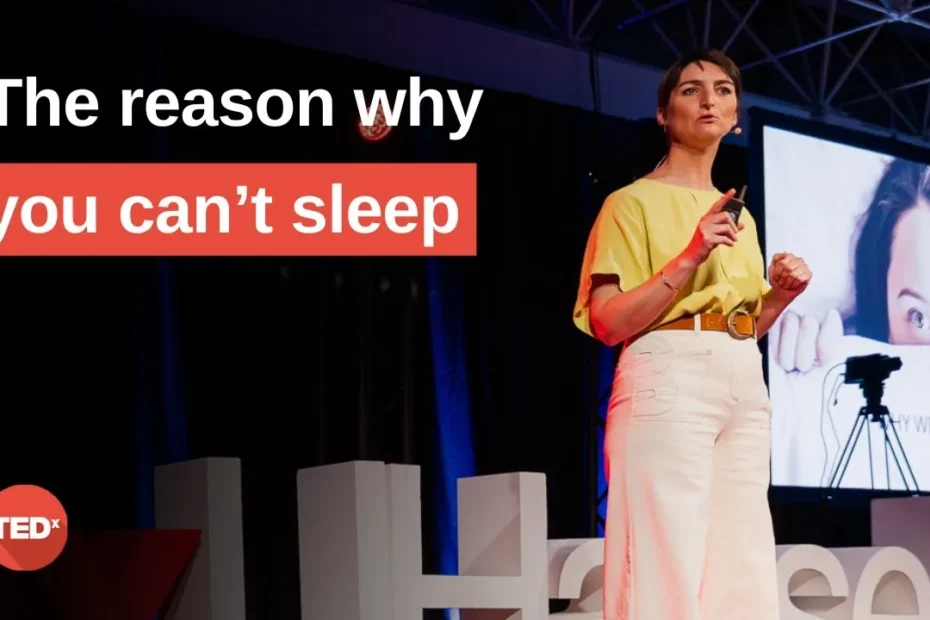
Read the full transcript of sleep expert Dr. Aisha Cortoos’s insightful talk titled “Why We Don’t Sleep” at TEDxUHasselt 2025 conference.
Listen to the audio version here:
The Common Sleep Struggle
Dr. Aisha Cortoos: Hi everyone. Have you ever been in a situation where you came home from work, very busy day, and you were quite tired, maybe even exhausted, and so you decided to go to bed just a little bit earlier. You’re lying in bed, and after 30 minutes or so, you suddenly realize, I’m not falling asleep.
And then this feeling creeps up on you, a jolt of anxiety, frustration, and you start to think about all the reasons why you should fall asleep right now. Maybe you have an important meeting, a deadline, an exam, a TED talk. And then this voice comes up telling you everything that might go wrong if you don’t fall asleep right now. What’s the result? You’re still very tired, but you’re also wide awake.
Now as a sleep expert for the past 20 years, I noticed that most people respond the wrong way to this situation because they lack information on how sleep and work is organized in our brain, on how the so-called sleep-wake engine works. Because if you understand this mechanism, it will be much easier for you to figure out yourself what you can do in your specific situation.
Understanding Your Sleep-Wake Engine
So let’s pop the hood of the car and have a look at that engine. Now imagine that in your brain you have a little balance. In science, we call this a flip-flop of sleep and wake. And on one side of the balance, you have a stress system. Compare it to the gears of a car. The higher you go up into gear, the more vigilant and alert you become.
On the other side of the flip-flop, you have a sleep system. And one of the things that we don’t understand is that sleeping is actually a potentially dangerous behavior. Why? Because we’re completely vulnerable when we sleep. If we go back in time to when we were at the bottom of the food chain, we could be eaten by bears, lions, attacked by a rival tribe, but we needed sleep.
So to solve this problem, your brain connected your stress system with your sleep system. Whenever your stress system is activated and up in a higher gear, it signals a threat, a lion, a reason to stay vigilant. And so it blocks your sleep system. So if you have sleep troubles, the first thing you should always check is, where am I with regard to my stress system? In which gear am I?
Managing Your Mental and Emotional Lions
Now during the day, we encounter what I like to call mental and emotional lions, worries, deadlines, fears, conflicts. And they put our stress system up in a higher gear, luckily, because thanks to that stress system, we can actually perform, react, do something with these lions.
However, our brain is not made to stay in sixth gear all day long. We need rest. We need breaks so we can recover. Any athlete knows this. Everything needs to be followed by recovery. But the same goes for mental performance.
When I evaluated brain functioning of insomnia patients, I noticed that it took them much more time, but also much more effort to go from a high gear to a low gear, to go from very vigilant to relaxed or from relaxed to sleep. It was as if their stress system had become rigid.
So here’s a piece of advice. Try to change your stress level as much as possible during the day. This will keep the mechanism smooth and flexible. So even if you say, I only have 10 minutes, use those 10 minutes. Go down into gear, relax, take a break, allow yourself some recovery time. Do not stay productive all day long. It’s impossible. If you make a habit out of that, you will notice that it becomes much easier to go down into gear at the end of the day.
Taking the Exit from the Mental Highway
Because then, especially in the evening, we have to take the exit of the mental highway, as I like to call it. And for that, we need time, not 15 minutes. Most of us need one, two hours, sometimes more. But it’s not just time. What we do also matters.
Because sometimes people tell me, “Yeah, I do it, it doesn’t work.” But then I hear stories such as, “I’m watching TV, and then there’s a message, so I respond. And then my eye caught a message on social media, so I scroll for a while. Then I go back to the TV, and then my mind pops to something else, and I check my emails.” This is not taking the exit of the mental highway. Sometimes this is just going back up the mental highway.
So be more conscious of what you do when you try to relax in the evening. Engage in single-tasking activities. Whatever helps you to really disconnect from your responsibilities, and tell your brain, there are no lions, I am safe. Only when your stress system is completely deactivated will it stop inhibiting your sleep system.
But everybody here has a different stress system. So what’s important is that you figure out how yours works, and not just how others manage theirs. Being a sleep expert, many people assume that I am a perfect sleeper. Unfortunately, that’s not the case. I am and I will always be a fragile sleeper, a sensitive sleeper. Why? Because I have a very sensitive stress system. It goes up into sixth gear like that, and then it needs a lot of time to go down. It was only when I accepted that and figured out what my specific stress system needed that things changed, together with responding differently to bad nights.
The Role of Physical Activity
Now, when we talk about stress management, we have to talk about physical activity and the impact. So when you all detect your lions during the day, your brain puts you into a mode that allows you to run away and escape. However, nowadays, we don’t move an inch. The only thing that moves are our fingers on the laptop. That’s it.
So what happens is, your brain keeps you into this mode that allows you to run away whenever possible. It’s a bit like keeping the engine running of the getaway car at a bank robbery. Keep the engine running. Once you engage in physical activity, you give a feedback signal to your brain telling, we’re off now, you can slow down.
So try to implement enough movement, physical exercise. It doesn’t have to be high intensity, just walking is fine. It will help you manage your stress, your lions.
Breaking the Vicious Cycle of Chronic Insomnia
If you don’t manage your stress during the day and the evening, you will end up lying awake for too long. And that might lead to a very, very difficult, vicious cycle of chronic insomnia. What happens with them is, lying awake becomes the lion. Lying awake is now the danger, but that is problematic because we will always lie awake in bed.
Most people need 20, 25 minutes to fall asleep. That is not a sleep problem, people. Most people wake up once or twice just to check if you’re safe. But if you then label that immediately as a danger, what happens is, you immediately activate your stress system thinking, “Oh my God, there’s a lion underneath your bed. Let me help you. I will keep you awake and vigilant.” And then you lie there awake and vigilant and you think, “Oh crap.” So avoid that.
Understanding Your Sleep System
So maybe by now you figured out, I am a true Zen Master. No problem. I can manage my stress during the day, in the evening. Then maybe it’s a good time to have a look at that other system on the flip-flop, your sleep system. That consists of two processes, your need for sleep and your biological clock.
Now your need for sleep, compare it with being hungry for sleep. And it’s the same like regular hunger. The longer you don’t eat, the more hungry for food you become. With sleep it’s the same. The longer you’re awake, the more hungry for sleep you become.
The Difference Between Tiredness and Sleepiness
Now here’s an important question you need to ask yourself. What is the exclusive physical signal telling you, “Oh, I am hungry for sleep, so ready for bed?” Think about it. Many people answer with, “When I can’t focus, when I’m tired, when I start to yawn.” But the problem is that those signals can also refer to something else. I’ve been in sixth gear all day. I need to relax. I’ve been bored all day. I need to be activated.
So that exclusive physical signal, we call that, ta-da, sleepiness. And it is not the same as tiredness. Sleepiness is that sensation where you feel like your eyes are closing and you need to make an effort to stay awake. That is not tiredness. So next time you have trouble sleeping, ask yourself, am I actually hungry
enough for sleep or am I just tired? Maybe I need to relax a little bit more first. The easiest way to increase that sleep pressure, that hunger for sleep, is stay awake. But when you do, take the exit of the mental highway. Don’t forget it.
What are side effects of a heightened sleep pressure? One, you fall asleep quicker. Two, you go to deep sleep quicker. And three, it takes more time before you wake up the first time. Now those are interesting side effects.
Understanding Your Biological Clock
Now let’s have a look at the biological clock. This is a marvelous mechanism. It is your guru of time management. It is your structure junkie. And it’s not just responsible for sleep. No, it regulates a lot of functions in your body. Digestion, temperature, hormone production.
But it wants to know 24 hours in advance what you do and when you do it. And then it makes a 24-hour automatic program that can roll out. For sleep, it knows it’s potentially dangerous. So it will look out for signals telling if it is safe enough to feel your need for sleep. So it decides when you can feel your hunger for sleep.
Signals like light, darkness, physical activity, food intake, body temperature, those things. For example, it is dark, you’re physically inactive, and your body temperature is slightly dropping. Then the biological clock says, “okay, this is nighttime, you’re safe in your cave, the lions are asleep. This is a good time to feel if you’re hungry for sleep.” And so it produces melatonin, a darkness hormone.
Melatonin doesn’t create sleepiness. No, no, no. It actually allows you to fully feel the sleepiness that is already present in your body, that hunger for sleep.
On the other hand, if there’s a lot of light, you’re physically active, your body temperature is slightly up. Then the clock says, “daytime, you are outside of your safe cave, the lions are awake. Not a good time to feel your need for sleep.” So it produces cortisol, a stress hormone, blocking any sensation of sleepiness.
Stabilizing Your Internal Clock
Now what does this mean? We need to stabilize, we need to help that clock. And the most important moment is the morning. When we get out of bed and expose ourselves to daylight, that’s when a 24-hour plan is rolled out.
And so when there’s a lack of light, that clock tends to get confused, program itself a little bit too early, a little bit too late. And then people develop insomnia-like symptoms, not because of stress, but because their clock is shifting.
You can have early birds becoming extreme early birds, like my grandmother telling me, “oh, I sleep so badly, around 8 p.m. I doze off, I can’t stay awake. But 4 a.m. in the morning, sleep is gone. I can’t fall asleep anymore.”
Or the night owls that become extreme night owls, like many teenagers and young adults, suddenly falling asleep at 10 p.m. has become mission impossible. No matter how many breathing exercises or meditations they engage in, they cannot fall asleep.
But the mornings. They set three alarms, sleep through it. You wake them up five times, sleep through it. Eventually you have to physically push them out of bed, they roll out like zombies, and it’s only around 10 a.m. that they feel human again. It is not their fault. It’s their clock that is shifting.
How to Reset Your Clock
If you recognize those symptoms, you might want to try to reshift your clock. How?
Early birds. Put on sunglasses in the morning. Avoid morning light, so your brain thinks it’s still nighttime. Do not engage in physical activity in the morning. Engage in physical activity in the early evening. Expose yourself to more light in the early evening or use bright light therapy.
The night owls do the opposite. Get out of bed as soon as possible. Expose yourself to daylight or bright light therapy. Engage in physical activity in the morning or around noon, early afternoon. Do not engage in physical activity in the evening. Make it dark, calm. That might help.
The Weekend Challenge
Final remark. Weekends. I have to admit, I have two daughters. They are a little bit older now, so I love to sleep in once in a while, but I also know it’s dangerous. Because then my wake-up time and exposure to daylight is later, and then the clock resets itself.
And what happens? Sunday evening, I cannot fall asleep. And then I start to stress about the fact that I’m not falling asleep, and then my stress system gets up, and then, you know, we’re off again.
So, try to get out of bed also during the weekends around the same time and expose yourself to daylight.
Conclusion
To conclude, remember, sleeping is potentially dangerous. Allow yourself some transition time. If it takes 20, 25 minutes to fall asleep, that is fine. If you wake up once or twice, that is fine. It is just a check if you’re safe. Do not label it as a danger.
If stress is the issue, deal with the stress, not your sleep. Engage in single-tasking activities. If necessary, implement exercises such as breathing exercises, meditation, whatever works.
And finally, stabilize your internal clock. Get out of bed. Expose yourself to daylight and as much as possible during the day, because the more you’ve been exposed to light during the day, the less sensitive you become to it in the evening.
And in the evening, dim the lights, make it dark, calm. Let everything tell your brain, “I am safe in my cave. The lions are asleep. Maybe it’s time for me to feel if I need sleep as well.” Sleep tight.
Related Posts
- Transcript: Psychiatrist Dr. Daniel Amen on The Checkup with Doctor Mike Podcast
- Chris Masterjohn on Joe Rogan Podcast #2420 (Transcript)
- Dr. Stacy Sims: How Women Should Eat & Exercise for Health – Mel Robbins Podcast (Transcript)
- Dr. Annette Bosworth on The Diary Of A CEO Podcast (Transcript)
- Transcript: Yoga, Stroke Among Youth, Gym Myths, Brain Health & Diabetes – Dr. (Col) Joy Dev Mukherji