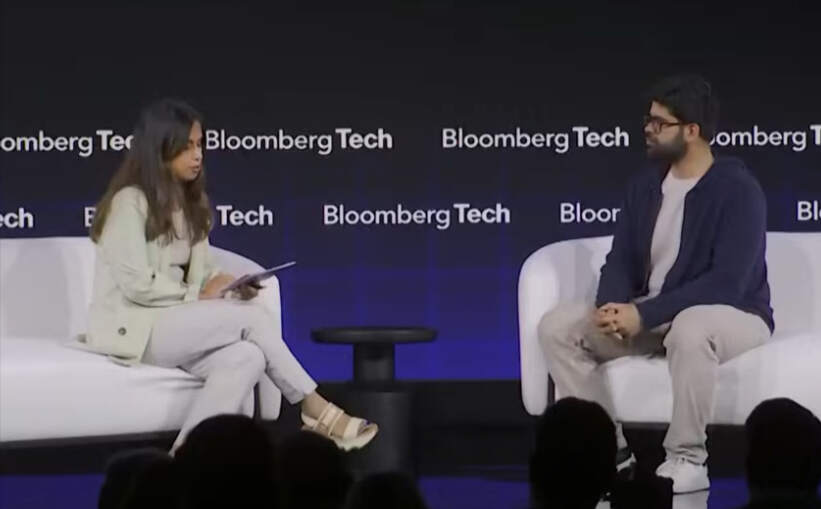
Read the full transcript of Aravind Srinivas, Co-Founder and CEO of Perplexity, in conversation with Bloomberg’s Shirin Ghaffary about the startup’s approach to reinventing online search, rising investor interest, and how Perplexity plans to stay ahead in the AI innovation race at Bloomberg Tech in San Francisco. (June 6, 2025)
From Google Intern to Google Competitor
SHIRIN GHAFFARY: You started Perplexity with the ambitious mission of taking on Google using AI. And what most people don’t know is that you were actually an intern at Google DeepMind in 2019. It was your first job after studying for your PhD at UC Berkeley. Go Bears. Did you know when you were interning at Google that you would just a few years later start a multibillion dollar startup going against it?
ARAVIND SRINIVAS: Definitely not. But I did everything an intern would do, just sleep in the office. They had all these pods which you can use to sleep in the office. They had a library. They had a lot of food, a lot of junk food too, which, you know, definitely I put on a lot of weight while I was in London.
And so it was one of the best times I had in my life. I think there’s a lot of things I would say. DeepMind was almost like a different company. I even remember how Demis had all these crazy visions of how AI will just be a scientist by itself and it’ll solve all theorems and proofs. And they were on a completely different trajectory.
So now they got folded back into Google to get them back into this AI race on the product stuff. But to me, DeepMind meant a lot more in terms of just going for that core artificial general intelligence dream. It was a fantastic time.
Building the Answer Machine
SHIRIN GHAFFARY: So you went on to work at OpenAI in its early days and then eventually decided to break out and start Perplexity. And for those who don’t know, can you tell us a little bit about what Perplexity is?
ARAVIND SRINIVAS: So Perplexity is an answer machine. You get answers that you can really trust. We were the first to reimagine search in the form of conversations and answers with trusted sources. And we did it in a way that essentially became the blueprint for every other chatbot out there.
Yes, everybody else has integrated search too, but when we started, people made fun of us, saying, in AI, hallucination is meant to be a feature, not a bug. And so I even had a former Googler who was one of my early seed investors, and he said, this looks good, but the reason ChatGPT is going viral now is because people want to laugh at AI’s mistakes.
And your product is trying to design it in a way where you do not make mistakes because you’re always pulling sources and summarizing what humans are saying. You’re not telling what the AI thinks. So I don’t think this will work. That was what was told to me. He literally said, you should go and build something like character AI, where people actually enjoy it. Like AI saying arbitrary, random stuff. And I’m glad I didn’t listen to that.
And I believe that this fundamentally a completely different tool. We didn’t even build it as a Google replacement, actually. We just built it because it was really useful to us. I was a very newbie founder, CEO. I didn’t take any health insurance because I was like, I’m all in on this company. I don’t care if the company doesn’t work. That’s my health insurance, actually.
And then my founders, the co founders were married, so they had health insurance to their wives. So that was when my first employee we hired, he asked for insurance and I had no idea which HR tool to use. What are all these different plans? How do you even figure out which plan to go for?
And of course insurance is that one adword category that Google makes like billions of dollars a year, so they have literally zero incentive to tell you which plan to pick or which provider to go for. And that’s when we started building these tools that could just give you answers directly in a chat interface, but plug into the web.
And so we kind of essentially built it as a tool we wanted and, and our friends wanted it, our investors wanted it, and then we put it out into the world. Never thought about it as like, oh, links, 10 blue links to answers. But once we put it out, that’s when we realized based on what people are saying, hey, this is actually a much better way to consume the Internet. We’re all living on the Internet. And so I would rather just feel the Internet through answers instead of links.
Staying Ahead of the Competition
SHIRIN GHAFFARY: Got it. So yeah, you guys were really one of the first AI companies to do real time AI search, focused on that linking back. Now everyone’s doing that, right? Including Google, including OpenAI. So what are you doing to differentiate? And do you want to talk a little bit about Comet, your new browser, which I took a sneak peek at and is really interesting.
ARAVIND SRINIVAS: Sure. Look, with respect to Google, I mean, I don’t mind saying this, like every year it’s the same feature announced in the IO. Like I think in 2023 they called it Search Generative Experience. In 2024 they called it AI Overview. This year they called it AI Mode. Next year they’ll call it another name.
But at the end of the day, the feature never gets shipped to the user. Literally. This is not hard. They have all the models, they have the best index, they have all the best infrastructure. They have their own hardware, data centers, everything. 3 billion, 4 billion users. So why not just change it? Why change google.com, make it perplexity.
Anyway, AI mode is literally, even the font is basically perplexity.
Now, that’s the extent to which they’ve studied our product. Great. So why don’t you go ahead and ship it? You cannot because you lose all the ad revenue if you can go and ask what are the best sneakers for you to buy or what are the best jackets for you to buy or best airlines to pick for this something or best hotels to stay at a place. How are you going to charge all these people for money?
Literally, in fact, leave the AI answers. These days if you just go and ask for the NBA score before even triggering the score widget, they put the Ticketmaster ads right at the top because they need the money and that’s the money that’s paying for all the R and D spend on Gemini.
SHIRIN GHAFFARY: Right. But what Google does have is reach. Right? So they have billions of users use it every day.
ARAVIND SRINIVAS: They cannot ship it. So that’s, that’s. And that’s been consistent over the last three years.
The Browser as the Next Frontier
SHIRIN GHAFFARY: And let’s talk about though. I mean they do ship a lot. But let’s talk about what you are going to do to try to get that same kind of reach and that same kind of integration that users have with Google in everyday life, which as I understand it, the browser is a big part of that strategy. So can you tell us that?
ARAVIND SRINIVAS: Why?
SHIRIN GHAFFARY: Why do you think browsers are the next frontier for successful AI companies?
ARAVIND SRINIVAS: Yeah, often. What said? Like, like why did Sundar become the CEO of Google? Because like he, he focused on the Chrome project. He was the one running the Chrome project. And that ended up being one of the biggest weapons for them, this battle against Microsoft. And it took them many years, probably 10 years to actually become the leading browser.
The browser is the front end to your Internet, like experiencing the Internet and the Omnibox, the search box is where almost all the Google queries are going to. That’s why if you go to Google Trends and see the top most queries by volume, it’s always Weather or like Amazon or Reddit or Instagram, Twitter, like these one word queries. So most people are just using Google as a navigational tool.
But if you can blend navigation information and activity like transactions and doing actual browsing sessions all in one clean interface using the browsing infrastructure, you can actually go for it all in one single tool. If you really want to transition AI from answers to actions to doing stuff for you, answers are essentially four or five searches in one. Actions are an entire browsing session in one prompt.
You really need to actually have a browser and hybridize the compute on the client and the server side in the seamless way possible. And that calls for rethinking the whole browser. We’re not actually thinking about Comet as yet another browser. It’ll be a cognitive operating system. It’ll be there for you every time, anytime, for work or life as an assistant on the side, or just going and doing browsing sessions for you.
And I think that will fundamentally make us rethink how we even think about the Internet. Earlier we would browse the Internet, but now people are increasingly living on the Internet. A lot of our life actually exists there. If you want to build a proactive, personalized AI, it needs to live together with you. And that’s why we need to rethink the browser entirely.
Explosive Growth and Fundraising
SHIRIN GHAFFARY: I want to talk a little bit about growth. You all have tripled your valuation, I believe, twice in the past couple years. Let’s talk about where you’re at in terms of how many people are using Perplexity. Can you give us the latest on how many people are actually searching on Perplexity, using it every day?
ARAVIND SRINIVAS: Yeah, I believe in May we did about like 780 million queries per. Sorry, what?
SHIRIN GHAFFARY: Per month is that?
ARAVIND SRINIVAS: Yeah, per month. And I think that’s growing like more than 20% month over month. So give it a year. We’ll be doing. We’d be doing billion queries a week if we can sustain this growth rate.
And that’s pretty impressive because we were like, first day in 2022, we did 3,000 queries just this one single day. So from there to doing 30 million a day now, it’s been phenomenal growth. And we still think that same trajectory is possible even now, especially with all the kind of distribution partnerships we are trying to seek and all the browser that we’re working on.
And if people are in the browser, it’s infinite retention. So everything on the search box, everything on the new tab page, everything you’re doing on the sidecar, any webpage you’re in, these are all going to be extra queries per active user, as well as seeking new users who just are tired of legacy browsers like Chrome, I think that’s going to be the way to grow this over the coming year.
SHIRIN GHAFFARY: Yes, and I want to talk about those partnerships in a second, but before we do, just on the fundraising route, as I mentioned, you tripled your valuation last year. Tripled again a few months. A few months later. We’ve reported that you’re now in talks to raise another 500 million at a 14 billion valuation. Taking a step back, is it challenging to raise these mega rounds that get bigger and bigger? It is expensive to run an AI company going against the big guys. What is it like fundraising in this market as a startup?
ARAVIND SRINIVAS: Fundraising is super interesting to you, but actually I prefer not to do it at all. I think it’s look, I think we’re attracting the funding because the product is really good. I think our vision for the future is always unique and original and we’re not chasing others, we’re actually setting the roadmap for other people. Including taking our font and UI and everything.
Sure, but literally you said search. But it’s not just that. Even the agentic the tool calls how iterative. We call the tools our research agents. Like the recent feature we put out is labs. These are all setting the next steps for how people will use these tools. And I think the browser will be very unique in its own way too.
So people, investors are excited about the possibility of completely changing the front end in which we experience the whole web. And the web is so valuable. The other thing that’s most important to consider about Perplexity is we’re the only company razor focused on all the accuracy aspects of AI. We really want us to be the accuracy layer for AI that’s going to influence both human and AI decision making.
And every day like trillions of dollars worth of decisions are made across retail, finance markets, exchanges, everything. And if we can influence a big chunk of that, then that will automatically means like we can be worth trillions dollars in market cap one day.
Strategic Hardware Partnerships
SHIRIN GHAFFARY: You mentioned the major partnership distribution deals that you’re doing with hardware makers. Perplexity is going to be pre installed on Motorola phones. We’ve also reported that you are nearing a deal to get Perplexity preinstalled on Samsung phones, potentially replacing Google’s Gemini Assistant. Can you tell us a little bit more about these hardware partnerships and why they’re important to your strategy?
Expanding Beyond Search: The AI Assistant Vision
ARAVIND SRINIVAS: Yeah. So towards the end of last year we started thinking about how can we go beyond just an app on the phone to being a native assistant. The Google Assistant is a terrible experience, but I think even they know it. That’s why they’re deprecating it themselves and trying to replace it with Gemini.
So there’s literally no assistant that you can have invoked with the action button or some gesture at the bottom of your screen and just quickly talk to it and voice and ask questions and ask it to do stuff for you like simply playing media or setting alarms reminders, sending your emails, setting smarter reminders. These things never even worked.
So we started to think about Perplexity more as an AI that’s just helpful and right there for you all the time. I use the word cognitive operating system. You can fundamentally rethink the OS on all your devices if you think AI first.
So we started building the Android Assistant. We put it out in January this year. It was super exciting. A lot of OEMs saw that and they were like damn, this is the coolest thing we’ve seen. We just can completely make Android really much better. And so they started talking to us. That’s how the Motorola partnership came out and that’s how every other partnership that we’re in talks with are merging.
SHIRIN GHAFFARY: Can you confirm that Samsung is also going to be a partner?
ARAVIND SRINIVAS: Well, we’re talking to a lot of people, so that’s all I can say.
Navigating Competition with Google
SHIRIN GHAFFARY: Is it difficult negotiating with phone makers who may not want to compromise their relationship with Google?
ARAVIND SRINIVAS: I thought so. And definitely Google has given us an extremely hard time. Like every time we’re very close to signing a deal there’s always some calls from Mountain View that are being made. I don’t know it’s from where. So they definitely don’t want us to succeed but we’re not going to. I mean if I thought it’s hard to succeed we wouldn’t be doing this company.
And I think it’s good for the world that finally someone is trying to actually fight and compete against this distribution lock ins that they have. And the DOJ case is going on and I hope something good comes out of it. We’ve made our statements that how Android as an OS needs to be a lot more open and Perplexity needs to be not just perplexity.
By the way, I’m happy for ChatGPT or Claude or like Microsoft copilot, every contender in the space should be an option for the default AI and Google cannot pay their way in to be the default, especially when they don’t even have the best.
Building Sustainable Revenue Models with Publishers
SHIRIN GHAFFARY: That’s, you know one thing that’s interesting about Perplexity is you offer all or many different AI models right on your platform. I want to also talk about, you know, you mentioned how important it is to be accurate and right now it is a tough market economically to produce accurate information. I know that firsthand as a journalist. Right. You’ve had some issues with media companies in the past who have accused Perplexity of cribbing content. You’ve since struck revenue share deals with other major outlets like the LA Times. What do you think?
ARAVIND SRINIVAS: By the way, we’re very interested in doing it with Bloomberg too, so that.
SHIRIN GHAFFARY: That’s not my department. But what do you think is a sustainable business model here for accurate, truthful information to be produced at the same time that AI chatbots are bringing more of this information into their tools and not to publisher sites?
ARAVIND SRINIVAS: Yeah. So fundamentally, sources and citations has been the forefront of our product. I think we use LLMs as engines that are doing the reasoning and synthesis and summarization. But the actual authentic sources of content are always mentioned as citations in our UI. And I’m happy others are adopting it too. We hope to drive traffic through those citations.
I’m never going to lie and say stuff like, oh, we’re still sending a lot of traffic and all this stuff that the bigger companies are trying to say. All that’s definitely wrong. We’ve been very transparent that yes, there will be less traffic referrals from these UIs and we’re being open about it.
On the other hand, what we’re saying is like, okay, imagine we make some revenue per query through some experimental work that we’re doing on advertising or even say we have sell somebody or someone converts to becoming a pro user through a query that cited a very valuable piece of content. We could potentially just share the revenue with them. That was the model we came up with.
Again, this is grounded in Jeff Bezos’ thought of your margins, my opportunity. Who has the least incentive to share any revenue with the publishers? It’s Google. Like they drive traffic to others, but they take all the ad revenue. Right. We don’t have to have the margins they have. So we are happy sharing revenue with the publishers. So that was the origins of our publisher program. And we’re happy that it’s slowly expanding.
It’s not growing at a crazy pace because everybody wants to like everybody’s skeptical, like how much revenue can be generated in these AI platforms at a query level. No one’s really managed that. People are still doing the subscription based monetization.
But in future you could imagine research agents like these deep research agents can plug into different data providers and then the user can even pay for accessing some things. Just like they pay for these paywalls and then the agent can see through the paywalls because the user actually paid for it. And that revenue can be shared between the publisher and the AI.
There’s a lot of ways to do this, but the number one thing to understand here is the intention to share revenue and the intention to be open about. Okay, that’s definitely not going to be the old school style of just traffic referrals from these new UIs. It’s just how these tools work.
And it’s important to also remember, the more you get cited in an AI tool, the branding for the source also increases. I would argue that maybe years from now, it’s probably better to be an authoritative source consistently in an AI product than ranking number three on the 10 blue link UI.
Related Posts