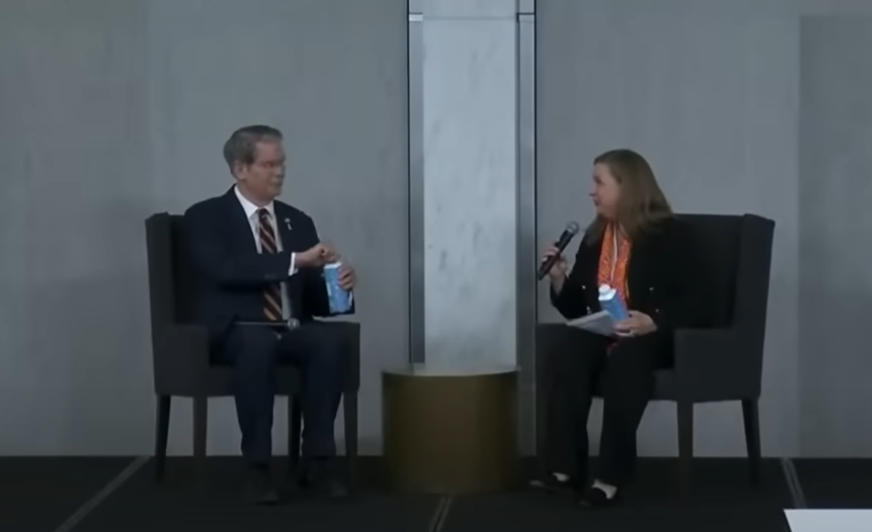
Read the full transcript of Treasury Secretary Scott Bessent’s fireside chat with Vice Chair for Supervision Michelle W. Bowman at Federal Reserve’s Community Bank Conference, October 9, 2025.
The Importance of Community Banking
MICHELLE W. BOWMAN: Thank you, Secretary Bessent. It’s wonderful to hear a Treasury Secretary—I’m not sure I’ve ever heard a Treasury Secretary talk about community banking and the importance of community banks in the United States and for the U.S. economy in my lifetime. So it’s really refreshing to hear you engaging on things that are so important to areas like where I’m from and rural communities across this country and how important community banking is for the foundation of our economy and the economic system.
So if you don’t mind, we’ll start with a question. And thank you for joining me for some fireside chat this morning. But as Treasury Secretary, you oversee U.S. fiscal and macroeconomic policy. So I know every banker in this room is interested to see how you think about how the economy is going to develop over the next 12 to 24 months and what key risks and opportunities should they be thinking about and looking out for as they’re thinking about how to shape their businesses going forward.
Economic Outlook and Fiscal Policy
SCOTT BESSENT: Well, I come with some good news this morning. Treasury, because of the Schumer shutdown, has not been able to release the exact numbers. But the CBO jumped the gun a bit and it was on Bloomberg this morning that the deficit for this fiscal year ending September 30th will be slightly lower.
When I went to see President Trump, and more importantly, the deficit to GDP now has a 5 in front of it. So according to the CBO numbers—and we don’t have the Treasury numbers yet—the deficit to GDP will have fallen from about 6.5%, which was the highest when we weren’t at war or weren’t in a recession in U.S. history, to 5.9%.
When I went to see President Trump approximately two years ago to tell him that I’d like to come out from behind my desk and get involved with the campaign—not going to repeat many private conversations, but this was particularly notable—he looked at me. First thing he said, “Scott, how are we going to get the debt and deficits down and not cause a recession?” And we’re on our way. I think we saw that today.
The Three-Legged Stool of Economic Policy
So I think the President’s economic policy, as many of you would have seen me say before, is a three-legged stool: trade, tax, and deregulation.
The tax bill, the one big beautiful bill, has incentives for both corporate America in terms of full expensing for plant, property, and equipment. And the plant part is new. In the Tax Cuts and Jobs Act 2017, there was full expensing for equipment, but we have added structures for both industrial structures and importantly agricultural structures.
Secondly, on the other side of the ledger, it also includes the President’s tax policies or campaign promises for working Americans: no tax on tips, no tax on overtime, low tax on Social Security, and interest deductibility if you buy an American car.
I think one of the things that we are seeing now—most taxpayers have not changed their withholding stance to reflect this. So we expect to see substantial tax refunds beginning next year, which I think will accrue to lower-end consumers, the bottom 50% who need the relief. And concurrently they will change their withholding schedule so their real take-home pay will be higher next year.
Trade Deals and Tariff Reform
On the trade deals, I think one of the under-reported aspects of the trade deals is not only are we taking in substantial tariff revenue for our American exporters, we have brought down non-tariff trade barriers and brought down tariffs across the board.
So with many of the deals that we have, we’ve gone from high tariff levels. I’ll tell you, for instance, Indonesia was very good about bringing down their tariff levels, but when they showed you the list of 9,000 tariffs that they had, you couldn’t believe it. And as President Trump said, he didn’t blame the Indonesians for doing it. You blame the people who are sitting at the Resolute Desk for letting it happen.
So on trade, we’re landing the trade deals that will increase certainty. And then finally on deregulation, we talked a lot about financial deregulation, but we’re also talking about energy and industrial deregulation. We’re trying to make it easy to build things here again in America, whether it’s permitting for factories, for pipelines, for the electric grid.
So I think I’m very optimistic that 2026 could be a very good year across the corporate and the consumer economy.
Supporting Community Banks
MICHELLE W. BOWMAN: Well, thank you for that. You’ve been very busy since you got started earlier this year. So thank you for sharing that. And I think that’s a very optimistic view about how the economy will be evolving in the relatively near future.
Thinking about that, community banks are critical in providing local and regional credit throughout their communities, through small towns, through rural areas, and in underserved markets especially. So you talked a little bit about what some of the initiatives are that Treasury’s been working on with the prudential regulators. Are there other areas that you’d like to focus on or to share with us today that might be helpful for bankers to know?
SCOTT BESSENT: Well, as you said earlier, I may be one of the few, if not the only Treasury Secretary who’s given this much emphasis to community banks—probably the only Treasury Secretary since the 1700s or 1800s who listed, well, wouldn’t have been farm radio, but is also a farmer.
So I remember listening to farm radio right after the Silicon Valley debacle, or the three-bank debacle, and they were talking about the risk to community banks that were happening, that could be happening here.
And I was just struck by what the presenter was saying. He said the big banks, they’re going to come in, they’re going to buy up our banks. They don’t play Little League baseball with your son, they don’t play softball with your daughter, they don’t go to your place of worship, they don’t know you from the Rotary Club. What are we going to do?
And so we are committed. As I said, I’d like to see us getting back to de novo banks again. It’s a sign that when you see creation of something, it’s a sign that the ecosystem’s healthy. So we want to get back to de novo. We want to get back to leveling the playing field.
Transaction Account Reform
I think these transaction accounts are very important. We try at Treasury to meet with dozens of community banks, whether it’s one-on-one or in groups, every month. And one of the main asks that we got was increasing the non-interest-bearing transaction account. So we’ve been working very closely with Senator Tim Scott on that, and I think we haven’t landed the exact amount yet, but I think that legislation is going to move through.
MICHELLE W. BOWMAN: Well, it’s wonderful to hear some progress in some of these areas that have been a topic of conversation for a number of years. So thank you for your support in working towards some solutions in that regard.
Capital and Liquidity Regulations
Later today we’re going to have a panel of community bankers to talk about capital and liquidity regulations. So I wondered if you might be willing to share your views and thoughts about how we could appropriately calibrate those capital and liquidity levels, especially for community banks, but maybe more broadly across the banking system to be more effective for economic growth and how to support the economy going forward.
SCOTT BESSENT: I think if we take a step back, we could see that the substantial amount of credit that is being grown outside of the regulated banking system tells you that the regulatory framework that was developed post-Dodd-Frank is too tight and that there is this substantial arbitrage to be done, whether it’s vis-à-vis big banks, whether it’s small banks.
Why do we have private credit that is bundling loans and then receiving lines of credit from banks? Let’s get back to the primary lending function. Let’s make capital more risk-based. Let’s understand that there’s a lot of work to do in terms of bringing this back down to common sense levels in terms of knowing your client, in terms of releasing what I would say is this regulatory straitjacket.
The Role of Private Credit
And famous last words: I think private credit is a dynamic new aspect that increases the depth and breadth of the U.S. financial system. But it can’t be to the detriment of the regulated system. Because my real worry with private credit is—everyone in this room, all the bankers—I met a lot of banks who’ve been going since the 1800s. And if you’ve been going since the 1800s, you know a lot about risk management, you know how capital works, you know how your clients are.
My worry with private credit is it could be very, very pro-cyclical. Without stable deposits, in terms of if there were a downturn, the way Treasury and Federal Reserve would work together would be with window guidance, would be with lessening the regulatory parameters to restart the economy on a countercyclical basis. So we also want to look at that.
Reducing Regulatory Burden
And again, a lot of the things we want to do, we want to make it easier to operate. We had a small community bank from South Carolina a couple weeks ago in one of our panels. I think it was 185 million dollars of assets, 17 employees. I think five were for compliance.
And no one is more focused right now on financial crimes. Our FinCEN department is 24/7 in terms of what we are trying to work on. But we are also trying to add a common sense layer. Can we do geographic targeting? If we see that a huge amount of the narco-finance is along the border, should we lower SARs there and raise them everywhere else to avoid all this regulatory expense?
MICHELLE W. BOWMAN: Well, I think that’s a very important topic for many community bankers as they think about some of the regulatory burden and requirements that they’re just not sure what happens to once they send it forward.
Bringing Activities Back Into the Regulated System
One thing I want to just pull a thread on is you mentioned the importance of ensuring that we have the ability as regulators and bankers are not disincentivized from participating in different types of activities. One thing I would point to, and I have many times over the years, is to talk about how important it is that we’re pulling some of these activities back into the regulated financial system, especially real estate lending and mortgage servicing and things of that nature. So I know many of these bankers in the room are hopeful that we’ll be able to think about that differently. So when you discuss the regulatory perimeter, I think that’s a very positive path for discussion and we’ll look forward to engaging.
SCOTT BESSENT: I mean, no one knows the real estate landscape like local bankers.
MICHELLE W. BOWMAN: Absolutely.
Understanding Community Bank Lending
SCOTT BESSENT: Maybe there’s some banks around the Ozarks who like lending down in Florida, but I hope they’re successful. But I will tell you that community banks—I’m sure all of you read all the news reports: “Community banks hold all the small community banks. It’s going to be a debacle. They hold all these CRE loans.”
And for 15 or 20 years, the initial 15 or 20 years of my career, I was a banks and insurance analyst. So I know how banks work. I may seem exciting, but I used to read state insurance call reports.
MICHELLE W. BOWMAN: Those are fascinating.
SCOTT BESSENT: Gripping. Gripping is the only word. But I can tell you that to the extent I was successful, it was being fact-based and not narrative-based.
And as we dug down on what was supposed to be a CRE wipeout for community banks, it turned out that they really weren’t CRE loans, that they were business loans. And we just went out and talked to small and community bankers. They were business loans where the business person put up their building as collateral.
So you didn’t have a loan on a part of a strip mall, you didn’t have a loan on a pod. It was an accounting firm that was financed. You had a loan to an accounting firm, you had a loan to a law firm, you had a loan to a medical practice. And only community banks know that.
Technology and Innovation in Community Banking
MICHELLE W. BOWMAN: Well, it’s refreshing again to hear the Treasury Secretary talk about community banking in a way that helps us recognize that you do have a background and that you were serious about the words that you’re saying in support of community banking. So thank you for your commitment to that and for sharing that with everyone here today.
One thing everybody’s a little bit concerned about going forward is the shift in the technological landscape. Banks for a long time have been innovating. It’s been a hallmark of the community banking framework in their survival since the 1800s, which I have to say, thank you for mentioning banks that were founded in 1800s because my family’s bank was chartered in 1882. So that’s a little piece of mind here that you think that they understand their risks. So I’ll have to share that with my cousin.
But on innovation, banks have been partnering with FinTechs for a number of years now and we continue to add more and more requirements about third party risk management and oftentimes they don’t make sense or they conflict with each other or they contradict what the requirements are. As we’re thinking about how the landscape with technology, with AI, with stablecoins and other types of new business services and activities are being brought forward through the sponsorship of legislation and new regulatory frameworks for stablecoins and things like that.
Today we have the Robinhood CEO and also the Paxos CEO to share their views on how community banks can engage or think about how that will look going forward. But how do you see the role of technology evolving in the banking sector and what policy levers do you think that we could use to help ensure that community banks can compete effectively in the new technology environment?
SCOTT BESSENT: I think it was very important. If I look at one of the biggest regulatory changes from the Biden administration to the Trump administration, there have been a lot of them, it’s our emphasis on AI and digital assets. AI in the Biden administration was governed by diffusion. They were going to treat it somewhat like the nuclear program, keep it in a box. They were going to hand it to Google, Microsoft, Meta and that was life.
On the other side, digital assets had a near extinction event with Wells notices going out to many companies, banks prohibited from opening accounts. And I think the fact that we’re creating the term “sandbox” where there’s a lot of experimentation, where there are a lot more offerings, and for community banks not to be locked in that they have to use one of three dominant service providers, that a wider range of supply will push down price, choice will inform community bankers and the owners, whether they’re family owned banks, whether the shareholders are usually in the vicinity.
And I think that they will be laser focused on the new technologies. And just like with the credit card companies, I think that new payment rails will exist and I think we have to make sure that it’s open for everybody. JP Morgan, Bank of America may have their own stablecoin, but I think it’s very easy and you’ll hear from two great participants that for community bankers to join together, whether it’s in some kind of a cooperative program, you can private label these under your own name and it doesn’t necessarily have to increase deposit beta.
The other thing we’re going to do because we value community banks, we are going to make sure that any new regulation is done in a safe, sound and not abrupt manner, that there will be a transition and everyone will be able to understand it and participate in it.
MICHELLE W. BOWMAN: Great. Well, I think that’s wonderful news for all of our CEOs in the room and everyone listening virtually. I think it’s important, as you said, that all banks can participate in this new economic environment and that we’re creating a framework that will allow for safe and sound engagement as well as ensuring that whatever customers are interested in doing, banks have that opportunity through a sandbox. That’s an excellent idea and it’s great to go back to those ideas from the first Trump administration where we were actively engaging with office hours, where we would bring in fintechs and bankers to talk about how they wanted to expand businesses in a way that was appropriate and met our expectations.
Crypto and Financial Inclusion
SCOTT BESSENT: And I also think too, how many people in this room, their first savings account was a Christmas club at a local bank? So are we going to develop a new kind of crypto Christmas Club? I like that.
MICHELLE W. BOWMAN: That’s an interesting idea.
SCOTT BESSENT: Yeah, CCC, Crypto Christmas Club. Because I do think one of the great things about crypto is it’s bringing young people into the markets, into the financial industry. And I think that community banks will be at the front line of providing that. You have a natural advantage in terms of going into the schools, in terms of financial education, in terms of financial literacy.
I think Mickey’s heard me tell the story, my deep dark secret that a lot of people from South Carolina have. I have a Dr. Pepper every morning for breakfast. I’m not allowed to do it at home, which used to take me to the Circle K on Meeting Street in Charleston, South Carolina. And in there there’d be a lot of young construction workers getting ready to go to work. They’d see me dressed like this and they’d be playing the lottery and say, “Mister, when I win the lottery, will you manage my money?” I said, “Well, the first thing you can do is not play the lottery.”
But imagine if that group that were involved in digital assets, if they’ve been putting that $20 of their hard earned money from construction work, from their blue collar jobs, into digital assets over this time. And it’s going to be community banks that do it. It’s not going to be the big national banks. I think that to be able to cater to that audience is going to really provide opportunity for a lot of growth.
Asset Thresholds and Regulatory Reform
MICHELLE W. BOWMAN: Well, I’ve got to say that my theory has always been you can’t win if you don’t play. So, you know, whatever venue that is, I look forward to seeing how all of those things evolve over the next 10, 20 years, maybe even sooner.
But before I ask you the last question about the future of community banking, I want to just touch on some of the legislative proposals that are being considered. There’s a big groundswell of discussion about asset thresholds potentially changing when and how certain regulatory requirements will apply to community banks and other banks of other sizes, including regional banks. How’s Treasury thinking about those proposals and what principles should guide those thresholds as legislators and as regulators are thinking about those going forward?
SCOTT BESSENT: Well, I think we should think about it in two ways. One, we always think about inflation adjustments, whether it’s for Social Security, sometimes for capital gains. So there’s probably a big catch up to do in terms of asset threshold. Just the economy has grown, the asset size has grown for bank lending and as I said, we want to bring it back into the regulated system. So I think that it will be natural to raise many of these thresholds.
But then I think you also have to look at what’s your book of business, how risky in terms of how have you grown your balance sheet? Does it look like something like Silicon Valley Bank with a lot of deposit beta? So I think it’s those two. But I definitely believe that we do need a substantial increase in terms of the regulatory levels and maybe even an increase from the $10 billion. When does the Fed get involved?
MICHELLE W. BOWMAN: I think those are really great topics of conversation and I think more and more I’m having discussions, as I’m sure you are too, with regional banks who are being frozen at a certain asset level size so that they’re not crossing that $100 billion threshold or a community banker that’s being frozen just below $10 billion in assets simply because of so many different thresholds of many, many kinds and different regulations and statutes.
SCOTT BESSENT: One of the banks we had come in and you would think that if a big, long standing, big customer came in and put a big deposit in at the end of the year, you’d be excited. But no, we can’t take it because it’s going to push us over $500 million and then the trigger there. So we want to make sure that you’re able to grow without setting off these regulatory tripwires.
MICHELLE W. BOWMAN: Well, I look forward to chatting with you about that going forward and seeing how all of us in the regulatory space can think about how we can more effectively allow banks to manage for their growth and their size, especially when they’re not changing their business model.
But finally, on the topic of the future of community banking over the next five to 10 years, how do you see the biggest structural shifts occurring and how do you think community banks will evolve to meet those challenges in the future? One of the questions that we’re asking all of our keynote speakers today is what does the community bank of 2035 look like?
The Future of Community Banking
SCOTT BESSENT: So the ones that make it through the next 10 years will have embraced technology, have embraced financial modernization, and as I said earlier, I think will have brought along a whole new generation of young people into the financial world. Because look, there’s a whole group just because of the bad calendar and they lived through the GFC, they lived through Covid, but when I interact with them, they’re curious, they want to be part of the system.
And it will have been that. And I think that we will see, I don’t know if the branch model is as big as it was. We’ll see with that. But I think it’s all going to center around technology. And so that’s the importance of low cost technological alternatives for the next 10 years, not just for 2025.
MICHELLE W. BOWMAN: Yeah. I think one of the wonderful experiences that we’ve seen over the past throughout Covid and the Paycheck Protection Program was that we have an amazing industry of community banks that are willing to bend over backwards to ensure that they can support their communities. And, you know, I look forward to seeing, hopefully we won’t have another experience like Covid, where we’re asking banks to be the sole provider of fiscal support or loans for their small businesses to keep their economies running and people employed.
But I think it’s a wonderful recognition of everything that community banks have done over the past at least five years to keep our economy running, to keep our people employed in rural communities and in urban communities as well. But thank you for the support that you provided.
Manufacturing and the Community Banking Ecosystem
SCOTT BESSENT: And I think that the other big opportunity is going to be what I saw in the local market in Charleston, South Carolina was when Boeing came in. Boeing doesn’t need, other than people in this building, they don’t need to bank with anyone in this room. But when Boeing’s second largest production facility came in, there was an ecosystem of more than 200 small factories that sprung up.
And the small and community banks, some of the small regionals all moved into Charleston and they bank every one of those small factories, some of the factories, some of these startup businesses that have 50, 100, 200 employees. So with this administration’s effort to bring manufacturing back to the U.S., I would say when we see we’re talking about bringing back the semiconductor industry, they need 500 companies around them to do that.
When we see this precision manufacturing, when you see a multinational company set up, they are going to need a big ecosystem. And the ecosystem, JP Morgan is not interested in the ecosystem. And I think everybody in this room should be.
MICHELLE W. BOWMAN: That’s wonderful. Thank you so much for sharing your perspective with us and celebrating the agility and flexibility of community banks to solve problems and to meet needs where they arise quickly. And we look forward to the rest of our day today. And we really appreciate your time this morning. Thank you, Secretary Bessent, thank you.
Related Posts