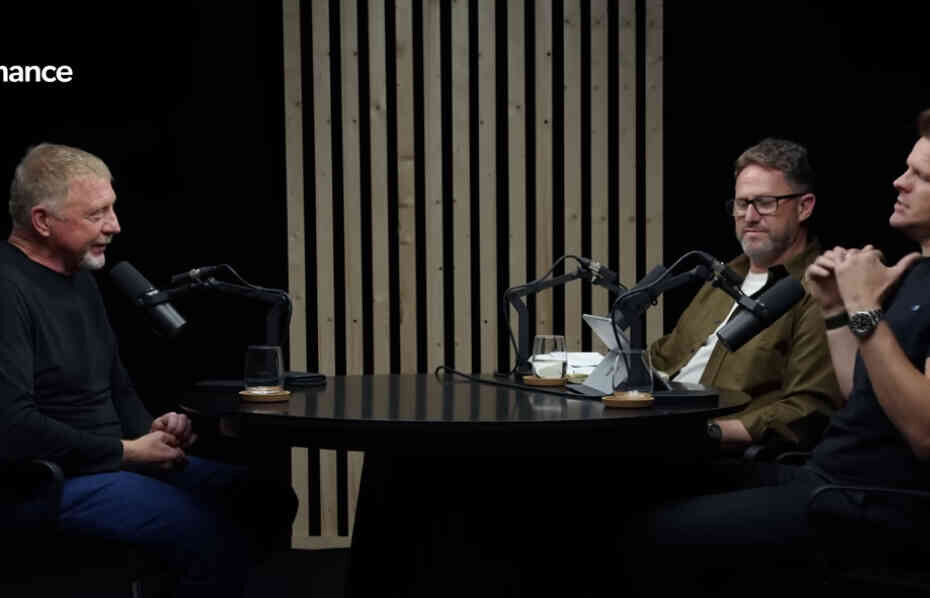
Read the full transcript of Tennis legend Boris Becker’s interview on High Performance Podcast with hosts Jake Humphrey and Professor Damian Hughes on “Surviving My Prison HELL: Tennis Legend Boris Becker on the REAL Story”, premiered on September 22, 2025.
The Day of Sentencing
JAKE HUMPHREY: The book that you’ve written starts with the day that you were sentenced.
BORIS BECKER: Yeah.
JAKE HUMPHREY: And the fear of standing in that glass box, not really able to work out exactly what was going on comes across so clearly in the book. What’s your abiding memory of that day?
BORIS BECKER: Well, it was the 29th of April in 2022. And it was my partner then, my wife now, it was her birthday. So on the same day of holidays in the year. So the morning I went, we were living very close to Harrods at the time, and there’s a nice flower shop, so I got a nice bunch of flowers and we hugged each other briefly. And then obviously we had to catch a cab.
On my way to the courts, I picked up my son Noah, because he was with us the whole time. And yeah, I put my gray suit on, I put my Wimbledon tie on because I feel that my Wimbledon success, especially as a 17 year old, was partly the reason I was put so much on the spot.
I packed my bag. Now, how do you pack if you don’t know whether you come home at night? How do you pack if you don’t know whether your sentence is seven years? So usually I’m a very good packer, but I was really confused the days before how I’m going to pack.
So, yeah, I had my little Puma bag and I went to Black cab and went with Lillian and Noah and we went to court. And then you wait. They sit you behind, they call it a dock. And you have to say goodbye to your loved ones before, because if they found you guilty and if they give you sentence, then they take you straight from the dock down into the cellar. There’s a holding cell where you wait then, and you can’t say goodbye anymore, which is quite a brutal moment. So we were touching each other on the window with the hands and then we went down.
The Moment of Truth
JAKE HUMPHREY: What about the moment when the judge passed the sentence? Did you have any idea from your legal team exactly how long you were going to be incarcerated?
BORIS BECKER: Well, up until the judgment, there was still a 50-50 chance that I don’t have to go. I was still hoping, crossing my fingers, that it’s suspended sentence. And so my legal team, they were 50-50, they say expect the worst and hope for the best.
And then obviously, the verdict the judge spoke is very long, so with very technical terms. So some of it you hear, some of it you understand, some of it you don’t. And there are moments when you have hope. There’s moments when you go, “Okay, it sounds like it’s going to be suspended.” And then there are moments when you go, “Oh, my God, it’s going to be years.”
And because you’re behind a very thick glass window, you don’t hear every word on top of it. So you have to really listen carefully what it is. And then there was a lot of talk about concurrently and consecutively. And before that, nobody told me the difference.
So when she said guilty in count four, you know, 30 months, and then I had three more counts where I was found guilty. It was 18 months, 18 months and 18 months. And for a second, I calculated that together, which is seven years. But what she said was then consecutively and concurrently. And for one of these, I had to serve. And that was the first one.
But I didn’t know that until I went down into the holding cell, had a last meeting with my lawyers, and then they were explaining to me that the whole amount is 30 months, it’s not seven years, which is better. But it’s too bad if I think about it now. Crazy.
JAKE HUMPHREY: What do you think?
BORIS BECKER: It’s like a movie, like a different life, if you understand. My life now, in peace and freedom with my wife and with my loved ones. And all those years before. It’s like a really scary movie. Yeah.
A Son’s Letter to the Court
DAMIAN HUGHES: There was a moment in the book where you recount your son Noah, standing up and reading out a letter to the court. Would you tell us about that letter and the impact on you?
BORIS BECKER: Well, you were asked, obviously, by your legal team that your family, your friends, your loved ones then write letters addressing the judge about your character and your personality. And, you know, he wrote a beautiful letter that, you know, it’s not only affecting his father, but it’s also affecting his life, his mental health and that of his brother.
And, you know, we sometimes forget this is a human story. Right. There’s a person. There’s a person behind the name. And I felt like, you know, sometimes judges, of course, they have to make their decisions and their rulings, and it’s quite harsh sometimes, but you want to try to give it a human point of view of the judge understanding you’re not only penalizing a man, you’re penalizing a whole family. So you better be sure that this man is guilty.
JAKE HUMPHREY: And how did you feel hearing your son say that his mental health’s being affected by what’s happening?
BORIS BECKER: Yeah, it’s a fact. I mean, it’s something that I knew before. It wasn’t a short case. It was a drag for years. It’s sad. I mean, he’s good now. He’s good now. He’s a wonderful boy. But, you know, what about my mother?
The Weight of Responsibility
JAKE HUMPHREY: It’s a hard emotion for you because as the son, you want to protect your mom. As the dad, you want to protect your son. As the husband or the partner, you want to protect your partner. And you were the sort of the reason they were feeling like this. So for you personally, the emotions must have been difficult.
BORIS BECKER: Yeah, I mean, it’s obviously my responsibility. It bears on your shoulder. You know, you feel guilty by putting them through something like that. So, you know, now, since I’m out, I’m even more protective of them, of being a wise old man now and just trying to protect them from making stupid mistakes.
Having grown children, though, good luck with that. Parenthood doesn’t stop when they’re 18. It never really stops, but it’s a big, you know, it’s the love of my life, of course, but it’s a big responsibility.
Setting the Record Straight
JAKE HUMPHREY: I thought one of the interesting elements early on in the book is. So you were sentenced to 30 months for fraud relating to a previous bankruptcy case.
BORIS BECKER: Well, let me correct you because I was going to ask you, you actually know what I did, you know what I was found guilty of? Yes. But I will ask you, because that’s one part of the book is, and I give you a few minutes to think about it, part of the book is that people wrote so much rubbish of what I supposedly have done, and I’m not being pretty non emotional about that because I felt like it’s my duty to say, actually, count four was for what, count 10 was for what, count 12 was for what.
And if you read that, you go, “That was it. That’s it. That’s what he was. He went to prison for.” And I’m not saying today it’s wrong or right, it’s just I was trying to be matter of factly of count four got me 30 months. Now. Let me ask you, you know what count four was?
JAKE HUMPHREY: I don’t know what count four was specifically, but…
BORIS BECKER: But that’s very important. It is.
JAKE HUMPHREY: But I’ll tell you what I thought before reading the book. And after reading the book, when I read the media coverage and looked on the Internet, I thought, “Boris has been hiding money. He’s been sending money offshore. He’s been not declaring things, and they finally caught him out and he’s been scuppered and he’s gone to prison.”
And then I read the book, and it seems to me that you went through a bankruptcy case. You had representatives who told you, and again, correct me if I’m wrong, that it’s okay to use the money. You’ve got to do the important things, pay child maintenance, cover mortgages, pay essentials.
So you weren’t, it felt, having read the book, that you weren’t hiding those things. You were doing what you thought was right. And then here we are a few years later, and you’re standing in a courtroom facing 30 months in prison because of the things that you thought were okay to do. Is my reading of that correct?
The Bankruptcy Process and Legal Battle
BORIS BECKER: It goes in the right direction, yes. So let me tell you a little bit how a bankruptcy case in the UK works, because that’s the first misconception. Everybody knows how it works. Very few people actually do.
So they declared me insolvent on the 21st of June, in 2017, for a loan to an English private bank for three and a half million euros. The reason that’s correct, I owed the bank three and a half million euros. But the fight with the bank for four years was because they put on the loan a 25% interest, which in Germany and the rest of Europe is actually not legal. But in America and the UK, it depends what you signed on.
So again, then someone should have told me, “Boris, this interest rate is a bit high. Are you sure?” That didn’t happen. You know, it’s called the small print. The small print I didn’t read. My fault. I’m not going to blame anybody.
So that 25% I didn’t want to pay on the three and a half million. That was this case about. So when we had that hearing on the 17th of June, my representative were asking the judge, “Give Mr. Becker three more months because he’s about to sell his finca in Mallorca, which was worth 10 million, and then he can easily pay the debt to the bank.”
It was not necessary to put me into insolvency because what happened after, I still sold the finca and paid the bank the full amount back. So ultimately the 10 million that I owed to the bank is paid back in full. So that’s when it started.
The week after you’re declared insolvent, you meet a gentleman and his title is official receiver from the authorities. And the official receiver now explains exactly what bankruptcy in the UK means. He says, “From now on, all your private bank accounts are frozen. You have to declare what you have – real estate, cash accounts and everything. And then you’re going to meet your trustee a little bit later.”
So that bit later is important. I met him on the 13th of September. So I met the OR just a couple of days before Wimbledon started. That’s why I remember the date. So I met them in late June.
So my question to the OR was, “Okay, now, since I can’t use my private accounts anymore, how do I pay my rent, how do I pay my mortgages, how do I pay child support? And how do I pay for my surgery that I’ve had after Wimbledon already organized in Switzerland?”
He says, “Do you have a company? Do you have a company account?” I said, yes. He says, “Well, use that money. But once you meet the trustee, tell the trustee that you’ve used that money to pay your bills.”
That’s exactly what I’ve done. On 13 September, I told the trustee I have paid what the OR has advised me and I don’t know yet whether the house in Germany is mine, because my mother lives in the house, so I think she owns half of it. But give me two or three weeks, I find exactly who owns the house. The house has a mortgage, which we’ve done before the insolvency happened. So nothing to do with insolvency, actually.
And I have shares in a sport Internet company. I don’t know the amount and I don’t know the value, but here’s the company’s director. That’s his email address, his phone number, but I’m happy also to find out.
I found all this information out on the 28th of September. The reason I know all these dates is because it’s proven in court. I can prove you that everything I’m saying is correct.
So on 28 September, the trustee heard that the house in Lyman is mine, that he had a mortgage, and that around the value of the shares. Of the shares I have in the Internet company, the value was about £9,000. That’s what he sold it for.
The Criminal Charges
That was my crime, though. So fast forward a couple of years, they were accusing me of 29 different counts. 25 of these counts are found not guilty. And the four counts I was found guilty was that I took money out of my company account to pay my bills, that I didn’t declare the house in Germany, I didn’t declare that it has a mortgage, and I didn’t declare that I have shares in an Internet company.
Those were the four counts of what was found guilty for. I’m not telling you whether I liked it or not, because it’s not important anymore. It’s not even that important whether I say it was wrong. I just want to say that’s exactly what happened to me.
And if it can happen to me, it can happen to you. It can happen to anybody. If the system wants to get you for whatever reason, the system usually wins. Harsh words, what I’m saying, but I’m giving you the truth. And you asked me before about the book. That’s exactly what happened to me.
JAKE HUMPHREY: Why did the system want to get you?
BORIS BECKER: You know, anybody else? At one woman, at 17, I was. I’m a big name. I’m a huge fish. I’m a huge fish for the prosecution. I’m a huge personality. Meaning if they’re going to get Boris Becker, they’re going to get everybody or anybody. You know, really, they are more powerful than you.
And of course, I’m not here blaming anybody. I could have had better advisers. I could have been smarter. I could have taken more time. But I didn’t think for these mistakes that I would ever be in prison.
JAKE HUMPHREY: So when you’re found guilty and the judge decides that you did commit these crimes, how are you processing the fact that this is your truth? Yet that judge is saying that you’ve broken the law. What was the evidence that they had to say that what you’re saying is not true?
BORIS BECKER: It’s already too late. Then you already passed the point. You already accepted everything that happened. The most difficult weeks were the three weeks between. It was April 8th, when I was found guilty to the sentencing, April 29th.
Because in these three weeks, you actually don’t know. You just know that you’ve been found guilty in four points. And these four points I just explained. But you don’t know what that means.
Of course you ask your legal team every day, and they say, “Boris, there’s not another case in the British system that’s anywhere close to you. So we don’t have an example. We don’t know. There’s 15 other cases that have done exactly what you’ve done. So we don’t know. We can only tell you that it’s 50-50, and you better prepare for the worst, because if you find guilty for each count, you might have to go for many, many years.”
So that was my preparation.
Mental Health and Control
JAKE HUMPHREY: You’re a man who spent his life being in control on the tennis court. That was your incredible innate ability. What did it do for your own mental health when you were so out of control in these three weeks?
BORIS BECKER: For good or for bad, I’m not really afraid of things. I wish I would be more afraid in my life because some of the things that happened to me wouldn’t have happened. But I’m not really someone that is afraid of going to Wimbledon’s Centre Court or going to a back alley somewhere or mixing with the wrong people. I’m not afraid of that.
So when these things started to happen to me, I accepted them quickly. I said, I can’t change them. You know, they’re not in my control. I have to do the best I can to solve the situation.
And you know what? The main thing here is acceptance. So the judge is right and I’m wrong, no questions asked. Whatever she says, I accept and I do what I’m told to do. That’s the only way to deal with it.
DAMIAN HUGHES: And was that learned in that process, or had you always had that sense of acceptance?
BORIS BECKER: You know, we talk about stoicism a little bit in the book, and I think without knowing, I was probably my whole life a stoic, meaning I live very much in the moment. So today counts. You know, yesterday is gone, and tomorrow we don’t know what it’s going to bring. So I guess that helped me later on in life, accepting difficulties, because ultimately, life has blessed me.
I’m healthy, I’m still young enough. I have a family that loves me. So for me, that was always my cornerstone, is that deep down, I know I’ve been blessed. You know, winning Wimbledon at 17 was wonderful. Being number one in the world was wonderful. Very few people can do that.
Yes, there’s a price to pay. Yes, there’s consequences. Yes, some people don’t like my nose. Some people don’t like my success. You know, I’ve beaten a lot of players. I’m sure they don’t like me either. But that’s part of the package.
So even after my career, you know, I’m sure I’ve pissed people off. Of course I have. We all do. It’s just that when Boris Becker does it, it’s a bigger consequence because of the name. So there’s many examples I can give and we could speak a week and I give you sorts of examples of that.
So great things happen because I’m Boris Becker, and bad things happen because I’m Boris Becker. Sometimes for the same reasons. I’ve learned to accept that too.
Financial Reality and Lessons
JAKE HUMPHREY: Before we go back to the moment that you left that courtroom and you headed to your new home –
BORIS BECKER: My new home, temporary home.
JAKE HUMPHREY: I think a lot of people listening to this will be thinking, how did a man who would have earned tens of millions of dollars over his career and was so successful at such a young age and was lauded and celebrated for so many years, how did he need to borrow 3 or 4 million pounds from a private bank? Have you managed to work out how you ended up in that situation? The lessons that people listening to this could take from that?
BORIS BECKER: Well, first of all, I didn’t earn tens of millions. Now, another wrong story. You know, if you were playing nowadays, I would earn that type of money. But in the 80s and the 90s, you didn’t earn the type of money.
Let me ask you a question. What was the prize money for Wimbledon champion in 1985?
JAKE HUMPHREY: £300,000.
BORIS BECKER: That’s before taxes, which in 1985 was a lot of money, right? Today, the winner makes £3 million. So multiply everything that we earned today, it’s ten-fold, right?
So the prize money I have won, which has always been written here, it’s $25 million. That’s before taxes and before costs. What was in my pocket was probably half, which is still a lot of money, but it’s not tens of millions.
Now, I had a great manager at the time, of course, I had Ion Tiriac, of course he got me great commercial deals, but not tens of millions of money. So I was wealthy. Of course I was wealthy.
What did I have then? Just to give you a better idea, in court, you have to declare what you think you’ve had. So in euros, I can do that better. It was about 30 million euros, which is a lot of money.
Now let me tell you another thing. So on the day I was called insolvent, I was cash poor and asset rich. What does it mean? I had a house in Germany, I had a finca in Spain, I had a flat in London. So I had these three expensive real estates.
Now the only thing I have to charge is that give me time to sell my finca and then I could pay the debt. What I didn’t have anymore, and most athletes don’t after their careers is have the same income, we have the same expenses.
And there’s another mistake, you know, I made. A lot of athletes made it. We don’t have the same income, but we have the same expenses. So I kept paying the ex-wives and the kids and the schools, but I didn’t have the income.
That’s what I mean with cash poor and this is where my problem started, is that I had too much outgoings and not enough incomings.
Let me give you another number. Since we talk about numbers, it’s good for the show. So for a three and a half million euros I lost all my real estate, right?
JAKE HUMPHREY: Yeah, it was worth way more.
BORIS BECKER: That’s my point. So for my three and a half million euro debt that I had to the private bank, plus the 25% interest, I lost my house in Mallorca, 10 million. I lost my flat in London for two and a half million pounds. I lost my house in Germany for 2 million euros.
So I’ve lost 15 million for three and a half million debt. Again, that’s not an opinion, that’s a fact.
JAKE HUMPHREY: There was a man who comes up in the book called Dieter Cleven, who’s a business associate of yours, who does not come out of the book with any credit at all. And what do you now think about the kinds of decisions you were making, about the people that you were trusting?
The Business Side of Tennis
BORIS BECKER: Look, it’s all my fault. Again, I want to emphasize that it’s nobody else’s fault, right? It’s my fault. But when you play tennis all your life, you focus on the practice, on the strategy and everything. I didn’t study business, right? You depend on managers, you depend on lawyers. They’re supposed to make your life better, right? So, and in most cases it works. In some cases it doesn’t work.
Now, when I finished my career, I was about 33, 34. Of course I want to learn the business side of it, but it’s going to take time. Of course, there were sharks who took advantage of the naivety. It wasn’t even a question of not being educated. You just don’t know the other side of business when you’ve been a professional. I’m not the only one that happens. There’s many cases like me where smart managers, agencies, naturally they take advantage of the player. That’s their business.
So it took me too long to realize that most of the people don’t have my best interest at heart. They want to take advantage. But then the damage was done already. So my mistakes that I paid for then in 2017 really started happening in 2010, 2011, 2012. And then it’s like an avalanche in the mountains. It goes thicker and you can’t stop it anymore. I was looking for ways to stop the debt. I was looking for ways to have more income. It just didn’t happen. And then ultimately I had to pay the price.
JAKE HUMPHREY: Were you sleeping?
BORIS BECKER: You sleep terribly. I mean, you don’t really sleep anymore. And how many beers can you drink, right? I mean, there’s a point where you just don’t sleep much. Thankfully, I’m a pretty strong character. So I hate drugs, I hate too much alcohol. So even then, I live through difficulties, doing a lot of sport as much as I can. You know, I walk a lot and I go to the gym, I swim. So that was my avenue. That was my way to deal with the stress. But for years it was very stressful.
DAMIAN HUGHES: So what advice would you teach—
BORIS BECKER: Yeah, before.
JAKE HUMPHREY: Can I ask you one really quick question because it is a crazy story and I hugely appreciate your honesty. Can I ask how much money you were left with at the end of this?
Losing Everything
BORIS BECKER: Everything I lose. Zero. I lost everything. Everything. When I went to prison, everything was gone. Another thing that people don’t understand if you get into a British insolvency, is that you’re still allowed to make money. So from 2017 until I went to prison, I still had a pretty decent income to pay child support and my bills and everything. Otherwise, how would I live if I don’t make anything?
But you have to give 50% of your income to the trustee. So if you make 100,000 you pay 50,000. If you make 500,000, you pay 250,000. So I was still earning a good enough living to pay for my lawyers, to pay for my house, to pay for my friends and family. But all this stopped the moment I went to prison. So then I literally had zero. So I went out with zero. That’s two and a half years ago.
Advice for Young Athletes
DAMIAN HUGHES: So what advice would you give to a 17 year old now about people and about your situation that would help them avoid the pain and the suffering that you’ve been through?
BORIS BECKER: Actually the 17 year old did all right. He was a tennis machine. I played, I won the tournaments, number one really up until I retired from tennis. That’s when the problem started. There was a time in my mid-20s where I was burned out, I was tired of tennis. And maybe in hindsight today I would say at 25, take a break, take a year off, see what you want to do. If you’re still willing to pay the price to be the best tennis player you can be, smell the roses a little bit.
So I didn’t do that. I kept on and I had contracts, there was responsibilities and so forth. So I played up until I was 32. Maybe I would have played longer if I would have taken a break at 25. I mean now the guys playing their mid-30s. But then I stopped also I had a bad injury, I had a bad right ankle and that needed to be fixed. And I think that was another main reason why I said, listen, I don’t know if I’m ever going to come back. The surgery is going to be very bad.
DAMIAN HUGHES: But if there was a 17 year old athlete listening to this today about your story, what would you teach them about people that could help them avoid some of these same pitfalls?
BORIS BECKER: Well, pick your friends wisely, of course. Ideally you come from great family. But then sports families are sometimes also taking advantage of the young player. That’s common as well. It’s a difficult thing to get out of alive really. It’s not healthy winning Wimbledon at 17. In hindsight I’d rather would have won later, maybe more often. I was in semi finals, I lost four, so that’s something. It still pisses me off today. So winning at 17 couldn’t have been healthy. I mean there was no normal way out of this.
The Real Cost of Fame
JAKE HUMPHREY: You say in your book, after the 7th of July 1985, everything changed. And later on you say after that moment it feels like someone else owns you. And young people these days, they laud fame, they laud money, they laud success and trophies. They think it gives them everything they ever want. And you’re giving us a very different view of actually what fame is like at a young age. Would you share with us the real cost of that? How it felt to suddenly be famous? Like what was actually going on in your life after winning Wimbledon?
BORIS BECKER: I mean, just to put it into numbers, maybe even today, right? In ’85 there was no Internet, there was no Instagram, right? Imagine a 17 year old British who will win Wimbledon this summer or the next summer. He probably has hundreds of millions of followers. In today’s evaluation, he’ll be a Messi, he’ll be Ronaldo. That would have been me, the 17 year old German.
So losing control when a whole country takes over your life, that’s what happened to me. Now tennis is an international sport. So of course some folks in America wanted the piece, some people in Australia wanted the piece. My sponsors wanted the piece. That’s what happens. So you lose control over your life and everything is decided for you.
Some people have good interests, of course they do. But you no longer can go, “Okay, I’m tired for tomorrow’s practice,” you have to give a press conference because you’re not having the practice tomorrow, because the tournament saw the practice, people are watching your practice or when you don’t want to play tournament, right? You get a fine. Then you have to explain to the world, “My shoulder hurts,” they go “Show me evidence.” So you have to go to the doctor and he has to give you medical. So everything you do is judged.
Now, considering all that I did well a long time, but I think at 25 or so, 24, 25, I thought for the first time maybe it’s time for a break because it’s too much. I want to live, I want to have a social life. I want to be normal. I didn’t do that. So that was a mistake.
Is that a scary explanation for a 17 year old today? I’m always saying, we have this phenomenon in football called Yamal, right? Look what he’s going through. I’m not going to fast forward and I’m going to tell you how this is going to finish. But he’s at high risk of going to difficulties in 10 or 15 years. Mark my words here.
JAKE HUMPHREY: Explain for people that are still confused by that. Why would a man seeming with the world at his feet be facing those difficulties in a decade’s time?
BORIS BECKER: In his case, as much as I know him, I think he comes from very moderate beginnings, right? Not to say poor beginnings. He’s a rich man now. His father’s rich, his mother’s rich, his sister’s rich. So imagine all the people wanting the piece of that wealth. Imagine what it does to a brain of a 17 year old or 18 year old where everything is in the public.
I mean, he’s the poor guy who’s texting a girl and now she’s his girlfriend. So everything he does will be a headline tomorrow. He plays for one of the biggest clubs. So a complete loss of privacy, which is very hard to take for anybody, let alone when you’re still a child. At 17, you’re still a child. You don’t know yet how life is. You’re not mature yet.
Yes, you have your teammates and the president of the club. I’m sure they’re doing well. But ultimately this boy goes to sleep alone and is wondering what the hell is going on. And there are ways to deal with it. Some are good and some are bad.
JAKE HUMPHREY: What would you, if you had five minutes in a room with him, what would your advice be?
BORIS BECKER: Five minutes is not enough. Honestly, find two or three honest, serious people that look after you. The man, the person, the human being. Not after the wunderkind, after the project.
JAKE HUMPHREY: You know how hard it is to make those judgments because you thought you were choosing the right people to look after your interest.
BORIS BECKER: When I was playing, I was good. I had my parents, I had Ion Tiriac. They were great people. Nothing happened to me. But my education in business just didn’t happen. Therefore, I didn’t know who was good in business, who meant well, who was cheating me, who was taking advantage. So that was my issue after I stopped playing tennis. In my tennis career, I was safe. But eventually there’s a time after.
The Pressure of Success
DAMIAN HUGHES: I find it intriguing that the brain doesn’t mature until around the age of 24 and 25.
BORIS BECKER: Some people even say we’re not mature until maybe later.
DAMIAN HUGHES: But I find it interesting that that was the age when you felt, you describe yourself as being burnt out and wanted to step away. So when you look back on the 17 up until the age of 24, what were the kind of mistakes that you realized you were making that maybe you wouldn’t have done after that?
BORIS BECKER: Well, there weren’t that many mistakes. It’s just very tiring playing 75, 80 matches every year. It’s very tiring. It’s frightening to go back to Wimbledon at 18. Everybody says you’re going to lose this, you’re not going to defend this. So it’s very tiring, very exhausting to go to Wimbledon and defend your title.
So dealing with the pressures, dealing with the expectations, your own team doesn’t believe you because nobody has done what I’ve done. Right, so you’re pretty much alone already then. And to overcome that and to deal with that and to deal with, I’m sure just bringing Yamal again, I’m sure he’s got some lonely moments. I mean, who can he talk to? Nobody’s as good as he was at 18. Not even Messi was that good. Nobody was as good as I was at 17, 18. Who can I rely on? Who can give me that advice? We had a couple guys who were that good. And then you’re supposed to do something that didn’t happen before.
DAMIAN HUGHES: So you said that was a frightening experience to go back to Wimbledon in 1986.
BORIS BECKER: Yeah.
DAMIAN HUGHES: But you’ve also said that you’re somebody for good or worse that doesn’t get afraid. So when did you learn to deal with fear and how?
Surviving Against All Odds
BORIS BECKER: I’ve never had an issue dealing with pressure. I had my ways about it. Some people call me a little crazy, but it’s fine. I never had an issue with that. It’s more other people had an issue with me, how I was and maybe how I am.
You put me, you throw me into the jungle of Brazil, I will find a way out, believe me. You throw me to HMP Wandsworth, I will come out alive. It’s just second nature. Don’t ask me how I do it, but I will find a way. So when I was 18, 19, 20, yeah, there was a lot of pressure and it was difficult and exhausting. And not every match I won. Of course not. But I was okay with it. I was okay with it up until I wasn’t.
The Transition to Prison Life
JAKE HUMPHREY: Look, aging happens to all of us, but feeling old, I believe, is totally optional. And I actually started noticing just recently some little subtle changes. I had slower recovery after my workouts. I was a bit stiffer. I just had whole days where I just felt like my energy wasn’t there.
BORIS BECKER: Ugh.
JAKE HUMPHREY: Let’s talk then about HMP Wandsworth, because this story of yours, the story that makes you laugh, because if you wrote it down as a movie script, it would be seen as too ridiculous to be real.
BORIS BECKER: It’s your lived experience.
JAKE HUMPHREY: It is your life. So you get the sentencing from the judge. You put your hand up to the glass to Lillian, she puts her hand back.
BORIS BECKER: And Noah, Noah taught you.
JAKE HUMPHREY: And Noah, you walk out of the dock. What on earth happens next?
The Symbolic Transformation
BORIS BECKER: Well, you actually go down. There’s a little door that leads you downstairs and there’s a small reception because I was still in my suit and tie, in nice shoes. And they were very nice English gentlemen. They say, “We’re so sorry what happened to you. We’re embarrassed. We know who you are. But the rules are you have to take off your suit, your tie, your shoes and everything and leave it here and put on your things that you brought to prison.”
JAKE HUMPHREY: That’s a symbolic moment, removing a Ralph Lauren suit and a wooden tie.
BORIS BECKER: Correct.
JAKE HUMPHREY: To put on your prison clothes.
BORIS BECKER: Actually, you don’t get your prison clothes then because you’re allowed to wear the clothes that you brought. So it was a Puma tracksuit I put on, but then I put on a black one because I wasn’t told I’m not supposed to bring the black ones. And they say you can’t wear the black. Black is for the wardens. So you have to take your blue or your orange one, whatever you had. And that’s what I did.
Then I had a half an hour with my legal team who explained me the difference between concurrently and consecutively. And then I breathed a bit lighter.
DAMIAN HUGHES: But before that you thought you’d been sentenced to seven years.
Understanding the Sentence
BORIS BECKER: Yeah, right? Crazy. And then they said, no, 30 months, which is bad enough, but usually they let you go after 15, which is still a year and three months. But I said, okay, where do I go?
Then they go, “There’s two large holding prisons if you get incarcerated in that region. One is HMP Wandsworth in the southwest, and one is in the northeast.” I forgot the name. And so they go, “So one or the other,” they even didn’t know that. They couldn’t have known.
And then, so, half an hour you go, okay, 13 months, 15 months. Okay, I find a way was my mindset. But then I’ve never been to prison, right? I’ve never been to HMP Wandsworth either.
So then they put you into a larger holding cell and there’s three other guys already in there waiting for the transportation to pick you up. You don’t know where you’re going. Then they put you in a car. You don’t know which one you’re being taken to. You hear whispers. It’s either this or the other one. It’s either Wandsworth or the other one. But you still don’t know.
The Journey to Wandsworth
The reason for it, I know now, is that career criminals get organized very quickly. Meaning if they know they go to a place, they have their small phones with them. Don’t ask me where they keep them. And then they make a quick call, get organized. So they get quickly sorted wherever they go. That’s why you’re not told in which prison you’re supposed to go.
Then you go into a bus. And each bus has their own little cell. There’s a small window. So you get an idea. Okay, you’re no longer in a city. You’re on a highway now. And then I saw a sign, Oxford. Then I figured, okay, wrong direction.
JAKE HUMPHREY: That’s when you went past HMS Belfast.
BORIS BECKER: Yeah, exactly, exactly. The boat. And then because it was Friday afternoon, the drive was pretty long because of all the traffic, but you don’t exactly know where you’re going. And then you get to the gate of HMP Wandsworth. And then you realize where you are.
The Cruel Irony of Location
DAMIAN HUGHES: So can I show you these two pictures? And I’d be interested in your reflection of them?
BORIS BECKER: Yes, exactly. That’s the first picture you have of HMP Wandsworth, that’s the one. And this one is in my mind. I don’t need to see this. This is in my mind.
DAMIAN HUGHES: But when did it dawn on you that this picture, that Wimbledon, where you’d made your name at 17, was just two miles away from Wandsworth?
BORIS BECKER: Not immediately, but obviously once you spend a couple days and you get your bearings and you understand where you are, then you know it’s a stone’s throw away. I mean, it’s a mile and a half or two miles away.
So, again, I mean, if you make this in a movie, they say this couldn’t be true. On one hand, your Wimbledon’s center court, the greatest court in the world, the most important tournament, my favorite place. And then a mile and a half down the road, it’s one of the worst places probably in the world. I did both.
The First Night Terror
JAKE HUMPHREY: I want to read you a quote from your book about the first night at HMP Wandsworth. “It’s the screaming that cuts you deepest on your first night in prison.” Tell us about the screaming.
BORIS BECKER: You don’t know many things when you first enter prison. I mean, German prisons are different. Every country has different prisons. What I’ve heard is HMP Wandsworth in particular, is a real bad one. But you don’t know that, fortunately.
So you get into prison, they make a picture, because then they give you a little badge which you have around your neck so you’re no longer Boris Becker. You’re a number. Mine was A2923EV, I think that’s what it was.
And then they guide you. People work there, actually, the listeners, which became very important for me. The listeners then start talking to you, and they start to explain you what’s happening in Wandsworth. And then they guide you into a cell.
Meeting the Prison Director
Before that, I must say, I went to the office of the director of Wandsworth, and he explained to me what’s going to happen now. So one of my fears was, naturally, that I have to share a cell with someone. And he says, “No, I have a single cell because I’m at risk.”
I said, “What do you mean I’m at risk?”
He says, “Other prisoners will take advantage of you. They may know you. They know your background, you have wealthy friends, you’re a famous guy, so we want to protect you from the rest of the lot.”
I said, “Great.”
Then I asked him, of course, “What about the showers?”
And he goes, “Well, just be careful. Just pick the right group of people. Because the shower is locked from the inside.” And we all watch these movies, right? What happens in the shower? So that was my biggest fear, is that I’m going to be showering with people that take advantage of me.
JAKE HUMPHREY: And the wardens don’t go in there.
BORIS BECKER: You lock inside the shower, so you’re with your lot alone. And what happens in the movies is actually true. So that was my second fear. And he says, “Just find your group. Find your group that you feel safe with taking a shower.” And that’s pretty much it.
The Reality of Prison Cells
And the listeners take you. They took me in one cell and it was Friday evening, and it’s really small. I mean, whoever says prison is easy is lying. It’s supposed to be punishment, supposed to be difficult. It’s really difficult, right.
So the cell is very small, and it was a very small TV, probably the smallest I’ve ever had in my life. But thankfully there was a TV. The programs were the BBC, ITV, Channel 4, and there was a movie channel, which I thought was nice up until I found out that they had about the same 20 movies on a loop. So I’ve been watching Rambo 3 and all the Schwarzenegger movies, I think 50 times at the end of it. But it was better than staring at the wall, right?
And then I was just about to make my bed and make myself comfortable and just accept it. Well, what are you going to do? Then they came in. The listener says, “No, no, this cell is needed because there’s an old guy and he needs to be in the bottom floor because he doesn’t walk so well anymore.”
So they put me on the second floor right in the middle, which was not so good because there’s a little look at the door which you can close and which the wardens look in. And if they want to tell you something, mine was broken. It was open. That’s why I heard the screams much more.
And so I had to spend the first week or so in that really terrible cell with the look open. And my first cell had a single bed. The second one had a bunk bed. But because the door was open, I put the clothes that I have on the top bunk just to have a little bit of privacy because there’s a thing that the first couple days, all the prisoners always check out the newbies. And so they were looking inside the whole time and asking me if I want this, if I want that. So it’s crazy.
Facing the Fear
JAKE HUMPHREY: What did you do? Because do you speak to them, do you not? Because they can smell fear.
BORIS BECKER: Yeah, of course. Well, at first I was unlucky because there was a holiday on the Monday. I was in that cell about 22 hours a day. I was only let out from 11 to 12 to grab my lunch and then out between 4:30 and 5:15. That was it. The rest I was inside that little hole.
And the first I remember on the Saturday, you go out and you’re really scared. I mean then, then you’re really scared.
JAKE HUMPHREY: Explain that fear to us.
BORIS BECKER: You are in a complete unknown environment. Everyone is a criminal. You don’t know what they’ve done. But then you quickly realize, there’s murderers, there’s pedophiles, there’s drug dealers, there’s people smugglers, the worst lot you can imagine. And they look like it. They look like it. I was probably the only one that didn’t have a tattoo, right?
And then you go and you stay at the servery with your little plate and you look to the floor, you don’t look anybody in the eye because you’re afraid. The listeners spotted me and they came around to protect me a little bit and they go, “Well, don’t deal with these people and don’t look at them. There’s another listener in the kitchen, his name is Mo. When you get there, talk to him. He’s going to tell you what you can eat and what you shouldn’t because the food is horrendous.”
I mean, I don’t understand in 2022 we have so much food in the UK, in London, why they serve this type of food? I mean, normally you can’t eat that on purpose. I don’t know why, I don’t know why. Maybe they don’t care, maybe they don’t.
JAKE HUMPHREY: How would you describe a meal?
The Reality of Prison Life
BORIS BECKER: Well, you see a sausage, but it’s raw or it’s too brown or you see, you know, usually you end up with a bit of mashed potato, a bit of rice and yeah, that’s it. I mean, can’t even describe it, the type of food you get there, but you’re so hungry you eat it anyway after, right? Yeah, real hunger, real hunger.
But the first, and I was speaking to Mo and he said, “Well, don’t do this, don’t do this and if you eat fast, come back, I give you the second lot.” Normally you’re not allowed. So I felt for the first time hunger. I was the first weekend I didn’t come back. I had only one round, so I had a bit of food for lunch on Saturday, a bit of dinner, and then like Saturday evening, Sunday evening at 8, you know, you want to grab a sandwich or you want an apple or you want something. I didn’t have that.
So I was really feeling hungry probably for the first time in my life. And the problem was all this didn’t change until Tuesday because of a bank holiday. So Saturday, Sunday, Monday were the same. 22 hours out for lunch and dinner. And then only Tuesday they let you out about 10, 10 ish. Because I didn’t have a job yet.
So what I found out that you need a job or two. And then the listeners, on the Tuesday, the listeners started talking to me about you need a job, we can help you find a job. They explained to the system that you get about £15 a week and out of £15 you have to pay for your food that you eventually can order on the canteen and calls and usually would do, you know, 50, 50, so about 8 pounds for the food and about 7 pounds for calls. That’s all you have up until you get a job.
And per job you get about a pound a day. So if you work five days a week, you get five extra pounds. I ended up having two jobs, so I got, you know, 10 plus the 15 with 25 to 30 pounds you can get by in person because you can buy enough food then and have the cost, but until you get there, until you are enhanced, until you get the job, it takes forever.
But on that Tuesday, I was lucky again the listeners me to say, “Well, on Wednesday there’s a job available. How good is the English?” I said, “All right, how good is your math?” “All right, well, there’s a job available as an English and math teacher and you can be the assistant of the main teacher.” I said, “I’ll take it. It doesn’t matter what it is, I’ll take it.”
So from Wednesday onwards I was teaching English and math in the mornings and in the afternoons. And I did that my whole time in Wandsworth, which was about four weeks. So then even though it was so bad, I had the listeners around, I had a job, I had a bit of structure and Danny was okay, actually, he was okay.
Understanding the Prison Hierarchy
DAMIAN HUGHES: Would you tell us about the listeners?
BORIS BECKER: I was trying to avoid their names because of privacy reasons. But they are criminals. As a listener is a criminal, usually a long termer, meaning five years or more, but trustworthy by the wardens. Because another misconception is that prison is not run by the wardens. It’s run by the prisoners.
I mean, I’ll give you an example. In Wandsworth, you have about 2,000 prisoners and 70 wardens. They have no chance. So they have to pick the most important prisoners, the most trustworthy prisoners, who then deal with the dangerous prisoners or with the newbies. Explaining me a little bit the whereabouts of prison.
And they really looked after me. I mean, I wouldn’t have survived it without them. And I’m still in contact with a couple. And they then tell you, “Okay, you get a job, you know, stay away from that group. He’s all right. Mo’s good in the survey and so forth.” And so they build you your infrastructure where you survive with.
Including the visits. Now, you have no idea what you have to do to tell anybody who’s supposed to come next week. So they told me, “Listen, there’s a page, a document, and that’s where you can pencil in on which date your girl or your son, whoever wants to come can go.” So that actually happened on that first Thursday. So for Thursday, I was able to, before that, call my partner and say, “Listen, on Thursday.” But you have to call HMP Wandsworth because you have to tell them who you are, when you want to come and so forth.
JAKE HUMPHREY: Lillian had to call.
BORIS BECKER: Lillian had to call. Right. I could. I just said, you’re totally out of control here. Totally out of control. Out of control. You know nothing. You know nothing. And that is, you know, for a control freak like me, that’s really difficult to deal with.
The Harsh Reality of Prison Violence
DAMIAN HUGHES: What would you say was the biggest shock?
BORIS BECKER: Well, the biggest shock still today is that how dangerous prisoners, that if you’re with the wrong lot, I mean, people today get killed in prison. There’s a large number of deaths that we don’t even know about. People can get really badly hurt. At the end of the year, you say a couple names are missing, but because you’re a prisoner, you lose all your rights. You’re nobody. Your number. I said that before. Your number. So that’s the most scary part of that type of prison.
JAKE HUMPHREY: But you’re Boris Becker.
BORIS BECKER: Not in prison. Not in prison. Which worked in my favor because a lot of prisoners didn’t know me, didn’t know tennis, weren’t interested. So that actually saved me a bit if that. They didn’t know that. Of course I know people of power and money so easily they could have taken advantage of the fact that this newbie. Yeah. Has a couple listeners, but we’re a lot of Mitchell, much bigger. We can take advantage of the famous Boris Becker.
Finding Liberation in Confinement
JAKE HUMPHREY: Was it strangely liberating that, as we’ve already discussed, fame was one of the big reasons you ended up in this prison. And suddenly fame had no currency. You could almost like reinvent who you were.
BORIS BECKER: He was liberating. I’ve slept. I’ve slept out of exhaustion and frustration. Not the first couple nights because of the streams, but after a week or so I was so tired, but I was liberated. That there was no role to play, there was no responsibility. It was just survival. And I don’t mind that. I realized then that I can do that. And it was. Until now. Until now I’m liberated of that.
Survival Strategies
JAKE HUMPHREY: And did you work out a tactic for survival? Because I’m thinking you’re now 57, this is 2020, so you have been 54, you’re in your early 50s, you carry injuries from your tennis career. And there’s 21, 22 year old, very strong, very physically capable, dangerous men sharing that building with you. Did you have a plan for what you would do if things went wrong?
BORIS BECKER: I certainly couldn’t fight them physically, yeah. But my brain and my heart are very good. So I was able to use my heart and my brain to have some sort of influence with the dangerous ones.
Becoming a mass and becoming an English teacher at first gives me access to a lot of prisoners. And most of them, unfortunately are not educated, most of them, and I can’t count. So helping them in their classes, just befriending them, you start to gain trust with them. And then I talk a little bit of what they’re in for and what they’ve done and so forth. And then you start to have a different power than a physical one.
And then also quickly, you know, I mean, the listeners is a very powerful group. You know, if you’re close with the Listeners, they are very important in prison to the point of almost running prison. They know which wardens are bad, which wardens are good, but they also know which prisoners are dangerous. So they’re sort of in between. And if you hang with them, that gives you a lot of respect.
Prison is all about respect. If they respect you, you’re safe. If they don’t respect you, they take advantage. So I was trying to be with the tough boys, the listeners, the people that were in power even though they were prisoners.
DAMIAN HUGHES: And what techniques did you use to be able to establish a sense of respect from them.
BORIS BECKER: Used my personality, used my character. Just talking to one another. We’re talking now. So you give me enough time with you, you either run away or you end up probably liking me. Right? So that’s the thing. I was able to show very humble humans. I was able to show me. Right, Right. I’m not a bad guy. Right. And we are in this thing together.
So you help me, I help you. If you can’t read the letter, I read it for you. If you can’t spell the words, I’ll write the letter for you. You can’t talk to authorities. I speak to authorities all the time. So you help each other, and then you start to have a really strong bond with each other.
Tennis Skills as Prison Survival Tools
JAKE HUMPHREY: So here’s a question then. If you weren’t one of the world’s greatest tennis players, would you have had the skills to survive in prison? Or do you think your sporting career helped you in this?
BORIS BECKER: I probably wouldn’t have survived prison if I weren’t a gifted tennis player. Tennis is a very difficult sport. You’re on your own. You have to deal with tough players, crowds, weather, scheduling and all that. So if you can’t overcome these situations, Most players can’t, by the way. Most players can’t today, cannot. I probably wouldn’t have survived prison.
So the qualities I talk about, stoicism, I talk about character, personality, this survival instinct in that fifth set, that survival instinct of coming back at 18, winning, this mindset that some call maniac or crazy, I probably am, but otherwise I wouldn’t have done what I’ve done. And I think that played in my favor.
DAMIAN HUGHES: And what would you say was the biggest characteristic, though, that is transferable from Centre Court to the prison?
BORIS BECKER: Well, you have to look after your own, you know, in that tennis match, I mean, you’re the one that decides to serve the forehand, the backhand. You’re the one decides when to get up, what to eat, what to wear. You are very, very independent. We were, anyway, in the 80s and 90s. I think players are more depending now, but in the 80s and 90s we were, you know, we were a bit wild. I mean, talk about Borg and McEnroe and Connors and Lendl and all these characters. We were a little crazy, but that set us apart, I think, from the rest.
The Underground Prison Economy
JAKE HUMPHREY: You write in your book about prison crack. I think for people who’ve never been in prison, they think, well, of course there’s no alcohol in prison because it’s prison. Of course there’s no mobile phones, because you’re incarcerated, of course there’s no drugs because you can’t get the drugs in there.
BORIS BECKER: What’s the truth? Whatever you want, you get in prison. Literally whatever you want. Depends how organized you are, how much you want to pay for. You can get, I wouldn’t say a first class menu. But talking about drugs, for example, the most popular drug in prison is called spice. I didn’t know that you can get through help. You know, I don’t want to claim, now it’s the wardens and I don’t want to claim it’s someone else. But if you pay enough money, you get almost what you want, including phones. You get the little phones and they, you know, you’re able to hide it on, in your backside. Right. I mean, it’s all happening. So depending what you’re willing to pay, you can get a lot of things in prison.
JAKE HUMPHREY: What was it like seeing people so close to you taking drugs, drinking, alcohol in this kind of confined environment? Like, what was the impact of those people that were taking what you call prison crack?
BORIS BECKER: Well, you would stay away. I mean, you quickly find your group and mine wasn’t dealing in that.
JAKE HUMPHREY: And how would you know that they’re on spice?
BORIS BECKER: Because the listeners would tell me all that. I wouldn’t know. I think they’re, you know, I obviously see they’re drunk, obviously they’re high, but you don’t know. How is it possible? How could they get this in prison? Right. I mean, it’s the first question you have. And then the listeners tell me, “Boris, you have no idea what’s happening in here. You can literally get almost anything, depending how much you’re willing to pay. Not in prison, but someone knows somebody outside.” Yeah, and that a person outside gets paid, and then someone organizes whichever way they do it to get to the prisoner.
JAKE HUMPHREY: But you’re thinking in that situation, if you can get drugs, you can do anything, you can kill me, you can rape you up, attack me.
BORIS BECKER: It’s a lawless place. It’s a lawless place. Anything can happen. That’s the most scary part for me, Dan, and in hindsight is how danger prisoners.
Coping Strategies in Prison
DAMIAN HUGHES: So what were your coping strategies to be able to handle such uncertainty, such danger?
BORIS BECKER: Stay with the right group, honestly. And then really be careful not to step out of place. You know, you can’t brag, you can’t tell too many of your stories where you’re from. You can’t tell anything about your loved ones. You have to be really, really selective and who you’re talking to and which topics you’re talking about, you have to really be careful.
And at first you really want to get out of your cell. I mean, that’s 22 hours in a little hole is really difficult. At the end of my prison term, there was my safe place at the end of Huntercombe. I couldn’t wait to get back into my cell because I was safe.
The Foreign National Prison System
JAKE HUMPHREY: So you mentioned Huntercombe Prison. So you were told by your legal representatives, correct me if I’m wrong, that you would spend some time being processed in Wandsworth for a few weeks, then go to an open prison. You can see Lillian, your partner, you can spend evenings at home.
BORIS BECKER: Yeah. And what happened that didn’t happen. That didn’t happen because I don’t have a British passport. I have a German one. So in about two weeks in Wandsworth, I have to go to the authorities and ask passport and everything. And then you go, “Well, you don’t have a British passport.” I said, “No.” “Well, then you have to go into a foreign national prison.” I said, “What is that?”
“Well, this is for people that don’t have a British passport and who want to stay in the UK.” And this is where I said, “But that’s wrong. I was told that after a couple of weeks in Wandsworth, I go to an open prison because obviously my crime isn’t as dangerous and isn’t as bad.” They say, “Well, you were told wrong.”
And what do you do? You can’t believe it at first, and you’re getting worried a little bit that what else is wrong that I was told. And that’s when you get careful who you talk to. And then we start, my wife, now partner, then we started really talking about, “Okay, what happens in a foreign national prison? What does that mean?” And then she gets information from the outside. I tried to get information from the inside about what that is. And then pretty quickly it was clear that because I don’t have a British passport, I have to go to a prison for foreign nationals.
Life at Huntercombe Prison
JAKE HUMPHREY: How would you describe Huntercombe Prison?
BORIS BECKER: Huntercombe Prison on the surface wasn’t as bad. The building was a bit more modern, more like in the 70s. The ceilings were lower. But you had the same criminals, so on the surface it was okay. But then you had your murderers and your pedophiles and whoever was in Wandsworth who was not British had to go to a foreign national prison.
One of them was my luck. There was that quickly one of the main wardens there was a guy called Andy Small to a point where he almost saved my life. He very powerful personality, but he was responsible and his team for the gym, which is the most important class for the gym and for the story class. And he quickly told me, “Listen, naturally, first of all, I know you are so you’re more qualified than anybody else to work in the gym because you actually know what you’re doing. So as soon as you’re enhanced, I give you the job in the gym.”
JAKE HUMPHREY: What does enhanced mean?
BORIS BECKER: Enhanced means that even though I was enhanced in Wandsworth, becoming a teacher, that was unusual. Right. The prisoners, the listeners, helped me so much. I didn’t have the Listeners in Huntercombe. I had nobody. So the normal process is it takes four to six weeks to be allowed to find a job.
JAKE HUMPHREY: And again, this is like prison rules. This is the kind of the prisoners deciding if you are enhanced or not.
BORIS BECKER: Yes.
JAKE HUMPHREY: The constant fight for hierarchy in prison.
BORIS BECKER: Yeah, yeah, yeah, yeah. But at first, as a newbie, you’re nobody, right. And they don’t care that you serve time already. They say every prison has their own prison rules. So in Huntercombe, I was not enhanced. So instead of the three or four days I was in my room for 22 hours, for five weeks was an absolute nightmare.
And that’s why Huntercombe was probably worse for me, but because in Wandsworth, I quickly had the listeners, quickly had a job, quickly was out of the cell in the morning. The afternoon in Huntercombe, it dragged on forever. And nothing Andy Small could do or anybody else, because the main guys went, “Okay, those are the rules. You’re just number. And you have to stay between four to six weeks until you enhance. And then you can start to draw.”
The Prison Hierarchy and Groups
DAMIAN HUGHES: And tell us about some of those characters that you did meet in Huntercombe.
BORIS BECKER: Because it was foreign nationals, of course, he had all nationalities. So the most powerful group in Huntercombe were the Romanians. Again, strong group of people, very dangerous. And they controlled the upstairs, just under Huntercombe’s 2 floor, who once were this much bigger building. They control the upstairs with the wardens.
So I befriended them because I knew a couple of Romanians. I mean, they knew Tiriac, they knew Nastase, they knew Simona Halep. So my bond was. Yeah, and I speak a couple words of Romanian. So very quickly I bonded with them.
And the reason. And another strong group is the Albanians. So Romanians, Albanians, Muslims. Religion is very important, Prison. Which faith you have, which God you believe in a lot of Muslims, a lot of Christians, very few Jews I’ve met in Huntercombe, I remember one. And in Wandsworth, I remember one. So a lot of Christians, a lot of Muslims, a lot of Africans. And I think those were the three biggest groups. The Romanians, the Albanians and the Muslims. And then you find a way to get along.
Meeting Ike and Building Trust
JAKE HUMPHREY: You met a man called Zach.
BORIS BECKER: Yeah.
JAKE HUMPHREY: And the story around this guy in the book is remarkable. Would you mind telling that story for people?
BORIS BECKER: Yeah, I have to go explain a little bit. So after my five weeks being enhanced, I started working in the gym, which was liberating. I had work to do in the morning, work to do in the afternoon. And then life became a little easier because I was enhanced. They put me from the upstairs to the downstairs.
And next to my cell was a guy called Ike. He was living in Hamburg, but he was originally from Nigeria, from Lagos. And he was a heavy duty drug dealer. He spent a lot of time in Belmarsh. And on my left was an Indian guy, a Sri Lankan guy called Shuggi. He was also a Belmarsh, both long termers, Sugar’s crime were gang related. And they became my, what should I say, my security. They became the people that I hung out with, especially Ike. Ike was a physically very strong guy. And I walked anywhere I did, I walked with them with those two.
JAKE HUMPHREY: What did they get out of that relationship?
BORIS BECKER: Ike, for example, speaks fluent German. He knows, he knew my first wife, Barbara. My first son is called Noah. So it’s. His first son is called Noah. And he just had lots of respect that I’ve picked a black woman as my wife. So I got a lot of respect from all the black prisoners because my wife is black and my kids are mixed raised. It’s again about respect.
So Ike was doing, was stealing the laundry, which was an important job because in the laundry you could speak freely. Must remember wherever you go, there’s microphones, there’s cameras. When you pick up your phone, you speak to loved ones. You’re listened to, you hear it and you were told, so don’t tell anything you don’t want the world to know. So even on your phone calls, but in the laundry room because it was noisy, you couldn’t. They couldn’t listen.
So then Ike, Ike sort of became my listener with Ike and Sugi. And they told me the facts of live in Huntercombe. And I know afterwards that Andy Small on purpose put me downstairs between Ike and behind Suggie because he knew they were good people, even though they were prisoners. And I didn’t know it then, but I know it now. And so we became very close.
What did he get out of it? Well, Ike was in for 12 and a half years. He trusted me. He told me things about his life that I’m not going to share with you. And I was sort of his shining light. I gave him motivation, I gave him hope. He wanted to go back to Germany as well. So I gave him. I gave him a couple of speeches about, you know, he shouldn’t give up and things like that. In a way, I became his coach.
And Shuggi was a man of faith, and religion is very important in prison. And so we started going to the church service every Sunday together, and we started praying and reading from the Bible and all that. So Shuggie trusted me because I was also a man of faith. And so that was our base where we trusted each other. Shuggie even became my barber.
Now, don’t ask me how. He had a knife and he could cut my hair and beard, but he did cut my hair and he did cut my beard. Now he’s a prisoner, right? He’s a criminal. There’s other things you can do with that knife or a little scissor yet. So you trust each other 100%? 100%. You have to.
The Confrontation with Zach
And one afternoon, I had food on my plate to the survey. And what you don’t do in prison, you don’t do go to another prison’s cell to a stranger. You just don’t do that is your safe place. This is where you have your belongings and your stuff, whatever. You’re not even allowed to go into somebody else’s cell when they’re inside. I mean, you do it, eventually, but you’re not supposed to. But certainly, you know, don’t go into another man’s cell by your own.
So this guy next to my cell was Ike cell. So this guy was in Ike cell. So I look, Zach. Zach was the guy. So I felt a bit protective of Ike and asked, “What are you doing in Ike’s cell?” And then he turned around, he just started barking at me, “Who are you doing?” And I go, “Well, my name is Boris. I’m next to Ike. I know Ike over the last six months. So this is not your cell. What are you doing yourself?” And then he started being aggressive and swearing at me and really facing at me.
JAKE HUMPHREY: What are you thinking at this point?
BORIS BECKER: I’m thinking he’s about to hurt me. He’s about to hurt me. So we went into. He went out of the cell. I walked backwards out, and he faced me, and he started screaming at me. And very quickly, because of my. Thankfully, it was late in my Huntercombe stay. Because of the relationship I built with all the other prisoners on my floor, they came all out of their cell.
JAKE HUMPHREY: What was Zach saying to you?
BORIS BECKER: “I’m going to beat the shit out of you. I’m going to kill you. I’m going to slice your throat. I’m going to do this and that.” And he’s. He’s a meter in front of me. I mean, he’s a big guy, big African guy.
JAKE HUMPHREY: How scary?
BORIS BECKER: Very scared. Very scared. But I had my tray, thankfully, in between. So I felt like if he starts touching me, I can do something with the tray. I don’t know.
JAKE HUMPHREY: I’m sorry.
BORIS BECKER: Yeah, I’m not sure the tray would.
JAKE HUMPHREY: Have saved your life.
BORIS BECKER: I mean, you would have come closer to me if I didn’t have the tray, right? I had the tray in front. But very quickly, all the guys of the cell behind me, in front of me came out, and then they started talking to Zach, and they just told me, “Just go back in the cell. We take care of that.”
JAKE HUMPHREY: How did that feel?
The Incident with Zach
BORIS BECKER: I was still scared, but I heard a few screams. I heard a few noises. And then, you know, Ike is running back at me. I said, “Boris, Boris, Boris. Zach will apologize.” What? He’s done and said, “Zach, just relax. I’m happy. I’m here.” Otherwise, no, no, no. Prison rules. Zach has to apologize. He threatened you. He’ll pay a price.
And then a couple days later. Couple days later, prison rules. Yeah. A couple days later, Zach asked me to come into the laundry. And he says, “Yeah, Zach is there. He wants to apologize.” I said, “No, Zach, no, leave me. Just leave me. I don’t want to.” No, no, you have to come. He will apologize.
So I go into the laundry room. Zach sees me. He falls to his knees, kisses my hand. I get embarrassed. I get. Get up, get up, get up. “No, no, no. I apologize about.” No, no, get up. So I gave him a long hug. I told him, “Who am I to tell you what to do, right?” “No, no. But I didn’t know, you know, you would suck. I disrespected you. Please take my apologies.” And I go, “Okay. We’re absolutely fine, you know, no hard feelings.”
And Ike, you know, thanks, but it wasn’t necessary. I ended up playing chess with this guy because he was a very good chess player, but I was always a bit afraid because he. He was. They stay. There’s a time when a person never leaves you, even though you. You’re able to go out prison. They could say after seven to eight to nine years, if you spend that much time in prison, that prison mentality will never leave you.
He was already in there for 17 years, so he had a. He had a mental issue. He was wearing a soft hat over his head because he was complaining that his brain hurts. So he was. He was. You know, he was borderline because prison got to him. He was a normal, healthy young man who went in there. He was 18. He killed two people. And he was. When I met him, was 35. So he was in there already for 17 years. He spent time in Belmarsh, and I feel sorry for him, so I was embarrassed in the laundry.
JAKE HUMPHREY: It’s interesting, though, even you talking about feeling sorry for him, it’s like he killed two people.
BORIS BECKER: I know. Yeah.
JAKE HUMPHREY: But you’re in a position where you’re seeing the human behind the criminal here. It must have been a very interesting time for your understanding of human nature and human beings.
Understanding Human Nature in Prison
BORIS BECKER: Yeah. Look, we all very judgmental, all of us, every day, we judge people because they’re white, they’re black, they’re big, they’re small, they’re thick, they’re thin, they have hair. They have no hair. And you can’t be judgmental inside because you’re one of many. You’re a prisoner.
And of course, you. You know, you don’t accept their crimes, but you’re not judgmental. We’re all people. We fuck up, we make mistakes. Some of us are caught. Not everybody’s caught. We make mistakes. And in order to survive prison, you can’t think that you’re better than anybody else. It’s about acceptance. It’s about dealing with your own situation the best you can in prison. You need one another.
And I can’t judge a person’s crime. He’s been already judged. He’s been already serving 15 years. I’m not going to be his judge, nor will be he my judge. And I’ve learned that quickly. And it worked for me. It worked for me. And, yeah, it’s a different world.
Discovering Stoicism
DAMIAN HUGHES: But a lot of how you’re describing that, Boris, sounds like the teachings of stoicism. Tell us, what is it about Stoicism that struck a chord with you?
BORIS BECKER: Well, it’s. First of all, it’s not a religion. It’s a philosophy. It’s very important. It was created by one of the greatest Roman leaders called Marcus Aurelius. At the time, he was probably Trump and Putin combined. He was the main politician in the world with the great Roman Empire. And he had, of course, he had slaves. And his most popular slave was a guy called Epictetus.
Now, Marcus Aurelius was always miserable, was always in bad moods. He was not in a balance. And this slave of him, Epictetus, he was always smiling. He was always in good moods. And I said, “Epictetus, I’m the most powerful man in the world. I have everything. You have nothing. And you seem to be in better moods than I am. How is that possible?”
That was the beginning of stoicism, meaning it’s very much about living today to its fullest. We certainly can’t change the past, and we don’t know what in the future. And also, it teaches you that the only thing you can control in your life is not your wife, is not your kids, is not your parents, it’s not your job. It’s your own thoughts. If you control your own thoughts, you become a better man.
And Epictetus was controlling his own thoughts, and Marcus Aurelius wasn’t. And that’s ultimately the most important message of today for everybody, is that we’re not in control of nobody else, but of our own thoughts. And in prison, you’re so much alone, you’re so much in your mind, in your thoughts, that you better make him nice. You know, you better make that. Make the space inside your head, you better make the beautiful, because otherwise it will eat you up alive.
DAMIAN HUGHES: So can you give us an example, then, after that incident with Zach, where you go back in your room and you’ve been threatened? What were you saying to yourself that could make it more tolerable?
Taking Responsibility and Rediscovering Purpose
BORIS BECKER: I went back and I was shaking. I was visibly shaking. I was a bit upset with me that I put myself in a situation that was dangerous. It shouldn’t have been my business to check in Ike’s room whether there’s Zach or anybody else. But I felt protective of Ike, but it was ultimately my mistake. You know, you always look as a story. You look at your own mistakes. You know, I’m responsible for my life. You’re not responsible. I’m responsible for my actions, for the good and the bad ones.
And so when I was a student in Huntercombe and Andy Small with a teacher, I heard a lot of sayings that I was telling myself as a tennis player, living in the moment, about pressure, about expectations, about how you value things. Money, for good or for bad, was never important to me. I didn’t play tennis for money to a fault. Unfortunately, we charge ourselves a lot. The guy is rich. That’s why he’s a good guy. And the guy is poor because he’s a bad guy. That’s wrong.
So I’ve learned to take responsibility for my actions. And as a player, that. That reminded me a lot of how I played, why I played. I wanted to win. I wanted to be the best. Whether I got that paycheck or not, it didn’t make a difference. And I lost that philosophy. After my career, you, you know, I became too complacent. I became too comfortable. I liked what everybody else liked. I became like everybody else. And so I lost my path a little bit. I lost my way of who am I?
And so when I went back to the classes, I realized that that’s exactly what happened to me and why the mistakes I’ve done, because I lost my path. I took a wrong turn and just so many things that were not like me. My character, my personality is different. And I rediscovered my personality in the stoicism classes.
Ultimately, I became a teacher in stoicism, and I told the criminals the same things. What we’ll be discussing now is that. Give an example. So you’re the third time as a drug dealer caught. You’re either very bad at it or you like prison. And they go, “What do you mean?” I said, “Just think of the money you couldn’t make for all the years you and Huntercombe. So either you become a better drug dealer and don’t get caught, but chances are you will. So you’re going to be here the fourth and fifth time. And all the time you spend in here, you can’t even use the money that you saw.” That makes sense with them. Yeah.
Or, you know, we all have emotions, we all have frustrations, everything. If you start beating up people because of that, you’re going to be caught. And if you beat up somebody really badly, you’re going to be caught and have to go to prison. Is it worth it, or is it about controlling your anger a little bit longer? Find a different outlet, because what you do will get you caught. And it doesn’t. Doesn’t go in there the first time, the second time. But eventually you start to build a relationship of saying, “Okay, prison life, it’s not worth it. Find a way to stay out of it.”
Accepting Your Fate
JAKE HUMPHREY: You’re talking to a fellow stoic here. I have a memento mori tattooed on my inside wrist, which, as you all know, is remember that you’re dying. So really, none of this actually matters. Too much. There’s another great stoic phrase, which is amor fati. Accept your fate. Don’t fight the things that have happened to you. For people who struggle with amor fati, for people who spend too much time in their own heads, for people who feel like the victim too often, for people who spend their lives blaming others for the things that have happened to them. As a. As a now a teacher, not just a student of stoicism, what would you those people to hear?
BORIS BECKER: You know, we. We eventually. I mean, you said it. We eventually are going to be all gone, right? We’re going to be old. We’re going to be. You know, hopefully we get old and we die, and then what’s. What’s left? What’s remembered? So, you know, you got to make the most of it while we can. While we can make a difference. Especially when you have children, you want to obviously teach them the rights and the wrongs and, you know, don’t waste your time on unnecessary things.
You know, we waste so much time on social media, we waste too much time on television. We waste so much time. And real bullshit is eventually that time is gone. So what I’m trying to do is, you know, with the days and the weeks and a month that I have, is that. Not waste my time anymore. I learned to appreciate time again.
You know, when time is taken away from you, when freedom is taken away from you, when you sitting in a shithole of a cell and the only thing you have, your mind, you’re going to be more appreciative once you have a little bit more. And again, my mind saved me. My mind is saving me now. And there’s only a couple of people that allow into my inner circle now. I’m very protective. My wife is very protective because I don’t want to waste time anymore. I’ve wasted enough time anymore, alive with the wrong people. So I’m really careful in who I talk to, who I have dinner with, who I drink with. Very, very careful.
Andy Small: The Man Who Saved My Life
JAKE HUMPHREY: Can I ask you one question about Andy? Andy Small, who ran the gym and had the stoic quotes on the wall. You started this by saying Andy Small virtually saved my life. How do you mean?
BORIS BECKER: Yeah, without. Without his supervision, without his guidance, without his protection, Huntercombe would have been very different. You know, he quickly realized that he could help me. I was open for it. He. In that regard, it helped that I won Wimbledon, otherwise he wouldn’t have known me. He quickly realized that I could be important for him as well because I could deal also with prisoners in a way, he couldn’t.
He wants me to continue the stoicism classes in Germany. We were going around the world already a couple times, and in preaching stoicism to whoever wants to listen to us, so he became a really close friend of mine. And, yeah, if you wouldn’t have put Shuggie and Ike next to me to protect me, Zach probably would have. Have hurt me. If he wouldn’t have invited me into a stoic class and made me a teacher, I wouldn’t have discovered it the way I have. So he’s very much responsible for me being the way I am today.
Meeting Lilian
JAKE HUMPHREY: What do you think when you see that?
BORIS BECKER: So to go. Yeah. That’s Lilian. That’s right. Yeah. Look. God blessed me with a very special person. You know, we met already a while ago in 2018 by accident. An Italian friend of mine in Frankfurt. He had a birthday. He turned 50. His name is Michele, and she was his friend as well. So that’s when I spotted her for the first time. And I knew then she was friends with Michele and his wife.
And, you know, 2018, I was in trouble. I was insolvent. I was not in a good state at all. So I meet her, and. And I. I thought she was very interesting. And I ended up going back to Frankfurt every couple of weeks to. To, you know, meet her and everything, but she didn’t want to meet me alone. She said, “I’ve. I’ve. I didn’t know you first, but I googled you. You sound trouble, so I stay away from you.” I said, “Probably. Good advice.”
And so she would only meet me if there’s Michele and his wife, if there’s a bigger group. So we meet for lunch and dinner. But I’m. I’m persistent, you know, when I want something, I’m very persistent. So it took me 10 months just to get her number. 10 months. And as a. As a former hunter and collector, that’s by far the longest it took me to ever get a girl’s number. Right. And then it’s that first phone call. That first phone call.
Finding Love in the Darkest Times
JAKE HUMPHREY: I love that you describe yourself as a hunter and a collector.
BORIS BECKER: Back in the days when I was young and wild. And that first phone call, whether we all have done that very first phone call, whether it clicks or it doesn’t click. And it clicked, and she was in Brazil on holidays, and then she came back, and we’re a couple ever since that comeback.
But again, obviously, it was a very difficult time for us. So when I got incarcerated, and it’s this three week stretch that I spoke earlier, from the 8th of April, 22 to 29, I knew that there’s a good chance that I have to go to prison.
I sat her down, I said, “Listen, you’re young, you’re beautiful, you’re educated. You don’t have to wait. You don’t have to wait for me. I don’t know if I’m in for two years, five years, seven years. Just live your life and that’s it.”
And she looked at me, said, “No, of course I want to wait for you.” I said, “That came out of instinct. That came too quick. I don’t believe you. You have two weeks now to think about it. Speak to your parents, speak to your friends. Don’t wait for me.”
And she almost, when I started again the conversation, she almost felt insulted saying, “How dare you question my decision? We are a team and we’re going to do this together.”
Now, very clearly, she was the only contact I had inside in my phone calls. I wasn’t speaking to anybody else. Yes, I spoke to Noah once or twice. I spoke to my daughter. But she was in total charge of my family, of my whereabouts, of my legal issues, everything. Without her, I wouldn’t have survived.
And again, maybe I had to go through all the shit that I had to go through to meet this angel. And naturally I came out, asked her to be my wife, and she thankfully said yes. We’re having our first baby together in December.
So at the end of it all, the difficulties in my 40s, I’m meeting this woman who is, I hate to say this, but she’s clearly the only boss I have in my life.
JAKE HUMPHREY: There’s a story in the book where she gets a phone call from the landlady of the flat that she’s living in while you’re in prison and gets told to leave.
BORIS BECKER: Yeah.
JAKE HUMPHREY: Because the amount of paparazzi outside the flat because of you is too much. And I just have this image in my head of a woman that you’ve known for a while, but has been with you when you’re insolvent, been with you when you’re not very happy, been with you when you’ve been sent to prison, is with you when, because of you, she gets evicted from her flat because of the fuss around being Boris Becker’s partner and still she sticks around.
BORIS BECKER: Yeah.
JAKE HUMPHREY: And I just, I started this book thinking it was a story about being in prison. And actually, I finished the book thinking maybe this book is actually a love story.
BORIS BECKER: Look very clearly, without her, I wouldn’t be the man I am today. That I found relatively late in life. Such a woman is, I’m blessed. I’m lucky. I didn’t expect that. There’s no reason for her to stick around other than she must like my personality, my character, because I had nothing else when I met her.
She gets evicted from the flat and has to find a new flat because of the fame and the paparazzi and the turmoil that I caused in the media and our relationship, even though she’s a very private person.
So, yeah, fast forward. Look, things happen for a reason. Things happen for a reason. The good ones and the bad ones. And my lesson learned is then I’ve done a few great things in my life, tennis wise, and I love my kids and everything, but I’ve done a few bad things, I’ve done a few mistakes, clearly, and I emphasize that it’s my responsibility for the good and the bad.
I think I’ve turned a corner. I think I wouldn’t have been motivated to turn the corner if I wouldn’t have met her either. That’s important. I was 50 when I met her, right? So I was asking myself, maybe I’m not made for relationships. Maybe it’s me. Maybe I can’t deal with a woman every day. Maybe one can’t deal with me every day. Maybe it’s me.
So you get a little bit complacent, you lose motivation to look after. You say it’s not worth it anyway. And then I meet this woman. So my headline for this, for my thing, is that God gives his toughest struggles to his best soldiers.
Becoming a Father Again
DAMIAN HUGHES: And you’re about to become a father again. What will you do differently this time?
BORIS BECKER: Well, I spent more time. When I had my first child, Noah, I was still playing and traveling the circuit. So naturally you’re on the road a lot in general. Time is very precious for me. Right. I want to spend a lot more time with the people I love. That includes my four older kids and that definitely include our new arrival.
Just, just again, big responsibility. I’m going to be 58, I think, when our baby comes. So I want to stay around longer. I want to be healthy. I’m going to drink less, I’m going to eat better, I’m going to do more sport. I just want to be there for both of them as long as possible because it’s worth it.
Looking to the Future
JAKE HUMPHREY: What does the future look like for you?
BORIS BECKER: Busy. As I told you, I started from scratch two and a half years ago, so I have to work my butt off. But I work a lot. I have a lot of things professionally that I do. And we’re good again. We’re good again.
Happy to live in Italy. Very, very happy to live in Milano. The fact that she’s Italian, obviously helps. I learned very late in life that a happy wife means a happy life. It took me about 40 years, so I want to give my experiences to the younger generation.
My network in sport is very good. I think young sportsmen and women can relate to what I went through. And yeah, I like the camera. I like the microphone. I’m working in the media. I love it. But I also have to work.
JAKE HUMPHREY: Is your mind finally quiet?
BORIS BECKER: I’m quiet, yes. I’m a good sleeper again. I was bad sleeper for a long time. I like my own company again. I don’t need a lot of people to tell me how great I am. I know I’m not great. I’m okay. I’m at peace. I’m at peace.
The Dream of Returning to Wimbledon
JAKE HUMPHREY: I tell you one thing that I would love to see, Boris Becker back at Wimbledon. Are you able yet to go to the UK?
BORIS BECKER: No, I’m working very closely with the authorities. The problem is that my case is so unique. There hasn’t been a similar case like mine. So I’m working with the Home Office, I’m working with the Ministry of Justice. And we’re all making an effort and we’re all trying to find a way. They literally also try and help. I just don’t want you served your time.
There’s rule changes that would be a little bit too complicated now to explain that, but there’s law changes. There were rule changes in the last couple of years. It’s not as black and white. I’d love to come back to London. I’d love to come back to Wimbledon. It’s sort of my middle name. I wouldn’t be sitting here without Wimbledon. So I’m trying hard and I’m convinced one of these days we’ll meet again in London.
JAKE HUMPHREY: Have you thought about how that will feel?
BORIS BECKER: Well, for me, it would probably be the last piece of my puzzle if I get back to SW19. I mean, that’s the one piece that’s missing. I work hard at it and not so much again. Of course, I love to work for the BBC, but just to be in the club, just to be in the club with my Wimbledon tie, as a member of the club, then the puzzle would be complete.
DAMIAN HUGHES: Because why?
BORIS BECKER: Because I wouldn’t go through all of this without Wimbledon. If I wouldn’t have won Wimbledon 17, none of this would have happened. None of this.
JAKE HUMPHREY: It’s the most remarkable story. Thank you so much for sharing it with us. I got on my flight today and the man sitting next to me was German and asked me, what am I doing? And I just said, “Well, I’m actually going to interview Boris Becker.” And he said, “Ah, Germany has fallen in love with Boris Becker again.”
BORIS BECKER: You’re aware of that? I am. You won a big award recently. Yeah, they like me again. They like me again. They start to appreciate a little bit. Maybe sometimes you have to be dying to be appreciated and maybe there’s a new wave of love coming my way, which I like. I mean, ultimately I only have a German passport. That’s why I went to a foreign national prison. Right.
Quick Fire Questions
JAKE HUMPHREY: We’ve got some quick fire questions. The first one is, after everything you’ve been through, what are the three non-negotiable behaviors, the three behaviors that now are most important to you?
BORIS BECKER: Honesty, accountability and tolerance.
JAKE HUMPHREY: Lovely.
DAMIAN HUGHES: What one message would you want to send to the men that you met that are still in prison?
BORIS BECKER: There’s a light at the end of the tunnel. Keep digging.
JAKE HUMPHREY: And for our audience that aren’t aware of the work of the stoics, if you were to leave them with one stoic message, what would you want that to be?
BORIS BECKER: Well, take care of your mind and of your thoughts, because that’s the only place to live in.
DAMIAN HUGHES: What makes a great coach?
BORIS BECKER: Communication skills.
A Mother’s Love
JAKE HUMPHREY: You dedicated your book to your wife, but you also dedicated it to your mum. If she was here today, what would you want to tell her?
BORIS BECKER: Well, I got to see her when I came out. That was very important to me. I had a beautiful story on the first week in Wadsworth. So on the first Sunday, the chaplain, he sees all prisoners and he also came into mine in my cell and he asked me, Christian or Catholic, whatever, and yes. Whether I wanted to go to the church service every Sunday once I get out, love to come to the church service.
And then I asked him, I said I wasn’t able to call my mother yet. So can you find a way for me to call my mother? Because I haven’t spoken to her yet since I’m in. And he said, “You know what? Come quickly with me into my office and I call your mother for you.”
So he picked up his phone, I gave him her number. She picked up, and I was able to tell her that I’m okay. Crazy. That was on the, the first Monday was Mother’s Day in the UK. So on the Mother’s Day, I was able to call my mother because the church chaplain allowed it. Probably he broke the rule. It’s probably not allowed, but yeah.
So how important was that for you? It was important for me, but I think it was more important for her is that she knows me a long time. She knows I’m a son of a bitch. Right. I can come through things. But she didn’t hear from me for a couple days, and she just wanted to know that I’m okay.
Finding Peace
DAMIAN HUGHES: Are you happy?
BORIS BECKER: That was the first question my wife asked me. And I didn’t know what to say because I wasn’t happy. When you meet someone, you talk about tennis and the kids and everything. And then one question in our early beginnings, looked at me, it goes, “Are you happy?” And I didn’t know what to say.
JAKE HUMPHREY: Because what was the truth?
BORIS BECKER: I was miserable. I was not happy at all. Yeah. And she, because I went through all, and we’re talking 2018, right? 2018.
JAKE HUMPHREY: Hardest time.
BORIS BECKER: Hardest time. I knew what’s going to happen and all this. So I was not happy. I was in the worst place of my life, even though I was outside. Right. So today I can easily say I’m very content. I’m at peace, I’m calm, I work a bit too much, but on that I’m good.
JAKE HUMPHREY: So why do you say you’re at peace and you’re calm and you’re content, but you don’t say you’re happy?
BORIS BECKER: Happy for me, it’s a little bit too soft, doesn’t mean much. Happy people. Yeah, I’m happy. What does it mean for me? It’s not a strong enough of a word. You know, happy. It doesn’t mean much for me.
JAKE HUMPHREY: I also think happy is so transient.
BORIS BECKER: Right.
JAKE HUMPHREY: You could be content, but still unhappy.
BORIS BECKER: Yeah, yeah, yeah.
Final Words of Wisdom
JAKE HUMPHREY: So the final question after this amazing conversation, and thank you so much for giving us so much time, is the final thing. You’d like to leave our audience thinking about how they can, after hearing this, go on and live their own high performance life.
BORIS BECKER: Look, I think we all have talents that we don’t even know about. I think we’re all geniuses in our own way. We just have to dig and find out what makes us better, what makes us stronger.
Sometimes you have to go through misery, through hardship, to find the real qualities. I think we’re all champions. We just have to find that champion mentality of what makes me better, what makes me more successful in whatever way that is.
And, you know, as a teenager, I was very much instinctive, you know, tennis and one to one and everything. And the other day I was thinking, you know, what would have happened if I wouldn’t have become a tennis player, would have been good in something else with the same characters and person. And the answer is probably yes.
So tennis was just a tool for me. So we all have that inside of us. Everyone has something really special. And, you know, for me, the key of life was always be. Find that. Find a champion in you, whatever it is, and then be the best of it.
JAKE HUMPHREY: Boris. What a story, what a life, and what an episode of high performance. Thank you.
BORIS BECKER: Thank you very much. Thank you.
Related Posts
- Scott Ritter: Full-Scale War as Iran Attacks All U.S. Targets (Transcript)
- Seyed M. Marandi: Israel & U.S. Launch Surprise Attack on Iran (Transcript)
- Joe Rogan Podcast: #2461 w/ Robert F. Kennedy, Jr. (Transcript)
- Tucker Carlson Show: w/ Catherine Fitts on Control Grid, Banks’ Role in War (Transcript)
- Megyn Kelly Show: w/ Tucker Carlson on Epstein, Iran, America’s Gender Divide (Transcript)