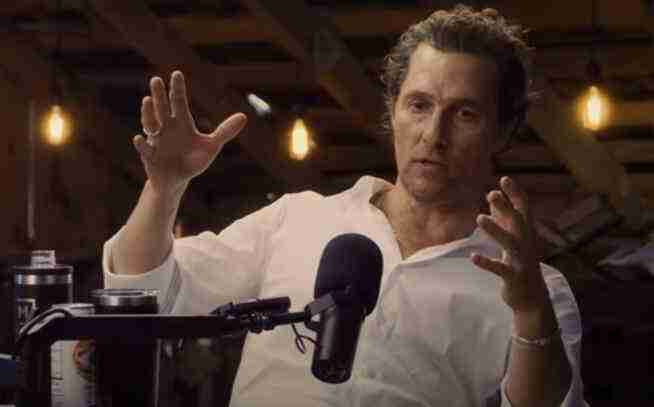
Read the full transcript of Modern Wisdom Podcast episode titled “The Hidden Art Of Reinventing Yourself” with Matthew McConaughey – an Academy Award winning actor, a producer and an author. (November 11, 2024)
Listen to the audio version here:
TRANSCRIPT:
Don’t Half-Ass It
CHRIS WILLIAMSON: What does “don’t half-ass it” mean to you?
MATTHEW MCCONAUGHEY: If you’re going to do it, do it. Say what you can do. Do what you say. If you can’t do it, don’t say you can do it. Don’t over-leverage yourself. Don’t over-leverage the decision and then jump in and kind of dip a toe. I think I’ll try it out.
No, think if you’re going to try it out beforehand, but when it’s time to go, dive. Finish it. Find out. Come out the other side. Don’t leave it and go, if I just thought it, uh-uh. That keeps me up at night. I think it keeps a lot of us up at night. When you half-ass something and you just don’t know whether you failed or succeeded, got what you want or didn’t get what you want, finding out and looking in the mirror and going, I didn’t half-ass it.
I went all the way. I found out and that ain’t for me. Or I found out and you damn right that is for me. That’s a great place to get to. But the limbo of not knowing, if you half-ass something, the limbo of going, I hedged my bet.
CHRIS WILLIAMSON: What could have happened?
MATTHEW MCCONAUGHEY: You don’t know.
CHRIS WILLIAMSON: Were you surprised when your dad said that to you, when you were going to take a pivot in life trajectory?
MATTHEW MCCONAUGHEY: It wouldn’t have been in the top 100 things I thought he would have said. I was fully stabilizing in that moment. As I said, I called Tuesday night, seven o’clock, he’ll have had a beer. He’s already had dinner. It’s not Monday because that’s the first day of the work week. He’ll be a little more stressed. Catch him at Tuesday.
When I unload this that I don’t want to go to law school, I want to go to film school. And I really thought he was going to go, “You want to do what?” Again, the family I grew up in, the idea of me thinking that the idea of going into film, it’s like very Saturday idea, a hobby idea, not a job. And when I shared it with him, the pause that he took, you know, another bead of sweat started on my back of my neck before he goes, “Well, don’t half-ass it.”
Now we’ll say this though. I do know now, and I didn’t know it then, I’ve realized it in the last 10 years, the way that I asked him is part of the reason he gave me that answer. I really wasn’t asking him. I called him, I said, “Dad, what do you got in my command?” I said, “I don’t want to go to law school anymore. I want to go to film school.” I didn’t go, “I don’t, I don’t, I’m not feeling, I’m not sure about law school. I think I want to, I mean, I think I may want to go to,” if I’d have stuttered into that, I think he would have again heard me half-assing what I wanted and gone.
CHRIS WILLIAMSON: In the process of being told to not half-ass it, you didn’t half-ass it.
MATTHEW MCCONAUGHEY: The way I asked. He asked and he heard my own conviction. And I think what he had in that moment was what I think every parent wants to hope to have with their kids is that, you know, we raise our kids to go in a structured form, follow this, and you can get most of what you want in life. But what, and that can work, but what do we really want our kids to do? We want them to follow that and then bust out of it one day and not even ask our permission. And that’s when we’re going, “That’s my boy. That’s my girl. That’s my child.”
We wanted to break out. And I think what he heard then was I was breaking out without really asking his permission. And that was clear. I spoke up, didn’t stutter. My voice was out of my throat a little bit. And I think that was part of why in that moment he gave me the answer, “Don’t half-ass.”
Getting the Role in Dazed and Confused
CHRIS WILLIAMSON: Do you think that sentiment carried forward into how you got the role for Dazed and Confused that I’m going to continue to lean in. I’m on the front foot and 10 toes down.
MATTHEW MCCONAUGHEY: Yes. Now how much that direct sentiment from that night when he told me don’t half-ass it had to do with that. I mean, yeah, it did have something to do with it. Look, when he said “Don’t half-ass it,” he was, and I talk about this in the book, he wasn’t only giving me permission, he was giving me a responsibility.
He was going, I knew I was at his word with me and my future decisions. I was making them for more than myself. I wanted to fail less because I didn’t want to embarrass him. And that was extra motivation, extra strength, extra courage, extra sobriety, extra like, well, let’s find out. Go for it, man. Go for it.
It carried on into other stories of other jobs. Time to Kill with Joel Schumacher going, I want the lead. That’s me going, I want to find out. And dad told me not to half-ass it back there a few years ago. You know, so if I don’t go for it, if I embarrass myself, I’m embarrassing him. So that was also some incentive and some weight behind those moves that I made, some of them.
CHRIS WILLIAMSON: Are you a brave person in that way, do you think?
MATTHEW MCCONAUGHEY: I don’t know.
CHRIS WILLIAMSON: And you still have a hunger for more?
MATTHEW MCCONAUGHEY: I think I’m going to kill chicken shit. I mean, not overall, but I think there’s many things that I’m not fully assing. I think there’s many things that I’m still could take further, that there’s still many things that, more risk I could take and more bravery I could have.
The Dazed and Confused Audition Story
CHRIS WILLIAMSON: Can you tell that story of Dazed and Confused, the story of leaning in, of taking that risk?
MATTHEW MCCONAUGHEY: Yeah. So, I mean, the initial one started when I went to, on a Thursday night, went to my favorite bar at the top of the Hyatt because I knew the bartender. He was at film school with me. He’d give me free vodka and tonic. So I went there. I get there that night.
He brings me my girlfriend, vodka and tonic, tells me, “There’s a guy at the end of the bar producing a movie. Let me introduce you to him.” I walk over, he introduces me to him. Four hours later, that man, Don Phillips, legendary casting director, who was actually produced on Dazed and Confused.
We get kicked out of that bar. I’ve had as many vodka and tonics as he had since I sat down. So I’m not leaving easily either. And I’m standing up for my new friend who we hadn’t done anything to get kicked out of the bar. We really hadn’t. We were just kind of standing on top of the tables, imitating some golf shots we played on similar courses in the past.
So we get not so politely escorted out and he’s in a cab, but we’re in a cab. He’s riding with me to my apartment, going to drop me off before he heads back to his hotel. He pulls out a joint, or I pulled out a joint, starts smoking. He goes, “Hey, you ever done any acting?” And I said, “Man, I was in a, you know, Trisha Yearwood video for a second, kind of more of a modeling job. I was in a Miller Lite commercial for about that long.” I go, “I don’t know if you call it acting.”
He goes, “Well, come to this address tomorrow morning, 9:30. You might be right for this part. It’s this character called Wooderson in this movie, Dazed and Confused. I think you might be right for the part.” This is three something in the morning. So 9:30 came really quickly and I was on time probably five minutes early. And we were already pretty tuned at this time.
Now, mind you, I get there, I walk in, they go, “Matthew?” I go, “Yes.” They go, “Don left the script for you.” I open it up. It’s signed by him. “Hey, here’s the part, Wooderson. I got three scenes in there, three lines. They’re all marked. Check them out. I think you might be right for it. Good luck. Let me know. We’ll call you in for an audition.”
I go away. I go look at this, these three lines. One of them was what I like to call these, a launch pad line, which is a line that sometimes they’ll have in a script where if that character means that line and that character is not playing that line as an attitude or a wink or a joke, if that character means that line, you could write a book on it. You could write a book based on that reality.
And that line in Dazed and Confused from the character Wooderson was a line when he’s leaning against the wall outside the pool hall. High school girls walk by, he checks one of them’s backside as they go by, and his buddy says, “Wooderson, you got to cut that out, man. You’re going to end up in jail.” And Wooderson says, “No, man. That’s what I love about those high school girls, man. I get older, they stay the same age.”
That line, I went, “Who is that?” There’s a book on somebody. If that’s not trying to be cute, if that guy’s not trying to say something coy and clever, if he believes I’ve got life figured out, man, this is my North Star. So that line informed who the character was.
I go, I read for it. I remember the first time I got called back because they said the sound was bad. And now I come back, I don’t know if the sound was bad or the fact that I just needed to come back. She used to come back and read for Richard Linklater, the director, who I did read for, and I got the part.
Now, the role was also based on, as I wrote about in the book, who I thought my brother was when I was 11. My 17-year-old brother was already my hero. He was cooler than James Dean. And we had one day where his car was broke down and my mom, when I was supposed to pick him up from school, and he wasn’t where he was supposed to be, we’re looking for him.
I’m looking at the back of our station wagon. And there I see this silhouette of this guy leaning against a brick wall, left boot heel against the brick wall, leaning back, lazy cig in the right hand smoking. And it was my brother. And in that silhouette, he was 13 feet tall, coolest dude in the world.
And just as I went to go, “Wait, there’s Pat,” I remembered, oh, he’s going to get big trouble for smoking. So I won’t say it’s him. My mom goes, “Who?” I go, “Nothing.” But that image in my 11-year-old eyes went, that was Wooderson.
Wooderson Comes to Life
MATTHEW MCCONAUGHEY: So we get to the set one night, and I just go in for what’s supposed to be a makeup wardrobe test, meaning put on makeup, put on wardrobe. When the director, Linklater, can leave the set and get to a minute, he comes, checks you out, eyeballs, gives you a few notes, and you say goodbye. I’ll see you when I come back for work.
Well, on this night, I come out of the trailer, Linklater shows up, has a look, as he’s walking up, his hands go out, he’s just going, “Yeah, yeah, Wooderson.” He’s like, “Peach pants. Is that a nude t-shirt? Ah, I like that. What’s that over there, that tattoo? That’s a Black Panther tattoo. Yeah, yeah, yeah. Look at the hair, the comb over. I like it, I like it.”
I said, “Cool.” About to say goodbye, I think. He goes, “Hey, man,” he goes, “uh, you think, you know, Wooderson’s been with the typical hot chicks in school, the cheerleaders and stuff.” I’m like, “Yeah.” He goes, “You think Wooderson would be interested in the red-headed intellectual?” I’m like, “Yeah, man, Wooderson loves all types of chicks.”
He goes, “Well, listen, the actress Marissa Ribisi is over here in her car. She’s got her nerd friends in the back. It’s the last day of school. You think maybe you want to pull up and try and pick her up?” I’m like, “Yeah.” He goes, “Okay, you want to do it now?” I said, “Give me 30 minutes.”
I took a walk. Now I’m about to be in my first scene. There’s nothing written. I’ve not done this before, but I’m going over scenarios. Where are we? Last day of school. I got some change in my pocket. I’m working with the city. Sure, red-headed intellectual. We’re going to go out. I’d probably speak a little Spanish.
Next thing I know, I’m in the car getting a lavalier mic put on me. I’m getting a little anxious, but I’m going, “Who is my man? Who is Wooderson? What do I love? What do I love? What do I love?” As this mic’s getting put on me, I’m like, “I love my car. I said, bam, I’m in my ’70 Chevelle right now. There’s one thing I got going for me. I said, I love rock and roll, man. I said, shit, man, I got Ted Nugent Stranglehold rocking in the eight track.”
MATTHEW MCCONAUGHEY: There’s two. I said, I love getting high. I said, “Well, man, Slater’s riding shotgun. He’s always got a doobie rolled up.” There’s three. And that’s when I heard “Action.” And as I looked up and dropped it into drive, thought of the three things I had while I was going to get the fourth. And I said to myself, and I love picking up chicks in drive, pull out three affirmations of the three things I did have on the way to get the fourth.
“All right. All right. All right.” Pull in, have the scene, try and pick her up, ditch the geeks in the back, going to be, you know, fiesta in the making, whatever it was, kind of spoke a little Spanglish, blah, blah, blah, blah. And all of a sudden it was over and a lot of people laughing. And Rick comes up and goes, “Oh, that’s great. That’s great. Great. Let’s try it one more time. Do this, that.” Did the scene two, maybe two times, three times. I don’t remember.
And finish it. I get out. People are laughing. I just had fun. I think with Cochran in the seats, in the Roy Cochran, the actor who played Slater in the shotgun seat, he’s giggling. I’m like, he’s like, “That was good, man. That was good.” I’m like, “Cool.” And all of a sudden I’m about to leave and Rick invites me back the next night. Got put in some other scene. Anyway, he invited me back every night for three weeks and I worked three weeks.
Now, what I found out two years ago was Rick also asked me that night on the sidewalk. “Hey, you’d think he’d be interested in the redheaded intellectual girl.” It’s because Rick had, he had just noticed that night that they had a story hole.
They didn’t know what car they were going to go, I think, pick up the Aerosmith tickets in and who, and who else had a car. Pickford had a car and I was the only one who had a car and had a little, a guy who had a job. And he was trying to start to fill a story hole. He didn’t tell me this till like a year ago.
And that’s why he invited me into that first scene at the top notch barbecue, where I said those three words, which were the first words I say on screen, which were the three affirmations for the three things my guy did have. And I think they came from, not intentionally, but leading up to that role, I was listening to a lot of Doors and there’s a live track of Morrison at some Doors concert. I don’t know where I think he’s in Europe somewhere where he barks out. “All right. All right. All right. All right.”
Very aggressively, not Wooderson style, but like four or five. “All right. All right. All right. All right.” And somehow that pop, I had no plans, but it popped in my head in that moment as being, let me take that version, just give three of them for the three things I’ve got for myself, but in a more laid back, cool way. “All right. All right. All right.” Pulled up.
CHRIS WILLIAMSON: How did it feel to have that positive reinforcement so quickly out of nowhere, both privately and then publicly after?
MATTHEW MCCONAUGHEY: Well, I mean, it felt fun in the moment, it felt good. And then it became public right there with the crew and the cast. Now publicly it became a year and a half later. I mean, look privately on that. I remember going, that was so much fun. I think, I think, I think I was good at it. People tell me I’m good at it. I’m getting invited back.
And then the other thing was I’m getting scale. I’m getting 330 bucks a day and I’m working a job at Catfish Station waiting tables. And the most I’ve made there in one night is $73. And now I’m getting 340 or whatever it was for doing this. I was honestly, I remember going, is this shit legal? Is this real? What am I getting away with here, yes, I’ll come back for the pay and because it’s so much fun. And then you probably know the story, five days in my dad moved on.
Rick and I were just talking about this the other day because his father just moved on a few days ago. We were talking about yesterday. I went home, came back to work. Still had going through mourning with my dad, but had that sobriety that comes when you lose a loved one to death.
You talk about sobering up and courage of the world, even more than my dad tell me don’t half-ass it. Him passing gave me some real courage, man. I mean, of looking at the world straight at, straight in the eye and not being intimidated by mortal shit anymore. And so it really helped me stay and focus on the role.
Had a great time. Probably a little quieter than I was in the first five days, more to myself a little bit. That’s where Rick and I kind of became more friends than just director or actor at that time because he was the kind of person I was talking to about how it was feeling and how to deal with my dad’s death.
I finished that. I go back to University of Texas, graduate film school. On the way out, already packed up at the U-Haul, get the Texas Chainsaw Massacre job for like five weeks, which is super fun. Another under the table cash for play that part. Unloaded the U-Haul and drove out to Hollywood.
And a year after that, I would say when A Time to Kill’s when all of a sudden I noticed, oh, wow, I’m famous. Life, I’ve cast a new check that I didn’t know about where I say the world become a mirror. There was no more anonymity. That was a whole new drug.
Alchemizing Bad Times into Good
CHRIS WILLIAMSON: I think one of the themes of your worldview that I’ve become familiar with is alchemizing bad times into good ones. A reminder that things that seem bad can end up being good. And in retrospect, I think it’s obvious and almost romantic to think about that alchemy in that way. But in the moment, it’s basically impossible. How can people or how do you have more of that perspective during a hard time?
MATTHEW MCCONAUGHEY: Well, a couple of things. First off, I probably start off intellectualizing something that I know I probably should believe in, but don’t believe in it and convince myself even to an extent to trick myself. You know, sit here and go, well, you just tell yourself this too shall pass. OK, great. Well, what the hell’s that mean? Even if it’s true in the moment, you’re like, what are you freaking talking about, man?
I’m in the debit section. I’m in a mourning section. This sucks. I think that how much I’m conscious of it or not, my undeniable optimism and faith that this isn’t how it is, and if it is, so what? That’s OK. Well, then really, so what?
You know what I mean? What’s the big deal to it minimizes? I don’t — I seem to have a tendency not to make a bigger deal out of things that other people make a bigger deal. Dramas, I don’t like to create false drama when it comes in. It’s hard. I am affected. I get the blues. I get sad. I get mad. I’m a shit to be around. I can’t get to sleep.
I got demons in my own head trying to work, trying to work the riddle out. Why did this happen? That’s the other thing that’s tough for me is I think that any bad thing that happens to me, my initial reaction is what you do wrong to lead to this. Like in a relationship, Camilla and I get an argument. My mind immediately goes, what did you do in the last two weeks to let this get to a point where you just had to raise your voice or she had to raise your voice, her voice? Usually there’s some P’s and Q’s that were not handled to get to that point. So I like it when things are running like this. The challenge when things are running great is we all tend to think, aha, this is it. I’ve found it. Bottle it. If I realize this, I can maintain this forever. And the truth is bullshit. No, we can’t.
But we can minimize it. There are habits that I notice of things I take care of in my life, health wise, faith wise, father wise, husband wise, that I know that if I’m doing that consistently, there’s less valleys. There’s less stress. There’s less warning signs. There’s less problematic. Oh, shit. How do we get in this? So there’s consistently behaviors that I know I can act upon that have worked in the past.
Responsibility and Optimism
CHRIS WILLIAMSON: I’m fascinated by people who take responsibility for things that aren’t their responsibility. We often get told pieces of advice in the modern world. It might not be your fault, but it is your responsibility. And one of the ways to unburden yourself is to assume that everything is. But there is a cohort of people.
MATTHEW MCCONAUGHEY: It’s an arrogant notion. Yeah. Look at how I, if only I could have stepped in. Yeah, you make yourself. But also the first side, I’m the reason that I step in shit, which is also an asset. Even if someone goes, why are you giving yourself so much credit for screwing that up? Yeah. Beautiful.
Yeah. I mean, look, I think part of this for me comes from, we didn’t get in trouble in my family for the bad deed we got in trouble for getting caught. So times where I can screw up and get away with it, I feel better than times that maybe I didn’t screw up as bad, but, but got busted. Because I got caught because I got busted because I got myself in the pickle because things didn’t go how I wanted it to go or how I believed it could go.
CHRIS WILLIAMSON: Is there something that you try to remember about the upside of a crisis during a crisis, or do we just need to ride that out?
MATTHEW MCCONAUGHEY: So I think that’s a good question. Yeah, right. Zooming out would be so beautiful. And in retrospect, if only you could give yourself the gift of distance of time. Yeah.
And yet, you know, something hard is going to come again, and you’re going to be swept away by the wave. I mean, for me, it’s an obvious answer to both because you can’t jump to the objective right away and go, “Inshallah. Oh, fatal habit. This too shall pass. I’m all — I’m fine.” No, because then you don’t deal with the crisis.
I do have a good — I do have a pretty quick threshold for being able to laugh, like honestly start giggling when I’m in the shit. Because I found that I’m able to handle the shit better if I just start as quick as I start going, “Are you kidding me?” And I will — and I also my I’ll get objective and remind myself, things like “You’re going to die, McConaughey,” which gives me that. “Oh, so what this is not as big of a deal as I thought.” I also quickly somehow comes in my head. Not right now. But one day, this is going to be a great story. I quickly go to that. I’ll get — I’ll project forward into those places that ease me a little bit, at least maybe look at it with a good eye.
CHRIS WILLIAMSON: You’re almost imagining being that future you laughing back at this.
MATTHEW MCCONAUGHEY: Yeah, yeah. And I goes back to the faith and belief that, you know, again, I’m nervous where I’m going to go speak or something. I got a little thing in my wallet. “You’re going to die one day, McConaughey.”
And I’m like, “Oh, that relaxes me.” If I’m going in, you know, complacent. I got another note or tell myself “What you’re about to say and do will outlive you. So you better do it well.” You know, to get me more on edge.
CHRIS WILLIAMSON: This balance is so fascinating. You know, being able to thread that needle, being able to find the golden mean, as Aristotle talked about. But yeah, I’ve heard you say that you should make a sense of humor, your default emotion.
MATTHEW MCCONAUGHEY: Yeah. Linklater and I came up with that in a conversation about 12 years ago. Richard Linklater. And we were just talking about how mad and angry and upset and offended people get if they don’t know how to react, if they don’t have an opinion on something. And we were like, “Yeah, man, wouldn’t the world be a better place, easier to get along with everybody if the default emotion, if you’re not sure how to respond.”
Okay. Now, most people think they go, “Well, that’s insensitive.” But that’s — it’s not insensitive. You usually think that means you’re not giving the crisis credit, if you can laugh at it. And I wholeheartedly disagree.
CHRIS WILLIAMSON: Oh, there’s some sort of tribute in solemnity.
MATTHEW MCCONAUGHEY: Yeah, that you’re not core enough about it, man, whatever that you know what I mean? It’s like, “Oh, you’re not taking it seriously. You’re actually putting me down. And just because you’re saying you’re not, you don’t feel victimized. And you laugh at it. You’re telling me you’re making fun of me being a victim.” No, no, no, no, no. I’m trying to deal.
Because especially when we talk about if it’s inevitable, too, that’s it. I laugh a lot quicker when I know I’m in an inevitable pickle. I have no other resource to get out of it that I know of. So I’m going to start giggling a little quicker. So I keep my eyes open and figure my way.
Because sometimes the hard work and the endurance and the elbow grease, the work harder, we were talking about that hustle, is not the way out. Sometimes it’s I need to back up, laugh, have a sip of my favorite whatever, and dance my way through the raindrops out of this sumbitch. Maybe it’s not banging your head on the wall. Maybe it’s backing up and seeing, “Oh, I got a key in my pocket that unlocks the door I’m trying. I’ve been bloodying my skull over. Banging ain’t banging into.”
The Importance of Humor
CHRIS WILLIAMSON: I do wonder why. I like being serious. I’m serious about the things I do. I’m serious about this podcast, as you might be able to tell by the fact we’ve renovated an entire barn. But there is something that you can take that too far. The seriousness can become a kind of rigidity as opposed to being dynamically persistent. Taking things too seriously, not swaying in the breeze, presuming that you like the things you do and you want to keep doing them, the less robust and flexible you are, the more likely you are to break in those ways. I think that humor is a lovely bit of ballast that helps to balance that out.
MATTHEW MCCONAUGHEY: I would frame it this way. Be very serious about humor. Be very serious about comedy. I’m extremely serious about comedy. Do I take myself seriously? Yes, but also take seriously the stuff I don’t. Do I want to know everything? Yes, but I also take seriously the stuff that I don’t know. Be serious about that you don’t know that. Be serious about that this is funny or at least it’s going to be.
I try to take the comedy seriously. I think we can take sense of humor seriously. We don’t have to create a new category of going, “Oh, I need to be lighthearted or more careless and carefree.” We can just care more maybe about the validity of a good sense of humor. Instead of it being a relief, let me — let go of the pressure here. It’s almost like it’s not another bucket. It’s in the same bucket of commitment and persistence and endurance.
Deconstructing Success and Failure
CHRIS WILLIAMSON: Talking about that balance between good times and bad times, the lessons that we take from each, I heard a quote recently that said, “Every man knows reflection and introspection when he’s at his lowest.” Bad times, you can’t do anything other than wallow in retrospective assessment. But one of my favorite things I’ve learned from you is when things are going well, given that that’s presumably what you want to have more of, maybe worth deconstructing that.
MATTHEW MCCONAUGHEY: Yes. I wish I could more and I think more of us could all deconstruct our assets. Happiness, you can’t guarantee it, but there is a science to satisfaction. You can look at habits that engineered less pain in your life, maybe more pleasure, but at least less pain. And that’s a win.
I try to deconstruct. Look, I don’t. Do I write it? Did I used to write as much? Look at anybody who’s ever kept a diary. What’s the old sort of nostalgic idea of a diary? You go there when you’re in pain and you share thoughts that you don’t want to share with anyone else of those reflection.
And I did used to, for some reason, I don’t know why, but would force myself to write every day, no matter how happy I was. And I didn’t a lot of times want to go write when I was happy because I was like, “No, I don’t need to write it. I don’t need to become conscious of it.
CHRIS WILLIAMSON: I’m having too much fun. It’s getting in the way.
MATTHEW MCCONAUGHEY: Come on. I’m doing it. It’s living. It’s happening. But, and in writing Greenlights, when I went back, that’s a lot of the consistencies that I found that I wrote when things were going well, that I was taking some, for some reason, taking time to go, “Can I try and bottle some science here to why things are going well?” And I did find consistencies. Who I was hanging out with at night, what I was drinking, what bar I was at, what food I was drinking, how exercise, preparation for work, for school.
Um, and I found things. I was like, “You’re really happy in this segment of your life. Let’s go back and look at what you were doing. Oh man. I had, I had Augmentino scrolls. I was on them every day. I had some discipline where I was checking in with myself. Oh, you were going to church on Sundays. You were, you were given, you, you, you, you were saying, thank you, God, before you went to bed each night, you were appreciating more. You were pointing out beautiful things and not taking them for granted.”
Until I found a list of things. I’m like, and when I get off track, I try to remind myself, “You’ve been slacking on some of those” and I can pull it off. I’ve evolved. I got different ways. I get away with some now, but you know, uh, I’ve definitely found consistencies. And I think we all have them. If we just notate them along the way that they’re not by accident, because we sure as hell deconstruct the reasons when we’re in the funk and we don’t believe they’re by accident, we can take ourselves to behind the woodshed and show ourselves exactly why we’re guilty for every reasoning, condemn ourselves for every damn reason we got to that spot.
Well, let’s, if we’re going to do that, I just say, let’s, let’s cheers. Let’s have a cheers on the way for all the things that are work for when we have stuff going right. Also knowing that it’s not forever, that it will, we will have a mountain to climb here shortly.
CHRIS WILLIAMSON: Isn’t it interesting? So much of content that people like to consume books, podcasts, autobiographies, memoirs is deconstructing the success of others. So we’ll happily dissect success in other people and yet only dissect failure in ourselves. This odd asymmetry where we bestow all of the glory on those people. “Well done. And I must find out how to do it more,” even if it doesn’t fit me, even if they’re a different constitution, different background, different time. For me, I’ll focus on the negatives.
There’s a really interesting stat around the likelihood of you ensuring that your dog completes a course of antibiotics is about 95%. The likelihood that you ensure that you’ll complete a course of antibiotics is about 50%. So we’re prepared to look after an animal twice as well as ourselves.
MATTHEW MCCONAUGHEY: I was, I wrote a note the other day, man.
CHRIS WILLIAMSON: What does that say on the back of your phone? The sticker? Oh, “Choose to shine.”
MATTHEW MCCONAUGHEY: Very cool. My daughter gave me that. I wrote the other day and then most of what I do is I use this note app, right? And I wrote the other day, where is it? It was on that note. I was like, “What’s my best advice I need to give myself right now is listen to my own damn advice.” Yeah. Followed that up with, where is it? Yeah. “Trying to live with less gravity and more backbone is a salty task.”
Living with Less Gravity and More Backbone
CHRIS WILLIAMSON: What’s that mean to you?
MATTHEW MCCONAUGHEY: Kind of live lighter with less gravity, live lighter, not take certain things so seriously, but still have the principle backbone because I’m getting older. We get older and the black and whites turn to gray. And then there’s a great word compromise. We all say, which is such a mature thing to do. And then all of a sudden we let things slide and then we start going, “Well, change will happen. Hey, change is inevitable. Let change happen.”
And I’m not ready. That’s part of getting old. I think not just getting older. Same with cynicism. It’s a disease of getting too old and I’m not ready to, I don’t want to be ready to give up certain things. I’m going, “No, man, the beauty of ignorance, the things that we believed in, I’ve gotten away with so many things because of my ignorance. I’m, I’m, I’m, I’d be dead 14 times in this life if I wouldn’t have been ignorant of the situation I was in.”
And so, yeah, I, you know, not, not knowing or knowing what we know it’s anyway. Yeah. It’s more backbone to hold on and be principled, what I stand for, what I stand against when it becomes easier and easier to just go with the flow and I’m not ready to go. Let’s just go with the flow. I just want to, I want to, I don’t want to pick the wrong battles.
I’m trying, trying to be discerning and not picking the wrong fights. Because I like picking fights and going after challenges, but I’m going to play, I’m kind of like, “Man, it’s tough duty to win the fair fights. And there’s a lot of unfair fights out there. And why do I want to spend my time if I got 24 hours a day picking unfair fights when I’m going to be busting my ass to win the fair ones?”
CHRIS WILLIAMSON: Well, also picking fights with yourself. You know, you hinted just there at the difficulty of a negative inner voice. You know, you take things seriously. You care about what you’re doing. You want to achieve things in this world, which means that you need to have high standards. You need to posit an ideal. But as soon as you posit an ideal, you then begin to compare yourself to that ideal. And often you find yourself lacking because it’s a ideal.
MATTHEW MCCONAUGHEY: I think it’s why a lot of relationships don’t work. We make her Wonder Woman and she makes us Superman and neither one of us can live up to it. And that we’ve got that bulb, that honeymoon bulb turned up to a hundred Watts and honeymoon’s over. We’re trying to deal with some real, just some real base stuff.
Let’s leave it at 20 Watts. We’re just lit, but we’re not just feverishly, you know, superhuman. And I think a lot of us just purport that on someone else and they can’t live up to it. And it ends up not being fair to them. And then they do the same to us and we both walk away going, “I under, I underwhelmed.”
The Michelangelo Effect
CHRIS WILLIAMSON: Do you know the idea of the Michelangelo effect? You heard of this?
MATTHEW MCCONAUGHEY: Awesome.
CHRIS WILLIAMSON: So the Michelangelo effect describes a situation in a relationship, friendship or intimate partnership where each partner sees the best in the other and tries to help bring that out. So the sum of the parts is greater than it is individually. And the reason I love it is why it’s called the Michelangelo effect.
So the block of marble that David was carved from had been attempted by a number of other sculptors previously. Huge, monstrous thing. If you’ve ever seen David in person, ginormous, people can’t. And when you’re looking up as well with that angle on the plinth, it’s even bigger. Previous sculptures had attempted and failed, but Michelangelo saw inside of the marble, what was David. He just needed to get away all of the things that weren’t.
I love that idea. I think in life, you want to be finding people that believe in you more than you believe in you, that hold you to higher standards.
MATTHEW MCCONAUGHEY: I think that’s the definition of a good friend. I think that’s the definition of a good partner. The definition of a good husband, wife. They remind us of the best of ourselves. They shine that light and remind us because we do. I know I do. I put the blinds on it and I don’t see it a lot of times.
I’ll be reminded. This has always been a thing for me. I don’t know how this correlates, but I’ve never been as good in my dreams as I am in real life. I never win the day, get the girl, ace the test. I can perform in my dreams. I never have, never have, as well as I will in real life.
CHRIS WILLIAMSON: I think I’m the same.
MATTHEW MCCONAUGHEY: I guess what I’m saying is I’ll pull something off. I’m like, “Everyone see that?” My friends are like, “No shit. That’s you, bro. What’s the biggie?” You know what I mean? It’s what I like about living in Austin, Texas. They’re not really impressed with stuff that I pull off. They thought it was cool. I won an Oscar, but they were like, “Well, no shit.” I was like, “Oh, all right. Yeah. Yeah. Thank you, man.” That’s what friends will do in a way, loved ones will do that and be like, “Yeah, there you are.”
The Difficulty of Being Gentle with Ourselves
CHRIS WILLIAMSON: It comes back to that. It’s so much easier to be supportive and gentle of other people than of ourselves. You will happily bestow this gentle, reassuring pat on the shoulder when somebody succeeds or falls short when they tried their best. Yet, given the fact that you tried your best, you give yourself a kick in the dick on the way out of the door and a harsh word to follow you.
MATTHEW MCCONAUGHEY: What do you think about when you do succeed? And a lot of people go, “Nope, that’s nothing.” I prescribed it. I think we should take some time to be able to look in the mirror and own that thing that we pulled off and go, “Good job. That’s what you wanted. That’s what you got.” At the same time, be able to, as we do more often, look in the mirror when we fail and go, “Eh, eh, bogey, you did not pull that off.” You know what I mean?
But I mean, it’s kind of big in the ownership idea of the fail or the gain, ownership being really important. And I don’t, I’m a fan of the ego. I wish people, someone said this to me before, look, oh, this, this, this, a queen said this. It came off the cuff. I didn’t even think about it. She was like, “Ah, tell me, Matthew, you’re so full of yourself.” And I, without thinking, I was like, “Well, who else am I supposed to be full of?”
CHRIS WILLIAMSON: That’s a good line.
MATTHEW MCCONAUGHEY: And I stopped that and I was like, that’s exactly what I meant. And I wrote that down. I wish more people were more full of themselves. Not in the arrogant way, but I’m talking about a healthy ego to understand. And then I understand ego’s difference between I and me. Me is the objective, but to know the I.
I wish more people, I wish we were more full of ourselves. I wish more people in the world were more full of themselves. I think part of the challenges in life is a lot of us are running around half-assing ourselves, half-fooling ourselves, not full of ourselves, not studying ourself enough, not holding ourself to task enough, not patting our own self on the back when we do get what we want enough, not cracking our own whip on our backside when we do get out of line, even though we knew better. I wish we were more full of ourselves that way.
CHRIS WILLIAMSON: The guy that was sat there yesterday, Dewayne, I asked him something not too dissimilar about self-esteem. He took a little while. He said, “I like me. I’d buy me a beer.” I thought that’s so great. I’d buy me a beer.
MATTHEW MCCONAUGHEY: Hey, he’s shaking hands with himself, you know, and sweet man, I got plenty of times where I was sure as I’m the last guy I want to have a beer with. I’m happy to say I got some times I’m like, I appreciate drinking alone. You know what I mean? I mean, yeah, it’d be nice. Would that be not more than nice is a better word than nice, but if go, go try to be today, someone you want to have a beer with. It’s a pretty good, easy way, pretty good bumper sticker. You know what I mean?
CHRIS WILLIAMSON: Could have been in the book. Yeah. Talk to me about the non-deserving complex. It feels similar.
MATTHEW MCCONAUGHEY: Yeah. So it definitely, and I think it’s called in their term, imposter syndrome or something like that. When I got famous off of A Time to Kill, I had more people saying, “I love you.” And I’d only said that like four times in my life to four different people.
And I was like, “Wow, this is, they mean it,” you know, the red carpets in caviar. I started to get that, you know, “Why me? Why me? There’s other people that deserve this more than me.” And that’s back when I had a, I was using the word deserve, which I’m not the biggest fan of now. I prefer earn. But I didn’t feel like I deserved it in the big scheme of things. It was a, I think it’s a, we have to, what’s dangerous about it. I think at its core, it’s a, it’s a, it’s a coping mechanism, but it’s a false humility.
CHRIS WILLIAMSON: Yep. Yep. I understand.
MATTHEW MCCONAUGHEY: It’s like, it’s almost arrogant to think that you’re, you did all that even, you know, it’s almost like guilt is an arrogant thing. Like who makes you the judge and jury of you on that? Who, you know, it’s like saying, being very arrogant and go, “Oh no, no, no, not me. I shouldn’t have that.”
Dealing with Fame and Success
MATTHEW MCCONAUGHEY: Um, it does help you, you deal when the stimulus of the world’s brand new and coming on you, it helps you back up. Because you can’t, you don’t want to take any more arrows because you’re feeling it all as arrows. Um, I sure felt that when I first got famous, um, talk about all the options and yeses, brand new yeses for me in the world, I pushed against it.
And I even had clumsy times where I got ugly just to counter it. Like I said, I attribute myself running downhill. I tripped myself because I felt like, “Man, things are going too well. I need a bloody nose. Bam. I give myself one. Now I feel more. Okay. Now I’m where I’m supposed to be.”
Does part of that come with the fact that I grew up in a middle-class blue collar family in Uvalde, Texas, 12,000 people from a dad who was like, “You get out there and you earn, you break a sweat.” Probably. I don’t know. Um, I, I wouldn’t, so much stuff was coming at me and I didn’t feel like I would, I’d broken a sweat to get it.
I was having fun what I did. And I was, couldn’t give myself enough credit for maybe he’s going, you’re good at what you’re doing. And I was like, and I was looking for the proverbial sweat. I was looking for the, “Where’s the exhaustion of a full working day where I actually, I drew blood, man. I did it. I made it through.”
CHRIS WILLIAMSON: Dude, the Puritan work ethic runs strong. I used to struggle. I ran nightclubs for a long time and there was a period where I didn’t miss single Saturday, which was our big event, uh, for 204 Saturdays in a row. And I would go on holiday, the holidays I was having, you know, I’m 20, 22 to 26, something like that. So prime young guy territory.
And, uh, I’d go on holiday from a Sunday morning until a Thursday evening. And then make sure that I was back in the Northeast of the UK.
MATTHEW MCCONAUGHEY: Why did you make sure you got back on the Saturday night?
CHRIS WILLIAMSON: Because I couldn’t bear to have success without having bled for it. Because if it, there was so many hoops I had to jump through in order for things to, for me to get a pat on the back, had to go well. Because if it went badly, I was less, but not only did it have to go well, I had to suffer in service of it going well. Because if it went well, but came easily, that was also somehow lesser.
MATTHEW MCCONAUGHEY: For me, I felt like it was a sin almost. Not a disease, but more of a sin. I was like, “I didn’t pay a penance there, man. I didn’t, I hadn’t given enough tithe. I didn’t, like I said, break the proverbial sweat for all the blood to earn that thing.”
I’m getting all this. Didn’t, wasn’t able to look at the eye. Didn’t feel it, needed things to feel. I also needed at that time anonymity, which I lost. And I think everyone needs an anonymous soul. And I had lost mine and I didn’t know what was up, down, left or right. I hand, I got through stuff. If I look back at my interviews, the first few years I got famous, I bet you they’re so damn boring. Because I was, my two rules were “Be a gentleman and don’t lie.” Two pretty boring rules. If that’s only what you’re going in for and you’re creative and you got a colorful life, but I was just repeat it, stay down the line.
It wasn’t until later on, I was like, “Oh man, I trust myself enough. I believe myself enough to share how I feel about things.”
CHRIS WILLIAMSON: Yeah. Privacy is one of the privileges that people are born with that they don’t realize until they’ve lost it. And, uh, this has been a little bit of a trajectory that I’m starting to dip my toe into over the last few years as well. Of loss of privacy, loss of privacy, increased scrutiny, right. Sense of eyeball and even, you know, it’s a micro niche, degenerate version of proper fame, but still this sort of sense of vigilance being watched in some way or another.
And, uh, yeah, it’s one of those odd inverted privileges. Most people think about privilege as something that is bestowed upon you after you have done X, Y, and Z. But this is one of those things that as you tend to go on the trajectory, most people want to go on. It’s something that gets derogated, something that you lose. Sure.
MATTHEW MCCONAUGHEY: And you, people have, you skip salutations of “Hi, how you doing? What’s your name?” People have bio on you. They have an idea, an opinion for you before you ask for it. Sometimes it’s hyperbole to the awesome, overly exaggerated awesome. Sometimes it’s well below and you walk outside.
You don’t even have to talk to the world. You know, you feel eyes. You see how people move towards you or move away from you or what you catch it all in your periphery. And you start going, “I know what, I know what, I know what they think.” And maybe that’s false. It feels a lot better when it’s maybe false, but to the, oh, if they even think I’m better than them, then they didn’t even think I did better than I did.
CHRIS WILLIAMSON: But still disconcerting either way.
MATTHEW MCCONAUGHEY: Either way, it’s off balance because it’s not on, it’s not on parts.
Reconnecting with Authenticity
MATTHEW MCCONAUGHEY: Why I headed out to Peru after I got famous, took the 22 day backpack trip. I, and I remember writing down, I said, “I need, I need to go test my, who I am, my character on people who know me as a stranger.” And when I left the hugs, after 22 days, the hugs and the tears of the strange, no longer strangers after 22 days, but the hugs and the tears were coming from people that only knew me as a guy named Matthew. And that’s it who showed up and met me from there.
No biography on me, had no idea I was famous, no ideas in the movies. And 22 days later, 22 days later, they’re weeping tears of gladness and sadness saying goodbye to me. That gave me trust back. And I was like, “I got it. I did this. I’m still, I got it. I’ll just go fix your tire. I don’t have to, I don’t have this whole thing. Is it just triple A coming to fix the car?” You know what I mean?
Okay. It was, it was a, that was a, I needed that. It gave me a lot of confidence to come back to Hollywood and look a lot of the, what I was deeming excess, look it in the eye and go, “I get it. I get it. I know I earned getting here. I’m still, I still, I got, I got the goods, all of this.” I may not have earned that. They didn’t even ask for a lot of this, but I know I got myself here. Okay.
A Lonely Chapter
CHRIS WILLIAMSON: Did you ever have a lonely chapter during your trajectory?
MATTHEW MCCONAUGHEY: Looking back, I would say I did. I mean, look, I had some wonderfully fun and healthy and honest single years that were, became sort of revolutions that became sort of structurally tangent. It was fun. Stayed on the surface purposefully. I kept it there. They kept it there.
But I would still, you know, have many lonely nights when a man lays his head on the pillow, no matter who was in the bed, I was sleeping with me. And felt like many times I was in neutral. Didn’t have something that I was building towards and chasing relationship-wise, even career-wise at that time. I got through it fine. I didn’t, I didn’t go overboard and overindulge and didn’t get dangerous with my health or anyone else’s. Mainly because if I did get to, if I get the blues, I’d be like, “Open your eyes, bro. Look around, man. You kidding me? Take your time.”
And so, you know, I would say ultimately I was lonely in that time because I knew, I knew it was a stop, not a stay. And I knew I wanted more career, relationships, et cetera. But I wasn’t really fully committed. I wouldn’t, didn’t have to, maybe the wherewithal, the identity to go actually chase it and go, “I know what I want. I want to, I want to live a way to attract that.” I did try and go, I did have a time where I tried to go find it. But as I talked about in the book, I mean, I had a time where I was every red light. “Who’s over there? Produce section. Who’s over there? Every party. Who’s over there?” You know, looking for the one.
And once I was like, “Uh-uh.” I had that great dream of the 88-year-old bachelor that I was with all the kids showing up. That dream gave me grace, man, because I quit looking for that one. I did start acting like someone though. My target drew the arrow. I wasn’t, I started acting like someone who had a wherewithal and a peace of mind with myself, not needing someone to fulfill that drew her to me that I didn’t have before that dream.
Choosing a Good Partner
CHRIS WILLIAMSON: You’ve had a front row seat to some, a variety of rhythms of marriages, your parents, yours. What have you learned about choosing a good partner?
MATTHEW MCCONAUGHEY: Oh, well, I’m, and I’m still learning, but friends first. I mean, Camila and I become friends first. No, we became lovers pretty quickly, but I, the things I respected about her and saw that she had were things that I valued in a close friend.
Someone who respected their past. Someone who had a great sense of humor, but was never going to lie to put themselves to get what they wanted in front of me or take advantage of me. Someone who, you know, was impressed with who I was much more than they were impressed with what I did. Someone who very quickly saw the best in me and was like, “I like that. Let’s see some more of that,” you know, and watered that side of me.
As we talked about earlier, let’s see some more of that. Let me set things, let me put some more fuel on that fire so you can even be more of that. Why not be all of that? You know, then if you’re going to get together, I think this is a Susan Sarandon line when she was married to, what’s his name, Tim. Who was Susan Sarandon married to years ago? An entire room of people shaking their heads. Great actor, Shawshank Redemption, Tim Robbins.
They had a line that said that “We have similar moral bottom line.” It’s always stuck with me. You’re going to partner with someone, especially if you’re going to have a family, I think. Make sure you got a similar moral bottom line because, and look, Camila and I are going through new challenges now because we have teenagers.
Our moral bottom line and do’s and don’ts and what’s accepted and what we wouldn’t accept has been pretty part and parcel up until now. Teens are getting like, “Well, I’m a little loose over here. Yeah, let them go, let them go get that scar. Let them go get their heart broke, whatever that is. Let them go try it out and fail or succeed. Let them go negotiate, free play.” She’s a little more, and so we’re, her and I are working on that balance right now.
And it’s a new balance having teenagers as they’re getting their independence, but having a similar moral bottom line, you know, connected to bringing out the best in the partners is having somebody you’re a fan of and that they’re a fan of you. You call each other on your stuff or you don’t have to call it because the look says enough and you’re like, “Yeah, I know. Yeah, that was me, bogey,” you know, or “Yeah, I got away with that one again. No more, cut that out.”
And then what I’m learning now, trying to learn, is that scenes were essentially all the person that, for me now, I think I’m just essentially saying the same person I was, I was 19 years ago. You know, it seems essentially the same person I was when I was eight, 51. But our value systems reorder as we grow independently and as a couple, your value system changes for every parent when they become a parent for what’s important in their life. So you read, you’re moving things different places on the chart and the number one spot, the two spot and three spot.
But to understand that it also happens with us as individuals and going that we do change and how do we, even by being essentially the same person that we fell in love with, we still need room to change along the way and go through things that may seem inconsistent with who the DNA of why we fell in love with that person or what do what we love with who someone was. But no, there’s still essentially that, but give them room to change, give them room to change.
Also I think it’s the Springsteen line, you know, “You don’t, sometimes you’re running and the other one’s walking. And it’s okay to be ahead, but don’t lose sight. Don’t get so far ahead that you leave your mate lost back there,” going, you know, sometimes, you know, somebody’s real healthy, the other one’s on IR or still on the same team that takes patience by the one who’s healthy and takes persistence by the one who’s on IR.
But you got to wait up to hold that hand to go, “We’re still doing this together,” even though maybe in this zone right now in my life, I’m flying and you’re walking. So certain things that I find them, well, she’s flying and I’m walking, you know, and so navigating that and how we change as we grow up and measuring that against who we initially fell for in the first place and seeing, well, they are still that. Of course it changed.
“Hell, I’ve changed. I want to say, you know, and a lot of times I know I, we said, I know I said, well, you’ve changed.” I was like, “Well, heaven, yeah, I’ve changed. I’d hope so.” Yeah. You know, and doing that with a partner is part of the work, I think, of a relationship.
The Courage to Make a Pivot
CHRIS WILLIAMSON: Sort of talking about transformations, trajectories, pivots, changes, let’s escape Hollywood and go to South America and see what’s going on over there. Let’s escape singlehood, pivot into a marriage, pivot into family from dyad to triad to so on. I’m fascinated by the aggressive pivot that you made between different movie categories. And that requires, I think, a lot of courage and hope and self-belief and faith in order to do, to let go of something good.
MATTHEW MCCONAUGHEY: Yeah.
CHRIS WILLIAMSON: For the chance that’s something that you think could be great.
MATTHEW MCCONAUGHEY: Yeah.
CHRIS WILLIAMSON: I think that’s something that a lot of people wish that they had a little bit more fuel for.
MATTHEW MCCONAUGHEY: It was a big risk. It was a big chance and it was no guaranteed return ticket. It was a one-way ticket possibly to I’m a head coach of high school football to this day.
CHRIS WILLIAMSON: One-way ticket to a dead end —
MATTHEW MCCONAUGHEY: Or to something new but a one-way ticket to a dead end in Hollywood. It’s an actor for sure. Look, it’s no coincidence that at that time to have the courage to make that decision, I did have really cool things going on in my life. I’d fall in love with Camilla. She’d just become pregnant with her first child, that gave me some significance of like, ah that’s what I’ve always wanted to be. It’s a father, here we go. If I stick with it this will give me a home base to feel secure in even though I’m stepping away from what has made me give me significance for so many years and decades in my life.
Having her to sit there as much as I knew it was the right decision and it was a 3 a.m. decision in my own soul. She’s always been very good with me about going and I say it out loud and we’re going to do — here’s what we’re going to do — if we’re doing this. She’s the one that said “You could this could be dry for who knows how long? You may not get work ever again, but if we’re going to do this I’ll be here by your side and we’re doing it together and there’s no going back. There’s no — we’re not going to get — We’re not going to get nerves at the goal line. If we don’t know where the goal line we’re not going to get down the line and go oh a pool parachute —
CHRIS WILLIAMSON: Even if it’s a 14 million dollar parachute.
MATTHEW MCCONAUGHEY: Even if it’s 14 million dollars, even if it doesn’t work out and you become a teacher or you go become a lawyer again whatever this way — so making that a choice that was inevitable that there was no pulling the parachute on, sure as hell helped with the endurance of me being away for what was 20 months. I learned a lot of endurance in that year in Australia, though. Same way that gave me a lot very thick skin for enduring something. So that 20 months was really hard and I’ve said it before that proverbial bottle on the shelf was looking better and better earlier in the day as time went on. I mean, I mean how many more times could I work in the damn garden man? I’m like, I’m not a gardener for life like this, but I gotta — I gotta come on man. But she helped me stay steady.
I stayed steady. My face helped me stay steady. I did have a real belief whether I was tricking myself or not that there’s a bigger pot of gold for me on the other side of this if I just out endured. And you’re this summit and it became a little like the year in Australia. I started — I started to gain pride and honor with the longer the penance went on and being without what I wanted. Mm-hmm started to be like well, “I’m not yeah, I’m definitely backing out now, man I’m six months in turns into momentum” all on a year later. I’m like “I’m a year in man. This is getting good okay, come on.” And out of the blue 20 months later I’ve been gone long enough to become a new good idea. Where’s McConaughey?
Plus he said no to that 14.5 million dollar offer three months ago, and I guarantee you that told some people in Hollywood what’s this so much up to? You don’t say no to a 14.5 million dollar off. It was way the offers too big to get out and he said no. Now someone does that you get a little more attracted to him. What this is on something. He’s got his own program. He’s playing offense on something. He’s not just regressing and I think that also sent a bit of a signal. It’s my hunch through Hollywood and then in the fact that it was just honestly 20 months almost two years later “Where’s my guy? We haven’t seen him in a rom-com. We haven’t seen him on the beach shirtless. Where is he?” He hadn’t shown up in front of our faces anyway, I don’t know what he’s doing
CHRIS WILLIAMSON: Do you fear or did you fear not being sufficiently prolific not being sufficiently sort of? fronted stage keeping your name out there. What if somebody else takes that place of me? What if I become irrelevant? What if people forget
MATTHEW MCCONAUGHEY: I didn’t have any fear of anyone taking the place? Because my place at that time was rom-com King and I was sure I was like, “I’m good I’ve done enough of those right now. I don’t need another one of those right now. I don’t want another one of those right now. If someone steps in take the place Bravo,” I always like to say I took the baton from Hugh Grant and then I had my time I was like —
CHRIS WILLIAMSON: Who do you think you threw it to?
The Fear of Irrelevance
MATTHEW MCCONAUGHEY: I don’t know the rom-coms are not — They’re definitely not as healthy of a genre now as they were then, we were rolling in the rom-coms. They were like can’t miss her span, their medium budget 30 35 mil. So the studio is not blowing their wand on the budget. They come out. They make good money. Studios make good money on all of them kind of worked, even the ones that didn’t work as well kind of worked.
CHRIS WILLIAMSON: Yeah, you know potential audience. Everybody can go see —
MATTHEW MCCONAUGHEY: It repeats on Valentine’s Day. Come on, you know So I don’t — I don’t know that didn’t really hand it to you. I don’t know anyone’s really jumped in that lane or if that lanes even got a help wanted sign anymore, you know, um. Did I feel the irrelevance? Sure, I felt the unease of irrelevance. I mean but then I got I became irrelevant. I mean it got to the point where I knew I was irrelevant. They got to the point where I remember my agent saying I said “You heard anything” Because “Matthew I haven’t heard your name in over two months.” I’m like and you’re my agent. You only have five clients. He goes it. “Yeah I’ve even heard your name.” I’m like “That sounds pretty much like irrelevance to me, bro. Okay all right, but never like I was shaky, but never was I going to go? Okay I’ll go back rip. Call. I’ll do it.” Never was I going to pull the parachute.
And what if — what if I didn’t what does calls never came would I regret that sitting here now? I don’t maybe I wouldn’t be sitting here now, but I’ve bet everything I got there’s no way I’d regret it. Whatever. I’d be doing in my life right now I would have said this opened up. We just start off the conversation with this the things you don’t get put us more in places where we are where we find our own satisfaction than the things that we do get in many ways. I mean like say it’s you know life’s mystery going forward to science looking back.
When you look back we know we can all connect every single dot. It’s mathematical scientific how we got to this table right here. We got plans for this afternoon, but we’re not sure what’s going to happen. But everything looking back, it’s all connected if we go back and look at it. And there’s a whole lot of — I thought that was the end — well it was the end but it was the beginning of this thing or I caught that red light and therefore made me 60 seconds later to get to that cafe where I met that movie producer or that woman who became my wife or whatever that is. It don’t make sense at the time, but we’re looking back. It’s all a science.
CHRIS WILLIAMSON: There’s that quote about uh “The ironic tragedy is that life has to be lived forward but only makes sense in reverse.”
MATTHEW MCCONAUGHEY: Yeah. Ironic tragedy who said that. I mean, what do you think about all that? Life’s the ironic tragedy. Life is pain and it just is nothing but pain. But so just if we can endure it, like my mom — can’t help. She’s worn me down with her endurance of the her prescription on life.
Denial as a Virtue
CHRIS WILLIAMSON: How old is she?
MATTHEW MCCONAUGHEY: 92 and she is the absolute proof of the value of denial if you really commit to it. She absolutely —
CHRIS WILLIAMSON: Committed denialist?
MATTHEW MCCONAUGHEY: Committed denialist and it’s not an intellectual trick. There’s no “Oh, I’ll deny I’ll intellectually deny it. So then I’ll talk myself in so now I can let me say You know, I’m a BAM. Yeah. Yeah. Yeah fata complete. No, it didn’t happen.”
“No mom. It did” “No, didn’t — I’ve said in it didn’t” and she’s not — You don’t catch her in between the lines are off by herself realizing like “Oh, well it did.” No, it’s done. Non-negotiably done, her favorite word is “Yes”.
“Well, I think you live in so long.” “Well, I can’t imagine not being here. Geez, oh, man, that’s pretty good.” All right, I really can’t — I honestly cannot imagine not being here so — She’s beaten two types of cancers on aspirin, and we’re like “That doesn’t make any sense” and we have to tie her up and haul her to the doctor the dermatologist if you get something on her leg. Because going to a doctor in her mind is recognition of possible sickness.
So you go there, remove a cancer, take some cancer medicine. “Do you have cancer?” “No, I don’t.” And you wink and she does not wink. “I don’t, I don’t, what.” Anyway, if you’re going to have — you’re not following suit you don’t believe it, next question. That’s how she is. She’s been because she’s not playing a trick. She does it. It’s a full-on commitment to denial and it’s awesome.
She would not prescribe to life is painful and you have to get there. She thinks it’s — she’s very anti because she’s someone who like I think I’ve touched on the book. She had a horrible mother and parental growth. She did not know how to be a mother. How’d she become a great mother by saying I’m doing the opposite of what that bitch did? There’s value to that. I’m going “Well, I’ve it just shocked I don’t know how to do this, but if I just do the opposite dude.
Avoiding Pitfalls and Alchemy
CHRIS WILLIAMSON: I love this idea. So I grew up in a very working-class town northeast of the UK, famous only for having the highest teen pregnancy rating in England and then it lost that. So it didn’t even have that anymore, and I think there’s that idea of food deserts in America or areas in which it’s difficult to get good food, and I think that Stockton on Tees in the 90s was a role model desert at least for me mm-hmm, so I wasn’t around many people like the person I wanted to be like.
And at the time I think I was desperately looking like a thirsty man parched for water for somebody that would be that but in retrospect again ironic. There were a lot of people around me. There were people I didn’t want to be and I was able to plant flagpoles in the ground that helped me to avoid the catastrophes and the tragedies that would have awaited me had I have done that. So “I don’t want his relationship with his family.” “I don’t want the way that he drinks in order to be able to deal with his emotions.” “I don’t want the way that he speaks negatively about all situations.”
I don’t like the way that yeah, I think much of life is avoiding pitfalls not necessarily expediting successes. Yeah, the pitfalls can take you out of the game completely in one form or another. And yeah, I don’t like dwelling on the negatives in that way, but also that’s another version of alchemy that we were saying before hey here’s something that you think is useless or toxic or not. Yeah, not valuable and you’ve managed to turn it into something that benefited you.
It’s the same reason why teaching people lessons that you’ve gone through from tragedies and traumas whatever in your life, it’s kind of like pointing at the thing that was bad and say “You didn’t get me. I’m going to make sure that you’re not going to get them either.”
MATTHEW MCCONAUGHEY: Yeah, and even looking at the things that are bad and going “Oh Thank you, appreciate that.” I mean the the push-off. You have established leverage rather than the create so, you know you you’re going to lean into something. You also need some push up, the push off is what you’re leaning into is that mystery going forward, right?
That ironic tries it you have something to push off the well, “I don’t know what I do want. But I do know I don’t want that,” you have leverage. Yes, you know, it’s there so — I don’t know. I mean we can get in a big discussion on on victimhood here as well. But I you know, I I wrote about in Greenlights about how, we always say “Well, who are you? You know what? She’s figured out who you are” and we asked I tried to try to ask my kids that now.
“Why don’t you know who you are?” Now part of that who’s helped me is Bob Dylan’s lines Like “I don’t know what all this talks about who we are, man. We are all just what we create ourselves to be” and that gives me a little “Oh, that’s relaxing.” But it’s so much easier to figure out who you’re not. Then if you start eliminating the who I’m not by sheer mathematics you end up moving towards who were of what feeds you and who you are, and it’s a hell of a lot easier thing to go “How can I get rid of some bullshit my life than it is to go? Well, how do I go to my true self?”
CHRIS WILLIAMSON: Do I want to press the accelerator more quickly or do I want to take my foot off the brake, right?
MATTHEW MCCONAUGHEY: Yeah and shit there and because I’m banging my head here and I’m going to eliminate some of that stuff. I want to get some of those things out of the way that didn’t had another hangover. I drank the same amount, when I didn’t you don’t usually have a hangover. “Oh, maybe it was the conversations I was having. Maybe it was you know, maybe it was the people I was hanging out with” those just clocking, some of those things and eliminate them. It’s a much easier place to start you know and maybe more is it — maybe more valuable.
I mean, I don’t know, we always like to think that the The UFC champ or the boxing heavyweight champ that believes they are the greatest is more empowering than the one who’s out for revenge, but man the one out for revenge wins a lot of the times. And when he’s pushing against yep now, I’m going to get back at rage. Nothing gets more shit done than that emotion of rage.
We like to say “No freedom and light is the one that carries it” man I don’t know. That’s maybe too evolved for us to really grab all the rage and anger and revenge are mighty powerful emotions. Yeah, yeah, but get a lot of shit done.
CHRIS WILLIAMSON: Yeah, especially in the beginning, especially for a short period of time. I think when you — it’s a potent fuel that’s toxic in the long term. And I think that it’s the sort of thing that you use to overcome the activation energy, especially the beginning of a thing. “Hey, I need something to kick me out the chip on my shoulder from the kids that didn’t believe me in school. The fact that I felt like I was mistreated or victimized or in some form there was something some limitation placed on me.”
MATTHEW MCCONAUGHEY: It’s a pretty good fuel. That’ll get you a long way.
CHRIS WILLIAMSON: Yeah, but you do not want to be using that two three four decades down the line.
MATTHEW MCCONAUGHEY: Well, you’ll what do you call yourself implode? Because you can’t recognize your allies from your enemies and you start taking that on your allies we see it in relationships. You start taking that on your mate, start taking it out on your wife, your husband, your lover and like “I’m an ally man, we’re on the same team, but you’re back to that non-deserving. No, I’ve got a I got a bleed. No, I got it. I got I got I got a win. I got to get inked now you’d a.”
CHRIS WILLIAMSON: Well also, the lesson that you’ve taken is enemies are more functional motivating sources than allies, right? Therefore if I can make enemies out of allies, I will just find lily pad lily pad lily pad. I’ll just keep jump jump jump jumping.
MATTHEW MCCONAUGHEY: Yeah, but that I think what you say is that that trajectory starts to go — it’s not lateral thing.
CHRIS WILLIAMSON: What have you got left? You’ve got an entire world. Yeah with enemies. Yeah, or at least no allies, right? And yeah, you know as someone who used a chip on his shoulder used a chip on his shoulder for a good while to get some activation energy. I much prefer the version that I am now
The Three Versions of Chris
CHRIS WILLIAMSON: Me and a friend have three versions of ourselves that we think about so we have dopamine Chris, We have serotonin Chris. We have cortisol Chris. And Dopamine Chris is leaning he’s thinking about plays on the show and how magnificent big it’s going to be in awards and cool money and stuff like that. And Cortisol Chris is seeing threats and anxiety. He’s looking out that that ambient vigilance that I was saying before is on edge. Then serotonin Chris is taking a micro dose of magic mushrooms. He’s playing pickleball with his friends or he’s lying under a tree looking up at the sky.
Yeah, I want to spend as much time in serotonin Chris as possible. Yes I want to spend as much time in serotonin Chris as possible and I find myself —
MATTHEW MCCONAUGHEY: Serotonin Chris magic mushrooms in a hammock hanging with his buddies.
Balancing Accomplishment and Relaxation
CHRIS WILLIAMSON: Exactly. Okay. Yeah, I want to spend as much time in that as possible. But that wouldn’t have got me out — that wouldn’t have been the escape velocity that I needed to be able to leave whatever atmosphere I was in. I needed to use these other very — I needed to to run away from a life that I didn’t want and run toward one that I did, needed to escape something that I feared and I also needed to go towards something. But the real bliss is when you go orthogonal to both of those which is —
MATTHEW MCCONAUGHEY: Let me ask you this, so when you’re Serotonin Chris magic mushrooms with your buddies in the hammock. How long can you lay in that hammock before you get to the imposters the thing hey, I got I got to go accomplish. For me, it’s going to accomplish something to have some sort of perfect. I’ve got a — I’m still working on getting better on vacations. I’m much — my wife knows that I’m much easier to get along with on vacation if I get a couple hours to write in the morning and get a workout in dude. I wish I could go two weeks with going. “Hey, man, whatever” but I get, I get antsy, I get edgy. I’m not present because I need a little little time to go break a sweat mentally physically and then I can be. Then man the rest of the day. I’m great.
CHRIS WILLIAMSON: I love this topic. I’ve been thinking about it so much recently. Type A people with type B problems. Type B people with type A problems. Okay, so the insecure overachiever needs to learn how to lie in a hammock, and the lazy person who’s on the verge of bankruptcy needs David Goggins shouting in that face, right?
Now the interesting thing is because of culture and because of the way that people are perceived a person who is Overworked but outwardly very successful will always seem to be in a more preferable position than someone who’s on the verge of bankruptcy and needs to get off Xbox. All right, so we gift more sympathy. It seems charitable supported to the person who you just need to work harder. Think about what you have contributed to the world which are movies. In every movie the training montage of the down underdog is them working hard and learning to get up on time and be disciplined and so on and so forth. I don’t know of any movies where a guy learns to log out of slack at 6 p.m and lie on a beach holiday, right?
How how like opulent and transactional and dopaminergic are you that you need to be taught how to chill out? You don’t know there’s people out there that would kill to be in the position that you are. That’s the dialogue right there.
MATTHEW MCCONAUGHEY:That’s interesting. About a movie about a low handicap movie for the type A that needs to learn how to chill it off slack and go hang in a hammock and pulls that off. And don’t — and don’t ask permission to tell it, don’t ask for boo-hoos for the character, just one’s showing that.
I mean look, what do we do today? What are the things going? You probably know better than I do. There’s a lot — it’s like people gotten much more into meditation. Successful people got much more than meditation. You brought one up earlier psychosilocybin is — it’s like psychosilocybin is now sort of an avant-garde sort of here. Hey, man, this is a way to breath work cold plunge. Yeah sound healing
Yeah, now how many of those are we going to look at in ten years and go “That was a fad?” How many of those we’re going to go? “That was a really cool discovery.”
CHRIS WILLIAMSON: Well, here’s the vicious thing about those modalities that a lot of people I call it productivity purgatory, which is the things that you do for fun you only do in order to be able to service more productivity when you get back to it, right?
So why do you do your breath work? Not because it makes me feel good and I like to do breath work but because I’ve watched an Andrew Huberman podcast episode that said that it allows me to work 15% harder the next day.
MATTHEW MCCONAUGHEY: You go. No, no, no, like your recovery modalities should be in service of themselves. Do you think this is a if we’re going to call it a sin or disease I’m going to do that for stereotyping typical word. Do you think this thing sin or disease of the West?
Because for instance, I mean I’m in in Italy and we’re with this wonderful couple, older couple and they’re both like 80 and they were just having shit together man. And the lady was a great. She was I get great. She was “Oh, I swimming around the island each day.” And they swim there and and my question was “How far do you swim” she’s like “What I swim until I don’t want to sweat anymore.” I’m like, it’s a very Western idea how far, how much time. She was like “I swim until I don’t want to swim anymore.”
CHRIS WILLIAMSON: You wanted to quantify it — corrected on Strava, right? You’ve got a spreadsheet for that.
MATTHEW MCCONAUGHEY: You have your ring or a ring on it says she was like what she was confused at my question, and I was like, ah the beautiful stereotypical difference in a European thought and a Western thought. But it’s similar to that.
CHRIS WILLIAMSON: It is very much — I mean we were playing friends birthday earlier this year in Miami and there was a pickleball court. But we were playing I like good British blokes. We were playing sort of foot tennis instead and I realized that we were playing to win and I didn’t want to play to win that wasn’t the energy– I was in dopamine Chris and I wanted to be in serotonin Chris.
So I said, “Why don’t we change the rules of the game and work both teams separately? But together to try and make the most beautiful game that we can. I want us to everyone to be doing trick shots you want to set up the other side to do trick shots.” Some of the guys were good football freestylers stuff like that. And the first response from my friend that came up with the serotonin dopamine cortisol thing George his first response was “Yeah and we can count them.”
MATTHEW MCCONAUGHEY: Yeah, yeah, what yeah, I’m taking this thought to my — I’m going to play tennis for two hours. I’m going to leave here and the girl I’m going to hit with as much as I can I’ll see if I could do it. I bet I doubt I could do it for two hours. But I’ll see how long I could do it a little bit and set her up for great shots and see how the rallies go yeah.
CHRIS WILLIAMSON: But even then we didn’t know well was that shot better than I thought it was.
The Impact of Interstellar
CHRIS WILLIAMSON: In six weeks time it’s the 10th anniversary of Interstellar. Well, okay. I think it’s being re-released in theaters in 70 mil. Imax. Okay how did that movie change you? It’s my favorite movie of all time. So thank you for —
MATTHEW MCCONAUGHEY: Have a lot of people tell me that, that that’s their favorite movie of all time And that’s another that a lot of people go had to go watch four times.
CHRIS WILLIAMSON: There’s a lot to take in.
MATTHEW MCCONAUGHEY: There’s a lot to say.
CHRIS WILLIAMSON: Again classic Nolan.
MATTHEW MCCONAUGHEY: Yeah how did it change me? You’re not talking about like the success of the movie I know the subject material everything else.
CHRIS WILLIAMSON: I’ve been working with Christopher Learning about I mean, you know Kip Thorne the consultant physicist on that show.
MATTHEW MCCONAUGHEY: So yeah also, you know in that sense it was similar to when I did a movie called Contact and I got to sit with Carl Sagan for three and a half hours. And he went through and I remember walking away from that gun “Oh my gosh as a believer God’s backyards a whole lot bigger than I thought it was” which is a very humbling and empowering thought.
I mean look the main thing was — I think on the human side of the real me personally I was like, “Oh you don’t leave your kids to go do what your dream is.” And then when I changed dream what your dream is to to go do what you’re meant to do, what you were born to do, that you have an ability to do, like nobody else. I’m like, “Oh well, maybe you do leave your kid.”
That argument and that leaving which is that countdown. That’s I remember that’s where I was. That’s the scene I’m remembering is the price you pay the cost the consequence of chasing death and I had — my initial thought was “Oh Cooper’s Being selfish in the wrong way, you know don’t” and then it’s a good argument. I don’t think you can easily say that. There’s a major consequence with that but look at what and I’d look I deal with now. I got three kids doing my favorite my favorite job,
But I think I was — I do find extreme and endless purpose in and parenting but I’m dabbling in different versions of leadership that had to do with the betterment, maybe I hope of more people and but it would be coming a consequence of being there and being present like I want to be from my three children and my wife as our family. I haven’t found anything that I believe is worth that at the sacrifice of this yet and my argument with myself there is the best exports we can have if we do it well is our children.
No better export you can put out a better extension of yourself. No better way to — You know affect create like a world — then hopefully having some healthy children that can go be independent enough and of you know — And you taught him when they see they see the world in the right way and can chase down things that they love and they hopefully love the right things.
CHRIS WILLIAMSON: So contributing to anything in place of that is a net negative.
MATTHEW MCCONAUGHEY: Well that’d be my argument at the sacrifice of fewer that I feel like “Oh, that’s that’s my lineage. I’ve really got it. I’ve got it. That’s — I’m helping give them the palette to paint on and I’m handing the right colors to them and letting them fall from the right height to the right trees, to where they get bruised, but hopefully don’t break a neck. You know what I mean?”
So but it’s a good argument one that I understand on the other side and I have friends that go have sacrificed that. I have friends that have been very successful even in the career of being an actor in Hollywood and a successful actor in Hollywood. You know, this brings me back to when we first had kids before Camilla pulled the goalie to get pregnant, she goes “One condition you go, we go.”
And my first reaction was “Hey, yeah, I’m lone wolf artist here man. I go off my airstream with my dog. I’m a solo coyote here, man.” And while I’m saying that I heard my mother’s voice go “You better nod your head and say she’s giving you a gift say yes, ma’am,” and I did “Yes, ma’am.” And that we’ve done that, I have a 16 year old or 14 year old and 11 year old. No doubt that has a major contribution to how to whatever strong strength our family is — I think our family is very strong and the security that my kids have and the courage that they have that, because we’ve never been away from each other that long. They picked up, came with.
There’s another side. I understand you go “Got opportunities that can do great things. I can share art or leadership in the world that hey, I’m going to be away.” And maybe that’s even there’s argument that that could be better for your children later on or maybe better for their children.
CHRIS WILLIAMSON: But this is that you know, we’re talking about that infinite regress of being mean to yourself or it’s emotions about emotions and stuff. Thinking about the decision that Cooper needs to make and also the decision that you need to make — you can always continue to kid yourself a little bit more. Is it more virtuous to stay at home with your children to raise your children despite the fact that the likelihood of them surviving into the future and their kids surviving into the future is lessened by that.
Okay, but then if you go and do the thing you leave them. You’re making that sacrifice. But are you doing it because you want to save the world, are you doing it because it’s your dream or the fact that you can get something virtuous out of something that’s also your dream is that Puritan work ethic we were talking about before which is — the only way that this can be a virtuous decision is if I suffer, more — It’s only suffering not just that it’s good for the future but also that I don’t want to do it because if I don’t want to do it then I know that it’s really really true, it’s a high price that I pay could go pull it off. And this is — as far as I can see the curse of the deep thinker.
MATTHEW MCCONAUGHEY: Amen. A curse and gift because it does do one thing that we hadn’t brought up at a very base level. And I think this goes along with stress, anxiety. At the very base it means in something that we can’t take for granted because not everyone has it. It means you give a damn and let’s not throw that — let’s not throw that out like “Oh, of course.” No, and I could not everybody does, it means you give a damn, about more than just yourself. And that is a high — that’s a high-end value and not an old-fashioned nostalgic thing to go. “Oh, it’s so 1950s bullshit.” That’s a real thing.
The Difficulty of Caring
CHRIS WILLIAMSON: Well, some people can’t care. Oh some people struggle to care about things. We’re entire people that go through their lives. It’s odd, especially in the UK loving things being too keen, right? Americans kind of have permanent first-line cocaine energy. Yeah, very excited.
And I like it. I like excitable people. I like enthusiasm. However, the UK doesn’t necessarily have that quite so much and I always think how much more I would — how much I wish I could gift that back to the UK. But how much that positive reinforcement we were saying it before, that first scene that you do and the guy next to you guys. “Hey, that was pretty good.”
The right encouraging word the right time where would that push people to? And okay, if that’s what you want for you in the world Right Have the opportunity to be that for other people and maybe it’s going to start to come back around and maybe we can begin to change culture a little bit by doing this.
MATTHEW MCCONAUGHEY: When will that English or does it? Does it have someone know that it’s constantly like that bollocks that goes in succeeds that you the English culture goes Bravo?
CHRIS WILLIAMSON: Rarely, ever rarely. So interesting stat around the UK. Globally so far in 2024 the UK has the second highest number of millionaire exits on us.
MATTHEW MCCONAUGHEY: What’s a millionaire exit?
CHRIS WILLIAMSON: A millionaire that has left the country and is now living in a different nation. China, first 15,000; UK second nine and a half thousand, but the UK is three percent of the population of China. So pro-rata we have got by far the most millionaires leaving. by far. We do not have a good culture around supporting success, around people doing different things. Another great example of this, the UK has got three universities in — the two or three universities in the top ten in the world as does America. So it’ll be Oxford, Cambridge, maybe Kings or Durham in the UK and there’ll be Yale, Princeton, Harvard, something else in the US and a couple of others. And we have 20% the number of startup founders, despite the fact that we have the same number of University graduates going from top flight University. Why?
MATTHEW MCCONAUGHEY: Culture.
CHRIS WILLIAMSON: Well, speaking of that what did you learn? You did the gentleman with guy. You spent a good bit of time presumably and meshing yourself into British culture. What did you learn while you were there?
MATTHEW MCCONAUGHEY: Well there is still a royal dance to play the part and do, in that I found that interesting and quite entertaining. I remember you know that everything has — there’s a costume and a timing and who goes here win and here’s how you sit there and this is how we do this. And I found it very interesting and pomp and circumstance, yeah, it was all there. And I Indulged in and played that part and enjoyed.
Now when I went out and they saw that I was actually a very good shot at pheasants. I’ve got a few. “Hey I got a few out of boy.
CHRIS WILLIAMSON: Bring me American over here.
MATTHEW MCCONAUGHEY: I like you now, right? And then I remember this one though where — I think it determines the where the posh went overboard, but nobody seemed to notice it but me. And we were at this dinner — and it was one of those dinners where 24 people on this side 24 people on this side. Mrs. is down there and mrs. down here. Mrs. Has a 24 foot by 18 foot oil painting of herself over her chair and mr has an 824 foot by 18 foot over his chair and it was just absolutely all just great. Everyone had their own waiter. That’s our thing on time. And this is just absolutely great.
Well after the dinner the youngsters, the sons and the daughters had come over with their friends and they were all these also posh to smoke a cigarette. Yes, and I remember this one get flicking the ash. There’s naturally right down the table. Boom on the carpet. I’m like “Dude,” and without even saying he’s like “No, man — I’m posturing. It’s cooler to go — I can drop my on your $550,000 Persian rug than it is to put it in the ashtray” and I was like why that one I think y’all went over but I think you went out of bounds on that one. But the fact that that was it was a big game is games it but they were doing it and consistently
CHRIS WILLIAMSON: Nick fascinating the Americans are basically blind to class. You’ve had to use the word “posh” almost in speech marks that right like a word.
MATTHEW MCCONAUGHEY: Yeah, yeah
CHRIS WILLIAMSON: There is not a single school child that doesn’t use the word posh in primary school once a day in England. Everybody —
MATTHEW MCCONAUGHEY: And it means class —
CHRIS WILLIAMSON: It means this person is well-to-do from a well-to-do background. I remember there was a guy that I played cricket with — Cricket still working class sport in the UK. It’s not necessarily upper-class. It’s very working-class town. There’s a kid who got a class Mercedes used for his 17th birthday, which is when you can drive in the UK. I was like, “Wow Danny’s from a posh family.” I never really knew that much but I knew had money. He always had nice kid. He always had new new boots at the start of each season. I was like, “Wow, he got a Mercedes.” In retrospect, it’s maybe it’s seven grand car ten grand cost something like that for me. I’m like, “Oh Hush.”
MATTHEW MCCONAUGHEY: Yeah Yeah, yeah. Yeah. Is there something though going on with the — as the royal family and the king and the queen losing power and that’s becoming is these Millionaire exits. Is this still a bit of a how dare you become that wealthy in the private sector? You’re not a royal or no.
CHRIS WILLIAMSON: I certainly don’t think with regards to that, but there is definitely skepticism around the monarchy at the moment and I’m really not sure where I stand on that one of my friends is a very compelling argument that we should do away with it. Doesn’t like the word “your highness” higher than what?
But also what was it that you were just saying like what have we got if we don’t hold on to the culture and the things that people? know us for. And I like the pomp and circumstance. When I graduated from Newcastle University, there’s this 10 minute procession of different mace bearers. Yeah, literally wielding medieval weapons doffing their caps to different people in different sequences in order to show who and where and why and like this is cool,
MATTHEW MCCONAUGHEY: Whatever it is it’s still because — America weird whether we know that we’re hungry for ritual. And we don’t have near as much rich — Yeah, we’re just just puppies. I hope that you don’t get watered down to where — Yeah, could y’all have amazing ritual laugh giggle at it or not do it and appreciate it and go this is a different place and it’s been around — it’s been around a while. Um yeah, posh class, okay. Yeah a little bit well to do okay
The Price of Success
CHRIS WILLIAMSON: You mentioned there about Some of the prices that people need to pay in order to be who they are. Yeah, I’m fascinated by this question. I’m fascinated by the cost of entry price of doing business to be a person that other people admire. Because I think that it helps to humanize other success and it helps to mitigate jealousy and envy because you see what someone has had to go through in order to be in a position that you think you want to be. And they go “Oh you you get to see this much by the way Does this monster hiding right behind? What do you wish more people knew about the price of success in life?
MATTHEW MCCONAUGHEY: Well success has taken on different definitions over time that it used to have to do and some people listen to this will be like, ah, come on because you have to do this and integrity. But I actually I think was aware that was in the definition in 1901 or 11. And now money, fame — that’s your definition of success. So it seems to be that and always has been to some extent whoever has more it’s not successful more access for money. You’re the winner The last for a lot
That is I’m not saying it’s a race to the red light, but I am saying the fourth quarter of that being your goal — the route through did it has the residuals decline on quality of life. I’ve met many more very rich men who chased that dollar to be successful and to be relevant for having the most that the last 15, 20 even younger years were bewildered, lost, had no relationships, didn’t have purpose chasing the dollar day. They just did it. They were good at it and made it happen, but they didn’t feel what they were doing — they couldn’t even necessarily say what they were really good at just good deal makers or made the right calls and certain mathematics.
That’s — but that’s definition. It’s also why I wasn’t surprised when Trump first got elected. It’s fame and money, we sell that every day in the West as this is how you make it America. That’s America. Yeah so I was not surprised because that’s what we’re getting fed what a success — let me pre phrase it with this we all want to be relevant, but I think we all forget to ask yourself relevant for what? Before we chase our relevance or chase success.
I think there’s a difference between success and profit. Being profit does pay you back. Can you do things and I love money. I’m all for it. But there I see a lot of one-way tickets that are you can get successful when have more money but not be making a profit in your life. How many times we sacrifice quality for quantity. The two don’t have to be separate now, you may have to make some sacrifices of quantity to have more quality. But I think we should give quality more credit than we do.
CHRIS WILLIAMSON: Well, are we not ultimately having more quantity in the hopes of more quality?
MATTHEW MCCONAUGHEY: Yes, I don’t think but that that’s not a quid pro quo. It doesn’t — it doesn’t equal out to that. We believe it it will and hey it can access I mean I got a lot of things now for money I’ve made that. I’m like “Damn, right, man. I’m glad I have that that makes my life night more convenient, I actually like that more.” Um, I like what I can do with my family more with that I like what — a Camilla and I can do as a husband wife I like what I can do solo even more with that enjoy it. And it get — it feeds me.
Um, but would I be any less — would I be any less happy if I had A 30th or 40th or 50th of what I have right now. No, I know that there’s no — I know I’d be any less happy. No way, I’d be less happy. Don’t want to give all that away and say “Well, I would make me poor. I’m down to like a you need to be more poor; other times like “No, no, no No, don’t be getting the imposter syndrome on this one. You’re using it — you could use it even better, but don’t be don’t get mad at it” you know, I mean,
I think we just need to ask ourselves that question relevant for what and also in the pursuit of quantity, which is what the world rewards, ask ourself read to watch out just drinking the kool-aid and go “What is the quality what do I want” and again, that’s a hard question of what I value the most. What I really value the most.
And it’s a hard question to answer. But if we can answer that, make sure it’ll make you — it makes us answer the quality question of what we want more of and not just the quantity question, because a lot of us I’ve done it, too been blind as could be chasing the quantity to see let me see if I get the biggest number.
CHRIS WILLIAMSON: That’s dopamine Matthew.
MATTHEW MCCONAUGHEY: Dopamine Matthew and I’m pretty damn good at it. If I want to put on my business that go that’s all I’m going to be right here found out I’m pretty good at it, but I don’t want to stay in that dopamine Matthew on that. Because I don’t get the reward, I get the reward of the acquisition. But the acquisition does not equally pay back the dopamine of the getting it’s the conquering. That’s the death the hit, you know
Redefine — everyone can have their own definition of success and ask yourself can have quality with the quantity and can have profit with my success. And profit goes into — leans into relationships. I think profit ends up to be a spiritual question, too. And how we treat ourselves and others I think it’s a longer game. This chase for just success if that’s money and quantity is a short-sighted game. If that’s all — if that’s all you’re after.
Now I understand some people out there can’t pay their rent or sick and trying to make to the next day or listen would, listen this and go “Easy for you to say” and I say “You are correct. I’m speaking from where from my position because you asked me because you got some people that are going I’m not — this is a hyperbolic conversation. You’re having I’m trying to make it to the next day.”
CHRIS WILLIAMSON: Type B person with a type A problem thinks what a champagne issue that is.
MATTHEW MCCONAUGHEY: But it’s a real one, and apologizing for it, but I understand the difference but I would just — I would say that it’s more people that are type A and or maybe other things are working at just — Check your quality as you’re chasing your qualities. Make sure that whatever you’re succeeding at is giving you actual profit and actually paying you back.
CHRIS WILLIAMSON: Matthew McConaughey, ladies and gentlemen, dude. I really appreciate you. I love the way that you think. I love your insights about life. Congratulations on the new book. Congratulations on the tequila.
MATTHEW MCCONAUGHEY: Thank you.
CHRIS WILLIAMSON: Thank you for coming today. I really really enjoyed this.
MATTHEW MCCONAUGHEY: I did too, Chris, very much. Glad to be here man. Met up top in a barn somewhere in Austin where I was looking down didn’t know where I was going, showed with a barn. I was like, “Oh, this is where we are.” Yes, it is.
CHRIS WILLIAMSON: Seems like on brand.
MATTHEW MCCONAUGHEY: I like it.
CHRIS WILLIAMSON: Heck. Yeah, dude until next time.
Thank you very much for tuning in. Look we went to a lot of effort to get some McConaughey here and convert an old barn that’s from the 1800s in Texas. So I really hope you enjoyed it. I’ll see you next time.
Related Posts
- Scott Ritter: Full-Scale War as Iran Attacks All U.S. Targets (Transcript)
- Seyed M. Marandi: Israel & U.S. Launch Surprise Attack on Iran (Transcript)
- Joe Rogan Podcast: #2461 w/ Robert F. Kennedy, Jr. (Transcript)
- Tucker Carlson Show: w/ Catherine Fitts on Control Grid, Banks’ Role in War (Transcript)
- Megyn Kelly Show: w/ Tucker Carlson on Epstein, Iran, America’s Gender Divide (Transcript)