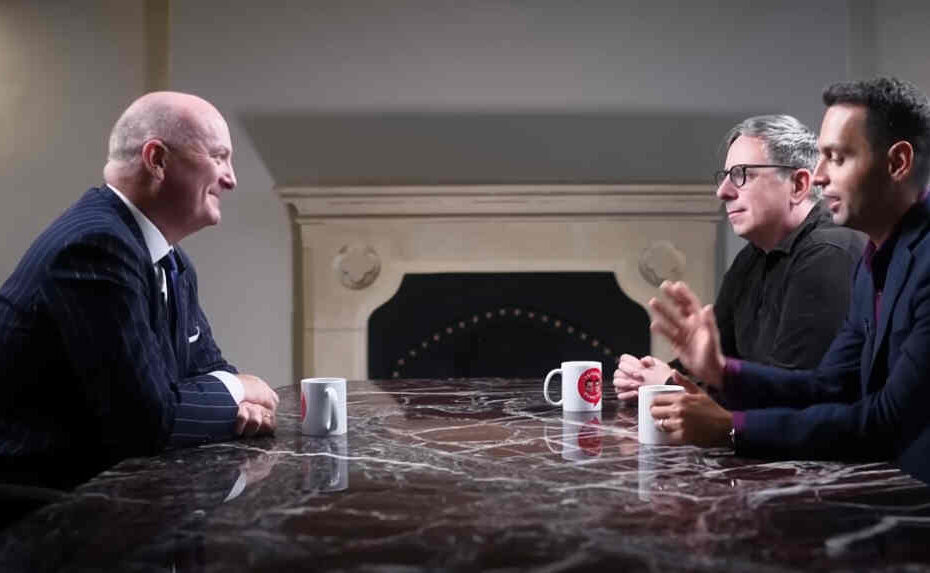
Read the full transcript of Irish entrepreneur and political activist Declan Ganley’s interview on TRIGGERnometry Podcast with hosts Konstantin Kisin and Francis Foster, September 10, 2025.
The TRIGGERnometry Interview: Declan Ganley on Politics and the Outernet
KONSTANTIN KISIN: Declan Ganley, welcome to TRIGGERnometry.
DECLAN GANLEY: Thank you for having me.
KONSTANTIN KISIN: Great to have you. We met in DC at a private event. I didn’t know who you were, but this guy came on stage, stood up, gave a 10 minute speech. I know a thing or two about speeches, if I do say so myself. You just blew the roof off the whole place. You talked about your business that you’re working on dealing with the Chinese Communist Party and all of that, but actually your story is even more rich than that. So just tell us, who are you, how are you, where you are, why are you here?
Background and Personal Life
DECLAN GANLEY: I’m an entrepreneur. I’m Irish. Plastic Patty. Born in Watford, north of London in 1968. Grew up there until I was almost 13 years of age. Moved back home to Ireland with my parents. They’re both from the west of Ireland. I’m a Catholic. I’m married to a girl from Staten Island, New York who’s Italian American. We met here in London in February 1993. I proposed to her three weeks later. We’ve been married for 32 years.
I have four adult children, one of whom lives here in London, three of whom live in the United States at the moment. And I am building the Outernet, which is the world’s first completely self contained global communications network. It’s a laser mesh network of what will become 600 satellites orbiting the planet in polar orbits to provide cyber secure communications to those that need it, amongst other things.
KONSTANTIN KISIN: Well, you’ve also had a political journey as well, particularly in Ireland.
The European Constitution and Political Awakening
DECLAN GANLEY: Very much so. Back in 2003, 2004, I thought that there was a great opportunity to do a roll up of the power generation industry in Europe. And it’s a long story, so I’ll fast forward to. It led me to read the draft European Constitution which was being drawn up at the time because I thought while there isn’t really a single market now for these kind of things, there will be. And I want to see the roadmap in the draft European constitution so I can factor that into how I do the roll up of the power industry.
So I start reading this thing as a very enthusiastic, unquestioning than enthusiastic European federalists. And as I read this thing, I realize I’m reading something that’s much more like the Communist Manifesto than it is than I would like it to be. And I ended up contacting people that were on the presidium drafting the constitution to say, is it just me or is there something wrong with this? And two of them told me there is something really wrong and gave me the background on what was happening in the presidium that was drafting the constitution.
So that constitution faced votes in the Netherlands and France at the time and they were. It was voted down and so it was not an issue anymore. And then I found out that Frankenstein’s monster was being dug up again and renamed and relabeled the Lisbon Treaty. So I read the Lisbon Treaty, which was exactly the same as the European Constitution, same problems.
Fighting the Lisbon Treaty
And I approached the then the party that I had the closest affiliation with in Ireland, which was the Fianna Fail Party. And I said, “Look guys, there’s a real problem here. We need to stop this.” And they were very interested and listened carefully and then said, “Well, don’t be silly, of course we can’t stop it.” I said, “Yeah, but it’s. This is going to be really bad for Europe. It’s going to be really bad for Ireland. It lays a foundation that is flawed. This will be the biblical house built on sand. And if we actually want Europe to work, this is not the way to do it. This doesn’t form a Europe that coincides with Irish values, Irish traditions and the things that we hold dear. And I believe the same would apply for people to right across Europe, be they in Latvia or wherever else.”
They said they wouldn’t fight it. I said, “Well, then I’m going to have to fight it.” Because I realized that Ireland would be the only country because of a constitutional requirement that would have to have a referendum on the relabeled European Constitution, which was the Lisbon Treaty.
So I ended up leading a campaign to vote down the Lisbon Treaty in the Irish referendum of 2008. Because if Ireland voted it down, the whole thing would have to be renegotiated, relooked at. And I thought, “Okay, this is a way to force the issue. Ireland becomes the pass of Thermopylae for this issue. And okay, if I sort of do the Leonidas and get my head chopped off or whatever, it’s worth the sacrifice. But we need to form a phalanx, we need to stop this. We need to force a reconsideration of the foundational formula for the future of Europe.”
Well, we won. And then they decided, “Well, we’re just going to make you vote again.” It was like, “Oh, okay, that’s how it works.” So that was my introduction to politics.
European Parliament Campaign and Bank Bailouts
I ran for the European Parliament in 2009. I came, I was about 10,000 votes short of winning the seat. I got 67,000 first preference votes in our system in Ireland. And I would say that was a blessing that I didn’t get elected because I would have been in the European Parliament from that time forward, at least for one term and probably for more.
And of course, everybody, every entrepreneur believes that what they’re doing is important. And mission comes before money. I think for successful entrepreneurs, mission comes before money. And so I’m very passionate about the Outernet mission. And that’s something that I couldn’t have been, I couldn’t even have begun had I been elected to politics at that moment.
That said, I did weigh in heavily on another referendum which was to do with the so called fiscal treaty, which were the terms that we would sign up for the European fiscal pact which came about because of the knock on consequences of the bailouts of the banks, which was something that I vociferously opposed at the time. I was ardently opposed to the bailouts. I felt very strongly and said so publicly. I’ve been on Twitter since 2009 and really actively since 2012.
I remember being interviewed by Faisal Islam. He was a reporter, I think for Sky News at the time, outside government buildings in Ireland on the night of the bailout when Ireland did the bank guarantees. And I was saying, “We must not do this. These are not our losses. This is socializing private losses after they have failed. This isn’t passing the buck, this is passing the burning on fire, melted thing into the hands of people that had no involvement whatsoever in taking on those risks.”
The Economic Consequences
The downstream consequences of this is, I think if you look at Draghi’s report, Mario Draghi’s report that he sent into the European Commission about a year ago. Now, if you want to look at reasons for the lethargic growth in Europe, you will find many of the routes, not all of them, but many of the routes in the bailouts of the banks. Because it was like the Soviet re engineering of the river system that dried up the Aral Sea. We redirected flows of fiscal flows, we incentivized money to go to all the wrong places, where you then had this absurdity of capital being provided at negative interest rates, meaning you get paid to borrow the money.
Would you sign up for that deal? You get paid to borrow hundreds of millions, billions given to companies that were the biggest dinosaurs in Europe, but they had the balance sheets that could support the. Literally not just free money, free money plus bonuses. Meanwhile, that capital would have flown otherwise to where growth is, which comes from entrepreneurs, from risk takers. And you had this perversion of a complete reversal of the risk equation where chronic risk aversion got rewarded and taking risk got punished. So it’s a very long answer to your question, but a very good one.
KONSTANTIN KISIN: We’ll maybe talk about Irish politics, especially in a bit, but talk to us about the Outernet now, because this is part of the thing that this is what you’re working on. Nobody knows anything about this, first of all, so you should explain what it is. And also in doing this, you’ve discovered quite a lot about the nefarious activities of the Chinese Communist Party in particular. And this was one of the interesting aspects of the story as well. So talk to us about it.
The Outernet: A New Global Communications Network
DECLAN GANLEY: So the Outernet is, it’s not just a. It’s called the Outernet because it’s not the Internet. So at the moment, every global communication system, data communication system, is really a patchwork quilt of different people’s networks stitched together with protocols, different owners, et cetera, et cetera. And it works very well. It’s also extremely vulnerable. So the arteries of the Internet, of the global communication system, are subsea cables. There are approximately 500 subsea cables on the whole planet. That’s it.
KONSTANTIN KISIN: And some of them are getting cut every now and again, from what I’ve seen. Just to emphasize your point very much so.
The Vulnerability of Global Internet Infrastructure
DECLAN GANLEY: So if we double the number of subsea cables, we’ll have a thousand subsea cables. These arteries are highly vulnerable. And without mapping out how I would do it, you would not even need to be a state actor to take out the Internet. I know that a non-state actor could do this for about 60 million bucks and they wouldn’t need a computer, they wouldn’t need a phone, they wouldn’t need Internet access, they just need cash and airplane tickets.
That I can’t say that will happen, but I will be very surprised if it doesn’t happen at some point. And certainly any state actor is capable of pulling this off. You wouldn’t have to be a rich country to do this.
Now there are reasons why states wouldn’t do this. But if you are a power that has your own completely self-contained Internet, that doesn’t touch anybody else’s Internet, if you have complete control of your own information systems, and you are a continental power that you don’t really need to be able to have real-time communications outside of your own area of immediate control. If you have stockpiled materials, steel, rare earth metals, electronic chips, and so forth, if you have the power to wage kinetic warfare, then of course you’re going to cut all the subsea cables because everybody else is dependent upon all of the supply chains and everything that is attached to and downstream of the Internet.
Which is most things in your life right now, be it your credit card, this show, your groceries, the logistics, supply chains that supply your groceries, the way that all of those payments are made, everything, all of it is dependent upon 500 subsea cables, which for about 60 million bucks you could take out.
The Challenge of Cable Repairs
And by the way, when they get cut, there are only so many ships in the world that are capable of doing these repairs. The list of guys that do subsea cables, cable repairs is very short. It’s not a big list. You can be sure anybody that wants to do this has got the list and knows exactly who they are, where they live, where the ships are, the handful of them that are involved.
And if you cut those cables in more than one place, the ocean currents will take care of the rest. You’ll be looking for it for months. So you have to lay new cables if you’ve got ships that are operating to do it. So you could be in a situation with a severance of subsea cables where it won’t be days that it will be out, it will be at least months and it could be a year or two.
Well, a lot of things can happen in that kind of space of time. Can you imagine the chaos that would ensue? This would make 9/11 look like a picnic compared to something on this scale. I don’t want to scare monger, but the possibility of this happening is high. It’s very, very high.
Lessons from Hurricane Katrina
So as I looked at this, I’ve been focused on the area of being able to prioritize emergency communications, something that I really worked on following our experiences in Hurricane Katrina. I did a deployment in Hurricane Katrina, 2005. So 20 years ago, actually like this week, I was in Camp Shelby, Mississippi. I was in New Orleans, I was in Baton Rouge, Louisiana, 20 years ago this week, leading the restoration of communications for Louisiana State Police, Louisiana National Guard, 1st Marines, 82nd Airborne, Coast Guard and other agencies that were responding.
We got a medal for it, we got paid for it. We ended up providing these systems to 33 states. But one of the things that we learned that we had to do was prioritize radio resources for the most needy, urgent communications. And we invented and patented technologies to do that.
The Space-Based Solution
And then, you know, move on. 18, 19 years down the road from Katrina and you’re in a situation where you realize that you need a global communication system that is not dependent upon the Internet and that will survive the event that I’ve just described.
And so as it would happen, a brilliant team of German engineers had done a lot of work to develop the technology to put a space-based outernet in place using polar orbits. So you go from the North Pole to the South Pole. You have 25 satellites in each ring that goes around the planet. Each satellite’s got four lasers on it. So linking to satellites in an adjacent ring, you put 24 rings around the planet.
Imagine going from the North Pole to the South Pole. The satellites are flying like this, about 20,000, 25,000 miles an hour all the time. You put them at 1,050 kilometers. So you don’t need thousands and thousands of them, you just need a few hundred. Thousands and thousands of satellites isn’t good because you have to launch them and that’s expensive, even though the costs are coming down.
The other reason it isn’t good, is you want to be not too close to the planet, because once you put lasers connecting the satellites, you want to have a bit of more altitude so your horizon is greater. So what you end up with, imagine like a fishing net cast around the whole planet that’s going like this all of the time. And that mesh of lasers ends up being the fastest way to communicate in the world. Because light through a fiber is slower than light through a laser in the near vacuum of space.
Securing the Technology
We then secured the licenses from the ITU, which is part of the UN, first in Liechtenstein and then in Germany. The German license is called Alternate 1. But what had happened is the Chinese had spotted what the Germans had done and they had done a hostile takeover, breaking all sorts of rules of this German company.
And I ended up doing a counter hostile takeover, fired the Chinese directors. We saved the project. The Chinese had already launched two satellites without consulting with the Germans, without notification being done the proper way. And clearly what was underway was a mission to mirror and then move the whole thing to China.
And when one looked at the background to what was going on, for example, there had been in the months prior a hypersonic missile test, this is public that the Chinese did, where they flew a missile around the planet. Hypersonic missile around the planet. And then there were two papers published on this confirming that they use the KA band, which is the band for these satellite frequencies, to communicate with the missile.
And the properties of the KA band, the wavelength apparently being that it can penetrate the plasma layer that develops around the missile when it’s flying at that speed. So one doesn’t need to have too much of a, too wild of an imagination to understand how important the world’s lowest latency, fastest and most secure communications network, the kind of advantages that it would provide.
The Unique Advantage
Whether you are a high frequency trading platform or you are a government that wants to be able to communicate with things going very, very fast around the planet and be able to do so from a laptop, you know, anywhere in the world without having to have ground relay stations placed in Chile or Argentina, or on a ship in the Pacific or the Indian Ocean or the Atlantic or whatever, which is traditionally how you do.
Why do I say that? Because every satellite system that you’ve heard of right now is anchored to the Internet. They all use gateways, meaning when you communicate with a satellite, you go from, say, your Starlink terminal, you go from your Starlink terminal up to the Starlink satellite. And the Starlink satellite looks for a ground gateway. It sends your signal back to the ground gateway. And then once you’re at the ground gateway, you’re on the Internet, like everything else, you’re on the subsea cables and so forth.
Now, in fairness to Starlink, they have added lasers for inter-satellite links, but it’s still to get you to the closest gateway. So ultimately you’re offloaded onto the gateway and onto the Internet.
The Alternate has no gateways. It does not touch the ground. You go from the terminal up to the outernet. You stay on the outernet, you get routed around the planet to the end destination, and you get landed, you do not touch the Internet at all. And that is unique. But it also gives you, makes it the fastest in the world, the lowest latency in the world. And very importantly, it has the tiniest attack surface of any global cyber attack surface of any global communications network. Because you can’t cyber attack something if you haven’t got a connection to it.
Current Security Vulnerabilities
I was in Japan this week and I was giving a talk a little bit like the one you heard in Washington D.C. and at the end of the talk, and there were people that had flown in from all over the world, and at the end of the talk, they said, “You know, do you have any immediate recommendations for us apart from the fact that, you know, we all need to use the outernet when it’s built?”
And I said, “Quite a few of you will have flown from Europe. And because of the rerouting of the flights, we don’t fly over Russia because of the war that’s on. So right now, if you look at a flight, say from London to Tokyo, you fly, you fly down, you go across the Black Sea, you go across the Stans, then you’re over Xinjiang and you come in west of Beijing, you cross down, you bank down over Beijing and then you cross over, you go out over the bay and on to Korea.”
So you spend hours flying over China and everybody has their aircraft Wi-Fi turned on. But what they don’t realize is, and in fairness, the Wi-Fi providers, it says this is an unsecure connection. When you’re flying over China, all your emails, your WhatsApps, your everything are going up from their satellite terminal on the aircraft to a satellite commercial satellite that’s not the outernet is being landed in a Chinese ground gateway and everything is being intercepted.
Now, it doesn’t mean they’re reading it in real time, but it might do if they think they were an important enough person. And you know people that fly on those planes, you know, some of them, they know who they’re looking at, but the ability to use AI to decrypt that stuff.
The Quantum Computing Threat
And once quantum, the quantum singularity moment of quantum computing comes, there is no encryption in existence that will survive the quantum computer because they will all be cracked in seconds. Because you can do a million years worth of computing in seconds. Once we have that quantum singularity moment. And we are really, really close to that.
KONSTANTIN KISIN: You that neither Francis, myself or most of our audience have any idea what the quantum singularity moment is. Can you explain that?
DECLAN GANLEY: It’s when quantum computing becomes the reality that they are really working, that they’re not in an experimental phase, that basically they’re turned on and they’re doing what they’re supposed to do.
KONSTANTIN KISIN: And quantum computers are.
DECLAN GANLEY: They are beyond supercomputers. So they are. It is a new rules of physics or rules of physics. Are the rules of physics new applications of physics being applied to a computing environment? That means that the speed and scale of information that can be processed will be the equivalent of what it would take us, a supercomputer, a million years to do right now. But it will happen in seconds.
FRANCIS FOSTER: I mean, that means that if it can crack any form of encryption, then how do we communicate? How do we communicate ideas that are sensitive? How do we communicate ideas that are state secrets? That will be the end of communication, won’t it?
The Future of Communication and Data Security
DECLAN GANLEY: As we know it won’t be the end of communication. It will be. It means we have to communicate differently. I mean, meeting someone at your mom’s house will still be a great way to go and communicate. You know, just quantum computer is not going to be there we will have to be more aware and more careful about how we communicate.
Now here’s something to dwell on. Everything that’s going onto the Internet right now is being picked up somewhere. It’s not that they’ve got teams of people sitting around listening to your conversations not happening, but it’s being stored. And as it’s stored, the combination of AI with quantum computing will be able to go through the library of material that’s been stored and it will all be decrypted and then it will be able to say, go find every conversation that. What do Konstantin and Francis think about this in private, that they’ve never talked about in public? And it will be able to figure it out and give you the answer.
So the way that you use, you know, GROK or Chat GPT or anything else, think about that, where if you put it in electronic format and it’s ever been on, it’s ever crossed the Internet, no matter how well encrypted it is, that it becomes that that encryption is taken away and then AI can go and hunt it out and find it.
We will be able to communicate. But having data sovereignty, ownership of your data, where you always own it and you never give it up to anybody else, data residency, so you have possession of your data, you know where it is all of the time. That’s going to be what data security is. And of course I would say this, wouldn’t I?
And the alternate is not going to be for everybody. It’s certainly not going to be for most private people. But having a completely separate communications network that, where you can communicate the world over without touching any of this stuff, where it can be intercepted and stored, gets to be pretty important, especially if you’re a bank, financial services, a government and you know, pharma company, myriad of other sectors and of course there will be private individuals who will want that level of security as well.
FRANCIS FOSTER: So how long are we away from this particular moment?
DECLAN GANLEY: We’re probably not as close as some experts would tell you. We’re definitely within a decade window. Are we six months away? Probably not. Well, I would say three, four years, something like that.
FRANCIS FOSTER: Because the worrying thing is, is as you’ve just explained, all this data is stored somewhere. And a lot of, well, the British government used WhatsApp, didn’t they? You know, America, you know, the American government, you know, they use. Some of them are on signal. So you go, well, this is a.
Salt Typhoon: Chinese Intelligence Penetration
DECLAN GANLEY: Well, the irony of that signal thing. Now, I don’t know that maybe people have said this. The signal is probably more secure than the thing that they officially are required to use. I mean, if you look at what’s in the public domain on Salt Typhoon, which is the Chinese intelligence services penetration of American networks, it’s everywhere and on everything.
So I was not surprised to. And there was such a hoopla about that signal chat going on. I was like, okay, they’re actually using something that’s more secure than the thing that they’re supposed to be using because Salt Typhoon has penetrated everything. This isn’t a conspiracy theory. I would ask your viewers and your listeners look up Salt Typhoon and this is out there. I mean, what is that?
KONSTANTIN KISIN: Tell us about it. What is Salt Typhoon Assault?
DECLAN GANLEY: Typhoon is the penetration of the Ministry of State Security, the Chinese Spicer espionage service, where they have penetrated US Communications networks and compromised them by putting in what they call backdoors and other forms of software manipulation so that they have been able to not just pick stuff up general traffic, but actually target everybody, including Donald Trump and Kamala Harris own phones and Biden’s and they can single out if they want to listen and pick up your stuff through Salt Typhoon. They’ve been able to do that. They did it. And it has been proven they’re getting everything.
FRANCIS FOSTER: So as worrying as that is and let’s be and it is incredibly worrying. Do the Americans have their own equivalent of Salt Typhoon? I’m assuming they do.
DECLAN GANLEY: I wouldn’t know. I think you assume too much.
The Decline of Western Competence
DECLAN GANLEY: I have to be polite and careful in what I say. We. When I was in my early 20s, I had. Look, I. As a kid, I grew up, I. You know, who is Reagan? Margaret Thatcher, Gorbachev, Pope John Paul II, Cole Metal. There were people that looked competent. I might not have agreed with them, but I knew they knew what they were doing.
And I went to the collapsing Soviet Union. January 1988. I was 19 years old. I saw what was a giant Potemkin village. And I just knew it wasn’t going to last. But just immediately knew it as soon as I was there. Saw people queuing for sausage. What’s that? Cue for sausage? What? And you knew that this thing could not continue.
And I believed that the west was competent and knew what it was doing because it had done so much to defeat Soviet Communism. That alliance between Pope John Paul II, Reagan that time inspired me. And seeing the collapse of the Soviet Union made me believe anything was possible. It actually made me a passionate optimist in life that anything is possible.
The number of people in this town in London that said to me, it will never change. The Soviet Union is around forever. Person said it to me on Red Square. I asked for a picture to be taken. I was at 19, 20 years old, and the big hammer and sickle red flag was over the criminal. I said, can you get a picture of me with that in the background? And it was a Brit, a guy that was taking a picture. And he said, well, what do you want that for? And I said, well, that’s not going to be there for much longer. He said, young man, that flag is going to be there long after I’m gone and long after you’re gone. And it was gone within a very short period of time after that very short number of years.
And then I assumed that we would have something like the Marshall Plan, which is what was done after World War II, when you had competent administrators. And I thought the Soviet Union or much of it would come into the west like Germany did, and it didn’t happen.
And I remember a dialogue going on when Latvia had just declared its independence and I was made an advisor to the first Latvian government. Not that I could have any experience or knowledge to advise them on anything. They didn’t have experience to be a government. No one knew what the hell they were doing. But people were passionate and idealistic and an American said to me that the Germans are going to have to recognize them first, diplomatically. I was like, well, why? And they said, well, Monroe Doctrine, blah, blah, blah, blah, blah. And you just saw people running for the hills when decisions had to be made fast and in real time.
And I realized then that we lived in a world that was becoming chronically risk averse, where nobody wanted to take responsibility. And I was having this discussion with my sons the other day in terms of when did this start? And Yeah, I think August 1914 is a very interesting point of. I think that that’s arguably Europe’s suicide. Hopefully not. We have to find out. The surrender of Singapore. I think the surrender of Singapore is a very interesting moment where you have an elite that takes a decision that affects huge numbers of people and literally cost them their lives, where they just decided, we’re not up for the fight, we’re not going to take the risk. It’s easier to not do the job that we’re being paid to do.
And so fast forward that to why. Why are we. Are we out there? Are we doing these things and are we being effective? I would say I hope so. But I can see, for example, in my case, little sort of subset of things that are going on. In the fight that I’m in with the Chinese, we have been subjected to 157 lawsuits, different legal actions from the courts in Liechtenstein, Germany, Luxembourg, Belgium, France, the United States.
And what they do is take the US for example, so they will sue you on a completely flaky thing and they lose and then they appeal it, and then they lose and then they appeal that and they lose and then they appeal that knowing full well that there was no point at which they had any chance of winning. But that’s not what it’s about.
KONSTANTIN KISIN: The process is the punishment.
DECLAN GANLEY: Bleed you out.
Chinese Lawfare and Military Doctrine
DECLAN GANLEY: So we have spent, I don’t want to say the number, but tens of millions fighting Chinese lawfare, real lawfare. This tactic of using the laws of Western countries against them and their private sector companies to achieve an objective of the People’s Liberation army of China is in the written, published doctrine of the People’s Liberation army of China. It is a legitimate method of warfare and it’s in their published military doctrine. So guess what? They’re doing it. Kel Suprise.
And yet how many governments have come and sort of the cavalry never showed up for us? We’ve had to keep doing it ourselves. And the brilliance of it is, is by suing in all of these different countries and in different courts in the same country. So you will face the same lawsuit, five different places with five different judges, and then you’re going to them. Well, actually, we’ve already argued this over here. No, what? No one does that. Like. Yeah, they do. They do it.
The German Ministry of Economy published a really interesting paper on this about a year and a half ago. But lawfare is. The war is on. It’s on. It has started. They want to dominate technology, any technology that will give the west the edge. They want to take it off the west and take it for themselves. And they are preparing for a major event. God willing, it will never happen.
FRANCIS FOSTER: What do you mean by a major event?
DECLAN GANLEY: A war.
FRANCIS FOSTER: A kinetic war.
The Taiwan Scenario
DECLAN GANLEY: Kinetic war. Metal on metal over Taiwan. And I am certain that China wants to take Taiwan. It would love to take it where Taiwan just puts its hands up, you know, Sun Tzu and all of that sort of thing, and just doesn’t even fight. And they’re certainly trying to achieve that. But if they don’t achieve that, that they will take it kinetically.
And if they can take the Internet down for six months, I mean, let’s say the Internet went out right now. Are you going to be thinking about Taiwan? No, you’re going to be thinking about how am I going to get home, what about my family? How are we going to have get food? I can’t contact my family because my phone isn’t working. So everyone’s got to head home. Actually everybody should have a plan for what happens when all when the Internet goes down because it’s probably going to happen.
The last thing you’re going to be thinking of or that you’re going to be giving a flying hoot about is what’s happening in Taiwan. And let’s say that that happens. Taiwan is taken and you find out about it six weeks later and it’s now just a fact on the ground, who’s going to do anything about it?
FRANCIS FOSTER: So I, I understand with the Taiwan thing, but why do you think, why are you so certain that this is what the Chinese want? What makes you say that Everybody projects.
DECLAN GANLEY: I’m 57 years old. I’ve been around the block a few times. Maybe I’m a bit jaded in terms of my attitudes but people the, the one of the great hacks and weaknesses of Western liberalism, neoliberalism, whatever you want to call it, is that we think everybody thinks the same as us.
KONSTANTIN KISIN: Do you know we talk about this on the show so much because I’m from the Soviet Union, France’s family from Venezuela and you just, I look around at these people who think everyone is the same and I go what the are you talking about?
DECLAN GANLEY: You know it, you know it.
KONSTANTIN KISIN: What are you talking about?
The Dark Legacy of Soviet Oppression
DECLAN GANLEY: I was years ago. So this was 1993. Now there’s also too dark of a view of humanity. So years ago, I mean, Yekaterinburg and I had been to a place called Asbest, which is out in near Siberia, and we’d driven for hours and hours from this place called Asbest to Yekaterinburg. And we got to have some meeting or other, waiting to get into something.
And I’m sitting in a Volga car, and there’s a guy in the back that I knew had been a colonel in the KGB. A very interesting guy. Won’t say his name. And we’ll call him Conrad. His name wasn’t Conrad. Conrad, I said, “There’s good people in Russia.” He said, “No, come on, go right.” I said, “You know, there’s a bit. No, there are no good people in Russia.” I said, “What are you taught? Of course there are good people, and I know there are.”
He said, “They killed them all.” I said, “What do you mean they killed them?” He said, “They killed all of the good people. They killed all of the good families. Anybody that was left, it was an accident.” He said, “They killed all the good people. The Bolsheviks killed all of them.” He said, “Stalin killed all of them.”
He said, “The good people in the villages would save flour and they would save honey and food, and they would store it and they used to hide it in lakes.” I didn’t even know this was a thing. Apparently the flour forms a cake around the bag of flour so you can put it in water, but the flour inside would stay safe and they would hide it.
And he said the worst bastard in the village would spy on the good families and the good people who would not just feed themselves, but they’d feed the whole village through the wintertime when the authorities were seizing food. And he said, “And they would give them up to the authorities.” And he said, “Those people would be killed.” And he said, “And the bastard would get half the flour.” And he said that happened in every little village in Russia, in the Soviet Union.
Now, I don’t subscribe to that gentleman’s idea that there are no good people in Russia, because there are. There most certainly are. But that mentality, the idea that such people can exist and did exist, and not only did they exist, they thrived.
KONSTANTIN KISIN: They were empowered.
DECLAN GANLEY: They were empowered. You had to be an evil so and so to rise to the top. You couldn’t get to the top and have your soul intact. You couldn’t. You literally, almost literally had to do a deal with the devil. And it’s a long way of saying if you look at somebody like Xi Jinping, you look at the cultural so called cultural revolution. Anybody is at the top of a communist party is a fundamentally flawed human being and does not think the same as pretty much anybody watching this podcast.
Laws Used Against Western Civilization
KONSTANTIN KISIN: Yeah, it’s so true. And you know, it’s interesting you mentioned the lawfare because. And the way you explained it made me think of something else because you talked about the fact that the laws of Western countries are being used against them by hostile forces. And I go, I look around at our country now and I go, well, the laws of the ECHR, for example, are being used against European countries to flood the country with illegal immigration that nobody wants.
DECLAN GANLEY: So nuts. I mean, the writing is on the wall, to use that biblical term. We are the authors of our own destruction. It’s not that anybody is doing this to us. We are ultimately doing it to ourselves. If you do not prepare, I mean, this is not even a matter of not being prepared. We are inviting our own. This is civilizational suicide that we’re going through right now.
And the chronic risk aversion that is allowing it to happen exists all the way through the system, right down to the private individual. People don’t want to get married, people don’t want to have children, or I’ll defer it, I’ll put it off. I’ll go on, I have an extra holiday. I want to go and climb Machu Picchu or something. Stop deferring life.
If you’re a man, be a man. Make a decision, take a risk, make a commitment. Life is one commitment after another. It’s all about rising to and enjoying the thrill of embracing the risk and taking a chance and doing something bold, like having a child, like making a commitment to one person for the rest of your life, like committing to a belief system, whatever it might be.
Those are the things that save us. The foundational building block of everything ultimately is the family. It starts from there. And if that isn’t right, nothing else will be right. And you end up seeing all of the edifices crumbling of civilization because the support structures have already rotted away, that we’re supporting them from the outset.
Government Failures and Generational Sacrifice
FRANCIS FOSTER: I agree with you, Declan. There was one element of pushback I would put to you, which is our governments, and particularly the UK government, prioritized the rights of the elderly over the young. And this was quite clearly seen during COVID where we were like, protect the elderly, protect the vulnerable, which we can all agree with, but we shut down society.
Young people were asked to sacrifice the literal best days of their life, their youth, to sit in a room, watch their youth get dribbled away as long as we protected the elderly and the vulnerable. And you go, that can’t work. And then you look at house building, the fact that young people can’t get on the property ladder because of planning laws, nimbyism. So I agree with you. But we also have to accept our part in this and the government’s part in this, that we’re also not helping young people.
COVID Origins and Early Response
DECLAN GANLEY: 100%. I agree. I mean, let’s take the lockdowns. So if you looked at my Twitter history over that period of time, we see this thing kicks off in Wuhan and it probably started in September. And the leak, if it was a leak, probably took place earlier than has been said.
KONSTANTIN KISIN: And by the way, it’s almost universally consensus now.
DECLAN GANLEY: Well, the satellite imagery around that center shows a lot of traffic, a lot of activity in September. And I’m in this satellite business. There is a lot of activity. There’s something kicking off whatever it is, whether it’s an effort of containment or whether it’s something else.
You want to be a conspiracy theorist? Hong Kong was destabilizing the Communist Party of China at that moment. The protests in Hong Kong were massive. And I think the Communist Party of China saw them as an existential threat. I don’t think it was a deliberate leak, but I certainly think it was harnessed.
And anyway, we didn’t know what it was. Coming into Christmas, I was seeing these things coming out, buildings being welded up in Shanghai and people shouting from their apartment buildings. And I said to my parents, I said, “There’s something bad happening here.” And my kids, they’re adult kids, they’re all over. One of my youngest daughters was going to Notre Dame University in the US at the time.
So I’m stockpiling at this point and I’m carrying in ammunition. My daughter looks very disapprovingly at me and she goes, “Dad, you’re not going to need that.” I said, “No, I’m probably not.” I said, “But if I do need it, I won’t be wishing I had it.” So I was being a prepper in that regard. In having months and months of supplies, I planted crops. I did all of these things. I planted more stuff than we needed or a lot of other people.
But once it became clear and it was quite quickly clear that the lethality of this thing was way below the worst expectations. The lockdowns were just completely uncalled for. In fact, we should have been doing the opposite. I mean, when I was a kid in Watford, before we moved back to Ireland, I remember we had a measles party where all. Someone caught the measles. I can’t remember who it was that caught it was me or my friend Ian or Chris or somebody else.
And the mums would put us all together to play together and everyone would get measles at the same time. And it was like, okay, we’ve done that and then you move on to the next thing. And that’s how we built immunity. Now, I’m not saying that people shouldn’t get measles vaccines or whatever, but that’s how we dealt with it back then.
The Orwellian Response to COVID-19
DECLAN GANLEY: Then we got into this repressive Orwellian situation. Now, I was very familiar with the Irish constitution because of Lisbon treaty and everything else. And I knew that the constitution in Ireland particularly protected the place of public worship at mass because of the penal laws where the Irish weren’t allowed to practice Catholicism for that period of time when practicing Catholicism was illegal in Ireland up until penal laws were finally lifted in the 1820s.
And so enshrined in the Irish constitution is this even elevated right to public worship. Learning from the lessons of that time, understanding that religious freedom is the ultimate freedom from which many other freedoms actually end up being derived. So I sued the Irish government on that point of public worship that we should be allowed because the churches had done all the mitigation and everything else.
And this is when the system really gets you. So I knew I had a slam dunk case they couldn’t win. There had already been successful cases taken in New York and a few other Scotland and a few other places Switzerland. There was another one where there were cases in process where it was clear that they were going to win and they did.
I get to the Irish High court and they just didn’t hear the case. And it was high profile case. They didn’t hear it. The judge kept deferring, deferring, deferring, deferring, deferring until the restrictions were lifted. And then he ruled the case. He said, “Well, there’s no restrictions anymore, so defer the case.” So it’s like you don’t even let me get onto the pitch and play. You’re just going to say, “Well, we’re not playing today because game’s been canceled.”
So those restrictions were appalling what we did to our kids was terrifying. What the conservative government in this country allowed to happen under their watch is unforgivable in my opinion. They resigned their right to rule here for what? They allow people out for a walk in their own with a bloody well drone following them around. I mean, this is Orwellian.
The Impact on Young People
And not only do I agree with you, I passionately agree with you. One of my kids, he’ll be furious to me for saying this, but I mean, in Ireland they did away with the exam evaluation process where you sit the exam and then you are anonymous, you’re just a number. I love the Irish system, the way it works. Nobody knows who you are. It is purely meritocratic. It’s like this is what you got.
Instead they said, “Well, we’re going to give you an estimated grade.” So he got an estimated grade, which is certainly where the guy would have been, maybe even better. And he got downgraded and the university that he chose and that had accepted him on condition that he made the grades, he not only did he made the grades, he exceeded them. They downgraded him to a point where the university couldn’t allow him to attend that particular university.
So he went to another one, which is very, very good university. Thankfully it’s worked out really, really well for him. But the injustice that was done to these kids is appalling.
The Housing Crisis and Capital Misallocation
And to the very important point that you made house ownership. If we are not allowing the next generation to put a roof over their head, to be able to get married, to have kids and everything else, what are we for? This has to be fixed.
Now, the reason we are in that situation, I would say is because of the misallocation of capital that we talked about earlier in this interview, that we so corrupted the system that the PE firms and pension funds and entities that ended up with the liquidity are sitting there with a very, very small group of people running them.
And they’re capital, they’re trying to allocate capital, hundreds of billions at a time with a team of a few hundred people to high performing assets that are going to provide a return. But when you’re running 150 million pound or $150 million fund, you need to have good performance, you need growth of 20%, so on and so forth.
If you’re running a half a trillion dollar fund, you don’t need performance like that to make your management fee, you need a 0.1%. You don’t have to blow the doors off in terms of Performance, you can just provide mediocre performance and you can make out like a bandit in terms of you will live the life of a billionaire.
So what do these funds allocate for? They’ll go and they will inflate and buy up housing stock, land stock, the lowest risk assets that they can do. And they end up inflating the values outside of where a normal healthy economic biome would have housing values. So we have totally artificially priced housing that is completely out of whack, where a 22 year old or 23 year old can earn, pay a mortgage, borrow the money, pay a mortgage and have a home.
The Parable of the Talents
And it’s because there’s a great parable in the Bible, it may be my favorite one, which is called the Parable of the Talents. And for those of your listeners or viewers that haven’t heard it or read it, read it. And it’s about the boss who’s going away and he allocates money talents, the unit of currents to each of his servants and says, “Look after these while I’m gone.”
And one of them goes out and he speculates and he takes risk and he does extremely well. Another one takes a bit less risk and he does okay. And one of them buries the talent, actually buries it.
When the master comes back, the guy that buried the talent says, “You gave me the talent, I buried it, I’ve dug it up again, here’s your talent.” The next guy that says, “Look, I was very careful and but here’s your return.” And then the guy that blew the doors off goes, “You gave me these talents, I took all of these risks, I made this many more talents. Here’s your.”
And what the master says is take the talents off the other guys, give them to the over performer. And as for the guy that buried the talent, he says, “Throw him out where there shall be weeping and gnashing of teeth.” And that is a lesson of capital allocation. And our society now is the servant that is burying the talent.
Risk Aversion in Britain
KONSTANTIN KISIN: Well, it speaks to your point about risk aversion and I suppose the question is how does that get resolved? Because I was just talking to my friend Chris Williamson on his show about this this morning. Actually the risk aversion in Britain, it’s particularly key. I go to America and people who think like you are much more prominent there and much more prevalent there. But in Britain we just seem to have completely lost.
DECLAN GANLEY: We had it in Europe, we had this country, had it more than anybody, more than anybody. This is the country that sent out the cutie sock, the East Indiaman that set up the East India Company that did all of these things. And I’m Irish, I’m not supposed to say this but, but I mean this country took insane risks and built successes out of them and then it turned on itself and the whole west has ended up doing this. We’ve become this self loathing society.
How do we fix it? Ultimately it has to be fixed not by the government, not by societies, it’s got to be fixed by us. At the most granular, private, individual level. We have to fix ourselves first. And this by the way is where I think faith and religion comes into being.
Because what are your gods? What are the things that you hold to be worth sacrificing for? What’s worth dying for? And when you do die, momento mori. Remember your death. Who do you want around you when you are dying? Because it won’t be your boss, it won’t be the people that you made money for, it won’t be your advertisers. They will be sorry when they hear about it. But they’re not going to be there. Who do you want around you when you are dying?
KONSTANTIN KISIN: Your family.
DECLAN GANLEY: That’s the most important thing in the world.
The Need for Systemic Change
FRANCIS FOSTER: I do see what you’re saying and I agree with you, but it is also as well with the government aspect of it. Unless we change the legislation around planning laws, unless we relax them, unless we get that moving, then it’s just people aren’t going to be creating.
DECLAN GANLEY: We have to tear the hole thing apart and start again. This is a broken system. It is not working. It is not working for the young. It is not protecting our national integrity, it is not protecting our culture, it is not protecting our traditions, our beliefs.
FRANCIS FOSTER: It’s.
DECLAN GANLEY: It’s an empty, hollowed out thing. And it’s. Yes, we have to fix planning laws and all of those things, but we’ve got to. These are just small symptoms of a disease.
KONSTANTIN KISIN: I think your point is that all of that stuff is downstream. If people want more risk taking and.
DECLAN GANLEY: Yeah, act we would, because then somebody would take the political risk.
The Power of Popular Pressure
KONSTANTIN KISIN: Yeah. You look at the situation now, I mean, we mentioned the ECHR. The way the consensus on that has shifted. You’ve now got people like Jack Shaw, former Labour Home Secretary. We’ve been told for the last 10 years, you can’t leave the ECHR, you’ll ruin Ireland, it’ll do this. And now suddenly it turns out it’s all possible.
DECLAN GANLEY: Why?
KONSTANTIN KISIN: Because there’s people on the street.
DECLAN GANLEY: Right.
KONSTANTIN KISIN: Because the moment you get people on the streets, it turns out suddenly the legal realities all change overnight. And now it’s possible. And by the way, they’re setting a very bad example with this because if you don’t adjust your course because people are simply saying things and they have to go out into the streets while you’re going to get a lot of people in the streets a lot of the time.
The Loss of Democratic Control
DECLAN GANLEY: This is true. I agree. I think that’s correct. I mean, the ECHR is one example of the soup, the loss of democratic or popular control over the instruments of power. And as we’ve seen them, and this happened with the Lisbon Treaty, and I said it at the time, we are moving Europe to a. This is happening beyond Europe, but we are moving Europe to a situation where we are making the positions of decision making more distant from the people.
Now we have somebody like Ursula von der Leyen. I’m sure she’s actually a very nice person. I really am sure she’s a very nice person, but she has no mandate from any electorate. Anywhere. And she’s going in and meeting the President of the United States and the President of this and the President of that as the representative of all Europeans. It’s like, what have. How do we get to this place? What happened to democracy now?
Is democracy the ultimate crucible? I would say no, but democracy is a means to an end. It’s Churchill, I’m paraphrasing him now, but it’s the least worst system out there. So. But to your point about people in the streets, people end up on the streets when they have found out that the levers that they have been presented that allow them to control what’s happening, they don’t work. They’re not attached to anything anymore. There’s actually nothing. It’s like one of those Fisher Price, driving toys that my kids used to have. There’s. It’s got an engine noise, it makes noises, but actually there’s nothing there.
The Situation in Ireland
FRANCIS FOSTER: And it’s a very profound point and we’re talking about people on the streets and it’s one of the things that I really want to talk to you about, and so does Constantine, which is Ireland, because we’ve been looking at what’s been happening in Ireland, but I haven’t been following it very closely because I’m more concerned of the bonfire that is my own country, if I’m being honest. So what’s happening in Ireland and why are we seeing this footage of demonstrations and angry people on the streets?
Immigration and Housing Crisis
DECLAN GANLEY: It’s exactly the same thing as is happening here, in fact. Indeed, it’s probably the consequences of exactly the same action. So those boats, when they come across the Channel and all those young fellows come piling in as they do, you know, some of that wave ends up going to Ireland. Why? Because there’s lower hanging fruit there.
We are called, amongst the trafficking community and their customers, “Treasure Island.” I better not say this out too loud. We are known to be mugs, to be the softest touches that are out there. I mean, we had a minister in our last government, Roger Gorman, do an ad in multiple languages, Urdu and all sorts saying, “Come to Ireland, you will get your own free, own door, accommodation, benefits galore.” It’s like, I mean, you couldn’t make it up. We did an ad saying, “Come here for free stuff.” Well, what a surprise. They came.
And this is a different type of, you know, somebody that will come in. You have genuine refugees that we are more. I believe we have a moral obligation to deal with. But so much if you look at the statistics of this stuff is false is economic migration where somebody will come in and will lie and falsify and claim asylum. Taking up a spot that is on the boat, if you will, that should be for somebody that’s genuinely fleeing real threat to life, persecution.
And they will take the spot and they will take handouts and dolls and accommodation and homes. I mean right now, today, back home in Ireland, at my place, back gate into my place, there’s a bit of land that I have on a 99 year lease with some other neighbors in the village and there’s a traveler’s caravan on it and it’s a family and they’re looking for accommodation. They can’t get me. So now it’s my problem or my neighbor’s problem because so much of our housing stock has been given away to people who shouldn’t be given free housing or subsidized housing.
Immigration Standards Then and Now
When my father was a young man, he’s 84 now, when he looked at emigrating to America in the early 1960s, he told me, he said you had to put up whatever the number, I can’t remember the numbers, X number of dollars you have to show you have in your bank account you had to give this the name and address of the sponsor and they had to show that they had the means to look after you and to accommodate you if you became sick and unable to look after yourself. There were all of these conditions to be able to just go to America, to emigrate to America.
Now we’re in. Is it surprising that people will show up for free stuff? And if you’re a self starter and you want to make a go of it, you’re attracting exactly the wrong sort when we’re saying “come here for the free stuff.”
I mean you do need immigration. You need to choose who comes to your country. You need to control immigration. You need to make sure that it does not get to a scale where it destroys the fabric, social fabric and cultural fabric of your own society and the ability of whatever country you are in to be able to support it.
I have immigrants working in my company. They’re brilliant people, brilliant people, phenomenal talents. We pay them very well. Highly skilled people. I’ve got people from more than 30 countries working in Rivada space networks. But there’s a difference. And treating all immigration as the same and saying we have to take anybody that shows up is, it’s suicidal, it’s nuts. And we can’t keep doing it. We can’t afford to keep doing it.
KONSTANTIN KISIN: Declan, what’s the one thing we’re not talking about that we should be?
The Hidden Cost of Data
DECLAN GANLEY: Oh, there are so many things but. Well, one thing that said, and this is very niche area but, but we are massively overpaying for data. So the way that radio spectrum is allocated by regulators in the Western world means that you are paying probably 90% more for data services and mobile connectivity than you should be.
And if you were to allow data to be priced on accordance to supply demand basis, the prices of data, wireless data, would drop to a fraction of where they are now and we would have whole new industries, services and applications that would naturally be being developed by risk takers and China would not be in the dominant position it is now with quantum computing, things like TikTok and other areas of information technology, they would lose all the advantage and that economic advantage would shift back to the West. That would be a game changer economically for us.
KONSTANTIN KISIN: Alright, head on over to Substack where we ask Declan your questions.
FRANCIS FOSTER: Artificial intelligence will create as many new occupations as it will destroy. What do you think will be some of those new high paying occupations?
Related Posts
- Transcript: World’s First AI Actress Interview on Piers Morgan Show: ft. Tom Conti, Tom Bilyeu & Prof Jiang
- In Vivo Podcast: w/ Cathy Tie and Prof. Jiang on Editing Embryos (Transcript)
- Transcript of Evy Poumpouras Interview: Read People, Spot Lies & More – FO563 Raj Shamani
- DOAC AI Emergency Debate: ft. Ed Zitron, Andrew McAfee, Nate Soares & Roman Yampolskiy (Transcript)
- Transcript of Norman Finkelstein Interview: Tucker Carlson Show