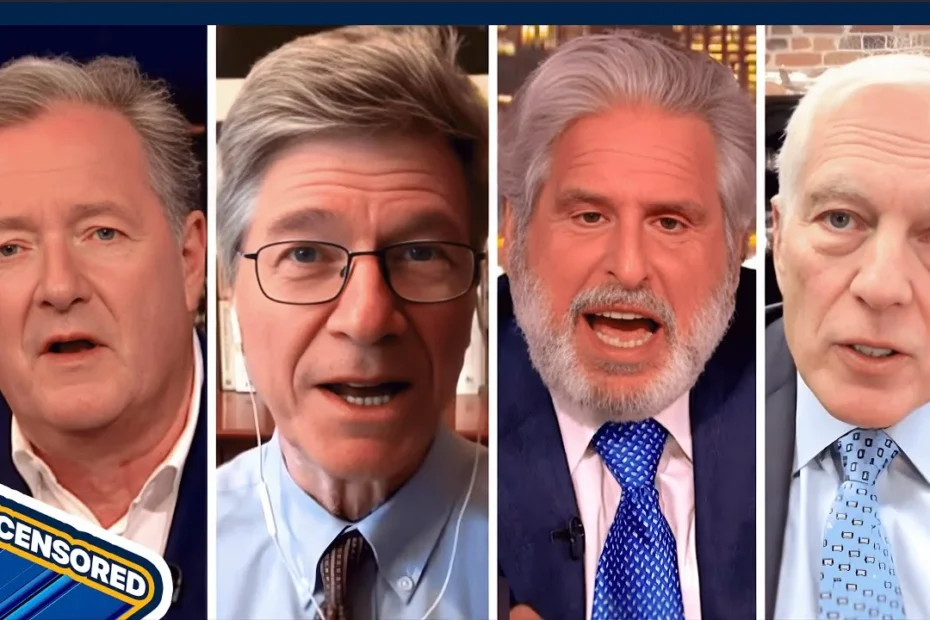
Here is the full transcript of Piers Morgan Uncensored episode titled “‘Ukraine Is A Corrupt MESS’ Trump Finalizes Russia Peace Deal”, November 25, 2025.
Piers Morgan is joined by economist and global affairs expert Jeffrey Sachs before discussing the latest with former NATO commander Gen. Wesley Clark, Head of the Global Magnitsky Justice campaign, Bill Browder, Russian broadcaster and political scientist Henry Sardaryan, international human rights lawyer Robert Amsterdam and former Ukrainian Prime Minister Arseniy Yatsenyuk.
PIERS MORGAN: Disgraceful, unworthy of our attention, unnecessary evil and huge calls for optimism. That’s a few of the many and varied views on a deal to finally end the Ukraine war. President Trump is hailing big progress today. Critics say it’s a step closer to a sellout, with Russia getting everything it wanted and giving up nothing in return.
Jeffrey Sachs on the Peace Deal
The first of our guests on this fast developing story is the economist and global affairs expert Professor Jeffrey Sachs.
PIERS MORGAN: Professor Sachs, welcome back again. This is a fast moving story and certainly the original twenty-eight point plan appears to not be a final plan, but is now being worked on and I suspect diluted somewhat. But ultimately, when you look at that twenty-eight point plan, can you see why a lot of people are very critical of it? Because it appears to be, on the face of it, giving Russia everything it wants.
JEFFREY SACHS: Well, I think what’s interesting is that the European response in practice is not very different to the twenty-eight point plan. Europe made a number of changes, but in substance, this war is coming to an end soon, and it’s going to come to an end on the basis that NATO won’t enlarge. Ukraine won’t be part of NATO.
Some land will be recognized de facto as under Russian control, but Ukraine is not going to acknowledge it as Russian. And that’s going to be the way that the fighting stops. So I think the truth is we’re probably coming close to the end of the fighting.
PIERS MORGAN: Why though would anyone on the Ukrainian side trust Putin given that he took Crimea and given he’s now taken, say, another twenty percent of land? We’ll see what the final geographical boundary says. But why would anyone on the Ukrainian side trust him not to come back for more?
JEFFREY SACHS: Well, the way that the agreement is structured is that if one side violates it, it ends all of the guarantees that that side has received. The idea is that this is a mutual or collective security arrangement. And it says that if one side violates it, the other side is free of any further obligations.
If indeed an agreement is reached and Russia violates it, I think the full force of whatever the West would bring to this would immediately return. So this is the basis of all peace agreements in human history, which is that both sides are exhausted. There is a tacit understanding, let’s stop.
There is some appreciation of what the causes for the fighting were in the first place, and they’re somewhat imperfectly accommodated, and that’s where we are. I think that this is the same here. This war was because there was a contest between NATO and Russia over Ukraine.
That contest, in my view, as we’ve discussed many times, should have been avoided all along. There is such thing that neither the US and Britain don’t like and don’t agree on. That’s called neutrality. But in any event, that was what was rejected by the United States thirty years ago.
Russia said, “Don’t do that.” The US said, “We don’t listen to you.” And, in any event, the fighting took place. Now the war is going to end. Ukraine is not going to be part of NATO, and that’s what’s going to enable the war to end.
We’re just going to basically call it a day, and now the arguments are over the details. But everybody’s exhausted. Ukraine’s losing on the battlefield. Europe doesn’t really have anything to offer in this except the words of leaders who have no standing in their own country anyway.
They’re all very unpopular: Starmer, Merz, Macron. So they don’t bring anything to the table anyway. And the United States does not want to fight on for a principle which the US started actually thirty years ago, that NATO will go wherever it wants and it’s not interested in fighting over that. I agree with the United States on that. Why fight over that?
The Question of Illegal Invasion
PIERS MORGAN: You and I, we’ve talked about this a lot and I’ve always valued our conversations about it. I feel I’ve learned a lot. I don’t necessarily agree with everything you’ve said, but I’ve learned a lot, particularly about the history. And I can certainly accept that Russia and Putin feel like there was unnecessary provocation from NATO, unnecessary encroachment and so on.
I can see that argument, but that doesn’t necessarily change, does it, the fact that in the end, in 2022, he illegally invaded a sovereign democratic country? I mean, you can argue about why he did it and the reasons for it and the build up and the logic and so on. But I mean we should be able to agree that the actual act that was committed when he invaded was an illegal invasion of a sovereign country?
JEFFREY SACHS: Yeah. But there were several illegal acts all along the way. There was a US-backed coup in February 2014, and there was an actual war with about fourteen thousand deaths that Ukraine was waging on the breakaway regions of Eastern Ukraine. So the war started in 2014.
Whenever you have something like this, there’s no start date. This is a game of narrative to choose one’s start date. This is two sides going back more than thirty years, contesting whether Ukraine should be neutral, whether it should be part of NATO, whether it should be part of Russia.
And it led to war because what was the basic answer, which was neither side gets Ukraine, Ukraine gets Ukraine, was the right answer.
War Crimes and Accountability
PIERS MORGAN: Professor Sachs, what happens to a country like Russia, which by common consent has committed myriad war crimes in the last three years? It’s targeted and killed civilians. I think that’s inarguable. It’s kidnapped a reported twenty thousand Ukrainian children. There was the massacre at places like Bucha. I’ve been there. Absolutely horrific what went on down there.
There have been the sexual assaults and rapes of Ukrainian women and so on. So it seems inarguable there’s been a number of war crimes committed. Is it fair and just that at the end of this, assuming you’re right, and this is the beginning of the end of this, that Russia emerges unpunished for any of this?
JEFFREY SACHS: Well, if the United States were punished for all its war crimes, the world would be a better place. And if all countries were punished for their war crimes, if Israel was punished for its genocide before our eyes, if the United States was punished for overthrowing so many regimes and causing so many wars, if the United States were punished for the Iraq war, if the United States were punished for the coup in Maidan in February 2014, I’d agree with you.
It would be great if governments were accountable. But what we like to do is say the other side is the wrong one and not to acknowledge our own sins. For this, Jesus had it right: “Why do you always point to the mote in the other eye when you have the plank, or the beam in your own eye?”
To my mind, this is the basic point. I would love to follow your line, Piers. I agree with it. We should have accountability for all the crimes that are committed, and the United States list is so long. I’ve been tracking it for more than forty years professionally. It’s just one war crime after another, including complicity in a genocide in Gaza during the last two years.
Is Peace Really Near?
PIERS MORGAN: Finally, Professor Sachs, do you believe we really are now on the verge of a peace settlement?
JEFFREY SACHS: You know, I wasn’t sure until I read the European counter position to the US plan. Now, again, what we’re reading in the press may not be authoritative, so I may be completely off. But when I read the European plan, and it’s basically tweaking the so-called US plan, I thought, you know, we’re probably near the end of this story.
The fact is Russia has almost won all of its war aims on the ground. And I think that the idea that this stops just about now, that Ukraine does not join NATO, that we have some kind of collective security arrangement so that nobody beats up the other side, this seems to be pretty much common currency now.
I don’t know where Zelensky stands on this. He rules by martial law. He’s in a corruption scandal that’s enormous. The Ukrainian people are exhausted. They cannot fight on anyway. I hope that this is over. It should be over.
And at least the US and the European answer, which was supposed to be very negative, isn’t so negative. If that prevails, we could be at the end of this story, and we really should be.
PIERS MORGAN: Jeffrey Sachs, great to have you back on Uncensored. Thank you very much.
JEFFREY SACHS: Always great to be with you. Thanks.
Russia Rejects Revised Peace Plan
Well, in the last few minutes, Russia has said that the revised plan for peace with Ukraine is “completely unconstructive and does not work for us” amid all the confidence we’ve been hearing that the war may be finally coming to an end. Does this mean it’s actually dead on arrival unless the Russians get everything they want?
Here’s a debate on very latest developments on the Ukraine peace plan. I’m joined by General Wesley Clark, the former NATO Supreme Allied Commander, Bill Browder, the CEO of Hermitage Capital, head of the Global Magnitsky Justice Campaign, Henry Sardaryan, who’s the Russian broadcaster and political scientist, and Rob Amsterdam, international human rights lawyer.
PIERS MORGAN: Well, to all of you. Let me start with you, Bill Browder. As we’re talking, it’s a very fast moving story. We had the twenty-eight point plan, which came from America, which many thought was very skewed towards Russia’s wants. Europe countered with their own version, which definitely diluted a lot of the stuff in the original twenty-eight point plan. Russia now says that doesn’t work for them. Where are we with this? Is it all false hope again?
Bill Browder’s Skepticism
BILL BROWDER: I think it was false hope even before the whole thing started. I don’t think that Russia wants to end this war. I don’t think Putin… I think Putin needs this war to stay in power. And his twenty-eight point plan was never endorsed by Russia.
I think that this whole purpose of this plan was really to throw open all this confusion at a really important moment in time, which was that the Americans were getting very, very close to sanctioning Russian oil to basically make it impossible for Russia to sell their oil. And this is the second time that’s happened.
And each time Putin has thrown some kind of spanner in the works. And so, this was right before the Alaska summit. He showed up there and all of a sudden oil sanctions were off the table. And now all of a sudden, his guy, Dmitryev, his envoy, leaks some twenty-eight point plan to the media.
Everyone gets all excited about this twenty-eight point plan. Of course, Trump can’t then impose oil sanctions on Russia. We spend a week all arguing about which points we like or don’t like. Nothing ever happens, and we’ll be back to war. That’s where I think that we are in this whole thing.
General Clark’s Assessment
PIERS MORGAN: General Clark, do you share that rather unhopeful view?
GENERAL WESLEY CLARK: I think the whole thing is what the Russians would call a provocation. That is it was thrown out to cause a rift between Ukraine, the United States, between the United States and European allies, and within the government of the United States, and it’s done exactly that. It’s like a hand grenade at a banquet. I mean, it’s really made a mess of things.
There are some things in it that are totally unacceptable. It basically is a proposal that calls for Ukraine to make concessions that are irreversible and for Russia to make promises that are unenforceable. So I just think it was a nonstarter.
But, of course, once President Trump put an ultimatum on it, it served its purpose for the Russians, because it’s caused President Zelensky to really scramble, throwing the Europeans off balance, caused a lot of issues. And at the same time that it was released, we had the army secretary and the chief of the army staff over meeting with the Ukrainians. So it looked like it had some official legs on it.
PIERS MORGAN: But I mean, just to clarify for viewers, what is so unacceptable on either side with the original twenty-eight point plan? And then we’ll come to how Europe’s counterproposal dealt with some of that. So you’re asking me?
GENERAL WESLEY CLARK: Number one is it doesn’t call for a ceasefire. The starting point of this has to be ceasefire. Number two, it requires Ukraine to give up land that it has defended that when it gives it up will be indefensible. Number three, it calls for no Russian concessions, no confidence building measures, nothing on the restrictions of Russia to mass forces to begin another offensive eighteen months from now.
You couldn’t say a thing. I could go through every point and tell you what’s wrong with it, but those are three major points. It’s number four. It’s an infringement on Ukrainian sovereignty. You’re telling Ukraine that they don’t have the right as a sovereign nation to make their own choices as to how they align themselves.
Number five, it’s an infringement on NATO. NATO has to pledge that it won’t expand. That’s contrary to NATO. Number six, it has no reference to the Budapest memorandum by which Russia assured Ukraine the sovereignty of its borders. I mean, you can go through this thing step by step, Piers, and find something wrong with every single paragraph.
The European Counter-Proposal
PIERS MORGAN: And in terms, General, of the European counter-proposal, so I’ve got some bullet points here that the alternative European plan removed the point from original proposal on Ukraine being barred from NATO, replacing it with a line saying membership of the alliance will depend on consensus of NATO members. It also removed any reference to Ukraine ceding land to Moscow, saying instead that the issue of territory should be resolved by further talks. It also raised limits on Ukraine’s armed forces to 800,000 soldiers, only slightly below the current size of the military there. However, it didn’t object to Russia being allowed to rejoin the G8 from which it was expelled in 2014 after the annexation of Crimea from Ukraine. I mean, how significant are those points which have been on the counter proposal?
GEN. WESLEY CLARK: They are insufficient in my view. They show timidity by Europe, and that also serves Russia’s purpose in this, Piers, because it shows that the Europeans really aren’t prepared to stand up. Why would you limit Ukraine’s military? I mean, why would you say, oh, 600,000? No.
But 800,000, that’s a really good idea to limit your military. Why? I mean, after you’re standing up for the sovereignty of Ukraine, why can’t Ukraine have the military it thinks is necessary to defend itself? So there are many elements. As soon as I read this pushback by Europe, I’m like, you people are just, you’re just not, you don’t realize what’s happening to you.
You have fallen prey to a diplomatic provocation. And I guess the European leaders are afraid to challenge the United States forcefully on this. But look, the United States is perfectly prepared to walk away from Europe under President Trump. Now I’m not saying that’s a good thing, but the European leaders, trying to go up to President Trump, say, “Oh, please, please, please, we really agree with you.” They should say, just stand up and say, “No. We’re going to defend ourselves.”
They should form an agreement. Germany is trying to lead this, but I don’t see that Germany is getting the full support it needs from the other nations in Europe, and it needs to do that. I’m not advocating the United States walk away. I think the United States should be deeply engaged in this.
Security Guarantees and NATO Forces
But let’s talk about another element of this. What is a security guarantee? Piers, what is a security guarantee? Security guarantee says, at some point, you violate the agreement, you’re at war with us.
Now that means it’s to be a guarantee, it’s got to go to the United States Senate. You can’t have a restriction and say no NATO forces can be there. Of course, NATO forces have to be there. Because otherwise, how could you effect a security guarantee? You say the Russians are going to stage a lot of forces.
At some point, they’re going to say, “Look. Look. Ukraine fired a rifle across us. Okay. Therefore, you don’t have any credit.”
Then the diplomats can argue. Then Russia surges its forces out. And NATO or the NATO members who were in a coalition of the willing say, “Gee, this looks like a, this looks like a maybe we should do something, but we don’t have any forces nearby. It will take us 90 days to mobilize forces. Well, you know, I guess that’s it.”
Now these European statesmen know better. Their militaries know better. This is a terrible agreement, and the European leaders need to stand up and say, “Absolutely not. Absolutely not.” And not this, you know, forget about Zelensky. He’s got to make peace with President Trump. But this is Europe’s own security we’re talking about.
The Russian Perspective
PIERS MORGAN: Okay. Let me get the Russian perspective from Henry Sardaryan. I mean, you know, in the end, if Russia is just being immediately responsive by saying this doesn’t work for us, is there any hope of this leading to any imminent peace agreement?
HENRY SARDARYAN: Look, Piers, the actual chronology of the process was a little bit different from which the previous speakers were talking about because it was not the Russian side which has organized the leak at least. I don’t know about it. We read about the main points and the bullets of the possible agreement in the Western media for several days. Only then it was first confirmed by the Western state officials, not by Russian officials.
Even from our minister of foreign affairs, there were several declarations that we haven’t received yet the official proposal until President Putin has said that now we have the kind of proposal. It might be a basis for negotiations because there are some points there which are really different from the previous proposals we had from the Western countries. So we can try to start sort of negotiations.
But if the European countries don’t want and if the Ukrainian government doesn’t want to start negotiations based on the proposal of Mr. Trump, then what we’re going to get is going to be the continuation of special military operation with targets and goals set by the President of Russian Federation. That is the official position of Russia.
Why is it so complicated to understand, accept the counter or I don’t know, the new proposal for peace talks made by the European Union? Because what the Europeans at the moment, what they do, they took President Trump’s proposal, which is actually different from the previous ones because of four or five points because everything else doesn’t matter. It’s almost the same.
But four or five points are really what makes the difference. First of all, that’s the territorial question that some of the territories should be already recognized as part of Russian Federation. The others should be liberated by the Ukrainian government and should be demilitarized. And some of the territories are going to be then passed to the Ukrainian government by Russia. That’s the first point.
The second point is the one talking about the Russian financial, some of the activities which they have in the European Union and which are frozen by now. And there is a way they propose to use them both by Russian and American government. The third point, which is really important is the neutral status of Ukraine. The fourth one is the non-enlargement in the future of NATO and etcetera, etcetera.
So what the European say, they say, “Okay, we’re fine with Trump’s proposal. We just have corrections.” So correction number one, no neutral status for Ukraine. Correction number two, no limit on their military or other limit, not the one which is set by the Trump’s proposal. Number three, no territorial secession. So basically they just neglect everything which was said in this proposal compared to the one before.
So if there is any sort of provocation this proposal, as my colleagues just said, I guess they mean that that’s a provocation by Donald Trump because that’s not Russian proposal. That proposal of the US government, which is as Axios, your media, not Russian, it’s a Western media. Axios today just published an article where they have given the full chronology of the negotiations.
And they say that in the first weeks, the main points of this agreement were discussed between the US officials and the Ukrainian officials, between Mr. Umerov and between your Minister of Army and between Mr. Umerov and between Stephen Witkov, only then it was proposed to Mr. Zelensky and after which Russian side had to see the main points and got to take part in the negotiations. So it would be really difficult for Russia to organize a provocation if it’s not the author of the proposal which we are discussing right now.
International Law and Human Rights
PIERS MORGAN: Okay. Robert Amsterdam, you’re an international human rights lawyer. From a human rights perspective, regardless of the arguments, and I talked to Professor Jeffrey Sachs earlier about this, regardless of the arguments about how we got to 2022 and the invasion, it doesn’t change the fact, does it, that in international law, Russia broke the law and illegally invaded a sovereign country. I mean, nothing that no sort of rationale about the dispute before that surely justifies what happened from a human rights or international law perspective.
ROBERT AMSTERDAM: I don’t believe anyone, certainly nobody in this panel would argue against that. I think the issue though, I represent the Ukrainian Orthodox Church in Ukraine. And I think in listening to the panelists, the issue comes down to the state of play inside Ukraine.
President Zelensky is horribly damaged by this first of what will be many corruption inquiries into him and the group around him like Andrei Yermak. The situation on the ground is terrible. People that I speak to in Ukraine are desperate for peace and a ceasefire to be explored.
The Europeans are very bullish. They’re bullish with frozen Russian assets and young Ukrainian soldiers. They’re not bullish with their money and their youth. And I think President Trump should be praised for trying to put together a plan. I think I agree with a lot of what’s been said about the problems with the plan.
But we’re talking about peace for one of the first times, thanks to President Trump coming to office. Whatever may be the boast he made, peace is now being explored. And the reality on the ground in Ukraine is terrible. They are kidnapping people off the streets to try to get them on the front lines. The faith in the government is broken.
The police are now and the army and all of the facets of Ukrainian society are now run like a typical one-party state. This is no emblem of democracy that exists in Ukraine. And when I hear commentators talk about Ukraine, it is almost a European fantasy world. Let’s look at the reality, the hundreds and hundreds of thousands of dead.
And let’s all agree, we’re unhappy. The Russians are unhappy. The Ukrainians are unhappy. But to the extent people are talking peace, that is a net plus. And to the extent we start to deal with the reality of a corrupt mess of a leadership in Ukraine. A guy in Zelensky who’s been sanctified and whose best friend and business partner has now fled because of corruption charges.
We need to try to deal with the reality on the ground. And I think that’s being missed by the Ukrainians because whatever money, whatever assets, whatever arms you want to give Ukraine, they need the people to fight. And dragging people to the front the way it’s happening today, while tens and hundreds of thousands of Ukrainians are deserting is not going to achieve a better result than you may get today through constructive negotiations.
The Reality of Russian Occupation
BILL BROWDER: But, Browder, what’s your response to that? Well, I know I’ve known Bob for a long time. He was actually one of the most avid anti-Putin lawyers in Russia when he was representing Mikhail Khodorkovsky who was sentenced to prison. And so he’s kind of done a 180 degree here.
Every word that he said is words that should be used to describe Russia. Russia is a terrible cesspit of corruption. I believe that Putin and the thousand people around him have stolen a trillion dollars from the Russian state. Russia has sent in, to their death or disability, more than 1.2 million young men. I don’t think those people want to be dying on the front.
Russia is the country that invaded a peaceful sovereign neighbor. And most importantly, and what I think that Bob is glossing over is what happens when Ukraine gets occupied by Russian soldiers? Well, it’s not a hypothetical. We saw what happened. There are several towns that were occupied that were then liberated. Bucha. Let me talk about Bucha.
What happened to the people of Bucha when they were occupied by Russian soldiers? All the women were raped. The men were then taken, had their hands tied behind their back, shot, and buried in shallow graves, and the children were kidnapped. That is why, that is what happens when Russia occupies Ukraine.
And so why are the Ukrainians fighting? Ukrainians don’t want to be at war, of course. Bob is right. Nobody wants to be at war, but it’s a hell of a lot better being at war than to be occupied by Russia. And he’s wrong about Ukrainians’ will to fight, and he’s wrong about the Europeans supporting Ukraine.
Ukraine has asked for help from Europe, and Europe is spending their money. Europe continues to spend their money. And the only reason why we need more money for Ukraine now is because America has stepped out. Donald Trump has stopped supplying money to Ukraine. And so what do we do about that? Well, Russia has $300 billion of frozen assets that are held in the West. Most of them are in Europe.
The Debate Over Frozen Assets and International Law
How does Ukraine continue to pay for its defense? Well, some of that money should come from the frozen assets. And so, I mean, I think the whole thing is sort of twisted on its head. And I’m pretty surprised, Bob, that you would be taking such an anti-democracy, anti-freedom position when you were the lawyer for Mikhail Khodorkovsky against Putin back in the day.
ROBERT AMSTERDAM: Let me tell you this, Bill. My position is completely consistent. I’m not here saying a word or disagreeing with you about Russia. That’s not my point. What I’m saying is you and many others are blind to the reality in Ukraine.
I’ve been to Ukraine. I represent this persecuted church in Ukraine where priests are beaten and churches are seized. I’ve been attacked by the secret police in Ukraine because I’ve been there trying to fight for democracy in Ukraine and freedom of religion. All the freedoms we hold dear.
I haven’t changed. The West has changed. We have blinded our journalists. Our journalists don’t report about corruption. They don’t report about the reality. It’s not a matter of who’s better or who’s worse. Ukraine is losing an entire generation. If you’re ready to have British or American soldiers go there, that’s one thing. But now we are sacrificing Ukrainians.
In fact, members of the church I represent are in the front lines, and they’re dying. And the point of the matter is, all I’m saying is—
BILL BROWDER: And why are they dying? Who’s killing them?
ROBERT AMSTERDAM: So has been a corrupt, incompetent government in Ukraine that hasn’t benefited. We’ve sanctioned them in Europe nineteen times, and they’ve still taken more money and energy than we’ve managed to freeze. And taking frozen money without a court order is a dangerous breach of international law.
You keep wanting to access frozen money, get a court order. Don’t violate rule of law and fundamental rights. I don’t care whose rights. Don’t violate those to get at that money because the European Union—
BILL BROWDER: It’s okay to violate the sovereignty of Ukraine to take over their territory?
ROBERT AMSTERDAM: I’m not saying that. Listen, as a lawyer, one wrong doesn’t make a right. You want to go to court, go to The Hague, and get an order. That’s fine. But until that’s done, you’ve got no justification for taking that money. Otherwise, it’s theft.
BILL BROWDER: Of course you do. It’s not theft. Russia’s caused a trillion dollars of damage to Ukraine. We’ve frozen three hundred billion dollars of Russian money. That money is owed by Russia to Ukraine.
ROBERT AMSTERDAM: Says who? Get us a court order, and I’d be the first one to applaud it. But until there’s some judge somewhere that says you’re right, you have no ability to steal that money. What you’re doing is destroying the international legal system by just taking money because Bill Browder and like-minded people think that’s the way to save the European taxpayer. It’s not.
General Clark on Democracy Under Threat
PIERS MORGAN: Alright. Let me bring in General Clark, if I may, to respond to that.
GEN. WESLEY CLARK: Giving Russia that money, that land in this kind of an arrangement, you really are destroying the international legal system. And I think by not recognizing Russia as an aggressor state and by not understanding that when a democracy is under threat, of course, certain democratic freedoms are abridged.
It’s happened in every country. It happened in the UK. It’s happened in the US. It’s happened in every country that’s under threat, and that’s necessary to fight back against foreign aggression.
And in this case, you have a state that clearly violated international law. And not only that, it violated its own promises in the Budapest assurances to Ukraine when Ukraine gave up its weapons. So how can you make an agreement and accept promises from a group like this? The answer is you can’t.
So you’re holding the West to a certain standard. You don’t care which judge. You don’t care which court. No. What I’m saying is world opinion. The court of world opinion says Russia is the aggressor state. It’s a major aggression since World War Two in Europe. You can’t tolerate that. You can’t appease it. You can’t accept it.
And your standard of, “yes, it’s terrible that people are dying”—you know how this war could be stopped? Instantly. All Putin has to do is say stop. No agreements. Just stop. Stop shooting. Stop launching those missiles. Just walk away from it. It’ll stop instantly.
You don’t need an agreement. You don’t need a court. Just stop. You want your money back, Russia? Stop the fighting, then we’ll talk. This is what the Europeans said. Get a ceasefire first. If Putin wants to deal with international law, he’s got to comply with it. Otherwise, he has no right to access international law in my view.
The Russian Perspective
PIERS MORGAN: Well, let me ask you a question, Henry. What is the mood in Russia? Because Russia has taken enormous losses too. Right? It’s become a global pariah in many parts of the world, not all, but many. Is there ongoing large support for this or not?
HENRY SARDARYAN: Well, I guess it depends on your optics, how you view Russia. If you’re in Russia, we have absolutely no sense that we have a sense of global isolation or whatever was told about Russia in these years, because Russia is a place where you have global summits. We have meetings with greatest leaders, both in Russia and Russia’s president meets them in different countries of the world. We participate in different diplomatic events.
I think one of them is a meeting with Donald Trump, the president of the U.S., in Alaska. So I don’t think that anyone in Russia has a sense that you are isolated or something like that.
Secondly, there were some facts which were told by my colleagues, which I would like to comment on. First of all, in Russia, the soldiers are not mobilized in contrast to Ukraine. They are signing voluntary contracts and we have hundreds of thousands of them who signed contracts. That’s their will. They go to the special military operation by signing an official contract with the Minister of Defense. That’s first of all.
Secondly, the problem with the corruption in Ukraine’s government is not the sort of, as they like to say, Russian provocation or something. It was actually talked about and was witnessed by the so-called National Anti-Corruption Bureau of Ukraine, which is an organization which Mr. Zelensky was trying to close several months ago and severe protests started in Ukraine against that.
And usually they say, well, there is a rumor that bureau is financed by the Western countries and that bureau has fixed that the closest allies of Mr. Zelensky are corrupted, but they are not stealing Ukrainian money. They are stealing the American and European money, which was actually dedicated to their country to fight Russian aggression, et cetera, et cetera, as it was said before.
And so that’s a thing which not Russia should think about, but the European countries and the United States. And I think that one of the reasons why the United States are so anti the idea of continuing the financing of Ukraine, because they see that there is no result.
The Alternative to Peace
HENRY SARDARYAN: And that’s the final point I would like to make. People might have any position they want, but what I usually hear from the European countries in these days, they say, “Okay, we don’t like Donald Trump’s proposal.” So what we want to propose is that the United States should deploy their troops in Ukraine. Russia should pay Ukraine from their frozen assets, et cetera. But I mean, and Ukrainians should continue to die on the battlefield. That’s what usually the ones who are criticizing Donald Trump. That’s what they are usually saying.
Americans should do this. Russians should do that. Ukrainians should do that, but I don’t see what Europeans are going to do in this perspective. And each time someone says that this peace plan is terrible, it doesn’t have this point or that point or third or fourth, well, okay, what’s the alternative?
The alternative is the continuation of the special military operation. We’re fine with that. If you’re attentive enough, you would see that Russia was not the one to try to hold on to this peace proposal. Russia’s president has said that, “Okay, that’s fine. We may try. But if no, we are going to continue the special military operation.”
So if the European countries don’t like the agreement, maybe they should listen to their favorite, Mr. Zelensky, who had a public speech right the day of the confirmation of the main point of the agreement. He has said, addressing the European countries, he told them, “Please understand that maybe we are made of steel, but even the most strong metal might be somehow distorted or something.”
He has said that they have a very, very difficult choice here. And I don’t understand why a president of a so-called sovereign country, as they are called, why he has to ask European countries to let him take this or that decision. If he’s sovereign, then he should take the decision which corresponds to the national interests of his country most.
And I see that Donald Trump, you may like him, you may not like him, but he really tries to find a way to make a deal with Russia as well, because you should understand that this special military operation is not between the United States and Ukraine. It’s not between the United States and the European Union. Russia is part of it.
So I think it’s obvious that if you want to sign an agreement, it should also include the national interest of Russia and position of Russia because otherwise, you could make an ideal agreement, which would be ideal for Ukraine, for the United States, for the European Union, but Russia would be against it. And then what’s the use of it? Then the special military operation will continue.
The Cold Hard Reality of War
PIERS MORGAN: Okay. I mean, we should just call a war a war, by the way. This “special military operation” is—blow it off. A war. It’s a war.
I just want to ask General Clark, you know, as we’ve discussed before, I’ve lost military, ex-military in my family. My brother was an army colonel for many years. And he said right at the start of this, when I was saying Ukraine have to fight to the finish, they mustn’t give an inch of land, I was being very gung-ho.
And he just kept cautioning me saying, “You realize that Russia won’t lose this. However long it takes, they’re not going to lose this war.” That’s the cold hard reality on the battlefield. Are we now seeing that cold hard reality slowly playing out? And therefore, ultimately, is a deal, albeit not a great deal, better than no deal with what may follow from that?
GEN. WESLEY CLARK: So you’re asking me, who has always expected Russia to outlast the West. The Russians are great students of history. They know how this works for the West. Basically, we get tired, and guys like Bob say, “Oh, the killings, it’s too great. We just can’t do it anymore.”
You know, I go back to what Winston Churchill’s speech was after Dunkirk. He said, “We’ll fight him on the beach. We’ll fight him in the towns. We’ll fight him in the cities. We’ll fight him in the forests.” Churchill had a spirit of resistance and a spirit of heartfelt ardor that motivated the British people.
Zelensky had this when he first began to speak, but he’s getting tired, and he’s being beset by these corruption charges. And there are other things going on for Zelensky. He’s under a lot of pressure from the United States.
But I think it’s up to the West to prove that Mr. Putin’s wrong, that the West with superior manpower, superior finances, superior military equipment, and Ukraine with its incredible spirit of resistance and innovation, can outlast Russia. And, unfortunately, that’s what this comes down to.
So, at some point, if European statesmen say, “Look. Enough’s enough. Let’s just give in to Putin, and we’ll walk away from it. We’ll be out of office pretty soon, and we’ll let my successors deal with it.” That’s the strength that Putin brings to this battle.
And if we believe in our values and our democracy, we have to find a way to prove Putin wrong, that he cannot outlast us. He cannot out-innovate us. He cannot out-challenge us, and we have to stand strong on this. It’s simple, Piers.
And so, Putin is determined. Look. He’s been on a twenty-five year campaign to take over Ukraine from the beginning. He knows he has to have Ukraine, so he’s not going to easily give up.
So the answer is put the military pressure on. Where are those Tomahawk missiles? Where’s the additional military assistance? Where is the additional one-five-five ammunition? Where are the additional small arms ammunition? You have Ukrainian soldiers out there without small arms ammunition. Really.
The Debate Continues
I mean, it’s terrible what’s happened. And I don’t blame just the United States. I blame our European allies too. But the point is we’re in what Mr. Putin considers a war with NATO. He doesn’t consider it a war just with Ukraine.
And if NATO wants to preserve its freedom and its security umbrella over Europe, it has to stand up. And the members of NATO have to support Ukraine and prove Putin wrong. It’s that simple.
Stand by just for few minutes, panel, and get your reaction to a brief interview I’m about to do with the former Ukrainian prime minister and chair of the Kyiv Security Forum, Arseniy Yatsenyuk.
Interview with Former Ukrainian Prime Minister Arseniy Yatsenyuk
PIERS MORGAN: Thank you very much indeed for joining me. What is your response?
ARSENIY YATSENYUK: Well, my pleasure, Piers. You have an amazing panel.
PIERS MORGAN: Yeah. It’s been a fascinating conversation actually. It covers all the issues, obviously. What is your reaction as a former Ukrainian prime minister to both the original twenty-eight point plan, but also the European counter plan and now Russia’s reaction that even that plan doesn’t work for them?
ARSENIY YATSENYUK: Well, here is the thing. This so-called peace plan, it’s not a peace plan. It’s a con plan. It’s a ploy plan. It’s a sham plan. It’s a deception plan. And this is the same playbook that designated war criminal Putin always applied. So it has nothing to do with the peace.
Initially, this was a completely nonstarter and dead on arrival, period. Because this was a kind of crawling capitulation plan. And it’s crystal clear for me that the author of this plan was the Russian asset of Ukrainian descent, Kyrylo Dmitriev. That’s another spy.
And, well, we do have traitors in Ukraine too. He fled Ukraine two years ago. And no doubt that he traveled to DC, then he was, as far as I remember, somewhere in Florida. And with the deception, he tried to sell this special military operation under KGB agent Putin to the entourage of President Trump. This is a copycat scenario.
Look. The same happened in Anchorage. Completely the same. And that’s the very reason why Putin is always insisting that there is a so-called mood of Anchorage, which is another BS. You know? This kind of plan envisages only one thing: how to take over Ukraine.
But as of now, as far as I see, after Geneva meeting, we are back to square one with our American allies. Let me reiterate once again because I still believe that Americans are allies to Ukraine. And we got along with both Rubio, and I expect that President Trump will dig into details, and he will change his mind. And as of now, he’s more flexible. He’s more soft on these deadlines.
It is important, Piers. It’s so important for all of us to be on the same page. I mean, Europeans and Ukrainians. And I fully share the take of General Clark. We know each other for quite extensive period of time.
So it’s not just about Ukraine, Piers. This is about the global security. And Putin and China, they are going after NATO, and Ukraine is a battlefield. We are at the forefront of this war. We are defending ourselves, but we’re defending your security, your way of life, and we are actually defending an entire NATO. That’s my answer, sir.
PIERS MORGAN: What would you like to see happen?
ARSENIY YATSENYUK: Look. There is no other way rather than to exert additional pressure on Putin. In the best case scenario, we can be on the same page with Americans. Because, I mean, we, Europeans, the European Union, Ukraine, and the US, as we are allies, and we represent the free world.
So if we hammer out a joint position on the realistic peace plan, the next step would be to press on Russia because there is no other way to convince Russia to accept this kind of so-called peace deal. And my gut feeling is that this designated war criminal, he’s just playing for time. He’s dragging his feet.
The main idea of that plan was first to circumvent sanctions and to postpone the decision of the European Union to use Russian sovereign assets as a collateral for this reparation law. And, actually, as of now, they’ve achieved some progress, I mean, Russians.
But once again, if we are on the same page, and it seems that the situation is much better than it was few days ago. If we craft a new peace proposal, a real one, and if we press on Putin and China—and I want to reiterate once again, China—because Putin is just a ram. You know? He is just a puppet in this big, huge game of a new geopolitical shift that China is trying to manipulate.
So in this case, we can get durable peace. But it all depends on our political will, and we have a lot of tools. I mean, we as a free world. Ammunition, financial support, long range capabilities, secondary sanctions, very strong economy, very strong military, very strong financial system. So everything is on the table. What am I seeing is the lack of political will and consistency.
PIERS MORGAN: Arseniy, I really appreciate you joining me. Thank you very much.
ARSENIY YATSENYUK: Thank you, Piers.
Panel Reactions
PIERS MORGAN: Let me go back for a quick reaction from the panel. Robert Amsterdam, what do you make of that from a former quite recent Ukrainian prime minister?
ROBERT AMSTERDAM: Listen. I totally empathize with his views. I don’t think they’re—again, I’m going to say bluntly—I don’t know how realistic it is that we have to continue to sacrifice Ukrainian lives and dismiss a discussion of peace.
I want to go back to something that’s very important. The EU is not meeting with Putin. The EU has, in fact, delegated everything to the United States because they won’t. They’re in this position of not recognizing Russia, not talking to Russia, treating them as an outlaw state. How is that doing?
My view is it’s not doing well. All of these sanctions, everything that we’ve done only further weakens Europe’s leverage with Putin. And in fact, before this latest initiative, Trump went to see Xi Jinping to try to apply pressure on Putin from the Chinese side. I think Trump is ahead of all of us in terms of trying to make the play, the game.
And it’s not that I disagree with the general one bit about what I’d like to see as an end result. What I’m saying is to the west, put up or shut up. Right now, we can’t keep sacrificing brave Ukrainians in a war which we’re not really interested in fully supporting and just have them continue to sacrifice.
In Churchill’s case, it was the children of England who were going to fight that war. In this case, it isn’t the children of Europe. It is the Ukrainians who are fighting that war, and they’re completely outmanned and outgunned. And the point of view is to stare reality in the face.
This is no leader of a democratic Ukraine. This is the leader of an autocratic Ukraine deeply, deeply compromised within his own people. He’s got Yermak negotiating. He’s chosen a man who everyone knows is going to be indicted in Ukraine, and he’s put him to head the negotiations to try to protect him just like when he tried to destroy NABU before they could charge all of his friends.
We’ve got to start being realistic about what’s happening in Ukraine and stop fantasizing about who they are and what they are. This isn’t necessarily about NATO. This threat of Russia is interesting. Russia has spent years and hasn’t gotten near Kyiv, but all of a sudden, they’re viewed as this giant threat to Europe.
I think the point is, let’s get realistic about a peace plan or step in with Ukraine and go to war if that’s what the west thinks. But this drip, drip, drip of support, which just further sacrifices the Ukrainian lost generation, is not doing anybody any good.
PIERS MORGAN: Okay. Bill Browder.
BILL BROWDER: I don’t even know what to say. It’s all just like Alice in Wonderland, all of the stuff that you’ve just said. Ukraine is begging us. It’s not—we’re not sacrificing Ukrainians. Ukrainians are fighting for their lives. They’re fighting for their territory. They’re fighting for their freedom.
And we just heard the former prime minister begging us for help. I don’t see what—it’s just an absurdity to say that somehow we’re doing this to them. What we’re doing to them, you’re right. We should give them—we should, as the general said, we should be giving them everything that they’re asking for militarily.
We should be cutting off Russia’s ability to sell its oil. We should be confiscating the Russian central bank reserves and giving that to them to buy weapons to fight off the Russians. The Ukrainians are an unbelievably effective fighting force.
Russia’s not winning. Russia has been at this. They’re supposed to win in the first three days, and here we are almost four years into the war. And every day, they’re losing a thousand men as they try to get a few meters of territory. This is a stalemate. It’s a stalemate that Putin—he’s the aggressor. Ukraine is the defender. Ukraine needs whatever they can to defend themselves.
You’re right. We’re not giving them what they should be given. We should give them more. We should allow them to defend themselves. And all this talk of trying to force concessions on Ukraine so that they’re effectively neutered. They’re not a sovereign country. They don’t have a proper military. It’s all complete and utter—it’s just terrible. It’s a terrible idea.
And I’m glad that the whole twenty-eight point, by the way, cooked up in the Kremlin, translated from Russian, quote, “peace plan.” I’m glad that’s been discarded and there’s at least something better on the table because that whole thing was a nonstarter from the very beginning.
ROBERT AMSTERDAM: And Bill, how do you explain the defections at the front? Ten thousand a week leaving. How do you explain the hundreds of thousands of Ukrainian young men who are living in Europe who have fled the war. Let’s just be realistic because the desertions of people are killing their fighting force.
BILL BROWDER: A lot of people don’t want to fight in a war, but they also, at the moment, are fighting off the Russians and killing Russians on a—
ROBERT AMSTERDAM: They kidnap new people to get them to the front, Bill. And so therefore what? Ukraine should just lay down their arms and the women be raped and the men—
BILL BROWDER: Let’s be realistic.
ROBERT AMSTERDAM: No. Therefore, we should have an international peacekeeping force.
BILL BROWDER: What happened in Bucha—
ROBERT AMSTERDAM: Oh, stop it. We should have it.
BILL BROWDER: War crimes. Let’s talk about—
ROBERT AMSTERDAM: Stop it. An international peacekeeping force. Let’s put—let’s talk about an international peacekeeping force that protects Ukraine.
BILL BROWDER: Well, look. International peacekeeping thing, but you can say the word “peace” three hundred times, it doesn’t—there’s no international peacekeeping force. It’s not being offered. There’s no peacekeeping force. And any agreements that anyone has made, we saw what happened with the Budapest Memorandum. It’s nonsense.
Have you looked at the wording of these supposed security guarantees? There’s no guarantee there at all.
ROBERT AMSTERDAM: But it’s complete—the point is to negotiate, Bill. Nothing is etched in stone. But as long as we just hardball and Europe won’t meet—
BILL BROWDER: Nobody’s hardballing anything. No. Nobody’s hardballing. The Russians have put this complete utter nonsense plan in front of the Ukrainians and said, take it or leave it. And the Ukrainians are saying, I’ll leave it. That’s what’s happened. And the Ukrainians are actually—
ROBERT AMSTERDAM: I don’t think that’s what happened. Rubio said yesterday, they’ve made amazing progress. So I don’t know.
Closing Remarks
PIERS MORGAN: You know what? The reality actually is this is moving so fast that even as we’re having this debate, which has been fascinating, by the way, and thank you all of you for your contributions. But even as we’re talking, I suspect things are changing fast on the ground of these negotiations.
I hope we can get somewhere. As always, I hope for the best. I have to say I’m quite cynical about Russia’s willingness to do any kind of deal right now, but we’ll see. Thank you all to my panel very much. I appreciate it.
Related Posts
- Transcript: President Trump Addresses the 81st Session UN General Assembly
- Maggie Haberman: Trump’s ‘Unreality Bubble’ Meets the Midterms (Transcript)
- Transcript: President Trump Remarks on Healthcare, Sep. 18, 2026
- Transcript: Jonathan Swan’s Dive into Trump’s Reality: The Weekly Show
- Transcript: President Trump Remarks in Dublin, Ireland – Sep 12, 2026