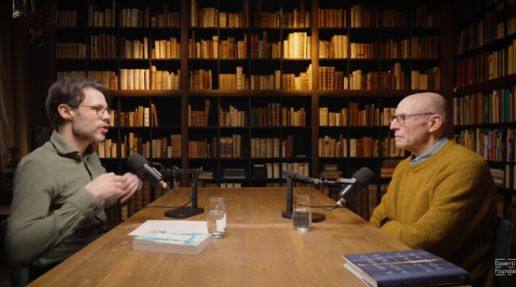
Editor’s Notes: Join the Essentia Foundation for an illuminating conversation with acclaimed journalist Michael Pollan as he discusses his latest book, A World Appears: A Journey into Consciousness. Set against the historic backdrop of the Embassy of the Free Mind in Amsterdam, Pollan explores the “hard problem” of science and his personal transition from scientific materialism to a more open-minded, agnostic view of reality. The briefing delves into the fascinating intersections of plant sentience, the role of psychedelics in expanding awareness, and the potential ethical challenges posed by artificial intelligence. Ultimately, the event highlights Pollan’s discovery of consciousness not just as a scientific puzzle to be solved, but as a precious practice of mystery and wonder. (April 18, 2026)
TRANSCRIPT:
Introduction and Setting
HANS BUSSTRA: A very warm welcome to the Essentia Foundation’s YouTube channel. I have the honor and pleasure of sitting down with Michael Pollan. Michael, a very warm welcome.
MICHAEL POLLAN: Thank you, Hans.
HANS BUSSTRA: It’s great to have you here. You’ve written a wonderful new book. In Dutch, I’ll say it, it’s een wedelte verschreint — A Journey Through Consciousness, Into Consciousness. And the setting we’re sitting here is called the Bibliotheca Hermetica Philosophica. We just showed you around a bit.
MICHAEL POLLAN: Astonishing place.
HANS BUSSTRA: It’s nice, right?
MICHAEL POLLAN: Yeah.
HANS BUSSTRA: And to me, it’s this great backdrop to your book in a sense, because we have this funny Dutch story of Descartes being here, starting his writings. He didn’t write his particular works on dualism here, but it did start — his thinking started here, like literally a couple hundred meters away from here, which led of course to the whole mind-matter divide in Western thinking, der Res Extensa, der Res Cogitans, where you very much start your journey.
And this collection here represents sort of, you could say, all the thinking up to that point, which was much more idealist — all is one, all is consciousness. So I thought that’s just a nice way. And then it’s called The Embassy of the Free Mind.
MICHAEL POLLAN: I love that name.
HANS BUSSTRA: So I think the setting is good already, right?
MICHAEL POLLAN: And it’s very Dutch, right? I mean, it’s the place where free thinking was encouraged compared to some places.
From Scientific Materialism to Uncertainty
HANS BUSSTRA: Yeah, we have left a rich tradition. My opening question, I think relevant to our audience — if you would have to say, on a sort of the metaphysical menu, broadly speaking, also relating it back to Descartes, we have matter and mind and we have to pick our metaphysics. Where would you say that your journey started as a journalist and where you were personally? And where did you end?
MICHAEL POLLAN: I’m trained as a science writer, and so I’ve kind of absorbed, through my education and all my many interviews with scientists, an assumption — really unquestioned for a long time — that scientific materialism was the paradigm in which science happens. And I kind of accepted it without much thought. I think I just kind of have a temperamental leaning that way.
And this journey into consciousness has raised all sorts of questions about that. And I think one of the things that’s interesting about consciousness science and philosophy is that it really pushes that paradigm and undermines it in interesting ways. But yeah, I kind of assumed that reductive science — its ability to reduce phenomena to matter and energy, and that everything can be reduced to matter and energy — I just took it for granted. And I haven’t thrown it out either, yet. I mean, I’m kind of in a liminal space of uncertainty myself.
HANS BUSSTRA: Are you a bit in the same place where Christof Koch is? We had him on the channel.
MICHAEL POLLAN: I don’t know exactly where he is now, because we talked and he was deeply curious about idealism. He had had this experience on psychedelics that changed his thinking because he experienced mind outside of the brain. He called it mind at large, just like Aldous Huxley.
And I asked him, “Why do you believe that? It was a drug-induced experience.” And he said it was as real as anything that’s ever happened to him. And what’s the ontological or epistemological status of insights gained on psychedelics is a real open question. I mean, I struggle with that too, because I had an experience that was similar in some ways, in which the plants in my garden all appeared to me to be conscious.
And it’s very common on psychedelics to have a sense of almost animism — that the world is more alive, more conscious than you thought. So how do we credit that? And I kind of leaned on William James in deciding how to handle it. In Varieties of Religious Experience, he said we can’t answer some of these metaphysical questions for certain. We should treat them as hypotheses and then test them against other kinds of science.
And that’s sort of what I did with plant consciousness in the book — look at what science had to tell us. And to my surprise, science had to tell us that — I wouldn’t use the word conscious for plants. I would be more likely to use the word sentient.
HANS BUSSTRA: Yeah.
MICHAEL POLLAN: Which is a kind of simpler, more basic form of consciousness.
Defining Sentience: From Bacteria to Plants
HANS BUSSTRA: How would you define it? Because I really very much liked how you structured the book in that sense. You say, okay, let’s start bottom up in a sense, not this top down — “what is consciousness and qualia?” Just start basically. We have organisms that show behavior that could very well be conscious. And then you divide your book into four main parts: sentience, feeling, thought, and self. And so now we’re at sentience, right?
MICHAEL POLLAN: So sentience I define as — and I’m not the only one who defines it this way, although there are people who use it interchangeably with consciousness, which is very confusing, especially in English.
HANS BUSSTRA: I think bacteria already will show us that.
MICHAEL POLLAN: Yeah, they have chemotaxis, which disposes them to recognize certain molecules as threatening and certain as food, and they can move away from one and toward the other. So yeah, even unicellular creatures seem to have some degree of sentience.
And I was also persuaded by some of the biologists I was talking to — people like Michael Levin, who says, and Karl Friston says this too — that nature, the world, is too unpredictable to program every action, every contingency. We talk about instinct, or we used to talk about instinct, as if you hardwired all these responses in your DNA. But nature just doesn’t work that way because there are too many things you can’t plan, that the DNA cannot foresee.
And Levin says that what evolution does is create these cognitive beings that can respond intelligently to whatever comes up, and that they can’t be programmed — they’re really making decisions in lifetime. So I looked at plants and what they can do, and there are amazing experiments being done to indicate that plants can learn and remember, that they can see.
HANS BUSSTRA: They have 28 days of memory, you write, right? Like, they have longer memory than fruit flies.
MICHAEL POLLAN: Fruit flies can only remember stuff for 24 hours and then it’s gone. I don’t know if they live longer than 24 hours.
Karl Friston, Free Energy, and Reducing Uncertainty
HANS BUSSTRA: And I just loved how you sort of — because you now already mentioned Michael Levin, you mentioned Karl Friston, and that’s all difficult stuff. And also for me, I’ve spent time with both of them.
MICHAEL POLLAN: Friston in particular.
HANS BUSSTRA: And how you just capture the essence in one paragraph — that’s astonishing. The storytelling and the clarity. This is a great guide.
MICHAEL POLLAN: I was determined to describe and explain Friston’s ideas in a way anyone could understand. And it was very hard to do, but I thought it was important. I mean, you can’t just ignore these things. You have to grapple with them. And I learned so much from him. It’s a difficult theory, I think in large part because he has four words for the same thing — very different words. But the reason he does is he’s trying to bridge different disciplines.
HANS BUSSTRA: Yeah.
MICHAEL POLLAN: Information science with physics.
HANS BUSSTRA: Physics, yeah.
MICHAEL POLLAN: Biology.
HANS BUSSTRA: And it all has to do indeed with what you mentioned earlier — reducing uncertainty, right? Uncertainty in the world. We cannot model the world as it is because then we would sort of succumb to this entropic soup, be one with the world. So we have to dissociate — in Bernardo’s language — and then we have to model the world. We cannot do it completely. And he has this theory of the free energy principle. But not to dive into that deeply—
MICHAEL POLLAN: Please, let’s not.
HANS BUSSTRA: Let’s not go into the Karl—
MICHAEL POLLAN: We will have a video.
HANS BUSSTRA: We have a video with Karl Friston. But what I found interesting — and that became clear in reading your book — is that movement and the ability to move away… We just said sentience, right? Okay, check. Bacteria or plants may be sentient, but a plant cannot move away. And I think in your book you write, for that reason, it would be very cruel of nature if they had sort of pain, right? Because they cannot run away. Animals can. And that was to me very insightful.
Do Plants Feel Pain?
MICHAEL POLLAN: Stefano Mancuso. So when I started learning how intelligent plants are and that they may be sentient, you immediately wonder — do they deserve moral consideration? Can we eat them? And do they feel pain? And is that lovely smell of new-mown grass the chemical equivalent of a scream? That was a disturbing idea.
And I asked two plant — they call themselves plant neurobiologists, even though they know perfectly well there are no neurons involved in plants. One said to me, Frantisek Baluška, a Bulgarian scientist, said, “Of course they feel pain, but we have to eat them anyway.” He’s very gruff.
Then I asked Stefano Mancuso and he said, much more reassuringly, “No, pain would not be adaptive for a creature that can’t run away. We have pain so you can remove your hand quickly from the fire, or escape the source of pain. Plants can’t do that.” So he thinks they’re aware but not feeling pain. They know that something’s munching on their leaves and they respond — they send toxic chemicals to thwart those caterpillars. So that was reassuring.
But he also pointed out that plants make fruits, plants make seeds that are meant to be picked up and eaten by mammals and birds. And grasses, which is the bulk of our agriculture, of course benefit from being grazed by ruminants. So it’s okay to eat plants.
Psychedelics, Shamanism, and Plant Communication
HANS BUSSTRA: But still, we cannot sort of exclude — okay, so that’s an argument to say they don’t have feelings. But you also write, I think quoting Evan Thompson, that we always regard this notion that the plants can communicate with us — which is what people report on psychedelic trips, right? And what shamans tell us is how they basically discovered ayahuasca, right?
MICHAEL POLLAN: The plants taught them.
HANS BUSSTRA: Exactly.
MICHAEL POLLAN: In visions.
HANS BUSSTRA: And that’s then — we say with our Western mind, that’s mythology, that’s just storytelling. And then you write, but maybe it could be that those are true epistemologies. And I’d like to dive with you a bit into that. Do you regard it as a true epistemology, a source of knowledge?
MICHAEL POLLAN: Yeah, I think so. I mean, we dismiss it in the West as mythology, but it’s another way of knowing. And again, it needs to be tested against evidence.
HANS BUSSTRA: And we’re talking about communicating with plants, or like talking to them. Have you had that experience with the plants?
MICHAEL POLLAN: No, I haven’t. I mean, people do talk about that and it’s definitely part of the shamanic tradition to communicate with plants. I haven’t personally had any communications with plants. I don’t talk to my plants, I don’t think. I’m trying to think if I ever have.
HANS BUSSTRA: Nice start.
The Secret Life of Plants and Setbacks in Research
MICHAEL POLLAN: Yeah. There was a book published in the ’70s called The Secret Life of Plants that set back our understanding of plants because it was completely discredited. It made outrageous claims. It said that plants liked Mozart, didn’t like other music, didn’t like rock music — grew better when you played music for them. No evidence has been found for that.
But the most outrageous charge was that you could use them in a lineup to identify a criminal, a murderer, and that the plants would pick out the murderer in a lineup. And how would they do that? Their electrical reactivity would go up. So this book was so ridiculous, but so many people read it. And I remember Prince Charles started talking to his plants and playing music for them. It was a huge bestseller and it set back real research for a generation.
Michael Levin and the Frontiers of Biology
HANS BUSSTRA: That’s the thing, right? That’s why we have to be careful. I say that also from our foundation’s perspective. We’re very much about science — Bernardo, and idealism. But you have to be careful there. And in that sense, you already mentioned him — Michael Levin. I love his work because that’s crazy stuff, right? Could you just explain what you find most fascinating, what you write about?
Michael Levin’s Bioelectric Fields and the Third Force
MICHAEL POLLAN: About Levin? Yeah, yeah. Levin’s project is very ambitious. He thinks the neuron and DNA are overrated as shapers of life. And he’s come to this because he does a lot of work with what are called bioelectric fields, which are a fascinating area of research that we’ve just begun to do. We knew they existed back in the ’30s, but since these fields vanish as soon as an animal is dead or a cell is dead, very hard to study, whereas the DNA survives and you can analyze it and do all sorts of experiments. It’s a classic case of looking for your keys under the streetlight. We do what we have the tools to do.
But in the ’80s, we got the tools to look at bioelectric fields. They developed these voltage-sensitive dyes, and you put them on a bunch of cells growing in a dish, and you see there’s all this activity going on, which he’s determined is communication and division of labor in a multicellular creature. And storing memories. So he works with planaria, which is a little worm, flatworm, and they regenerate. So if you chop off their head, they grow a new head. If you chop off their tail, they grow a new tail. He teaches the planaria some sort of conditions that give it some sort of lesson, which planaria can retain. And then he chops off their head and then they grow a new head and they remember the lesson. So it was stored not in the brain, not in neurons, but in their bodies.
HANS BUSSTRA: —Or in the fields, perhaps.
MICHAEL POLLAN: —Or, yeah, possibly in the fields, it’s true. And so there was that, and then he also did these experiments, which he’s continuing to do, creating these xenobots, which are essentially novel organisms that have never existed before. He takes cells from tadpole skins and puts them in nutrient solution, and they do something really interesting. Freed of their day job as skin cells, two-dimensional skin cells, they clump together forming three-dimensional creatures. They repurpose their cilia, which skin cells have to repel infectious agents of various kinds. They repurpose those as a mode of locomotion, and then they can swim around and navigate mazes and all this kind of stuff. There’s nothing in their DNA that dictated that structure. It’s completely original. Structure spontaneously formed. They form a bioelectric field, and they only live about a week, but the fact that they can live at all is astonishing.
They don’t have neurons, and their DNA is saying become a frog, which they’re not becoming. So it’s kind of mind-blowing. And he suggests— he’s come to the conclusion that there is a third force shaping a creature like this, which is a Platonic pattern. And in the same way math has these patterns that preexist us — I mean, most mathematicians would say that 3 angles adds up to 180 degrees or whatever it is — that there are patterns dictating things like goal-driven experience, a sense of purpose in the world, intention, and that creatures and possibly machines can ingress, is the term that is used. It’s a Whiteheadian term, that these patterns are what’s organizing this behavior. Who knows? It’s a fascinating idea and it’s so outside of the paradigm of biology.
Transmission Theories of Consciousness and Mind at Large
HANS BUSSTRA: I think he’s quite ignored in biology, but people from computation and philosophy love his work. I’ve spoken to Nick Rouleau, who’s a collaborator of Michael, who is very much into transmissive theories of consciousness, also relating it back to William James. I was thinking, what are your thoughts there? You do mention it at the end of your book, the whole idea that we channel consciousness, that it could be a conscious field, the bioelectric field Michael Levin talks about that we somehow receive, also relates back to Aldous Huxley’s thoughts. What are your thoughts there? Because you do touch upon it, but not too deeply. I was very curious there.
MICHAEL POLLAN: Yeah, just because I’m not sure. I’m really agnostic on these theories, or these metaphysics, because I don’t know how to prove them. I don’t know how they could be proved to anyone’s satisfaction. That’s the problem with metaphysical ideas, a lot of them. But I’m very attracted to the transmission idea. I think it’s a beautiful theory and it has some explanatory power.
Aldous Huxley’s version, which is where I first encountered it — although there are hints of it in William James too, and I think it traces to Henri Bergson, who had a big influence on Proust, and is a very interesting philosopher — is where I first encountered it. And like Christophe Koch, he had this psychedelic experience on mescaline. He imagined consciousness — he saw the brain’s function as editing. This giant mass, this ocean of consciousness that’s out there and admitting only the trickle, he called it, that we needed to survive. And everything else would overwhelm us. There’s just too much sense information, too much information of all kinds, experience. And so he imagined the brain as a reducing valve, and what psychedelics did, he decided, was to open the reducing valve wider, and you felt like you had more consciousness than you do ordinarily.
He had this idea before he had the mescaline trip. So it’s a case where he had a philosophical inclination that was supported by his experience, but came out of it convinced that there is this “mind at large.” And it would certainly explain things, ideas of collective consciousness. People have been asking me too about collective consciousness and Jung. And I don’t know if Jung ever settled on a mechanism to describe how we would have this shared pool of mythological ideas, whether it was in the DNA like other inclinations or emotional proclivities, or it came from some field outside of us. I don’t know. Bernardo would know.
HANS BUSSTRA: Bernardo has written a beautiful book on Jung. We’ll put a link down below.
MICHAEL POLLAN: Yeah, I need to read that. I’m not a Jung expert at all. I still need to spend more time on Jung.
HANS BUSSTRA: What I find interesting, exactly what you say, these experiences people have of experiencing mind at large. And in your book, that line of thought to me was very beautifully described by you visiting Thomas Metzinger, the philosopher. There are just so many nice anecdotes. Just one that popped to mind — you mentioning that I had never knew — we all go back to sort of Hoffman with his LSD or Huxley, but you also trace back Sartre, who had a bad mescaline trip. So that’s just cool storytelling stuff and reason to read this book.
MICHAEL POLLAN: Yeah, it really destabilized him for months. He thought crabs were following him around. And he would ask them to shut up when he was lecturing. It’s so funny. This is the ’30s.
Thomas Metzinger, Pure Awareness, and Consciousness Without a Self
HANS BUSSTRA: But back to that “mind at large” experience — Thomas Metzinger has written about this. What’s the title of the book? The Elephant and the Blind. But you have this — could you sort of tell the story of how he critiques Crick, the whole neurocortex of consciousness movement, for just being way too narrowed down on just a specific part of consciousness? Because that to me was very, very insightful.
MICHAEL POLLAN: Well, it’s often been thought that the problem with studying consciousness is it’s subjective, which is to say it’s the product of a self. And that subjective experience of being a self is impossible for the physical sciences to get access to, since they’re based on this idea of objective third-person God’s-eye view. And so what do you do with that self? And the hard problem is often phrased in this way that you don’t have the right tools. We’ve left subjectivity and qualitative experience off to the side, and self.
And Metzinger’s work — and he’s done this very empirically for a philosopher — he’s collected—
HANS BUSSTRA: Got data, right?
MICHAEL POLLAN: —50, 100 accounts of people who had an experience of consciousness without self. Mostly through meditation, sometimes through psychedelics. And if you discover that you can have consciousness without a self, it might make the phenomenon more tractable since you’re not, in a way, dealing with subjectivity.
HANS BUSSTRA: Pure awareness.
MICHAEL POLLAN: Yeah, pure awareness is the term he uses. And it sounds like a very weird condition. Many people have had it. I had it on psychedelics once, but a lot of people have it — experienced meditators have it. And then as he points out, we all have it every morning for 500 milliseconds right when we wake up, and there’s this lag of, “Where am I? Who am I?” And then you knit together the self. Then the story starts.
HANS BUSSTRA: And the story starts, exactly.
MICHAEL POLLAN: And it’s more than — if you’re in a hotel room in a foreign country, 750 milliseconds, sometimes a full second in my case.
HANS BUSSTRA: Okay, and then ayahuasca will give it to you for an hour.
MICHAEL POLLAN: Yes. Yeah, check. I think Metzinger’s work is very interesting — that you can separate the self and consciousness. I think there are a lot of implications to that. I think it lends some support to the idea that consciousness might transcend the self.
HANS BUSSTRA: And it’s funny, you write that he sits down with, when he was still a younger philosopher, not that known, with Crick, who was very famous for discovering the double helix.
MICHAEL POLLAN: Oh yeah, he gave him a hard time.
HANS BUSSTRA: He gave him a hard time, right? Saying like, who are you? Because he critiqued—
MICHAEL POLLAN: He said, “What’s your definition? What are you trying to solve?” Says this to Crick as a good philosopher’s question. And Crick is like, we shouldn’t define things too early. You know, it’s early in the process.
HANS BUSSTRA: And you even write like, “You philosophers should shut up.”
MICHAEL POLLAN: Oh God, he was so arrogant.
Gender, Spontaneous Thought, and the Limits of Consciousness Science
HANS BUSSTRA: But what it tells me also — and that really touched me in a sense — there it also even becomes in a sense political, where you quote, let me see, what’s her name?
MICHAEL POLLAN: Kalina Kristof? Yeah, Kalina Kristof.
HANS BUSSTRA: She basically says, I see this also as just a male way of approaching this. We want to understand it and let’s just look for the keys under the lantern. But where have you lost the keys? I don’t know. But this is where the light shines. The light here being visual perception, for instance, that we can understand. Just focus on visual perception. So we see the whole cognitive revolution being very much about that. But of course, consciousness is about feeling, being here right now, and she makes that point. Could you sort of elaborate? And also Alison Gopnik makes this point in your book.
MICHAEL POLLAN: Well, there really is a kind of interesting gender split in this world, and most of the consciousness scientists, the people trying to solve the hard problem, are men. And I think that’s really interesting. And as the book goes on, I sort of transition from looking at the science closely, getting somewhat dissatisfied with it or frustrated with it, because it’s making progress, but it hits a wall — and the wall is how does this conscious subject emerge?
When I read these accounts of consciousness by the consciousness scientists, they say we’re going to explain the experience of the rose and what red is and the taste of coffee. But what they do is they’re really focused on how perceptions become conscious to us. How does a visual perception get into awareness?
HANS BUSSTRA: And yeah, and that’s a sort of active inference story and the free energy principle.
MICHAEL POLLAN: And it’s all interesting, but it’s not the whole of consciousness. Perception is one part of it. But then you have the contents of consciousness. You have our thoughts. And for this, I found that they were kind of useless and that it was worth turning to novelists and poets, who know an awful lot about consciousness, who’ve been studying it longer than the scientists have. And in terms of the experience of being a conscious being, they’re far ahead. They’re not explaining how it comes to happen, but they’re explaining what it’s like. And when it comes to consciousness, that’s a very important part of the story.
Kalina Kristof Hadji-Livia is a Bulgarian-Canadian psychologist, and she studies spontaneous thought, which I didn’t even know was a field. And this is mind wandering and daydreaming and intuition and how thoughts emerge from the unconscious, where there’s a lot going on that we don’t have access to, but every so often certain things come into consciousness for reasons we don’t totally understand and by a process we don’t understand at all. And I said, why don’t more people study spontaneous thought? This sounds really interesting. And she said, well, because it’s unproductive. There’s a lot of money in studying decision-making and things like that, rational thought. But there’s no money in studying daydreaming.
HANS BUSSTRA: I think you quote, “They want to turn us into soldiers of capitalism.”
MICHAEL POLLAN: Yes, that’s her quote.
Spotlight Consciousness, Lantern Consciousness, and the Limits of Materialism
MICHAEL POLLAN: I was like— She’s very political. And, who decides what productive thought is? Well, capitalists. And no factory wants mind-wandering workers. Yeah. And I could understand operating heavy machinery, you might not. But she says it’s very productive for us. It’s part of creativity. It’s how we make meaning of our lives. So she thinks it’s very important and that we’re doing less of it because of technology in large part. And so she’s an interesting counterweight.
Alison Gopnik is another scientist. She’s a philosopher and child development, developmental psychologist at Berkeley who’s a friend. And she gave me an interesting caution when I started on this project. I told her I was writing a book about consciousness and looking at the science. And she said, “Don’t ever forget that the people doing this work who study consciousness have a very unusual kind of consciousness themselves,” that she calls professor consciousness. What’s that? These are people who can sit in a chair for a very long time thinking about one thing and blocking out everything else. And it’s very powerful. It’s very academic. It’s very disembodied. And she just said, “Just keep that in mind.” And I did.
HANS BUSSTRA: She calls that spotlight consciousness, right?
MICHAEL POLLAN: Spotlight. Spotlight consciousness. And she also talks about, as an opposing term to spotlight consciousness, lantern consciousness. So instead of aiming a spotlight at one thing and focusing, which we need to do to succeed in school and succeed in work, children have this light in 360 degrees. They’re taking in information. Lots of information we don’t see anymore because we’re predicting what we’re going to see. They haven’t developed their predictions yet. And the world is numinous to them and full of wonder and awe. And it’s a very different kind of consciousness.
We get a taste of it, I think, at various times. I think psychedelics gives us a taste of that kind of consciousness where we feel overwhelmed by sensory information and we can’t stay on a track. But anyway, it’s just really good to keep this in mind that consciousness is not one thing, at least in humans.
HANS BUSSTRA: Indeed, and these different modes of thinking play into the field and have consequences. For instance, you also visit Mark Searle, who’s trying to very rigorously build a conscious AI, right? Which I think— is it Alison Gopnik who critiques?
MICHAEL POLLAN: No, Kalina. Kalina critiques it — just make a baby. Yeah, well, they’re trying to create— this is someone else who’s trying to create a robot that will share our vulnerability and therefore have feelings. So feelings are very much tied to having a body that’s vulnerable, that can feel pain, and probably that is mortal. And without that, what does a feeling mean?
And so there’s a scientist named Kingston Mann that I interview who’s a protégé of Antonio Damasio, very prominent consciousness researcher at USC in America. And Kingston accepts this idea that you need feelings to have consciousness, that that’s where it begins. Yeah. But he thinks you can do that in a robot by giving it terrible skin with lots of sensors so it feels itchiness and heat and cold. And why did I bring that up? Or you brought it up.
HANS BUSSTRA: We were talking about Searle trying to build it.
MICHAEL POLLAN: Yeah. So there are people making, even though they believe that feelings are at the base of consciousness, nevertheless, they’re trying to make a conscious AI. I think it’s a fool’s errand finally, that I don’t think any feelings that a machine reports are going to have any weight because they lack that vulnerability.
And in the case of Kingston, I said, so do you think the feelings of your robot, if you build it, will be real feelings? And he said, yes, I did believe that until I had an experience on 5-MeO-DMT, a very powerful, short-acting psychedelic. And he had this amazing, wonderful, ecstatic experience. But he came out of it thinking there’s a spark of divinity in all of us that no robot will ever possess. Okay, so another psychedelic insight. Nevertheless, he’s proceeding. Yeah.
The Hard Problem and the Limits of Materialism, Panpsychism, and Idealism
HANS BUSSTRA: And that’s what a lot of these scientists are doing, and that’s what your whole journey or book describes. It are people sort of departing from the scientific method as we know it, sort of from the materialist metaphysics, trying to draw consciousness out of matter. And no one can tell us exactly where that is. I mean, Michael Levin will say it scales up and it’s just this gradient, but you cannot pinpoint where it happens. No one can pinpoint where it happens.
And I just end up— and I’m curious what your final conclusion there is — it is to me, it borders on magical thinking. You are really searching for a magic, you want to sort of, and to relate it back to, for instance, the zombie thought experiment. Can we conceive of an exact physical copy of you that does not have an inner life? Under materialism, it’s hard to deny that. You can’t conceive of that. So you just end up with that problem, that under materialism consciousness is sort of this weird magical thing, but they do want to put it in. So I see this just as sort of a funny playing around with it all. What are your thoughts here?
MICHAEL POLLAN: Well, I see three big metaphysical ideas around consciousness. Maybe I’m missing some. One is materialism, that consciousness is an emergent property of brains, although no one can explain it now. And emergence, when you press on it, sounds a lot like abracadabra. It just doesn’t really have that much explanatory power in the case of consciousness.
But then you have panpsychism, which is another idea — consciousness didn’t come into the world, it was always here, and it is in every particle. This table is made of has some little bit of psyche. But there’s a hard problem there, which is how do you combine all these proto-conscious things to make a fully conscious being like us or an animal?
HANS BUSSTRA: And it’s also a bit dualist in a sense, right? Because you want to sort of uphold matter as we know it, but we also know that it’s a matter.
MICHAEL POLLAN: Yeah, you’re adding to matter.
HANS BUSSTRA: Okay, just add it back. So it’s just this Cartesian going back to Descartes, and I think—
MICHAEL POLLAN: I don’t know if it’s quite going back to Descartes, but it is basically an exorbitant solution to the problem. Like, we’re going to add this whole new layer to matter and endow it with consciousness. It solves the problem in a funny way, in the same way that stipulating there’s a multiverse solves certain problems in physics. High price to pay. Yeah, introducing an idea like that.
And again, there’s the question— it’s called the combination problem. So that’s as hard as the hard problem. Yeah. But idealism has its own problem, I think, and that is the separation problem. So if you have this giant field of consciousness, why aren’t you transparent to me? Why do we have these separate membranes around each of our consciousnesses? The fact that we can’t read anyone else’s minds. And Bernardo proposes this idea that it’s— think of it as dissociative identity disorder, which is a metaphor in this case. And in the same way, people with this disorder can have multiple personalities in one head, like up to 20.
HANS BUSSTRA: Yeah. But so in that sense, it’s more than a metaphor, right? It is a mechanism we see in nature. It’s happening in brains. But Bernardo extends that to a universal mind. Right. It could very well be that the universe is doing this on a larger scale.
MICHAEL POLLAN: Yeah, but I still think it’s a metaphor, even — it’s either metonymy or synecdoche. I forget which. Yeah. Where you take a part to represent the whole or a part symbolizes a whole. Yeah. Anyway, I forget. I should know this. I was an English major.
And that’s the separation problem. So it seems to me they all three have issues that haven’t been resolved to my satisfaction. Yeah. For what it’s worth. And so I’m kind of agnostic on these. I mean, I think they’re really interesting. I’m interested to explore them. I think the critique of materialism is easier to make than the proposal of the alternative.
HANS BUSSTRA: Yeah, I would say — wouldn’t you say that sort of experientially what idealism has for it is exactly what we mentioned a couple of times earlier, that people experience that. So I can experience what it is like to be a self, Hans sitting here with Michael, and in certain altered states of consciousness, I can truly experience what it is to be like pure awareness, which goes beyond the ego. So that then I know experientially.
MICHAEL POLLAN: But why does it have to be altered states of consciousness?
HANS BUSSTRA: Well, just my waking state of consciousness, very often, yeah, that’s that millisecond story, it just boots Hans. So yeah, yeah.
MICHAEL POLLAN: I mean, altered states gives us access to these other ideas. Yeah. There’s still the issue of, okay, how do we evaluate their — how veridical are they? And that’s where you get into — I think James had a very generous and sensible approach. Is this a useful idea? Does it solve problems? He’s a pragmatist. As a hypothesis, can you find support for it? Yeah. And I don’t know how you find support for panpsychism or idealism. I’m not sure. I don’t know how you go about that.
HANS BUSSTRA: Yeah, indeed. I mean, it’s metaphysics. So at certain— but we’re trapped in sort of any world belief, or you cannot live without a certain sort of ground assumption of what you’re in. And so even an agnostic viewpoint, in my opinion, is a form of metaphysics. So we cannot sort of escape metaphysics. And then it’s, well, what’s your most plausible best guess about the fundamental nature of reality?
And I’m curious because you, at the end of your journey, of course, you get back to Christoph, who’s now had his sort of psychedelic experiences and is now moving towards idealism. So I do read your book as sort of departing from the hard problem towards idealism, and then you yourself do not take this position.
MICHAEL POLLAN: Well, I mean, I think the trajectory of the book is from a closed mind to an open mind. I mean, really, I don’t settle. You know, I say right in the beginning, “You may know less at the end of this book than you do right now.” Indeed. And I know that’s not a selling idea, but it’s honest. And it is. And you do know all sorts of things you probably didn’t know, but one of the things you probably didn’t know — for the average reader that I had in my head — was this assumption that brains generate consciousness. And to simply question that idea or show the limitations of that idea for a lot of people represents a pretty radical change.
Propelling the Hard Problem into the Mainstream
HANS BUSSTRA: Yeah, I think, and I really hope that this book will do — and I have high hopes for it — that it will do what your previous book did, which sort of propelled psychedelics into the mainstream. And I think this book very well may sort of propel the hard problem into the mainstream, like we do have a really hard problem.
And I like, Michael, you as sort of this tragic figure in the story. And of course, you are a storyteller, so you have to sort of bring yourself in, right? So you get—
MICHAEL POLLAN: Where’s the tragedy?
HANS BUSSTRA: The tragedy is when you sort of, of course, beautifully describe someone like Carl Friston, but of course you’re tired. I’ve spent time with Carl Friston, I’ve spent time with Christoph Koch, and I just see you being tired. And then you’re at this moment in your book sort of halfway — halfway the hero’s journey here, I have to go in, and that’s where phenomenology enters the game, right? I have to go into consciousness. I don’t want to stay outside all this theory or these journals, and I get— I’m very much on the same page there.
And okay, now he’s going to sort of find some rest, right? But then you go to this psychologist who lets you wear this device. Yeah, they give beeps in your ear. Can you tell us that story? That’s so funny, and exactly what happens when the two of you discuss your experiences with that device. Yeah. So you get the tragedy there, right? I’m hinting.
Sampling Consciousness: Russell Hurlburt’s Beeper Experiment
MICHAEL POLLAN: Yeah, I get it. It’s tragic comic. So I got very interested in the contents of consciousness, which the physical scientists don’t deal with at all. And I found this guy, a psychologist at University of Las Vegas. His name is Russell Hurlburt, who for the last 50 years has been doing a single experiment. It’s kind of a remarkable career.
He had this idea he wanted to sample people’s inner experience, kind of take a snapshot of consciousness. And his way of doing this was to essentially invent a portable beeper device. These things didn’t exist in 1973 when he started. And so he was an engineer and he made this thing. And you put this earpiece in your ear and you carry around this little box. And at arbitrary times during the day, it sends a very sharp sound into your ear. So you know exactly what it is. It’s not like, is that my phone? Is that somebody else’s phone? It’s like, no, this is a beep. And you’re supposed to write down your thoughts at that very moment. It gives you a little pad. It’s very analog, the whole thing. And you would do like in the course of a day, you can’t wear it all day because it makes you really self-conscious. You know, you’re constantly like, what if it goes off now?
HANS BUSSTRA: Yeah. When’s the next beep? Yeah. What are the intervals? How many beeps a day?
MICHAEL POLLAN: Well, we would do 5, which would take a few hours. And then I seldom wore it past lunch because it was very discomforting. And then he would have a Zoom meeting with you to discuss your beeps because he had to kind of interrogate them because it turns out we know less about our thought process than we think.
And so I’ll give you an example. One beep occurred. I had seasoned a fillet of salmon and I was returning it to the refrigerator. And halfway to the refrigerator, I was like, “Shit, I forgot the pepper.” Beep. And that was my thought. A lot of my thoughts were banal and had to do with food. And not enough about sex, right? No, there was nothing that, you know— you wrote that.
HANS BUSSTRA: I find that funny, right?
MICHAEL POLLAN: Yeah. Nothing worth suppressing or censoring.
HANS BUSSTRA: Sorry, I interrupted.
MICHAEL POLLAN: That’s okay. So then you talk to him about it. I said, yeah, I had this beep and it was pepper, you know, the word pepper. And then he was like, well, did you hear the word pepper or did you speak the word pepper? I was like, I don’t know. And you realize we have a voice in our head, but are we listening or are we speaking? And that’s— it’s not clear, actually.
Anyway, so we went through a whole lot of different beeps and we had a lot of arguments because I didn’t think you could disentangle the momentary thought from everything that was going on. So I was in a bakery. I was thinking of buying a roll to make a sandwich for lunch. Another food beep. And I had an image of it, but kind of a very sketchy emoji-like image of a roll. But at the same time I was thinking about that, when the beep went off, I was noticing the smells, which was bakery, but there was also cheese. I was hearing the voices of people behind me in line, and I was noticing this very unflattering plaid on this woman’s skirt in front of me. And that was all part of the conscious moment to me. But he was like, no, you have to separate it. What was before the footlights of consciousness? So we would have these arguments over and over again.
The Four Types of Inner Experience
MICHAEL POLLAN: And ultimately, he concluded— so he believes that there are like 4 basic different kinds of thoughts or inner experience. There’s verbal thinkers, there are people who really think in words. Which turns out, though, not to be a majority of people. It’s a minority, which is interesting in itself. And there are people who think in images. And then there are people who think in unsymbolized thoughts, which are neither images or words. And I think that did apply to me to some extent. That’s an interesting one, right?
HANS BUSSTRA: Yeah. What’s that? An unsymbolized—
MICHAEL POLLAN: You just have this idea that you have not translated into any kind of symbol, either visual or— It’s in a superposition. Yeah, in a way it is in superposition. But then he said there are people who have very little inner life and that he decided that was me. Thank you for laughing. And I got very defensive about this because—
HANS BUSSTRA: Of course, in a more French scientific context, that would be like an insult. It’s like, right?
MICHAEL POLLAN: Well, he said there’s certain—
HANS BUSSTRA: Who are you to tell me about my inner life?
MICHAEL POLLAN: I know, but he said there’s certain advantages though, that people with this lack of inner life are just experiencing things without bringing a lot of ideology to it. Ah, so it wasn’t all bad.
HANS BUSSTRA: So it’s journalists’ consciousness you have.
MICHAEL POLLAN: But you know, it was ridiculous. But anyway, he just felt my inability to separate out the conscious moment that I was filling a great void with all this contextual material. So anyway, it was a funny experience.
HANS BUSSTRA: But it’s this in-between step, because I sat sort of in your tragic, in your hero’s journey in the book, right? It’s this moment where you say, okay, let’s go in, let’s go phenomenology and then you encounter him, but it’s still this sort of, let’s call this male, male scientific approach, third-person perspective. Okay, what did you experience, Michael? And then he’s harsh on you and it’s just funny. And then towards more the end of the book when we touch upon the self beyond thought, you get to Thomas Metzinger and you end your book sort of in Plato’s cave, right, in a sense.
MICHAEL POLLAN: I don’t think it was Plato’s cave. It was my cave.
HANS BUSSTRA: It was your cave. Tell us about your cave and how that was.
The Self as Consciousness’s Greatest Creation
MICHAEL POLLAN: So when I started working on self, the chapter on self, which I see as the kind of apotheosis of consciousness, I mean, it’s this very complicated creation of consciousness, or seems to be, and that it’s very paradoxical, and the Buddhists think it doesn’t exist, that it’s an illusion, and there are ways in which it is an illusion.
HANS BUSSTRA: Yeah, and it’s very nice to be clear there. So it’s the moment where thoughts become meta-conscious about themselves. So it’s us thinking about ourselves, constructing stories, right? That— Yeah.
MICHAEL POLLAN: And also the fact that, as David Hume discovered a very long time ago in the 1740s, if you go looking for yourself in your mind, you will find thoughts and perceptions and feelings, but you won’t find a thinker or perceiver or feeler. And that’s kind of interesting and spooky. And it’s an exercise worth trying because you will find thoughts that are essentially thinking themselves that you did not will to think.
So, and also the idea that there’s a thread connecting us today to our 6-year-old or 13-year-old self, which is, we’ve changed in so many ways since then, yet we still feel a kinship with that boy. And is that real or just a function of, we’ve created all these memories that make us feel like it’s real? It’s a very elusive concept. There’s a conventional self, there’s the one we’re using right now and it helps us. And in fact, it reifies our sense of self.
And one of the things I learned, I went and spent several days in this cave that the Zen teacher sent me to because she thought I was getting lost in my head.
HANS BUSSTRA: Who was she again?
Joan Halifax and the Cave Retreat
MICHAEL POLLAN: Her name is Joan Halifax, and she’s an 82-year-old Zen teacher, very wise woman. And I went to her because I’d heard that her retreat center in Santa Fe was a— she’d called it a factory for the deconstruction of selves. And people go on these 2-week retreats and they have a moment, kind of a crisis moment, where they give up their self and kind of merge with the group. And that has to do with meditation. It has to do with ritual, which takes away volition. It has to do with silence and the fact that there’s no social contact, that you not only don’t talk, but you don’t make eye contact, which is a very powerful thing. I’ve had experience of that. And it makes you realize what a social construct ourselves are. Because when you don’t have friction with other people, it starts to melt. It gets very permeable.
And so anyway, she decided at a certain point— I wanted to ask her all these questions about the self and consciousness. And I should have known she’s a Zen teacher, that she’d be allergic to concepts. And she certainly was. The first interview she started by saying, or in advance of it, she said, “I’ve divested from meaning,” which is okay. So she said, I think instead of going through the process with the people on retreat, we should drive up to this other retreat, which was just a place in the mountains where she has a couple huts, and then there is another half-mile up in the hills, there’s a cave that her monks have dug out of a hillside and put a sliding glass door on.
And it’s very tiny. It has a little bed that I could barely fit in. It’s got a meditation cushion. It’s got a little camp stove, but no running water, no electricity. It’s as far off the grid as I’ve ever been. And she just said, go have an experience, let’s not talk about it. And I did. And it shifted my perspective in important ways.
It was just a few days, but the silence was like nothing I’d experienced before. And I meditated for hours at a time, which I’ve never been able to do. Utterly undistracted, alone with my thoughts, lots of spontaneous thought. And it made me realize that I’d gotten kind of trapped in this framework, which was very Western, very male, very Cartesian, of problem-solution. And that there was another way to think about consciousness, which is as a practice, and that the problem was one thing, but the fact of consciousness is quite another.
And it’s an extraordinary gift. And I hadn’t appreciated it quite enough that we have this private space in our heads where we have complete privacy. We can think whatever we want. We can talk to ourselves. It’s this incredible gift and we squander it. We take it for granted. We don’t even think about it. And I thought about it a lot in the cave.
And it made me realize also that we’re less conscious than we might be. There is a reducing valve, as Huxley said, and we think that animals are less conscious than we are, but in fact they’re more conscious in many cases because they have to be. They have to be present to the moment, otherwise they could become another creature’s lunch.
And so that was a shift and it was one I didn’t see coming. And it sort of made a virtue of not knowing, that not knowing opens you up to mystery and awe. And it is a beautiful mystery. And I became less concerned with solving the problem than finding ways to make myself more conscious.
Consciousness as a Practice, Not a Problem to Solve
HANS BUSSTRA: Beautiful. It was, in that sense, it was touching to me. It also made me think of the book The Alchemist, by Paulo Coelho, I think, the writer. It’s a story of being in search of something, this long quest, all to discover it’s just in front of you all the time. And I also have that in my own work for the Essentia Foundation. I mean, you can walk around and forget that it’s just in front of you. And for me, it’s my kids. And that to me was also sort of almost emotional to thinking about lantern consciousness being present, a rich stream of consciousness in the moment, playful, versus sort of— and then we get older and it goes like this, right? And then in our culture, we have to sort of— now we have ended up that we need those medicines, psychedelics, for instance, to open up again.
MICHAEL POLLAN: Yeah, that’s right.
HANS BUSSTRA: And your book opens with the question how to— you already say that in your book, right? That your wager may not sort of end up with knowing more about consciousness, but maybe how to use it better, right? And that’s sort of what your story just illustrates.
Consciousness Hygiene and the War on Consciousness
MICHAEL POLLAN: And how to defend it too, because there are interests in our society that have designs on our consciousness. Social media is trying to hack our attention. What is that? But that’s how we direct our— it’s how we allocate our consciousness. And now we’re forming emotional bonds with machines in the case of chatbots. And that’s another, I think, assault on our consciousness. And it limits the kind of, the amount of spontaneous thought we can have. So I think there’s— I’ve been thinking in terms of consciousness hygiene, that it’s something we need to protect. It’s precious and it’s under siege.
HANS BUSSTRA: Indeed, and it’s funny how people— have you heard of Alex Gomez-Marín? He’s this neuroscientist that you have— yeah.
MICHAEL POLLAN: He’s been in touch, but go ahead and refresh my memory.
HANS BUSSTRA: Yeah, he’s this neuroscientist, physicist, very much into psi phenomena. So he sort of had a near-death experience himself. Also interesting, Michael, you didn’t go into parapsychology, near-death experiences. Maybe nice to touch upon that in this one, but Alex has sort of become much more radical. He spoke at the Science of Consciousness conference last year, and he said, time’s up. He can sort of start doing his work as a scientist, but the thing’s becoming political now. There’s a war on consciousness.
MICHAEL POLLAN: Really? Yeah, it was like that. How would he characterize the threat?
HANS BUSSTRA: He would say the war is sort of a physicalist, materialist agenda pushed by mainly Silicon Valley and the AI investments. To tell us that we are machines, right? And of course, there are billions invested into that whole idea, and we need to push back because it’s an unscientific idea. And then he says— I’m curious what your thoughts are here. He says, this is also a funny one. He says, Dave Chalmers, who you feature a lot in your book, you go back to Dave and he keeps saying, “No, the problem is still hard.”
MICHAEL POLLAN: “The problem is still hard.” He’s the superego. Yeah, that’s nice.
HANS BUSSTRA: So it’s all just great storytelling. But Dave Chalmers— Alex Gomez-Marín says Dave Chalmers just rebranded the death of materialism when he told us that the question is, how does the water of brain chemistry turn into the wine of consciousness? Because it shouldn’t be how, it should be if at all. And if that’s the question, we take a step back and only if you say, “Yeah, it could be real,” then you ask the how question. But somehow our Western mind skips that question. We go all into how. And your book is this whole quest on the how.
MICHAEL POLLAN: And then realizing that’s not the right approach. Yeah. Could you sort of—
HANS BUSSTRA: Yeah. Follow there? Is his line of—
The Limits of Computational Functionalism
MICHAEL POLLAN: Yeah. I mean, I think he’s right. I mean, I think that there is this very reductive materialist view of consciousness being promoted in Silicon Valley. There’s a general belief that you could run consciousness on another substrate instead of meat. We run it on meat, it could be run on silicon. That’s a general belief there, which is a pretty wild idea, but they’re operating from a presumption that computational functionalism is true. And that is the idea that consciousness is essentially a kind of software or maybe algorithm that can be run on different substrates. And we happen to do it on brain cells, but it doesn’t have to be.
It’s based on a faulty metaphor. The metaphor is that brains are computers. They do do some computation, it’s true, they have some resemblance, but metaphors are not equivalences, and this one has big problems. The first is that in brains, unlike computers, there’s no sharp distinction between hardware and software. Every experience you have physically reshapes your brain, and your brain is different than mine because you have different life experiences. I mean, physically different than mine. So this idea that you could extract consciousness from a substrate and separate the two, which is at the heart of computer thinking, just doesn’t work. Consciousness is embodied in the sense— if it is indeed produced by brains, it’s very much tied to the substance.
Neurons are also not like transistors. Yes, they fire or don’t fire. In that respect, they’re sort of digital, but they’re also influenced by chemicals. The intensity with which they fire, the inhibitions, hormones, neurotransmitters, drugs all change what neurons do. And then there’s this issue of feelings, which we talked about— what does it mean to say a machine has feelings? I think feelings are different than thoughts. Not everybody does. Chalmers doesn’t agree with that. He thinks all mental contents are the same and you could have consciousness without feelings, and he points to Dr. Spock, a fictional character, I might point out.
Magical Thinking and the Nature of Matter
HANS BUSSTRA: And may I put you a little bit on the spot?
MICHAEL POLLAN: Sure.
HANS BUSSTRA: During your quest, you go back to— you have, I think, to check in with your friend, colleague, Dan Gilbert, the positive psychology writer. Yeah, colleague.
MICHAEL POLLAN: I wouldn’t call him a friend. Oh. I don’t want to offend him. I quite like the guy, but I’ve met him once. In my definition of friendship, it’s a couple more meetings.
HANS BUSSTRA: But you go to Dan Gilbert, who warns you against magical thinking, right? And we want the soul, we want meaning, and we know that we live in a material universe, etc. Your journey goes to Bernardo and touches a little bit on quantum. And so I spent quite some time also talking to the quantum physicists, etc. And now to me, talking deeply to them in the fields of the foundations of physics— to me, very often the magical thinking is now matter. It’s sort of this observer-independent universe. If you think that’s fundamental, that’s the magical thinking. Which brings me back to just Descartes’ first line. I know, or as you point out in your book, it should maybe be, “I feel, therefore I am.” And that’s it. And the magical thinking is matter.
And of course we need to explain matter. So the burden of proof on idealism is, of course, how do you get from that to something that— I mean, it feels like solid stuff and independent of me. So that’s a big open question. But not only neuroscience, but physics points us in that direction. And if, as a journalist, it’s not your task to put judgment here, and as you said, you don’t want to commit—
MICHAEL POLLAN: I’d be happy to make a judgment if I had certainty. It’s not a journalistic reluctance to draw conclusions. If you read my work on food, or psychedelics, I draw conclusions all the time. I’m not shy about that. No, it’s just not being convinced.
But your point about magic and materialism, I think, is well taken. I think someone’s— magic is just a way of insulting ideas you don’t agree with. I don’t think Dan was right about that, to assume that anything that isn’t materialistic is magical thinking. I don’t think we know enough to say that. And it’s true that the inner nature— I mean, when you talk to physicists, matter, which to philosophers and biologists seems so solid, suddenly falls apart. I mean, they don’t really know what matter is. Which is remarkable. And entanglement is a pretty magic-seeming concept, right? It defies all our material laws, even the speed of light. So yeah, we have to keep an open mind.
Living in Mystery
HANS BUSSTRA: And on the meaning of life, Michael, has it changed your outlook on what it all means to be human?
MICHAEL POLLAN: Yeah, I mean, I think we’re living in more mystery than I thought. And that’s just fine. And beautiful.
HANS BUSSTRA: And beautiful, yeah, it is. I like that. Our world appears to us and the beauty of that.
MICHAEL POLLAN: Thank you, Hans.
HANS BUSSTRA: Yeah, thank you very, very much for a beautiful book. And I wish you a very nice continuation of your book tour. Thank you. And hope you can stay zen in the midst of all this talking about consciousness. You can find some silence.
MICHAEL POLLAN: I’d like to find another subject. I’ve been talking about it a lot. If I may invite you then, if you would.
HANS BUSSTRA: I mean, I’d love to hear you dive into quantum and sort of— oh God, I thought I was going from mind to matter.
MICHAEL POLLAN: I thought I was going to end up there, but the quantum theories seem really undeveloped. And the one around microtubules— the Hameroff-Penrose conjecture. Yeah, new book. I don’t know what to do with that. Maybe another book. Thank you so much.
HANS BUSSTRA: Yeah, thank you. Thanks a lot.
Related Posts
- Jared Isaacman: A New Era for NASA and American Space Exploration (Transcript)
- Transcript of Bill Gurley: Searching for Feynman at All-In Summit 2026
- Transcript of Neil deGrasse Tyson Interview: This Past Weekend #683
- Transcript: Elif Shafak and Robert Macfarlane Interview on Writing w/ David Perell
- Transcript: How Does Your Brain Know Where You Are? w/ Edvard Moser – World Science Festival