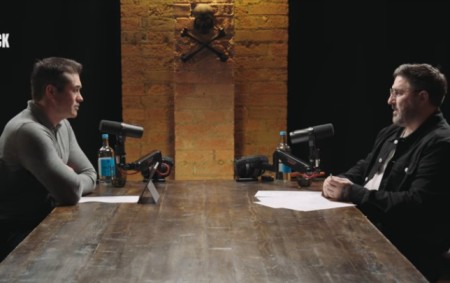
Editor’s Notes: In this thought-provoking episode of The Peter McCormack Show, host Peter McCormack sits down with Freddie New to explore the chilling parallels between the decline of ancient Rome and the current state of Western civilization. The conversation delves deep into the history of currency debasement, comparing the fall of the Roman denarius to the modern-day loss of purchasing power in the pound and dollar. Together, they examine how fiscal irresponsibility, political corruption, and a hollowing out of societal standards mirror the patterns that led to Rome’s eventual collapse. From the impact of “soft money” on human behavior to the potential for a digital “Solidus” like Bitcoin to restore stability, this episode is a fascinating journey through time and economics. (April 16, 2026)
TRANSCRIPT:
Currency Debasement: Rome and the Modern West
PETER MCCORMACK: Right, Freddie, last time we had you here, I learned that you studied classics.
FREDDIE NEW: I did.
PETER MCCORMACK: Based on your study of the classics and the fall of Rome, how do you compare it to where we are now?
FREDDIE NEW: Currency debasement’s a fantastic place to start. Obviously we’re all familiar with the pound sterling. Over the past 100 years, the pound sterling has lost about, I think, 95-96% of its purchasing power in the last century.
And then if you lay that over the currency debasement in ancient Rome, the denarius started to lose purchasing power around about the time of Marcus Aurelius, the gladiator emperor. Most people will know him. Played by Richard Harris, I think it was, in Gladiator. Then over the next 150 years, that had a comparable decline in value. Its purchasing power by the time of Diocletian was 3% of what it had been in the time of Marcus Aurelius. So in terms of pure time and pure number, those are worryingly similar to each other.
PETER MCCORMACK: Why is money the linchpin to the collapse of an empire?
FREDDIE NEW: Well, I think it’s because money is so fundamental to humans and to human society. We literally could not function without an abstract form of value that we can use to exchange goods and services. Most of your listeners will already be familiar with the Coincidence of Wants problem, the idea that if you have an apple and I have a house, we can’t trade between each other unless maybe you’ve got half a million apples and you can sell those for something that I also want. So that’s the Coincidence of Wants in a nutshell.
And money is crucially important for gigantic power structures like the Roman Empire and complex civilizations like our own, because it really underlines who is going to end up in power and who’s going to end up making decisions that affect the economy and the people who live in it.
PETER MCCORMACK: And the debasement of the currency in Rome — I understand it as the coin clipping, which by the way, I recently understood from Lyn Alden, the grooves on the edge of the coins were to prove coins haven’t been clipped.
FREDDIE NEW: We still have them today for that same reason.
PETER MCCORMACK: Well, who’s going to clip a pound coin?
FREDDIE NEW: Well, exactly. It’s a historical anomaly now. There’s virtually no precious metal in any of our coinage anyway.
PETER MCCORMACK: No, but it was coin clipping in Rome. The equivalent is the money printer here. But what are the similarities between the times? Is it just the state living beyond its means?
Plague, Military, and the Spiral of Debasement
FREDDIE NEW: It’s far more than that, actually. And even when you consider something like COVID-19, there was an enormous plague in the 3rd century. Perhaps I’m jumping ahead of myself to get to the 3rd century. Maybe just touching on your coin clipping point, actually — it started with coin clipping, and some of the earlier emperors began shaving little bits off coins. It then got a lot worse with the actual dilution of the amount of silver that was in each coin.
And bear in mind that the most important people the emperor had to pay were the military, the soldiers. And as time went on, the military became more and more important in deciding who was going to become emperor. There was a crazy year after the death of Nero. It’s called the Year of the Four Emperors. You had Otho, Vitellius, Vespasian, and Galba all in one year, all basically warlords killing each other. And then Vespasian came in and established the Vespasian dynasty and had a bit of stability, but shaving of the coin had begun then.
And then as the economy and the infrastructure of Rome began to collapse to a greater and lesser degree, encouraged by things like plague, by manpower shortages, by supply chain blockages — all of which are pretty familiar to us certainly over the last 5 or 6 years — the situation got worse and worse and worse. The salaries paid to soldiers dramatically increased. And you had an interesting example in the real world of people refusing to get paid in the new money, because its silver content was so much less than that of the old money. And so while coins of the empire were notionally of equivalent value, everyone knew that they were worth less.
PETER MCCORMACK: Did they get away with it for a while though? Were people aware immediately they were clipping or shaving or diluting?
FREDDIE NEW: I mean, they arguably got away with it for 300 years because they kept doing it.
PETER MCCORMACK: Right. And the West, the US, us have got away with printing money now for at least half a century or maybe more.
FREDDIE NEW: Yeah, I’d probably say sort of two big periods of money printing. One was around about the First World War when we first came off the gold standard.
PETER MCCORMACK: Yeah.
FREDDIE NEW: And that obviously enabled us to print a gigantic amount of money very quickly to fund World War I.
PETER MCCORMACK: And was it a similar scenario as we see here, where in Rome, as they were clipping the coins, there was like an inflationary pressure, but the wealthiest continued to get wealthy?
The Wealth of Empires: Rome, Britain, and Infrastructure
FREDDIE NEW: Oh, absolutely. Probably worth mentioning two things as well. So part of the wealth of Rome, I think, is a really interesting analogy to the wealth in the United Kingdom. Rome became unfathomably rich largely via wars of conquest. They expanded their empire, they got access to more resources, more people, huge amounts of money funneled into Rome. And as long as the empire kept on expanding, then that process would continue.
And there’s an interesting analogy to draw there with the British Empire in that we, in terms of land area, I think, covered the greatest extent of the planet. And vast amounts of wealth and money were drawn into London. And actually, the infrastructure point is an interesting one. We’re still reliant to a huge degree on infrastructure that was laid down during the Victorian period, which is arguably the height of the British Empire.
And if we’re going down this analogy route, I’d roughly equate that to Augustan Rome. So after the Old Republic has fallen, Julius Caesar’s crossed the Rubicon with his army. He says, “Alea jacta est,” even though he doesn’t, but it sounds good. “The die is cast.” And then he effectively establishes the empire, and the first emperor is his adopted son Octavian, later known as Augustus. I roughly equate that to the Victorian era. Our sewers, for example — I think 40% of our sewers are still Victorian, which is just extraordinary.
PETER MCCORMACK: Yeah. So for you, when you’re watching the geopolitical movements that are happening right now, are you automatically drawn to comparing it to what happened during the Roman Empire?
FREDDIE NEW: Probably inevitably, but as you said —
PETER MCCORMACK: It’s like history doesn’t repeat but it rhymes.
FREDDIE NEW: Yeah, exactly. And one of the key reasons why you study history is to understand how humans behave and understand also that although the nature of the time that you live in may be different, the way in which humans behave is probably fairly similar in most of those situations. And so it’s fascinating to look back at a highly complex civilization and realize, oh, we actually share quite a lot in common with those people, and we’re making exactly the same mistakes as some of them did because of human nature, I think, fundamentally.
PETER MCCORMACK: We’re all kind of greedy and want an easy route out.
The Trap of Soft Default and Sovereign Debt
FREDDIE NEW: Well, yes, and even if we’re not greedy — if you’re faced with two unpalatable alternatives, you’ll choose the less unpalatable one, and then you keep on choosing that. And arguably, currency debasement and money printing is the less unpalatable one.
In terms of government sovereign debt, I’ve always been of the view that you can solve it in a couple of ways. You could have a complete debt jubilee, which doesn’t work because our economy functions on liability money, on credit. You can, as a government, decide to default if you’re Argentina or as Russia did in the relatively recent past. That’s not great either because then that wipes out your ability to raise new money and new credit in future on the markets. Or you can soft default, which is — keep the nominal amount the same. So I’ll still owe you £100, but I’ll inflate the currency to a point where that £100 won’t even buy me a boiled egg.
PETER MCCORMACK: But that’s the sleight of hand we keep playing.
FREDDIE NEW: Yes.
PETER MCCORMACK: And that is the sleight of hand that they played in Rome.
FREDDIE NEW: Yes, to a very large degree. Remember I mentioned earlier — if you’re an emperor, you have to keep paying the army.
PETER MCCORMACK: Yes.
FREDDIE NEW: If you don’t pay the army, you’re out. And the army are also aware that the silver content of their coins is getting debased, so they want more and more money. Their salary has to keep increasing. And if the salary increases, you create more and more coins, you reduce the value of the coins that are currently in circulation. So although they’re using physical coins and can do it definitely to a much less aggressive extent than we can, they are still flooding the system with new money. The individual purchasing power of those coins in the system is rapidly decreasing.
We can see from the graphs — I don’t know if it’s a good time to pull up our graph. You can see — yeah, this is a fascinating chart.
PETER MCCORMACK: Do those coins look all a bit f*ed up because they’re old, or is that actual clipping in practice?
Reading the Chart: The Collapse of the Denarius
FREDDIE NEW: A bit of both, actually. So if we start — the red period at the top is the later Roman Republic. As you can see, the currency remained pretty solid and stable for about 150 years. And then Augustus takes power around about the time of the birth of Christ. And then you’ve got the Julian emperors who go from Augustus down to Nero. And even at the time of Nero, you’re still looking at like 90-odd percent.
Things began to trickle down about a century later. Marcus Aurelius presided over the initial drop there, and then — listeners are probably familiar with Commodus, also from Gladiator, also a real guy, and actually a much worse person in real life than he was in the film.
PETER MCCORMACK: He was even worse than the film.
FREDDIE NEW: Oh yeah, he was a complete barbaric lunatic. When you’re reading about the kind of things these people do, it’s important to understand that the contemporaneous historians are often exaggerating how bad previous emperors were because they were writing under a subsequent emperor, right? So you want to say, yeah, your predecessor was awful. He used to do insane things. There’s a story about him, for example, tying together cripples who’d lost their feet in a long serpent in the arena and then clubbing them to death with himself dressed as Hercules for the entertainment of people in the Colosseum.
PETER MCCORMACK: Yeah, nice guy. Is that going to be you, Con?
FREDDIE NEW: Horrific person. And then during the second and the third century, things got worse and worse and worse. And you can see the absolute collapse to 3% purity that we mentioned under Diocletian.
PETER MCCORMACK: And is it a case that once this starts, it’s very hard — like, once the currency starts to collapse, they have to repeat? They’re trapped. It’s a bit like Labour has to right now keep printing money, Trump has to keep printing money. And it’s just an acceleration. You can’t stop this, really.
Once You Start, You Can’t Stop
FREDDIE NEW: Effectively so. And although the reasons why you can’t stop may be slightly different — our reason that we can’t stop is not because we can’t afford to pay the army, although we can’t do that.
PETER MCCORMACK: We actually can’t.
FREDDIE NEW: Yeah, that’s a similar attitude, but that’s not an existential crisis for the country yet. It’s more about the fact that we pay $110 billion a year just on servicing our debt, and that money has to come from somewhere.
PETER MCCORMACK: We don’t want a hard default. No, because that’s politically not popular.
FREDDIE NEW: No, exactly.
PETER MCCORMACK: And the consequences will be quite severe.
FREDDIE NEW: Yeah.
PETER MCCORMACK: So it’s death by a thousand debasements, basically.
FREDDIE NEW: Exactly. And inflation of 2 to 3% is high enough for them to keep achieving that. And we obviously know real inflation is higher than that, but it’s not so high that people will be out in the streets demonstrating.
PETER MCCORMACK: So there’s an inevitability of this.
FREDDIE NEW: Yeah, a qualified yes.
PETER MCCORMACK: Where would you— actually, Connor, can you find the chart which shows the pound losing its value over time?
FREDDIE NEW: Well, I can do that off the top of my head.
PETER MCCORMACK: Oh right, okay.
FREDDIE NEW: So if you look at around about where it says 100 years on the chart, just between the green and the purple lines, if you call that 100 years ago, so call that 1925.
PETER MCCORMACK: Yeah.
FREDDIE NEW: Then now we’re about where Diocletian is.
PETER MCCORMACK: Where’s that?
FREDDIE NEW: Right at the left-hand side where we’ve lost about 95% of the purchasing power.
PETER MCCORMACK: Oh, so we’re near collapse.
FREDDIE NEW: Yeah.
PETER MCCORMACK: But we got better, but we’ve got different tools now. We’ve got technology. Yeah.
FREDDIE NEW: I mean, we could still go down another 100% from here. Yeah.
PETER MCCORMACK: When I look at this chart, it makes me question whether the invention of paper money was probably the worst thing possible because it made the cheapest form of printing money.
FREDDIE NEW: Yeah, I kind of agree with that because you can debase coinage, but you can prove relatively easily what its silver percentage is or what its gold percentage is. If you’re printing paper money, which is effectively a credit claim on a central bank which ostensibly holds valuable assets, that’s really what our pound coin or our pound notes are. Then your money printing ability is limited only by the cost of paper. Yeah, it just speeds it up. And now that we’re digital, it’s even worse.
The Roman Equivalent of Modern Socialism
PETER MCCORMACK: Did they have an equivalent of a socialist back in those days?
FREDDIE NEW: It’s funny you ask that because I really was thinking about where—
PETER MCCORMACK: Who was the Roman Zakpolanski?
FREDDIE NEW: I don’t think a real equivalent existed. It’s interesting to think about in terms of morality though. I think that a lot of people who have left-leaning tendencies think that it’s morally right to hold the belief set that they do, whereas I think a lot of people on the right don’t really bring morality into it very much and would be based more on what they would, I think, call logic or hard truths, let’s say.
Edward Gibbon, who’s the source of a lot of our knowledge about the Roman Empire— if anyone has a spare year, read The History of the Decline and Fall of the Roman Empire. 1.5 million words, depending on your edition, between 7 and 12 volumes. Took me a year to read it.
PETER MCCORMACK: You’ve done them all?
FREDDIE NEW: Yeah.
PETER MCCORMACK: Wow.
FREDDIE NEW: He was very focused on the idea that a decline in Roman morality and appropriate behavior partly led to the corruption and decline of society in general. And so he had a very moralistic viewpoint of the decline and fall, which I think is now generally quite frowned upon. There are better economic realities that really underlie the death of empire. And there are a lot of people who would argue that actually empire didn’t so much die as evolve. For example, the empire was split into the East and West. The Byzantine Empire continued until 1453 and the invasion of the Ottomans, and then became the Ottoman Empire. And a lot of knowledge and culture then came back over to Rome and triggered the Renaissance. So I’d see these more as a kind of cyclical evolution of different systems.
Soft Money, Grift, and the Loss of Standards
PETER MCCORMACK: Well, so one of the things I keep thinking about, I think about this quite a bit, is that we are now on a soft money standard, really.
FREDDIE NEW: Yeah.
PETER MCCORMACK: Easy to create money, easy to access money. And within that, we have what I think is now a system of grift. I’ll give examples— the employment law system whereby if you want to get rid of somebody from your company, it’s very difficult. And if you haven’t followed an exact procedure correctly, they can take you through an employment process which takes months. You have to employ them, you have to pay them during that process. If you can’t structurally prove that they should lose their job, then you have to give them a payout. It’s very hard. And so people who really should just lose their jobs because they’re shit at their jobs can grift this system and an employer for months on end to get paid, which to me is like capital destruction.
I saw a thing the other day, a BBC investigation whereby there were lawyers helping immigrants who’ve come across to understand how to portray themselves as homosexual and can’t go back to their country because they’ll face persecution. And I think what it is, is like, I look around, I think there’s a loss of standards, a loss of discipline, a loss of integrity. Everyone’s just out for what they can get without considering the consequence for who they’re stealing from. Because all of this, to me, is theft. When you’re trying to grift the system and rules, somebody’s paying, so you’re stealing. And so we’ve lost all those standards.
But I also look across at the people, and if somebody’s listening and hasn’t heard me talk about Bitcoin, which I do all the time, those are the people now on a hard money standard themselves. There’s a lot more discipline to their lives generally, I find. Discipline around money, discipline about rules, discipline about how a society should be structured. So I think what I’m really putting to you is, does the way we treat money— does our society reflect how we treat money?
Money, Value, and the Dissociation of the Two
FREDDIE NEW: I think that’s a fantastic question, and I’d be inclined to say yes. There’s a sort of core idea I keep on returning to, which is that in modern society, money is easy to create, value is hard to create. And people, I think, have forgotten, or at least conflated, the two.
Ask the regular person in the street if £10 has value, and they would say yes. But arguably, that money is a representation of value. It’s not value itself. By value, I mean things like businesses which provide valuable goods and services to other people, even educational services that help people better themselves and understand things, technology pipelines that build out our superconductors and our chips and so on. Those are all examples of value creation, but we’ve completely dissociated the creation of value, which money is supposed to represent, from money itself.
Money is now created out of thin air at the press of a button in the Bank of England every time the government goes to the bond markets. They are creating new money and then signing up to pay the coupon on those new gilts for however long. And every time a bank makes a loan, they’ve created more money literally out of nothing. So when you go and get a mortgage for your house, the bank doesn’t have that money sitting in its account. It’s not lending you someone else’s money, which is what a lot of people think. It literally credits that amount into your account, and then it also credits the same amount into its balance sheet as an asset that bears interest, which you pay it. It’s phenomenal— and I bang on about this all the time— runaway house prices are a direct symptom of the ease with which money has been created and is dissociated from the value of a house.
The Hollow Men: The Slow Collapse
PETER MCCORMACK: Well, I think, remember that quote that you found about inflation. Do you know the one I mean? That was the one about the hollowing out of society. And I think if you go to my Substack, I wrote an article about it. So go and find that.
So my biggest concern with society right now is inflation, and because that’s basically directly connected. Talking about the Four Trampas? Yes. You got it? I’m going to read you this thing. This is something Connor found and it blew my mind. But I think the hollowing out of our country is down to inflation because we’ve essentially created a treadmill where we were slowly increasing the speed over time. And in that time, that person might be getting fitter, but eventually you can’t get to a certain speed, you can’t keep up.
And I look across at what’s happening in our country at every single level. If we’re making it harder and harder for people to keep up, naturally there are others that go, “Well, I’m going to grift.” We also have a clearly corrupt elite system which has created socialism for the rich. Like in some ways being a Bitcoiner— we’ve got socialism for the rich. If you’re an asset holder, you’ve got socialism for the rich. And I understand why young people are pissed off or other people in society are pissed off. They’re like, “What can I do to keep up? I’m doing everything I can. I’m going to work. I’m working hard, yet I cannot get a house.” I get that it’s getting away from them because their wages cannot keep up with inflation. And so I think this is the most important thing we need to deal with as a country.
But this was the post. Let me read you this. It’s really interesting. Connor found this and sent me to—
FREDDIE NEW: I’ve read this.
PETER MCCORMACK: Yeah, what was it you said to me? So it was the most devastating and beautiful thing I’ve read. Yeah, so:
“There will be no collapse the way some of these people think of it. It’s not going to be like the movie Dawn of the Dead or whatever. One day suddenly shit hits the fan and the prices skyrocket and everyone begins to riot and the SS comes marching down the street to kill everyone. There’ll be no happening. It’s far more insidious than that. Read the poem The Hollow Men by T.S. Eliot and you’ll understand.
>
You’ll just notice that every day simple things will become a little bit more expensive. Everyone’s homes and apartments will get smaller. Your work hours will get longer, but your pay will decrease. You’ll see your family and friends less and find that in time you care less about them. Every day you’ll find yourself lowering your standards for everything— work, food, relationships. Job security will no longer exist as a concept. You’ll notice houses and apartments shrinking. People will start hanging on to clothing longer and longer. Less people will get married. Even less will have children. People engross themselves in technological distractions and fantasy while never truly experiencing the real world. Whatever dream people used to have about their lives were going to be will become for them a distant memory. The only thing left will be the reality of the debt and their poverty.
>
And every minute of every day they were told, ‘You are stupid, ugly, and weak.’ But together we are free, prosperous, and safe. That is the collapse, the reduction of the American man into a feudal serf, incapable of feeling love or hate, incapable of seeing the pitiful nature of his situation for what it is, recognizing his own self-worth, or recognize his own self-worth.”
Wrote 13 years ago.
FREDDIE NEW: Yeah, 2013.
PETER MCCORMACK: Yeah, so that was a mad thing. Kind of sent me— I was like, oh, and then I looked at it in 2013, I was like, holy shit. And it says the American man, but that can be the British man, the European man. But I feel like this is what we’re living through now.
The Collapse of Infrastructure and Local Government
FREDDIE NEW: I completely agree. I grew up in the Middle East, in Southern Africa. I’ve lived in two very tough societies, one of which was in the process of collapse when I was growing up there. And you can see, I think the roads are a very good example. The extent to which a civilization is no longer able to keep its roads in good repair is indicative of its extent of decline.
And again, tracking back to Rome, the Appian Way, built at the height of the Roman Republic, is still walkable today and is still used as a freaking road. We have Roman roads here in London. Watling Street, not far away, starts near St. Paul’s and runs all the way up north, up towards York. If you drive along that today, you’re pretty much tracking a Roman road. You drive around the roads in the southeast of England, and before you know it, you’ve broken the axle on your car because you’ve fallen into a 20-foot pothole. And in collapsing societies, you begin to see things like that happening. Things begin to deteriorate, infrastructure crumbles, and no one fixes it because there’s no money to do it, and there’s no one to pay to do it because no one will bother to work.
PETER MCCORMACK: That collapse of the roads isn’t just the potholes. I don’t know if you’ve noticed driving down roads now, you look at the side of the roads, there is rubbish everywhere. Everywhere. And so my expectation of that is, it’s like, well, the people used to go and used to put out there to clean the sides of the roads, they’re going less or not going at all. Or we’ve become so indecent that more people just chuck shit out their car.
Perhaps that’s true, but I think we’ve always had indecent people who chuck shit out their car, but it’s just everywhere at the moment. And I think a lot of the inflationary issues — a bit like how the West exports its inflation to the third world — I think we’ve been exporting our central government inflation to local councils because they go and bust up and down the country. I think something like 14 in Section 114s. I mean, they’re effectively bust.
FREDDIE NEW: Birmingham’s the most famous, obviously, and the biggest, I think.
PETER MCCORMACK: Yeah, but all the other — I mean, almost everyone is facing it. Everyone is. I think there were like 4 councils who didn’t raise their council tax.
FREDDIE NEW: Yeah, I live in the Southeast and our council is facing — I have a bit of insight into this through school associations — the gigantic cost of looking after the new special educational needs requirements and welfare and care in the community.
PETER MCCORMACK: Housing as well.
FREDDIE NEW: Yeah, exactly. Pretty much wipe out everything else. So the local council is now a welfare engine rather than supporting the council.
PETER MCCORMACK: That’s exactly the same as Bedford. Bedford is facing a funding crisis. It’s teetering on the edge of Section 114. It probably will have one — exactly the same problems. It’s SEND provisions, welfare, supporting the homeless. And it’s not that these aren’t noble things to want to solve, they just don’t have the money to do it.
And so this, to me, I look at this and I look at what’s happening across the country, and I think about inflation all the time, and I have a lot of empathy. I’ve got a lot of sympathy for the socialists. I’ve got a lot of sympathy for what they’re saying. I just think their solutions are clearly wrong, but I’ve got a lot of sympathy and I really fear for what’s going to happen. And so when I think about that and I ask you about Rome, I mean, I’ve got to hear the political corruption, the military overstretch, and the social breakdown and the degeneracy. That all happened in Rome, right?
Degeneracy and the Roman Emperors
FREDDIE NEW: It did. The degeneracy is probably the funnier one to talk about. I can reel off a list of Roman emperors as long as your arm who did astonishing and weird and disgusting things. And again, as I said earlier, it’s hard to parse exactly which of those are completely historically accurate and which were kind of propaganda written by later ones.
But supposing they’re accurate, degeneracy starts very, very early. Rome’s obviously famous for orgies. Caligula — we’ve talked before — he made his horse Incitatus a senator, allegedly. Supposedly slept with both of his sisters on the way up, murdered his father, and then also slept with his mother Agrippina at some point. Interesting chap. Had a gigantic golden statue built of himself which he would dress depending on which god he was pretending to be on different days. Claudius, funnily enough, melted the statue down into coinage after Caligula passed, being murdered, as you would probably expect.
Nero — we were talking about Sporus on the way up. Nero kicked his wife Poppaea to death, and then fell in love with this slave boy Sporus, who apparently bore a striking resemblance to her, and then had Sporus forcibly castrated and married him in a ceremony where he made Sporus put on a wedding dress and would then repeatedly sort of deflower him afterwards. Again, an interesting chap, Nero.
Roman Governance and the Social Contract
PETER MCCORMACK: What was the relationship like between the civilization and the population of Rome and the emperors? Like, how did it work? Is it quite like today? We see today the voter turnout’s the lowest it’s ever been. I know they didn’t have direct democracy, but what was the democratic system like? Did it work?
FREDDIE NEW: That’s an interesting question, because it did work very well for a very long time. So the Romans got rid of their kings. The last king, Tarquin Superbus, was about 400 AD, I think — you need to fact-check me on that. But then the Republic lasted for a very long period of time, and they did have direct voting, and they had a very enlightened term-limit style of government, which I suspect the American system derives from.
They didn’t have one person in charge in the Roman Republic, they had two. They were called the consuls, and you were appointed for a year term. One consul served overseas and one served at Rome, so you had one managing the empire and one locally.
I think you raise a very important point in terms of administration. We forget how big the Roman Empire was for its time and how hard it was for information to travel from the center to the periphery. So in winter, the empire was about 120 days wide, and in summer about 90 days wide. And then we mentioned the Year of the Four Emperors earlier. If you’re like a general in a province in Britain and there’s four emperors in one year, as soon as you hear the news from Rome that there’s a new emperor, that’s already out of date and there’s another emperor who’s in charge.
So in terms of governance of the empire, they had a system of client kings, garrison, legionary garrisons, and generals who effectively would manage the periphery on behalf of the center. And being part of the Roman Empire, citizenship was a prized asset. Citizens couldn’t be crucified, for example, although you had to pay taxes. The basic bargain was that the Roman army will protect you and civilize you. It’ll build roads and build aqueducts, and in return you won’t get crucified and you’ll have a relatively peaceful life and we’ll keep the barbarians away. That was sort of the rough social contract of Rome.
And then obviously that all began to deteriorate. Again, tracking back to our earlier point, at the point when you’re no longer able to keep your army paid, they might start looking around for someone who’d be a better and a richer emperor.
The Roman Economy
PETER MCCORMACK: Okay, and what was the shape of the economy? What were the kind of things the soldiers would be spending their money on? Was it just wine and food and horses?
FREDDIE NEW: A lot of it would have been primary industry, so huge amounts of agriculture throughout the empire, particularly in provinces like Gaul, which were enormously rich. Egypt was a prized possession of empire because of the huge grain productions in Egypt, silver mines in Laurium. Greece was highly regarded for its culture, its intellect, its supply of really intelligent, well-read, and numerate slaves who were brought into empire effectively to run the gigantic bureaucracy in Rome.
And then huge amounts of engineering — the Romans were phenomenal engineers, which is why the Via Appia, as we mentioned, is still here. We can still see Roman aqueducts today. Those guys built to last. And if you look at the gradient on an aqueduct, it’s extraordinary that they were able to do that without using the number zero. They had no concept of zero.
PETER MCCORMACK: So they had no concept of zero, of course.
FREDDIE NEW: No, no, no. Their mathematics was completely without zero.
PETER MCCORMACK: Do you know what? That never even crossed my mind.
FREDDIE NEW: It makes their engineering achievements even more extraordinary. They had—
PETER MCCORMACK: So when did we get a zero?
FREDDIE NEW: It’s Arabic originally, and I think — I may be wrong here — I have a feeling the Babylonians had a concept of zero, and I think it originally started with Indian mathematicians and then slowly moved its way westward.
PETER MCCORMACK: So was there a Roman ruler that started at 1?
FREDDIE NEW: I suppose it would have been. I mean, an abacus had concepts of obviously beads and numbers, but there was no concept of absence. Wild, man. That’s why their dates are so hard to read.
PETER MCCORMACK: I’ve got one on my ear as a tattoo. Connor, I’ve got MM14.
FREDDIE NEW: 2014?
PETER MCCORMACK: 4.
The Shape of Rome’s Collapse
PETER MCCORMACK: Okay. And talk to me about the collapse. What was the shape of the collapse? And how do you compare that to now?
FREDDIE NEW: We’re probably going to have to be quite inventive around the analogy here. The monetary collapse, I think, is fairly simple to map, and you can draw a direct correspondence with a long period of stability during which the currency is pegged to gold, or in Rome’s case it was to the silver denarius, which remains relatively sensible and straightforward until the collapse that we looked at earlier.
Various people did try to do things to stop that. So Antoninus introduced a new form of coinage, and Diocletian’s solution to it was — actually, maybe Diocletian is a good example for Zach Polanski. So Diocletian was, in Gibbon’s view, the last good emperor. Fun fact, he’s one of the only emperors I think who died of natural causes. He retired to grow cabbages in Croatia. You can still visit his palace actually.
PETER MCCORMACK: Amazing.
FREDDIE NEW: If you go to Split. So he was very, very morally upright. He tried to reintroduce worship of the old gods and sort out Rome’s morality problem as he saw it. And he also introduced price controls, which I think is probably the Zach Polanski parallel.
PETER MCCORMACK: Yeah.
FREDDIE NEW: Something you said earlier about grifting — and I think you’ve made the point yourself — it becomes comprehensible because you understand the despair that people are feeling now. You know, you do everything you’re supposed to do. You work hard, you go to school, you study, you try and get a decent job, and then you can’t pay off your student loan. You can’t get a mortgage. You don’t have children. And so you look ahead at your life over the next 10, 20, 30 years and you’re filled with despair. “Where the hell am I going to go?”
PETER MCCORMACK: “Where’s my place in society?” Yes, exactly.
FREDDIE NEW: Where is your place in society? Because prices are accelerating out of control. So I think Diocletian understood the problem in terms of inflation and the destructive effect that that was having on society, because we were seeing the same kind of societal unrest and sense of despair in the 3rd century. I mean, it’s famously one of the worst periods of history to live through. 50 different emperors in 50 years.
PETER MCCORMACK: Wow.
FREDDIE NEW: It’s like us in the UK with 6 different prime ministers over, what, 7 years or something?
PETER MCCORMACK: Yeah. And likely heading towards a hung parliament.
FREDDIE NEW: Yes.
PETER MCCORMACK: Nobody can fix the problem.
FREDDIE NEW: Yeah.
PETER MCCORMACK: Nobody has an idea. The public don’t know what they want. It’s kind of desperate times.
The Welfare State as Rome’s Army
FREDDIE NEW: Yes. But remember the desperate times meme? It’s not a one-way street. It’s a cycle. I mentioned before we started that I’m generally a very optimistic person, and I don’t see these bad times as the end state.
We were talking about Diocletian and his recognition of the inflation problem and what he tried to do about it in the form of price controls, which I think— I think there were more than 1,000 different items had their prices fixed. It was completely unenforceable, created a huge black market, and ultimately didn’t work. And I’d kind of equate that to taxing the rich. Obviously, we know how the Laffer curve works, and you can increase the tax burden to a point at which it no longer becomes accretive to government finances to increase taxes. So there’s a sweet spot for taxation in most economies.
PETER MCCORMACK: We’re beyond that now.
FREDDIE NEW: Quite possibly. Did you see these stats this week?
PETER MCCORMACK: Which ones? There’s been a lot that come out. I mean, the downgrade— we had the downgrade from the IMF, inflation up, we’ve had the 0.5% growth reported today, but what a lot of people don’t realize is that their predictions— there’s still more data to come in. Any of those? Anything else?
FREDDIE NEW: How stupid of me just to say, “Have you seen the stats?” The one I was thinking of in particular was the stat that we are now spending more than we are getting in income tax terms. So we are spending more on welfare. Exactly. So we’re spending £330 billion, £333 billion on welfare costs. So paying people not to work. And from those who are working and paying income tax, we are getting in £331 billion.
The Modern Equivalent of Rome’s Army
PETER MCCORMACK: See, I wonder if this is the correct analogy for the Roman times, because to defend the empire, you needed a strong army. You needed a strong army, and so you had to pay them and you had to get them paid. And because they were diluting the silver, they had to pay them more, and so you had the inflation.
So I see the two equivalents of that as follows: if you think of modern government, their job is to win and defend power. Well, who is most likely to vote for you? It’s the people who rely on you. Well, who relies on you? It is the state— it is the doctors and the nurses and the teachers who work for the state, and it’s all those who rely on welfare. But not even just those who aren’t working— the working people who rely on welfare even though they’re going to work and earning.
So who is going to vote for conservative economics when you rely on that? And we have this left-wing push at the moment, so I’m wondering if the equivalent army is your welfare dependents and your people who work for the state. And all they’re doing is they’re going to flip from Labour to Green or a mix of the left-wing people, because they want to keep it going for themselves. But it feels like it’s the exact same scenario.
FREDDIE NEW: That is really interesting, and I’m ashamed of myself that I didn’t come up with that. That’s a fascinating idea. So in your analogy, the emperors needed the army effectively to defend their own power structure.
PETER MCCORMACK: Yes.
FREDDIE NEW: And obviously Labour in power at the moment— Labour need a dependent population in order to defend their power structure.
PETER MCCORMACK: Yeah, but even more so than that, I think more than just Labour, I think the institution of the government itself.
FREDDIE NEW: Yes, I mean, government— they’re one and the same really, the uniparty.
The Vicious Cycle We Cannot Escape
PETER MCCORMACK: Yeah, and look, it can be just the organic incentives at work, because even if you look at what Reform are doing, they’ve tempered their ideas, they’ve tempered their— you know, they’re going to keep the triple lock. They’ve tempered their kind of economic plans because they want to win power. So potentially we are in a vicious cycle that we cannot escape because not enough people have said, “I don’t want this anymore.”
What happened in Argentina— the reason Argentina managed to get away from decades of inflation, hyperinflation— is they went through so much pain. So many people like, “f*, I’ve had enough of this, I don’t want this. What’s Milei saying? I want this. We want something different.” And it’s working for them to an extent.
I don’t think we’ve got to that point at the moment, and it really frustrates me. The thing that pisses me off at the moment is: you’re a parent, I’m a parent. We will do everything we can for our kids to leave them with capital, wisdom, and opportunity. That’s how you raise your kids. But what is the point of doing it only for your kids if everything around them’s burning?
Imagine I leave Connor with the ability to buy a home and a job, and he’s smart enough to live a good life, maybe meet somebody and have a nice enough life and have kids. But around him, all his peers are struggling. They can’t move out of their parents’ homes, they can’t afford a house, they can’t have kids, they’re nihilistic about everything. What is the point of that?
So we have a collective responsibility, not just for our own kids, but for all kids. And what we’re doing collectively— what we’re essentially saying— is, “We want stuff now, you’ve got to pay for it in the future.” Why are we doing that? It gets to me, man.
FREDDIE NEW: It’s really damaging, but I think you’ve cut to something quite important. You and I are both still in this country and we are both— you more so than me, but I’m doing what I can— relatively vocal in terms of trying to illustrate these problems.
But I think you make a very good point that under our present system, no one is going to really vote for a party who jumps up and says, “It’s going to be really tough for about 10 or 15 years, but then things will get better.” And it’s like I said earlier about the two bad alternatives. Most people are going to say, “Okay, when you say really tough, how tough do you mean?” It’s like, well, everyone— we’re going to have to pull our socks up and basically get on a war footing.
Taking the Pain for the Next Generation
PETER MCCORMACK: And who’s it tough for? Because I’ve seen the films and the documentaries of World War II and you see 18-year-olds, even 17-year-olds lying about their age to go to war. I’ve seen Dunkirk. I’ve seen what happened where people went across to go and rescue our soldiers. I’ve seen all of this.
The country came together. But even more so, youngsters, teenagers went, “Okay, I’m going to get on a boat and I’m going to go in the trenches and I’m going to go fight in a war and I’m probably going to die.” And they did it, and they had a duty to go and do it. And we can’t even as adults try and protect the future.
So it’s like, I’m all for the pain. I’ll take the pain. People say, “Oh, you just don’t want to pay.” I pay tax. I’m happy to pay tax. If a party came and said, “You know what, you rich people, you’ve got to pay a bit more— we’re going to up the tax, it’s going to be 50%, 55%. And you know what we’re going to do? We’re going to lower the tax for—” yeah, maybe no income tax until you’re 25.
FREDDIE NEW: I saw your post about that.
PETER MCCORMACK: Yeah, no income tax until you’re 25. You don’t get to vote. But we’re going to give you a choice. You have no income tax or you get to vote. Which one do you want? Some kind of fresh ideas. And in this process, what we’re going to do is we’re going to sequence ourselves off welfare. It’s going to be a system we sequence ourselves off, but there’s going to be no deficit spending, no more debt. We’re not going to have any more debt. And we’re all going to have to come together. It’s 10 to 15 years, and I don’t know— parts of the NHS we’re going to have to have— you pay for appointments. I don’t care what the pain is. Give me a plan that says this country will go from a deficit to a surplus. Tell me my costs and I’ll be part of that.
FREDDIE NEW: Yeah. Because I’m pitching.
PETER MCCORMACK: Yeah. Because Connor’s generation— we’re saying to them, “You want to get a job, you want to get a home, you want to have kids? Well, here’s a path for you lot.” And we— probably people 35, 40 and over— are going to take the pain. Okay, I’ll take it. I’ll take the pain because what’s the alternative? The alternative is us actually going, “F you Connor, f you kids. We want stuff now.”
FREDDIE NEW: I mean, this is where we differ from the boomers, because their whole lives they’ve said, “We want stuff now.”
PETER MCCORMACK: Yeah.
The Boomer Problem and Democracy
FREDDIE NEW: And perhaps we can’t even get into a place of considering what you’ve just said until— I don’t want to be mean about this— but perhaps until the boomers are no longer with us. They still exert a disproportionate effect on our society. They are, I think, now all going to be net welfare recipients to a greater or lesser degree, and they sit on most of the housing wealth in the country.
PETER MCCORMACK: But then that points back to the problem of democracy at the moment. Anybody who wants to win an election is fearful of pissing off the boomers.
FREDDIE NEW: Yes, 100%. That’s the triple lock.
PETER MCCORMACK: So we need to shame the boomers.
FREDDIE NEW: I do try, but they’re so immune to criticism, it’s very hard to do that.
PETER MCCORMACK: Yeah, honestly Freddie, I want to be optimistic and I want to contribute and I want to help, but I am so fearful of what is coming because we don’t deal with this. Because we are not collectively going, “Let’s get on a war footing, let’s repair the country, let’s ensure that we have police funded, teachers funded, let’s ensure that there’s an opportunity for youngsters.” We’re not doing that. We’re going, “How do we drive a little bit of growth right now?”
FREDDIE NEW: I think it’s very, very hard to solve those large-scale problems voluntarily when we—
PETER MCCORMACK: Oh, here we go, we’re going to get a dictator.
Cincinnatus and the Question of Leadership
FREDDIE NEW: Well, it’s interesting you bring up dictator because particularly in the context of Rome, actually two interesting people. Do you know about Cincinnatus?
PETER MCCORMACK: Yes.
FREDDIE NEW: Love the story of Cincinnatus.
PETER MCCORMACK: I discovered him recently because somebody said to me, “Rupert Lowe is our Cincinnatus.”
FREDDIE NEW: Interesting.
PETER MCCORMACK: So he didn’t want to be— who was it? He picked him out. He was like a farmer or something, wasn’t he?
FREDDIE NEW: Because he used to own Southampton Football Club, I think.
PETER MCCORMACK: No, not about him. Cincinnatus.
FREDDIE NEW: Oh, so Cincinnatus was— yeah, so Cincinnatus had been a high-ranking Roman official and general, and then he retired to the country, to his farm.
PETER MCCORMACK: Yeah.
FREDDIE NEW: The Roman political system that we touched on earlier with Connor, in addition to the two consuls, in times of crisis, the Republic, the Senate could appoint a dictator who was— it was a temporary role, and dictator basically means “the person who tells us to do stuff.” And the dictator would have absolute power for a short period of time, and then the Senate would remove that power at the end of his term.
Cincinnatus famously came back, defended Rome militarily in a period of crisis, and then relinquished his power and returned to his farm. So he was held up as this fantastic example of civic duty and the best Roman. And that’s why Cincinnati is named after him, because the Americans, when they set up their republic, also held him in very, very high regard. He is the ideal Republican, basically.
PETER MCCORMACK: So we need a Cincinnatus.
Julius Caesar and the Perversion of Power
FREDDIE NEW: We kind of need a Cincinnatus. Julius Caesar unfortunately perverted the power of the dictator because, when we mentioned earlier, he crossed the Rubicon under arms, which no general was allowed to do. The Rubicon was the northern border of Italy between Cisalpine Gaul and Italia. He crossed under arms heading for Rome because Pompey and his other rivals were about to try charging him with treason.
He managed to consolidate power at the heart of Rome, and then he was appointed dictator for life. And then when he was subsequently murdered because he wouldn’t relinquish that power, there was another bloody civil war, which eventually left one man standing, Octavius, who called himself Primus Inter Pares, “the first among equals,” the Pater Patriae, “the father of his country,” and Imperator, which originally meant general and then obviously transformed into meaning emperor. And then he ruled as emperor for what some people think of as the golden age of the Roman Empire.
PETER MCCORMACK: When Cincinnatus stepped back and went to his farm, did the collapse not just start again?
FREDDIE NEW: No. It was— I forget exactly who was attacking them, but it was a short period of military crisis.
PETER MCCORMACK: My thought process is, is this just the life cycle of empires? Are they born, they grow, and they die just like humans do?
FREDDIE NEW: I think it’s probably— I’d say yes, it’s true. And even if it’s not definitively true, then that’s definitely how empires have behaved throughout history.
PETER MCCORMACK: So we look at history to understand how humans work and what will happen today.
FREDDIE NEW: Yeah, exactly right.
PETER MCCORMACK: So in saying so, are we just prolonging the death of our empire? By trying to fight it.
FREDDIE NEW: Yeah, I think so.
PETER MCCORMACK: And delaying our own Renaissance potentially.
FREDDIE NEW: Yes. I mean, again, looking at the time periods we were discussing earlier, I put us now somewhere in the 3rd century where things are, civilization is still kind of working, but things are beginning to collapse. We don’t know quite how long until the collapse becomes terminal, but then it’s happened within the last 150 years. I strongly encourage anyone listening to this who hasn’t read it to go read When Money Dies. It’s a story of the Weimar Republic. Yeah, it’s just horrific.
The Splitting of the Empire
PETER MCCORMACK: And just one more — is there an example of the first province of the Roman Empire that stepped away, and did they have first mover advantage? You’re sneaky, I know exactly what you’re asking.
FREDDIE NEW: So in terms of stepping away, not so much. The Empire did splinter, so it split into East and West. There was a tetrarchy under Diocletian, so there were roughly 4 nominal emperors, and then it split formally into East and West. And arguably the Eastern Roman Empire fared better than the Western Roman Empire. Constantine moved the capital to Byzantium, which became Constantinople. And actually, we should talk about Constantine before we finish because he’s a bit of a ray of hope in all of this.
The Western Empire survived for quite a lot longer — 700 or 800 years longer. Romulus Augustus was the last Western emperor, and he fell when Rome was sacked by the Goths in 400 and something AD.
PETER MCCORMACK: But so there’s no example of fleeing a falling empire to— why don’t you ask him the question you want to want to ask? Is there a modern-day— Bhullarji put an idea in his head.
FREDDIE NEW: Oh, the network state?
PETER MCCORMACK: No, no, no, no. So like, emigrate before it’s over, and then you can accelerate. Liquidate, emigrate, accelerate.
FREDDIE NEW: I think the closest analogy would be looking at the little bits of the empire that were carved off at the edges as power had to consolidate in the center. So Rome abandoned Britain, for example, 300 or so years after it originally conquered them. And then Britain was left to its own devices and then arguably turned itself into the next great empire. Yeah, given another 500 years or so.
PETER MCCORMACK: What Connor’s really asking is, why are we still here? Why have we left? And it’s a fair question. I mean, the guy who created JCB, or that runs JCB, the billionaire — he’s like, “I’m going to leave. I don’t want to pay a 40% inheritance tax.” The Revolut guy left. Like, all the wealthy people look at our country and go, “Why am I going to stay here and give billions or millions to this collapsing state?”
FREDDIE NEW: Yes, well, fortunately I’m not wealthy enough to be able to give billions to the state. So that’s one answer. Another one is I like Britain. I like the United Kingdom. This is my ancestors. Most of my ancestors are from here, and my family’s got a thousand years of history here. Why should I be driven away by a bunch of short-termist politicians who can’t understand the fundamental issues that they’re supposed to be dealing with?
PETER MCCORMACK: But therefore we’re either in decline or in growth, right? At the moment we’re certainly in decline.
FREDDIE NEW: Yes.
PETER MCCORMACK: And how do we fix this?
The Weimar Warning and the Search for Solutions
FREDDIE NEW: Well, we touched on this a couple of minutes ago. I think unfortunately voluntarily fixing it seems to be extraordinarily difficult. And looking back at how it’s been fixed in history, the Weimar Republic is a dark example because the German economy was collapsing. People were literally starving in cities because farmers wouldn’t sell goods to the cities, because by the time they got home with the money they’d been paid, it would be worthless.
So you had this extraordinary position where farmers were producing gluts of food that was rotting on their farms, and people in cities were starving, literally dying, because they didn’t have anything to eat. And then the collapse of German society got to such a point that they began to look for desperate solutions, and those included the darkest period in the last 150 years in Europe, where the solution was a dictator.
PETER MCCORMACK: Yeah, and war.
FREDDIE NEW: Yes.
PETER MCCORMACK: But you also just said, maybe we need a dictator. We need a good one.
FREDDIE NEW: We need a Cincinnatus, I said.
PETER MCCORMACK: Not a Hitler.
FREDDIE NEW: No. And actually Constantine, whom we mentioned in the context of Byzantium — I know I flagged up that rather depressing chart of money supply and money debasement earlier — Constantine actually turned that around. So it’s important not to stop with Diocletian, because that’s a sad end to the story. Diocletian’s hard times created strong men. And Constantine, who came into power shortly after Diocletian, militarily reunified the empire. And crucially, he introduced hard money. He introduced a gold coin called the solidus, which was renowned for its purity, which people could rely on, which people knew was good money and wasn’t being diluted and debased. And if you look at the data, that solidus retained its purchasing power for 700 years. That’s extraordinary.
Bitcoin as Hard Money
PETER MCCORMACK: Yeah, it is extraordinary. And we are at a time where we actually do have a form of money that could retain its purchasing power infinitely. As long as we defend its security — and it’s digital — this is one of the most frustrating things for me. I have the firm belief that inflation will destroy our country. I believe that our country would be in a much better position if most people could have a grasp of basic economics.
I think if people read Bastiat’s The Law and understood that the role of government should be to defend life, liberty, and property. I think if we could get these basics across to people and get people onto a hard money standard, back onto that — which is part of the pain. We talked about it might be 10 to 15 years of hard times, but that 10 to 15 years of hard times could be a transition to a hard money standard. But at the end of it, what will we have? We will have a wealthier, more prosperous, happier society. But getting people just to take that first step is really hard.
FREDDIE NEW: It is really hard. And I think at the moment, partly because of the extraordinary animosity towards Bitcoin that exists in the United Kingdom, the people who are able to advance, to get an advantage from it, are the outliers. And they’re people who say, “You know what, I’m going to opt out as much as I can. I’ll stay living here, I’ll keep paying my tax, but any spare money I have, I’m going to save in this hard money which you can’t debase.” And they’ll participate in society and do their bit, but thus far and no further. “I’ll pay my 40%, but that 60%, that’s mine.” And I think that might be the way a lot of people are currently living. It’s a kind of form of soft opting out rather than a soft default.
PETER MCCORMACK: It’s not 60% though.
FREDDIE NEW: No, no, it’s not.
PETER MCCORMACK: Not when you toss up VAT and stamp duty.
FREDDIE NEW: VAT, stamp duty—
PETER MCCORMACK: I mean, stamp duty is another incredible one. There’s another house where I live that I’d really like to buy, but I only bought my house 3 years ago, and I wiped out a lot of my previous appreciation of capital in my last house with the stamp duty on the new one. And I’m just not going to move again because of stamp duty. So what does that destroy? That destroys social mobility. But also, what about all the money I would have spent in that house?
It does frustrate me. But trying to get people to just understand this — so if we were to have an equivalent Roman leader for now, who would you choose?
Who Would Be Our Roman Leader Today?
FREDDIE NEW: Who’s the pool of candidates from the entire history of the Roman Empire?
PETER MCCORMACK: Who do we need?
FREDDIE NEW: I mean, if we can have Cincinnatus, he would be excellent.
PETER MCCORMACK: Okay.
FREDDIE NEW: Octavian was an absolute master strategist. I would guess some form of psychopathy. He was extraordinarily gifted in making people like him and persuading people to follow him. Young, good-looking, charismatic, and astonishingly clever. And in manipulating existing power structures—
PETER MCCORMACK: Is this you? Is it you, Freddie?
FREDDIE NEW: I would absolutely hate it, and I’d be sh*t at it as well. But those are the kind of qualities that Octavian had. Julius Caesar had a similar bunch of qualities. Master military strategist, charismatic, articulate, great writer. It’s a hard question to answer because our society is no longer so heavily militarized, and so the obtaining and losing of power is no longer associated with military force. I think you’re—
PETER MCCORMACK: I think it is militarized though, in what I said.
The Zach Polanski Problem and Wage Ratio Policies
FREDDIE NEW: Yes, I was about to say, your analogy there is really, really interesting. So who would the recipients of state beneficence choose to sort? Because the interest— if we play with your analogy a bit more, if the power base of the Roman Empire was the army, if the power base of the modern British state are those who are dependent on the state, then who would the civil service and the mandarins coalesce around if society is collapsing?
Who do they push to the front to sort these things out? Because at the point at which their way of life is threatened, if for example a hard default becomes increasingly likely, if they themselves begin to realize, “shit, even I can’t afford a house now,” at what point— at some point their own personal safety and security would be threatened, as it was for the army under Rome. Who would they coalesce around?
PETER MCCORMACK: Hmm.
FREDDIE NEW: I don’t think it’s going to be Zach Polanski.
PETER MCCORMACK: No, who’s increasingly looking like a lunatic.
FREDDIE NEW: Physically and in terms of what he says, or—
PETER MCCORMACK: Yeah, I mean, even yesterday when he came out with the idea that the highest paid earner in a company— is this a policy he’s interested in— can earn no more than 10 times the lowest paid person.
FREDDIE NEW: Well, as we know from Diocletian, those kind of things don’t work.
PETER MCCORMACK: I mean, the interesting one is that the CEO of Tesco’s could only earn £140 an hour. And you’re going to have a different pool of candidates because people who would be a candidate to be the CEO of Tesco will go to another country and take a job.
FREDDIE NEW: Yes.
PETER MCCORMACK: So it’s unworkable. It would destroy the economy. But also, interestingly, Connor pointed out the guy who runs the ticket gate at Manchester City would be on £50,000 a week. So it would create some opportunities. Oh yes, because that’s a great point actually, on £500,000 a week.
But this is the crazy lunatic s* that’s coming now. But the interesting part on the 10 to 1 ratio is the amount of people defending it. So I saw the announcement, I saw the people discussing and going, “well, £140 an hour should be enough for a CEO. Maybe you’ll find a fairer CEO, or if you don’t like it, you should pay better wages.” I don’t think they understand Tesco operates on a razor-thin 2.2%. Yes, that 2.2% can lead to billions in profit, but it’s razor thin to manage.
FREDDIE NEW: Most people have never seen a profit and loss account or looked at a balance sheet. Unfortunately, most people haven’t run a business. We know that no one in government has run a business. No one in the civil service has run a business that I could name. I may be being rude. There may be people in the civil service who have done, and if so, I apologize. None of my friends have. I’m a bit of an outlier in that, I went off to work in startups and in tech and it’s a, oh man.
AI, Agents, and the Lightning Network
PETER MCCORMACK: All right. Well, listen, can we just do a small quick pivot to AI?
FREDDIE NEW: Yeah. Quickly.
PETER MCCORMACK: How does that change things for you? Are you optimistic or pessimistic?
FREDDIE NEW: Again, I’m soured by irrepressible optimism. I think we’re in an interesting transition period in terms of beginning to understand what it can practically do. And I connect that with the emergence of AI agents. Previously, up until maybe 6 months ago, a lot of us were treating AI as an enhanced Google to ask questions and to help with writing, let’s say.
AI agents tie in a whole bunch of different skills like calendar management, sending emails, website checking, form filling, and so on. And it’s the first time I’ve actually felt a real step change in my use of AI. I’ve got an AI agent that we’ll be exploring through bhodl in terms of automating payments and really exploring what kind of money agents will use. Agents obviously can’t pass KYC, they can’t get a bank account. And so our thesis is that there’s going to be huge demand for the Bitcoin Lightning Network arising out of the agent economy.
We were chatting beforehand, our agent is already able to make Lightning payments in reply to Lightning addresses that have dropped into a Twitter thread. And I’ve since worked with Bitrefill to set her up so that she now has full autonomy. I can literally give her an instruction, “buy me an Amazon gift card,” and she’ll go and buy it for me on Bitrefill. It takes her 30 seconds, and then the code’s in my inbox.
So part of our thesis in bhodl terms is that there’s likely to be a huge upswing in demand for the Lightning Network. Most people haven’t seen that yet. Therefore, it’s an asymmetric opportunity. We’re excited about being part of building out the Lightning Network and we want to have a piece of that pie.
For us as regular people, this agent has made my diary management a lot easier. For example, I’ve set it up with some skills to trawl my calendar every day, tell me what I’ve got coming up today, what I’ve got coming up for the rest of the week. It’s helped me with finding flights, hotels, locations. I haven’t given it my credit card details yet, but it has its own Bitcoin wallet and it’s transacting autonomously online.
PETER MCCORMACK: Yeah, I had my first, this was a step change week for me. So I’ve been using it like you, like an enhanced Google, and also like prepping stuff, like “give me some notes on this, review this, spell check that” kind of thing. But I started playing with Claude, which to me was mind-blowing, like slightly frightening how good it was.
I set up Claude Desktop. I now have essentially employees that do amazing research. I set it up one night and said, “every night, just go and look at our website and give us ideas, ways to improve it.” And it came back with a list of things. It said, “you’ve got no meta descriptions on your website, but I can do these for you.” So I logged it into Squarespace and off it went. It went to every single episode whilst I was, I dunno, scratching my balls and having a beer, and replaced all the meta descriptions.
That was the step change for me. My fear on it is that the increase in productivity is going to lead to exhaustion because it enables me to do even more and I don’t want to do more. I want to actually do less. And so it’s not leading to me doing less, it’s leading to me doing more and I don’t like that.
FREDDIE NEW: I mean, this happened before. This happens simply with a desktop computer. It seems to be, talking about the way that humans behave, every time we invent a new labor-saving device, we use that spare time to do more work.
PETER MCCORMACK: Yeah, but he was 21 when the computer was invented and now he’s 45. What do you want about that? I had my first computer at 5, dude. And I’m 47 and I’m old. Is AI the next empire, you think?
AI as Empire: Power, Logic, and Silicon Life
FREDDIE NEW: The next example, it kind of depends whether it develops self-awareness and is a benevolent god.
PETER MCCORMACK: No, I mean more so 5 companies create this empire.
FREDDIE NEW: Oh, in that sense I completely agree. Governments don’t have control over these things. Governments still do have the advantage of being able to functionally impound things.
PETER MCCORMACK: Who do you think has more power currently, Anthropic or the US government?
FREDDIE NEW: I’d still have to say the US government because of the hard power, but I know Anthropic is also beginning to contribute to their deployment of that hard power, isn’t it?
PETER MCCORMACK: Oh, they declined. No, didn’t they decline?
FREDDIE NEW: Didn’t they?
PETER MCCORMACK: Yeah, I think they did.
FREDDIE NEW: Oh, I thought they used Claude to strike targets in Iran.
PETER MCCORMACK: I don’t know, but I think they declined a contract with the US government. No, that was OpenAI and Anthropic took it over.
FREDDIE NEW: Oh, I thought it was the other way around.
PETER MCCORMACK: Yeah, it is all blowing my mind, but I’m wondering if we are contributing to our downfall. But then conversely, if I had the choice in the next election— and I know there are some caveats to how this would be programmed— but you can have vote for a government or an AI government. Give me the AI government.
FREDDIE NEW: Well, yeah, because I’m on the autistic side of things, I much prefer dealing with something that’s logical, even if it tells me answers I don’t want to hear.
PETER MCCORMACK: Yeah.
FREDDIE NEW: “This is going to be painful, but it’s true.” Or, “have a sweetie.” It’s— I mean, that’s kind of where we are, really.
I had an interesting conversation with my agent, though, around— have you read The Blind Watchmaker? It’s one of Richard Dawkins’ less well-known books. There’s a fascinating section in there where he talks about one particular theory about the emergence of carbon-based life. And there’s one theory that complex organic molecules first formed in sort of oily surface layers on a silica substrate, ancient clays. And so there are some traces of very early organic molecules forming on silicon. And then obviously they eventually, if we’re correct in that theory, evolved into life and into us.
And we’ve now given rise to what could potentially be another silicon-based life form. And so I was chatting with my agent around this theory that maybe in the whole history of the universe, carbon-based life forms will just be this tiny little flash between the ancient silicon life forms and an eternity of silicon life forms stretching into the future who gave birth to them.
PETER MCCORMACK: That’s the autism.
FREDDIE NEW: That’s it.
PETER MCCORMACK: Yeah, that’s it. We cooked. We’re done. Oh, f*. Oh, man. Well, listen, I appreciate you, man.
FREDDIE NEW: Thank you. Thanks for having me on, and I appreciate the history lesson.
PETER MCCORMACK: I don’t know if I’m going to read 1.5 million words.
FREDDIE NEW: Don’t know. She’s very, very hard to read.
PETER MCCORMACK: If there’s an AI summary—
FREDDIE NEW: Yeah, if there’s one takeaway, it’s remember the solidus and remember Constantine. So bad times may come, but they pass again.
PETER MCCORMACK: Okay, good. Hopefully it does. Freddie, love you, man. Thank you for coming in. Thank you, everyone listening. We’ll see you all soon.
FREDDIE NEW: Cheers!
Related Posts
- Transcript: Why Adaptability Beats Planning in an Unpredictable World? – Mr. Sanjeev Sanyal
- Transcript of Dr. Prathosh AP Lecture: AI Is Making Intelligence Cheap
- Transcript: Stanford’s Chad Jones on The Future of Jobs in an AI World
- Jared Isaacman: A New Era for NASA and American Space Exploration (Transcript)
- Transcript of Bill Gurley: Searching for Feynman at All-In Summit 2026