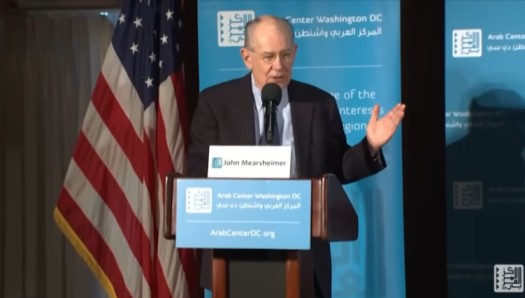
Editor’s Notes: In this compelling keynote address at the Arab Center Washington DC, Professor John J. Mearsheimer delivers a scathing critique of U.S. Middle East policy, focusing on the “growing propensity for genocide” in Gaza and Iran. Mearsheimer argues that the U.S. relationship with Israel has moved beyond strategic interests, leading to unconditional support and complicity in actions he describes as genocidal. He further analyzes the catastrophic failure of the U.S.-led war with Iran, which he characterizes as a “colossal blunder” driven by Israeli influence and President Trump’s desperate search for a decisive victory. Ultimately, Mearsheimer warns that the current trajectory is pushing the region toward an incredibly dangerous future, including the potential use of nuclear weapons. (April 10, 2026)
TRANSCRIPT:
Professor Mearsheimer’s Opening Remarks
JOHN MEARSHEIMER: Thank you, Khalil, for the kind introduction, and thank you to the Arab Center for inviting me to be here today. It’s a great honor. My only regret is that I only have a total of 45 minutes. I wish I had two hours and 45 minutes because I’d like to talk for at least an hour and take questions for at least an hour and 45 minutes.
Given the events of the day, or of the past few days, or maybe the past 40 days, I want to focus mainly on the Iran War. But I’d like to put my comments into a larger context. And I’d like to start by saying that when I was young and we thought about the Middle East, it was always emphasized that it is one of the three areas of the world that is of great strategic importance to the United States, in large part because that’s where the oil is located. The other two areas, of course, were Europe and East Asia, and those areas were important because other great powers were located there.
The Middle East was important because of oil, and what we wanted to make sure didn’t happen was that no one state, whether indigenous to the Middle East or from outside, controlled all of the oil. What’s happened over time is the oil issue has faded into the background because there’s really no threat of any country dominating all of the oil in the Middle East. So we don’t have to worry — we the United States — much about the Middle East because of oil.
And the reason we care greatly about the Middle East today, we care enormously about the Middle East, is because of our connection to Israel. And the fact is that Israel has a very special relationship with the United States that is unparalleled in history. It’s very important to understand this.
The US–Israel Relationship
The United States supports Israel unconditionally. The United States and Israel obviously have different national interests at particular points in time because no two countries have the same national interest all the time. But in cases where Israel’s national interest and America’s national interest diverge, the United States pursues what is in Israel’s national interest. And the reason, of course, is because of the power of the Israel lobby, which is just enormous.
I think most people realize that today. When Steve Walt and I wrote the original article in the London Review of Books in 2006, and then the book itself in 2007, I think most people thought that we were exaggerating. In fact, we were talking about the tip of the iceberg. And I think now people understand that. But it’s just very important to understand that our foreign policy in the Middle East is largely driven by Israel. And, of course, the key factor in making that happen is the lobby.
Israel’s Grand Strategy in the Region
So let’s just talk a bit now about what Israel’s goals are, sort of what Israel’s grand strategy is in the region. I think it has three parts to it.
One, they want to expand the borders. They want to create a greater Israel. This, of course, now includes the occupied territories, the West Bank and Gaza. But Israel’s ambitions go beyond that. They want to take southern Lebanon up to the Litani River. They want to take parts of southern Syria. I think they’d like to take the East Bank, if they could, and expand into the Sinai. They have a voracious appetite for expansion. That’s the first goal, to create a greater Israel.
The second goal is to ethnically cleanse the territory that they take. And here we’re talking at this point in time mainly about Gaza and the West Bank. As you all know, there are roughly as many Israeli Jews as there are Palestinians inside greater Israel today. And that’s a huge problem for the Israelis. The Israelis were willing to accept about 20% Palestinians. But when you’re in a situation where it’s about 50-50, that’s unacceptable. So the Israelis are deeply committed to ethnically cleansing.
And then the third goal has to do with their neighbors. What they want to do is make sure all their neighbors are as weak as possible. And this works in basically two ways. One is to have neighbors that are subservient to the United States. This is Egypt and Jordan, and I would argue even Lebanon to some extent. They want countries on their borders that the United States has huge coercive leverage over. And if that doesn’t work with the bigger countries, like the Syrians, the Iranians, the Turks, then they want to wreck those countries.
And in fact, what the Israelis are very interested in doing in Iran is wrecking Iran the way Syria was wrecked. They’d like to break it up into different pieces. Or if they can’t do that, they’d like to get regime change and get a regime in place in Iran that is subservient to the United States.
But those are the three principal goals, and it’s very important to understand that what was happening in Gaza, or what is happening in Gaza with the genocide, is the pursuit of goals number one and goals number two.
Creating a greater Israel that is ethnically pure.
And that’s what has led them to pursue ethnic cleansing, which has morphed into a genocide. But the case of Gaza is the first two goals at play. The case of Iran is the third goal at play. Again, the aim there is to break apart Iran or cause regime change. And if you look at Lebanon, Lebanon is really a case of the first two goals. They want to take the territory south of the Litani River, make it part of greater Israel, and they want to ethnically cleanse that area. You can see them hard at work in pursuit of that goal. So that’s the basic picture.
## Gaza: Ethnic Cleansing and the Path to Genocide
Let me say a few words about Gaza before I go to Iran. What happened in Gaza after October 7th is that the Israelis sought an opportunity to cleanse Gaza. The two big cleansings that had taken place before October 7th, as almost all of you know, took place in 1948 and 1967. And those two cleansings took place in the context of a war. And once you have a war, which is what you get after October 7th, the Israelis have an excellent opportunity to cleanse Gaza.
And they think that what they can do is they can use massive military power, air power mainly. They can punish the Palestinian population in Gaza to the point where it leaves Gaza. They can ethnically cleanse Gaza. And their hope is that the Egyptians and the Jordanians will accept the Palestinians because the Israelis will inflict so much punishment on them that how could the Egyptians and how could the Jordanians not accept them? That’s the basic logic that’s at play here.
But of course, the Palestinians don’t leave. They absorb the punishment. And what happens is that the bombing, the punishment campaign, morphs into a genocide campaign. And if you can’t drive out the Palestinians, then you kill them all. You murder them all. And you do that through bombing and you do that through starvation. And this, of course, is what happened. And this is why I think it is perfectly appropriate to describe what happened in Gaza as a genocide.
## Liberal Silence and U.S. Complicity in Genocide
I want to make one other point about that genocide, which has implications for what I’m going to say about Iran and moving forward. What is truly remarkable to me, as someone who is a realist, who has operated in a very liberal academic and intellectual environment in the United States for all of my life, is the extent to which liberals, dedicated liberals who profess to believe in human rights, said virtually nothing when this genocide was taking place.
And it’s not only because the Israelis were committing a genocide that I’m shocked, and people didn’t say anything. In a fundamental way, what shocked me even more was that the United States is complicit in the genocide. There’s just no question about this. If we had Nuremberg trials, we’re not going to have them. But if we had Nuremberg-like trials, Joe Biden and his principal lieutenants, and Donald Trump and his principal lieutenants, would be hanged. There’s no question in my mind about this.
We’re talking about a genocide. We know what happened to all those people who executed a genocide between 1941 and 1945 in Europe. They were hanged. I think the same thing would happen to Biden and his lieutenants, and Trump and his lieutenants. It’s really quite remarkable that hardly a word was said in the liberal establishment in the United States against what Israel was doing, and the United States was helping them to do. Committing genocide, the greatest of all crimes. Just truly remarkable, in my opinion.
And I used to say to myself, there’s something wrong here when a realist like me is one of the few people inside mainstream academia who is standing up and saying, this is terribly wrong and something should be done to stop it.
## Moving on to Iran
Moving on to Iran. Let’s talk about why we went into the war to start with. It’s quite clear that basically the Israelis bamboozled President Trump into starting this war.
I could tell from the beginning that the deep state was not in favor of this war. I know one or two people on the inside, and you could tell from what people were saying about General Kaine’s views in the mainstream media, that the deep state was not enthusiastic about this war.
And of course, we all knew, just having watched Prime Minister Netanyahu over the past 40 years, that he is deeply committed to attacking Iran with the United States and either creating regime change and producing a regime that dances to our tune, or wrecking the country. So we knew for sure that Netanyahu was pushing very hard.
The Deep State vs. the Push for War
And the New York Times has now written two big pieces on how the decision was made, and in my opinion, it’s unequivocally clear from those two articles that the deep state was not in favor of this war. There were all sorts of individuals who were telling President Trump — these are government officials at the highest level — who were telling President Trump, this is not a good idea, it’s probably not going to work. Kaine basically said, we don’t have a viable military strategy, and the National Intelligence Council produced a report that said it wasn’t going to work, and so forth and so on.
But what happened is that Mossad convinced both Prime Minister Netanyahu and President Trump that we could win a quick and decisive victory. You all know the story. What we do is we go in, we launch a shock and awe campaign, and we specially pay attention to decapitating the regime. And once we do that, the whole house of cards will tumble. And the reason that the whole house of cards will tumble is that the regime is built on sand. The foundation is very weak, and all you have to do is topple the leaders, and people will be able to rise up, overthrow the government, and we will get in place a new government that will basically surrender to us.
And it’s quite clear that Netanyahu himself and the head of Mossad, David Bornea, played a key role, the central role, in convincing President Trump that this would work, that this strategy, this shock and awe strategy built around decapitation, would produce a quick and decisive victory.
From Shock and Awe to War of Attrition
And we all know from the international relations literature, when you don’t produce a quick and decisive victory, that what happens is the war morphs into a war of attrition. And this, of course, is exactly what has happened in the case of Iran. We’re now in a war of attrition. And the fact is, we can’t win a war of attrition. It’s just not possible.
Let me just give you six points that illustrate that. Think about this very powerful Navy that we have, that President Trump talks about using to open the Straits of Hormuz. We can’t put that Navy anywhere near Iran, certainly anywhere near the Strait of Hormuz, for fear that it will get sunk to the bottom of the Jolly Roger by either Iranian cruise missiles or Iranian drones. You understand that the Navy is parked far away from Iran, and not, therefore, very useful.
Bases. We have 13 bases in the region, 13 major bases in the region. The New York Times has reported that of those 13 bases, all of them are either badly damaged or destroyed.
In terms of ground forces, a ground invasion, people in the media talk about 40,000 or 50,000 troops being located in the Middle East, and this implies that these are 40,000 or 50,000 combat troops. That’s simply not true. You need infantry divisions or marine brigades or whatever to wage combat, ground combat, against Iran. And President Trump has only recently moved 7,000 combat troops into the region. 7,000 combat troops. You can do hardly anything with 7,000 combat troops.
And if I walked you through all the scenarios where you might think about using those 7,000 combat troops, you would see that it’s not possible to win any kind of military victory with those small ground forces.
## The Cost of Escalation: Planes, Missiles, and Military Overstretch
In terms of aircraft, do you know that in this rescue operation, we lost more planes in one day than we’ve lost at any time since the Vietnam War? Just think about that. We lost more planes in a rescue operation that’s supposed to be a great victory than we’ve lost on any single day since the Vietnam War. And that was a long time ago, and we’ve fought a long list of wars since then.
And missiles and high-end munitions — you understand we’re running out of missiles and high-end munitions. This is catastrophic for trying to contain China. We were supposed to pivot to Asia. We’re pivoting away from Asia. We’re bringing THAAD missiles. We’re bringing Patriot missiles. We’re bringing this Marine Expeditionary Unit out of East Asia to deal with the problems we face in the Middle East. This is not the way you want to contain China. This is pivoting away from East Asia, as I said.
And then finally, we have no ability to defend our allies in the GCC. They’re being pounded by the Iranians.
## Iran Holds the Cards
That’s just the American side. The more interesting side is the Iranian side. They hold almost all the cards. They are in a really powerful position. By cutting off traffic through the Strait of Hormuz, they’re in a position to tank the global economy. Just think about that. The leverage that they have is enormous.
The consequences of what’s happened so far for the international economy are going to be devastating. The fertilizers — people don’t talk much about the fertilizers. They talk about the oil and gas. One-third of the world’s fertilizers come through the Strait of Hormuz. This is planting season in lots of countries. The consequences of all this down the road — many, many people are going to starve to death as a result of this crazy war.
But the Iranians, right, they have huge leverage over the world economy, and we of course understand that. Furthermore, they have huge leverage over the GCC states, those six countries. Why? Because they can destroy them as functioning societies. They can destroy their energy infrastructure, but more importantly, they can destroy their desalination plants. These are big, fat targets. Few in number. The Iranians have lots of very accurate missiles, and God knows how many drones. They can wreck those countries. This is a serious threat. That gives them huge leverage.
## Trump’s Predicament: No Way Up, No Way Out
So the basic problem that President Trump faces — this is the basic problem he faces — is he can’t go up the escalation ladder, because the Iranians can beat him on every rung. Because they have control of the Strait of Hormuz, and they have the ability to wreck the GCC countries, and by the way, do enormous damage to Israel as well. There’s a good reason that the Israelis are going to enormous lengths not to let us know what’s happening inside their society, in terms of hits from missiles, both ballistic missiles and cruise missiles. So you just want to understand that.
So we can’t go up the escalation ladder, and moreover, there’s no exit option here except admitting defeat. That’s the only way Trump can get out of this, is to basically admit defeat. You see what I’m saying here? You can’t go up the escalation ladder, and there’s no attractive exit option, and the Iranians are certainly not going to give him an attractive exit option.
If you’re playing their hand, you want to be incredibly hard nosed and ruthless with the United States and the Israelis. They are mortal enemies. You understand that from the Iranian point of view, we are an existential threat to them. So they have a deep-seated interest in driving a hard bargain, to put it mildly, and they have a lot of leverage. This is the predicament that Trump is in.
So this brings us to Monday. Monday morning, he issues this remarkable Truth Social post, where he says that if the Iranians don’t cave — in other words, if the Iranians don’t throw up their hands and surrender by nighttime — he’s going to destroy Iran as a civilization. He’s going to destroy it and make it impossible for Iran to come back from the dead.
This is a truly stunning statement. This is another example of genocidal language. Did anybody ever think that an American president would say something like that? I certainly didn’t. This isn’t the kind of language that you would expect from someone like Adolf Hitler, right? You’re going to exterminate this country called Iran, erase it from the planet, and make it so it can never come back? Sounds like a Carthaginian solution, doesn’t it?
Trump’s Desperation and Retreat
What’s going on here? You want to ask yourself. What’s going on here is Trump is desperate. He’s desperate because he understands the basic logic that I just laid out to you. We are playing a losing hand, and the consequences of continuing to play that hand are that the global economy will go off a cliff. It will do much more than destroy his presidency. The consequences would be enormous. He knows this. I’m sure he has people who are telling him that. He’s desperate.
So what does he say Monday morning? I’m going to turn to extermination. I’m going to turn to genocide. But then you want to think about what happens later that day, Monday evening. He backs off. And what does he do? He basically says, “I concede defeat.” It’s very important to understand that. He basically says, “I concede defeat.”
The Two Plans: A Study in Contrasts
Now, why am I saying this? First of all, there are two plans on the table. One is the 15-point plan. Those are our demands. That’s plan number one, the 15-point plan. And then there’s the Iranian plan. That’s the 10-point plan. And if you read them, it’s like the difference between night and day. If you read the 15-point plan, it has all the typical US and Israeli demands of Iran. And if you read the 10-point plan, the Iranian plan, it has all of their maximalist demands in it.
What President Trump says in his Truth Social post, where he basically says, “I surrender,” is he says that I accept the 10-point plan. He says that. He says it’s a solid basis, or a sound basis, or a good basis for moving forward. Wow, that’s really shocking.
The Tag Team’s Four Goals — All Failed
So let’s just look a little more carefully at what’s going on here. We went into the war — we meaning the United States and the Israelis. I like to call them the tag team. The tag team went into the war with four main goals. Number one was no more nuclear enrichment for Iran. Number two, they have to get rid of all their missiles, their long-range missiles, for sure, anything that threatens Israel. Number three, they have to stop supporting the Houthis, Hamas, and Hezbollah. And number four, regime change.
It’s very clear that regime change is the goal. Trump denies that. Others deny it from time to time, others in the administration. But all you have to do is look at the New York Times piece, and it’s manifestly clear that we were bent on regime change. That’s what David Barnea and Benjamin Netanyahu were talking about, and President Trump. There’s no question about that. And you want to remember, President Trump talked about unconditional surrender. This is regime change. So regime change was one of the four principal goals.
We have failed at every one of those goals. We’re not getting rid of Iranian missiles. We’re not getting rid of their nuclear enrichment capability. In fact, their great fear is that they’re going to get nuclear weapons, right? And in terms of supporting Hezbollah, the Houthis, and Hamas, there’s been no change on that dimension. The Iranians and Hezbollah are actually working together, dealing with the situation in southern Lebanon and northern Israel.
And with regard to the Houthis, one of our great fears is that the Houthis in cahoots with the Iranians will shut down the strait at the end of the Red Sea and then there’ll be no traffic at the Red Sea as well as that of the Persian Gulf. This would be really disastrous, right? And we haven’t gotten regime change. None of the four goals have been achieved. And furthermore, the Houthis are now in charge of the Strait of Hormuz. On February 27th, they were not in charge of the Strait of Hormuz. They were not threatening to throttle the world economy. They now control the Strait of Hormuz. And they would be out of their minds to give up that control.
So I think for as far as the eye can see, Iran is going to be in control of the strait. This is disastrous for the United States. It’s just disastrous. Furthermore, if you look at those Houthi demands, they want the sanctions lifted, right? They want U.S. bases out of the region. Now who knows what the final agreement is going to look like. But if they get any of those demands, this is a shocking defeat for the United States. You just want to understand that. Because as I said to you, the only exit option here, the only exit option was to accept defeat. Exactly what the defeat looks like, not easy to say at this point, but it is a clear defeat.
The Cataclysmic Consequences for Israel
I want to switch gears and talk about the Israelis. I think for the Israelis, this whole situation, it borders on cataclysmic. First of all, they believe, the Israeli people believe, and certainly Prime Minister Netanyahu believes that Iran is an existential threat that is committed to wiping them from the face of the earth. I don’t believe that, but that doesn’t matter because what I believe is largely irrelevant. It’s what they believe. They believe that.
As you all know, for Prime Minister Netanyahu, Iran is his Moby Dick, right? And he has lost this war. Iran is stronger than ever. Furthermore, Iran is still in a position where it can support Hamas, Hezbollah, and the Houthis. Furthermore, this has done enormous damage to U.S.-Israeli relations. That New York Times story the other day is guaranteed to make it clear to huge numbers of Americans that the Israelis led us by the nose into this war, and there were all sorts of people in the national security establishment who were flashing orange lights, if not a red light. But why did we go? Because the Israelis convinced President Trump that it was a good idea, that they had a workable strategy. This is disastrous for Israel.
A Shift in U.S.-Israeli Relations and Public Opinion
And furthermore, if you look at what’s happening to public opinion in the United States regarding the state of Israel, and regarding our relationship with Israel, and regarding the lobby, what’s happening — for me, as someone who wrote the Israel lobby article and book in 2006–2007, I find it hard to believe that this has all happened. I never thought that as long as I remained on the planet, I would see a situation that looked like the one we’re in today in terms of U.S.-Israeli relations and the lobby situation here in the United States. So I think Israel is in truly deep trouble, truly deep trouble.
What happened on February 28th, from our point of view, and from the world’s point of view, because of the economic consequences of all this, but also from Israel’s point of view, this was a colossal blunder. You just cannot underestimate what a colossal blunder it was for the United States and Israel to go to war on February 28th. It has backfired in a profound way.
The Threat of Nuclear Escalation
Brings me to my final point. This all raises the serious possibility that somewhere down the road, the Israelis will use nuclear weapons against Iran. I am very worried about that. As I said to you before, the Israelis worry greatly about Iran.
They think it’s an existential threat, and their greatest fear is that Iran will acquire nuclear weapons, and I think if the Israelis even suspect that Iran is pursuing nuclear weapons, that they will use nuclear weapons to prevent Iran from acquiring a nuclear deterrent, because it’s now clear that Israel cannot prevent Iran from acquiring nuclear weapons using its own conventional forces. It doesn’t work. The only option they have is nuclear weapons, and I believe the Israelis would use nuclear weapons in that situation.
Now you might say to yourself, well, the United States would stop that from happening. The United States will not stop that from happening. The United States is complicit in the genocide in Gaza. President Trump’s first reaction on Monday when he was in desperate straits was to threaten genocide himself against Iran, and furthermore, just given the power of the lobby in the United States, it’s extremely unlikely that we will stop Israel from using nuclear weapons against Iran.
So my final two points to you are this. Number one, this all shows that Israel is an albatross around America’s neck, an argument I’ve long made, and number two, the years ahead in the Middle East are going to be extremely dangerous because of the situation that I just described. Thank you.
## Q&A
MODERATOR: Thank you, Professor Mearsheimer, and particularly for willing to entertain a couple of questions after this great presentation. Let me begin while we’re waiting for some more questions to come this way, ask you about the impact of this war on the GCC countries, the so-called Arab allies of the United States. How long do you believe these countries are going to take or need to recover from the damage done over the past month?
Impact on GCC Countries and the Global Order
PROFESSOR JOHN J. MEARSHEIMER: Well, with regard to how much damage is done, it is possible that the ceasefire will break down and we will go back to fighting and even more damage will be done to the GCC countries. So the question here, the answer to the question here depends on how long this war goes on and how much damage is done. Most people say, I mean, I’m not an expert on this, and furthermore, it’s hard to tell exactly how much damage has been done because there’s so much propaganda taking place. But most people seem to think that it will take a good five years at least to undo all the damage that’s been done and to return to a situation that approximates the status quo ante. So I think it’s going to take a number of years and I think in the meantime that’s going to have serious negative consequences on the global economy.
And I think one of the really interesting questions is what is the diplomatic or alliance structure likely to look like once the war ends? In other words, are the GCC countries going to abandon their close relationship with the United States given what the United States has done to them?
My sense at a general level is that countries all over the world are thinking about how to change their relationship with the United States. If I’m an East Asian ally like South Korea or Japan and I see that the United States moved all these critical resources out of East Asia to deal with a problem in the Middle East, I begin to wonder whether or not the American security umbrella, which is over my head, the American nuclear umbrella, which is over my head, is reliable. So I think it will have huge consequences there.
The Europeans, I mean Trump continues to beat the Europeans over the head for no purpose. It just seems to me that they’re very close to the point where they’re finally going to get some spine or some backbone and stand up to the Americans and understand that they just can’t rely on the United States anymore. The Gulf states are in a similar situation, right? They didn’t decide…
to start this war, in my opinion, the United States brought this war down on them and their countries are being wrecked or at least they’re being seriously damaged and run the risk of being wrecked. I think that would be better language. So the question is what are those states going to do once the war ends?
I think they’re going to go to great lengths to try and distance themselves from the United States as much as possible. Number two, they’re going to go to great lengths to be nice to the Iranians because they don’t want to do this again, but the big problem that they face is that they have no alternative alliance partner at this point in time. Maybe down the road that will be China and they can turn to China for help, but they’re between a rock and a hard place. It’s hard for them to walk away from the United States, but the problem is every state on the planet outside of the United States knows now being close to the United States gets you in trouble.
As Henry Kissinger likes to say, there’s only one thing that’s, or he liked to it as he used to say, there’s only one thing worse than being an adversary of the United States and that’s being an ally of the United States.
Q&A: Implications for NATO, Trump, and the Transatlantic Relationship
MODERATOR: We got actually a few minutes, less than eight minutes to answer about, what, 50 questions that you guys have sent, so I really thank you for your interest and for all your questions, but I apologize for not being able to squeeze all of them, but briefly you have a question from Dimitri Kersanov of TASS. What are the implications of the Iran conflict with NATO going forward?
PROFESSOR JOHN J. MEARSHEIMER: As I said, I think the consequences of the Iran war coupled with everything that happened before that regarding Greenland and Ukraine spells doom for the transatlantic relationship. President Trump has almost three more years left in office and he’s like a bull in a china shop. Nobody, I assume, has any doubts about that at this point in time and you also understand that President Trump has now got to figure out who to blame for this fiasco because President Trump never accepts responsibility for anything foolish that he does. It always has to be somebody else’s fault and I bet he’s going to blame Prime Minister Netanyahu. I bet he’s going to blame his NATO allies for not rescuing him at the appropriate moment. He’s already begun to spin this story that we could have won this war had the Europeans sent their navies to help open the strait. I mean, this is a ludicrous argument, but that’s what’s going on here.
So I anticipate that US-European relations, which are now poisonous, will get even more poisonous. And by the way, this will have huge consequences for the Ukraine war working in Russia’s favor, I would add.
Why Didn’t Trump’s Advisers Stop the Iran War?
Why didn’t Trump advisers warn him that the Iran war would jeopardize the containment of China? Well, I would make a couple points. One is they effectively did warn him. The New York Times makes that clear. They told him that this was not likely to work. This was not a good idea. The problem with Trump is he didn’t dig down and ask them why they were doubtful about the likelihood of success and study the problem himself and figure out why it was unlikely to succeed.
What I find truly remarkable about this is we have a rich scholarly literature that is easily accessible to anybody with a college degree. I would argue anyone with a high school degree that tells you that using air power alone to produce regime change doesn’t work. We have a whole literature on the subject of regime change, leave out the air power dimension, that tells you how hard it is to do regime change and how often it backfires. The idea that this strategy was going to work, I don’t know how anybody could possibly believe it.
The Decision-Making Process and the Rationality of War
And remember I told you that David Barnea, who is the key person in Mossad, who convinced Netanyahu and Trump that we had this winning strategy. Barnea’s predecessor, I think his name was Yossi Cohen. He was the previous head of Mossad. He thought this was a cockamamie idea, quite correctly. But Barnea turned it around 180 degrees and said that it would work. So there was just a huge amount of evidence that this wouldn’t work.
As best I can tell, except for maybe Pete Hegseth, there was nobody who was in the inner circle who was arguing that this is a good idea. All of them had major league doubts.
Final point I’d make to you is Trump is such a powerful personality and he’s so difficult to be honest with that I don’t think that people went all the way and fully expressed their doubts. They expressed their doubts. But you’ve seen the pictures of his cabinet meetings where they go around the table and everybody licks his boots. You’ve seen this, right? That’s what you have to do when you’re dealing with this guy. And that’s not what you want in these kind of situations.
I mean, I’ve thought long and hard about this over the years, about what a proper decision-making process looks like. Sebastian Rosado and I wrote about this in the book *How States Think*. And when you’re in charge, when you’re the president, you know, you’re President Kennedy, it’s the Cuban Missile Crisis. You want to hear what everybody has to say. And you want to let them express their full opinions. Because when you go to war, you are rolling the dice. You just want to understand that.
And that applies whether you’re a communist country like the Soviet Union thinking about invading Czechoslovakia in 1968, or you’re JFK thinking about how to deal with the Cuban Missile Crisis, or if you’re Donald Trump thinking about rolling the dice and going to war against Iran. You better think long and hard about how this is going to play out. It’s the Clausewitzian logic tells you that war is a crapshoot. He should have understood that. And he should have had advisors who were fully upfront with him about what the likelihood of success was, what the potential costs were, and so forth and so on. But it’s very hard to do that with Donald Trump because of his commanding personality.
MODERATOR: Related to that, Professor Mearsheimer, Sina Azodi asks, with regards to your latest book, *Rationality of States*, was this war rational at all, from your perspective?
PROFESSOR JOHN J. MEARSHEIMER: I’ll answer that with one word, no.
MODERATOR: Ladies and gentlemen, please join me in thanking Professor Mearsheimer. Thank you.
Related Posts