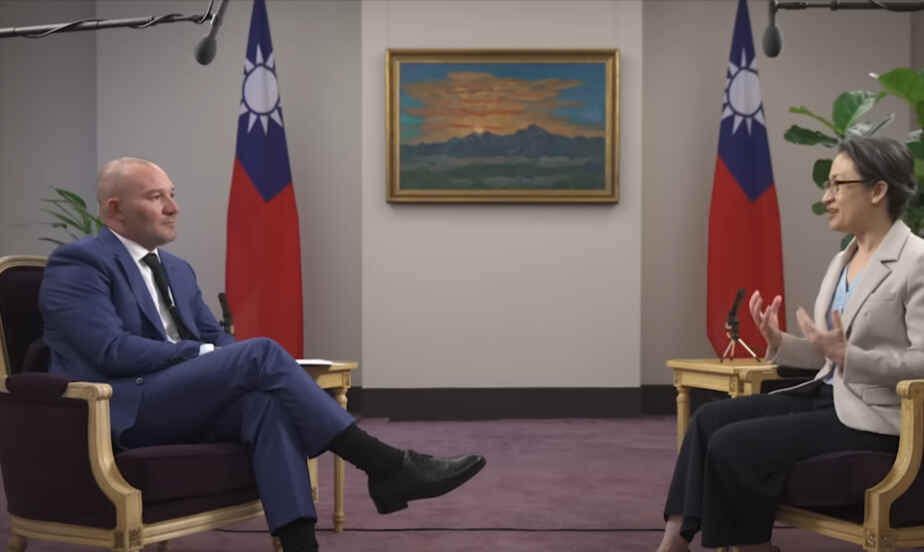
Read the full transcript of Vice President of Taiwan Hsiao Bi-khim’s interview on Shawn Ryan Show Podcast (SRS #210), June 19, 2025.
Welcome and Introduction
SHAWN RYAN: Hsiao Bi-khim, welcome to the show.
HSIAO BI-KHIM: Thank you, and welcome to Taiwan.
SHAWN RYAN: It’s an honor to be here. And I just want to say before we start, thank you so much for the hospitality. You have treated me and my team extremely well. We’ve learned so much in the couple of days that we’ve been here, and I just want to say that I have been following this situation for many years, and this has been my number one interview that I’ve wanted to do, and it’s an honor. So thank you for hosting us.
HSIAO BI-KHIM: Yes. Well, hospitality is an important part of our culture, and we’re always eager to welcome friends and eager to foster opportunities for better understanding. So I’m really glad that you’ve come out all this way to do this interview, and it really demonstrates a very strong interest and commitment to a partnership and friendship between our peoples.
SHAWN RYAN: Thank you. Well, I think that I believe that this is the most delicate situation in the entire world right now, and I would just like to bring exposure and be able to get your story out there for everybody to hear. And so before we start, everybody gets a gift.
HSIAO BI-KHIM: Yes. Oh, yeah. Gummy Bears.
SHAWN RYAN: Gummy Bears.
HSIAO BI-KHIM: Thank you.
SHAWN RYAN: Made in the USA, Vigilance Elite. Made in Michigan. So I hope you enjoy them.
HSIAO BI-KHIM: Thank you, Lake Michigan. Thank you. Thank you.
SHAWN RYAN: You’re welcome. So I’ll start off with an introduction here.
HSIAO BI-KHIM: So do I give my present to you, too?
SHAWN RYAN: Oh, we can wait.
HSIAO BI-KHIM: Okay. We can wait on that. Yes. Thank you.
Background and Credentials
SHAWN RYAN: Hsiao Bi-khim, Vice President of Taiwan. The 13th and current vice president of the Republic of China, Taiwan. You have a Taiwanese father and an American mother. Born in Japan, you grew up in Tainan, Taiwan, and later in New Jersey. Degrees from both Oberlin College and Columbia University, equipping you with a unique perspective on Taiwan’s role in the world.
Served as Taiwan’s representative to the United States from 2020 to 2023, strengthening Taiwan-US ties during a critical period of heightened tensions with China. A trailblazer who made history by attending President Joe Biden’s 2021 inauguration, the first time a Taiwanese representative was officially invited since the US severed diplomatic ties with Taiwan in 1979, stating “democracy is our common language and freedom is our common objective.”
A target of Chinese sanctions, blacklisted by Beijing in 2022 and 2023 for your alleged support of Taiwanese independence, reflecting your pivotal role in Taiwan’s resistance to Chinese pressure. And once again, I just want to say that I do believe and my entire team believes this is the most delicate and fragile situation in the entire world. So it is an honor to be here.
And I’d like to start with Taiwan makes world renowned semiconductors and it runs the entire modern world. And I would just like to get your perspective on how Taiwan was able to do that.
Taiwan’s Semiconductor Industry Success
HSIAO BI-KHIM: Well, in the technology sector and specifically on the chips, it took us decades to build this particular capability. And it involves not only the chip making fabs which Taiwanese are also now investing in the United States to make them in the States, but an ecosystem of hundreds and thousands of small and medium sized companies, from the designers to the chemical suppliers, to the machine tools, the entire ecosystem that is within a compact geographic region of the island called Taiwan.
And the logistics coordination, the integration of this ecosystem has functioned and grown in a way that is extremely efficient. So Taiwan has been able to produce not only the high end, most advanced chips, but we have been able to do that in a cost effective, efficient and reliable way. And I want to emphasize the word reliability because I think in technology, especially technology that empowers everything from AI to our phones, home electronics that involve privacy and confidence, trust and reliability are very important.
And so I think Taiwan has managed to integrate that cost efficiency, a comprehensive ecosystem as well as trust and reliability that comes with our cherished value of freedom together to make Taiwan a very critical part of the global technology supply chain.
But we do have to give credit to a number of leaders in this industry, of course, for their foresight. For example, Dr. Morris Chang, who’s now in his 90s. I have great admiration for him for his foresight and vision in understanding how to run a business. He came from the United States, he was part of Texas Instruments. And he came with expertise from a very good American education and really put into this industry along with many other leading Taiwanese scientists who were also educated and trained in the United States and built this industry.
Here in Taiwan, we see this as not only a Taiwan ecosystem, but broadly speaking, a Taiwan-USA ecosystem of advanced technology that serves to power human advances, that serves to protect our freedom, that serves to continue with global scientific discoveries. This ecosystem is so important to the extent that the G7 and other countries have repeatedly emphasized that Taiwan plays a critical role in fostering global stability and prosperity.
The Critical Role of Semiconductors
SHAWN RYAN: I mean, Taiwan produces 60% of all chips in the world and 95% of all the high end chips. I mean, can you elaborate a little bit on just for the audience that doesn’t understand the importance of how much of society has run off these chips?
HSIAO BI-KHIM: Well, you know, chips power everything from your smartwatches on you to your phones, to your cars, all the electronic equipment around you, microphones. And so, you know, chips really power and connect the modern world. And Taiwan chips, especially the advanced chips that are now widely used in smartphones, are also critically important for making those global connections, enabling the Internet, enabling AI. And we will continue to contribute in a way that helps to advance technology.
SHAWN RYAN: And a lot of defense tech as well.
HSIAO BI-KHIM: Oh, for sure, yes.
Strategic Maritime Trade Routes
SHAWN RYAN: How much trade goes through the strait?
HSIAO BI-KHIM: There have been estimates of somewhere between 20 to 50% of maritime, the value of global maritime trade.
SHAWN RYAN: 20 to 50%?
HSIAO BI-KHIM: Yes, yes. Well, U.S. government officials have been talking about 50% of global maritime trade. And if we look at container value and other shipping records, it’s at least 20% and beyond. Taiwan Strait, if you look at the world map, is right at the center of the Western Pacific in a growing region with growing economic weight in the world, not only in terms of manufacturing production, but also in importing high value energy and other goods from around the world.
And so in terms of maritime trade, Taiwan also sits right at the center at a pivot of how the global economic system could truly function. You look at the global map, there are some points, for example, the Suez Canal, the Red Sea, the Taiwan Strait, really key locations where if compromised, if the freedom of navigation is compromised, would have a dramatic impact on the global economy.
Economic Diversification Strategy
SHAWN RYAN: And I have 2.5 trillion in trade running through the strait. And with so much geopolitical turbulence, how are you maintaining or even deepening trade relations with key partners around the world?
HSIAO BI-KHIM: You know, we are indeed in a very complicated geopolitical environment and we seek to balance that concern and anxiety about geopolitics with a continuing confidence that supports good business and investments. Taiwan, we’re a relatively small island. We are heavily dependent on global trade as well as our connections with the rest of the world. And we plan on deepening that, diversifying that.
Over 10 years ago, over a decade ago, Taiwan’s economy was much more integrated with the Chinese economy. Over 80% of outbound investments went to China. But our government has called for diversification. That is, we cannot be vulnerable to putting all our eggs in one big basket. We need to consolidate partners with other like minded democracies.
And so those figures have been through very dramatic transformations, including more engagements with the Southeast Asian, significant investments in the United States. And now the United States has become one of our top investment destinations, especially in the area of high tech. A very big Taiwanese company, TSMC, which produces chips, has already made a $165 billion commitment to investments in the United States. And that is the largest greenfield investment from a foreign country in American history.
So that is a very meaningful contribution. You know, think about this. We’re a small country, but we are making the largest single greenfield investment in American history. And that will contribute to technology resilience, to the diversification of supply chains. And we do want to deepen those ties. You know, we Taiwanese have benefited from American innovation, research, design, development, and we also depend on the American market. So we do want to be well integrated with reliable and trusted partners. From the economic perspective, it’s my understanding.
Diplomatic Recognition Challenges
SHAWN RYAN: That there are only 11 countries plus the Vatican that verbally, outright say that they stand with Taiwan. It’s also my understanding that China has been sort of picking these off one by one by influx of money. How specifically are they doing that?
HSIAO BI-KHIM: Well, it’s an unfortunate situation that only 11 countries recognize Taiwan in a diplomatic context. And we lost Honduras a couple years ago. They made all kinds of claims such as a huge Chinese market buying more goods from Honduras. But I think the Hondurans have discovered that instead of making more money off the Chinese market, the Chinese trade surplus over Honduras has only widened. And some of their export markets are running into some significant challenges.
But I think the Chinese tend to use multiple tools of coercion, plus economic incentives or promises that they may or may not keep. Once countries switch their allegiance or diplomatic ties, we want to keep these partners standing with Taiwan. In the Americas, in Latin America, our sole partner is Paraguay. In Central America, it’s Guatemala, Belize and a few Caribbean islands who still recognize and stand with Taiwan. And we want to work with them on economic partnerships, on public health, on empowering small medium sized enterprises, on continuing growth. But we also count on the United States and others to also stand with our friends and our partners.
The Need for International Support
SHAWN RYAN: I mean, with the fact that Taiwan produces 95% of all of the high end semiconductors, I don’t understand why more countries don’t verbally come out and say that they stand with Taiwan. I mean, the repercussions if China were to invade and take those chip factories would be detrimental to the entire world. And so what will it take to get more countries to verbally come out and say that they stand with Taiwan?
HSIAO BI-KHIM: Well, besides those who have diplomatic ties with Taiwan, a larger number of countries, most of them democratic and freedom loving countries, have come out to support Taiwan’s meaningful participation in international organizations. They have also highlighted the importance of peace and stability in the Taiwan Strait.
The United States, for example, we don’t have formal diplomatic ties. However, through the Taiwan Relations Act, the US continues to help Taiwan fortify our ability to defend ourselves, including through the sale of defense articles and other initiatives supported by the National Defense Authorization Act.
Other countries around the world, especially in our own neighborhood, the Japanese, the Filipinos, for example, are also facing a heightened degree of coercion from the People’s Republic of China through their activities in the South China Sea, through military drills. Much more intensified military presence in this region are also posing potential threats to our other partners in this neighborhood. Now, the Chinese military presence has gone as far as Australia and close to New Zealand in the Tasman Sea. Their intentions obviously do not stop with Taiwan.
I think it’s all the more important that there is a greater degree of understanding this, but also in working together to fortify our defenses. We in Taiwan believe in sustaining peace through strength. We are all peace loving people. We certainly do not want to see conflict. We will do everything we can to prevent a war or conflict from happening, but Taiwan alone will not be enough to deter the aggression. And we do need to work to further establish partnerships that will support the deterrence against a conflict.
Taiwan-US Economic Relations and Defense Cooperation
SHAWN RYAN: I spoke with a few gentlemen and a woman yesterday at the Foreign Affairs Ministry of Foreign affairs and the subject of tariffs came up and so it’s my understanding that Taiwan was the first one to come to the negotiating table with President Trump to come to a resolution. And on top of that, on top of those tariffs, the subject of Ukraine came up that Taiwan wanted to help fund Ukraine in their defense against Russia and that they had denied aid. Why did they deny aid?
HSIAO BI-KHIM: Well, first let me talk about the tariffs. As I said in the outset, Taiwan US Economies are very important to each other. This partnership has enabled Taiwan to grow in strength. It has also allowed Taiwanese companies to support growth and profit in the United States. It’s an ecosystem that benefits both of our societies.
So we are hoping to reach an arrangement with the current administration on a significant reduction of tariffs and other non tariff barriers, as well as supporting some new investment projects such as in the area of semiconductor chips, but also in energy and acquisitions. So we are in the process of trying to work that out and hope that we will have a good arrangement that provides a win win situation.
We understand how many Americans are pursuing a greatness in re industrialization and in AI and we in Taiwan want to be strong as well. And it’s important that Taiwan is a strong nation. I think that is ultimately a goal that works for both of our societies. On the economic and trade front.
Taiwan’s Response to the Ukraine Conflict
In terms of the European situation, like many countries around the world, the Ukrainian government has been rather cautious about any interactions with Taiwan. But the Taiwanese people in general have been sympathetic to the victims of invasion and war. And that’s why we have provided humanitarian aid and support. From a humanitarian perspective, we’ve had medical teams and other NGOs expressing our sympathies.
But at the same time, I think the conflict there teaches us many lessons. First of all, it is a wake up call to many people here that as much as we love and want to protect peace, we cannot take peace for granted. We have to do more to prevent that type of conflict from happening in our part of the world and on our island. And so we do need to invest more in our defenses.
And we not only it’s not only in terms of spending the amounts, but it’s about investing in the right areas. I think another lesson from the Ukraine experience is the asymmetry in that theater. And so we do need to invest in more smart technologies. Drones and unmanned systems are widely used in that theater. I watched part of your interview with Dina Mavrukas on Saronic unmanned surface vessels and we need to look at more robotics unmanned systems on all fronts.
We also need to be adopting artificial intelligence and integrating our sensors and data fusion. So we have a lot of work to do. And this is really a new era of self defense.
And I think a third thing that we have learned from the Ukrainians is the need for much more decentralized command control and to support more small unit autonomy and decision making and to be much more nimble and flexible. Our military has for decades been trained in a very traditional way and we need to quickly adapt to new requirements. And so a lot of reforms are going on.
Military Service Reform
Our president has actually, the former president started this process, but we are carrying it through that is expanding our conscript training period. Every young man in Taiwan has to serve a mandatory one year military training requirement. We need to make sure that that is not just one year from every young Taiwanese man’s youth, but one meaningful year. Quality training, adequate training. And I think that will also foster stronger capabilities and the will within our society and confidence in our society, in our resilience.
SHAWN RYAN: Was that recently implemented?
HSIAO BI-KHIM: Yes, that was recently implemented.
SHAWN RYAN: How was the response from the Taiwanese people?
HSIAO BI-KHIM: Well, politically it was not easy because we started the implementation right around our election time. And when you mandate every citizen extra duties, that is never an easy political decision. But it is something that we knew we had to do given the geopolitical uncertainties and threats in order to ensure that peace can prevail, that we can sustain peace through strengthening ourselves.
We knew it was difficult, but a necessary decision. I think it’s upon us to ensure that that extended training is meaningful, that they do get the quality training part of our partnership with the United States as we acquire more modern systems, how to use those systems and how to operate in a rapidly changing environment. Continuing these discussions is also very important.
Chinese Military Presence and Gray Zone Threats
SHAWN RYAN: Let’s move to Taiwan, China relations. A week ago we saw 70 ships, 70 Chinese ships move into the strait. And I believe it was yesterday. Two carriers went farther out into the Pacific. And so what is the sentiment of the Taiwanese people when these kind of things happen?
HSIAO BI-KHIM: Unfortunately, that has become a daily reality. Something that is part of our lives. That’s something that we’ve been forced to live with, although completely undesirable. But I think over the years this is. It’s something that is not new to the Taiwanese people.
In fact, when we were having our first ever presidential election in 1996, after 37 years of martial law and one party dictatorship, we finally for the first time could vote and elect our own leader. And the Chinese responded to that with missile firing, missiles and military drills. And so they’ve been doing this repeatedly over the years and unfortunately, intensified recently.
So that is another reason why, again, we cannot take the status quo for granted, that we have to invest more in our defense. We have to do more to make our society resilient. And part of that military presence, and not only the naval presence, but the air incursions into the surrounding air defense identification zone has also become a significant problem.
And we see that as part of what we call the gray zone threats, that is, between peace and war. There is a gray zone where they are using many different types of hybrid tools to threaten and coerce our society into submission. And the military measures are part of that. But there are also many other steps they are taking, such as cognitive warfare through disinformation, political intervention in our society.
They are also using economic trade tools as another leverage for coercing members of our business community and other foreign countries, threatening them from having ties or relations with Taiwan by using that economic leverage. And so they are doing a lot.
Whole of Society Defense Initiative
And in response, we’ve talked a lot about Taiwan’s own military investments and our preparedness. But I also want to raise another very important initiative of our president, and that is a whole of society defense and resilience project. That is, we see our country’s security as not only in military terms, but in societal resilience terms.
That is, we need communications resilience because our undersea cables have been damaged and cut by Chinese vessels recently. And to ensure that we can continue to communicate with the rest of the world. Our data, our comms. So communications resilience, cybersecurity. Our society is one of the most attacked societies in the world in terms of cyberspace, defending our critical infrastructure, our power, our energy, our transportation lines, the security of our financial system.
Also, thinking about stockpiling as an island, we need to think about stockpiling critical food, security items and medical supplies. Of course, energy resilience is a continuing challenge for us that we are working on. So we have many lines of efforts going on at the same time to further magnify our strength, our resilience in coping with all of these daily challenges, including the presence of Chinese naval assets around Taiwan.
But let me also again raise that it’s not only around Taiwan. They are all over the South China Sea. They’re to the north, around Japan. There have also been air incursions into Japanese airspace. There have been maritime incursions. And this is a challenge that many of us face. How to ensure the freedom of navigation, because that is foundational to global trade. It’s foundational to keeping global prosperity and supply chains affecting flowing.
Innovation in Defense Technology
SHAWN RYAN: I’d like to, if it’s okay with you, I’d like to dive into each one of those sectors. And let’s start with. You had mentioned innovating defense tech and you had brought up Saronic. It’s not my opinion. Warfare is changing at an extremely rapid pace with technological advancements. And we have companies like Palantir, Anduril, Saronic. There’s, there’s a lot of new generation defense tech companies that are extremely innovative. And I’m just curious, have you spoken to any of those companies, those U.S. based defense tech companies that are true innovators?
Defense Technology and Innovation Challenges
HSIAO BI-KHIM: Yes. Well, a few years ago when I was posted to represent Taiwan in Washington D.C. I had some opportunities to engage with the U.S. defense tech community. And in fact I’ve been involved in conversations on bridging the hill and the valley that is Silicon Valley and Capitol Hill. But I think broadly speaking, the defense community and new tech. I think a lot of the discrepancies or gaps that Americans are trying to bridge are also challenges for us.
That is, historically our defense establishment has their way of doing things and their way of the pace at which acquisitions are made or decisions are made. But that pace doesn’t meet the urgent requirements of fortifying our defenses. For example, we have made requests for some foreign military sales from the United States which your government has also approved. But it is taking forever to deliver those articles of defense and supply chain issues, production issues, regulatory issues, all of these are challenges that need to be overcome.
In the meantime, there are some new innovations. Some of them are commercially based, some of them are dual use. Some of them could expedite this process. Some of them can dive into the manufacturing process to make significant reforms to modularize some of our acquisitions. And so I think we take this seriously. And we are also looking at ways to not only partner with American tech, but also build and fortify indigenous capabilities.
Here we again learning from theaters elsewhere. Having an indigenous capability to innovate and build what is needed in our society is also very important. But we also need to bridge that gap between traditional defense apparatus as well as all of the capabilities and innovations of our own private sector.
China’s Artificial Islands and Military Expansion
SHAWN RYAN: I would like to talk about the artificial islands that China continues to construct off its shores. And can you talk a little bit about those islands? It seems like they’re trying to push the borders out farther and farther.
HSIAO BI-KHIM: Yes, well, over a decade ago, China claimed that, you know, they were only providing bases for resupplying fishing boats and for completely humanitarian purposes. But we see that now they are not only building artificial islands, but they are also militarizing them. And that is generating tremendous anxiety, I think, in our own neighborhood, among other Southeast Asian countries.
I think that certainly demonstrates my point that their expansionist intentions are not limited to Taiwan. They have broader global ambitions in changing the rules based order, or the rules as we know it. And some of those rules involve the freedom of navigation. And freedom of navigation, again, is foundational to global trade, especially maritime trade.
This is quite an alarming evolution. And if China gets its way in terms of setting the rules for international behavior, advancing their system of governance to other parts of this world, obviously we have a very different idea of how the world should be run. We have a very different idea of how individual freedoms as well as the role of the state, and this is an ongoing balance that we have to ensure to protect our freedoms.
SHAWN RYAN: What kind of militaristic capabilities have you seen on those islands?
HSIAO BI-KHIM: Well, they are projecting their naval capabilities certainly beyond the immediate coastal area of China. And it’s not only on those artificial islands they are building, but they are projecting their military capabilities even to the Middle East, the Red Sea, Djibouti, they’re building bases elsewhere around the world. And I think those also have some strategic consequences.
The projection of their power, I think in the South China Sea specifically has to do with their establishing or denying access to others in whether they are Taiwan contingencies or other security contingencies in this region. Those deployments, such posturing goes way beyond the immediate vicinity of Taiwan.
Cognitive Warfare and Disinformation Campaigns
SHAWN RYAN: Yeah, I mean, we see them buying farmland in the U.S. settling all kinds of different areas in Africa with the Belt and Road initiative, and buying land next to our military bases. And it’s taken a long time for the US to wake up to that. But let’s talk about cognitive warfare and disinformation. We spent some time at a nonprofit organization that combats disinformation and cognitive warfare. And so I wanted to ask you, how are they doing that?
HSIAO BI-KHIM: Well, you know, spreading disinformation is not unique to Taiwan. It’s a global issue. But the Chinese Communist Party is extremely aggressive at doing that, providing narratives and different stories and kind of amplifying their government propaganda and trying to internalize that in our society.
And some main themes of their current wave of disinformation are aimed at discrediting the institution of Taiwan’s democratic government. They are trying to sow divisions in our society, to sow doubts in our society about the strength of our own democracy. So the themes involve, I think three main points.
They are targeting our partnership with the United States. All of the Chinese propaganda that we are seeing right now is saying the US is not reliable, United States can’t be trusted, that this is a very weak partnership, that America is arming Taiwan not for the purpose of defending Taiwan, but to make Taiwan cannon fodder for the global competition with China. I mean, that is the theme of Chinese propaganda on the US side.
The second part involves doubting our own military and our capabilities and really putting us down and promoting Chinese technologies and their military capabilities. The third theme around their propaganda involves attacking this government. They have refused to dialogue diplomatically, but dialogue in a civil way with the democratically elected government of Taiwan and instead chosen to sow disinformation, really attempting to not only discredit, but to attack the legitimacy of this government.
And so around those three themes, they have multiple tools and spreading and to try to get their message around in our society. And to counter that, of course, we have many civic organizations. The government isn’t always the most trusted institution, but fortunately we have a very robust civil society and concerned citizens who are also shouldering responsibilities and countering such disinformation through media literacy.
There are a lot of media literacy campaigns. And as far as our government is concerned, we also have a rapid response requirement. That is, whenever there is disinformation related to the government or our services, we have to demand a very quick response. Some of that involves even supply chains in our country, the prices of availability of eggs or vaccines or other issues. And we just need to set the record straight.
And so having mechanisms in which we can quickly respond to such disinformation, but also educating and empowering our citizens to be much more critical of the propaganda they see at face value and to be much more literate analyzing and dissecting information. I think all of that is also very important and ongoing.
Methods of Propaganda Distribution
SHAWN RYAN: What mechanisms are most effective for utilizing their propaganda and their disinformation?
HSIAO BI-KHIM: For utilizing it or for countering for.
SHAWN RYAN: Them to utilize it? Is it social media?
HSIAO BI-KHIM: Well, they are taking advantage of our very open and free media environment. Taiwan is a free society. We cherish the freedom of speech, the freedom of the media, and China is taking advantage of that. So they are widely using social media platforms to amplify their messages.
They are also actively targeting civic groups. They selectively invite groups, fees paid to China to try to get them on their side to support the amplification of their narratives in our civil society. They are also working with influencers in Taiwan, the marketers in Taiwan, to amplify their views. They have many tools in their toolbox and it’s not easy to be as pervasive and sophisticated in countering that or as systematic as they are. But we have no choice but to continue to find ways to fortify public confidence in our democracy, public confidence in defending our values and what’s important for us.
SHAWN RYAN: Yeah, I received a tip that they were recruiting YouTubers with 300,000, at least 300,000 subscribers to come over and spread their propaganda.
HSIAO BI-KHIM: Yes.
SHAWN RYAN: And so exactly how are you, how exactly are you combating that? Especially since Mark Zuckerberg at Facebook is doing away with the fact check program. How is Taiwan combating the disinformation more specifically?
HSIAO BI-KHIM: Well, there was a time, especially during elections, the disinformation campaigns are particularly rampant. And there was a time when we sought partnerships with these major international social media platforms to support fact checking programs, but also to make transparent some of the advertising, and especially if it involves advertising or amplifying political or campaign related messages.
We have required a degree of transparency like who’s paying for these ads? And that the citizens should have a right to know that some organizations are more cooperative than others in terms of setting up these mechanisms. But it’s a constant struggle to catch up with all of the new tools that they are using to weaken, to weaken our unity, our cohesion and public confidence.
SHAWN RYAN: Do you feel that the Taiwanese people are becoming smart to the propaganda and are able to pick it out?
Taiwan’s Approach to Disinformation and Media Literacy
HSIAO BI-KHIM: I think it’s an evolving learning process. But I can say from my own experience that I used to be a member of Congress here and kind of more in the grassroots, and we did so much media literacy, educational work, and reminders that there’s a lot of disinformation out there that eventually my supporters and constituents would start sending me news articles and say, is this real or is this fake?
And so I think minimally, you have this awareness that fake news is potentially out there. We need to verify or double check whether I should be their source of checking or others. And that’s why we have many NGOs that support more politically independent fact checking apps and information verification avenues for our citizens.
I do think that our society is aware that disinformation is a big problem. And so there is that understanding that we always need to think twice, we need to check on the sources, we need to check on the information. And that is already a big step.
But again, there are always new tricks. And these new tricks always require further responses. And part of that is also on our side, understanding the source of disinformation and calling them out when we can clearly identify patterns of where this disinformation is coming from.
And there are what we call content farms in China that develop, they grow content and build content to be disseminated in Taiwan. And when we trace different patterns and content back to China and call them out for that, it also helps to educate and raise awareness within our society.
Xi Jinping’s 2027 Timeline and Taiwan’s Response
SHAWN RYAN: You know, Xi has said that he will invade Taiwan by 2027. How serious do you think he is?
HSIAO BI-KHIM: On that date? Yeah, when we look at these timelines, it involves intentions and it also involves capabilities. And I think ultimately for Taiwan, everything we are doing is to prevent a conflict from happening, whether it is 2027 or before that or beyond that. And so we need to work on both intentions as well as capabilities.
On the capability side, again, investing in our own defense and an SMS in a way that provides a deterrent or complicates their calculations in having the confidence that this can be done in a way that does not impose serious costs on the Chinese Communist Party. I think that is the direction we are trying to move on in terms of balancing those capabilities.
On the intention side, it’s no secret that the PRC has laid claim to Taiwan and that they are enforcing that through their diplomatic, military and economic tools on a global level. But what we need to do is to influence those calculations not only in complicating decisions, but also promoting the idea that keeping the status quo is in the best interest of all stakeholders around the world, including China.
We seek to maintain the status quo. We have our differences with the Communist Party of China, especially in how government should run and the relationship of government to the people. But the status quo has served as a stable framework for each side to pursue our own courses of development and prosperity.
We will not provoke or seek to disrupt the status quo, but neither will we submit to coercion. And we need to be clear about that, that their intention to coerce us, to threaten us, to push us into submitting to their political system, will not work.
And at the same time, of course, we need to do our own work in fortifying our public will to defend our public will to protect our cherished way of life and our freedom. Within Taiwan, freedom didn’t just fall from the sky. People sacrificed and fought for our freedom.
We have a history of colonialism, foreign occupation, and we have finally established the right of the Taiwanese people to determine our own future through democratic means, through elections, through the power of the vote. And we will not give that up.
Naval Capabilities and Asymmetric Defense
SHAWN RYAN: China has roughly 250 times the shipbuilding capacity of the United States. They have 50% of the shipbuilding capacity in the entire world, and the United States has 0.1%. How does the growing Chinese navy stand up against the US and its allies’ Navy?
HSIAO BI-KHIM: Well, I think those numbers that you just outlined have been quite alarming. And that is why we have seen the United States and many others working to overcome some of the manufacturing and building obstacles and also working among allies and partners to ensure that a strategic balance can be maintained to keep the status quo that is so important for many of us.
But at the same time, from Taiwan’s perspective, we know we can’t match them ship by ship or asset by asset. And that is why we have developed or we have focused on asymmetric capabilities. And that is we need to be smart, innovative, and we also need to look at our own indigenous manufacturing capabilities in developing systems that can be more effective in protecting what we so cherish.
SHAWN RYAN: I mean, it’s 250 ships to one per the U.S. How do the capabilities, or do you have any idea of how those capabilities stand up against a US Fleet? Are they as technologically advanced or are a lot of these container ships with a couple of weapons on them?
HSIAO BI-KHIM: Well, China’s investments in the military have been growing significantly. And although they, you know, their propaganda targets our government as the reason they’re doing this, but they started this endeavor long before we came into government.
And as they continue to expand their military investments, their technology is also advancing in many ways, not only in the shipbuilding industry, but we see that they are making significant advances in the area of robotics and unmanned systems that we see in the next generation of warfare. And I think we do need to take those advances seriously.
But at the same time, these technologies have not necessarily been fully tested in real conflict. And we certainly hope that Taiwan will not be their testing ground. And that is why we are doing everything we can to prevent a conflict.
But we see some indications that they are not only conducting drills, exercises, rehearsals around Taiwan and into the Indo Pacific, but they are also exporting their capabilities to other theaters around the world. In the European theater, in the Middle East, we see a lot of Chinese parts and components and technologies being used and applied and tested. I think that is also a very alarming trend.
I think that is also why we are working to build non red supply chains or supply chains among the peace loving or freedom loving societies around the world. So that number one, we’re not dependent on Chinese parts and components in everything we are trying to build.
But number two, we will not be vulnerable to their coercion when such supply chains are disrupted. But also thirdly, we need to be aware that they are testing their military technologies, dual use technologies globally. And that does pose a significant challenge to us.
SHAWN RYAN: Is there any specific technological advances in their military that you’ve witnessed that you find most alarming?
HSIAO BI-KHIM: Well, it’s across the board. I see that in your show you’ve interviewed experts in many areas including space, land and maritime capabilities, that the Chinese have been where they have been gaining serious advances. And it’s all the more reason why, as those who cherish peace, stability and freedom need to also put our heads together to develop smart, asymmetric and effective responses.
Civil Society Preparedness and Whole-of-Society Defense
SHAWN RYAN: I learned yesterday that it seems that the vast majority of Taiwanese people are on board and taking this extremely seriously. I learned that 65% of Taiwanese would resist an invasion, which is up from 50% just a couple of years ago, I believe. And we went to the Kuma Academy yesterday to talk about some of the things that regular, everyday citizens of Taiwan are doing to prepare. Can you elaborate on some of that?
HSIAO BI-KHIM: Well, I think that’s part of what we see as the broader whole of society or civil society resilience. And you know, many polls, domestic public opinion polls over the years have demonstrated that the people of Taiwan are quite adamant about protecting our freedom, protecting our land, and protecting our way of life and our democracy.
But that needs to go beyond just a will or an ideology. It has to be backed up by capabilities and good training. And so as a government, it is also our responsibility to support our society in having adequate tools to defend ourselves.
SHAWN RYAN: We learned about evacuation. Yes, we learned. And so what are some of the more specifics that they are preparing for?
HSIAO BI-KHIM: Yes, well, you know, you had an experience of a minor earthquake yesterday. And in Taiwan we’re quite used to earthquakes and unfortunately other natural disasters that sometimes cost lives and really have significant impact and damage on our society.
Our society is building resilience to deal with such impacts and damages to our societies. First aid training, other emergency response training, again, the stockpiling and resilience sheltering, all of these are important aspects of our preparedness.
But what we are not so used to is historically, every disaster we’ve had is the military support civil society. What we haven’t really experienced is going the other way around and our civil society supporting our defense, our military, and the President’s initiative on the whole of society.
Defense and resilience is primarily aimed at how citizens can, number one, protect themselves. And by protecting themselves and defending themselves, it relieves some of the traditional burdens of government, but when able, also supportive of continuity of government and protecting our freedom.
Many of these organizations that you see, including the Kuma Academy and Ford alliance and some other organizations, really have that in mind. And that is the more prepared we are, the more capable we will be in reducing the harm and damage posed by unforeseen circumstances.
Energy Security and Infrastructure Resilience
SHAWN RYAN: When it comes to. Actually, I’d like to. You had mentioned energy earlier, that you guys were investing in your energy and your power grid. How are you doing that?
HSIAO BI-KHIM: It’s a continuing challenge being an island and depending heavily on energy imports from elsewhere, including from the United States. But we will continue to diversify our energy sources. We are also investing in making our energy delivery grid much more resilient.
In the past, the most efficient way or the low cost way to manage energy was have a big national grid. But that is vulnerable to disruption and having a wider impact. When I was serving in the United States as Taiwan’s representative, we had an incident of a colonial pipeline cyber attack which impacted the delivery of oil and gas to many states in eastern USA.
I think from our perspective is to build resilience so that these damages or impacts can be minimized. And our energy grid is also being reformed in that context.
SHAWN RYAN: I learned yesterday that you guys are putting windmills out into the ocean and not only is that serving for energy, but it’s also could be utilized as a blockade and or a defensive military position. Is that true?
HSIAO BI-KHIM: Well, a lot of new technology or new structures around Taiwan have dual use purposes. But as far as the windmills go, it’s part of our efforts in diversifying our energy portfolio and rather being 100% dependent on imported energies that we have at least some indigenous localized energy producing capabilities.
In terms of the military aspect is historically there have been known what we call red landing zones around Taiwan where amphibious landing would be relatively easier in a military context. I think every country around the world looks at their landing zones when they have significant threats and seek to fortify defenses within that context.
I think the new structures and changing landscape around our coastal areas have also had an impact on assessment of landing zones and different ways of defending ourselves. Our military, from their professional perspective, will continue to work with other friends around the world in looking at these and seeing how we can more effectively deter and defend.
The Nature of Potential Conflict and Taiwan’s Resilience
SHAWN RYAN: I’m sure you guys have war gamed this out several times. What does an invasion from China look like? Is it a kinetic war or is it more of a cognitive war? Or is it them influencing the KMT political party?
HSIAO BI-KHIM: I can’t emphasize enough that we want to avoid a kinetic conflict. There are no winners in war. But the other gray zone coercion against Taiwan is already happening. There are military assets circling Taiwan.
The cognitive warfare, the disinformation, the efforts at dividing our society, weakening our domestic unity and cohesion, that is already happening. The cyber attacks are already happening. And so we also need hybrid responses.
And I do not want to really think about what a kinetic conflict will look like because it will be hell and a disaster for humanity. I think it will also be harmful to the people of China. We are continuing to invest in our defenses so that deterrence will actually work and that we can avoid such a conflict.
But in the meantime, all of the other gray zone areas of coercion threats, cyber attacks, that’s ongoing and we are in a race to make ourselves much more resilient.
Now, I’ve used the word resilience many times today and I do think that is a core spirit of who we are as Taiwanese people. I grew up in a Presbyterian family in Taiwan and the emblem is a burning bush. The burning bush is symbolic of resilience, it is also a defiance against oppression. It’s about keeping the spirit going and about resurrection against persecution.
And I think that particular spirit is not only part of my upbringing, but it is very much internalized among our society. And again, we’ve come a long way in making Taiwan also a land of the free. And no person or no country is too small to deserve freedom. So we are determined to protect that.
Global Stakes and International Support
SHAWN RYAN: What other countries are showing interest in this? You mentioned Japan.
HSIAO BI-KHIM: Well, I think all the countries that have a stake in ensuring stability and ensuring that the global supply chains that foster prosperity are not disrupted. All those countries who have a shared commitment to freedom in the belief in what I just said, that no country is too small to deserve freedom, I think should show an interest in this.
And so in our immediate neighborhood, of course, they are also impacted not only because of Taiwan, but because the PRC military presence is expanding across the Indo Pacific region. So they tend to show an interest in this. But beyond that, we hope that the world will also stand with us in ensuring that peace will prevail, that conflict will never happen.
The Stakes of Taiwan’s Security
SHAWN RYAN: Well, you guys are certainly a beacon of light for democracy in this part of the world. And I know that we’re on a crunch timeline. I just have a couple more questions I want to ask you. What does the world look like if Taiwan were to be invaded?
HSIAO BI-KHIM: Well, I hope that hypothetical scenario never happens.
SHAWN RYAN: Me, too.
HSIAO BI-KHIM: But I think, as I said at the outset, Taiwan is critical in all of the modern technologies that surround the daily lives of people around the world. And Taiwan is also on the front lines of protecting freedom and our values. Our belief in a system of government that empowers the people and all of that would be at stake.
And again, you know, everything we are doing is to prevent that particular scenario from happening.
Trust and Self-Reliance
SHAWN RYAN: What gives you so much confidence in the United States? You saw we spent 20 years in Afghanistan. You saw how we left. Caveat to that. Pete Hegseth just said in Singapore that we will stand with Taiwan. I’m just curious on your thoughts of why you trust us.
HSIAO BI-KHIM: Well, I think ultimately we have to trust ourselves. And that is why we are focused on enhancing our own defense capabilities and localizing, making indigenous the range of things that we have to do to protect ourselves.
And then secondly, we work on our partnerships, and our partnership with the United States is based on the legal framework of the Taiwan Relations Act that has withstood different administrations across the political spectrum over decades. We have continued to try to build bipartisan support for this partnership and I think that is one of the areas of rare agreement within the United States that is the importance of sustaining a strong partnership with Taiwan.
And through that we continue to acquire and build our own defensive capabilities that add to our indigenous efforts and ultimately dealing with the People’s Republic of China and the Communist Party’s aggressive expansionist intentions. Taiwan is on the front lines, but we will not be the only ones affected.
Closing Thoughts
SHAWN RYAN: Wrapping up the interview. I just want to say that with all things considering in the situation right now, I think that Taiwan is in a very unique position because if the rest of the world does not stand with you and China were to invade, they will become the most technologically advanced country in the entire world and they have a lot of adversaries.
And so I think that even if they don’t say it, I think that the entire world will be here to aid you in the event that that happens. And with that being said, I just like I said, it was an honor to interview you. I really appreciate your time and I just wish you the best and I hope I can return soon.
HSIAO BI-KHIM: Thank you. Well, standing with Taiwan is critical to preventing that disaster from happening.
SHAWN RYAN: Yes, ma’am.
HSIAO BI-KHIM: Yes. Thank you for standing with us. Thank you.
Related Posts
- Transcript: President Trump Addresses the 81st Session UN General Assembly
- Maggie Haberman: Trump’s ‘Unreality Bubble’ Meets the Midterms (Transcript)
- Transcript: President Trump Remarks on Healthcare, Sep. 18, 2026
- Transcript: Jonathan Swan’s Dive into Trump’s Reality: The Weekly Show
- Transcript: President Trump Remarks in Dublin, Ireland – Sep 12, 2026