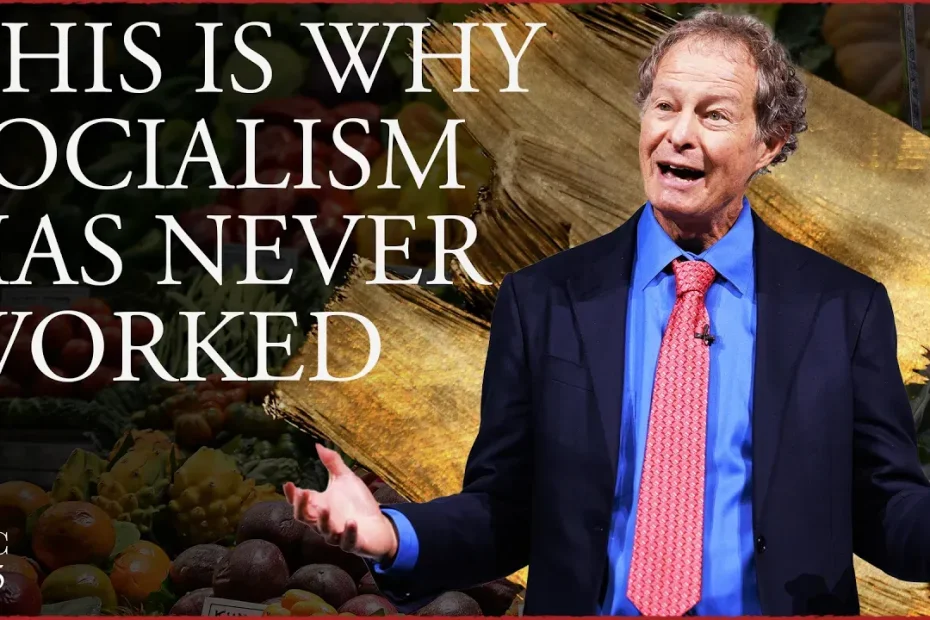
Read the full transcript of Whole Foods CEO John Mackey’s talk at The 2025 Alliance for Responsible Citizenship (ARC) on Feb 18, 2025.
Listen to the audio version here:
TRANSCRIPT:
JOHN MACKEY: Thank you. It’s great to be here. I like what ARC’s trying to do, so I’m honored to participate here.
But let me start off by declaring my biases. I believe in capitalism. Capitalism is the greatest thing humanity’s ever done.
Now, some people are uncomfortable with that word capitalism. It came from Karl Marx, after all, so maybe with good reason. And if you are, you can think of it as the free enterprise system. My favorite re-expression of it is innovationism, because that’s really what it is.
Economic freedom results in innovations and progress. Let’s take a look here.
Personal Background
First, a little bit of who I am.
So I started a company back in 1978 called Whole Foods Market. We did $365,000 our first year. When I retired two and a half years ago, we were up to $22 billion. We started with 12 team members and grew that to 105,000 over 44 years.
Our initial market capitalization was $45,000. When we sold to Amazon, now almost eight years ago, for $13.7 billion. If Amazon tried to sell Whole Foods today, it’s probably doubled in price, so it’s probably worth $25 billion. Probably the thing I’m most proud of, though, is that we were named one of the 100 best companies to work for in the United States for 20 consecutive years by Fortune magazine.
Until Amazon bought us, and we weren’t eligible to do that any longer.
The Great Enrichment
So, humanity has made just unbelievable progress in the last 250 years. And people take this progress for granted, but they shouldn’t, because it’s been never occurred. It’s unprecedented. And these are the major sources of prosperity. If I had more time up here, I would go over in some depth the importance of each of these.
I’m going to focus on economic freedom today, though.
So one of my favorite economists, Deirdre McCloskey, calls this period of time from about 1750 to current day, the 275 years, she calls it the Great Enrichment. And you look at this hockey stick.
So for about 2,000 years, GDP per capita was stuck at around 800 across the world, with a very much smaller world population. Now we have increased that almost 20 times in the last 250 years, from 800 to over $20,000.
Economic Freedom and Prosperity
But it can sort it out by economic freedom. The more economic freedom a nation has, the more prosperity it creates. And you can see this, that the most free countries have substantially more income per capita. This is the Economic Freedom Index.
This one’s by Heritage. Fraser Institute in Canada also does one that’s very similar. I put this up here partly to show that my country, the United States, which for most of our history probably would have ranked number one if they had an Economic Freedom Index, and then for many years it ranked number three behind Hong Kong and Singapore.
But in the last 15 years, it’s fallen all the way down to number 25. I put this up because all the Nordic countries now have more economic freedom than the United States. And I want to reclaim the Nordic countries for capitalism, because they’ve tried to pirate them away to the socialistic point of view.
But in fact, the Nordic countries are capitalistic with strong welfare states, but their economic freedom is incredible. The greatest accomplishment of capitalism has not been increasing prosperity, although you might say it’s the other side of the coin. It has been its tremendous progress in decreasing global poverty.
Capitalism’s Impact on Poverty
So, the statistics are so amazing that they just have to be shared.
So if you just go back 200 years ago, 85% of everyone alive on the planet Earth lived on less than $2 a day. And that’s in today’s dollars. Think about that. 85% live on – think you could live on less than $2 a day.
Now, we’re down to like 6%. And if we can – if economic freedom increases in Africa, I predict that we will wipe this out in the next 20 years or so. Because poverty is the default condition of the human race. Poverty doesn’t need to be explained. As Jane Jacobs said, “to seek the causes of poverty in this way is to enter into an intellectual dead end.”
Because poverty doesn’t have any causes. Only prosperity has causes. Life expectancy.
Improvements in Life Expectancy
So, what we know from anthropology and from studying primitive cultures, we know that the average lifespan for humanity basically was between 28 and 30 for tens of thousands of years. That didn’t change until basically late in the 19th century when science and medical technologies began to be – vaccines, better sanitation for water, we began to understand about bacteria and viruses.
And then we saw life expectancy shoot up from 28 to 30 to now across the whole planet, it’s in the low to mid-70s. In the most advanced nations for life expectancy, like Singapore and Japan, they’re getting close to the mid-80s. A badge of shame for the United States, we spend more money on healthcare per capita and it’s part of our GDP than any other country in the world. We rank number 40, 40th in the world in life expectancy.
Progress in Literacy
Illiteracy. Consider the fact that 200 years ago, 88% of everyone alive on this planet could not read. 88%. Only 12% could read.
Now, we’ve completely reversed those numbers so that 88% can read and only 12% cannot read.
The Transformation by Capitalism
So, capitalism has done this amazing thing. It’s transformed our world in only 250 years ago. And by the way, economic freedoms never existed before the modern era. The entrepreneurs were under the thumb.
They had no economic freedom or very little. They were controlled by their governments, controlled by the aristocracy.
They could not accumulate capital if they were minorities, like the Jews in the West or the Chinese in the East. They were routinely persecuted in whatever country they were in. Their money confiscated and they were run out of the country.
Public Perception of Capitalism
So, it’s been so amazing and yet it’s hated by hundreds of millions of people. Perhaps billions of people hate capitalism. These are polls in the United States.
But it’s interesting that Americans’ confidence in big business is at an all-time historical low. Only 16% have any confidence in big businesses’ motives. Americans believe, 83% believe, corporations, the government benefits corporations more than the middle class. Only 2% of investors believe that CEOs, like myself, are very trustworthy.
And the most disturbing statistic for me is that only 45% of millennials believe that capitalism is, they have a positive view of capitalism, and 51% have a positive view of socialism.
Arguments Against Capitalism
So, I have debated on the public stage many, many times against anti-capitalists and these are the arguments they routinely make. If I had more time, I would rebut every one of these arguments. It exploits the workers. It entices people into consuming bad products.
It makes the rich richer and the poor poorer. It creates more inequality in the world. It harms the environment. And they believe socialism is a better, more just, and more ethical system than capitalism is.
The Reality of Socialism
Well, let’s take a look at socialism. What has it ever accomplished? Well, it’s been really good at creating more poverty. It’s championed at that.
It’s inherently based on government coercion. Individual freedom, individual rights, they’re inevitably suppressed. It doesn’t matter if it’s called democratic socialism or not. Freedom and rights are suppressed.
And think about it. In the last 100 years, socialism has been tried by 40 different countries, all 40 failed. There’s never been an economically successful socialistic country. The real world history of socialism is the history of coercion, murder, and poverty. This is the most important chart. This is the one that, when I always put this one up when I debate socialists, they don’t like this one.
But in fact, socialism is the greatest murderer in history. These are mostly citizens from their own countries that they’ve murdered. And by the way, the Nazis are up here, because there’s this mistaken assumption that, well, socialism’s on the left, and Nazis are fascists, they’re on the right. Nazis were socialists.
It doesn’t matter left and right. You can be a socialist on either the left or the right. Our task now is to try to redefine the narrative of capitalism. We do not market capitalism well.
Redefining Capitalism
And we also need to evolve the way we think about it and the way business people think about themselves. There’s four things I want to quickly talk about in the limited time I have left. I want to talk about purpose, I want to talk a little bit about stakeholders, I want to talk about integrity, and I want to talk about love. All the stakeholders matter.
But they’re not all equal. The left, or the anti-capitalists, have weaponized stakeholders. They’ve made it so that stakeholders are trying to take power away from the investors and the owners and redistribute it to other stakeholders. This is a complete misunderstanding of what stakeholders are.
Here’s the fundamental truth. These are all the stakeholders here, customers, employees, suppliers, investors in the communities. They are all voluntarily exchanging with the business. Business not only creates value for its owners, it creates value for all of the stakeholders. If it didn’t, they wouldn’t trade with the business.
And this is what makes capitalism such an extraordinary vehicle of progress and growth. Because, in fact, if you think about it, business creates probably a hundred times more value than all the non-profit organizations and all the governments combined. Right?
So once you realize that you have these stakeholders that are voluntarily exchanging with the business, and that you’re creating value for these stakeholders, you can do this in a more conscious way, which means you just look for win-win-win strategies. Strategies that benefit all of the stakeholders, the investors, the customers, the suppliers, all of them. All of them can all win. Capitalism is a win-win-win game.
That’s what’s so incredible about it. Everybody that participates in it can win. Even the competitors can win. Because capitalism forces you to get better. It forces you to innovate. If you don’t, you’re going to lose your customers. You’re going to go to a competitor, or your employees are going to go get jobs somewhere else.
So you constantly have to improve. There’s never-ending improvement built into the capitalistic system. What happened here? Oh, I cut my purpose slide out. I’m not going to let it be cut out.
The Purpose of Business
Have you ever asked the question, what is the purpose of business?
People, they think, well, if you go to a party and you say, what’s the purpose of a business? They’ll say, what do you mean? The purpose of business is to make money. Isn’t that what we hear?
Let me ask you, what’s the purpose of a doctor? Do they make money? Yes. Their purpose is to heal, not make money.
What about the purpose of a teacher? They educate. Architects, they design things. Engineers construct things.
Every one of the professions refers back to some type of public good and service that they are doing that helps people. Well, business is the greatest value creator in the world. Business helps more people than anything else.
And yet, we market it as it’s just about the money. It’s just about profit.
So we have to start talking about purpose. My company that I founded, Whole Foods, our higher purpose was to nourish people on the planet. And that was from the very beginning. We articulated this higher purpose.
And we lived that purpose every single day. We measure ourselves against how we were meeting that purpose. The companies that you most are familiar with, take Google. Google’s purpose, what’s their purpose?
Well, their purpose is to organize the world’s information and make it readily accessible.
Quick question, how many people have used Google in the last 24 hours? Wow, that’s a lot fewer people than I thought.
But nevertheless, Google has changed the world. I want to talk briefly about integrity. Business is not trusted. And part of it is because business doesn’t have a complete commitment to telling the truth.
The Importance of Integrity
Too often, the PR teams take over the messaging. And they’re always spinning things.
So we want to build more trust in business. Start telling the truth all the time. Don’t worry about, don’t let the PR team run your company. We also need to be guided in all of our decisions, not merely what’s legal, what you can get away with, but what you know is right.
That type of integrity builds trust, it builds loyalty, and it will change slowly over time the narrative about business. And finally, I want to talk about the importance of love. I heard a lot about sacrifice today, and I don’t want to get into an argument about that, but I’m a great believer, I say I’m a believer in the New Testament. I believe in love.
Love in Business
And I believe love is in the corporate closet for the most part, at least in America it is. Because the organizations are so professionalized, you go in, you check your integrity and your purpose and your love at the door, and then you do your job, and then you go home to those things and you can bring them back out again. We need to bring love out of the corporate closet. We need it to be something that we do when we lead.
We need to lead with love. And I will leave you with this final thought. At Whole Foods, if you want to get more love in your company, if you practice this, I promise you, you will open, you’ll take love out of the corporate closet. We just do appreciations at the end of every meeting.
And I will do an appreciation for one of my friends that’s here, so I will try to demonstrate this to you. One of my friends at the Art Conference is a friend of mine in Austin, Texas, where I live, named John Papola.
And John, I want to tell you how much I admire you. I admire you for your commitment to liberty, economic and personal freedom. I love your intellectual integrity, how you’re determined to tell the truth in all circumstances. I appreciate the fact that you are creative, and that your podcast and your rap videos have so many millions of views.
It’s inspiring to me. And finally, I want to appreciate you and your lovely wife, Lisa, for adopting Johnny from Colombia, because you have such big hearts, and because you love, and because you know how important family is. Thank you, John. I love you.
Just imagine if you did that, something like that, and everybody did it voluntarily, when you end your meetings. It will transform your organization. Love will be awake in the corporations. I urge you to do this. I want to finally finish by recommending to those of you that want a few books that I think are particularly worth reading about the prosperity of capitalism. I’d start with The Rational Optimist by Matt Ridley, who’s here.
I also recommend Enlightenment Now by Steven Pinker, which was an incredible book. I also love Superabundance by Marian Tupy and his partner, Gale Pooley. I’d recommend these books very much. It’s been an honor to be with you, and I look forward to seeing you at the rest of the conference.