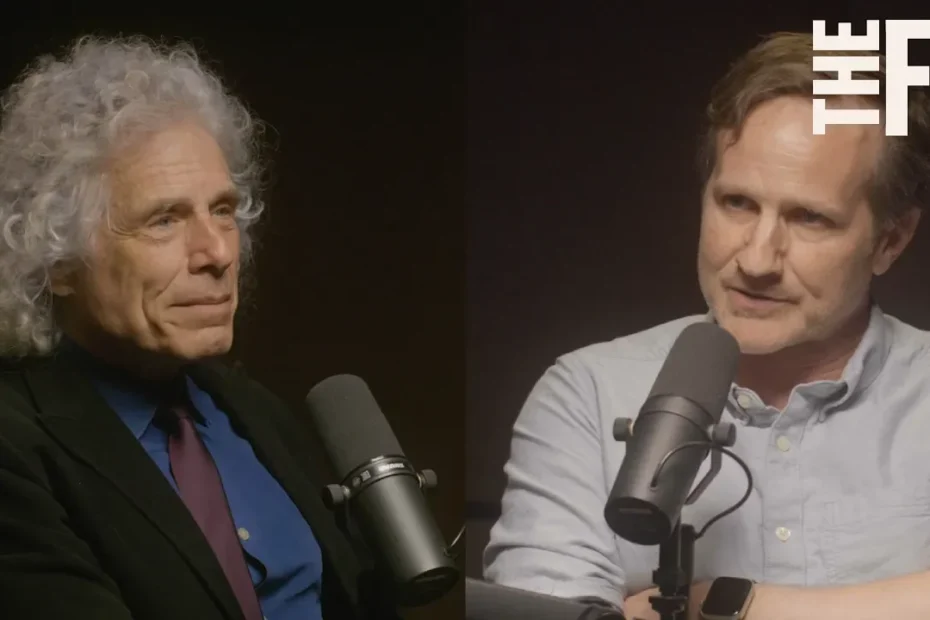
Read the full transcript of world-renowned cognitive psychologist Steven Pinker in conversation on Honestly podcast with Michael Moynihan on “Why Smart People Believe Stupid Things”, June 18, 2024.
The Nature of Misinformation and Belief
MICHAEL MOYNIHAN: I’m Michael Moynihan for the Free Press in New York. And this is Honestly. Today I’m sitting down with cognitive psychologist Steven Pinker. Pinker is the author of nine books, including “Enlightenment Now: The Case for Reason, Science, Humanism and Progress” and “Rationality: What It Is, Why It Seems Scarce, and Why It Matters.”
We talk about why smart people are prone to believe conspiracy theories, the moral panic around AI and how the world is getting better. Let’s talk about misinformation. I mean, I started the Rationality book and we talked about misinformation very quickly. Well, the first couple pages. Why do we believe things that are wrong and things that are demonstrably false?
STEVEN PINKER: Yeah. I would turn the question around that when it comes to things that don’t impinge in our day to day lives, where by the way, I think we don’t tend not to believe things that are wrong if there’s no food in the fridge. People don’t tend to hallucinate food in the fridge. They go out to the store and they buy some food.
But when it comes to things that are grander, more abstract, more cosmic, who really makes decisions in corporate boardrooms, in the White House? What is the ultimate cause of fortune and misfortune and suffering? What is the origin of life? What is the origin of the planet? What is the history of this country? People’s beliefs don’t affect the conduct of their lives.
For most of human history, you couldn’t know. And so what we contented ourselves with was mythology, uplifting tales, morality tales that single out of a villain, that glorify our heroes, that get the kids to believe in morally salubrious values and beliefs, and the default in human belief for this zone outside of what impinges on them, you pick the best story because no one could find out.
There was no science, there’s no historical archives, there was no responsible journalism. So we grown up in an era since the Enlightenment where we expect that you can find out these things, that there is a truth to be found. That’s why we have science, that’s why we have investigative journalism, that’s why we have professional historians. But it’s just not the natural human way of thinking.
And so I would flip the question around is how do you get people to the mindset that presumably you and I share, that you can’t believe anything you want? Some things are true and it really is virtuous to believe things that are true by our best lights.
Historical Context of Conspiracy Theories
MICHAEL MOYNIHAN: But is that something that’s been static over the years, are we in a worse place or a better place now? I mean, you have a number of people that point to technology and say, this is screwing everything up. And then you look backward and say, well, you know, we’ve always had conspiracy theorists. We’ve had the John Birch Society. We’ve had these things for years. Is it just that more people have access to this now because of the Internet and social media, or are we better off than we were previously?
STEVEN PINKER: Yeah, it’s a good question. There has been a study, so I try to base answers to questions like that and other questions of have things gotten better or worse on do we actually have data sets that could lead to an informed answer to the question?
The only one I know of is a researcher named Joseph Yashinsky looked at letters to the New York Times and I think other papers over 100 year span and found no change in the proportion of conspiracy theories. However, I think his investigation ended in 2010 prior to the explosion of social media. So we don’t know if things have gotten worse there, but it is a constant temptation.
There have been, of course, anti-Semitic conspiracy theories for all this hatred. Right. And anti-Catholic conspiracy theories and anti-Freemason conspiracy theories.
The COVID-19 Information Crisis
MICHAEL MOYNIHAN: Obviously, we saw a huge rise. And again, this is not data. This is my hunch during COVID-19, which makes a certain amount of sense, Right. We’re all stuck at home. A pandemic that we don’t understand, scientists don’t understand it. And there was an effort by a lot of people to say the truth is static from the very beginning and we don’t want people going outside of that. And let’s take them off of YouTube, demonetize them, take them off of Twitter and just in some ways just kind of shame some of these people. Is that an effective way? I mean, I suspect that people have less trust in science now.
STEVEN PINKER: I think that’s right. I mean, I don’t even think that was the most egregious instance. Probably the most egregious was telling people that you should not get together in crowds for MAGA rallies, but it’s okay to get in crowds for Black Lives Matter rallies because the cause is so much more just.
MICHAEL MOYNIHAN: I remember the person in Defender this who said it is a type of pandemic racism.
STEVEN PINKER: Yes, right. So, I mean, that is a way of signaling, blaring that the public health establishment is a house organ of the political left, that I don’t know how widely that message was received, but it would be absolutely toxic to the idea that the Public health establishment is a disinterested source of information about public health.
But you’re right that the demonetization, the deplatforming was wrong for a couple of reasons, just wrong as a precedent, that is if you do have protected speech. Again, there are exceptions like fraud and extortion and sexual harassment. None of these were those. So it’s just a bad precedent.
But even worse, we now realize that some of the so-called misinformation may have been closer to the truth than the advisories from the public health establishment.
MICHAEL MOYNIHAN: Mask or, or don’t wear a mask initially.
STEVEN PINKER: Yeah, yeah, don’t wear a mask. Save them for the surgeons. Or many of the social distancing restrictions, closing down beaches, keeping kids.
MICHAEL MOYNIHAN: That was a wild one. Beaches and playgrounds. Yeah.
STEVEN PINKER: I mean the idea people reasonably thought what they’re trying to do is exert control when something that is patently has no redeeming purpose in terms of public health.
MICHAEL MOYNIHAN: Yes, but it has some kind of. It’s a tribal thing in the sense that when I saw people, and still do, wearing masks outside, it’s usually in a social class in an area. Yeah.
STEVEN PINKER: So I spent a year in Berkeley on sabbatical and there you’d see people on bicycles with a mask and no helmet.
MICHAEL MOYNIHAN: Yeah. So getting it exactly back, the probability thing in the rationality book. Right.
STEVEN PINKER: Yeah.
MICHAEL MOYNIHAN: Right.
STEVEN PINKER: So how are we going to know if some of the advisories are wrong? It’s because some people say they’re wrong and we got to show whether they themselves are wrong.
The Rationality Behind Conspiracy Theories
MICHAEL MOYNIHAN: Is there a rationality to conspiracy theories? Sometimes. I mean, do people get pushed towards conspiracy because the public health establishment or any establishment does a series of things that invites suspicion and the average person is just going to be like, you know, I imagine there’s some big kind of apparatus that’s trying to screw me over. Is there a slight rationality to conspiracy theory?
STEVEN PINKER: Sometimes it depends on the conspiracy theory. I mean if it’s just like two government officials both trying to hide something, well, that happens all the time. Or 4. But if it’s 9/11 was faked, the so-called truther movement, then the conspiracies are preposterous on the face of them. In terms of how many things that have to go perfectly for the conspiracy both to succeed and be undetected.
Since, you know, no stings, no defectors, no screw ups and we know what can go wrong will go wrong. And for 137 steps to go perfectly, it’s pretty unlikely.
MICHAEL MOYNIHAN: That’s what I got from the Rationality book is that as you expand the number of things involved, well, the better.
The Psychology of Detailed Stories
STEVEN PINKER: The story, the less likely it is because a good story has lots of detail fleshing it out. And of course every detail you add multiplies the probability in multiplying that is a number less than one by another number less than one, resulting in a still smaller number.
This is something pointed out by Amos Tversky and Daniel Kahneman in their famous conjunction fallacy where I mean the example now kind of known to every intro psych student and for that matter reader of Kahneman’s bestseller “Thinking Fast and Slow” is if you present a stereotype like Linda, a bit of an anachronistic name because it’s kind of a baby boomer name, but we’ll still call her Linda.
She’s a social justice warrior and anti-nuclear and black lives matter and majored in philosophy, very bright and articulate. What is the probability that she is a bank teller? You say what is the probability she’s a bank teller and activist active in the feminist movement. People say well, it’s more likely she’s a feminist bank teller than a bank teller, which of course violates the law of probability that the probability of A and B has to be less than the probability of A.
But we get captured by by stereotypes. Tversky and Kahneman called it representativeness, but we can just call it thinking by stereotype and not taking into account base rates probabilities.
Now the way this plays itself out in conspiracy theories, but not just conspiracy theories, also for lawyers, arguments for the prosecution or defense is you spin a plausible story and again contradicting the law of probability, laws of probability that say every detail you add to a story has to reduce the probability that the entire story is true. As audience is receptive to a good story, the more details you add, the more plausible the story is and the higher the probability people give it.
Now the other the added absurdity to most conspiracy theories, aside from the fact in addition to the number of things that have to go right for the conspiracy to have succeeded, is that usually part of this conspiracy is a massive attempt to suppress the truth. And here are these guys on their card tables on street corners and publishing handing out leaflets. And how come they haven’t been sent to the Gulag if they. If there is a conspiracy to hide the truth?
The JFK Assassination: A Case Study
MICHAEL MOYNIHAN: I mean, it’s an odd thing. I mean, if you really want to ruin a dinner party, which I really enjoy doing, you can say something that sounds pretty inoffensive. That Lee Harvey Oswald shot John F. Kennedy. That you’re the crazy one in the room, right? Yes, right. It is very hard. I mean, that is a conspiracy theory that is believed, I think by 75% of Americans.
STEVEN PINKER: That is true.
MICHAEL MOYNIHAN: And the power of an Oliver Stone movie, or just the popular culture can really make people forget about probability and say that all of these things that would have to happen. It’s nearly impossible. When Lee Harvey Oswald, who had previously two months before, tried to kill General Walker, one of the heads of the John Birch society, seems pretty obvious.
STEVEN PINKER: Well, it’s true. And it really does show the difference between our thirst for accurate truth and our thirst for a good story. Because the thing is that the Kennedy assassination, it’s a crummy story. I mean, some pathetic schmuck kills the leader of the free world, much beloved. I mean, what kind of stupid story is that? Now, of course, the fact that it’s true often just doesn’t register. I’d rather believe the story that they’re nefarious forces.
Why Smart People Believe Stupid Things
MICHAEL MOYNIHAN: So why do people believe these things? I mean, why do smart people believe these things? I mean, smart people believe very stupid things. Everybody knows the George Orwell quote, something so dumb only an intellectual could believe it. What is that? What is the instinct that makes people believe?
The My Side Bias and Credibility Crisis
STEVEN PINKER: In general, smart people tend to be more resistant to cognitive illusions, fallacies and biases. One exception being the my side bias. Namely, you give a pass to errors in an argument that makes your own coalition look good and makes the other coalition look stupid and evil. And there people on the left and right are equally susceptible and it is more or less independent of intelligence.
It goes back to the artificiality of the moment, which we think we’re living in at least, or we like to live in. Namely that you can determine the truth about who killed JFK. That is, there’s forensics, there’s arguments like Gerald Posner, pretty convincing. But for most of history, the documentary record, the forensics, the ballistics, all that, the Zapruder film, none of that was available. And so it almost was, as we would say, kind of an academic exercise. What really happened? Because no one could know.
If no one could know, then should you believe anything? No, you believe the story that serves the greater moral purpose, whether the moral purpose is exposing the corrupt, powerful forces that dominate us or expose the nefarious conspiracy or that teach the young the right moral values.
And the question is, why don’t people, I think, why don’t intelligent people trust what you and I would call more credible sources, like a journalist like Gerald Posner, like the Warren Commission, as flawed as it may have been, but still, they probably came to the right conclusion, like science, when science is functioning properly, like academia, when it’s functioning as it ought to function. The problem, of course, and the reason that academic freedom for me is such a vital issue, is universities are squandering the trust that would lead to accepting beliefs that are likely to be true, as are many journalistic outlets.
The Misinformation Debate
MICHAEL MOYNIHAN: In the misinformation stuff, when people say, we have to combat this, I mean, I wince a little bit because I kind of like the market to combat it in a way. And there usually seems to be some ideological component to the combating of misinformation.
STEVEN PINKER: I think we’ve seen that in the fact that a lot of COVID misinformation turns out to be, if not truth, not obviously false.
MICHAEL MOYNIHAN: What do you make of that argument? That it was misinformation that allowed Donald Trump to win the election in 2016, allowed his supporters to be deluded about the election that he lost in 2020, et cetera?
STEVEN PINKER: Yeah, I think it’s an empirical question. There are analyses, such as by Brendan Nyhan, a political scientist, that, in fact, the impact of fake news was negligible, that it didn’t get to that many people. And the people that “Pope Francis endorses Donald Trump.” So how many people saw that and how many people believed it, other than people who are kind of cuckoo Trump fanatics in the first place?
And so there may have been something of a moral panic over disinformation or misinformation in 2016. The certainly “stop the steal” is based on. Actually, I think it’s probably doing it too much service to call it misinformation. It’s just—
MICHAEL MOYNIHAN: It’s a lie, which is made up. I used to have this conversation with people, you know, about people like Alex Jones. They would presume that, oh, this Alex Jones video had 2 million views. Are those 2 million people who agreed with Alex Jones, or are they, like me, who watched it and said, this guy’s out of his mind? The presumption is that people watch that and they agree with it.
STEVEN PINKER: Yeah. And also that the people who tune in and watch it would have had their minds changed by him as opposed to having those beliefs in the first place because we do have filters for credibility of the source, corroboration by other sources. Now, if you’re a true believer, you choose not to exercise those filters. But most of us weren’t born yesterday.
And I don’t think language would have evolved in the first place if it was that vulnerable to spreading misinformation. That is, if anything someone said immediately got implanted in your brain in mind your belief box, and from then on you believed it. We just would not listen to anyone because we’d be too easily manipulated. This is an argument from the cognitive psychologist Hugo Mercier in his book “Not Born Yesterday.” And it’s a reason to not panic about deep fakes. They could be misused at the margins. But since they’ve become fairly widely available, there are very few cases in which they’ve swayed any opinion in any direction simply because, you know, people don’t automatically believe them.
MICHAEL MOYNIHAN: And they’re very quickly debunked.
STEVEN PINKER: They’re very quickly debunked. Yeah. And sources do exercise some discretion. Let’s hope they continue to at least. Sources like the CNN and the Wall Street Journal and the New York Times. A lot of the stuff that they publish may not turn out to be true, but still you’re better off believing them than Alex Jones’s website, for example.
The Retreat from Enlightenment Values
MICHAEL MOYNIHAN: Where are we as a world now? It’s a big question, but I mean, I view in some ways the Enlightenment book as an accidentally anti-MAGA book in the sense that there’s a lot of stuff about free trade in there. I mean, you look at these enormous precipitous declines in poverty, the increases in life expectancy, and you say, wow, this is a miracle. And then you realize that it’s, you know, along with countries opening up, I mean, Vietnam, China, India, et cetera, and those closed economies, previously closed economies pulled a lot of people out of poverty. But we’re in a moment that both Democrats and Republicans are in a protectionist, mercantilist kind of mindset.
STEVEN PINKER: Yeah.
MICHAEL MOYNIHAN: And you know, all this stuff has done so such great things for the world. It seems like we’re trying to double back on that now.
STEVEN PINKER: Yeah. So since I wrote “Enlightenment Now” went to press in 2017, you know, I still try to keep track of trends and, you know, some have gotten a bit worse. There have been. Homicide rates have gotten worse. War deaths have gotten a bit worse. Democracies have gotten a bit worse. Global trade as a proportion of gross world product has gotten a little worse, assuming that trade is a good thing, not as it hasn’t undone the progress, but it’s gone in the wrong—
MICHAEL MOYNIHAN: It’s got it down.
STEVEN PINKER: Yeah, it’s gone either slowed down or in some cases gone a bit in the wrong direction, wiping out a decade or two of progress. Part of the argument of “Enlightenment Now” and before that, “Better Angels of Our Nature,” is that over the course of history, what we might call Enlightenment values have increased. And they have been, that is human rights and democracy and open economies, science as a way of knowing, and that the rise of those values has had benefits to the world, such as disease and child mortality and maternal mortality and extreme poverty going down and war.
Those are two different arguments. One of them is that Enlightenment values increase, and the other is that Enlightenment values cause the world to be better in terms of measuring actual outcomes. There’s no law that says they have to keep increasing, and we know that there are the values. That is the whole Enlightenment ideals in some ways does go against features of human nature like tribalism, authoritarianism, puritanism, magical thinking, primitive intuitions of essentialism.
Human Nature and Authoritarianism
MICHAEL MOYNIHAN: Authoritarianism is, you think, sort of part of human nature. I mean, that’s our general instinct.
STEVEN PINKER: So deference to what people think of as a legitimate authority is probably one of the ways in which we moralize the world. John Haidt and his moral foundations includes deference to authority as one of the keys available on the keyboard. Not everywhere, always, but I think it’s something that people tend to fall into. How do you solve our problems? Well, let’s entrust a strong leader so we’re vulnerable to that.
The whole concept of democracy is. No, it’s not that a strong leader just has the wisdom and strength to solve problems. It’s that we need to agree upon someone to temporarily preside over a council, a president, not a king, and that that person wields power only for the betterment of the people that he or she is governing. The whole concept of democracy is not particularly intuitive. I think it’s intuitive to challenge a leader who’s arrogated too much power to take him out. But the whole idea of consent of the governed and division of powers, freedom of speech, completely unintuitive.
So Enlightenment values, I think, are always pushing uphill and have a natural tendency to slide back if I’m right and I don’t have the data to demonstrate this empirically. But the idea would be as the world retreats from Enlightenment values, so too measures of global well being will go backwards.
MICHAEL MOYNIHAN: I mean, Russia’s one of the great examples of this, isn’t it? I mean, 1989, 90 comes and say, well, that’s the end of the Soviet empire. It’s gone. The evil empire from 1917 to now, I can’t believe it lasted that long. And we’re going to have flourishing capitalism. And then 2000, after a very shaky time with Yeltsin, Putin takes over and Russia succumbs yet again to an authoritarianism that it’s been used to through its entire history. And people are shocked by. Yeah, I mean, I was shocked by it.
STEVEN PINKER: Yeah. Yeah, me too. I mean, there was so. And you’re right, by the way, that in addition, I invoke features of human nature that when things go south, we’re apt to empower a strong leader. That’s natural. The democratic mechanisms are not so natural. But it may. On top of that, it may be that some cultures, because of their history, are more receptive than others. And the fact that Russia has the czars, then the Soviets than Putin, there may be some historical continuity there, but—
MICHAEL MOYNIHAN: There’s always the thing in these countries that they feel like they have to go through the motions of democracy. Saddam Hussein used to have elections and it wasn’t implausible. 98% of the people.
STEVEN PINKER: Well, it’s true. There’s things like the Democratic Korean Republic and the German Democratic Republic.
MICHAEL MOYNIHAN: I’ve always said if it has democratic in the title. Right in the other direction, it’s not going to be democratic.
STEVEN PINKER: You know, it’s not.
AI: The Latest Moral Panic
MICHAEL MOYNIHAN: Yes. You’ve written a bit about AI.
STEVEN PINKER: Yeah.
MICHAEL MOYNIHAN: This is the latest moral panic.
STEVEN PINKER: Yeah.
MICHAEL MOYNIHAN: Give me the broad sense. Should I be worried about this? Because we see these things with wonder. I cannot believe this. It’s answering me in these fluid answers in ChatGPT. But, oh Lord, this could go horribly wrong, couldn’t it? Am I being too pessimistic about that?
STEVEN PINKER: Yeah, I think so. There clearly could be harms with AI, as there are harms with any technology. But I don’t think that the doomers have made a good case. That is the idea that AI will, by some accounts, inevitably try to take over and therefore it will extinguish us the way we did other species, the way we did indigenous peoples.
MICHAEL MOYNIHAN: So it’s not a jobs argument like this will take—
STEVEN PINKER: That’s separate. I think we should be so lucky. We’d have to kind of figure out how people can pay for food and rent. But if there’s that much abundance, then that strikes me as a kind of a smaller problem. In fact, that has to be a net huge benefit. People don’t have to do boring, dangerous jobs and instead stuff gets produced. Things happen for free. I mean, it’s amazing, especially with a population that’s likely to decline.
But, but granted, if we don’t come up with new policies, whether it’s a universal basic income or a negative income tax or finding new uses for human capital, there could be some rough times. But it’s not the end of the human species.
MICHAEL MOYNIHAN: Are we on the precipice of those times? I mean, there seems to be a lot of change coming.
STEVEN PINKER: There is. I don’t think it’s going to be that fast. So we still do not have cars that can go from point A to point B and allow you to read a magazine, even though those have been predicted for a long time.
MICHAEL MOYNIHAN: I mean, my car yells at me when I drive. I have a Tesla. I take my eyes off the road and I’m like, it’s spying on me. It’s yelling at me too.
STEVEN PINKER: Yes, exactly.
MICHAEL MOYNIHAN: “Pay attention.” I’m like, no, you made this technology so I could read. Stop it.
STEVEN PINKER: I have gone through the same experience spying on you.
MICHAEL MOYNIHAN: It’s this Stasi car.
STEVEN PINKER: But the fact that you can’t read a magazine and let your Tesla drive you to work shows that these problems can be really hard. And the reason that they’re hard even when they work a lot of the time is that it’s not good enough to work a lot of the time. It’s the times that they don’t work that you worry about that require human common sense. Like construction worker holding up a hand painted construction sign telling you about a detour and you got to be able to read the sign and Teslas can’t read, as far as I know. All those edge cases, as they say, mean that it’s really harder than we think to build infallible technologies to.
The AI Doomer Case and Its Flaws
MICHAEL MOYNIHAN: Can you steel man a case that AI is going to produce some negative outcomes and some harm that we’re not really prepared for?
STEVEN PINKER: Oh, it’ll certainly produce negative outcomes and harms that we won’t prepare for because all technologies do. So I don’t even have to steel man. I’ll just say it. It’s really the Doomer case.
MICHAEL MOYNIHAN: What is the Doomer case?
STEVEN PINKER: The Doomer case has two versions. One of them is that just as we dominated other species, sometimes to the point of extinction, certainly to the point of exploitation, as we did to many indigenous peoples, well, AI is to Homo sapiens as Homo sapiens is to the passenger pigeon.
The other doomer argument is that the values of AI may not be aligned with human values. So if a hypothetical AI is given some goal to pursue, such as eliminate cancer, then since exterminating every last human would be a way of making cancer go away, it will kill us all as collateral damage on its way to eliminating cancer or war. By the way, I did not make that up.
MICHAEL MOYNIHAN: Really? That’s an argument that smart people make.
STEVEN PINKER: That’s not just some Internet argument that only smart people could make. Or that you give an AI a goal of regulating the water level behind a dam and it floods the city because that’s one way to keep the water level as specified.
MICHAEL MOYNIHAN: That could happen now.
STEVEN PINKER: Oh, that could happen now.
MICHAEL MOYNIHAN: Yeah, technology can screw up quite a bit. I mean, you see what happened with air buses and things like this. I mean, this is a common thing, right? I would imagine. Be more precise.
STEVEN PINKER: Well, it’d be more precise to extend the argument. The singularity could happen where AI would recursively improve its own intelligence. It would be so smart that among the things that it could do is figure out how to get smarter. And it would make it figure out how to get still smarter.
And that would include disabling all human efforts to disable. Could include brainwashing or bribing or manipulating humans to do its bidding when it has not been empowered by being connected to the grid or the net or actual machinery. And so it could recruit armies of people to pursue its goals. And those goals may come at the expense of human well being.
MICHAEL MOYNIHAN: Is that… I mean, this is dystopian science fiction, but is that possible? Could that ever happen?
Why the Singularity Argument Fails
STEVEN PINKER: Well, the thing is, if you think that it’s coherent, that the Singularity is coherent, that recursively improving one’s own intelligence is coherent, then maybe. I think it’s not coherent because I think it is extrapolating from smarter to infallible and omniscient. I think there are a number of things wrong with the argument.
One of them is that just because you’re smarter doesn’t necessarily mean that you have an urge to dominate. In Homo sapiens, intelligence comes bundled with aggression and dominance and all the other nasty traits that we came saddled with because we’re the product of a competitive process, natural selection. But if something is designed, there’s no reason that it should want anything. It wants what we tell it to want.
That wanting something and being smart enough to know how to get it are two completely different things. It’s not the case that like in myths like the Golem and the Sorcerer’s Apprentice and so on, that as you get smarter, that kind of stokes a thirst for power, for dominance. That I think is a human projection.
And as I kind of put it, we know that there are creatures that are capable of advanced high intelligence without the urge to dominate and conquer. They’re called women. So as one example, or those old enough to remember Al Capp’s Schmooze, the cartoon figures who had extraordinary powers, but they were also extraordinarily altruistic. So they would barbecue themselves for the pleasure of human diners. They would bring about a utopia that is no more or less plausible than an AI conquistador or megalomaniacs. That’s one thing.
Another is that the scenarios of giving a system a single goal and not occurring to you, that there could be side effects is just so patently idiotic that I’m just not worried about people accidentally doing it. Engineering consists of carrying out multiple conflicting goals. You’ve got a car with an engine that makes it go as fast as possible and you also put in brakes and a steering wheel and catalytic converter and all the rest. That’s what engineering is.
A system that was smart enough to figure out that one way of eliminating cancer is eliminating humans. For one thing, that’s not artificial intelligence, that’s artificial stupidity. Because bringing about multiple simultaneous goals is what intelligence is. If you single mindedly pursue one goal at the expense of everything else, that is idiocy. It’s not intelligence, it’s double idiocy. Because the system would be idiotic. And any engineer who would build a system like that would be more idiotic.
MICHAEL MOYNIHAN: It requires human input. I mean.
STEVEN PINKER: Yeah, who’s giving it the goal?
MICHAEL MOYNIHAN: Yeah, exactly.
STEVEN PINKER: And who would be moronic enough to both empower and direct?
MICHAEL MOYNIHAN: I can think of a few people. I don’t think they’re a scientist.
STEVEN PINKER: So here’s AI safety: don’t let them have access to the grid.
Real Threats vs. Artificial Ones
MICHAEL MOYNIHAN: Okay, so AI is not going to destroy us.
STEVEN PINKER: I mean, so there are plenty of…
MICHAEL MOYNIHAN: Smart people who are going to destroy ourselves. That is the argument that I hear a lot from a lot of people.
STEVEN PINKER: You mean like nuclear war?
MICHAEL MOYNIHAN: Nuclear war. We’re on the precipice of nuclear war or environmental disaster. So let’s not worry about the robots. Let’s worry about ourselves.
STEVEN PINKER: Well, I think worrying about ourselves should be a higher priority. Like making nuclear weapons harder to deploy accidentally, making leaders less empowered to wield the nuclear arsenal capriciously or impulsively. I think those are very worthy goals and I think even longer term would be goal is getting rid of them.
MICHAEL MOYNIHAN: And this was an argument against your book which caused a lot of controversy, “The Better Angels of Our Nature,” which basically says wars are less frequent, less deadly than they’ve been at any time, despite the fact that you think otherwise. Some of the counter arguments, one of which is just that, yeah, might be fewer of them, but we have nuclear weapons everywhere and we could have one and destroy everything in one go. What do you make of that argument?
STEVEN PINKER: Well, that is possible and in that sense that’s a new risk that we didn’t have more than 75 years ago and it’s a risk that we should do something about.
MICHAEL MOYNIHAN: Yeah, but you don’t think that sort of invalidates the argument in any way?
STEVEN PINKER: Well, no, it’s a different argument. There are the wars that do happen, there’s a war that might happen, and the wars that do happen happen less often and are less deadly. A war that could happen could be worse. So do you want to combine those into one statement? I think it’s kind of apples and oranges. I think they’re both true and we’ve got to figure out how to make sense of both of them.
The Misuse of “Genocide” and Moral Reasoning
MICHAEL MOYNIHAN: I think there’s evidence of the thesis of your book when you see young people who have seen nothing in life, but they’re smart enough to get into very august institutions. Telling me that genocide is happening with a small number of people relative to say Syria where 500,000, 600,000 people died. Is that because people just don’t have a sense of what war has been in the past?
STEVEN PINKER: I think it’s a case where the my side bias, where just the drive to moralize just obliterates rational consideration. I mean, not only in terms of magnitude, was Syria way worse than Gaza. Gaza, by the standards of measuring war, Gaza, at least so far, is what you call small war that is killed in the tens of thousands. Now that’s horrible. And each one of those deaths is a tragedy. But there are, there have been wars that killed in the hundreds of thousands, such as the Syrian civil war in the millions and then the world wars killed in the tens of millions. So there’s that dimension.
But in addition, there is a huge difference between people getting killed in the course of a war designed to achieve other objectives and people being targeted for murder in order to murder those people as a group. As a group or that’s a lot of individuals. But yes, as a group, which is really what genocide means.
The application of the word genocide to refer to tens of thousands of war deaths. I mean, I think it is a kind of blood libel. It’s trying to import the moral opprobrium that we associate with genocide to the designated enemy in this case Israel. I think because of where I alluded to my side bias, the sides in this case being the sides that are that a lot of hard left critical theory has defined, namely white oppressors against everyone else’s victims, which ignores the Mizrahi majority population in Israel, but among other things.
MICHAEL MOYNIHAN: But I mean, is this, I mean, you say it’s a blood libel. I mean it’s pretty strong to say this is like a blood libel.
STEVEN PINKER: Well, it is a blood libel in the sense that it is an accusation of deliberate murder. Ill founded in that the… And one could disagree with Israel’s campaign against Gaza. One could say that this is not justifiable, it’s not a just war. It’s still different from deliberately murdering as many people as possible as in and we know there have been genocides.
No, I think it really is a terrible blood libel and it’s a sign of how people’s moralizing in the service of demonizing and dichotomizing, dividing the world into good and evil can just flatten their ability to analyze and to think clearly.
Mental Health and the Culture of Pathologizing
MICHAEL MOYNIHAN: Now, it’s often said that mental health is getting worse, particularly among young people. What do you make of that argument?
STEVEN PINKER: Initially I was skeptical of the hypothesis from John Haidt and Jean Twenge that it was because of the rise of social media, although I think they’ve made a stronger and stronger case. When I first read it, I didn’t give it much credit, but now I would give it stronger credence.
I would add though that the routine pathologizing of ordinary human emotion, where every setback is a trauma, where every difference is a neuroatypical condition, which Haidt and Greg Lukianoff have identified as the three great lies. “Whatever doesn’t kill you makes you weaker. Always trust your emotions and the world can maybe divided into good and evil,” which they argue is the diametric opposite to what cognitive behavior therapy tries to accomplish. It being one of the most successful forms of therapy, that set of three great untruths may have had as much of a role as the like button on Facebook.
I would add another thing. I tend to think that the doom mongering of mainstream media, which is easier and easier when everyone on earth is an on the spot reporter and when many media cultivate their own negativity bias to give the worst possible spin puts a pall over the future that I think impacts the mental health of large numbers of people.
One of the things, even though I sometimes joke that even though a lot of people hearing that I’m a psychologist mistakenly believe that I’m in the process of making people mentally healthier, that’s not what I do. But I may have finally earned that title by accident, because people do write to me and they say, “Gee, when I see those data and I see that things aren’t as bad as the headline is lit, I find it easier to get up in bed in the morning. I’m a teacher. I find it easier to motivate my students.”
So I do think that you don’t want to lie to people. You don’t want to just, say, put on a happy face. But when the best understanding of the world also happens to be less pessimistic than the headline by headline doom scroll, then we ought to promote accuracy. That also is more optimistic.
Democracy and Media Negativity Bias
MICHAEL MOYNIHAN: I turned on television yesterday, MSNBC, and Joe Scarborough was saying we’re close to ending our democracy in America. Democracy is almost just about to be out the door. A lot of negative stuff, right? Negative stuff sells, clicks, views, et cetera. Tell me why I should not be worried by that kind of headline bias in that things are maybe not as dire, maybe you don’t think that. But do you think they’re as dire as all these people who say we’re very close to losing our democracy?
The Robustness of Democratic Systems
STEVEN PINKER: Yeah, I mean, I think it is something to worry about, because worrying about foreseeable risks as a way of making them less likely to happen, which I think we ought to do. And the current prediction markets, which I think are more reliable than polls, give Trump at this point a 50-50 chance.
What we don’t know is what will happen, of course, between now and Election Day. What will be the outcome? What will be the effects of any, say, criminal convictions? We don’t know how much Trump will actually try to implement if he does get inaugurated. We don’t know how much the system will push back, as it did, say, after January 6, where 60 something trials rejected the lawsuits. So the danger is that he’d be undermining those very safeguards.
MICHAEL MOYNIHAN: But there’s a robustness in our system that didn’t exist in, say, the Weimar Republic, right?
STEVEN PINKER: Yes, yes. Both economically, both in terms of the strength of the government. I think civil war is extraordinarily unlikely. Civil wars tend to occur in poor countries with weak governments. We’re a rich country with a strong government.
And for all of the distrust of institutions, people by and large trust the post office and agency that sends out Social Security checks and the traffic police and so on. So I don’t think there’s enough hatred of the establishment to allow a genuine civil war to occur. But still I think we should implement measures to prevent that from happening because they won’t be stopped by themselves.
The Importance of Probability and Measured Response
MICHAEL MOYNIHAN: And so you take prophylactic measures, but I mean, maybe along the way, stop telling people that fascism is just about here.
STEVEN PINKER: Yeah. I think to consider how many things would have to happen for us to. For that. That label to be appropriate.
MICHAEL MOYNIHAN: It’s all about probability in the end, isn’t it?
STEVEN PINKER: It’s all about probability.
MICHAEL MOYNIHAN: Is that the most important thing that I should take away from my conversation with you and reading your book?
STEVEN PINKER: Yeah, I think so.
MICHAEL MOYNIHAN: That probability tells you more about the past, the future, et cetera, than almost anything else.
STEVEN PINKER: Probability and data from trustworthy agencies. Yes.
MICHAEL MOYNIHAN: Steven Pinker, thank you so much.
STEVEN PINKER: Thank you.
Related Posts
- Neil deGrasse Tyson on UFO Files, Trump & Alien Existence (Transcript)
- Professor John Lennox: AI Is Humanity’s Attempt to Make God (Transcript)
- What’s Changing, What Kids Must Learn w/ Sinead Bovell @ SXSW (Transcript)
- How Emotions Are Made: The Secret Life of the Brain – Dr Lisa Feldman Barrett (Transcript)
- The AI-Generated Intimacy Crisis – Bryony Cole (Transcript)