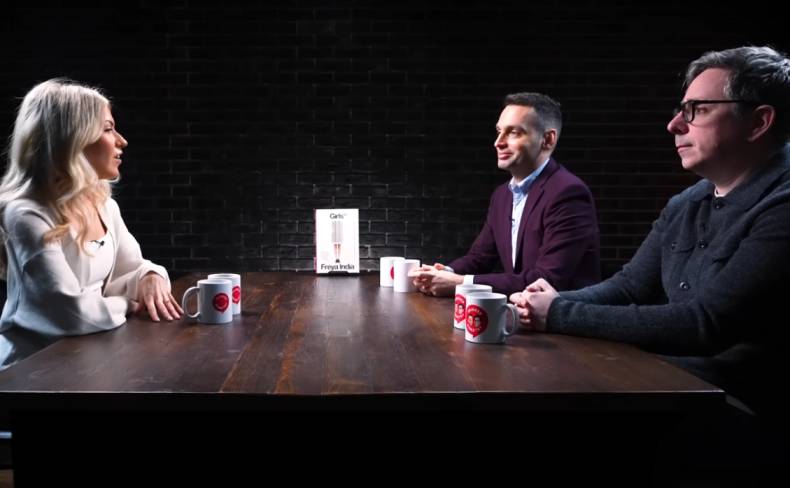
Editor’s Notes: In this insightful interview on Triggernometry, author Freya India joins the show to discuss the profound and often damaging impact of the internet on Gen Z, exploring the themes of her new book. She delves into how young people, particularly women, are being transformed from individuals into commodified products through a digital landscape that exploits insecurities and rewards performance over authenticity.
The conversation provides a sobering look at why nearly half of Gen Z adults wish social media was never invented, examining issues like the rise of “therapy speak,” the exploitation of algorithms, and the erosion of genuine human relationships. Freya offers a compelling argument for reclaiming our humanity and protecting the next generation from the relentless pressures of a hyper-connected world. (Feb 26, 2026)
TRANSCRIPT:
Freya India, Welcome Back to TRIGGERnometry
KONSTANTIN KISIN: Freya India, welcome back to TRIGGERnometry.
FREYA INDIA: Thank you so much for having me. It’s great to be back.
KONSTANTIN KISIN: Oh, it’s great to have you. Listen, when we first interviewed you it was very clear that you’re a very talented writer, but you were still, I think, working part time in a cafe. And since that time, your Substack has exploded, you’ve written this great book which I’m sure will be a big success. You’re on all the big shows now. And I think it’s because the message that you are delivering and the things that you’re talking about is actually something that the entire world is now concerned about. What have you made of the journey you’ve had so far, if nothing else?
A Generation Being Remade
FREYA INDIA: Yeah, I mean, I think when you asked me to come on, I was literally cleaning toilets in the cafe. So it’s very meaningful to be back. I think that Jonathan Haidt obviously has accelerated this conversation and he’s given the foundation for a lot of the stats in the book. But I kind of think of it — when I first came on, I was talking about the first part of a story which was a generation falling apart. And that’s what psychologists like Jonathan Haidt and Jean Twenge have all been talking about, which is the rise in anxiety, depression, self harm, and suicide among Gen Z.
But the book is really the second part of the story, which is a generation being remade. So what we were turned into. And I actually think that young women have turned from people into products, and that the reason we’re unhappy is because we’re no longer human, or at least not treating ourselves as human.
KONSTANTIN KISIN: Do you think that part of it is we’ve just got more powerful technology now? Like, women have always been treated as a product by the people who could sell them stuff, right? And profit from their insecurities, from their natural tendencies to feel certain ways about their looks and stuff like that.
FREYA INDIA: Yeah.
KONSTANTIN KISIN: And now we’re just in a place where the technology is so much more powerful.
FREYA INDIA: Yeah. So the book is all about age old anxieties that every generation of women has felt. So it’s like how you look, how you feel, your relationships, everything. But it’s all been magnified now until it’s unmanageable, and then it’s more sinister than that. It’s actually been exploited by all of these industries and companies.
So yeah, I think other generations of women would say they’ve been objectified or treated like a product. But I think this is like the core experience of girls today — commodification. So every experience of growing up, whether it’s dealing with your developing body or going on your first date, it’s all commodified and intruded upon by the market.
We Are the Product
KONSTANTIN KISIN: Tell us more about that. What does that mean, commodified?
FREYA INDIA: Well, so you’re constantly marketing and selling yourself. All through adolescence you’re performing, obsessively analyzing your metrics, and then your self worth is determined by your ratings and reviews online. But this is happening from maybe age 12. Let’s say you’re on Instagram at age 12 — then your entire experience of growing up is packaging yourself up for Instagram, displaying yourself on a dating app like a product, and then in your 20s, turning yourself into a personal brand that has to be monitored and managed all the time.
And so I think the difference today is other women were relentlessly sold products and procedures, but we are the product.
FRANCIS FOSTER: It’s very interesting you say that because when I was reading the book, I remembered this scene in Bowling for Columbine, the documentary by Michael Moore, where they interviewed Marilyn Manson and he was going, our entire consumer culture is based on fear. You’ve got pimply skin, no one’s going to want to date you — buy this product. You’ve got greasy hair — you’re going to need this shampoo. And that sprung into my mind when reading about this. This is entirely a fear based culture, isn’t it?
VIDEO CLIP BEGINS:
FREYA INDIA: You’re watching television, you’re watching the news,
FRANCIS FOSTER: you’re being pumped full of fear.
KONSTANTIN KISIN: There’s floods, there’s AIDS, there’s murder.
FREYA INDIA: Cut to commercial. Buy the Acura, buy the Colgate. If you have bad breath, they’re not
FRANCIS FOSTER: going to talk to you. If you got pimples, the girl’s not going to f* you. And it’s just this — it’s a campaign of fear and consumption.
FREYA INDIA: And that’s what I think it’s all based on — is the whole idea
KONSTANTIN KISIN: that keep everyone afraid and they’ll consume.
VIDEO CLIP ENDS:
Algorithms, Fear, and Vulnerability
FREYA INDIA: Yeah. And also if you are online, that’s what the algorithms pick up on very quickly — fear and insecurity and vulnerability. So companies like Facebook will even track if a user uses a word like “worthless” or “insecure” and then send them an ad. If a girl deletes a selfie, Facebook will send her an advert for a beauty product.
And this is the issue with social media — it will pick up on any small insecurity or vulnerability you have immediately and then serve you more of it.
FRANCIS FOSTER: Because there are a lot of conservatives who will be like, “Oh well, you need to take responsibility,” et cetera, et cetera. And when I hear them, I go, number one, you’re male, number two, you’re in your 50s. That’s very different from being a 13 year old girl who’s going through puberty and suffering quite a lot of distress as a result of that.
FREYA INDIA: Yeah, I mean, how does a 12 year old girl compete against billion dollar industries who are working on making you addicted all the time and have all of the tools and technology to do it? And with AI now — Jonathan Haidt talks about it — it is just such a vulnerable age. Basically, if you’re a parent, if you can keep your child off before 16, it’s before that when it’s really dangerous, because that’s also when your self esteem is forming, that’s when your view of men and women is forming, that’s when a lot of your brain is developing, a lot of your worldview. And so if we can keep them off in that stage, I think it’s critical.
Why Young Girls Are Especially Vulnerable
KONSTANTIN KISIN: And what makes you vulnerable at that age particularly? A lot of people will either not have experience being an early teen girl, or just forget what it’s like. What makes young people, and young girls especially, so vulnerable?
FREYA INDIA: I think you’re acutely aware of your reputation. So social media is all about your reputation — you being ranked and reviewed and publicly measured against other people. So you’re going through puberty and you’re getting feedback on your developing body and your face and your life. You’re marketing your memories and then getting feedback from that, just like a product.
And I think that’s really when you develop your sense of self and your sense of self worth. So I think if you’re a particularly anxious girl who doesn’t perform well on social media, it kind of sets how you view yourself going forward, because at such a vulnerable time, you’re being told you’re lesser than your friends. And it’s also being displayed to everybody all the time.
So I say in the book, a lot of these things were things that you can’t take down or delete — they’re happening without your control. So I talk about Ask.fm. So this was a big part of my childhood where you could ask and answer anonymous questions. It’d be people at your school asking questions like, “Who is the ugliest girl?” or “Rank who has the worst body?” And then your name can be put on that and there’s nothing you can do to take it down.
And if you think about young girls, they ruminate way more than young boys. If they’re distressed, they go inwards, and that can be anxiety or eating disorders or self harm — it’s usually rumination. Maybe in the past, someone says a comment at school and you ruminate over it, but now you can go back to it, you can keep looking at it. And I think this was the thing that really damaged my generation — it’s a public ranking of you and it’s inescapable.
Bullying, Reputation, and the Rise of Social Media
FRANCIS FOSTER: And also, I remember when I started teaching — it was 2007 I started training, then 2008 when I was in schools properly — and that’s when Facebook became much more prevalent. And obviously things are worse now with Instagram. But one of the things we noticed with Facebook was bullying, especially between girls, skyrocketed.
FREYA INDIA: Yeah, well, I think girls use indirect forms of aggression, which will be reputation destruction. And this is a theme throughout the book — we’re not only turning into products, but we’re looking at each other like we’re products as well. Treating other people like objects, ranking and reviewing them, and you lose your sense not only that you’re fully human, but that other people are fully human as well.
So you’re growing up judging other young girls on how many likes they get, how many followers they have. And you can go after their reputation by, say, posting an unflattering photo of them on Facebook that they can’t take down. Or you can go after their reputation by attacking them because they haven’t posted the Black Lives Matter square and they have offensive opinions — and it’s all public.
And so I think the reputation destruction that used to happen on playgrounds is now happening online and then getting recommended to other children by algorithms.
FRANCIS FOSTER: And because what people don’t understand — and you’ll know better than anyone — is young girls and young boys, particularly those who are pubescent or pre-pubescent, their brains aren’t developed. There have been a lot of studies showing that below the age of 14, boys in particular have no ability to conceptualize consequences. You see that so often in schools where an 11 year old boy pushes another one, the boy falls over, hurts himself, starts crying, and the enraged teacher will say to the boy who pushed the other one, “Why did you do that?” And he will always do the same thing — he’ll shrug his shoulders, because he couldn’t comprehend that. And we know their brains aren’t fully developed yet. We give them this technology and then we’re shocked when it creates all this havoc.
The Cruelty of Cancel Culture and Permanent Records
FREYA INDIA: Yeah, and I think it’s quite cruel that we give them a technology that is for adults essentially, and they haven’t formed their opinions yet, they haven’t formed a sense of self worth and who they are. So when you’re young, you’re experimenting and you’re figuring all of that out. And then we give them a technology that never forgets anything.
Also on social media, you have to categorize yourself, or it will categorize you for you. You have to list your features like a product, you have to list the things you’re interested in. And you have girls doing that at, say, 12 or 13, and then they change a lot, and then it becomes really difficult to change. So let’s say at 13 you’re convinced you have a mental health problem and you go down the rabbit hole of all the mental health videos and you have an account that’s all about your mental health issue — you might not want that when you’re 20, but you’re already categorized.
And then I think this is also the cruelty of cancel culture and holding people to account for opinions they had at 12, statuses they posted — because you’re young, and the whole point is that you make mistakes and you figure this out. But we’re having to market and brand ourselves from age 12, and then we’re changing and we’re having to market that change. And then people say to you, “Oh, you’re different now,” or “We’ve got evidence that you were different five years ago.” It’s so cruel that we’re not giving children that freedom to figure out who they are.
KONSTANTIN KISIN: You know what? I would be terrified to be a young person who did what I do now, but at the age of 25.
FREYA INDIA: Yeah.
KONSTANTIN KISIN: I would be horrified because my entire worldview is so different to what it was when I was 25.
FREYA INDIA: Yeah.
The Pressure to Stay in Character
KONSTANTIN KISIN: And when you’re 25, like Francis said, when you’re 25, you don’t, as a man especially, you don’t think about consequences, particularly, you haven’t thought everything through. You’re full of testosterone, whatever it is, you’re trying to make a mark in the world. You’re saying all this dumb stuff that people are going to hold against you for.
And most importantly, you then also probably feel like you have to almost stand on this lie that you said — that’s no longer true about you, but you said it. So, okay, fine. I’m just going to stand here and I’m going to defend this thing that I said 10 years ago.
FREYA INDIA: Yeah.
KONSTANTIN KISIN: Because I have to now.
FREYA INDIA: Yeah. I often think of it as — we have become entertainment. A lot of people think my generation is wasting time watching mindless entertainment. A lot of people are actually turning themselves into entertainment. And then what happens is if you change your opinion, it’s out of character. You’re now presenting your life like a series of episodes, and everything is kind of for other people to consume. So you have to stay coherent. And this is why I focus on—
KONSTANTIN KISIN: You have to stay in character. Literally in character.
FREYA INDIA: And this is why I focus on things I’ve experienced in growing up as a girl, because I think, what can you be an expert on at 26? I can’t talk about the tax system or how I think the country should be run. The one thing I could be an expert on is the feelings that I’ve had in going through this experience.
But I think there’s also enormous pressure on young people to be successful very young and to have things to show on social media. So for this book, I had to hide away for a long time to get it done. I could not be tweeting and posting videos of myself because I did not have the time and the attention to do it. But I think young people think now they have to constantly prove that they’re doing something impressive and show that they exist. So they have to keep doing stuff. And so you’re seeing people putting more care and attention into their Twitter than maybe doing a longer project like a book, because you have to hide away to some extent.
Dating, Risk Aversion, and the Distortion of Relationships
KONSTANTIN KISIN: And what are your thoughts — I mean, one of the big conversations that’s been had in recent times is dating and sex lives of younger people, which is that they’re not having as much sex as they used to. Dating seems to be more of a challenge. What are your thoughts on the impact of all of this on that aspect of life for young people?
FREYA INDIA: Yeah, I think the main theme I sort of noticed in the book is risk aversion among young women in terms of dating and relationships. And it’s funny because I think a lot of the time we get told the problem is something that’s not true anymore. So a lot of people think the problem is women being too dependent on men, whereas really for my generation, the problem is women being very risk averse, scared of, and even having contempt for, men.
But a lot of the dating advice is about how to stay independent and not lose yourself in a relationship. And then the other dating advice we get is the pressure to settle down — how to deal with that pressure where people are asking, “When are you having children?” and “When are you getting married?” And I see that all the time, even though I’ve never experienced it. In my experience, it’s always been pressure to stay single, and it’s scrutiny if you want to settle down too young.
So I think a lot of the dating advice hasn’t caught up to our main issue, which is risk aversion. If you go on hashtag relationships on TikTok, it’s all red flags — what to watch out for, signs that he’s a narcissist, signs he’s going to cheat on you. And the sad part is you have girls watching that who have not even kissed a boy yet or held a boy’s hand, and they’re being overwhelmed by the opinions of professionals and sometimes wounded adults telling them to be fearful and risk averse.
And it happens on both sides. You have the manosphere influencer guys saying, “Don’t ever be too vulnerable, be an alpha male.” And then you have a therapy influencer saying, “Don’t ever be vulnerable, be an independent woman. Set boundaries.” So I think for boys and girls alike, they’re having their view of relationships distorted by scrolling through the opinions of adults too young.
KONSTANTIN KISIN: And there’s a lot of good stuff on there as well. There are people giving great advice. But I imagine a lot of the time that great advice just doesn’t go as viral as the bad advice, because it doesn’t hit the same sweet spot of outrage and offensiveness and whatever else it might be.
FREYA INDIA: Yeah, the incentives are completely wrong.
The Internet’s Incentive Problem
FREYA INDIA: The incentives are completely wrong. So the incentive of a relationship influencer is to grab your attention immediately, which will be something like, “Don’t do this in your relationship or it will explode,” or “Five signs he’s cheating on you right now.” It’s got to trigger an emotion like fear or anxiety.
But it’s interesting because another place people often get advice is Reddit — online forums where people ask for relationship advice. There was this graph done of all the relationship advice on Reddit for the last decade. The least popular answer that Reddit users gave was “compromise.” The most popular was “breakup” or “divorce.”
So it’s not only that the incentives are wrong for influencers — it’s that the Internet attracts lonely and hurt people to gather together and post their way through their pain. And unfortunately, if you ask for someone’s opinion, they’re not going to tell you to work it through. They’re going to give you their emotional argument. So I think really, anywhere that you’re getting relationship advice online, you should at least be very suspicious.
FRANCIS FOSTER: Scott Galloway — not Scott Adams, sorry — Scott Galloway, a former guest on the show, made a great point about social media, which is that the social media companies found something better to monetize than sex. And that’s rage.
FREYA INDIA: Yeah.
FRANCIS FOSTER: And when you look at most social media — after I saw that clip from Scott, I looked through social media and thought, “Oh, this is just all rage.” There’s female rage, there’s male rage, there’s young rage, there’s old rage, there’s trans rage—
KONSTANTIN KISIN: We don’t want to exclude people.
FRANCIS FOSTER: Yeah. There was even at one point a “day of rage.”
KONSTANTIN KISIN: Was there?
FRANCIS FOSTER: Yeah, yeah. That was against Jewish people.
KONSTANTIN KISIN: So.
Growing Up in a World of Rage Before Experiencing the World
FREYA INDIA: Yeah. Well, I think as well, to reiterate the point — when you’re slightly older, you have context and a level of discernment to say, “This is mental.” And I think for my generation — I got a phone at 11, and it wasn’t as bad for me because I talk about the algorithms and how they were gradually introduced — but now you’re seeing all that rage about the world before you’ve even experienced the world.
So you have young people getting advice before they’ve even lived, and it’s so contradictory. If we talk about relationship advice, you can scroll through Twitter and see “Always move in with someone before marriage,” and then the next tweet is “Don’t ever move in with someone.” You have people so passionate and sure that this is the way.
And I think the sad thing is it’s a lot of people thinking that you can protect yourself from vulnerability and the possibility of getting hurt. Then you have a generation who has grown up in this safetyism culture, who have been infantilized and are maybe prone to risk aversion, and then they’re scrolling through people who are warning them all the time or raging about the state of the world — and they have no life experience to put that in context.
FRANCIS FOSTER: And then you add on top that a lot of these kids come from broken homes.
FREYA INDIA: Yeah.
FRANCIS FOSTER: So they don’t get maybe access to dad, or if they do, it’s very infrequent. And mum has to work because she needs to support the family, and then dad needs to work as well. So where are you going to go for advice if you live in this ever more atomized world? You’re going to go to the Internet.
Substitutes and Simulations for What We’ve Lost
FREYA INDIA: Yeah. And that’s a big theme of the book — that we lost a lot of things, and online we have substitutes and simulations for them. But my generation don’t realize that we’re simulating something because we’ve forgotten what we had in the first place.
So something like Instagram, they think is a community because they’ve never experienced a real community or neighbors. Or instead of going out with friends, they watch influencers. Or instead of speaking to their parents about relationships, they scroll through relationship TikTok or go on relationship Reddit forums, forgetting that this is a bad replacement for something that did exist before.
And I think it actually helped to write the book because I realized how many things in my life were these substitutes that had been sold to me for something that has broken down — whether it’s community, or family, or even just adults giving advice. I feel like for my generation, a lot of our parents thought it’s not their place to give advice, that it’s just imposing their worldview if they do that. They thought that’s the nice way to be — to be neutral and not tell young people right and wrong.
Then you have young people desperately searching through relationship TikTok, which has hundreds of millions of views, because they want some guidance and direction and to know what right and wrong is. So I think a lot of these trends that are popular — it’s helpful to think, what are young people actually looking for? And maybe what has been lost in the first place.
FRANCIS FOSTER: And there’s also this idea — and I’ve seen it so often with parents, when I was teaching — they would say, “We just want our kids to be free. I don’t want them growing up in a restrictive, repressive environment.” And you’re looking at their kid thinking, I think that’s why the kid is literally climbing the walls as we speak — he’s got too much freedom, if anything.
FREYA INDIA: Yeah. And also you can be nice and neutral, but the world is not neutral. So if you step back, my argument is companies will step in. If you don’t teach your daughter what she’s worth, Instagram will. If you don’t teach her about relationships, then Pornhub will.
So I think a lot of parents did it with good intentions, but they didn’t realize that the world will impose its own values — progressive values that always change, sexual values that become more permissive. There will always be arbiters of right and wrong. And for a lot of young people, unfortunately, it’s companies and influencers.
The Void Left by Parents and Society
KONSTANTIN KISIN: Well, you’re so right about the gap being filled. And it’s interesting you say both parents and education, but both of you make this point, have sort of stepped back from their responsibility. If you think about it like as a parent, I can tell you my first thought is I have to prepare this child for the world.
FREYA INDIA: Yeah.
KONSTANTIN KISIN: That means I have to, to the best of my ability, which is limited, and my wife’s ability, which is limited, give them an understanding of how the world actually works and how you can operate in that world with maximum happiness, effectiveness, whatever it is that I’m optimizing for. Right. That inevitably means giving guidance in a way that it’s going to be received.
FREYA INDIA: Yeah.
KONSTANTIN KISIN: Right. So there’s a balance. In the past, people would push so hard on their kids. There’s a balance to be struck there. But this voluntary abandonment of parental and adult responsibility combined then with this super powerful technology just seems to have created a complete disaster.
FREYA INDIA: Yeah. I think we undermined any form of authority. So I think a lot of parents don’t give guidance. But then I actually think not only companies have filled the gap, but they directly advertise, “We will give you guidance.”
And so I talk about therapy companies in the book, like BetterHelp and TalkSpace, who have gone now to advertising themselves like parents. So not only do they say stuff like, “We’re so proud of you. We love you,” on their Instagram and their adverts. But they directly say, “We will guide you through all of the exam stresses, dealing with your developing body,” all of these things that parents used to give you advice and direction for. We’re now telling a generation that they need professional help and intervention for these things.
And you can’t help but think it’s quite sinister when you look at the actual adverts for, say, BetterHelp, where they have this series of adverts where the dad will say something like, “Oh, maybe you should get out and have a walk in the sun.” And the daughter will just be looking at the camera like, “What?” And it will come up: “That’s unhelpful.” And they do it with friends as well.
KONSTANTIN KISIN: Well, that’s actually great advice. Going out for a walk is like, solves 99% of your problems, basically.
FREYA INDIA: Yeah, it’s horrifically offensive. And then they have ones with friends where there’s a TalkSpace advert where a girl and a young guy are walking, and she’s like, “Oh, do you want to talk about your crush? Or how your maths test went?” And he’s like, “I don’t want to talk about it. I don’t want to talk about it.” And she’s like, “Why don’t you text your therapist instead?”
It’s an advert for their unlimited messaging therapy where you text a therapist. And so there’s this really sinister thing happening where you have companies offering guidance and direction, but also basically saying your friends and family are unhelpful because they’re not professionals. There’s no way they could help you with relationships because they don’t know. And so we kind of always encourage young people to be less close to their family, to set boundaries, not burden them with their problems, but then get closer and closer to professionals.
Filling the Void: From Jordan Peterson to Andrew Tate
KONSTANTIN KISIN: It comes back to the point that Francis made. And I know that you focus very heavily on the corporate exploitation of all this stuff, and I agree with you that companies will exploit all this stuff. But I also think, in a way, a lot of it is just filling a void that exists because of what society has become.
I remember somebody who I don’t need to name, who said a long time ago, I think it was when Jordan Peterson was first breaking through, and she was like, “Yeah, I’ve never been interested in Jordan because I had a good dad.” And it was a dismissive backhander to him, which I initially reacted to. But then I realized in some ways she’s saying something very true, which is a lot of society is looking for someone to tell them how to live their life, basically.
And when Jordan broke through, he broke through because nobody was doing that for generations. And then, unfortunately, I always go like, you can chronicle the decline of civilization by the type of influencer that fills that void.
FREYA INDIA: Yeah.
KONSTANTIN KISIN: So you went from Jordan to Andrew Tate to God knows what the next one of that is going to be. But ultimately, what that is for men is somebody to tell them how to live their life and also how not to feel downtrodden by society, that’s become very rhetorically anti-male.
FREYA INDIA: Yeah. I think this is why I try and talk with sympathy for my generation and younger, because I think we can lose all context where, as you said at the beginning, with conservatives kind of saying, “Oh, you need personal agency and stuff.” I think you have to remember what my generation has never known.
So, for example, maybe we’ve never known kissing a boy before we’ve seen violent videos on Pornhub, or we’ve never known friendship before it became posting your friend like a prop on Instagram, or getting a Snapchat streak with someone. We’ve never had the freedom to grow up clumsily. It’s always been on social media. We’ve always had this surveillance on ourselves.
And I think sometimes my generation is judged from the perspective of an older generation who had those things. And I think it starts to make more sense when you view it as a generation just trying desperately to simulate what has been degraded.
Growing Up Under the Lens
FRANCIS FOSTER: When I was reading your book, I just remembered this memory from about being like 11, 12, maybe 13. So when I grew up, I was very small, I was very skinny, and I spent a lot of my time in Venezuela. And my Venezuelan family always used to go, “You’re so white. Why are you so white? Need to go to the beach, get some sun.” Not great advice, talking about advice from family.
But I remember that inculcated in me a painful shyness, particularly when it came to my physical appearance. And even taking photos would be really uncomfortable for me. I would do it, but there was no part of that that was pleasurable for me in the slightest.
FREYA INDIA: Yeah.
FRANCIS FOSTER: And I was thinking to myself, if that was my experience of having a family photo taken, what would it be like on Instagram?
FREYA INDIA: Yeah. And you feel like you have to join in. So I was the same. I was painfully shy when I was younger, but I felt like I wouldn’t exist if I wasn’t posting selfies on Instagram or trying to sort of endlessly prove my existence like everyone else.
And I think for my generation, it’s even worse for girls because we grew up with Facetune editing apps, and for the next generation, AI beauty filters. So the app Facetune — I spoke about it last time I was on — it’s gotten even worse to the point now where they have a feature literally called a friendly AI assistant, where you ask the AI what you want to look like and it will just do it for you.
So we would have to go in and edit our body and edit our faces by hand, whereas now you just ask and it will just give you a curvier body or transform your face. Then you post that on Instagram and you get attention and validation for that. It does better than an unfiltered, unedited picture. And then you develop dysphoria and you can’t see your true self anymore.
You can kind of click this undo button where suddenly it goes back to the original you, and it honestly looks deformed. It’s like horrifying. And I was doing that all through my teenage years, and it’s taken me years to not enjoy having a photo taken, or allow a photo to be taken of me, because that contrast between the filtered me and the real me just felt horrifying.
Empathy for Parents
FRANCIS FOSTER: And I feel we can very easily get into blaming parents, shaming parents.
FREYA INDIA: Yeah.
FRANCIS FOSTER: But I think we also need to have a lot of empathy for parents. It’s like when you talk about Facetune — I’ve got no idea. And to a lot of parents, they had no idea of the tech, they had no idea what was actually happening. And more importantly, nobody really had an idea about the long-term consequences of this.
KONSTANTIN KISIN: And by the way, if you gave your kids a phone in 2007, you were not giving them the phone. The word is still the same, but the thing is completely different. A phone 15 years ago and a phone today — totally different ballgame.
FREYA INDIA: Yeah, well, I got a phone when the social media apps were in chronological order. So it was whoever posted in the order that they posted. And then it changed to algorithms, where it was then dependent on what you lingered over, what you watched twice, any emotional reaction you had to something.
My mom didn’t know that they changed the algorithm. And so it went from Instagram being very benign to very sinister, very quickly. But I kind of have hope for my generation because I think that this conversation is happening and we know more about it. And I think for my parents’ generation, there was just no knowing where this was going to go. And they often thought the opposite was going to happen than what did happen — like we would all become more connected and friendlier and understand each other more. And now we can see that it’s pretty much the opposite.
KONSTANTIN KISIN: My favorite genre of content now is where you see an influencer and they turn at the wrong angle and all the filters fall off. Have you seen that? It is f*ing incredible. It’s so funny.
FREYA INDIA: But some of them — I mean, have you seen some of the AI filters, how realistic they are?
KONSTANTIN KISIN: Yeah.
FREYA INDIA: So when I was younger, if you sort of waved your hand in front of your face, it would glitch off. But now you can film a whole video of yourself as someone else using AI.
Safety, Screens, and False Security
FRANCIS FOSTER: Because when I was growing up — and this also happened 20 years ago because of the tabloid press — more and more parents, understandably so, were concerned about safety, and in particular physical safety. And it seemed like every summer there’d be some type of horrific crime where a young girl got kidnapped and went missing. Awful. Awful. So people equated safety with physical safety.
FREYA INDIA: Yeah.
FRANCIS FOSTER: And they think, “Well, if my daughter’s upstairs on her phone, she’s safe.”
FREYA INDIA: Yeah.
FRANCIS FOSTER: But that’s not true.
FREYA INDIA: Yeah. I think a weird thing happened where I wrote the book thinking my generation was so infantilized and coddled. That was my initial assumption. And then I got to the end and I was like, it’s actually two things happening at once — where we’re infantilized, but we’re also forced to grow up very fast.
So you have adult expectations on young people at the same time as they’re being infantilized. You have girls worrying about wrinkles before they’re through puberty, literally. Then you have girls thinking their normal emotions are serious disorders and diagnoses, and they can tell you all about these disorders at a very young age. Then you have girls expected to have fully formed political opinions that they can post online and represent and defend before they’ve even left home.
So you have that conflict all the time. You have hustle culture online, but then you have a helicopter parent at home. And then you have these really weird contradictions where adults’ TV shows will become infantilized, but kids’ TV shows will become sexualized. And so you have a really confusing time for young people where they’re being treated like adults in some sense, but then they’re going through this extended adolescence at the same time.
So I think what happens is they have the adult pressure but with none of the life experience or resilience to actually process and handle it.
The Warping Effect of the Internet on Real-World Behavior
FRANCIS FOSTER: And it’s also that the more time you spend online, the more it warps your ideas of the world. Because in the real world, there are certain things that you cannot do. I see a lot of young men doing this, and particularly a lot of young men in our space speaking to people in ways which are quite frankly antagonistic, borderline disrespectful. And there’s part of me thinking, mate, if you talk like that to that bloke in real life, you’d get your head kicked in.
FREYA INDIA: Yeah.
FRANCIS FOSTER: But if that’s all you’ve known, which is going on social media and then being, to put it quite frankly, a prick.
FREYA INDIA: Yep.
FRANCIS FOSTER: And getting away with it — not even getting away with it, just getting engagement — then why wouldn’t you do that?
KONSTANTIN KISIN: Bring back head kicking.
FREYA INDIA: Yeah. I think it’s — again, we see each other as objects. I find it bizarre that people think you can grow up, you can have your puberty on social media, and then you’ll just become a fully formed, polite, functioning adult who has great relationships, even though you’ve spent your whole puberty consuming other people’s lives like content, swiping through people like objects, disposing of people, treating people badly, blocking them, moving on, ghosting people.
I think if you do that for a decade and then you try to be someone who is respectful of other people, sees them as fully human, sees them in full context, that’s a lot to ask of younger generations. And I think it applies to relationships as well. You have conservatives saying, why don’t young people want to settle down and have children and be in relationships? And it’s like, do we really expect them to grow up watching graphic porn — sometimes from as young as six — and then not get into a relationship till maybe 16 or 18, because they’re delaying their first boyfriend and girlfriend? So that could be after a decade of watching porn. We expect them to do that, but then file that away and then be a perfect partner who’s really good at compromising and sacrificing and caring for someone.
So I think we have to look at what we’ve trained young people to think like and how we’ve trained them to treat other people. And that’s what I think we’re seeing the consequences of now.
Porn, Relationships, and the Social Fabric
FRANCIS FOSTER: It was really interesting you say this. I was on a date with someone, and she said — I was like, “Oh, well, what’s dating like? How are you finding it?” And she went, “It’s awful.” And I went, “What do you mean?” And she’s 30. And she went, “I can’t really date people of my own age. Men of my own age.” And I’m like, “Why not?” And she went, “Because they have the look.” “What do you mean by the look?” And she said, “It’s when I know they’ve watched too much porn and they look at me and I can tell that even though we’re having a drink, we’re having dinner, they’re already fantasizing about what they’re doing to my body.”
FREYA INDIA: Yeah. I think when you grow up watching porn, you just see people as categories on porn sites, and you see them as things to get pleasure from. And I think the discussion about porn is always focused on the individual child who’s watched it — not really on the society and what it does to the social fabric, and what it does to forming relationships when you’re older. You’ve got men like that who see women as just inanimate objects. But then you have women thinking that all men are insatiable and predatory and evil, because they’ve grown up watching violent porn — probably watching real sexual assault and abuse, if you think of the statistics on the porn sites.
KONSTANTIN KISIN: And what do you mean by the statistics on the porn sites?
FREYA INDIA: So in 2020, the New York Times did an investigation of Pornhub and found that they were hosting videos of real underage victims and sex-trafficked victims, and they had to remove 60% of their website from unverified users. It was like 10 million videos. And so in all likelihood, you’ve seen a video of something like that where real abuse is happening, and you could be watching that when you’re young.
And then people say, why do all these feminist young women not want to settle down with men? They probably have the worst view of men ever, because they have porn. But then they also have all of this gender discourse online — like we said — which is the hurt, probably resentful, bitter men talking about women. And so why would you take the massive risk of having a child with someone and settling down? I think the root of it is fear and vulnerability.
The Power of Attention and Self-Fulfilling Prophecies
KONSTANTIN KISIN: Well, yeah. And before you even get there, one of the things that’s incredibly powerful about human behavior is the power of your attention. If we are driving down the road and I say to you, “Freya, count all the green cars,” you’ll count the green cars — you will not notice the red cars that are going by.
FREYA INDIA: Yeah.
KONSTANTIN KISIN: So if you’ve been primed to see men in a certain way, or see women in a certain way, or see relationships in a certain way, the first sign of your partner not being perfect, you go, “Okay, I know what this is. This is that thing that I’ve been told about my entire life” — when it’s just a person being human.
FREYA INDIA: Yeah. It’s a self-fulfilling prophecy, but with software engineering behind it. So maybe you have a suspicion about your partner. In the past, you’d talk to friends and family, and they’d rationalize you and say, “Not everyone’s perfect.” But now you have a suspicion, so you accidentally linger over something suspicious about men, and then you get the bombardment of, “This is a red flag, you should leave, you’re in danger.”
And I think this is a big part of the discussion about young people being so fearful that we miss — we think of it as, “Oh, Gen Z are scared to talk on the phone or they’re scared to order in restaurants,” which is true. But we miss that they’re actually scared to have a human relationship, and they’re scared to do things that previous generations did really without introspecting and analyzing to the extent that we now think you have to.
So I wrote a piece recently where I spoke about my grandparents having children. I asked them about getting engaged and having children and why they did it, and they didn’t really have an answer — which to me is insane. It’s a completely different way of viewing the world. And I think my generation immediately thinks that is reckless. We don’t think that it’s pretty human to meet someone and get married and have children without laying everything out. I think the assumption we have now is that you have to analyze every possible risk, and only when you’ve cleared that risk can you commit to someone. And I think that’s why so many of us are alone.
The Lost Art of Just Going for It
KONSTANTIN KISIN: Which just sucks, because the point of being young is that you don’t have all these reservations and concerns — you just go for stuff. And because of that, you make mistakes along the way, like everybody. But also — my wife and I, we met at 18, we were married at 20. Even back then, this is 23 years ago now, everyone thought we were totally crazy to get married at 20. All the older people around me were like, “Why are you getting married? Do you understand what that means?” I remember one person at work said to me, “Do you know what that means? What’s yours is hers.” And I was like, “I f*ing know. Fine, we’ll work it out.”
FREYA INDIA: Yeah.
KONSTANTIN KISIN: That’s kind of how life is. You work it out together. And the thing that people don’t tell young people nearly enough is it’s a hell of a lot easier to work stuff out together.
FREYA INDIA: Yeah.
KONSTANTIN KISIN: If you’re on a team with somebody.
FREYA INDIA: Yeah.
KONSTANTIN KISIN: Than it is by yourself.
FREYA INDIA: Yeah.
KONSTANTIN KISIN: And it’s sad that that is being lost.
Self-Actualization and the Impossible Standard
FREYA INDIA: Yeah. I think what we’re teaching young people now is a kind of impossible thing, which is that you can self-actualize alone — you can do it all alone. You can’t. So you have young people saying they feel all this pressure to settle down and get married. And I think what they’re really talking about is the pressure to cram in all your self-actualization before you meet someone or before you take on a responsibility. So it’s like you have to love yourself, you have to be healed, you have to be whole, you have to be able to do life alone, you have to be independent. Then when you’ve ticked all of that off, you can meet someone.
KONSTANTIN KISIN: Sounds rather ambitious to me. I mean, I’m 43. I don’t know if I’ve ticked all those boxes. I don’t think anyone has ticked all those boxes. It’s impossible.
FREYA INDIA: And I think it’s especially cruel for young women, because we want to depend on someone and we want someone to take care of us when we’re struggling. And I think we’re telling young women now: if you struggle with being independent, if you struggle with being insecure or jealous or unsure of what to do, you’re not ready for a relationship — you’re not quite there yet. There’s this way of being that you need to achieve before you let someone in.
Not realizing that we find ourselves often in other people, and actually a lot of happiness comes from caring for other people. We’re telling a generation to arrange their lives so almost nothing is ever asked of them, and then spending all that time introspecting and doing the work and figuring themselves out — whereas really, you can figure yourself out with another person. And it’s often easier.
Navigating the Gender Politics
KONSTANTIN KISIN: A lot easier. That’s certainly been my experience. One of the things you touch on — and you’re very wise to stay away from the politics of all of this, but it’s kind of hard to stay away from it completely. I know you’ve done a bunch of mainstream media interviews where people have tried to pull you in different directions. But inevitably, we kind of live in a world where what you just said — that young women want to depend on someone and have someone help them — is in itself a super controversial statement. And it’s kind of hard to discuss all of this without getting into a little bit of the gender dynamics, isn’t it?
The Danger of Pathologizing Personality
FREYA INDIA: I think that is a real cruelty that we’ve told young people that. I think young women have a real fear of dependence because we’ve told them so much that it’s a really dangerous place to be. And again, like I said at the beginning, we keep getting told that the biggest danger and the biggest problem is too much dependence on men. So they’re very resistant to any conversation about that, but humans need to depend on people.
Especially say you’re a woman like me, you’re very ruminative and introspective. It really helps to have someone who thinks more externally and doesn’t go inwards. And women are more prone to going inwards and thinking things over and over and over. And it just helps to have a partner who can rationalize some of these things for you.
I think the issue is we’re now telling young women there’s something wrong with them if they want to depend or if they need help with things. And I think we put them in a really cruel dynamic where we say you need to be vulnerable and open up about your feelings all the time. And it’s really good to be aware of your mental health and to help other people by sharing how you feel. But then we also say a strong, independent woman never gets jealous, she never gets insecure, she never worries about anything.
And so what we often do, I think, is we take girls’ instincts and we reframe them as insecurity. So if you have an instinct to depend on someone, you’re just insecure. Or let’s say you have a partner who’s addicted to porn and you don’t like it, that will get reframed as you’re insecure and you’re controlling. So we take these natural needs and feelings and make girls feel confused about them, and then they pathologize themselves and diagnose themselves.
FRANCIS FOSTER: A saying that kept coming up as I was reading the book was “a little information is a dangerous thing.” You listen to the way people talk — was every one of your exes a narcissist?
FREYA INDIA: Yeah.
FRANCIS FOSTER: Literally every single one of them had MPD, which is quite a rare disorder. And one of it is you. I’m not saying you may have dated a narcissist, but one of the two traits of narcissism is a fundamental, fundamental inability to empathize with others.
FREYA INDIA: Yeah.
FRANCIS FOSTER: And you just go, come on. Not everyone is a narcissist. Not everyone has autism, not everyone has ADHD.
KONSTANTIN KISIN: Not unless you’re dating within the media space. In which case, yeah, maybe you’re right.
Therapy Speak and the Loss of Normal Language
FREYA INDIA: I really think therapy speak is ruining our language. All of these disorders and diagnoses, and even just the therapy way of seeing the world — I think it ruins relationships because it’s too much information, it’s too introspective and risk averse.
I think we’re also losing the language for personalities. So instead of being forgetful, you have ADHD. Instead of being shy, you have autism. We’re also losing the language for just character and good traits. So instead of being selfless, you’re now a people pleaser who needs help with that. You can’t be a hard worker — you have to be a traumatized, insecure overachiever. You can’t be a hopeless romantic — you have to be anxiously attached.
And so you have all these young people growing up, and anything that’s too human about them — like a habit or an eccentricity or a flaw — has to be inspected and figured out and then becomes a problem to be solved.
I talk about these TikToks in the book. These TikTok influencers really don’t help, where they do videos like “five signs you have autism,” and the sign is like, “you’re chatty.” Or “you can’t sit still” for ADHD. One medication company called Cerebral, that in America will send you medication to your door, had an ad that said “being spacey, forgetful and chatty is a sign that you might need ADHD medication.” And so you have young people consuming this all the time and then pathologizing every personality trait they have, until nobody’s normal.
FRANCIS FOSTER: Exactly. I remember a friend of mine — his nephew — his family were talking about whether he has ADHD. And they asked me, because they were like, “You’re a teacher. What do you think?” And I went, “He’s three years old.”
FREYA INDIA: Yeah.
FRANCIS FOSTER: That’s what he does. Little boys go around messing stuff up.
FREYA INDIA: Yeah.
FRANCIS FOSTER: That’s what they are. Don’t medicalize him. Let him be a little boy. You’ve got a little boy. He’s happy and healthy. He’s a wonderful little man, just enjoying life.
KONSTANTIN KISIN: That’s terrifying to me as someone who has a three year old. That people would think like that about a child of that age.
FREYA INDIA: The assumption now is like, something’s wrong. And the earlier you address it, the better.
KONSTANTIN KISIN: Right. So get them on Ritalin at three.
FRANCIS FOSTER: That’ll help.
Lowering Expectations of Parents, Raising Expectations of Experts
FREYA INDIA: This goes back to the other problem — we lower the expectations for parents in many ways and raise the expectations of experts and professionals.
KONSTANTIN KISIN: Yeah.
FREYA INDIA: And so parents feel stressed out, but a lot of the stress is finding the right experts to understand their child. So you have parents thinking, “I can’t possibly tell if this is my child’s personality. I need to get them to an expert as quickly as possible.” I think we’re going to look back at that and think it was so cruel to teach young people that their personality traits were pathologies. And then they grow up again with a self-fulfilling prophecy — they can’t achieve things or do as well as other people because they’ve been diagnosed.
KONSTANTIN KISIN: And I have to say, I do think this is where parents need to — to use a phrase of Francis that he likes — take some responsibility. But they do. Because when you are a parent, you’re not 14 anymore. And you are able to discern between the good information and the bad information that’s available online and actually make good choices for your kids.
If you let go of whatever anxiety you’ve decided to have, you can genuinely go out and — the Internet, we’re talking about the negative side of it, and you’re totally right about the negative side of it. But the great side of it is there’s amazing information available online if you want it. And by the way, the algorithm will give it to you. My Twitter’s horrible, but my Instagram algorithm — all it does is serve me positive parenting content with great advice. That’s all it does, because that’s all I click on, that’s all I look at.
And for parents, you don’t need to think a three year old boy has got ADHD because he’s running around too much. Because if you actually did some reading and research, you’d know that that’s what little boys are supposed to do.
The Pressure to Be a Perfect Product
FREYA INDIA: I think there’s an expectation young people have of perfection because we’re trying to be these perfect products. And I think life has become about optimizing yourself on the market. So you have to be this pristine product, and if there’s anything slightly off about you or imperfect, you diagnose it essentially. And I think parents are doing that as well, whether they’re expecting perfection.
I think one of the easiest things for parents to do is just accept some flaws in their children and in raising them. And one of the really important things to do is to instill in them that they are human — they will say things they regret, they will make mistakes, they will maybe be with the wrong person. There’s only so much you can do to protect from these things.
And I think a lot of the anxiety for young people is that they think they have to be perfect and they have to go through life without making mistakes, always inspecting themselves for defects, and also worrying when they are too human. When they have human feelings and emotions, that’s okay. You don’t have to immediately categorize that and diagnose it. You can just sit with it and know that you’re a human being. And I think this is something that’s getting lost now in a world where we’re trying to be products.
FRANCIS FOSTER: And I think part of the problem is — and I think this is true with social justice movements as well — that we’ve gone from one end of the pendulum right the way through to the other.
FREYA INDIA: Yeah.
FRANCIS FOSTER: When I was a kid, I had real problems. I still do. It’s something that I have to work on every day — problems with concentration. And I remember when I was at school, they got me my own desk away from the other kids. They were like, “Francis isn’t going to be able to pass the exams. He can’t concentrate, he can’t focus.” But we don’t really do that anymore.
When Everyone Is Sick, No One Gets Help
FREYA INDIA: One of the issues with too much mental health awareness is that you lose awareness for people who genuinely need it, because everybody’s sick. And I think then everybody thinks they need constant intervention, and then the people that do need it can’t access it as much.
So, for example, therapy. The therapy companies don’t say, “You need therapy if you have severe trauma or you have this disorder.” They say everyone needs therapy. That’s literally the tagline. And then some of the reasons for therapy that influencers will give will be first date nerves or exam stress. And so you end up convincing young people that they all need this assistance.
And then what’s happening is you have such a demand — because everyone is human and it’s impossible to heal from that — so everybody has an issue, and then the therapy gets diluted down.
When I say therapy, you probably think of in-person therapy. That’s not what my generation thinks therapy is. So in the 2010s, it became emailing a therapist, which you could do through BetterHelp and Talkspace. Then it wasn’t emailing a therapist — then it was texting a therapist. Then it was texting a therapist 24/7. So you have a “therapy room,” which is like a conversation where you can message them anytime with an issue or a need — which is not what therapy is supposed to be. And all the advertisements are like, “Never have to leave the comfort of your room.” So it’s playing into the risk aversion and anxiety of young people.
Now, the therapist doesn’t even have to be human. It could be an AI chatbot or a mental health app. And so I’m often skeptical of therapy, and people say to me, “Therapy is really valuable, I really needed it.” But it’s like, okay, that’s not the type of therapy young people associate the word therapy with. And also with these therapy terms — I’m sure some of them are useful — young people are not learning the perfect definition. They’re getting the pop therapy stuff on Instagram. And it’s just a very different concept of therapy than what older generations think of.
FRANCIS FOSTER: And it’s such a profound point, because if everybody is ill, if everybody is sick, then what do these terms actually mean?
FREYA INDIA: I think it’s one in 36 children in the UK are thought to be autistic. And it’s risen — from 1998 to 2018, it rose by 787%. And it just keeps going. And so you’d expect it, if it’s awareness, to sort of plateau at some point. But it’s just going and going, because it’s encompassing more and more personality traits.
The Pandemic, Comfort Culture, and the Monetization of Social Media
FRANCIS FOSTER: By 2060, everyone will be autistic. And a much better world.
KONSTANTIN KISIN: It will be. But when I was reading the book, I was thinking the pandemic must have a significant part to play in all this. It must do.
FREYA INDIA: Yeah. Jonathan Haidt talks about this, that teenagers were already social distancing before the pandemic. A lot of these things were already happening. But then what happened was the level of simulations and substitutes for things — everything was just made so much more convenient and so much easier.
So Gen Z are already growing up in a world where they don’t really have to interact with a human, but then everything gets way more convenient. So you have online communities, you have online porn, you have online therapy, you have online lectures, you have online delivery services. You just don’t have to look a human in the eye at all.
And if you, again, are in those formative, vulnerable years where you’re 14, 15, and you learn not to interact with people, and then you become dependent on the simulations. So I think the pandemic just really — it tore everything apart that was already fraying.
FRANCIS FOSTER: And we’ve talked about this with Lionel Shriver. It’s that we seem to have evolved into a society that is constantly looking for comfort. But it’s like the metaphor — if you’re looking for comfort all the time and you’re sitting on a metaphorical sofa day in, day out, number one, you’re going to get pretty depressed. You’re also going to get pretty fat. Your muscles are going to be weak. You’re going to become lethargic. Comfort will destroy you.
The Problem with Mental Health Advice Online
FREYA INDIA: Yeah. And this is the issue with a lot of the mental health advice now — it’s about affirming and validating your struggle. I was so socially anxious when I was young, and the worst thing that could have happened would be me joining a social anxiety Reddit forum or following social anxiety influencers, because typically they’ll say things like, “You’re different from just shy people.”
So shy people will struggle to speak on the phone or to be in big groups. Socially anxious people — it will cause a panic attack, something much more severe. And when I was 14, I would have been like, “Yeah, that’s me, the worst one.” But then they say, “It will be too overwhelming for you to try and do these things.”
And unfortunately, girls co-ruminate with each other, so they bond through talking about their problems over and over. And a Reddit forum is like a rumination machine where you’re all there to ruminate. So you have socially anxious people saying, “This awful thing happened to me. Don’t ever put yourself in this situation.” And you have people avoiding.
So I think, as you say, we try and chase comfort, and then we say, “But we’re so disordered, we’re so struggling that the discomfort would be too much for us.” I think this is one of the issues with everybody diagnosing themselves — you think you then need to have special treatment or to arrange your life in a way where you don’t come across the discomfort because you have a disorder. And very often you grow out of it.
KONSTANTIN KISIN: Well, you grow out of it partly. But the other thing I was going to say is so much of being a young person is overcoming all these things.
FREYA INDIA: Yeah.
KONSTANTIN KISIN: I’d like to think I’m a pretty decent public speaker. I used to have a fear of public speaking.
FREYA INDIA: Yeah.
KONSTANTIN KISIN: And one of the reasons I got good at it is I don’t want to have a fear of public speaking. So I’ll go and do this course, I’ll go and practice, I’ll go and do this, I’ll go and do that. And so Francis and I could tell you stories for days of how we were anxious about this or depressed about that, or struggled with the very thing that people will look at us now and go, “Oh, you’re actually really good at this.”
FREYA INDIA: Yeah.
KONSTANTIN KISIN: Because that is — life is going, “I’m a young person. The reason I’m anxious is I don’t know anything.” Like, why wouldn’t you be anxious when you go to apply for a job when you’ve never done it before? You’ve never had a job before. Of course you’re going to be anxious in an interview. Why wouldn’t you be anxious about talking on the phone to somebody when you don’t know what you’re supposed to say? This is normal. All of this stuff is normal. And your job, to go from a young person to an adult, is to overcome. Overcoming is the point.
FREYA INDIA: But it’s offensive to tell someone —
KONSTANTIN KISIN: I don’t give a f*, as you probably know.
FREYA INDIA: Yeah.
FRANCIS FOSTER: I don’t.
Incentives, Monetization, and the Truth
KONSTANTIN KISIN: What does that even mean? What does it mean, “it’s offensive”? This is the great Thomas Sowell line that I love more than anything, which is: if you want to help people, you tell them the truth. If you want to help yourself, you tell them what they want to hear. And that’s what I see online especially.
And I was going to ask you about this. I benefit from this personally, but I think it’s damaging to society — it’s the monetization of social media. The fact that you can now make a living posting just clips on Instagram or Twitter. Maybe there’s no getting away from that. But I have seen that change social media for the worse in the last two years. And you can just see it, right?
FREYA INDIA: Yeah. And it’s with everything. So the relationship influencers need to make money.
KONSTANTIN KISIN: Yeah.
FREYA INDIA: So they have to hook you, they have to keep you engaged, they have to keep you coming back.
KONSTANTIN KISIN: Yeah.
FREYA INDIA: So they have to convince you you have an issue.
KONSTANTIN KISIN: Yeah.
FREYA INDIA: And you’re scrolling for certainty and you’re wondering if what you have is enough or you should break up. So they have to keep you in a state of anxiety.
KONSTANTIN KISIN: They can’t actually help you solve your problem because if they did, they’re screwed.
FREYA INDIA: Yeah. There’s that in every sort of arena. And then you have it in really perverse places. Like, if you’re a family vlogger, you need to make money off your children. And so if your life is pretty boring and not much is happening, you need to invent some sort of plot twist to keep people watching.
So maybe your child is trans, which happens. I talk in the book about one of the biggest family vlogging channels in the UK, where the son transitioned to a girl at age five. And the channel is full of compilation videos of this poor child in dresses and wigs and adult makeup, with captions like, “This is not a phase. This is his true self.” It has like 42 million views.
KONSTANTIN KISIN: Bring back hanging.
FREYA INDIA: But it’s like, then they have to do this because that’s what’s going to make the most money. So they have to vlog his visit to the gender clinic, they have to vlog his new name, they have to vlog all of this.
And then you have it with, let’s say, you’re a couple influencer and your income is dependent on your relationship — sharing the proposal and the compliments and you getting married and everything. You need drama because, again, your life has become an episode on TV. So you have people vlogging about the breakup, giving the worst details of it because it will get clicks.
I talk about a couple in the book who started a podcast about their relationship, but they need thumbnails to get clicks. So the thumbnails are like, “Why our sex life has died,” or, “The most explosive argument ever caught live on video,” and the caption’s like, “I hope you die alone.” But it’s the incentive, because otherwise it would be very boring.
Public Attention and Incentive Structures
KONSTANTIN KISIN: One thing I’ve learned in the time we’ve been doing this is public attention doesn’t tend to make these things better. If you went through my life and chronicled my parenting, I’m a pretty good dad, I would like to think. Am I a perfect dad? I am not a perfect dad. I am not a perfect husband. I’m not a perfect business partner. I’m not a perfect anything, because I’m human. If you went through my life and filmed it all and then wanted to make content from that —
FREYA INDIA: Yeah.
KONSTANTIN KISIN: Would you make representative content that accurately represents the entire — oh, no, you wouldn’t. So if you’ve got these people who are subject to those incentive structures, and incentives are the most powerful force in human behavior that has ever existed —
FREYA INDIA: Yeah.
KONSTANTIN KISIN: You end up in a very bad place very quickly. And I think that’s where we are.
Commodifying the Self
FREYA INDIA: Yeah. You need storylines, and unfortunately this is happening worst of all with influencers. But young people are mimicking their behavior, and they also want clicks and likes, and they also think that they have to market their own relationships. And that puts pressure on relationships. Everything is ranked and reviewed. Your relationship is ranked and reviewed. Your proposal is. Your children are.
And that’s what I try and say in the book — it’s very difficult to live a life where you’re not commodifying anything. So obviously I’ve written a book, I’m selling a book, and I commodify my writing. So I’m okay for my writing to be ranked and reviewed. But I would not be okay for my future children to be ranked and reviewed, or for something like a proposal — an intimate moment. I don’t want to offer that up to strangers.
So I think the message I’m trying to say to girls is: you can commodify your work, but be very careful commodifying your actual self and your private life, because it’s the one haven you have from all of this madness. And once you offer a tiny bit up — if you post one boyfriend, people will then ask, “Where’s he gone?” So then you have to explain the breakup. If you post one opinion, people will ask for updates, and then once you’ve done that, they’ll ask for other opinions. Once you give a little bit, you’ll be expected to give more and more, because you are now a TV show. You’re a character, and they’re expecting things from you. Otherwise they’ll just scroll for someone else.
KONSTANTIN KISIN: So what’s the answer to all this, Freya? What do we do?
FREYA INDIA: I don’t know.
KONSTANTIN KISIN: Well, you do know. I mean, you give some ideas in the book, right?
Advice for Young Women and the Path Forward
FREYA INDIA: Yeah, I think it was difficult for me to give really direct solutions because I’m struggling with all of it. And I say throughout the book, I’m not an expert in these things. I’m just have felt them all very intimately and know them so well. And I also think it’s difficult to come across like you’re lecturing and saying, well, I’m so much better than you guys. I’ve struggled with everything in it.
But I give some advice, especially around becoming a product. So something I would say to girls is to notice what you’re being sold rather than what you’re being told. So first of all, to think about how you actually feel. A lot of these marketing strategies, they’ll say things like social media will make you feel connected and Facetune will make you feel confident. And you have to really sit and think, how do I actually feel after these things?
Like, if you Facetune yourself and post it on Instagram and you feel embarrassed or anxious, that is worth paying attention to. If you feel ashamed after watching porn, that’s worth paying attention to. If you feel alone after chatting with an AI bot, that’s worth listening to. People say that young women are too in their feelings, but I think we actually need to connect with how we’re actually feeling and not being told we should feel.
The other thing is not to treat other people like products, or to notice when you are doing that, and the risk aversion as well. Being comfortable with the human consequences of having a relationship, the imperfections that come with that. And I think the main thing for me is thinking about the next generation of girls, or if I had a daughter, would I be happy with her doing these things? If I find it horrifying to think of a future daughter facetuning her prepubescent body, or objectifying herself for strange men on Instagram, or being convinced by TikTok strangers that she’s mentally ill, then I don’t want it for me. And I think that’s for women my age — that’s a message that might resonate more.
Signs of Progress
FRANCIS FOSTER: Now let’s look at the positives, because I know that’s not on brand for me. And people are going, what? What’s going on? But there have been some positives. For instance, one of the positives, and this was a couple of years ago, was Mark Zuckerberg, in his infinite wisdom, said we should have Instagram for kids. And there was a huge backlash against that and it didn’t happen. Which I think we can all agree was an enormously positive thing. So what else has been going on that we can say that’s positive? We’re starting to move this conversation in the right direction.
FREYA INDIA: I think mostly the conversations people are having are very different. So something like sharing your children online used to be really hard to communicate to people why you shouldn’t do that. And I think there’s much more a reflexive sort of aversion to that now — that that’s not something you should be doing.
So obviously you have influencers doing it a lot. But I think of my mum, or my generation’s parents — we would have like entire childhood albums uploaded to Facebook, like everything. All the holiday pictures would be on Facebook. And I don’t think that’s happening as much anymore. I think that’s something very unique to the early 2000s and 2010s, when we didn’t really know what to do with this technology. We just put everything on. It was a different thing.
KONSTANTIN KISIN: This is what I’m saying — Facebook in those days was you and your friends from school, with my experience, and your family. And you go, of course, I want to show my friends and family where I went on holiday. That’s fine. That is not what Facebook is now.
FREYA INDIA: No. And it actually changed from keeping in touch with people to meeting new people. And then it became the simulation.
I also think there’s a growing forgiveness. Cancel culture, I think, is changing. We’ve seen some of the worst consequences of cancel culture. And I feel like people are now slightly more forgiving toward things people have posted online at 12, because we have an understanding now that this is how young people grew up. And it was very difficult to be a personal brand at 12 and to know what you’re doing.
And I think, writing my Substack, there are a lot of young women who feel the way I did. When I was sat here last time, I was not sure — I thought this could just be me being anxious and ruminating about things. But I think there’s a lot more young women who have been convinced that the problem is them. And I hope that the book and other things will show them that it’s not.
The Policy Question: Banning Under-16s from Social Media
KONSTANTIN KISIN: Do you support — I mean, there are countries already doing this — lots of countries that are talking about banning under-sixteens from social media.
FREYA INDIA: It’s so difficult. I try not to talk about policy because I don’t know the unintended consequences.
KONSTANTIN KISIN: You’re literally the first person in the history of the show that has said that thing. Which is totally true, because actually that’s the biggest thing of any policies — you know what you’re getting positively, but what are you getting negatively that you haven’t thought about?
FREYA INDIA: Yeah. So my gut instinct is I love it, and I love the sound of having to upload ID to watch porn in the UK. My gut reaction is that’s great. But then we have the Online Safety Bill in the UK, and my Substack could get flagged as harmful content where you have to upload your ID. And so it’s very difficult for me to just endorse a policy.
But I kind of, in the book, operate on the assumption that — let’s say there’s nothing that can be done legally, or companies won’t do anything — what can you do right now? And hopefully it gives young women a sense of agency that there are decisions they can make now.
KONSTANTIN KISIN: And for parents as well — we talk all the time about policy, because we’re in this world of culture and politics and whatever. And because of that, we neglect the fact that your child doesn’t have to be banned from social media by the government.
FREYA INDIA: Yeah.
KONSTANTIN KISIN: You are their parent. If you don’t want them to be on social media, you’re the parent.
FREYA INDIA: Also, the main hope with the book is to convince young people not to want to do it themselves.
KONSTANTIN KISIN: Right.
FREYA INDIA: So not to want to watch porn, rather than having to have legal change. And I think it really helps, actually, to lay it all out. So often writing it, I thought some of this has been said before — but having it all together, when you’ve grown up in this stuff, you’re so immersed in it, you actually can’t see how ridiculous it is.
When you write out some of the examples of the BetterHelp ads and the family vloggers, you’re able to zoom out and laugh at it. And I think this is what younger generations haven’t had. They haven’t had the context, because this all happened as the only world they’ve ever known. And so it really helps to just see everything together, and then you can make an informed decision.
A Neo-Luddite Backlash?
FRANCIS FOSTER: And you’ve also got to have faith in people as well. You look at every movement, whether it’s Wokeism or whatever it may be, there’s always going to be a backlash, there’s always going to be a pushback. So I think with what we’re seeing with AI and everybody being super online, and most people not enjoying being online as much as they are — or as much as they pretend to be — I think you’re going to see a kind of Neo-Luddite movement, like the hipster movement but on steroids, as a result of all of this stuff.
FREYA INDIA: Well, I think it’s over half — or nearly half — of Gen Z adults wish social media was never invented, which you don’t really get with any other invention. You don’t really hear that from other generations about radio or TV. It’s quite unique.
I think this generation has nostalgia for a time that they never knew. Whereas I talked to older generations — every single one of them says to me, “I’m so glad I was born when I was.”
KONSTANTIN KISIN: Oh, it was so great. Yeah, it was so great.
FREYA INDIA: But have you ever heard a Gen Z person saying, “I’m so glad I was born in the 2010s?”
KONSTANTIN KISIN: No.
FRANCIS FOSTER: No.
FREYA INDIA: With Instagram and Facetune and Pornhub and all these things, you don’t hear it. And you actually have young people lamenting about the loss of their childhood when they’re still a child. And so it’s a very different thing. And I think hopefully we’ll take that into our own parenting. And maybe my generation has been wounded enough that this will not happen again.
KONSTANTIN KISIN: Yeah.
FRANCIS FOSTER: Well, here’s hoping. Freya.
Closing Thoughts: The Mental Health Industry
KONSTANTIN KISIN: Freya, congratulations on your success. I hope you get your message out to way more people. We’re always delighted to have you on. We’re going to go to Substack where we’re going to ask you questions from our supporters. But before we do, what’s the one thing we’re not talking about that we really should be?
FREYA INDIA: I think it would have to be the mental health industry. We talked about it a lot today, but I think we’re really going to look back with regret that we put girls through all of this and then diagnosed them when they couldn’t cope — and boys as well.
I think there’s a lot of people who are sort of understandably outraged at the trans phenomenon and the surgeries and the hormones and the kind of cruelty and confusion that we put young people through. I think that’s part of a bigger story. And the biggest story is the internalization and medicalization of girls’ distress. And so I think we need to start seeing the mental health industry as an industry, and as something to protect girls from.
FRANCIS FOSTER: Fantastic stuff. Thank you so much for coming on the show. Join us on Substack as we carry on the conversation and you get to ask your questions. Girls have always been conformist — but is it now harder than ever to go against a crowd? For example, being a tomboy, or just not watching the latest in-show?
Related Posts
- On Purpose Podcast: with Priyanka Chopra Jonas (Transcript)
- Diary Of A CEO: w/ Divorce Lawyer James Sexton (Transcript)
- On Purpose Podcast: w/ Relationship Coach Matthew Hussey (Transcript)
- On Purpose Podcast: w/ Sabrina Zohar on Modern Dating (Transcript)
- Mel Robbins Podcast: w/ Terry Real on Transforming Modern Relationships (Transcript)