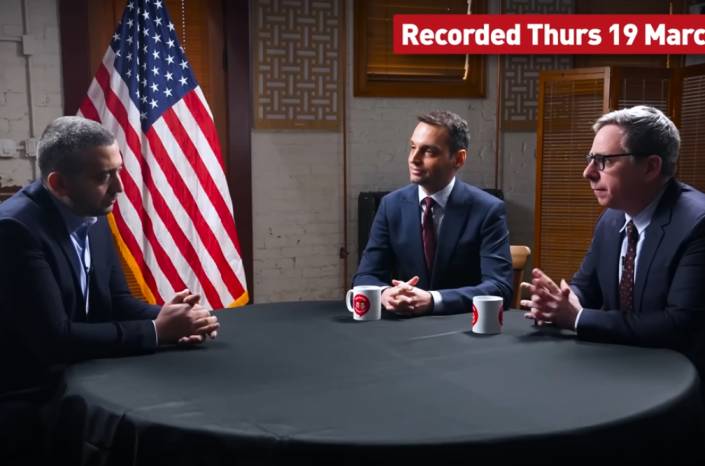
Editor’s Notes: In this intense debate, journalist Mehdi Hasan joins the Triggernometry hosts to dissect the escalating tensions in the Iran war, the complexities of immigration, and the influence of the Israel lobby on U.S. foreign policy. Hasan challenges mainstream narratives, arguing that the current military approach to Iran’s nuclear program is fundamentally flawed and that negotiations remain the only viable solution. The conversation also touches on the “open border” debate and the ethical implications of using AI in modern warfare, providing a provocative look at the most pressing issues of our time. (March 28, 2026)
TRANSCRIPT:
Introduction: Who Is Mehdi Hasan?
FRANCIS FOSTER: Mehdi Hasan. Welcome to TRIGGERnometry. Before we get into the meat of the interview, Iran, domestic policy, all the good stuff. Tell us who you are on your journey through life.
MEHDI HASAN: That’s a big question. Thanks for having me, guys. My name is Mehdi Hasan. I am the editor in chief of a media company called Zeteo. I’ve been a journalist here in the US and in the UK for the past 25 years. I’m old. I used to be at MSNBC. I’ve done shows for Al Jazeera, I’ve worked at Sky News, I’ve worked all over the place. So I do interviews, I do shows, I write books, and I’m stuck in the middle of all the current controversy right now here in Washington, DC.
From the UK to the US: Mehdi’s Political Journey
FRANCIS FOSTER: So what I find very interesting is you’re from the UK, you’re left wing. What brought you to be on the left?
MEHDI HASAN: To be on the left, yes. I grew up in a very political household where my father, my late father, who passed away last year, was very, very political. Loved Harold Wilson, immigrant from India to the United Kingdom in the 1960s, arrived in 1966, a great year to arrive in England.
I grew up in a household where we were taught to give a damn about what’s happening in the world, care about causes both distant and nearby. I’ve always cared about justice. I’m also a Muslim. As a Muslim, you’re taught from a very young age to give a damn about your society, your community, about a world bigger than yourself. So justice, I guess justice has been something that I’ve cared a great deal about.
So, yeah, I was an angry young man in my teens and probably, you know, they say you grow out of it as you grow older, but I didn’t.
FRANCIS FOSTER: Absolutely. Fair enough. So what brought you to the US? Why not stay in the UK and focus on UK domestically and be angry there?
MEHDI HASAN: One, there’s a history of British people coming to the US, both in the media, in entertainment, across the world, to look at different opportunities. I was always fascinated by the United States. I’m sure both of you guys, you’re here in DC. US politics is fascinating. It affects all of us around the world.
Also, my wife is American and they say a happy wife is a happy life. So at some point when she said, you know what, we’ve done a good gig in the UK, why don’t you come try live in the US? So I moved here in 2015 just as Donald Trump was coming down the golden escalator. So it’s been an interesting 11 years.
The War in Iran: Is It Justified?
KONSTANTIN KISIN: Well, it has. And as we sit here in DC, big things are happening globally. The war in Iran, what do you make of it?
MEHDI HASAN: Right now, I think it’s a disaster. I don’t think it was legal, I don’t think it was justifiable, I don’t think it was necessary. I think it’s self-destructive. I don’t think it’s in the US’s national interest. And I think a lot of innocent people are dying as we speak without any real justification.
KONSTANTIN KISIN: Why do you think it’s happening?
MEHDI HASAN: Many reasons. One of the main reasons was expressed by Secretary of State Marco Rubio before he tried to walk it back, where he said that we were told — this is Rubio’s words, I’m paraphrasing — that Israel was about to attack Iran and if they had attacked Iran, Iran would have attacked us. So we decided to attack first. Which is kind of insane on multiple levels.
Number one, if you thought Israel was going to attack Iran, just stop Israel from attacking Iran. It’s your client state. Number two, imagine if you’re at home and you’re like, my brother’s about to get drunk and drive the family car and wreck it. I’m going to wreck it first. So it’s a bizarre argument. They were going to attack, so we attacked first.
So Israel plays a big role in this. I don’t think it’s the only role. Joe Kent, who has just quit the Trump administration, director of counterterrorism, he wrote a letter saying it’s all Israel. Israel manipulated us into war. I think that takes away too much responsibility from Donald Trump, from Lindsey Graham, from the US Government, and hawks in the US who have long wanted a confrontation with Iran.
This has been building for years. We’re all old enough to remember the Iraq war. We’re old enough to remember George Bush, Dick Cheney. They wanted to go into Iran at the time, too. They didn’t. George Bush was smart enough not to do that after the disaster in Iraq. Benjamin Netanyahu is on the record saying, “I’ve dreamed of attacking Iran for 40 years. Trump’s the first president to let me do it.”
Why Would Trump, the Self-Proclaimed Anti-War President, Do This?
KONSTANTIN KISIN: Those are all points that I wanted to discuss with you. But I’m still not very clear on why you think it’s happening. Because I agree with you, a lot of people talk about Israel, but as you said, Israel is a client state of the United States.
So why would President Trump, who’s on the record repeatedly saying, “No more foreign wars, no more forever wars,” who got rid of all the neocons within his administration from the first one, why would he do this now?
MEHDI HASAN: I think “now” is the good question, Konstantin. It’s about the timing, because Donald Trump is not anti-war. I never accepted the line that he was anti-war. I was one of the people in 2024 who said, don’t buy this. He went to Michigan and told Muslims, “Vote for me. There’ll be no wars in the Middle East. No Muslims will die. If you vote for Kamala Harris and Liz Cheney, they’re going to bomb the whole of the Middle East.” I never bought that stuff. I remember his first term. He was pretty belligerent.
KONSTANTIN KISIN: Why not? Why didn’t you buy it?
MEHDI HASAN: Because in his first term, he expanded drone strikes. He killed Qasem Soleimani. He bombed Somalia at a rate we never talk about. There was nothing in his first term that said this guy is not totally happy with war. He also surrounded himself with, look at the people he hired — Marco Rubio, Pete Hegseth. Look at his best friend in the Senate, Lindsey Graham, a man who’s never met a country he doesn’t want to invade. So I never bought that. And unfortunately, I’ve been vindicated.
In his first year, he bombed, I think, seven countries in 12 months. Last year, he just bombed Nigeria on Christmas Day. We’ve all just moved on from that. He started this year with Venezuela, regime change, Maduro, and then Iran.
The timing is interesting. I was talking to Senator Chris Van Hollen, an anti-war Democrat, yesterday, and we were trying to get to the bottom of this. What is going on in Donald Trump’s head? Is it just Benjamin Netanyahu playing him? Partly, yes. Netanyahu’s kind of admitted it. Is it the old belligerence of Donald Trump with a country that won’t bow down to him? Is it Witkoff and Kushner screwing up the negotiations, not understanding what was going on, which a lot of reporting is suggesting? Is it just Jared Kushner and others trying to make money out of this? A lot of would — Trump follow the money is often an explanation for a lot of what’s going on.
Is it him trying to distract from domestic economic woes? We’ve seen this before. Unpopular leaders at home decide to start a foreign war to distract public attention. Zeteo, my company, did a poll of the American public recently and found 52% of Americans think the Epstein files was one of the reasons Trump went to war. You might think that’s a mad conspiracy theory, but a majority of Americans believe that is one of the reasons he went to war.
So I think it’s a mix of things. Israel obviously played a big role in that. And I think now he’s in it, he’s doubling down, tripling down. He could just declare victory. People like Tucker Carlson have called him, or called proxies of his, and said, “Just say mission accomplished and go home. Just say, I killed Khamenei, I degraded their military, and go home. Like you did last year after the 12-Day War.” He won’t do it. He’s quadrupling down as we speak.
Is Trump Losing the War?
KONSTANTIN KISIN: So why do you think that is?
MEHDI HASAN: If we’re going to spend an hour psychoanalyzing Trump, it’s going to be difficult. I think he is someone who does not want to accept defeat. The worst thing in his life is to be a loser. The guy doesn’t accept he lost the 2020 election. Still ranting on about that. The idea that he would lose to the Iranians — and he is losing right now. Let’s just be very clear. All of the available evidence suggests he is losing.
KONSTANTIN KISIN: What do you mean?
MEHDI HASAN: What are his goals in Iran? We don’t know, because he’s never really stated them. But if it’s destroying Iran, he’s failed. He posted a couple of weeks ago, “I’ve destroyed 100% of Iran’s military capability.” Okay, then what are we watching every day? Missiles landing on Gulf countries? What are we watching happening in the Strait of Hormuz? He’s alienated his allies. Iran’s nuclear enrichment, whatever they have still left over, they still have. They’re still hitting Gulf countries. Gulf countries are furious.
So I think he’s losing. And strategic experts will point out that a country like Iran wins simply by surviving, because they’re the weaker, smaller power. So I think he’s in a bad state. I don’t think he’s going to give up because he can’t handle the defeat.
And by the way, it’s a US-Israeli war. And a lot of people have pointed out that the US and Israeli interests are not the same. Our strategic interests are not Israel’s.
The Israel Lobby: Manipulation or Mutual Interest?
KONSTANTIN KISIN: That’s very clear that they’re not. And I think that divergence is one of the reasons people keep saying Israel tricked Trump into this war. Or bullied — I think one of your guests on your show recently talked about how he bullied him. And that’s where they lose me, because I don’t understand what this supposed mechanism is by which Israel bullies America.
MEHDI HASAN: Well, I don’t know about the word “bully,” but let me just say, in terms of tricked or manipulated, this is not a conspiracy theory. The beauty of these Republicans — and you’re in DC, I know you’re going to be speaking to Republicans — the only redeeming feature of the Republican Party right now is they just say the quiet part out loud. People like me don’t need to speculate or come up with theories. They just say it.
So Lindsey Graham told the Wall Street Journal that he went to Israel and Israel showed him intel that made him think, “We’ve got to go to war.” That’s bizarre. A United States Senator went to a foreign government for intel. Then he says he met with Netanyahu and he coached him — his words, not mine — on how to persuade Trump to get into this war. Again, bizarre that a United States Senator and a foreign leader are discussing how they’re going to coach, how they’re going to persuade, manipulate a sitting president into war. So they’re saying this stuff out loud.
I’m not absolving Trump of responsibility, but nor am I saying Israel didn’t play a role. Would we be in this war were it not for Israel? No, I think that’s very clear. And by the way, if we stopped the war tomorrow — just one last point — if Trump was saying, “We’re done, we’re over,” one of the reasons I think he’s not is because he’s been told the Israelis aren’t stopping. And therefore, as long as the Israelis go, we go.
KONSTANTIN KISIN: Well, see, all I’m doing, Mehdi, is trying to parse logically the things that people are saying, including logic —
MEHDI HASAN: And Trump doesn’t always go in the same sentence.
KONSTANTIN KISIN: Well, sure, fine. But I guess what I’m saying is this. If President Trump didn’t want to do this, he wouldn’t do it. Agreed?
MEHDI HASAN: We are in 100% agreement.
KONSTANTIN KISIN: He could very easily say to Iran, “We have nothing to do with this.” And in fact, “We’re not even going to shoot down your ballistic missiles if you shoot them at Israel, because we want no part in this,” and then none of this would be going on. So that’s the bit where people lose me when they talk about Israel. I mean, every country wants to manipulate the United States into doing —
MEHDI HASAN: They’ve been doing it well. But he’s easily manipulated.
The Israel Lobby and Its Influence on American Politics
KONSTANTIN KISIN: Russia wants him to make it easier for them in Ukraine. Ukraine wants it to make it easier for them to defeat Russia. China spends huge amounts of money shaping US Foreign policy, if it can, so does Qatar. So do lots of countries. So I guess the thing that I’m trying to get to the bottom of, because it’s such a big talking point in the US right now, is what is the supposed mechanism by which this tiny country of Israel has this outsized power over the President of the United States?
MEHDI HASAN: So, couple of things. One is, it’s not mutually exclusive. Is it, Konstantin, to say that Donald Trump has responsibility. He’s a grown man. He may not act like a grown man, but is a grown man and has to take responsibility for decisions he makes. That’s not mutually exclusive with saying, but the Israelis also tricked him, manipulated him, lobbied him, bullied him, pressured him. Both of those things can be true at the same time.
KONSTANTIN KISIN: All I’m asking is what is the mechanism?
MEHDI HASAN: But we accept that both those things —
KONSTANTIN KISIN: — could be true, of course.
MEHDI HASAN: So now we come to what is the Israelis doing. You would accept that you just listed a bunch of countries and the Gulf, the Qataris have a lot of influence. The Emiratis have a lot of influence. The Russians sadly have a lot of influence with Trump. You would accept that none of those countries come close to Israel’s influence. I don’t think there’s any question mark about Israel’s influence on American politics. The question you’re asking about is, what’s the mechanism? And no one would deny. I mean, you watched the Ted Cruz interview with Tucker Carlson that went viral not long ago. Cruz says, “I came into politics to defend Israel.” They don’t say that about any other country. I’ve never heard an American senator say, “I came into politics to defend Belgium.” Never heard it. Never heard anyone talk about any other country.
KONSTANTIN KISIN: Let me reject one more thing, if I may. That’s not necessarily evidence of Israel having influence. It might well be a case of that. There are lots of people who live in America who believe, for whatever reason, for religious reasons or for geopolitical reasons, that this is a country with which America should have a close alliance.
MEHDI HASAN: 100% I agree with you. There are Christian evangelicals in this country who believe that the rapture will happen when all the Jews are gathered in this place, and they are even more hardcore pro-Israel than a lot of pro-Israeli Jews. That’s 100% true.
But there are also a bunch of people in American politics — I know, I’ve met them, I’ve interviewed them, they tell me this on and off the record — who are supporting Israel because they’re worried about being primaried, they’re worried about losing their jobs, they’re worried about being called anti-Semitic, they’re worried about being targeted by AIPAC, they’re worried about being targeted by their political opponents, et cetera, et cetera.
The idea that there isn’t a very, very powerful pro-Israel lobby is absurd. Just as there is a very powerful gun lobby, just as there is a very powerful farmer lobby. It’s funny that in this city, people are happy to say “you’re owned by the gun lobby,” but for good reasons, because of anti-Semitic tropes, people don’t want to say “you’re owned by the Israel lobby.” There’s a good reason for it, of course. But the fact is, there is an Israel lobby that has massive, outsized influence on American politics.
The Democratic Disconnect on Gaza
KONSTANTIN KISIN: The distinction I’m trying to make, and I think it’s an important one and it’s good that we’re exploring this, is I think the reason people worry about calling it the Israeli lobby versus the gun lobby is the Israeli lobby implies some kind of foreign influence. Whereas the point that I think you and I are both making, actually in agreement on, is there are lots and lots of Americans who, for whatever reasons — their own personal reasons — view this as an important strategic alliance of the United States, or a religious worldview, or whatever. And I think that’s where the distinction becomes difficult.
MEHDI HASAN: I think you’re in good faith overstating the other part of the argument, maybe for argument’s sake or devil’s advocacy. All I’m saying is, let me give you one example. When you ask Democratic voters, “Do you support what Israel’s doing in Gaza?” 8%, according to one poll, said we support it.
KONSTANTIN KISIN: Democrats don’t support it.
MEHDI HASAN: The vast majority don’t support it. When you go look at Democrats in Congress, the vast majority do support it. There’s an absolute discomfort. The numbers are reversed.
KONSTANTIN KISIN: And why is that?
MEHDI HASAN: That’s exactly my point. Why is that? It’s not because they’re all out for self. It’s because they are lobbied by various lobbies — the military industrial complex, which also has interest in war, the pro-Israel lobby, vast influence. There’s money in politics that influences a lot of positions in this country. You’re in this town — this whole town is very corrupt. The way you influence people is through money. And the same thing with Israel.
By the way, you mentioned foreign lobbying. I said “Israel lobby,” not “Israeli lobby.” The lobby for Israel — that can be Americans. But let’s just be clear. There’s a long history of people trying to get the pro-Israel lobby to register as a foreign agent, just as some pro-Arab lobbies have to register as foreign agents. You go back to RFK — Robert F. Kennedy Sr. — he wanted to register the precursor to AIPAC. Senator William Fulbright, a very famous Democrat senator in the 70s, said we should register it as a foreign lobby. So there’s been a debate for a long time as to whether AIPAC and other such groups should actually register, because they do seem to coordinate with the Israeli government. That’s a separate issue.
But look, I take your point. There are many Americans who support Israel. But if you look at the polling, Konstantin — you’re in D.C. at a time when, in astonishing polls I never thought I’d see in my lifetime, Americans have now switched. They are now supporting Palestinians more than they support Israel. First time in my life I never thought I would see those polls. Sadly, it took a genocide and tens of thousands of Palestinians to get Americans to switch their positions. But again, if that doesn’t translate into Congress, into the presidency, then you have to ask, why do we have a democratic crisis?
KONSTANTIN KISIN: Well, 70% of Republicans support Israel over Palestinians.
MEHDI HASAN: But the American public — Republicans, Independents and Democrats —
KONSTANTIN KISIN: Yeah, the Republicans are in power, so that would explain it.
MEHDI HASAN: But they should also respond to public opinion. It’s not like when Democrats are about — they only follow the base. They spend their whole life chasing swing voters.
KONSTANTIN KISIN: I don’t know about that.
MEHDI HASAN: Well, look at Kamala Harris’s election campaign. She didn’t go to the left.
KONSTANTIN KISIN: Interesting. So, coming back to the Democrats — it’s an interesting point you make. So your contention is Democratic politicians fear AIPAC.
MEHDI HASAN: Yes. We’re meeting in D.C. just after a bunch of primaries in Illinois. AIPAC dumped millions of dollars to defeat the critical —
KONSTANTIN KISIN: Lots of lobbyists dumped millions of dollars.
MEHDI HASAN: I’ve agreed. We said that.
KONSTANTIN KISIN: But your claim is that the reason Democratic politicians ignore their voters’ concerns about the Middle East, for example, is because of something like AIPAC.
MEHDI HASAN: Yes.
The Iran War: Uncharted Waters
KONSTANTIN KISIN: Okay, fair enough. And so how do you think this conflict will go on from here?
MEHDI HASAN: It’s very hard to know. We’re in uncharted waters. I’ve said since 2003, both as a private individual and when I became a public figure in 2009, I’ve said this consistently — that I was against the Iraq war. And I think it was one of the big disasters of my lifetime. But Iran would make Iraq look like a walk in the park. It would be Iraq on steroids. Much bigger country, much harder to topple, way more regional and international ramification.
And we’re seeing that now. We’re a couple of weeks into this war and we’re seeing the oil price spikes, the economic repercussions globally, the attacks on natural gas facilities. I’m not an expert on this stuff, but the experts are saying this could have 10-year, 20-year ramifications to rebuild some of this stuff. The environmental consequences in the region, the public health consequences of causing acid rain in Tehran, and of course the blowback.
I always joke that Americans have the memory of goldfish — eight seconds. It’s hard to remember last week, let alone last year. People in the Middle East have very long memories. Americans don’t know who Mohammad Mosaddegh is. Most Iranians will tell you that’s the prime minister who in 1953 the US overthrew and brought back the Shah, and then the Shah led to the revolution, et cetera, et cetera.
When we talk about blowback, we need to have the big picture. God forbid, three years, five years, a year from now, some bomb goes off somewhere, kills a bunch of innocent Americans. We say, “Why, why, why do they hate us?” And we’re like, “Khamenei, who’s he? We’ve forgotten about him already.” This is my worry. We’ve seen this with every invasion. The invasion of Iraq brought about ISIS. The invasion of southern Lebanon in 1982 brought about Hezbollah. These illegal wars, these wars of choice, these occupations — they lead to blowback, unintended consequences, what the CIA calls blowback.
And I really worry about that. When it comes to Iran, we don’t know what’s going to happen next. To quote Donald Rumsfeld, an Iraq war architect, there are the known unknowns. We know there’s some bad coming, we don’t know what it is.
FRANCIS FOSTER: Mehdi, there’d be people who go, “Well look, you’ve mentioned Hezbollah. Iran funds Hezbollah, they fund Hamas, they effectively destabilize the region.” I don’t say that I agree with this, actually. But they would say, “Look, if we deal with Iran long term, we’re going to get a better, more prosperous, more stable Middle East.” What would you say to that?
The Consequences of Regime Change
MEHDI HASAN: I would say Benjamin Netanyahu said exactly those words in front of Congress in 2002. He said, “If you invade Iraq, there’ll be positive reverberations throughout the region.” What happened? We got ISIS, we got Al-Qaeda in Iraq. We got 20 years of war. We got the seven bombings in London. Tony Blair was warned — if you invade Iraq, there will be bombings at home. The Joint Intelligence Committee told him in 2003. He ignored those warnings. We got more terrorism, more blowback, more violence, more regional instability, more refugees. That’s what I fear is happening now with Iran.
In terms of destabilizing the region — look, this is where we get to, where do you start the clock? I would say, yes, of course Hezbollah and Hamas destabilize the region. But they would argue, and many people would argue, that the destabilizing began with Israel. They are a reaction to Israel’s actions. Depends where you want to start. Like I said, 1982 — Israel invaded southern Lebanon. There was no Hezbollah in 1982.
Look, Iran does play a role that is malign. I’ve never blindly defended Iran. Iran does bad things. No one’s debating that. Many countries in the Middle East do bad things. We are not invading Saudi Arabia. I think we would all agree around this table that Saudi Arabia does bad things, has done bad things. We are not invading and trying to topple Saudi Arabia, or bombing their oil fields and gas facilities. And I’m glad we’re not.
So I don’t think this war is a solution to the problem. By the way, what is the problem? Donald Trump will not tell us what the goals of this war are. It changes every day. Marco Rubio says it’s degrading the Navy. First they said it was the nuclear program that they obliterated last year in the 12-Day War.
The Nuclear Deal, Iran’s Incentives, and the Strait of Hormuz
KONSTANTIN KISIN: Apparently there’s a lot of evidence that the nuclear material may well have been removed prior to strike.
MEHDI HASAN: But I’m saying this war was not about the nuclear program because that’s actually—
KONSTANTIN KISIN: —the thing that they have said that makes sense to me. I think I’m actually kind of with you in terms of I don’t understand what the goals of this thing are.
MEHDI HASAN: They don’t.
KONSTANTIN KISIN: If we take the nuclear stuff and degrading the military, that’s fine, but then why are you killing their leaders? That’s the bit I don’t understand.
MEHDI HASAN: Well, interestingly, they’re not killing their leaders right — they killed Khamenei, but the Israelis are doing much of the killing. They’ve killed the intelligence minister. They killed Ali Larijani.
Now, let’s just deal with what Israel wants. Because what Israel wants is pretty clear to anyone watching. They want an unstable, weakened Iran that doesn’t pose a threat to them. They don’t care if it’s a democracy. They don’t care if it’s a dictatorship. They don’t care if it’s civil war. They just want Iran off the table.
And therefore they’re killing people who might do a deal with Trump. They’ve done this before. Last year in the 12 Day War, they tried to kill a guy called Ali Shamkhani, who survived. Then they killed him. Now, he was a negotiator who Trump had been praising and reposting on social media. They killed him because they don’t want Trump to do a deal with this guy.
FRANCIS FOSTER: Why not?
MEHDI HASAN: Because they don’t want to negotiate a solution to this conflict. They want to keep going, the Israelis, until they wipe out everything.
KONSTANTIN KISIN: Yeah. They want to degrade Iran.
MEHDI HASAN: They don’t want Donald Trump to do one of his deals. That’s the worst thing they could have. They didn’t want the JCPOA, the Iran nuclear deal that Obama signed, that would resolve the nuclear program for at least 15 years. They were dead against that deal.
KONSTANTIN KISIN: But so was Trump himself.
MEHDI HASAN: Yes. And Trump pulled out of that deal. And then what happened? Enrichment went up. Then Biden came back in, said, “Let’s try and go back into that deal.” The Israelis attacked Natanz in 2021. They enriched up to 60%. Then last year, they went to Oman to negotiate. They had a meeting scheduled for Sunday. The Israelis bombed on Friday.
This year they negotiated in Geneva. The Omani Foreign Minister came to D.C. and said, “A deal’s on the table.” Apparently Jonathan Powell from the UK said there was a deal to be done. Guess what happened? The US and Israel bombed the next day. There’s a history of Israel in particular, but also the US, bombing every time we’re close to a deal, every time there’s a negotiation in place.
KONSTANTIN KISIN: And this is why we just come back to the nuclear point, because I agree with you. It’s very clear that there’s a difference between the interests of the United States and the war goals of the United States, and the war goals and interests of Israel. And Israel’s war goals and interests are actually very clear. I’m very unclear as to what the US wants.
MEHDI HASAN: Well, if it is the nuclear program, I think we’re both unclear. But if it is the nuclear program, I don’t think they know. But if it is the nuclear program, this is not the way to do it. Negotiations are the way to solve it. Most experts say you cannot bomb away a nuclear program. It’s in people’s heads. It’s scientific expertise. You cannot kill every scientist and academic—
KONSTANTIN KISIN: —destroyed the nuclear material and then they can just—
MEHDI HASAN: —and then years later they can rebuild facilities and enrich again.
KONSTANTIN KISIN: Sure.
MEHDI HASAN: And then you’re just mowing the lawn, as the Israelis say — go in and bomb every couple of years. But we had a JCPOA, we had a deal that was working. The IAEA said Iran was in compliance with it. You know how much enriched uranium they had under the JCPOA? 3.64%. You know how much they have now? 60%. You want to go back to logic — logic tells me that was a failure to get out of that deal.
KONSTANTIN KISIN: I also don’t think there’s any huge evidence that negotiations produce nuclear non-proliferation. I just think this is a very—
MEHDI HASAN: Come on. I think it’s the entire history of the post-war era.
KONSTANTIN KISIN: Well, if you look at Ukraine, for example, Ukraine was forced to give away its nuclear weapons and made itself very vulnerable. And I’ve been on record as saying I think that in and of itself, and the fact that we haven’t supported Ukraine properly, will lead to more nuclear proliferation.
MEHDI HASAN: I agree with you on that, and—
KONSTANTIN KISIN: —I think on this issue too, I don’t see what the incentive would be for Iran not to pursue nuclear weapons.
The Lessons of Iraq and the Logic of Nuclear Deterrence
MEHDI HASAN: Well, we’re in agreement, but not just Iran. If you guys remember the Iraq war — do you remember Mohamed ElBaradei? He was the head of the IAEA.
KONSTANTIN KISIN: Yes.
MEHDI HASAN: Him and Hans Blix went to the UN and said, “Don’t invade Iraq, we can disarm.”
KONSTANTIN KISIN: We were both against that one.
MEHDI HASAN: Right. That’s why I’m saying this to you, because I know you understand. He said, “We can guarantee disarmament.” He was the head of the Nuclear Watchdog, spent his life opposing nuclear proliferation. I interviewed him recently. I said, “If you were in the Turkish government right now, which Israel is saying is next, would you try and get nukes?” And he said yes. I was astonished. This is a man who’s devoted his life — because as you say, everyone now has an incentive to get nukes. Why would you not?
KONSTANTIN KISIN: My point was even broader than that, Mehdi, which is that I think everyone always has the incentive to get nukes. And that’s where I don’t think negotiating with Iran—
MEHDI HASAN: So that’s where we disagree.
KONSTANTIN KISIN: Hold on, let me finish the point, though. I don’t think Iran has any interest in that. Iran is very clearly — the reason the Gulf Arab states and Israel all want Iran degraded, and all supported this conflict, by the way, and are still encouraging it — the Gulf states especially internally, the people at the top, the people on the street may not — is because Iran wants to dominate the region. It’s a perfectly legitimate thing for Iran to want to do. But that being the case, the fact that they fund proxies to facilitate that process — of course they’d want nuclear weapons, and I don’t think they’d negotiate them away.
MEHDI HASAN: But they already did negotiate them away. According to US intelligence, they suspended whatever nuclear weapons research they were doing in 2003 after the fall of Saddam, because they didn’t want Bush to invade them. There was also a fatwa from the late Ayatollah Khamenei saying that nuclear weapons are haram — forbidden under Islamic law — which is ironic. People are now saying, I hear supporters of Khamenei saying that was a mistake. He should have actually got—
KONSTANTIN KISIN: But under him, they did enrich more—
MEHDI HASAN: —uranium, but they didn’t build weapons. Enriching uranium is their right. Under the NPT, every country enriches uranium. No, not to 60%. That was a bargaining—
KONSTANTIN KISIN: But they did.
MEHDI HASAN: That was a bargaining chip. Well, why did they enrich to 60%?
KONSTANTIN KISIN: Because they’re saying if you keep pushing—
MEHDI HASAN: Israel attacked them. So they went to 60%.
You say Iran wants to dominate. This is so important for your viewers to understand the timelines here. I know we in the west — we’re kind of brainwashed by some of our media and politicians to believe that Iran is this Hitler country. And again, I’m not saying that. I didn’t say you said that. I said some in our media and politicians — brainwashed over the years. Trigonometry is a great show. It hasn’t been here for decades. I’m talking about the last 30, 40 years — have been told that Iran is the great… you know, just like Iranians say “the Great Satan,” Iran is also the great rogue state in the Middle East.
Actually, when you look at it, Iran is the country that is actually now being bombed, was attacked from 1980 to 1988 by our ally Saddam Hussein, attacked with chemical weapons, lost half a million people, had their plane shot down by the United States of America. And then they agreed to a negotiated deal with the American government in good faith — and with the EU, by the way. The JCPOA was with the US and the EU. Iran stuck to that deal. Trump tore it up. Trump violated that deal by pulling out of it.
As I said, they then began to increase enrichment only after the deal was done. So I don’t accept your premise when you say, “Of course they want to get nuclear weapons and enrich.” No — they signed the JCPOA, which says in the first paragraph, “We will never get nuclear weapons.” That’s what they signed.
KONSTANTIN KISIN: But they then took that money and used it to fund their proxies.
MEHDI HASAN: Okay, but now you’re moving the goalposts. I just want to stick with your nuclear point. You made a very strong point about nuclear — they have incentive to get nuclear weapons. I’m saying there’s no evidence of that. It’s the exact reverse.
KONSTANTIN KISIN: The incentive is clear. You’re saying now they have an incentive?
MEHDI HASAN: For sure. They just got attacked.
KONSTANTIN KISIN: They always do.
MEHDI HASAN: Well, of course.
KONSTANTIN KISIN: I mean, if you want to be the—
MEHDI HASAN: Strategically, yes, there was a— But the irony is they didn’t. That’s the irony. If they did, they’d be fine. Ayatollah Khamenei would be alive, chilling with Kim Jong-un right now if he had got nukes like Kim Jong-un did. Let’s just be very real about that. There’s a reason why Pakistan and North Korea — which destabilize their region much more than some would say Iran does — are fine, because they have nukes.
KONSTANTIN KISIN: We’re in complete agreement.
MEHDI HASAN: But Iran didn’t get nukes. This is a great irony here. They didn’t get nukes. They got attacked. The leader got killed. And now I’m hearing you say it’s because they wanted to get nukes. It’s the exact opposite. If they had gotten nukes, they’d be in a much safer place.
Instead, he put out a fatwa saying no nukes. He signed up to the JCPOA, which many Iranian hardliners were against. Khamenei signed on to a deal that people in his own country said we shouldn’t sign on to. They then stuck to the deal, according to the IAEA. Trump then tore up the deal. They then marginally increased enrichment to 20%. They then got attacked by Israel in 2021, increased to 60%. And then last year got attacked during negotiations, and again this year got attacked during negotiations.
And one last point — the Gulf countries. It’s just not true. The Omani Foreign Minister just wrote a piece for the Economist magazine. Oman got bombed by Iran. And even he’s saying it’s very rational for Iran to do what it’s doing. This is an Israeli war that America has been dragged into. America needs to be independent from Israel.
The Qataris — I’ve spoken to very senior Qataris privately, who of course are mad that Iran are bombing their oil and gas fields. But they know who they blame. They know who started the war. It was Israel and the United States. And they’re reaching out to the US, telling the US to stop this. So maybe the Saudis, maybe the Emiratis wanted this war, but not all of the Gulf countries. That’s just not true.
KONSTANTIN KISIN: Fine.
The Strait of Hormuz and the Economic Stakes
FRANCIS FOSTER: So it’s really interesting that you’re talking about the bombing of facilities, gas facilities, et cetera, because one of the worries for me, Mehdi, is how this is going to affect ordinary Americans. And I don’t actually think that we’ve been focused on that enough. So let’s talk about the Strait of Hormuz. Let’s talk about why it’s so important. Let’s talk about why shutting it down is not potentially catastrophic — it is catastrophic — for the global economy. But for Americans and Brits and the west in particular, it’s a disaster.
The Strait of Hormuz and the Cost of War
MEHDI HASAN: This is what. So we just ran a piece by Elan Goldenberg, who was a senior official on foreign policy under Barack Obama and Joe Biden. He conducted war games with the United States government and what would happen if they attacked Iran because they were doing the JCPOA, they had to have a backup in case it all goes pear shaped.
If we go to war in Obama time. He says the worst case scenario of the war games is what’s happening right now. That’s kind of scary when you hear someone who’s in government saying that. He wrote that piece for us and he said, look, the Strait of Hormuz is always going to be the Iranian leverage. It was always going to be the choke point.
When Donald Trump comes out and says, “We didn’t know they would do this, we didn’t know they would attack the Gulf countries,” I mean, it’s idiocy of the highest order. It’s like Covid all over again. He mishandled a major national crisis because he was incompetent, not just ideologically doing the wrong thing. And again, we have these people like Hegseth and Trump who are completely out of their depth running this war and saying stupid things like, “Well, we didn’t know about the Strait of Hormuz moves.”
I just saw reporting the other day that the Brits and the Poles and the Germans all have minesweeping carriers that could have been of use. The Brits pulled ours out. I don’t know where the German one is. But meanwhile, Trump is just attacking all the allies, saying, “We don’t need anyone from NATO. We don’t need you.” He’s doing all caps, late night, insane, deranged posts on Truth Social. He doesn’t know how to run a war. He doesn’t know how to keep allies on board.
Again, I’m going to have to go home and take a shower after praising George Bush. But even George Bush, a war criminal who should be in the Hague, created a coalition of the willing with a bunch of countries. Not the big countries, but some. What was it called? New Europe, Rumsfeld called it. This guy can’t even build together a coalition. He didn’t even tell his allies before he decided, as you say, to create massive economic chaos for everyone in the world.
And we’re speaking on a day, Francis, where the Treasury Secretary just announced we may unsanction Iranian oil. I don’t say hilarious, because it’s such a tragic war and people are dying. But bizarre that three weeks into this war, the result of this war is Iran’s oil is unsanctioned. That’s insane.
FRANCIS FOSTER: But let’s go back to the Strait of Hormuz. Can you explain for people who are listening, who have got families, they’ve got jobs — why is it so important? And why is closing it so disastrous?
MEHDI HASAN: So it’s where the majority of that region’s oil and gas goes out of the region, goes out to China and India, into the Indian Ocean. It’s very narrow. I think it’s 25 miles at its narrowest point. It means that the Iranians can shut it down with, like, one guy on a boat, right? With, like, a rocket launcher. It doesn’t require a massive Iranian military presence.
There was a moment the other day where he said — we’re run by such incompetence — Peter Hegseth, the Defense Secretary, said, “No, no, it is open. You can go through with a ship, as long as you don’t get attacked.” Well, you will. So it’s not open. The whole point is all these planners, military planners, are saying you can’t open it up. As long as Iran is a country in that region, they will always have that leverage to shut it down, because it doesn’t require much on their part to take out one tanker — and then which country, which company is going to go into that place?
So there are literally two lanes, one going that way, one going that way. It’s very easy to shut down. So this was always the Iranians’ key leverage point. And apparently Trump didn’t know about this, didn’t think it through. He posted the other day calling it the Strait of Hormuz, spelled S-T-R-A-I-G-H-T. That’s the President of the United States.
So we’re in a very disastrous position. The Iranians can hold out. We don’t know how long the Iranians can hold out, but the longer they do, us at home here in the US — you guys in the UK — are going to feel the pain. $104, $110, $120 barrels of oil. Who knows how high it’s going to go? And the repercussions for a country where affordability was the big political issue at the last election — inflation.
Trump’s Political Gamble and the 2028 Question
KONSTANTIN KISIN: Well, you should be very excited about this, Mehdi, surely, because, remember, you asked —
MEHDI HASAN: — me at the beginning why I’m on the left? I believe in justice. I don’t want people to suffer just to win my political —
KONSTANTIN KISIN: I meant — I was kidding, obviously — but I meant politically. The Democrats, I think, are on course to win the House and the Senate.
MEHDI HASAN: Maybe the Senate. Definitely the House, yeah.
KONSTANTIN KISIN: And you imagine — I mean, it’s clear, I think, whatever you think. You support the conflict or the President, Trump or you don’t. I think it’s very clear. This is the biggest gamble of his political career, 100%. And if it doesn’t go the way he wants, I mean, the Republicans surely would lose the presidency at the next election. Bush and Blair were reelected after —
MEHDI HASAN: The real counterargument is there’s three years to go. Francis, Trump years are like dog years.
KONSTANTIN KISIN: Francis is him, but that’s fine.
FRANCIS FOSTER: I know what he tries to say.
KONSTANTIN KISIN: It’s all right, it’s all right.
MEHDI HASAN: Because I’m —
KONSTANTIN KISIN: So you did that politician thing where you tried to name people by name, but you got us confused.
MEHDI HASAN: It’s because I was thinking about the next three years as I said it. The point I was making when I confused you both was it’s three years to go of Donald Trump. Three years — we’ve just had a year, and it feels like 10 years. The idea that anyone can know what will happen in the US a year from now, let alone three years from now, is insane. Anyone who tells you they know what America will look like in 2028 is a liar or a fool. It’s just too much change. Too much happens here.
So anything could happen between now and then. That’s why people who say it’s going to be Vance or Rubio — no, it might be neither of them. It might be Trump again if he doesn’t want to leave.
KONSTANTIN KISIN: Do you think that’s a realistic possibility?
MEHDI HASAN: Yes.
KONSTANTIN KISIN: You think there’s a possibility?
MEHDI HASAN: 100%. Not that 100% that he will stay, but 100% there’s a possibility that he would try. That he would try.
KONSTANTIN KISIN: To me, that’s kind of terrifying.
MEHDI HASAN: It is.
KONSTANTIN KISIN: But then we talk to people all over the political spectrum, but we have a lot of friends who are on the right, and they all say, “If that were to happen, I’d be on the streets opposing it.”
MEHDI HASAN: So, again, I have a longer memory than most. In 2019, I wrote a piece for the Intercept saying, “Donald Trump loses next election. He will not accept the results. He will try and stay in office. He will start a riot.” I wrote that piece in May 2019. People laughed at me. I was not an American at the time. They said, “You’re a Brit. You don’t understand American politics. Secret Service will march him out. His party will never accept it.” January 6th happened. He still doesn’t accept the result. He’s still trying to fiddle with that result and the next result.
Donald Trump should be taken seriously and literally. I do take him seriously and literally when he says again and again, “Should we suspend elections? Will this be the last time you ever have to vote? Should I stay on for a third term?” He’s not just joking. I’m not saying he isn’t joking, but he’s not just joking. In that weird head of his, there’s stuff whirring.
You’re a close Ukraine watcher. Remember when Zelenskyy came to the Oval Office — not the time he got berated, but the other time — and a journalist said, “Why haven’t you had elections in Ukraine?” And Zelenskyy said, “How can I have elections? We’re in the middle of a war.” And Trump jumped in immediately: “Oh, if you’re in a war, you don’t have to have elections. I’ll have to remember that. Ha ha ha.” And people chuckled. And I’m thinking, that’s Donald Trump’s brain working there. He’s thinking, there’s a war — maybe we don’t have to have elections.
And you’ve got people like Steve Bannon, who I do take seriously, making it very clear that they’re working on a plan to try and keep him in office in 2028. That doesn’t mean they’re going to succeed. That doesn’t mean he’s going to do it. But to pretend — when he shows world leaders merch saying “Trump 2028” — that we shouldn’t take this guy, who already tried to stay on in office, already incited an insurrection — yeah, we should take that seriously.
The Democrats’ Problem
FRANCIS FOSTER: This is a party that doesn’t believe in democracy anymore. But we’re talking about democracy, and I’m looking at the Democrats. I’m not someone who’s on the left or the right. And I’m looking at the Dems, and I don’t see any candidates. I don’t see any particular ideas. I don’t see any challenge, if I’m being honest. Mehdi, what am I missing?
MEHDI HASAN: It’s a good question. I mean, look, I’ve been very critical of the Democratic Party from my own position on the left. Look, there are not great candidates. I agree with that. There are candidates — it depends who they’re up against. If you’re up against a Vance, then Gavin Newsom or Jamie Pritzker or whatever it is could do a decent job and easily be competitive. I don’t rate those Republican candidates.
But yes — do I wish there was a more dynamic Democrat? Yes. Do I wish there was a more charismatic Democrat? Yes. Do I wish there was a more populist Democrat? Yes. Do I wish Bernie was 20 years younger? Yes. Will AOC run? We don’t know. It’ll be interesting to see.
I think there will be about 30 people running. Remember the 2016 elections where the Republicans had to have a kiddie table debate the night before because there were too many candidates — like Lindsey Graham and the losers who went the night before? I think they’re going to have a Democratic version of that, because I think everyone and their dog is going to run this time.
FRANCIS FOSTER: But you look at Gavin Newsom and people are going, “Oh, this guy’s the next candidate.” You look at California — it’s a mess.
KONSTANTIN KISIN: He’s got great hair, though.
FRANCIS FOSTER: Yeah.
The Future of the Democratic Party
MEHDI HASAN: He looks the part. Donald Trump would make him a running mate if he was a Republican because he always goes for visuals. Yeah. Look, I’m not disagreeing with you. I think there are Democrats. But look, again, three years to go. I’m of the Donald Rumsfeld “Known, Unknown, unknown, unknown.” There could be someone none of us have even thought about who emerges. Barack Obama was elected in 2004 as a senator and then ran for president in 2008 and won. There’s a guy, Jon Ossoff in Georgia, who’s about to be in a very tight Georgia Senate race. He’s Jewish, he’s young, he’s centrist, he’s not on my side of the political spectrum. He could. He’s very charismatic. He could be the candidate. If he wins in Georgia, he could change things around. We don’t know.
FRANCIS FOSTER: Do you think when you look at people like Zohran Mamdani, do you think,
MEHDI HASAN: I wish he was born in the US so he could run for president.
FRANCIS FOSTER: Do you think that could be the future of the Democratic Party, that kind of very left wing progressive politics? Or do you think that in order for the Dems to win, they need to be more pragmatic and they need to attack the center?
MEHDI HASAN: I don’t know what the center is anymore, to be honest. In the crazy world we live in now, and I know you guys are based in the UK where there’s five parties now fighting for dominance, I think the old ways of thinking about politics are gone. What does the center mean in the age of Trump?
I think what matters is, are you anti-establishment or are you pro-establishment? I don’t think it matters. I think left and right is less relevant then. Are you anti-establishment or pro-establishment? Are you a populist or are you not a populist? I think that’s what Mamdani proved in New York. Mamdani got a bunch of Trump voters. So did AOC, Alexandria Ocasio-Cortez. Trump voters. They exist. There are Trump-Mamdani voters. Why? Not because they agree with his socialist policies, but because they see him as an outsider. They see him as someone who takes on the establishment. They see him as someone who speaks his mind and doesn’t talk like a consultant with boring talking points.
That is going to be the person who emerges and is really going to occupy the ground — center or left — come 2028, if that person exists. I think Americans are fed up with politicians. They’re fed up. We talked about moneyed interests earlier. They’re fed up with money in politics. They’re fed up with foreign wars. We didn’t talk about the fact that this Iran war is the most unpopular war of my lifetime. I’ve never seen a war in the US where the public doesn’t get behind it. Once troops are committed, they’re behind it even if they’re skeptical. Like Iran? Nope, not this time. They are consistently anti-war, the American public — consistently anti-war, consistently anti-billionaire, consistently anti-establishment and anti-DC.
Who is the candidate in either party who’s going to monopolize that? Trump did a great fake con job of being “I’m going to be the outside guy,” even though he gives tax cuts to billionaires and enriches himself. But he played the part, to some people, of being “I’m the guy who’s going to go shake things up and burn it down.” Who’s actually going to do that, and who’s going to do it on the left?
The Iran War and Public Opinion
KONSTANTIN KISIN: Well, there’s a couple of points I want to jump in on. I mean, one of them is the anti-war thing. It’s an interesting point about the broader sweep of the entire country. The Republicans are overwhelmingly in favor of this war.
MEHDI HASAN: We agree.
KONSTANTIN KISIN: And the Democrats overwhelmingly against it. And I imagine that’s partly to do with the person who was doing it. I think a lot of Republicans support it —
MEHDI HASAN: Oh, they would be opposed to it if Kamala Harris was bombing Iran.
KONSTANTIN KISIN: Likewise, a lot of Democrats would probably support it if it was —
MEHDI HASAN: Chuck Schumer would be behind this war if it was a Democratic president.
KONSTANTIN KISIN: So I don’t think that’s a reflection on the war as much as it is —
MEHDI HASAN: But the public — you’re talking about politicians. I’m talking about the public as a whole. Whether Republican or Democrat, they are tired of this war.
KONSTANTIN KISIN: No, no.
MEHDI HASAN: I know the polling shows Republicans are buying Trump, but I think that’s because it’s Trump.
KONSTANTIN KISIN: That’s what I’m saying.
MEHDI HASAN: But I don’t think they think a lot. I think there’s a general —
KONSTANTIN KISIN: I also think a lot of Democratic voters are against it because it’s Trump’s war.
MEHDI HASAN: Agreed. But I also don’t think they would be enthusiastically for it, the voters. I think voters across the board — I’ve not met enthusiastically pro-war people in this country outside of media green rooms.
KONSTANTIN KISIN: I have. I mean, we’ve met people who just go, you know, “you support your country at a time of war, I support the president.” There are lots of people —
MEHDI HASAN: There’s this polling that shows that a significant minority of Republicans would bomb Agrabah if given the chance — from Aladdin. So.
KONSTANTIN KISIN: Yeah, well, as long as they’re trying to develop nuclear weapons, we’re all — in fact, well —
MEHDI HASAN: And we agree that Iran wasn’t developing —
KONSTANTIN KISIN: I’m kidding. But I think Francis’s point about the center versus not the center — I guess if you take something that we have explored quite a lot on our show, which is the cultural dimension of all these conversations. You could see at the last election, some of the — you know, this was talked about endlessly — about the trans ad that Trump ran, et cetera. I guess the question is, is the Democratic Party going to move away from that or more lean into that? I mean, Mamdani, I think, actually really didn’t go into that at all and tried to stay on economic issues as much as possible.
Populism, Weakness, and the Democratic Party’s Identity Crisis
MEHDI HASAN: I’m not sure that’s quite true. But yes, he definitely led with economic issues. But he was super anti-ICE, which used to be an unpopular position in the Democratic Party. Now everyone finally gets behind “abolish ICE.” Well, some do. The leadership don’t. The public is now getting behind “abolish ICE.”
By the way, both of you say you’re centrist, but I notice — I couldn’t help but notice — both of you say “Democrat Party,” which is a Republican phrase.
KONSTANTIN KISIN: Is it?
MEHDI HASAN: “Democratic Party” is what it’s called by the Democrats. “Democrat Party” is like a smear used by Republicans.
KONSTANTIN KISIN: This is just an ignorance thing on our part.
MEHDI HASAN: FYI for you, this is just an ignorance. Just good to know. I just wanted to let you know that is something in right-wing circles that is used — that’s interesting to bring back.
KONSTANTIN KISIN: Anyways, it’s an ignorance thing on our part.
MEHDI HASAN: Fair enough. I was just flagging it because I’m hyper attuned to this stuff.
KONSTANTIN KISIN: All right, the Democratic Party.
MEHDI HASAN: Look, I do think Mamdani ran definitely on a populist platform, economic issues first, and that is the way forward. But he didn’t shirk away. He went — you know, Tom Homan was the guy who runs the border stuff. Mamdani was caught on camera screaming at him at a protest in Albany during the campaign. People said, “This is going to destroy Mamdani. He looks like a crazy mad leftist Muslim.” Didn’t hurt him. Actually, it put him ahead of the curve on where public opinion has gone on ICE, which is very anti-ICE. So I do think you can walk and chew gum at the same time.
I think the problem in the Democratic Party is they don’t know what they believe. And when you look at the polling — to go back to your point, Francis, not Konstantin — to go back to your point, the polling shows that people think the Republicans are extreme now. But the criticism of the Democratic Party is no longer that they’re extreme left. That’s not the criticism. When you ask Americans, “What is the number one objection you have to the Democratic Party?” they say, “They’re weak, they look weak.” That is what the American people tell pollsters. And they’re right. They are weak. Anytime Trump does something, they either roll over or they write a sternly worded letter. They don’t know how to fight.
Mamdani showed that you can fight. Some of the people who are standing out in the Democratic race — you asked about presidential candidates — there’s a guy called Ruben Gallego, senator from Arizona, very centrist, border-hawk Latino, ex-military veteran. He’s going to run for president too. He has a great line right now. He says, “Donald Trump ran on exposing pedophiles and stopping wars. He’s protecting pedophiles and starting wars.” That’s your bumper sticker. Democrats just run with that. He has been very anti-ICE too, even though he’s in a border state.
So why do I like Gallego right now? Not because he and I are on the same part of the political spectrum, but because he’s fighting, because he’s standing up, because he’s taking strong stances. He doesn’t look weak. That is the problem for the Democratic Party right now. They’ve looked weak for so long.
FRANCIS FOSTER: And I also think as well — let’s be honest, we live in the age of populism.
MEHDI HASAN: Yes.
FRANCIS FOSTER: I think in order to be elected you have to be a populist. You have to have a populist message.
MEHDI HASAN: I agree.
FRANCIS FOSTER: And I don’t see that from the Democratic Party. You see — I got it right, Mehdi.
MEHDI HASAN: But not just the whole party — the leadership of the party, surely. Chuck Schumer, Hakeem Jeffries. These people are useless. They should be gone. I don’t know why the hell they’re there. But I say there are others. There are Ruben Gallegos, there are AOCs, there are Mamdanis, there are Ro Khanas. There are people who are taking a more popular stance. Whether they win the nomination is — who knows?
The Democratic Party — you know, the Israelis used to always say about the Palestinians, in a very derogatory way, “They never miss an opportunity to miss an opportunity.” That was their lie, which is false. But I would say that about the Democrats. They never miss an opportunity to miss an opportunity. There is a moment now for this party, but they just won’t take it because they’ve got losers as leaders. And they always go towards this fake center ground.
Look at the people they put up. Joe Biden in 2020 was the candidate. He only won because of COVID. Let’s just be very honest about that. Had there not been a pandemic, Trump would have been reelected. In 2016, Hillary Clinton was defeated by Donald Trump. You know, this is the problem. They put up these people who are not the right people and then they say, “Oh, we’ve got to try the centrist playbook again. We’ve got to be pragmatic,” when it hasn’t worked. And what does work is populism.
FRANCIS FOSTER: It’s populism and it’s also economics. Because when you see the average person, they go to the supermarket and they’re thinking, “Everything seems to be going up, apart from my wages.” And there’s an anger and a frustration to that. They also see billions being spent in overseas wars. And the question that a lot of people would ask — fairly enough, in my opinion — is, “Why is the money being spent over there? It should be spent here,” or whatever else.
The Immigration Debate: Open Borders or Failed Policy?
MEHDI HASAN: That’s what Trump ran on. That was MAGA, right? America first. And I think you’ll see a lot of Democrats now borrowing that language. The smart ones are saying exactly what you just said, Francis, why are we spending that? I think they just asked for $200 billion. Trump has just asked for, for the war. That’s insane. $200 billion. You could just give free, a free community college to every American with that money. Just insane numbers. And I think that’s only going to get worse over the coming years.
And look, my thing is, Republicans are evil geniuses, right? They know what they’re doing. I wrote a book about debating and persuasion. One of the first chapters in the book is, you don’t win people over by giving them facts, statistics, policy papers, polls. That’s not how you convince people. You go to people’s hearts, right? You get their emotional heartstrings and you pull them.
The Republicans are masters at that. They appeal to our dark demons. They’re like, you need to hate that person. You need to be mad at that person. The migrant, the Mexican, the trans kid, right? It works. It’s evil genius. It works. The problem for the Democrats or the Labour Party in the UK is they don’t have a positive version of that. They don’t have a way of actually inspiring people with the same emotional messaging. Nor do they have a way of channeling people’s anger in the right direction.
People are angry, but don’t channel that anger towards the undocumented migrant. Who’s not the reason your wages haven’t gone up? Who’s not the reason that you’ve lost your job, even though that’s what you’re told. Channel it at the people who actually are screwing you over. The people who are getting massive tax cuts from Donald Trump, the people who are not paying their taxes, avoiding taxes, stashing their money offshore. The people who are running big tech companies and screwing over your kids with ridiculous algorithms and nonsense. Channel the anger that way, and I think you win.
FRANCIS FOSTER: Look, it’s a good point, but also as well, we have to admit that there’ve been fundamental failings on the left. For instance, the border, having an open
MEHDI HASAN: border, no open border. Francis, where’s the open border?
FRANCIS FOSTER: Well, Trump has closed it, but before there was an open border.
MEHDI HASAN: What’s your definition of an open border?
KONSTANTIN KISIN: Well, you lose millions of illegals coming in.
MEHDI HASAN: That doesn’t mean it’s open. That just means they managed to come in illegally. That just means the border wasn’t as secure as you wanted it to be. Open border means I could just walk into America. Nobody could do that.
KONSTANTIN KISIN: Well, hold on. If millions of people are able to walk into my house and I say, “I’ve got an open door policy to my house,” and go, “That’s not an open door policy. It just means people got in.” I mean, come on.
MEHDI HASAN: No, no, I’m being very serious. If you want to use your house analogy. If you opened your house door and said, “Everyone come in. No, I’m not going to stop you,” then fine. That is an open door policy. If people come into your house in the window in the middle of the night while you’re calling the police, that you left open. Well, did they leave open?
KONSTANTIN KISIN: Clearly. Because the moment Donald Trump was elected, he closed the window.
MEHDI HASAN: Well, which is ridiculous because now you can’t even claim asylum, which is a legal right. Joe Biden actually deported more people than Trump did in his first term. He actually detained the deportation.
KONSTANTIN KISIN: Deportations. Hold on, let’s just focus on the open. Yes, Mehdi, let’s just. We’re having a great discussion and we’re really.
MEHDI HASAN: Yeah, sorry, you triggered me with open border.
KONSTANTIN KISIN: Clearly.
MEHDI HASAN: Yeah.
KONSTANTIN KISIN: But actually, I think we should talk about the issue and we don’t get triggered about it.
Under the Democrats, unlike under both Labour and Conservatives in our country, numbers went up. It’s not just that numbers went up. I always give the stat. I came to Britain in 1996 when I came to Britain, 55,000 people a year were coming in legally. More people now come into Britain illegally every year. Now, to me, you can argue about language, but when you have that, and in this country, in the United States, literally millions of people coming in illegally, and you can see that when there’s a change of administration, that stops. Okay, you can disagree with ICE at the extremes, and I think probably all of us do. But to describe that as an open border policy, I think it’s quite reasonable, don’t you?
MEHDI HASAN: No, because open borders suggest anyone can walk into America. And that’s right.
KONSTANTIN KISIN: And they did.
MEHDI HASAN: Millions of people did and millions of people didn’t. Millions of people got detained, millions of people got mistreated in camps. I mean, Joe Biden was not some dove on the border. Biden and Harris put together the most draconian border security legislation, which by the way, Trump told Republicans not to vote for because he wanted more people to come in so he could win the election.
But they put together. I’m on the left. I was criticizing Biden and Harris for being hawks on certain things, for example child separation, for example, putting children, you know, all this stuff. They borrowed a lot of Trump policies for the first year of their administration. They kept the same rule that Trump used under the pandemic to just kick people out, which was a nonsense rule.
Did a lot of people come in? Of course they did. Record numbers came in, millions. But again, why? Was it just because of an open border or was it because of push factors, not just pull factors? What was going on in Central America in 2021 and 2022, the actual crises that drove people out, not just economic migrants.
Did the Left Fail on Immigration?
KONSTANTIN KISIN: But yes, this is where you trigger me, with all respect, because I walk around the United States. Core Trigonometrists keep triggering each other. So that’s why we’re having this discussion. I mean, as I walk around the cities of the United States and we travel here regularly, I’m shocked by the number of homeless people, right? And you could say, well, look, the push factors, the people who don’t have somewhere to live, so that’s why they’re coming into your house. No, they’re coming into your house because you’ve left the door open. And that’s what was happening under the Democratic Party.
MEHDI HASAN: So it’s not quite true. So let’s look at the numbers. When Biden left office, right, in 2024, there were fewer people coming in than in Donald Trump’s last year of office in the first term. That’s just a fact. Go look at the numbers. The trends were down. You’ve got to look at trends. Clearly there was a peak, I’m not disputing that. In 2021, 2022. Huge peak. I was at MSNBC, we covered it all the time. But the point is, if it was an open border, why didn’t they stay? Why didn’t it stay up, up, up? Why did it.
KONSTANTIN KISIN: Well, because they realized it’s a problem and they were trying to deal with it.
MEHDI HASAN: Then we agree there wasn’t an open border.
KONSTANTIN KISIN: No, there was an open border.
MEHDI HASAN: Okay. For one year they were really bad at border security. Yes, let’s concede that.
KONSTANTIN KISIN: Okay, so Francis, we remember how we started this conversation. Actually, I think you guys were agreeing a lot. But he said the left had failings, right? And one of those failings was the failure to enforce the border. And you’ve just conceded that. I mean, in your telling, it’s one year, I would argue it’s a longer thing.
And it’s interesting to me because I wrote about this in my book, actually, that the Democratic politicians and left wing politicians in our country talked about the importance of border security and managing immigration well and carefully for decades. And then there was this moment which meant, you know, let me present the argument and you tell me what you think about it.
My sense is there was a cultural view that immigration, good, illegal immigration, isn’t illegal immigration. It’s all asylum seeking. There is nobody who’s trying to get in illegally. Everyone’s trying to just find their way to a better life. And there was a cultural shift which a lot of people call woke, where that was perceived as the morally right thing to do. And that’s why across Europe and the United States, people in power, not just left wing by the way, but across the political spectrum, did leave the. I mean, you argue with the quibble with the word open. Failed to have the border policies that the people of their countries repeatedly voted for. And that is one of the reasons Francis, I think, is arguing the left got the kicking that it did.
MEHDI HASAN: Well, can I untangle those two things? One is the electoral thing, which is a much more complicated issue. I don’t have time to talk about. Why did they get the kicking in different places? There’s incumbency, there’s inflation. We’ve talked about many things. Populism. Agreed. Clearly, immigration played a role.
I’m on the left. When you say the left failed, you might not like this. No true Scotsman fallacy. The left hasn’t been in power, right. And Tony Blair was not the left. Gordon Brown was not the left. David Cameron and George Osborne were not the left.
KONSTANTIN KISIN: You can’t play this game.
MEHDI HASAN: I can because I criticize them from the left. If you tell me that there was open border, I would say Tony Blair spent his whole life being hawkish on border. He’s tried to. He gave asylum seekers vouchers. I spent most of the 2000s attacking Blair for being cruel to asylum seekers. Gordon Brown talked about “British jobs for British workers.” People say you sound like Nick Griffin, if you remember 2010.
And then, for example, here in the US, Biden and Harris were way to the right of me on the border. Kamala Harris said, “Do not come.” She went to Central America, said, “Do not come.” Doesn’t sound like someone with their door open to me.
KONSTANTIN KISIN: They did leave the door open.
MEHDI HASAN: That’s a separate argument. But she went.
KONSTANTIN KISIN: In practice, you can’t have the analogy.
MEHDI HASAN: Okay, so in practice, people got in. I’ve never disputed it. Your argument was you left, you opened the door, said come in.
KONSTANTIN KISIN: My argument is the fact that people at one point were not able to come in and then they were is evidence of a shift in policy. Is that a fair claim?
MEHDI HASAN: I don’t know about its policy because the Biden administration did copy a lot of Trump policies. For example, they got rid of Remain in Mexico, whereby Trump took people and said, “You’ve got to go to Mexico and make a claim. You can’t do it here.” He got rid of that. People said, “Oh, because of that, the numbers went up.” I don’t agree with that. I think the numbers were coming up.
KONSTANTIN KISIN: The numbers go up.
MEHDI HASAN: I told you. Because there were push and pull factors. The economy was opening up. Let me finish a sentence. The economy was opening up after COVID. The US economy, despite Trump’s claims, was amazing on Biden’s watch in terms of growth and jobs, record jobs growth. So when you have record jobs growth, people come for work. You need people from abroad, legal immigration.
And number two, there was a lot going on in the Northern Triangle in all these Central American countries. A lot of crises, some crises that we’ve caused, were people coming in. So there were many, many factors. Was it also liberal bias? Maybe. But this idea that, you know, the left, you said the woke, you know, want to virtue signal to be, you know, everyone’s an asylum seeker.
Immigration Policy and the Left
KONSTANTIN KISIN: I don’t say virtue signal.
MEHDI HASAN: Okay, but the implication being they want to look good by saying everyone’s an asylum seeker. No one’s illegal.
KONSTANTIN KISIN: No, no, that wasn’t my implication. Feel free to answer once I just address this. It’s not an implication thing. I think it’s a change of worldview that happened. People changed how they thought about this issue on the ground.
MEHDI HASAN: Maybe. I wish it changed in government. This is what’s amusing me, listening to you guys. I wish these people existed in power. They don’t. Joe Biden wasn’t that person. Hillary Clinton wasn’t that person. Tony Blair and Gordon Brown weren’t those people. Keir Starmer is not that person. You know, Keir Starmer and Shabana Mahmood are to the right of David Cameron in many ways on this.
KONSTANTIN KISIN: Talk like they are.
MEHDI HASAN: Well, talking’s bad because it has effects on the public and on our discourse. I wish these people existed that you’re telling me exist. Yes. There are people on the left who I know and I’m part of, who did take a much more open border stance, who did say, actually, a lot of these people are asylum seekers and you shouldn’t demonize them all. I’m not sure I saw that in policy or in government. I wish, maybe I missed it, but I didn’t see Joe Biden make the case emotionally for refugees and asylum seekers during his administration.
KONSTANTIN KISIN: But I’m just a little confused here, Mehdi, because your point about push factors — I think it’s true more people want to leave countries when there’s economic problems, etc. But you can’t deny that policy shifts change the number of people who will come through a door, depending on whether that door is ajar, of course.
MEHDI HASAN: Of course. But if the alternative policy, as Francis has said, was will Trump shut the border, do I agree with that? No, that’s ridiculous. Do I believe in building a wall? No. We have to allow migration into this country because we need it for the economy. And we have to allow asylum seekers in this country because it’s the legal thing to do. It’s our obligations under multiple international conventions and US law. He’s blocked all of that. Would you agree that people should have a right to asylum in the US?
KONSTANTIN KISIN: I think my view on asylum is very simple, and this was true for Ukrainian people in my family, which is that you should apply for asylum in the area that you’re in, and then if you’re approved, you get to travel to the country. We shouldn’t have people crossing.
MEHDI HASAN: So you would change all international law and US law?
KONSTANTIN KISIN: Absolutely.
MEHDI HASAN: But right now we haven’t changed that. Under our current legal obligations, people should have a right to claim asylum.
KONSTANTIN KISIN: Hold on. The solution to asylum is actually very simple, which is you set up asylum processing centers near the countries where there’s war and conflict and so on, and then you filter out the people you want to come.
The Broken Immigration System
MEHDI HASAN: So I don’t necessarily fully disagree with you. What’s interesting is a lot of these solutions require people with good faith, good intentions, competence, funds — half the problems of the immigration system in this country. If you talk to immigration lawyers, as I do, they’re not all open borders advocates. They’re saying, why do we not have enough judges to process the claims? Why is there a backlog? Why do people disappear into America when they arrive? Because there’s no court hearing, there’s no court date. Why is there no fully funded system of lawyers and judges? It would cost a trivial percentage of what we spend on ICE.
So it’s linked. Because if you deal with that, then you deal — because you said policy and election, so I’m coming to that. One of the reasons why immigration has worked for the right is because it looks like chaos. And it is chaos. But it’s manufactured chaos. So when Biden and Harris put a bill together — not one I agreed with, but a draconian bill to really shut down asylum claims and immigration at the border — Republicans voted against it for political reasons because there was an election coming up.
KONSTANTIN KISIN: Yeah.
MEHDI HASAN: So they don’t actually care about solving the issue at the border.
KONSTANTIN KISIN: A bigger conversation.
MEHDI HASAN: It goes back 20 years. Marco Rubio, who’s Secretary of State right now, who’s now a hardcore hawk because he works for Trump — he was a guy in favor of amnesty. Marco Rubio, whose grandfather was deported, he was in favor of an amnesty for migrants in this country today. MAGA would destroy him if he dared say that. But that was part of the solution. What do we do about 15 million people in this country? You can’t just deport them all.
The Shift in Western Immigration Policy
KONSTANTIN KISIN: This is a totally separate point. I think the way — sorry, I’m talking for Francis a lot, but I just want to —
MEHDI HASAN: That’s why I called you Francis.
KONSTANTIN KISIN: That’s right. I want to get to the bottom of this. Across Europe and the entire Western world, there was a gigantic shift within our lifetimes from what I would consider sensible immigration policy, which is you welcome in the people that you’ve looked at, you’ve looked at their background, you think they’re going to be a positive addition to your country. You do it in numbers that are manageable. You give people an opportunity to integrate. You do it in a way that is not disruptive to the existing population of the country, that people don’t feel unsettled, the infrastructure is not under pressure. So that’s what we had for the entirety of my lifetime. And everybody agreed.
MEHDI HASAN: Yeah.
KONSTANTIN KISIN: And then —
MEHDI HASAN: I’m not sure I agree.
KONSTANTIN KISIN: Well, that was my experience. And then suddenly, at some point, whatever happened, that changed. And you got to a position where lots and lots of people effectively advocated for or tacitly supported a policy whereby we didn’t enforce the border in the way that we used to and we allowed mass flows of immigration from all over the world.
MEHDI HASAN: So you’re mixing together different things. Here’s where you’re 100% wrong. You can’t enforce a border if you’re in the EU. Let us not forget that. What you’re talking about — the period — forgive me, when did you move to the UK?
KONSTANTIN KISIN: 1996.
MEHDI HASAN: Okay. So early 2000s. You will remember Tony Blair as Prime Minister. Huge debate about Eastern Europeans.
KONSTANTIN KISIN: Well, he failed to introduce transitional controls, which is why we got a million people instead of 13,000.
MEHDI HASAN: But it was still part of an EU debate. We were in the EU. There was free movement. So it was free movement within the EU. You can have a debate about what deals he should have done with the French and others. But the EU was the issue. It wasn’t people from Iraq, Syria at the time. I mean, they were there, but they weren’t the big issue.
KONSTANTIN KISIN: Right.
MEHDI HASAN: And then we voted for Brexit. Apparently the British public did this mad thing where they voted for Brexit. And what happened? Numbers went up from other parts of the world. As you know — you know better than me, you’re living there. So this is a problem with these kind of populists on the right who kind of sell you a bill of goods. The Brexit vote didn’t solve the problem of immigration. Because you can’t be King Canute and just say we’re not going to ignore the state of the world.
You mentioned massive flows — first of all, massive compared to who? Compared to the developing world? They take the bulk of the refugees.
KONSTANTIN KISIN: Compared to the entire history of —
MEHDI HASAN: And I’m saying you have to take a global perspective and say these numbers are minuscule compared to what a Turkey or an Iran or an Afghanistan or a Pakistan has had to deal with. The vast majority of refugees live in the developing world. A few of them manage to get into Europe and then we lose our minds.
And by the way, a lot of these people who are coming in — where were they coming in from? Afghanistan, Syria, Iraq, Libya. Hmm. Do we have anything to do with those countries? I think we do. So I do think those of us who said, you know what, we do have a moral responsibility — we helped mess up a lot of these countries. Let’s just be very honest about that, either directly or indirectly.
It’s funny that you have Richard Tice and Farage now backing this war in Iran and saying, “We stand with the Persian people,” apparently. And you can fact check this — I read this a second ago, I don’t live in the UK, so I read this online — the second or third highest number of people on the small boats coming across are Iranians. So the irony of them saying that they support Iran while also being the people who turn away people fleeing the regime in Iran is not lost on me.
Public Perception and the Democratic Party
FRANCIS FOSTER: But the problem is, Mehdi, it’s the public perception of the Democratic Party. And they saw —
MEHDI HASAN: Yeah.
FRANCIS FOSTER: And I agree with you —
MEHDI HASAN: They think it’s weak.
FRANCIS FOSTER: Yeah. And they saw what happened under Biden and they’re thinking to themselves, I don’t want to go back to that. I don’t want that to happen again. And that’s going to be their real challenge. Because, look, as someone who’s half Venezuelan, I saw — I walk around the streets of New York and then you see what’s happening with some Venezuelan, a minority of Venezuelan people — Tren de Aragua, et cetera. People will quite rightly ask, why are these people here? Why didn’t we get rid of them under Biden?
Immigration, Public Opinion, and the Role of Media
MEHDI HASAN: So it’s interesting you should say that. There’s the funny thing about the American public. We talked about this earlier. Eight second memories. When Biden was in office, they were super anti immigration. I agree. Look at the polling. It was definitely a problem. Right now look at the polling right now, a year into Trump, they’re more pro immigration than the American public’s been for decades. Support for immigration is now, I think, near record highs. Why? Because Trump went the other extreme, and now they’re not thinking about the Biden era. They’re looking at ICE agents shooting people in the street. They’re hearing horrific stories of their friend’s grandmother being pulled from her garden while gardening by masked agents of the state.
So, actually, the Democrats are in a very, very strong position on this issue now because Trump has been so typically fascistically extreme that actually the immigration issue is now, I know you mentioned earlier, talk about the border, not interior. It’s actually all about the interior now. It’s all about ICE. It’s all about Stephen Miller and his white supremacist rhetoric and this plan to make America white again. The White House put out a post, one of these memes, the Department of Homeland Security saying 100 million deportations. Think about that. That’s insane. 100 million deported. U.S. citizens are getting deported. People like me are getting deported. People who are born here are getting deported. That’s just insane.
So that’s turned the American public actually against what the administration’s doing and actually made them much more positive about immigration. And as the economy tanks further, I think you’ll see a lot of businesses also remembering the virtues and values of immigration. So, look, there is a problem. I don’t deny that. But when we talk about the public, we also have to accept that the media plays a big role in this. A lot of what the people think about immigration. My favorite poll, when I lived in the UK, there was polling done in the UK, I think by Gallup, that if you ask people in the UK, “Do you think immigration is a national problem?” Yes, it is. “Do you think immigration is a problem in your community?” No. Why is that? Because in their community, in their lived experiences, they’re not seeing gang members on their streets. They don’t have immigrants causing them problems. But they hear from the Daily Express and the Daily Mail and Tory politicians, and now Reform politicians, that it’s a huge problem nationally.
Same thing in the US. You ask Americans what proportion of the country is migrant or Muslim. They give you massive percentages because they think that immigrants have taken over the country. You’re in the US. Ask Republicans. I’m sure you’re interviewing prominent Republicans. Ask them about Muslims in the UK. They think Muslims run the UK. They think London has fallen to an Islamic caliphate. This is the kind of insane rhetoric that Elon Musk pumps with his algorithms.
So I do think a lot when you talk to me about public opinion. I think public opinion is something you should change. I don’t think politicians should just blindly follow public opinion. They should lead. And one of the things Donald Trump was able to do is get his entire base to switch their views on Russia, switch their view on tariffs and free trade. That’s what Democrats should aspire to do, try and change people’s hearts and minds.
What Should Democrats Focus On?
FRANCIS FOSTER: I agree with you, but the problem for me is going to be, are they going to put together a coherent package to actually make that happen, and are they going to prioritize economics? Because to me, if you want to win this election, you focus on economics particularly.
MEHDI HASAN: It’s very hard for me to say what you focus on three years out. We don’t know what the biggest issue will be. I mean, in 2017, if you had said to me, “Trump’s unpopular, Democrats just lost with Clinton. What should they focus on in 2020?” And if I’d said to you they should focus on a virus from China, you would have said, “Don’t be silly.”
KONSTANTIN KISIN: Yeah. Well, I remember we had a guest on the show actually, very much to your point about how Joe Biden won because of COVID. We asked him who was on course to win before COVID happened, and he said, “If nothing changes, and it will…”
MEHDI HASAN: Yeah.
KONSTANTIN KISIN: Then blah, blah, blah, blah, blah. So I agree with you, Mehdi. Before we go to Substack and ask you questions, we always ask the same question to all guests at the end. But I want to ask you about one other thing before we do that. In the time we’ve been here for a couple of weeks now, there have been four — I don’t know if you necessarily describe them as such, but I think they were four terrorist attacks committed by what we understand to be an Islamist. Do you see that as part of the blowback you talked about, or is there another reason this seems to be happening with increasing regularity in the United States?
Islamist Attacks, Islamophobia, and Community Relations
MEHDI HASAN: Yes, a good question. It’s very worrying. It’s one of the things that keeps me up at night. I think the more we see that, the more we’re going to see real fractured relations in communities. Islamophobia right now is already off the charts in the Republican Party. They’re looking for any excuse. I don’t know if you’ve seen the tweet from Andy Ogles saying Muslims are not part of American society.
KONSTANTIN KISIN: I didn’t see that.
MEHDI HASAN: This is a Republican congressman who said Muslims are not welcome in America.
KONSTANTIN KISIN: And there’s another one. He keeps saying — there’s a guy called Randy Fine.
MEHDI HASAN: He said, “If I had to choose between dogs and Muslims, I’d choose dogs.” Yeah. So there’s some real — I mean, if you talk to Muslims who lived here after 9/11. I didn’t. I moved here in 2015. But if you talk to Muslims in my wife’s family, friends of mine, they will say the Islamophobia now is much worse than after 9/11. After 9/11, George Bush went to a mosque and said Islam is peace. Donald Trump would never do that.
And so in a climate of Islamophobia, of course, any self-identified Muslim who carries out an act of terror against a synagogue or against a university or whatever it is — it’s going to be a morally wrong and a criminal act, but it’s going to be a real disaster for community relations, for the political debate, for some of these cultural issues we talked about.
I don’t know what is motivating all these people. It’s very hard to say. The guy who attacked the synagogue in Michigan recently — there’s reporting that his two brothers were killed, their kids were killed.
KONSTANTIN KISIN: They were two Hezbollah people.
MEHDI HASAN: That’s what some people say. Some people say not. We don’t have a confirmation. Different media outlets — some say Hezbollah, some say no. We don’t know. But clearly he may have been — it sounds like he was pissed about what happened in Lebanon. That doesn’t justify what he did. But that sounds like — there was another attack that same day or week in Virginia on a college campus from a guy who had been linked to ISIS, who had been released from prison. Again, don’t know, because people say he was mentally ill.
Muslims, we always joke that we don’t get to be mentally ill. It’s only the white mass shooter who gets to be mentally ill. Muslims never have any mental illness in our community. We are just all Islamists. But look, this is a country with a lot of violence. Gun violence is the norm. Mass shooters are the norm. So the night we went to war with Iran, there was an attack on an Austin bar. There’s a mass shooting that also — some people are reporting — I haven’t…
KONSTANTIN KISIN: Well, he was wearing a T-shirt saying “Property of Islam” and he had…
MEHDI HASAN: …a flag, an Iranian flag, whatever. So some links. Yeah. But when that story first came out, most people just shrugged and said, “Oh, another mass shooting in a bar.” It’s just normal in this country. And then you throw in the political or religious angle, then it becomes a…
KONSTANTIN KISIN: …big news story. I think, to be fair — and I actually — I mean, your point about mentally ill. I haven’t heard a Muslim be described as someone with real mental illness.
MEHDI HASAN: No, there’s a famous Family Guy meme.
KONSTANTIN KISIN: Yeah, I’m familiar with it. But on the other hand, I also think that if you have a white guy and there’s any connection to white supremacy, that also gets amplified. Right?
MEHDI HASAN: Sometimes.
KONSTANTIN KISIN: So when a mass…
MEHDI HASAN: If you look at the studies, actually, not really. It’s like an 8 to 1 ratio of how much we talk about the motivations and religion of a Muslim shooter versus a white shooter. There’s been a lot of studies done.
KONSTANTIN KISIN: Well, the point I was going to make is, if someone is wearing a T-shirt saying “Property of Islam,” or if someone is a member of ISIS, or if someone expresses allegiance to — I’m agreeing with you.
MEHDI HASAN: It’s bad for Muslims.
KONSTANTIN KISIN: Let me just finish. So if someone expresses those views, it would be natural for us to talk about that. Likewise, if someone expressed white supremacist beliefs while committing a shooting, like the guy in New Zealand or whatever, or the…
MEHDI HASAN: …people who attacked the Capitol, who Donald Trump pardoned on day one. Many of them wore Camp Auschwitz T-shirts, carried Confederate flags.
KONSTANTIN KISIN: Right. And people focused on that. So…
MEHDI HASAN: And Trump pardoned them.
KONSTANTIN KISIN: Well, hold on. But you’re derailing my argument. I’m not a Trump advocate.
MEHDI HASAN: I apologize.
KONSTANTIN KISIN: So my point is, the reason I asked you about this is this is obviously something that we have had to deal with in Europe extensively.
MEHDI HASAN: Yes.
KONSTANTIN KISIN: And it feels to me — I don’t think it’s being talked about in this way here in the US — but it feels to me like it’s coming to the US. Do you agree?
MEHDI HASAN: I worry that you may be right. Especially…
KONSTANTIN KISIN: Why is that?
The Blowback Debate: Muslim Terrorism and Foreign Policy
MEHDI HASAN: I mean, I don’t want to make it all about blowback, because it’s not. But you can’t. I mean, correlation is not causation. But I was an MSNBC anchor for three and a half years. I can count on — I did two weekly shows, sometimes I used to do a nightly show — I can count on one hand, the fingers on one hand, how many times I talked about ISIS or Al Qaeda. Not because I was ignoring the story. It wasn’t a big story. It went away. We stopped talking about it. We were only talking about the far right and white supremacists, because the FBI said that was the biggest threat to the homeland. We’d just seen an insurrection. We kept arresting nut jobs who wanted to, you know, militia members who wanted to blow sh*t up, who thought Covid was a way of the government taking over America. All of this stuff.
So I think people got complacent, certainly in my community, thinking, “Ah, nobody thinks Muslims are terrorists anymore. There aren’t any Muslim terrorists anymore.” Now, as you say, there does seem to be an uptick. Is that to do with Donald Trump becoming president? Is that to do with the war in Gaza, the genocide in Gaza?
I know we haven’t talked about it today, but US Intelligence warned Biden in year one of the genocide that this will be a generational recruiting event for Islamist and jihadist groups around the world. This will be a threat to the United States. Obviously, I don’t need to be an intelligence member to say that — it’s just common sense. If people spend two years watching a Gaza journal, some people, some more unhinged people, some more extreme people will say, “I want to take revenge, I want to blow sh*t up.”
KONSTANTIN KISIN: Well, why is that? I mean, I don’t see the same being done by Russians or Ukrainians who’ve also had to deal with various things, who might blame Americans for something or whatever. Why is that?
MEHDI HASAN: I’m not sure that’s a good analogy. For example, Ukraine — why would a Ukrainian feel the need to go blow themselves up in Russia when they have an army that’s fighting Russia and killing Russians?
KONSTANTIN KISIN: They might say, “Oh, America, you know, didn’t give us the help they need.” Or the Russians say, “We’re at war with you.” Why doesn’t that happen?
MEHDI HASAN: I think the analogy between America not supporting Ukraine as much as Ukraine might want — even though America has basically kept Ukraine alive — is not the same as America arming and funding a genocide in Gaza for two and a half years on our phones.
Suicide Terrorism, Occupation, and Understanding the Enemy
KONSTANTIN KISIN: Take the Russian example. The narrative in Russia — I know this because I have family and I follow what’s happening in Russia — the narrative in Russia is “we’re at war with America.” I don’t see Russians blowing themselves up or throwing nail bombs or shooting people in bars up and down America.
MEHDI HASAN: I think because they think that they can do the damage they’re doing in Ukraine. I mean, this is the difference. And you could say the same thing about Jewish people and Israel — well, they have an army that’s bombing Gaza.
Look, this is not some crazy theory. This is something that has been testified to by history. Take Sri Lanka, for example. The people who invented suicide bombings were not Muslim. The Tamil Tigers perfected it as a mass weapon. That was people who believed they were under occupation by Sinhalese. And Robert Pape, who is an expert on suicide terrorism, has talked about this — that there’s a clear link between foreign occupations and foreign wars and suicide terrorism in particular.
But look, is there a problem where certain Muslim groups are exploiting political conflicts? Yes. I spent 20 years opposing jihadists and Islamists and pointing out that there is no justification in Islam for this kind of violence. But explaining something is not the same as justifying it. I don’t justify what they do. I think it’s reprehensible. But I understand how they work and the mindsets and how they — and this guy in Michigan is an example of that. I don’t agree with what he did; he’s probably mentally unbalanced. But people say, “Well, what would you do if you lost your family?” Well, I wouldn’t go attack a synagogue. But people act in an unhinged way after tragedies happen in their lives. That’s not to justify it.
Is it going to get worse? I hope not. But again, violence begets violence. We’ve seen that in Palestine. We’ve seen that with Hamas. Who knows what’s going to happen?
KONSTANTIN KISIN: But isn’t that the exact logic that justifies America bombing the hell out of Afghanistan after 9/11?
MEHDI HASAN: It doesn’t justify it, but it explains it. So if you ask me why did America bomb Afghanistan, I wouldn’t say it’s for the Bible or Christianity. I would say they did it because they got attacked and they wanted to attack back and make a show of force and do whatever they want to do. It doesn’t mean I justify it. I didn’t agree with the war in Afghanistan, but I understand it.
What we refuse to do with our opponents and our enemies, especially the Muslim ones, is try and understand the mindset. We don’t try and understand why Iran’s doing what it’s doing, why Hamas is doing what it’s doing, why Hezbollah’s doing what it’s doing. You don’t have to agree with it. But they’re not all crazy people. They actually have their own strategy.
Shia Islam, Iran, and the Nuclear Question
MEHDI HASAN: And some people suggest, “Oh, they’re all just messianic people.” You did say, Konstantin, so I’m going to bring this up, because I watched you on Rogan. You did say on Rogan, “Oh, well, my Iranian guests tell me there’s a Twelver Shia Islam and they’re messianic and they want to bring about the end of the world.” That’s not true. I’m a Shia Muslim. I’m telling you, Shia Islam is not messianic. I mean, it is messianic in that we expect a messiah to come, just like Christians — a Mahdi. But there’s no evidence that Shias in Iran are trying to bring about the end of the world, and that’s why they want nuclear weapons. So that kind of thinking is not helpful.
KONSTANTIN KISIN: I was quoting specifically —
MEHDI HASAN: Yeah, they’re wrong. I’m telling you.
KONSTANTIN KISIN: Well, they’re wrong. I’m only quoting them. And I think I made it clear that some people say that. I’m not — I mean, I think we had this conversation with someone else the other day. I’m not convinced of this idea that they want nuclear weapons and the first nuclear weapon they get, they’re going to drop it on television. I’m not convinced about that. I think there are some people —
MEHDI HASAN: Although Israel has nukes. Remind — we haven’t said that in this whole conversation. Israel illegally has nukes.
KONSTANTIN KISIN: You keep throwing stuff in.
MEHDI HASAN: That’s not the conversation? It is relevant. Come on. We spent an hour, half of the talk about Iran’s nuclear program. I forgot to point out to the viewers — Israel has nukes.
KONSTANTIN KISIN: Mehdi. When we had Yossi Cohen, who was the former head of Mossad, I literally made a joke which exposed the fact that Israel has nukes. Of course Israel — everyone knows Israel has nukes. No one denies it here.
But what we’ve done here is we’ve derailed the conversation we’re actually having. The point I was making is I suspect Iran wants nuclear weapons for the same reason that any country would want them, as we talked about earlier. Anyway, appreciate you coming on.
Closing Remarks and Final Question
MEHDI HASAN: Thank you for having me. Thanks for the conversation. Apologies for confusing you both — you look so similar.
FRANCIS FOSTER: You’re more offended by that.
MEHDI HASAN: I don’t know who’s more offended by that.
KONSTANTIN KISIN: We’re both offended by that.
MEHDI HASAN: Yeah.
FRANCIS FOSTER: Final question is always the same, Mehdi. What’s the one thing we’re not talking about that we really should be?
MEHDI HASAN: I think if we’re going to talk about war and conflict and World War III and the future of the world, I think we’ve got to talk more about AI. There’s a study that came out of King’s College a couple of months ago that said when AI was asked to resolve various conflicts, in nine out of ten cases it said use nukes.
FRANCIS FOSTER: I mean, it’s more effective.
KONSTANTIN KISIN: It’s talented.
MEHDI HASAN: I mean, I grew up watching Terminator 2, so I worry about Skynet all the time.
KONSTANTIN KISIN: Yeah. No, I think AI is insane, and I think in war especially — well, and actually before you get to the nuclear thing, I mean, they are already talking about the next phase being autonomous drones. And the school in —
MEHDI HASAN: Iran — there’s a lot of reporting that suggests that was hit because of AI.
KONSTANTIN KISIN: Really? It was right next to a military base, wasn’t it?
MEHDI HASAN: But it’s the AI that didn’t have — whatever didn’t do the sufficient checking. I’m not sure, but that’s what’s been reported.
KONSTANTIN KISIN: I mean, historically speaking, civilian objects next to military facilities always get hit in war. Tragically, you know, in a lot of —
MEHDI HASAN: American schools on a lot of American military bases — we wouldn’t allow that. No, no, no.
KONSTANTIN KISIN: Well, obviously, it’s terrible that it happened.
MEHDI HASAN: AI is doing — and in Israel and in Gaza, something we didn’t talk about — AI was used to kill a lot of innocent Palestinians with a 10% error rate. The Israelis admit this. It’s like 1 in 10 of the AI attacks they accepted was maybe not the right target, but they did it anyway.
KONSTANTIN KISIN: Mehdi, thank you very much. Head on over to triggerpod.co.uk where we ask Mehdi your questions.
Related Posts
- Transcript: President Trump Addresses the 81st Session UN General Assembly
- Maggie Haberman: Trump’s ‘Unreality Bubble’ Meets the Midterms (Transcript)
- Transcript: President Trump Remarks on Healthcare, Sep. 18, 2026
- Transcript: Jonathan Swan’s Dive into Trump’s Reality: The Weekly Show
- Transcript: President Trump Remarks in Dublin, Ireland – Sep 12, 2026