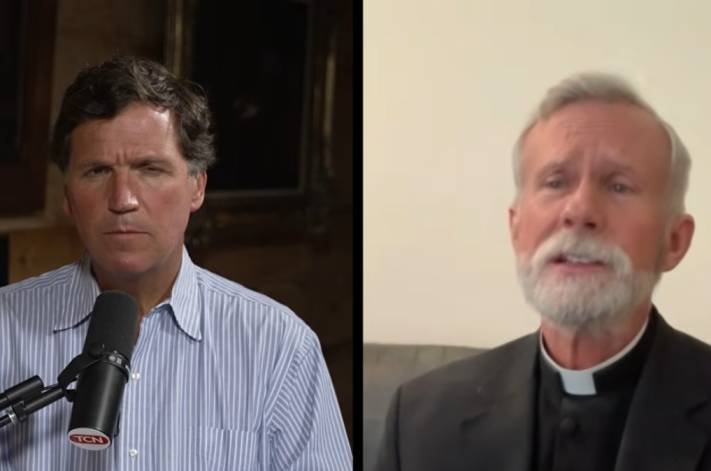
Editor’s Notes: In this interview, Tucker Carlson and Bishop Joseph Strickland discuss the recent closure of the Church of the Holy Sepulchre by Israeli authorities and the broader moral implications of the ongoing conflict. Bishop Strickland argues that the large-scale destruction of civilian life is never morally justifiable and emphasizes the importance of adhering to the principles of “just war”. The conversation delves into the spiritual nature of the struggle, the role of Christian leadership in times of crisis, and the necessity of standing for the truth despite persecution. Ultimately, they call for a return to foundational values and a rejection of violence against the innocent. (March 31, 2026)
TRANSCRIPT:
The Closure of the Church of the Holy Sepulchre
TUCKER CARLSON: Bishop Strickland, thank you so much for doing this. What do you make of the closure of the Church of the Holy Sepulchre by Israeli authorities on Palm Sunday?
BISHOP JOSEPH STRICKLAND: Well, really, Tucker, some things have probably developed even since the last thing I saw, but it looked like they were deciding to open it after all, or whatever. To me, really, Tucker, this comes down to a consequence of the evil that we see, that we’re witnessing. And I think we need to pay attention to it in that context.
As we already discussed, the large scale destruction of civilian life is never morally justifiable by any nation, by any entity, for any reason. It’s just not. And to me, the closure of the Holy Sepulchre — the holy site for us, there are so many in the Holy Land — but the closure of that and the not allowing the procession of Palm Sunday is a tragic consequence of just how far off the mark really the world is at this point in so many ways, and what’s going on there.
We must speak calmly, lovingly, clearly, that, no, we can’t allow this. And the closure to me is just one of many tragic consequences where this has to be addressed. And we’ve got to keep going back to that principle, that the large scale destruction of civilian life can never be morally justified.
A Foundational Principle of Faith
TUCKER CARLSON: Amen. And I’m glad to hear at least one religious leader in the United States say that so clearly. I think that any believing Christian would agree with that as a foundational part of the faith, but you’re hearing just the opposite. And I want to ask about that in just a minute, but you don’t seem like you believe that the Church of the Holy Sepulchre was closed for “safety reasons.”
BISHOP JOSEPH STRICKLAND: Well, I really don’t know, Tucker, and maybe for some making those decisions, that’s the reason. But why is it — why would it be judged to be a place that is unsafe because of this chaos that surrounds it? So, like I said, I think it’s a consequence of everything we’re seeing, which is immoral and is destructive to humanity in very significant ways.
You’re a man of history, and we all need to be people of history. And if we look at history, these days will be marked in history as a very devastating time, similar to things that we can look back on in the last 100 years, 200, 2000 years, that when these kind of moral aberrations begin to just take over, we need to speak up.
And I really don’t know the motivation for the closure of the Holy Sepulchre. I mean, I can surmise a lot of things. The possible reopening or partial reopening that I’ve heard about — I don’t know if even that’s accurate. Part of what I know you’re fighting and what we’re all finding is so much misinformation, so many false messages, it’s really hard to know what is true. And that’s why I think it’s so important. And I will be a broken record repeating: we can never justify the large scale destruction and devastation of civilian life as morally justifiable. We can’t do that. And I think we have to keep going back to that home base with all the chaos that we’re all dealing with.
Christianity in the Crosshairs
TUCKER CARLSON: I think one of the things that we can say is that Christianity — targeted or not — the core tenets of Christianity, whether on purpose or not, is often in the crosshairs. We know that. I believe, talking to people in Jerusalem this morning, that there were no synagogues completely closed. And we know that the Church of the Holy Sepulchre was not closed during the last two world wars. We know that the idea was to have a Catholic leader and three others in there for a live stream service. And that was banned. So it’s hard to understand how this was done for safety reasons.
And moreover, I wasn’t aware that the government, the secular government of Israel, owned the Church of the Holy Sepulchre, or by the way, the Dome of the Rock, or any other religious building owned by someone else in East Jerusalem. I mean, where does this authority come from that you can just close someone else’s church?
BISHOP JOSEPH STRICKLAND: Well, I don’t think it is true authority, and it’s basically totalitarian — saying, “We’ve got the power, we’ve got the bombs, we can do what we want.” And that is again, as we look at history and we look at this moment, that is about as scary as it gets, to have that attitude. And sadly we’re seeing that attitude: “We are the ones with the power, so we are the ones calling the shots. Forget what is moral, forget what is true, forget what is historic, what has historic precedent.”
I mean, I’m sure both of us, for several years now — I get tired of the word “unprecedented” because we hear it all the time. But we’re living in unprecedented times, for all the more reason we need to go back to foundational pillars of life and faith.
I mean, you used the phrase “in the crosshairs.” The cross is where Jesus Christ died. And ironically, Tucker — and I’m sure it isn’t lost on you — that in my experience as a bishop and a priest, Holy Week is always a time where things are in the crosshairs. It’s different issues and different situations historically. But there’s something about Holy Week that calls us back to: who is Jesus Christ? Do we believe him or not? And if we do, we must morally be guided by his light. We must.
Truth as a Threat
TUCKER CARLSON: It suggests that there’s something else going on here, perhaps influenced by the spiritual war ongoing around us, that Christians would be the target, since it is, at its core, a religion that opposes violence against innocence and the destruction of innocence. And so here — I mean, a totalitarian regime, at least as you think of it in your mind or I do, targets violence against its enemies. There’s nothing less threatening than four Christian clergymen standing in an empty church livestreaming the sacraments. But they went after those guys. So what does that tell you? Of all the enemies, why are they the —
BISHOP JOSEPH STRICKLAND: Really, really, Tucker, what it tells me is that truth is threatening. And if you think about the drama of Holy Week, which we in the Catholic faith are in the midst of — when Jesus Christ is before Pilate, and that is historic reality for whatever your faith perspective — this Jesus of Nazareth stood before Pilate, the leader of the Roman Empire that was stationed there in Jerusalem. And Pilate says, “What is truth?” And the mob that was there, Pilate himself, everyone was threatened by this Jesus who we know, we believe, is truth incarnate. He is the truth.
And as he’s standing there, really, Tucker, I think that is what’s threatening to those who are not living by the truth and humbly seeking the truth, which we all have to do. I don’t claim to have it all figured out, but I look to Christ because He is the truth. For those who are promoting all of these things — closure of holy sites and attack of innocent people — they are definitely threatened by the truth, not by some propaganda, but by the real truth. They find it threatening.
And to me, that really is what Cardinal Pizzaballa and the others were going to try to do — just a live stream, very small scale, really. That was threatening because it’s about proclaiming truth that really begins to cause people of good hearts, whether they have faith or not, it causes the human instinct to say, “Wait a minute, what’s going on?” When they hear truth that is disruptive, not in a violent way, but just because truth cuts through it all — that’s what they’re afraid of. I truly believe that.
The Power of Truth Over Violence
TUCKER CARLSON: One of the truths that seems the most threatening is that violence is not the answer. And so — yeah, I’m sorry.
BISHOP JOSEPH STRICKLAND: Well, the power of the world isn’t the answer. That is what threatens them. And that’s what they don’t want to get into the hearts and minds of just everyday people. They don’t want that word to get out there that war isn’t the answer.
Sometimes — I mean, the Church, the Catholic Church has a doctrine of justifiable war, which is pretty strict and pretty clear, and probably very few wars have qualified. And there are serious questions about this war. I think it’s pretty much unqualified. But that’s what we have to keep looking at — look at the principles.
And really, Tucker, what I would encourage your viewers and all of us — I mean, I’m just one of the viewers in many situations. I’m a bishop who doesn’t even have a diocese anymore. But I do have an apostolic call that I take very seriously. And I say to myself, to you, Tucker, as a good man seeking truth, and all of us who are in this: we need to take a breath, we need to calm our hearts, and we need to simply seek the truth.
I believe and I feel compelled to proclaim to the world: we know the truth. The truth sets us free. It’s Jesus Christ. And certainly that was the threat that the Romans and the Jewish leaders wanted to get rid of. That’s historic reality. They plotted to rid themselves of this “truth problem.” And in many ways we see the same thing repeated. I mean, it gets masked in a lot of ways. But I pray daily for the leaders of the world, for every nation, for leaders who have the power and the responsibility in this moment to go back to those basic principles. They need to take a deep breath and ask themselves, “Is this true? What I’m promoting, what I am doing — is it about the truth that sets us free?”
And when we ignore the truth, that is when we are the most bound by violence and evil. And we’re seeing it played out in our lifetime, right in these moments on the TV screen, on our phone screens, on the airwaves — we’re seeing that ignoring truth has consequences.
And it comes down to each of us individually, when we ignore the truth that I am a sinful man who needs to repent and I need to seek the life that is Jesus Christ. When we try to hide that, to ignore it, to eliminate it — it doesn’t go away. It will not be eliminated any more than killing Jesus Christ on a cross in the first century eliminated the truth that he is. Truth will not be eliminated.
But a lot of innocence can be harmed when we think we can avoid the truth and do it our way and do it with our power. When we go down that path, it’s destructive in so many ways, even to those individuals that are doing it. But the tragedy is there are so many innocents that get lost in it, that we must speak against innocent lives being — the term is “collateral damage.” But that in itself says we have to be very careful about allowing our hearts to harden, that we just use terminology for innocents dying. “Oh, they’re just collateral damage.”
Just War Theory Explained
TUCKER CARLSON: May I ask you to go back for a second? As a Protestant myself who’s often heard the term “just war theory,” which I think derives from Augustine, but I could be wrong — can you summarize that for people who aren’t familiar with what it is? Just in broad terms, what’s a justified war?
Just War Theory: The Core Principles
BISHOP JOSEPH STRICKLAND: Well, there are four basic points and I can’t claim that I can get all of them. As you know, it’s pretty simple. Most of the time the truth is pretty simple.
The just war theory is based on if war, which should be avoided if at all possible, if it is to be justified, it has to be proportionate. It can’t be preemptive, really. It goes back in a lot of ways to the right to self defense, the right to self defense of one person, the right to self defense of a nation. That is really the core of the just war theory.
It has to be a real threat, not a perceived threat, not a future threat, but a real threat. It has to be in proportion. I mean, putting it in the just person to person context, somebody slaps you, you don’t shoot them. That is not proportional. It has to avoid harming innocents that really have nothing to do with whatever the conflict is in any direct way.
And so those basic points are what you have to look at. It has to have a reasonable expectation of success, that this will accomplish the protection of innocents that it should be about. Those points are what we have to keep looking at.
Like I said, there probably aren’t many wars in human history that would qualify as meeting all the criteria. Some meet more than others. But I don’t know that this present conflict — they’re not even calling it a war, and I think that tells us something. I don’t know that it qualifies on any of those points, because yes, there was some threat there, but was it justifiable to immediately address that threat, which seemed to be a future threat that may have been very real? I don’t claim to know all of that, but I think the leaders are challenged to really look more deeply at that.
And certainly the idea of protecting innocents — honestly, I mean, and again, I haven’t been in any war rooms or heard the real discussion, but it seems, from what we’re seeing, it’s like we can expect and we can plan for the collateral damage, which should always be stated as: we can plan for innocents to die because of this action, because that’s what collateral damage really is talking about.
So that, I think, is a reasonable — probably not the most scholarly — exposition of the just war theory, but those are the basic points. And again, if people say, “Oh, it gets so complicated,” just think about defending yourself, defending your home, defending your family. You can’t go out — you have a neighbor that’s talking crazy — and go and put a bomb in their front yard. That’s not proportionate, that is not reasonable.
And I think one of the greatest points of the just war theory is: is it likely to be successful? Is it likely to have an outcome that brings more peace, more protection, not just to the individuals that you’re specifically responsible for, but brings it to the world?
So I think that we’ve got to honestly assess what is happening and acknowledge that no nation seems to be really doing that. And I love the United States. I was raised as a patriotic kid. I still believe in a lot of the principles. But when we lose sight of the basic principles of our founding as a nation, or of our faith of Christianity, or whatever our faith is, those basic principles have to guide us. And we can’t allow popular opinion or political agendas to override those basic moral values. That should be the pillars that found us, that stabilize everything that is shaking in the world today.
Threatening Civilian Infrastructure: Is It Consistent With Just War?
TUCKER CARLSON: So this morning, the President of the United States, whom I campaigned for and defended daily for 11 years — not attacking him — but he issued a statement threatening to destroy the civilian infrastructure of Iran, including the desalination plants and energy grid of Iran. And that seems to be a threat against innocents. I don’t know any other way to read it. How would you assess that? Is that consistent with a just war?
BISHOP JOSEPH STRICKLAND: No. And as you said, Tucker, we have to acknowledge that it is — to directly do that is wrong, is immoral. Going back to that basic principle I started with, anytime civilian life is devastated, it’s not done morally. It’s not something we can just turn a blind eye to and say, “Well, we’ve got to do this.” The large scale destruction of civilian lives is never morally justified.
Like I said, if I’m a broken record making that point, I believe I need to be. Because the more I think about that, the more I pray about that, the more I look at what’s happening, it says: let’s put a stop to this, let’s pull back from this.
And I understand from what I see in the news that there are efforts of talking about some sort of solutions, but the talk seems to always have much less focus and much less power behind it than the bombs and the destructive forces. I guess that is — by human nature, maybe that’s somewhat natural — that when you’ve got the power, it’s hard to restrain yourself from using it. We see that played out in so many ways.
But that is where the moral values have to kick in for the individual man or the individual nation. And the leader — that is a man, or a group of men and women that are leading a nation — they need to constantly go back to those principles and ask themselves: “Is this justifiable? Is this something that is moral to do?” And if it’s not moral, then we should just put up a big bright red stop sign and say, “We’re not going to do this because it is morally questionable,” much less clearly immoral.
And when we go down the path of saying, “Well, we’ve got to do some immoral things” — it’s like the end justifies the means. Some basic principles of philosophical, logical thought that have guided nations and individuals through history — if we get on a path where we say the end justifies the means, then the means can become so immoral that it’s just devastating, not just for the individuals or the nations involved, but for all of humanity.
We’ve got to be very cautious about going down that path. And I’m afraid that many of the things that we’ve seen have crossed that line of just saying, “We believe, yeah, this is evil, okay, it’s evil, but we’ve got to do it for the good end.” That is very dangerous territory.
Christianity and the Justification of Violence
TUCKER CARLSON: Also common, I think. I mean, people, as you said, who have power tend to misuse it — an often noted phenomenon because it’s true. What’s different, at least in my lifetime, is seeing self-described Christian leaders not only defend violence but attack anyone who questions its use, and then use the Bible to justify it.
So I guess what I’m saying is, one of the battles here is over what Christianity is as a faith. And that seems to me a very important battle, certainly a conversation. What you’re seeing some Christian leaders do is say, “Well, there’s violence throughout the Bible and God justifies it, in some cases defends it,” through what the Christians call the Old Testament — from beginning to end, there’s violence against innocents. So it’s therefore okay. What is your response to that?
BISHOP JOSEPH STRICKLAND: Well, Tucker, quite simply — probably not surprising — my response is Jesus Christ.
If we claim, which I do, and I do my best — I mean, I’m a sinner, I mess up all the time. We do individually. If we’re smart enough to be humble enough to acknowledge that we as nations and we as individuals get off the mark, we mess up, but we can always repent of that and seek again to follow the truth that is Christ.
And that’s the distinction that I would make. If people are calling themselves Christians, we are of the body of Christ, that is his church, and we have to look to him. Yes, in the Old Testament there are many examples of destructive power, but that is not the world that we live in. We believe that Jesus Christ has redeemed everything.
And one of the key points of Jesus Christ — and St. Paul says it very well — we are neither Greek nor Roman. We are not individual nations. We are Christian. And to use Christianity as a weapon against one part of his body to another part of his body is a misuse of the message of Jesus Christ.
If we look to him — I mean, he died on the cross because he embraced that freely as a man and as the Son of God. He was willing to do that. He was willing to personally receive the greatest violence of destroying his body and his human life for the sake of the peace that he brings. And if we look to Jesus Christ, we can’t justify the violence that we’re seeing.
You can hearken back to the Old Testament, but if you believe Jesus Christ is the new covenant — I mean, he came out of that world of the Old Testament, he is of Hebrew origin, and we should embrace that absolutely, that is historical reality — but he came to bring a new covenant and to bring a redemption of all of that.
And just one example of what Christ — if we look to Christ — he’s often saying, “Yes, we used to do this, but this is the new way that through the Father sending me to you is being revealed.” It used to be an eye for an eye and a tooth for a tooth. That cannot be that way with us. He says to his disciples, and we have to really listen to that.
We may not like listening to Christ himself, but that is what we’re called to, especially if we call ourselves Christian. That is probably, as you point out, Tucker, one of the greatest issues that we have to face now, because there are many non-Christians in the world. And for Christianity to be really co-opted and hijacked in the way that we’re seeing is destructive to the message of truth that is Jesus Christ.
Because I can imagine people are saying, “Well, if this is what Christianity is really all about, I’ve considered it, but I’m not going to even look at Christianity if that’s what it’s about.” It’s not what it’s about. But when voices are saying — going back to that basic idea — “We can destroy civilians violently and in drastic ways and say that it’s moral because we’re claiming to be Christian,” that’s nonsensical and it’s offensive to Christ himself as anything could be.
He is a man of peace, and that doesn’t mean just let yourself be run over. But real peace is about respecting our lives and the lives of others, and always seeking without violence to embrace the truth that sets us free.
So I guess what I would say to Christians that are claiming sort of Old Testament justification: show me that in Christ. And they’re not going to find it.
The Message of Holy Week
TUCKER CARLSON: It does seem like this is an effort to co-opt Christianity and change the world’s understanding of Jesus. And it seems like Holy Week maybe is particularly hard for people who want to do that, because the whole message of Holy Week is the opposite.
I mean, you’re the theologian, but I think Jesus is coming into Jerusalem at a time when it’s occupied by foreign pagan authorities. They’re oppressing the people of Jerusalem. And a lot of people watching assumed Jesus was going to liberate the city using force. He was the king. But he doesn’t come in on a war horse, he comes in on a donkey, and then submits to being tortured to death. Because the victory is larger than a military victory. It’s a final victory, it’s a spiritual victory.
And that seems like the message. As a non-theologian Protestant, that seems like a very clear message. But you tell me, is that the message?
BISHOP JOSEPH STRICKLAND: Tucker, you are spot on. And that’s why I mentioned earlier in our conversation, Holy Week is a week of drama. And it’s a week of waking up and realizing the real message of Jesus Christ.
The whole passion story of Christ — the elements are all there. We have Judas Iscariot — why did he betray Christ? I don’t claim to be able to read his mind or his heart, but the indications are he betrayed Christ because he wanted the kind of military leader that many wanted.
Christ’s triumphant entry into Jerusalem is a very interesting scene that we need to constantly go back to and look at in terms of what’s really going on. Just before Christ, as recorded in scripture, just before Christ enters triumphantly into Jerusalem, the verses are talking about the authorities seeking and plotting to assassinate Lazarus, the one he had raised from the dead.
TUCKER CARLSON: And that is really one of the most — it’s described in John, and it’s one of the most amazing passages in the entire Bible. Jesus has just raised this man from the dead four days after his death — one of the amazing things he did. The guy’s alive, and the religious authorities want to murder him. It’s amazing.
The Danger of Shaping Christ to Our Agenda
BISHOP JOSEPH STRICKLAND: It really is. And the drama is right there. We have to see it and recognize the way it continues to unfold in our lives.
I don’t want to label anyone Judas Iscariot, but we need to ask ourselves — every one of us, and I include myself — we have to be very careful and ask: are we beginning to move in a direction that Judas Iscariot would have approved? When we are saying, “Hail Jesus, hail to the Son of David,” but we want to shape the Son of David according to our agenda — that is where it gets very dangerous. And it culminates in destruction for Judas Iscariot, and apparent — I mean, real destruction for Christ.
Because he is truth, because he is God’s divine Son, what the world can throw at him can’t destroy him, because he’s beyond creation. He is the Lord of creation. But he allows it to happen out of love for all of us.
It’s just so rich with images that can be beneficial to all of us. But for us to hear Christ in this time, in this moment in our history — for the world, for this nation, for the Catholic Church, for Christians — to hear Christ say to those who are literally in the moment nailing him to a cross, killing him: “Father, forgive them, they know not what they do.”
To have that kind of mercy and compassion in your heart — we’ve seen some saints that have echoed it. St. Stephen, the first martyr, echoed his Lord in saying that. But that, again, going back to where’s the threat — that is a very threatening sentiment. When the world thinks that the powers of the world can ultimately prevail, to hear the man being destroyed by the world saying, “Father, forgive them, they know not what they do” — it reminds us that we’ve got to retune our hearts and our minds to the message of Jesus Christ, and to face everything we’re facing.
Holy Week Played Out at Large in Our Time
It’s like Holy Week being played out again, writ large in our time. The hidden messages and the plottings and the confusing — here we have things being hailed as wonderful, and then underneath it, the underbelly is a darkness of plotting, the destruction of innocence, and the destruction of lives that really have nothing to do with this.
So once again, I go back to that idea — the gauge has to be: the large-scale destruction of civilian life can never be morally justified. And with Christ, it was one man. But in terms of reality, in terms of the universe, trying to kill Jesus Christ, Son of God, Jesus of Nazareth — killing him. They were successful in killing him. He died on the cross. But that is large-scale destruction of innocent life, of civilian life. And that is the principle we just have to keep going back to, to keep looking at everything through that lens, and urging the leaders of Israel, the leaders of the United States, the leaders of Europe, the leaders of the world to come together and to listen to the words of Jesus Christ — even those who don’t believe him — because they are true words. They resonate in hearts if people will just listen and really open their hearts to what he’s saying.
I mean, certainly I believe the world will embrace Jesus Christ before it ends. That is prophecy and that is logic. When the world will embrace truth — not everyone, we’re all left with our free will. And that is the free will of the individual, and writ large, the free will of nations. We see that in the Old Testament — God doesn’t necessarily stop the free will of nations or individuals from doing something that God knows is contrary to truth.
The consequence of ignoring the truth — we can see it as God’s punishment, but really it goes deeper than that. It’s simply in conflict with reality. And when we oppose the truth, we’re opposing reality. And the consequences will follow. Maybe not immediately, but the consequences will catch up with us when we ignore truth.
Tucker, I know that the people that you interview — as your life, your career, your good work of doing your best to share truth — you’re constantly talking to people who have themselves lived through the consequences, and hopefully awakened to the reality: “I’ve got to follow truth.”
When we ignore the truth, in countless ways in our society today, we get on a path that brings us harm. And sadly, the more influence we have, the more that path involves other innocent people. The more we can bring destruction down on the heads of the most innocent, when we decide we’re going to consciously deviate from the truth because we’ve decided we know better — that should be a huge caution, ultimately a stoplight, for all of us. Be very careful about going down that path, because we’ve seen it in history and we see it in our time. When the individual says, “I’m somehow above or outside the truth,” they may prevail for a moment, but it will always come to destruction.
The Case of Kari Prejean Bowler and the Religious Liberty Task Force
TUCKER CARLSON: There was a controversy six weeks or so ago around a woman called Kari Prejean Bowler, who was a member of the President’s Religious Liberty Task Force. She was expelled from it — really, from my reading, for two reasons.
One, she called attention to the deaths of innocents in Gaza and made the point that their lives were as valuable as anyone else’s. And two, she refused the basic tenets of Zionism, political Zionism, and said that she didn’t have to sign up for that as a Christian. And she was expelled for that. And there were a number of religious leaders, Christian leaders, who approved of her expulsion — in fact, who made it possible.
You weighed in on this. Can you tell us why you did that and what you said?
On Carrie Prejean Bowler, Truth, and Speaking Out
BISHOP JOSEPH STRICKLAND: Yeah. Thank you, Tucker. Well, really, again, I’m a simple guy, and it comes down to basic simple truth. Ultimately, truth is simple, yes. It’s deep, it’s rich, it’s hard to fathom, but it’s not complicated in the way that our world is so often complicated.
As you said, I think Carrie was removed because they didn’t like the truth. She was speaking the truth about Gaza, which is verboten by many. The innocence that have devastatingly died there is just horrible. It truly is a holocaust of our time. They didn’t like that truth, and they didn’t like the truth of her pushing back against the agenda that is saying this political Zionism is something that Christians need to embrace. No, it’s not. And the Catholic Church is very clear from everything that I’ve seen.
I had a conversation with Carrie before I put out my statement. And I had the conversation because I was hearing things and I just wanted to really — my intention with reaching out to Carrie was just to be a pastor and to offer her some support and some consolation. In the midst of that conversation, she basically challenged me and asked me, “Bishop, if what you’re saying, you really believe your message” — my message to her — “if I really believed it, was I willing to publicly speak it?”
And I told her I would pray about it and I would consider it. But even as I told her that I would pray about it, I knew in my heart that I was, as we say, sometimes Christians say, I was convicted. I knew that if I was going to be the man I want to be, if I was going to be the Christian that I want to be, I had to speak up and to not attack anyone, but simply say — and what I tried to do in rather several more words than this, but basically was say — Carrie was removed from that committee because she was speaking truth that the powers that be didn’t want to be spoken. And because of that, I felt the need to speak out for her.
I don’t think Carrie claims to be a sinless, some sort of perfect woman, but she was right in what she was speaking. People can say — and I know you hear this all the time — when they don’t like the truth that’s being said, they’ll very often go after the tone. And it’s human too for the tone to get a little elevated when we’re speaking truth, especially when it’s being opposed. I know I can personally confess that sometimes that happens when we’re facing pushback against something we know deeply in our hearts to be the truth. We can hopefully not get violent, but we can get very animated in how we’re doing that.
And I think that’s what people really pretty cleverly will say. “Oh, well, it was the tone.” Well, yeah, sometimes the tone, but sometimes it may be appropriate when truth is being ignored. We need to get attention sometimes.
The Model of Christ: Speaking Truth with Vigor
And again, looking to Christ, the model — I mean, he said, “Love your enemy,” but he also was willing to call a spade a spade. And when the leaders that he was speaking with were clearly not in the line of truth, he was willing to get pretty animated in the way he spoke to them and said things like, “You brood of vipers.” I mean, I think that was actually John the Baptist. But Christ said those kinds of things to the leaders because that’s what truth demands sometimes. We should not return to violence in order to stand for the truth, but we should do it with vigor, with strength.
And to me, that’s where Carrie was rejected — primarily because they didn’t want her to speak that truth. And you’ve seen it so well. I think you’re an example, Tucker. I mean, you were a man speaking truth, and they tried to silence you. Carrie was speaking truth. They tried to silence her. And ultimately it backfires when it is truth. When someone or a group is speaking truth, trying to oppose that, it does backfire.
I think of Gamaliel in the Acts of the Apostles, a Jewish leader who said, “You all need to be careful. If this is of God, you’ll find yourself finding God. If it’s not of God, then it’ll go away on its own.” What Gamaliel is saying is: truth lasts, truth prevails, truth continues because of the essence of what it is. It is truth.
And we see that over and over again when truth is being proclaimed. And whatever powers of the world try to squelch that truth, try to silence it — so often — I mean, Jesus Christ. What is the whole drama of Jesus Christ? The world, the powers that were in the first century tried to eliminate him. And where are we now in the 21st century? He is still that voice of truth that can and should guide us.
So Carrie was removed as one voice echoing the truth that is Jesus Christ. She was removed because of that. And look what’s happened. Her voice has grown. I had no idea who Carrie Prejean Bowler was before she got removed. And then I end up making a statement about her that is a beautiful example of what we all need to remember for ourselves and our personal journey against sin and death. And in the global journey, we need to remember: if it’s the truth, it will come out and it will prevail. So we better do our best to stay with the truth.
I love the image of the plumb line of truth that comes from Old Testament prophets. To stay with the truth — I waver, I weaken, I’m a sinner. But I do my best to return to that plumb line of truth. And that’s what we need to do as individuals and as nations. We need to constantly be willing to challenge ourselves: “Am I in whatever way avoiding or trying to obfuscate the truth?” And to the degree that I’m doing that, I’m sinning. I repent, I ask forgiveness, and I get back to the truth.
TUCKER CARLSON: What kind of response did you get to the statement that you wrote about Carrie?
The Overwhelming Response and a Worldwide Famine for Truth
BISHOP JOSEPH STRICKLAND: I’d have to say overwhelming. I mean, I’ve been on X — even when it was back when it was Twitter — and I’ve had some things that I’ve said that have gotten significant response. I don’t even know what you call the numbers that you see, but whatever the biggest number there is, close to a million at this point of people. And sometimes those numbers don’t all necessarily mean that people are in agreement. But the vast majority of people have said, “Thank you for being a bishop, a successor of the apostles, that was willing to speak to this.”
And Tucker, over and over again — and I can imagine, I mean, you have a big voice in today’s world, and I know you know that, and I know you do your best to take that responsibly, which we have to. I’m the first to be surprised to have a million acknowledgments of what I’ve said. For the most part, very positive. So the response has been tremendous.
And the words I believe that I posted — I believe they came from prayer, they came from real consideration of the truth that I believe in. But it wasn’t my words that people are really responding to. It’s truth. People are hungry, they are starving. There is a worldwide famine for the truth. Thankfully it’s there, we can find it, but we have to fight for it sometimes. And that’s what I saw in the response — people are grateful when a voice speaks.
Parallel Journeys: Canceled for Speaking Truth
And when Carrie and I spoke — God has blessed me in tremendous ways. And really, Tucker, I mean, we’ve never met, but I see you. Our story is very similar. They tried to cancel you. I mean, back in the culture when people speaking truth were getting canceled. And what has happened? Your voice has grown. And I think it should, thankfully. I mean, I know you’re not the perfect man, but you are a man seeking truth. That’s how I understand Tucker Carlson. And because of that, they tried to — they fired you, and they tried to eliminate your voice. And that voice has only grown.
The same thing for me. I’m a bishop removed from his diocese, and my voice has grown. I mean, I still am the kid from East Texas, but my voice of doing my best to be faithful to the truth and to be willing — and that’s, I think, where both of us can stand together. We’ve been willing to speak the truth when it wasn’t popular, when it was sometimes threatening to bring further consequences if we stay with that voice of speaking the truth.
But I think both of us, in different ways — I can’t speak for you, but I can speak for myself — I have to. I have to do what I’ve done. I can’t knuckle under and say, “Okay, just quit speaking the truth.” I was told to quit it. “Stop it. Quit speaking the truth.” You were told as well. And I’m sure behind the scenes you could share lots of stories of people saying, “Oh, Tucker, don’t — calm down, don’t do this. Back off.”
But we can’t. When it’s the truth and you know it deep in your heart, that is what Christ was able to do in a beautifully peaceful way. He endured everything the world could throw at him. And in many ways, I haven’t had anything thrown at me, but I’ve been willing to speak the truth when it wasn’t popular and when it basically got me kicked out of the club. But I’m still a bishop. I’m still a successor of the apostles. And so it’s essential that I continue to speak — not my truth. I mean, that’s where it gets crazy. People speak of, “Oh, well, that’s your truth, and that’s my truth.” There’s truth, and we all have the obligation to seek it, to be willing.
And I’ve said this many times, and I say it again: anytime I speak something that I’m claiming to be the truth, if people can show me that this is not the truth, I want to hear that. I don’t want to ever be in a position where people are saying, “Oh, well, he’s got a big voice, so I won’t tell him he’s wrong on that.” I want to hear if I’m wrong. And I have been — I can be, for sure. I’m a man, weak and sinful and easily confused and easily diverted from the truth. But I keep going back to trying to do my best to proclaim it. That’s what we’re all called to do.
And I think I see Carrie right there with us — as a woman, a mother and a wife, and a woman with a voice. And once you have a voice, you have an obligation to speak the truth with it.
Do You See God Moving as Evil Becomes More Obvious?
TUCKER CARLSON: You said you’re on X. You’re clearly paying attention to what’s happening around the world. It’s very easy to become discouraged. Jesus is under fire. The church, broadly, is under fire. Truth is obviously a target, maybe the main target. So it’s discouraging. Do you see God moving as a counterbalance to that? Do you see God moving more as evil becomes more obvious?
God Is Working Through All of This
BISHOP JOSEPH STRICKLAND: Tucker, thank you for asking that question, because I think absolutely. I see goodness and beauty and truth changing hearts and moving people in all kinds of ways. That’s been one of my blessings. I’m basically an itinerant bishop now who travels all over the place and speaks in different settings and meets people across this nation and really around the world. And I have seen that goodness in those hearts seeking the truth.
And of course, I believe that God is still his world. It’s still his church, and he isn’t absent from any of this. Free will allows us to destroy ourselves if we make that foolish choice. But God is always offering the opportunity to each of us individually and to each of us in whatever group, whatever definition of a group of humanity. For us, we’re all brothers and sisters. We’re all the children of God.
But I believe, absolutely, answering your question, that God is working in hearts. God is working through all of this. I mean, look at all the evil that’s been exposed. We hate it. We’re horrified. But it needs — it’s like a wound that needs to be cleansed, a wound that needs to be opened up, and the putrefied flesh needs to be cleansed. We’re in a time of cleansing, of purification. God is allowing the truth that has been hidden for so long — so much corruption — it just does get overwhelming.
And I’ve put out messages to encourage people: don’t despair. It’s so easy to despair. And we see it. I know both of us see it too often, especially young people, lives ending, sometimes intentionally because they just despair of this dark world. But we can never despair. We should be people of hope and acknowledge the evil that’s there, but believe that God is with us. Jesus Christ prevails as truth prevails.
And I guess that’s because I know many of the people that probably listen to you are not people of faith. But again, I would go back to simply: truth prevails. And we know, I believe, that Jesus Christ is truth incarnate. Truth walked this earth. And we believe in the Catholic faith he remains here through the sacraments, through the life of baptized people, in goodness, living in the world. But truth prevails. And when we are willing to challenge ourselves, to always go back to the truth, that will lead us nowhere but to God. And so God is working through all of this.
Our Lady of Good Success and the Signs of Hope
And there’s so much goodness out there — the things that have been hidden literally for centuries that are coming to light. What comes to mind for me is an apparition of Our Lady called Our Lady of Good Success, that is in Quito, Ecuador. It happened shortly after Our Lady of Guadalupe. Our Lady of Guadalupe appeared in 1531 there in Tepeyac, outside Mexico City. The image of Our Lady of Guadalupe still is revered there by Catholics and others of that miraculous appearance.
This apparition happened in the 1570s, I believe, shortly after Our Lady of Guadalupe. And what’s interesting is the apparition — it’s to a nun. Our Lady speaks to a nun. And this has been approved as private revelation, but it is accepted as authentic by the Church. But basically the apparition, Mary says to this nun, Mother Mariana, that for the 20th and 21st century this will come to light and will help people navigate a world and a church deeply affected by the chaos of not following the truth.
I mean, that’s what it comes down to. We believe the Church will prevail. “The gates of Hell will not prevail against the Catholic Church.” That is our faith. We believe what Christ says in the Gospel and we believe it applies to this Church. But that doesn’t mean that we human beings — and the Church has gone through every kind of storm that humanity can come up with — but we believe the Church will not be destroyed, so we can’t despair.
But what’s interesting to me is that this apparition — it’s a sign of the goodness, a sign of the hope, a sign of God still with us. One of the things that as a bishop, as a lifelong Catholic, one of the great realities that I think is always helpful to me is to remember: God is timeless. That’s hard for us to grasp. We can’t really grasp it. How can God be outside time? But he is. God is eternal.
And so the things unfolding — we said, well, this was 400 years ago and now it’s happening now. And how does this work for God? There is no time. It’s simply truth, goodness and beauty always flowing from the heart of the Trinity — God, Father, Son and Holy Spirit.
Truth as the Anchor Against Destruction
So keeping that perspective always reminds us — reminds me — to be careful about presuming things about history because God’s outside all of that. I mean, history is a reality of the creation that God has given us, which is precious and is good. As God says in Genesis, he saw that it was good. But the evil and the bad can come when we who are created in God’s image and likeness begin to ignore truth. That is constantly what it comes down to.
When I sin, I’m ignoring truth. I mean, we may not say, “Oh, I’m going to go ignore some truth today,” but if we trace it back logically, what I’m doing when I sin — in significant or just small ways, sometimes it’s literally telling a lie — ignoring the truth, pretending that this is the way things are, or this is what I’ve done. But when we ignore truth on the personal level, on the national level, in the midst of history, when we ignore truth, we are on a destructive path. So we’re always challenged to go back to the truth.
And in this conversation once again, I repeat: the destruction, the wanton destruction of innocence of civilians is never morally justified. That’s the anchor of truth. That’s the pillar of truth that we have to keep returning to. When we get caught up in the confusing and chaotic realities that we’re all facing, we have to go back to the truth and humbly acknowledge, “Lord, I’ve wandered in significant or maybe just in basic ways.”
But the more we allow ourselves to put blindfolds on and ignore the truth — and I think that’s a lot of what’s happening right now — it’s like the political entity that is called Israel is getting a free pass for facing the truth, for whatever reasons, for political agendas or some kind of co-opted religious idea. But when we ignore the truth that atrocities have been committed against civilians, against innocents, then when we won’t speak of that — like Gaza — then we’re on a dark path and it becomes something. It’s sort of like the club of complicity where we say, “Well, we’ll all ignore that truth, won’t we?” And we move forward. And too much of that happens in today’s world.
The Spell of Deception: A Supernatural Blindness?
TUCKER CARLSON: You wonder why. I mean, there is a lot written about this. There’s a lot of speculation about it. Why would people intentionally lie in the United States about what everyone can see — about the atrocities you just mentioned? Why would our political leaders do that? Why would so many of our religious leaders do the same? And there are all these theories — well, they’re being paid off — but those are not adequate explanations.
From my perspective, it does feel like — and there are instances of this, Paul alludes to this in Galatians — that it’s almost like there’s a spell, there’s a supernatural quality where people can’t see things. They sincerely can’t see things. Their vision is clouded. Do you think that that phenomenon exists now?
BISHOP JOSEPH STRICKLAND: Oh, absolutely. Absolutely. Evil is real. The Catholic Church sees evil personified in Satan and his demons. I mean, Satan has no power, really. But we individual human beings, and any group of human beings, when we give in to ignoring the truth, we really are giving into the power of evil.
And like you’re alluding to, Tucker — that’s why, thankfully, God clearly tells us through his Son and in other passages, even in the Old Testament, we are not to judge each other. We are not the judges. We are to make judgments about what is true, but we’re not to judge the individual person. And I think that’s where we have to always remember — because the atrocities that happen — and that doesn’t mean we just say, “Well, out of respect for this person, I need to allow this to happen or allow myself to be attacked.” That is not what we’re talking about.
But we do have to always acknowledge: when it comes down to judging the person, we should simply not do it, and acknowledge that maybe there is evil. And I truly believe that the delusion of evil has many in its grasp in the world today. We all have the obligation to set ourselves free from that, to see the light and to make the choice to turn from it. But I know that it can become very difficult, seemingly impossible.
The “I Know Better” Attitude and the Suppression of Truth
And I think that really, as we talk about all of this, Tucker, I believe again it comes down to basic human choices. The world leader that is deciding, “This is justified because I have decided this, this and this” — it comes down to — and again, I think of us as individual sinners. When we sin, we’ve simply decided, “I know better in this.” We explain it away, we make rationalizations, but at the heart of it is: yes, this is what the world says is true, but “I know better. I’ve figured it out. I know better.”
And I think that’s where the atrocities in Gaza — they are actively working to hide those and to squelch any voice that dares to speak up about innocent lives being destroyed — because it threatens their “I know better” attitude. It threatens that truth that they’re trying to create. We can all try to create our own truth, but it doesn’t exist really. And that is what we have to always be humble enough to acknowledge.
And we have to pray that world leaders will be people whose hearts are open, because they’ve got the power to do drastically, devastatingly destructive things — like we’ve witnessed in Gaza, what we’re witnessing in Lebanon. I mean, very little is spoken about some of these things because the powers that be don’t want that truth spoken, because it threatens their false scenario.
So it really is as basic as that. But I think there are forces — worldly and supernatural — of evil. I mean, just like when evil tries to cancel a voice of truth in our culture, certainly in the supernatural realm, Satan and his minions are trying to do the same thing. I mean, the St. Michael prayer that we offer as Catholics is rooted in acknowledging that basic reality — and not seeing a demon around every corner, but acknowledging that evil is real. Evil has its power when we give it power, and that’s why we have to prayerfully turn to the truth.
I urge everyone to do that. And if you aren’t a believer, to at least — I mean, hopefully somewhat being sane is to embrace the truth. A definition of insanity is to say, “Well, I’m going to ignore what’s true and just go into my fantasy world.” Sometimes that happens. But if we are people who are rational, then rationality means being based in the truth. And we all have an obligation to find the truth, to speak the truth, and to live the truth.
Persecution of Christians: What Lies Ahead?
TUCKER CARLSON: My final question is about persecution, which you’ve alluded to, and you’ve said, “Oh, Jesus was murdered for telling the truth.” That was the main threat he posed — the fact that he was the embodiment of truth — and that that principle stands, and that people who — it’s not the liars who are punished, it’s people who tell the truth.
So if we accept that, we’re clearly in a new kind of world where trends are accelerating. You would have to think that persecution will intensify, specifically of Christians. And I think it is. I think it’s what we’re watching. Do you believe that? And if you do, how should Christians respond to persecution?
The Christian Response to Persecution
BISHOP JOSEPH STRICKLAND: Well, Tucker, I do believe that. I mean, it’s very clear. I believe that faith, any, really any, stands for truth. The real truth is being persecuted because the powers of chaos, the powers of that false message are growing and gaining influence.
What is our response as Christians? Well, it probably sounds pretty simplistic, but we stay with the truth. We don’t compromise. We don’t become violent in the face of violence. We don’t embrace hatred. I think that probably one of the most powerful things we can do is seek to truly love our neighbor alone.
And certainly, Christ tells us, “Love God with all your heart, mind and soul and your neighbor as yourself,” the great commandment. But I think that we need to put that into practice by not giving in to the hate. No matter how much we are persecuted, no matter how much hatred is thrown at us. We have great examples in our Catholic faith, in the saints of the ages.
So many of the saints, and Christ himself says, “If they hate you, remember they hated me first.” What is persecution about? We’re persecuted when they hate what we’re doing, they hate who we are, they hate what we’re saying. And so we’re in good company with Christ himself.
How did Christ respond? He didn’t waver from the truth, but he didn’t violently fight back either. That is, I think, the basic reaction we should have. We should trust in the power of the truth. Yes, we can be eliminated, we can be assassinated in this world, and it happens, but the truth continues to prevail.
And if, as Christ died in service to the truth, he was the truth and he died for the truth, if it comes to that, we shouldn’t seek that — our lives are valuable. But if it comes to that, then we who believe in the truth should be willing — if that’s what it takes to stand for the truth, that I sacrifice my life in this world — it begins to remind us that life is not limited to this world. We believe in everlasting life.
The salvation of souls is what the Church, the Catholic Church, exists for. It may not always look like that through history and in our time because too many voices seem to be too worried about this world. But ultimately, to be alive is to have eternal life with God, and so sacrificing this earthly life, if it comes to that.
I’ve always loved the example of St. Thomas More. He was a great lawyer, he was a great mind, and he did everything he could to keep from losing his life in this world. But ultimately he knew that if he had to sacrifice his life in this world, he could look to eternal life with God in heaven. And he says that to his own daughter: “We shall merrily meet in heaven.”
That has to be our attitude as well. Not wantonly and easily allowing our lives to be destroyed — that is not respectful of the treasure of our life that God has given us. We should desire to be here as long as God gives us breath. But when that ends, and if we lose that life because we’ve stood for the truth, then we’re in good company.
So the Christian response to persecution should ultimately be to be willing, and to be strengthened, and to strengthen each other to stand with the truth, come what may.
TUCKER CARLSON: Amen. Bishop Strickland, thank you very much for taking this time. That was great.
BISHOP JOSEPH STRICKLAND: Thank you, Tucker. God bless you.
TUCKER CARLSON: God bless you.
Related Posts
- Transcript: World’s First AI Actress Interview on Piers Morgan Show: ft. Tom Conti, Tom Bilyeu & Prof Jiang
- In Vivo Podcast: w/ Cathy Tie and Prof. Jiang on Editing Embryos (Transcript)
- Transcript of Evy Poumpouras Interview: Read People, Spot Lies & More – FO563 Raj Shamani
- DOAC AI Emergency Debate: ft. Ed Zitron, Andrew McAfee, Nate Soares & Roman Yampolskiy (Transcript)
- Transcript of Norman Finkelstein Interview: Tucker Carlson Show