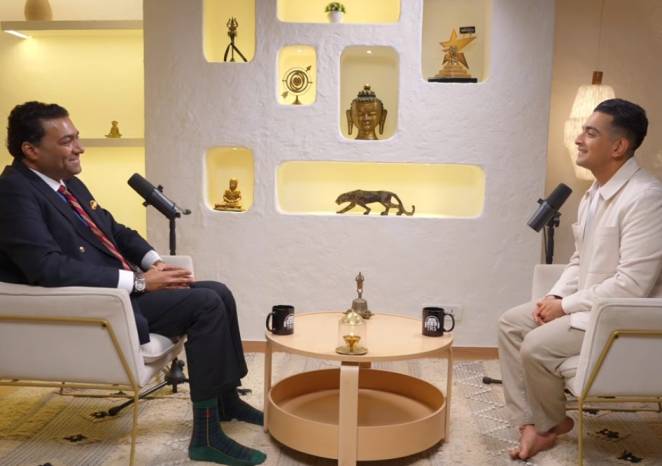
Here is the full transcript of ophthalmologist Dr Rohit Shetty’s interview on The Ranveer Show, January 15, 2026.
Brief Notes: In this episode of The Ranveer Show, host Ranveer Allahbadia sits down with world-renowned ophthalmologist and researcher Dr. Rohit Shetty to explore the fascinating intersection of eye health, brain chemistry, and spirituality. The discussion ranges from the biological impact of digital scrolling on our vision to groundbreaking discoveries about dopamine levels in tears and their role in predicting future eye conditions. Dr. Shetty also delves into the medical science behind the “third eye” and shares insights into the future of indigenous gene therapy for treating blindness. This deep dive into modern medicine offers practical biohacking tips and a deeper understanding of the “privileged organ” that connects our mind to the world.
Introduction
RANVEER ALLAHBADIA: This is not your typical health or medical podcast. Dr. Rohit Shetty has contributed to the field of modern-day medicine both as a doctor and as a researcher. He’s shared some of his groundbreaking research on this episode. It’s not your regular health podcast with a doctor where they’re giving you daily changes and practical changes. It’s something slightly deeper.
RANVEER ALLAHBADIA: You’ll definitely enjoy it if you’re a medical professional and you’ll definitely enjoy it if you enjoy biology the way I do. Proud and very happy to bring you Dr. Rohit Shetty’s work in motion on TRS.
After a very long time, am I this pumped about a medical podcast? Dr. Shetty, thank you for representing India’s name on a global level and thank you for doing what you do for medical science. Also, thank you for all the eye health knowledge you’ll give us today. That’s a thank you in advance.
DR. ROHIT SHETTY: Thank you. Thank you.
RANVEER ALLAHBADIA: How are you?
DR. ROHIT SHETTY: Pleasure to meet you here.
RANVEER ALLAHBADIA: Likewise.
DR. ROHIT SHETTY: All good. Top of the world.
The Impact of Digital Scrolling on Eye Health
RANVEER ALLAHBADIA: Had some mental health professionals on the show lately and they highlighted short content, reels, shorts, etc. Because scrolling seems to affect your mental health. It’s pretty obvious it affects the health of one’s eye as well. Do you think people understand the degree to which the health of the eye is affected just because of scrolling?
DR. ROHIT SHETTY: I don’t think so. Because, you know, scrolling has become such a part of a habit, a lifestyle. And as you scroll, your attention span also becomes shorter. It’s not just about your eye. You mentally also, if you’re going to school, you want the teacher to finish off everything within 30 seconds. It’s not going to happen.
So the eye needs time to focus. There is a lens inside. It focuses, refocuses thousands and thousands of times.
RANVEER ALLAHBADIA: Every time you walk?
DR. ROHIT SHETTY: Everything, anything. If I see my hand, if I see you, there’s always that focusing which happens. And if you continuously focus, it goes into a kind of spasm. It’s like you exercise yourself continuously.
RANVEER ALLAHBADIA: So is it like when you’re scrolling, every time you go into a new reel, your eye’s refocusing?
DR. ROHIT SHETTY: Yes, absolutely. Because you’re trying to refocus on somebody’s shoe or somebody’s hat or watch or something. So every time you have to focus and your angulation at what is not at your eye level, its angulation is different or it changes.
I mean, if you see today, a lot of people come with all kinds of neck, back, and all problems. It’s not because of the work, it’s because of the way you’re positioning your system.
RANVEER ALLAHBADIA: Text neck.
DR. ROHIT SHETTY: Absolutely. So it’s called that.
Dopamine and Eye Health: A Groundbreaking Discovery
RANVEER ALLAHBADIA: You also briefly mentioned before we started rolling about how certain eye problems are also linked to dopamine. I know dopamine has become a very common topic of discussion nowadays and I think everyone understands that our dopamine systems are a little wrecked because of short content, again, low attention spans, etc. But specifically, how does dopamine affect the health of your eyes?
DR. ROHIT SHETTY: Absolutely. See, many years back we started looking at dopamine as one of my research areas in work. And when we started looking at the young children, you see today, if you’re in your class, you know, out of 100 students, 25 would wear glasses, 30 would. In my class, maybe two would wear glasses. Wearing glasses was a special thing.
Today, not wearing glasses is special. Really, out of a hundred, at least five or six don’t wear glasses. Everybody is wearing glasses. The question is, myopia is becoming the biggest pandemic and we were not born to wear glasses. Evolution has given us a fantastic sight. We are making our evolution go to a different level where we are using those glasses and what causes those myopia increases in it.
And one of the many, many factors we found is the eye secretes dopamine.
RANVEER ALLAHBADIA: Oh really?
DR. ROHIT SHETTY: And there are dopamine receptors, there are dopamine activities. And dopamine has a lot of synergistic relationship with vitamin D. So dopamine in the eye—we published this work in a research journal—stops the eyeball from elongating, stops it from getting elongated. That means your eyeball can keep elongating and that increases your minus power.
RANVEER ALLAHBADIA: Can we take a step back and can you explain what dopamine is from a basic level? Just to recap.
DR. ROHIT SHETTY: Dopamine is one of the neurotransmitters. You know, it gives you that rush that you need to push for it. You need that dopamine.
RANVEER ALLAHBADIA: As far as I understand, dopamine also exists in the animal kingdom. And every time any mammal is trying to do anything—hunt, reproduce, whatever—it’s the dopamine system at play.
DR. ROHIT SHETTY: Yes, but what happens is many of the neurotransmitters in a particular organ, they work differently. And from a cerebral level, it’s about pumping you up. You do a good meditation, you’re pumped up. You know that is secreted in lots in you.
And your gut bacteria secretes dopamine. That means, that’s why they say “gut feeling.” That means your feeling is also from the gut, not just the brain. So when this dopamine in the eye stops the eyeball from elongating, this is a very new concept that’s emerging.
And what increases dopamine? Make the child play more, make the child be in the sunlight. Vitamin D secretes, pushes dopamine, makes the child get more active. So many Asian countries like Singapore are mandatory—they have to play two hours in the morning or evening. Because sports is not about your physical activities. Sports improves the change in myopia in the children.
And this dopamine is going to be the nesting where we need to tackle especially. And we were one of the first few research institutes to find dopamine from the tears, from your tears. And then we were able to predict, will this kid change to become a minus 10 or minus 11 kind of power?
RANVEER ALLAHBADIA: Never associated dopamine with the eyes.
DR. ROHIT SHETTY: Yes, this is something which is very unique. And people should be aware. I mean, I want the parents to be aware that make your child play. It’s not for his physical health, it’s for making your child—especially if a child has a small power in his eye—wow.
RANVEER ALLAHBADIA: Okay, I’m assuming that this is the research that’s gone on for like only the last five years or so.
DR. ROHIT SHETTY: The first paper we published was around five years back and this year we’re publishing around three or four on the dopamine itself.
The Limits of Medical Understanding
RANVEER ALLAHBADIA: The one thing I know about medical science is that we are still only beginning to understand the human body. Am I right in saying that?
DR. ROHIT SHETTY: Absolutely.
RANVEER ALLAHBADIA: So in percentage, if 100% is the complete understanding of the human body, how much do you think we’ve already understood?
DR. ROHIT SHETTY: Very little. I may be wrong or right, I don’t know, but less than 1%.
RANVEER ALLAHBADIA: We’ve only understood less than 1% of the human body?
DR. ROHIT SHETTY: The reason we have understood less than 1% is every time you think you understood something, new questions come in. You think that, oh, you conquered cancer, a new cancer behaves. You conquered an antibiotic when penicillin—Alexander Fleming introduced penicillin, he found that, okay, this penicillin will kill every bacteria. We don’t need to worry. New set of bacterias came.
Now you have a new set of bacterias which are resistant. So human body changes with the behavior. We are in the ecosystem. The ecosystem changes the body. When the ecosystem changes, our understanding—every time you think you understood, you go back. It’s like a snake and ladder. You reach 99, you think you’ve cracked it, you go back to zero.
RANVEER ALLAHBADIA: Could you give an example of something like this, which we thought we knew, but then we actually don’t know anything about?
DR. ROHIT SHETTY: There are a lot of times, you know, in my own practice where we know how to sort it out. For example, a simple dry eye. People would say, take a lubricant. It used to work 10 years back and now the same lubricant doesn’t work because your eye has changed from 10 years back.
As a postgraduate in early 2000, there wasn’t so much of people using blue light computers and all. Any 50-rupee drops would work very well. Today, it doesn’t work. That means that our understanding then and now is completely different. And we knew at that point in time that was a wonder drug. And today it is not.
And same thing—today’s wonder drug, tomorrow it becomes irrelevant. And so same thing with vaccines. So the whole idea of understanding that you do not know anything is a very important statement. You know, one philosopher said—I think it was Socrates or Plato, one of them—the first thing you have to say is, “I don’t know anything.”
RANVEER ALLAHBADIA: We don’t know what we don’t know.
DR. ROHIT SHETTY: What we don’t know. And that is what today the medicine is. And that is what we have to be aware of—that we don’t know much. But we are trying to attempt to find out something.
Revolutionary Tear Biomarker Technology
RANVEER ALLAHBADIA: Doc, there was something you mentioned about tears, right? Now you said that you extracted the nature of dopamine in different people’s tears.
DR. ROHIT SHETTY: Yes. See, if I go back to the time I started my practice, then I thought we should do something where the tears should be like your blood. It should pick up things. It’s like your urine, your blood—it can pick up anything. So I thought, let’s start working on it.
And when we started working on it, everybody said it’s like a dead end. You will not find anything. Tears is just water. Just like people said they don’t find anything in urine. Urine has all the components—you can pick up how healthy you are.
So we created, after that—now I’m saying this 20 years now—we created the world’s first tear biomarker machine where today I can check dopamine for you. I can check about a lot of body’s inflammation. And my vision is in the next five years to look for proteins specifically to Parkinson’s and Alzheimer’s.
And see what people want today. They don’t want to have a complex prick, get some report, something. If you find something from your tears and you say something, you have it, why not? And this is the contribution we are giving to the world. And there’s nowhere in the world—this will be launched next year, the first time.
And it’s like a Pandora’s box. The first time it will do only certain things. And then it’s like when the first time the phone came in, it could only call people. Today, phone has become a computer. The kit, we call it—we call it the Biomarker Pathfinder. It means it finds the path of biomarkers which can help to predict disease.
RANVEER ALLAHBADIA: It’s like how your blood basically contains your body’s secrets.
DR. ROHIT SHETTY: Absolutely.
RANVEER ALLAHBADIA: Your tears also contain your body’s secrets.
DR. ROHIT SHETTY: It just had to be. It’s like I call it the pen drives, you know, of the science of biology. You need to have a right port to put the pen drive. It tells you everything. Just need a specialized paper, which any ophthalmologist would do. I just take a tear. You don’t need a prick. From that paper, we can extract whatever you want.
RANVEER ALLAHBADIA: Or you just like punch them really hard, make them cry, collect them.
The Emotional Chemistry of Tears
DR. ROHIT SHETTY: You know, people who cry when they see a happy movie or they cry when they see an emotional movie, the tears are different. The composition is different. That shows how beautifully your body reacts to this.
Why when you cry with emotions, you’re filled with all these secreted neurotransmitters, your tears behave completely differently. And when you cry when you see an emotionally connected movie—a dog dying or something like that—your tears contain a lot of unwanted steroids.
RANVEER ALLAHBADIA: Wow. Okay.
DR. ROHIT SHETTY: And the experiment was done in one of the Asian countries, and they made the students watch certain movies and they made them cry and took tears and analyzed them. So your tears of joy, happiness are different. So when we—even the tears know when you’re happy or not.
RANVEER ALLAHBADIA: Damn. So you’re effectively saying that every time you cry, one, there’s a bunch of biomarkers in your tears.
DR. ROHIT SHETTY: Absolutely.
RANVEER ALLAHBADIA: Same as your blood.
DR. ROHIT SHETTY: Yes.
RANVEER ALLAHBADIA: And the second thing is that there could be different types of tears.
DR. ROHIT SHETTY: Absolutely, absolutely.
RANVEER ALLAHBADIA: Which tell you a lot about your emotional state.
DR. ROHIT SHETTY: Absolutely.
RANVEER ALLAHBADIA: So when you’re happy, those tears are—
The Science of Tears and Emotional States
DR. ROHIT SHETTY: Piece of joy contains different neurotransmitters. Maybe they may contain lot of dopamine secreted, lot of things. When you’re sad, what increases are your norepinephrine, your steroids, all those gets increased. Those things are picked up.
RANVEER ALLAHBADIA: Small tangent that I want to take. You said that to prevent kids from getting glasses, it’s really important to introduce them to sport.
DR. ROHIT SHETTY: Yes.
The Impact of Screen Time and the 20-20-20 Rule
RANVEER ALLAHBADIA: Now, what I understand from a bunch of the biology podcasts we’ve done is that, say, this problem of looking at reels, your eyes basically getting strained.
DR. ROHIT SHETTY: Yes.
RANVEER ALLAHBADIA: But it’s become a part of normal human life, so it’s going to be there.
DR. ROHIT SHETTY: Yes.
RANVEER ALLAHBADIA: The hack is to put your phone down and look at something in the distance.
DR. ROHIT SHETTY: Yes.
RANVEER ALLAHBADIA: Because it unstrains your eye a little bit. Now, I assume that when someone is playing a sport, they have to constantly shift between near and far.
DR. ROHIT SHETTY: Absolutely. Of course. Say you’re playing football, your football here, they’re looking at the goal post, looking at who is running. So what happens is the beautiful rule of 20-20-20 that, every 20 minutes you look out at an object which is 20 feet away. Why? Because you’re breaking that accommodative cycle.
What causes myopia is because chronic state of accommodation. If I’m looking at one thing, my eye goes into chronic state of accommodation, secretes biological factors which assumes that you are more of a person who needs more near vision. The body behaves to what you want. What is what you’re telling it.
RANVEER ALLAHBADIA: It’s like if you permanently sit like this, your posture is going to be right.
DR. ROHIT SHETTY: Exactly.
RANVEER ALLAHBADIA: You’re doing that inside your eye.
DR. ROHIT SHETTY: Exactly. And what is near vision? Minus power. That’s why it’s called nearsightedness. If you say that this kid needs everywhere, the brain tells, “Okay, don’t go into the state of echo. Don’t go into the comfort zone. Expand it.”
Elite Athletes and Slow Motion Vision
RANVEER ALLAHBADIA: Okay, I have another bit of a sci-fi tangent.
DR. ROHIT SHETTY: Okay.
RANVEER ALLAHBADIA: Do you watch any cricket?
DR. ROHIT SHETTY: Yes.
RANVEER ALLAHBADIA: You know Virender Sehwag?
DR. ROHIT SHETTY: Yes.
RANVEER ALLAHBADIA: Okay, so with batsman, if you watch cricket long enough as a fan, you know that some batsmen have an extra bit of time when it comes to hitting the ball.
DR. ROHIT SHETTY: Yes.
RANVEER ALLAHBADIA: Now what this translates to for people who don’t watch cricket is that those batsmen are almost seeing the game in slow motion.
DR. ROHIT SHETTY: Absolutely.
RANVEER ALLAHBADIA: And this happens in football as well. With some footballers, especially forwards, it seems like they are living like, you know how flies live. Like when you go to kill a fly, fly flies away. Because it’s probably seeing its own world in slow motion.
DR. ROHIT SHETTY: Absolutely.
RANVEER ALLAHBADIA: So can the human eye be trained to live life in slow motion?
Sports Vision Complex and Spatial Awareness
DR. ROHIT SHETTY: Not really, but it’s a very important topic. I am very thankfully brought it up. It’s many times not discussed. There’s something called a sports vision complex. I get a lot of these people who come to me, “My son got hurt. He gets getting hurt all the time.” And I said, I figure out why are you getting hurt when you’re playing a cricket or a badminton?
Then we realize there’s something called as adaptation time. There’s something called a binocular single vision where I’m seeing you and suddenly something comes. I should be aware that something comes in the whole component of adaptation time, the eye, how it adapts. Because you need what you need vision, you need auditory inputs. Most of the time is the vision inputs which tells the brain what is coming from here.
For example, the spatial awareness is about how spatially we are aware that if I push my hand in, there’s a mic here, or I just put my hand up here, there’s a cup here which will fall. This is scientifically known to improve in meditation and yoga. When you watch TV or old movies or whatever, we think that when you become extremely strong in your state of meditation, you have superpowers. You do this, fire comes up or something like that. Because we believe power as a power to create something.
But these people who get those spatially aware, I believe that spatial awareness becomes so much that they’re aware of everything. For example, simple example I gave you before this interview. You’re sitting in an aisle seat. Somebody comes with the bag. If he’s spatially aware, when he turns around, he knows that there is somebody sitting. His bag is going to hit his face.
So what happens is how you can make them spatially aware is of course, through these, is to see if they are actually having a good binocular vision. Binocular single vision. Is that how both eyes see? It goes to the brain and there is an image, then they become one. Otherwise I should be seeing two of you because I’m seeing one from this side, one from this side. How does it focus and become one?
The ability of, say, Virender Sehwag or tomorrow, any of the great sports people is about how their binocular vision is very good. That means he’s able to see that in slow motion because he’s able to gauge it better.
Depth Perception and Binocular Vision
RANVEER ALLAHBADIA: Okay, sorry. Just to be on the same page as you, I know that when you close one eye and look at anything, if you keep one eye closed long enough, then your sense of judging distance becomes affected. You don’t know if that’s a big object or a small object.
DR. ROHIT SHETTY: Because you need to be in. The depth perception goes off.
RANVEER ALLAHBADIA: So when you open your second camera, the combination of images from the two cameras help you gauge distance. And what you’re saying is that in elite level athletes, that’s very good. This is an even higher version of combining the two cameras.
DR. ROHIT SHETTY: Absolutely. And in fact, I had met recently a sports therapist. I said, when your student is not doing well in that sport, what do you do? You give him a lot of exercise. You tell him he’s lazy, said push him, get a basic test done. There are some specialized tests for the sports people to see whether they’re fusing well, whether the depth perception is good. How is the stereopsis?
Stereopsis is, there are some very nice simple ones which tells you sometimes stereopsis is so bad. And you put this guy into a cricket, as a batsman, he cannot judge the ball. And you know what is very interesting about this part? In acute phase of stress, you lose stereopsis. You know, sometimes I feel somebody’s may, somebody’s, why did the form suddenly drop? Somebody is a great tennis player, why is he not playing well?
And you say, okay, one game you lose, two games you lose. It builds on you. And what happens is brain and all the places the stereopsis, that means he’s able to judge becomes slow. And then that small misalignment of the judgment, he misses the ball or he misses to hit that ball.
RANVEER ALLAHBADIA: I think what’s important to note for the end listeners here is that this is not just about sports. This is about life.
DR. ROHIT SHETTY: Absolutely.
RANVEER ALLAHBADIA: Like better spatial awareness leads to better performance at the workplace. It probably leaves you as a better human, even around your family.
DR. ROHIT SHETTY: Absolutely.
RANVEER ALLAHBADIA: All these things are linked.
DR. ROHIT SHETTY: Absolutely.
RANVEER ALLAHBADIA: I over to you, tell us how they are linked.
Frequency Illusions and Brain Programming
DR. ROHIT SHETTY: See for example, in this art of we’re talking about spatial awareness, there’s something called frequency illusions. Frequency illusion is if the brain keeps understanding that something is important, you would always see that all the time. For example, you assume that 11:11 is an important number. I mean people believe that’s something different. But if today I say 11:11 on your phone is an important number, your brain automatically knows that in that spatial awareness picture that for so and so, 11:11 on a phone is important.
So it will make sure that whenever you pick up that phone that 11:11 comes or somebody says, “Oh, car number 14 is an important number today.” Tomorrow you assume you’ll see all cars. You will see 14. Because brain filters out 13, 12, it will only show you what is 14. This is such a phenomenal psycho-physical processes with the eye and the brain work. Which tells us one important thing. Your brain knows you how to compartmentalize because it has that frequency of thoughts.
Okay, for example, there are 24 hours and you have something like 11 hours or 12 hours to work today. You tell the brain that you want to work from morning, whatever. Each one of us may do our different work, brain will make sure that it will compartmentalize. But somebody has not put it across. He says, “I’m so stressed that I have to work today.” Then it will not compartmentalize.
My father-in-law, who started the Narayana Hrudayalaya was a phenomenal work in motion. His philosophy was he would never tell and used to tell his grandchildren, anybody asks, you should say “top of the world.” Doesn’t matter what state of mindset you are in, because when you say “top of the world,” the brain automatically filters everything else.
RANVEER ALLAHBADIA: Massive lesson for younger generations. Yes, because I remember when us as millennials and we were younger, we were taught “all is well” from Three Idiots, you know. And nowadays when you tell people to think positive, stay positive, what you’re rebuttal with is, “Hey, don’t be the toxic positive person.” They call this toxic positivity, but it’s a secret hack for life.
DR. ROHIT SHETTY: Absolutely.
RANVEER ALLAHBADIA: This has kind of become like a Science of the Third Eye podcast also. And we’re talking to one of our country’s best eye doctors ever. So I love it.
DR. ROHIT SHETTY: Absolutely.
The Eye as an Extension of the Brain
RANVEER ALLAHBADIA: Okay, I need to recap again, doc, and I’m going to bring in some of my basic biology knowledge now. I know that and please add to the biology here. Basically your eyeball has a retina at the back. This is how cameras are also built. The retina and the camera is the sensor. And then it’s almost like there’s a wire that goes into your brain.
DR. ROHIT SHETTY: That is your optic nerve.
RANVEER ALLAHBADIA: I believe that the material that the optic nerve is made out of and I believe your retina as well, it is an extension of the same material that your brain is made of. Could you add the biological terms?
DR. ROHIT SHETTY: See, there are, retina has many layers and all those layers confer or becomes confluent into an optic nerve which is like a connect. It’s like a wire which connects your bulb to the switch. And that the nerve is like any other nerve in the brain. It has all the components of the brain. It has the sheets, your myelin sheets and everything which helps in relaying the information.
So eye is an extension of a brain. And because whatever we see, it has to go to the brain, but then the emotions gets added up. It goes to the limbic systems, the amygdalas, the seat of, where you seat of spiritual soul, they call and you have the other limbic system, hippocampus. And all of them add emotions to that. And we also have to make out, for example, I look at you. I need to go back to my previous thing. Whether I have a good image about you, bad image about you.
RANVEER ALLAHBADIA: What kind of image do you have about me?
DR. ROHIT SHETTY: Okay, I’m glad so that my brain tells me that. And so all this goes in the processing. So there’s something called seeing and something called processing. And the processing happens so beautifully. It’s still a miracle that I find it very difficult to believe that evolution only changed this. I always believe that maybe something else superiorly which created us, not just evolution. Because it’s too much to give credit to only evolution.
RANVEER ALLAHBADIA: There has been some divine intervention of some sort.
DR. ROHIT SHETTY: Could be anything. Anything could be or, you know, something even just some few million years back from hunter gatherers, from that to Homo erectus, to what we are. And it is difficult that we have reached this stage with such finesse. And the reason we are talking about it, that finesse, we are breaking it by messing it up big time. Blue light, spending time in a lot of pixelated images. Vision is never for pixelation. We were sent to see the world in different dimension.
Hidden Abilities Within the Eye-Brain Connection
RANVEER ALLAHBADIA: Yeah. I have to take you back to that brain-eye conjunction that we were talking about in the same way that we spoke about spatial awareness and how sports increases spatial awareness and therefore that can increase the quality of your life as an everyday human.
DR. ROHIT SHETTY: Yes.
RANVEER ALLAHBADIA: Do you think that there are other abilities like that hidden within the eye which can be used to program your brain in a certain way?
The Eye as a Privileged Organ
DR. ROHIT SHETTY: See, not just from the brain, but if you really look at a lot of things which are secreted like vitamin D, the eye can secrete vitamin D without need of the skin or the whole pathways of it. So the eye, it’s a very privileged organ and it’s been privileged from the time we became into this evolution.
So I also, for example, there are certain animal kingdom. I just go into this question which can take a decision without impulses reaching the brain. For example, it sees threat. It just knows what to do based on what it sees, not about what the brain thinks.
RANVEER ALLAHBADIA: So you’re saying that the eye can react very fast.
DR. ROHIT SHETTY: In some animal kingdom, in some animals. In some human beings, we need still the input from the brain. But our dimension of health, our mental, physical, emotional health depends a lot on the eye health.
For example, if you’re a stressed person, you feel sometimes the eye twitches, you feel tired. You know, when the eye feels tired, the brain is telling that you go into, they say brain fog. So that means the eye has also a lot of emotional component. It’s telling you the eye is also involved in some psychological thing, psychological changes.
A lot of times I get patients who have very bad dry eye and most of them have psychological issues.
RANVEER ALLAHBADIA: This is the subject of psychosomatic illness.
The Eye-Brain-Psychology Connection
DR. ROHIT SHETTY: Psychosomatic is when you don’t have an illness, you claim that you have an illness. That’s also a borderline about this. But here what happens is chronic eye issues, because you’re so easily connected to the brain centers on many fronts, makes you reach a stage where you become chronically depressed.
I have had at least two people who’ve been having chronic depression and they never got their eyes checked up. And they had a small, that I told you, the binocular fusion issues. And they kept telling that I see double. I can’t gauge my thing. Sometimes I’m just climbing stairs, I feel like falling.
And when we gave them certain exercises, and their dopamine is anyway very low, the serotonin is also very low, that the urge to do something in life is very low. So the eye has a very strong psycho-brain eye axis, is a very phenomenal strength in the psychosocial well-being of a person, and which is very poorly understood because these are very difficult to research upon.
But there are a lot of new research areas opening up which is the role of FMRI or functional MRIs where you can pick up the impulses from the brain for a particular images. And you know, like why you like somebody. The symmetry, you know, symmetry of a person. And see, that’s what’s attractive, you know.
RANVEER ALLAHBADIA: Exactly.
DR. ROHIT SHETTY: Mind see, it’s how the, because if the symmetry has to come from the eye, right? It has to find its symmetry. Some faces are symmetric and you know, there was an experiment where they showed around 40 different very good looking people to some like a child or different people. And most of them ironed on one or two people.
And you know, in technical terms they were not the most good looking, but when they put it into a computer they found the most symmetric aspects in them. And see, and the other thing is about the behavior. Like why do we like somebody? Why do you like the first meeting? It’s just not about chemical emotional reactions. It’s about the body language and who observes the body language, the eye.
And it’s all about sensing impulses. For that you need spatial awareness. Somebody has a terrible body language and you know, you are very nervous or somebody’s fidgeting and you know, you spatially pick that up and it tells the brain no, this is not the person.
Spatial Awareness and Communication
RANVEER ALLAHBADIA: For me, that is how better spatial awareness improves the quality of your life. It’s like, you know, I personally feel as content creators the skill that we bring to the table is effectively communication skills more than any other skill.
DR. ROHIT SHETTY: Absolutely.
RANVEER ALLAHBADIA: The most important aspect of communication skills is what I believe is called active listening. Just listen to whoever’s in front of you and react. Your ability to listen actively and to react improves with better spatial awareness. Because while I speak to someone without moving my eye contact away from them, I’m able to notice the hands, their feet and that makes me a better podcaster.
DR. ROHIT SHETTY: That’s spatial awareness. So that awareness is what the eye brings in.
RANVEER ALLAHBADIA: I think in every career you need conversational skills.
DR. ROHIT SHETTY: Absolutely.
RANVEER ALLAHBADIA: And one of the most important aspects of biology which is at play in conversational skills is the health of your eye and your spatial awareness.
DR. ROHIT SHETTY: Absolutely. Because that’s what reaches the brain.
RANVEER ALLAHBADIA: Okay, so now as a doctor, my question to you is how can someone at home sit and improve their spatial awareness?
The Gut-Brain-Eye Connection
DR. ROHIT SHETTY: It’s not possible. It’s like the question is you have to make an attempt. Like you yourself give an answer to it that you know how it improved through this meditation, physical exercises improve it and sedentary life messes up big time.
And one important thing again, which is also very important for the viewers is your gut microbiome is a very strong influence about how you are as a person. We have more bugs and bacteria in our body than ourselves. What happens is a lot of recent research says that a lot of these neurotransmitters like serotonins, dopamines, GABA, and these are all actually secreted in lot by bacteria itself, the good bacterias.
And a lot of these things actually you need both ways. They secrete this and those which are these neurotransmitters. Also you need to keep those bacteria healthy. For example, if you look at a high level of steroids in your body, cortisol, the type A personality is always stressed and you know, the same cortisol changes the flora of your gut. That means it makes gut which is not secreting good neurotransmitters.
The gut feeling is a concept. Whoever has, you know, our forefathers had thought about it, had thought with a lot. They had probably a billion times more intelligence than us as a medicine. We all started in the times, I’m talking about thousands and thousands of years back. We all started as human healers. We used to heal. Heal means somebody comes with an eye problem, I heal the body. I figure out where is the problem in his gut or something else.
Now what are we? We are curing. You have an eye problem, I’ll give you these drops. You have a heart problem, I’ll give you these things. This is a big difference between healing and curing. Because for healing you need patience. And I believe I always tell this to my patients, that pill and prayers need patience.
I’m happy there are a lot of new innovations in gut microbiome study. And when we found we did one very interesting test, when we look at the bacteria of our eyes in area of keratoconus, which is my area of work. The eyeball keeps, the cornea keeps bulging out. You know it’s very common in youngsters today really because of eye rubbing, allergy.
RANVEER ALLAHBADIA: What are the symptoms?
Understanding Keratoconus
DR. ROHIT SHETTY: Eye gets blurry, you start seeing everything as multiple things. You see moon, you see three moons.
RANVEER ALLAHBADIA: This is a common thing now?
DR. ROHIT SHETTY: It’s becoming very common and I did my PhD on that.
RANVEER ALLAHBADIA: Keratoconus.
DR. ROHIT SHETTY: Keratoconus. Kerato is in Greek called cornea. Cone is the cone shape. It’s becoming cone shape. So we found a completely new set of bacteria in your eye which is probably pushing it to become weaker. So that means that this is what I said. You know, we just don’t know people.
If you look at the textbook of keratoconus, it is caused by rubbing of the eyes. Medicine today needs disruptive scientists. People should stop thinking about what is in the book. The book said it’s a non-inflammation. That is, that means it is 150 year old definition. It’s no inflammation and there is no, it’s just a degeneration caused by rubbing.
But if you start disrupting, can there be a bacteria causing it? Can there be some inflammation causing it? Can there be something? Because if you become a disruptor, your thought process of treatment becomes disruptive. Then you start thinking okay, what you’ve done all these years. This is one of the most common causes of people going for a transplant. The youngsters going for transplant. This forms 90% of youngsters going for transplant anywhere in the world.
So if you start looking at it in a disruptive way, you start looking at everything in a different way. So you need scientists to look at it differently. It’s what I saw that award in you because it makes sense, that is what we need.
RANVEER ALLAHBADIA: Okay, couple of angles here. First we spoke about keratoconus and you’re saying it’s become a common problem with young people nowadays.
DR. ROHIT SHETTY: Yes.
RANVEER ALLAHBADIA: The causes that are written about in textbooks are usually related to eye rubbing.
DR. ROHIT SHETTY: Rubbing your eye, this is what it becomes.
RANVEER ALLAHBADIA: So this one’s for the Gen Z’s out there. So you’re saying that other than all the other problems that they’re going through in life, this is another eye problem they look out for.
DR. ROHIT SHETTY: Absolutely. And I’m happy that you can see there’s a bulge in the, it’s like a cone shaped in the bulge out there. And this is one of the areas where we are taking a very big lead in bringing a gene therapy to this disease.
RANVEER ALLAHBADIA: Okay, you’re saying that the textbooks say it’s related to rubbing one’s eye, but modern research says that there’s a particular kind of bacteria.
DR. ROHIT SHETTY: Not just that, there’s inflammation. Inflammation could be because of long hours of computers, TV, dryness and bacteria is also one of the factors, one of the hundred odd factors which could cause this.
RANVEER ALLAHBADIA: Okay, what’s the most common factor?
DR. ROHIT SHETTY: I feel that chronic dryness and dryness leading to always fidgeting with your eye.
RANVEER ALLAHBADIA: And what causes chronic dryness?
DR. ROHIT SHETTY: Long hours of work.
RANVEER ALLAHBADIA: Screen time.
Modern Solutions for Eye Dryness
DR. ROHIT SHETTY: Yes, and I did a research on them. People who work 10 to 11 hours a day, they don’t go for an eye checkup, they don’t go meet anybody, they just go for small glasses or they just go to the counter and take some drops. There are a lot of new drops for this. Like for example, companies have come out with now Omega 3 drops. There are trehalose based medications. Like I said, these are all medications which are used for modern day lubricant.
RANVEER ALLAHBADIA: Okay, I think this is becoming kind of a young person’s podcast. We spoke about so many different aspects already. I want to run you through a few things and just get your medical opinion. Now, Doc, we’ve spoken so much about how eyes are a window to the mind.
DR. ROHIT SHETTY: Yeah.
What Eyes Reveal About Physical Stress
RANVEER ALLAHBADIA: Because the brain is linked to the eye. Now the context here is that this is the world’s best young midfielder right now, at least become the world’s best midfielder. It’s a very famous photo in football circles. Basically when he was 17, his nation and his club discovered that this is a generational player we have.
So they found him as a 16, 17 year old and his strength is his stamina. So his managers and coaches made him play every game. And in football circles, this is the photo that went viral that by the end of it he almost looks aged. Now I want to ask you as an eye doctor that when you see dark circles forming like that or stressed eyes, what does it say about a brain?
DR. ROHIT SHETTY: Usually it says that it’s not just about the brain, it’s about your physical body. Because what happens is in this case he’s lost a lot of fat. The eye becomes shrunken inside. And once you lose that fat, there are a lot of this melanin pigments which forms there chronically.
And sometimes, you know, you chronically keep squeezing your eyes. People who don’t wear glasses, they have a tendency to squeeze, see like this. So what happens is they chronically have those pigments. It just means that they go through a lot of stress. And you see this in a lot of patients who are under a lot of psychological stress, just don’t look healthy with their eyes.
RANVEER ALLAHBADIA: I want to take a free consultation from you right now. I’m currently in the middle of a deep podcast schedule. And every day we are doing very deep conversations. Even if I sleep seven to eight hours a night, by the end of a week of continuous podcasting, I develop some dark circles, which then go away in three days when I go to a beach. What is actually happening in my body and skin and eyes?
The Science of Hydration and Dark Circles
DR. ROHIT SHETTY: See, when you sit in an environment like this or you sit in a flight for 10 to 12 hours, you take a long flight. When you get down, everybody has dark circles. Everybody. Because it’s hydration. Your hydration is necessary for your cells here. And these are all loose cells. And they need, they’re not thick skin, they need that cells, they need hydration.
The fat cells which are inside, they release hydration. So especially when you are doing this, you should double the intake of water. And that’s why every airline has a thing about, they keep water every time. Because you increase more water, because the cabin humidity, you lose more water than running a marathon.
RANVEER ALLAHBADIA: So according to science, during stressful work phases.
DR. ROHIT SHETTY: Absolutely.
RANVEER ALLAHBADIA: Or phases of lack of sleep, like when you’re traveling.
DR. ROHIT SHETTY: Absolutely.
RANVEER ALLAHBADIA: You are more prone to developing dark circles.
DR. ROHIT SHETTY: Absolutely.
RANVEER ALLAHBADIA: And to prevent the speed of formation of dark circles, you should keep drinking.
DR. ROHIT SHETTY: A lot of water, hydration. And you can look at the days you have said, you said you had dark circles. You see that day, you just see how much of water you have drank. You’re not mindful about drinking water.
RANVEER ALLAHBADIA: Wow. So it’s much more than just a lack of sleep that causes dark circles.
DR. ROHIT SHETTY: Absolutely. Honestly.
The Biology Behind Eye Shine and Emotional Stress
RANVEER ALLAHBADIA: I have a friend, he’s famous. His name is Baja the rapper. And we did an episode with someone called Parmeesh Varma, who’s another Punjabi singer. And Bacha messaged me saying, “Hey, man, keep the glow up,” because this year, with everything that happened, I was doing podcasts from a very scared place.
But with Parmeesh, these Punjabi big bros, they lifted me up. So I was happy while doing that episode. Since then, I’ve been happy recording. We do a lot of this thing called game taping, where we go back to old episodes. I’ve noticed that in that phase when I was actually sad, it’s almost like the shine leaves the eyes. So when someone says that, “Hey, my eyes don’t shine anymore,” is there biology behind that?
DR. ROHIT SHETTY: Absolutely. If I can take a little bit detour on answering this question, because it’ll also be very funny. I get a lot of students from different parts of the world to do some research work. So one student who had come from Europe asked me that in my country, when nothing works for very bad pain in the dry eye, my patients use their own urine and it works wonders.
As a doctor, it’s, suddenly you get, but I learned a very beautiful phrase from a Nobel laureate talk once. He says, “If somebody tells you that it cuts like butter, if you are a scientist, you should ask him at what temperature?” Because that is what the science is about.
So I asked, so I used the same analogy. I said, “What do you think is happening?” He said, “Doc, this is rubbish.” I said, “It’s rubbish. Nobody’s going to ask anybody to use urine. But if you look at what does urine contains, urine has steroids. And what does steroids do when you put anywhere in the body, it improves anything.” So what the patients were doing is completely wrong. It’s completely messy, completely scary. But the urine does do something because it has steroids.
So when somebody says that when I’m stressed, my eyes don’t twinkle, the twinkle in your eyes, the shine, the glow is, when you are under tremendous amount of emotional stress, you have very bad dry eye. And I told you, emotional stress is cortisol. Cortisol makes the eyes to evaporate. It creates all kinds of stress. So when you have that stress, your eyes don’t twinkle.
You see the most happy people in life. Like, you see lot of great patrons, saints, philosophers, they have, you get completely magnetized by their look. And what is the look? It’s not the face. Most of it’s covered with beard. It’s about the eyes.
RANVEER ALLAHBADIA: So you’re saying that basically when you think someone is sad, when someone’s looking sad.
DR. ROHIT SHETTY: You don’t tear enough.
RANVEER ALLAHBADIA: Subconsciously you’re noticing the eyes, which are dry.
DR. ROHIT SHETTY: Yes.
RANVEER ALLAHBADIA: And one of the root causes of dry eyes is high cortisol.
DR. ROHIT SHETTY: Cortisol and poor secretion of tears.
RANVEER ALLAHBADIA: And again, perhaps this is also linked to your eyes and their own dopamine secretion locally.
DR. ROHIT SHETTY: Absolutely.
Balance, Aging, and Spatial Awareness
RANVEER ALLAHBADIA: So, again, this is why you should work on your spatial awareness so you can catch all this about other people. I want to go back to that spatial awareness thing. So effectively, I’ve been doing yoga for three years, but only in the last year have I been doing it very seriously and been doing slightly more complex asanas. And I’ve realized a lot of them are based on balance.
Now my mum’s a doctor as well and we were doing an episode on aging women, I believe, and she said that one of the most common problems that an aging person faces is a loss of balance. And you got to do exercises as you grow older to just maintain your sense of balance.
I feel as you grow older is also when you’re 30 years old, your balance is not the same as it was when you were 22. But if you can keep working on it, chances are that you’re doing your older self a favor. And I would like to believe that you’re keeping your body and your mind younger.
DR. ROHIT SHETTY: Absolutely.
RANVEER ALLAHBADIA: So while we speak about this whole anti-aging conversation, little things like doing yoga and weight training regularly from a very early age has a bunch of other benefits than just building strength and flexibility.
DR. ROHIT SHETTY: See, one beautiful line I had seen during the National Yoga Day, International Yoga Day is about this line which says that it’s not about your ability to touch your feet, it’s about all the things you can do when you’re going down. To touch the feet means the whole body changes about it. It’s not just your flexibility. When you talk about these things, the flexibility is about improving the lymphatic, lymphatic flow.
Understanding the Lymphatic System
RANVEER ALLAHBADIA: We’ll have to take a tiny pause here. Again, very important life skill that someone in their 20s should learn early on. There is something called a lymphatic system in one’s body. For lack of better explanation and please help me, you’re a doctor. It’s almost like kind of a type of excretion system in your body.
DR. ROHIT SHETTY: Absolutely.
RANVEER ALLAHBADIA: Like the dirt in your body is kind of processed through the lymphatic system. Now what you can do through something called a lymphatic drainage massage is just direct all that dirt from your face, from your body into your excreta and then you urinate it or you pass it as stool. But you have to actively do this either through lymphatic drainage or according to what you said through perhaps yoga.
DR. ROHIT SHETTY: Any of these activities improves this. And the lymphatic system is also driven by a lot of nervous system. You said about the stress and the whole concept about it. You said you have a swollen face.
RANVEER ALLAHBADIA: All this is linked to finally getting a result of being better looking, having better skin, better hair, helping your aging process. Go on doc.
DR. ROHIT SHETTY: So that is where we improve the whole system and everything. It’s not just yoga or meditation. Any form of non-sedentary activities including walking 10,000 steps improves everything. It’s just that, and somebody may say I’m feeling very cold. Somebody may say I’m not feeling cold at all. That means your body has nociceptive channels which keeps, each person has a different threshold. And they are the ones which helps you to feel the ground when you’re walking, sit down. They are the ones who keep you in balance.
RANVEER ALLAHBADIA: Taking in data about the environment through your skin.
DR. ROHIT SHETTY: Absolutely. Of the whole thing. So one of the big challenges today is exaggerated nociception in people.
RANVEER ALLAHBADIA: What’s the right version of this? Like you should be okay in all environments.
DR. ROHIT SHETTY: See, you should be okay. It’s not that, see somebody may say it’s too cold. Somebody may say, but it should not be exaggerated. We see a lot of this in the eye nowadays. They said I just cannot tolerate AC. I just cannot tolerate light. When the light is there, the eye waters. Now the old drops don’t work for them.
That’s why I said in the beginning that the new concept medications, I’m happy that a lot of Indian pharmaceuticals are coming out with very strong medication. Like we have something like Omega-3 drops have come. We have something called trehalose drops have come. We have something cyclosporine. All these drops now work on not just giving a holistic way of treating the person.
When I told you it’s about trying to make not just cure, trying to heal. Also the targeted medicine will make the life easier for people. Somebody who has, who can’t see the light. Imagine we have, everything is light. You sit in a computer, it’s light. So the life is gone.
Reading in Low Light and Eye Health
RANVEER ALLAHBADIA: Is it really a bad thing to try reading a book in low lighting? It probably helps the eye, right?
DR. ROHIT SHETTY: Low light is you’re trying to focus on different dimensions. See it’s okay if you’re doing it ergonomically. Sometimes you put it here and if the light is focused, it’s good because it doesn’t allow, you don’t squeeze too much. But the olden time table lamp had an arm which would just focus on it, looks very good. Sometimes the fancier ones don’t do the work as the older ones.
Dark Adaptation and Military Training
RANVEER ALLAHBADIA: I’ll give you context on where this question is coming from. Major Vivek Jacob, who’s a legendary Indian commando, he has these training camps for scuba, which are kind of in the outdoors. So I remember we were setting up our tents at night along with former Indian special forces commandos and they were able to see everything and all of us weren’t.
So they were just like, “Listen, in commando training and even generally in the Indian military, they teach you spatial awareness. They teach you how to see better in the darkness.” And it was completely dark, no moonlight, nothing for us to really focus in the darkness. Took us a bit, maybe like an hour or two later, we were able to see things. So I assume that there’s something called rods and cones in the eyes. Cones are related to color. Rods are related to lights.
DR. ROHIT SHETTY: Right. Rods are related to light. So what happens is they train them to adapt them to, it’s called dark adaptation. Each person has a different time of dark adaptation. They adapt to dark because of training much faster. And they don’t use just the dark in the eye, they use spatial awareness about everything. The body gets adapted to that.
That’s why many of the special forces are very hell bent on getting the right vision for them. They don’t take somebody with a glass or contact lenses. They’re very, very clear that they need to have somebody with the 20 by 6 or better vision. So that means that when you have somebody like that, his rod response is better than somebody having a minus one power.
Eye Warm-Up in Sports
RANVEER ALLAHBADIA: We’ll go back to the screen now. There’s a couple of things I want to show. So this is the current best Indian T20 player. Why do batters do this before they go into bat? Can your eye be warmed up? Now see, see what he does next? Look at this. What is happening here? He’s clearly doing something to his eye and his brain. So as a doctor, can you explain the biology behind it?
DR. ROHIT SHETTY: What he’s trying to do the same thing. You see, a lot of F1 racers also do their reaction time. He’s building his reaction time. So that is a very important thing. If we look at him playing with the ball, that means how is there something called acclimatization? So what he does is he works on acclimatization to how the ball is coming.
RANVEER ALLAHBADIA: So he’s warming up his senses, especially his eyesight.
DR. ROHIT SHETTY: Eyesight, eye and brain.
RANVEER ALLAHBADIA: Everything to go in and bat.
DR. ROHIT SHETTY: Go in and bat.
Flow State and Visual Processing in Cricket
RANVEER ALLAHBADIA: In the world of cricket, there’s often this thing about flow state. When a batter has already scored a lot of runs and it seems like every ball is just being hit way better than normal. Like where bowlers can’t get him out. Kohli enters this flow state a lot. Anyone who’s actually scored a century has entered this flow state.
So on one level, they’re training it all the time. On the second level, we see Abhishek Sharma, Sai Sudarshan doing these eye exercises. What’s happening at this third level where they’ve entered the flow state? Has time actually become slow?
DR. ROHIT SHETTY: See, you just gave a answer, gave this part of the answer about the special forces. Why do they see well in the dark is not because they are different aliens with us. They see it better in the dark because they have been tuned to that. They have acclimatized to that.
Because every day you work in the dark, you become more acclimatized. Your brain is like a frequency illusion. Brain thinks this person, make him night owl, make him like a, make his, tune his brain to that. So it’s not better. It’s just that impulses go faster.
After some time, you feel that it’s not going to this brain. It’s a spinal cord. The ball comes here, it doesn’t need the brain to react. He knows he can go back and the ball can go back.
RANVEER ALLAHBADIA: Body just does its own thing.
DR. ROHIT SHETTY: Yes.
Training the Brain Through the Eyes
RANVEER ALLAHBADIA: The one fascinating medical insight I’ve gained from you is that your eyes can be used to train your brain.
DR. ROHIT SHETTY: Absolutely.
RANVEER ALLAHBADIA: Okay. There is a spiritual motivational concept called power visualization.
DR. ROHIT SHETTY: Yes.
RANVEER ALLAHBADIA: We have to speak about what the third eye even means according to an eye doctor.
DR. ROHIT SHETTY: The third eye, according to eye doctor, is a sensation other than just visualization. You know, seeing is what the eye does. Visualize is what it needs the brain to do.
So when you see visualization, it adds colors to it, it adds form to it, it adds emotion to it, it adds anger, feelings, everything to it. But that’s why the third, the inner eye is about visualization. You mentioned about, you know, visualize. People can visualize you becoming the greatest footballer or the greatest podcaster ever in the history of the world. It’s about how you keep reinforcing that into your brain.
The Neuroscience of Visualization
RANVEER ALLAHBADIA: Again, I’m bringing in some biology. Please correct me, Dr. Sid Warrior, who’s a famed neuroscientist as well as a neurologist, he’s been on the show repeatedly. We did an entire episode on evolution and where we are currently in the evolutionary timeline.
So he spoke about the frontmost part of the brain. He said that the responsibility of that part of the brain which is physically at the front is related to your sense of visualization.
DR. ROHIT SHETTY: Yes. There are visual centers, the visual association centers, visual connecting centers. So every part of the brain has some connect to all the centers. The visual centers goes in the occipital cortex, which is in the back.
But what you, sometimes, you know, you have dreams, you hallucinate. I mean, you visualize things. Then you have frontal, temporal, and all this cortex and these things add. Like I said, whatever you see is just a pixelated image. If you don’t add emotions to it, if you don’t add colors to it, if you don’t add, so that’s why we need all those centers to help you.
RANVEER ALLAHBADIA: What do you mean, pixelated image?
DR. ROHIT SHETTY: For example, if somebody has never seen a cup, he just looks at the cup and he doesn’t know what it is. Some other center in the brain has to tell the brain whatever you’re seeing is a cup. And this is how you hold it. And that is why vision is not just about seeing. It’s about the complex things which happens.
Meditation and Brain States
RANVEER ALLAHBADIA: Okay, I’ll bring in a couple of angles here. There is a particular type of meditation called Kriya Yoga, spoken about in multiple books, spoken about very commonly on the Internet as well. I have not got my initiation in Kriya yoga, but it used to be the path I had chosen once upon a time. And I was training to get initiated.
And it was a very difficult training pathway. Very fulfilling, but very difficult. A lot of meditations were taught to us before we would actually be eligible for the Kriya yoga initiation. A lot of those meditations were related to turning your eyeballs up and closing your eyes when you turn your eyeballs up.
This was said by Dr. Marisa Peer on the show. She said that when you turn your eyeballs up, it’s like it switches your gears of your brain, I believe, into what she called the gamma state or the theta state, I can’t remember. The brain has four states of vibration. Alpha, beta, gamma, theta. Am I right?
DR. ROHIT SHETTY: Yes. That’s how the, how your electrical responses are.
RANVEER ALLAHBADIA: Okay, so whichever one of those states is related to spiritual sensibility visualization.
DR. ROHIT SHETTY: Yes.
RANVEER ALLAHBADIA: That is what is switched on when you turn your eyeballs up.
DR. ROHIT SHETTY: You have to be in that meditative state. If you are in that state, one of the states of beta or theta or gamma state of things where you are, your vibrations are of the highest order, then you are able to receive a lot of, you know, this is what a lot of scientists used to do.
You know, many of the scientists in the past used to be in that state. They used to have a book and paper when they’re sleeping and they get up suddenly they see, visualize something so that they otherwise they forget. They had that capacity to get up and draw it.
And they say the, one of the benzene ring which is the chemical component of benzene which is, and he, the scientist who discovered had a lot of challenges to find what is the composition of how the chemical composition of it should be, the structure. So it says that he had that, he was in this state where he saw a snake eating its own tail and he got up and he found that benzene ring structure.
When you go into that meditative state of living, a lot of your answers, questions gets answered.
Finding Truth Through Overlapping Insights
RANVEER ALLAHBADIA: You know, for me as a podcast host because I get to talk to so many subject experts, whenever I find something overlapping between two subject experts, I’m really enjoying speaking to. That’s when I know that it’s probably pointing towards truth.
DR. ROHIT SHETTY: Yes.
RANVEER ALLAHBADIA: So this visualization thing has been spoken about by Dr. Sid Warrior in the brain. He said that that’s actually something you can develop.
DR. ROHIT SHETTY: Yes.
RANVEER ALLAHBADIA: Dr. Marisa Peer spoke about this turning your eyes upward.
DR. ROHIT SHETTY: Yes.
RANVEER ALLAHBADIA: Dr. Alok spoke about the different states of the brain and how there is this meditative state. You’re the fourth subject expert who I’m enjoying talking to who’s saying the exact same thing. Just for better clarity, I’m actually going to pull up that Marisa Peer conversation to just recap a bit.
DR. ROHIT SHETTY: Well, there’s alpha, beta, delta and theta. So there’s four brainwaves.
RANVEER ALLAHBADIA: Okay, please teach us.
DR. ROHIT SHETTY: Well, alpha is a good one because it’s the one where you can program the brain to change.
RANVEER ALLAHBADIA: So for instance, if you had a fear of birds, when you go into an alpha, something quite magical happens in that not only can you program the brain to think birds are perfectly normal and to be so friends. I was working with a girl last week has a terror of mice and rats.
I said, look, you don’t have to like them. The opposite of love is not hate. The opposite of love is indifference. You don’t have to like a rat. I don’t like rats. But I can always be indifferent to them. If I’m where could I be? If I was in Africa, for instance. I was sleeping in this cave and I could hear little roads running up and down the walls. But I didn’t, didn’t bother me because I could be indifferent. So the alpha brainwave is the brain where you can program alpha state.
RANVEER ALLAHBADIA: Yes. Give me the medical aspect of what she’s saying, sir.
The Medical Explanation of Eye Movement in Meditation
DR. ROHIT SHETTY: It’s just that your muscles are all relaxed. If I really look, there’s something called the Bell’s reflex. You know when suddenly if something comes into eyes, the eye always rolls up. It is just to protecting reflex.
So what happens is evolution has a huge role to play in how all these reflex formed in our body. See, when you go into a deep state of sleep or any kind of like even today called meditation, you don’t want the eye to be exposed to chemicals or anything because that will, you know, the cornea is to be protected. That’s why we need the lids when it goes up. She said the white thing is seen. That’s a sclera. It’s seen because that is not going to be damaged.
The Third Eye Experience
RANVEER ALLAHBADIA: I’ll share an experience and anyone who’s been a part of ISS or any meditation school will validate this exact experience that I’m going to share. Basically over time, if you keep meditating every day for 20 to 30 minutes and you focus on turning your eye upwards comfortably, there will be a day probably after like a week or so, maybe earlier for some people where in a 20 minute meditation session, if your eyes turned upward, you’ll start seeing a circle which is violet or blue in color, somewhere between violet and blue.
Now in the world of mysticism and meditation, this is what is referred to as the third eye. We are also taught certain theoretical knowledge about this exact type of meditation. As you keep going into deeper meditative states, you start seeing a sharper circle and then you also see a star inside. I think it’s a six pointed star.
This is an experience that many, many, many, many, many humans share. Again, I just believe that enough clinical research has not been done about this to publish it as a peer reviewed study, etc.
DR. ROHIT SHETTY: Unfortunately no. But I’m very hopeful that with the advent of functional MRIs where they are studying a lot of meditative states, in fact some of the US universities do have a mind brain research centers because they are, the mind is different and brain is different.
So there is a whole big departments now which is working on exactly what you said and how do they do it. When you are in the deep state of meditation, they would have put electrodes and they would have done an MRI to see which parts of your brain that’s actually lighting up. And they know that, okay, this is where it is lighting up.
Now why is it useful? It’s not just about meditation. It’s useful because it’s this has a huge role in dementia, you have a huge role in Alzheimer’s, you have a huge role in Parkinson’s, where you lose cognitive and ability to ability to think clearly. So why it is important is if they are bringing this mind back brain research complex, they may actually help to change a lot of perception and depression.
RANVEER ALLAHBADIA: It’s just brain exercise.
DR. ROHIT SHETTY: Absolutely.
RANVEER ALLAHBADIA: That’s what meditation is.
DR. ROHIT SHETTY: Absolutely. And what it focuses is it explained. What you explained beautifully is the power to connect to your consciousness at the purest form.
Understanding the Violet Circle
RANVEER ALLAHBADIA: What do you think that violet circle and the star is, this different form?
DR. ROHIT SHETTY: Of how you connect to a consciousness in your brain. It’s like form. You have given it and each person, everybody may not see the same colors.
RANVEER ALLAHBADIA: Okay.
DR. ROHIT SHETTY: Everybody may not see the same thing. Like we have given a form to our gods, we are given a form to our, our each one items have a different form. The form is done so that you are able to focus on it much better.
And the forms, for example, many people who have extremely strong spiritual meditators do not leave any form. They can just go into that state of samadhi just like that. Because they don’t need. For many of us who are beginners or even early stage, we need a form to connect.
A Practical Guide to Experiencing the Third Eye
RANVEER ALLAHBADIA: You know, again, I’m trying to approach this conversation from the perspective of the end listeners. If they wish to experience this violet circle, it’s simple. You can do it at home. Just keep your back straight if you need, keep a back rest, turn your eye upwards comfortably and do any form of meditation that you wish to do.
Any kind of om chanting, mantra chanting, whatever mantra is accepted in your own faith. But just turn your eye upwards and focus on that point between your eyebrows.
DR. ROHIT SHETTY: Pineal glands, that is the glands which is supposed to be, you know, very important in this whole meditations.
RANVEER ALLAHBADIA: Why do you think that is so?
The Science of Mental States and Neurotransmitters
DR. ROHIT SHETTY: Because like I said, everybody has their own hypothesis. It’s maybe the ability of you to reach that state of consciousness where you secrete certain neurotransmitters.
So from a chemical angle, what does a pure state of all this do to your body’s chemicals? They secrete lot of good chemical mediators, for example gabapentin. Then you have the dopamine, serotonin, multiple things. They also suppress the things which actually makes you to become very anxious. So this is proven. The neurotransmitters change with your state of mental well being.
RANVEER ALLAHBADIA: In medical college, what is taught about the pineal gland?
Rethinking Medical Education and the Mind-Brain Connection
DR. ROHIT SHETTY: Medical college, do not focus too much about this aspect of it. That’s what I said when I started off being a disruptor. Our whole medicine has to be relooked at it every 10 years. Because your old concepts is not going to help you with your today’s treatments.
We have to encourage to do more mind brain research in our country. And being a country which has taught the world the mind brain connect. See, if you look at the old forms of medicine, there was a psychological aspect to the medicine that is healing. You’re healing the mind. Faith. Faith is all about healing.
If you look at the faith in medicine, it has probably the most powerful element which lot of us have not understood. During the World War II, there were a lot of anecdotal reports that they ran out of morphine for the wounded soldiers. So somebody said, okay, let’s label some bottles as morphine. And they were just water or something. They were injecting. They did exactly the same as the pathway works same as giving morphine. Because your mind gets tricked that it is morphine.
The component of faith in a practice is something which has to be looked at it. I read this article full book was “Faith and Healing” was a thing. And what it said was why do some fake type of healers do very well is because they create a theater of healing. There is a word called “theatre of healing” is not just about using a stethoscope. It’s about creating theater of healing. Starts with your touch and feel. Talking to them, listening to them. And you are a theater.
The Power of Self-Talk and Visualization
RANVEER ALLAHBADIA: There was a very famous clip of LeBron James who is the world’s best basketball player of this generation. He says that “tired is only the mind. You tell yourself you’re tired, you will be tired.”
DR. ROHIT SHETTY: You’re tricking your mind.
RANVEER ALLAHBADIA: This is what all elite level athletes talk about. Self talk.
DR. ROHIT SHETTY: Yes.
RANVEER ALLAHBADIA: Sourav Ganguly has written about this in his autobiography as well. That when he was nervous about a particular match the previous night, he would spend time before going to sleep just visualizing that he’s able to bat really well. And he claims that exactly what he visualized would end up happening in the match. And that was the game changing moment in his own career. What is happening in the eyes and the brain here?
DR. ROHIT SHETTY: See what happens is again, it is not seeing. Here is visualizing. You visualize yourself playing that hundred which you always wanted to do in that specific ground. So when you visualize all the centers which is necessary, there are certain centers which are the limbic centers in the brain which the job is to add all kinds of pick up all it’s like a library. Picks up multiple things from different places. Hippocampus.
And all of them starts feeding into all your nervous system that you are getting ready for the most important match of your life. A lot of surgeons do. If a lot of surgeons. If I have to do something a very complicated. You run in your mind maybe hundred times how you would approach this case. And when you are on the table, every brain cell has conditioned itself. Every fingers, every tactile sensation is conditioned yourself to that hundred times of practice which you have done. And you will do exactly the same thing.
A lot of people have said that, you know, you see somebody else doing it. Like you see Viv Richards playing. That’s the eye looking. And you connect to Viv Richards in the brain and say that can I play like him? You need a vision to see who is your benchmark. And that vision is from the eye. And what happens there is the visual processing centers which connects to everything. And then they secrete and those cells secrete dopamine. You keep telling the brain that, you know, I need to win, I need to win. There are neurotransmitters you need. Without neurotransmitters, you don’t have the drive.
RANVEER ALLAHBADIA: This is a very nice scientific angle on the third eye, what you’ve just spoken about. Your body and your nervous system tunes itself to go and do the actions required for that dream.
DR. ROHIT SHETTY: Exactly the same way as you would do it on that day in the ground.
Relationships, Dopamine, and Brain Chemistry
RANVEER ALLAHBADIA: Now, I want to ask you a very flimsy question. Every time I’ve been in a very happy relationship, romantic relationship, it almost seems like the world contains more color. Why is this happening in my eyes and my brain?
DR. ROHIT SHETTY: Very interesting. You know, if you look at from a biologically. If you want me to answer this or this is what I have understood many things. What we say, we discuss is hypothetical.
RANVEER ALLAHBADIA: Okay.
DR. ROHIT SHETTY: So dopamine, I’m talking about the relationship makes you to get that person. High dopamine, you go and chase, chase, chase, chase. But after you get that person, the dopamine drops down. About that person who needs to be sustained is serotonin, oxytone, oxytocin. So you need all these things in together.
RANVEER ALLAHBADIA: There’s a concept. Pardon my language, okay? I’m just relaying a piece of information to you. There’s a concept of a whole phase for both men and women nowadays, which effectively means you have multiple sexual partners and you chase new relationships one after another. With the very short lived relationships, the biological aspect of what’s happening here is that all of these people are dopamine junkies.
DR. ROHIT SHETTY: Emotions is all about, you know, how your brain acts to neurotransmitters. You know, I’m sure a day will come somebody will bring tablets or drugs to improve your neurotransmitters. So you may be more in long term relationship. Apart from ups and down. I mean that is something which is a hope.
The Impact of Sexual Health on Eye Health
RANVEER ALLAHBADIA: Pardon this question again. It’s related to eye health. It might seem like a silly question on the surface, but I’m accumulating everything else that we’ve spoken about in this conversation. Do you think that eyesight can be affected because of a habit of casual sex?
DR. ROHIT SHETTY: If they are taking any supportive, like people use Viagra left, right and center. That has a huge effect on the oculus or the eye. It changes the vasculature, especially people who are prone for small vessels, you know, it can change the vasculature and that is where I feel, I know where I feel we have to be cautious about.
RANVEER ALLAHBADIA: So utilizing Viagra for your sex life can actually affect your eyesight?
DR. ROHIT SHETTY: Absolutely. The vessels in the eye can get damaged and sometimes acute damage and chronically over time they can have something in the macula. We have seen that they may show leakage of blood vessels and changes. It’s not for the eye, it’s not very safe.
RANVEER ALLAHBADIA: And then on a deeper level, everything we spoke about wrecking your dopamine systems, therefore affecting your…
DR. ROHIT SHETTY: You’re just knocking your dopamine off and it’s like this, it’s like somebody who starts smoking, they start with one, they think it’s casual. Then they need 10 per day because you need that much of nicotine to change your mental well being.
Everyday Habits That Damage Your Eyes
RANVEER ALLAHBADIA: So as an eye doctor, what are some everyday habits that people kind of just don’t even assume are damaging their eyes, but actually damaging their eyes? Like not the obvious ones like screen time or whatever. What do you think are some habits that people need to understand about?
DR. ROHIT SHETTY: See, people assume that when you’re in a state of deep, you know, when you’re working, you don’t blink often. We blink around 12 to 30. When I say blink, then we all, both of us start blinking because that’s a, because it’s a voluntary response, you know, involuntarily, it keeps happening. So one thing is you tune your brains that you have to blink often because blinking brings in tears, which is a very good quality.
RANVEER ALLAHBADIA: Blinking is good, very good. Okay.
DR. ROHIT SHETTY: Because every time you blink, you bring in tears. The second thing which I feel is every time, after every half an hour, they go to the wash basin and clean their eyes. They think that water, water takes off their tear film. So constantly washing your eyes is not healthy, which is considered healthy by everybody. You know, every time you feel tired, you go and wash your eyes.
And the third is about the gut microbiome. The gut microbiome has a huge impact in the quality of immune status of your eyes. And we have to be careful about our gut. We don’t care about our gut.
RANVEER ALLAHBADIA: We never link it with eyesight.
The Gut-Eye Connection
DR. ROHIT SHETTY: Absolutely. Gut microbiome is linked to everything today. Cancers, any form of disease. So gut microbiome. So if you want to have a healthy eyes, take care of your gut. Also, because your dopamine, serotonin, multiple things are also secreted by the gut and the intestinal lining secretes lot of this thing.
That’s why I did mention four, five times, because I know it’s so important today because of a food we eat, we’re completely messed up. We don’t have normal gut flora at all.
RANVEER ALLAHBADIA: Now, I mean, I’ll share the essence of one gut specific podcast that we had done with Dr. Pal, one of India’s most famous gut doctors. Now, he effectively said, you need a variety of foods and you need whole foods. Avoid processed foods. That’s effectively what it is.
Beyond this, as you age, everyone’s gut subjectively changes a little bit. So at every stage of your life, you have to ask yourself the kind of foods that are bloating you, the kind of foods that are causing an upset. Stomach is different for different people. So the basics are the same where you eat variety, you eat clean, and you avoid things that come out of packets. And the secondary advice is that you get to know your own gut and how it reacts to different foods and cut off the ones that are not suiting you.
DR. ROHIT SHETTY: Not creating a challenge to you.
Foods That Benefit Eye Health
RANVEER ALLAHBADIA: Now, my question to you, Doc, as an eye doctor, is there specific foods that benefit both your gut and therefore your eyesight?
DR. ROHIT SHETTY: See, things which really benefit is good amount of vitamin D. Of course, it’s not through food and B12. And vitamin D is now emerging as a very important aspect of the eye health. And I’m fortunate that me and my team are original researchers of this work on vitamin D. Now it’s come to the textbooks and everywhere. And the second is Omega 3, works very well to the orally. Where do you get vitamin D from sunlight. That’s it. Yes.
RANVEER ALLAHBADIA: No other source.
DR. ROHIT SHETTY: No other source. Because you need sunlight for this to be synthesized. Vitamin B, vitamin B12. See, anything which is fibrous are good for the eyes like any other part of the body, and be very good with the exact amount of nutritional proteins and balance of carb you take.
Especially with diabetic patients today being high and retina being a challenge. You know, we really have to really do something about the carbohydrate Indian diet, which is so commonly used everywhere because people don’t link carbohydrate to sugar. Carbohydrate is sugar.
RANVEER ALLAHBADIA: Yeah. They think only sweets cause type 2 diabetes.
DR. ROHIT SHETTY: Diabetes carbohydrate is one which causes more.
The Carbohydrate-Diabetes Connection
RANVEER ALLAHBADIA: Yeah, I see a lot of guys who are kind of in shape in my office, young guys overloading on carbohydrates in the early 20s, having mounds of rice, mounds of rotis, and I’m just like, man.
DR. ROHIT SHETTY: And what I feel is, as doctors, also, we only ask for what fasting blood sugar, random sugar. Most of them will show normal. But if you want to know what you’re going to, how you’re going to develop after 10 years or five years, you do your fasting insulin, which is not something which is routinely done, and you look and then you realize how close are you to become a diabetic?
And you know, see, the statistics are very scary. A lot of youngsters have fasting insulin already reached 27, 28. You know, 15 is normal. That means it predicts how you’re going to believe. That means your insulin level is not able to cope up to what you’re eating.
The Universal Rules of Health
RANVEER ALLAHBADIA: You know, every medical podcast eventually boils down to the same rules. Exercise regularly, try doing yoga, sleep well, get sunlight, eat.
DR. ROHIT SHETTY: And today we have to tell them to visualize something every day.
RANVEER ALLAHBADIA: Oh, that’s the new one.
DR. ROHIT SHETTY: Yeah.
RANVEER ALLAHBADIA: As a scientist, what are you the most excited about in terms of the research you’ll do in the next 10 years?
Gene Therapy and the Future of Medicine
DR. ROHIT SHETTY: See, one thing is I’ve always been a very disruptor in thought process, how I want to be a doctor. I don’t want to just be a part of a curative thing. I want to be a holistic of healing. So two important factors.
One is to predict what will come 10 years. Like I said about fasting insulin, I will think that tears will be able to predict a lot, including Alzheimer’s. And my next foray is going to be in the cancers and figuring out what proteins are secreted. That is going to be a very big area of work. God willing.
The second is, which I’m very close, which will be one of the first ever, is to do a gene therapy. That means you correct the genetics of corneal diseases and to make the genes more functional, better. So what is the foundation of our health is the genes.
RANVEER ALLAHBADIA: As in the code of your body.
DR. ROHIT SHETTY: In your genes, in one of your code is wrong, you showed that keratoconus. The keratoconus becomes aggressive.
RANVEER ALLAHBADIA: I’ll just simplify this a little more. Basically, your body is made up of cells.
DR. ROHIT SHETTY: Those cells contain chromosomes, and these chromosomes contain DNA. And each of those DNA contains proteins. So what does see like chromosomes, then your DNA and then DNA becomes that. Every DNA has to send message to the cells to produce proteins, because we need proteins at the amino acids.
Each of these DNA has certain same level of amino acids, which is like a coded. It’s called the “God’s codes.” So for example, you want to have a hair which is straight. You have a cord which comes to the scalp.
RANVEER ALLAHBADIA: It’s like the seed to a plant.
DR. ROHIT SHETTY: Absolutely. But in that whole process of coding, sometimes some codes get wrong and that wrong codes create what maybe a disease.
RANVEER ALLAHBADIA: I think there are some negative codes also present.
DR. ROHIT SHETTY: Exactly.
RANVEER ALLAHBADIA: Like this would be bad genes.
DR. ROHIT SHETTY: We call it that genes, but it’s actually in the coding.
RANVEER ALLAHBADIA: So effectively, if your family has a particular kind of lifestyle disease like you’re prone to heart disease and you pass it on to your children.
DR. ROHIT SHETTY: Okay, and you’re saying that specifically for the eye.
RANVEER ALLAHBADIA: There are so many in the body. But we started working on few things. One is the eye disease, which we have come very close to treating it with probably a small injection or a future in the drops thing. So where you can change the code and make the… How do we change the code?
We take… You need something to enter a cell. Entering a cell is not… nothing can enter the cell. See how scientists are so intelligent. Who thought about it? Somebody said what does enter a cell easily? A virus. There’s a specific group of virus called adenoviral virus.
You take the gene of that virus so that the virus doesn’t infect you. You add the corrected gene to it. There is something called as we can edit the gene. That’s what we work. And you edit the gene and then what the virus do. It’s like your spacecraft. It goes into any cell and then it removes the load off that thing. And your cell, which was now behaving erratically, suddenly starts becoming controlled.
RANVEER ALLAHBADIA: Gotcha.
DR. ROHIT SHETTY: So it’s a virus taking a load like rocket into your cell. So now why is it important is because more than 140 odd human diseases when our children come into and their children come, it is not going to be just injection or something. It’s going to be they treat your genes.
So that is where I feel is going to be the next thing. Why is it important for us is lot of these injections or these treatments are available outside. Few of them. But one of the costliest injections ever made in human body is one for the gene therapy for the blindness. It costs something like 10 or 12 crores.
RANVEER ALLAHBADIA: One injection that cost 10 to 12 crores.
DR. ROHIT SHETTY: I don’t know about today’s conversion, even more. But imagine how many of us can afford that. So our vision was to create an Indian made indigenously built therapies which we created our own labs to do it with the scientists and we created, we could do our own.
In the next few years we will remove few zeros of that thing and we’ll be able to make it affordable to everybody because we are manufacturing, we have control on it.
The Revolution in Medical Science
RANVEER ALLAHBADIA: Got it. So currently the process to fight diseases is usually related to the cures or it’s related to taking a vaccine.
DR. ROHIT SHETTY: Yes.
RANVEER ALLAHBADIA: But you’re saying in the next five to 10 years it’s also going to be related to gene therapy.
DR. ROHIT SHETTY: Genes, stem cells repair, regenerative therapies.
RANVEER ALLAHBADIA: So I’m assuming you’ve been a doctor for 20 to 30 years.
DR. ROHIT SHETTY: 23, 24 years.
RANVEER ALLAHBADIA: 24 years. Do you think that medical science has reached a point of some revolution?
DR. ROHIT SHETTY: I see revolution is happening every day in some form or the other. It’s about our ability to accept it. We are very rigid in accepting things. So some are, we have to… So that’s what I said. Being a disruptor. Sometimes most of your revolutions are not accepted at all.
RANVEER ALLAHBADIA: But this gene therapy revolution now seems to be…
DR. ROHIT SHETTY: It is, it is very close. The government is also very excited about these things.
RANVEER ALLAHBADIA: So in how many years will we see these kind of treatments?
DR. ROHIT SHETTY: Hopefully if we come to your show next year we would be having the gene therapy already corneal. Yes. The one you showed, this is for the eye. This for the eye. That will be the first one in the world for the eye.
RANVEER ALLAHBADIA: And what about other body parts?
DR. ROHIT SHETTY: Lot of place. We are also working on the muscular dystrophies. The children who get that, the muscular dystrophy, they can’t walk. We are working on them. We are working on hemophilia also. That’s one of the areas of work and we are working on multiple other diseases other than the eye because I believe strongly we have to fight the next wave of diseases, especially cancers and other things through the genetic.
RANVEER ALLAHBADIA: Wow.
DR. ROHIT SHETTY: They’re trying to work on the genetic code. Wow.
Vaping and Eye Health
RANVEER ALLAHBADIA: Okay. Love this heavy duty podcast. A lot of fun. For the final segment we have saved some images which we would love to run through you as an eye doctor.
DR. ROHIT SHETTY: Yeah.
RANVEER ALLAHBADIA: And I’d love to get some of your opinions, some silly questions, some deep questions. Okay, doc, so this is a reel that went viral some time ago. Apparently someone had vaped one night, used a vape and on the following day their vision got affected, they went blind. So can you play it? This was a 40 year old woman.
DR. ROHIT SHETTY: Yeah.
RANVEER ALLAHBADIA: Okay, so what happened here? How does a vape take away someone’s eyesight?
DR. ROHIT SHETTY: See many times lot of these vaping or any of this in some susceptible… When you say susceptible individual, that means they have different blood vessel morphology. So what happens is suddenly this blood vessels suddenly can get ruptured or aneurysm or sometimes they can get suddenly gets like a heart attack, just gets clogged.
So the cornea, the whole retina, which is the one which connects your brain can go into a shock. When they go into shock, they will not see. They do recover over time, some of them. But very rarely they go into a complete blindness.
RANVEER ALLAHBADIA: But do you think it’s a particular kind of chemical inside the vape that’s getting absorbed and then causing this reaction?
DR. ROHIT SHETTY: It could be. It’s like for example, some people have allergy to watch straps. Why? Because he’s got that. So this person may be different kind of an individual who may not tolerate that.
RANVEER ALLAHBADIA: Yeah. Okay.
DR. ROHIT SHETTY: But it’s important that these things been told because people can lose their… became blind with vaping. I mean it may be one in… but still it is a chance that they can do it.
RANVEER ALLAHBADIA: Does smoking cigarettes affect eyesight?
DR. ROHIT SHETTY: Absolutely. They change the blood vessels, they change the ocular surface, they remove, they bring in a lot of unwanted stuff.
RANVEER ALLAHBADIA: I also assume on a very basic level that your blood oxygen levels are not great if you’re a regular smoker.
DR. ROHIT SHETTY: Yes.
RANVEER ALLAHBADIA: And then less oxygen is reaching your eye.
DR. ROHIT SHETTY: Blood vessels gets completely damaged.
RANVEER ALLAHBADIA: Okay, so effectively in a chain smoker’s body, what is their eyesight like?
DR. ROHIT SHETTY: See, they can develop early changes in the retina, they’re prone for glaucoma. Glaucoma where there’s a pressure buildup in the eyes. There’s a lot of changes they may develop early cataracts, which is not good. And the rods and cones you mentioned, because change in the blood supply, they’re not very healthy.
Understanding Glaucoma
RANVEER ALLAHBADIA: Is this pressure in the eye thing normal?
DR. ROHIT SHETTY: No. See, if you have high pressure, it’s like blood pressure. You can lose the nerve which connects the retina to the brain gets damaged. So you don’t get complete images. Sometimes people can only see half because it can get damaged.
RANVEER ALLAHBADIA: And does this pressure build up over time?
DR. ROHIT SHETTY: It does.
RANVEER ALLAHBADIA: So what do you have to spot as a human being?
DR. ROHIT SHETTY: Glaucoma is called the “silent thief of vision.” It silently kicks your vision. So a routine eye examination, like how you do your blood tests and everything. An eye test has to be routinely done. And when you go to a proper eye clinic, they do check your pressure every time you go. Like you check your blood pressure, they check your blood pressure.
So especially in the younger generation who uses so much of the visual needs, you need to be very active with a proper eye checkup at least a year.
RANVEER ALLAHBADIA: I’ll tell you, I sometimes occasionally feel this eye pressure thing. Especially in stressful phases.
DR. ROHIT SHETTY: It is because see the pressure is dynamic. It keeps changing in the eyes. Sometimes, it becomes very hard. But glaucoma is when it’s constant. It’s like all the time your pressures are hard. Your eye then causes damage. Some fluctuations of it should not cause much of an issue.
RANVEER ALLAHBADIA: So a little pressure here and there is fine.
DR. ROHIT SHETTY: That’s okay.
RANVEER ALLAHBADIA: How do you reverse it?
DR. ROHIT SHETTY: There are drops to make it better. And also if it gets really bad, they need surgery to reduce the pressure.
RANVEER ALLAHBADIA: Oh man. Okay. And it gets progressively worse over time.
DR. ROHIT SHETTY: That’s why it’s called the silent thief of vision.
RANVEER ALLAHBADIA: Silent thief.
DR. ROHIT SHETTY: Silent thief of vision. Because you don’t even know that is there. It is one of the most… third most common cause of blindness in the world.
RANVEER ALLAHBADIA: And it’s going up?
DR. ROHIT SHETTY: Yes.
RANVEER ALLAHBADIA: Why?
DR. ROHIT SHETTY: Because one is because people don’t get it checked. It’s genetic also. And the third is maybe multifactorial lifestyle. Lifestyle and other things and smoking can cause glaucoma. Gotcha. Okay, next.
Optical Illusions and Visual Processing
RANVEER ALLAHBADIA: Okay. This is an optical illusion. I want to ask a top quality eye doctor what is happening and is this damaging my eye just looking at this?
DR. ROHIT SHETTY: No, it’s just like I said, it’s a way your brain and your vision, your optical pathways and all plays with your transcends between mind and seeing.
RANVEER ALLAHBADIA: It’s getting confused in that pathway between your eye and your brain.
DR. ROHIT SHETTY: Exactly. It’s not confusion, it’s just about how the visual senses, the way it’s graphically designed. You can see sometimes it moves. I mean it’s a very complex explanation to it, but it’s just about a complex… It just explains how complex is a visual system.
Visual system is from the front to the brain and all the other connection like you spoke about. Dr. Sid who speaks about different parts of the brain and how all of them add to create this kind of an illusion.
RANVEER ALLAHBADIA: Would you say that certain kinds of shapes, colors and lighting are not easily processed in the part of your brain related to it?
Brain Processing and Visual Phenomena
DR. ROHIT SHETTY: I think the brain is a phenomenal processor. It can process a different use which no machine can process. It’s just about certain individuals may have a different quality of it, but otherwise I don’t think so. That is in a healthy person it should do everything.
RANVEER ALLAHBADIA: Gotcha. Okay, move on. What is this, sir?
DR. ROHIT SHETTY: This is, you know, this is what you have in migraine where you have the aura, you know that colors keep coming. It’s how the brain reacts to certain impulses. And sometimes you get those like zigzag patterns, scintillating scotomas, which comes some part of your brain. You don’t see something, they think they’ve gone blind. It’s a temporary one. It’s related to the whole state of migraine. Migraine again is such a complicated state.
Traditional Eye Practices: Surma and Kajal
RANVEER ALLAHBADIA: And I think there’s one last one. Okay, this. Apparently it’s a very common problem in the subcontinent. It’s the Surma or Kajal in the eye. A lot of kids are put through this. Does it cause eye problems?
DR. ROHIT SHETTY: It does cause. Because sometimes what happens is a lot of these are in the past this were done because we had trachoma. Trachoma is a disease with infectious disease. In the past, it used to be a blinding thing and trachoma used to be one of the things where it was treated by this. And so it became such a common trend that people were using it even now and unhygienically done things will bring in all the kinds of infection and sometimes if they don’t know what it contains, it may have an impact on the corneal cells.
RANVEER ALLAHBADIA: Okay, so it’s just a hygiene issue here.
DR. ROHIT SHETTY: Yes.
Eye Tattoos and Scleral Health
RANVEER ALLAHBADIA: Oh my God. I can’t look at this. It’s an eye tattoo. How do you feel about eye tattoos as an eye doctor?
DR. ROHIT SHETTY: Complete no.
RANVEER ALLAHBADIA: Complete no.
DR. ROHIT SHETTY: I mean I think this is because you’re changing. The sclera is very important for the health. This is called the ocular surface biology. From that point of view, complete no.
RANVEER ALLAHBADIA: But I mean, what’s the outcome of injecting color into your sclera?
DR. ROHIT SHETTY: Multiple things, you know. Sometimes if it’s his deposition of his injection ring. I don’t know whether it’s done by a trained person or not. Sometimes it can even go into the eye rupture and multiple things.
RANVEER ALLAHBADIA: Okay, put it off, man.
Treating Styes and Eyelid Infections
DR. ROHIT SHETTY: It’s very commonly seen in when you have issue with. Sometimes when you have oily skin, sometimes you may have some bacterias going there. Most commonly we see in people who work long in this kind of environment AC and they have dryness. So and many times they also could be deficiency of sometimes vitamins and other things. So they need to be. It’s not about just it’ll go or just forget about it. It cannot be equated to a pimple. A lot of people say pimple, it will go. But they have to probably go and get a proper checkup done.
RANVEER ALLAHBADIA: Do you visit an eye doctor or skin doctor for this?
DR. ROHIT SHETTY: Eye doctor. An eye doctor, yes. And the treatment is we give you some hot fermentation. You have to take care of the lubrications. The lubrication will be in children. Usually what happens is because of hygiene, they play and then put their hand into it.
RANVEER ALLAHBADIA: Can you treat this at home?
DR. ROHIT SHETTY: We do explain. Tell the parents how to give hot fermentation with the small cloth with heated water. Just give a massage. The heat reduces the meibum there and maybe sometimes may in this. It looks lightly infected so it may need antibiotic ointment or something for this. But long term, you know, this child would require hygiene, care and also some lubricating drops.
RANVEER ALLAHBADIA: The problem is if the kid keeps getting it.
DR. ROHIT SHETTY: Then there is something inside the child is doing something wrong.
RANVEER ALLAHBADIA: It’s got to be potty trained again or something.
DR. ROHIT SHETTY: Or the playing with the mud and rubbing the eyes.
Closing Thoughts
RANVEER ALLAHBADIA: Gotcha. Okay, doctor, this is a fun little third eye episode. Thanks for all the insights. I hope you had fun.
DR. ROHIT SHETTY: Very much, very much. It was great and I really enjoyed this discussion and you know, I mean it was just both two way communication about what we feel is about the third eye.
RANVEER ALLAHBADIA: Yeah, I think you’re one of the best medical minds in India in the modern day. So I’m just honored to have shared this space with you. And thanks for your time, Doctor.
DR. ROHIT SHETTY: Thank you.
RANVEER ALLAHBADIA: Wish you more luck in this whole gene therapy situation.
DR. ROHIT SHETTY: I’ll keep you informed about it.
RANVEER ALLAHBADIA: I’m glad.
DR. ROHIT SHETTY: Thank you.
RANVEER ALLAHBADIA: Thank you, Doctor.
DR. ROHIT SHETTY: Lots of fun. Thank you.
Related Posts
- Mel Robbins Podcast: w/ Dermatologist Dr. Shereen Idriss (Transcript)
- Diary Of A CEO: w/ Glucose Goddess Jessie Inchauspé (Transcript)
- How Microplastics Are Ruining Your Health And What You Can Do About It – Dr. Rhonda Patrick (Transcript)
- Diary Of A CEO Podcast: Jonathan Haidt & Dr Aditi Nerurkar on Global ‘Brain Rot’ Crisis (Transcript)
- Diary Of A CEO: w/ Sleep Expert Dr. Michael Breus (Transcript)