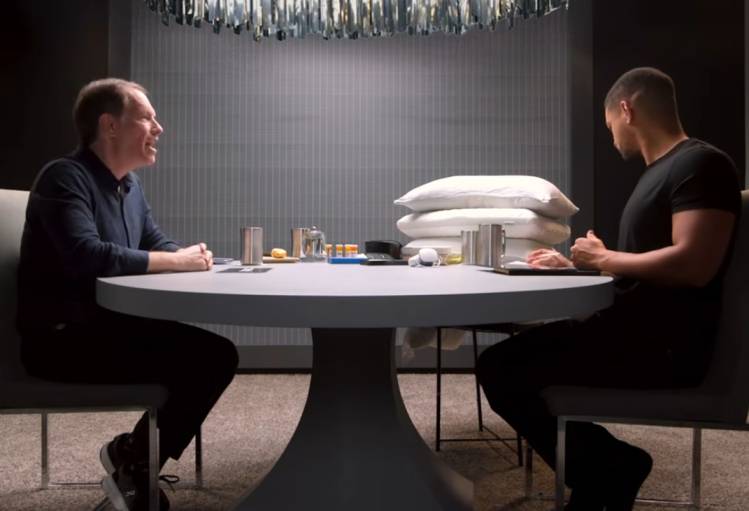
Editor’s Notes: In this episode of The Diary Of A CEO, renowned human sleep expert Dr. Michael Breus sits down with Steven Bartlett to reveal the secrets behind mastering your “genetic sleep code,” or chronotype. Dr. Breus debunks common sleep myths and answers the three most frequent questions he faces: how to handle waking up in the middle of the night, how to choose the right pillow, and the surprising truth about the best time for sex. From the benefits of “Nap-a-latte” to why you should avoid bathroom trips at 3:00 AM, this deep dive offers practical, science-backed strategies to optimize your sleep and overall health. Whether you identify as a Lion, Bear, Wolf, or Dolphin, this conversation provides a personalized roadmap to better rest and improved daily performance. (Feb 9, 2026)
TRANSCRIPT:
Introduction: Who Is Dr. Michael Breus?
STEVEN BARTLETT: Doctor Breus?
DR. MICHAEL BREUS: Yes.
STEVEN BARTLETT: What is it you do? Why does it matter so much now? And what perspective do you take on what you do that is atypical versus other people I might have spoken to about this subject?
DR. MICHAEL BREUS: I’m a sleep doctor. I take care of people’s sleep problems like apnea, narcolepsy, insomnia, things like that. I’ve dedicated a good portion of my career not just to understanding how to treat those disorders, which are sleep disorders, but what also I call disordered sleep.
I’m really interested in behavioral habits. What’s going on? What are the things that you might be doing right now that are kind of messing up your sleep that are easy to fix and be able to maybe change how things are going forward?
I didn’t start out thinking I was going to become a sleep doctor, if I’m going to be honest with you. That was not on the path. I was actually going in a completely different direction. And one of the things I really discovered was when you change someone’s sleep, dude, you change their life. It is fundamental to who they are.
And it’s important for me to be a sleep educator in a way, shape and form that’s practical so that people can actually get something from what I’m talking about and apply it right then and there.
STEVEN BARTLETT: And there’s probably a couple of million people that have clicked onto this conversation. To who is this conversation for?
DR. MICHAEL BREUS: I think it’s for anybody out there who’s either curious about sleep or wants to try to improve their sleep or maybe suspicious that they could have a problem with their sleep. I think any one of those three types of people would find tremendous value here.
STEVEN BARTLETT: And what are we going to be able to do for those people today specifically?
DR. MICHAEL BREUS: So I’m going to give people several different plans, if you will, maybe even a five step plan of things that they can absolutely learn how to do. They’re also going to learn about a genetic sleep code that they have inside them called their chronotype.
A lot of people don’t know that they have a chronotype or maybe they’ve heard of the idea, but they haven’t ever heard of the term. We’re going to learn a lot about that. We’re also going to talk about dreams a little bit. I’m excited to have the opportunity to do that. I’ve spent the last year and a half learning more about how to use dreams in my clinical work as a psychologist, which is very interesting stuff. So I’m excited to share some of that. So I think people are going to learn a whole bunch.
The Importance of Dreams
STEVEN BARTLETT: And dreams matter?
DR. MICHAEL BREUS: Oh, yeah, they absolutely matter. I call dreams emotional metabolism. And so when you’re dreaming, what is the function? What is the purpose? What are you doing? You’re actually working through your emotional states that you had during the daytime.
This is why we have nightmares. And so in a nightmare, it’s a scary scene, and all of a sudden it gets so emotional, you wake up. That is officially called a nightmare, that awakening. But you stop processing. And when you go back to sleep, you go back to the dream, and you get to that scary point, you wake up again, and you get caught in this loop.
And so dreams matter because they can be incredibly disruptive. Also, they can tell you things about yourself that you may not want to know or may not have in the front of your mind at all times. Sometimes people have very interesting dreams, like dreams of being chased or dreams of their teeth falling out or all these different things. And they can mean a whole host of different things.
But I want to be super clear. There’s no guidebook that says, hey, if you’re dreaming of that, you’re in water, you hate your mother. It doesn’t really work that way. Dreams mean something to the dreamer. And so the goal is to understand the context within that. So who is the dreamer? What is the dream? And then how do those two work together?
Dr. Breus’s Professional Background
STEVEN BARTLETT: And what is the experience that you’re drawing from academically but also professionally? Give me a view of how many people you’ve worked with.
DR. MICHAEL BREUS: Oh, yeah, yeah.
STEVEN BARTLETT: The range of things people come to you with.
DR. MICHAEL BREUS: Yeah. So I’ve been an actively practicing sleep specialist for 26 years. So I work in offices with medical doctors because I’m not a medical doctor. I have a PhD and I work with them on their patients. A lot of insomnia patients, but also the apnea, the restless legs, the narcolepsy of the world, because I have kind of a unique distinction in that I’m one of 160 people in the world who took the medical boards without going to medical school.
So I can work within that framework and really understand a lot of what’s going on. I don’t prescribe medication, but if I’m honest with you, most people don’t need sleep medication. As far as I’m concerned. I can get them to sleep usually without any medication at all.
STEVEN BARTLETT: And you’re a psychologist as well?
DR. MICHAEL BREUS: I am. I’m a clinical psychologist.
STEVEN BARTLETT: And how does those two worlds make one plus one equal three?
DR. MICHAEL BREUS: Sure. So when you talk about sleep, psychology is all over the place. I would argue 75% of the reason people don’t sleep is anxiety or fear. That really falls well within the range of psychology, for sure.
And it’s different kinds of fears. It’s fears that you know about that are right in your face, like something that’s going on in your daytime. But it could be other fears. It could be fears of your relationship, it could be financial fears. It could be a whole host of different things. So I think there’s a lot of psychology that gets to be played in all of this kind of thing.
The Props and Tools
STEVEN BARTLETT: I’ve got two more questions before we really get into the details, the specifics, and start really helping the audience with whatever they’re dealing with. The first is we have lots of props here.
DR. MICHAEL BREUS: Yes.
STEVEN BARTLETT: Give me a top line view of the types of things you’re going to show me and why you’ve brought all of these wonderful props.
DR. MICHAEL BREUS: Absolutely. So I get asked a lot of questions, as you might imagine. And one of the big questions that I get asked is what bed and pillow should I buy? So sitting next to you is a large stack of pillows. All different types, actually. And I want to be able to show some of your audience how you look at pillows and which pillows make sense for which people. Believe it or not, there’s a fitting process we’re going to go through that.
This device right here is a sleep test, believe it or not. So it used to be we’d have to send you to the hospital. Yeah, you can unwind it. We’d have to send you to the hospital. We’d put 27 electrodes all over your body. Respiratory belts across your chest. We’d have cameras zoomed in on you. And then, by the way, you’re supposed to be able to go to sleep.
And we’re supposed to be able to monitor you. Now, historically, we were able to do that pretty well. But once Covid hit, nobody wanted to sleep in the same bed that somebody else had been sleeping in the day before. So now we have what are called HSTs, or home sleep tests.
STEVEN BARTLETT: Wow.
DR. MICHAEL BREUS: Yeah. We’ll talk about how to use it and what it can tell you.
The Most Common Sleep Questions
STEVEN BARTLETT: My last question before we get into the details is, what are the most popular questions that people come to you with as a sleep doctor?
DR. MICHAEL BREUS: Yeah, so I’d say there’s probably three biggies. Number one is, hey, Dr. Breus, I fall asleep just fine, but I wake up somewhere between 1 and 3 o’clock in the morning and it either takes me 20 minutes or three hours to fall back asleep. What the heck is going on there?
STEVEN BARTLETT: And you can help people with that?
DR. MICHAEL BREUS: Absolutely. I’m going to give everybody exactly what I do in clinic. I’m going to explain to everybody exactly what I say to my patients and how to go about getting through that particular problem. Because it’s so flagrant. Everybody needs to know how to work with that.
The second question would be, what bed should I buy or what pillow should I buy? I think we’re going to address that over here. And then another one that people ask me all the time is, is there some kind of timing? Is there something… They say this all the time. They’re like, if I just lived in a different time zone, I feel like everything would work out well.
Understanding Sleep: The Basics
STEVEN BARTLETT: So the very basics of sleep, what do I need to know about what sleep is? The role it solves for us to even understand the context of the things we’re going to talk about today.
DR. MICHAEL BREUS: Yep. There’s only a few things that are truly important to understand about sleep. One is how does sleep work in the brain? It turns out that there’s two separate systems in the brain. One is called your sleep drive, the other is called your sleep rhythm. And they both work in an interesting way. They’re both a little bit like hunger.
So sleep drive is like hunger because I’m hungry, I’m hungry, I’m hungry, I eat something and that hunger begins to dissipate. Same holds true with sleep. The longer you stay awake, the more sleepy that you get.
When you look at it from a biology standpoint, it’s kind of interesting. So when a cell eats a piece of glucose, something comes out the back end. One of those things is called adenosine. It works its way through your system and goes to a very specific receptor area. As adenosine accumulates, you get sleepier and sleepier and sleepier.
Now, why am I going into so much detail? Turns out when you look at adenosine and you look at caffeine, they’re off by one molecule. So here’s a little tip or trick early in the pod for everyone. I call it the “Nap-a-latte.”
The Nap-a-latte Technique
So what you do is you take a cup of drip black coffee, just throw in a couple of ice cubes, merely to cool it down. Drink it as fast as you can, then immediately take a 25 minute nap. The adenosine that’s built up in your brain will burn through while you’re napping. Caffeine, since it’s so close in molecular structure, can fit into that receptor site. It blocks any new adenosine. You’re good for four hours, guaranteed.
I use it with every CEO that I work with. So let’s say you only got three hours of sleep the other night. You’ve got a big presentation to do or an awards ceremony or something like that. You can do a nap-a-latte for about 25 minutes or so and you will feel much better. That’s sleep drive.
STEVEN BARTLETT: Let me just…
DR. MICHAEL BREUS: Sure.
STEVEN BARTLETT: I want to make sure I really understand this. Can you explain this to me again as if I’m a 16 year old, why having a coffee and then taking a nap would make me feel energetic? Because one would think that having a coffee and taking a nap are almost impossible.
DR. MICHAEL BREUS: Would be almost impossible, right? So number one, the caffeine doesn’t kick in before the end of the nap. So a lot of people think when I drink coffee, boom, it just kind of spins up and all of a sudden I get a lot of energy from it. That’s really not actually how caffeine works. It has to go down, has to get absorbed, has to be digested.
And so while all that’s going on, which takes approximately 25 to 30 minutes, you’re actually taking a nap to lower the amount of adenosine that has built up in your brain. Let’s say it’s 2 o’clock in the afternoon and you only slept for four hours and you are dragging. All that adenosine that’s built up. When you take that 25 minute nap, you’ll burn through a lot of it. And then caffeine fits in and blocks any additional adenosine from coming in. So that way you’re actually adding caffeine to the situation and boom, your energy goes strong.
STEVEN BARTLETT: Oh, okay. So adenosine makes me tired.
DR. MICHAEL BREUS: Exactly.
STEVEN BARTLETT: When it’s docked in my brain.
DR. MICHAEL BREUS: Exactly.
STEVEN BARTLETT: So I have four hours sleep, which means there’s lots of adenosine and sleep clears the adenosine.
DR. MICHAEL BREUS: Correct. And then caffeine comes in because it fits so perfectly into that receptor site and off you go. That’s sleep drive.
Sleep Rhythm and Circadian Rhythm
Sleep rhythm has to do with your circadian rhythm. And so lots of information about that. But basically your circadian rhythm is also a lot like hunger. You ever notice you’re hungry around breakfast time, around lunchtime, around dinner time? That’s your circadian rhythm for hunger.
For sleep, most people, at least here in North America, have a tendency to fall asleep somewhere between 10:30 and 11:00 o’clock, 11:30 at night. So that’s kind of the circadian rhythm there. So when your circadian rhythm is high and your drive is high, you sleep. But if either one of them is off, that’s when you have a sleep disorder or disordered sleep.
STEVEN BARTLETT: My circadian rhythm is high when your—
DR. MICHAEL BREUS: Circadian rhythm is on point.
STEVEN BARTLETT: On point.
DR. MICHAEL BREUS: High is probably not the right word. On point. Meaning you are abiding by your circadian rhythm. Now another question you might say to me is, well, how do I know what my circadian rhythm is? And we’re going to talk a lot about chronotypes, because that’s what your circadian rhythm is.
Understanding Chronotypes
STEVEN BARTLETT: Okay, so let’s do chronotypes then. You’ve got some cards in front of you.
DR. MICHAEL BREUS: I do. I kind of like these cards. So when we talk about chronotypes, a lot of people may have heard of the idea, but not actually heard the term chronotype before. So if anybody out there has ever been called an early bird or a night owl, those are chronotypes.
So we’ve got early birds. These are people who, by the way, this is genetic. You don’t actually get to choose this. There’s a special area on your genome called the PER3 area. And when you have something called a single nucleotide polymorphism or a SNP, if it’s flipped one way, you’re an early bird. If it’s flipped another way, you’re a night owl. If it’s not flipped, you’re in the middle.
Okay, so so far I haven’t told anybody anything new. Like this is all stuff that we’ve already learned. The new part is this irregularity that seems to happen for people for their sleep schedules, specifically an irregularity in their melatonin and cortisol production.
So all of this is predicated on when does your body make melatonin. So if you’re an early bird, your body makes melatonin earlier in the night, starting at around 8 o’clock in the evening. Makes you want to go to bed around 9:30. You had a question.
STEVEN BARTLETT: So melatonin is a hormone?
DR. MICHAEL BREUS: It is that helps sleep inside of your body. That actually helps you sleep. It guides, it tells your body when it’s bedtime, which is a little bit different than the adenosine, which makes you feel sleepy.
STEVEN BARTLETT: I guess people listening now would be asking themselves, why does it matter to know my chronotype? Like, as it relates to my productivity, the way I live my life, my relationships, whatever matters to me. Why does it matter?
Why Your Chronotype Matters
DR. MICHAEL BREUS: Because I can show you, based on your chronotype, the perfect time of day to do almost any activity. So if you know when your body is doing certain things, when it has melatonin or when it has cortisol or adrenaline or all these other things, if you know the schedule, you can actually just change your activity to when your body is naturally producing the hormone and then you do the hormone better.
So let’s talk about the easy one, which is sex, right? So a lot of people want to know, hey, Michael, what’s the best time to have sex? By the way, I think that might be the third question that I get asked most often. Other the insomnia one and the mattress one, I think is, what’s the best time for sex? Might be the other question that I get asked more than anything.
STEVEN BARTLETT: Be tricky if the time you want to have sex and the time your partner wants to have sex are off.
DR. MICHAEL BREUS: Well, think about it like this. What if your partner’s an early bird and you’re a night owl?
STEVEN BARTLETT: Yeah, I think that’s me.
DR. MICHAEL BREUS: Don’t worry, we’re able to fix you. So first of all, there’s a couple of different answers to this question. So number one is you want to have a time. So first of all, most people are intimate between 10:30 and 11:30 at night. That’s just a survey that we did. So it makes kind of a lot of sense.
But here’s what’s interesting, is your hormone profile doesn’t look too good at 11:30 at night for having sex. In order to have successful sex, you want to have estrogen, testosterone, progesterone, adrenaline and cortisol, all to be high and melatonin to be low.
What do you think your hormone profile looks like at 10:30 at night? It’s literally the opposite. Right? Melatonin is high and all those other things are low. That’s hint number one as to when would probably be the best time to have sex.
Hint number two, if you happen to be having sex with somebody who was born biologically male, what do most men wake up with in the morning, an erection? If that’s not mother nature telling you when to use that thing, I don’t know what is. Right.
So when you start to look at it, and we actually did the surveys, we discovered that people actually have greater connection and greater performance in their sex when they have sex in the morning time. Now, do you have to brush your teeth and throw in a little mouthwash first? Yes, of course you do. Like, let’s be fair to your partner here, but you end up learning quite a bit. Again, your body is telling you this is actually the perfect time to do something like this.
Did you know there’s like a perfect time to have coffee?
The Perfect Time for Coffee
STEVEN BARTLETT: I didn’t.
DR. MICHAEL BREUS: Yeah, there’s absolutely a perfect time based on your chronotype too. One of the first things that I ask people all the time, I’ll ask you, is the first liquid that crosses over your lips in the morning caffeinated?
STEVEN BARTLETT: Yes.
DR. MICHAEL BREUS: So let’s talk about why that’s probably not the best idea. So most people don’t know. Sorry. Most people don’t know. But sleep in and of itself, is a dehydrative event. You lose almost a full liter of water just from the humidity in your breath by breathing all night long.
Caffeine is diuretic, which means it makes you have to go pee. So when you’re already lost a liter, now you add a couple of cups of caffeine, which makes you have to pee. You’re going to turn into a raisin before this whole thing is through. Okay? So we need to get some water inside of you.
And so one of the big recommendations that I give all of my patients is don’t have caffeine for the first 90 minutes you’re awake. Now you’re going to sit here and say, 90 minutes. That’s Michael. That’s a long time not to have any caffeine. Like, how am I going to do that? Like, I’ve got my morning routine. I can smell the coffee in the morning. It smells so good. Everything’s going. How’s this going to work?
Let me explain the biology. In order to exit a state of unconsciousness, you need two hormones, and then you need a lot of them. You need adrenaline and cortisol, and they both wake you up. When you have a brain that’s full of adrenaline and cortisol and you add caffeine to it, it’s like adding weak tea to somebody who’s taking cocaine. Okay. It’s not a very powerful stimulant compared to the hormones that are in your brain that are a powerful stimulant.
But if you just wait 90 minutes, cortisol and adrenaline naturally drop. If you have your caffeine, then it actually boosts the cortisol and gives you a bigger bang for your buck. So you hydrate before you caffeinate. And about the amount, somewhere between 15 and 20 ounces of water. If you can get that down in the first hour and a half that you’re awake.
STEVEN BARTLETT: What’s that in English terms?
DR. MICHAEL BREUS: Oh, I don’t know. We’ll have to look it up.
STEVEN BARTLETT: Is it one cup, is it two cups?
DR. MICHAEL BREUS: Oh, I would say it’s probably three to four cups of water.
STEVEN BARTLETT: Okay, well, that’s a lot.
DR. MICHAEL BREUS: Well, don’t forget you’ve lost a lot of water while you’re sleeping and you might have lost it the previous day because let’s say you worked out or things like that.
The Four Chronotypes
STEVEN BARTLETT: So let’s get into these chronotypes then.
DR. MICHAEL BREUS: Yeah. So let’s start off with the lion. So lions are my early birds. You know you’ve got a lion in your midst when you get an email at 6am, right. That’s somebody who’s been up for a while and who’s got their brain kind of cooking.
Lions like to make a list and go from step one to step two to step three every single day. They get a lot of confidence and they get a lot of pleasure following this list. But if I’m honest with you, being a lion isn’t all it’s cracked up to be because dinner and a movie is out for a lion. They’ve been up since like 4:30, 5 o’clock in the morning. Right. They don’t want to go see a concert late at night. They want to go to bed at like 8:30, 9 o’clock.
So when you’re looking at lions or early birds, what I call lions, they’ve got some very interesting characteristics. They make up between 10 and 15% of the population. From a biological characteristic standpoint, their melatonin stops early and their cortisol starts early. So their melatonin stops at about 4:30, 5 o’clock in the morning. And that’s when cortisol starts and that’s the reason why they wake up so early.
STEVEN BARTLETT: What sort of window did the lions wake up in?
DR. MICHAEL BREUS: So it’s interesting because I’ve got some lions who are kind of extreme. Like they’re getting up at 4:30 in the morning, which is not really probably the best idea, but generally speaking, my lions get up right around 5, 5:15, up until about 6, 6:30. They are definitely my early risers.
They have a small breakfast. They don’t like to eat a lot of food early in the morning time because a lot of these people like to go work out fairly quickly after they’ve woken up, which is very different than some of my other chronotypes. My night owls don’t like to work out in the morning. They don’t like to do anything in the morning.
So my lions like to work out early in the morning, a light breakfast. And also their best work window is usually somewhere between like 9:30 and 11:30. Like that’s when all the good stuff get. Like when they have if they’d have to get details or they have to do brainstorming or things like that, that’s really kind of where a lot of the magic happens for them.
By about 2 o’clock in the afternoon, there’s not a lot of stuff left inside the lion to be able to do a lot of good things. That’s when I have lions do more physical activities that don’t require a lot of cognition. So maybe you go for an afternoon walk or maybe you have, you know, you’re meeting with your folks that may not be really detail oriented, but more process oriented in the afternoon.
STEVEN BARTLETT: Admin and stuff.
DR. MICHAEL BREUS: Yeah, yeah, absolutely. I actually had one fellow chronotype his entire company and then move meetings based on who was going to be in the meeting. Like he had all the early birds and he had meeting at 8 o’clock in the morning and then all the night owls. He had a meeting at 4 o’clock in the afternoon. He said it was amazing. He said it worked out really, really well.
STEVEN BARTLETT: Wow. What’s the next one?
DR. MICHAEL BREUS: So the next one is the bear. So bears are representative of people that are in between early birds and night owls. Right. So bears are the best. Honestly, dude, I wish I was a bear. Because the whole schedule of life works on a bear schedule. 9 to 5 is perfect for a bear and they make up between 50 and 55% of the population. So literally one out of two people is a bear.
STEVEN BARTLETT: And when’s their peak work time?
DR. MICHAEL BREUS: So their peak work time has a tendency to be sort of in the noon to 2 o’clock range. They’re a little bit later than what you would see with the lion. Some of them, I think can actually be better at 11. It’s kind of interesting. We’ve had almost 3 million people take the quiz and we’ve discovered that inside of bears, there appear to be early bears and later bears.
So there are people who fall into that category but like to get up a little bit early. So for them their productivity window is probably 10:30, 11, but for the later bears it’s more like 11:30, 12, and then it’s about a two hour window after that.
STEVEN BARTLETT: For the people listening on screen at the moment is a grid showing you the different chronotypes, the wake times, the peak work window and the sort of afternoon slump time. What’s the next chronotype?
DR. MICHAEL BREUS: So the next chronotype is me, the wolf.
STEVEN BARTLETT: I think I’m a wolf.
DR. MICHAEL BREUS: You might be a wolf.
STEVEN BARTLETT: Especially because I love lions.
DR. MICHAEL BREUS: I get it, I’m a wolf. Well, you might be. Hey, look, join me. It’d be great. So wolves represent the night owls, right? And so wolves are my artists, my actors, my creatives. If you know a creative, when do they get their biggest idea? It’s not 2 o’clock in the afternoon, it’s 2 o’clock in the morning.
Wolves are my highest risk takers. I know that probably you fall into that category as well. Wolves are the folks that show up at the party at 11 o’clock at night, but they stay till 2 o’clock in the morning and they help you clean up. And they hate mornings more than anything. So should we talk about dolphins?
STEVEN BARTLETT: What’s the next one?
Understanding Dolphins: The Highly Intelligent Insomniacs
DR. MICHAEL BREUS: Yeah, dolphins. This is the category that you fell into. So let’s talk about who are the dolphins and what does this actually represent. So dolphins are usually highly intelligent. They’re usually people who are fast talking, well read. These are people who are a lot like a lion in terms of they like to get up, they crave longer bouts of sleep, but unfortunately their body just doesn’t have a long sleep drive and so they get really frustrated a lot of times.
Also I think they have just a teeny bit of anxiety behind them. So a lot of them, for example, the details really matter to a dolphin, right? Versus other people where details might not matter nearly as much. I think a lot of my dolphins have got just a little bit of obsessive compulsive disorder. So they’re kind of focused in on the different things.
Like if I ask a dolphin to do a project, generally speaking, they’re never finished with it until I say, can you just give me the project back now? Because they’re always working on a little detail here or working on a detail there. But dolphins are my favorite. They’re the people that I actually wrote the book for. They’re the ones that I enjoy working with the most because they’re actually the easiest to work with. Because once I explain to them how their hormones can be up and down and sideways, it starts to make a lot more sense for them.
STEVEN BARTLETT: And for anyone trying to figure out which one of these they are, where do they go to do the test and how long does it take?
DR. MICHAEL BREUS: Yeah, you can go to my website. It’s called chronoquiz.com and it takes about three, four minutes. It’s not very long at all. It’s going to ask you a bunch of questions about your sleep, about timing, things like that.
STEVEN BARTLETT: Okay, I’ll put that in the description. So after you finish listening, you can all go take it. And let me know your thoughts in the comment section as well. So once you figure out what your chronotype is, come back to the episode and let me know below, please. And does my sleep change with age, Michael?
How Sleep and Chronotypes Change Over Time
DR. MICHAEL BREUS: It does, absolutely.
STEVEN BARTLETT: So do my chronotypes change with age?
DR. MICHAEL BREUS: They do, actually. So believe it or not, you’ve gone through all the chronotypes already. When you’re a nitty bitty baby, you’re a lion. You go to bed really early, you wake up really early, right? Then you’re a toddler, right? In like grammar school, you’re a bear. You’re going to bed around 7:30, you’re waking up around 7:30.
Then adolescence hits, right? What do you want to do? Stay up until midnight and sleep until 2, right? You become a wolf. Then at about 23, 24, your chronotype has a tendency to set into one of those three or four things. And then you stay there for an extended period of time, like 25, 30 years, until you hit my age.
So I’m going to be 58 soon. And right when you hit in the mid fifties, what we see is melatonin production can either slow down or get earlier. So as an example, if your parents are still alive and you said, hey, Mom, Dad, I want to go for dinner, what time would they want to go for dinner?
STEVEN BARTLETT: Early, right?
DR. MICHAEL BREUS: 4:00 in the afternoon. 4:30 in the afternoon, you’re like, what is wrong with you? Mom, what’s going on? That’s her chronotype is going backwards. And your sleep changes over the course of time. To be clear, once you hit like age, probably 50, 45 or 50, we start to see a slowdown in production of melatonin.
We also see an increase in what are called EEG arousals. So things that break up your sleep and make it so it’s not so continuous. That can be problematic as well. So there’s a lot of things that can happen as you age.
STEVEN BARTLETT: So do I start sleeping less as I get older?
DR. MICHAEL BREUS: You start sleeping of poorer quality. I’m not convinced that it’s always less.
STEVEN BARTLETT: And is that going to make me grumpy?
DR. MICHAEL BREUS: Yes, it is.
STEVEN BARTLETT: Really?
DR. MICHAEL BREUS: Absolutely. Poor quality sleep is, I would argue is much worse than poor quantity sleep. I would rather I’ve got somebody who got five hours of really great sleep versus seven of really light, crappy sleep every time.
STEVEN BARTLETT: Does that mean that as I get older I’m going to be more grumpy?
DR. MICHAEL BREUS: It depends on the quality of your sleep. So what I can teach you is how to not get poor quality sleep as you age. Perfect example. A lot of folks who are a little bit on the older side are used to drinking coffee late in the day. Well, if you change that habit, then you don’t have as many sleep problems.
STEVEN BARTLETT: And I shouldn’t be having coffee late in the day at all.
DR. MICHAEL BREUS: Probably you want to stop by about 2pm, right. So if you stop around 2pm, the half life of caffeine is between six and eight hours. So eight hours later is roughly which is roughly when people are kind of wanting to go to sleep. So I would say that that would probably be the time to do it.
School Start Times and Academic Performance
STEVEN BARTLETT: I think about my siblings and us all being woken up for school and I think about my performance in school and of all my siblings, there’s four of us. I was the one that always struggled with being woken up in the morning in part because I’d gone to bed later, but then I was also the one that struggled with school the most.
DR. MICHAEL BREUS: Yeah, that characteristic of the wolf, characteristic of this night person, if I’m honest with you, dude, most kids should not be waking up at the time they’re waking up to go to school, right. I mean so many kids are waking up at 5:30, 6:00 in the morning, they have an hour long bus ride, then they get there. And if you’re an adolescent, I don’t think anything could be worse, right.
So we have to really start to try to be a little bit more thoughtful and look at what are some of the activities that kids are doing? How can we get them to maybe take naps during the day if they need them? Athletic performance can depend on sleep. Academic performance can depend on sleep. It’s unbelievable, all the different things.
STEVEN BARTLETT: Has there ever been any research done on different chronotypes and academic performance?
DR. MICHAEL BREUS: There has been. Actually, they haven’t labeled it directly as chronotypes, but they’ve looked at it based on age range. And we know that, for example, here in the United States, there’s a big push to change school start times. So that way high schoolers aren’t starting at 7 o’clock in the morning, because high schools shouldn’t be starting at 7 o’clock in the morning.
Preschoolers should be starting at 7 o’clock in the morning because their body naturally wakes up at that time. So we’ve actually seen there was a great study that was done at the University of Minnesota that discovered that when they just had people come in one hour later from their first period, they improved by one full letter grade, meaning they went from being C students to being B students or from B students to A students merely by changing the timing of their first class.
So that should give you pretty good insight as to sort of these big areas. And all children are vulnerable to this. This is not like, I’m not telling you anything that’s new. These are studies that have been going on for quite a while and there’s actually a whole movement trying to get school start times to slow down.
STEVEN BARTLETT: Now, looking at some of the research here, it says research consistently shows that morning types, which is the lion, earn higher grades not due to higher IQ, but because exams are scheduled during their peak alertness windows.
DR. MICHAEL BREUS: You got it.
STEVEN BARTLETT: That’s crazy.
DR. MICHAEL BREUS: Sometimes wolves turn out to be much smarter, but because they can’t perform at those early times, nobody knows. Remember, wolves are my creatives. Where do you think some of these great creative innovations and ideas come from in the tech world? Right? These are the wolves that are out there that are up late at night coding and trying to figure out what’s going on. It’s pretty cool when you think about it.
The Synchrony Effect
STEVEN BARTLETT: And there’s this thing called the synchrony effect from a study in 2020 where nearly 800 students found a clear synchrony effect. Students performed significantly better when their class schedule matched their chronotype exactly. Those morning people dominated in morning classes, and the owls or the wolves often caught up and outperformed the morning people when tested in the afternoon or evening.
DR. MICHAEL BREUS: Exactly. It’s pretty fascinating. Now think about it like this. Could you imagine a school system where if we identified children’s chronotypes during their particular age range and then we changed the testing so that they got tested when they’re at their peak hours, they’d actually do better?
STEVEN BARTLETT: People don’t know, but I never do podcasts in the morning.
DR. MICHAEL BREUS: I don’t blame you. You shouldn’t. It’s not your time, right. You have a very specific time that I think works well for you. So I think you should abide by that.
The Truth About Sleep Duration
STEVEN BARTLETT: Duration of sleep. There’s lots of conversation around how long you’re supposed to sleep for. What’s the truth here?
DR. MICHAEL BREUS: Eight hours is a myth. Let’s be fair. We came up with that from the 30s. There was a great study at Stanford that came up with 8 hours and 13 minutes plus or minus. And that’s kind of where we came up with that as an idea. The truth of the matter is somewhere between seven and nine hours really is kind of the amount that people should be looking for.
But some people don’t have that luxury. Some people don’t have that much time that they can put towards sleep. And so they get a little bit less sleep. But for the lower level limit, I don’t like anybody getting less than six hours. When somebody gets less than six hours sleep, their driving is off. And so you can’t operate machinery. So if you’re driving to work or God forbid, carpooling your kids to school and you only got less than six hours of sleep on board, it’s probably not going to go well.
The Challenge of Parenting and Sleep
STEVEN BARTLETT: We do have to stop here and talk about parents because listen, you’re either a parent now, you might be someday.
DR. MICHAEL BREUS: Absolutely.
STEVEN BARTLETT: Maybe you won’t be. But for those, I’ve just got a huge amount of respect for parents because, you know, I’m not a parent yet. I hope I will become one. But when I see what my brother, who has three kids under the age of seven now, how much sleep has he lost? A lot. And his wife as well. But you must get parents coming to you all the time being like, what the hell do I do? I’ve got to wake up when the kids wake up. But it’s destroying my relationship, my marriage.
DR. MICHAEL BREUS: Absolutely.
STEVEN BARTLETT: My sex, whatever it might be.
Parenting, Sleep, and Managing Family Chaos
DR. MICHAEL BREUS: Yeah. So parenting children and sleep are difficult to coexist, but they’re not impossible. It really has to do with discipline and kind of thinking through some ideas for yourself. So I have a 23-year-old son and a 22-year-old daughter. So I’m a little bit out of the realm of having to deal with them every day. But I was, like I said before, I was in charge of more at our house waking them up. And it’s a lot, right?
And so the very first thing that I try to explain to parents, especially if they have a child who has an irregular sleep pattern and is really causing chaos for the rest—like one child who won’t go to sleep and it’s keeping the whole house up—first thing you want to do, educate the kid, right? A lot of kids don’t know what they’re doing is causing a lot of problems. They’re just kids, they’re just hanging out, having fun. They’ve got energy, they want to be awake.
So you want to educate them and say, hey, now is a particular time to wind down. This is where your body recovers, this is how you get to do sports the next day or theater the next day, or whatever—your computers, whatever your thing is. You can tie it to sleep and performance pretty easily. And so getting them to understand that becomes very, very critical.
Number two is have some guidelines, right? Have bedtimes, have wake up times and follow them as closely as you can. For parents, oftentimes what I try to tell them to do is, look, after your child goes to bed, if you’ve got a child that has problems for sleeping, take turns. Do what I call the “on call method.”
So as a doctor, sometimes you get a call in the middle of the night because you’re covering patients at the hospital for your buddy or something like that—you’re on call. So when you’ve got two people who are managing one child, one person handles Monday night, Wednesday night, Friday night. The other one handles Tuesday, Thursday, Saturday. You flip a coin for Sunday.
So if the kid wakes up at 2 o’clock in the morning, both parents aren’t awake. One parent has that responsibility, the other one can keep their eyes closed and go to sleep. Interesting study was done looking at men and women in bed when a child cries. So women take care of the child, whereas men lie there and fake sleeping in order to be able to stay asleep, right? That’s problematic in a lot of cases.
STEVEN BARTLETT: What did they know in the study? That they were fake sleeping?
DR. MICHAEL BREUS: Because they asked the men afterwards, what were you doing? And they all said they woke up and they were faking it. It’s pretty crazy when you think about it. But this is a big deal for parents. A lot of parents turn to me and they’re like, this is killing our marriage. Like we haven’t had sex in three years because we’ve got a child who maybe the child has special needs, or maybe the child doesn’t have special needs but has other things going on. Or maybe it’s just normal development and they’re worried about it.
And so what I like to sit down with parents and do is number one, let’s figure out when your kid needs to sleep and let’s set some guidelines and rules. But number two, let’s do the same for you, right?
The Problem with Alcohol and Sleep
But a lot of parents, when they’re super stressed out, one of the first things they do, grab a glass of wine, right? Wine’s about the worst thing you could possibly do for sleep, to be fair. Now I’m going to teach people how you can still have a glass or two of alcohol and not completely destroy your sleep. But I want to be very clear about something. If you’re using alcohol as a stress relief tool at night before bed, it’s messing up your sleep. Probably pretty bad.
STEVEN BARTLETT: You might be asleep, but the quality of your sleep is shit.
DR. MICHAEL BREUS: It’s awful, right? And interestingly enough, during the one stage of sleep that alcohol knocks out, which is stage three and four stage sleep, what’s the most interesting is that during that particular stage of sleep, there’s something called the glymphatic system that comes in and scoops out these proteins that have a tendency to accumulate in your brain. And when proteins accumulate in your brain, they wrap around the nerves and that’s called Alzheimer’s disease.
So stage four sleep is imperative to avoid Alzheimer’s disease. And when you drink alcohol, you destroy stage four sleep. So it would be great if nobody drank alcohol, but I’m not so stupid as to think that. Plus, I like bourbon, I like whiskey, I enjoy a glass of champagne every once in a while.
So how can you successfully still drink alcohol and still get a decent night’s sleep? I’m going to give you a quick one, right? Let’s say you’re having dinner at 6:30, have your first glass of wine, then have a glass of water, right? Then your second glass of wine starts at, let’s say almost 7 o’clock, right? Then you have your second glass of water. Then you stop everything by 7:30. You wait three hours, which would be 10:30, and then you can go to bed.
STEVEN BARTLETT: Why the water? Why the wait?
DR. MICHAEL BREUS: So the water helps wash it through the system. Also fills your stomach up so you don’t have too much, so you’ve got more fluid in there, so that way you don’t drink extra wine. And it makes you have to pee, which flushes the system out as well.
STEVEN BARTLETT: And it hydrates you.
DR. MICHAEL BREUS: It does, absolutely. Because remember, wine pulls both magnesium and most water out of your system because it makes you have to go pee.
STEVEN BARTLETT: Helps with the hangover.
DR. MICHAEL BREUS: So there’s a couple of different things that I would say. Number one, this definitely helps with the hangover because you’ve got water going in. For a lot of my patients, what I tell them is the very last thing that you could do is have a little bit of coconut water. So coconut water is loaded with zinc, magnesium and vitamin B. And those are some of the things that get pulled out of your system when you’re drinking.
By the way, did you know that there are happy hours specific to your chronotype?
STEVEN BARTLETT: Didn’t know that, no.
DR. MICHAEL BREUS: Yeah, so it’s kind of interesting. So here’s what’s cool about it, is your body produces something called alcohol dehydrogenase, which is how you metabolize alcohol, but it does it at a particular time and the time is different for each chronotype. So your body is most efficient at drinking between basically the hours of 4 and 8. Happy hour, as a lot of people know it.
Timing Your Meals for Better Sleep
STEVEN BARTLETT: And how do you think about what time you eat at nighttime?
DR. MICHAEL BREUS: Such a great question. So three hours before bed, you want to stop fluids, including alcohol and food. You want to just stop it all. Three hours before bed. Why three hours? So it takes your body about that level of time to, number one, digest the food and then have all the mechanisms that are working towards digestion now be able to be refocused onto the recovery process of sleep.
However, I will tell you that there’s this—I’ve seen a couple people, and there are people out there that are claiming that if they stop eating at 11 o’clock in the morning, that it helps their sleep dramatically at night. And it turns out it has to do with your heart rate.
So one of the big metrics that is very important that all of our viewers and listeners want to know is you need a heart rate of 60 or below in order to enter into a state of unconsciousness. And when you’ve got food in your stomach, your heart rate is up. That tracks, right? So the longer you can wait, the lower your heart rate is, the easier it gets into sleep.
And so when we’re talking about—so a great example, let’s get back to parents for a second, right? You feed your kids at an earlier time and then what do you do? Oh, then you go back and have dinner with your spouse, right? Maybe that’s not the best idea because you’re having dinner so late. Maybe you should have dinner with your kids and enjoy that time with them and eat earlier because that gives you more space later on to be able to relax and go to bed.
STEVEN BARTLETT: I said, that tracks, because I remember I’ve told this story once or twice before. I remember when I was doing some podcasts over here in LA and we had Seth Rogen on.
DR. MICHAEL BREUS: Sure.
STEVEN BARTLETT: And the day before in the hotel, before I lived here, I had a cookie from the minibar. I’m going to admit it. I had the cookie.
DR. MICHAEL BREUS: They’re so good.
STEVEN BARTLETT: And then I went to bed pretty quickly. Oh, God, it was just f*ing terrible. And I was looking at my Whoop the next day, hashtag ad. And my heart rate straight up was like 75 or 80 for the first two to three hours after I got into bed.
DR. MICHAEL BREUS: Isn’t that crazy?
STEVEN BARTLETT: And I woke up feeling like hell.
DR. MICHAEL BREUS: Yep.
STEVEN BARTLETT: Terrible day. The next day, I was terrible during the conversation, and I looked at my Whoop and go, oh, my God, it was that cookie. It put my heart rate high.
DR. MICHAEL BREUS: So also on top of that is sugar.
STEVEN BARTLETT: Yeah. I mean, f* me.
DR. MICHAEL BREUS: Yeah, right? So sugar actually slows production of melatonin. Remember, melatonin’s kind of the key that starts the engine. Yeah, the key that starts the engine for sleep.
Lowering Your Heart Rate Before Bed
STEVEN BARTLETT: So is there anything else that I can do to make sure my heart rate is low as I get into bed?
DR. MICHAEL BREUS: Absolutely. Meditate.
STEVEN BARTLETT: Okay.
DR. MICHAEL BREUS: Breath work, all kinds of things.
STEVEN BARTLETT: Brings my heart rate down.
DR. MICHAEL BREUS: Yeah, absolutely. So what a lot of people don’t realize is just because we’re breathing doesn’t mean we’re actually breathing in a way, shape and form that can be helpful for us for sleep. So in my most recent book, Sleep, Drink, Breathe, I talk a lot about breathwork and what is it and how does it work for you. But I’d love to teach you my favorite form of breathwork and meditation that I think you’ll get a lot out of.
STEVEN BARTLETT: And I do this before bed?
DR. MICHAEL BREUS: Exactly.
STEVEN BARTLETT: Okay.
Falling Asleep and Relaxation Techniques
DR. MICHAEL BREUS: And you can, by the way, you can do it in the middle of the night if you wake up as well. So let’s talk about how to fall asleep and do some relaxation exercises for that. And then I’m going to give you some different ones for in the middle of the night.
So let’s talk the beginning of the night. Number one, you need runway to land the plane. So many people think they’re just waiting for their head to be bobbing in front of the TV, and then they go brush their teeth and they get in bed, and then all of a sudden they’re wide awake and they don’t know what’s going on.
So you need time for your system to shut down. It’s not an on-off switch. It’s more like slowly pulling your foot off the gas and slowly putting your foot on the brake. There’s a process. It should take you about 12 to 15 minutes to actually fall asleep.
So number one, what I ask people to do is take the last hour before bed and chop it up into three 20-minute segments. So let’s say you’re going to bed at 11, starting at 10 o’clock. And by the way, set an alarm on your phone to tell you that it’s 10 o’clock because it’s really easy to slide by your bedtime. And then all of a sudden it’s like all bets are off. So set the alarm.
20 minutes for stuff you just got to do. So in our house, it used to be getting backpacks together for school, for our kids, finding sports equipment, maybe laying out my stuff for work the next day or getting the last email sent, something like that. 20 minutes for hygiene. Brush your teeth, wash your face, maybe take a shower, something along those lines. And then 20 minutes for some form of meditation, relaxation, prayer. I don’t care what you do, but it has to be something that’s calming to get you there.
The Muse Headband for Meditation
So one of my favorite techniques to do is meditation. Now, I’m going to be honest with you, I’m a terrible meditator. I have never been able to do it. I’ve actually gotten kicked out of meditation retreats. Because I’m the guy that’s like, what’s going on? Like, am I doing it right? I’m kind of that person.
And so I was told about this tool called a Muse headband. We have one right here. So this is my personal Muse. I actually brought it from home. And you’ll notice on the inside there are sensors here and there are sensors along the earpiece here. And so what happens is you wear it on your head, and it’s measuring your brainwaves. And so when we’re doing it and we’re measuring brain waves, that goes on the back part.
So what’s cool about this is it’s attached to an app. And then while it’s measuring your brain waves, you’re listening to a particular music. It could be a guided meditation, it could be any of those things. And while you’re doing this, the volume gets lower and then, you know, you’re getting closer to a meditative state.
STEVEN BARTLETT: The volume comes down?
DR. MICHAEL BREUS: When on the app, when your brainwave starts to relax, so you’re immediately getting feedback. We can try it if you want. But it’s pretty interesting. And then when you get to the alpha state, little birds start chirping.
STEVEN BARTLETT: The alpha state?
DR. MICHAEL BREUS: Yeah, the alpha state is when your eyes are closed and you’re at the most relaxed state of your brain waves. It’s called the alpha state. And that’s really what people are trying to get to for meditation.
STEVEN BARTLETT: And are you affiliated with this company in any way?
DR. MICHAEL BREUS: I’m not.
STEVEN BARTLETT: And how much does it cost?
DR. MICHAEL BREUS: I think it’s around $275, I think, for the headband.
STEVEN BARTLETT: Interesting.
DR. MICHAEL BREUS: It’s pretty fascinating. I’ve been pretty impressed with them.
Progressive Muscle Relaxation
STEVEN BARTLETT: So that’s meditation. You talked about breath work as well before.
DR. MICHAEL BREUS: Yeah, let’s talk about it. So one of the other things that I do is I do something, well, this isn’t breath work. This is called progressive muscle relaxation. So this is where you tense and relax muscles, starting from your feet and going all the way up your body. And as you tense and relax the muscles, you feel that relaxation from releasing that tension, and it helps you fall asleep.
Actually, you know what I can do is I can send you an audio file that has me walking through progressive muscle relaxation that we can make available for everybody if you want, for free. It’s no big deal.
STEVEN BARTLETT: Amazing. I’ll put that in the description below as well.
DR. MICHAEL BREUS: Yeah, people will really dig it. I think they’ll really enjoy it. So that’s another thing that we do.
Waking Up in the Middle of the Night
But now let’s talk about the middle of the night. By the way, do you have this as an issue? Has this happened to you before?
STEVEN BARTLETT: It happens sometimes. And it’s typically when, like, my sleep is somewhat disordered or disruptive, or when there’s really something on my mind.
DR. MICHAEL BREUS: Yes. So that precipitatory anxiety, like before flight, like if I have an 8 o’clock in the morning flight, I sleep like s* the night before because I’m constantly worried about that. But a lot of times what people do normally is they just wake up in the middle of the night and they can’t return to sleep and they’re really not sure why.
So number one, there’s biology involved. So your core body temperature rises, rises, rises, and when it hits a peak, it drops. That drop is then a signal to your brain to release melatonin. Again, the key that starts the engine for sleep. However, your core body temperature continues to drop, drop, drop. By the way, this is the reason why we tell people you want to sleep in the cool, not the warm environment, because again, your core body temperature is dropping. If it’s too hot, your core body temperature can’t go down and you can’t get to sleep.
STEVEN BARTLETT: Which tracks with evolution.
DR. MICHAEL BREUS: Exactly. So here’s where it gets interesting. It keeps going, going, going, and then at some point in time, your body has to heat up. And if it doesn’t heat up, you go hypothermic. Guess what time that is? Between 1 and 3 o’clock in the morning.
STEVEN BARTLETT: Oh, your body starts heating up at 1 and 3.
DR. MICHAEL BREUS: Every single person’s body on earth does this. Everybody on earth wakes up between 1 and 3 o’clock in the morning. However, most people burp, roll over, get comfortable, and fall back asleep in 30 seconds. However, there’s a select group of people who end up being my patients who don’t have that. And herein lies the problem.
Steps to Take When You Wake Up at Night
So here are the steps you want to take in the middle of the night to be able to solve this issue. So number one, don’t go pee. I know, I know, I know. People like, what? What are you talking about, Michael?
So here’s what ends up happening. When people wake up in the middle of the night, they say to themselves, well, I’m up, I might as well go pee. Here’s the problem. Remember I told you the big metric was in order to enter into a state of unconsciousness, you need a heart rate of 60 or below. What do you think happens to your heart rate? You go from a lying position to a seated position to a standing position. You walk across the room, your heart rate goes straight up.
So what we want to do is keep your heart rate down. So if you don’t really have to go to the bathroom, don’t go to the bathroom. 75% of people sleep on their sides and they kind of squanch up, which means they’re putting pressure on their bladder. So my guess is that most of those people, if all you did was when you woke up is lie and get on your back for about 25 seconds and see if you still need to pee. If you don’t need to pee, stay in bed and keep your heart rate down. If you need to pee, please go pee.
STEVEN BARTLETT: Right.
DR. MICHAEL BREUS: If you’re going to go to the bathroom, have a strategically placed night light along the way so you don’t have to flip on the light in the water closet. Because if you do that, you just told your brain it’s morning and it stops producing melatonin.
But let’s say you don’t have to pee. The second thing, don’t look at your phone. Now this turns out to be very difficult for 99% of the people out there because the first thing they do is they grab their phone and they head to the bathroom. And they’re either checking emails, looking at Facebook or Twitter or whatever social media they’re on, or just trying to figure out…
STEVEN BARTLETT: What time it is.
DR. MICHAEL BREUS: And that’s where the problem is. As soon as you see the time, you instantly do the mental math and now you’re pissed off. It’s 3:30 in the morning, I got to get up at 6. Sleep, sleep, sleep. And you try to force your brain to sleep. Dude, in the history of time, nobody has been able to force their brain to sleep. Because your heart rate’s going in the wrong way. It needs to be coming down.
So if you can, don’t look at the clock. So you haven’t peed, you haven’t looked at the clock, but you’re still awake and nothing’s going on.
The 4-7-8 Breathing Technique
Here’s where the breathing technique comes in. It’s called 4-7-8 breathing. I did not develop this technique. It was developed by Dr. Andrew Weil, Harvard trained, natural doctor, super smart dude. And he did it for the military to teach them how to lower their heart rate during stressful situations. We use it because it helps lower our heart rate past 60.
And it’s super simple. I’m going to get you to try it. So go ahead and sit up straight. And so all you’re going to do is breathe in for a count of four, you’re going to hold for a count of seven, and you’re going to breathe out for a count of eight. And I’m going to walk you through it. I want you to have your eyes closed. And what I also want you to do, you’re going to go in through the nose, out through the mouth. And then what I also want you to do is picture the number in your head. So when I say breathe in 2, 3, 4, you should picture the 2, the 3, the 4 in your mind’s eye.
STEVEN BARTLETT: With my eyes closed?
DR. MICHAEL BREUS: With your eyes closed. You ready?
STEVEN BARTLETT: Yep.
DR. MICHAEL BREUS: Breathe in. Two, three, four. Hold two, three, four, five, six, seven. Push. Two, three, four, five, six, seven, eight. Good. You want to get through about 20 cycles of that. It’s incredibly relaxing. I actually did it before I came out here to do the pod because it helps lower my heart rate and gets me set.
STEVEN BARTLETT: Hmm.
DR. MICHAEL BREUS: It’s pretty remarkable. Now, there’s some problems with the technique. Number one, sometimes it’s hard to hold for seven, and sometimes it’s really hard to push for eight. So I tell people, you can do this. 4-5-6, 4-6-7, or 4-7-8. So just work your way up to it. If it’s too hard to hold your breath for seven seconds or it’s too hard to push your breath for eight, you can do a little bit less just while you’re getting used to it.
And then the other big thing is it’s hard to figure out where the 20 cycles is, because you need to get to 20 cycles of this. So what I have people do is take their hands and make light fists while they’re doing this. And when they do one cycle, they put out a finger, another cycle put out a finger, and before you know it, you got 10. And when you bring it back, you’ve done 20 cycles.
STEVEN BARTLETT: It’s funny. I just did two, and I started yawning.
DR. MICHAEL BREUS: I know. I just saw that. I’m telling you, dude, this thing works. And so I have people do this technique. Here’s the best part: it avoids monkey mind. So what is monkey mind? Monkey mind is I’m thinking about stuff that I have no business thinking about in the middle of the night for absolutely no reason, like what’s on the grocery list, or what did I say to my spouse, or did that podcast go okay? Or any of the things that might be floating through your head. You cannot count and worry at the same time.
STEVEN BARTLETT: And why does it work? What’s going on in my physiology?
DR. MICHAEL BREUS: You’re distracting the brain from the thing that’s stressing you out, and it’s lowering your heart rate, and then the natural sleep process comes in after. So all these are distraction techniques. To be clear, there’s several of them out there. One of the other ones I use for some of my patients is I tell them, hey, count backwards from 300 by threes. It’s mathematically so complicated, you can’t think of anything else. And it’s so damn boring, you’re out.
The Impact of Distractions on Sleep
STEVEN BARTLETT: Like a light on that point of distractions. A lot of people go to bed listening to podcasts or movies. Jack was just saying that he needs to listen to something to fall asleep. I’m the same. I listen to, like, serial killer stuff, which is—
DR. MICHAEL BREUS: That’s interesting.
STEVEN BARTLETT: Don’t judge me.
DR. MICHAEL BREUS: Wait till we get to the dreams part of the podcast. I can’t wait to hear what you dream about.
STEVEN BARTLETT: I think I always try and figure out why it is. And my sister’s the same, my sister Amanda, and she listens to serial killer stuff to fall asleep. I think it’s because—this is just hypothesis—my mum would always ask me to put on Forensic Files, which is this like serial murder documentary thing when we were younger, because she couldn’t use the remote. So my mom would say she’d pass me the remote, put on Forensic Files, and I’d like put on the number for her.
DR. MICHAEL BREUS: Right.
STEVEN BARTLETT: And so that was always playing in our house at that time. And we all had TVs in our bedroom that just mirrored what was playing downstairs, of course. So when I got into bed, I’d watch Forensic Files and I fall asleep.
DR. MICHAEL BREUS: This explains a lot about you.
STEVEN BARTLETT: I know, right? You say that to people, they think you’re—
DR. MICHAEL BREUS: So let me tell you what it’s like in my house. And actually, you and I have a commonality. So in my house we have a big screen TV. It’s on all night long.
STEVEN BARTLETT: Where? In which room?
DR. MICHAEL BREUS: In my bedroom.
STEVEN BARTLETT: Okay.
DR. MICHAEL BREUS: Okay. When I met my wife, she said to me, “Michael, if you ever happen to spend the night, I want to let you know that I sleep with the television on.” I said, “Don’t worry about that, Lauren. I’m going to be a sleep doctor. I’m going to fix that.” We met when I was 30, so known her for quite a while. And you ever tried to change something in your bed partner?
STEVEN BARTLETT: Yeah. Good luck.
DR. MICHAEL BREUS: Yeah, good luck. So I took the TV out. She said, “If you ever want to come back in here again, I suggest you put the—” I put the TV back in. And then I studied her to learn what was going on. And it turns out that she’s listening to it out of what I call the corner of her ear. Her eyes aren’t even open. And half the time it’s an episode of Seinfeld or something like that.
My wife actually likes murder mysteries and so it’s usually Forensic Files or something along those lines that’s going on. But for her, it’s a perfect distraction technique. Now, there’s a second thing that’s important in our bedroom that happens is we have two dogs, they sleep in the bed with us. I’m the f*ing sleep doctor, dude. Like, it’s insane.
But the point here is sleep is flexible, okay? Just because it works for you doesn’t mean it works for your bed partner. And vice versa is also true. Right? Like, just because some people can’t sleep with the TV on doesn’t mean that it’s going to mess up your sleep forever to have the television on, because it’s not.
And by the way, 99% of TVs have timers built into them. If you don’t know what it is, ask your kid. I had to ask my son. He showed me how to use it. We turned it off. It wasn’t a problem. Right. So creating a sleep environment that is conducive to sleep for you and your bed partner can have a lot of variation to it. And I don’t think people—there’s no hard and fast rule that says, hey, nobody should ever sleep with the TV on. I mean, there are people out there who say that, but quite frankly, everybody sleeps with the TV on.
Finding Balance with Your Sleep Partner
STEVEN BARTLETT: Well, a lot of people do. I wouldn’t put the TV on in our bedroom. I mean, we’ve done it once or twice, whatever. Because we’re watching something and we slip off to sleep, and I wake up and I realize it’s on, and I turn it off. But I also really think it’s an important point to say that people will listen to podcasts like this. They’ll listen to the biohackers of the world, and then they’ll get so militant about how they fall asleep that it will cause friction because one partner’s different.
DR. MICHAEL BREUS: Don’t do that.
STEVEN BARTLETT: And I had this problem in my relationship, which was my girlfriend sleeps in silence and has just such a glorious routine to everything she does.
DR. MICHAEL BREUS: Right?
STEVEN BARTLETT: And I am completely the opposite. The opposite. Like, I need to—like I want to listen to a murder—
DR. MICHAEL BREUS: Opposite’s a draft.
STEVEN BARTLETT: I need to be on my phone. It’s like when I look at my whoop scores. Works for me.
DR. MICHAEL BREUS: Yeah.
STEVEN BARTLETT: It’s like I am getting—I get great sleep even if I’m listening to a serial killer documentary.
DR. MICHAEL BREUS: But not if you eat a cookie before bed.
STEVEN BARTLETT: Not if I eat a cookie. That’s gone. But so what I do is I put one AirPod in. In my right ear, so whichever ear is not going to be on the pillow. And it means I can listen to her if she says something.
DR. MICHAEL BREUS: Right?
STEVEN BARTLETT: But when it’s silence, all I hear is the thing that I’m listening to.
DR. MICHAEL BREUS: So I’ve got a trick for you.
STEVEN BARTLETT: And I wake up in the morning and dig the AirPod out of the bed where it ends.
DR. MICHAEL BREUS: Right? So now I’m going to help you with the digging of the AirPod. So, first of all, they now make these things called pillow speakers.
STEVEN BARTLETT: Oh, interesting.
DR. MICHAEL BREUS: Right? So it’s a Bluetooth speaker that will attach to your phone that you can just slide and it’s just under your pillow so only you can hear it. So that’s number one. You might want to consider that. And they’re pretty inexpensive. Number two, they now make specifically earbuds designed to be slept in.
STEVEN BARTLETT: Oh, nice.
DR. MICHAEL BREUS: So there’s a new company out called Next Sense, and they have developed an earbud that actually measures your brain waves while you are sleeping. And when you move into a lighter stage of sleep, it sends in a frequency signal to help you go back to sleep or to stay in that depth of sleep. Brand new company, Next Sense. I have nothing to do with them. I mean, it’s a friend of mine who owns the company, but I’m not on their behalf.
STEVEN BARTLETT: I would like something to do with them.
DR. MICHAEL BREUS: We’ll figure that out.
STEVEN BARTLETT: So does it allow you to play your music as well?
DR. MICHAEL BREUS: It does.
STEVEN BARTLETT: Or your podcast or whatever?
DR. MICHAEL BREUS: I can listen to Diary of a CEO every single night while I fall asleep.
STEVEN BARTLETT: That’s amazing.
DR. MICHAEL BREUS: And it will make sure that I don’t wake up from any dreams.
STEVEN BARTLETT: And you can still like and subscribe.
DR. MICHAEL BREUS: And stuff, even through the earbuds? Of course. I think everybody should like and subscribe.
What to Do When You Can’t Fall Back Asleep
STEVEN BARTLETT: That’s a good feature with an AI agent that helps you subscribe. Okay, so that’s you wake up in the middle of the night, don’t pee, you don’t check your phone, you’re doing these breathing exercises. You don’t give yourself a hard time. And then what happens? It doesn’t work. What do you do?
DR. MICHAEL BREUS: Right, so there’s the new research on something called non-sleep deep rest. We call it yoga nidra. Okay? It’s been around for thousands of years. When you lie relaxed in like a corpse pose like this, you’re actually doing something that’s valuable for your sleep. Now, I want to be clear. It’s not the same as sleep, but if you lie there for an hour, it’s like 20 minutes worth of sleep. So everybody should know that even lying relaxed and calm is very, very helpful.
STEVEN BARTLETT: Right?
DR. MICHAEL BREUS: But if you start to get anxious and your heart rate starts to tick up, you need to get yourself out of bed. Because that’s when—because all you’re doing then is thinking, “Hey, this bed is this place where I get anxious and pissed off. This is not a place to sleep.” So as long as you stay nice and quiet, the non-sleep deep rest, absolutely the thing to do.
The other big thing that I do—and by the way, this happens to me on occasion too. Like I’m not immune to it just because I’m a sleep doctor—you have to stay positive. And what do I mean by that? Is everybody, when they wake up in the middle of the night, your brain is set to negativity. There’s no reason you should be up at 3 o’clock in the morning that something good is going on, right? Nobody’s coming in and wishing you Happy birthday at 3 o’clock in the morning. Something terrible has happened and your brain has gotten accustomed to that.
So when it wakes up it immediately goes to the negative and you start thinking about bad things. You can’t stop your first thought, but you can stop your second thought, right? And so when you wake up and you think negative, what I want you to replace that with is “Okay, Michael, for some reason your body has decided to wake up at 3 o’clock in the morning. It’s not the game that I wanted to be playing tonight. However, I think I’m going to be okay. I’m just going to lie here and relax and let the natural sleep process take over. If I feel my heart rate increasing, I’m going to go to another room in the house where I’ve already got a book and a light set up so I can do a little bit of light reading and then come back to sleep.”
And I just tell myself that I give myself permission to just chill, just relax and then you know what happens? The natural sleep process comes over. As soon as your heart rate starts to go down, your body wants to get back to sleep. And so it really has a lot to do with heart rate.
The Global Sleep Crisis
STEVEN BARTLETT: I love having these conversations on the Diary of a CEO because I have a huge amount of sympathy and concern for people that don’t get sufficient sleep. And I know there’s a lot of people that don’t. And I actually think it’s to some degree it’s somewhat increasing because of the way we live our lives. I was looking at some of the stats around the increase and there’s a study done in 2025 and early 2026 that revealed we’re in a global sleep crisis.
DR. MICHAEL BREUS: Oh yes, we are.
STEVEN BARTLETT: Both the CDC and Stanford Medicine report said that 1 in 3 adults and nearly 80% of teenagers are now chronically sleep deprived.
DR. MICHAEL BREUS: Correct.
STEVEN BARTLETT: A 2026 survey by the American Academy of Sleep Medicine found that 93% of Gen Z admit to regularly losing sleep due to social media usage. And 71% of employed respondents globally have said that they sometimes call in sick at least once or twice due to poor sleep.
DR. MICHAEL BREUS: Just to sleep? Yeah. When I was down in Australia doing some work down there, a lot of Australians, they take holidays and they just sleep just to catch up. Like it’s pretty remarkable. We’re in a very sleep deprived society. And I think there’s a couple of different reasons why that is. Number one, have you seen what’s going on outside in the world today? It’s pretty crazy out there. Well, I can understand why people are getting a little anxious.
STEVEN BARTLETT: I think one can argue it’s been crazier through history, but we never knew about it.
Sleep Disorders and Modern Lifestyle
DR. MICHAEL BREUS: Well, I mean, the media getting us this information so quickly I think is definitely, I would agree with you. It was much crazier during like World War II, stuff like that. Now we’re getting information so quickly and people are getting so ratcheted up about it. I think that has something to do with it, but I think the bigger culprit is people being overweight.
When you look here in the United States and you look at the obesity epidemic and you look at people being overweight, it’s something close to like 70 something percent of people in America are overweight. When you’re overweight, that puts you in line for potentially having something called sleep apnea.
Now, I want to be clear, not everybody with sleep apnea is overweight, but a large percentage of the people with sleep apnea are bigger people. And so when you look at a society that’s getting bigger and all the unhealthy food that we’ve got going on, all this highly processed food, things of that nature, that isn’t helping anybody. It’s adding the pounds.
And specifically, like for men, we gain weight through our necks. I don’t know if you’ve ever noticed it, but like, if you ever were heavy and you lose weight, the first thing somebody says, “Oh, it looks like you lost weight because I can tell from your face.” And they’re like, “Oh, your neck looks different now.”
And so we see a lot of what’s going on in the world from a weight perspective and a food perspective could be driving some of the sleep problems. Then there’s the anxiety perspective that I spoke of earlier that I think comes in. And again, I agree with you. I don’t think we have more crazy stuff going on. I think we know about more crazy stuff that’s going on.
STEVEN BARTLETT: But also work is now largely digital. And I imagine for my great grandfather, he would go to, I know, the factory or wherever he works, his work would finish at six. Your work doesn’t finish at six now. It finishes when you’re awake.
DR. MICHAEL BREUS: Yeah, absolutely. It finishes when you go to sleep.
STEVEN BARTLETT: Yeah, exactly.
DR. MICHAEL BREUS: Yeah. And that becomes problematic, because a lot of times also, by the way, you need to have dividers in your home. Like let’s say you live in a studio apartment and your bed is your couch is your kitchen. You have no designated spot for sleep. Your body needs to know, “Hey, this is the spot where I can chill out and finally get some rest.” And I think a lot of times our environments just aren’t that way.
STEVEN BARTLETT: So many of us are pursuing passive forms of income and to build side businesses in order to help us cover our bills. And that opportunity is here with our sponsor Stan, a business that I co-own. It is the platform that can help you take full advantage of your own financial situation. Stan enables you to work for yourself. It makes selling digital products, courses, memberships and more simple, more scalable and easier to do. You can turn your ideas into income and get the support to grow whatever you’re building.
And we’ve just launched Dare to Dream. It’s for those who are ready to make the shift from thinking to building, from planning to actually doing the thing. It’s about seeing that dream in your head and knowing exactly what it takes to bring it to life. It’s not too late to join the challenge. Enter to win $100,000. Visit DareToDream Stan Store.
I’ve had so many founders speak to me and say, “Why didn’t this particular ad that I ran on this platform work for me?” Maybe the copy wasn’t good, the creative wasn’t strong. But usually the problem is they’re not having the right conversation because that ad never reached the right person. And if you’re in B2B marketing, that is much of the game. And this is where LinkedIn ads solves that problem for you.
Their targeting is ridiculously specific. You can target by job title, seniority, company size, industry, and even someone’s skill set. And their network includes over a billion professionals. About 130 million of them are decision makers. So when you use LinkedIn ads, you’re putting your brand in front of the right people. And LinkedIn ads also drive the highest B2B return on ad spend across all ad networks.
In my experience, if you want to give them a try, head over to LinkedIn.com direct. And when you spend $250 on your first LinkedIn ads campaign, you’ll get an extra $250 credit from me for the next one. That’s LinkedIn.com diary. Terms and conditions apply.
Understanding Sleep Apnea
STEVEN BARTLETT: Which sleep disorder should we start with?
DR. MICHAEL BREUS: Sleep apnea and insomnia. Sleep apnea, for folks out there who may not know what it is, is when you are snoring at night. Almost everybody who has sleep apnea snores. Not everybody, but almost everybody. And when you’re sucking air in, you pull your tongue to the back of your throat and you cut off your air and you literally stop breathing for a few seconds.
Then all of a sudden you make all this kind of grunting, groaning noises, and then you wake up. This can happen hundreds of times a night, and it can be very problematic because of course it wakes you up every single time that you have one of these events. And so as an example, we measure the events per hour. So as an example, somebody with sleep apnea could have between 5 and 15 times per hour that they stop breathing, and that’s mild.
STEVEN BARTLETT: So how are they going to get into the deep sleep that clears out the brain?
DR. MICHAEL BREUS: They can’t. That’s the problem. And so apnea prevents them from getting into a lot of that deep sleep, and so their brain doesn’t clear out. And then they’re kind of screwed.
So at the end of the day, the goal here is to get as many people to, number one, identify if they have a sleep disorder and then be able to try to figure out what to do about it. And the percentage of people in the US that have undiagnosed sleep apnea is pretty big. It’s like somewhere between, I think, like 18 to 20%.
STEVEN BARTLETT: This is crazy. I was just looking at the stats. It says, according to 2026 data, approximately 936 million people to 1 billion adults worldwide have obstructive sleep apnea. Which is what, one in seven?
DR. MICHAEL BREUS: Yeah, that’s about right.
STEVEN BARTLETT: Making it as common as diabetes. One in seven people listening have sleep apnea?
DR. MICHAEL BREUS: Yes. As popular as diabetes. Let that sink in for like half a second. Everybody knows what diabetes is. Almost nobody knows what sleep disorders are, specifically sleep apnea.
STEVEN BARTLETT: And it says 80 to 90% of those people remain undiagnosed.
DR. MICHAEL BREUS: Undiagnosed, that is correct.
STEVEN BARTLETT: So there’s people listening. There’s actually a huge percentage of people listening right now that have sleep apnea and have no idea that they have it.
DR. MICHAEL BREUS: Exactly right.
Testing for Sleep Apnea
STEVEN BARTLETT: How would they know?
DR. MICHAEL BREUS: Do the sleep test.
STEVEN BARTLETT: This thing here?
DR. MICHAEL BREUS: Yeah.
STEVEN BARTLETT: And what would this show?
DR. MICHAEL BREUS: So this actually collects what is your oxygen levels throughout the night? What is your heart rate throughout the night, how many times do you actually stop breathing? And also the depth of your sleep, which stages of sleep you get when you fall asleep, things like that.
STEVEN BARTLETT: And what would this… So you know, because people are going to be like, how do I know if I need to do the test?
DR. MICHAEL BREUS: So great question. So you want to think about the symptoms that you might have. So do you snore? Do you wake up gasping for air? Has anybody told you that your snoring stops for brief periods of time or that they’ve heard you gasping for air? Do you wake up with a headache in the morning? Do you find your moods are up and down? All of those are signs and symptoms of sleep apnea.
STEVEN BARTLETT: And this test, are you affiliated with this company at all?
DR. MICHAEL BREUS: I am not, but we do have that test on my website. We sell it to people so that way we can test them.
STEVEN BARTLETT: And how much does it cost?
DR. MICHAEL BREUS: $189. So it’s not exorbitantly expensive. And it also is covered by insurance.
STEVEN BARTLETT: And it connects to an app.
DR. MICHAEL BREUS: Absolutely. So you’d put it through your cell.
STEVEN BARTLETT: So I’d put that there and then like this.
DR. MICHAEL BREUS: Yeah, exactly. And that’s it. You go to bed, wake up, then the information ports over to your phone and then tells us exactly what’s going on. Now here’s where it gets even better. I know, right?
STEVEN BARTLETT: Can you imagine me getting in bed with my fiancé and being like, “Come on, babe, let’s…”
DR. MICHAEL BREUS: We’re recording all kinds of good stuff. Who knows what she might like?
STEVEN BARTLETT: Is this going to help my sex life?
DR. MICHAEL BREUS: Absolutely it will. Because getting into bed and knowing how well you sleep and knowing if you have sleep apnea or not will definitely affect your sex life. Also, by the way, I’ve saved more marriages as a sleep doctor than I ever would have as a marital therapist dealing with snoring in the middle of the night and things like that. So you’d be surprised.
But what’s nice about this is it’s one night. You don’t have to do it multiple nights. It’s super easy. And again, believe it or not, that’s disposable. You can actually throw that whole thing away after it’s all said and done.
Should Couples Sleep Together?
STEVEN BARTLETT: And on that point, before we just go a little bit further into sleep apnea, should we be sleeping in bed with our partners? And I know that’s an interesting thing to say.
DR. MICHAEL BREUS: Great question, great question. The strength of your relationship has nothing to do with where you sleep. Okay, so lots of people are like, “I got to sleep with my partner, otherwise my relationship’s going to go to shit, and everything’s going to go terrible, and we’re never going to have sex.” Not true.
So a lot of times for people that I have… So for example, I’ve got people who have sleep apnea, and they use a machine to help them sleep called a CPAP machine. And that noise, for some people can be disruptive. And so they sleep, let’s say, in a different room. Is that detrimental to your marriage? No, it’s not.
Because here’s what you do is you vacation on the weekends in your bedroom. I can’t count the number of people who sleep separately during the week and then together on the weekends. And it turns out that they get much better sleep during the week. And then, guess what? Intimacy shows up much faster on the weekends because they’re not so tired.
Used to be, “Not tonight. I have a headache.” It was really “Not tonight. I’m exhausted.” When you allow your partner to get good sleep during the week, there’s a reasonably good shot that you’re going to be able to be intimate over the weekend if they got good sleep. So wearing that to bed might not be the sexiest thing in the universe, but it’s better than having sleep apnea and eventually ending up dead.
STEVEN BARTLETT: Are the symptoms of sleep apnea different for men and women?
Sleep Apnea in Women vs. Men
DR. MICHAEL BREUS: They are. Great question. So it turns out that men and women are quite different, but we’ve historically been scoring them the same. So women don’t have a tendency to have as much snoring as men do. Women have a tendency to have more arousals where they wake up constantly. Women have a tendency to report headaches in the morning, more so than men do.
So it’s actually different types of symptoms for women versus men when it comes to sleep apnea, to the point where we’re now considering using different testing devices. So this testing device would not necessarily measure EEG, and in women, EEG might be important. That’s what we’re learning. So as an example, our company is finding a device specifically to send to women, so that way we can more accurately measure sleep apnea in women.
Now, there’s a lot of questions about treatment for sleep apnea, and the biggest reason why nobody gets sleep tested is because they’re afraid that they’re going to end up sleeping with a CPAP machine on their face at night. And so let me describe to your audience what that is. Also, full disclosure, I have sleep apnea. I don’t look like somebody who has sleep apnea. I stop breathing in my sleep. I think it’s 26 times an hour. I know, right? Kind of crazy. And I wear a CPAP machine and it helps me sleep every single night.
CPAP and Alternative Treatments
DR. MICHAEL BREUS: Let me explain what it is. So when your throat closes here, CPAP machine is a little air compressor with a tube and a mask that sits on your nose, pushes a just thin stream of just air. And when it hits that blockage, it ever so slightly opens it up, shoots air straight down to your lungs.
Now, you might be saying to yourself, that sounds barbaric. That is insane. It’s a hairdryer blowing up my nose all night long. Here’s what I can tell you is when you have a severe case of sleep apnea, this can be a lifesaver. This can be one of the biggest, most important things that you possibly do.
Now, a lot of people say, oh, I don’t think I could sleep with a mask on my face. Well, that’s not the only treatment. There are other treatments called oral appliances. This is like a mouth guard, like you see the footballers wear, but it’s an upper and a lower, and the lower slowly brings your jaw forward, which opens up your posterior airway space. The same way that air pushes things aside, the oral appliance structurally moves your jaw slightly forward, thereby opening up your airway. So that works well. And there’s no mask on your face.
There’s a third device that you can wear on your tongue that vibrates, that shrinks your tongue by a couple of millimeters, which opens up this posterior airway space and allows you to breathe better.
STEVEN BARTLETT: Have you tried all of them?
DR. MICHAEL BREUS: I have, as a matter of fact.
STEVEN BARTLETT: And why did you choose the apnea machine?
DR. MICHAEL BREUS: So, for me, the apnea machine worked the best and made the most sense for me right now. But I’ll be honest with you, I will probably get the mouth guard for when I travel. There’s a lot that can be done out there. And by the way, there’s also surgeries. And surgeries are a little bit more permanent fix, but in many cases, those surgeries can be quite effective. Also, by the way, they’re working on a pill for sleep apnea now, and that’s just apnea. We haven’t even talked about insomnia.
STEVEN BARTLETT: I was just reading about the FDA approving a drug.
DR. MICHAEL BREUS: Yeah, it’s quite remarkable. And there’s actually two. I think there’s actually three different companies that are working on different drugs right now for sleep apnea. And I mean, to be clear, when that happens, I think it’s pretty much game over for sleep apnea. Right. I mean, once we can get it in a pill form, which means compliance increases dramatically, we can help a lot of people with sleep apnea, which I think would be pretty amazing.
STEVEN BARTLETT: And women are heavily undiagnosed, right? Because we think of it as, I mean, I’ve heard it being referred to as sort of an old man’s disease.
DR. MICHAEL BREUS: Yeah, absolutely. And here’s the thing. Many women have a tendency to report insomnia types of symptoms over sleep apnea types of symptoms, when in fact they actually have undiagnosed sleep apnea, which we can catch.
Sleep Apnea and Alzheimer’s Risk
STEVEN BARTLETT: We talked a little bit earlier, but from many of the conversations I’ve had on the show about Alzheimer’s, your chance of getting Alzheimer’s, I imagine, is going to increase, right? Because you have sleep apnea.
DR. MICHAEL BREUS: Yeah. Well, when you have sleep apnea, it keeps you out of the deeper stages of sleep. The deeper stages of sleep is where that glymphatic system comes in and scoops out those proteins. And that’s really probably one of those big causes for it. So that’s one of the things that we always want people to understand.
But there’s also something else that I think is important to maybe talk about, which is on the other side, not sleep apnea side, but on the insomnia side, which is there’s a lot of people who go and they go to the drugstore and they buy an over the counter sleep aid. Right? Now, I’m not talking about supplementation yet. We can get into supplements in a minute if you want to, but I’m talking about things like the PM medications, right?
So here in America we have them where there’s like an analgesic plus a PM. So there’s Tylenol PM, Advil PM. And what it is is it’s a pain reliever, but they add something called diphenhydramine and it makes you feel sleepy and it makes you fall asleep. Diphenhydramine is actually an antihistamine. Right. So it’s used for congestion and things like that. But there’s now data to suggest that daily use of the PM part of this, not the pain relieving part, but the PM part, can lead almost directly to Alzheimer’s.
STEVEN BARTLETT: Oh, wow.
DR. MICHAEL BREUS: Right. So if people can just go to bed and follow a couple simple rules and go to bed naturally, you’d be shocked at how much better your world is going to be.
STEVEN BARTLETT: The Queensland Brain Institute at the University of Queensland found that people with untreated apnea have a 45% higher risk of developing Alzheimer’s disease.
DR. MICHAEL BREUS: Like I said, which is crazy.
STEVEN BARTLETT: It’s really important.
DR. MICHAEL BREUS: Here’s the thing is we’ve got all these people who are watching your show right now. They need to start thinking in their head like, maybe I have sleep apnea, maybe I don’t. But maybe I should take a look at what are some of the symptoms and see if that’s something that could be going on for me. Because again, testing is available.
And to be clear, it’s not like I’m the only guy out there testing people. I mean, there are sleep doctors all over the world that are testing people. My encouragement to people is, hey, figure it out. If you can’t figure it out, shoot us an email. We’ll find a sleep center for you to go to. But if you think there’s something going on, it’s definitely worth checking out because by the way, you can stay with undiagnosed sleep apnea for your entire life and all it does is basically break down everything that’s going on inside.
That’s not what you want. Remember, sleep is recovery. This is how your body still functions. If you want to lead a nice prosperous life, you want to sleep.
Understanding Insomnia
STEVEN BARTLETT: Insomnia has become a bit of a word that people throw around for sure, right? They kind of self diagnose themselves. We kind of think of it as this one specific thing. I think people say I have insomnia when they just don’t sleep well.
DR. MICHAEL BREUS: Right.
STEVEN BARTLETT: What is insomnia and what’s the big myth around it?
DR. MICHAEL BREUS: Yeah. So number one, there’s a couple of different flavors of insomnia. There’s the I can’t fall asleep. There’s the I can’t stay asleep, which we talked about quite a bit. There’s the I wake up too early and then there’s just the I wake up from unrefreshing sleep. So we really think that there are four types of insomnia, right?
And when people, I would say some of the biggest myths that a lot of people have surrounding insomnia is, or like the biggest problem that they do is when somebody has a really crappy night, then what they try to do is the next evening go to bed early and try to catch up on some of that sleep that they missed. So to be clear, this is a terrible idea because your circadian rhythm isn’t ready to go to bed early. So you lie in bed and you’re exhausted, but you can’t fall asleep. You’re what I call wired and tired, right?
And so what we want people to do is if you do have a bout of insomnia where you have difficulty falling asleep or difficulty staying asleep, number one, don’t over caffeinate during the daytime. So many people are like, oh, I’m dragging, I got to get a coffee, you know, and they caffeinate, caffeinate, caffeinate, and then they caffeinate so late into the day that they have shitty sleep that night. And now we’re in the washing machine suck going over and over and over. It sounds like you might be relating to this a little bit, maybe yourself.
And then so we want to avoid that. The other thing we want to avoid is overstimulation at night, right? So a lot of times people get that nervous energy and so they’re just doing, doing, doing again. You need runway to land the plane, so give yourself kind of that space and then just make sure that you’ve got some level of regularity.
The Number One Sleep Tip
DR. MICHAEL BREUS: I would argue for my insomnia patients, but quite honestly, for anybody who’s watching this, the number one sleep tip that I can give people is to wake up at the same time seven days a week, not go to bed. I don’t actually care when you go to bed that much. I know there’s a lot of sleep specialists out there who are like, you got to go to bed at the same time and wake up at the same time. I’m not of that ilk. I don’t really care that much about the going to bed time. I really only care about the wake up time. Let me explain why.
When you wake up in the morning, sunlight hits your eye and you have a special cell in your eye called a melanopsin cell, which sends a signal to your brain to turn off the melatonin faucet in your head. But it sets a timer for exactly 14 hours later. It’s called the melatonin phase response curve. So if you’re waking up at 6, melatonin turns off until about 8 PM. Then it takes about a couple hours for it to get up and in. So then you start to get sleep around 9:30 and you go to bed.
But if you did that, and now it’s Saturday and you sleep in until 8, melatonin doesn’t kick off until 10 Saturday night. So what I’m saying is the time that you wake up directly determines when your internal melatonin kicks into gear. So if everybody woke up at the exact same time every single day, seven days a week, automatically you would get tired at the right time and you would start going to sleep.
Primary vs. Secondary Insomnia
STEVEN BARTLETT: And is there two different types of insomnia? Sometimes I hear primary, secondary insomnia. I think I had that on your YouTube channel.
DR. MICHAEL BREUS: So when you look at primary insomnia versus secondary insomnia, the way we categorize that secondary insomnia is usually due to something else that’s going on in your life.
STEVEN BARTLETT: Psychology.
DR. MICHAEL BREUS: So maybe caffeine abuse.
STEVEN BARTLETT: Oh, okay, right.
DR. MICHAEL BREUS: Maybe something along those lines. Whereas primary insomnia is there’s nothing else. The only thing you’ve got going on is sleep disorder. Another example of something where insomnia might be secondary would be pain, right? So if you have a pain syndrome, if you have fibromyalgia or low back pain, that could prevent you from sleeping, that would be secondary insomnia secondary to pain.
STEVEN BARTLETT: And I hear that the most common treatment for insomnia is CBT therapy.
Treating Insomnia: Pills, Therapy, and Supplements
DR. MICHAEL BREUS: So yes and no. So I would say that the most common therapy for insomnia is alcohol. More people drink themselves to sleep than any other single thing out there. And then you start to get into the pharmacy of it all. And there’s a lot of pharmaceutical drugs out there that people utilize for sleep.
And I want to make a point, if I can, is there’s nothing wrong with needing a pill to sleep. Okay, I want to be very clear about this. There are people out there who need pills, right? All kinds of different ones. Thank you. There’s a whole host of reasons why you and your doctor may have come to the conclusion that a sleeping tablet is good for you.
The problem comes when those sleeping tablets are over prescribed. So insomnia is in the sleep world, we call it a door handle diagnosis. Because when the doctor has their hand on the door and they’re just about to leave, that’s when the patient says, “Oh, and by the way, I’m not sleeping.” And then the doctor usually pulls out the prescription pad and says, you know, Ambien or Trazodone or something like that, writes it up, says here, come back in 30 days.
Well, you haven’t really done anything for this person. You’ve handed them a pill. And by the way, now they’re probably either psychologically or physiologically addicted to said pill, right? Now, once again, if you’ve got a major mental health issue, I don’t think I care. I think it’s okay for you to have your Ambien and be fine.
STEVEN BARTLETT: And a lot of people that do have insomnia have depression.
DR. MICHAEL BREUS: Oh, I think it’s one of the biggest things that we see. But I would argue anxiety might be a little bit more than depression. But yes, anxiety and depression, I would argue, make up 75% of insomnia at any given time.
STEVEN BARTLETT: Right.
Cognitive Behavioral Therapy for Insomnia
DR. MICHAEL BREUS: I work with people and I do something called cognitive behavioral therapy for insomnia, which you correctly identified as CBTI. Right. And so I work with patients all the time. And that’s exactly what we do, is we reschedule them. So that’s the behavioral part.
And then the cognitive part is we talk to them about how do you think about it. Because a lot of people think about sleep in disastrous ways that are like, “If I don’t get eight hours, my whole day is screwed and everything’s going to happen.” It rarely happens that way. It’s called catastrophizing. You just make it worse and worse and worse.
And so we look at those cognitive distortions and we help fix them in therapy by really kind of what I call doing the math. And so I say, “Well, have you ever had four hours of sleep?” Yes. “Did you do something terrible the next day?” No. “So where’s your evidence?”
STEVEN BARTLETT: Right.
DR. MICHAEL BREUS: And you start to get people to challenge themselves, and all of a sudden they can kind of get there. There’s also another area that a lot of people go to somewhere in between the pills and therapy, and that’s supplementation. So there’s a lot of people out there who like to use supplements and try to understand how to fix their insomnia with supplementation. So if we can, let’s talk a little bit about supplements and sort of what’s good and what’s bad.
STEVEN BARTLETT: What is the difference between a supplement and a pill? Or are you talking about the same thing here?
DR. MICHAEL BREUS: So under the context of this conversation, a supplement is a non-FDA regulated thing that you can purchase at any drugstore, and a pill is a by prescription only from a doctor.
STEVEN BARTLETT: Okay.
DR. MICHAEL BREUS: That’s how we’re going to make the distinction for this particular conversation.
STEVEN BARTLETT: Okay, so those pills that are in front of you there.
DR. MICHAEL BREUS: So right in front of me, these are actually all supplements. So these are not pharmaceuticals. These are different things.
STEVEN BARTLETT: I mean, in different countries, it’s different.
The Truth About Melatonin
DR. MICHAEL BREUS: Right, great point. So let’s talk about melatonin, since that’s kind of the biggie that a lot of people like to know about. So, number one, melatonin is by prescription only almost everywhere other than the United States.
STEVEN BARTLETT: Right.
DR. MICHAEL BREUS: So in England, in Australia, in Europe, you can’t just walk into the drugstore and buy melatonin. And there’s a reason. A lot of people don’t realize it, but melatonin is a hormone. There’s a reason you can’t go to the CVS and get testosterone and estrogen, right? Because hormones affect the entire system. They affect almost 300 different things in your body.
So what you don’t want to do is have somebody just willy nilly grabbing a hormone and starting to pop it without somebody understanding what’s going on with them. More importantly, melatonin in particular, and the point I wanted to make earlier about depression, melatonin interacts with all SSRI medication. An SSRI is a serotonin specific reuptake inhibitor, an antidepressant.
So things like Prozac, Zoloft, Celexa, all of those are medications that will be affected by melatonin ingestion. And nobody knows that. In addition, melatonin affects birth control. Yes, you heard it here, birth control. It affects blood pressure medication and it affects diabetes medication.
So one of the problems is that people go into the local drugstore and they’re like, “Ah, I’m going to grab some melatonin and I’m going to make my sleep better because I’m sleeping poorly.” So first of all, that’s not what melatonin does. Melatonin is a sleep regulator, not a sleep initiator. Melatonin doesn’t affect sleep drive. Melatonin affects sleep rhythm.
So remember in the beginning of our conversation, we’re talking about the two systems. Melatonin only affects your brain telling it when it’s time to go to bed. It does not make you sleepy. That’s adenosine. We already talked about adenosine and caffeine and how similar their molecular structures are.
So when you look at something like melatonin, you need to really be thoughtful about using it. Number two, melatonin is not to be used in children. Okay? So a lot of people are like, “Michael, I’ve got pediatricians all over the country telling me to give my children melatonin.”
I’m going to say it right here in front of everybody. That is the dumbest idea I have heard in a long time because you just taught your child that they need a pill to sleep. No child needs pills to sleep. And by the way, most children make almost four times the amount of melatonin that their brain even needs. So giving them extra melatonin doesn’t do you any good.
There is, however, one group of children where melatonin does work well, and that’s in kids on the autism spectrum. We don’t know exactly why, but, or at least I don’t, but there is data to suggest that at 5, 6, 7 milligrams that can be very helpful for them.
Dosage also is a problem. If you go to the drugstore, you almost can’t find it in the appropriate dose. The appropriate dose is anywhere from about half a milligram to one and a half milligrams. Maybe top out at three, but that’s about as high as you want to go. But when you go to CVS, you find gummies in 10 and 20 milligrams. And people tell me all the time, “Oh, I can’t take melatonin. It gives me crazy dreams.” Number one side effect of overdosing on melatonin is crazy dreams.
The Problem with Unregulated Melatonin
STEVEN BARTLETT: On this point of going to a supermarket and picking some melatonin off the shelf, FDA approval and the lack of FDA approval in melatonin means that there’s less clarity on what’s actually in there, right?
DR. MICHAEL BREUS: That’s exactly right.
STEVEN BARTLETT: I was reading about a study in 2024 where they looked at different melatonins that were found on the shelf, and…
DR. MICHAEL BREUS: They found very different things inside the bottle.
STEVEN BARTLETT: Very, very different things. They looked at an analysis of melatonin gummies marketed for children and found that the actual amount of melatonin ranged from 0%…
DR. MICHAEL BREUS: Right.
STEVEN BARTLETT: To 667% of what was listed on the label.
DR. MICHAEL BREUS: Yep. See it all the time.
STEVEN BARTLETT: And in the same study, some melatonin gummies contained absolutely no melatonin, while others contained hazardous contaminants like CBD that were not disclosed on the label. Because melatonin is sold as a supplement in the US and not a drug, the FDA does not test it for safety or accuracy before it hits the shelf.
DR. MICHAEL BREUS: You are 100% correct, and that’s a huge problem. Just think about that for a second. I mean, the market for melatonin is tremendous. It’s huge in the supplement world, yet there’s no regulation whatsoever. Nobody knows about these interaction effects, which are big, big, big. And by the way, most people are using it wrong.
There’s really only three, maybe four different instances when melatonin would be useful. I would use melatonin for jet lag, and we should talk about jet lag. I would use melatonin for shift workers. Right. So for people who work night shift who have to sleep during the daytime. They would be excellent people to use melatonin.
People with a melatonin deficiency, a lot of people don’t think about that, but right around age 50 is when if you’re going to have a melatonin deficiency, we start to see that happening for people. Their ability to produce melatonin begins to decline. So I think those three situations absolutely would be on board for melatonin.
Believe it or not, there’s some data to show that in ADD and ADHD there’s some use for melatonin and then also for a very specific sleeping disorder called REM behavior disorder.
STEVEN BARTLETT: We’re going melatonin crazy as a society, aren’t we?
DR. MICHAEL BREUS: Absolutely. We don’t need it. It’s completely unnecessary.
STEVEN BARTLETT: I was looking at the data. 1999, 0.4% of Americans said they used melatonin. Today it’s almost 30%, so about 70 million. That’s crazy, dude.
DR. MICHAEL BREUS: That is problematic. And again, they have no idea what it’s doing to them. Right. And they’re giving it to their kids. I can’t think of anything worse for a young female developing body than to add a contraceptive when it’s not necessary. It just doesn’t make sense to me.
STEVEN BARTLETT: The rise in children overdosing on sleep gummies is the fastest growing trend in poison control data.
DR. MICHAEL BREUS: Yeah, I think it’s almost 600% increase or something crazy like that for kids who have overdosed on melatonin. There was a study that came out maybe a year ago, year and a half ago, showed almost 600% increase in overdosages for kids. That’s pretty messed up when you start to think about it.
And here’s the thing. Kids know how to sleep, right? You just got to stop. You just got to let them sleep. Right? You got to give them some parameters. Here’s when you go to bed, here’s when you wake up, don’t get out of bed. Don’t come in and ask for 12 glasses. You know, all the stuff that goes on there. I mean, this isn’t hard.
Using Melatonin for Jet Lag
STEVEN BARTLETT: So when and how. So I used melatonin once in my life, okay? And I got to be honest, it f*ing worked.
DR. MICHAEL BREUS: Yeah. Oh, if you use it right, it works, bro.
STEVEN BARTLETT: And it was actually about a week ago because I’d been struggling with lots of jet lag. I’d flown from the UK to LA, to UK to LA, to Cape Town to Middle East to wherever. And I was getting to bed every night at 4 or 5 a.m. and still waking up at, you know, having to wake up at about 10. So I thought, I need to correct this. It’s been going for two weeks and I need to correct this.
DR. MICHAEL BREUS: Absolutely.
STEVEN BARTLETT: So I thought, f* it, I’m going to cave. I took the melatonin and corrected it.
DR. MICHAEL BREUS: Yes, it does. So let’s talk about jet lag. So it’s a bit of a story, but I got involved with a company that has an app, which is very interesting. Okay. I don’t have any… I’m not invested in the company, just to be clear, but it’s one of my close friends who developed it. So I’m kind of a space nerd.
STEVEN BARTLETT: It’s not Timeshifter?
DR. MICHAEL BREUS: It is Timeshifter. Oh, really? It is Timeshifter.
STEVEN BARTLETT: I would also like an affiliation with Timeshifter, because I used to be…
DR. MICHAEL BREUS: Yeah, I will get you that. So here’s what’s fascinating, is the way the whole Timeshifter started was… So aren’t you kind of a space guy?
STEVEN BARTLETT: I’m an investor in SpaceX and other space…
DR. MICHAEL BREUS: Okay, so I’m a space nerd myself. Right. So you know the ISS is moving around at 17,500 miles an hour, right? The Earth, it’s cooking.
STEVEN BARTLETT: ISS, meaning the International Space Station.
DR. MICHAEL BREUS: Yeah. It’s whipping around. Right. Can you imagine how many sunrises and sunsets they get in a given day?
STEVEN BARTLETT: I don’t know how many. Every two hours?
DR. MICHAEL BREUS: So they basically get 12.
STEVEN BARTLETT: Wow.
The Space Station Sleep Solution
Think about how messed up their circadian rhythms would be from seeing the sun rise and seeing it go and seeing it. It gets really messed up. And by the way, you don’t want to make big mistakes in the space station. Like, you don’t leave the airlock open or sh like that. Like, that’s when things get really, really bad.
So they called down to NASA and they were like, hey, we got a problem up here. Everybody wants to use the lab at the same time. Like, people have seen the sun, like, what’s going on? So they called a buddy of mine named Stephen Lockley over at Harvard. Stephen is arguably one of the best circadian researchers in the world. Super smart dude. And he was like, well, let’s send up a lighting kit and let’s create shifts on the space station.
STEVEN BARTLETT: Right?
DR. MICHAEL BREUS: So that’s exactly what they did. So they set up a lighting kit. I think it was on the Columbus Columbia shuttle before it got decommissioned. And they set up lighting and then they set up timing for lighting. And so there was a morning shift, a mid shift, and a night shift for the astronauts.
Once they got the algorithm working, they brought it down terrestrially and they put it into the Mercedes Benz Formula One race car team. So they gave it to Lewis Hamilton, right? Because when you think about it, think about what he has to do. He’s on or off the podium on hundredths of a second, and he’s in a different country every three weeks. So this guy’s got jet lag like you wouldn’t believe.
And so once we were able to get it going there, then we created the Timeshifter app. And so it’s an app. You can get it on your phone, and what you do is you put in your flight number and it automatically pulls up the flight and knows where you are.
Why Jet Lag Is a Math Problem
This is why I think that jet lag is a math problem. Let me explain. We learned about 20 years ago that when you take a certain frequency and intensity of light and you shine it in somebody’s eyes, you can move their circadian rhythm by about eight hours.
STEVEN BARTLETT: Their circadian rhythm, again, being…
DR. MICHAEL BREUS: Being that internal biological clock. The times when your body wants to go to bed and wants to wake up. We can actually move that by about eight hours with about 10,000 lux, which is the brightness level of blue light, particular frequency of light. Okay?
So when you hit that, if you start in LA and you’re going to Manchester, and there’s a big time difference, and you know what time it is in LA and you know what time it is in Manchester, it’s a math problem of when do you get the light. So that’s what Timeshifter is. It determines when do you need that light. And then on the times when you don’t need light, it has you use caffeine to keep you awake, or if it’s time to sleep, then you use a little bit of melatonin. That’s when melatonin becomes so valuable.
STEVEN BARTLETT: It also tells you when to eat.
DR. MICHAEL BREUS: It does. It tells you all of these different things. And it’s kind of nice because it kind of shows up on your phone. It’s like, hey, do this, then do this, then. And it works really, really well. But yeah, Timeshifter is one of my favorites. I’ve been using it literally for 15 years.
STEVEN BARTLETT: Wow.
DR. MICHAEL BREUS: And it solves jet lag, bro. Like, we’re going to fix that for you. No question.
The Truth About Melatonin
STEVEN BARTLETT: How often should someone be having melatonin? Is there, like, too often? Because some people literally have it every day.
DR. MICHAEL BREUS: Yeah, I would argue it’s a bad idea. So if you have a melatonin deficiency, sure, have it every day. Or if you’re a shift worker, probably. But I use it only for jet lag myself. Otherwise I’m not using it on the regular.
STEVEN BARTLETT: And what’s the risk there of having it every day?
DR. MICHAEL BREUS: It’s a good question. So when you start to look at melatonin overdose and you start to look at melatonin on board for long periods of time, there’s been some conflict in the research. There’s a group of people that say if you stay on melatonin for extended periods of time, your body stops producing. There’s another group of people that have looked at research and have said, actually that’s not the case.
So right now we have studies that lead out to about a year or so on melatonin. And when you stop, their melatonin production after they’ve been taking it for a year, their body seems to start back up, no problem. It’s different than testosterone. So with testosterone, we know that when men start taking testosterone, their body actually stops producing it. With melatonin, that does not appear to be the case.
But we don’t have studies that go out past that year long. And so if somebody’s been taking melatonin every day for five, 10 years, you kind of start to wonder what’s going to happen. Also, don’t forget that that melatonin is different than the melatonin that’s actually produced in your head.
STEVEN BARTLETT: I think it was Andrew Huberman who I was speaking to a couple of weeks ago that was saying about not giving kids an overdose of melatonin. And I think afterwards I was doing some research on it and I read something that said it has an impact on puberty, potentially.
DR. MICHAEL BREUS: So in high dosages, melatonin is a contraceptive.
STEVEN BARTLETT: So that would pause puberty.
DR. MICHAEL BREUS: Exactly. Or change it in ways we may or may not know. So I agree with Andrew on that point that again, melatonin is not something that kids need unless you’ve got kids on the spectrum, which is again, where I find it to be helpful. And I’ve treated kids with that. But generally speaking, I don’t put melatonin on anybody under the age of 18.
STEVEN BARTLETT: Am I more likely to have nightmares if I’m having lots of melatonin?
DR. MICHAEL BREUS: If you’re overdosing, you are. So the number one side effect of a high dose of melatonin is super vivid dreams and then eventually nightmares. Why? I’m not really sure. If I was garnering a guess, then what I would say is that part of the reason why you have crazy vivid dreams from melatonin is because it probably does put you into REM sleep a little bit quicker than you normally would and might keep you there a little bit longer. I don’t have any data to support that, so I want to be clear. This is more of a hypothesis on my end, but that might make intuitive sense.
STEVEN BARTLETT: Just on a quick search, you’re right. It says it keeps you in REM sleep a little bit longer and more intensely.
DR. MICHAEL BREUS: There you go.
STEVEN BARTLETT: This leads to vivid, highly vivid dreams or night terrors, which paradoxically makes you wake up feeling more exhausted.
DR. MICHAEL BREUS: Right. I can’t count the number of people who tell me I need to go back to sleep because I’m so exhausted from my dreams.
Sleep Supplements: What Actually Works
STEVEN BARTLETT: Oh, wow. Right, so let’s finish off on these supplements then.
DR. MICHAEL BREUS: Yeah, absolutely. So we talked a little bit about melatonin, which, like I said, select usage. A couple of other ones that we’ve got here. One of them is valerian. So when we talk, valerian is probably the most studied. It’s a root, it’s called the valerian root. But to be clear, it’s an anti-anxiety medication. So what it is, it helps lower your level of anxiety and that is the reason why it has a tendency to work.
Interestingly, when you look at the data, it works better when combined with hops, like what you’d find in beer. So a lot of times when you’re looking for a preparation, you should look for valerian plus hops as the preparation.
Also, we should talk for a second about supplements. A lot of people don’t understand this, but a lot of people will put a whole bunch of different supplements together and put it into a capsule. I don’t think that’s the best idea. I think you should have single ingredient supplementation.
STEVEN BARTLETT: Why?
DR. MICHAEL BREUS: Well, number one, you get the correct dose so you know it’s actually working for you. There’s a lot of companies out there that make a powder or something and they put a bunch of stuff in it and they put just enough in there to be able to say it on the ingredient profile, but not enough for it to actually do any good for the patient.
So I like using single ingredient supplement profiles because I know exactly how much of each thing that I’m going to get in there, and I can make sure that it’s the correct dosage for what the person needs. So I prefer single ingredient supplementation.
STEVEN BARTLETT: Okay, so valerian.
DR. MICHAEL BREUS: Yep. Valerian root.
STEVEN BARTLETT: Not going to mess up my hormones.
DR. MICHAEL BREUS: Nope, it’s not going to mess up your hormones.
STEVEN BARTLETT: Going to help me with overthinking?
DR. MICHAEL BREUS: Probably not. What it’ll probably do is slow your thinking down a little bit, depending upon how much of it you take. I think if you were looking for something that’s going to slow down your thinking, then I would say we don’t have the thing here, but it’s called GABA, G-A-B-A, Gamma aminobutyric acid.
So this is a substance that your body makes. It’s kind of the brakes of the brain. And you can buy it as a supplement. I’ve had several people use that and that seems to help calm people down in the evening times.
STEVEN BARTLETT: What about ashwagandha or whatever it’s called?
DR. MICHAEL BREUS: Ashwagandha.
STEVEN BARTLETT: Ashwagandha, exactly.
DR. MICHAEL BREUS: I just kind of like saying it. So here’s my theory on supplementation. The first thing I tell people to do is go do blood work. Okay. What deficiencies do you have? Fix your deficiencies first before we start going to the valerians and the melatonins of it all.
If you’re deficient in vitamin D, magnesium, iron, fix those three things first. Dude, I can’t tell you. Probably 15% of the people that show up at my doorstep we do blood work on. And all I do is fix their deficiencies and their sleep is magic.
STEVEN BARTLETT: What are some of the surprising things though that you discover, like blood sugar, like diabetes that impacts sleep?
DR. MICHAEL BREUS: No, it absolutely does. I also think that a lot of people who have uncontrolled diabetes, it wakes them up in the middle of the night because their blood sugar gets so low, and then they’re hungry in the middle of the night, then they end up eating in the middle of the night. Then they have sleep eating syndrome, which is kind of a pain.
STEVEN BARTLETT: There’s this one here that I’ve never heard of before. What’s this one?
DR. MICHAEL BREUS: It’s called tryptophan. So L-Tryptophan in particular. So tryptophan is the substance that we find in turkey that has a tendency to make people sleepy. However, when you really look at the data, you’d have to eat a 46-pound turkey in order to get enough tryptophan to make you sleep. Even in my best days in college, dude, I couldn’t eat a 46-pound turkey. Okay.
Same holds true with milk. Tryptophan is the thing in warm milk that supposedly makes people sleepy. But once again, you’d have to drink almost a half a gallon of warm milk, which is kind of disgusting, in order to do it. Tryptophan can be helpful for people if you have a tryptophan deficiency, but it’s definitely something that lowers a little bit of anxiety and can make you feel a little bit sleepy. But it is a naturally occurring amino acid in your system.
STEVEN BARTLETT: Calcium.
DR. MICHAEL BREUS: So calcium turns out is interesting because when you mix calcium with magnesium, it’s easier to absorb. So for some people, what we’ve discovered is if you have a magnesium deficiency and you fix the magnesium deficiency, in many cases, it can actually help with overall sleep. And calcium is one of the things that can be added to it that helps with absorption.
Now, unfortunately, the big problem is that there are 13 different kinds of magnesium out there. And so people don’t know what’s been studied and what hasn’t. So I’m here to let you know there’s only a couple of brands out there that have actually been studied for magnesium.
The ones I like is there’s one called Magnesium Threonate, which is made by a company called Magteen. They actually have a published research study in the journals. That’s why I mentioned their brand name. I have no association with them.
There’s also another company called Upgraded Formulas. They make a magnesium. And kind of funny story is the guy who runs Upgraded Formulas told me, he says, “My magnesium is the best in the world. I can make anybody fall asleep.” And I said, “Hey, you want to put your money where your mouth is? Let’s do a clinical trial.” He handed me a check for 75 grand. I went and did a clinical trial. And he was right. His magnesium really made people sleep better.
STEVEN BARTLETT: What is magnesium doing?
The Science Behind Magnesium Supplementation
DR. MICHAEL BREUS: So we’re not 100% sure. In the deficient people, it’s obviously clearing up the deficiency of magnesium. And then magnesium is used in about, I think, almost 300 different functions in the body. So it probably lets the body work more efficiently, and probably that helps to overall sleep.
But I’m not convinced that we have the whole mechanism of action worked out. I will tell you that when people take magnesium, they tell me that they introspectively feel calmer. And we definitely know that it can definitely help cause a relaxation response in the musculature. So I think that might have something to do with it.
STEVEN BARTLETT: Why did you bring a banana and a knife and a teapot?
DR. MICHAEL BREUS: Ah, this is my favorite way to get magnesium.
STEVEN BARTLETT: Oh.
Banana Tea: A Natural Magnesium Source
DR. MICHAEL BREUS: A lot of people want to know, “Should I take my supplements? I’m tired of taking a fistful of pills every morning, Michael. There’s these powders, what’s the best way?” The best way, so, number one, supplementation is when you’re not getting all of the things, the vitamins and minerals that you need from your food. So the best place to get it from is food, generally speaking.
Turns out magnesium is one of the best ones, but it’s problematic because we have to eat our magnesium. Our body doesn’t actually produce it themselves. And by the way, you could eat a bushel of kale and still not get enough magnesium. Because here in the United States, the soil has been over-tilled, which means the magnesium isn’t in the soil, so it’s not coming up through the root stalks and allowing people to have it.
So a lot of people require magnesium supplementation. Believe it or not, between magnesium and vitamin D, I’d say we’ve probably covered most of America in terms of having a deficiency. Bananas are loaded with magnesium, but it turns out it’s not the fruit, it’s the peel.
STEVEN BARTLETT: Oh.
DR. MICHAEL BREUS: Itself. So, no, I’m not going to make you eat the peel. I was going to say, don’t worry. So I developed a recipe that I call banana tea. All this is is a regular old banana. So what you do is you cut off the stem, right? And cut it in half and then you drop it into some boiling water. Okay. So we’ve already done this, right? And you can see the banana has turned brown, right? It’s been soaking in the boiling water.
So it’s not really tea. It’s just basically hot banana water. But with the banana from the skin, you also get these things called phytosteroids that actually help you absorb the magnesium better than if you just had it from a supplement. So you have to really like bananas. My daughter says it’s very banana-y, Dad, the flavor, I mean.
STEVEN BARTLETT: Oh, it does smell like banana.
DR. MICHAEL BREUS: I’m telling you, if you like bananas, it’s nice. I know it’s nice. And you can use this as an evening ritual. And you can make banana tea and have it in the evening with, you know, a biscuit or what have you and have a night and read a book and just be chill.
STEVEN BARTLETT: How do I know the magnesium’s actually in the…
DR. MICHAEL BREUS: Because it came through from the steeping in the water. We could test it if we want, but I can assure you it’s in there. You need to leave it in there for about five minutes. And we’ve been talking for a while, so I’m pretty sure it’s there.
STEVEN BARTLETT: And how long before sleep to get those effects?
DR. MICHAEL BREUS: I would say about 25, 30 minutes. You don’t want to have too much, by the way, because then you’re going to have to wake up and pee. So try, if you can, to be able to have it about 30, 40 minutes before bed.
STEVEN BARTLETT: So you can put it in anything. So a lot of people have different types of tea. So you could just use that as the water instead.
DR. MICHAEL BREUS: Yeah. Oh, without question. Actually, that would be a really good idea. And if you mix it with a fruit tea, like an herbal fruit tea, that would be really delicious.
The Importance of Vitamin D for Sleep
STEVEN BARTLETT: Are there any other supplements that you do encourage people to take if they’re struggling with sleep that we haven’t talked about yet?
DR. MICHAEL BREUS: We haven’t talked about vitamin D, and that’s a big one. So it turns out that vitamin D is a circadian pacemaker. So when light comes into your eyeballs, it helps change your whole circadian system. And if light is coming in for a certain amount of time, about 15 minutes, your body will start to produce vitamin D.
Vitamin D does a whole host of important things to your body, but most importantly from a sleep perspective is it helps regulate melatonin and when your body produces it. So by taking vitamin D every day or getting 15 minutes of sunshine, either way, you’re going to be in better shape.
So, as an example, my morning routine that I have, all my patients do is I have them when they wake up in the morning, I have them go outside if it’s nice out, sit in a chair and have 15 deep breaths merely to wake up the respiratory system. Then 15 ounces of water, because once again, remember, you’re dehydrated. And then 15 minutes of sunshine. So they can do all of this together at the same time. And it’s a nice way to wake up in the morning.
Morning Routines and Daily Habits
STEVEN BARTLETT: A lot of people talk about what’s the perfect morning routine. Do you need to have a morning routine? What’s your take?
DR. MICHAEL BREUS: So it depends upon how disciplined you want to be and it depends upon how much time you have. I can tell you what my morning routine is because it’s very specific. And I’ve discovered that it works really, really well for me.
So I wake up naturally somewhere between 6:10 and about 6:25 or so. My body just seems to naturally wake up. I do 15 minutes of red light therapy. So I have a red light in my office that I sit in front of and I do my meditation at the same time in the morning time. So I have about 15 minutes of meditation. Sometimes what I’ll do is I’ll sit on the floor and the boys will come and sit on my lap and then we’ll all meditate together. I know that sounds a little weird.
Then we do a 15-minute walk. I try not to have any music or any telephone or anything like that at all up until this point. I put the dogs away and then I hit the gym. I’m at the gym from about 8 till about 9:30, 10 o’clock. I do a sauna every day afterwards. And then I’m in front of my desk by about 10:30. And that’s when I have my breakfast. And so I make the same breakfast almost every morning. I do ground turkey with a third of a pound of ground turkey, three eggs and broccoli. And I put it all into a skillet and I make it every morning.
Sleep Trackers: Benefits and Limitations
STEVEN BARTLETT: Do you use any sleep trackers?
DR. MICHAEL BREUS: In the past I’ve used a few of them. I tried them out because a lot of my patients try them out. I think if I was going to be looking at them, I think the Oura ring probably does the best job. I really don’t think they’ve gotten there quite yet. Because remember, depth of sleep is based on brainwaves and it’s hard to get brainwaves from your finger, right?
And so what they’re doing is they’re creating a proxy. So they’re looking at heart rate or oxygen or pulse or something along those lines. And then saying, “Okay, when Steven’s at this pulse, we think he’s in REM sleep. So we’re going to label every time that REM sleep,” when in fact they don’t really know because they’re not measuring your brain waves. So I think until we get to the point where we can measure brain waves from distance, I think we’ll have a little bit better shot at it.
However, there’s some interesting things that are going on kind of in the sleep tracker world. And some people get a little too into the whole tracking of it all, if you know what I mean. Like, I can’t count the number of people that are like, “Oh my God, Dr. Breus, you know, this says I only slept 14 minutes last night. What do I do?” And I’m like, “Well, number one, how much did you sleep the night before?” And they say, “Oh, 16 minutes.” I’m like, “Okay, well, let’s check you tomorrow.”
They come back in tomorrow, it’s even worse. 12 minutes. I’m like, “Oh, you’re fine.” They’re like, “What?” I’m like, “Look, it’s being consistently inaccurate. There’s no way you only got 14 minutes of deep sleep. That’s just not how the body works.” But if you got 14 minutes, 14 minutes and then one night you look at your score and it’s 407 minutes, I want to know what happened on that night.
STEVEN BARTLETT: My friend was a big fan of Whoop, so he told me to try a Whoop. I tried a Whoop. The most I think critical thing it’s done for me is it allowed me to create some understanding of causation and associations with my sleep. So one of the ones that completely changed my life when I first wore my Whoop, which by the way, I’m an investor in the company, so I have to disclaimer that, was I didn’t realize how impactful alcohol was on my sleep.
DR. MICHAEL BREUS: It’s massive.
STEVEN BARTLETT: It blew my mind because I had had one glass of wine.
DR. MICHAEL BREUS: Yep.
STEVEN BARTLETT: And then the bloody Whoop thing said, “You’re either really sick, really stressed or you drank alcohol.” And then I watched a video online where they compared all of the devices to the hospital grade stuff.
DR. MICHAEL BREUS: Yep. Polysomnography.
STEVEN BARTLETT: And the Whoop 4 was the closest to the hospital grade. And then I contacted the company and said, “Could I invest,” et cetera, et cetera. I’ve also tried Eight Sleep.
Temperature and Sleep Quality
And I would argue that temperature, like if we’re talking about what is the easiest thing to manipulate to change your sleep, either good or bad, temperature is it. And people don’t realize it, but you can change the temperature in your bedroom, even in your bed, and you can change the quality of your sleep.
You mentioned Eight Sleep. That’s a company that has a topper type of thing that can change the temperature underneath the covers. There’s also taking a look at the accoutrement that’s on, so pillows, sheets, comforters, all of those things. But if you can get your body to cool down, your body will go down and get into deeper stages of sleep.
If you can stay cool versus bumping up and down all night long, let’s say you’re a woman in menopause, that becomes highly disruptive. And so by being able to keep a consistent temperature stimulus to the body, it ends up sleeping a whole lot better.
Dreams and Their Meaning
STEVEN BARTLETT: Dreams.
DR. MICHAEL BREUS: Let’s talk about dreams.
STEVEN BARTLETT: People are so fascinated by dreams.
DR. MICHAEL BREUS: Aren’t they? I love it.
STEVEN BARTLETT: But so little is known about dreams.
DR. MICHAEL BREUS: Yeah, well, yes and no. I mean, here’s the thing. Dreams have been studied, honestly, since the dawn of time. If you look in the Bible, you will see that people are talking about dreams. If you look at ancient texts, people are wondering about these crazy movies that are going on in my head.
When you start to look at dreams, here’s the thing that I will tell you: dreams mean something to the dreamer. They don’t necessarily mean something to somebody who is not the dreamer. And so when I do dream work, and so to be clear, just take a step back, I took a year and a half and I became a dream therapist. So what does that mean? Is that even a thing?
So dream therapy, by the way, is not dream interpretation. That is not “here’s a symbol, here’s what that means.” Dream therapy is where you use dreams in the therapeutic context to help people with things like depression and anxiety.
Let me give you an example. A nightmare. So when somebody has, let’s say somebody was in an active theater of war and they watched one of their friends, God forbid, something terrible happened to them, and that image is now in their head. And now they constantly have this image over and over and over. But what happens is they’re going, going, going, and they wake up. They’re going, going, going, they wake up.
We talked a little bit about it earlier that dreams are emotional metabolism. Dreams are where you work out all of these different things that are going on in your head and kind of become okay with them. So that way, next day you can kind of move forward and keep doing your thing.
Why We Dream
STEVEN BARTLETT: Do we need to explain why we dream? Because I think that’s the big sort of question.
DR. MICHAEL BREUS: Sure. So there’s a couple of theories. One theory is that this is a great stage for practice. So we dream about things that we’re eventually going to try in the real world. And so we get a chance to practice them in our head beforehand to make sure we don’t kind of screw the whole thing up. So there’s that whole idea of being able to kind of work stuff out in my head.
Then there’s the processing idea that we talked about before, where this is emotional metabolism therapy. It’s like you go to therapy every single night. Actually, that’s a really good way to think about it. I hadn’t thought about it like that, but I think I’m going to use that. I’m going to take that from you. I like that. Dreams are therapy every single night because they really are. You’re really moving through a lot of that emotionality.
Some people think dreams are complete nonsense. Some people think that’s just some crazy movie in your head and it’s just this after effect of your brain moving into a different mode and who knows what it could mean. I find that one hard to believe.
STEVEN BARTLETT: Myself, because humans don’t do anything—
DR. MICHAEL BREUS: I don’t think so.
STEVEN BARTLETT: That isn’t for some type of survival benefit for sure. It’s a waste of energy or, you know—
DR. MICHAEL BREUS: Yeah, I agree. And so if we looked at it from an evolutionary perspective, like what is the evolutionary purpose of dreams? I would argue that it probably has something to do with emotions and being able to move through some emotions, difficult times, or it’s an early warning system.
A lot of people dream things and it helps them understand something else that’s going on in their life. You ever heard the thing people say before? “I make a big decision, I want to sleep on it.”
STEVEN BARTLETT: Yeah.
DR. MICHAEL BREUS: This is what they’re doing. When they sleep on it, all these desperate pieces of information come together and work themselves so that you can come to a solution. So I think the other reason that we dream is to come to solutions and to create innovation.
Sleep as a Problem-Solving Tool
STEVEN BARTLETT: That tracks in my life. I can be going to bed really thinking about something quite, you know, ruminating about something to the point that it’s like overthinking and it’s a problem. It’s stressing me out. I can get eight hours sleep and wake up and it’s like the clouds have parted.
DR. MICHAEL BREUS: Right. It’s like magic.
STEVEN BARTLETT: It’s like magic.
DR. MICHAEL BREUS: It’s great.
STEVEN BARTLETT: And I really realized this in the last couple of years when, you know, business, my businesses got bigger and there was more problems just to work through that, like actually I could use sleep as a weapon against the problem.
DR. MICHAEL BREUS: Absolutely.
STEVEN BARTLETT: Versus trying to stay up all night and solve the problem. I could focus on the sleep to solve the problem.
DR. MICHAEL BREUS: Yeah, I do it all the time. And what you can actually do, it’s called priming, is you can think about the problem in a way before you go to sleep and then it triggers your brain to think about the problem while you’re sleeping.
STEVEN BARTLETT: Would you write it down or would you—
DR. MICHAEL BREUS: There’s a lot of different ways you can go about doing it. So for example, what I have some people do is write down everything they can remember in their dream beforehand before they come to therapy. But what you can do is something different. If you want to change your dream, you write it all down, but you change the ending. And you read it several times before bed, and it will actually change your dream.
Changing Your Dreams
STEVEN BARTLETT: So what am I writing down before bed, then?
DR. MICHAEL BREUS: So let’s say you had a scary dream. You’re walking through a haunted house, and something terrible is going to happen when you walk out the back door.
STEVEN BARTLETT: The night before?
DR. MICHAEL BREUS: Yeah, the night before. Then I have you write all of that down. And then when you come into session with me, I say, okay, we’re going to change the ending. Because at the very end, you walked out onto the porch and somebody got you. So instead of that happening, you’re going to walk out to the porch and you’re going to pull out a gun and you’re going to shoot the guy.
And so we change that in the dream and what you wrote down, and then we talk about it in therapy. And then right before bed, you read this to yourself multiple times. And over seven to ten days, you change the ending of the dream.
STEVEN BARTLETT: And how does that help?
DR. MICHAEL BREUS: So it makes it more positive. And when you change the ending, the reason you’re waking up is something is scaring you so much that you’re waking up and you stop processing. And so when you change the ending and you don’t wake up, you continue to process, and then you move past the dream.
Just like you said, when you wake up and the clouds have cleared, a lot of people wake up and the clouds don’t clear because they have nightmares and they keep repeating it over and over and over again.
Dream Therapy in Practice
STEVEN BARTLETT: Hmm.
DR. MICHAEL BREUS: It’s quite remarkable. The process is very interesting. So what I do is I bring them into a session, put them into a mild hypnotic state only by doing some simple breath work.
So let me give you an example of somebody that I worked with and tell you exactly how it went. So I was working with somebody who had had a pretty significant trauma. They had been raped. And so they were having nightmares about this. Serious situation. So she had a nightmare of being in a jungle.
So I had her come in session, wrote it all down. And when we got to the end, we were walking through the jungle where she was actually being chased through the jungle. So I turn to her and I say, okay, well, we’re in the jungle. Tell me more about this jungle. And she said, what do you mean?
I said, well, in jungles, there’s lots of tropical plants. Are there a lot of colorful flowers? And she’ll stop, and you can see, she’s looking around inside her head at the dreamscape. And then she says, oh, there are. There’s some beautiful flowers over there. I’ve now advanced the dream, because she didn’t know there were flowers before. Now she’s imagined that they’re flowers. I’m moving the dream forward.
So we go over and we smell the flower. And I said, well, you know, usually in jungles, there’s animals there. Any animals? Tick, tick, tick, tick, tick, tick, tick. Yeah, there’s a lion. Oh, gosh. Is the lion friendly? Yeah, the lion is friendly. Can we go over and talk to the lion? Yeah, Michael, we can.
So again, in her head, we walk over. So I say to her, does the lion have a name? And she said, I don’t know. Let me ask. So she asked the lion his name. And she said, yeah, his name is Jack. And I said, what does Jack mean to you? And instantly she says, Jack was my uncle, and he saved me from getting raped by my stepfather.
Now we’re getting somewhere. Now we understand what’s chasing her. Now we understand where she’s headed to. She’s trying to head to the person that saved her. Now she starts to understand where this dream is coming from. And guess what? In three or four more sessions, she doesn’t have the dream anymore.
STEVEN BARTLETT: Because you did what?
DR. MICHAEL BREUS: Because she now understands where it is. She’s no longer scared in the middle of her dream. She’s able to understand it, wake up, and move forward. It’s remarkable. It’s kind of the coolest thing ever, if you want to know the truth of the matter. Working with people’s dreams is just amazing stuff.
Starting Your Own Dream Journal
STEVEN BARTLETT: And for people at home that might not have access to you, is there a simple thing that they can do to start to sort of get a hold of these dreams?
DR. MICHAEL BREUS: Yeah, yeah, yeah. Number one is you could actually start a dream journal. So it’s just a journal. And there’s a couple things that you would write down in a given dream journal.
So you might write down what was the theme? Was it dark out? Was it light out? Was it scary? Was it happy? You might describe the surroundings of it, and you might describe the people that are in it as well and start listing these things and getting as detailed as you possibly can.
Once you’ve kind of gotten through the point of getting the details down of your dream, then if you want to change them, you can change the ending. It’s not hard. You just change it the way you want it to be, then you start to read it over for yourself.
Now I want to be clear, in terrible nightmare situations this can be a little bit difficult. And so you’re probably going to want to talk with your therapist about it and maybe work with the therapist while doing something like this. But it is absolutely possible to collect information in a dream journal and be able to do some interesting stuff with it.
I would not recommend taking your dream and stuffing it into ChatGPT and asking ChatGPT what it means. Lots and lots of people are doing that these days and here’s why that’s probably not the best idea. So number one, unless ChatGPT really knows and understands you, it’s going to give some very broad based sort of encyclopedia, you know, “here’s a symbol that means this” type of thing, which once again, we have very little evidence that that actually works.
So I would argue that you’re better off talking about your dreams with people who know you because they can actually help you understand a little bit more about what’s going on.
STEVEN BARTLETT: There’s a few other items on the table here. I mean this is, I don’t use this exact one, but maybe I should. But this has been an absolute game changer for me. So when I travel, when I’m on—
Sleep Masks and Travel
DR. MICHAEL BREUS: Planes, I love a good sleep mask. My wife says it looks like I’m living in the fifties when I’m wearing it. But I love a good sleep mask. That one in particular is pretty cool because you can remove the eye cups and you can change the sizing of where you want it and then these can actually, you can replace these with things that heat or cool. But I love that particular eye mask. It works. Yeah, it really works quite well. It’s very dark in there. You definitely can’t see it.
STEVEN BARTLETT: That’s crazy, right?
DR. MICHAEL BREUS: And then I’ve got one more thing that I think people will find interesting.
STEVEN BARTLETT: I can’t explain how much of a game changer it has to cover my eyes when I go to sleep because the amount of nights per week where, I don’t know, there’s like a crack in the curtains or I don’t know, someone gets up early and…
DR. MICHAEL BREUS: Well, also for you, you’re traveling all the time, you’re in planes, you’re in different environments. Also, by the way, every time you’re in a different environment you have something called the first night effect. So we see this with every human on earth. When you sleep in a new place for the first night, you never sleep well because it’s new sounds, new sights, new smells. All that stuff is new. So what’s nice about having this is when I put one of these on, I don’t have to worry about light. I don’t have to worry about anything.
Air Quality and Ventilation
STEVEN BARTLETT: Does CO2 play a role in what way? In changing sleep. I was thinking if ventilation, the amount of oxygen in the room matters at all. Because sometimes I go to hotels and they don’t have windows you can open, right.
DR. MICHAEL BREUS: So air quality is also an important thing, not just air quantity. And so number one thing, if I was going to tell people, hey, here’s an easy thing to do to make your sleep better, just go out and buy an air purifier for your bedroom. Think about it. It’s the room you spend more time in than any other room in the house. You want that air to be fresh and filtered. And not a big, it’s not expensive, 20, 25 bucks. One sits in the corner, just runs the air cycles all day long. That way you know you have good, clean, fresh air.
Also I tell people, open the windows once a week. It’s good to get fresh air. Now the only problem comes is if you have allergies and the allergens fly in and there’s pollen or dust or things like that, that can be somewhat problematic. But generally speaking, if you don’t have enough oxygen going on, you’re definitely not going to sleep well and your body’s going to wake up. So if you were in, let’s say, oxygen restrictive environment, so let’s say that you were underneath the covers and you’ve got the thing all the way over your head, you’re not going to sleep particularly well and eventually you’re going to feel so restricted that you’re going to open up the covers.
Relationships and Sleep
STEVEN BARTLETT: I want to understand the best possible sleep position. I do have a bed in the room next door that we can go to and talk about these pillows. But before we do that.
DR. MICHAEL BREUS: Sure.
STEVEN BARTLETT: I would like to talk about relationships, arguing with your partner, sex, all those kinds of things. What do I need to know to protect my sleep, but also to protect my relationship? If we start with talking about, I know you wrote about it in your book The Power of When. You talked about, I think it’s on page 100, you talk about arguing with your partner before bed.
DR. MICHAEL BREUS: Possibly the worst thing you can possibly do is argue with your partner before bed because it’s increasing heart rate. What I tell all my patients to do is if you need to have an important discussion with your spouse or your partner, do it right after dinner. So like in that 7 o’clock range, 7 to 8 o’clock range. So that way you have enough space and time to be able to discuss something and not hopefully go to bed anxious or angry, if you can avoid it at all possible.
It happens. Look, I can’t say that I’ve never gone to bed angry. I’m sure you can’t say that either. Sometimes things are a bigger deal. But if you can find better times to schedule those things, they work out a lot better for me. The other thing that I oftentimes ask a lot of my patients to do is, for example, if there’s known issues that are going on, like let’s say somebody’s going through marital therapy or there’s an issue that they’re trying to work on, then maybe that’s better done at 11 o’clock in the daytime versus starting to kind of address some of those issues in the evening time.
I like evening times to be as stress free as humanly possible. Now if you got something you got to talk about, you got to talk about it. But generally speaking, I would say the less emotionality that you have towards the evening, the better. Unless it’s joy or happiness.
STEVEN BARTLETT: So many couples, they have these difficult conversations on the pillow, including me sometimes.
DR. MICHAEL BREUS: Yeah, well, and it makes sense. Like, when else do you see that person? You haven’t seen them all day. You’re literally face to face, like, hey, I got something I got to talk to you about. This is kind of the best time to do it.
STEVEN BARTLETT: It ruins your sex life as well, doesn’t it?
DR. MICHAEL BREUS: It just absolutely ruins your sex life unless you have makeup sex afterwards. And then it’s great, but at the end of the day, it’s not a lot of fun to have those conversations at night. That’s again, why I choose to, if I’m going to have the conversation, the best time honestly to do it is right after breakfast.
STEVEN BARTLETT: In my relationship, we’ve banned difficult conversations at nighttime.
DR. MICHAEL BREUS: Good. That’s probably a smart move.
STEVEN BARTLETT: Dude, you’re tired and it’s going to destroy your sleep. You can’t think straight. You’re probably more emotional and you haven’t…
DR. MICHAEL BREUS: Put all the pieces together yet of the issues that are really going on. I can assure you if you sleep and then have your discussion in the morning, you’ll actually think about the issue better.
STEVEN BARTLETT: It’s so crazy. As I’ve gotten older, I’ve realized how much of my mood is determined by my sleep.
DR. MICHAEL BREUS: It’s remarkable.
STEVEN BARTLETT: And I think it’s got worse with age.
DR. MICHAEL BREUS: Oh, absolutely, it does.
STEVEN BARTLETT: Because at 25, you could blow sh off.
DR. MICHAEL BREUS: Oh, yeah. Or you could drink a Monster or a Red Bull. Yeah. Sleep matters. And I think that’s what you’re, that’s the button that you’re pushing here. And I think it’s important for your audience to hear that. Is, look, you’re 33 years old and you’re already seeing things changing in your sleep that have a big effect in your life. I’m 58 years old. I see the same thing happening.
Everybody, sleep is so fundamental to the human condition that it’s one of those things that we’ve got to really pay attention to. And the thing is, most people don’t pay attention to it. Because they’re like, well, my body does it automatically, Michael. Like, how tough could this be? I walk into that room in the back of the house, I turn off the lights, I go to bed. Then I wake up. Something magical happens, and I should be great. It doesn’t always work that way.
The Best Time to Fall in Love
STEVEN BARTLETT: I was reading in your work about the best time to fall in love.
DR. MICHAEL BREUS: Yes.
STEVEN BARTLETT: That’s a strange thing for somebody of your profession to be thinking much about. It was in this book, wasn’t it?
DR. MICHAEL BREUS: Yeah, it was.
STEVEN BARTLETT: Yeah.
DR. MICHAEL BREUS: When you think about it, everything is based on time, timing. So the timing when your hormones are at a certain point and you meet that person and their hormones at a certain point, and then all of the sudden there’s a connection. That’s hard to do when you’re exhausted. Try going on a first date when you’re completely, like when it’s the worst. You’re not giving a good impression of yourself. You know that you’re not getting a good impression of that person because your mind is not going where it needs to be.
So there’s timing involved. And understanding your chronotype and that person’s chronotype really leads you in that positive direction. And I would argue that it’s pretty easy to fall in love at that time.
STEVEN BARTLETT: Okay. So in your book Power of When, on page 94, you say dolphins best mood is in the afternoon to evening. So the best time for them to fall in love is 8pm. Lions, 7am.
DR. MICHAEL BREUS: Because remember, they’re early morning people. They’re exhausted at the end.
STEVEN BARTLETT: Damn. So they should be going on morning dates.
DR. MICHAEL BREUS: Yes.
STEVEN BARTLETT: Bears, 4pm and the wolf like me, 11pm. That tracks.
DR. MICHAEL BREUS: Yeah. I get it.
STEVEN BARTLETT: So should I be doing my, you know. Okay, I’m in a relationship. I’m about to be married.
DR. MICHAEL BREUS: Yes.
STEVEN BARTLETT: But I should be…
DR. MICHAEL BREUS: I heard you got engaged. Congratulations.
STEVEN BARTLETT: Thank you so much. Yeah. But I should be doing my dates later. It kind of tracks. That’s kind of when I did them.
DR. MICHAEL BREUS: Well, look at your whole schedule, dude. You don’t do a thing before noon.
STEVEN BARTLETT: That’s true.
DR. MICHAEL BREUS: I think you’re exactly like I am.
The Perfect Sleep Position and Pillow
STEVEN BARTLETT: Shall we go and look at the best possible sleep position?
DR. MICHAEL BREUS: Yeah, let’s check it out. And we’ll talk about pillows, too.
STEVEN BARTLETT: Okay. So I’ll bring all the pillows with me.
DR. MICHAEL BREUS: Okay, great.
STEVEN BARTLETT: Okay, so we’re going into the next room where there’s a bed, and you’re going to tell me what can you tell me when we look at the bed? How can you help?
DR. MICHAEL BREUS: So there’s a couple of different things. So number one, I’m going to look at your starting sleep position, and I’m going to give you some feedback about that. Then we’re going to fit you for the right kind of pillow for you. And then there’s some cool technology in there that I want to show you as well, that can help keep you cool all night long.
STEVEN BARTLETT: And do we need to take this with us?
DR. MICHAEL BREUS: Yes, take the Orion.
STEVEN BARTLETT: Take that one. And then how many pillows are there?
DR. MICHAEL BREUS: I think there’s five.
STEVEN BARTLETT: There’s five different pillows? Yes. Okay, great.
DR. MICHAEL BREUS: They all do different things.
STEVEN BARTLETT: Okay. Okay. So we’re now downstairs in a bedroom we have in the house. I have lots of pillows here.
DR. MICHAEL BREUS: Quite a few.
STEVEN BARTLETT: And there’s a bunch of questions I have for you. The first is pillows. Do they matter? Is there a perfect one? Is it different for every individual sleeping position? Is there a perfect sleeping position?
DR. MICHAEL BREUS: There is.
STEVEN BARTLETT: And the third one is about temperature.
DR. MICHAEL BREUS: You got it. Let’s go.
STEVEN BARTLETT: So I just grab whatever pillow is in the bed wherever I travel.
DR. MICHAEL BREUS: Terrible idea. Really terrible idea. So, first of all, a lot of people need to understand that a pillow is a bed for your head. And so the goal here is to keep your nose in line with your sternum, which is sort of the center part of your chest. But you don’t want it facing down, and you don’t want it facing up. You want it to be completely in the center like that.
And so if you have a pillow that tilts your head to the one way or tilts your head to the other, it causes a pain signal from the strain of the musculature that goes to your brain. You don’t get into deep sleep. So you really want to make sure that you’ve got a good pillow. Otherwise you end up with a crick in your neck. You don’t get good deep sleep. It becomes problematic. All right, so the big question is, how do you pick a pillow?
STEVEN BARTLETT: Right.
DR. MICHAEL BREUS: So first question you want to ask yourself is squishy or firm? So let’s take a look at our tower of pillows here. So for you, let’s take a look. So this is a pretty firm one. This is basically a foam based hunk of foam pillow versus this one, which is sort of the normal kind of pillow. Much more squishy. So which are you, squishy or firm?
STEVEN BARTLETT: That one.
Choosing the Right Pillow
DR. MICHAEL BREUS: Okay, perfect. So you’re more on the squishy, which means you like to manipulate the pillow. You don’t want it to have a huge form factor where your head is on a block of cheese. Right, got it. So perfect. So let’s move this foam pillow out of the way.
The second thing you want to look at from the pillow is when the fabric comes together here, it forms what’s called a knife’s edge. So it’s where the two pieces of fabric meet. Now why is that important? Because when you have your head on a pillow like this and the knife’s edge is down here, you’re not getting as much support underneath your neck here. Right.
So in order to fix that, we have something called a gusset. So a gusset is this piece of fabric that comes alongside here. So you notice these two pieces of fabric don’t meet. There’s a thickness here. So when you were to sleep on it, it actually catches you all the way down. So let’s say you would be like this. It gives you support all the way down. Now, you don’t like the foam of it all, but you do like the gusset.
STEVEN BARTLETT: Right.
DR. MICHAEL BREUS: Here’s one that’s got the gusset without the foam. So it’s squishy and has the gusset. So if you were going to use this.
STEVEN BARTLETT: That’s good.
DR. MICHAEL BREUS: So now we’ve been able to fit you for the pillow. Now the next question we have. Well, the last one is there are some special types of pillows. Actually, this one has got a cutout. So you notice how that’s got like a moon here. It fits perfectly here. And notice, right, this is my personal pillow.
STEVEN BARTLETT: Okay. You know, after shift.
DR. MICHAEL BREUS: I know, sorry. And so you can see it really comes all the way down to your neck, and it gives you support all the way from the base of your neck all the way up through. And that’s one of the reasons that I like it, because I can cut it out and put it right there on me.
STEVEN BARTLETT: For the average person, if they had to pick one pillow without you knowing anything about them, which pillow would you pick of these six?
DR. MICHAEL BREUS: So of all of these six. Well, if I had my choice, I’d pick this one, because this is my favorite, by the way. There’s also another feature of this that I think is important and that people should notice is it’s got a zipper, which means I can change the stuffing and I can pull it out or put it in so I can change the height of my pillow.
STEVEN BARTLETT: And what stuffing is that?
DR. MICHAEL BREUS: This is actually a shredded latex.
STEVEN BARTLETT: Okay.
DR. MICHAEL BREUS: Which I really like to sleep on.
STEVEN BARTLETT: So what’s this pillow called?
DR. MICHAEL BREUS: So this is by a company called Coupe, and I like it because of the change in the shape as well as the stuffing and the zipper on the side. It really makes it kind of what I would argue to be probably the best pillow.
STEVEN BARTLETT: And what’s the worst pillow?
DR. MICHAEL BREUS: The worst pillow that we’ve got here? This one. So almost no support.
STEVEN BARTLETT: Right.
DR. MICHAEL BREUS: It’s super squishy.
STEVEN BARTLETT: Yeah.
DR. MICHAEL BREUS: Right. We don’t have the knife’s edge here. There’s not much to it. Also, by the way, it feels like this is made with polyester, which is a heat trapper.
Now, let’s lie you down on the bed, get you in your starting sleep position, and then I’m going to show you exactly where the pillow should go and what pillow should be for you. So if you can lie down for me. Now, what is your starting sleep position? Are you a back sleeper? Are you a side sleeper? You a stomach sleeper?
Finding Your Sleep Position
STEVEN BARTLETT: I start on my stomach, and I roll to my right.
DR. MICHAEL BREUS: Got it. Okay, perfect. Go ahead and get on your stomach.
STEVEN BARTLETT: By the way, how weird is that?
DR. MICHAEL BREUS: Roughly 75% of sleepers are side sleepers either right or left. So you’re definitely not. Don’t fall into that category. Another 20 or so percent are back sleepers. You’re in the, like, 5% category of stomach sleepers.
The reason it’s the worst position is when you’re lying on your stomach, right, and the pillow is here, you’re pushing on your back here, and it causes what’s called a splay, which is extra pressure on your lower back, and that can give you low back pain over time.
STEVEN BARTLETT: I only do it for the first, like, 10 minutes.
DR. MICHAEL BREUS: And then you rotate.
STEVEN BARTLETT: And then I rotate onto my side.
DR. MICHAEL BREUS: Which side, right or left?
STEVEN BARTLETT: My right. This side.
DR. MICHAEL BREUS: Perfect. So in all actuality, you actually want to be on your left side. Because when you lie on your right side, you’re actually all of your organs push down onto your stomach and it can leak some of those gastric juices, and you end up with something called gastroesophageal reflux disease.
So the way I teach people is right is wrong. So you don’t sleep on your right side. You sleep on your left side. If you can. But let’s fit you anyway. Let’s go ahead and get you down on your, what would be your right side, and let’s see how you do. Lie down.
STEVEN BARTLETT: How I normally lie down.
DR. MICHAEL BREUS: Yeah.
STEVEN BARTLETT: Okay. This is how I lie down when I first get in bed for the first time.
DR. MICHAEL BREUS: I can’t wait to see.
STEVEN BARTLETT: I like this. I move the pillow out the way.
DR. MICHAEL BREUS: Right.
STEVEN BARTLETT: And I just lay like this for a while.
DR. MICHAEL BREUS: Okay. And you have no pillow.
STEVEN BARTLETT: No pillow.
DR. MICHAEL BREUS: Perfect. And then when you rotate to get to your side.
STEVEN BARTLETT: Yeah. Show me that. I sleep like this on my right side. Like roughly like this.
DR. MICHAEL BREUS: So what you’ll notice is your shoulder is now up into this part here, so it’s still being supported. Your head is fine. And what you’ll notice is his head is in line with his sternum.
STEVEN BARTLETT: Right.
DR. MICHAEL BREUS: His nose is in line there. It’s not falling too far. It’s not overextended.
STEVEN BARTLETT: What’s my sternum?
DR. MICHAEL BREUS: Your sternum is the direct center of your chest. It’s like your breastplate is what you would call it. Right?
STEVEN BARTLETT: Right.
DR. MICHAEL BREUS: Sort of in the center. So you want your nose to be in line with that, which it basically is. And when I look at your head, your head is not tilted to one side or another. So I know there’s no more neck strain. So that would be the perfect pillow for you. But that happens to be my pillow, so I’m not going to give it to you. But I might get you one if you’re nice to me.
STEVEN BARTLETT: Thank you. What about these other pillows? So the bad one was which one?
DR. MICHAEL BREUS: The bad one was this one. So now go ahead and put yourself on that one.
STEVEN BARTLETT: Yeah, I’m going too far down.
DR. MICHAEL BREUS: Right. And you’re not even trying. Like, you don’t even have to push your head that far. And you can see. And look, where do you put your arm? Your arm’s not supported like it becomes like. People don’t realize it, but pillows matter.
What I try to tell people is I used to be a runner. And when you’re a runner, like, equipment matters, like your shoes matter, your music matters, your dry fit wear matters. The same holds true with sleep. If you don’t have good pillow, good mattress, good sheets, you don’t have the right equipment, you’re not going to get good sleep.
STEVEN BARTLETT: That is a terrible pillow, I’m telling you. Really, really bad pillow. Okay, so sleeping on my left side is the correct side.
DR. MICHAEL BREUS: With a good pillow.
STEVEN BARTLETT: With a good pillow.
DR. MICHAEL BREUS: But now let’s talk about temperature.
Temperature Control for Better Sleep
STEVEN BARTLETT: Yeah.
DR. MICHAEL BREUS: So while you’re lying here, you may have noticed that there’s different temperature on either side of the bed. So if you feel here.
STEVEN BARTLETT: Oh, it’s warm.
DR. MICHAEL BREUS: It is. That’s correct. So when you’re lying there, your body will naturally become more warm. So remember how we were talking that sleep follows the core body temperature cycle? Right. And so as your core body temperature drops, you want your environment to drop with it, because if it doesn’t and the environment is too hot, you can’t fall asleep.
So this is a product. It’s called an Orion Sleep System. And it’s a topper that you’re lying on top of, has a thin tube that goes through it. You can’t feel the tube. Should feel cool over there and warm over here.
STEVEN BARTLETT: It’s cold here, it’s warm here.
DR. MICHAEL BREUS: Exactly. And you can rotate it however you want. But what’s so fascinating about this is you can actually set it so that it follows your circadian rhythm, and it actually can help you stay asleep.
The only thing that you, as a consumer can manipulate in your sleep. Like, you can’t write a pharmaceutical prescription, you can’t get a CPAP machine, but what you can do is control the temperature. So you might say to yourself, when would I want to control the temperature for my sleep? Well, if you were female and you were 45 years old and you were going through menopause, you really want to control the temperature because hot flashes might wake you up in the middle of the night. Those types of things become very, very important.
STEVEN BARTLETT: And how much does this cost?
DR. MICHAEL BREUS: So this runs about a little over $2,000 US. The nearest competitor is significantly more expensive, almost a third more expensive.
STEVEN BARTLETT: Are you affiliated with them in any way?
DR. MICHAEL BREUS: I am affiliated with these guys. I am their chief sleep officer.
STEVEN BARTLETT: Oh, nice. Didn’t know that was a job title.
DR. MICHAEL BREUS: I know. I didn’t know. I made up the job title myself. Thank you very much.
STEVEN BARTLETT: Okay. Is there anything else I should know about the broader room that is pertinent?
Creating the Optimal Sleep Environment
DR. MICHAEL BREUS: So when I talk about broader room aspects, I think of the five senses. So sight, sound, touch, taste, and smell. Right.
So sight is light. Right. So clearly you want the lights down. As we’re starting to get towards bed, maybe having a dimmer switch or something like that is a great thing to slowly start to do that. Or cut the overhead lights and just have the bedside table lamps about 30 minutes before bed. Again, setting the tone.
The next one would be sound. So it’s always better to be quiet. But at the end of the day, sometimes you can have that and sometimes you can’t. It’s really about the emotionality that you attach to the sound itself. If you get annoyed by something, it’s just going to get worse and worse. But if you can think in your head, hey, this isn’t so annoying anymore, it becomes less problematic. But to be clear, certain volume sounds and certain decibel levels are going to wake you up. And so you really, it’s hard to sleep next to a big highway, right? So you want to have as much sound buffering as you possibly can.
So we did sight, we did sound. Let’s do touch. Touch is temperature. Right? We talked about that. You want the bedroom to be cool if you can get the air conditioning on. But let’s say you’ve got the air conditioning on, but it’s super hot summer and you’re not fortunate enough to have an Orion sitting underneath your sheets. What do you do?
Go out and buy a plastic bottle of water, two of them, stick them in the freezer, then put them into socks and then put them on your sides. Okay, so frozen water bottle inside a sock that sits on your side. It’s like a mini air conditioner underneath the covers. It works like a charm. I use this when I travel because a lot of times you know the room, you can’t necessarily change the thermostat or things like that. And it’s a great way to be able to do that kind of stuff.
And the final one is smell. So people always ask me, does aromatherapy really work? Believe it or not, there are at least two scientifically rigorous studies that show that aromatherapy can actually be helpful for you. But I want to be clear. Candles are not the way to do aromatherapy. Fire and sleep do not mix. Okay. But a diffuser I’m fine with, or a little sachet or a pillow mist, all of those can be quite helpful. And you just put them, you spray it on your pillow or you have it right next to your pillow. And as you breathe in the aroma, two aromas have been shown to be helpful for sleep. One is lavender. Surprise, surprise. The other is called ylang ylang. That’s one that’s actually got some data on it. And I actually think I saw a study on vanilla.
Should You Sleep Naked?
STEVEN BARTLETT: And should I be sleeping naked?
DR. MICHAEL BREUS: Such a good question. So here’s what I’ll tell you, is you thermoregulate better with less clothing on. So less barriers allow your body to do exactly what it should do. So I would argue you definitely could sleep naked. And I think there’s an argument for sleeping naked will allow you to sleep better and thermoregulate better. However, be careful because if you have animals in the bed and you’re sleeping naked, what looks like a chew toy to them might be important for you.
STEVEN BARTLETT: You’re speaking from experience.
DR. MICHAEL BREUS: I’m just letting you know there’s problems out there. I’m not saying that I had one of those problems myself.
STEVEN BARTLETT: Okay, I think we’ve covered it.
DR. MICHAEL BREUS: Right, last one.
STEVEN BARTLETT: Yeah.
DR. MICHAEL BREUS: Socks.
STEVEN BARTLETT: Oh, socks.
DR. MICHAEL BREUS: Everybody wants to know, should I wear socks to bed? So here’s what’s interesting is you dissipate heat faster with unsocked foot because there’s no hair on the bottom of your feet. You ever notice when you’re hot at night and you stick your foot out from under the covers, you instantly cool down and everything’s okay? So what I do for some of my patients who have thermoregulation issues, I have them start with socks, but no clothes, and then they can remove their socks afterwards as they start to get too warm.
STEVEN BARTLETT: Okay, let’s go back upstairs and finish this conversation. I’ve got important question to ask you.
DR. MICHAEL BREUS: Okay.
STEVEN BARTLETT: So I want to go back upstairs. Thank you so much for that. Super, super, super useful.
DR. MICHAEL BREUS: Sure.
The Closing Question
STEVEN BARTLETT: Dr. Michael Breus. We have a closing tradition on this podcast where the last guest leaves a question for the next guest, not knowing who they’re leaving it for.
DR. MICHAEL BREUS: Oh, I didn’t know this. This is awesome.
STEVEN BARTLETT: And the question that’s been left for you is if you could have the power to change one thing in the US healthcare system, what would it be and why?
DR. MICHAEL BREUS: What I would want to see happen? Well, there’s two things. One is a wish, and one is, I think, a possible reality. So the possible reality is I’d want to see everybody in the United States get tested for sleep apnea. It’s so under diagnosed. There’s so many people that are suffering from it. You saw the statistics. I mean, it’s an epidemic. So if I could have one thing that happens in the US healthcare system, it would be that somehow or another somebody, the powers that be say, hey, you know what? We need to test everybody for sleep disorder, specifically sleep apnea. I think that would be a great big wish that I would have.
The second wish, which I don’t know would ever happen, but I’m going to take my second wish anyway, even though you didn’t offer it, is I want everybody to get a great night’s sleep, but I want it to all be on the same night. I want everybody in the world to get a really good night’s sleep on that. Can you imagine what would happen the next day? What if people actually found peace in the warring nations because they actually got a good night’s sleep? What do you think innovations would happen if we get some of the smartest people in the world to just get a good night’s sleep? What about charities? What about philanthropy? Every single thing that you do, you do better with a good night’s sleep. Wouldn’t it be cool if everybody got one just for one night and see what happens?
STEVEN BARTLETT: Nine months later? There’d be a lot of kids born.
DR. MICHAEL BREUS: There would be a lot of kids born for sure.
Final Thoughts
STEVEN BARTLETT: That’s so beautiful. Michael, thank you so much for the work that you do. It’s so incredibly important because as the number and the stats have shown, people are struggling increasingly in the world that we live, but through lifestyle factors and the way that we work and all these other factors we talked about with this more than anything. And for so many people, it’s the cause of so much frustration. It is the thing furthest upstream from a lot of the problems that they struggle with in relationships, in their work, in their sex life, and everything in between.
So having great educators out in the world that help to demystify this black box is so critical. And you’re one of the very, very best I’ve ever met. And in part because you’re so unbelievably engaging. You’re a great storyteller. You’ve been in the field doing this with patients of wide varieties. But also you bring that psychology element, which is quite rare, to people that talk about the clinical side of sleep.
You have several great resources. If people want to continue to learn more, I would highly recommend people, if you’ve gotten to this point in the conversation, I would highly recommend going over to your YouTube channel now and watching some of your top videos because I found them to be fascinating and I learned so much more. We weren’t able to go through everything today, but if there’s specific things like waking up in the middle of the night, your videos about that have 6 or 7 million views over on your channel and they’re very, very focused on that subject. So if there’s specific things that you felt weren’t covered in this conversation right now, go over to Michael’s channel, it’ll be linked below and watch more there.
But also, if you’re a reader and you love to read and that’s your thing, which I know is great for sleep, two great books here in front of me, “The Power of When: Discover Your Chronotype” and “The Best Time to Eat Lunch, Ask for a Raise, Have Sex, Write a Novel, Take Your Meds and More.” And also this book here, “Sleep, Drink, Breathe,” which talks broadly about the simple daily habits for profound long term health. Michael, thank you.
DR. MICHAEL BREUS: Thank you. This has been so much fun. I wasn’t exactly sure what to expect, but it was lovely. I really enjoyed it. Everybody here is fantastic and I just want to wish everybody sweet dreams.
STEVEN BARTLETT: YouTube have this new crazy algorithm where they know exactly what video you would like to watch next based on AI and all of your viewing behavior. And the algorithm says that this video is the perfect video for you. It’s different for everybody looking right now. Check this video out and I bet you you might love it.
Related Posts
- Diary Of A CEO Interview: Neurologist Dr. Stasha Gominak (Transcript)
- Dr Stephen Porges Interview on Polyvagal Theory: Why You Feel So Anxious All The Time (Transcript)
- Transcript: Activate Your Ultimate Inner Doctor – Dr. B M Hegde
- Thomas Seyfried Interview on Cancer Origins: Diary Of A CEO (Transcript)
- Making Sense #485: w/ Siddhartha Mukherjee – The New Science of Cancer (Transcript)