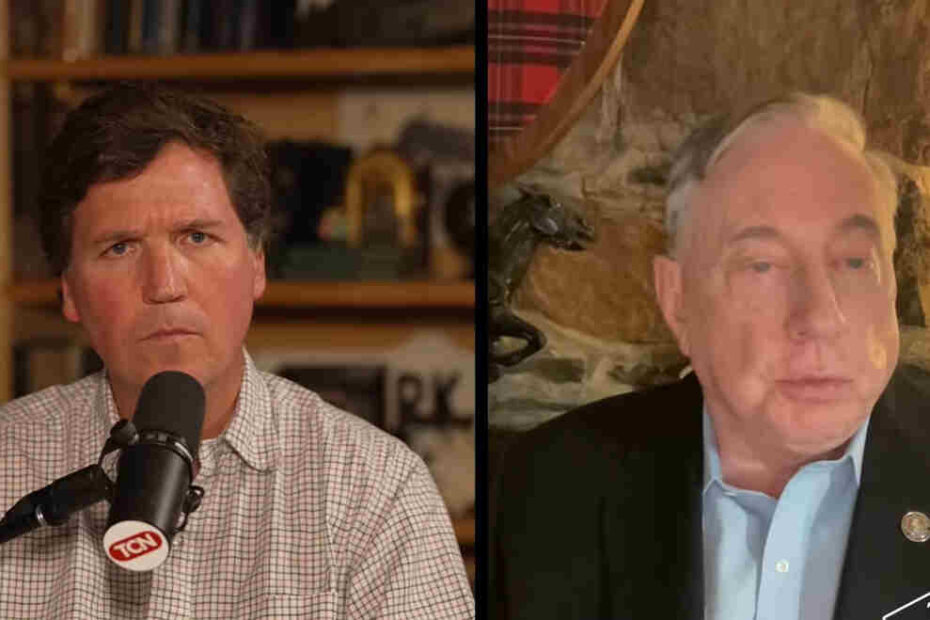
Read the full transcript of The Tucker Carlson Show episode titled “Tucker and Col. MacGregor Warn How Neocons Are Exploiting the Drug Crisis to Drag America Into War”, October 29, 2025.
America Steaming Toward Another Regime Change War
TUCKER CARLSON: Not to be the bearer of bad news, but it looks like we’re about to embark on another regime change war like next week. There’s so much going on right now in this country that you may not be aware that there is a US naval armada steaming toward Venezuela, which is a large oil rich country in South America, not too far from here actually.
And the purpose, the stated purpose of this show of military force is to force the leader of that country, Nicolas Maduro, to leave. And the threat is unless he leaves, vacates the premises, gives up his job, turns over the reins to the opposition party, splits Venezuela for good, the United States will go to war with Venezuela, invade it even. Kind of a big deal.
You may not even have known that. Very few people seem to be talking about that. Again, there’s a lot else going on, but it’s a pretty significant turn of events if you think about it. It’s not every day the United States has another regime change war. In fact, it’s been quite some time. We had narrowly averted regime change war back in June with Iran.
They were telling you the point was just to stop its nuclear program. Of course, the point was to change the leadership in Tehran. President Trump pulled back. That didn’t happen. Thank god.
But we are on the cusp of something very similar happening not too far from here, and an awful lot could go wrong. And, yes, we’re fully aware that anyone who points out the potential downside possibilities of a war is not only a wuss but unpatriotic hysterical.
The Proximity Problem: Venezuela Is Dangerously Close
The fact that Caracas, Venezuela, the capital, by the way, you’ll be hearing a lot more about it if we go to war there.
And that’s significant not because Venezuela’s SEAL teams are going to blow up Puerto Rico, but because wars tend to precipitate huge movements of people. They cause migrant crises. They cause massive and irreversible demographic change. This has always been true, always been true.
But we have a couple of pretty recent reminders. Back in two thousand fifteen with the help of the US government at the urging of our closest ally in the Middle East, the Syrian civil war raged and there were lots of players in that war but the United States was certainly one of them.
And as the result of the Syrian civil war, which most Americans were not paying attention to, Europe got invaded by migrants. Remember the migrant crisis of two thousand fifteen? You may not remember because it never ended. In the ten years since that, one point three million asylum seekers arrived in Western Europe.
Western Europe has been completely destroyed. Totally unrecognizable. That’s not an overstatement. Go to Paris. Go to London. Go to Oslo. Go to any capital in Western Europe, and it does not look Western European. And, clearly, that entire part of the continent is on the dramatic downswing.
There are lot of reasons for that, the main reason is immigration, mass migration due to war. So that’s not a hysterical position. It’s not crazy to worry about that considering we’re pretty close to Venezuela. So that could happen.
The Human Cost of War
Also, people get killed in war. Whenever you commit troops to a place, even if you bomb a place, there are aftereffects, there are ripples and people die and some of those people are apt to be your people. So if you have a war, it’s fair to expect some Americans will die.
And of course, we’ve had a lot of wars in the last hundred years, and Americans have been prepared to bear that cost. Not usually the same Americans starting the wars or cheering on the wars. They never bear that cost because they never show up at the war. People like Lindsey Graham haven’t been to a lot of wars.
But most Americans are aware of the fact that when you have a war, people die, including some of our guys. It’s sad, but we tell ourselves it’s worth the cost. But it’s close to inevitable.
All of that is just to say, before this happens, it would be nice to know why we’re doing this. Why are we having a regime change war? And by the way, unlike what happened in June, the people pushing this are just saying it right out loud. The purpose of this adventure is to replace the government of Venezuela.
A Long History of Hostility Toward Venezuela
Now we haven’t liked the government of Venezuela for quite some time. It’s been at least ten years. They’ve been under pretty tough American sanctions. There have been now publicized efforts to get rid of the leader of Venezuela, Nicolas Maduro, and before him, his predecessor, Hugo Chavez, who claimed as he died of cancer, that he was infected with cancer by the CIA. No confirmation on that.
But the point is this is a conflict of long standing. The United States under a number of different administrations has said out loud, we would like someone else to run that country. Now it’s a little strange if you think about it, that one country can just say to another country, we don’t like your leadership, leave or we’ll kill you. But that’s what we’re doing.
Is that a precedent you want to set? Well, we set it long ago. But what’s interesting is it’s hard to think of all the regime change affected by the United States and its various agencies whose budgets you can’t know and whose activities are still decades later shattered in secrecy.
Of all those regime changes affected by the US government, how many worked out well? Would anyone say that hanging Saddam Hussein made Iraq better, made the world safer, made America more prosperous? Well, it empowered Iran for one thing, and so on and so on and so on.
So to say the US does not have a positive track record of regime change that the after effects upon examination haven’t been worth doing. I mean, that’s an understatement. It never works, but we’re doing it again, apparently. So the question is why?
Examining the Stated Reasons for Regime Change
Why are we doing this? Why are we so opposed to Nicolas Maduro? So if you ask someone on the street, random person, why are we against Nicolas Maduro? The answer you’re going to get is who’s Nicolas Maduro? But if you find someone in South Florida, for example, who knows who Nicolas Maduro is, who can identify where Venezuela is on a map, that person will almost certainly say, because he’s a communist or a socialist.
He’s exceedingly left wing, and that is true. Nicolas Maduro and his government are very left wing on economics, not on social policy, by the way, which is kind of interesting. In Venezuela, gay marriage is banned. Abortion is banned. Sex changes for transgenderism are banned.
It’s one of the very few countries in the entire hemisphere with those policies. It is on social policy, not defending the regime, just saying. One of the most conservative countries in North or South or Central America. Only El Salvador really comes close, which is much smaller, of course.
And by the way, the US backed opposition leader who would take Maduro’s place if he were taken out is, of course, pretty eager to get gay marriage in Venezuela. So to those of you who thought this whole project was global homo, not crazy, actually.
Is It Really About Democracy?
So the average person when asked would say, we got to get rid of the guy because his politics are bad. His ideas are bad. We’re in favor of democracy. Of course. That’s why we’re supporting the unelected dictator in Ukraine because we’re for democracy. That’s why we had the two thousand twenty election with the drop boxes and the fake mail in ballots because we’re for democracy.
But democracy because we have a moral obligation to make sure that good government reigns in our hemisphere. That would be the answer. But that’s not really a compelling answer. Is that really the reason? So if we see a leader in our hemisphere or anywhere in the world who’s dictatorial, who, I don’t know, cancels his own citizens, arrest them for saying bad things, we overthrow that person? That’s not really the standard. No.
Our closest ally in Europe is the UK. And famously, last year, the UK sent three times as many people to jail as Russia did for saying naughty things on social media. So the UK, the government of Great Britain under Keir Starmer is authoritarian. Obviously, it’s not a democratic government. You can have a democratic government with censorship by definition.
Of course, if people can’t say what they believe is true, they’re not free people. It’s not a democracy. They don’t own the country. They’re under the thumb of a dictator. But there’s no move to liberate long suffering Britons from Keir Starmer. Maybe there should be, but there isn’t.
So I think we can discount, we can safely discount democracy as a reason for affecting regime change in Venezuela. We’re not going to go kill Nicolas Maduro because we don’t like the way he’s treating his people. It’s possible we’re mad that he doesn’t allow gay marriage. That is a distinct possibility, but no one will say that out loud. So what could be the other reasons?
Is It About Oil?
Well, energy. That’s the obvious one. Venezuela has the deepest proven oil reserves, the biggest proven oil reserves in the world. Venezuela has more oil than Saudi Arabia does. Now it’s low grade oil, dirty oil, and its infrastructure, its oil extraction infrastructure is in terrible shape after ten years of sanctions and mismanagement by the government, etcetera, etcetera.
Again, none of this is a defense of Maduro’s economic policies, but they’re not that out of whack with a lot of different places, lot of different countries. In fact, they’re not that different from the economic policies of the incoming mayor of New York. Actually, to be honest, the big difference is that Nicholas Maduro is a social conservative and the incoming mayor is all about transiting your kids, but whatever.
Oil. People say, of course, it’s about oil. Is it about oil? Doesn’t seem to be about oil. There are a bunch of American oil companies, big ones and little ones, independent and publicly traded, who would like to get into Venezuela. They can’t because of sanctions, but they’d like to change that so they can help Venezuela extract its mineral resources and make money in the process and presumably help the United States in the process. They haven’t been allowed to do that.
So if your goal was to secure as much oil as you could, as much energy as you could for the United States and help American energy companies build their businesses, employ Americans, of course, you would stop moralizing long enough to let Americans rebuild Venezuela’s aging extraction infrastructure, but we’re not doing that. So is it really about oil? Probably not.
The Drug Trafficking Excuse
Well, then it’s about drugs. That’s what we’ve been hearing now. It’s about drugs. Venezuela is a drug dealing nation. Its regime is involved in drug trafficking. And by the way, sounds true. Probably is true. Is Maduro or people around Maduro involved in the drug trade in some way? Probably would think so. How many Latin American heads of state aren’t? That’s a good question. But it’s not an excuse. It’s bad.
But how significant is Venezuela in the hemispheric drug trade? Like, if you’re looking at the drug trade in the United States, how much of that comes from Venezuela? Well, we have a fentanyl crisis famously. Does fentanyl come from Venezuela? No. It doesn’t. Actually comes from Mexico.
What about meth? Well, meth also comes from Mexico. What about cocaine? That would be Peru, Bolivia, and Colombia. Not to say that drugs don’t come from Venezuela. Of course, they do. But most drugs that wind up in this country do not come from Venezuela. They’re not produced there. They’re not trafficked through there.
And the cartels that distribute them and kill people in our country are not Venezuelan. They’re Mexican. All of them. The top five drug cartels operating in the United States, including the ones that control entire counties in Northern California, huge parts of the American Southwest, Florida, Texas, all over, Northern New England, those are all Mexican. So probably not about drugs.
What Is This Really About?
What is it about? We should know not simply to argue against it. I mean, we have no control, clearly. No one is asking the American public whether they want another regime change war. No one’s asking Trump voters whether they want another regime change war. Nobody cares. So it’s going to happen no matter what people think.
In fact, if it does happen, it will likely happen at a time when most Americans had no idea it was about to happen. In other words, it’ll be a huge surprise to everyone if this happens. Except those eighteen people, if it’s even that high a number, who still watch the broadcast television Sunday shows.
If you’re one of those people, likely someone in intensive care, strapped to a gurney, the attendant’s going out for a cigarette and taking the remote and you can’t change the channel, you may have seen this on Sunday. This is senator Lindsey Graham of South Carolina redolent with glee as he describes our plans to kill Nicolas Maduro. Watch.
VIDEO CLIP BEGINS:
LINDSEY GRAHAM: Venezuela is now partnering with Hezbollah. Hezbollah is running out of money because Iran is weak.
UNIDENTIFIED SPEAKER: That’s not new. Partnering with drug cartels in Venezuela.
LINDSEY GRAHAM: No. It should have stopped. Here’s what, here’s what’s new. You got a commander in chief that’s not going to put up with this crap. We’re not going to sit on the sidelines and watch boats full of drugs come to our country. We’re going to blow them up and kill the people that want to poison America. And we’re now going to expand operations, I think, to the land.
VIDEO CLIP ENDS:
TUCKER CARLSON: We’re not going to torture you by replaying that tape, but if you rewind it in your spare time to the point where he says that, I’m quoting, “we’re going to kill people.” You can see a little shiver of excitement go through his aging frame. We’re going to kill people. We’re going to kill people and we’re going to kill them as Lindsey Graham just explained because Hezbollah in Lebanon.
The Hezbollah-Venezuela Connection: A Questionable Justification
We’re going to kill people in Venezuela because Hezbollah in Lebanon. And, obviously, the security of southern Lebanon is a key American objective. It’s probably not five people who voted for Donald Trump who didn’t do so with the security of southern Lebanon in mind. We’ve got to get Hezbollah out of southern Lebanon. And anyone who has any connection to Hezbollah must be invaded and killed, of course.
And as you learned in school, the main funder of Hezbollah is, of course, Venezuela. Just have a lot in common, language, religion, proximity. What? I mean, okay. So they’re Hezbollah guys in Venezuela. Well, there are Hezbollah guys here. They’re Hezbollah sympathizers probably in a lot of different countries. Okay. What does that have to do with us? Have a lot of Americans been killed by Hezbollah in the United States with money from Venezuela?
If so, when did that happen? Can you prove it? Can you speak slowly so I can understand it? Can you show me the receipts? Can you give me some explanation for what this is and why we’re doing this? Hezbollah, drugs. So it’s a mystery. Clearly there’s something going on.
One obvious partial explanation is there’s a big Venezuelan exile community in South Florida. Super nice people, actually some of the nicest people you will ever meet. Good values, decent people. They’re mad about what happened in Venezuela. They have every reason to be mad about it. A lot of them had all their stuff taken, had to flee to Florida or a lot of it taken, not all of it, judging by their houses, but good people for real.
Venezuelan exiles, Cuban exiles, a lot of Latin American exiles in South Florida. They’re mad about what happened in their home countries. Totally understandable. Easy to be very sympathetic to them. I am personally sympathetic to them. On the other hand, these people just got here.
And so why would they be using the US military to settle some score in a country that’s not America? Doesn’t really seem like the way things should work. America offers you refuge. Great. We feel good about it. You feel good about it. We feel morally superior. You work hard and thrive. And that’s kind of worked.
But the moment when you decide, well, wait a second, I’m going to use the military power of the country that gave me shelter to fix things in the country I came from, you’re going to have to tell me why that’s a good idea for me and for everyone else, the hundreds of millions of other Americans who didn’t come from anywhere else who were born here, whose grandparents were born here. Why should we be paying for that? How is that good for us? Shut up. One ever asked those questions.
So it’s possible that there’s been quite a bit of lobbying by Venezuelan exiles in South Florida to do this. Of course, we know that that’s true. But is that really the reason? It feels like there must be something else going on. You don’t send the US Navy to go effect regime change because people in three counties in one state want it, do you? Maybe there’s something else. Not exactly sure what it is. Someone should look into this because it’s apparently really important.
The Drug Crisis: America’s Real War
But let’s linger on the last explanation, the stated explanation. You’ll notice after Lindsey Graham finished hyperventilating about Hezbollah, whatever that is. Oh, he left out the part about why I should care. Oh, they’re behind the ninety eight three barracks bombing. Okay. Yeah. Remember that. That was, forty two years ago. There’s a lot going on. UPS just laid off almost fifty thousand workers. So tell me why Hezbollah is the top of my concern list? Oh, shut up.
But after he got dumped the Hezbollah part and restoring peace to southern Lebanon, key concern for most Americans, he said this is about drugs, bringing boats of drugs. Now everyone through the numbers. Of course, they’re probably drugs coming from Venezuela. It’s a chaotic country. It’s a poor country. Per capita income’s like eight thousand dollars. Yeah. There are drugs in Venezuela, but Venezuela is not where most drugs are coming from.
So if you wanted to address the drug crisis in the United States, what would you do? Well, first you acknowledge it’s an actual crisis. More Americans have died, many more Americans have died of drug ODs over the last hundred years than in all wars during that time combined, including the second world war, something like four hundred and sixteen thousand Americans died, the Korean War, Vietnam, Iraq, Afghanistan, all of them put together.
We’ve had far more Americans die from drugs than from all conflicts. So back when forty years ago when Ronald Reagan was declaring a war on drugs now widely mocked, it wasn’t totally crazy. This is in its effect, in its death count, in its toll on America, like a war. And you don’t even need to know the numbers to know that. There’s not a town in America. There’s not a person in America who doesn’t know someone who knows someone who’s died of drugs. It’s destroyed a lot of this country.
Starting With Deportation of Drug Dealers
And so if you were going to use the US military to fight the drug problem, you might start here. If you were going to take the national security state and use its awesome power to fix the drug problem, Well, I mean, maybe you could start by deporting drug dealers because in every state with a drug crisis, the people trafficking the drugs and in many cases selling the drugs are foreign nationals. That’s true. That is an industry that’s been completely outsourced. It’s not Americans anymore.
Americans aren’t growing weed in Mendocino County. Mexican cartels are growing weed in Mendocino County and Humble County. They’re not, no, American citizens are not selling meth in New Mexico or fentanyl in Arizona. No, it’s Mexican nationals are doing that. Americans aren’t selling opioids in Market Square in San Francisco. No. It’s people from Guatemala, and none of those people are citizens. Why not deport them?
It shouldn’t just be people with bad foreign policy views that get deported. Also, we should deport drug dealers. So, you know, that would be a good precise use. A universally popular use of ICE, it seems to me, is to start with the retail dealers. Oh, but that’s not the root of the problem. Depends how you think about it. You don’t necessarily have to fix the problem at its root to make people’s lives better.
If there are drug dealers in front of your kid’s school, and then the next day they’re not there, that’s a massive improvement for you and your kids. Did we solve the drug problem? Do we burn the poppy fields? No, but we solved your problem and solving people’s problems is the purpose of government. So let’s start there.
A Civilization in Collapse
But maybe even before we did that, we would look clearly at what we’re facing and we would experience the rage and the shame that comes from acknowledging that your priorities are completely backward. Our leaders spend their lives looking across the globe at fading empire and thinking, how do I shore this up? How do I affect change here? How do I knock off that leader? How do I send the CIA paramilitaries or the Delta Force in to do something dramatic?
And as they’re focused on those problems, they miss what Portland, Oregon looks like, what Portland, Maine looks like, what San Francisco, what every big city in this country looks like. Degraded, filthy, evil. As a reminder, in case you haven’t looked it squarely in the face, here’s Portland, Oregon.
VIDEO CLIP BEGINS:
UNIDENTIFIED SPEAKER: Every Friday, this paraphernalia pop up opens for business in this busy northwest Portland neighborhood, providing clean needles and pipes to drug users free of charge, no questions asked. The goal? Reducing harm by preventing infections and disease. The problem? The location, right in the middle of a school zone.
Essentially, message is we want them to relocate. Do your outreach. Just don’t do it within five fifty feet of a kindergarten. Parents and neighbors have since joined forces accusing Portland Street Medicine and the Portland People’s Outreach Group, or PPOP, of refusing request after request to move their operations out of the school zone.
Videos and photos obtained by FOX twelve show why they’re so concerned. They say every week, the free giveaway immediately attracts droves of drug users, followed by a swarm of drug dealers with the resulting street party lasting for days. Drugs like fentanyl and meth sold in broad daylight, Users disregarding the presence of children nearby. And no evidence of outreach workers providing any treatment literature or sharps containers.
The way I see it, what they’re doing is they come into our neighborhood, they pour gasoline on a fire, and the fire gets worse. And it gets worse every week. It get worse every month. It gets worse every year. They drop needles. They drop the pipes, and then they leave. It’s the saddest thing.
VIDEO CLIP ENDS:
TUCKER CARLSON: That’s a society completely out of control. It’s a civilization in collapse. And the saddest thing of all is the expectations of the neighbors and the parents. Move it out of the school zone. The school zone. The school zone? How about the city? How about the state? How about our country? Get out now.
If you’re giving drug paraphernalia to drug addicts, you’re going to get shut down immediately. If you’re a convenience store selling meth pipes and Brillo pads, fake opioids. We’re going to shut you down. We’re not going to have any tolerance for this. Normal countries have zero tolerance for this, zero tolerance for it.
And because they have zero tolerance for it, when you visit them, you feel immediately that this is a safe country. This is a clean country. This is a country under control with self respect. They don’t put up with that in Japan. They don’t put up with that in Doha, Qatar. Sorry. They don’t put up that in any civilized country.
They don’t say, just get out of the school zone. They say, we’re not putting up with this because this is our country. You can’t just live on the streets smoking meth anywhere. School zone, park, anywhere. We’re not we’re not doing that because we know where it leads. It leads to where it’s led in this country. Total devastation and death and degradation and loss of self respect and chaos and filth. It’s not hard.
Shut Down the NGOs Making It Worse
You don’t need to kill Nicolas Maduro to fix the problem. You need to shut down the NGOs that are making the problem worse. They’re your enemy. Your enemy and the enemy of civilization. Giving needles and pipes to drug addicts? They’ll give you some lecture about harm reduction. How about we just end the harm right now by shutting down those NGOs? It’s not complex. You don’t need the US Navy to do that. DOJ could do that.
The entire state of Oregon and many other states, but Oregon specifically is in a state of insurrection by its total unwillingness to abide by federal narcotics laws. They just legalized fentanyl and crack. Can you do that? Can you legalize slavery? Can you? Of course you can’t. You can’t just ignore federal law. And if you can, why are you paying your taxes? Seriously?
If Oregon can legalize crack, why are you following any federal law? If it’s all optional, if it’s a la carte, I don’t think I agree with that. I think I’m going to do it. Why have a federal government? Maybe we shouldn’t have a federal government. Maybe fifty states can live the way they want. Okay, that’s a totally different system. Maybe we should try that.
But on the system we have right now, federal law supersedes state law. You have to obey. Previous presidents have sent tens of thousands of troops into various states over violations of federal law, the refusal of a state to follow federal law. But when it comes to drugs, we ignore it. The one thing that is most obviously destroying the United States at its core level, which is to say destroying the people of the United States, we just ignore it.
This would be a good time to use force. I know it probably wouldn’t fix the Hezbollah problem. Hezbollah. Hezbollah. But it might make people’s lives better in our country. Maybe that’s why they’re not interested in doing it. Maybe that’s why Mark Levin isn’t calling for it because it’s just about us and, like, who cares? Shut up and pay.
A National Crisis, Not Just Portland
But, of course, it would be a mistake to pretend it’s just Portland, Oregon. It’s also Tampa, Florida. It’s also Phoenix, Arizona. It’s also Oklahoma City, and it’s Bangor. And it’s every single city in this country has a deadly drug problem. The Territory State has killed more Americans in the last hundred years than all wars combined. Here’s Philadelphia. Watch this.
VIDEO CLIP BEGINS:
UNIDENTIFIED SPEAKER: Alarm bells are sounding in Philadelphia about tranq. And you’d see people kind of, like, walking around looking like animals when their knuckles are touching the ground.
VIDEO CLIP ENDS:
# The Human Cost of America’s Drug Crisis
Now Art El Malik’s hands and knuckles are swollen to three times their natural size from exposure to the animal sedative Xylazine, street name Trank.
VIDEO CLIP BEGINS:
ART EL MALIK: When I was leaving, submitted samples and that’s what got me stuck, man. You had samples of pre dope.
UNIDENTIFIED SPEAKER: The Xylazine now mixed into ninety percent of Philadelphia’s fentanyl and heroin supply, drugs that drive fatal overdoses. Adding a horse tranquilizer, something more sedating, makes it feel like it lasts longer.
But now fentanyl addicts newly addicted to xylazine seen nodding out and falling over along Philadelphia’s notorious Kensington Avenue are also developing dangerous sores on their bodies.
ART EL MALIK: Biggest holes all over you, these sores in your legs and go wherever. They just pop out of anywhere.
UNIDENTIFIED SPEAKER: Have the doctors told you that you could lose your leg?
ART EL MALIK: Yes.
UNIDENTIFIED SPEAKER: And that’s not enough to get you to stop?
ART EL MALIK: Try and it’s not, it’s a lot easier said than done.
VIDEO CLIP ENDS:
Misplaced Priorities in American Foreign Policy
TUCKER CARLSON: The next time someone lectures you to Hamas or Hezbollah, show them that video. That’s your country. Those are your countrymen. Those are your people. And not only dying, it’s worse than that. They’re living death. They’re so degraded. You heard the guy say they live like animals.
Killing Maduro, guess you can make a case for it, it’s not going to fix that. It’s not going to even touch that. So why not go right to the actual problem, which is we put up with the stuff we shouldn’t. Our federal government doesn’t care. Lindsey Graham has zero interest in solving these problems, but those are the real problems.
They’re the problems you can walk to. They’re problems in your city. They’re the reason you don’t live in the city you grew up in anymore. They’ve driven you out of your own city. We’re running out of places to run to, and nobody cares.
They’re not sending the US Navy to fix the city you grew up in because it’s not Hezbollah. So the question is, are we actually about to embark on a regime change war in Venezuela? What is this naval armada doing on its way to Caracas?
Colonel MacGregor Weighs In on Venezuela
Colonel Douglas MacGregor commanded the last, I think, the last tank battle that the US Army participated in during the first Iraq War. A graduate of West Point and a frequent guest joins us now to assess the likelihood of a regime change war against Maduro. Doug, thanks so much for coming on. Are we doing this?
COL. DOUGLAS MACGREGOR: It looks bad. It in fact, it looks like it could happen on four or five November. The reason I bring that up, it just so happens to be a full moon, which would lend credence to the argument that lunatics are ruling us in Washington DC.
You know, you’ve gone down the list of reasons, and there are a couple that I would add because I recently went into DC, and I talked to some people. Some of the people I talked to are just below the decision maker level. And these are the usual smug resume builders who come in and out through every administration hoping that at some point they’ll get a high level appointment.
And they said a couple of things that I thought were interesting. First, they said, well, you gotta understand, Doug. We’re flipping the chessboard on Russia and China.
I said, what?
Oh, yes. Don’t you understand? By going into Venezuela, we’re saying a very strong message because Russia and China have tried to build up and cultivate support there, and we’re telling them that they can’t do it. We’re flipping the chessboard.
The Flawed Logic of Military Intervention
COL. DOUGLAS MACGREGOR: Oh, I said, well, I don’t think the Russians are prepared to fight for Venezuela. In fact, I know that Putin has given very explicit instructions to the Venezuelans. You’re on your own. We’ll give you equipment and assistance if you if we can, but forget it. We’re not going to fight for you.
The Chinese certainly aren’t going to send the Chinese navy to the Caribbean to stand off and fight us. That’s not going to happen. And I said that. I said, so, you know, you can’t make this argument that this has some great strategic value that justifies this enormous task force.
And, you know, it ultimately boiled down to it’s time for us to be strong again as though bombing hapless people in Venezuela or Colombia or Nicaragua or anywhere in Latin America is testimony to our greatness as a nation.
And then, of course, the final story is, well, we’ve gotta, we’ve gotta destroy the drug problem where it originates. Well, I’ve got a big flash of the obvious. The drug problem originates here inside the United States.
You’re not going to get anywhere by bombing Mexico just because Mexico provides most of the fentanyl. When I say Mexico, we’re talking about the cartels, and Mexico’s an organized crime state. It has been for a while. They’re going to do what they can, but the Mexican army is much more responsive to the cartels than it is to the president of Mexico.
So, you know, bombing these places isn’t going to stop anything. It’s not going to improve anything. It may turn out to rally all of Latin America against us, The evil Yankee who’s intervening yet again inside Central and South America. We’re blamed for almost everything that’s wrong down there. All we’re doing, he’s saying, I guess you’re right. Look what we’re doing now.
The Case for Focusing on Domestic Problems
COL. DOUGLAS MACGREGOR: It’s not going to change anything, but that means you’ve got to come home. This seems to be the thing that no one in Washington wants to do. Somebody said, Doug, what do you want to come home for? You know, we have troops all over the place. We have what do you want to come back here for?
I said, because what happens here is far more important and existential for us than anything beyond our borders. The world has changed. Putting little packets of troops or ships here or there isn’t going to stop things from happening overseas. They’re going to happen whether we like it or not. And the good news is most of what happens beyond our borders doesn’t matter to us. It’s not a reflection on us. We need to focus here.
And I said, you know, if you exercise some restraint right now, you bring the forces back to the United States, defend the borders, defend the coastal waters, and then crack down on the peddlers. And I would add child trafficking to the drug trafficking.
TUCKER CARLSON: Of course.
COL. DOUGLAS MACGREGOR: And I would the death penalty for anybody who engages in it. That means you’re going to go to trial. And if you’re found guilty, you’re going to face the death penalty or reason.
Oh, that’s terrible. But it’s okay to bomb Venezuela. You know, don’t execute the drug peddler or the child trafficker, but let’s bomb Venezuela. Doesn’t make any damn sense whatsoever. That’s where people’s heads are right now in Washington DC.
The Erosion of Democratic Accountability
TUCKER CARLSON: But I worry, I mean, it used to be, well, you’re the army officer. You tell me. But my understanding was in a democracy, you know, our republic, the president has constitutional authority to just send troops and start wars effectively even without congressional approval, I’ve noticed. But there was always this expectation that someone would explain why we’re doing this.
You didn’t want to go into a conflict because, of course, you never really know what’s gonna happen without getting the public on board. And I don’t think I know five people who know this is about to happen.
COL. DOUGLAS MACGREGOR: Well, you know, you bring something up that’s very interesting. Somebody pointed out to me just the other day. Benjamin Franklin told the population that was standing out in front of the Independence Hall when they asked what sort of government do we have now, mister Franklin? This is after the constitutional convention.
He said, well, you have a republic if you can keep it. He said, we need to change that because today, if Ben Franklin came back, he would say, you have a drama queen republic if you could keep it.
TUCKER CARLSON: Yeah.
COL. DOUGLAS MACGREGOR: We have a lot of frivolous theatrics in Washington that passes for diplomacy and policy. We have a president, and you know that I like the president personally, always have. But everything is about theatrics and optics and appearances.
And now we have the prime minister of Japan who just made wonderful deals for Japan with us, by the way. Japan is going to continue to buy oil and gas from Russia. There will be no change in that. Japan is going to invest more in the United States. We’re already heavily invested here as it is. That’s not a big deal. Although Toyota has since come back and said, we’re not increasing our investment. Sorry. We didn’t make that promise.
But we she gave Donald Trump the most expensive set of golf clubs in world history. They’re beautiful. They’re magnificent. And she promised that she would nominate him for the Nobel Peace Prize. And suddenly, president Trump says, this has been a big success. We are winning.
So now he goes on to South Korea. I’m sure he’ll get some similar treatment there. And, oh, by the way, I see no evidence that India is going to stop buying oil and gas from Russia either.
The Illusion of Foreign Policy Success
COL. DOUGLAS MACGREGOR: And now we have this ceasefire that was declared a few weeks ago that’s just completely disastrously violated by the Israelis. And everybody says, okay. That’s fine. So what are we dealing with? We’re dealing with facades, illusions.
And I think Venezuela is another illusion. Instead of doing exactly what you’ve suggested, turning inward, focusing here at home on what’s important, bring the forces back. If we’ll exercise some restraint now, we’ll build more capability for the future. But there is no long term planning.
We launched a tariff war. There’s no stability in the tariff regime. It’s driving everyone crazy. They talk about the dollar as reserve currency. That’s all shifting into pure gold now. Ask Nasim Talib. Ask Ray Dalio. Ask anybody. Gold is a new reserve currency. We’re not even prepared for that. We’re not paying attention to it.
Let’s bomb Venezuela. Let’s bomb Colombia. Let’s punish those bastards. They’re the ones that created this drug problem. No. They’re not. They’re feeding an appetite in North America for something that people will pay a lot of money for.
Crack down on the on the appetite at home, secure the borders, the coastal waters, and stay out of Central and South America.
Questioning America’s Foreign Policy Obsessions
TUCKER CARLSON: I just don’t understand how, I mean, our public conversation is so dominated by Hamas, Hezbollah, all these far away, Ukraine, Russia, these far away conflicts, groups that are really not connected to the United States and haven’t over time posed a meaningful threat to the United States.
You’re not even allowed to say that Hamas does not pose a threat to the United States and never has. Like, am I mad about more mad about Hamas than I’m mad about the open air drug market in Philadelphia? I why don’t any politicians in the congress put the open air drug market in Philadelphia above the threat of Hamas? What is that?
COL. DOUGLAS MACGREGOR: Well, I think you have, well, I think you have an answer of sorts, and it comes interestingly enough from missus Machado. I don’t know if she’s married or not, so I call her missus. She may just be miss Machado. She’s the lady that just won the Nobel Peace Prize, and she’s from Venezuela.
And she said if we’re liberated by the US armed forces and they remove Maduro, our first act will be to move the Venezuelan embassy to Jerusalem.
TUCKER CARLSON: What does that have to do with, I’m completely confused. Like, what?
COL. DOUGLAS MACGREGOR: Well, you can’t be that confused. I think she’s hit on something very important. She’s figured out where the power lies, and she’s playing to the audience that makes the decisions.
Who Really Rules America?
COL. DOUGLAS MACGREGOR: You’re talking about this democracy business. We’ve always been a republic with limited democracy, but I think we can pretty much conclude that we’re ruled now by a small group of extraordinarily wealthy people, billionaire oligarchs. Those are the terms they use in Eastern Europe and places like Ukraine.
TUCKER CARLSON: Yeah.
COL. DOUGLAS MACGREGOR: I think they’re in charge. I think they’re calling the shots. And I think there are interests in the oil resources, oil and gas primarily. Although, let’s face it, they’ve got gold mines and emerald mines as well and other things. I’m told they have a lot of lithium.
There may be a true interest in putting in a puppet government and finding way to extract these resources because right now, for the first time in thirty years, all the central banks beyond the borders of the United States around the world hold more gold than we do. That’s a very important thing to understand.
So how do you begin to reverse this process of managed decline, which is really what we’ve been on now for the last twenty five years?
The Economics of Venezuelan Oil
Well, oil is part of it. Oil is gold. And even though the oil is exactly what you described, it’s heavy oil, high sulfur content, requires a lot of refining. But still, we have the best oil engineers in the world, especially for deep drilling. It will probably for the same amount of money we pay for one barrel of oil out of the ground in the United States, we could probably get two out of Venezuela.
It’s still not as good as Iran or Libya where you could probably get three barrels out for what we spend to drill in the United States. But it doesn’t look like we’re going to get control of the Iranian oil fields. And I think we’ve bullied the Emirates and the Saudis as much as we can at the moment, and Iran stands defiant. So look for another war in the Middle East while all of this is unfolding because Israel’s objectives aren’t met. Neither are the objectives of the New York and London banks.
I think we’re in a lot of trouble financially, and there’s a genuine interest in controlling resources to offset that crisis.
Resource Control and Maduro’s Offer
TUCKER CARLSON: So you think this is a resource play that this is motivated by control?
COL. DOUGLAS MACGREGOR: Big part. I think it’s a big part. But I mean, would it actually take an invasion? I mean, Lindsey Graham was salivating at the idea of boots on the ground in Venezuela. That’ll confuse the crap out of most Americans if that happens. But why not just go to Maduro? I think he offered.
Well, that’s what I was just going to tell you that we didn’t have to go to Mr. Maduro. He came to us. Right. And in fact, President Trump was questioned in the Oval Office last week. And they said, we understand that Mr. Maduro approached you through intermediaries, no doubt, and offered you a very lucrative deal. I’m told it was about a stake in the oil and gas industry, all sorts of things like that.
And he replied. He said, oh, yes. It was not just a good deal. He offered everything. And so people looked said, was that not enough? No. That’s not enough. I think there’s something else going on here beyond that. Clearly.
TUCKER CARLSON: Clearly. That’s what I’m asking. I ask people, and some people have said, well, you remember Venezuela was involved in that Dominion Software scandal. Remember that Dominion Software was developed for Hugo Chavez. I said, okay. Maybe this is a personal grudge match. I don’t know. But I do know that there’s this feeling that President Trump needs a win. He wants a win. He’s not going to get a win out of Ukraine. Doesn’t look like he’s going to get a win out of the Middle East. So where does he go for a win? I guess.
How about Philadelphia or Portland? No. I’m serious. I mean, that was the whole point. That was why, you know, people voted for that. It’s not hard. And for the resources we’re spending just to send the ships to the Caribbean, you know, you could do a lot for downtown Atlanta. Like, isn’t that what people want?
COL. DOUGLAS MACGREGOR: Seventy-seven million people voted for exactly what you’re describing. There’s no question about it. But I don’t think that is necessarily the kind of theater that Washington’s interested in, and I don’t think people on the hill may also include friends of President Trump and others are necessarily going to profit from any of that activity.
I mean, we’re watching an awful lot of huge, hundred million, billion dollar deals closed all over the place by people connected back to Washington right now. That’s not new. We saw that under the Biden and Clinton administrations, but it’s certainly vulgar and out in the open right now. You don’t close those kinds of deals by shutting down the drug trade and the child trafficking in Philadelphia or Seattle or anywhere else.
Domestic Priorities vs. Foreign Policy
TUCKER CARLSON: I do think it’s fair for people to say, okay. You know, do your deals, do your crypto or whatever, but we don’t want to live like animals and we want, you know, our kids be able to buy a home. Like, there should be more balance here. Like, no presidency should be completely dominated by foreign policy concerns, and yet most of them seem to be.
COL. DOUGLAS MACGREGOR: Well, they’re drawn into it because it’s a wonderful platform for them to display their decisiveness, their strength, their courage, their leadership. That’s the way people think of it. But you’re right. It’s an illusion.
And you know what? I know President Trump from the standpoint of foreign policy to some extent. It was very clear to me the last time I spoke with him and worked with him that he wanted to get our forces out of Europe. Now very recently, nobody’s paid any attention to it, but suddenly, we’re finally withdrawing troops from Romania and Bulgaria. That’s a very wise thing to do. Thank god.
Let’s get them out of Poland, get them out of Lithuania, start pulling them out of Germany. We don’t need those forces over there, and the Europeans don’t need those forces. There is no threat to Europe from Russia. I think he knows that. I think he knows that China isn’t going to invade Taiwan. And so you see him moving through Asia diplomatically and behind the scenes. Everybody is telling him, we’re not supporting a war with China. China is not a military threat to us. I think he understands that.
So I think he wants to focus at home. But this thing in the Caribbean basin is clearly not an original idea on his part. He agrees the threat from Central and South America, but particularly Central America is very serious. He knows that. But the issue is how do you deal with it? And you deal with it along the lines that we’ve described.
But how do you face people who say, well, I don’t want you to arrest someone. And then if they’re found guilty, punish them with the death penalty if they’re trafficking children or they’re trafficking drugs? But the same people that object to that will turn around and say, well, I don’t want you to bomb innocent people in Venezuela or Colombia. They need to make up their minds. They need to understand what is required, what is necessary for the survival of the country.
Federal Authority and State Defiance
You’re right. You know, we had a dispute over this federal law issue back in eighteen sixty-one. We solved it. It was ugly, but we did it. And we may have to solve it again. I keep wondering when the John Brown moment arrives. We’ve got a lot of evidence that one is coming because we can’t let governors and mayors stand there and pour filth and abuse all over our federal laws and simply say no. We won’t enforce them. And by the way, we regard you and your police forces as the enemy.
TUCKER CARLSON: Yep. It’s insane. So since you’re—I just have to ask you a final question about Russia Ukraine. When does that conflict end?
The Russia-Ukraine Stalemate
COL. DOUGLAS MACGREGOR: My impression is that since President Trump concluded that he wasn’t going to get a ceasefire that he could tout as another great foreign policy achievement like the last ceasefire in Gaza, he’s lost interest. I think he knows that he can’t settle that. But remember, he made remarks before he was elected, which were very unfortunate, telling everyone I can end this with a phone call in twenty-four hours. No understanding whatsoever of the problem. That is very unfortunate. The problem is far more serious.
Central Asia and Geopolitical Tensions
By the end of this week, he is going to meet. I think it’s in the next few days and maybe next week. I don’t know. He’s going to be meeting with the leaders of the five Central Asian republics, you know, Tajikistan, Uzbekistan, Kazakhstan, and so forth. He wants to talk to them about commercial arrangements with us in trade. This is going to be a real serious issue for the Russians and the Chinese.
First of all, Moscow has not forgotten our attempted coup in January, February of twenty twenty-two when we tried to overthrow the government in Uzbekistan. The Russians went in there at the request of the president and stabilized it. This was another one of these color revolutions cooked up by the National Endowment for Democracy, which should be the National Endowment for Anarchy, and, of course, the CIA always. The CIA mucks around in Central Asia all the time.
We’re still pumping hundreds of millions of dollars into places like Afghanistan that are really destined to support subversive elements in Central Asia. The Russians don’t like it. They don’t want it, neither do the Chinese. They want stability there. They want to build the one belt, one road, which they know will bring prosperity to the people of Central Asia.
And they also have a long memory. They don’t want Central Asia to become what it was a few hundred years ago, which was the greatest force in the world under someone like Genghis Khan. And people laugh. Well, you don’t understand Central Asia and the people that live there, but they could be mobilized. They could be united and present a real danger to everyone.
The Russians and the Chinese understand this. They don’t want that to happen, but we’re in the business of subverting and destabilizing. And this visit now will not be treated as something positive in Moscow. They will see this as another attempt to undermine Russian and Chinese security. That’s a meeting he doesn’t need to hold. But he’s going everywhere. He’s selling America. That’s his argument. I don’t think people understand the implications.
The Venezuela Trap
So the bottom line is President Trump has great instincts, but then he walks into the swamp, and he gets mugged early. And people distract him into areas where he’s not familiar, and they’re going to put an end to his presidency if they drag him into Venezuela. That place is a terrible, terrible mess for us. We can’t fix it. We shouldn’t try. Let the people that live there do it. And if they say, well, they can’t, well, that’s their problem. It’s their home.
TUCKER CARLSON: Yeah. Remember, Venezuela has one thousand seven hundred miles of coastline, one thousand three hundred and seventy mile border with Colombia, one thousand three hundred and eighty mile border with Brazil. And I’m being told by people with experience down there that you’ve got a hundred thousand paramilitaries along their border in Brazil and Colombia that just can’t wait to go into Venezuela and fight us if we go into that country.
COL. DOUGLAS MACGREGOR: And this sort of thing will spread. It’s the last thing that we need. What we need is stability and peace. I would urge the president to reconsider his rejection of this proposal from Maduro and get out of this business of regime change, particularly when you know that somebody like Machado is playing to the wrong audience.
TUCKER CARLSON: Well, what a joke. Why are we trying to install this woman? It makes no sense.
COL. DOUGLAS MACGREGOR: Well, because she’ll bring gay marriage to Venezuela, and that’s important. I mean, that’s what we stand for.
Well, you know, you got some real criminals. Let me just finish up here real quick here. On the hills around Caracas, you’ve got as many as eight thousand Colombian drug criminals. They’re there. There’s no question about it. Maduro has clamped down on them contrary to what people here think. He’s holding them in check. That’s not an easy thing to do in Latin America. As you know, you visited El Salvador. You know the region. You know what it’s like. This woman can’t do that.
So my point is that if you don’t like it now, it’ll get a lot worse if we go in there.
TUCKER CARLSON: Yeah. But, I mean, is he protecting the trans community? No. You know? So let’s kill him.
Thank you, Doug. Great to see you.
COL. DOUGLAS MACGREGOR: Thank you, Tucker.
Two Perspectives on the Drug Problem
TUCKER CARLSON: So there are at least two ways, ends of the telescope, to consider the drug problem. One is at the level of countries, the root problem, and the other is at the level of your experience, your daily life. So Washington is very focused on the macro. We need to sign this treaty. We need to depose this dictator. We need to send military force to this region. We need to change this policy.
But most people understand drugs in terms of like their niece who is living on the street or their nephew or college roommate’s son or their own daughter who dies of a fentanyl OD. And the truth is it’s probably easier, less expensive, and much more effective to deal with the drug problem on the level of experience, which is to say in your daily life than it is on some international level.
# The Human Cost of Failed Drug Policies
Root causes are hard to pin down. Everyone’s got a theory about the root causes for everything, but no one needs to theorize about what a nodding fentanyl addict looks like or someone having some kind of manic episode on the subway because he smoked too much meth. That is something everybody understands and authorities, local, state, and federal have made basically zero effort to fix those problems for the last thirty years.
And as a result, hundreds and hundreds and hundreds of thousands of Americans have died and a much greater number have had their lives destroyed. For a time, a long time, Ginny Burton was one of those.
She’s from the state of Washington. She was addicted to drugs. She was arrested multiple times. In fact, this is what she looked like. This is a mugshot from Ginny Burton.
There she is at the height of her drug addiction. Look familiar? Our parks and our sidewalks in every American city are full of people who look exactly like that. The difference is that Ginny Burton recovered completely. We’ve spoken to her before because she has a perspective that people really ought to hear, and that perspective is what is it like to be the victim of all of this, of these root causes, and what can we do to help people like her like your niece?
Ginny Burton joins us now.
TUCKER CARLSON: Ginny, thanks so much for coming on.
GINNY BURTON: Thanks for having me Tucker.
The Harm Reduction Industry
TUCKER CARLSON: So these groups that hand out needles and pipes to addicts, this started you know forty years ago in Europe in Switzerland, Zurich, and was abandoned because it seemed to make the problem worse. But in this country, it’s only become better funded, more widespread. No one has really pushed back against it in a meaningful way. What effect does handing pipes to meth heads have on the meth heads, do you think?
GINNY BURTON: Well, it exacerbates the problem. It helps us stay stuck in a state of dependency. So we’re actually contributing to the destruction of human life, and we’ve made an industry out of it in the United States.
TUCKER CARLSON: It does seem like an industry. It seems like it employs an awful lot of people. It employs more people. These NGOs employ more people than drug addicts they’re saving. I mean, you ever heard of any drug addict who’s like, oh, a free pipe, I’m going to stop using drugs?
GINNY BURTON: Yeah. It really doesn’t happen that way. A person has to be removed from the destructive path in order to gain that clarity. I think it’s a very, very small percentage of people that can be immersed in the problem in that hypnotic sort of intimate relationship with drugs and actually find their way out. And I’m talking a really small percentage. So yeah, we’re definitely contributing to the problem.
Can I share something really interesting with you actually?
TUCKER CARLSON: Yes.
A Predicted Industry Boom
GINNY BURTON: So in two thousand and one, nine eleven happened. Two thousand and two, early two thousand and two, George Bush extended unemployment benefits. It was called worker retraining. And he allowed for, believe it was a thirteen week extension for anybody that was going to receive a certificate because they were displaced because of what happened during nine eleven.
I attended at that time, and I had just gotten out of prison, September of two thousand. So I’d been working in a doggy daycare at the time, and I made the decision to go back to school. So I attended an information session at the Seattle Central Community College.
And it was during that time that there were two different industries that were projected to significantly increase within the next twenty to twenty five years. One was the biotech industry, there was a certificate program that was being pushed in that industry, but it was also the social service and drug counselor or drug treatment industry. So it was projected that within the next twenty to twenty five years that those two industries were going to explode significantly.
That was something that I never forgot. I kind of put that little piece of information in my pocket. And then when I went to work in social services, which I felt spiritually compelled to do as a recovering addict who didn’t really have a lot of experience navigating anything except for that environment. I watched the decline happen exponentially. And that little memory was sort of brought to the forefront of my mind. And it makes me really believe that this is by design.
A Journey to Recovery
TUCKER CARLSON: So how did you get better? How long were you addicted and how did you get sober?
GINNY BURTON: Yeah, well, I was on drugs the majority of a thirty year period. I started using around the age of seven. I was arrested for my I don’t know how many times I was facing a fourth prison sentence at the age of forty. And it was at that point that I knew that I couldn’t keep destroying my life.
I knew that the system was only going to provide one dimension of what I needed, which was the separation. And then I utilized, you know, my will. And whatever it is that came into the institution treatment or twelve step treatment opportunities and church to actually piece together some sort of process for me to stop screwing myself over. If it weren’t for arrest and incarceration, Tucker, I wouldn’t be doing the work that I’m doing today.
TUCKER CARLSON: Do you think you’d be alive if you’d never been arrested?
GINNY BURTON: No. I’m pretty sure I’d probably be dead at this point, especially with what’s been happening over the last five years. And mind you, we’ve had this progression with drugs and the sort of decrease in law enforcement engagement and court system separation from the real problem. But specifically over the last five years, during COVID and the George Floyd era, I’ve seen an exponential spiraling of the drain with the people that make up this portion of the population.
TUCKER CARLSON: What do you mean a spiraling? Are the drugs more powerful? Are there different drugs? Are they what what do
GINNY BURTON: Different drugs. Heroin is no longer yeah. Heroin is no longer a thing. Fentanyl now dominates industry. I think the majority of our drugs are coming up through Mexico. We used to produce drugs right here in this country. There were much better drugs, I’ll just tell you that, than what we’re getting today.
We’ve seen disease and destruction and overdose and insanity just explode over the last five years specifically. I believe that the first time I remember somebody dying of a fentanyl overdose was about seventeen, but where we really started to see the increase in the overdose deaths was about twenty twenty.
I truly believe that if incarceration and separation were not an option for me, I was arrested in twenty twelve, and we were not pumping medication assisted treatment drugs into everybody’s life at that time the way that we are now. I truly believe that I would be dead today because of the potent nature of fentanyl, the complicitness with the industry in making this problem so acceptable that people essentially cannot get themselves out of the maze.
The Maze of Social Services
Because person goes to a social service agency to get help, they’re looking for a way out. And what’s happening and this is why I couldn’t work in the industry anymore. What’s happening is when they go to get that help, they’re being handed the poisons that continue to destroy their lives. And so it’s like they’re trying to navigate through this maze. And as soon as they get close to the door to get out of the maze, the trapdoor is dropped, and they’re rewarded with rotten fish essentially.
They’re given the very thing that’s destroying their life. And, you know, our service structures are helping them kill themselves. It’s really grotesque.
TUCKER CARLSON: But, I mean, this is not a complex problem to solve, is it? Just stop making it easy for drug addicts to be addicted to drugs, and you’ll save a lot of lives.
GINNY BURTON: Yeah. I and I think it’s a little even more simple than that. It’s about accountability. Right? So we’ve removed accountability from, I think, every aspect of everything in this country. We’re literally and first, let me I also want to say thank you for the things that you’re covering. Thank you for being concerned about the bodies that we’re walking over in our own country before you’re being concerned about what’s going on in other countries.
Because we’re focusing our attention so much on the lives of others while we are devaluing the lives in our own communities. We are saying that the people that we’re walking past that are destroying their lives are less worthy of our support than the people that are being affected by foreign policy in other places. And so that’s really, in my opinion, it’s none of our business until we can get our own house in order.
If I was in my home, and my family members were ill, and their lives were deteriorating, and I was being mandated to go out into my neighborhood to help other families first, I would I would put a big break on that. I would not leave my own home to help the people in my neighborhood before I helped my own family, and I feel like that’s what we’re doing.
Misplaced Priorities and Failed Policies
And so we’re spending millions and millions of dollars or excuse me, billions and billions of dollars in other countries, while we’re spending millions and millions of dollars. Actually, one point seven trillion dollars in dependency creating programs that do not help people to overcome their circumstances or their underlying causes in this country, and ignoring the fact that these are our community members.
We can hold people accountable. That includes the people that are on drugs. The people that are on drugs, drugs are not free. They’re committing crimes. They’re victimizing people in the community. It is our responsibility to love them enough to remove them from their destructive path, and at the same time, remove the people that are complicit in pushing those drugs. Right?
And then what we do is we create an industry that actually supports the overcoming of individuals where we’re addressing underlying causes, and then we’re helping people to learn how to navigate society successfully outside of the problem.
TUCKER CARLSON: Is there any pretty government agency that you’re aware of that does anything like that?
GINNY BURTON: Government agencies? I am not. No. I am not aware of any. And I’m going to tell you that NGOs that accept government funding push the policies that feed this problem, which are the two dominant policies or housing first and harm reduction policies.
And so our housing first policies have been extremely destructive in the country. They’re spreading across the country like wildfire. It’s kind of insane to me, actually. So you had named a few cities. I will tell you that when I started to see problems in cities like Missoula, Montana, and places in Colorado, adopting on these policies and the problems growing those places, said this is a problem.
And so people are looking to some of the western states like San Francisco, Portland, Oregon, and Seattle as examples of best practices. I don’t know how we can ignore the fact that we are walking over the destruction of human life, and we want to model that across the country and call that some kind of success. But I don’t know any government entities or institutions that are practicing things that are pro human.
The Housing First Disaster
TUCKER CARLSON: Can you well, that’s it’s obvious by the results, but the details, I think, are unknown to most people. Can you explain what the housing first policy is and why it’s bad?
GINNY BURTON: Yeah. Housing first means that people just need to be housed and that the intention or the thought behind it is that then they will find recovery, which is absolutely untrue. So why is it bad? Because what happens is we’re just sweeping the problem on the streets behind closed doors.
And what I’ve noticed is, because I worked in the industry for a period of time in the homeless sector, the shelter sector, and Housing First is that capacity equals funding. So if these spaces, if these beds are not filled, if we’re not handing out this many burritos, if we’re not giving these many showers, then we’re not going to be funded through government funding.
There are people that are staffing a lot of these buildings, these housing first buildings, who have absolutely no idea what it’s like to be in that kind of environment, let alone supervise ninety to a hundred and fifty bodies of people who are victimizers, are drug addicts, some who are elderly, they’re mixing all of these different people with these pretty extreme levels of vulnerability inside of these buildings.
And what we have is we have the catastrophic experiences that we’re looking at on our streets all behind closed doors and trapped. And we’re seeing more people actually die of overdose deaths. There’s more, we I mean, we have cartel engagement in some of these buildings. We have violent experiences that are going on, murders, rapes, thefts, all kinds of things going on inside of these buildings.
And we have our government officials that are claiming that these places are a benefit, that they are blessing people’s lives, that they are some sort of solution to the problem. And we’re spending a ton of money to exacerbate the problem. And we’re snowing the voter. We’re snowing the taxpayer and telling them that these things are actually working.
TUCKER CARLSON: I assume the landlord is doing pretty well on this deal. Like, section eight
GINNY BURTON: The landlords are the NGOs. Yeah. The NGOs. Yeah. They’re the NGOs. I mean, that’s sort of like a crony capitalism sort of piece. Right? There are the builders, the developers that have the relationships with the politicians who are then going in and building these massive structures.
And then we have the NGOs that are fundraising to get the money to buy these buildings and then managing these buildings who are also pushing the harm reduction, you know, processes inside of these buildings where inside of these buildings, they’re handing out the drug supplies. They’re doing everything they can to keep the people suspended in the problem that they’re trying to be removed from.
TUCKER CARLSON: Are they allowed to use drugs in the facilities?
GINNY BURTON: Hundred percent. Hundred percent.
TUCKER CARLSON: I mean, wouldn’t it I mean, why? Why would taxpayers pay for the housing of people who are continuing to use drugs? I don’t I mean, especially when there are a lot of kids living at home because they can’t afford housing. I don’t I don’t get that.
GINNY BURTON: Yeah.
The Reality of Federally Funded Housing
Well, we have to understand that these buildings, first of all, house people at thirty percent of their income. So they’re low income. So they’re federally and locally funded buildings. And if you don’t have any money, zero percent or zero dollars, thirty percent of zero dollars is zero dollars. There are significant amount of residents inside of these buildings who just refuse to pay their rent, and then there’s no eviction that takes place.
I mean, Seattle is a really great place to look at if you want to see the failed experiment of housing first. So, you know, and arguably, the kids that there’s a building in Bellingham, Washington called Twenty Two North that houses people from eighteen on eighteen years old and up, where some of these kids have left home and started using drugs in some of the encampments that are really dominant in this area in Western Washington. And then they go into these youth service agencies, and then they get placed in these housing developments and have to pay no rent.
And then these children are often victimized inside of these buildings, and then they get turned out to, you know, trafficked, what we consider trafficked inside of these buildings. And then there’s like this fortress that’s around them, disabling the family unit to have any kind of contact to be able to advocate for.
By this time, these kids are so strung out on the drugs. I mean, it’s really, really destructive. And then our government is paying for this, and they’re on a regular basis to pay for this. And then they’re handing out the drugs and they’re doing all of these things. And so I’ve been doing some research on a lot of this stuff.
The Pharmaceutical Business Model
So we have to understand that, you know, over the last five years, I’ve been doing a little bit of research, not enough to have a complete story to write yet. But the pharmaceutical companies that are pushing a lot of these medication assisted treatment drugs, like they have a business model, and the business model, of course, is to increase funding. We have politicians who are incentivized to, you know, push that kind of legislation as well as the legislation that supports a lot of these NGOs and a lot of these housing structures that are popping up everywhere.
And so and then you have, like, in Seattle specifically, Seattle pushes a lot of the legislation for Washington State around harm reduction and housing first. And so a lot of these NGOs are working in concert with academics that are doing research.
Specifically, we have Caleb Bantegreen here in Washington State who’s been quote unquote researching medication assisted treatment or harm reduction practices for a period of time. I mean, there’s a lot of money being made, you know, through this process or these industries. It’s gross to me. I don’t understand why we can’t be more intentional and focus on overcoming teaching people the skills necessary to navigate society.
I mean, that’s what I do in prison, and it works. And it’s cost effective. We could evolve as a country as opposed to decline and destroy our human capital. But no one seems interested in sobriety. I mean, the official government policy doesn’t demand sobriety. Sobriety has got to be the goal.
The Goal Must Be Sobriety
Like, I’m not on anything. I think clearly I’m like a human being again. Is anyone even trying for that? No. I was recently out of press release in September in Seattle. Bruce Harold, the mayor there, had a press release. He was really excited to talk about forty million dollars of funding that was going to be spent.
What we’re experiencing here in Washington State and across the country in different areas is a rebranding. Right? After the executive order came out from Donald Trump on homelessness and all of the things that we’re talking about right now, some of the officials that I was just talking about in Seattle essentially expressed via media that, you know, well, we’re already doing these things, right?
So we’re just seeing a rebranding of these harm reduction and housing first spaces. And so there was this conversation where Harold was talking about how many millions of dollars were going to this organization, how many millions of dollars were going to that organization. And after they were done, I raised my hand and I said, how much of this money is going to be diverted to abstinence based treatment and environments for people to come to when they want to get their life together.
Because I worked in Seattle in the midst of all of this for a period of time, and person after person wanted out. First of all, it was such a glacial process was so much red tape for me to actually be able to get somebody into treatment. And this was back in, you know, twenty fifteen, twenty sixteen, twenty seventeen.
But I asked him, I said, how much of this money is going to be diverted? And there was a lot of work to do. It was passed from one city leader to another. And, eventually, the answer came back, and it was zero dollars.
Zero Dollars for Abstinence-Based Treatment
TUCKER CARLSON: Zero dollars.
GINNY BURTON: Yeah. It was zero dollars. And first, they wanted to know, are you with the press? Who are you? Who are you with? I said, no. I’m not with the press. I’m with myself. I’m a former social service worker.
And I didn’t really talk about the work that I do with the state of Tennessee. And I didn’t really talk about the work that I’m doing inside of our prison system. I just represented myself like I always do when I stand up in any of these kinds of meetings. I represent the person just like me, whose life is being destroyed because they can’t find a way out.
So, you know, we have the executive order in here in Washington State, our leaders are saying, well, we’re already doing this, because these methods are a path to and I can tell you out of the hundreds of people that I served in that industry, I only know two that got clean and sober. And it’s almost impossible for it.
TUCKER CARLSON: Yes.
GINNY BURTON: And I’m like, not kidding when I talk about that. It’s almost impossible for a person to remove themselves. And I mean, it was for me. I knew that my life was deteriorating. But because I was in an intimate relationship with drugs, Tucker, it was almost impossible for me to remove myself. Thank god for the police. Thank god for the police.
Law Enforcement and Accountability
We have hobbled our law enforcement across the country. We have shamed our criminal justice system into participating in the illusion that these methods, that these policies are somehow a benefit to the people on the streets. But there are a lot of people making money off of people being sick, and that’s what we have to recognize.
And so, you know, at the end of the day, this is the thing. I’m not going to be able to dismantle the machine. The machine is big. It is bigger than us. And so we have to stop selling out for dollars, because I absolutely refuse to. I will not adopt the practices of any of these harmful policies, these harmful practices. I will not do it because I know what people are capable of.
And so I try my hardest to utilize the space where people are removed, where they’re clear of mind, and then implement processes to help them address their underlying causes and connect with the resources necessary once they have cleaned out the inside and refragmented themselves with common sense. And then and only then are the resources that are provided going to be sustainable.
And so I’ve been busy building this. I believe it will become an industry. I’ve been busy building this playfield over here to the right because spending my energy to try to dismantle is a pointless endeavor. What I’m doing is I’m collecting data. I’m changing lives. And then when we have some success, will we be able to say no, and this is how it’s done?
And these are the human lives that are connected with the data, not this ambiguous stuff that sounds really good to the person that’s totally confused when they look at the where’s Waldo poster that says, where am I supposed to start? Right? And I think that that’s our – that’s the common sort of response from a voter or a taxpayer or just your average community member when they are definitely walking over bodies where they have a family member that’s affected because I have been contacted by people all over the world when they saw my pictures.
What Can We Do?
And their question is always, what can I do? Because you got to imagine if you’ve never been strung out on drugs, how in the hell are you going to know where to start? Well, you don’t. And so in order to do that, we have to have the right people in the right places. And I truly believe that the only way for us to redevelop a system is to influence the lives of those who make up that system.
We cannot have a top down solution because, honestly, if you haven’t been to hell, you don’t know how to navigate your way out of it.
TUCKER CARLSON: Well.
GINNY BURTON: So we can’t expect and I try to not talk about or think about how ineffective the majority of our political leaders. I have a hard time calling them leaders, but I have a really hard time, you know, removing myself from being pissed off all the time because I have I have a hard time looking at the destruction of human life. Like, really. And so but my anger has to be fueled appropriately. Right?
So I’ve got to be able to help the people that make up the system change their lives. Then when we show the numbers and the cost effectiveness, then maybe we can do a shift.
TUCKER CARLSON: I have a hard time removing myself from being pissed off. Yeah. I like the way you put that, Ginny Burton. I struggle with the same phenomenon. Thank you for that. That was totally compelling. You’ve got the authority to say it and just bless you. Your thriving really makes me happy seeing it. So great to see you.
GINNY BURTON: Yeah. It’s great to see you as well. And, you know, what makes the most sense to me is not my thriving, but being able to contribute to the thriving of the people who would be released from institutions.
TUCKER CARLSON: Yep.
GINNY BURTON: And end up the next homeless population. We have disincentivized arrest and accountability, and that is the one thing that enables us to actually be able to change a nation because we have to understand that all of these people are somebody’s sons, daughters, mothers, fathers, brothers, sisters, and they’re our neighbors. So we can either have them living next to us in a tent and dying in our front yard, or we can do something to actually influence them to be able to navigate society successfully. So thank you for having me, Tucker. I really appreciate your attention to this.
TUCKER CARLSON: Oh, well, I think there’s few things more important. Jenny Burton, thank you very much. Good to see you. America needs to get sober. Everybody’s on something. It’s depressing as hell. And so as long as we’re spending billions of dollars to overthrow dictators, maybe we should pay attention to the actual drug problems in this country. Hopefully, we will. Thanks for joining us. We’ll be back live next week.
Related Posts
- Joe Rogan Experience: #2429 with Tom Segura (Transcript)
- This Past Weekend: #630 with Stephen Wilson Jr. (Transcript)
- Shawn Ryan Show: SRS #264 with Hunter Biden (Transcript)
- Tucker Carlson Show: Matt Gaetz on ADL, Israel Policy, and Identity Politics (Transcript)
- TRIGGERnometry: Christina P on Woke Culture, Feminism, and More (Transcript)