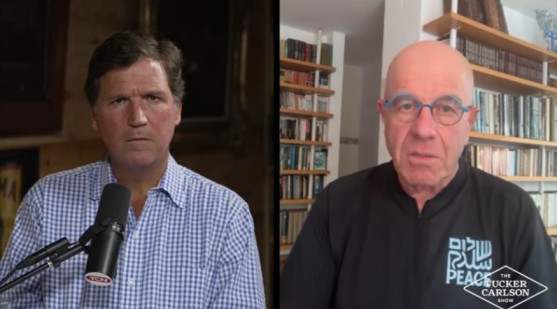
Editor’s Notes: In this candid interview, Tucker Carlson sits down with Avraham Burg, the former interim President of Israel and Speaker of the Knesset, to discuss the deepening moral and political divisions within the country. Burg offers a rare dissenting perspective from within the Israeli establishment, challenging the Netanyahu government’s current military strategies and the notion that all criticism of the state is synonymous with anti-Semitism. The conversation explores Israel’s internal shift from secularism toward religious fundamentalism and the lack of a clear strategic endgame in its ongoing conflicts with Gaza and Iran. This interview provides a profound look at the ideological struggles shaping the future of the Middle East and Israel’s global standing. (Mar 24, 2026)
TRANSCRIPT:
Introduction: Netanyahu, Criticism, and the Antisemitism Argument
TUCKER CARLSON: The government of Benjamin Netanyahu in Israel and its many organized cheerleaders here in the United States have for some time now made the case that all criticism of their government is anti-Semitism. And it is because their government somehow speaks for all Jews globally. Every Jewish person is represented by the Netanyahu government. Therefore, the actions of the Netanyahu government represent every Jew on this planet. And any criticisms of that government are by definition an attack on every Jew. They are anti-Semitism.
It’s a position that doesn’t make any sense, but it’s kind of hardened into a consensus in the United States, at least for right now. And if you think about it for a moment, it’s not only incorrect, it’s a kind of slander against Jews, it is itself a kind of antisemitism. Because, no, not all Jews are represented by Benjamin Netanyahu, and there are many who don’t want to be.
And that’s true even within Israel. Yes, polling consistently shows that most Israelis were in favor of the war. But in Israel, as in all countries, most people don’t really know the details of what is happening or why. And that’s by design. Israel is a particularly censored place. It’s also a particularly small place, fewer than 10 million people. And so its citizens, by and large, live the same way we do, in an information vacuum where what they know is determined by somebody else for political reasons.
All of which makes it very important to do our best to break the spell of this, to hear from people who disagree and hear them explain why — people who have some credibility and knowledge. Not just wackos with weird opinions, but thoughtful people who have a dissenting view.
And one of those people is a man called Avraham Burg. Burg is in his early 70s. He was born in Israel. He’s from a prominent Zionist family, and he himself was a prominent political figure for many years. He was a member of the Knesset. He was speaker of the Knesset, the Israeli parliament, its lawmaking body, its congress. He was even interim president of Israel at one point.
So his opinions may represent the minority of Israeli opinion, but he himself is not a fringe figure. He was at the very center of Israeli politics. Once again, he was the interim president of the country. And in the hours after this current war broke out, he wrote a very strong op-ed in the Israeli press explaining why it was a terrible idea, why it didn’t serve Israel’s interests, and why the people doing it had no idea why they were doing it. It’s a pretty brave thing to say in the middle of a country at war. But he said it because he’s a pretty brave guy. Agree or disagree.
So we thought it would be worthwhile to hear directly from him. Avraham Burg from Israel. Here it is.
Israel’s Lack of Strategy: Tactics Without Direction
TUCKER CARLSON: Avraham Burg, thank you very much for doing this. I want to ask you about something that’s happening right now. Apparently so. The President of the United States issued a statement this morning saying that because of ongoing negotiations between the US and Iran, the US would not actually commence with hitting civilian infrastructure as he’d promised, and that we’re going to try and work something out diplomatically this week. Almost immediately after issuing that statement, there were reports that the Israeli military was hitting civilian infrastructure in Iran. Assuming that’s true, what do you make of that? What strategy does that suggest?
AVRAHAM BURG: The same strategy that Israel has for years. No strategy in Israel. In many, many cases, the compilation of many tactics sometimes assemble into a de facto strategy, but otherwise nothing.
I mean, just look at the last two hours. When was the announcement of the President? The surprising one, two hours ago. And you have a bundle of messages coming from all directions. The first and the most important one, “Hallelujah, they’re going to renew the flights so we can go for Passover vacation.” That’s the immediate reaction of many Israelis, my daughter included. The second is, “Oh, Netanyahu knew altogether.” I mean, Netanyahu is behind the move, as if framing it as his own move. And then, “Oh, Trump, oh, he is so softy, he’s so weak, he doesn’t have any resilience. The Iranians, they trick him,” etc., etc., etc.
Bottom line is nobody has a clue. And in this chaos, the military does what it does the best, simply hammer the nail.
TUCKER CARLSON: But you’re suggesting that those tactics, the ones we’re seeing today and the ones we’ve seen for the last month, don’t add up to a strategy. There’s no strategic goal in mind.
AVRAHAM BURG: I listened to you very carefully in the last couple of weeks and the way you try to conceive the Israeli strategy — from Netanyahu’s 40 years life mission to the greater land of Israel, biblically speaking, or messianic, eschatological one — and I envy you that you really believe that we have something like that.
It doesn’t work that way.
And there is a difference here. I have no idea what’s the American strategy. I do not know what was the end game. I have no idea what is the final design the architects of the White House or Washington really had in mind.
I can tell you one thing for sure. Israel wants to remove the Iranian monster because part of it is a real threat and part of it because we pumped it to the size of a monster. So we are fighting in a way a real demon and a demon which is our own creation. So what we want to do is — we don’t like the war, we want it to end. We don’t like the missiles, we hate the sirens, we skip nights after nights of sleeping. But once we are into it, let’s make sure that it’s over. So the real will of many Israelis is, “Let’s get over with the Iranians.”
The Question of Size, Power, and Israeli Self-Perception
TUCKER CARLSON: The problem is the relative size. Israel is a small country, Iran is a large country. How exactly do Israelis expect that’s going to happen?
AVRAHAM BURG: Size-wise and number-wise, we are, let’s say, 10 million in a good day and they are 100 million in an average day. In a way, many Israelis do not really measure it this way. Many Israelis believe that we are a kind of a superpower.
A couple of weeks ago I was in a high school somewhere and I promoted my good old, no-goodnik peace agenda. And one of the students stood up and said, “Avraham, can I ask you a question?” I said, “Yes, please do.” And he said, “Why won’t we do to them what we did to them in Afghanistan?” And I said, “I know Gaza, I know Lebanon, I know Syria, I know Egypt. What did we do to whom in Afghanistan? I mean, we haven’t been there yet.”
And I asked him, “Where are you from originally?” And he said, “I was born in Moscow.” And I said to myself, “Haha, he thinks like a Russian.”
And I asked him, “Tell me, how many Jews are there in the world now, Tucker?” With no hesitation he said, “Ah, 54.3 million.” And how many Israelis are we? He said something like 20 million.
In the eyes of many Israelis, we’re not just a superpower technologically and a superpower economically in a regional hegemon. Politically we have the numbers — the numbers in economy, the numbers in support, the numbers in demography — without really calculating what the real numbers are. So when you ask the Israelis, “How do you simply do it?”
What Does Victory Look Like for Israel?
TUCKER CARLSON: And what will the end victory look like from an Israeli perspective? How will Israelis know they’ve won?
AVRAHAM BURG: I don’t have a good answer for this question. In many cases the American or the Western way of thinking is usually a kind of a win-win. I mean, we end the war and we make sure that we left at the other side somebody to talk with. I mean, yes, it is ridiculous that an American president is saying, “I would like to talk with somebody, but there is nobody there because I killed him.” This is your own oxymoron. This is a paradox that I take it you intellectually, you know how to square this circle.
But from the Israeli point of view, in many, many cases, philosophically no, psychologically, we do not live in a win-win situation. We live in a zero-sum game. If there is a competition, if there is a race, if there is a war, if there is a battle, if there is a conflict that ends up that Tucker and Avraham both profit, something is wrong with me. I want to win alone. I want you to be dead. I want to humiliate you, I want to cancel you — whomever you are, my enemy.
And when you look at this philosophy, you understand where comes the political rhetoric that every adversary, never mind who he is, minor or major, by the end of the day he is a Hitler. And every decade we have a new Adolf Hitler. And since everybody is the arch enemy, there is only one solution to this one enemy — removal.
And therefore, when you ask me what is the Israeli political echelon — forget about the people in the street — the political echelon approach toward any kind of resolution, whatever it is, it’s not a dialogist one. Now, it is not just about Netanyahu, which is a case by himself. When you look at what is allegedly called opposition in Israel, they simply compete with the government — who is more aggressive, who is more, as if, resilient, who has more so-called creative solution to the enemy we have to demolish and obliterate. And this is why you hardly find in Israel any reconciliatory politics.
Where Does This Zero-Sum Mentality Come From?
TUCKER CARLSON: Where does this attitude come from?
AVRAHAM BURG: When I was in school, in high school — I was in a religious high school, in a religious academy, a yeshiva — every other week the rabbi used to call my mom. My father was busy, so he used to call my mom and said, “You have a very, very talented boy child. He’s like an egg. The more I boil him, the harder he becomes.”
Now, in a way, our life experience as Jews in the last couple of thousands of years and Israelis in the last couple of decades boiled us into a very, very hard, stiff-necked egg. On one hand we never trusted hands offered to us and on the other hand we never experienced extending our own hands.
I’ll give you two examples. The rhetoric of Israel since 1948 is a rhetoric of survival, of existential threats, of permanent imminent war. Out of nowhere came President Sadat to Israel. I remember myself as a young soldier at the 1973 war at the other side of the Suez Canal, in a foxhole in the desert in the middle of the night, like a frightened 18-year-old boy. And I was listening to the then-iPhone — the transistor. Do you remember the transistor with the rusty voice?
TUCKER CARLSON: Oh yeah.
AVRAHAM BURG: And I heard President Sadat in the middle of the night say, “I’m ready to sacrifice a million and a half Egyptian soldiers in order to redeem the Sinai Peninsula.” And I said, “Holy, holy God. A million and a half Egyptian soldiers against me, Avraham Burg, a Jewish boy from Jerusalem.” I was frightened to death.
And then four years later he came to Jerusalem and I’m running — I’m a released paratrooper officer, a young one — running after his convoy and chanting, “No more war, no more bloodshed.” It was redemption, it was eschatological, it was messianic. It was the first time Israel was offered a different syntax, from a syntax of war to a grammar of peace.
We never grew up into the challenge of Sadat’s, never. We never walked all the way with the Egyptians, with the Palestinians, as was part of the original Camp David framework. And we rejected it. Even when a couple of years later, Oslo — deus ex machina — out of nowhere, Oslo came to the world. As problematic as we now know, de facto, that Oslo was, at the time when it was launched, it was an eruption of hope. It was again an offer for a different language. We didn’t grow into it.
So Israel does not have a vocabulary or state of mind to talk peace now. There is a different layer that I’m not at all sure we are — it’s too early in the conversation between us. But this is the transformation from eternal Judaism that was a religion of powerlessness. And if I would like to use Václav Havel’s terminology, we had the power of powerlessness, and we transformed into Israelis with the power of the Almighty. And we feel much more threatened.
The Paradox of Israeli Power and Threat
TUCKER CARLSON: Well, there’s a paradox. So as Israel has become more objectively powerful, it has felt more threatened, more endangered.
AVRAHAM BURG: Yep, yep, yep.
TUCKER CARLSON: It does seem like, if you were to, just as an outsider, it does seem like Israel is more threatened. And it does seem like if it had continued on the trajectory from the Sadat talks or from Oslo in the way that you suggest, it would be less threatened. I think objectively that’s probably true.
AVRAHAM BURG: Or maybe both. Maybe at the same time. We have opportunities and the threats are better threats, so to say.
Let’s look at numbers just for a second. When I was a student, I’m in an elementary school, a pupil, we were told that in 1948, the year in which the state of Israel was born, seven Arab armies invaded the just born state of Israel. So 1948 it was seven versus one. In 1967, 19 years later, it was only three out of the seven — Jordan, Egypt and Syria. Six years later, in 1973, it was only two out of the three, only Syria and Egypt.
Ever since, as broken as it is and as chilly as it is with Egypt, we have a peace agreement and Syria, in a very good day, is a dysfunctioning threat. And the Palestinian issue that was not there in 1948, the way it is today, was born along the road.
So you can say, listen, in eight decades — 1948 to 2026 — from seven armies to half a problem, which is the Palestinian one, this is an evolution, this is a positive progress. And in a way it is. And this is before we count in the potential of Saudi Arabia, the potential of the Emirates, etc.
On the other hand, two elements emerged as well. The first is Israel, that at least in two or three stages in its life, was fully accepted among the family of nations — 1948 and its euphoria, 1967 and the eruption of redemptive feelings all over the world maybe. And the atrocities of 10-7-23, three times that Israel in conflict time. This is beside Camp David, beside Oslo, beside other positive peace agreements. But in a conflict situation, Israel was well received and well accepted in the world.
And then we must ask ourselves, how was it wasted? How comes that two years ago, three years ago — in 2023 — Israel was so well sympathized with all over the world and now so despised? So the threat of being rejected, of being a world pariah, maybe it’s not a military one, but it’s a deeper one, it’s an existential one.
And the other is assuming that the Iranians would have had a nuclear capability that very soon would lead to a chain of reactions — that others will have nuclear weapons in the Middle East. Without using the weapons, but a Middle East with mass destruction weapons is a different scale of a threat for many, but for Israel especially.
So I will say yes, we have better relationship with many and the situation is not 1948, is not 1967, is not even 2023. But the threats are not gone. They were transformed and different and require different strategy and philosophy and value system.
How the War Against Iran Started
TUCKER CARLSON: How did this war start? This month-old war against Iran. There’s debate in the United States about how it started. Whether or not the United States was pursuing its own interest, defending itself from Iran, or whether President Trump followed the lead of Prime Minister Netanyahu. What’s your view?
AVRAHAM BURG: If we go back to your initial introduction or your immediate question you bombarded me with — without any introduction. You said, “We have no clue what’s going on.” So we do not know. We don’t yet have information, neither about the launching of the campaign nor about the continuation of it.
So in a world with no information, in a realm of no information between me and you, we can look at the gestalt, we can look at the frameworks of what happened — the details, Tetris-like, will fall in.
And I will say the immediate trigger was an awful one. We had an opportunity. Since when you declare a war because there is an opportunity? I mean, that’s the worst opportunistic reason I’ve ever heard in my life. My father was a very wise man. He used to say about one of his colleagues, “That’s a man of principles — principle number one, opportunism.” And I say, what kind of a principle is this one, to declare such a world war in a volatile reality where China is out there waiting for something and Russian-Ukraine is ambushing us, and now you have to have another front? So the immediate trigger — that we had an opportunity — I will say whatever was the opportunity, using it was an unjust, immoral trigger.
The larger frame is Netanyahu’s life mission. I take it that it requires more than one Tucker Carlson and more than two hours between you and me, or five hours, or as long as we can tolerate each other, in order to understand this figure. He’s a very, very interesting individual and a very, very significant leader of a state in this time. Significant — I hope it’s natural enough, because I don’t have much of sympathy to his leadership. However, he’s there, he’s significant.
Where his life mission is coming from — I will say that it has two drivers. One is very Jewish and one is very conservative. The very Jewish is, in a way, like my mom. My mom believed that the world is divided 50-50. 50% Jews and 50% who hate the Jews. Which means she believes we are something like 3.5 billion people — we, the Jews — and the rest of you, whomever you are, do not like us.
So this notion that the entire world is against us and you cannot trust nobody but ourselves is embedded in the Jewish conscience ever since — maybe even since the Bible, since biblical time — but for sure later on, and the exilic period instilled it into our psyche. So we do not trust, and therefore we are not being trusted in a way. There is a dialogue of not trusting here. So Netanyahu is part of this classic Jewish paranoia — the entire world is against us.
At the same time, he is a very kind of 1970s, 1980s, 1990s conservative and your hobby neocon. To say we are the children of light and they are all the offspring of darkness, and our life mission is to push them back, our life mission is to fight them, is never compromise, never realize if there is somebody out there that we can communicate with — maybe they are not a monolithic group of people, maybe like us, that divided, that dissected. There is the diversion. There is a richness of expressions in ideologies and values and religious manifestation. No, no, no, no. They are all, all of them.
And when you listen to Netanyahu — Huntington through Netanyahu — he is the leader of our civilization of light versus whomever is the civilization of darkness. So his built-in classic Jewish paranoia that many Jews have, some of it rightly so, some of it molded into it. And part of it is part of a worldview that you know better than I do because you explore it almost a couple of times a week. And this is the mistrusting Christian West who does not trust anybody but itself. And when you look at some of their attitude towards Europe, it does not even trust itself.
So where this war started — it started with an opportunity in a frame of mind.
Netanyahu and Trump: Fear, Chemistry, and Leverage
TUCKER CARLSON: How do you think Prime Minister Netanyahu sees President Trump?
AVRAHAM BURG: He’s afraid of him because he’s unexpected. I don’t know if the term “whimsical” is the right one, but he’s unexpected. I believe the more I monitor the actions of the President that there is a kind of a worldview behind it. Not always articulated clearly, but de facto I can realize some things there.
So first, Netanyahu is fearful of the unexpected. The second, Netanyahu is so talented that he took the disadvantage and made it his prime advantage — how to puppeteer the President. So I will say he has a dual feeling, a fear and a know-how of how to use this fear for his advantage.
Now look at the pattern. How many American presidents saw Israeli prime ministers as their elder brothers — like Clinton and Rabin, George W. Bush and Ehud Olmert, maybe not elder brother but an experienced one, Golda Meir and Nixon. So there is a kind of older-younger brother relationship between Israeli prime ministers and American presidents that Netanyahu, with his vast experience and malicious intentions, knows how to use also this leverage point in order to promote his agenda with this American president.
TUCKER CARLSON: How do you think he did it? What were the leverage points?
AVRAHAM BURG: I heard you with this — how you call him — the Prophet, the Canadian prophet, this weekend.
TUCKER CARLSON: Yes.
AVRAHAM BURG: Okay.
TUCKER CARLSON: It’s interesting.
AVRAHAM BURG: I’ll tell you something very funny in a second, if I may. He came with four theories, how it happened. I’ll tell you something very, very simple. It’s a chemistry between two charmers. Listen, Tucker, I cannot stand you, but you’re a nice person, so I talk with you. I mean, you know —
TUCKER CARLSON: I’ll take that as a half compliment. Yes, of course.
AVRAHAM BURG: No, I mean, it’s a one and a half. And you know my position. And despite, or in spite of, my positions, we’re talking. So there is something there at the very personal chemistry that simply worked.
And Netanyahu is a brilliant campaigner. Listen, when you walk out of the room with Netanyahu, check your sleeves, whether you have your hands into them still. Maybe he stole your hands out of your sleeves. This is how talented he is. He picked his pocket and so did Trump to him. They use each other.
TUCKER CARLSON: I don’t understand. I mean, I understand half of that explanation, but I don’t understand what President Trump or the United States could conceivably gain from this. It seems like 100% loss to me.
AVRAHAM BURG: It’s more a question to you as an American than a question to me, as a far-away subject of the American empire or the American influence zone.
Is the prophet, for example, a place in history? As much as many authoritarian leaders, since they do not trust their people to commemorate them after they pass away, so they commemorate themselves while still alive — make sure that there are libraries on them and cultural centers and bridges and airports, and you name it.
Still, history plays a role. And when you think of Trump coming from Manhattan with so many Jewish associations around him, he’s familiar to the Jewish talk of New York. He is familiar to the rhetorics of Jews and their association and affiliation with Israel. He understands that many of them see Israel under a permanent threat of extinction.
Saving Israel — before the base, before the Christian Zionists — saving Israel is, historically speaking, almost prophetic. Listen to his rhetorics: “After Gaza, I put an end to 3,000 years of a conflict.” I don’t know when the counting began, and still counting. Nonetheless, it’s a state of mind. It’s politics and history mixed. And Netanyahu, as a child, as a son of an historian, understands how to play this card.
TUCKER CARLSON: So you believe it’s likely Netanyahu said to Trump, “You will be recorded by history as the man who saved the Jews.”
AVRAHAM BURG: This is on the positive side. And on the negative side is, “You do not want to be recorded as the one that under his God and in his shift, something so awful like the second Holocaust happened to the Jews.” There are two sides to this moon — the dark one and the one a bit more illuminated. Publicly, you speak about the leaden side of the moon. In dark rooms you speak about the dark side. “We are under permanent threat. Save us.”
How Gaza Is Seen Within Israel
TUCKER CARLSON: You said a minute ago that what the Israeli government has done in Gaza has permanently, or at least for the moment, made Israel into a pariah state internationally. How is Gaza seen within Israel?
AVRAHAM BURG: In order to touch such a volatile issue, I need a very brief introduction to offer you my own framing of this last couple of years.
Whatever Israel did to the Palestinians since day one, 100 years ago — all the wrongdoings, the transfer, the expel, the demolition of 400 to 500 communities, the Nakba, the tragedy, the catastrophe of the Palestinians — whatever we’ve done to them, all wrongdoings, does not justify the first step and the first step towards atrocities committed by Hamas on October 7th.
The Moral Abyss: Gaza, Identity, and Israel’s Isolation
TUCKER CARLSON: I agree.
AVRAHAM BURG: None.
TUCKER CARLSON: Right.
AVRAHAM BURG: And whatever Hamas did on October 7th to the Israelis, brutal, awful crimes against humanity in the bodies of my friends and my colleagues and my fellow citizens, whatever Hamas did to us does not justify the moral crimes and maybe even crimes against humanity that Israel exercises in Gaza ever since. You have two crime scenes. Do not nihilate each other, do not balance each other, do not justify each other. You have to deal with Hamas crimes and with the Israeli crimes simultaneously. As difficult as it is, and sometimes as paradoxically as it is now, this is how I see it.
Most of Israelis are not in my place. Most of Israelis, regardless of October 7th, I mean, even much before October 7th, do not really know where Gaza is. Yes, it might be five minutes away from a doorstep, might be 40 minutes drive from Tel Aviv, but it’s beyond the mountains of darkness. I don’t know. I don’t know where it is. I haven’t been there ever.
When you look at the Israeli media up until October 7th, and ten times more after October 7th, you never see Gazan people. You see tunnels, you see cement, you see rockets, you see demolitions, you see Hamas troops running here and there. You never see the individual Gazan people, as if there are no people there. And the report is never about the humanitarian side of it. The report is always about insurgencies, terrorists, etc.
Gaza, as awfully expressed by my President Herzog, who said, “In Gaza there are no innocent people.” God forbid to live in such a situation that you do not believe there are innocent people. The other side, even Abraham the patriarch, believed that in Sodom and Gomorrah there are innocent people and God negotiated with him. But we are better than God and we are worse than Abraham. We simply write off any innocence in Gaza, and ever since it did not improve. So in a way, Gaza, it’s not a blind spot. Blind spot is too technical. Gaza is the moral abyss in which Israel collapsed into.
International Perception vs. Israeli Reality
TUCKER CARLSON: I find it so striking what you just said, because Israel is such an international country. I mean, I don’t know what percentage of the population was born somewhere else. And people are always in and out of Israel. I mean, it’s hardly — it’s not Central Africa, it’s right in the Mediterranean. It’s very international, as I said. So it’s interesting that many Israelis don’t have a sense of what’s happening just right at their southern border. What do they think when they read about it? There’s so much international controversy about it. When you pull up the Internet, someone’s getting mad about Gaza. How do Israelis respond to that?
AVRAHAM BURG: You put here two topics. The first is media report.
TUCKER CARLSON: Yes.
AVRAHAM BURG: And the second one is where is the existential reality of Israelis? Who are we? When she asked you, the Economist editor, the right to exist, and you exploded — “What is that? Right to exist?” And I said to myself, Tucker, don’t get mad at her. The question is a different one. The right to exist from the point of view of being Jewish, not so much being part of the international community. Is Israel justified according to the norms it tells itself — “the only democracy in the Middle East, the most moral army in the world,” et cetera, et cetera. There it implodes.
Now let me try to answer your question, first about the international reports. Most of us listen to Hebrew media only and read Hebrew media only. And the Hebrew media filters most of the non-Hebrew expressions. We do not speak English. I mean, even listen to me with my Arnold Schwarzenegger accent. We don’t speak English. We don’t speak German. And if we read something about it, “they’re all anti-Semites.” The weaponizing of antisemitism into a kind of thick filter that enables us to reject any kind of legitimate criticism is part of the system here. So, media wise, we hardly hear the international situation. Hardly hear it.
The question of what does that mean to us — I would say as follows. Up until the Second World War, 90% of the Jews in the world were Christian-born Jews, what we call Ashkenazi, and 10% were born in the Muslim sphere, what we call Sephardim. So it was 90% Christian world Jews and 10% Muslim world Jews. Today in Israel it is 50-50, which means the old perception that Israel is an offspring of the West, of Christendom, demographically doesn’t work, because at least half of the Jewish Israelis — not to talk about the 20% of Palestinians with Israeli identity, but from the 80% Jews — 50% were born or are offspring of Muslim world Jewry, which do not share the same legacy and the same heritage and the same tradition that Jews shared with you, which is the evolution of the West.
I’ll take it a step further. Yes, many of us were born in so many other places, our parents or grandparents, but most of us were born here. And here is a very strange place. On one hand we’re not Europe anymore, because we got disconnected. And on the other hand we never got connected to the region. So we are a kind of standalone island, totally disconnected from the region, refusing to get connected. When normalization was offered to us only two, three years ago, it was a threat. We never dwelled into the strategy — what should be our relationship with the region.
So much so that in a way we resemble a lot the Kingdom of Jerusalem of the Crusades. Foreigners coming from the outside, circling ourselves with a kind of self-siege, wars, and never integrating. It is not right because there were interactions between the regional Muslims at the time and the Christians at the time. But nonetheless, the Kingdom as a political entity never wanted to be part of the region. After 200 years it expired.
The State of Israel, born out of the ashes of the Holocaust for sure, but earlier on was born out of the nation-state idea of secular Europe, with its solutions to its national groupings, came to the Middle East, which is not part of the nation-state thinking, didn’t go through the processes of secularization and revolutions — the Industrial Revolution, the French Revolution, the American Revolution, the British Revolution — never went through them in order to get where we are today, and therefore didn’t find any hooks to get connected. So we lost our western hinterland and we never ceded enough in order to grow to be part of the local fauna. So we are isolated.
How Israelis View America
TUCKER CARLSON: I think many — I don’t know what they think now, but for most of my life in the U.S., many Americans regarded Israel as a kind of European-ish country. That was always my opinion. Some of them felt that Israel was almost part of the United States. Not in a sinister way, but “we’ve got so much in common.” 51st state. Golda Meir, I think, was from Milwaukee, Wisconsin.
AVRAHAM BURG: She grew up in Milwaukee.
TUCKER CARLSON: Milwaukee, right, okay.
AVRAHAM BURG: As they used to say at the time, “the woman who made Milwaukee famous.”
TUCKER CARLSON: Smoked Chesterfield cigarettes, American cigarettes. I mean, it felt very American. What is the view, would you say, of most Israelis now toward the United States?
AVRAHAM BURG: We love it, we admire it, we want to move there. And we think you are so childish and naive.
TUCKER CARLSON: Why?
AVRAHAM BURG: Because this is what you are.
TUCKER CARLSON: I mean, I’m not sure I would disagree with you at all. But what about America strikes Israelis as childish and naive?
AVRAHAM BURG: Let’s begin with a smile because it’s heavy stuff. You know why we Israelis do not make love in the street? Because then everybody will come and give you advisors. Everybody is a prime minister. Everybody’s a diplomat, everybody’s a strategist. Everybody is Tucker Carlson. Everybody is everything. Everybody is Napoleon. We know better.
And when we think about — first, begin with the West in general. “How don’t you understand that immigration brings you down, that you compromise your own very existence? How don’t you understand that the Muslim tidal wave of immigration is going to compromise your very entity?” Leave aside, I don’t think that many Israelis understand the exchange theology. I’m not at all sure that they understand exchange theory. But speaking generally, you ask Israelis how many Muslims they think there are in Europe — something between 30 to 50%, which is far away from the actual number.
So what do you think about America? “What do you think in America? Oh, wow, wow, wow. What do you know? Michigan, in the last elections, just show us how big is the Muslim minority. Obama, Hussein Obama.” So you don’t understand your own reality, so to say. This is the kind of experience — everybody gives advice about Israeli reality on a daily basis.
The second is it’s very, very difficult for us to understand the fairness of the game. If you ask me, what does it mean to be an American? I can give you five different answers. One of them is, since you have a constitution and everybody is equal in front of the constitution, or supposed to be equal in front of the constitution, there is a fairness in the game. “You cannot trick me. You cannot look down at me. You cannot abuse me. I cannot abuse you.”
On the other hand, we don’t understand it. We Israelis live in a reality where a constitution is a threat. Equality to all citizens — not just Jews and Arabs, but for the sake of it, orthodox and unorthodox — is a threat to the very existence of the state. So on one hand, as if we have shared value foundations. But when you try to translate these values into practical reality here, the gap grows.
We cannot accept the American wall of separation between church and state. Impossible for us. As much as the definition of “Jewish and democratic” is hollow in a good day and deceiving in an average day — it’s a flawed definition, but we believe it’s possible — and we cannot accept that you are not “Christian and democratic.” You’re democratic first. “Ah, only democracy. Too weak. Not for us.”
And then I’ll take it maybe to the last stage. We hardly care, unfortunately, and it pains me, about American Jewry. When Netanyahu said a couple of years ago, “They are Democrats, they don’t support my position anyway. Let’s go with the Christian Zionists. That’s our political backbone. They’re the best friends we have.” And giving up on American Jewry — beside many other things, that we don’t respect them when it comes to the law of return, when it comes to accepting the Reform and Conservative movement’s religious expression, which is totally rejected by the religious establishment in Israel, et cetera, et cetera.
When we look at America, we see two things and we don’t accept both. On one hand, we see as if this is the total definer, the absolute definer of the democratic movement — the wokes. “All Democrats are wokes.” And on the other hand, “all the right wingers are hating Jews like Tucker Carlson.” That’s it. So in between, what’s in it for us? Silicon Valley, technology, economy, profit. But not the values. Not anymore.
A Religious War in the Making
TUCKER CARLSON: Is this a religious war from the Israeli perspective, or from the orthodox Israeli perspective?
AVRAHAM BURG: This one with Iran now — never defined this way officially. I would say it’s the second. Me personally, who observes the situation and tries to intellectualize it in order to comprehend, I will say it’s the second stage of a religious war. In what sense? Up until October 7th, the conflict between us and Palestinians — which is bloody and malicious and awful, especially awful because it could have been resolved so many times before — was a political conflict between two national communities. Political conflicts and national conflicts, as difficult as they are, we know what to do with that.
October 7th was the first round of the full-scale religious war. Jewish fundamentalism at the Israeli government and Muslim fundamentalism at the Hamas government. The philosophy of Hamas and the ideology of the Israeli government and some of its leading ministers was out in the open, with rabbis and chaplains in the army and ministers and members of Knesset expressing it loud and clear. So October 7th was the first chapter of the deterioration of the political conflict into a religious one.
This one with Iran, which is three years later — which historically speaking is maybe the same period, it is so fast. I mean, what is three years in human history? It’s nothing. It’s not even a comma.
TUCKER CARLSON: Yes.
AVRAHAM BURG: Yet when you live it day in and day out, it’s difficult, it’s heavy, it’s sirens, it’s kids not sleeping, it’s sleepless nights and fear. But it’s a different one. The war with Iran now, from my point of view, is the first religious fundamentalist world war — Jewish fundamentalism, Christian fundamentalism, and Muslim fundamentalism at the battlefield.
TUCKER CARLSON: It feels that way to me, fortunately — I’m sorry, it feels that way to me watching this. That’s exactly what it feels like.
The Temple Mount, Greater Israel, and the Future of Israeli Democracy
AVRAHAM BURG: And the problem of you and me, as much as I take it on few many other things, we are other sides of the, of the other side of the street on something like that, which is such an existential problem to our ideologies and our identities and our values. Never mind where are you in the other disagreements between us? We are watching. We are just watching. We didn’t yet come forward and offered an alternative, a comprehensive, attractive, spiritual and political, ideological and maybe even eschatological alternative that fights them. I ask myself with shame. I cannot tell you how much we didn’t yet open the chapter of what Jewish settlers are doing in the occupied territories.
In the West Bank, daily crimes against innocent Palestinians conducted by wild savage settlers, ignored by the army and by police and supported by members of Knesset and members of the cabinet. Daily. I’m full of shame. But the utmost one is where the heck are the rabbis? Where are the spiritual leaders? Maybe they’re not coming because they are the inciters, because they are beyond behind it, because they support it, because they promote it, because it promotes their messianic ends of the day eschatological philosophy. And this is, as I said earlier, where classical Judaism implodes into, into Israeli ness.
TUCKER CARLSON: How important is the rebuilding of the temple to the people you’re describing, to the cabinet ministers, to the rabbis who are not speaking up against what’s happening in the occupied territories. Is there actually an effort to do that, do you believe?
AVRAHAM BURG: For the people in the streets? Not the rabbis, not the people engaged, not those you ask question about — to the masses? It’s a non issue. I figured that it is as if a kind of — I mean, yeah, Disney World in Orlando. Okay. Yeah. I mean, do there. Whatever you like. I mean, just. Just give us a break. Okay? So for the masses, they are not there.
On the other hand, since ’67, at least five — I’m not at all sure that not more — at least five attempts to remove the mosques from the Temple Mount were done by these groupings since ’67. Which means that when you come to address this question, it is not so much about the numbers who support the removal of the temples and the removal of the mosques and the rebuilt of the temples. It is about the dedication and the readiness and the fanaticism of those who are ready to act.
TUCKER CARLSON: Let me just say I’m embarrassed. I did not know there had been five attempts to get rid of the Dome of the Rock and Al Aqsa. So these were plots to blow them up. Is that what happened?
AVRAHAM BURG: Yep. Yep, huh? Yep.
TUCKER CARLSON: What happened to the perpetrators, to the plotters?
AVRAHAM BURG: The most famous one is the ’80s, what is called the Jewish underground. A group of settlers from the same educational system that I grew up, that I was brought up on. Some of them are friends and friends of families and people from the same school I went, et cetera. I mean, pretty like me. People who were caught, sentenced, sent to jail and got a political deal a couple of months or two years later. And few of them, if not many of them, became prominent, prominent Israeli figures. One of the most important newspaper editor in Israel, Makorishon, advises to ministers, members of Knesset, you name it, well received back into society, not excommunicated and not excluded, not secluded, not excluded.
So much so that today sits in jail for life Igal Amir, who assassinated the Prime Minister. And there are constant voices even within the Knesset, even within the government and the Netanyahu’s coalition calling for his release. So as for your question, what is the support? The support in the public is very small. The dedication of the few is very intensive.
The Consequences of Destroying Al Aqsa
TUCKER CARLSON: What would happen if the Al Aqsa complex were destroyed?
AVRAHAM BURG: I don’t know, Tucker. Let’s move on.
TUCKER CARLSON: That’s how I feel, but I don’t live there. You do. So you see that as a profound change in world history. If that were to happen,
AVRAHAM BURG: I’m not at all sure that we are not already into this profound change. Yes, like this war with Iran combined with October 7, combined with other things. We’re in the middle of a transformation of world order — to what next order or this order? Neither you nor me know. And maybe we don’t share the same vision of what should it be. But we’re in the middle of a transformation here.
Now, this issue of the temple, the issue of the mosques, will be, morally speaking, a coin with two sides. On the Israeli side, if and when this will happen, God forbid, that will be the end of justification of the existence of the State of Israel. And if this, God forbid, will happen, I’m afraid it will trigger the masses all over the Muslim world — that this might topple down few regimes and bring to power different powers and different regimes — that the entire world order the way we knew it, will not be recognized by us anymore. Yes, it is much more volatile and explosive than a nuke. Yes.
TUCKER CARLSON: That is certainly my read on it. I don’t think you’re overstating it. Of course, no one can predict the future, but that seems very likely. Do you think — my other sense, again, I’ll allow you to have the more definitive word on it — but is that if there was ever a time it could happen, it’s right now, in the middle of this war.
AVRAHAM BURG: The only thing I will say is that I hope that the attention of the Prime Minister is given to that also.
TUCKER CARLSON: Yes.
AVRAHAM BURG: That’s the only hope I have. I trust him. My trust is very minimal. And this is in a very good day. I hope that he understands if something like that happens in his shift, it’s bigger than him. Yes, and I hope he pays attention to it.
TUCKER CARLSON: I feel the same way about him, but I agree with you. I don’t see why he would want this.
Netanyahu, the Military, and Israel’s Shifting Values
AVRAHAM BURG: Here we go to something else. Netanyahu is a well read person. He’s not an Alphabet. He reads books, he understands, he knows, he has a vision. You can agree with him, you can disagree with him, but at least he’s an interesting partner. He knows what he’s talking about. Okay.
What happens to him in the last couple of years is that he does not behave politically according to his wisdom. He behaves according to his political survival instinct rather than according to his ideology and philosophy. So between political survival or conservative, right wing, decent right wing conservativism — if he was the right wing conservative, I would say I will oppose you, but I respect you. The minute it’s the personal survival instinct only, I don’t accept it and I don’t respect it and I suspect it. And the fact that in his cabinet there are so many influential ministers who promote this agenda and create daily provocation around the mosques troubles me.
I take you a step further. How many times did you in your analysis say, listen, there are so many fanatics in politics, etc. etc. But the Israeli army is a moderate one. They’re usually the sound of reason. Okay, this is the perception we have. But pay attention. Most of the generals and the high up officers of today are people who were brought up, educated, shaped and molded at the previous times of Israel — under Rabin, under Peres, under Menachem Begin, even under Ariel Sharon — in a much more responsible country.
The people who climb up now the ladder, the military ladder, are different kind of people who were brought up under the chaotic, problematic value system of Netanyahu, in the settlements, educated with this kind of messianic mission to use the army as a tool to accelerate redemption. And a day will come that you will see a chief of staff with this kind of agenda. You already have the head of the Shin Bet of our secret service coming from these circles. So to trust the Israeli army to be the moderator for good might be a mistake. Pay attention.
TUCKER CARLSON: Things have changed so fast there. I mean, from an outsider’s perspective, it’s just a very different country from what it was even 15 years ago. That’s how it feels to me.
AVRAHAM BURG: It is. Right. And in order to understand the shift, I will say as follows. When was your first time here in the region?
TUCKER CARLSON: 25 years ago.
AVRAHAM BURG: Make me the 2000.
TUCKER CARLSON: Yeah, exactly.
AVRAHAM BURG: Okay, 2000 was the end of the tale of secular Israel. Israel of ’48 was, as Bernie Sanders called it, socialist — but let’s call it European, wise, social and democratic. A very young democracy, but with a prospect to move on for a better, more developed democracy and very secular. Israel of today is democracy in deficit in a good day, harsh, capitalist to the level of libertarian, anarchy almost sometimes, and very religious. So Israel of 2026 is not Israel of ’48, not Israel of ’67, and not Israel of 2000s. Different society, different leadership, different rhetorics, different ethos and pathos.
And the real struggle today between the political forces — yes, it’s very personal. My personality, your personality, my leader, your leader. Okay, that’s granted. We have it in every political system. Imagine politics with no ego. So boring. Okay, God forbid. So thank God we have some ego left. But the undercurrent is the warming cold war between religion and politics, between the Jewish and the democratic. That’s the real deep struggle. Will Israel by the end of the road will be Jewish, religious — that their religion is defined by this kind of people — or will it be back a kind of a liberal democracy? And let’s not argue now what is the definition of this liberal democracy, but much more secular in thinking and therefore speaks with the language of reason. And this is the real political struggle in Israel today. I’m hopeful, by the way, as difficult as it is, the pendulum will come back. But we have to understand what the fight is all about.
Greater Israel and the Future of the Settlements
TUCKER CARLSON: Do you think, given Israel’s moves since this war in the last month — both in West Bank and in Lebanon — do you think that Israel will have different borders by the end of it, will control more territory by the end of this?
AVRAHAM BURG: As much as there are enough people who buy into your suspicion that we want Israel from the Euphrates to the Nile — this is actually your question, right?
TUCKER CARLSON: How real is the Greater Israel Project? It’s just hard to know. It looks real, but I don’t know.
AVRAHAM BURG: No, I just wanted to show you that I listened to you, you see. Okay. This was just —
TUCKER CARLSON: I’m just quoting the Torah. That’s it.
AVRAHAM BURG: Yeah. Okay. So as much as there are these elements — which are the same elements that were behind the killing of Yitzhak Habib and the underground to remove the mosques and those who harass the Palestinians now, et cetera, et cetera, et cetera — I do not believe that in any future that both of us will be part of it, Israel will have any legal and legitimate borders, but the ’48, ’49, ’67 borders. There will be so many attempts, there will be so many provocations, there will be so many manipulations by all of these people. It will never work. So much so that I also wholeheartedly believe that some were, by the end of the process, most of the settlements and the settlers from the West Bank will be removed as well. Yeah.
TUCKER CARLSON: That’s not the trend that we see from this vantage. Why would you predict that?
AVRAHAM BURG: Most of Israelis want to have good life. As much as Netanyahu came with his prophetic vision of super Sparta, we still prefer Athens. Okay. I mean, because of this, because of the souvlaki, because of the halloumi, because of whatever —
TUCKER CARLSON: Everyone prefers Athens to Sparta. Of course.
AVRAHAM BURG: You see? So as much as the democracy in Athens was a little bit — how shall we put it? Not updated.
TUCKER CARLSON: Yes.
AVRAHAM BURG: Okay. The original version was a little bit limited, but yet the vision of Athens as the place of aesthetics and philosophy and wisdom and reason and democracy, the seeds of Western democracy — most Israelis would like to have good life. We want to live. We want our children to live.
Tucker, I cannot tell you how much I cried when my kids went to the army. I was standing there when the bus took them, and I remembered my mom telling me, “Kido, when you grow up, there will be peace and you will not have to serve in the army.” And I did have to serve in the army. And then I said the same thing to my kids. And between my wife and myself and my kids, we have more than 30 years of service in the family now. We have grandchildren. And one day soon they will have to serve because we are citizens of the place, we are partners to their responsibility.
And I know that the day in which my grandchildren generation will stand up and say, “We are ready to defend the legitimate Israel, but we’re not ready to sacrifice our life or to sacrifice the life of others on the altar of this craziness.” This day is close. That’s very reassuring.
The Future of a Nuclear-Free Middle East
TUCKER CARLSON: I’m sorry, that’s a very reassuring thing to hear.
AVRAHAM BURG: I give you a moment that you were there with me in that moment when October 7th erupted like a volcano, covered the entire city of Naples, so to say the Israeli Naples. We were all under the dust. What was the first thing that came back to the table? Two state solution. As much as Trump said, “I made it. I mean, I solved it.” And Netanyahu, like Houdini, made it disappear. It came back to the table and it is still there. And you cannot ignore it and you should not ignore it. And therefore, the pressure from within and from the outside and the reality and the options, a hope will be offered to all of us after this round with Iran will be over. There will be new options, some of them awful, some of them promising. Eventually Israelis will say, we are ready to serve the needed, but not the fantasies.
The Nuclear Question
TUCKER CARLSON: Are you concerned that Israel, if this continues at the current pace, will be hit hard enough by Iran that it responds with nuclear weapons?
AVRAHAM BURG: The first time I thought about it was when you started to raise the issue in your programs. And I had a feeling that you are really troubled by it.
TUCKER CARLSON: Very.
AVRAHAM BURG: And I had a feeling that now you are troubled that Israel will be nuked or will nuke them, because the effect on so many other fronts and the nuclear race that will start right afterwards will put all of us in a real threat. So I started to think about it. I’m not so much troubled by Israel nuking them, because Israel has two strategies, since we as Jews, we could never compromise with one opinion. So we said, “Yeah, let’s have two opinions.” So we have one conventional army that is ordered to win, never mind what. And then we have the non-conventional capability, which is ordered to win, no matter what. And I believe that every threat yet in the region we can address with conventional power and setting.
Yet if there should be a way out of it, you promote, in the last couple of weeks, you promote the issue of all the sides who sit together around the same table. Talk respectfully to each other with no patronizing and with no arrogance. Just talk to each other. I say something as well? Yes, of course. I’m a dialogist. I talk with you. Okay, we’re talking. I want the outcome of this war to be a Middle East clean of weapons of mass destruction to all. Israel denied, bombs included.
Now, it is clear that Iran must have a North Korean strategy in order to protect itself. It didn’t start with us. It started with the Iraqis. Then they said, “Listen, the only way we can protect ourselves is to have this kind of supra capability.” So in order for Iran not to have it, and therefore Saudi not to run after them, and then Egypt to say, “What about us?” And then the Emiratis or the Qataris buying something from Pakistan. And we should make sure that by the end of this negotiation, whatever we give to whom. Because this negotiation, you give, you take, you negotiate, the outcome should be a process, a Middle East clean of weapons of mass destruction which will be imposed on Israel as well.
TUCKER CARLSON: Who could impose that?
AVRAHAM BURG: President Trump overnight.
Can Netanyahu Accept It?
TUCKER CARLSON: It’s hard for me. I mean, again, as someone who would love to see, would be grateful to see what you just described. I want that. It’s hard to see Netanyahu ever accepting that under any circumstances.
AVRAHAM BURG: That’s right. That’s right. It’s difficult. It’s not easy. But as my wise father, that was mentioned once already in this program, used to say, he doesn’t believe in sticks and carrots. He believes in carrots. And carrots. And then he said, “Even a carrot can cause some pain sometime.” I mean, there are ways to do it, there are ways to secure it. There are ways to guarantee. Opens a whole new window, so to say.
Can you trust America today? What the Gulf states that both of us are curious about them. Yes. Okay, something is happening there. What will they say if America will walk away from this conflict and leave them alone at the mouth of the Iranian lion or the Israeli lion? Not good. Not good. What will Japan say, what will South Korea say, what will India say, and Taiwan, Singapore, all of these important places, if you cannot trust America? So it’s self-reliance. Self-reliance means an immediate armament race, which is bad.
So in order to prevent the world from going into a new race like that, and this is the entire world, and we know who will be the profiteers of it — all of those who export death and weapons of hatred all over the world — in order not to make these industries of hatred and industries of suspicion and industries of death profitable, the only way to come positively out of this conflict is to begin here at home. Here is the first region which is clean, and we move on. And these are the guarantees we Americans are giving you, that nothing bad will happen to you if a threat like this one day will stand in front of you.
So America, in order to do anything, is not just about the oil prices, which is important by itself. I mean, if you live in the suburbs for so many years and you want to drive to your pharmacy or to your supermarket, the price is crucial. I consider it very seriously as a daily existential issue for the American citizen. But if you want the world to be pacified and calmer, you need to restore not the trust in the markets, but the trust in America.
What Happens If America Steps Back?
TUCKER CARLSON: Again, we strongly agree on that. What would happen if no American leader was able to restore that trust, or the United States couldn’t afford to remain a stabilizing force globally because it’s expensive? What would happen to the world?
AVRAHAM BURG: The simple answer is, I have no clue. The little bit more augmented one is somebody else will walk. Somebody else will grow into this responsibility. Will it be China that, with all the problems that the Chinese are having, they’re about two things. They are very much about continuous stability at home and abroad. And they hardly ever initiate a war. They play games, but they don’t declare wars the way we declare wars every now and then. So maybe China will grow into it. Maybe there will be a different world coalition of interested parties who would like to see something like that.
And what about Europe? I saw your Vice President there, and then I saw your Secretary of State there. One with a little bit more abrasive style, the other one a little bit more subtle, one saying the same thing: “Europe, you are done.” And I say, I’m not at all sure. The good old continent was done so many times and rediscovered itself. Can you say rebirthed itself? Reproduced itself so many times in history. And I have a feeling that this mechanism of renewal, which is the cradle of the Western civilization — Western civilization is European first and only, then the rest of the Christian, Anglo-Saxon, et cetera, et cetera — and I have the feeling that Europe has the power to renew itself and to grow up into it. And remember that Israel and Turkey and Iran and Saudi Arabia are the next door neighbors. It’s not far away from Florida.
TUCKER CARLSON: No, it’s not.
AVRAHAM BURG: And I take Mark Twain’s wisdom who said that every now and then America declares a war in order for Americans to study geography.
TUCKER CARLSON: Did he really say that? That’s pretty good.
AVRAHAM BURG: This is what I read. Okay. And if he did not, let’s give it to him. He deserves it. You know, in the world, you either say Bernard Shaw or Groucho Marx or Oscar Wilde or Mark Twain. Right.
TUCKER CARLSON: We have a limited palette.
AVRAHAM BURG: Yes.
TUCKER CARLSON: Great.
AVRAHAM BURG: One of them did it. Okay. And I say for Europe, it is much more natural. In what sense? When you look at the Middle East, the Middle East of today, with all of its fragility and all of its volatile forces, is the leftover of two poisonous European fruits, the Holocaust and colonialism. And I’m not at all sure that Europe went yet through the process to internalize it, to grow up to the challenge. What do we do about it? Do we have any kind of historic responsibility? And with America walking away from NATO and walking away from so many things, maybe it’s time for Europe to recalculate its position in history.
A War Without a Strategic Goal
TUCKER CARLSON: So I have to end, and I should have done this at the beginning, but I just want to make sure that you get credit for this. I want to read a line that you wrote immediately after the beginning of this war, and you wrote it in the Israeli press because it’s just so prescient. And you’re describing your Prime Minister Netanyahu and our President Trump. You said, “Neither he nor Trump has the faintest idea why they want, what they want to happen here after day one.” You saw that at the very beginning that this was a war without a strategic goal. And I think that’s proven true. How were you — here’s my question — how were you treated when you said that? What was the response to that? And what has your life been like in Israel over the last month? Because I don’t think you’re in the majority in your opinions.
Being a Jew Means Being an Alternative
AVRAHAM BURG: I left the Knesset voluntarily some 20 years ago. And ever since, I dedicated most of my life to think, to write, to read, to lecture, to teach, to offer an alternative narrative to Israel. Easy it is not. And with each and every book of mine and each and every article of mine, in a way, I’m pushed further away from the mainstream. This is not just about the death wishes and the threats and the pushbacks in the streets. It’s not about that. It’s about the loneliness of having an opinion.
Yet I’m a Jew. What does that mean? Being a Jew is many things. One of them is to be dedicated to the culture of disagreement. When you look at the Talmud, that’s the most important Jewish writing creation. That’s the Oral Torah. This is the development of the written scripture. It’s thousands of pages. So boring, Tucker, you cannot imagine. “My goat ate your tomato. Your cucumber heated my wife.” I mean, what kind of — but it’s not about goats, it’s not about cucumbers. It’s not about this. Jews for centuries — so did I, so did my father, so did my grandfather — study the Talmud. Because the Talmud documents obsessively not just the decision and the verdict of the majority, but the position of the minority. With the assumption that a day will come that the majority will wake up and realize how wrong they were. We have already ready-made the strategy prepared by the minority to become the new majority philosophy.
So being in a minority and a Jew, it’s not a problem. So were the prophets, so were the rabbis, so were the intellectuals. So what? It’s a responsibility. And I see my role in life — and it’s not alone, you never do things like this alone — is to offer first thinking, which is different than the parameters of the public discourse, and to be courageous enough and expressive enough for people to know there is an address out there. There is somebody out there who thought about it, and he’s not afraid. So shouldn’t we be afraid?
Look at my T-shirt, okay? I went abroad a couple of months ago. I’m going with that. I said, “Listen, every ultra-orthodox has his outfit that you recognize, like an Englishman. Okay? Yes. Every settler has his or her outfit, which is an M16 rifle and something else, okay? I have my uniform.” So I’m in the airport, comes to me a guy and says, “Burg, don’t you think it’s about time to change your shirt?” Said, “Why? It’s thinking.” He said, “No, no, no, no, no. Peace is thinking, okay?” And of course, for me, it was an opening for a deliberation, for a discussion.
So, yes, many times I’m alone. And yes, many times I’m even lonely. But I’m full of hope, and I offer hope for others. And when my daughter asked me, “Daddy, how do you feel?” — she asked me the Tucker’s question, “How do you feel?” — I said, “What’s the problem, dear? I’m in a majority. I agree with myself. At home, we all think the same. So it’s a majority. All my friends think like me. It’s a majority. Politically, I support people like me. So we are the majority. The fact that they have more numbers, that’s marginal.” Bottom line is, sometimes, Tucker, being a Jew means being an alternative.
Closing Remarks
TUCKER CARLSON: Well, I like your alternative, and this conversation has really been a blessing for me. So thank you very much for taking the time to do it, and I hope a lot of people see this.
AVRAHAM BURG: Thank you very much for your time and giving me the opportunity. Thank you very much, Tucker. Thank you.
Related Posts
- Transcript: World’s First AI Actress Interview on Piers Morgan Show: ft. Tom Conti, Tom Bilyeu & Prof Jiang
- In Vivo Podcast: w/ Cathy Tie and Prof. Jiang on Editing Embryos (Transcript)
- Transcript of Evy Poumpouras Interview: Read People, Spot Lies & More – FO563 Raj Shamani
- DOAC AI Emergency Debate: ft. Ed Zitron, Andrew McAfee, Nate Soares & Roman Yampolskiy (Transcript)
- Transcript of Norman Finkelstein Interview: Tucker Carlson Show