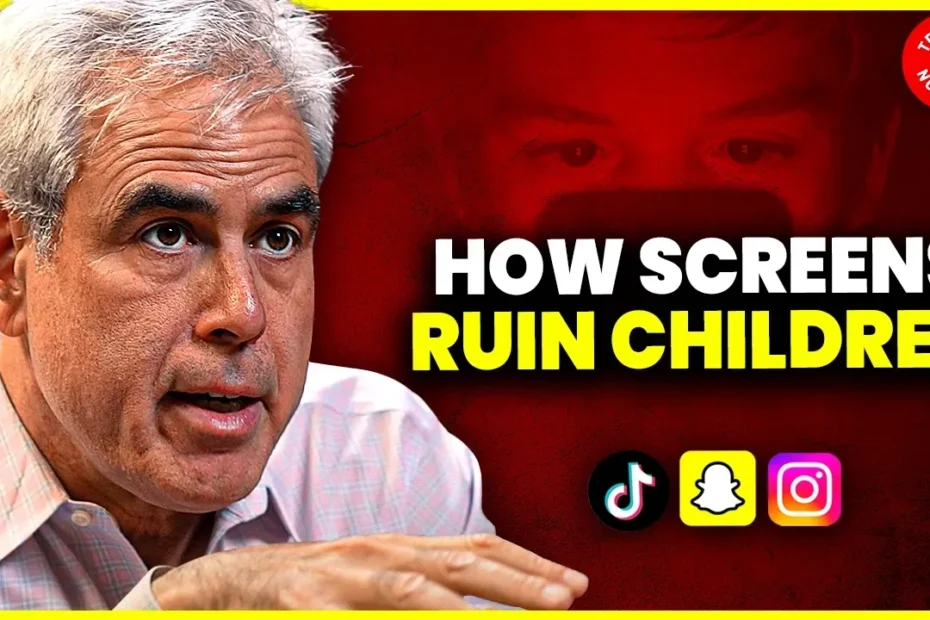
Read the full transcript of American social psychologist and author Jonathan Haidt’s interview on TRIGGERnometry podcast titled “We’re Heading for Civilisational Collapse”, August 11, 2024.
The Anxious Generation: Understanding Modern Society’s Crisis
INTERVIEWER: Jonathan Haidt, it has been a long time, us trying to make this happen. You are the author of some of our absolutely favorite books which really describe a lot of what’s happening in modern society. Your latest one, “The Anxious Generation,” is talking about something that is crucial to the future, I think. Tell us what do you see, why you wrote it, what are your concerns and what are some of the solutions?
JONATHAN HAIDT: Sure. Well, first, Konstantin, Francis, thanks so much for having me on. Yes, I’ve blown you off for years, but I’ve blown off everybody for years because it’s like how do you get time to write a book when you have a full life? And so I had to be very rude to everyone, but here’s my baby. It came out now.
The Great Rewiring of Childhood
In a sense, it’s a follow on to “The Coddling of the American Mind.” In that book, Greg Lukianoff and I talked about how something really weird happened around 2014 or so, 2013, 2014. Greg first noticed it and it felt to me kind of like a glitch in the Matrix, like something changed right around 2014. We saw it in college students. They were very different than they were in 2012.
That’s where you start getting the shout downs and the fragility and the claims about “we have to stop this person not because they’re unjust, but because of somebody’s mental health.” All that was new and at first we thought it was something about college students. Then we talked in “The Coddling” about overprotection. We have a lot on the importance of free play, being unsupervised. So we have a whole part of the story there and we have just like three paragraphs of speculation that, well, you know, social media might have contributed to this too because the timing is right.
If you’re born in 1996, beginning of Gen Z, you went through, you got Facebook when you were a kid and Instagram when you were going through puberty. So the timing is right, but we don’t know. The data’s not clear. So that was 2017 that we wrote that book.
A Global Phenomenon
Then things just get worse and worse on university campuses. But also it becomes clear it’s not just college students, it becomes very, very clear. It’s everyone. It’s everyone born after 1996. And especially once it became clear that it wasn’t just the US, it was exactly the same in Canada, the UK, Australia. We have more recent data. It’s the Nordic countries as well. In all of them we see a very sudden shift in the early 2010s. It really is like a glitch in the matrix.
I argue in the book here that what it is, is there was a great rewiring of childhood that happened in those years. In 2010, almost all kids had a flip phone. The iPhone was just coming in, but it wasn’t that popular, there weren’t that many apps, social media wasn’t on it. So in 2010, almost all kids have a flip phone or other dumb phone. There’s no front facing camera, there’s no high speed Internet. You have to pay for every text you send. So you can’t spend your whole life in 2010, teenagers are not spending their whole life on their phones. They’re using it as a tool to connect and get together later. That’s fine, that’s normal childhood.
The Smartphone Revolution
By 2015, everyone’s got a smartphone, front facing camera, Instagram on the phone, we’ve got a lot of high speed Internet. You don’t pay for texts anymore. So now, and there’s so much going on, so the phone now becomes an experience blocker and all the experiences that a kid needs blocked out by this. That’s why kids born after 1996, after 1995 are just really different from those born just a few years earlier. On average, obviously there are exceptions, but on average that’s what the book is about. How did we create this anxious generation and then what do we do now?
Managing Modern Technology
INTERVIEWER: And I suppose the question is, given that all of this technology is here, we’re not going to be able to Luddite our way out of it. We’re not going to be able to smash them to pieces and whatever. So I guess it’s a question of how do we manage this, how do we deal with the reality of modern technology? Which by the way, seems to me to be only going to accelerate from here.
The Problem with Digital Solutions
JONATHAN HAIDT: That’s right. So I have a whole email inbox where I send every day. I get emails from somebody who has an app or a website or something that’s going to address the problem. And I don’t even read them anymore. I just send them to this inbox and maybe someday someone will look at them.
I’ve come to the opinion that there is no way to make the nine or ten hours a day that kids are spending on their phones nicer and safer. We’re not going to smash the technology, but you know what, we can delay it.
When cars came out, they were amazing and a lot of people died in them, a lot of children died in them. And eventually, we realized we need safety features in the car. And you know what, you have to be 16 to drive. We’re not going to let a 12-year-old drive a car.
And I think the same thing, we’re going to come to that realization about social media in particular, possibly smartphones. I just got back from the UK and all the talk is, “Let’s ban smartphones. Let’s not let kids under 14 own a smartphone or not let them be sold.” As an American, I’m not very fond of bans, but I think the norm needs to be, you know what, we’re biological creatures, we’re mammals.
The Importance of Childhood Development
Kids have to spend enormous amounts of time playing with each other, hanging out, teasing each other, unsupervised. No adult coming and saying, “No, no, no, don’t say that. Oh no, you go sit in the…” Just let them work it out. Obviously there are cases of bullying. We have to attend to that. But other than those limited cases, let kids work it out. Let them get most of the way through puberty.
This is a key idea in the book. I really came to see that puberty is this incredibly important period where the whole brain is rewiring from the child form to the adult form. And it happens in stages from back to front, more or less. The last part to rewire is the prefrontal cortex. And this is happening around 13 to 16. In that period, it continues on to 25.
But it’s completely insane that when puberty starts, which is around 11 or 12 for girls, around 13 or 14 for boys. When puberty starts is basically when we give them a phone and say, “How about no more real world experience. How about you spend 10 hours a day on this thing and your brain isn’t going to…” I mean, neural rewiring is this incredibly complex dance and just as if we gave our kids alcohol every hour, that would disrupt neural growth. Well, I would say giving them four hours a day of video games for the boys or five hours a day of video games for the girls, it’s going to disrupt neural growth.
Declining Creativity and Imagination
INTERVIEWER: This is anecdotal, but I was a teacher for many years. One of the things that I noticed, because I was a drama teacher and a lot of drama teaching in the UK is you give children a set of stimulus and then they create their own plays, improvised plays around a stimulus. And I remember talking with the drama teachers halfway into my career and we were going, “I think kids are becoming less imaginative.”
JONATHAN HAIDT: What year was this?
INTERVIEWER: This was around 2015, 2016. And we started to notice that the quality of work that the kids were doing was degrading.
JONATHAN HAIDT: There’s a lot going on there. The one thing I can say with some confidence is the fragmentation of attention. This is very general, the ability… So the one thing the prefrontal cortex does is called executive function. It’s the ability to make a plan. Say like this morning, I said, “Okay, I would need to be here at 9:30.” And I thought about the different methods and I made a plan. And then I stuck to the plan because I have a normal prefrontal cortex.
And if you disrupt that, if you’re constantly… In the early teen years, if you’re constantly being divided, you have all kinds of stuff coming in. That part doesn’t develop as well. So this is one of the most common comments we hear about Gen Z is that it’s very difficult for them to stay on task.
In fact, their brains have become accustomed to such a constant incoming stream of information that a lot of them have trouble watching a video because it’s not enough stimulation. So they do this thing. There’ll be… And people have sent me these things. There’s like a video of me giving a talk, and underneath it is a video of a video game going on. They need two things at once where if they’re at the computer, they need the phone as well.
And so this is inhuman. This is what we’re doing to kids in preventing them from developing executive function is going to hurt them for the rest of their lives.
The Impact on Creative Output
So that’s a very general comment. Now, as for creativity, that’s quite possible. I don’t have, I haven’t studied that. I don’t have a specific mechanism. But in general, creativity requires you take in a lot of stuff and you put out stuff and then you get criticism. So you’ve got to have this back and forth with the world to be creative.
But now that kids are basically taking in gigabytes, I mean, 10, 50 times as much stuff as we did when we were young, this stuff is coming and not a lot is coming out. And they’re not doing a lot of writing, they’re not writing books, they’re not starting companies even, they’re taking in so much stuff. So I’m guessing, I’m speculating, but that might be part of why you’d see a reduction in creative production.
INTERVIEWER: And what was interesting as well is that towards the end of my time in education, I noticed that there were far more arguments, there were far more fights between kids because their social skills had diminished so they couldn’t find a way to negotiate conflict. And the people were like, “Oh, it’s because they’re spoiled.” And I was like, “I don’t think it is. I genuinely don’t think they know how to communicate effectively.”
Four Key Differences Between Online and Real-Life Interaction
JONATHAN HAIDT: That’s right. So we need to develop one-on-one communication skills. And something I realized in writing the book is I had to deal with this question of, “Well, aren’t they playing online? Isn’t that just as good? Aren’t they socializing online? Like, what about a kid who’s isolated here, he has lots of friends, isn’t that just as good?”
And what I realized in writing the book is no, actually there are four ways in which online community, online interaction are not as good or very different.
So the first is that real life is embodied. And just what we’re doing now, just like the rules of you guys are looking straight at me because I’m talking. But if I were just to look straight at you while I was talking, that would be… It’s kind of weird because you don’t do that. So you have to work out rules of eye contact. And we’re all communicating with our heads. It’s not just our mouths, it’s like our head movements are very important. So anyway, there’s all these non-verbal channels online. You get emojis and you get a lot of uncertainty. You say something, you don’t know how it landed and you’re anxious until they respond. So it’s embodied.
Real life is synchronous. Now we have instant, really rapid back and forth. And now on a Zoom call, or in some video games you have that. So some parts of the virtual world are synchronous, but most are not. It’s text based. I say something, you misinterpret it, and then you tell other people, we lose that connection.
The third is that real life interactions are mostly one-to-one, or in this case, one-to-two, one-to-a-few. You hang out with a group of friends, but once it becomes like a group text where a kid is posting and there’s 80 kids, like the whole class is on this group text, it’s not playful anymore, it’s performative and it’s anxiety provoking because you make one misstep and your reputation is trashed. So it’s scary, it’s anxiety provoking.
And then the final one is that real life communities in general are durable, whereas online communities are evanescent. Maybe there’s 500 people in a group and most will be gone by tomorrow. Almost nobody’s going to be there a year from now. So kids need to be rooted in permanent communities. This is part of the human developmental plan. And in the online world, they just dip their toe into hundreds of little things.
The Rise of Meaninglessness
This, I think, is one of the major reasons why the thing that happens right around 2012, it’s not just anxiety shooting up. It’s not just depression shooting up. It’s the sense of meaninglessness. There’s all these really sad questions on these surveys. “Sometimes I feel like my life has no meaning. Sometimes I think I’m no good at all.” There’s these really sad questions.
And until 2012, the rates of agreement among American high school kids were very, very low. And then all of a sudden, right around 2012, as they move their lives onto the girls, social media, the boys, more video games, as they move their lives into the virtual world, they’re lonely and they have a sense of meaninglessness. They’re not rooted in anything.
So this is why I call it the great rewiring of childhood. And it’s become something inhuman. And we have to roll it back just to finish this train of thought and with my experiences.
The Escalation of Cyberbullying
INTERVIEWER: One thing, again, this is anecdotal, but still, I think it’s important. So I was in high school. I qualified as a secondary school teacher in 2008. And I remember talking to the teachers and they were saying to me, “You know what, Francis? Bullying.” Because I always worked in rough, tough schools, they were like, “You know, these are deprived kids. It’s always been a tough environment, but the bullying since Facebook,” and I’m not even talking about Instagram or any of the others. “When Facebook came into this school, the bullying got so much worse.”
And to take your point, I remember when I was a form tutor being handed printouts from parents of messages these kids were sending to each other. It was vile, utterly, utterly vile. And you just go, “This is incentivizing this type of behavior because there is, you can just say these things and you know there’s going to be little to no pushback.”
JONATHAN HAIDT: That’s right, that’s right. And you say them together. Prestige, where you’d never say them directly to the kid face to face for a lot of them.
So you know what we call middle school in the United States? Grades 6, 7 and 8, roughly ages 11 to 13. This is when bullying peaks. Around seventh grade is when bullying peaks. And these are very difficult developmental years, especially for girls. Their bodies are changing, they’re insecure, they’re being judged by their looks, by their breast size. But it’s such a difficult time for girls.
And that’s right when we introduce this crazy thing where everyone can say anything about anyone, often anonymously. And you, I mean, you take all the difficulties of adolescence, especially for girls, and you multiply them by 10. Oh, and then let’s add in stranger. You can talk to strangers without your parents knowing.
The Threat of Online Predators
And with all these platforms, they start off lovely, they start off fun, they start off playful. But any system you create, any ecosystem you create, unless you have an incredibly elaborate evolving immune system, any system is going to be taken over by parasites, viruses and exploiters.
And so, for example, I’m just so horrified. One thing I learned about, I was in the UK is the rapid growth of sextortion. I’d heard about it for years, but apparently there’s a Nigerian gang, the Yahoo Boys. And you know the trick, strangers can talk to your kids. And they do this to boys because boys are stupid enough sometimes to send a naked photo. If a beautiful girl says, “Let’s swap photos,” and she’s been flirting with them for a couple of days. Boys are stupid enough or gullible enough or desperate enough to do it.
And the instant they send that photo, this person in the criminal gang says, “Now I’ve got everything I need to ruin your life. You have 30 minutes to send me $500 or I will ruin your life. I know all your contacts. I’m going to send this photo to everyone. I know where you live.”
And so, I mean, this is the idea that we’re exposing boys to predators who not only can sextort them, but I read in one recent report, the FBI has linked 22 suicides of boys just to sextortion, which means there’s probably hundreds of them, which means there are tens of thousands who are being sextorted and having their lives ruined.
The Need for Delayed Access
So the idea that in the most vulnerable, difficult transition from child to adult, we say, “How about if you could all say things about anyone and you can be exploited by predators and you get these TikTok challenges urging you to do stupid things like kick people’s legs out while they’re jumping so they fall on their head.” I mean, crazy, crazy stuff.
So we’re not going to burn the technology, but we need to delay it. We can’t be raising kids on this stuff. This stuff is not suitable for children.
The Challenge of Making Online Communication More Human
INTERVIEWER: And John, one of the things that is the origin story of trigonometry is our concern about people being prevented from speaking their mind, restriction of speech. And also it’s clear from the way that social media operates that I worry about AI as well, in the sense that AI is learning about human beings from social media effectively and from online communication, which we all know is not how people actually are.
JONATHAN HAIDT: Right.
INTERVIEWER: It’s how people actually communicate. And the reason is, one of the reasons is what the word you used already, which is performative. So is there a way to make online communication more human?
JONATHAN HAIDT: Well, I think the telephone did an amazing job of that. When the telephone came in, it connected everyone in a good way. And I’m sure there were people at the time who had some objection. But overall, we’ve seen the telephone as a boon when you connect people directly.
And I think when Facebook first came out, many people saw it as a boon. There was no news feed. It was just, here’s my page. I can put up pictures and I connect. You’re my friend, I connect to you. So in theory, social media could be beneficial.
But they all, especially once Facebook developed the advertising driven business model, where now it’s not about giving you a platform by which you can talk with your friends, it’s now about how do I keep you, how do I keep your eyes on the sites that I can sell more ads to my customers? Who are the advertisers? The users are not the customers.
Again, everyone has an idea for how to do a better online form of interaction. And I’m so sick of it. So I say, you know, maybe for over 18s, yeah, for adults. Let’s have some better platforms. Drive out the bad platforms. But you know what? For 12, 13, 14, 15 year olds. No, no, just get rid of all of it. Get rid of all of it.
Restoring Play-Based Childhood
What we have to do is give kids back normal human childhood. So, very important point I’m trying to make to parents, everyone’s focus is on the phone stuff. You can’t just take away the phones and the iPads and all the technology from your 6, 7, 8, 9, 10, 11, 12 year olds. You have to give them back something else, which is play.
You know, I’m sure you have fond memories. Go back to when you’re 8, 9, 10. Think of a fond memory. Say it. What do you see yourself doing?
INTERVIEWER: Granddad’s farm. Playing. Swimming in the river.
JONATHAN HAIDT: Being with granddad. Who you with?
INTERVIEWER: No, with cousins.
JONATHAN HAIDT: Right. You know, other kids. That’s right. And you’re, and this is exciting. It’s thrilling. You take risks, you know, you figure how to swing, you know, you throw a vine or a rope and you swing and you take risks and you might get hurt. That turns out to be really important.
It’s very important that kids need to sort of size up the risk and each one has to adjust it to the level that he needs that day. And if you let kids do that, they will occasionally get hurt, but at the end of the process, they really can judge risk.
The Shift from Physical to Virtual Play
What we did beginning in the 90s, because the backstory here, it’s not just about the phones. The backstory is we got rid of the play based childhood in America, we freaked out about child abduction. But even in the UK, where you didn’t have much of it, you still freaked out and lost trust in each other and got hyper concerned about traffic and said, no, we’re not letting our kids out.
So kids, what kids need is play based childhood. That’s what they had until the 1990s, early 2000s. And instead they, at the same time that we were locking them up and saying, no, you can’t go outside unsupervised. Oh, but here’s a personal computer and you know, has a dial up modem and look, you can play video games and oh, you can talk to your friends.
And so in the 90s and early 2000s, kids were shifting over to virtual interactions. Their mental health didn’t collapse then. Actually, it was actually pretty stable in the 90s, especially in the 2000s, pretty stable. It’s only once they make the jump from flip phones to smartphones.
That’s when you go from playing a bunch of video games at home on the family computer to I have the entire Internet with me all the time and I can be flirting with strangers who claim to be sexy women. You know, you get the craziness once, you get this all the time. That’s why 2010 to 2015, that’s the key period when everything collapses.
The Permanent Impact on Generation Z
INTERVIEWER: And John, one of the things that I think is inevitably something we have to be honest about is even if right now we did everything that you’re saying, we still have one, maybe two generations who are just who’ve been raised in this way and there’s nothing that can be done about it.
JONATHAN HAIDT: So two points on different sides. One, I do suspect, because puberty is such a crucial period of brain rewiring, I do expect that Gen Z will be less than it could be permanently. I think that Gen Z is not. You know, even if we look at them in 30 or 40 years, my prediction is they’ll be less successful than they would have been if they’d had normal human childhoods. So I think we will see a permanent effect on Gen Z.
But that’s a tragedy, John. Oh, this is the greatest destruction of human capital in human history. We’ve taken an entire generation globally. Certainly I don’t have any data from the developing world, but in the developed countries we’ve taken an entire generation. You’ve taken away what they need biologically to develop, risk, exposure, hanging out, time. We’ve taken all that away and given them something unnatural.
So yes, this is, I believe, the greatest destruction of human capital in human history. I could be wrong. I’m making an argument that this is what has happened.
Hope for Recovery and Change
But now on the positive side, even though there’ll be a difference, I’m a social scientist, so if there’s going to be an average difference, I’m going to talk about and say this is incredibly important. But it doesn’t mean that each kid in Gen Z is condemned to a life of anxiety because the human brain is quite malleable up through 25. And even after that, we can all learn new thinking patterns and new behavior patterns.
And so what’s most exciting to me is the results I’m getting. In my class at NYU, I teach a course called Flourishing. It began as a course just for MBA students in 2014, like teaching them how to have a more flourishing career. But once it became clear around 2019, just before COVID that our undergrads are really depressed, just like undergrads everywhere. And so I volunteered to convert the course over to a longer, deeper course for undergraduate students.
And so I limit it to sophomores. I want to get them pretty early in their time at Stern, at NYU Stern. And so they’re all about 19 years old. And the course, the point of the course is to make them smarter, stronger, and more sociable.
Reclaiming Attention
And smarter. I show them that, you know what? Since 2015, young people have had essentially zero attention. You don’t have any attention to do anything. It’s all sucked up by your devices. So if you have no attention, you really can’t accomplish anything in life. Now, do you want that? Okay. None of you want to. They’re business students. They want to be successful.
Okay. You know, you have a hundred dollars of attention every day and you’ve given all of it away, so you have none to spend. Now let’s change that. Look at your notifications. Look at how much time you spend on YouTube. On TikTok, one of my students was spending six hours a day just watching TikTok, just TikTok. And then with all the other stuff, we’re up to 10, 12, 14 hours a day.
So. But they get amazing results when they shut off. Almost all notifications I show them just shut off. You know, leave on Uber and a few others where, you know, yes, I give Uber permission to interrupt my attention to tell me your car will be here in three minutes. Like, yes, that’s worth doing. But do I give some newspaper permission to interrupt me to say, Prince Harry says this or major weather pattern in Brazil? No. No.
So when I help them regain their attention, understand risk, understand that they need to take risks. This is one thing that’s so exciting to me is that Gen Z totally recognizes the problem. They’re not in denial. They want to take risks, they want to get. They want to grow. And so if you lay out a path and you say, here’s the challenge, and then they do it together. So it’s a very collectivist generation, more so than previously. But if a class of kids or if a group of friends or if a school, if they do it together, they make amazing progress.
The Dark Side of Collectivism
INTERVIEWER: Well, this is where I was going with it. And you were excited by the idea of this being a more collectivist generation. I have some questions about that, yes.
JONATHAN HAIDT: There’s a dark side.
INTERVIEWER: Well, quite. And more broadly, I guess where I was going is, even though I think what you were doing clearly is magnificent and helping them, and I think with younger kids, there are conscious parents who are trying to, you know, mitigate some of the consequence of this.
I was sitting in a bar in Florida the other day talking to some guys next to me and they were saying, oh, you’ve got a two year old, what are you doing? And I was sort of, well, he’s not getting any screens because my wife is a screen Nazi and I fully support her, you know. And this guy was saying, oh really? That’s it? He seemed shocked and he was like, oh, my 12 year old’s been banned from TikTok for posting videos of him fighting with other kids. You know.
So I guess what I’m getting at is I’d be curious to hear, given that I suspect the mass of these this generation isn’t going to be re educated, so to speak, in a Jonathan Haidt brilliant course. What are some of the social and societal trends that we are likely to see, especially when inevitably these kids start hitting the workplaces and start having influence and power and so on. What’s going to happen then? I thought my generation were bad.
JONATHAN HAIDT: Millennials.
INTERVIEWER: Millennials, yeah.
The Generational Divide and Its Impact on Democracy
JONATHAN HAIDT: That site, again, is Ground News Trigonometry. Don’t miss out on this incredible tool to help you stay informed and critically engaged with the news.
But the millennials were different in the way that every generation is different. So every generation has stereotypes of the one after them. They’re soft, they’re self involved. That’s been true since about the 16th century. Once you get modernity, you get rapid change. Each generation thinks the one behind it is defective, but that’s always been the case.
What we have here is something very new. Gen Z. It’s not just that they’re different, it’s that they’re really anxious, fragile, they have no attention to focus on things and they’re just not very effective. And so I teach in a business school, I speak to a lot of people in business and I always ask them how are things going with your Gen Z employees? I’ve only once heard a good thing.
It’s almost always like, “Oh my God, I mean, they’re so anxious and they’re always taking days off and they don’t take initiative on things and they expect others to come and fix things.” I mean, so Gen Z is not integrated into the workforce. Well, none of this is their fault. This poor generation, they were the first that were completely deprived of free play and then they were the first to go through puberty on smartphones.
And then just as they’re coming out of high school or college, just as they’re going into the workforce, Covid hits. So this is a generation that just, they were just blocked and blocked and blocked from developing skills that will make you effective in business or in life. So there’s no criticism of them here. There’s sympathy, but it’s not going well integrating into the workplace.
INTERVIEWER: Well, I guess what I’m asking is what is going to be their impact on culture, politics and everything else? Because people who are highly anxious and all of the other things you list. I imagine the laws that they might want to pass are going to be different to people who are resilient. I imagine the way that they interpret existing laws is going to be different. You mentioned being a collective generation. Like, what are they going to want?
The Challenge of Maintaining Liberal Democracy
JONATHAN HAIDT: That’s right. So one of the things I’m very concerned about. I’m very concerned. I think you guys have talked about this too, is the difficulty of having a large, diverse, secular society. Human groups, we evolved in fission fusion communities. We’re very good at coming together to fight another group. But once we reach a certain size, we tend to split.
Civilization is a way of having much, much larger groups traditionally united by shared gods, shared blood and shared enemies. That’s the human way. That’s been true for 5,000 years. So you can have civilizations based on shared God, shared blood, shared enemies, and those can be very stable for many generations.
But in the west, we develop these liberal democracies. And as an American, I’d like to take credit. I mean, there are earlier democracies, but I’ll take credit for our founding fathers were incredibly wise political philosophers. They read history, they were amazing social psychologists. They knew that democracy is unstable because people are passionate and the people can’t just rule themselves. You can’t have direct democracy.
Come up with a system where you don’t have direct democracy, but yet the people can throw them out of power. The people ultimately can say, “No, we don’t like this.” So they set up this elaborate like, almost like an elaborate clock with counterweights and gears and pulleys. And at the time, Ben Franklin said he was asked the famous line, he was asked, “What kind of government have you given us?” And he says, “A republic, if you can keep it.” Meaning if the people have sufficient virtue to keep this going, you can keep it. But if the people don’t have certain virtues, then this thing is going to fall apart.
The American Experiment in Self-Governance
Now the key to the American form of government, I believe, is that it’s been called the American experiment. And what that means is it’s an experiment in self governance. So the idea was, can we govern ourselves without a king? And Europeans said, “No, good luck. No one can do that. You need a king, you need a potentate, some power.” And we said, “We’re going to give it a try.” And it was chaotic at times, but we kept improving and we solved a lot of our problems.
And Alexis de Tocqueville observed in the 1830s when he traveled around America, he said actually similar what you and I were just talking about before we started filming. He said, “You know, when there’s a problem to be solved in France, everyone waits for the king to do it. And in England they wait for the local nobles to do it. But in America they form a committee and they each put in a few dollars and they say, ‘We’re going to build this bridge over this river that we need or we’re going to build a school or a hospital,’ whatever it is.” So he admired this can do spirit of Americans.
And a key idea which Greg and I developed in “The Coddling” is in order to become self governing as a nation, you need citizens who can be self governing in their lives. Citizens who can work out conflicts without always going to the police or the courts. Citizens who can work out conflicts by themselves.
And all of us had childhoods where we were forced to become self governed because there were no adults in the afternoon, on weekends you’re out playing. So it’s those conflicts on the playground. It’s, you know, you have a game and you say, “Well here’s the boundary” and someone says “That was out of bounds” and you have to adjudicate like “No, it wasn’t.” And how are we going to, we want to keep the game going so we’ve got to work it out. All that is essential stuff in childhood to create self governing individuals which can allow you to have a self governing republic.
The Loss of Self-Governance Skills
What happens now? The kids are almost always supervised so they don’t get a chance to become self governing. Some people say, “Oh well, you know, that’s why video games are so important. It’s the one place where the kids aren’t being supervised.” Well, guess what? There are no conflicts on a video game. There’s no out of bounds, there’s no adjudication. The platform does all of that.
All you do is control your player and have adventures, but they’re not real risks. My son jumps out of planes many times a day and stabs people and shoots people. And it’s all just, it’s not exciting in the way that, I mean, I don’t want to say it’s exciting in real life, but I’m just saying growing up in the virtual world does not give you the ability to become self governing in the ways that we need.
So I’m extremely afraid that’s a long winded way of getting back to your question. It’s possible that we’ll have a complete rupture in American history. It’s possible that Gen Z and later were deprived of the opportunity to develop the virtues that we’ve always assumed would be there. Not that I’m late baby boomer. Not that my generation did such a great job. I mean Gen Z bears none of the blame for the mess that America’s in now. But I’m afraid that we have ill prepared them to handle this mess.
The Changing Attitudes Toward Free Speech
We’re going to have a lot more. We’ve already seen it. They’ve been raised with these ideas of microaggressions and trigger warnings. So they think that speech is, many of them think that speech is violence. And Greg Lukianoff and Fire have been charting this out and I was doing also with Heterodox Academy we charted out a lot of this. Attitudes towards free speech are really changing rapidly in Gen Z because we were raised with “sticks and stones will break my bones, but names will never harm me.” Of course names do hurt, but this was a way of saying, “You know what, I’m not going to let, go ahead, insult me. I’m not going to react.”
But the new thing is if you say anything that I can in any way interpret as a criticism of me or my group, you’ve committed an aggression. Someone has to punish you because you’re hurting me. And this means we are stuck in endless, endless conflicts over somebody said something. This is something I hear from business people too. You see it especially in progressive organizations. There have been a few articles written about the chaos within politically progressive nonprofits because it’s just constant conflict over someone said something. The older people say “Can’t we do our work?” “No, because somebody said something.”
So yes, I think we are going to see a change in values and social abilities that may be incompatible with the American form of democracy.
The Crisis of Shared Identity
INTERVIEWER: Well, very much on that point. There was another thing you mentioned and is something that I’ve been thinking about a lot. You said people can unite into civilization that’s bigger than you know, the Dunbar number of 250 people or whatever or 100, whatever, 150. If they’ve got shared blood, shared gods, shared enemies. I would argue we’ve got at best one of them and the worst one which is we might be able to say we have a shared enemy. Even that I think is in dispute at this point.
JONATHAN HAIDT: Right.
INTERVIEWER: How the hell do we keep this thing together?
The Cycle of Civilizations and Social Cohesion
JONATHAN HAIDT: Yeah, so here’s where we need. There’s a really wonderful Arabic word called asabiyya, which I take from the 14th century Muslim scholar Ibn Khaldun. Ibn Khaldun was one of the theorists of cyclical history. You get these theories in ancient Greece, you get them in Islam, you get them today.
The observation, he observed that a tribe would come out of the desert, knock over the soft rich people in the city, take over, enjoy their riches, but their grandchildren are now pretty soft. And the same thing happens again. So there’s an Internet meme: “Hard times create strong men. Strong men create good times. Good times create weak men. Weak men create hard times.” So I think that is happening now.
Those were tribal societies. These were still based on lineage, those societies that he was writing about. In a secular liberal democracy like the United States, we have to. Asabiyya is the word for cohesion, trust, the ability of a group to act. And nothing creates asabiyya like a foreign attack.
So World War II and especially Pearl Harbor that created, I mean that’s responsible for so much of America’s greatness in the late 20th century. Because my parents’ generation, everybody who remembers that attack, they all came together for five years. Everything was for the war effort. They were united. And then when they went on to go into politics, they could work together. We call them the greatest generation.
Building Cohesion in Liberal Democracies
So having some, if you keep your eye on cohesion, you can address this question of what can a large liberal democracy, a secular one like the UK or the US, what can you do? In the US we’ve long had what was called the American civil religion or civic religion from Robert Bella, sociologist.
And when I was growing up, there was a real reverence for the Founding Fathers, the flag, the Declaration of Independence, our founding documents. It really is religious. And the way they’re presented in the archives with soft light. And it really is a religious thing that we had in America. The Constitution and the Declaration, those were our sacred documents. So things like that can create asabiyya.
And especially in a diverse country like the United States, of course, World War II did that. The Cold War did it. The Cold War is over. So we don’t have the common enemy in America. We never had shared blood. That’s one of our great risk points. But it became our great strength. And we found out, how do you stitch people together without the common blood? And so I think that’s why we were such an example to the world of a liberal democracy.
What shared gods? To a large extent, we did used to have shared gods. It was all Protestants at first with some Catholics and then sort of the Catholic Protestant thing goes into a little bit of Jews and okay, Judeo Christian. So we did have a sort of a shared Western Christian, Judeo Christian heritage.
And diversity brings a number of benefits, but it also tends to reduce asabiyya. So I wish, and this is one of my points with Heterodox Academy, we really need good social science more than ever before. Maybe the 1930s we needed it just as much, but we really need good social science. And the social sciences are getting so ideological they’re not capable of doing full, honest exploration of any issue on which someone will say that’s not politically correct or you’re not allowed to say that.
So yeah, I’m very alarmed about the future of liberal democracies based on the older model that may not be applicable.
Mental Health and Gen Z Fragility
INTERVIEWER: And it seems to me that this is all tied into mental health, but also the way social media fetishizes mental health. And as a result of that, that ties into a fragility amongst Gen Z. So I’ll give you an example.
So before we started this show, I helped to run a comedy club and there was this very young, very good comedian, actually Gen Z comic, who turned up and he went on. He didn’t have a particularly good set. And he was booked for two sets that night. He turned around, looked to me and went, “I broke up with my girlfriend two days ago. My mental health is really bad. I can’t carry on. I can’t do the second set.” And he just simply walked out.
And I was utterly dumbfounded because I’ve never seen that type of behavior.
JONATHAN HAIDT: That’s right. It’s unprofessional. But it’s the norm. If you have anxiety, the world must accommodate you. So yes, let’s talk a bit more about mental health because there’s a lot more to say on this.
Gender Differences in Mental Health Decline
Let me bring in the sex difference here because this is actually very important. So boys and girls both are more, they both gotten much more anxious and depressed. For the girls, it was a very sharp. It was in all the graphs, you’ll see in the book. For the girls, there’s really a sharp elbow right around 2012, at least United States. Like, it was flat, and then boom, it goes up like a hockey stick.
For the boys, the curve is more gradual. Because 2012 is basically when Facebook buys Instagram. All the girls get on Instagram in 2012, and by 2013, their mental health is worse. Boys, it’s more they’re withdrawing from the real world. Boys are. They’ve been getting into video games since the 90s. They’re failing to do things that will toughen them, that will make them into men. They’re failing to do things that will make them attractive to women later on.
So boys are kind of wimping out. They’re not up to the task of a challenge like that. And they’re all marinating in this idea about mental health.
Now, one counterargument I’ve gotten is, “Oh, it’s not a real increase in anxiety, depression. It’s just that Gen Z is so comfortable talking about it. That’s a good thing. They should be talking about it. We don’t want stigma.”
Yeah, that’s right. We don’t want stigma. And my entire career as a psychologist, we’ve been reducing stigma. And by 2012, there wasn’t much stigma left to saying you’re depressed or anxious.
The Social Media Mental Health Echo Chamber
Once the girls get on various groups, there are YouTube groups, TikTok groups, Instagram groups about mental illness. Now what you have is girls talking to each other. It’s overwhelmingly female. The mental health groups, girls talking to each other with no professionals in sight and an algorithm that means that whoever is the most extreme becomes the most prestigious.
And so in certain pockets of social media, you get the extreme valorization of mental illness. And this is a horrible thing to do to girls. This makes them sicker. So this idea that, “Oh, social media is great, they find a support community,” no, stop it, stop it.
And here I think Abigail Shrier has been great. I haven’t read her book yet. I’ve been so busy with this, but I’ve heard her on podcasts, just immersing kids in these ideas about illness as opposed to giving them opportunities to grow. It’s a pretty good way to make them ill.
INTERVIEWER: And also, there’s also always been a social contagion element when it comes to mental illness with teenage girls. And you see that with anorexia.
JONATHAN HAIDT: Exactly. And actually, I remember in one school that I didn’t work in, but was near to me, one girl tried to commit suicide and about, I think four or five of her friends then proceeded to do the same as well.
INTERVIEWER: That’s right. And these girls were left with life changing injuries as a result.
Brain Differences and Social Media Vulnerability
JONATHAN HAIDT: That’s right. So I go into this in the book. One of the main differences between boys and girls is that because of the influence of prenatal testosterone, it shifts the brain over into what Simon Baron-Cohen in the U.K., autism researcher says, the male brain. It’s all derived from the original brain, which is a female form. The male brain is shifted over to be a little higher on systemizing, a little lower on empathizing.
And so boys are a little more socially clueless, more interested in things and machines, more drawn to computers and video games, but less open to each other’s emotions. They just don’t notice necessarily. Whereas girls are more socially perceptive, more socially concerned. They have a much more elaborate mental map. They want to know who’s fighting with whom, who’s dating whom, they’re more socially concerned.
And so that can be a great strength. But it also became a huge vulnerability when social media companies developed this advertising driven model where now you got to get attention, you have to play on their insecurities. You ping them, “Oh, somebody, do you want to see what somebody just said about you? Oh, somebody commented on your photo, come back, come back.”
And as we all know, you’re busy. But you say, “I’ll just check it out for a second.” And before you know it, you’ve spent 20 minutes going. So the girls are particularly vulnerable to being exploited by social media. They’re particularly vulnerable to sharing emotions, especially negative emotions, anxiety, depression, anorexia.
So Abigail Shrier and I, from what I’ve heard on podcasts, we generally agree about what’s happening to kids. Our only disagreement I think is that she thinks that I’m putting too much emphasis on the phones rather than the therapy and what the adults are doing. And I agree, I didn’t talk much about that. She’s right, that that’s a big piece of it.
But part of my argument is it was the move onto permanent full time phones and social media that allowed the crazy over therapization by unprofessionals. That all floods in around 2012, because that’s when we have the great rewiring.
The Pornification of Society
INTERVIEWER: And also, if you look at what’s happening to girls, particularly with Instagram, you get this, for want of a better term, pornification of society.
JONATHAN HAIDT: Yes, yes.
INTERVIEWER: Where you see girls being hypersexualized. And I’m 42 years old, and I remember I went for dinner recently on a night out, and I looked around at all these young women, and they’d all had the lip fillers, they’d all had that kind of hypersexualized plastic surgery at the age of 22 or 23.
INTERVIEWER: Where they’re in the full bloom of youth.
The Impact of Social Media on Youth Development
JONATHAN HAIDT: And you’re thinking to yourself, you don’t need plastic surgery. And you wonder what that’s doing to women’s mental health and self perception when they see photos of people who don’t look like they do in real life, but on Instagram, they look a certain way. And also pornography as well, on top of that.
That’s right. There’s so much to say about that. Just this morning, I sometimes read stoic writings in the morning. And just this morning I was reading Epictetus, and he has a line about how girls, at the age of 14, we call them ladies and we evaluate them on their beauty, and this makes them very focused on their looks, their beauty. He’s sort of commenting on what a waste, how sad it is that girls suddenly are just appreciated as physical, as sexual partners.
So this is always a risk in society that as girls are entering puberty, suddenly men are more interested in them. Growing up in the 70s and 80s, my recollection was it was a constant struggle to tell girls, “You don’t have to wear makeup, you don’t have to look pretty. You should have a career, you should become an independent person.” And boy, did we make progress in the 70s, 80s, 90s.
And so to see now, middle school girls, they’re spending a lot of time in Sephora. They’re going to Sephora to buy expensive face creams and skin treatments. They’re 11 and 12 years old, they have perfect skin. They shouldn’t be thinking this way. But because everything is about how you look, especially for girls, and the best way to look is sexy. They pose in the same way – boobs out, lips larger. There’s a kind of a porn pose. Porn seeps down into the things they do.
They’ve all seen porn. I mean, you can’t be on the Internet and not see porn. So they’ve all seen it, but it filters into the way the girls self present and again, just an unbelievable destruction of human capital. It’s really clear with the boys who are dropping out of life, but it’s really clear with the girls who are being shunted into a focus on beauty and sexiness. It’s so sad.
INTERVIEWER: And what effect is this exposure via the phone to hardcore pornography? We’re seeing it in girls, but what is the effect that is having on boys?
The Pornography Problem Among Boys
JONATHAN HAIDT: So we cover this in the book. There is some research. It’s a very difficult field to do experiments in, especially with under 18. You can’t do experiments with under 18. All you can do is surveys of what are you watching. And we know that very few girls are daily – all girls have seen pornography, but very few of them look at it every day. Whereas the percent of boys who do is growing a lot. It’s not the majority, but it’s 20, 30, 40%. A lot of them are watching every day.
And it’s not like a Playboy centerfold, a beautiful woman that you then fantasize about having sex with. It’s hardcore close ups of anal sex.
INTERVIEWER: You don’t need to fantasize.
JONATHAN HAIDT: That’s right.
INTERVIEWER: It’s all there.
JONATHAN HAIDT: It’s all there. And it shows a way of treating women roughly, very rough. And then they love it or they, you know, so if you imagine a boy just beginning to feel sexuality and whether they’re gay or straight, it’s all beginning at the same time. I don’t know anything about gay porn. But for heterosexual boys, the attitude, what is beautiful? How do you have sex? What are women like? What do they want?
And so one of the most disturbing things is the choking that the boys, boys are increasingly choking girls during sex. And some of them say, “Well, the girls ask for it.” And I don’t know, maybe some of them do, but I’m sure many of them don’t. The point is it’s hard enough for boys and girls to understand each other. It’s hard enough to learn to flirt, to be effective at it, to the point you can then have a boyfriend and girlfriend, to the point where you might go steady, to the point where you might fall in love, the point where you might eventually get married.
All that has always been very difficult and I think the pornification of childhood makes it much more difficult. I think we’re going to see plummeting rates of marriage and childbearing. Those numbers have been going down steadily since the 70s. Marriage and childbirth have both been going down around the developed world. It’s not just the US down steadily. But my prediction is when we get to Gen Z is now 28, the oldest. So I think we’re going to see a real steepening, a drop in birth rates to be more like Korea where it’s I think less than 1 child per woman.
Civilizational Collapse and Hope for Solutions
So what we’re talking about really is civilizational collapse. If things keep going the way they’re going, then yes, the trends are so bad that if we don’t do something about it, then yes, we will have an ever shrinking population of ever more anxious people. That’s the way we’re headed. But I think we’re going to do something about it.
And what I’m so excited about with this book is, I’m used to being Cassandra and prophesying doom and gloom in our universities and our democracy and all these problems and now AI. I have a lot of writing that’s doom and gloom but this one is the most optimistic thing I’ve ever done because once you understand how we got into this, once you understand that it’s a collective action problem, that the reason why now in the UK, I was just in Britain, 24% of your five to seven year olds have their own smartphone. Their own smartphone, five to seven. That’s insane because it’s just like, “It keeps them quiet. It’s a babysitter.” Life is easier for us if our 5 year old has his own phone.
But we got into that for a lot of reasons. But one of the main ones is because if you don’t give, as you’re going to find, if you don’t give your kids screens and everyone else has them, your kid is going to feel left out if he’s the only one, right? So the trick is how do you make that nobody’s the only one, right? We don’t have to get 100%. But if we can get even 20 or 30%, suddenly it’s easy.
INTERVIEWER: There’s a community there for you to be part of.
JONATHAN HAIDT: Exactly.
INTERVIEWER: The no phone community.
Four Norms to Break the Collective Action Problem
JONATHAN HAIDT: That’s right. So what I propose in the book is, there’s a lot of specific suggestions for parents, for teachers, for. But the four norms, if we understand it’s a collective action problem, then with four norms we can break the collective action problem. We can escape collectively. They’re so simple and we can do them all. I’ll just list them.
No smartphone before 14. No smartphone before high school in the United States we had this nice clean break between eighth and ninth grade. So just keep them out of middle school and below. Let kids have a flip phone or a phone watch. But no smartphones, no social media until 16. This stuff is not appropriate for minors. But I think 16 is a reasonable minimum age at which we would allow kids on phone free schools.
And this is a no brainer and this is really happening. The phones are such gigantic distraction devices. Test scores around the world have literally been going up for decades and decades and decades until 2012. And now they’re going down and down and down. Not just from COVID it started in 2012. So phone free schools from beginning to end of the day.
And then the fourth is far more independence, free play and responsibility in the real world. So if you told me you’re great. You and your wife are raising your kid without screens, that’s going to be a very lonely life. Unless you have a few other families. If you, soon your son will have friends. Just be in touch with the friend’s parents. They probably share your concerns. And if you all agree we’re not giving screens, we know what we’re going to give. Every week they’re going to have a sleepover. These four boys, every week they’re going to have a sleep. It’s going to go two days long. They can go down to the store and buy candy for all we care. Just let them have fun together now. It’s thrilling. Now it’s not deprivation, it’s fun. And that’s what we have to give them back.
So if we do those four things, we can actually fix this problem in the next year or two.
The Authoritarian Response to Chaos
INTERVIEWER: Well, we are British, so your unbridled optimism is offensive to us. But John, I want to talk about, I think none of the three of us are actually that keen to get involved in political conversations. And what I’m about to ask you isn’t coming from that place. But we were talking before we started about where we see ourselves politically. And you talked about being in the center and attempting to see things rationally without too much passion.
And I think one of the other reasons Francis and I had this felt sense about starting trigonometry and the things that we were concerned about is the sense that Jordan Peterson talks about this – order and chaos, that it’s not that we are these sort of hardcore conservatives who want there to be absolute order and everything, but just the sense that when society moves too much towards chaos, that that’s not good in and of itself, and that will often trigger a snapback that can be very harsh, as we’ve seen in the 20th century towards society is obsessed with or even Diana Fleischman, who we had on. Who’s an evolutionary psychologist, she talked about the fact that when there’s higher prevalence of disease in society, people become more small c conservatives. I think it’s fair to say we’ve seen that in the last few years.
So I definitely feel that part of the reasons we do. The reason we do what we do is we’re concerned about the increasing chaos, whatever, whether that’s higher levels of crime, whether that’s illegal, whatever. And I’m worried about the snapback. What do you see?
JONATHAN HAIDT: So let me put on the table here a really powerful theory from a political scientist named Karen Stenner, Australian political scientist. She wrote this amazing book called “The Authoritarian Dynamic,” which was really influential on me when I wrote “The Righteous Mind.” And what Karen’s work shows is that whenever people perceive what she calls normative threat, that means a threat to the moral order. So that it’s like, it activates. It’s like you press a button in their heads. And she finds that about a third, a quarter or a third of all people have this authoritarian response. And they’re not all on the right, they’re often on the left. We’ve seen that.
INTERVIEWER: You got it.
The Authoritarian Dynamic and Social Cohesion
JONATHAN HAIDT: You got it. So when there’s a perceived threat to the moral order, it’s like the superorganism comes back together. And you could call it acebia if you want. It is a kind of cohesion where we have to come together and kick out the deviants, the aliens.
And so in her research, she would do things like she found if you give people an article about, like, Mexicans coming over the border, they become more racist against Mexicans, but also against black people. Like, they just see they just want to, like, clamp down on, like, we have to return to, you know, the moral order and who we are. So she calls it the authoritarian dynamic. And it’s very powerful.
And chaos sweeps authoritarian dictators into power. If you have chaos, you’re going to, you know, Adolf Hitler or, you know, someone can just come to power, a strong man. You know, in Brazil, I think on the flag it says order, you know, or demi progreso, you know, order and progress. So chaos tends to push many people to the right, or at least towards an authoritarian. And so that’s the first piece.
The Conservative Impulse and Political Balance
Now let me add on to that, you know, the analysis I gave in The Righteous Mind, because we know that politics is highly heritable, whether you are on the left or the right. If you have an identical twin separated at birth, you’re probably going to have similar politics because it’s a temperament thing about openness to experience and conscientiousness, all sorts of things.
So if you have a society in which some people, they just really want to change, they question everything. “Why do we do it this way? Why don’t we do it differently?” Well, it’s good to have some people who do that, but then you also have some people who say, “No, the old ways are tried and true. You know, let’s not go changing them until we, you know, unless we really need to.” And so this is Edmund Burke. This is the conservative impulse.
So when I started The Righteous Mind, I was a progressive. I wanted to help the Democrats stop losing, you know, to George W. Bush. And I was very much on the left. But by the time I finished the book, I realized, wow, to have a good society is so difficult. And you got to get the settings just right. And if you have some people pushing for change and some people are resisting, you get this dynamic that can be incredibly productive. That’s when I really became a centrist.
Academic Bias and Professional Responsibility
As a social scientist, I was increasingly bothered that most social scientists are on the – not just that. No, almost all are on the left. Other than some economists, they’re almost all on the left. But many of them act as though they are the support team for the Democratic Party. And I used to be like that, too. And I think that is unprofessional. We’ve got to stop. So I became a principled centrist.
By principled, what I mean is it’s not like I’m a centrist on every issue because the answer is in the middle. No, I’m a centrist because of human imperfections, because of confirmation bias. We need people to disconfirm. We need to interact with people who disconfirm our bias.
John Stuart Mill and Free Speech
In fact, can I bring on the John Stuart Mill book? Where is that?
INTERVIEWER: Of course you can.
JONATHAN HAIDT: Yeah, let’s bring it on. Okay, so this is – so John Stuart Mill’s “On Liberty” is one of the greatest works of Western philosophy. The greatest thing ever written about the importance of free speech. And in particular what Mill does is he points out that when we shut people down, we don’t just hurt them, we hurt ourselves. We make us all stupider.
The most famous line in here, I know it by heart: “He who knows only his own side of the case knows little of that.” And it just, you know, so at Heterodox Academy we took chapter two of “On Liberty.” You know, it’s 15,000 words with a lot of obscure historical examples. And with Richard Reeves, this great British intellectual policy person now American, we’ve got him. But so he and I condensed it down to half that to 7,000 words.
And this amazing artist, Dave Cicarelli came to me and said, “Can I help you? I love what you do with Heterodox Academy.” And I said, “Yeah, read this chapter and then illustrate the metaphor.” So you get these amazing, you know, illustrations of people locked, you know, people locked into their head and you know, prison of thought.
INTERVIEWER: And what John’s saying, Gen Z is he’s – they’ve even put in pictures for you. Go read it. There’s a coloring in bit as well.
JONATHAN HAIDT: Beautiful, beautiful illustrations to – so I’m an intuitionist, that is I believe that we need to feel something and then also get the reasons and then we know it. So that was our idea with this book and Dave is so brilliant that then he checked in with me again last year and said, “Hey John, how you doing?” I said, “Dave, the publisher’s come up with a terrible cover for my book. I don’t like it. Can you do better?” And he did this. Wow.
It’s, you know, it’s a girl kind of drowning in a ball pit of emojis and smiles. And he and I did this guerrilla art campaign. Dave created these 12 foot tall milk cartons and that say on them “missing childhood.” So anyway, there you go. Yeah. So here work by Dave Cicarelli.
INTERVIEWER: Awesome. We’ve actually done our hour and I want to spend another 40 minutes or so on locals talking about some more controversial stuff, more difficult stuff, etc. So we’re going to go and do that in a second. We’re going to ask you some questions our supporters have submitted. Before we do that, we always end the main part of the interview with the same question, which is, what’s the one thing we’re not talking about as a society that you think we should be?
The Sacred Status of Diversity
JONATHAN HAIDT: Ah, let’s see. And there’s so much, I mean, there’s, you know, there’s so much that we don’t talk about because we’re afraid of the social consequences. So, you know, exploring the – just a pure sociological exploration of the effects of diversity I think would be extremely important to do. And the social and sociology should be doing that. But sociology is an incredibly ideological field. They’re, you know, they’re not a lot of sociologists.
INTERVIEWER: Well, it’s a sacred subject, really, isn’t it?
JONATHAN HAIDT: Exactly.
INTERVIEWER: We’ve given these things sacred status.
JONATHAN HAIDT: That’s right.
INTERVIEWER: So “diversity is our strength” is a thing that you’re not supposed to investigate because you might find that it’s not. And then what are you going to do with that?
Fiduciary Duty in Academia
JONATHAN HAIDT: That’s right, because it’s an Orwellian sort of phrase. And so one another, a whole other line of writing that I have is on fiduciary duty and professional responsibility. I think as professors, as academics, we have a – we have two fiduciary duty. Fiduciary duty is way above normal legal obligations. It’s pure perfect. You must never betray it. You must never act in a way that helps you but harms the fiduciary, the person that you are fiduciary for.
I think as professors we have two fiduciary duties. One is to our students’ education, not to their welfare, to their education. We must never act in a way that puts our politics ahead of their education. And we do it all the time. So that, I think is a horrible violation of our fiduciary duty. That’s one reason why America, especially not just on the right, but Americans in the center, have lost a lot of trust in higher ed in this country.
But the main fiduciary we have as scholars is to the truth. We must never ever say something that is not true because somebody paid us money to do it. Now that almost never happens. Money is not the big threat in the academic world. We must never, ever say something that is not true because our politics demands it. And that’s everyday life in the social sciences and the humanities.
So the corruption of academic research is not from money. I mean in medical areas it is, but for the most part it’s not from money. It’s from the fact that we have almost no viewpoint diversity and therefore certain things become sacred, not the truth. That’s why I co-founded Heterodox Academy with other social scientists and with a legal scholar, Nick Rosenkranz, because we were not – it wasn’t about a left right thing. It was about we love universities. We want them to work. They’re not working and they’re, you know, so anyway, I think universities have made their bed by allowing this stuff to happen and now they’re lying in it and unable to have a clear voice on protests and intimidation.
INTERVIEWER: Well, we’re going to talk about protests on campus, we’re going to talk about diversity. We’re going to talk about what you can do with your kids in terms of solving the problems that we’ve talked about so far and a lot more including your questions on local. So head on over there now.
Related Posts
- Diary Of A CEO: w/ Divorce Lawyer James Sexton (Transcript)
- On Purpose Podcast: w/ Relationship Coach Matthew Hussey (Transcript)
- On Purpose Podcast: w/ Sabrina Zohar on Modern Dating (Transcript)
- Mel Robbins Podcast: w/ Terry Real on Transforming Modern Relationships (Transcript)
- Modern Wisdom: w/ Macken Murphy on Female Attraction (Transcript)