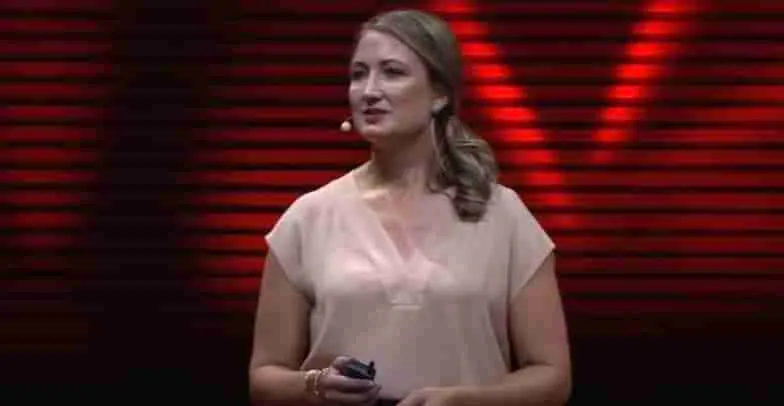
Full text of Hallmark Cards CMO Lindsey Roy’s talk: What trauma taught me about happiness at TEDxKC conference. From this talk, you will learn about her specific methods for overcoming the brain’s natural negativity bias, letting go of past expectations, and connecting to a deeper self in the here and now.
Listen to the MP3 Audio here:
TRANSCRIPT:
Lindsey Roy – Chief Marketing Officer at Hallmark Cards
You know there’s a story here. My legs used to be like most of yours.
Standing here on this prosthetic leg, miracle of design and engineering though it may be, and this other reconstructed leg which is the surgical miracle all its own, I won’t tell you that I never missed the originals.
But I’ve gotten so much better at focusing on what’s now and what’s ahead that wishing things for the way they used to be happens less and less.
And I’m here to say you don’t have to get run over by a boat, dance with the propeller, wind up with three severely injured limbs, including one that had to be amputated, and years of recovery and adaptation ahead to gain that perspective. You can have it for free.
And between those two options, that’s also my recommendation.
You know, this gap between what we want and what we get, or what we used to have and we have now can be vast. And we fill that gap with the yearning for what was or what could have been. You know, I compared this to a phantom limb sensation, the feeling of actually believing you still have a limb that’s no longer part of you.
You know, I distinctly remember days after my accident, feeling this string stuck between my toes. The sensation was so real even though those toes were no longer part of me. And it was completely maddening and to want to change something I couldn’t.
You know, this natural desire we all have to change something we can’t, that yearning for the unfulfilled wish, or the thing we lost. That can creep into our lives. It can pervade our entire experience of being alive, our sense of self, our capacity to be here now. I’m calling it Phantom Life, that nagging dissonance between what was or should be and what is.
You know, nothing in my first 36 years of life ever really confronted me with the reality all that demanding. I’ve always been generally happy but like most people, I’d find reason at times, you know, oddly wished life were different, easier, better. I’d focus on little things that don’t really matter, or I’d compare the real to the ideal or the perceived ideal.
You know, it’s a habit of mine, I think, shared by most of us to reflexively compare our situation to a seemingly better one. But then one weekend four years ago, everything changed. That boat ran over me and I almost died.
A freak accident sent me on a one-way journey to find a cure for phantom life. It was a demand to give up attachment, not only to a limb but to a fixed way of thinking about loss and change, about the way things should be.
And you know the perspective I learned on that journey was essential; it was also exhilarating. And I want to share a few lessons – four to be exact — that I learned from that unexpected journey.
So the first one is centered all around the brain. You know, the brain is magnificent, and there are things we all know about the brain, such as its high level of plasticity and the ability for our brains to learn and relearn over time.
You know, what’s most interesting to me though is how our brains react to positive and negative events. Did you know our brains actually have a negativity bias? It’s physiologically easier to be negative, and when something does happen that creates negativity, perceived or real, it’s like a reinforcing of this natural wiring.
But here’s what I learned: we can actually get better at this; we can practice this. It’s not just something that you have to say: Wow, why is that other person so much better at dealing with whatever life hands them?
[read more]
But like all brain changes, frequent and repetitive actions are key to molding and reinforcing neural connections. So said simply, thinking more positive thoughts is like daily exercise for your brain, just like other exercise strengthens your body.
You know, this next lesson centers around this idea of an anchor. You know what, anchor means a few things to me. First of all, there was literally involved an anchor with my boating accident that day. An anchor is also what grounds us and for me that’s always been my friends and my family, my roots.
But the anchor I want to talk about tonight is what we anchor our perspectives to. You know, we respond differently to other people’s struggles than we do to our own. For ourselves we replay, we wallow, we ruminate, we wish things were different. We scratch the Phantom Life.
But we often use the dire circumstances of other people to diminish our own problems. You know, a common response is wow, that puts things in perspective. It’s like a pop of light where the issue of the day seems meaningless in the wake of someone else’s horrific problem.
Then what do we do ten minutes later? We move on to worrying about whether we have something planned for dinner or who just texted us… wow, that puts things in perspective moment. It’s like the original Snapchat for our brains. See it and it’s gone.
You know, recovery from any trauma: illness, death, divorce, job loss, whatever it is, we’re not prepared to handle, is hard. And I’d venture to say most of us don’t want to stay depressed or angry or bitter.
I know I didn’t.
So I found I had to seek out those Snapchat moments and make them last. I had to start looking for perspective in a sustainable way. It wasn’t enough to wait for those: wow, that puts things in perspective trains to arrive at the station. They didn’t come often enough and they never took me to a whole new place.
But I did find that I actually could make perspective last just by simply focusing on it. To do this, I would ask myself frequently, obsessively, a series of questions, things like how could this situation have been worse? You know that boat could have hit my head or my vital organs? It’s amazing that it didn’t. My kids could have been there to witness it. Thankfully they weren’t.
You know, when we say it could be so much worse, we usually say that about someone else’s problem. But what I found is when you’re struggling, when you’re really struggling kind of at the end of that proverbial rope, ask yourself: what are five ways that could be worse? Commit to it, say it out loud, write it down, whatever. You’ll be amazed at how it can change your anchor point.
I’d also ask myself: what’s the hidden advantage in this seemingly terrible situation? You know, many days I honestly couldn’t find an answer to this.
I was the mother of a two-year-old and a four-year-old, crawling upstairs, were stuck in a wheelchair. My career was on hold. My husband was instead a caregiver. I couldn’t do one single thing alone.
But some days I’d find an answer I could make myself believe. Maybe I’ll write a book and go on tour and inspire millions and work one day a month. You know, sounds pretty good.
Maybe my kids will be more accepting or empathetic. I remember during this era, my son would tell me that mom, I’m going to come live with you when you’re resting your legs and he’d tell me he’d bring me one of his stuffed animals. This is usually how that would end. Of course, I didn’t have a leg on.
And then I would also notice his high empathy as he would care for one of our special friends Mr. Caterpillar who also happened to lose a leg.
I remember my two-year-old daughter at this phase coming down wearing this single leg warmer, and I asked her what is that? And she said well that’s my prosthetic leg, mama. Solidarity at two!
But what I really learned was that it didn’t matter if I found the hidden advantage. Just the practice of regularly asking the question changed my perspective.
Another tactic I would use was to think outside of myself, a broader lens, a third person point of view. I would use this broader lens to reset my anchor to the past. For instance, I would make myself compare day 72 of my recovery to day 7 of my recovery, versus comparing day 72 to my pre-accident life. You know, bearing weight on a new prosthetic leg and taking those first steps, learning to walk again. It’s pretty miraculous compared to not being able to roll over in bed or put in your own ponytail.
We need to choose our mental competition wisely. We get to choose any point you want.
So I learned that the power of perspective and it is so powerful as we all know but it’s short-term unless you find ways to make it last.
You know, this next lesson centers around the idea of attachment. Okay, so first of all, Eastern philosophy offers us a lot of wisdom about this idea of non-attachment. Basically the idea is desire… suffering… attachment is the root of that desire and thus the root of all of our problems.
This resonates with my idea of phantom life, what we want versus what we get. But I’m Western through and through, I’m a small-town girl from Clyde, Kansas. No matter how many links people sent me on, check out this idea of non-attachment. I didn’t know what to do with it. It just wasn’t that useful for me.
But I did find something useful on my journey in this idea of reattachment. Okay, so my right leg was severely injured, it was nearly amputated. I had lost about 8 inches of my fibula which is your outside lower leg bum, as well as key tendons and muscles.
The tendon loss was the most debilitating because I couldn’t walk without this huge clunky uncomfortable ugly brace. So I decided to have a tendon transfer surgery. My surgeon reattached that inner tendon I still had to the center top of my foot. You know, this was extremely successful, but not immediately.
You know, after that surgery, I really learned about this idea of reattachment. For over three decades, my brain had believed that that inner tendon was used to move my foot inward and downward. But now it had to compensate, it had to do more. It had to make up for what I was missing.
So post surgery, for instance, if I wanted to move my foot up, I had to concentrate and tell my brain: move foot in. You know over time and lots of foot movement, my brain learned this new pathway. But what it really started to learn was maybe there’s something bigger here. Maybe there’s a bigger metaphor that it’s not just all about tendons and muscles and surgeries. Maybe there’s something about our lives.
So I started to think maybe we can actually detach from our old life, the one that we thought had to turn out a certain way, and reattach to a new one, and maybe one that’s full of more ability than we could have ever imagined.
So my last lesson is all about a swimsuit. You know, about a year after my accident, we took a family vacation to the beach. There were lots of other families there, and I’m guessing some of the moms might have been thinking things that I might have ordinarily been thinking like this swimsuit is terrible, why do we have to wear these things? Could I be any fatter or pastier? Are my kids safe?
No, I know all these feelings well. The morning of my accident, a near supermodel friend took this photo of my husband and me and I distinctly remember thinking, okay, let’s not document this. Please do not put this on social media. But you know if I had only known that was the most perfect my body would ever be for the rest of my life.
So here I was on that beach a year later and I’ll tell you my concerns were very different. I was mainly just thinking about this waterproof foot I was carrying in my beach bag. My normal prosthetic foot is pretty cool. I mean it can do things like since terrain so if I’m going uphill or downhill it can mimics a natural ankle movement. So you know all that requires electronics so I have to plug it in like a cell phone every night.
So I need this separate waterproof foot for water activities and sitting there that day on that beach, I took foot B out of my beach bag and I replaced foot A with an Allen wrench. And as I sat there during the transfer by the way I remember having this really weird thought as I looked at my feet, I thought I actually do have two left feet.
And I took this photo and I posted it… you know, so excited to be on the beach and so many people actually commented about my toenail polish. And I thought, you know, that was the hidden advantage I hadn’t thought of yet that I didn’t have to go and get a fancy pedicure because before I put it in my beach bag I just set it on the table. It’s like the perfect angle to paint your toenails. It worked out great, so I noted that in my hidden advantage journal that day.
But the biggest thing I learned through this whole era was that you really have to think about perspective. And as I sat there on the beach thinking about it, it lasted for a while. But honestly that day, negativity started to take over. That waterproof foot was really just a piece of wood carved to look like a foot, tricky enough to walk on let alone, you know traverse a football field full of sand or play with my kids.
So we got back to the hotel, I hobbled into the room in pain and honestly I just wanted to bawl my eyes out. I couldn’t stop thinking of what that trip would have been like without this problem. I couldn’t stop thinking about the other people at the beach, their working legs and feet, another why me moment had arrived.
So I locked myself in the bathroom to shower and standing there I willed myself into a new perspective. I literally said out loud things like I’m lucky to even be here. So many people can’t travel for so many different reasons. If anyone had told me six months ago I’d walk on a beach today, I would have been elated.
Standing here on this waterproof foot, well at least I’m standing up in the shower which I haven’t done in a year, that feels pretty fantastic. Now this isn’t just Pollyanna stuff, by forcing myself just for a few minutes to flip my thinking I could feel my energy. It was flowing down a different road.
And what did it take? Didn’t cost me any money. I didn’t have to visit a doctor or buy a book. I created my own little chemical reaction in my brain, by leveraging the free and abundant resource of perspective, catalyzed by a new set of comparisons.
And I learned something important that day, that actively forcing a new perspective on yourself is the cheapest and easiest way to change how you feel about your situation.
So here’s where I tell you, you can start rewiring your brain with this kind of perspective training right now. You know, it’s so simple if you don’t have to, most people probably won’t even bother to try it.
But if you knew that practicing perspective training could better prepare you to handle any kind of challenge or struggle, would you do it? Would you give yourself the equivalent of a dopamine shot every day but one that’s free, painless, organic and on your own time?
Would you spend just a few minutes reframing your daily problems, to wire those pathways for the bigger problems to come? You know, perspective is essential. We all know it’s part of the human condition to face change and struggle and challenge. I always say you never meet anybody who turns 90 and says nothing ever happened in my life.
And we need to think about perspective for what it is. It’s free, abundant; it does not discriminate. It’s like air, it’s all around us, it’s life-giving. We don’t notice it when it’s good, but when it’s bad or when we run out of it we can notice nothing else.
And what do we do when it’s water instead of air? Even as we’re losing consciousness close to death, we struggle to surface to breathe to save ourselves.
You know, my crazy life experience along with that of other trauma survivors forces this kind of brain training: it’s do or die time literally.
Multiple studies have shown that trauma survivors are happier on average than lottery winners. This makes sense to me because survivors have been forced to learn these lessons. It’s like you’re awarded a free pair of life goggles if you make it back to the living.
But anyone living can wear them, you’re wearing them now. You just have to start asking the right questions and see how the view and you begin to change.