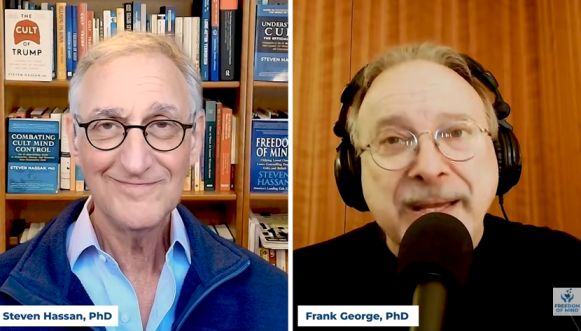
Editor’s Notes: In this episode of Cults, Culture, and Coercion, Dr. Steven Hassan speaks with neuroscientist and psychologist Dr. Frank R. George about what makes Donald Trump’s brain function differently from a typical human brain. They explore Trump’s pathological narcissism as a form of addiction, where rallies, media attention, and adoration act like a dopamine-driven drug that he must constantly seek. The conversation unpacks malignant narcissism, cult dynamics in the MAGA movement, and how propaganda and fear help such leaders maintain power and control. This conversation also deals with how social media, personality disorders, and possible dementia intersect to create escalating dangers for democracy and public mental health. (Jan 26, 2025)
TRANSCRIPT:
Introduction: Dr. Frank R. George’s Distinguished Background
DR. STEVEN HASSAN: Hello, I’m Dr. Steven Hassan with another episode of my podcast, Cults, Culture and Coercion, and I have a distinguished guest with me. I’ve been looking forward to this interview for a long time. Dr. Frank R. George is a PhD in psychology from the University of Colorado. He’s an internationally established expert in psychology, neuroscience, narcissism, and addictions. He was a senior fellow and chief of Behavioral and Biochemical Genetics at the National Institutes of Health for six years.
Dr. George, man, you definitely rock it. Currently ranks within the top 1% of Google scholars worldwide with nearly 200 publications, over 30 patents worldwide. Wow. Your work’s been cited nearly 4,000 times in scientific literature. And for us newbie scholars, that’s like, whoa, that’s really impressive.
And 10 years ago, noting that pathological narcissism looked very much like a form of addiction, you morphed your background into a focus on pathological narcissism, where you’ve worked ever since. So you were the head of the Colorado chapter of the Duty to Warn, a group composed of tens of thousands of mental health professionals, including my friend Bandy X. Lee, who edited “The Dangerous Case of Donald Trump,” whose mission has been to warn about Donald Trump being unfit for office.
You’ve appeared on 60 Minutes, 20/20, Rolling Stone, a million other places. You’re a legal expert witness, and you have a Substack called “The Gaslight” by Frank George. I’m on Substack too, so we should do a Substack live sometime, George. But welcome and please, thank you for your work first and foremost. And please share your expertise with my audience.
DR. FRANK R. GEORGE: Well, Steve, hey, thanks so much for having me. It’s a real pleasure to be here on your show. And I want to say you were impressed with the citations and publications. I’m always equally impressed with someone who can write a bestselling book. That’s not an easy task either. So you have my respect there, believe me.
DR. STEVEN HASSAN: Thank you so much. But you know, mental health professionals like yourself have been censored by the mainstream media. We haven’t gotten our message out. And that’s part of what I think is an attack on experts in science by authoritarians wanting to use people like Trump to dismantle our country. But tell us more about your background, your interests, and what you think the public most needs to know.
From Neuroscience to Understanding Narcissism
DR. FRANK R. GEORGE: Sure. My background originally, research-wise, has been, was for a number of years related to neuroscience and general neuroanatomy, neurochemistry and such. But as that relates to addictions and genetics. So a lot of the work I did—in fact, I think it’s in the general knowledge these days—that there’s genetic predispositions to drug abuse and alcoholism. So that was some of the work that I was involved in some years ago. Takes a while to get out there, but eventually it does.
So I did that for a number of years and ultimately I guess I got kind of bored with academia, dare I say. So like a number of us have been that were at NIH for a number of years, you either stay there or you kind of opt out. And a lot of us do things like start our own biotechs or things like that.
DR. STEVEN HASSAN: Right.
DR. FRANK R. GEORGE: So that’s what I did. Started my own biotech medical device company and that was going really well. Success, had FDA clearances, company was doing great. I made the big mistake in a board meeting one day of disagreeing with one of the board members who, as it turned out, was a pathological narcissist.
And it turned out that I was right. But that didn’t matter because I made him look wrong in front of the other board members and he set out over a two-year period to sabotage and do all these things and ended up one day literally just tossed me out of the company. So there’s litigation with that. I learned that lawyers are also a very high narcissist community because the less empathy you have, the better an attorney you are. You don’t care. Your goal is to win the case.
DR. STEVEN HASSAN: Interesting. I thought about that with lawyers, but it makes sense. I know that they’re greedy for money, a lot of them.
DR. FRANK R. GEORGE: Yes. But it’s—in fact, I had someone really say to me, I mean, to my face, “You know, it doesn’t matter whether you’re right or wrong. It’s who can tell the best story. And I tell a hell of a good story.” It’s like, okay, well, I’m glad he’s on my side and he told a great story and that went wonderfully.
But yeah, it often doesn’t matter. Their career is really based on their win and lose record. It’s like major league sports and the less empathy you have, it doesn’t matter who’s right or wrong. It’s whether you can go out there and win the case.
DR. STEVEN HASSAN: Right. Yeah. And we’re storytelling creatures, aren’t we, as humans? We’re social animals. So tell us about narcissism and how it relates to addictions.
Narcissism as Addiction: The Brain Science
DR. FRANK R. GEORGE: Oh, sure, yeah. That’s a great question. And it’s an interesting relationship. And it’s only been bandied about maybe 10 years now. The idea is that with addictions, you’re addicted to a substance or an event. It could be heroin, cocaine, gambling, chocolate, what have you. Well, there are certain pathways in the brain that regulate all that. In particular, our reward centers and our understanding of the effects of the drug and all that goes into how rewarding it is.
Well, when I got contacted by John Gartner, who founded Duty to Warn and was one of the authors in Bandy Lee’s book, we started talking and as I was learning more and more about narcissistic supply—the need for the adoration, you have all that aspect of it—that sounds curiously like a form of addiction.
So I started looking into it and I saw more and more neuro relationships. Being a brain guy, I thought, wow, all of a sudden I’m seeing a perfect overlap between cocaine—cocaine is the most studied—so obviously cocaine with this fact, with cocaine and where it goes in the brain, what it does, how it does it, and with the brains of pathological narcissists, the idea of narcissistic supply being their drug, that they have to have that.
If you notice, like during COVID, everything was shut down and Donald Trump, after a period of time, he couldn’t take it anymore. He had to get out and get his drug from a crowd. So he went out to do rallies. Does he care if 50,000 people get COVID? No, he doesn’t care at all. He’s a pathological narcissist. He needed his drug. And it’s exactly the same thing. Exactly.
DR. STEVEN HASSAN: It’s so fascinating because I have not thought about it. I knew that they were needing it. But to have a neuroscientist like yourself say, actually it’s the same regulatory neurological phenomenon going on is fascinating to me.
DR. FRANK R. GEORGE: Yeah, it really is. And if you look at the withdrawal aspect—like when once the drug goes away, it’s the same thing with withdrawal. There are symptoms. They get angry and go into a rage and they start going through withdrawal.
And what do you see when a narcissist is not getting all that supply? They go through what’s called narcissistic rage and then narcissistic collapse. And it just overlaps withdrawal. I don’t want to say wonderfully because it’s not wonderful. Extremely.
DR. STEVEN HASSAN: Well, no, it’s horrible. So malignant narcissism was coined by Erich Fromm studying Adolf Hitler. It works for me when I’ve applied it to all the cult leaders that I’ve encountered with clients and such. Does that resonate for you as well?
Understanding Malignant Narcissism: The Dark Tetrad
DR. FRANK R. GEORGE: It absolutely does. I mean, Fromm’s analysis was so spot on. But his adding—seeing pathological narcissism, narcissistic personality disorder, and then having the symptoms of sociopathy, psychopathy in there as sort of the dark tetrad, the dark triad.
DR. STEVEN HASSAN: But then adding—explain the Machiavellian. Explain the triad and the tetrad. I hadn’t heard that before.
DR. FRANK R. GEORGE: Yeah, the dark tetrad was the Machiavellianism and the grandiosity, the lack of empathy. But adding in the dimension of sociopathy then led Fromm to say, “Ah, we have the dark tetrad.” But he saw one more factor which was sadism.
And the characteristic of sadism is what led him to develop the idea of malignant narcissism. And he called it malignant because he saw it had no purpose, that its only purpose was to destroy and to ultimately destroy the soul. It’s sort of like a cancer of the soul.
And one of the worst aspects of malignant narcissism is that—well, let’s just say pathological narcissism in general, I’ll expand it just for a moment—is that it’s a disorder that goes outward and not inward. And by that I mean that if someone is clinically depressed, it’s affecting them. If someone is schizophrenic of whatever type, it’s affecting them. Sure, it may be affecting some immediate family members or something, but it’s primarily an inward-focused disorder.
But if you look at narcissism, it’s outward-focused. The narcissist doesn’t believe that they’re ill. They don’t believe they have a disorder. “What’s wrong with me? You’re the one with the problem.” That’s why they never want to go to therapy.
DR. STEVEN HASSAN: That’s right.
DR. FRANK R. GEORGE: I mean, they’re absolutely the worst patients. A lot of therapists won’t deal with a narcissist. And in fact, people talk about the Goldwater rule and et cetera. But one of the ways that people actually get a narcissist to come in for treatment is that they’re court-ordered.
And one of the ways that they learn that someone is a pathological narcissist is through their partner who is the one that comes in for treatment for all of their problems. And the therapist is kind of going, “Well, you know what? You’re not the one with the problems is what it’s seeming to me. I bet there’s a narcissist involved.” And that’s how they get defined and brought in for therapy when they do.
So the whole idea of having to get someone in front of you and diagnose them personally face-to-face and such, it’s just become so obsolete than where it was in the 1960s with the whole Goldwater issue. And as you know, the DSM, Diagnostic and Statistical Manual—
DR. STEVEN HASSAN: Right.
DR. FRANK R. GEORGE: We were on the second edition back in the ’60s, and as you know, that was basically Freudian psychoanalytic perspective on life, the universe and everything.
DR. STEVEN HASSAN: Right. And being gay was a pathology.
DR. FRANK R. GEORGE: Yeah, exactly. And today we’ve got the fifth edition, but more so rather than just a number, clinical psychology, psychiatry, neuroscience, et cetera, it’s such a different phenomenon today. All the research practice, the different types of therapies, they’re all validated, evidence-based, classified, the inter-rater reliability. Like if you and I now saw someone, it’s likely that we would come up with the same type of diagnosis. That’s what we were doing 40 years ago. The odds were that we wouldn’t.
DR. STEVEN HASSAN: Right, yeah, that’s a very good point. Yeah.
The Roots of Narcissism: Insecure Attachment
DR. STEVEN HASSAN: Psychology has lots of models and we don’t have a theory of mind that everyone agrees with of what developmental psychology—and there’s all these little silos of different theories and approaches and each have a value, but they’re not integrated and such.
Now, my understanding from my research is that narcissistic and other personality disorders is rooted in insecure attachment or disorganized attachment. What are your thoughts about that?
DR. FRANK R. GEORGE: Yeah, you’re absolutely right. You’re 100% spot on. The pathological narcissists—their underlying disorder, their real disorder—is a pathological insecurity, which blows people away because, well, this person, everything they have is the best, and it’s all gold and it’s—and they know more than their generals do and the usual.
DR. STEVEN HASSAN: Right, DT? Yeah, I know.
DR. FRANK R. GEORGE: Yeah, of everything. And so what do you say? Insecurity? Well, no, that’s all a mask. And that’s why we call it—it is a mask that that person wears, and that is their persona, and that’s part of their total lack of authenticity is part of that disorder. It’s this false self. Call it the mask.
So nothing they do is authentic. There is no authenticity. It’s all transactional. And underneath that mask is this pathological insecurity. And a fascinating thing to me is that there’s even neuroscience, like MRI, fMRI evidence that says that that’s the case depending on which brain areas light up in response to different types of images and things.
DR. STEVEN HASSAN: So it’s fascinating.
The Escalating Symptoms of Narcissistic Collapse
DR. FRANK R. GEORGE: It does really appear to be the case. So the whole idea, part of what we’re seeing and why more and more people are getting concerned, is that the symptoms are getting worse. So as it progresses, we’re seeing more and more those symptoms of cracks in the mask.
And as that happens, the individuals, their total reason for existing is to preserve their mask. And when they start to feel that it’s going to dissolve or their false self will be exposed, they will do anything—and I will underline, put in bold, highlight—anything to preserve that mask. And that’s what we’ve been seeing more of.
And dare I say, the Epstein files are a cause of that collapse and that rage and the fear of that mask being exposed. And so you’re seeing this behavior escalate. So things have been done. And the fighter jet video, dumping—I don’t know what you want to say on your show or not. Poop.
DR. STEVEN HASSAN: You can say shit, there we are.
DR. FRANK R. GEORGE: Okay. On people. There we go. You know, it’s just absurd, everything that’s going on with the Epstein files. His actions are absurd in their increasing extremeness. And that’s what’s becoming so increasingly dangerous.
You know, you get into things like Venezuela, for goodness sakes, right? Ten years ago, 15 years ago, this would not happen. He wasn’t at that level of disorder, in terms of some of the underlying thing of possible dementia, but just in terms of his pathological narcissism, it just wasn’t at that level of fear of the mask getting exposed. Right. And so that’s, I think, a lot of what we’re seeing these days.
The Escalation Toward Violence and Terror
DR. STEVEN HASSAN: And he’s escalating towards violence. More and more themes of violence. We just had a shooting of ICE officials in Minnesota of an unarmed woman who was a protester. But it feels like there’s a deliberate attempt to terrorize people into submission and compliance. So a lot of bad actors can take over.
And whether it’s the billionaire tech bros who want to do their own version of utopia, the network state crap of Musk and Zuckerberg, etc., or the Christian nationalist dominionists who want to destroy the separation of church and state, or the Nazis or whatever, and Putin and Xi just doing whatever they can to dismantle the United States of America and our power, our authority as a force for human rights.
DR. FRANK R. GEORGE: Absolutely. Everything that Trump does is, again, it’s based on this preservation issue, but it’s all in the realm of needing to devalue others. And others can be a person, it can be a group, whatever it might be, because he needs to be at the top of absolutely everything.
So when he says climate change is a hoax, it’s not that he may believe it’s a hoax, but if he does, that’s another dementia-related issue. Perhaps, but that phrasing is deliberate. It’s a hoax because that is a term that devalues the other. And so if he’s devaluing all that climate science, then he can claim that by saying it’s a hoax, he is now the most knowledgeable and he becomes the best.
So it’s not just saying it’s a hoax. Oh, it’s a bunch of BS. No, for him, it’s another way of displaying his pathology.
DR. STEVEN HASSAN: Interesting. He also serves the interests of the fossil fuel companies and countries that are paying him. And when in doubt, follow the money. Yeah, yeah.
DR. FRANK R. GEORGE: That gets out of my area of expertise. You know, I stick with my part of the brain.
Who Is Vulnerable to Narcissistic Manipulation?
DR. STEVEN HASSAN: So I want to ask you, as a victim of a narcissist on your board, etc., and I was a victim of Sun Myung Moon, who was a malignant narcissist, I’m interested to hear if you have any thoughts about who is vulnerable to this type of personality.
DR. FRANK R. GEORGE: Man, I hate to say it, Steve. But you know who’s vulnerable? All of us.
DR. STEVEN HASSAN: That’s my answer. So I’m happy to hear you, honestly, because normal people can’t imagine that’s psychopathology. Like, we would never think of behaving that way. So when people do that, it’s like we don’t—it doesn’t compute.
But that’s also why I wanted to do this interview with you, because I want people to understand what to look out for, how to reality test who you’re getting emotionally involved with, or what company or your boss is, how he’s behaving or she or whatever.
Because I think my theme is for freedom of mind. It’s your mind and only you should control it. So in order to control your mind, you need to know psychology and neuroscience and know how to not be taken over by your thoughts or your feelings, etc. But also not be taken over by external actors and forces.
And there’s another thing I wanted to ask you about is social media and its effects on us as human beings.
Understanding the Narcissistic Brain
DR. FRANK R. GEORGE: So let me answer your previous thought first, which is about who’s vulnerable or not vulnerable. And one of the things that I do with the Gaslight Report with my Substack is I always try to offer strategies that people can do to step out or to react to. And it’s always about educating people.
One of the things that people need to know is that I describe it in the class I used to teach until it conveniently got dropped on pathological narcissism, that Donald Trump’s brain is not like your brain or my brain. And I would describe it literally as, it’s not human. It’s like Homo sapiens narcissisticus. And that was a tool that I used.
DR. STEVEN HASSAN: I like it.
DR. FRANK R. GEORGE: And the reason being that people don’t understand that his brain, mind—I really want to conceptualize it—doesn’t work like a neurotypical person’s brain. People take my class, they go, “I can’t understand why he did this.” Exactly. And you know what? You never will.
You can have all the education about it, you can understand it, but you won’t understand it, you won’t get it, because you’re still coming at it from a perspective of a normal brain. And it’s the reason why people were so stunned initially. Now it’s just another day in the life of when he would just walk over some thing that nobody had done since the founding of our nation and people would say, “Well, that’s against the law.”
Well, it turns out there’s no law. It’s just that anybody with any sense of morality, empathy or whatever would never do that in a million years. He’s not a person who runs by that script.
DR. STEVEN HASSAN: Right.
DR. FRANK R. GEORGE: So it’s not that he’s—people go, “Oh, he’s such an ahole.” No, for him, it’s Tuesday. He’s behaving absolutely normally for that brain, for that Homo sapiens narcissisticus.
DR. STEVEN HASSAN: Yeah.
DR. FRANK R. GEORGE: The rest of the people that are Homo sapiens sapiens don’t get it.
DR. STEVEN HASSAN: Right.
DR. FRANK R. GEORGE: Yeah. And so that’s just the first thing for people to understand that it really is different. And you really don’t get it. It’s so hard. And anyone can be affected. Absolutely. Anyone. As we’ve seen, you’re a bright guy, I’m a bright guy. And look, we both went through it.
The Contagion Effect of Narcissism
DR. STEVEN HASSAN: Yep. But I can tell you my experience in the Moonies. May I call you Frank?
DR. FRANK R. GEORGE: Yeah, absolutely.
DR. STEVEN HASSAN: My experience in the Moonies was like the real Steve got recruited and then I got this new pseudo identity programmed in that I should be like a small Sun Myung Moon and think like him and feel like him and walk like him and talk like him.
So my experience was the higher up I got in the group and the more time I spent with Sun Myung Moon, the more narcissistic I became. The more I wanted people to bow when they saw me because we bowed when we saw him. And there was like a contagion effect. Talk about the contagion effect in neuroscience, because I’m fascinated by that.
DR. FRANK R. GEORGE: Well, have you seen his cabinet members and how they’ve transformed over time too? It’s like they’re all becoming little Trumps in a sense. Right. And yes, you see that it is contagious.
Years ago, when Ronald Reagan was president, his big economic plan, a guy called Reaganomics about trickle-down economy, that money would trickle down—
DR. STEVEN HASSAN: Which was BS, but that’s what they were saying.
DR. FRANK R. GEORGE: But why was it BS? Because greed, I would say evil—like Kant and Arendt and Freud and their definitions of evil—evil got in the way and prevented that. The concept in a just moral world was fine, but that’s not our world.
And so if you look at “evilnomics”—I came up with that—that’s what you see with narcissism. It still starts at the top, but the evil trickles down. And it does trickle down, unlike the money.
DR. STEVEN HASSAN: I’m going to use that, “evilnomics.”
DR. FRANK R. GEORGE: I like it. Go ahead.
DR. STEVEN HASSAN: I will attribute it to you, of course.
DR. FRANK R. GEORGE: Thank you. And it really is true. I mean evil really does start at the top and trickle down, work its way down. And it’s worked into his cabinet members, it’s worked into MAGA. And it really is this trickle-down effect.
And that’s how you saw Fromm, Arendt, all their studies of what went on during World War II with Hitler. That’s part of what went on. You see that these people that had nine-to-five jobs during the day, they’re sending people off to gas chambers and they go home and have dinner with their family.
DR. STEVEN HASSAN: Yeah, you know, sort of. Yeah. Robert Lifton, my mentor, wrote a book, The Nazi Doctors, about that phenomenon. In fact, he called it doubling.
But talk to us about the influence of the media, social media and the media on our brains. And it seemed like since Bernays, like we were getting more narcissistic as a society. Like you need to smell good and wear the right watch. We needed to have a certain way of being that was very egocentric or whatever. What do you think?
Social Media and the Narcissistic Culture
DR. FRANK R. GEORGE: I think some of that has been with us forever, I guess. Who had the most bones around their neck or something?
DR. STEVEN HASSAN: How many kills on their arrow bow?
DR. FRANK R. GEORGE: Yeah, exactly. But with social media, things are so instant and so amplified that it’s just become a destructive force. And there is a disorder now that’s not officially in the DSM but that you may have heard of called Social Media Use Disorder.
And it’s about individuals who—it used to be called Facebook Use Disorder, but now, you know, Facebook is so yesteryear. So now since they’re all lumped together—
DR. STEVEN HASSAN: Well, they changed their name deliberately too to Meta anyway, so it wouldn’t matter. Right, but keep going. I want to hear more and I want you to tie it into addictions when you—
DR. FRANK R. GEORGE: Ah, okay. Okay, so I have a mission. Well, so social media. Let me ask you a question. Do you take, oh, I don’t know, let’s say 30 selfies a day?
DR. STEVEN HASSAN: No.
DR. FRANK R. GEORGE: Okay, let’s see. We’ll check that one out. How about 60 text messages a day? Easy, every day. Come on.
DR. STEVEN HASSAN: Oh yeah. Especially with my clients and my team.
DR. FRANK R. GEORGE: Okay, but there’s a reason for doing so. Correct?
DR. STEVEN HASSAN: Correct.
DR. FRANK R. GEORGE: Okay, so that’s a bit—
DR. STEVEN HASSAN: I’m texting. I’d rather talk.
DR. FRANK R. GEORGE: There you go. So there’s a reason for your texting which is a bit of a different category. What about, let’s see, social—how much time are you on your phone or your laptop on Facebook, TikTok, blah blah, eight hours a day, ten hours a day?
DR. STEVEN HASSAN: I have a lot too many hours. I know my phone measures screen time and say it’s seven, eight hours a day, sometimes more.
DR. FRANK R. GEORGE: And, but a lot of that is important, like it’s part of what you do.
DR. STEVEN HASSAN: I almost—I do very little personal stuff online because I prefer to be with people in real life. But if my son is in Oakland, California, we Zoom because I like seeing him or FaceTime with him and such and I do consultations over Zoom, etc.
But I’m on too much and I need to detox and get off of my phone. And there is this dopamine effect with likes and the doom scrolling effect, etc. So it is there.
Social Media Addiction and Dopamine Hits
DR. FRANK R. GEORGE: And you’re absolutely right. You hit these little hits of dopamine and I don’t know if you notice but Substack keeps rolling out these little features. Like now they’ve got this bestsellers list because they want you to keep track of where you are.
And it’s all about intermittent reinforcement. Like oh, I moved up. Oh, that last post didn’t do quite as well. Why, what about this next one? And that’s all intermittent reinforcement to get you to do more on Substack to make them more money. So they’re doing some of the same thing.
DR. STEVEN HASSAN: That’s so interesting. You know I have part time help that does my social media. Like I’ll record comments on a topic, I’ll do a live stream. But I really don’t know enough about how to do Substack or Instagram or all these things. But it’s also a hindrance in terms of if the goal is trying to reach more people.
And it’s a love hate relationship at this point because I’m much happier when I’m not online and I’m just in nature. I’m dancing, I’m listening to music, I’m hanging out with friends.
DR. FRANK R. GEORGE: You’re doing normal stuff.
DR. STEVEN HASSAN: Yeah, doing normal stuff. But I grew up in a different generation. Probably you too. Where my, I remember my family had a radio and then we got a black and white TV. So I have a reference point. My last video game thing was Pac-Man. I never got into video gaming. It’s just I was always interested in books and learning and that sort of thing.
Life Before the Internet
DR. FRANK R. GEORGE: My daughter, who’s in her 30s, asked me a couple weeks ago. We were having a little discussion via messenger or Zoom. She’s in Australia. And so, “Dad, what was it like before the Internet?” She’s like, “Wow, that’s like asking, so what was it like when you didn’t have electricity or something?”
DR. STEVEN HASSAN: And the brain grows up on Internet. It’s very different. And I interviewed a psychiatrist from Harvard, Carl Marcy, who wrote a book, “Rewired.” His book was about, I think it was Harvard Press, in fact, or BU Press. And it was all about developmental psychology.
And he was saying children shouldn’t even be near screens like TVs for the first three years if you want optimal brain health. Because the brain is taking in information, and we want it from humans. We want it from the real world, not this artificial world that is getting created.
DR. FRANK R. GEORGE: So the idea of social media use disorder, which is like saying addiction, only more politically correct, which we’re not supposed to do anymore. Oh, I can call it addiction again. I don’t have to be so…
DR. STEVEN HASSAN: I can call it addiction with me and my followers.
DR. FRANK R. GEORGE: So social media addiction. There we go. So those are actually some of the questions, like, how many selfies do you take? I mean, I know a couple women that are still friends on Facebook that used to be actresses and, oh, my gosh. “Hi, World, it’s me. Hi, World.”
DR. STEVEN HASSAN: Oh, my God.
DR. FRANK R. GEORGE: Don’t even look at me. Here’s our first picture in the bathroom with some robe on. I’m awful with all my makeup. No, hey, I put on my makeup. I’m going down. This is what I’m having for breakfast. The required cleavage shot in the mirror kind of thing. Just on and on and on.
It’s not even a get over yourself sort of thing. It’s really a join the world. This is not your reality. If this is what you are, then that’s not good.
DR. STEVEN HASSAN: Yeah. And superficial.
The Destruction of Human Connection
DR. FRANK R. GEORGE: And so we’re seeing more and more, dare I say, younger people fall prey to this. And if I take a bus or subway or something, you get on, and I’ll stand there, I’ll look down the row, and there might be 15 people and they’re all staring into their phones. It doesn’t matter what age they are. They can be 12, they can be 50, whatever. They’re all staring at their phones and oh my gosh, that in and of itself is a destruction of society.
DR. STEVEN HASSAN: It really is. Yeah. And it’s dangerous too, because you’re not paying attention to your environment at all.
DR. FRANK R. GEORGE: I was teaching at this one university in Denver while I was in Colorado. And there’s this big breezeway and so I did this little experiment walking to a class. It’s like, okay, I am not going to get out of the way. I’m just going to walk down the middle and see what happens.
Two people bumped into me because they weren’t watching. And one of them said, “Hey guys, watch where you’re going.” I hope that stuff at me. And being a psychologist, I was there. Oh my God, this is great stuff. This is going in a book somewhere someday.
DR. STEVEN HASSAN: I interviewed Greg Epstein, who’s Harvard and MIT humanist chaplain, who wrote a best selling book called “Tech Agnostic” and it’s an MIT press book. And it was all about the tech billionaires and their ideologies of long termism, accelerationism, transhumanism and crypto.
And he was saying that people used to think of religion as prayer and now they’re walking around with their phones and that’s what they’re praying to. This is analogy. Anyway, it was a fascinating interview, a very important book. And he was just talking about it being like a cult. And he considers himself agnostic. Like, I don’t want my life to be run by these people and their vision of artificial reality and robots and AI and all that.
DR. FRANK R. GEORGE: And I think the Internet is fascinating. I mean, I think it’s a fabulous thing. I mean, we wouldn’t be here without it. And so it’s like most things in life, there are pros and cons. It can be used for very good reasons. It can be used for very bad reasons. Sometimes it comes down to just because you can doesn’t mean you should.
DR. STEVEN HASSAN: Right.
DR. FRANK R. GEORGE: So the overlap, the social media addiction thing, there is a real overlap with addictions and a lot of younger people. I know one, a woman, a friend that has a daughter, a young teen who was suffering from this disorder and essentially she went through the equivalent of a detox program. And that’s how serious. And again, that’s how similar it is because of all the little dopamine hits you get constantly.
How many likes did I get? Oh, my God. Oh, I got a lot of likes. This is great. And how many followers do I have? But that is so not human connection. And I always tell students in my classes, you are so much richer person to have two good friends than 2,000 Facebook friends.
DR. STEVEN HASSAN: I like that. That’s good.
DR. FRANK R. GEORGE: Yeah. It’s so true.
The Tech Bros’ Vision of Artificial Relationships
DR. STEVEN HASSAN: It’s so true. We’re humans. We’re embodied minds. And the tech bros are trying to sell us on robot substitutes for girlfriends and with AI, and they’re training it how to have empathy and they’ll know everything we want and cater to our every need. And they’re pushing this.
DR. FRANK R. GEORGE: It’s a thing in Japan.
DR. STEVEN HASSAN: In Germany, people are married.
DR. FRANK R. GEORGE: Oh, didn’t know.
DR. STEVEN HASSAN: I didn’t know they were marrying droids.
DR. FRANK R. GEORGE: And I don’t know if I should use marrying specifically. They said partnerships. There are examples of people that have left their wives for a robot because, and everything what you just said, oh, it fulfills my needs and listens to me. It’s all these things.
DR. STEVEN HASSAN: Never criticizes me, never needs me to take care of them, other than plug them in, I guess.
The Media’s Failure to Platform Mental Health Experts
DR. STEVEN HASSAN: Let’s cycle back to what I think is one of the major problems, which is that mental health professionals like yourself, experts who spent decades studying what works, what doesn’t work, what’s healthy, what’s pathological. We’re not having a platform in the media where we’re being asked, like, how do we help the people survive this? What’s happening to our country?
Like, we have our Substacks and we have our little silos, but the mainstream media has turned its back on people like yourself and Bandy Lee and myself, and it’s just really frustrating as heck.
DR. FRANK R. GEORGE: It absolutely is. I’ve been giving talks about Trump being unfit for office and stuff, starting back in 2016, 2017, along with being part of the Duty to Warn movement. And that was so frustrating because nobody listened.
I mean, eventually, John Gartner was actually fairly successful at getting a couple of congressmen to listen to him, and he started to use the term pathological narcissism or some type of narcissistic disorder, and he eventually ended up on a couple of talk shows and things. But it was so, so difficult.
DR. STEVEN HASSAN: Bandy Lee was too. She was on a lot of shows. And then they just censored her after the APA said she’s violating the Goldwater rule, which is a bunch of crap. I interrupted you. Forgive me.
The Goldwater Rule’s Dampening Effect
DR. FRANK R. GEORGE: Oh, no, no, no. I mean, that’s a really good point. The APA. I mean, I think when all is said and done with all this currently, people talk about like Merrick Garland or something, that if he had been faster, Trump would be in jail, etc. That may all be true.
But if the APA didn’t have the Goldwater rule and people weren’t hiding behind it for so long, this information would have been out there much, much louder, much faster and much stronger. And I think that that’s been a real dampening effect on the whole effort because then if you do speak out, then people say, “Oh, well, you’re not supposed to be. So we’re just not going to listen anyway.”
And so, yeah, it’s just been really difficult. And that’s why I’m so thrilled that my Gaslight Report on Substack has done so well that I’ve been gaining so many subscribers. It’s like, wow, people are listening. And the comments I get are, it’s so relevant. Thank you for giving us the information and what do we do with it?
And we see so many things about, okay, write to your congressman about this issue or whatever may be going on. And I just had the thought with the last issue and some of the comments I was getting, like, you need to write to the head of the American Psychiatric Association. That’s who needs to get 40,000 emails. There needs to be that sort of focus as well, because all these voices, our voices are still here. All of them got out. There is still a major effect.
Strategic Efforts for Accountability
DR. STEVEN HASSAN: Yeah, so you’re talking my language and my way of thinking, Frank, because I believe in strategic efforts. And when Jack Smith’s eight hour deposition came out, I was like, you should be writing to the Supreme Court to say you’re supposed to uphold justice. It’s like, look what you’ve done by giving Trump immunity because he’s in the President’s office. It’s on you.
And I don’t know that the Supreme Court can reverse a decision, but I’d like to believe they could.
DR. FRANK R. GEORGE: They worked on reversing a couple of previous decisions.
DR. STEVEN HASSAN: So even their own. Reversing their own decision of earlier this year, because seriously, Jack Smith did a diligent job. The evidence is there that he’s a criminal. He’s already a convicted felon from New York State 34 times over, but they’ve given him a pass to destroy our country. And it’s just absurd, but that’s what’s happening.
The Nixon Connection and Historical Parallels
DR. FRANK R. GEORGE: And I think some of his sycophants don’t realize that that pass ultimately does not apply to them. And at some point, if there’s a reckoning, he may say, well, I’ve got immunity. It doesn’t matter. But it matters to them.
When I was at NIH, my boss at the time, who’s the director of the institute that I was at, he was Richard Nixon’s—this is like years earlier—he was Richard Nixon’s first drug czar. He was the Doonesbury character, the whole thing. He was a fabulous, fascinating person.
When I first met him, I went into his office to meet him, and he walks in a couple minutes later and he goes, “Oh, you’re looking at that picture.” He had these two by three poster pictures on his wall. I go, “Yeah.” He goes, “Look at that. I’m the only person in that picture that didn’t resign or go to jail.”
And I looked around the table, and for those that know the history of that, Haldeman, Ehrlichman, Agnew, Dean—they were all sitting around that table, and so is this.
DR. STEVEN HASSAN: Yeah, this guy was as well. He’s proud.
DR. FRANK R. GEORGE: I’m the only one. Yeah. In kind of a dark way, you know.
DR. STEVEN HASSAN: Yeah. But didn’t he—wasn’t there a report to Nixon that pot wasn’t dangerous and Nixon ignored it or something?
DR. FRANK R. GEORGE: You know, I’m thrilled that you brought that up because, yes, you’re absolutely right. And Biden and, dare I say Trump, might actually do something reasonable and let this change go through. You know, they want to bring it from a schedule one compound to wherever, which is long overdue.
But yes, Nixon and Jerry Jaffe is his name, who’s my boss and Nixon’s drug czar. I mean, I’ve read their transcripts of them sitting in the Oval Office before Nixon got reelected and talking about, “Okay, you know, this drug. Yeah, yeah, yeah, yeah. What do we do about marijuana? You know, what do we do about marijuana?” And they didn’t know what to do.
And the comments were, “Well, if we throw them into prison like these other drugs, that would be insane.” I mean, they literally use the word “insane.”
DR. STEVEN HASSAN: Interesting.
DR. FRANK R. GEORGE: And, you know, they knew all the clinical work and everything, but then Nixon would say, “Yes, but the public is against marijuana and I need to look tough on drugs.” So they were in this bind. You know, Nixon’s going, “Look, you know, I got an election coming up. I got to look good. But we don’t want these people to go to jail for 10 years. You’re just going to produce hardened criminals.”
So their decision was, “You know what, we’re going to shelve it till after the election. We’ll put it on shelf.” Well, what shelf did they pick? Schedule 1. And then we know what happened. Watergate, et cetera. That shelf never got addressed. And there you have it. Yeah, so that was the reason—because they didn’t know what to do with it, so they put it on shelf.
DR. STEVEN HASSAN: Yeah, but you also talk about Nixon’s narcissism, that he was more concerned about how he would look than other people would go to jail.
DR. FRANK R. GEORGE: Yeah. And they all went to jail, resigned. And, you know, so there is, hopefully, hopefully there is that reckoning these days. And they may find it. Trump may weasel his way out again, but those other people won’t.
The Need for Clinical Training on Brainwashing
DR. STEVEN HASSAN: Yeah, well, I’m going to do everything that I can because I don’t believe in giving up. And I have a unique set of skills and frameworks that I want the public to understand about. Brainwashing is a dissociative disorder, and clinicians need to learn how to identify and treat people. And no university is teaching this.
DR. FRANK R. GEORGE: Really.
DR. STEVEN HASSAN: None are. None. I created an online course that gives CMEs for psychiatrists and CEUs for psychologists and social workers and everything. But people have people sitting in front of them and they’re just blind to asking the questions to ascertain what’s going on. So people are getting misdiagnosed, they’re being medicated and they’re not understanding how people—
DR. FRANK R. GEORGE: They’re missing the root of the problem.
DR. STEVEN HASSAN: Yeah, they’re missing the people had a radical personality change. You know, if you go back in time, the family goes, “They were completely different, they were normal and now they’re a right wing fanatic or a left wing fanatic, or they were a vegetarian and now they only believe in meat. Or now they’re space aliens that are inhabiting bodies or whatever.” And it’s so sad.
So I’m going to keep doing my thing. I’m really grateful to meet you. I know there’s more I want to ask you about your career. We covered social media, we covered narcissistic supply, dopamine hits. What else? Think back of your illustrious career to something you can share with my audience of interest.
A Career in Neuroscience and Media Production
DR. FRANK R. GEORGE: Well, let’s see. I’ve been doing narcissism work for the last 10 years when I saw the similarity with addiction and decided to morph out of one to the other. In between, I’ve always had multiple career paths, multiple things going on. It’s just the way the brain works. And I had the biotech company in that process.
I also had an audio visual production company that produced neuroscience addiction educational videos. They all did quite well. They’re used all around the countries in colleges, counseling programs, high schools. My daughter came home one day and she’s going, “Oh my God, Dad.” I go, “What are you so pissed off about?” “They showed one of your shows in my health class today.” I love it. I just start cracking up.
DR. STEVEN HASSAN: No, I dance. Yeah, because—
DR. FRANK R. GEORGE: Because her friends are going, “Oh my God, that’s your dad. He’s a movie star.”
DR. STEVEN HASSAN: That was a good thing.
DR. FRANK R. GEORGE: Yeah, you know, I’m just a host on this video thing. But my response was, “Well, I don’t know, I’d send stuff off to a distributor.” I didn’t know our local school district had them, so it’s kind of hilarious. So I had that going on at the same time. And that was based on a back entertainment career. I have a lengthy career in music and production and stuff.
Studying Cult Propaganda and Online Radicalization
DR. STEVEN HASSAN: That’s fascinating. So I need to ask you this question because maybe we can do a collaboration if you’re interested. But I’m really fascinated to take cult propaganda films that have recruited people into QAnon, for example, or indoctrinated them, the Plandemic video, and study brain reactions and whether or not there were subliminals or whether or not there were hypnotic phenomenon that were in those things that were convincing people of stuff that’s wrong. I’m just interested in unpacking the radicalization online phenomenon.
DR. FRANK R. GEORGE: Yeah, it’s a fascinating idea. I can say off top of my head that the subliminal work would probably would not be a factor in terms of how I understand subliminal effects because that was actually shown to not have a major effect at one point.
DR. STEVEN HASSAN: I thought the visual was, but not the auditory. Am I misinformed?
DR. FRANK R. GEORGE: There’s an idea that, you know, if you embed, let’s say an ad for your favorite soda underneath a television show and it’s subliminal that it would all get absorbed. Now what I learned from that was that—and some years ago now—was that no, it doesn’t work and that you can’t learn a language overnight with—well, that’s different. Yeah, right. And that’s a different phenomenon.
So that’s my understanding of the subliminal thing is that that effect doesn’t work. Now if you know more, that splits it out in terms of visual versus auditory, I’d actually love to know that because that actually goes beyond what I studied.
DR. STEVEN HASSAN: We should talk beyond this because I really want—I’m just thinking from a psychological warfare perspective and taking the theme that Russia has been trying to hack American minds and China, and of course America has been doing that to other countries too. But taking that mindset like what works and what doesn’t work, what techniques are effective with the idea of inoculating people to be not just “beware of AI. You can tell that the watch face on the person’s hand is not right and you know, it’s AI.”
No, I’m talking about something much more sophisticated because it seems like with AI things are getting more and more sophisticated based on profile data of people. And I’m interviewing right now someone who was radicalized to become a right wing incel and then flipped to a left wing incel and now he’s out. And so he’s teaching me, he’s showing me what YouTube video people he was watching.
And a lot of the things that I’ve seen are very hypnotic. That’s one of my strong areas of research. But to coordinate with a neuroscientist, but also someone who knows media and can think about getting a grant and doing a video or something that can help people understand what they’re seeing and how manipulative it is and how—you know, other than just “you should know what disinformation is” or “check your sources” level.
DR. FRANK R. GEORGE: Yeah, that’d be fascinating. That’s a fabulous topic. One thought would be, and I don’t know if you’ve looked at all, maybe you will have—is the infiltration, let’s say, has it progressed along the realm of “okay, we hit confirmation bias, confirmation bias,” you know, give you things that you want to hear and then slowly add in little things.
DR. STEVEN HASSAN: Yeah, nudging into that.
DR. FRANK R. GEORGE: Yeah. So is that a pretty common tactic as well?
DR. STEVEN HASSAN: Yeah, absolutely. It’s incremental. I say to people, when you get recruited into a cult, you don’t realize it’s a cult because you’re meeting a pretty girl or whatever. You’re going to some social beneficial thing. And it’s incremental.
And it used to be when I was recruited, you get them to an isolated area, you sleep deprive them and such, but now it’s being done online where they have meetings all night long. You’re on Discord servers and you’re getting—you’re in your apartment. So you’re not physically isolated like it used to be in the 70s and 80s, but now people are getting programmed in isolation through social media.
The Incremental Nature of Cult Indoctrination
DR. FRANK R. GEORGE: I know this young woman who was working on a farm. She was like the farm manager in the Northwest. And it’s very isolated and, you know, she took the position for a season, I guess. And so I was talking with her a few weeks back, you know, “How was it?” Because she’d moved back home near where we lived and said, “You know, it was really interesting. It was kind of weird once in a while because we had quiet hours after such and such a time. You know, we all wore the same type of clothing because it was better for what we were doing.”
You know, it was just on and on and on and on and on. And at one point she stopped, you know, as I stopped nodding and going—
DR. STEVEN HASSAN: Sounds like a cult.
DR. FRANK R. GEORGE: She went, “Oh, my God, it sounds like a cult.” Yes. And, you know, it was just on, on, on, on. And it was, yeah, as she described it, it was so covert. Oh, my gosh. But she just went on and on and on. And it was little by little by little. They introduced, “Oh, now we’re going to have to do this.”
DR. STEVEN HASSAN: Yeah, yeah, we adapt. And it’s part of our strength as a species and our weakness.
DR. FRANK R. GEORGE: Absolutely. We’re great at adapting, which is sometimes not a great survival skill. Most of the time it is.
DR. STEVEN HASSAN: Yeah.
DR. FRANK R. GEORGE: It’s kind of the most adaptable species, maybe bacteria.
Final Thoughts on Dementia and Narcissism
DR. STEVEN HASSAN: So, Frank R. George, psychologist, neuroscientist, expert on pathological narcissism and tech expert. And final words of yours, my friends. Thank you so much for doing this.
DR. FRANK R. GEORGE: Oh, thank you, Steve. I appreciate it so much. So, final words, one last thought would be, as people see the dementia symptoms, understand that this is why the malignant narcissism is getting more obvious because the dementia, the frontotemporal dementia symptoms augment the narcissism, so that becomes more obvious.
So one of the things that I would tell people is, you know, it’s got a silver lining. It’s horrible, it’s dangerous, but more people are realizing it at the same time.
DR. STEVEN HASSAN: That’s a great point to end on. Yeah. And I’m seeing it with Marjorie Taylor Greene being called a traitor and the Epstein files, which we mentioned in the beginning and such. More and more people are leaving MAGA. More and more MAGA people are realizing their health care bill has now gone up four times because of the GOP.
You know, now things are happening that directly affect them, and that’s going to shift the paradigm as well. I just wish there was something more organized as a response to it as opposed to just a lot of siloed voices speaking out. And the comedians have been doing a great job. But I want people like you and Bandy and others to be.
DR. FRANK R. GEORGE: I would love to. I would love to see people, like I said earlier, instead of run your congressman right to the head of the APA or write to your whatever local clinic and say, “Geez, for goodness sakes, you know, will you not be shut up and say something?” Because if we all raise our voices right, those voices are loud and can still have a dramatic effect.
DR. STEVEN HASSAN: Totally. So the Gaslight Report Substack, Frank R. George. We’ll have to talk further. It’s a pleasure, my friend. Thank you.
DR. FRANK R. GEORGE: Me, too. Thank you, Steve.
DR. STEVEN HASSAN: Okay, take care.
Related Posts
- Transcript: World’s First AI Actress Interview on Piers Morgan Show: ft. Tom Conti, Tom Bilyeu & Prof Jiang
- In Vivo Podcast: w/ Cathy Tie and Prof. Jiang on Editing Embryos (Transcript)
- Transcript of Evy Poumpouras Interview: Read People, Spot Lies & More – FO563 Raj Shamani
- DOAC AI Emergency Debate: ft. Ed Zitron, Andrew McAfee, Nate Soares & Roman Yampolskiy (Transcript)
- Transcript of Norman Finkelstein Interview: Tucker Carlson Show