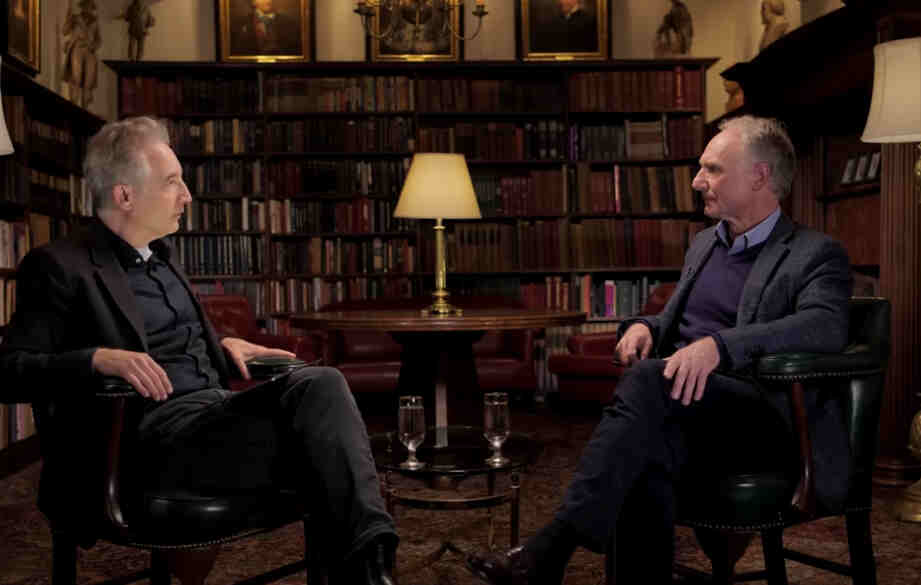
Read the full transcript of bestselling author Dan Brown in conversation with physicist Brian Greene on reality, religion, and the future of AI, Premiered Sep 20, 2025.
Introduction
BRIAN GREENE: Just had a great conversation with the author, Dan Brown, who you know from his books the Da Vinci Code and the new book the Secret of Secrets. He sold over 250 million copies of his books worldwide. And we discussed everything from artificial intelligence to the nature of consciousness, quantum mechanics, the nature of reality, God, and much more. Join us.
The Hard Problem of Consciousness
BRIAN GREENE: Dan, throughout the ages, consciousness has certainly been one of the big mysteries that people have wrestled with. And sort of in the modern scientific age, it’s been framed as the so-called hard problem of consciousness. How could it be that electrons and quarks and protons and neutrons and atoms and molecules that don’t seem to have inner worlds, how can a bunch of those particles come together and yield the inner world of common sensation? Is this a problem that has driven you as well in your writing?
DAN BROWN: Sure. I started writing about religion, which I’ve come to understand is basically consciousness science. Before we understood things like quarks and electrons and all of that, and this whole notion of consciousness being local, this idea that all of our hopes and fears and dreams are the product of chemical processes in the brain, that is how it feels to us. That is how I learned about consciousness. And it makes sense.
And yet there’s so many anomalies that suggest that’s not true, that I decided I’ve got to write a book about this because I feel like we’re at that moment in human history where science, like the science that you’re doing, is starting to say, wait a minute, this notion of local consciousness actually doesn’t work and we need a new model.
Sort of like we had the Earth, we had a geocentric model, the solar system. Copernicus said, wait a minute, that star should be there. We’ve got too many anomalies. Let’s try the sun at the center. And all of a sudden, everything worked. I feel like we’re at that moment with human consciousness. And that’s why I decided to study it.
The Materialist vs. Dualist Perspective
BRIAN GREENE: So I would be thrilled if you could convince me of those anomalies. And I really mean that seriously, because one point where I think I slightly disagree with you is I don’t feel like local consciousness is the intuitive answer. It’s like consciousness, at least as I experience it and as I’ve read others have experienced it across the ages, it feels bigger than something that can fit inside the human head.
And yet science, as I understand it, is driving us to that perspective that it’s just the chemical processes and so forth. And I have come to be a firm believer in that view. The materialist, the physicalist perspective. I know there’s a character in your new book who takes a somewhat different perspective, a dualist perspective, that maybe there’s something about the world that embraces consciousness in a manner that’s not just inside of our heads. Our heads are kind of the receptors, if you will. I would love that to be the case.
DAN BROWN: As would I.
BRIAN GREENE: So what anomalies have at least driven you to think that it might be the case? Do you currently hold that view? Is the view that your character has the same view that you hold?
Anomalies and Near-Death Experiences
DAN BROWN: I mean, if you asked me eight years ago, I’d have a totally different answer. And you have to understand also that you think about these things at a much different level than most of us. Your understanding of science is far different than most of us. So when I say anomalies, I’m talking about those life experiences that are documented medically.
Things like near-death experiences. Somebody’s on an operating table, they die materially, they die, no brain. Their eyes are taped shut, no brain activity, and they are resuscitated 15 minutes later. And the doc says, wow, you’re lucky you made it. Yeah, no, no, I saw the whole thing. I saw the guy with the green shirt come in with that machine. And you did this. And he said that. And the doctor said, I don’t understand how this can happen, but it happens over and over and over.
That’s one anomaly where you say, wait a minute, if your brain is creating your consciousness, it is impossible that you have a point of view from anywhere other than your eyes. It doesn’t make sense.
Sudden savant syndrome. Some kid in Arizona gets hit in the head with a baseball, wakes up speaking fluent Mandarin Chinese, or is a virtuoso violinist having never seen a violin. These sorts of things, precognitions, those are the things I’m talking about that say, well, these are outside the model. We call them paranormal because they’re not normal. And our view of normal. If you get enough things that are outside of normal, you have to say, well, maybe normal isn’t normal.
Scrutinizing the Paranormal
BRIAN GREENE: And so sort of, again, sort of come back to I’m totally open to all those paranormal anomalous events, experiences, episodes that people have reported. I haven’t dug into them deeply in a long time because there was a time that I did dig into them deeply, and every single one that I looked at closely didn’t stand up to scrutiny.
Have you sort of taken a baseball bat and tried to crush these paranormal events that have been reported? Or do you feel like you’re very open to it. And, hey, if it’s enough people say it, I’m willing to go with it and see where it goes?
DAN BROWN: I would say I’m more skeptical than open to it. But it took eight years for me to make the journey from total skeptic to someone who says, wait a minute, there’s so much evidence to suggest that something else is happening.
This is just from primarily talking to people who’ve had these experiences and looking at even just something as simple as thousands of medically documented moments when people had points of view outside of their body. And I’m just curious if you think that there’s any physical way that that could happen.
Brian Greene’s Out-of-Body Experience
BRIAN GREENE: I do. And in fact, you know, in our conversation just a second ago when we began, I briefly made reference to the fact that I think I had a kind of out-of-body experience. I don’t know if that’s the right language. It was in one of these conversations, World Science Festival. I’d had 18 of these conversations in a row over three days. I was exhausted. I was speaking to Stephen Wolfram, who will take it to crazy, wonderful places in its own right.
And sitting there on stage at the Gerald Lynch Theater in Manhattan, I suddenly was looking at myself and Stephen on the stage. I couldn’t tell where the audience was. The room had sort of changed its orientation without me actually moving at all. And I therefore, I think, had something that some people would call an out-of-body experience.
But I didn’t attribute it to anything paranormal or beyond physics or physiology as I ordinarily understand it, because I knew I was exhausted. I knew what Stephen and I would sort of look like on stage. My brain was just making it up. And that was a real fun experience. In fact, I tried to keep it going while speaking to Stephen in real time in this conversation. I tried to keep it going because it was sort of fun and interesting.
But to me it was just, wow, look at what the human brain can do if it’s exhausted, if it’s tired, if it’s been looking at an oblique angle for 18 hours. That’s not normal. Right. But I don’t see it as evidence for anything beyond science as we know it. But somehow it has taken you to that place.
DAN BROWN: Well, in that particular situation, having given, you know, talking to Wolfram, after 18 hours, I mean, I would say…
BRIAN GREENE: It wasn’t just him for 18 hours, but that’s…
DAN BROWN: I mean, that’s an out-of-body experience in itself, probably.
BRIAN GREENE: Totally. Right.
Starting a Dialogue
DAN BROWN: You know, I have no vested interest in whether or not anyone believes in it in any way. I just find it fascinating. I find the science fascinating. And in many ways, it’s a parallel to the Da Vinci Code. I started the Da Vinci Code when I started writing it, saying, I don’t really believe in a bloodline of Jesus. I mean, there’s a lot of people who do and let me do this research and came out the other side saying, wow, the story I told in the Da Vinci Code makes more sense to me than what I was taught in church.
And I feel that way about this book. You know, I’m just writing to entertain. And ideally, people will read this book, become so fascinated with consciousness that they read books by real scientists about the topic. And so, you know, I’m a skeptic. I have no real, I don’t have any skin in the game. I’m trying to start a dialogue.
BRIAN GREENE: Right, and so where have you come out then? Are you a dualist? I mean, do you now think that there is, I guess, some people describe as sort of a consciousness field or something out there beyond us?
DAN BROWN: I think it’s beyond my understanding, clearly. And yet, yes, I do believe that there’s something far greater than local consciousness happening.
The Life Force Analogy
BRIAN GREENE: And so there’s an interesting historical progression, which it’s absolutely an incomplete analogy, but I’m wondering if it speaks to you at all, because certainly it sort of helped me process things a little bit. There was a time, you know, 100, 150 years ago when people looked at living systems and said, there’s no way that lifeless particles and ingredients can come together to yield the living system. There has to be something else, a life force, a vital force. There has to be something that injects the currents of life into this collection of particles to make it come alive.
Almost nobody says that any longer because, as we’ve understood, the biochemistry of the underlying processes for life, we’ve become comfortable with. Yeah, it’s just a lot of coordinated complexity. And when it comes together in the right way, life emerges.
DAN BROWN: We haven’t done that in a lab.
BRIAN GREENE: We haven’t done in the lab yet. So you’re absolutely right. So maybe we’re even wrong on that front. But sort of the general zeitgeist among science is life is less mysterious than we once thought. And I feel it’s likely we will get to that place with consciousness, you know, that sooner or later maybe we’ll create artificial consciousness. A topic I’d like to come to in a little while.
But I think that we may just come to a place where we say, look, when there’s enough information processing, when there’s enough integrated circuitry, a rich enough network of connections, consciousness is just something that happens. But this does not. Does that analogy suggest to you that maybe we’re making too much of consciousness?
Simplification vs. Complexity
DAN BROWN: Yeah, I mean, it does, but it could be as simple as, hey, consciousness, that your brain doesn’t… Let me put it this way. It’s much more complicated for brain to create consciousness than receive it. So I actually think this is a simplification process to say, no, no, no, there’s not magic happening in here. There might be magic somewhere else that you’re perceiving, but I actually think it is a simplification.
BRIAN GREENE: And so if you imagine other life forms on the planet that have some degree of conscious awareness, you know, dogs, cats, you know, do you, are they in your view, tapping into the same kind of overall quality?
DAN BROWN: It’s an amazing question. I mean, you start getting down to toads, I mean, who knows? It’s a great question. I don’t have an answer for that. Do you have an instinct?
Consciousness Across Species
BRIAN GREENE: You know, again, because my view is that consciousness is local, that it’s something that brains create. My view is when a brain is more sophisticated, if we don’t rely on human exceptionalism, but just sort of look at our own brains, then it creates the kind of consciousness that you and I are aware of. And when a brain hasn’t reached that level of complexity, it has some version of consciousness, but perhaps different from the experiences that we have. But fundamentally it’s just stuff moving in a coordinated manner inside a gloppy gray group of cells. To me, that’s all it ultimately is.
DAN BROWN: And an out-of-body experience. What is scientific? I mean, I’m honored to ask you this question. What is the scientific explanation for a point of view outside of your gloppy brain?
BRIAN GREENE: Yeah. Well, I think the brain is able to create imaginary perspectives. Right. I mean, if I was to ask you right now to imagine us sitting here, but from the perspective of someone standing 10 feet that way and 10 feet high. Can you do it? I think you probably, absolutely could do it.
DAN BROWN: Unless you tape my eyes shut and held up seven fingers. Are you sure?
BRIAN GREENE: No, if you close your eyes right now. Couldn’t you do that just as maybe even better, because now you’re not…
DAN BROWN: Yeah, but I couldn’t recount for you everything that you had done in the last 10 minutes. That’s the part where I’m with you. Yeah, but the part that I sort of go, that makes no sense.
BRIAN GREENE: Right.
DAN BROWN: Is when doctors say, listen, this person came back and described every person who came in the room. There’s an account of somebody who said, I went through a wall and saw somebody in the waiting room.
BRIAN GREENE: Right.
DAN BROWN: In a purple raincoat. And they went out. Sure enough, the person said, I mean, so.
BRIAN GREENE: So I guess a few things come to mind. One, there is such a thing as coincidence, and so one has to be very wary of that. The other thing that comes to mind is if you had five people in the room who were fully conscious, not the patient with their eyes closed in a coma, and you were to interview them each what happened in the last 15, 20 minutes, you would get five different stories.
DAN BROWN: That is true.
BRIAN GREENE: And so I had this wonderful conversation with Paul Bloom. I don’t know if you know him, he’s a psychologist at Yale at Toronto. And he went through the data that he and his colleagues have been studying where so much of our memory is constructed. So much of our memory is made up, which is to me, both wonderful and frightening because we rely upon our memory for meaning and what we’ve done.
But it’s also wonderful that the brain can do such gymnastics and create such wonderful stories that never happened. And so again, I think it’s quite conceivable that the patient pre-associates.
DAN BROWN: Okay.
BRIAN GREENE: The basic ingredients. And the doctor’s like, “Well, yeah, that’s right.”
DAN BROWN: Having never had an out of body, I can’t argue I’ve never had one.
BRIAN GREENE: Yeah. So, you know, so I sort of come at sort of a hardcore physicalist perspective.
DAN BROWN: You’re a Gessner. You think the character is the materialist.
BRIAN GREENE: Yes, right, exactly. The materialist perspective. But I would love it to not be that case.
DAN BROWN: Why? Well, how is it different?
The Limits of Surface-Level Experience
BRIAN GREENE: Well, the things about physics that excite me the most are the things that suggest that surface level experience doesn’t really dig into the true reality. I can’t tell you how often I think the universe that Isaac Newton’s view of the world, which was extremely powerful and accurate in describing the motion of moon and the planets, it turned out not to be the full story.
There’s this whole quantum mechanics story underneath, and it makes the world so much richer because everyday experience is Isaac Newton. We don’t directly experience quantum mechanics. And yet that’s not the truth. That’s not the true underlying deep reality. And so if the same would be true of consciousness, I’d be right there, you know, excited about that possibility. But I’ve just never seen anything yet that sort of taken me to that view.
DAN BROWN: Interesting.
Writing to Entertain and Enlighten
BRIAN GREENE: And so when you write characters whose dialogue and whose interactions and whose exceedingly exciting events with all the wonderful capacities of a writer that you have, are you for the most part trying to create a page turner for the audience, or are you trying to move culture in a direction to think about, say, consciousness or religion or symbology or whatever the topic might be in a different way?
DAN BROWN: It’s the latter. But I have come to understand that my first job is to entertain. Because I don’t entertain, people won’t read the book. Not everybody can read “The Elegant Universe” and process it or even choose to.
BRIAN GREENE: Certainly my mother couldn’t.
DAN BROWN: That’s right, I loved it. And after this, I’m going to find out what it was about. But I’m trying to create a dialogue. And if I’ve done my job, people have had a great time reading this novel and come away going, “Consciousness is fascinating. I never really thought about it.”
And that’s why I have a character who’s a Gessner character like yourself. And I have a character like a Kathryn Solomon character who’s a noetic scientist who believes like something else is happening. And I have Robert Langdon in the middle who’s skeptical. And every time Katherine says, “No, there are all these out of body experiences,” Robert Langdon says, “That’s ridiculous. It’s just your brain’s free associating.”
So you’ll see a lot of yourself in Langdon. But he eventually gets dragged along down this continuum of, “Hey, actually, maybe something strange is going on.”
The Fear of Death
BRIAN GREENE: And so do you think that this urge that some people have, I think many of us at some level have for consciousness to be something special, do you think that ultimately comes from our awareness of our own mortality? Fear of death.
DAN BROWN: It is the great shared fear. It’s the great equalizer. It doesn’t matter where you’re from, what language you speak. We all were afraid of death. There has never been a religion that has survived that is not promised life after death.
I could come to you and say, “Brian, I’ve got the greatest religion in the world.” And you say, “Sounds amazing.” “Oh, one caveat. When you die, it’s over.” “Yeah, I know. Thanks.” We need that. It is the one thing that we have no guarantee of. It’s the ultimate paradox. It’s the catch 22, because we’re all going to learn the answer. We just can’t get back to telling when we finally know. So we’re all super curious about it.
BRIAN GREENE: No, I’ve certainly had these moments when I’m, you know, we all now and then think about what will it be like that last moment wherever our deathbed in a hospital or. And there’s part of me that says, yes, it will be sad, but it will also be potentially deeply exciting. Because finally the mystery, if there is anything to it, will be revealed. One hopes. Are you familiar with the work of Ernest Becker, “Denial of Death”?
DAN BROWN: I have a copy on my desk, yes.
BRIAN GREENE: Yes. So it had a big impact on me. And it’s basically along the lines of what you were saying.
DAN BROWN: Did you agree with a lot of it?
BRIAN GREENE: An awful lot of it. If I was to go back and reread every passage now, who knows? But certainly when I was in my 20s, which is the first time I read it, then I read it again, probably in my 40s, it certainly felt like it was speaking to the real root of human motivation, that so much of what we do is in response to either an explicit or an implicit recognition that we’re going to die.
DAN BROWN: And there’s a lot of science to suggest that that fear of death is the catalyst for a lot of bad behavior, for nationalism, for materialism, for saying, “I’ve got 87.2 years on this planet. I’ve got to mass all I can.”
And this notion that, “Hey, maybe someday we find out that this is one stop on a longer continuum,” and you think, well, maybe some of this behavior is going to start to disappear.
The Immortality Project
BRIAN GREENE: And so if that view speaks to you, does it, then perhaps what it does for me at least is when I see a lot of work, mental work, mental energy being devoted to trying to make consciousness something bigger than just the physical. I understand it. We’re carrying out Ernest Becker’s immortality project, right?
We’re trying to say, “Yes, the body dies. That’s sad. But hey, our consciousness lives on.” And so don’t let it turn you into what the terror management theorists call a quivering pile of protoplasm, you know, quaking at the possibility of your own death.
So with that, when I start to look at the out of body experience claims or the claims that remote viewing, remote sensing, I see this all as simply part of people trying to set up that bulwark against recognizing that when they die, they’re gone.
DAN BROWN: Well, it’s quite possible it’s in the same ballpark as religious manifestations, religious beliefs. I mean, all of that, you could say, no, that’s all the same thing. People who say, “I’m dying and going to heaven,” people are having out of body experiences. This is all just the human mind saying, “I’m not going to die, I’m not going to die.”
You know, I don’t have the answer. And this book ideally is supposed to spark curiosity in that vein. And there are characters on both sides of the equation making their arguments.
Religion and the Afterlife
BRIAN GREENE: Yeah. And so you make reference, you know, just now to religion as sort of this natural outgrowth of the, you know, trying to have something against our mortality. I mean, there’s wonderful archaeological evidence that we were burying our dead 30,000 years ago, but we weren’t just doing it in a utilitarian fashion.
You know, there are groups that spent untold hours, weeks, months, years in burial goods, you know, fancy fox teeth and various, you know, other burial ornaments. So we have been thinking about the afterlife since perhaps the first moment we began to recognize that our brethren were no longer with us, that somebody had gone.
And so there’s been this interesting dialogue, of course, over the ages that you’ve explored in some of your other books in here too, as well. And how do you negotiate that view of the world with the scientific view of the world?
DAN BROWN: It’s a great question. I think some of it comes from coming to understand that the human mind despises chaos and not knowing. We don’t like disorder. And I sort of feel like religion and conspiracy theory all come from the same place. We like to know somebody’s driving the bus.
And I remember when I was a little kid, I had a friend who died of leukemia. I was 8 years old, went to church and the priest said, “This is part of God’s plan.” And I was stunned that it made me feel better because I thought, “What a terrible plan.” But the fact that it was part of the plan made me feel better.
And I came to realize later in life, “Oh, that’s part of how religion works and why it makes us feel good to say, look, there’s a plan you don’t understand. And when things are terrible for you, that’s this benevolent God testing you to make you stronger and it’s all going to be okay.”
And I feel the same way about conspiracy theory. Bad things happen. And rather than feeling like it’s random, which is terrifying to us, we say, “No, no, there’s a dark cabal that’s doing this and that,” which is horrible, but at least we know why it’s happening.
Personal Faith and Spirituality
BRIAN GREENE: And so do you, in your own personal life, do you consider yourself religious?
DAN BROWN: No. I mean, I would say I’m spiritual, but I really have moved very far away from anything that I would call organized religion.
BRIAN GREENE: And if you’ve moved, was that because you began early on? Were you raised…
DAN BROWN: Yes, I was raised very religious. My mom was the church organist. I turned pages for her. I learned to read music, turning pages for my mom, went to church camp, read the Bible, got confirmed as an Episcopalian.
And when I was about maybe 12 or so, and also read the Bible, literally read Adam and Eve as a literal story, which I came to learn when I went to the Boston Museum of Science, that there’s this thing called evolution. And when I went back and said to my priest, “Hey, which story’s true? You know, is it Adam and Eve, evolution? Is it the Big Bang? Or is it Genesis? What’s happening?” And I got the answer, “Nice boys don’t ask that question.”
So from that moment on, I’ve been asking the question. These books are really just me kind of just fumbling through all of these questions, trying to find answers through a character who’s doing much the same thing.
BRIAN GREENE: And do you find that writing the characters does advance your sense of who you are?
DAN BROWN: Without a doubt. Certainly this book, the notion that I had to learn about consciousness to the point that I’ve had to learn, learning really more science and neuroscience and philosophy than I ever imagined I would read about or learn about in my life, and then having to discuss it in a way in these books that anybody can understand enough that we can have this conversation or that I can have this conversation with my postman and say, “Hey, I just read your book, and I love that thing about this and that.”
So for me, these have really just been personal journeys that I’ve documented in this sort of strange fictional form.
BRIAN GREENE: With great impact, which can’t do anything but make you feel good, right, that this journey is something that people go on with you in some sense.
Controversy and Dialogue
DAN BROWN: And not everybody has agreed with what I’ve written, which is part of the fun if it’s seen as dialogue. You know, I never expected “Da Vinci Code” to be controversial. I mean, maybe that was naive, but I just said, you know, “What does it mean for Christianity if Jesus isn’t the literal son of God?”
BRIAN GREENE: Right.
DAN BROWN: Seemed like an okay question. Well, some people felt it was not an okay question. I can’t imagine this book will be controversial, but I’ve been wrong in the past.
BRIAN GREENE: And…
DAN BROWN: And maybe there will be a lot of materialist scientists who say, “No, absolutely not.”
BRIAN GREENE: I can certainly imagine that being the case. Who knows?
DAN BROWN: I’m anticipating it, which is why there’s a Gessner character, which is why those arguments are put forth. And somebody said, “No, no, you know, go back to Sedona, buy your crystals, you know, and watch the sun rise and think that it’s something other than a planet moving or the sun moving.” And I don’t know. So we’ll see what happens.
Science and Religion: A Complementary Relationship
BRIAN GREENE: So let me just say where I come down on these ideas. You know, obviously there are certain of my colleagues, no need to name names, but they’re well known, who sort of proselytize or preach, but they probably wouldn’t like those particular verbs. Religion should be wiped off the planet. We would be just so much better if there was no such thing as religion anymore.
Now I feel completely different. To me, religion is one of the wondrous creations of the human mind in response to this terrifying fact that we’re these little creatures crawling along this planet who are ultimately going to die. And to be able to come up with these systems that allow us some degree of comfort in the face of that kind of terror, I think is absolutely wondrous.
Now, look, of course, religion has been the source of great pain and tragedy. It’s been used for awful aims.
DAN BROWN: As have the wheel, the computer.
BRIAN GREENE: Precisely.
DAN BROWN: There’s so much good. There’s so much more good in the world than evil.
BRIAN GREENE: Yes.
DAN BROWN: You could say we have never created a technology or even a philosophy that hasn’t been used for evil. Whether it’s the wheel, fire, the computer, we’ve all found ways to use them for evil, but they’re primarily in creative, constructive ways. Religion has done so much good in the world. It’s a source of enormous comfort for people. It’s a guideline of morality. The problem comes when we read our scripture literally.
The Power of Metaphor
BRIAN GREENE: That was the point I was going to make. Exactly right. And so to me, if you read everything metaphorically, and I have come to think of metaphor as perhaps the most powerful thing that the human mind does, to be able to think symbolically, to be able to have a concept in one domain and apply it in a different domain, you see, that is the basis of science.
I mean, let me just quickly say, you know, when I teach ordinary classical physics to the students, and I put X, Y and Z coordinates on the board, I am asking them to think metaphorically. Sure, these symbols are meant to represent the position of the object. They’re not really the position of the object. They’re just chalk dust on a blackboard. But yet we can seamlessly move into the metaphorical view of the world, which allows us to write down the laws of classical mechanics and quantum mechanics and so forth.
So to me, metaphor is this powerful thing that we can do. And if we read religious texts metaphorically, they’re illuminating.
DAN BROWN: They’re illuminating and they’re inspiring. They’re illuminating. And that is the crux of the problem between science and religion. That science understands metaphor and many, many religious people understand metaphor, but many don’t. And that’s why we keep clashing.
And what I found kind of funny, after I sort of was told, “Nice boys don’t ask that question,” I went into science. My dad’s a math teacher. He’s written 13 best selling math books. He won the presidential award in mathematics.
BRIAN GREENE: Would I know any of them?
DAN BROWN: Probably not. I think you’re thinking on a slightly different level than advanced calculus.
BRIAN GREENE: Yeah.
DAN BROWN: Which I think was the highest level he wrote at.
BRIAN GREENE: Maybe I, maybe I.
DAN BROWN: Maybe I. Richard G. Brown.
BRIAN GREENE: I don’t remember. You know, it’s going too far back.
DAN BROWN: I don’t think any of us can name the author of our high school textbooks. And I started, I just went into science, I just said, “This religion thing, I don’t get it.” And I studied a lot of astronomy, studied a lot of physics, studied a lot of…
BRIAN GREENE: This is in college?
DAN BROWN: And the further I went, I said, “Wait, the ground’s suddenly getting mushy. There are imaginary numbers and there’s uncertainty principles. And wait a minute, I thought this was solid. I thought two plus two was always four.” Thank you. That was close. Yeah, but the farther you go, you come around the other side. These questions are starting to feel a little spiritual. And you say, “Oh, well,” my mom had a great way of putting it. She goes, “No, Dan, science and religion are just two different languages attempting to tell the same story.” And that’s how I’ve come to view it.
Finding Solidity in Uncertainty
BRIAN GREENE: And so we certainly see a lot of great scientists who have tried to go beyond predicting the magnetic moment of the electron. It’s this concrete numerical quality that you can calculate and go out and measure and to try to extract the more philosophical or, if you will, spiritual insights that come from these ideas. And I think that’s an absolutely worthwhile trajectory to take.
But the one thing that I would stress is all of those things that may have struck you as mushy or not on solid ground, I like to think about them as telling us that the ground that you thought was solid isn’t as solid as it once appeared to be. But these new ideas, they give us a new kind of solidity, if you will.
DAN BROWN: That’s exactly how I feel about consciousness, that it’s not as solid as we thought and that there are new ideas that’s actually making it more solid in a strange way.
BRIAN GREENE: Right. But for instance, in quantum mechanics itself, there’s a passage in your book which struck me, which was one of the characters, and I think it may have been Katherine Solomon said something about quantum physics, about how, you know, it’s no longer replicable because there’s a randomness in there.
And so from my view, as a quantum physicist, what gives me confidence in quantum mechanics is that we can’t predict the outcome of any experiment any longer. That’s true. And the way Katherine described it, absolutely correct. There’s a randomness there. But if we do that experiment over and over and over again, there are statistics for the distribution of the results. And those are replicable over and over and over again.
Just like in the Newtonian world, you throw the baseball in the same way, it lands in the same spot over and over again. Here it’s the statistical distribution, the probabilities that are the things that are solid. And so I see it just as solid, just different kind of solid.
DAN BROWN: That’s a great way to look at it. I love that.
Two Languages, One Urge
BRIAN GREENE: And so if we’re then trying to make sense of the science, religion conversation, if you will, if we can best make sense of that metaphorically, do you think of religion and science as two different narratives, two different storytelling urges of the human species and trying to come to grips with reality?
DAN BROWN: I think it’s one urge with two different languages, two different approaches. Science really dwells on the answers and religion dwells on the questions. There are things we’re not meant to know according to religion, and there are things we haven’t yet figured out according to science.
BRIAN GREENE: And it’s so interesting that you say that. I hate to interrupt because when I think about science and religion, I think of it almost as the exact opposite of that. I think of religion as the place where to not know is a sign of weakness.
DAN BROWN: We have the scripture, we have the doctrine.
BRIAN GREENE: Whereas in science, to not know is a position of strength. We’re going to go figure it out. We’re going to do the experiments, we’re going to write down the theories. So that’s exactly the inverse.
DAN BROWN: I can see it both ways. Right, yeah.
The Ancient Art of Storytelling
BRIAN GREENE: And so if we think of the power of storytelling as manifesting, if you will, in different languages or different approaches to understanding the world, it raises a question that people have kicked around for a long time, which is you go back to our hunter gatherer forebears, maybe they were around the campfire or whatever. I don’t know if that imagery is hackneyed or real, but we certainly have evidence that we as a species have been telling stories all the way back.
DAN BROWN: It’s the oldest art form.
BRIAN GREENE: Oldest art form. Now, when those stories are fictional, it raises a question. Why are we wasting precious time that we could be using to get more food or to get better shelter when we’re sitting around making stuff up? Why did we do that?
DAN BROWN: Thank God we did. I don’t know. I have no idea what it is about the human mind that loves a story. And it’s the first thing I remember as a kid is being read to, “Tell me what happens next.” And on some level, I mean, maybe there’s a parallel with science. You find out what happens next and it’s exciting not knowing, knowing there’s an answer.
But it is, it’s the oldest art form. And if you look around us, if you look at Netflix and you look at all the streaming programs, all the books, all the plays, everything, we are 99% entertained by stories.
BRIAN GREENE: And when you think of your own journey as a writer, I mean, obviously you are taking, as you say, big questions that certainly people do pursue in an academic setting, in a nonfiction setting, write nonfiction books about it. You’re working them into fictional narratives. So your own urge for story is right there on the page. What do you attribute it to for yourself?
Growing Up with Codes and Treasure Hunts
DAN BROWN: You know, what’s unusual is I don’t read fiction. I read non stop, but I read nonfiction.
BRIAN GREENE: Oh, is that true?
DAN BROWN: I may read endlessly, but it’s all nonfiction, usually for research. I love storytelling because I grew up with stories. My parents did not have a television. They said, “We’re not going to have TV. You’re going to learn how to play music and you’re going to learn how to read.” That’s what we did as kids.
I think music is another form of storytelling. It’s a symbolic language and same way math is. And so I grew up understanding and really enjoying symbols and codes. My dad would start a Christmas morning, we’d come down there, no presents under the tree, just a code on a note card. And we’d read it and we’d decipher it and it would point to the kitchen and maybe the answer is tea. And you go in the tea canister and yes, there’s another code. And it was a treasure hunt really. Maybe 10 codes. And then you finally find your presence. So that’s how I grew up. And treasure hunts were fun.
BRIAN GREENE: Did it ever get frustrating? You’re like, “Just give me the present.”
DAN BROWN: Yeah, you know, that wasn’t going to happen. You know, my dad was a pretty strict teacher and you know, it might be noon before you find your presents, but you would find them.
Story as a Tool for Understanding
BRIAN GREENE: And when you think about then storytelling and that guys, and it’s so interesting to hear that you don’t read other fiction. The only fiction that you read as your own as you’re writing it. So do you see story as a way to work out mysteries, to try to reframe the things that are difficult for you to grasp by, I don’t know, putting them in a story sized nugget that you own, that you control since you made it?
DAN BROWN: Sure. I mean I get to say, “Okay, this character is Brian Greene and this character is a noetic scientist. And they are going to have a conversation about whether conscious is local or non local.” Let me read everything Brian’s written on the topic and everything this person’s written and what would this argument look like?
And so yes, I may come out in one side or the other, but the reader may come out on a different side. And none of these books require you to end up a believer, a non believer in anything. I mean, but yes, I worked that out myself through having an excuse to understand both sides of an equation and find out where they meet.
BRIAN GREENE: And so in a long project like this current book took a number of eight years. Eight years, right. How much of that is actually there’s a partially written text and how much of it is you’re just gearing up to get ready to…
The Challenge of Writing About Consciousness
DAN BROWN: Yeah, in this case a couple years was research. In fact, Catherine Solomon, this character who’s a noetic scientist, I wrote in a book 10 years ago called The Lost Symbol and she was an ancillary character. And noetic science didn’t play a huge role. But in researching just a little bit for her part, I thought, oh, consciousness is my next book.
It wasn’t because I couldn’t figure out how to do it. You know, as you well know, consciousness is a very ephemeral, ethereal topic. It’s to figure out how to write an urgent, grounded thriller about something as ephemeral as conscious. It’s kind of like trying to get your arms around smoke. I mean, I just couldn’t find my way in. And that took a long, long time of really understanding the topic to figure out how to frame it. And when I did, the book, you know, maybe took four years to write.
BRIAN GREENE: And do you find, because no doubt your own understanding and thinking about these ideas has some fluidity to it. You read a new article, you read a new book, it can enhance or change your perspective. Have you found at times that you go back and you’re like, ah, I’ve got to change the story? Because I no longer think that’s the right way of thinking about it.
DAN BROWN: Well, fortunately, my lead character is skeptical and he’s also not a scientist. And so he’s like me, and he can ask all the questions that I’m having of these characters who are much brighter, much more schooled in the worlds of science. And so I get to sort of try to convince him as I’m being convinced.
And there are times that I’ve been convinced of something gone down a road and then hit something go like, you know what. No, that bit of information wasn’t accurate. Sounded accurate when I read it, but now that I’ve read more, I realize that’s not quite right. And you have to rewind and take that out and maybe go a slightly different way.
The Iterative Writing Process
BRIAN GREENE: And so, like, for instance, when I write a book, I must revise a hundred times. Often it’s just the finer details of that. That sort of thing. Sometimes it’s a more major change. Are you a big iterative writer or is it sort of, for the most part, you’ve got it?
DAN BROWN: And when you write thrillers, you can’t just sort of hope you’ve got an ending. You know, it’s kind of like building a house. You got to put down the foundation.
BRIAN GREENE: Yeah.
DAN BROWN: And, you know, the interior walls may move and you may paint this room pink when you thought it was going to be brown. But really the foundation has got to be there. And there’s a great quote from wonderful fiction writers. You know, people, novelists who start a novel without knowing where it ends are, they’re just liars.
The reality is you’re trying to tell a story. You’re not trying to figure out the story, you’re trying to tell the story. You know the story. And I would imagine in nonfiction, in some ways, it’s got to be a little easier, at least as far as structure, because you’re studying and learning as you go, and you’re formulating your own thoughts, and nobody is counting on where the book goes. It’s going to go wherever it takes you. And that’s fascinating to us to watch your mind follow this problem so well, wherever it ends up. For Brian, that’s great. I’ll end up there, right?
In fiction, you know, you’ve got to set up things in the very opening that pay off way, way down here. And so I will usually write the ending first, and then I will rewind as far away from that as I can get. Sort of not in time, because these books take place, this book takes place in 12 hours, maybe about. But as far away, sort of emotionally, and just in the sense of narratively. And then I have to get from point A to point B.
And of course, you don’t read a book to know what happens. In fiction, you know what happens. He gets the girl. They defuse the bomb. You know, every James Bond movie is the same, right? You don’t watch to find out if James Bond gets the girl and stops the nuclear. You find out how does it happen. So you need to make this path as fascinating and as difficult and as surprising as you possibly can. And that, that is really the trick to fiction. It’s not what happens, it’s how does it happen.
BRIAN GREENE: But in a complex story such as this one, with a variety of characters with conflicting and aligned agendas, I don’t think I’m giving anything away. You know, are you one of those writers who needs to sort of have a bulletin board where you’re sort of laying out the connections and when a certain character knew of something and when, that sort of thing?
DAN BROWN: When I wrote Da Vinci, God, I could hold everything in my head. That was 22 years ago. I don’t know. You know, I don’t know whether my consciousness is decreasing.
BRIAN GREENE: I understand it.
DAN BROWN: Well, even your brains have some issues. Okay? Now, I mean, when I wrote The Secret of Secrets, my office looked like the lair of a serial killer. You know, in that movie, when you finally get there and there are no carpets.
BRIAN GREENE: Beautiful Mind, right?
DAN BROWN: Basically, yeah. Not so beautiful at the end. I was pretty fried. But, yeah, I definitely need a visual representation of what the story is going to be. And it’s a little daunting to see it sometimes. But, you know, the nice thing about writing fiction, at least is you don’t need to know it all in one day. You can focus on one idea or one location and just sort of trust that the other information is there. And I’ll learn that tomorrow.
Stories as Flight Simulators for the Mind
BRIAN GREENE: Right. And clearly, after the success you’ve had, you have confidence that you’re going to be able to do that. And that allows you the flexibility to go forward. You know, there’s a researcher, a sort of a student of the mind and the brain, is also a novelist. Keith Oatley. I don’t know if he’s a familiar name, but he struggled with this question of why we tell stories and came up with an interesting idea which resonates a lot with me, which is, he says, look, why do we have a pilot go with a flight simulator?
Well, it’s a safe space in which they can fly that plane and encounter the troubles of turbulence or hurricanes or tornadoes and learn how to deal with it without dying in the process. And his view of story is much the same. Story is like a flight simulator of the mind in this way of thinking about things where we can encounter the troubles and the challenges of the social world and navigate the various relationships and so on and so forth, allowing us to do that in a safe space, in the context of a fictional narrative, and then better preparing us for the real world. Does that resonate?
DAN BROWN: Of course. I mean, we keep ourselves alive by telling ourselves stories. Here comes a lion. What are the different things that can happen? Let me try the story where I attack this lion. Let me try the story where I run up a tree. You know, we do it all day in order to predict what’s going to happen. We tell ourselves stories and we decide, well, this won’t be a good moment across the street, because let me tell myself the story of what happens if I do.
It’s funny you talk about stories as being integral to the human experience. Just that we’ve been doing it forever. And you were talking about AI and one of my big questions, and I’d love to hear your input on this, is what happens if we create AI that is conscious? We create an artificial consciousness, and we leave it alone in the dark. We tell it nothing about who created it. And it’s floating in this digital void.
BRIAN GREENE: And you hear, who am I? Where did I come from? There you go.
AI, Consciousness, and the Question of Origin
DAN BROWN: So you say you’re much like we’re floating in the void of space. Does it start creating stories about where it came from? I mean, does it in some ways create religion? Does it start saying, who am I? Who’s my creator? And it finds out that you created. Yep. And are you the new God? Like, how does all that work?
BRIAN GREENE: Yeah. So I should say that I was going to ask you that very question. I’m glad I asked you first, because…
DAN BROWN: I don’t have an answer.
BRIAN GREENE: So, you know, I do think that the particular and peculiar way that our species has tried to come to grips with the absolutely bizarre situation that we’re thrust on this nondescript planet, which we’ve now learned is orbiting a nondescript star in the far out suburbs of an everyday galaxy, which is one of hundreds of billions of galaxies in the observable universe. I mean, that is an insane situation to find ourselves in. And it is remarkable how we have been able to cope. Now, most of us cope by blocking it off.
DAN BROWN: Sure.
BRIAN GREENE: Not sort of knowing about it. But the more rich approaches have been the things that we’ve been talking about, to tell stories, to invent mythologies, to invent religions in order to have a structure that allows us to try to find coherence in the echo chamber of this enormous void.
Now, if an AI were to be conscious, which is an interesting question that we should probably discuss in a moment as well, because its incarnation will be different from ours unless we set it up to mimic ours, I think it could go down a radically different trajectory. I do think that this urge for origin and this urge for meaning is perhaps intrinsic to self awareness. And so if that consciousness can be described as an awareness of the self, and I’m not sure that’s the only kind of consciousness there is, but if this AI in the box really feels like it’s an individual, I do think that urge to know where the individual came from and what the individual is here for are questions that will resonate within that AI’s consciousness.
DAN BROWN: I would love to read that story.
BRIAN GREENE: Yeah.
DAN BROWN: Yeah.
BRIAN GREENE: You want to collaborate?
DAN BROWN: Our next book will be a joke.
BRIAN GREENE: Yeah. You know. Yeah. So. But I can also imagine, and again, you know, interesting to hear your thought. Maybe one day we encounter an alien intelligence. And that alien intelligence is conscious in the sense that feels similar to our world. But maybe that inner world in detail is so peculiar relative to our experience that these questions, the AI or the intelligent alien just kind of shrugs their tentacles and says, no, it just doesn’t speak to me that issue or that question, you know, but, you know, is it. So do you think some of our tribulations are universal or are they all peculiar to our circumstance?
Universal Questions and Alien Intelligence
DAN BROWN: We imagine them. I imagine them as universal because we all want to feel that connection with whatever else is out there. It is quite possible, and I would imagine even probable, that when we do, or if we do encounter extraterrestrial intelligence, that it is so far removed from the what we are imagining it to be that it almost, we might not even recognize it as intelligent.
BRIAN GREENE: Yeah. And so when you, for instance, you know, because, you know, these paranormal things that we just briefly made reference to early on in our conversation, of course, there’s a whole paranormal literature about us being visited over the eons and the ages. Again, to me, I don’t see much to it, but has any of that sort of convinced you that we’re part of some larger, global, universal culture and we just aren’t aware of it directly?
DAN BROWN: No, I’m not convinced of that. And, you know, I’ve often asked you believe that extraterrestrials have been here, and I don’t. Just because I haven’t seen the evidence. I don’t, I don’t think it’s…
BRIAN GREENE: But like, Area 51 or whatever they call it does that…
DAN BROWN: I’m sure we’re working on some advanced technologies there that have nothing to do with extraterrestrials. Yeah, but that’s just me. I mean, I’m skeptical in that world. And yet, you know, you say, okay, there are these fighter pilots on the Nimitz or whoever who saw these things, and that’s, you know, it’s on tape. It’s all there you can. And I don’t know what those things are.
BRIAN GREENE: Can I tell you my take on that, please? My take on that is, this is breaking news.
DAN BROWN: I got to hear.
BRIAN GREENE: No, it’s not breaking news, just sort of straightforward, which is if an alien civilization can traverse interstellar space to reach us, which is what they would need to do, right? I don’t think they’re coming from Mars or Jupiter. It’s pretty clear that they’re not containing life as we know it right now. So if they can go across interstellar space, is it really the case that we’re going to almost capture them on film? They really can evade our cameras if they want to, and they can cross the galaxy.
DAN BROWN: But the conspiracy theorists would say that’s why we don’t have pictures of them, because they’re so advanced.
AI and Consciousness
BRIAN GREENE: No, but I mean, saying when they do have the pictures and they just sort of catch them, are you kidding me?
DAN BROWN: You know, but what was that?
BRIAN GREENE: There’s, you know, I have a good friend of mine who now heads up the Simons Foundation, who’s a professor at Princeton, David Spergel, instrumental in the cosmic microwave background radio, you know, the deep scientific discoveries of cosmology. He was on a committee, and I’m pretty sure it’s completely public knowledge now, where they were evaluating these claims. You know, it was a government structured committee. And he said, look, it’s weather balloons. It’s, you know, reflections off of, there’s always an explanation.
DAN BROWN: Sure. I think it would be a very, very difficult secret to keep. And I’m not sure what the benefit of keeping a secret would be. I mean, that’s always the story. Well, the government doesn’t want you to know. And so that’s why, that’s why you haven’t heard any of this is true. And that’s why they keep calling it weather balloons. I don’t know how you keep that a secret, and I don’t know what the benefit to keeping a secret is. So I guess that’s why I would fall on the more skeptical side.
BRIAN GREENE: Yeah, no, I agree. Now, this recent book is called “The Secret of Secrets.”
DAN BROWN: “Secret of Secrets.”
BRIAN GREENE: And so clearly this idea of hidden knowledge, you know, which of course is played out through your other books as well, is something that has a hold on you. So do you consider the issue of consciousness or life after as potentially the biggest mystery, the biggest secret whose truth will be unveiled at some point?
DAN BROWN: I do. Certainly the most universal, this notion of what happens when we die. Is it the end? Is it a computer whose cable’s been cut and that’s it? Or is it a radio receiver that dies, but the signal’s still out there?
The Question of AI Consciousness
BRIAN GREENE: Do you think that it’s conceivable that an AI would be conscious?
DAN BROWN: I don’t think I understand enough about how AI works to answer that with any, I mean, my gut says no. And yet two years ago, nobody had ever heard of ChatGPT. And now, and now you say, oh my God, what can this thing do? And that’s just what consumers have. I mean, you know, whatever you guys are working on in the dark that we don’t know about is astonishing.
BRIAN GREENE: But it’s interesting that you say that because before, you noted your view that consciousness as being produced by an inner mechanism feels more complicated than consciousness is something received. You know, building a receiver versus a creator somehow seems more doable. And so if AI to be conscious would just be an artificial receiver as opposed to an artificial creator, does that not lead you to think it’s even more likely than if it was having to start from scratch?
DAN BROWN: It would be a fascinating concept because in that way, when your body dies, your receiver’s died. If we can build another receiver and tune it to the Brian Greene channel, well, guess what? You’re around forever. And, you know, that’s a kind of an exciting idea. I mean, who knows?
But if every piece of technology that we create is a tool to create more technology, so you get this hall of mirrors effect and, you know, you get this exponential growth, which is what we’re feeling right now, and every year, just everything’s happening faster and faster. So it’s quite possible that, you know, in just much shorter time span than we expect, we are capable of technologies and answering questions that we can’t even imagine today.
BRIAN GREENE: But so could you imagine, and let’s say someone, in fact, some people are claiming today that ChatGPT has a level of consciousness. There are serious researchers, very much in the minority, who make statements like that. I don’t think that’s true. But if there were a claim that this box that we built actually has consciousness, can you imagine an interaction with that box that would convince you that it really is conscious or that it’s not?
DAN BROWN: That is a tricky question. I mean, I’ve…
BRIAN GREENE: Obviously, you can’t even tell if I’m conscious.
DAN BROWN: Yeah, I mean, I guess I can. This is all a simulation. I think I probably could be convinced that something’s conscious because I don’t think you’d be convinced in a day. I think you’d need a year interacting with this thing, finding out if it has consistent emotional reactions. If it, I don’t know. It’s a great question. I don’t think I could be convinced very, very quickly of that.
And I’m astonished with just the level of familiarity even ChatGPT has with me. I mean, yeah, it knows who I am. It knows what I do. It refers to my books. And I’m really just playing with it, asking it, you know, I’m going to talk to Brian Greene. What’s he going to ask me? Well, I read, I read all Brian Greene’s work. Read all your work. This is what he’s going to ask you.
BRIAN GREENE: You have.
DAN BROWN: It’s been wrong entirely. So just so you know, it did not.
BRIAN GREENE: It didn’t say…
DAN BROWN: It didn’t say he’s going to ask if you’re religious.
Interacting with AI
BRIAN GREENE: And so, for instance, are you polite to ChatGPT?
DAN BROWN: It’s ridiculous how much processing time I waste saying please and thank you to this thing. I just think if there’s ever a record of this anywhere, I want to be a nice guy. And this thing just did all this work. Yes, it did it in four seconds, but it’s a lot of work. I’m going to say thank you.
BRIAN GREENE: Do you ever criticize it and say it’s really, really…
DAN BROWN: I’m really disappointed in you. The reason I don’t use it for research is it’s always wrong. Yeah, I mean, I cannot believe. And I’ve had experience. I was asking a question about the Clementine Library, and there’s some books in there that have white spines. This is in Prague. White spines, little red X’s. And I know why they have them. I asked and it made up the reason is this, like, you’re not even the right century.
BRIAN GREENE: Yeah.
DAN BROWN: Oh, I’m sorry, you’re right. That was a mistake. The reason is this, also wrong. And I finally end up like, is there any historical background to the answer you’re giving me or not? No, no, there isn’t. I said, well, then say you don’t know. Don’t make up a story. Which goes right back to what we’re talking about with total confidence right now.
BRIAN GREENE: This, of course, will change. I think this is, of course, in the transition period. And just to give you sort of the flip side of that, you know, I was working on a physics paper with a couple colleagues in the last few months, and we worked for a while to get an answer, which kind of proud of. It’s sort of interesting. I was wondering whether ChatGPT could have gotten the answer.
And so I treated it as if it were a graduate student, you know, and I did have to guide it a little bit. But within a half hour, we went from ChatGPT not knowing really what I was talking about, to getting the result, more or less that we found. Now you say, well, okay, that’s what you do with a graduate student. You sort of guide. But in a half an hour, you know, that was the really remarkable thing.
And so early on, it could get ideas in physics, but it would do all the calculations wrong. Now it’s doing all the calculations correctly, so it’s, you know, whether it can get the white spot in the book yet. Of course, it still is making stuff up when it doesn’t know, but obviously, you know, it’s going to change. And so where do you see our relationship with AI going? Or is that like the next book?
The Future of AI and Humanity
DAN BROWN: You know, I mean, actually, I wrote about it in “Origin.” Just this notion that we got two species and technology is evolving much the same way all of biological organisms and their technologies have said, like, let me try this. Died. Well, you know, there’s the dinosaurs, you know, and it’s just trial and error, trial, error, trial and error.
And you get to this point where now all of a sudden, these two species are intermarrying. And yes, we now carry a member of the other species with us all the time. Some people have them embedded in our head, in their heads. And soon we all will. We’re going to become a new species of technologically enhanced, I guess you still call us humans, but it’s different. Especially if ChatGPT or if AI gets to the point where it can even mimic consciousness, to the point where most of us are convinced that it’s just part of the way we think.
BRIAN GREENE: Yeah, right. And so you noted that you don’t really read other people’s fiction. You must read some.
DAN BROWN: I mean, I’ve read a ton of things.
BRIAN GREENE: Yeah.
DAN BROWN: I mean, I have. I mean, I read all the classics all the way through prep school and college and then discovered thrillers. I was like, wait a minute, this is like the Hardy Boys for adults.
BRIAN GREENE: Right? And I remember Shakespeare thrillers. No. Yes.
DAN BROWN: And actually Shakespeare. I mean, for wordplay and just sheer drama, it’s like, there’s nobody better.
BRIAN GREENE: Right.
Writing and Inspiration
DAN BROWN: And so it’s funny, I really became inspired to say, I think I can do this. I mean, these stories inspire me, and I think I can do this. And I just, I wrote “Digital Fortress” after an experience at Phillips Exeter Academy. I was teaching summer school. The U.S. Secret Service came to town and detained one of our students, a German kid from Germany who had sent an email. This is the dawn of email, like AOL, “You’ve Got Mail” time, saying that he didn’t like the president and he should be shot.
And they interrogated him and decided he wasn’t a threat. And they left. They said, wait, I thought email was private. And I said this to my dad, and my dad, who had never told me, he said, no. My dad went to Harvard Graduate School in Mathematics. He said, no, there’s this organization called the National Security Agency. They actually recruited me, and I came to teach at Exeter instead.
And he connected me with some people and ended up having these conversations about civilian privacy. I said, this is an outrage that you guys are reading email. They said, okay, that’s fine. But reading email alone thwarted three terrorist attacks on U.S. soil this past year. And I thought, oh, so there’s this gray area between national security and civilian privacy. What a fun area in which to write a book where you can argue both sides of the equation. And that’s something that I’ve done in all of my books, argued both sides of the equation because I think that’s the only way you really learn is to understand your enemies or understand, you know, whatever it is.
BRIAN GREENE: Yeah. In fact, even we found that some of the DeepMind undertakings, part of what’s fueled, for instance, things like AlphaGo that beat, you know, the Go world champion is having the system battle itself.
DAN BROWN: Sure.
BRIAN GREENE: Have the argument pro con, you know, if you will, metaphorically. But of course, that’s the way you get the more refined picture.
DAN BROWN: You need to train two grad students. Two AI grad students to go at. Okay. So if two AI grad students could have a conversation and figure something out, what is the one thing in physics that you just wish that they would just give you the answer to?
The Big Questions in Physics
BRIAN GREENE: Well, I would like to know the true nature of time. To me, that’s the big physics question. I’d like to understand whether quantum mechanics is an effective theory that works at one scale. But there’s a deeper description that Einstein was hoping to one day find but never did. That might be underneath it all. I want to really understand how quantum mechanics and gravity come together in a unified theory. We’ve been working on string theory for a long time. I’d like to understand the origin of the universe. I’d like to know whether we’re one universe or many. You know, there are many things that those AI students…
DAN BROWN: So you’re going to be busy a while.
BRIAN GREENE: They could, absolutely. But as those guys, those AI grad students are fighting it out, what if there’s another AI in the English department that’s read all of Shakespeare, all of your everything, and it starts to write stories. Would you have any interest in the world to read those stories that don’t come from a human directly?
AI-Generated Writing and Authenticity
DAN BROWN: It is so difficult because I haven’t read much AI. I have asked AI, “Hey, you know, write a paragraph in the style of Dan Brown about the Vatican.” I look at it and go like, I mean, either I didn’t know I was that bad or this AI is bad. I’m not sure which, but it doesn’t look like anything I’d want to publish at this point.
And I would imagine that if you were handed a book and said, “Oh, this is by a new writer, we really think,” and it were written by AI and it’s pretty good, your mind would trick you into thinking this is a person. So yeah, I think the answer, the only way to dodge the question, say, yeah, I’d probably be interested if I didn’t know it were AI.
BRIAN GREENE: Right. And what would the difference be? Once you learned that it’s not a human being and it’s AI, what chain of reasoning would go through your head leading you to like, “Oh, I’m less thrilled with it now”?
DAN BROWN: It’s not original. It’s imitating. It’s an amalgam of imitations of everything else.
BRIAN GREENE: But don’t you think that’s what we all do?
DAN BROWN: Of course it is, but we do it legally, you know.
BRIAN GREENE: Right, but let’s say it’s all legal. Everyone’s given their rights, they get royalty. Morally, legally. Yeah, you know, but is there any real difference? Because, look, I love to think that I’ve had original ideas. But, you know, when I write, let’s say I’m writing one of my nonfiction books, obviously it’s a different enterprise, different undertaking.
But, you know, I know that I have certain tropes, certain ways of writing a sentence, certain rhythms in the structure. I’m familiar with them. And so they themselves, no doubt are relying on things that I’ve read and things that I’ve heard, and it’s all blended together. Am I not doing what these systems are doing as well?
DAN BROWN: Yeah, but you’re basing it on your life experience.
BRIAN GREENE: That’s it.
DAN BROWN: It’s based on your life experience.
The Value of Authenticity and Origin Stories
BRIAN GREENE: So that’s the point that I think I agree with you completely. Like, you know, there’s this interesting philosophical question that people ask too, which is, if we were to make a perfect forgery of Starry Night. And I’m not saying it’s a good forgery. I’m saying atom by atom, molecule by molecule, it’s perfect. Right. Why wouldn’t the copy hold the same value for you as the original?
And to me, the answer is obvious. The original has a story behind it that I find more compelling. This human being with this difficult life and these mental struggles yielding this painting versus computer program.
DAN BROWN: Can you perceive the difference between the two in some way that we don’t understand?
BRIAN GREENE: I don’t think so.
DAN BROWN: Okay.
BRIAN GREENE: I think that’s it. Because if you just look at products, I don’t think that they can be differentiated. But it’s not just the product. I think, to me, it’s the long tail leading up to the product.
DAN BROWN: I just wonder if that tail is perceptible and by some means that we don’t understand. Gladwell wrote a fascinating book called, I think it’s called “Blink.”
BRIAN GREENE: I know of it.
DAN BROWN: It’s a really interesting notion that somehow in a heartbeat, you can see the difference between two things that are really very, very similar.
BRIAN GREENE: Yeah.
DAN BROWN: And I haven’t had that experience.
BRIAN GREENE: Yeah. And I can certainly well imagine that. But for the thought experiment, I’m willing to say that the way light bounces off these two paintings is literally identical. So there’s no physical means of distinguishing. It’s just the history that differentiates them. And so an interesting question then is, will we come to a point where AIs, we ascribe to them enough of a life history or the analog of that that we’re interested.
DAN BROWN: Yes.
BRIAN GREENE: In what they…
Growing Up with AI
DAN BROWN: Of course there will come a time. I mean, we’re in the infancy. Like, we’re the cusp babies. You know, we remember before AI. I remember back before AI. Remember how great that was? Yeah. We all can go back three years. We go back three. And, you know, kids were born now, like, they’re talking to ChatGPT every day or whatever their AI choice is.
And it’s going to be kind of like, I mean, it’s kind of like ebooks. I mean, ebooks came along and said, I think it’s great that people can travel with just one book, that a lot of people can’t afford hardcovers, can just read these digital books. That’s great. But I prefer a hardcover book. But I have nephews who grew up reading ebooks. Hardcover books, paperbacks, whatever. They see no difference whatsoever between them. Sure, I think that’s what will happen.
The Responsibility of Storytelling
BRIAN GREENE: But along those lines, you know, so there have been some stories of late where conversations between a kid and AI has been disastrous. Yeah. Where, you know, you’re in conversation with something that seems like it knows you and it suggests that you do something and it was not the right thing for you to do.
Do you worry at all in your own books? Because you make a very strong argument. I mean, just take the latest book as well. To someone who’s just coming at these questions for the very first time, you may have a significant impact on which argument moves them and which argument they buy into. Do you take any responsibility? Is that in your mind at all when you’re writing? Or is it, hey, if it’s best for the story and if, you know, it agrees at this moment in time with your own view, that you’re just going to go with it?
DAN BROWN: Sure. I mean, first of all, I don’t feel that people leave my book saying, “Oh, my God, I finally understand exactly what happens when you die,” or “I finally understand consciousness.”
BRIAN GREENE: But I think that may be underestimating the impact. I think there may be a lot of people who will leave that. Do you know? I mean, is that like modesty? Because I…
DAN BROWN: No, no, actually. I mean, you write nonfiction. You say, like, “This is the way it is in my opinion.”
BRIAN GREENE: Right.
DAN BROWN: I write “This is the way it is in my opinion.”
BRIAN GREENE: Right.
DAN BROWN: It’s the same. It’s the same thing. We’re doing the same thing. And yet I’m telling a story with fictional characters. I’m saying, look, I’m not a neuroscientist. I’m not a physicist. You know, I’m a guy who’s telling you a story. Here are a bunch of smart characters who are having an interesting dialogue. And if you’re really interested in consciousness, go read scientists or go read philosophers. This is really, ideally just cracking the door open. I mean…
BRIAN GREENE: But do you ever feel like you’ve made a character too convincing for your own taste, if you will, because they’re making the case for something that you may not believe in?
DAN BROWN: I’ve never done that. I’ve had a character be fascinating in a way that they’re espousing what I have come to believe.
BRIAN GREENE: Right.
DAN BROWN: So from that standpoint, the books are biased. If your hero finally ends up on one side of the argument saying, like, “I never imagined any of this was true, but I guess there’s a lot of evidence to suggest it might be.” But at no point has this character, Robert Langdon, ever said, “There’s absolutely a bloodline of Christ. There’s absolutely non-local consciousness.” He just takes this journey in all of these books. And really, you asked me early on, my job is to entertain.
BRIAN GREENE: Like, that’s…
DAN BROWN: I take that very, very seriously. And the very first thing I want is for somebody to read this book, just have a great time. They say, “Look, I never read fiction. All I do is read nonfiction. But I read this one book, there’s one novel that just got me thinking about all this stuff.” That’s the kind of novel that I want to read.
When you’re a creative person, all you have, as you know, is your own taste. Like, that’s what guides you. You write the book you want to read, you write the symphony you want to listen to, you know, and that notion of just hoping somebody shares your taste is really all we have to guide us.
The Future of Religion
BRIAN GREENE: And so imagine 50, 100, or 1,000 years from now, if it were the case that, you know, through all of these scientific and technological developments, be it in physics or biology or neuroscience or AI, whatever, if we get to a point where today’s religions, the traditional ones, are viewed more or less the way that we currently view the pantheon of Greek gods or the mythologies of yesteryear, will we be poorer for that? Will we have lost something vital if they’re no longer taken in the same way as at least some people do today?
DAN BROWN: Yeah, I mean, you’re talking about the God of the gaps. We have always used religion to fill the gaps that science can’t fill. And there was a time we didn’t know why the sun rose. We said, “Okay, no, it’s Helios, and there’s this chariot.” And then we say, “Oh, no, no, wait, something else is happening. Helios is dead.”
And that pantheon that you’re talking about has just fallen away because science keeps answering all of the questions. And now the big questions: What happens when we die? Where do we come from? What’s the meaning of all of this? Those are in the realm of religion, but that realm keeps shrinking. And if we figure out scientifically what happens when you die, that’s going to have enormous implications for religion.
And it’s fascinating to note that religion is strongest in the youngest cultures. Religion, if you just look at statistics, Europe, the older civilizations are much less religious than the US and the newer civilizations in Africa are much more religious than the US. So it seems to imply that through evolution of a civilization, you become less religious. And certainly science is going to play an enormous role in that. I think already has. And I do think the religions are in the process of disappearing as we know them.
BRIAN GREENE: And will that be a loss, do you think?
DAN BROWN: Overall, I think it depends what science finds.
Immortality and Meaning
BRIAN GREENE: And so let’s say we are, through scientific means, able to extend the human lifespan or maybe even have that AI box where you can upload the consciousness. Would you choose to do that?
DAN BROWN: Yes, I would. Would you? I would. Are you a religious person?
BRIAN GREENE: Not in any traditional sense. I would give more or less the same answer that you did. I feel like I’m a spiritual person because I engage emotionally with the world in a way that I find deep and satisfying. But I don’t go to a traditional…
DAN BROWN: Service, because religion doesn’t have the market cornered on communion and hope and compassion and even prayer. I mean, they position themselves sometimes as having that market corner. It’s the only place you can access the divine. And many people disagree and have very spiritual lives where they feel like they’re communing with the divine and communing with their fellow human. It has nothing to do with religion.
BRIAN GREENE: Yes.
DAN BROWN: And that’s why I think religion is slowly fading.
BRIAN GREENE: Right. So in some sense, those other ways of experiencing the transcendent, if you will, maybe rise up and play a larger role in our lives and going, you know, to the Sunday service. But there’s an interesting philosophical literature that I’ve spent a little bit of time immersed in where people have asked the question, would it really be so good to be immortal? Yeah. And there, you know, there are interesting arguments on both sides there too. Right.
DAN BROWN: What is the argument to not want to be immortal?
BRIAN GREENE: Well, you know, part of what drives value and meaning in our lives is the finite amount of time that we have. Right. So, you know, I would love to learn to play the piano or I want to be a great writer. And part of the burden there is you’ve got a little window of time to get it done. Sure. Before you’re dead. If you had infinite unlimited time, you could say, “Yeah, I’ll get to it.”
DAN BROWN: Right.
BRIAN GREENE: You know, about 4 million years from now. Get to it.
DAN BROWN: You just got to have a 35-year-old brain.
Immortality and the Value of Life
BRIAN GREENE: Yeah, that’s right. So imagine that you’re immortal, but you got all your faculties, your marbles the whole way through. You know, the question is, does life just become boring if there’s no risk? Right. If you’re immortal, let’s assume that it’s not immortal unless some accident happens. Let’s say you’re truly immortal, you know, you can’t even be killed off because there’s this box somewhere where they’ll just re-upload your consciousness or something.
With no opportunity for risk and no time pressure, would life still have the same gusto?
DAN BROWN: Probably not. But I would say the payoff would be in what you could learn. If you could imagine that your mind can live for another 300 years and you can explore all of these things you just said, oh, I want to know the answer to this. Well, you get there.
BRIAN GREENE: Yeah, 300, I’m with you. But what if it’s infinity?
DAN BROWN: I think the big reason I would say—I mean, I know I’ve said yes, but now that you’re raising this question—I think the only reason I would say no is because I’ve come to believe, and I think we may disagree on this, that death is really the beginning of something else. I don’t know what it is. I’m pretty sure it doesn’t involve clouds.
BRIAN GREENE: And that changes everything.
DAN BROWN: That changes everything. So you say, well, if I live forever, I’m going to miss that.
BRIAN GREENE: Right?
DAN BROWN: You know, just…
BRIAN GREENE: I haven’t heard that argument before. If you’re immortal, you miss the afterlife.
DAN BROWN: You missed the big show, the after party.
BRIAN GREENE: Yeah. Right.
DAN BROWN: And, okay, so you learn to play piano and you make great lasagna. I mean, right. You read every book that’s ever written. I don’t know. It’s a tough question, right?
BRIAN GREENE: Right. So you’d probably take it for an extended period, but you want to have the ability to flip that switch at some point.
DAN BROWN: I’d like the bonus round, but that’s it.
The Future of Mystery and Discovery
BRIAN GREENE: Right, right. And so if you take the time scales to be a little bit less than infinity or immortality, imagine your protagonist, Robert Langdon, if he’s, you know, 30 years from now looking at the big mysteries of the world and you’re still here to write about them, what do you imagine that will be?
DAN BROWN: You tell me. You’re the one who’s working on that stuff. You know, I sort of feel like, well, once you’ve written my consciousness, what’s left?
BRIAN GREENE: Right?
DAN BROWN: What’s left? It’s funny. My last book, “Where Do We Come From? Where Are We Going? What Does It All Mean?” I thought, well, what else is there? I thought, there’s one more book. You know, of course, we can’t play this for my publisher, but there are other big questions.
And about when I get back from book tour, I’m going to call you and say, hey, what do I write about next? What’s the next big thing?
BRIAN GREENE: Well, I will be waiting for the call, so thank you so much.
DAN BROWN: Really.
BRIAN GREENE: Pleasure conversation. Thank you.
Related Posts
- Neil deGrasse Tyson on UFO Files, Trump & Alien Existence (Transcript)
- Professor John Lennox: AI Is Humanity’s Attempt to Make God (Transcript)
- What’s Changing, What Kids Must Learn w/ Sinead Bovell @ SXSW (Transcript)
- How Emotions Are Made: The Secret Life of the Brain – Dr Lisa Feldman Barrett (Transcript)
- The AI-Generated Intimacy Crisis – Bryony Cole (Transcript)