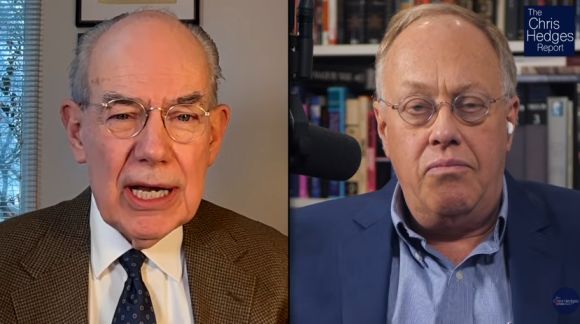
Editor’s Notes: In this episode of The Chris Hedges Report, Chris Hedges sits down with renowned political scientist Professor John Mearsheimer to analyze the ongoing and precarious conflict between the U.S.-Israel “tag team” and Iran. Mearsheimer explores how the Trump administration fell into a long-feared strategic trap, shifting from a one-day bombing to a grinding war of attrition that lacks a clear exit strategy. The discussion breaks down the severe global consequences of this escalation, including a massive energy crisis triggered by the closing of the Strait of Hormuz and the potential for a worldwide economic depression. Ultimately, they examine how this “terrible miscalculation” is degrading U.S. security arrangements in the Gulf and threatening to end American hegemony in the region. (March 12, 2026)
TRANSCRIPT:
Introduction
CHRIS HEDGES: Information in war is weaponized. This is true for the United States, it is true for Israel, and it is true for Iran. But reading through the fog of war, the conflict with Iran does not appear to be going well for Israel or its US ally.
Iran’s closing of the Strait of Hormuz and threats to mine the waterway is triggering the largest energy supply shock in decades. This energy crisis will only get worse. Iran has degraded the region’s military infrastructure, taking out sophisticated US radar stations in the Gulf and in Israel. This has left the US and Israel increasingly unable to track incoming missiles and drones.
Iran has carried out successful strikes on US bases and ports, as well as energy infrastructure, desalination plants and diplomatic compounds. The longer the war continues — and Iran shows no signs that it is interested in negotiations — the more it erodes the security arrangements in the Gulf, ones built on the premise that America will protect the Gulf countries from Iran in the event of a conflict.
The Trump administration has no clear goals for the war other than the unrealistic calls for unconditional surrender and bombastic threats. It has clearly made a terrible miscalculation about what the US could achieve by killing the top leaders in Iran, including the Supreme Leader. This war, as it drags on with no discernible exit strategy, has the potential to see the US forced, as the global economy goes into crisis, to meet Iranian demands. This humiliating defeat would potentially mean the end of US hegemony in the region.
Joining me to discuss the war in Iran is Professor John Mearsheimer. He is the R. Wendell Harrison Distinguished Service Professor of Political Science at the University of Chicago. Professor Mearsheimer, who graduated from West Point and was a captain in the Air Force, is the author of numerous books including Conventional Deterrence, Nuclear Deterrence, Ethics, Liddell Hart and the Weight of History, The Tragedy of Great Power Politics, The Israel Lobby and US Foreign Policy, and Why Leaders Lie: The Truth About Lying in International Politics.
How the Pentagon’s Resistance to War with Iran Was Overcome
CHRIS HEDGES: Let’s begin with this fact that the Pentagon for three decades has vigorously fought back against Israeli pressure to go to war with Iran. Whether that was Obama, Bush, Biden — and for all of the reasons, of course, that are now evident — the Pentagon didn’t want this conflict. How was that reticence or resistance overcome?
JOHN MEARSHEIMER: Yeah, it’s quite remarkable, Chris, that none of Trump’s predecessors took the bait when the Israelis tried to trap us into going to war against Iran. And you want to remember, in 2024, Joe Biden’s last year as president, the Israelis twice — once in April and then again in October of that year — tried to trap Biden into going to war against Iran, and he refused to do it.
And Trump is the first president who fell into the trap. And of course, he did it last June during the 12 Day War. You want to remember, in the 12 Day War, the Israelis by themselves started that conflict on June 13, and it ended on June 25. But on June 22, we bombed three nuclear targets in Iran. But it was a one day bombing. We talked about “one and done” at the time. And you remember that when the evening came on June 22, the bombing was finished. President Trump declared victory. So although he got involved for the first time, it only looked like he was putting his ankle in the water, that he wasn’t becoming deeply committed to fighting a war in Iran.
But that all changed on February 28th. The United States and Israel together — what I like to refer to as the tag team — decided to attack Iran. And we are now in a war of attrition with the Iranians, in which case it’s hard to see how this war ends.
So Trump took the bait. And I think, to put it in more specific terms, I think basically that Prime Minister Netanyahu, who has been working overtime for decades now — literally decades — to get the United States to attack Iran for Israel, finally succeeded with Trump. As I said, there was a tiny step taken forward in that regard last June, but now Trump has jumped full body into the water.
General Caine and the Military’s Unease
CHRIS HEDGES: And yet you see, even with this sycophantic head of the Joint Chiefs, Caine, every time he’s trotted out in front of the cameras, he doesn’t look very happy. I think the military foresaw, the Pentagon foresaw what is coming and is quite perplexed about how to deal with it.
JOHN MEARSHEIMER: I think that General Caine has actually behaved quite well here. You want to remember that when Trump came into office in January of last year, January 2025, he fired the Chairman of the Joint Chiefs of Staff, General Brown, and he brought General Caine out of retirement. Caine was only a three star general.
Now, given that he was in effect Trump’s general, that he owed his position to Donald Trump, you would think that he would tell Donald Trump what he wanted to hear about going to war against Iran. But on the contrary, what Caine did before the war — this is before February 28th — was he made it very clear to President Trump that we did not have a viable military option.
So when you say that General Caine, every time he’s trotted out, looks very uncomfortable — I think that’s true. And I think there is a simple explanation for why he looks so uncomfortable. He knew from the get go that this one was not going to work out the way Trump and Netanyahu thought that it was going to work out. And he understands that. He is the Chairman of the Joint Chiefs of Staff, and he was the chairman when we entered this foolish war on February 28th, despite the fact that he had warned against it.
The Decapitation Strategy: Regime Change or a Trap?
CHRIS HEDGES: Is it too simplistic to say that Trump and Netanyahu naively believed that by taking out the Supreme Leader and some of the hierarchy, there would be regime change and the war would be over?
JOHN MEARSHEIMER: I think that’s clearly the case with Trump. I think that that was the argument that Netanyahu sold to Trump, and Trump liked the argument. I think, given what happened in Venezuela, he thought that we had the ability to float like a butterfly and sting like a bee. And when Bibi told him that the regime in Iran is weak and all we have to do is decapitate it and really hit hard on that first day or two, that the regime would crumble and we would end up with a pro-American, pro-Israeli regime in its place — I think Netanyahu was very successful at telling Trump that story. And Trump is not exactly surrounded by wise advisors, save for General Caine, who would tell him otherwise. So he fell into the trap.
Now, Netanyahu is a more complicated case. One could argue that Netanyahu understood that a decapitation strike wouldn’t work, that this would not be a quick and decisive victory, and that instead, what he was trying to do was trap Trump into a long war, in which case Iran would be destroyed. In other words, Netanyahu understood that the regime would not fall quickly, but once we committed to fighting the war, we would have no chance — no choice — but to see it through. And that’s the situation that we’re in now.
So that’s a possible argument. It’s hard to know for sure whether it’s true, but it’s also possible, just having watched Netanyahu over time, that he too bamboozled himself into believing that the Iranian regime was fragile and that we could easily affect regime change. He’s been saying that for a long time, as you well know, Chris, and sometimes when people repeat particular arguments, after a while they even begin to believe their own arguments, although they initially did not. So it’s possible that Bibi fooled himself, or it’s possible that he was just tricking Trump into getting into this war.
American vs. Israeli War Goals
CHRIS HEDGES: Well, the Israeli goal is different from the American goal. The Americans want regime change. The Israelis want to create a failed state. They want to fragment Iran the same way they fragmented and destroyed Iraq, the same way they turned Libya into a failed state. Those are very different goals.
JOHN MEARSHEIMER: I agree with that. But the Israelis don’t advertise that fact. I think the Israeli view is, if they got regime change and they got a pro-American, pro-Israel regime in place, then they wouldn’t have to worry that much about destroying the country. But I think that they probably understand that that’s not going to happen, that Iran’s not going away. And given that Iran is not going away, let’s wreck it. Let’s do to Iran what we did to Syria, and then we’re done with Iran. We can turn to Turkey and break Turkey apart as well.
Iran’s Strategy: Targeting the Economic Machinery
CHRIS HEDGES: Well, let’s talk about a country that does have a strategy, and that’s Iran. What I found interesting is that rather than confront the American military might — that is the ships — they have decided quite astutely and quite methodically to destroy the economic machinery not only in the Gulf, but globally.
JOHN MEARSHEIMER: Yeah, the Iranians are pursuing a smart strategy. And going back to General Caine — General Caine has made a number of comments about the Iranians that make clear that he respects their ability to strategize in this war. He is not contemptuous of the Iranians.
When you listen to Hegseth and Trump talk, they talk about the Iranians like they’re a bunch of country bumpkins and we’re the strategic geniuses. And not only do we have an advantage in material power, we Americans have an advantage in how to think strategically. I think that’s not the case. And I think if you listen carefully to General Caine, he’s making that point. We are up against a formidable adversary.
Given what you said, given what General Caine said, they have a lot of cards to play. The key here, Chris, is that Iran has a huge arsenal of short range ballistic missiles and drones that it can use against the Gulf states. And the Gulf states present a target rich environment. It’s easy to use those drones and those short range ballistic missiles to do great damage to all of the countries in the Gulf, including Saudi Arabia.
The Iranians also have a lot of long range missiles and also long range drones that can hit Israel. Now, they’ve not done much of that up to now. It’s very important to understand that in the 12 Day War last June, the Iranians fought almost exclusively against Israel. They did not target American military bases in the region and they did not target the Gulf states. In this war, they’re targeting Israel, American military installations in the region, and the Gulf states. And in the first part of the war up to pretty much now, they’ve concentrated mainly on attacking American installations and attacking the Gulf states. But they have announced that they are now beginning to switch the focus and they’re going to concentrate much more on attacking Israel.
And they have the long range ballistic missiles and they have drones which they can use to hit Israel. And the problem that the Israelis face — and of course this is a problem that the Americans face — is that we only have a finite number of defensive missiles that can be used to shoot down those incoming ballistic missiles. And even when we use those defensive missiles, they oftentimes don’t hit the incoming Iranian ballistic missile.
So we have this situation in the Gulf and in Israel where the Iranians have the capability to pound all of those countries for a long period of time and there’s nothing we can do about it. And in fact, as time goes by, our ability to shoot down those missiles and shoot down the drones decreases. It doesn’t flatline and it certainly doesn’t increase. It decreases.
So the Iranians have a serious set of military options against us. And what this means, Chris, is that as we walk up the escalation ladder — and that’s what we’re likely to do if we can’t find an off ramp, and I don’t think we’re going to find an off ramp — I think what we’ll do is march up the escalation ladder. And of course Pete Hegseth and Donald Trump will say we have escalation dominance as you go up that escalation ladder. But I don’t think that’s true. I think the Iranians have powerful cards to play and therefore we are in a really terrible situation.
The Escalation Ladder
CHRIS HEDGES: What does that escalation ladder look like? What will that mean? They’re already carrying out virtually saturation bombing of Tehran.
The Limits of Air Power and Escalation
JOHN MEARSHEIMER: Not yet. They’re pounding Iran, there’s no question about that. And they’re pounding Tehran. But they have not killed more than 1,500 people. I mean, it’s terribly regrettable that they’ve even killed one person, much less 1,500 or whatever the number is. But they have not gone that far, the Israelis and the Americans have not gone that far up the escalation ladder.
And in a very important way, there’s evidence that the Americans are discouraging the Israelis from going too far and too fast up the escalation ladder because we understand that the Iranians have a second strike capability. The Israelis don’t care that much because the Israelis want to see us get deeply involved in this war and destroy Iran. They’d like us to level every city in Iran, break the country apart. But Trump does not, at this point, want to go down that road.
But I think what happens here, Chris, as we march up the escalation ladder, is that we target civilian areas. We end up killing larger and larger numbers of people. And furthermore, we begin to flirt with the idea of tearing apart Iran’s petroleum infrastructure and maybe their desalination plants as well. We begin to really try to throttle the regime, to strangle it. And again, this involves not just simply killing people, which I think if you get desperate enough, you’ll do. The Israelis, of course, would have no problem doing that. And ultimately, I think if we got desperate enough, we would not either.
But again, the problem is, as we do those things, the Iranians will retaliate. If we go after energy infrastructure in Iran, the Iranians will go after more and more energy infrastructure in the Gulf, in Gulf states. If we go after desalination plants, they’ll go after desalination plants in places like Saudi Arabia and Israel itself. I think the Israelis have four or five big desalination plants that they depend heavily on. And I think the Iranians will be incentivized to take them out if we, or the Israelis, or both of us, go after their desalination plants.
So you can see that as we go up the escalation ladder, the Iranians will go up with us. And I don’t see how you can make the case that we have escalation dominance in any meaningful way, especially when you take into account the fact that the historical record is quite clear here — that countries can suffer enormous amounts of punishment in these sorts of air campaigns, and the population does not rise up against the government and overthrow it. And in fact, what happens in most of those cases, if not all those cases, is that the population rallies around the flag.
So if we think, or the Israelis think, that killing Iranian civilians is going to put pressure on the government to quit the war, I think that is erroneous thinking.
CHRIS HEDGES: Well, we tried that in Vietnam.
JOHN MEARSHEIMER: We tried it in Korea. If you ever look at what we did to North Korea during the Korean War, it’s horrific. It’s much worse than what we did in Vietnam. And then you go back to World War II in Europe, and World War II in East Asia against Japan. The number of people that we killed is just hard to believe. But it’s very hard, if not impossible, to get those air campaigns to cause a government to quit.
The Historical Record on Air Power and Regime Change
CHRIS HEDGES: Well, is there an example of an air campaign that does break a government? I don’t think so historically. Is there?
JOHN MEARSHEIMER: No. I think the only case you could make is the dropping of two nuclear weapons on Hiroshima and Nagasaki on August 6 and August 9 got the Japanese to finally quit. The Japanese were at the edge of the cliff by August of 1945. And the question is, what pushed them off the cliff? And some people would argue it was the two nuclear weapons on those two dates. I actually think that’s not true. I think it was when the Russians came in on August 8th.
Remember, the war in Europe is won on May 8th, 1945. At Yalta, the Russians, or the Soviets, had said that they would come in three months after the war in Europe ended. In other words, they would come into the war against Japan three months after the war in Europe ended. And the war in Europe ends on May 8, 1945. Three months later, on August 8, 1945, the Soviets invade against the Japanese Kwantung Army in Manchuria and quickly overrun it. I believe that it’s the Soviet decision to attack Japan on August 8 — which is in between the two bombs on August 6 and August 9 — that is the critical factor that gets the Japanese to throw up their hands.
But that’s the only case you can make where one could say that air power helped a bit to end the war. And just quickly, Chris, on that case, because it’s important to understand it — we start firebombing Japan on the evening of March 10th, 1945. And the first night that we firebomb Tokyo, we kill more Japanese than are killed at either Hiroshima or Nagasaki. Just think about that. That’s the first night we firebombed Tokyo. And then we’re working our way down the list of large Japanese cities and firebombing them, murdering huge numbers of people. Just truly remarkable. And the Japanese don’t quit. They don’t quit until August. And that, of course, is when the two nuclear weapons are dropped and the Soviets come into the war. And that’s sort of the coup de grace.
But firebombing just didn’t work. And it supports the basic point that I’m making — that you can murder, and this is really murder because you’re purposely targeting civilians, you can murder huge numbers of civilians, and it doesn’t work. The historical record is remarkably clear on this.
And here we are in Iran. We’re not going to send ground forces in, right? We’re going to rely on air power. We’re going to bomb Iran and win the war. We’re going to create regime change without sending ground forces in, just going to do it through the air. The historical record makes it unequivocally clear that this is almost impossible to do, absent a miracle. And I don’t believe in miracles. It’s hard, if not impossible, to get regime change using air power alone. You’ve got to put boots on the ground.
This is what we did in Iraq. We had to invade Iraq to get regime change. And if you want regime change in Iran, you’re going to have to invade that country, and that’s not going to happen. The country is much too big. There are too many people. And furthermore, we’ve been there before. It doesn’t work very well. And even Donald Trump is smart enough to know that sending an army into Iran would be a real prescription for disaster.
Economic Consequences: The Strait of Hormuz and Desalination Plants
CHRIS HEDGES: Let’s talk about the economic impact of shutting down the Strait of Hormuz. And just on the issue of desalination plants — having worked in Saudi Arabia, you take these out, you have a huge humanitarian crisis. I mean, cities like Riyadh are almost completely dependent on desalination.
JOHN MEARSHEIMER: Absolutely. And the Trump administration has told the Israelis to stay away from desalination plants. We do not want to get into a war where both sides are attempting to destroy the desalination plants on each side. This would not be good because, as you say, it would be a catastrophic disaster for the people in all of those countries in the Gulf region. And I believe it would have devastating effects inside Israel as well if the Iranians were able to take out those four or five desalination plants that the Israelis have.
So I think that, for the time being anyway, we’ll stay away from that. The economic consequences have not been fully felt yet, and we’ll see what happens with the passage of time. Very interestingly, the Iranians are still shipping oil out of the Gulf. Needless to say, Iranian tankers, or tankers carrying Iranian oil, are not going to be sunk by the Iranians, and they can make their way through the Straits of Hormuz. So the Iranians are still selling oil.
CHRIS HEDGES: Which I think 80% of their seaborne oil goes to China. Is that correct?
JOHN MEARSHEIMER: I think that’s right. But I think that if you look at China’s present situation in terms of how much oil it has in reserve, where it gets its additional oil from, China is not going to be hurt that much, at least initially. If the oil is cut off, it’s Japan and South Korea that are going to be clobbered. Japan and South Korea are more dependent on oil coming out of the Gulf than the Chinese are.
It’s quite interesting here, Chris, but if you think about it, the Europeans are really going to be hurt badly if the oil is cut off for a sustained period of time. And you want to remember, the Europeans are already in trouble because they’re not getting oil and gas in the way they used to from Russia, and now they’re depending more on the United States and the Middle East. So if you cut off the flow of oil and gas from the Middle East to Europe, on top of the fact that all that oil and gas coming out of Russia has been curtailed, you can see that the European economies, which are already struggling, are going to be in even more trouble.
So Europe is going to be hurt. It looks like Japan and South Korea are going to be hurt. And then there are countries that are less developed, like Nigeria, that are going to pay a real price as a result of what’s happening here. The economic consequences, which are just beginning to be felt, could be significantly worse. And the consequences of this for the world economy could be catastrophic. And, of course, the Trump administration fully understands that.
You can tell plausible stories about how this ends up being one giant nightmare. Again, it’s not to say that will happen, but you can tell plausible stories about how this becomes a nightmare. We go far enough up the escalation ladder, and the Iranians really go after the Gulf states and really go to great lengths to destroy their oil infrastructure and gas infrastructure. The consequences could be disastrous for everyone on the planet. And the Trump administration understands that. They don’t want to take any chances here. This is why you see evidence that the Trump administration is looking for an off ramp.
CHRIS HEDGES: Well, the Iranians aren’t going to give it to them, are they?
The Question of an Off-Ramp
JOHN MEARSHEIMER: They’d be crazy to give it to them unless they get a good deal. You hardly see any talk about this in the mainstream media. But all of the talk revolving around the question of an off-ramp and ending this war has to do with how we think we fared in the end and how we think the Israelis fared in the end.
In other words, the Israelis are fearful that if we cut a deal now without regime change or without destroying Iran, this will be a victory for Iran, and the Americans might be happy, but we’re not happy. And President Trump and his people are thinking that given that we have the midterm elections coming up, the war is not going well, we have to end it. And even if we don’t have a decisive victory, so be it. It’s just important that we get this war put to bed and declare victory and then start worrying about the election in November. That’s the way the discourse is evolving in the West.
But nobody seems to understand that to get the Iranians to quit, you have to offer them a deal that they find acceptable because they’re in the driver’s seat now. The war is playing to their advantage. They figured out that they have leverage over the United States and over Israel. The fact that they have all these ballistic missiles and all these drones and they’re operating in a target-rich environment, they understand that. They don’t want to quit here. They want to use this capability to give them leverage.
Now, you say to yourself, leverage for what? Leverage to get a deal at the end of this conflict, to get some sort of arrangement put in place that leaves them much better off than they were before February 28th. So what exactly does that mean? First of all, they’re going to want sanctions relief. They’re going to want major sanctions relief. They’re probably going to want reparations, and they’re probably going to want some sort of arrangement that guarantees that the Israelis and the Americans can’t pay them a return visit in six months or a year.
Remember, last June there was a war against Iran. And here we are in March with another war against Iran. This is in less than one year. Iran has been attacked two times by the tag team. They don’t want a third war. And the question is, how can they prevent a third war? How can they get these sanctions finally taken off of Iran? These are issues that they care greatly about.
And when they negotiate an armistice or a peace agreement or some sort of deal to put an end to this war, they’re going to have demands, and we’re going to have to meet those demands. And if we don’t meet those demands, they have an incentive to continue upping the ante until we do agree to certain of those demands. And this is why I say it’s hard to see where the United States has a clear off-ramp today, because it’s not just getting the Israelis on board with quitting this war. You have to work out a deal with the Iranians. And given what looks like the balance of power now between Iran on one side and the United States and the Israelis on the other side, in terms of the conduct of the war, they have no incentive to quit. They should continue to fight.
The Risk of Global Economic Catastrophe
CHRIS HEDGES: Let’s talk about the consequences. Let’s say this does become protracted — weeks, months. You use the word “catastrophic.” Paint a picture of what the global economy could look like.
JOHN MEARSHEIMER: Well, you could have a worldwide depression. You could have something less than that, like a worldwide recession. That would have huge consequences for people all over the planet, especially in developing countries. Less so in developed countries. But even in developed countries, it’s quite clear that the importance of oil for running the international economy simply can’t be underestimated.
It’s very interesting, but for people who study grand strategy like I do, when you talk about what areas of the world matter to the United States, where are our vital interests at stake? Almost everybody says that outside of the Western Hemisphere, East Asia and Europe matter enormously. And they have both mattered enormously over time because that’s where the other great powers are. But then the question is, why does the Persian Gulf — not the Middle East, but the Persian Gulf — why is the Persian Gulf considered to be the third most important strategic area?
You can understand East Asia and you can understand Europe, because that’s where the great powers are. But why the Persian Gulf? And the answer, of course, is not because there’s any great power in the Persian Gulf. There is not. It’s because that’s where the oil is. And we have long understood the centrality of oil, this natural resource, for fueling the international economy. And if something went catastrophically wrong with the flow of oil coming out of the Middle East, this would have disastrous consequences for the international economy. We’ve long understood this, and this is why we consider the Persian Gulf to be a vital strategic interest.
All of that tells you that if this war plays out in ways that produce a serious cutoff of the flow of oil out of the Gulf, or it’s almost completely cut off, this will have disastrous consequences for the international economy. And it won’t be just a case of not being able to get gas for your car at a reasonable price — that’ll be the least of our problems. The fact is that if you cut off the flow of oil from the Gulf, the effects of that will ripple throughout the economy. It will have a tremendous effect on the industrial base as a whole. It will have a tremendous effect on the cost of electricity. Inflation will go through the roof. Production will be curtailed in serious ways. As I said, you could be in a global recession or a global depression, and people talk about that possibility all the time.
And I want to be clear here, I’m not arguing, Chris, that this is going to happen. And in fact, I think that once it becomes clear that we’re heading in that direction in a serious way — to put it in slightly different terms, once it becomes clear that we’re heading for the edge of the cliff — I think the Trump administration will pull back. I think that President Trump and his lieutenants, who are not the world’s greatest strategists, will understand clearly that we have to be very, very careful here because of what the consequences would be.
Russia and China’s Role in the Conflict
CHRIS HEDGES: Let’s talk about Russia and China. There have been reports, not surprising, that Russia is providing intelligence — maybe China, too — to the Iranians, help with drone technology. This is, of course, what we have done against Russia in the war in Ukraine. Maybe you can just speculate a little bit on their role and the consequences for Russia and China.
JOHN MEARSHEIMER: Well, the first thing we should talk about is the incentives that the Chinese and the Russians have to help Iran. And the fact is, they have huge incentives, both of them, to help Iran and to do everything they can to make sure that the United States suffers a humiliating defeat in Iran. The United States is a mortal enemy of both Russia and China. And I believe that Putin and Xi Jinping fully understand this. I believe they don’t say that publicly for diplomatic reasons. They’re smart enough not to advertise just how dangerous they think the United States is, but they sure understand that they’re dealing with a country that’s basically a rogue elephant that can’t be trusted and is incredibly powerful. So seeing the United States pinned down and in serious trouble in Iran is to both Russia and China’s interests.
Now, in terms of what the Russians and the Chinese are actually doing, there are limits to what they can do in terms of direct intervention. The last thing the Russians want to do, given that they’re fighting this major war in Ukraine, is get bogged down in another war in Iran. So they’re not going to get directly involved, and the Chinese don’t have the power projection capability to do anything significantly to help Iran. They can’t get involved directly either.
But both the Russians and the Chinese are still helping Iran, and they’re providing intelligence. By almost all accounts, the Russians are providing significant intelligence information to the Iranians that they’re using for their advantage. It’s quite clear that they’ve helped them with technology. There were all sorts of reports before the war started that the Chinese had sent in air defense missiles to Iran and they had sent in a radar — a long-range radar that could track stealth aircraft. And that, coupled with the fact that Russia is providing Iran with detailed intelligence information, has really helped the Iranians wage this war against Israel and the Gulf states and the United States military assets in the region. So they’re helping, for sure.
And I think very importantly, as time goes by, Russian and Chinese assistance to Iran will grow. I think the problem that Israel faces in terms of destroying Iran as a functioning nation state will only increase with time, because I think the Chinese and the Russians will go to greater lengths in the future to help Iran than they have in the past. And as China in particular develops more power projection capability — and you want to remember, China is building a Blue Water Navy and China’s Belt and Road initiative extends into the Middle East — I think you’ll see the Chinese getting more and more involved in the politics of the Middle East and more and more involved in Iran. And they’ll help Iran more than ever. And this will make it increasingly difficult for the United States and Israel to attack Iran, which in my humble opinion is certainly all for the good.
The Future of U.S. Military Presence in the Gulf
CHRIS HEDGES: What is this going to do to the projection of U.S. power within the Middle East? These bases, as I pointed out in the introduction, were purportedly set up to protect countries like Qatar and Dubai. The opposite has happened. In fact, there are reports that most of the interceptors that the U.S. has are being shipped to Israel. How is that going to play out?
JOHN MEARSHEIMER: Well, I think you can tell two very different stories, Chris. First, you can tell the story that you were effectively telling, which is that we have turned these countries into giant magnets for Iranian ballistic missiles and drones because they’re joined at the hip with us and because we have all these military installations sprinkled inside of these Gulf states. When a war breaks out with Iran, the Iranians have a powerful incentive to target these Gulf states. They’ve become magnets for Iranian ballistic missiles and drones.
Given that story, you would think when the war ends that what the Gulf states will do is put a lot of distance between themselves and the United States and tell the Iranians, if there’s another conflict, that they’re staying out, they’re not helping the United States, and they will not let the Americans use the bases on their territory — and maybe even they’ll throw those bases out. That’s one story you can tell.
A different story, which points in exactly the opposite direction, is that when the war is over, the Gulf states will move even closer to the United States and work more closely with the United States to form a defensive shield against Iran, because this war will prove to the Gulf states just how dangerous Iran is. In the second story, Iran — not the United States — is the principal threat. In the first story, it’s the United States, not Iran, that is the principal threat.
I find it hard to say where the Gulf states will come down on this one when the war ends, but I do think there was evidence even before the war started that the Gulf states were moving away from the United States. I think if you look at the Saudis, they had serious doubts — this is before February 28th — as to whether the United States was a reliable ally. As I’m sure you remember, the Saudis formed a strategic partnership with Pakistan, and Pakistan literally said it would put its nuclear umbrella over Saudi Arabia. And now the Turks are trying to join that Saudi-Pakistani alliance, make it triangular, because the Turks are worried about the Americans as well.
The Turks and the Saudis see that the Americans and the Israelis are a tag team and that the Israelis at least — but even the Americans — are willing to use military force very liberally in the region. And who’s to say they won’t use it against the Gulf states? You remember that the Israelis actually attacked Qatar in the past year. That had a shocking effect on countries in the Gulf. The Israelis, who are joined at the hip with the Americans, attacked Qatar. What does that tell you? Are we safe? Are the Americans going to protect us? They didn’t protect Qatar from an Israeli attack.
So I think even before February 28th, these countries were getting skittish. And certainly after February 28th — because you want to remember, as we were talking about earlier in the show, if the Iranians really unleash the dogs and really go after the Gulf states, they go after the desalination plants and they go after the oil infrastructure, and they try to destroy those sites completely — you’re basically talking about destroying those countries. It’s not clear that they can survive after that. The damage would be literally catastrophic.
And what I’m saying is this is a real possibility. So you see what your close alliance with the United States has done for you. You would think that this would, at least to some degree, push them away from reliance on the United States, because it seems to me that it is the United States, not Iran, that’s the principal threat. But as I said, you could make the opposite argument.
Israel’s Bleak Future and the Corrupting Effect of War
CHRIS HEDGES: Well, there must be a deep feeling of betrayal. They weren’t consulted, they weren’t part of the decision process, and they’re paying a horrific price.
JOHN MEARSHEIMER: Absolutely. But as we know, the Trump administration doesn’t really care what its allies think. The Trump administration does what it wants. President Trump is not into taking the allies’ interests into account. He’s a unilateralist par excellence. He does whatever he wants. And I think, as I’ve said on numerous occasions, he treats allies worse than he treats adversaries.
The Impact on Israel
CHRIS HEDGES: So, John, let me just close by asking you about the effects on Israel. There’s heavy military censorship. You’re not allowed to film the aftermath of strikes. The interceptors apparently cannot do much against Iranian hypersonic missiles which they have held in reserve. What do you see happening in Israel?
JOHN MEARSHEIMER: Well, as I said before, it’s important to understand that in the initial week or so of this conflict, the Iranians have concentrated more on attacking the Gulf states and the American military assets in the Gulf states than they have focused on Israel. And they now have indicated that they’re going to turn their attention to mainly attacking Israel.
And it’s very hard to determine what’s been done so far to Israel, what sorts of damage the Iranians have done to Israel because of the censorship, as you described it. It’s really quite remarkable how tight and effective the censorship has been. But I would imagine that quite a bit of damage has already been done, even though the Iranians have not been focusing on Israel per se. But with the passage of time, I believe more and more damage will be done. I believe the Iranians have the assets to attack Israel and to do great damage.
And as you and I both know, Israel is a postage stamp sized state. It’s a small state. And the Iranians with all those ballistic missiles and drones can do a substantial amount of damage, especially if this war becomes a protracted conflict. So I think that Israel is going to suffer.
And I think the fact that Israel is constantly at war against its neighbors — and you want to remember the Israelis are now engaged with Hezbollah. They’re not only fighting against Iran, they’re fighting against Hezbollah in a serious way as we speak. And of course the genocide is ongoing in Gaza. So you have this multi-front war. There’s no sign that it’s ever going to end.
As you and I both said, they’re not going to destroy Iran. Iran is not going to disappear from the map. You’re not in all likelihood going to get regime change. The person who’s now in charge in Iran is more likely to pursue nuclear weapons than not. He’s more inclined to pursue nuclear weapons certainly than his father was, who was the principal block against Iran getting nuclear weapons.
So you can easily imagine a situation where Iran has nuclear weapons or is beginning to push down that road. And the question you have to ask yourself is what effect is that going to have on Israeli society? If you’re an Israeli citizen and you’re constantly fighting these wars and you’re running to bomb shelters when either Hezbollah or Iran is lobbing missiles and shooting drones at you, what does this say about your future life there?
And then when you begin to hypothesize a situation where maybe Iran has a nuclear weapon, and you know Iran is a mortal enemy, and you’ve been telling yourself these stories for decades that Iran’s principal goal is to eradicate you from the earth and as soon as they get a nuclear weapon they’re going to attack you — isn’t that going to incentivize you to leave the country?
So I think Israel’s future is very bleak here, and we haven’t even begun to scratch the surface when you talk about the state of affairs in Israel, because there are just all sorts of other cleavages in this society that don’t bode well for the future. So I think Israel is a country that’s in real trouble. And I think the idea that they can get themselves out of trouble by fighting more and more wars is a fallacious argument.
I think war has a corrupting effect on societies. I think the founding fathers fully understood that when they created this country and they wanted to create a situation where we went to war as infrequently as possible. And that was wise thinking. I say this as a realist IR theory person. I understand that war is an instrument of statecraft and that states sometimes go to war for good strategic reasons. But at the same time, I think you should go to enormous lengths to avoid going to war unless you absolutely have to.
But Israel has the opposite view. It lives by the sword. And I think if you live by the sword, you turn yourself into a modern version of Sparta. The end result is not going to be happy.
America’s Own Addiction to War
CHRIS HEDGES: We’ve done the same thing. I mean, we’ve eviscerated our diplomatic core, militarized our embassies. And this predates Trump.
JOHN MEARSHEIMER: Absolutely. I believe that if you are addicted to war and you become a crusader state, which is what we have become, you’re going to undermine liberalism at home. And I think we’re doing exactly that. I think it’s a tragedy what’s happening to liberal values in the United States, the extent to which people like President Trump trample on the Constitution, trample on the rule of law, ignore Congress. It’s terrible what’s happening here, and I think it’s due in good part to all these wars that we fight, as well as our attachment to Israel.
You want to remember that we are joined at the hip with this Sparta, this new Sparta. And when you’re joined at the hip with Sparta, Sparta’s values are going to percolate into your body politic. So one does not want to underestimate the negative impact that Israel and the Israel lobby has on liberal values inside of the United States.
CHRIS HEDGES: Great. Thanks, John. And I want to thank Diego, Sophia, Max, Victor and Thomas who produced the show. And you can find me at chrishedges.substack.com.
Related Posts
- Transcript: World’s First AI Actress Interview on Piers Morgan Show: ft. Tom Conti, Tom Bilyeu & Prof Jiang
- In Vivo Podcast: w/ Cathy Tie and Prof. Jiang on Editing Embryos (Transcript)
- Transcript of Evy Poumpouras Interview: Read People, Spot Lies & More – FO563 Raj Shamani
- DOAC AI Emergency Debate: ft. Ed Zitron, Andrew McAfee, Nate Soares & Roman Yampolskiy (Transcript)
- Transcript of Norman Finkelstein Interview: Tucker Carlson Show