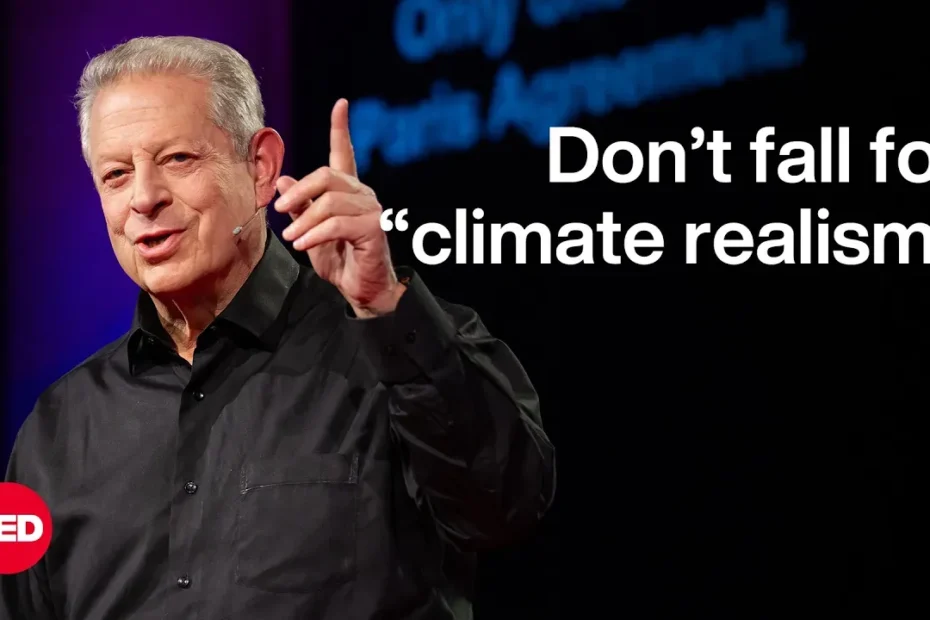
Read the full transcript of Nobel Laureate Al Gore’s urgent and hard-hitting talk titled “Why Climate Action Is Unstoppable — and “Climate Realism” Is a Myth”, which was recorded at TED Countdown Summit 2025 on June 16, 2025.
Listen to the audio version here:
Ten Years After Paris: Progress Despite Political Setbacks
Al Gore: Thank you very much for the warm welcome, and it’s been 10 years since the Paris Agreement, and every single nation in the world, 195 nations agreed to try to get to net zero by mid-century. Let me deal with the elephant in the room. One nation, only one, has begun the process of withdrawing, and the Trump administration has also canceled executive orders withdrawn from international climate organizations. They have declared a so-called energy emergency in order to promote fossil fuels. They’ve phased out government support for clean energy.
But bear this in mind, during the first Trump four-year term, investments in the energy transition doubled. We have seen solar capacity more than double, electric vehicle sales have doubled, wind energy went up by almost 50% during his first term, and we are seeing that 60% during his first four years of new energy came from renewable energy, and coal investments went down almost 20%, so there’s good news and there’s bad news. A lot’s happened in the last 10 years.
The Myth of “Climate Realism”
But I want to ask this question. The fossil fuel industry wants to ignore the amazing good news, and they are labeling the commitments that the world made at the Paris negotiations as a fantasy, and they’re calling for an abandonment of the efforts to reduce the fossil fuel burning, and they’re now advocating a new approach that they call climate realism.
Well, climate realism, according to them, we should abandon the efforts to deal with the principal cause of the climate crisis, 80% of it comes from burning fossil fuels, and we should focus on adaptation as well, almost exclusively. Well, we need adaptation, a lot of people are suffering, but do we want to vastly increase the number of people that have to go through that hardship and suffering instead of dealing with the cause of the crisis and solving the climate crisis?
They, according to climate realism, historically the energy transitions have taken place very slowly, so we have no right as human beings to even imagine that we could go faster in the future than what history has told us was the reality in the past, even though human civilization is at stake. For the so-called climate realists, the goal of solving the climate crisis is way less important than other goals, such as, especially, increasing energy access to developing countries, which is obviously important, we’ll deal with that, but they want to do it, obviously, by burning more fossil fuels.
According to climate realism, it’s just not practical to stop using the sky as an open sewer for the emissions from burning fossil fuels and the other emissions, instead we should just continue using the sky as an open sewer.
Climate Refugees: The Human Cost of Inaction
So where climate realism is concerned, I have some questions. Is it realistic to ignore the one to two billion climate refugees that the climate scientists are warning us will cross international borders and have to move inside their own nations by 2050 because of the climate crisis?
You know, the temperatures keep going up, ten hottest years were the last ten, last year, 2024, was the hottest year in all of history, yesterday, in parts of the Persian Gulf, 52.6 degrees, and for those of us who use Fahrenheit, 126.7 degrees, a few days ago in Pakistan, 50.5 degrees, that’s 122.9 in Fahrenheit, and they’re telling us that as the temperatures go up and the humidity goes up, the few areas in the world today that are labelled physiologically unlivable for human beings are due to expand quite dramatically by 2070 unless we act to cover all of these vast, heavily populated areas.
Is it realistic to ignore this crisis? Look at what a few million climate refugees have done to promote authoritarianism and ultra-nationalism. How can we handle one to two billion in the next 25 years? Already here in Kenya there are 800,000 refugees, 300,000 of them in this place, where of course the USAID cuts are now cutting the food aid 70%. Is that what they mean by adaptation?
The Economic Reality of Climate Change
We have to also ask if it’s realistic to ignore the devastating damage predicted to the global economy. The whole regions of the world are becoming uninsurable. We see this in my country, where people are having their insurance cancelled, they can’t get it renewed. We have seen predictions that we could lose $25 trillion in the next 25 years just from the loss of the value of global housing properties. And over the next half century, according to Deloitte, it would cost the economy $178 trillion if we don’t act, but if we do act, we can add to the global economy by $43 trillion.
You know, I had a teacher who said we face the same choice in life over and over again, the choice between the hard right and the easy wrong. It seems hard to choose correctly, but it would turn out to be even harder to take what looks like the easy wrong.
The Accelerating Ice Loss Crisis
Is it realistic to ignore the fact that right now Greenland is losing 30 million tonnes of ice every single hour? In Antarctica, decade by decade, the ice melting has accelerated. We’ve seen the doubling of the pace of sea level rise in the last 20 years, and the predictions are that it’s going to continue dramatically.
Is it realistic to ignore the rapidly increasing climate crisis extreme events that are occurring practically every night on the television news is like a nature hike through the book of Revelation?
We lost $3.5 trillion just in the last decade. And you know, the fact that these scientists were absolutely correct decades ago when they predicted these exact consequences should cause us to pay a little more attention to what they’re predicting is in store for us in the years ahead if we do not act.
Extreme Weather and Environmental Devastation
The drought last year and continuing at some level in the Amazons, the worst drought in the history of the Brazilian Amazon, 90% of the Amazon River in Columbia went dry. This is the third year in a row that we’ve had these massive fires in Canada. When I left Tennessee to fly over here, we were breathing in Nashville, Tennessee smoke from the Canadian wildfires. And they’re still getting worse today. The wildfires have doubled over the last 20 years in frequency, and they’re due to increase even more.
Health Impacts: The Human Toll
Is it realistic to ignore the massive health impacts of the climate crisis? You know, the University of, well, the World Health Organization has long told us it is the most serious health threat facing humanity. Just last week, the University of Manchester released a new study warning that three species of fungi in the next 15 years, because of increasing temperatures and increasing precipitation, will pose a significant risk of infection to millions of people. The fact that the fungi are being pushed into the range where they can threaten humans, that is not a fiction.
The particulate air pollution from the burning of fossil fuels kills almost 9 million people a year, costs almost $3 trillion per year from the burning of fossil fuels for both energy and petrochemicals. Let me show you an example from my country. Cancer Alley is the stretch that runs from New Orleans to Baton Rouge, Louisiana. All these red plumes are particulate pollution that people are breathing in. The green areas, by the way, are majority, minority, mostly African American areas. In the middle of Cancer Alley, Reserve Louisiana has the highest cancer rate in the United States, 50 times the national average. And they want to put even more petrochemical facilities there.
Ocean Acidification and Species at Risk
Is it realistic to totally ignore the acidification of the world’s oceans, 30% more acid than before the Industrial Revolution, and 93% of all the heat is being absorbed in the oceans? That’s why the coral reefs are in such danger. 84% in danger right now. We’ve seen massive die-offs. That’s why a lot of the fish are at risk. Forty to 60% of all the fish species face an extremely high risk as the rivers and the estuaries where they have spawning and in their embryonic stages continue to heat up. And 50% of all living species that we share this planet with are at risk of extinction.
Is it realistic to ignore that? My faith tradition tells me that Noah was commanded to save the species of this earth. I think we have a moral obligation as well.
The Looming Water Crisis
Is it realistic to ignore the predictions of a freshwater scarcity crisis? Already 40% are facing water scarcities. In the mountain glaciers here in the Himalayas, one quarter of the world’s population depends on that meltwater, but depending on whether or not we act, 80% of all those glaciers will disappear in this century. We can act. Now this just happened in Switzerland, a 600-year-old city was completely destroyed by a glacial avalanche. Now they’re adapting. Is
this realistic, to put white sheets over the remaining parts of the glacier? Well, God bless them. I hope it works. But these are the kinds of extreme measures that people are being pushed to in order to avoid reducing the burning of fossil fuels, because the fossil fuel industry and their petrostate and financial allies have control over policy.
In lots of cities, particularly in places like India, the water wells are going dry. In Bangalore, 4 million people now have to buy expensive water trucked in because their wells have gone dry. What about the food crisis that scientists are predicting? Is it realistic to ignore that as well, in order to avoid doing anything to reduce fossil fuel emissions?
The Miraculous Decline in Clean Energy Costs
Now why also do these so-called climate realists ignore all the good news about the miraculous decline in the cost of the alternatives to fossil fuel? Is it possibly because their business models are threatened? If there is a cheaper, cleaner alternative that creates many more jobs, it might not be good for them the way they calculate it, but the rest of us have a stake in this.
This could be why they’ve been consistently wrong in their predictions in the past. For example, ExxonMobil in the year of the Paris Agreement had a prediction about solar capacity in 2040, 840 gigawatts. Well, this year we’ve already tripled the number that they predicted for 15 years from now.
In OPEC, OPEC the same year predicted electric vehicle sales would barely increase. Well, they were wrong, but here’s what it is, actual sales to date right now. Same year OPEC predicted that it was just unrealistic to think that solar power would ever be able to compete in cost with the burning of fossil fuels, but now it is by far the cheapest source of electricity in all of history.
Now, you know, a lot of other people have been surprised by how quickly these costs have come down. The University of Oxford studied 3,000 past projections, and the average predicted decline was 2.6% a year. The reality was 15% per year, and when you compound the number like that, it makes quite a difference.
Here are all the past projections from the International Energy Agency of what solar energy was likely to do. They’re projections year by year, and here is the reality of what has actually happened. It really is quite extraordinary. My goodness, nobody could have imagined that it would be this incredible, but it is, and it’s right before us, and they still want to ignore it.
The Clean Energy Revolution in Numbers
Since 2015, the world’s installed twice as much solar as all fossil fuels combined. Solar is the breakout winner in fuel sources. Electric vehicles have increased 34 times over since the time of the Paris Agreement. Vehicle sales in China, 52% are already EVs, and within five years, the prediction is 82% of all car sales will be electric vehicles.
Also, by the way, China in April installed 45 gigawatts of new solar capacity in one month. That’s the equivalent of 45 brand-new giant nuclear reactors in one month. It’s actually incredible what is happening, and the cost of all of these clean energy technologies has come down quite dramatically, particularly solar, and even more dramatic is utility-scale batteries, 87% down. That’s making a huge difference as well.
The Fossil Fuel Industry’s Deception Tactics
But I have to say this. There’s one thing that the so-called climate realists are right about. In spite of this progress, we are still moving too slowly to meet the goals of the Paris Agreement. We have got to accelerate it. We have the ability to do so, but the single biggest reason we have not been able to move faster is the ferocious opposition to virtually every policy proposal to try to speed up this transition and reduce the emissions from the burning of fossil fuels.
The fossil fuel industry has used a lot of bright shiny objects to divert the public’s attention and deceive them into thinking there are solutions other than reducing fossil fuel use. For example, carbon capture and storage and direct air capture and the recycling of plastics. They are much better at capturing politicians than they are at capturing emissions. They are employing their captive politicians and policy makers to help confuse the public.
Here is an example. Tony Blair, speaking for his foundation, his foundation gets massive funding from Saudi Arabia, the United Arab Emirates, Azerbaijan, etc. He said, “oh well, the center of the battle has to be carbon capture and direct air capture.” Well, he really should know better, you know. Upton Sinclair wrote in My Country Years Ago, “it’s difficult to get a man to understand something if his income depends on him not understanding it.” The income goes to the foundation as I understand it.
But here is carbon capture. These are the ones operational. These are the ones that have applied for permits. These are the ones that have had the big public announcements, “oh boy, look, we’re going for carbon capture. We don’t have to reduce the burning of fossil fuel. We’ll capture it all as it goes out the smokestack.” It is a fraud. It is a deception imposed on the people in order to try to change policy and to make the policy what they want.
The Fossil Fuel Subsidy Problem
And because they’ve captured the politicians, they have been able to force the taxpayers in countries around the world to subsidize fossil fuels, to actually subsidize the destruction of humanity’s future. What would happen if we got rid of those subsidies? Well, the International Monetary Fund said that we would get $4.4 trillion in savings, which happens to be just about the exact amount we need to finance the transition to renewable energy. That’s where a lot of the money can come from.
We’d also save a lot of lives, and we’d also reduce emissions by a third in five years, and we’d reduce income inequality. So is it realistic to ignore this urgent need to reform the world’s financial infrastructure so that we can properly invest in the climate crisis?
The Developing World’s Energy Access Crisis
Most of the financing comes from private sources, but developing countries are not getting their share of it. We need to reform the policies that are leading to this, because 100% of the increased emissions expected are going to come from the developing countries. We’re about to see massive reductions in emissions. It’s really, it may have already started, especially in China with all their renewables, but the developing countries, that’s where the emissions increases are due to take place, and yet they only receive less than 19% of the world’s financing for clean energy, but almost 50% of the money flooding in for more fossil fuels.
The single U.S. state of Florida has more solar panels than the entire continent of Africa. That is a disgrace, because Africa has 60% of the world’s prime solar resources, yet only 1.6% of the financing for renewable energy. But look at what’s happening with the investments for fossil fuels in Africa. There’s a dash for gas. There, all of these new facilities. There are three times as many fossil fuel pipelines under construction and proposed for construction to begin in Africa as in all of North America.
And you take those, the LNG terminals, the cost of one of them, there’s 71 in the works, 31 already existing, $25 billion. That’s the exact amount that would provide universal energy access to all of Africa. So maybe we could spend that money a little bit better, but instead of financing actual energy access to renewable energy, they want access to the resources to export it from Africa instead of giving access for Africans.
You know, the potential for solar and wind in Africa is 400 times larger than the potential energy from fossil fuels. Every single country in Africa could have 100% energy access using less than 1% of its plant, most including the country we’re in, less than .1% of their land.
The Advantages of Renewable Energy
What else are they ignoring? Well, they’re ignoring that with solar and wind, you don’t face the fuel supply chain risk. You don’t face price volatility for fuel. Look at what’s happening to energy. Oil and gas is soaring because of the war in the Middle East. In fact, they don’t have an annual fuel cost at all. So we should be moving in this direction, not least because it creates three times as many jobs for each dollar spent as compared to a dollar spent on fossil fuels.
They also, why do they also ignore the fact that methane is as bad as coal when the leaks are factored in and the leaks are ubiquitous? And right now in the European Union, the fossil fuel lobbyists are arguing as hard as they can to stop legislation to try to deal with methane leaks because they think it’ll cause them some money. So what’s really
So here’s what I believe that the so-called climate realists are most wrong about. They don’t believe that we, the people who live on this planet, have the capacity to make the changes necessary to save our future. The greatest president in my country’s history, Abraham Lincoln, said at a time of dire crisis, “The occasion is piled high with difficulty. We must rise with the occasion. As our case is new, we must think anew.”
I believe that we as human beings have the capacity to recognize that our survival is at stake, and that we need to move faster, even though the big polluters have the political and economic power to try to block us. We’ve got everything we need. The people are demanding change. The one thing that they tell us might be in short supply is political will, but always remember, political will is itself a renewable resource. Let’s get out there and renew it.