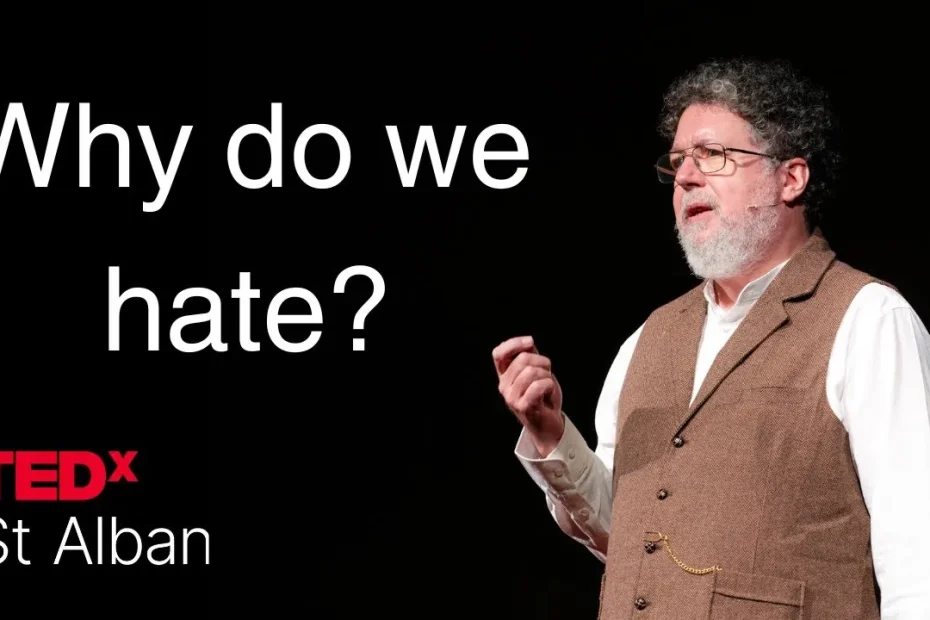
Read the full transcript of psychotherapist Jon Wilson Cooper’s talk titled “Why do we hate?” at TEDxSt Albans 2024 conference.
Listen to the audio version here:
TRANSCRIPT:
The Power and Fragility of Compassion
JON WILSON COOPER: I’ve got a serious problem. I can switch off my compassion like that and make the world a darker place and I suspect so can you. I’ve been training counsellors for over 23 years now which amounts to over 400 people. I support my students to prepare to work with an incredible range of potential clients with an almost unimaginable list of issues that those clients might bring. The main skill that a counsellor needs to have is the ability to deeply understand other people’s emotional experience.
This presents two challenges developmentally.
First I need to help my students to be able to sit with incredibly strong emotion.
Secondly I need to help them to empathise with others no matter what. It doesn’t matter whether or not we like the person we’re sitting in front of. We might not approve of them. We might not like the things they’ve done.
However it’s only necessary to have an empathy for the core human being sitting in front of you. These challenges can be quite difficult because most people have a degree of fear and emotion even phobia at times and also we find certain people really difficult to empathise with because we really disapprove of how they live or we don’t understand them and we don’t take the effort to find out more about them.
It’s easy for us to switch off compassion particularly if the other person is very different from us and that tip can go into hate. There seems to be a major proliferation of hate in the world at the moment and there’s a lack of compassion in quite extreme situations that we’re seeing around the globe and it seems very easy for people with power and influence to actually manipulate us into blaming certain groups of people for the struggles that we’re facing.
Understanding Hate and Love
Today I want to talk about hate and how we come to hate and what we can do about it. On the flip side I’ve worked with people from all walks of life to help them to learn to love themselves and each other better. I don’t mean the kind of conditional, controlling, at times romantic love, more the kind of love that one has for a child or a best friend. The kind of love where the other person’s safety, happiness and well-being is almost as important as your own.
It’s a kind of visceral connection whereby seeing them hurt actually causes you pain. I’ve learned over the years that the love and compassion that people can have for each other can cause people to do extraordinary things. Ordinary people can take incredible risks, risking serious harm to themselves, even death, to try to protect another human being. A really poignant example was on the 29th of July this year in Southport, UK.
A young man attacked a dance class with a knife. He killed three children and he hurt eight others. One of the organisers of the dance class, Leanne Lewis, stepped forward to try to protect those children at huge personal cost and they weren’t even her kids.
When I became a father for the first time I recognised a profound change in me. When I was out in the world with my daughter I realised that I’d become hyper-vigilant, that I thought to myself if a vehicle was to suddenly hurtle towards her I would act without any hesitation to save her life. With my partner however, I think about it first. What had happened is my system has effectively been rewired to protect my daughter.
The Concept of Compassion
The notion of compassion is so central to us as human beings that the word humanity itself can mean compassion. Being compassionate means wanting to minimise the suffering of others and we want to go out of our way to try to reduce or heal the hurt that other people may have endured. We’re born with the ability to attach and love others because we need each other to survive. Most of us want to see ourselves as benevolent human beings and we’d hate to see ourselves as the opposite, cruel, unkind, indifferent, inhumane.
However this dark side I believe exists within all of us and can come out given the right set of circumstances. Most of the atrocities in the world have been committed by very ordinary people but we prefer to think of those people as being very different from us. I’m not like that.
However most Nazis were extremely ordinary men and women. We need to have the courage to look at that in ourselves and own it, know that we can do this and know how we do it.
So compassion as well as being an incredibly powerful motivator that we can do incredible things, take extreme risks to look after another human being, it can also be very fragile it seems. It can disappear completely. I think that compassion is conditional and I believe it relies on three basic conditions. Proximity, worthiness and hurt.
The Three Conditions of Compassion
Firstly proximity. It seems that caring for others can be pretty automatic when we can see ourselves in them or when they’re close to us. We feel a little less urgency the further we go out and if somebody’s very different to us in terms of geographical difference or difference from who we are, then the urgency seems to diminish. It’s almost as if we’ve got concentric circles going around us so we’re very responsive to the people that we’re closest to.
Slightly less responsive maybe to friends and extended family, a little less concerned about neighbours and work colleagues and the further out we go the less we care about them.
So that’s one factor, it’s degree of separation. Worthiness. We can often lose our compassion for others when we believe that they’re suffering, they’ve brought it on themselves because they’ve made bad decisions.