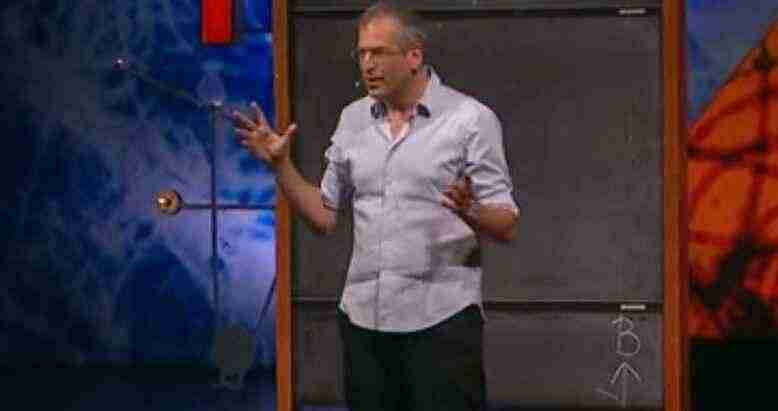
Read the full transcript of Uri Alon’s talk titled “Why Truly Innovative Science Demands A Leap Into The Unknown” at TED Talks conference. (Jun 12, 2014)
Listen to the audio version here:
TRANSCRIPT:
The Cloud: A Journey Through Scientific Discovery
URI ALON: The middle of my PhD, I was hopelessly stuck. Every research direction that I tried led to a dead end. It seemed like my basic assumptions just stopped working. I felt like a pilot flying through the mist, and I lost all sense of direction. I stopped shaving, I couldn’t get out of bed in the morning.
I felt unworthy of stepping across the gates of the university because I wasn’t like Einstein or Newton or any other scientist whose results I had learned about, because in science, we just learn about the results, not the process. And so, obviously, I couldn’t be a scientist. But I had enough support, and I made it through and discovered something new about nature. This is an amazing feeling of calmness, being the only person in the world who knows a new law of nature. And I started the second project in my PhD, and it happened again.
I got stuck and I made it through. And I started thinking, maybe there is a pattern here. I asked the other graduate students and they said, “Yeah, that’s exactly what happened to us except nobody told us about it.” We’d all studied science as if it’s a series of logical steps between question and answer, but doing research is nothing like that. At the same time, I was also studying to be an improvisation theater actor.
So physics by day and by night, laughing, jumping, singing, playing my guitar. Improvisation theater, just like science, goes into the unknown, because you have to make a scene on stage without a director, without a script, without having any idea what you’ll portray or what the other characters will do. But unlike science, in improvisation theater, they tell you from day one, what’s going to happen to you when you get on stage. You’re going to fail miserably. You’re going to get stuck, and we would practice staying creative inside that stuck place.
For example, we had an exercise where we all stood in a circle and each person had to do the world’s worst tap dance, and everybody else applauded and cheered you on supporting you on stage. When I became a professor and had to guide my own students through their research projects, I realized again, I don’t know what to do. I studied thousands of hours of physics, biology, chemistry, but not one hour, not one concept on how to mentor, how to guide someone to go together into the unknown about motivation. So I turned to improvisation theater, and I told my students from day one, what’s going to happen when you start research. And this has to do with our mental schema of what research will be like.
The Schema of Research
Because you see, whenever people do anything, for example, if I want to touch this blackboard, my brain first builds up a schema, a prediction of exactly what my muscles will do before I even start moving my hand. And if I get blocked, if my schema doesn’t match reality, that causes extra stress called cognitive dissonance. That’s why your schemas had better match reality. But if you believe the way science is taught, if you believe textbooks, you’re liable to have the following schema of research. If a is the question, and b is the answer, then research is a direct path.
The problem is that if an experiment doesn’t work or a student gets depressed, it’s perceived as something utterly wrong and causes tremendous stress, and that’s why I teach my students a more realistic schema. Here’s an example where things don’t match your schema. You know? So I teach my students a different schema. If a is the question, b is the answer.
Stay creative in the cloud, and you start going, and experiments don’t work. Experiments don’t work. Experiments don’t work. Experiments don’t work until you reach a place linked with negative emotions, where it seems like your basic assumptions have stopped making sense, like somebody yanked the carpet beneath your feet. And I call this place the cloud.
Now you can be lost in the cloud for a day, a week, a month, a year, a whole career, but sometimes, if you’re lucky enough and you have enough support, you can see in the materials at hand, or perhaps meditating on the shape of the cloud, a new answer, c, and you decide to go for it. Experiments don’t work, experiments don’t work, but you get there. And then you tell everyone about it by publishing a paper that reads a arrow c, which is a great way to communicate, but as long as you don’t forget the past that brought you there. Now, this cloud is an inherent part of research, an inherent part of our craft because the cloud stands guard at the boundary. It stands guard at the boundary between the known and the unknown.
Because in order to discover something truly new, at least one of your basic assumptions has to change. And that means that in science, we do something quite heroic. Every day, we try to bring ourselves to the boundary between the known and the unknown and face the cloud. Now, notice that I put b in the land of the known because we knew about it in the beginning, but c is always more interesting and more important than b. So, b is essential in order to get going, but c is much more profound, and that’s the amazing thing about research.
The Power of Naming: The Cloud
Now, just knowing that word, the cloud, has been transformational in my research group. Students come to me and say, “Uri, I’m in the cloud.” And I say, “Great. You must be feeling miserable.
But I’m kind of happy because we might be close to the boundary between the known and the unknown, and we stand a chance of discovering something truly new.”
Since the way our mind works is just knowing that the cloud, you know, is normal, it’s essential, and in fact beautiful, we can join the Cloud Appreciation Society, it detoxifies the feeling that something is deeply wrong with me. And as a mentor, I know what to do, which is to step up my support for the students because research in psychology shows that if you’re feeling fear and despair, your mind narrows down to very safe and conservative ways of thinking. If you’d like to explore the risky path you need to get out of the cloud, you need other emotions, solidarity, support, hope that come with your connection from somebody else. So, like in improvisation theater, in science, it’s best to walk into the unknown together. So, knowing about the cloud, you can also learn from improvisation theater a very effective way to have conversation inside the cloud.
The Power of “Yes, And”
It’s based on the central principle of improvisation theater. So here, improvisation theater came to my help again. It’s called saying yes and to the offers made by other actors. That means accepting the offers and building on them, saying yes and. For example, if one actor says, “Here’s a pool of water,” and the other actor says, “No, that’s just the stage.”
The improvisation is over. It’s dead, and everybody feels frustrated. Saying, you know, that’s called blocking. If you’re not mindful of communications, scientific conversations can have a lot of blocking. Saying yes, and sounds like this.
“Here’s a pool of water.” “Yeah. Let’s jump in.” “Look. There’s a whale.”
“Let’s grab it by sail.” “It’s pulling us to the moon.” So saying yes, and bypasses our inner critic. We all have an inner critic that kind of guards what we say, so people don’t think that we’re obscene or crazy or unoriginal. And science is full of fear of appearing unoriginal.
Saying yes, and bypasses the critic and unlocks hidden voices of creativity you didn’t even know that you had, and they often carry the answer about the cloud. So you see, knowing about the cloud and about saying yes, and made my lab very creative. Students started playing off of each other’s ideas, and we made surprising discoveries in the interface between physics and biology. For example, we were stuck for a year trying to understand the intricate biochemical networks inside ourselves. And we are deeply in the cloud, and we had a playful conversation where my student, Shaishan, said, “Let’s just draw this on a piece of paper, this network.”
And instead of saying, “But we’ve done that so many times and it doesn’t work,” I said, “Yes. And let’s use a very big piece of paper.” And then Ron Milos said, “Let’s use a gigantic architect’s blueprint kind of paper, and I know where to print it.” And we printed out the network and looked at it, and that’s where we’ve made our most important discovery. This complicated network is just made of a handful of simple repeating interaction patterns, like motifs in a stained glass window.
We call them network motifs, and they’re the elementary circuits that help us understand the logic of the way cells make decisions in all organisms, including our body. Soon enough after this, I started being invited to give talks to thousands of scientists across the world, but the knowledge about the cloud and saying yes, and just stayed within my own lab. Because you see, in science, we don’t talk about the process, anything subjective or emotional. We talk about the results. So there’s no way to talk about it in conferences.
Changing the Culture of Science
That was unthinkable. And I saw scientists in other groups get stuck without even having a word to describe what they’re seeing, and their ways of thinking narrowed down to a very safe path. Their science didn’t reach its full potential, and they were miserable. I thought that’s the way it is. I try to make my lab as creative as possible, and if everybody else does the same, science will eventually become more and more better and better.
That way of thinking got turned on its head when by chance I went to hear Evelyn Fox Keller give a talk about her experiences as a woman in science. And she asked, “Why is it that we don’t talk about the subjective and emotional aspects of doing science?” It’s not by chance. It’s a matter of values. You see, science seeks knowledge that’s objective and rational.
That’s the beautiful thing about science. But we also have a cultural myth that the doing of science, what we do every day to get that knowledge is also only objective and rational, as like Mr. Spock. When you label something as objective and rational, automatically, the other side, the subjective and emotional, become labeled as non-science or anti-science or threatening to science and we just don’t talk about it. And when I heard that, that science has a culture, everything clicked into place for me because if science has a culture, culture can be changed. And I can be a change agent working to change the culture of science wherever I could.
And so the very next lecture I gave in the conference, I talked about my science, and then I talked about the importance of the subjective and emotional aspects of doing science and how we should talk about them. And I looked at the audience, and they were cold. They couldn’t hear what I was saying in the context of a 10 back-to-back PowerPoint presentation conference. And I tried again and again, conference after conference, but I wasn’t getting through. I was in the cloud.
Breaking Through with Music and Improvisation
And eventually, I managed to get out of the cloud using improvisation and music. Actually, I since then, every conference I go to, I give a science talk and a second special talk called “Love and Fear in the Lab.” And I started off by doing a song about scientists’ greatest fear, which is that we work hard, we discover something new, and somebody else publishes it before we do. It’s we call it being scooped, and being scooped feels horrible. It makes us afraid to talk to each other, which is no fun because we came to science to share our ideas and to learn from each other.
And so I do a blues song, which called “Scooped Again,” And I asked the audience to be my backup singers, and I tell them, “Your text is scoop, scoop, sounds like this, scoop, scoop. Tell them, I’ve been scooped again. Scoop, scoop.” And then we go for it. “I’ve been scooped again.”
“Scoop. Scoop.” “I’ve been scooped again. I’ve been scooped again. I’ve been scooped again.”
“Oh, mama, can’t you feel my pain?” “Evans, help me.” “I’ve been scooped again.” Thank you. Thank you for your backup singing.
So, everybody starts laughing, starts breathing, notices that there are other scientists around them with shared issues, and we start talking about the emotional and subjective things that go on in research. It feels like a huge taboo has been lifted. Finally, we can talk about this in a scientific conference. Scientists have gone on to form peer groups where they meet regularly and create a space to talk about the emotional and subjective things that happen as they’re mentoring, as they’re going into the unknown, and even started courses about the process of doing science, about going into the unknown together and many other things. My vision is that just like every scientist knows the word atom, that matter is made out of atoms, every scientist would know the words like the cloud, saying yes, and, and science will become much more creative, make many, many more unexpected discoveries for the benefit of us all, and will also be much more playful.
And what I might ask you to remember from this talk is that next time you face a problem you can’t solve in work or in life, there’s a word for what you’re going to see, the cloud. And you can go through the cloud not alone, but together with someone who’s your source of support to say yes and to your ideas, to help you say yes and to your own ideas, to increase the chance that through the width of the cloud, you’ll find that moment of calmness where you get your first glimpse of your unexpected discovery, your c. Thank you.