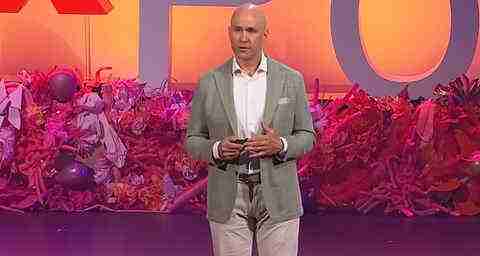
Read the full transcript of Dr. Robert Guldberg’s talk titled “Your Immune System Could Predict How You Heal” at TEDxPortland 2024 conference.
Listen to the audio version here:
TRANSCRIPT:
The Cellular Symphony: Listening to Our Body’s Healing Processes
DR. ROBERT GULDBERG: Did you realize there are 37 trillion cells in an adult human body, and over 200 different types of cells? Some of these are depicted on a beautiful three-story painting in which the cells are symbolically painted outside the body and come together to form a person kneeling at the center. Now, the cells on the inside of our body are constantly communicating with each other, and sometimes, like all of us, they talk to themselves. But what are they saying, and what could we learn if we listened in on that cell conversation?
What I’m here to share with you today is that what we can learn from ourselves has the potential to revolutionize how we diagnose and treat the most common cause of pain and disability worldwide: the injury and degeneration of bones and joints. I’m a professor of biomedical engineering, and I’ve been studying how bones, muscles, and joints repair from injury for over 30 years.
In that time, I’ve had the privilege of interacting with a large number of people who have had all kinds of tough procedures. A few years ago, a man walked into my office who had had 39 orthopedic procedures. He’d had his ankles fused, his knees replaced, his spine had been fused, reconstructed, and rebuilt, and his hands and wrists no longer worked. But NBA Hall of Famer and Portland Trailblazer legend Bill Walton is still smiling.
Bill had come to learn more about our research in the Knight campus, but it was really me that was inspired by him, by his positive outlook on life because of all the perseverance he’d had throughout his career and the pain and suffering. Now fortunately, most of us have not been through as much as Bill, but I would guess many of you in the audience have had to recover from a severe injury or watched a loved one go through that painful process. And for many, that will have meant benefiting from metal plates, screws, or total joint replacements.
The Promise of Regenerative Medicine
Today, it’s amazing that some of these implants are actually customized to the patient through 3D printing. But the problem with metals and plastics, no matter how tailored they are to your body, is that they can eventually wear out. And so my laboratory, along with many others around the world, are taking a radically different approach. Instead of trying to replace damaged tissues with medical devices, we are working with regenerative medicine, where the idea is to use what we know about cell behavior and our body’s own healing mechanisms to regenerate living, healthy tissues.
Now that might seem like science fiction, right? Growing tissues. But we all know it’s possible because we did it very well from the time we were conceived to the time that we stopped growing as teenagers. And in nature, there are some amazing creatures like the newt that have the ability to completely regenerate their limbs. Now unfortunately, except for in the movies, we don’t have the same regenerative superpowers as newts.
Maybe with enough research, we will someday. But in the meantime, with a boost from biology and biomaterials like this incredibly intricate 3D printed fibrous scaffold that’s made of fibers that are up to 10 times smaller than a human hair, we have the ability to help the body to heal itself. All right, so here’s some research of our own in which we were trying to repair a large defect that was so large it could never heal on its own.
We treated it with a biomaterial that was derived from brown seaweed, believe it or not, combined with a natural protein. So the biomaterial in this case served two purposes. One was to serve as a scaffold or a template to tell the body where we wanted regeneration to happen. And the second purpose was to call in the cells and instruct them, in this case, to make new bone.
Now using this approach, we were able to regenerate several inches of living, healthy bone tissue. Pretty amazing, right? But one of the great challenges of bringing regenerative therapies to everybody, and the reason you shouldn’t necessarily believe all those radio commercials that you hear, is that they don’t always work. In fact, you might be surprised how often medical therapies or surgeries fail to work, and we don’t always understand why.
The Challenge of Unpredictable Outcomes
In fact, there’s a medical term to describe this lack of understanding. Have you ever heard the word “idiopathic” attached to a whole bunch of different medical conditions? This basically means we have no clue what caused that. Alright, a joke.
But for patients and families that are in the dark about why a medical therapy or a surgery didn’t work, this is really no joke, right? I know this firsthand because my family’s been through this as well. So this was our daughter when she was 14 years old. She was a nationally competitive tennis player.
But in one of her tournament matches, she felt some pain in her back, and that pain was propagating down into her legs. So we took her to the doctors, and we were shocked to learn that she had a spine condition in which the segments of her spine were highly unstable. The only treatment was for the doctors to fuse together several segments of her spine by growing bone in between the segments to stabilize them. Now, this required a seven-hour surgery, and our daughter had to enter her first year of high school with this hard back brace that she called her “turtle shell.”
The surgery recovery was really painful, but the doctors assured us, you know, she’s going to heal.
She’s young, and she’s healthy, and our daughter was really dedicated to her rehabilitation routine because she wanted to get back to playing tennis someday. So everything seemed to be going very well, but about nine months after her surgery, she turned over in bed, and she felt the rods in her back snap. The bone had not grown in between the segments, and the surgery had failed.
The only thing that was more shocking that this young, healthy athlete had to go through a first surgery was that she was going to need a second revision surgery and another long recovery period. And for those of you who are parents, you’ll attest that a parent would do anything in this moment to take the place of their child, right, and not have them go through this a second time. Now, fortunately, the second surgery went much better. She recovered very well.
She rehabbed, and she worked really hard and got back to competing and, in fact, won two state championships for juniors and seniors. But nobody could ever tell us, why’d that first surgery fail, and why’d it take nine months to figure out something was going wrong? And that question continued to bother me, and for biomedical researchers like myself, it’s those unanswered questions where we could potentially discover something or invent something that’s going to help patients that really drives us to get back into the lab.
Predicting Healing Outcomes Through Cell Communication
So my students and I took up this question. If regenerative therapies and surgeries don’t always work, is there a way for us to predict which patients are going to have complications very early on? Now, from a clinical translation perspective, what you’d want to do is to predict this rate as early as possible in the healing process, and you’d like to do it using something that’s relatively simple and non-invasive. So we decided to measure cells and proteins in the blood just a few days after injury.
Now, your blood, of course, contains blood cells, but it also contains other types of cells, such as immune cells, that respond to crises in your body, like an infection or an injury. Your blood also contains proteins, and the proteins are produced by the cells, and that’s the primary way that the cells talk to each other. So we wanted to measure the cells and the protein in the blood, and if we had done this a few years ago, we could have measured a few types of cells and a few types of proteins, but things are moving so quickly that today we can measure dozens of types of cells and thousands of proteins, all from a single blood sample.
So that’s great, right? More data is better, but it did create a different challenge for us as we were trying to understand all the cellular conversation. Imagine for a moment trying to understand what’s going on if everybody in this room started talking at the same time. Please don’t do that. But that was the challenge that we were facing, trying to understand all of that cellular chatter. So we integrated AI and machine learning in order to try to detect patterns in the blood very early after injury that would predict what we were seeing many months later in terms of patients.
Understanding the Healing Process
So what did we see? Well, first, I have to tell you a little bit about what happens after an injury. It won’t surprise you that after an injury, there’s a lot of inflammation and associated pain. What you might not know is that inflammation, some of it, is a good thing because the inflammation calls in the cells in the blood vessels that help with healing, and in fact, taking too much anti-inflammatory medication after an injury can slow down your healing.
But too much inflammation is actually destructive, and so the body, which is really smart, counteracts all that inflammation by sending out immunosuppressive signals. And if all goes well, those two signals come into balance after a couple of weeks, and the patient goes on to heal well. But what we saw in the patients who did not heal well was that they had high levels of cells and proteins associated with an immune-suppressive response. Now, that was really interesting to us because immunosuppression is associated with a lot of different clinical problems, but not much was known about how it related to poor healing outcomes.
Okay, so why does this matter? Well, right now, doctors don’t have any way of getting this information so early in the process. And let me show you what I mean. So these are x-rays of two patients one week after surgery.
One of these patients is going to go on to heal, and one of them is not. Can you tell which is which? I can’t, and I’ve been studying bone a long time. And I would challenge any radiologist to be able to tell which of these patients is going to heal and which is not.
But if we fast forward many months later, we can see that patient A has healed and patient B has what we call a nonunion, or they have not healed. So by listening to the cells at this early time point, one week after surgery, we’re able to detect patterns that predict many months later which of these patients is going to heal and which is not. Now this coming so early and being so clear is that we can potentially provide doctors with a diagnostic weather report, if you will, on their patient outcomes, and that can direct how they treat those patients.
The Future of Healing and Regenerative Medicine
In addition to trying to predict which patients are going to have complications, we’re now working on treatments to try to bring the immune system into balance. So for a patient that’s going to be destined to have a poor healing outcome in multiple procedures like my daughter did, if we can treat them early enough, perhaps we can turn them into a patient that’s going to have a great healing outcome the very first time.
Now I’ve been talking about very severe injuries that might happen on a battlefield or perhaps in a motorcycle accident, but we think this approach has applications to a wide variety of different situations. For example, trying to tell an injured runner how quickly they can return to competing without re-injuring themselves or predicting an infection following a surgery. In fact, as we journey from trying to encourage cells into a site of injury to listening to what those cells are trying to tell us, you can imagine there’s a whole new frontier of medicine that may be opening up.
To prepare for that new frontier, I’m very excited that our next generation of scientists are being trained in bioengineering, immune biology and data science all at the same time. That’s very different than the way I learned many years ago. These immunoengineers are not only learning about the intricate complexities of our immune systems, but they’re trying to develop new therapies and test them to bring our immune systems into balance.
Imagine a future where we are able to listen to our cells so well that doctors can predict complications before they happen and then deliver patient-specific precision therapies to help us heal. Perhaps even bringing into reality that future where metals and plastics are obsolete and tissue regeneration is a reality for everyone. Thanks so much for listening today. Thank you.