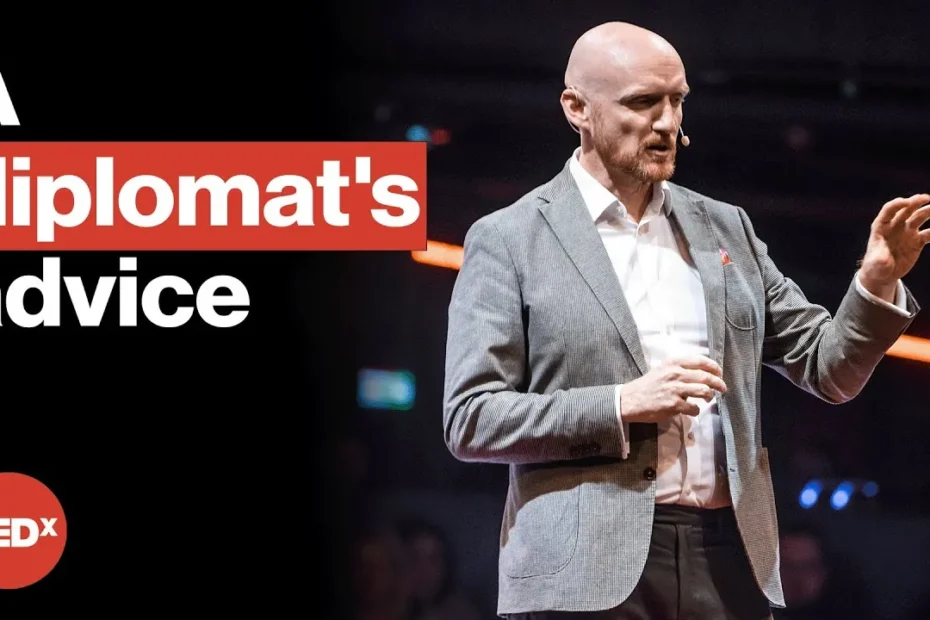
Read the full transcript of Ambassador Matt Field’s talk titled “3 Lessons On Starting Over” at TEDxPrague, August 24, 2025.
Listen to the audio version here:
MATT FIELD: I am 18 years old, fresh out of school, sat on the end of the bed in the middle of a Kenyan countryside. I am about to start work as a volunteer and I am far away from electricity and running water. **What have I got myself into?**
I am in my early twenties. I am stepping off the train in a small Japanese town. I’ve never been in the country before. I don’t speak a word of the language. I am about to start a new life as a teacher and rugby coach. **What have I got myself into?**
I am in my thirties, travelling to Brazil with my wife Martina and our two-year-old son with another one on the way. We arrive in the capital city Brasília, a 1950s vision of the future. Five thousand miles from friends, family and other babysitters. **What have we got ourselves into?**
I am a diplomat. I have lived in nine different countries on four different continents and apart from a few fellow travellers in the room, this globe-trotting lifestyle probably seems quite alien. But the truth is that **each of us regularly has to make a new start**. Each of us has had to begin a new job, a new course, we’ve had to make new friends, we’ve had to create a new home.
So today what I’d like to do is share with you three lessons, **three lessons from a diplomat about fresh beginnings and starting over**. Three lessons that I hope will help you to make the best possible start wherever you are and whatever you’re doing.
First Lesson: Be Curious
So the first lesson is be curious.
I’m sometimes asked what qualifications or experience or skills someone needs to be an ambassador and the list could be quite long. Of course it helps to be really well read in politics, history, culture, international law, to never forget a face or a name, to be able to hold a glass and a plate and a conversation without spilling anything.
But really I always come back to the same answer. **The quality that makes a fantastic ambassador is curiosity**. Curiosity is what makes us explore the world around us. It makes us get to know the people that we meet. It makes us ask why things are the way they are.
Curiosity is what helps me to stop focusing on the things I might be missing from home. Chips, fish, fish and chips, and instead explore the world around me and find what’s new and interesting there.
When I started as the British ambassador here in the Republic and I stepped off the number 22 tram on Malostranské náměstí, I said, “Jsem tu nový.” I wanted to communicate that I was enthusiastic and ready and paying attention. Not just nový, but nový. I asked people for their recommendations and I received hundreds of titles of Czech films, books, songs, all kinds of things. I was curious and I was listening and I received the warmest possible welcome.
I didn’t want to be the kind of visitor that is remote and cut off. It’s trying to recreate where they’ve just left. If something was strange or surprising, I wanted to find out why and then it would be less strange and surprising.
So for example, in the UK, the airport is the only place it is socially acceptable to have a beer at 8 o’clock in the morning. Of course, eventually I realised the Czech Republic is one giant airport.
So to quote Walt Whitman, **”be curious, not judgmental.”** Or it might have been Ted Lasso.
Second Lesson: Believe You Can Learn
The second lesson is to believe you can learn. Now **whether you think that you can gain new skills or whether you think that you cannot gain new skills, you’re right**.
A lot of the time, in fact all too often, we concentrate our praise and our attention on effortless achievement. People who can do things immediately, so easily, talented, smart. The scientific research actually points in the other direction.
So when we praise talent, intelligence, inherent qualities, we reduce ambition and we reduce future performance. Instead, when we recognise and reward effort and perseverance, we start to build that growth mindset. We make it possible to learn new things. So we can create exactly the opportunities that we want in terms of a growth mindset and that ability to learn new things.
So we go really from seeing resistance as the end of the road to the start of the learning. **We go from “I cannot do it” to “I cannot do it yet.”** I cannot understand this writer yet. I cannot work out this maths problem yet. I cannot stop embarrassing my children yet. To be fair, I’m not trying very hard on that one.
Learning Languages Opens Doors
But I cannot speak Czech fluently yet. And actually, learning a language is the perfect example of this shift in growth mindset. I’m not a natural linguist, but I have learned several languages. I’ve immersed myself. I’ve practiced. I’ve made mistakes, many mistakes. But I’ve learned. And that effort has always been appreciated. And doors open. Opportunities come forward.
I have a friend who’s a diplomat. And he has worked all over the world. And he has learned one phrase in 20, maybe 30 different languages. One phrase. All these languages. Kind of brilliant. What’s the phrase? I’ll say it in Czech first. All sorts of new opportunities. All sorts of open doors.
And actually, I’ve learned a few things as well along the way. So I’ve learned that in Brazilian Portuguese, for example, when you want to say someone is in a difficult or uncomfortable situation, you say they’re wearing a tight skirt. You say in Japanese, if someone is curious, they have a heart that loves the unusual. In Croatian, you say if someone is pretending to be dumb, they are playing the Englishman. Thank you, Croatia. And in Czech, of course, I’ve learned that na jedno never means na jedno.
Lesson Three: Take Home With You
The third lesson I want to share with you is to take home with you. So it’s the European football championships. And I’m talking to my younger son. He’s still very small. We’re watching it on TV. And I said, “Who do you want to support? You can support England with Daddy. You can support Croatia with Mama.” And he looks up at me and he said, “Brazil.” I said, “It’s the European championships. Brazil’s not playing.” And he said, “I was born in Brazil. I support Brazil. I’m half English, half Croatian, and half Brazilian.”
Now, mathematics to one side. Imagine yourself in this life, so this diplomatic life, where every few years, you are moving, you are changing, you are starting over. Where is home? Isn’t there a risk that you become homeless?
Well, the answer for me and Martina has been that we take home with us. So home is wherever we are. Home is not a fixed location. It’s the sum total of all the connections that we have with friends and family all around the world, and the memories that we carry with us.
And if you look on our wall, you’ll see photos, pictures, road signs, all kinds of memory joggers, like the ornaments on our Christmas tree, double-decker bus from London, the angel from Sweden, the brass door knocker from Bosnia and Herzegovina. And of course, the traditions as well. We take those with us. We gain new traditions. Not yet the calf in the bathtub, yet. Yet. But home for us is not what we’ve left behind. It’s where we’re going. We take home with us.
Conclusion: Embrace the Unknown
And those are the three lessons I wanted to share with you. With curiosity and a belief that we can learn. We can make new connections and we can make new homes. The world today is a scary place. It’s confusing. It’s complicated. But it’s also full of wonder and joy and amazing experiences.
So let’s get out there. Let’s explore. Be a diplomat. Be curious. And who knows what you will get yourself into next. Thank you.