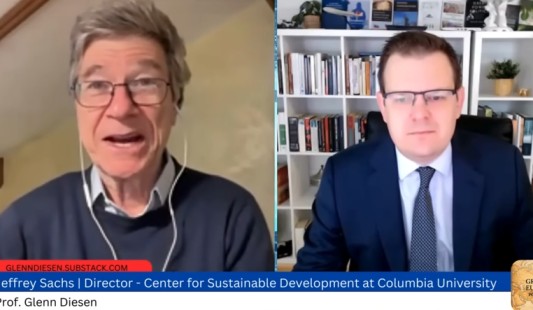
Here is the full transcript of American economist and public policy analyst Prof. Jeffrey Sachs in conversation with host Prof. Glenn Diesen, December 12, 2025.
Brief Notes: Economist and foreign policy expert Prof. Jeffrey Sachs joins Glenn Diesen to unpack how Donald Trump’s “new Monroe Doctrine” departs from the original 1823 vision and what it means for global security. Sachs traces the evolution of the Monroe Doctrine from an anti‑colonial, reciprocal non‑intervention pledge to a 20th‑century tool for U.S. regional policing, and now to what he calls a license for American bullying in the Western Hemisphere. He explains how Trump’s approach aims to exclude China and other powers from trade, infrastructure, and investment in Latin America, blurring the line between economic policy and military strategy. The discussion also explores Sachs’s idea of “spheres of security” as a way for great powers to avoid nuclear confrontation while still respecting the sovereignty of smaller states.
Introduction
GLENN DIESEN: Welcome back to the program. We are here with Professor Jeffrey Sachs to discuss the new Monroe Doctrine of the United States. Thank you very much for coming in there from the Vatican, if I’m not mistaken.
JEFFREY SACHS: Well, in Rome, yes, indeed.
Trump’s Reassertion of the Monroe Doctrine
GLENN DIESEN: So in this new national security strategy, which everyone seems to be talking about, the United States reasserts the Monroe Doctrine. Not covertly or with euphemisms or hidden words. Instead, it’s quite direct. It’s mentioned over and over again.
To quote the beginning of it: “After years of neglect, the United States will reassert and enforce the Monroe Doctrine to restore American preeminence in the Western Hemisphere.”
Now, as an economic historian, how do you see the role of the Monroe Doctrine in terms of how it’s interpreted differently and how the Trump administration is using it?
The Original Monroe Doctrine vs. Modern Distortions
JEFFREY SACHS: Very good. Because the point is, this isn’t reasserting the Monroe Doctrine. It is completely distorting the Monroe Doctrine, which has changed repeatedly over history.
The original Monroe Doctrine was aimed at stopping European colonialism in the Americas, but now it is taken as a license for U.S. hegemony and brazen bullying in the Americas. So when Trump claims a corollary to the Monroe Doctrine, he’s not really talking about the Monroe Doctrine. He’s talking about a Trumpian version that is completely different from the original.
The Monroe Doctrine was enunciated in 1823. It was the seventh message of President James Monroe to the Congress. And this is just one part of the message. But the Monroe Doctrine was an excerpt that had three principles to it.
This was in the early 1820s, after the Latin American countries had gained their independence after the Napoleonic Wars. So they had rebelled against the European empires and there were now independent nations in Central and South America.
And the United States said first that the age of European colonialism in the Americas is at an end. That didn’t mean the end of European colonies. Some of them have lasted until today, after all, in the Caribbean, for example, or indeed in South America. But the point is that there would be no new colonies.
The second was that Europe should not intervene in the affairs of the Americas. So it was a non-intervention idea, not only the end of colonialism, but the end of European meddling. Remember, this was the age of high European imperialism. And the United States, a new and relatively weak country at the time, was asserting that European empires should not meddle in the internal affairs of the newly independent countries, independent from Europe.
There was a third clause, almost never mentioned, very important, which said: by the way, the United States will not meddle in Europe’s affairs. So from the beginning, the Monroe Doctrine was a doctrine of reciprocity. This is hardly ever mentioned.
The United States from the beginning said, “You don’t bother us, we won’t bother you.” Now, this has never been actually applied, at least since the United States became a great power internationally in the 20th century. The doctrine has been applied as: “You don’t bother us and we’ll bother you as we see fit.” Thank you very much.
So the reciprocity part was very important in 1823, but then abandoned. But you can see that in 1823, the Monroe Doctrine was not a doctrine claiming U.S. prerogatives in the Americas, the U.S. right to intervene, or any such thing. It was a message to Europe: Stop your colonialism, stop interfering in the internal affairs of the Americas, and we, the United States, will not interfere in the internal affairs of Europe.
The Evolution Through the 19th Century
During the 19th century, the Monroe Doctrine was invoked a number of times. For example, when Napoleon III attempted to install an emperor in Mexico, and the United States said no, European imperial powers cannot meddle in the Americas.
Starting at the end of the 19th century, the U.S. had completed its conquest of North America, which was the main imperialist expansion of the United States in the 19th century, continental. But once the continent was under U.S. control, then U.S. actions internationally became the imperial intent.
So already in the mid-1890s, President Grover Cleveland invoked the Monroe Doctrine to stop Britain from forcing a territorial adjustment between Venezuela and British Guyana. This was an example of the United States asserting more claims that we’re going to decide these issues, not the European powers. Britain was the main power of the world after all, in 1895.
The Roosevelt Corollary: America as Policeman
But then in 1905, our real imperialist President Theodore Roosevelt made a corollary. And this is very, very important. It also has a background. But the Roosevelt Corollary, actually in 1904, stated that the U.S. asserted its police functions in the Western Hemisphere. The U.S. was there to keep order in the Western Hemisphere.
So this was very different from the doctrine of the 80 years previously.
This was not only a doctrine now addressed to Europe, it was an assertion of American power in the Americas that the U.S. would be the policeman for the Americas.
It has an interesting origin, actually, which is that Venezuela defaulted on its external debts in the first years of the 20th century, in the early 1900s, I think 1902, and Britain sent warships, so-called gunboat diplomacy, to the harbor of Caracas, started shelling Caracas to demand debt service should start again.
And so Roosevelt’s Corollary was partly to stop the gunboat diplomacy by Britain and other European creditor powers. But it didn’t just say stop that. It said, “We’ll do the policing.”
And after the Roosevelt Corollary, the U.S. intervened militarily, repeatedly in the Caribbean and in Central America, landing troops in Cuba or Nicaragua or Haiti or Dominican Republic, where it saw fit under the corollary that Roosevelt introduced.
FDR’s Good Neighbor Policy and the OAS Charter
This underwent a change for the better in 1934 when Franklin Roosevelt came into office and said, “Okay, we’re going to stop our own gunboat diplomacy. We’re going to stop our intervention of the Marines. We will have a Good Neighbor Policy.” And this was because Latin America was seething with all of the U.S. military interventions.
After World War II, very importantly, a continental treaty was adopted: the Charter of the Organization of American States in Bogotá in 1948. And in that charter, I think it’s Article 19, there is a non-intervention clause, very important, that there is collective security in the Americas, and no country will intervene militarily or politically in the internal affairs of any other country.
How nice and interesting and how different from what is being asserted now.
The Cold War and Cuban Missile Crisis
So this finally brings us to Trump, actually. Even before coming to Trump, just to mention, when the Soviet Union in 1962 installed offensive nuclear weapons in Cuba after the Cuban Revolution and after the United States had attempted to invade Cuba and overthrow Castro at the Bay of Pigs in 1961, the U.S. invoked the Monroe Doctrine then and repeatedly afterwards, that outside powers must not intervene in the Americas. The kind of the original meaning of the doctrine.
Trump’s Corollary: Hegemony on Steroids
But this brings us to Trump because Trump is kind of the Roosevelt Corollary on steroids. It’s saying, not only is the U.S. the policeman, the U.S. is the hegemon, it’s the boss.
Not only will we keep order, not only will we blow up fishing vessels if we say that they’re running drugs, not only will we commandeer oil tankers when we feel like it, as the United States has done a couple of days ago, we assert the right to tell the rest of the Americas who you can do business with and who you can’t do business with.
It’s not that other countries can’t interfere in the internal affairs. They can’t even do economic business. They can’t do trade, they can’t do investment if the United States deems it so.
So the Trump corollary is: “We’re the boss, we’re the hegemon. We will do what we want. We will tell other countries, you will make contracts with American companies sole source. You will not deal with China, you will not deal with outside influence on so-called strategic assets.”
What are those? What we deem to be strategic assets. “We will tell you who will invest in our hemisphere and who will not and you will accept an American-led order.”
It’s absolutely extraordinary. So all of this is to say, Glenn, sorry for being long-winded, but this is a complete transformation of what James Monroe conveyed to the U.S. Congress in 1823, which was that Europe should stop its colonialism and stop its meddling and stay out and we’ll do the same vis-à-vis Europe.
Now it is a claim of American bullying rights in the Americas and everyone else stay out. Well, this is something. It’s not a corollary. It’s a completely different claim and a quite outrageous one.
Finding Balance: Security Without Domination
GLENN DIESEN: Yeah, well, I’m happy you mapped up both the positives and the negatives here because it is a difficult balance to strike. Perhaps that is the Monroe Doctrine being anti-imperialist in terms of not having European colonial powers in the Americas. But in order to enforce it, it’s easy to make it an imperial policy by instead facilitating American imperialism.
But how can we find this balance between demanding someone to stay out without claiming dominance? Because this is often something we find on the borders of great powers. You and I have spoken before about the same applying to Ukraine. That is, the Western countries should not have subverted the government. They should not have entered militarily. However, it doesn’t give a right for Russia to dominate it either.
So how do you find a balance there? And also it would have to be through reciprocity, that is deals with the others. Because it’s very hard to sell this to other great powers that we will still be on your borders, but you can’t be on ours.
How would this be implemented? I guess practically if you would sit down with these world leaders and come to an agreement of a civilized Monroe Doctrine, if you will.
The Two Attractive Elements of the Original Monroe Doctrine
JEFFREY SACHS: The Monroe Doctrine has actually two very attractive elements to it. One is anti-imperialism. Don’t meddle in the internal affairs of other countries. It was an early statement of this, but now this is enshrined in the UN Charter. So the idea that countries are sovereign and other countries should not meddle in their internal political affairs is a very good idea.
It’s one the United States does not recognize in practice because the US foreign policy is typically based on regime change operations of all the countries in the world. In fact, the United States doesn’t have diplomacy in the normal sense of saying, well, we have issues with you. Let’s negotiate. When the United States doesn’t like another government, as long as it’s small enough, it says, we will change you, we will overthrow you.
And there have been, of course, probably about 100 such regime change operations. I like to reference the wonderful book by Lindsey O’Rourke called “Covert Regime Change.” She was a PhD student of John Mearsheimer, and she did a wonderful study of all of the US regime change operations between 1947 and 1989. And she enumerated 64 covert regime change operations. Covert meaning the US tried to overthrow the government and then lied about it, denied its engagement. So this is what is first opposed in the Monroe Doctrine. Very attractive.
Second, the Monroe Doctrine, as we both mentioned, is reciprocal, which is again, completely forgotten. The United States says, clearly we will not meddle in Europe’s affairs. And that goes back actually to George Washington’s Farewell Address, where he argues against entanglements in European affairs, that the United States should not become entangled in Europe’s endless wars. So these are two attractive ideas. Non-intervention and reciprocity as a basic norm.
Spheres of Security: A Modern Framework
I think they can be built into a legitimate system today which we’ve discussed and which I call “spheres of security.” And by spheres of security, it is a kind of takeoff on the Monroe Doctrine, stated a little bit differently. But it is that the major powers, and by this I mean the large nuclear powers that can project power outside of their borders—the United States, Europe, Russia, China, India—I believe that these countries should respect the borderlands of the other great powers so as not to provoke what could become a nuclear war.
And this would be one part. It’s like the Monroe Doctrine. It says Russia or China should not intervene in the Americas, but the United States should not intervene in Russia’s near neighborhood, Ukraine, or in China, Taiwan. And this would be reciprocal.
But I would pair this with the Good Neighbor Policy of Franklin Roosevelt, which actually worked and is very important. And yet another reason why I regard Franklin Roosevelt as the greatest American president. When he came into office, he said, we will stop these military interventions of the United States in the Americas. And he did so. His vision was, we’ll be a lot more secure ourselves if we have collective security in our region.
So the idea of a sphere of security is a great power arrangement where the great powers say, we won’t step over the red lines of other great powers to avoid global conflict. Something the United States blatantly violated in the case of pushing NATO enlargement to Ukraine and to Georgia.
But the Good Neighbor Policy says that is not a license for Russia to run Ukraine or to run Georgia, any more than it’s a license for the United States to run Mexico or to overthrow the government of Venezuela, which is what Trump is trying to do right now.
So these are the two principles I would like. Non-intervention by great powers in the neighborhoods of other great powers so that we don’t blow up the world, but also saying to the great powers, you are not a bully in your hemisphere. You have no right of military intervention. You have no right to do exactly what Trump is doing right now in Venezuela, which is explicitly to destabilize Venezuela for the purpose of overthrowing a government that should not prevail.
It’s against the UN Charter, and my view is it’s against US security. Yes, we can do all sorts of things, but does it lead to good results? No. When you look at the lessons of Lindsey O’Rourke’s wonderful study, you find out that these regime change operations typically are disasters. Yes, maybe a government is overthrown, but what comes next? Typically, civil war, unrest, mass migration, economic collapse.
In other words, this doesn’t produce something stable, it produces something unstable that can then actually escalate into a new regional or global disorder. So the idea of meddling, overthrowing governments, declaring oneself under the Trump corollary as a bully of the hemisphere, it’s not in America’s own interest, much less the interests of the target countries.
Great Power Arrangements and the Core Five
GLENN DIESEN: But I do like the idea, though, of going back to a great power arrangement. It’s often—it can also take a negative form if you think the great powers are carving up the world between them, but in a more benign form. If the great powers come together and essentially not cut out zones of exclusive influence, but accept that they have to stay out of each other’s backyards, harmonize interest, essentially, if you get the big pieces into place, the smaller ones are easy to organize thereafter.
Now, it’s been suggested, while reports coming out, that the Trump administration would like to form something alternative to the G7, because the G7 are not all the main economies anymore. So there’s reference to these “core five,” that is the United States, Japan, China, Russia and India. Obviously Europe—not obviously, but Europe is not on the list. But it is to have these five countries find some formula to cooperate. Do you think that could, I guess, civilize and create a benign version of this Monroe Doctrine?
Separating Military Strategy from Economic Policy
JEFFREY SACHS: First, it’s interesting. I think there’s a very important distinction between the militarization and the economy. And I prefer to keep the two quite distinct. And the opposite is happening right now. Right now, the view is everything in an economy is about the military. And so trade is breaking down because, quote unquote, everything has dual use.
This means, oh, that technology could show up in some weapon, therefore we can’t have trade, therefore we can’t have supply chains, therefore we have to break apart the international trade, finance and investment system. This is a big mistake and it’s a kind of paranoiac mistake. And it’s putting the generals in charge of the economy. No, thank you. This is not the right way to look at things.
So I do think that great power accommodation is vital because of nuclear weapons, because the weaponry is very dangerous, because we’re now escalating into autonomous weapons, into space weapons, into cyber warfare, into the new warfare of the digital age, drone swarms and all the rest. So the chances of great power confrontation are extremely high.
And the drum beats of war in our journalism, for example, in the west, is shocking. The New York Times ran a piece a couple of days ago of their editorial board about preparing for the future of war, which is disgusting, mind boggling in its emphasis on getting ready for war rather than diplomacy.
So I would like, yes, four or five of the great powers to sit down and work out this spheres of security to understand, stop bothering each other, stop provoking US-China conflict, stop provoking US-Russia conflict. This is the point.
When it comes to the economy, first of all, I’m much less convinced that those five are in any sense the right five, or that there is some kind of exclusive order on the economy because the economy should be simply a win-win of enabling economic improvement and not a game of a few large economies.
In this sense, we have a multilateral economic order that was constructed over decades. The World Trade Organization is an example of that. The World Intellectual Property Organization is an example of that. The International Telecommunications Union is a part of that. IATA for civil aviation is a part of that. In other words, international norms for international economic behavior.
And we have the G20, which Trump is out to break right now, because Trump doesn’t want Indonesia and Brazil and South Africa and Turkey and others at the table, even though these are very significant places with hundreds of millions of people. And Trump says, no, no, I’m going to choose a different list. And the list is mainly exclusionary for the economy.
There’s no reason for such exclusion. In fact, it’s very dangerous. Our main goal should be collective prosperity. We should be very pleased that the G20 has added the African Union and its 1.5 billion people in the member states of the AU into the G20 process.
What happened though at the G20 recently in Johannesburg is that Trump boycotted it. He’s a bigot, he’s a racist. His base is like that for what he appeals to. So he says, I’m not going to these places. This is a kind of racism. That’s vulgar actually and it’s a motive force, at least in Trump’s imagination. I won’t say other people can support him and be far from anything like that, but for Trump, that is actually a view.
And so when he says, no, I’m going to have this group at the table for economy, I’m not only not persuaded, I find it very deliberate and annoying. He’s leaving out the 1.5 billion people of Africa. He’s leaving out the 700 million people of Southeast Asia in the 11 ASEAN countries. He’s leaving out the hundreds of millions of people in Latin America. No thanks.
The Rise of Medium-Sized Powers in a Multipolar World
GLENN DIESEN: Well, no, that’s a great point. And I think many of these countries from Indonesia and Turkey, that idea that they’re simply minor pieces, I think this, even Brazil, to put this massive country under the Monroe Doctrine, that this is exclusive area of influence for the US is quite, given the new distribution of power, it’s not rational.
And I think that’s one thing we’ll see in the multipolar world is a lot of medium-sized countries getting much more political autonomy. Let me just one last very quick question though. The new Trump Monroe Doctrine seems to be a clear stance towards China and Russia not being in the Western Hemisphere. From reading the document, what role do you think China and Russia would be, well, quote unquote, “allowed” to have in the Western Hemisphere under what Trump sees the new Monroe Doctrine as being?
Excluding China from the Western Hemisphere
JEFFREY SACHS: Clearly Trump understands what he’s doing as excluding China in particular from the Western hemisphere in terms of its role in infrastructure, investment, business operations, mining and so forth. The idea is we run, control, extort, expropriate in the Western Hemisphere, not anyone else.
This is quite explicit because it’s not only about meddling in the internal political affairs or military. It’s about what they call “strategic assets” and about contracts and infrastructure. And we’ve already seen this at play in the Panama Canal, for example, where Trump said, you can’t have a Hong Kong international business operating in the Panama Canal Zone.
Are you kidding? Hutchinson, this is an established Hong Kong British company. The owner happens to have Canadian citizenship, if I’m not mistaken. And suddenly Trump says that regular port services operation by Hong Kong company is not permitted. The idea is to get China out of this business so the United States can do all the exploitation. It’s unreal.
I believe it is absolutely delusional and hubristic. Now, it would be devastating for the economies of the Americas if they actually went along with that because they have China as their main trading partner right now. But this is the attempt to keep China out, also out of infrastructure, out of port services, out of rail and other areas.
These are not strategic inroads by China. This is not militarization. This is the economy. This is trade. We ought to keep trade and the military and nuclear issues separate. If we don’t do that, we’ll destroy the economy along with our paranoia, and this is what we want to avoid.
GLENN DIESEN: Well, thank you very much for taking the time early, of course, on a Friday. I know it’s a big day over there in Rome, so thank you very much.
JEFFREY SACHS: Great to be with you. Thanks a lot, Glenn.
Related Posts