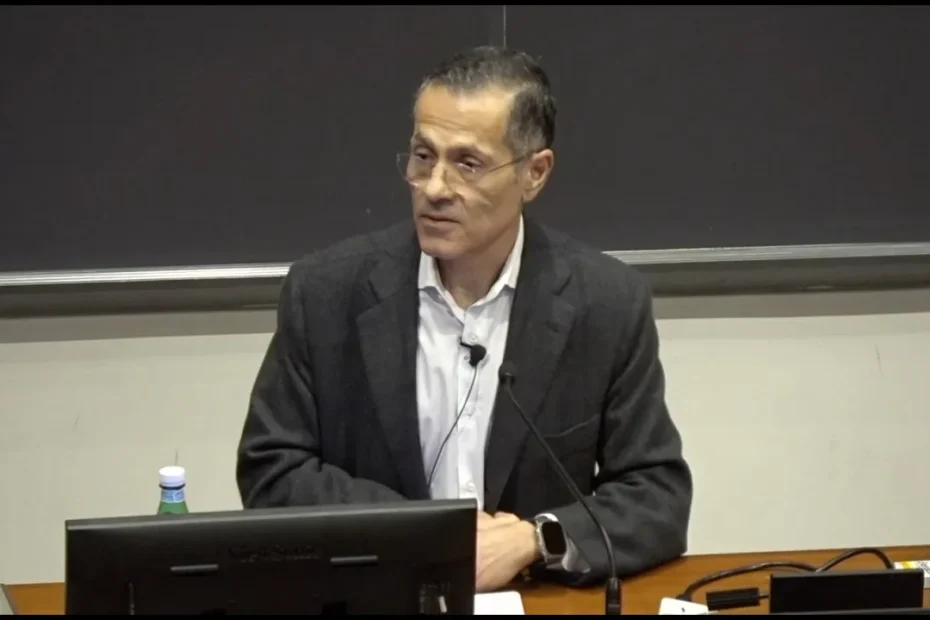
Editor’s Notes: In this insightful episode from the Mossavar-Rahmani Center at Princeton University, distinguished scholar and policy expert Dr. Vali Nasr explores the deep-seated root causes and grand strategies behind the ongoing US-Iran conflict. Dr. Nasr delves into the historical context of Iran’s 47-year struggle for sovereignty and independence, explaining how past experiences like the Iran-Iraq war have shaped the nation’s current resilient and militarized state. The discussion examines the shift in Iran’s domestic leadership, its tactical reliance on “mosaic” command structures and asymmetric warfare, and the broader implications for global energy markets and international order. (April 1, 2026)
TRANSCRIPT:
Introduction
UNIDENTIFIED SPEAKER: All right, good afternoon everyone. Thank you all for joining us and apologies about the delay in today’s event. We’re so honored to have Dr. Vali Nasr with us today. Apparently Amtrak and SEPTA were playing April Fool’s Day pranks on us earlier, so we’re very grateful for all of you to be here for today’s event.
Over the course of the last month, as we have witnessed the horrible events of the war on Iran unfold and its consequences around the Middle East region, I, like I’m sure many of us here, have been thinking about how we have come to this point, how we have reached a point of war and devastation on Iran. And as we have thought about this question and what the goals of this war are, what the long-term strategies that may be informing both the American and Israeli side and the Iranian side are, many sort of questions have arisen.
There’s really no one better equipped to guide us through the many questions that have arisen in the wake of the war than our distinguished guest today, who really needs no introduction, who is Dr. Vali Nasr, surely a name which is familiar to anyone who is in any way following the news on Iran.
About Professor Vali Nasr
Dr. Nasr is the Majid Khadduri Professor of International Affairs and Middle East Studies at the Johns Hopkins University School for Advanced International Studies, SAIS, in Washington, D.C., where he also served as dean from 2012 to 2019. He currently serves as the co-director of the SAIS Rethinking Iran Initiative and holds the prestigious 2024–25 Henry Kissinger Chair at the Library of Congress.
Beyond his rigorous academic pedigree, which includes a Ph.D. in political science from MIT, Professor Nasr brings a wealth of frontline diplomatic and policy experience. Between 2009 and 2011, Professor Nasr served as senior advisor to U.S. Special Representative for Afghanistan and Pakistan, Ambassador Richard Holbrooke, has been a trusted advisor for generations of leaders in this country, and his expertise is all the more necessary today.
Professor Nasr is a prolific author whose insights frequently appear in the New York Times and Foreign Affairs. I’ll take that as an opportunity to remind everyone to please silence any devices that you may have. He’s the author of many influential books, from The Shia Revival to The Dispensable Nation.
Most fitting for today’s discussion, he’s the co-author of a recent work, which many of us learned from tremendously when it was published, together with Narges Bajoghli and others. This is How Sanctions Work: Iran and the Impact of Economic Warfare. And we had originally invited Professor Nasr to the Iran Center to speak about his most recent publication, which unfortunately is more relevant today than a work like this ever has been. This is Iran’s Grand Strategy.
To summarize, Professor Nasr brings a rare combination of historical depth, rigorous scholarship and top-tier policy experience to help us think about the complex geopolitics of the contemporary war in the Middle East. Please join me in giving a very warm welcome to Professor Vali Nasr.
Opening Remarks by Professor Vali Nasr
VALI NASR: Thank you very much for that kind introduction, and my apologies for having to rearrange your day. But I’m very, very happy to be here, and I’m very grateful to the Musab al-Rahmani Center for inviting me back. It’s wonderful being back at Princeton.
As Dan mentioned, we planned for this talk a little bit differently, which was about Iran’s grand strategy and the work I did on that. So where we are in some ways is very relevant to that.
For all of those who watch Iran, for all Iranians and for all Iranian-Americans, for anybody with ties and roots to Iran, the past year has been sort of a series of enormously traumatic events, starting with the June War, the 12-Day War, and the horrific events in January of a mass uprising in Iran and its very bloody suppression, and then immediately the onset of this war.
And even those of us who are outside, we feel sort of the full force of these events, each of which is really history-making, historically turning, pivotal moments all coming at once. At one level, it almost looks like the 47 years of the Islamic Republic, of the Iranian Revolution, is really coming to a head in varieties of ways.
I mean, we could have looked at the January protests as really a final reckoning between the population and the Islamic Republic — of a population that has really gone past the revolution, wants a very different future, and the finality that the Islamic Republic really had to resort to a bloody brute force in order to suppress it. But even that within it had a sort of a reckoning of 47 years of economic isolation, which was one of the very big reasons for the mass alienation of the population, particularly since 2018, when maximum pressure sanctions were put on Iran, which, as you mentioned, was a subject of a different book we did.
And that economic sanctions is in turn related to Iran’s grand strategy and the way that it looks at the world and the way that it has organized itself. And you can look at this war, although it didn’t quite go the way President Trump had it in mind, that it would be a decisive war that would remove the Islamic Republic, but in many ways, again, it’s the culmination of 47 years of Iran’s ongoing confrontation, game of cat and mouse, with the United States in the region.
The Shocking Resilience of the Islamic Republic
Now, the question that often I get asked these days a lot by policymakers, others, but even it’s an academic question, is the shocking resilience of the Islamic Republic.
I think just in the sort of annals of those who study states, particularly in the Middle East, given also what’s happened to Middle East states in other wars and during the Arab Spring, is in of itself worthy of study. And then, connected to this, the other question is, what are these guys thinking? I mean, what on earth they think they’re going to get out of this war? Why aren’t they behaving in the ways that is expected of them?
47 Years of Isolation: How Iran Built Itself to Withstand
And we can dig into all of this, but I think some of this goes back to history. I mean, part of, let’s say, Iran’s resilience, even under the enormous amount of bombing, has to do with 47 years of isolation. This country has organized itself not to be easily subjugated. Iran’s electrical system, for instance, was deliberately built in a way that you cannot easily bomb it out. It would take months and months of bombing just to be able to knock out the electricity.
We’ve all read about Iran’s water shortages, which obviously has to do with climate, with mismanagement, with corruption. But one big reason is that in 2011, when President Obama pushed through, for the first time, the idea of secondary sanctions on Iran, that the country decided that it was going to be food self-sufficient. So Iran, in a way, overproduces agricultural goods, because it doesn’t trade in them. But at the same time, it is one reason why it is able to sustain the kind of war that is going on, for instance.
I would say that the resilience of the state, in some ways, and where it’s finding itself, and why does it look at this war and its situation, has a historical root to it. That actually allows us to put this in perspective of how Iran — and when I say Iran, I don’t mean every single Iranian, because ultimately, people are not making decisions.
It’s decision-makers who are making decisions, just like in this country. So their mindset and where they’re coming from and their education is what is material here.
You know, when I was doing my research for my book, I was struck by a theme that kept coming back, which was, whereas we’re often in the West very focused on the religious character of the Islamic Revolution and the religious character of the Islamic Republic, and the fact that it’s a theocracy, or we just sort of get too fixated on that. And we don’t take seriously a national security perspective here, which is very key.
And in that sense, Iran is a legal, rational actor in a barbarian sense. Doesn’t mean that its rationality necessarily is universally shared, but in a sense that it has a theory of what is the main threats to the country and how to defend against it.
Iran’s Historical Memory and the Fear of Imperial Domination
And I guess the fundamental flaw is that the Islamic Republic and Iran’s revolution over read the history of Iran since even going back to the Safavid period, but particularly history of Iran in the 19th and 20th centuries. Which all Iranians are familiar with, that the long 19th century, Iran barely survived as a state, barely survived as a nation state. It was deeply penetrated by imperial powers. Its history was a lot more like that of China, never formally colonized, but essentially having just about quasi-sovereignty in a territorial entity that was tolerated by colonial powers.
And then it had barely got its feet under it in the early 20th century, when during World War II it was occupied. It went through actually the first regime change, if you would, when even the monarch was removed. The country went through a famine during World War II. And then at the end of World War II, it faced again dismemberment when the Soviet Union would not leave its northern provinces.
And immediately seven years after that, it went through a burst of anti-imperialist struggle to secure control of its oil under popular Prime Minister Mossadegh, which ended up a military coup, which the Iranian people came to believe, right or wrong, that it was engineered from London and Washington.
And in the imagination of revolutionaries, in fact, Iran has never been independent, truly independent and sovereign for the past 200 years.
The Islamic Republic’s Claim to Sovereignty
I mean, about three, four months ago, there was a former Iranian foreign minister, Javad Zarif, had an interview with the Foreign Policy Magazine online in the US, in which he said that the Islamic Republic is the first government in Iran in over 200 years to give Iran true sovereignty and independence.
Now, this is a very, very audacious, if I may say, claim that I, for one, don’t agree with, but it is the truth that they actually believe in, that the main achievement of the Islamic Republic was not to make Iran Islamic, was to make Iran independent. And only an Islamic regime can give Iran independence. And that actually is truly their great historical achievement. We may not believe in it, but Ali Khamenei definitely believed in it, and he deeply believed in it.
And that then the mission of the Islamic Republic was to preserve and protect that independence. And against whom do you have to protect that independence? It’s against the United States.
Khamenei’s Worldview: America as the Eternal Adversary
I found it fascinating that in his first public speech after the massacres in January, and here is a massive public uprising, we would say it’s about politics. It’s about that your people are tired, they want something else, they want a different politics, and you have killed a large number of them. And the very first thing he said is that the United States has been wanting to subjugate Iran for 47 years. And this is not Trump, it’s American policy.
So to him, the great drama of Iran is about that we kick the Americans out, we want independence, they will be never reconciled to our independence. They want Iran to be subjugated as a colonial vassal, which is how Khamenei and the elite of the Islamic Republic view the Shah’s period.
And that this is all about that. And in a way, and I say this because, and I say this also often when public figures ask, that regardless of what you think about your adversary, you have to take him seriously. You have to take him seriously at their own words in the sense of how they’re looking at this struggle.
For the leadership of the Islamic Republic, and I’m not saying for all Iranians, this is not a battle for regime survival. That’s the way it’s characterized by their opponents and by people inside and outside. They see this as an existential struggle for Iran to maintain its independence as a country. So they see this in a very different way. It’s not about signing a particular item on the nuclear deal, or it is the view that it is the United States agenda to take Iran back to the Shah’s period, which in their view means a subjugated Iran, which is exactly what the revolution was all about, was about independence.
The Gap Between Khamenei and the Iranian Public
And I think that’s pretty important. The way in which they’re approaching this war, the way in which they’re willing to sacrifice. I think the big divide between Khamenei and the Iranian public, which became bigger and bigger over time, it was not just that you should wear hijab and they didn’t want to. In fact, he was probably, of all Iran leaders, was least concerned with hijab among all the Ayatollahs. That was not his issue.
I think the key issue was that he believed that protection of Iran’s independence is worth every single possible sacrifice that you need to give. And the Iranian public at some point just didn’t see either the reason why they needed to give that sacrifice, or that there were no other ways of achieving their goal with less sacrifice. So essentially, they rebelled against the concept of the Islamic Republic, exactly because this gap had become wider and wider.
And I say that’s actually pretty important because where Iran goes from here, the kind of conversation that’s going to happen between whatever’s left of the Islamic and the Iranian people will pivot around this issue, about how far was Iran’s independence as a country threatened. That Iran’s independence is not as illusory as what I was describing is. Like theoretically, Iran was independent. This is actually about real territorial integrity of Iran. It’s about destroying things that Iranians associate with their independence and sovereignty, like their steelworks, their industries, their national heritage, things of this sort.
And to what portion of the Iranians this now will ring true, that actually this is not just a political fight, this is actually about the independence of the country. And I think that’s material now in the way the Iranians are increasingly reacting to this war internally, and it will be material going forward.
The Iran-Iraq War as a Defining Experience
And I would just raise two other key issues that I think historically are very important for who we are. Beyond this sort of grand narrative that I described in a sort of mindset of Khomeini, of Khamenei, of that generation, and I have to say, it wasn’t just religious Iranians who believed Iran was a colonized state under the Shah. The left believed that. The Marxist-Leninists, the liberal Democrats, the Islamo-Marxists, they all basically had this theory that Iran was a colonial state after 1953.
Is that below this, there’s also learned experience here, which is actually very important. I argue in my book that perhaps the most important experience that shaped the Islamic Republic was the Iran-Iraq War. For two reasons. One is that it was a really, really big war. It’s probably the biggest war of the 20th century that nobody in the West seems to have ever heard of. We don’t think about it unless you’re a Middle East buff. It’s not on everybody’s mind. But if you look at numbers, conservatively, over 500,000 Iranians died in that war. Multiple that number were maimed or impacted by that war. The entire social profile of the country changed because of migration.
The entire economy of the country changed because of the social contract that the Islamic Republic essentially signed with its population, sacrifice and resources given to war in exchange for entitlement program that actually changed the character of the Islamic Republic.
And also, some of the experiences that they went through, which are very key, which is Iran was occupied for two years before they figured out how to liberate it. That is the attitude that sometimes I hear about taking Kargaila, right? We’ve been there, we’ve done that before. You can come and sit here and then it will be Iran-Iraq War over again. Again, I know it’s simplifying it, it’s very different, but it goes to the actual mindset.
Iran’s Isolation and Self-Reliance
The second was that, as is the case today, then Iran was alone. Iran, some of it because of its own doing, taking American hostages, etc. The United States and Europe were opposed to it, supporting Saddam. The Arab countries were opposed to supporting Saddam. Soviet Union was supporting Saddam. Nobody sold Iran weapons. Nobody gave Iran weapons. So essentially, whatever Iran had to do, had to do on its own. And some of that built resilience that is also showing today.
And again, in the middle of all this, Iran is alone. I mean, yes, China may help it. Some Arab countries may help it. But it actually really doesn’t have natural friends or natural allies or a natural partner in this war. So whatever it can do with its own missiles and its own drones and whatever it comes up with, it has to do it on its own.
Now, I say this because I actually think, and this is not just the Islamic Republic. You can go to Iran’s private sector. You can go to various aspects of Iran. These years of having to do it on your own has created a can-do nation. I mean, that’s what really, really separates Iran from the Arab world. Everything they have, they have to build on their own. They have to figure out on their own. If you’re manufacturing water bottles in Tehran and you’re a private company, you have to figure out how to deal with everything, right? It’s a very, very different mindset, which then is playing out today in terms of resistance and resilience. It’s not a monopoly of the Islamic Republic. It’s just that a country that for 47 years has basically grown up, if you would, in that kind of an environment.
The Iran-Iraq War as a School of Statecraft
The second importance of the Iran-Iraq War is that every leader of the Islamic Republic that mattered in the 47 years, although a lot of them have now been killed, got their first education in statecraft during that war, starting with Ali Khamenei. He was a political activist. I mean, he went to jail a lot. In fact, he says that’s the one thing he has upper hand over Khomeini. Khomeini really didn’t spend that much time in jail, but Khamenei spent a lot of time in jail. But he hadn’t done anything in government. He hadn’t run a country, and off the bat, he basically became wartime president.
All of the commanders of the Revolutionary Guard, they didn’t go to officer school. The equivalent version of officer school was trench warfare in the Iran-Iraq War. There were seven, a generation of… Qasem Soleimani was 17 years old. I mean, he was 17 years old when he was part of a company that liberated the city of Khorramshahr. So for them, what they understood out of that war, what they understood about resistance, about military organization, about how you fight a war against a different enemy, essentially was learned in that war. And some of those lessons are actually being implemented in this war itself.
So most Iranians have forgotten about that war, or they were born after that war, right? So it’s kind of like talking about Vietnam to a new generation of students, right?
Iran’s Strategic Doctrine: The Logic of Forward Defense
But if you went to older Americans, like when I worked for Richard Holbrooke, he was a creature of Vietnam, right? And that’s the difference. The generation, the older generation that’s actually running Iran is the veteran of that war, even though the younger generation has moved beyond it.
The other, I think, very important experience for Iran is the decade, although they started with this kind of warfare, proxy warfare, in Lebanon in 1982, but in a very big way from 2003 Iraq war, let’s say, until the killing of Soleimani in 2018, and then obviously till October 7th wars, which actually collapsed this idea of forward defense and all those proxies that you fight in other territories.
I mean, first of all, it is important because Iran, after the Iran-Iraq war, came to the conclusion that it cannot defend itself on its Iraq borders. That’s the border from which Alexander came into Iran, that the Arab armies came into Iran, that the Iraqi army came into Iran, and it’s actually fascinating that you read all the debates of that period in the memoirs of Revolutionary Guard commanders, in Khomeini’s proclamations, what you don’t see at all in the debate is the idea of exporting revolution to Iraq. It’s just not there.
The entirety of it is around the fact that the Revolutionary Guard says that we’re a volunteer jihadi army. If we demobilize, we cannot remobilize, and this border is not defensible unless you have tanks and artillery, which nobody sells us. We have to occupy, we have to be defending ourselves from further inside Iraq, and preferably even go all the way to Basra and capture that and force Saddam to fall. The entire argument for continuing the war was a military argument, and all the debate was a military debate.
The American Invasion of Iraq and Iran’s Existential Fear
Iran didn’t succeed then. The whole thing fell apart, but then you had the American invasion of Iraq, which I think, before this time, was perhaps the single biggest threat to Iran, because Iran sort of felt like the United States was feeling comfortable, was in the mood to overthrow all “quote-unquote rogue regimes.” Bush had dismissed Iran’s aid post-9/11 with the overthrow of the Taliban, and had put Iran on the axis of evil. They were going to invade Iran, so that fear of being taken over by the United States became very, very real.
And the way that they dealt with it was exactly the way they’re dealing with the United States today, which is the former foreign minister of Syria, after he parted ways with Assad, went to Geneva before he died. He took a whole suitcase of documents and memoirs, which he’s gradually been publishing, and he narrates a very interesting story when he went with Bashar Assad to Tehran just before the United States invaded Iraq.
They first meet with Khatami, Iranian president, and Bashar Assad says he’s really worried that after Iraq it would be Iran and Syria’s turn, and Khatami says, “Yes, I was just talking to Jacques Chirac this morning, and he said that Bush’s ambitions are much larger than Iraq.”
So then in the afternoon, all of a sudden, along with Khatami, go to see Khamenei, and Assad again says the same worry, that “I’m afraid that it won’t stop at Baghdad. They’re going to go after us, and they’re going to go after you.” Khamenei again says, “I agree that America wants to re-engineer the region,” and he says, “then we just must make sure that the crocodile doesn’t digest its bite easily,” which has been exactly what Iran is doing right now.
Kissinger, Larijani, and the Question of Revolutionary Fatigue
In fact, it reminds me, I narrated in the book, I didn’t mention his name then because he was still alive, that in 2015 there was a meeting between Henry Kissinger and Ali Larijani. Larijani was in New York for a get-together of speakers of parliament, he was speaker of parliament, and he met with Kissinger, and Kissinger basically wanted to know, when is Iran going to get tired of this revolution? When are you going to basically become a normal country, right?
And Kissinger begins to talk to him about Immanuel Kant and his theory of perpetual peace. He didn’t know that Larijani had translated Immanuel Kant in Persian, so apparently, according to Kissinger, who later on narrated to me, they had a fantastic conversation because then it got elevated to a subject that both of them really reveled in, but the gist of it was that Larijani said, “We want to know when are you going to get exhausted, right? When are you going to leave us alone and move on?” And this is not sort of an ideological war for Iran, this is basically us protecting our liberation by exhausting you to just leave it alone.
Iran’s Strategy of Exhaustion: Militias, Proxies, and Guerrilla Warfare
Now, the combination of what Qasem Soleimani did in Iraq, in other words, organizing militias, proxies, which is essentially, gradually for Iran became a very effective way of guerrilla warfare against the US and Israel. Again, yes, to Arabs this obviously, very understandably, was very, very unwelcome, just as much as any villager anywhere in the world would not like when guerrillas show up and take over their village and wage war from there.
That Iran actually would see that the best way of dealing with the United States, to making it exhausted, to making it not want a repeat of Iraq, to give Israel second thought every time it thinks about attacking Iran, is actually to have these militias which continuously snipe and attack and remind Israel and the United States of the dangers of attacking Iran.
And the strategy obviously worked until it didn’t, after October 7th, but in Iran they would say that it’s not true that it was a failed strategy or that what we did was wasteful. We created protection for two decades, between 2003 and 2023. For two decades the strategy worked, that’s why even at the height of the nuclear issue, Israel did not do an attack, that’s why the United States didn’t attack Iran. Now it doesn’t work anymore, but it worked at that point in time.
How Iran Wages War Beyond Its Borders
But it is not so much in the model that it’s in the manner of organization. In other words, how did Iran manage, a country under sanctions, to actually wage war in countries that are two countries removed from it, in Syria, in Yemen, in Lebanon, in such a successful way. And the key important thing is that that is the war that Iran is waging in the Gulf today. It’s guerrilla warfare against the global economy and against the United States.
And the interesting thing is that if you looked at Iran’s Revolutionary Guard, the top command were veterans of the Iran-Iraq war, whether they were corrupt, not corrupt, effective, et cetera. Israel has systematically been eliminating them in June and today. The commanders that are coming up did not fight in the Iran-Iraq war. They fought in Syria and Iraq against the U.S. It’s a very, very different experience. But again, it’s a war experience that Iran has. So again, it’s being translated into this war.
The Islamic Republic: Built for Resilience, Not Popularity
They’ve organized the Iranian state in a way that essentially is very difficult to eliminate. I mean, first of all, the Islamic Republic, from the minute that it was created, I think its mantra was, it was not created to be popular. It was created to be resilient, right? So obviously on the popularity level, it has failed and it will keep failing. But from units of Basij, the way IRGC is set up, the way they promote ideology, the way they cultivate the 15 to 20% of the population, these are all strategies of survival.
Some of it has to do with these war experiences. Some of it has to do with when you are fighting for 47 years against the world’s premier superpower, you basically develop a different way of thinking about resilience. And some of it even has to do with the early years of the revolution where a large number of their leaders were assassinated in what was essentially a civil war against the left. And it is a state that doesn’t depend on a person. It didn’t before. It is multinodal. That’s why it’s so chaotic.
That’s actually why it’s so corrupt because there’s not a single authority that dominates. You have multiple nodes of authority in the clergy, in military forces, in the private sector, among oligarchs, within the bureaucracy, judiciary, clerical establishment, and then they are connected to each other in varieties of ways.
That’s why when you kill 30 commanders of a revolutionary guard in June that the system doesn’t actually completely collapse. It stays afloat. And between June and January, we’re talking about six months, and again, I’m not saying they’re the same element of brilliance, but you have to basically take this seriously, they were extremely fast at adapting. So basically they reorganized the state and their military along the ways they call a mosaic command and control, which means that it doesn’t depend on any one decision maker.
Remember, I heard in September that every civilian leader down to the mayors of small towns has been ordered to appoint up to four people below them. So if you have a system that by killing one or two people it doesn’t collapse, you have to systematically kill a lot of people over a lot of time. You cannot behead the state, decapitate it. You have to keep shaving off, shaving off, and that threshold means that it’s a much, much longer campaign.
Now, that ultimately is one reason that what we are seeing is that they were able to sustain themselves.
Iran’s Missile Program and Guerrilla Warfare Strategy
The second is the example of guerrilla warfare. So Iran invested massively in missiles, and it has created a formidable force. In fact, one thing Israel learned in the June war was something that it didn’t know, and it became a whole new threat, that the Iran missile program is more lethal and more dangerous than perhaps was estimated before the June war, and now again, that’s the case.
But even there, the way they did this, obviously hypersonic missiles are much more difficult, but when it comes to much cheaper missiles, it again is built on a very different kind of a thinking about warfare, which is a poor man’s warfare, which is like a guerrilla warfare. So the Shahed missile, according to the US, costs $35,000. According to the Iranians, costs $7,000, right? And the chips they use to make them actually are from refrigerators, from commercial refrigerators, and they deploy them en masse on a battlefield the way they deployed human wave attacks during the Iran-Iraq war, right?
They didn’t have tanks, they didn’t have the Iraqi military but they had dedicated young people who were willing to basically run at the battlefield, on minefields, et cetera, to overwhelm the enemy. That’s what the Shahed drone is. It’s the modern day’s equivalent of human wave attacks.
Fighting on Iran’s Terms, Not America’s
Secondly is that clearly Iran, as it learned also in the Iraq war, cannot fight a conventional military with conventional weapons. First of all, there is no weaponry anybody can give you that would withstand the combined force of United States and Israel. So that’s a futile battle to do. They learned from Saddam’s resistance to the US that the US can dismantle any conventional military in a matter of weeks.
But rather that they need to fight the United States on the battlefield of their choosing, not of the US choosing. And that battlefield is the global energy markets and is the economies of the Gulf. With some countries, they do have issues, with some countries it’s just not personal. That’s where the battle is going to take place.
And they have proven that essentially they can take hold of the Strait of Hormuz to be able to match escalation by the US laterally. In other words, Israel can bomb Iran’s gas field, Iran can bomb Qatar’s gas field. And that the United States is just not capable right now or wasn’t prepared for denying Iran that capability to escalate.
How the War Has Transformed Iran
Now, the war in many ways has also been transformative for Iran. And it’s actually been transformative in a way that at least at face value doesn’t look good.
First of all, I think that the war has, in a very de facto way at least, confirmed that Iran is now an IRGC state. It is not a theocracy. Even then it was before to me, it had already passed that threshold. Yes, the language of the state is religious, the laws are based on religion, but at its core now, this is a state run by generals. This is a state run by military men. They were extremely influential in Iran before. They now are the state, pretty much, in a much more frontal way.
So yes, you do have a civilian facade in a supreme leader, a president, a member of the judiciary, but essentially the state is now dominated by Revolutionary Guards. So when Israelis killed Ali Larijani, his successor is a Revolutionary Guard commander. You killed Khamenei, Khamenei’s successor is Revolutionary Guard. I mean, Moshe Bar Khamenei is a turbaned guardsman. Before he went to the seminary, he was Revolutionary Guard. For 30 years, he’s been deeply immersed in Revolutionary Guards.
And every commander that Khamenei had put there, which much like himself was a bit prudent and not willing to go all the way, is now being replaced by commanders that Mushtafa is putting in their place, which are much more hawkish. I mean, the general that replaced Larijani, it was so hawkish that when he was vice commander of the Revolutionary Guards, Osama Soleimani resigned from the Revolutionary Guards. He left. And then later on, the supreme leader called him personally to come back and take command of the Houthis force. And now this person is Iran’s national security advisor. So this is a fact that will remain after the war.
Regime Change: The Rise of the Hardliners
In other words, the greatest, yes, President Trump is right. There has been regime change in Iran. Actually, I don’t dispute that at all. But both Israel and the United States, what they achieved is not only make the state Revolutionary Guards, but actually elevate the most hardline hawkish side of Revolutionary Guards.
The commanders that are taking over for some time have been criticizing Khamenei for having been too soft and as a result, having invited war on Iran. They argue, and these are, you can even find, they never name him, but you know who they’re talking about. They say that when the United States left JCPOA, you should have left NPT. When they killed Soleimani, you should have killed Americans. When they killed Ismail Haniyeh Nasrallah, you should have been far more aggressive. And when they hit Fardaw, the symbolic hitting of empty buildings in Qatar invited this attack.
And so the lessons they’ve learned from their time in Syria and Iraq is not that prudence pays. It’s actually, this is a much more aggressive side of the regime is taking over. We know how, we’re seeing it in action on foreign policy. What we don’t know is what they’re going to do domestically.
I mean, this general that has become National Security Advisor, General Zolgat, was responsible for the cracking down on student uprising of 1999. His hands are bloody with the suppression of the 2006 Green Movement. I mean, his record is not, he has a record, in other words, on the domestic scene. And I think that’s actually quite important in the sense of, you know, what will come next in Iran.
What Comes Next: The Social Contract and Reconstruction
I mean, a lot of it obviously will depend on how this war ends. What do they get out of this war? Under what circumstances they come out? And ultimately, there will be a new social contract with this population for three reasons, I think.
One is that January happened, right? In other words, they still have to address the alienation, anger, despondency of the population. Now, I’m not saying they can, but they have to. They can’t govern Iran in this situation that was left in January. So I don’t know how they will address it, but they will have to address it.
Secondly, I think they have to address the issue of reconstruction and the consequences of war on Iran. And that requires a completely new, if you would, conversation.
The Question of Iran’s New Leadership
**VALI NASR:** And again, I don’t know how that conversation would go. And thirdly, is that there is a new regime in Iran. And ultimately, Mujtaba has now a clean slate. This is Mujtaba’s state, it’s not his father’s. So he can take it in this direction, he can take it in that direction. Early indications are, of course, we could read one set of tea leaves, but that would remain to be decided.
Iran’s Population and the Post-War Mood
And the third factor here is the Iranian population. I would say the Iranian population, majority of them are still in the same mood they were in January. Maybe they’re not ready to go in the streets, but that has not been forgotten.
What is very interesting to me is the way in which this whole thing panned out. After the hijab uprising, the mass famine issue, and after the 12-day war, it was very clear that the 20% of the population that is very close to the regime, its real base of power, was on the defensive. It was basically being told to demobilize and get out of people’s way.
Particularly after the 12-day war, it was very clear, everybody was saying that, first of all, the state basically gave up on the hijab issue, wrapped up the morality police. The language that was being used with people is that the Iranians, the same hijab protesters stood by their country during the war, and Israel clearly sees Iran’s population as an Achilles heel. You have to be nice to people, right? In fact, Larijani said that, you have to be nice to people. So it was very clear that that side was being demobilized.
The Significance of Khamenei’s Death
But something happened which has consequence, which is, the way Khamenei died is actually quite important. Some of it is peculiar to me. The Israelis couldn’t find him during the 12-day war. They tried to kill him. Twice they tried to kill him, but they missed. He was largely inaccessible between June and January. And when there was most likelihood of war, he actually surfaced and went back to his office, which is itself a very enigmatic situation.
But the way he was killed with his family was very much, in the language of the state, evokes the myth of Ashura and the myth of Karbala. And in a way, yes, Mujtaba was the selection of the Revolutionary Guards in the middle of the war. But it’s very clear that the message that’s being conveyed to the base in Iran is that it is not his credentials as a statesman or his religious theological credentials that gives him authority to be the head of the Islamic Republic. It is that his story is Hussein’s story.
His charisma comes from his suffering. His charisma comes from, in a way, like the killing of Khamenei and the way in which most of the family died is a reenactment of Ashura, with all the obvious characters, Israel being Yazid and, you know, but that actually has worked. It has energized that base in a major way.
Mujtaba’s Path Forward
It would tell you that whereas before the war, the priority of the Islamic Republic seemed to be to bring the people who are in the gray area closer, try to build bridges with those who are protesting or are alienated, at least until the January uprising, the priority after the war is not people who are alienated. It’s the base that the Islamic Republic needed, that energized base from which the Basij, the IRGC, et cetera, come from. And it’s very clear that that base is very engaged.
But then, you know, what happens to that engaged base afterwards? I think that’s a really key issue as to whether Mujtaba will try to rule just with this base, or will he again try to find a way to create a broader base of support for the regime. And I’ll stop here. I’d be happy to hear your thoughts and comments. Thank you.
—
UNIDENTIFIED SPEAKER: We have about 15 minutes or so for questions. I will say fundamentally, although my colleague, Nargis Bajoghli, is much more attuned to this, and I do listen to her a lot on this.
I think the Islamic Republic, of course, uses every argument that is out there to convince the Iranian public that this is not a war to liberate you, that this is a war against you. And I would say that the way they see this is that there is an element that there’s a hot war that has been happening between Israel, Iran, and the US. But they realized at the Mahsa Amini period that they’re actually in a very intense information war with the West, and they are losing their population to that information war.
And so the television stations abroad, the social media, et cetera, I believe has had on Iranians inside and outside a kind of Fox News effect in 2016. In other words, people are just watching the same thing, the same things, and they come up with certain conclusions, like Israel is going to liberate Iran, that this is going to be a really nice targeted attack that’s kind of like a scalpel will open the way for a democratic Iran to emerge.
Now, much like in the US, obviously the Islamic Republic did help create the ground for people to be receptive to these messages. But its view was then that this is information warfare. And so this time around, you see them much more adept and quick out of the gate in order to engage that information warfare on multiple directions.
Iran’s Information War Strategy
So they are talking very directly all the time to Iranians outside of Iran, and particularly countering messages that they’ve heard on television that this is a war of liberation, that it’s a clean war, and the outcome of it would be positive. They’re also directing it on the inside. So what have they done is they’ve shut down the internet. There is national security reasons for that, which is to deny ability to use the internet to locate people, kill people, communicate with them.
But it also — Iranians who don’t have access to Starlink or ways outside, majority of them, the images and what they’re seeing of the war is what they’re seeing internally, unfiltered among them. So it’s what goes on their own mobiles, shared within the Iranian version of intranet, or on state media or on channels that exist. And so in a way, they have been able to do that.
And I think at a third level, they have been extremely effective in channeling and getting their message out to a much larger global audience of Global South and progressives and MAGA movement in the West. So I don’t know if you’ve seen these Lego movies they put out, that clearly is not directed at Iranians. That’s directed at the TikTok generation. And so there is a dimension of this which is essentially information warfare.
Nationalist Sentiment Over Religious Language
What I’ve seen mostly is, I think, which they think resonates most with Iranians is not the religious language of Hexeh, although they use this — I’ve seen references to it. But actually, the bigger issues that Trump has talked about: “I’m going to take their oil, I’m going to give weapons to the Kurds, we’re going to dismember Iran.” I mean, as of last 24 hours, what he’s really, really tracking across the board is this — what he said is that “I’m going to bomb them to the Stone Age.” So because they think that that talks about the nationalist sentiment of Iranians, which is now far more widely shared than religious sentiment.
And then also with their base, they are putting out huge numbers of very religiously charged production, and some of which has gone viral globally. I mean, some of these, what is called the maps, the religious elegies that are now with very modern music has sort of gone outside. They’re pumping that as well enormously.
Again, I would say if you looked at the approach, this is also a younger generation coming up, which is not only tech savvy, media savvy, but it’s also guerrilla warfare on the information front. They don’t have the equivalent of Iran International TV with a $250 million a year budget.
But what they can do is to turn Instagram and X and Facebook into vehicles for waging information war.
Understanding the Adversary: Iran’s Intellectual Ecosystem
AUDIENCE: Thank you. I was very taken by the anecdote you told of Ali Larijani meeting Henry Kissinger, and that led me to a thought. The late Iqbal Ahmed used to say that one of the great dilemmas of the Palestinian movement was its failure to understand its adversary with the kind of sophistication that it needed to develop meaningful strategies that would overcome the disproportion of military, economic, and political power in the struggle.
And I’m just wondering that in the United States, there is a small but very dynamic and gifted cadre of experts available to the US policy debate on how to understand Iran. Folks such as yourself and others, and there are centers for the study of Iran scholars in various universities and places. What is the ecosystem inside Iran for understanding the United States other than this imperialist, which has its own value, but in terms of the debates and the discussions about what the US is, what it’s doing, how it decides, and how they understand Trump and the Trump agenda?
Because it seems to me that a key part of developing meaningful strategies that we’ve seen failing on the US side is a deliberate choice not to try and understand the adversary, except on your own terms. And so I’m just wondering about whether this focus on the imperialist nature of the United States serves a kind of self-interest in the Iranian system that closes out the possibility of meaningful debates about other ways to think about and address the challenge that the United States and Israel pose?
Iran’s Intellectual Depth and Strategic Gaps
VALI NASR: No, it’s a very good question. I mean, there’s one side of Iran among the youth, which is like here, it’s all TikTok generation, and they’re not interested, and I hear people saying that young people don’t read, et cetera. But at the same time, also, Iran is not only a highly educated society, but it’s also a society that is extremely hungry for knowledge.
I mean, when you look at the number of social science books, or the number of books that are translated into Persian, and who would be the audience for all of these, it’s quite astounding. Where they’re lacking is obviously those who are at the policy-making level, those who sit in think tanks or in government who actually make decisions, there are less and less that now have a foreign education or come outside on a regular basis.
But still, I mean, when you listen to the level of debates in Iran, let’s say, on strategy, on policy, analyzing the United States, it’s quite sophisticated. It’s far more sophisticated than you would see in many other countries, which actually have access to the outside, or it could be on the same level. Obviously, a lot of it is secondhand, and as they’re listening to the outside, it’s not so much experiential.
But I do think there are gaps. I mean, they also have gaps in quite understanding. For instance, one of the very interesting issues that Iran increasingly is grappling with is that the revolution started with the idea that Israel is just an instrument of the United States, right, that’s the great Satan, this is the little Satan. But that strategically doesn’t work anymore, right, because the little Satan has eaten up the greater Satan, or is actually completely maneuvering the greater Satan.
And you could say strategically, Iranians cannot address this fundamental issue, that they cannot improve their relations with the United States at the same time as they are worsening their relationship with Israel. It’s just not tenable, right?
So there are gaps like this. But I think the failure right now for them to actually be able to arrive at a deal or arrive at places is mostly a failure of policy, I would say. And it’s not just a failure of understanding, I think. Yes, there is a failure of understanding that Trump basically underestimated Iranians altogether.
The Cycle of Mistrust
**VALI NASR:** But it’s actually the case that each side is beholden now to a particular world view. Ali Khamenei had a view that you cannot trust the United States. They will never accept the revolution, they will always want to destroy it. But every time that he also gave in, the U.S. also proved that it has exactly the same view, which actually proved him right.
So it was Qasem Soleimani who convinced them to help Iran help the U.S. in Afghanistan in 2001. And the reward Iran got was to end up on the axis of evil list. Then he begrudgingly allowed Hassan Rouhani and Zarif to go through with the JCPOA. The result was that the U.S. basically decided that now that Iran has dismantled its program, we really don’t want to have a deal and we actually want to squeeze them even more.
Which means that it’s not a question of understanding Iranians. It’s a question that the U.S. is beholden to the fact that we just don’t want to talk to an adversary, unless they come on their knees and they change.
Audience Q&A
We’re running low on time, so I think I’m going to collect some questions if this is okay. So we’ll start and work our way back here. So I’ll start with Weilin.
**AUDIENCE:** Thank you so much for the talk. So I read that some argue that this war will push Iran closer to China. But I know that before this war, there was rigorous debate within Iranian elites, even within the conservatives, about a closer alignment with China, mainly due to their emphasis on Iran’s independence, as you mentioned in your talk. So do you think this war will override these concerns about independence and really push Iran closer to China? And if it is, then what would Iran really expect from China — like selling weapons, or financing, or reconstruction?
Yeah, and also you mentioned that now the country is basically an IRGC-run country. So after this war, do you think there will still be rigorous policy debate or political debate within Iran? Thank you.
**AUDIENCE:** Okay, so I know this is going to be a lot, but here. Yeah, thank you very much for your talk. And so you talked about how during the Iran-Iraq war, the IRGC pushed for continuing the war into Iraq in order to establish kind of a deterrence. And so now with this war, there’s often — if you read the U.S. newspapers — there’s maybe Trump wants to end the war, but maybe the Iranians want to push on. And maybe for the IRGC to establish kind of a deterrence, they’re not interested in ending the war and they’re willing to bleed more and sacrifice more in order to destroy the global economy so much that it will be impossible for the U.S. to think about doing this again. So I would like to hear your reading on that.
**AUDIENCE:** Yeah, thank you very much for your talk. So we were pretty sure that enrichment was Khamenei’s personal mission and he won’t give up on enrichment. What do you think — in this new regime, are they going to give up on enrichment and also respect the region? Because if he doesn’t, it’s going to be…
**VALI NASR:** So, do you want to ask more or should I go ahead?
Iran After the War: Leadership, China, and a New Mindset
**VALI NASR:** Okay, so very quickly — I mean, the top text of all three questions is there’s going to be a new leadership in Iran, number one. So it’s going to be a whole new decision making.
Secondly, I think this war is going to be so big, so important to Iran, that it’s going to transform the country and its mindset in important ways.
So on China, yes, Iran talks a lot about bringing China in and relying on China. It also depends on what China is willing to do with Iran. But there were red lines that Iran previously did not cross with China. Iran didn’t want to borrow money from China. It didn’t want to go under debt.
Iran’s New Deterrence Strategy
Now it might have no choice but to do that. Maybe, first of all, the key decision maker is very different. Maybe Moshe Tavav will think differently than Ali Khamenei did. Maybe Iran realizes that it really cannot survive America and Israel without having a much tighter military and economic relationship with China. So some red lines may be crossed.
On the issue of deterrence, I would say, I mean, that’s the name of the game. The deterrence that Iran was counting on, which was its proxies, collapsed. And it has been very aggressively trying to find another way of defending itself. It went from defending itself from inside the Arab world to having to defend itself inside Iran itself.
And I think there are three things that right now, what you hear them talk about deterrence.
One is obviously missiles. There’s no way they’re going to negotiate over that. The only reason Iran survived the 12-day war and has survived today is missiles. And so to ask them to give up missiles is just like asking for a country to disarm itself, like Japan or Germany after World War II. Although I was very intrigued that in the 15-point President Trump put forward, he said, well, only defensive missiles that they need. Although that’s open to interpretation, what’s defensive, what’s offensive.
The War as Deterrence and the Strait of Hormuz
Secondly, I think the Iranians, much like what Larijani told Kissinger, now see the war itself as the biggest deterrence. In other words, we have to accept all the pain that we get, our steelworks, our universities, destruction, etc., because we have to reach the level of pain for the global economy, for Europe, US, Israel, to a point where all options are not always on the table. The war itself has to become unpalatable. This idea that it would be an easy war with Iran should be disabused. Again, that’s not a scale that you can say when you’ve achieved that, but you hear that quite a bit.
And the third is the Strait of Hormuz. I think Iran discovered in this war that its single biggest asset, strategic asset, is the Strait of Hormuz. I think they would be willing to give up the nuclear program in exchange for the Strait of Hormuz, in a way. If certain things like a political cover is there, that you have a right to enrichment but you don’t enrich, so it doesn’t look like they gave up.
Because you hear them say this, they say the nuclear program, particularly the way Ali Khamenei managed it for 20 years, only brought Iran war and sanctions. The only things that have protected Iran are missiles, and is now the Strait of Hormuz. So if they keep the Strait of Hormuz, they believe there won’t be war on Iran because the Strait will be closed again. And so they’re toying with these sets of things.
I don’t want to say it’s all set, but it’s the lessons when the war stops, it’s the lessons that will be internalized that would then become their new military doctrine.
The Enrichment Question
And then on enrichment, yes, I do think what they offered in Geneva was a de facto no enrichment. If you say we don’t zero stockpile, they basically are saying even if we enrich, it would be immaterial.
I think the right to enrichment is something that they will insist on. They will insist on that they have to have minimum rights that every signatory of NPT has, that they will not accept as a matter of principle for Iran to be treated as an exception case under international law. So what the German Chancellor says, that international law doesn’t apply to Iran, they won’t accept that.
So if there is a political cover that says, yes, you have all these rights, but just don’t exercise it, in exchange for this, I think that’s too…
You know, the Gulf, I think, we’re kind of like a deer in a headlight with what happened to the Gulf. And the sort of de facto way is to think that it will snap back to where it was.
The Gulf’s Changing Security Landscape
And I think everything about the Gulf has also changed. Its security has changed. Even if the Strait of Hormuz opens up, it’s not a given that its economies will return to where they were very quickly. I mean, the trust factor that the services economy, etc., was based on will take time to rebuild.
Not all Gulf countries will actually react the same way, either on security issues or to Iran. Now, UAE in particular, I think, is an issue with Iran for a number of reasons. One is that the issue of the three islands is on the table, and UAE has been agitating about it more. Secondly, Iran views that UAE and Bahrain are Israel’s allies. The other ones are not. But these countries are actually an axis with Israel, which makes them different from the other four. And then also, the UAE has been much more aggressive in this war. Even in their view of both UAE and Bahrain helping the U.S. actually launch missiles, etc., against Iran.
Now, what I hear is that this new generation of IRGC that’s come to the fore does not have the same economic interest in UAE that the previous one had. And secondly, they have already started going around UAE. And again, that’s where the issue of China comes in. If there’s a much, much larger economic relationship with China, the dependence on financial houses of UAE and oil brokers, etc., to manage things would be different.
I could see that Iran would continue to have a very difficult relationship with UAE after the war. But I think it’s a very dangerous thing for UAE because they’re caught between a stone and a hard place. Clearly, they want to get rid of Iran and his chokehold on the Strait of Hormuz. But on the other hand, if the Islamic Republic survives, which for now looks like it will, and if they’re in an antagonistic relationship with Iran, it is much more difficult for them to get their economies back. Because the continuous, persistent threat would basically make it very difficult to say that expats, direct foreign investment, and many of these things will go back.
So they have to make a decision that they want to quickly de-risk their economies, which means that they have to find a way not to prolong the conflict with Iran. And on the other hand, they also are under a lot of pressure from Iran more than the others. And as a result, they’re reacting much more to Iran.
Q&A: Moral High Ground in the US-Iran Conflict
We have time for one very brief question here at the end.
AUDIENCE: I’ll keep it brief. My question is, who do you personally believe is on a higher moral ground? And what are the moral values that Iran is trying to protect versus what the U.S. is trying to project on them?
VALI NASR: Ethics and philosophy was not my strong suit in college, so I don’t want to say I’m well-versed on that. But what I would say is that there are certain rules in this war that are dangerous for the international community. In other words, like killing — decapitation of heads of state. Yes, it’s very easy to justify it in the West and say, Iran is a rogue state, it’s a bad guy. You can do that, which is actually what the Germans have been saying in Europe. But then it won’t stop there. The rules that are being written about Iran will become more and more dangerous.
I think, to finish with this, I was reading an article in the New York Times which had a paragraph in the middle about a conversation between the president of Brazil and the president of South Africa. President Lula says that we should have a defense pact because if we don’t have a defense pact, both of us can get invaded. But that’s the level of conversation that has not come out.
I think that the inclination for more and more countries to go nuclear, to create a deterrence against decapitation, is going to get more. I think everybody is watching this war not in terms of just who has the moral high ground.
The Collapse of the Old Order
VALI NASR: That’s easier for them to answer. They say it’s an illegal war, it’s been conducted illegally, and some of Iran’s behavior, like closing the strait etc., is also illegal.
I think the larger issue is the old order is dead, very clearly it’s dead, and so you’re having increasingly rules of jungle being written around the country that is easy for the West to justify, but then these rules will become ubiquitous very quickly.
UNIDENTIFIED SPEAKER: With that, please join me in thanking Professor Nasr. Thank you. Thank you.
Related Posts
- Transcript: Maya Angelou’s Greatest Life Lessons on Oprah Podcast
- Transcript: The Next 50 Years: Humanity, AI, Power w/ Yuval Noah Harari
- How to Stand Out in an AI World by Thinking Better, Not Faster: Sol Rashidi (Transcript)
- Modern Wisdom: w/ Alex Petkas on True Story Of The Odyssey (Transcript)
- Reconstruction: Malcolm Gladwell Interviews Barack Obama (Transcript)