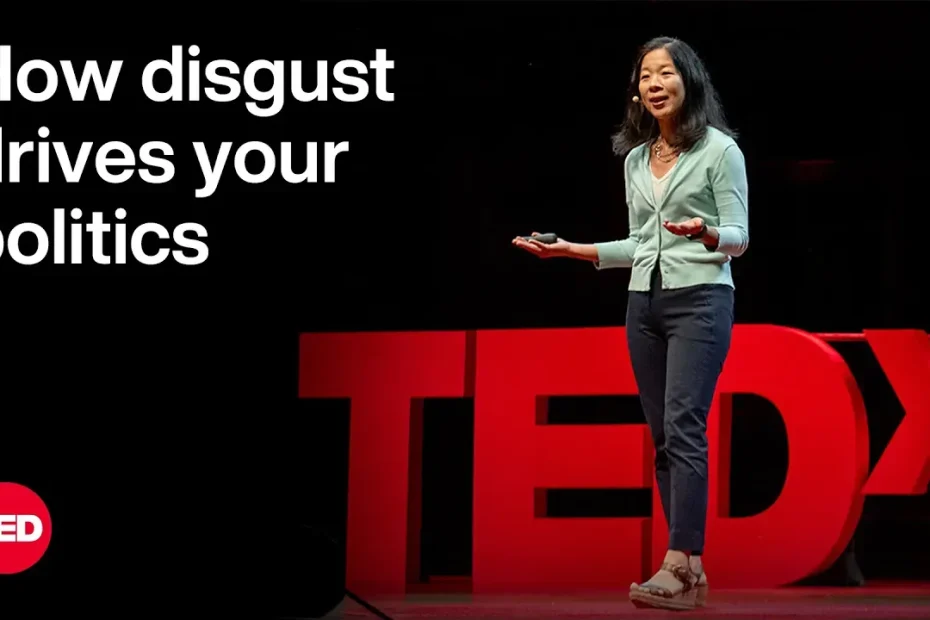
Here is the full transcript of political psychologist Cindy Kam’s talk titled “How Disgust Drives Your Politics” at TEDxNashville on August 24, 2024.
Listen to the audio version here:
CINDY KAM: Cicadas emerge every 13 years. You may remember the noise they made. It was deafening. You may remember the slime they left on the bottom of your shoes. How about how they tasted? Anybody remember that? Well, members of my family do. My daughter was curious about how they would taste. So one day she went out, gathered a whole bunch, washed them, deep fried them, seasoned them, and offered them so kindly to her family as a snack. My teenage son, my husband, even my 79-year-old dad, they were all game to try. It doesn’t taste like chicken, I hear. Me, no thank you.
Something made me shrink away from that very kind offer of a snack. I don’t think it was the fully rational part of my brain. Instead, it was a visceral gut reaction. That visceral gut reaction is the emotion of disgust.
The Role of Disgust in Decision Making
So let’s talk about the emotion of disgust and its role in our decision making. Each of us has occasions where we have a disgust reaction emerge. These reactions are automatic, but what we do with them is not. Now you can think of disgust as being ready to be roused and to be in the driver’s seat of your decision making. Where will it steer us, and should we let it? Or sometimes, should we tell it to get in the back seat and let other thoughts and emotions take the wheel?
Let me start by noting that disgust is one of many factors that influence our decision making. They say we make 35,000 decisions a day, too many for us to spend very much time hemming and hawing over them. Psychologist John Barge coined this the “automaticity of everyday life.”
Now emotions are among these forces that underlie our decision making. Emotions can be helpful. On a social level, emotions help us very quickly and efficiently communicate what we are thinking and feeling to others and enable us to very quickly encode what others are thinking and feeling. On a cultural level, emotions help to reinforce values, norms, and identities.
Emotions are universal, that is, they cross time, space, people, and societies around the world. But what triggers them often is culturally constructed.
Understanding Disgust
So let’s talk about disgust. What triggers that? Well, disgust is a basic emotion, which means it emerges as a basic physiological response. We can see it in someone’s face, the puckering of the lips and the closing of the nostrils as if to ward the body off from potential contaminants. And that’s what disgust is. It’s when we seek to reject contact with an object, an entity, a practice, a person that we think may be impure. Disgust begins with the body, but disgust extends beyond the body to the soul and the social order.
Now anyone with a one-year-old probably knows that the disgust reaction is not innate. Disgust emerges around the age of two or three when children are potty trained. So even though disgust is universal, experienced around the world, across time, in societies of people around the world, we have to be taught what is disgusting. That occurs through cultural enculturation and through experience.
The thing about disgust is that it’s adaptive, and it can lead to protection. So evolutionary psychologists talk about disgust as an adaptive physiological response. Tens of thousands of years ago, humans lived in small bands of hunter-gatherer societies. Imagine you’re one of these hunter-gatherers. On an everyday basis, you may be out there, and your job for today is gathering berries. There may have been an occasion where you had a red berry, and then you didn’t feel so good afterwards. And ever since then, now you avoid those red berries. You see them, and your stomach turns. You say, no way, I’m not going to do that. That’s conditioned taste aversion.
Conditioned taste aversion is an evolutionarily adaptive physiological mechanism. Our bodies orient us away from those objects we associate with illness or disease. So disgust is adaptive. It can lead to protection and connection.
Disgust in Politics
So disgust also operates not just on evolutionary scale, but in politics. So in 1906, Upton Sinclair published his novel, “The Jungle.” You may recall “The Jungle” for its graphic descriptions of the Chicago meatpacking industry. Through “The Jungle,” readers learned what went into the sausage, and it wasn’t what they expected. They learned that the chicken sold in tins on their neighborhood shelves might actually be beef hearts or other organs, or worse. They learned that a worker could trip and fall into a vat of lard that ended up on their neighborhood shelves.
Now Upton Sinclair actually intended for his novel to be an expose of exploitative working conditions. He is famous for having remarked, “I aimed at the public’s heart, and by accident I hit it in the stomach.” And boy, did he. The American public was disgusted, and they demanded protection. President Teddy Roosevelt ordered two separate investigations, and within four months of the publication of “The Jungle,” two landmark laws were passed, which remain the pillars of our current food safety system.
Disgust Sensitivity in Research
So disgust can lead to protection. I’ve looked at this connection between disgust and protection in everyday contemporary politics. In my work, I’ve thought about disgust sensitivity, an individual trait where people vary in how likely they are to feel disgusted. We measure disgust sensitivity with a set of questions developed by psychologists, which include things like, how disgusting would you find it if you went to take a sip of milk only to find that it was spoiled? Or how disgusting would you find it if you went to take your trash out and you saw maggots on a piece of rotting meat?
A couple things about these questions.
First, they’re not political. They’re personal. Second, they’re everyday, not momentous. And third, people vary in how they respond to them. Some people find the scenarios in these questions extremely disgusting. So for them, it’s like disgust is shouting through a megaphone. Some people shrug and say they’re not disgusting at all. And for them, if disgust speaks, it’s in a whisper. And for others, they’re somewhere in the middle.
And what I found in my research is that this variation in disgust sensitivity helps us understand people’s views of important public policies. People who are higher in disgust sensitivity than people who are lower in disgust sensitivity are more likely to support policies that they construe as protecting them, protecting their bodies, protecting their soul, or protecting society.
How Disgust Creates Connection
So disgust can be protective. Now the other thing about disgust is that it can actually lead to connection, which is kind of funny because disgust is an avoidance emotion. We seek to avoid whatever we think is contaminating. In my research, I’ve looked at the relationship between disgust sensitivity and public opinion, demand for policies. And I found that disgust can actually push people, even those who are political opponents, in a similar direction.
So for some of this, these are policies on the left, such as support for more government spending on the food safety system. People who are more disgust sensitive want to see more government spending on securing the nation’s food safety. There are also connections between disgust sensitivity and public opinion that are less on the nose, if you will. As I mentioned, what triggers disgust is often culturally constructed. And so some political discourse has connected disgust-laden rhetoric with particular stigmatized groups. And so disgust sensitivity can also lead people to intolerance for these groups and to support exclusionary policies.
Now I’ve also found a connection between disgust sensitivity and public opinion on disease. First, this was B.C. before COVID. At the time, I was looking at what seemed to be very far away and very distant outbreaks, Zika and Ebola. And for those outbreaks, I found that people who are higher in disgust sensitivity, they wanted to see government doing more to protect the country from outbreaks. They refused to travel to places with outbreaks, and they wanted to close the borders to those traveling from places with outbreaks. This occurred even though Ebola and Zika were barely politicized, and it occurred across party lines. So in this way, disgust sensitivity pulled people in the same direction, regardless of where their political alliances stood.
You can also think of this in the context of eating cicadas. So you and I may disagree on many issues, but for some of you, we may be in agreement that we’d rather not eat cicadas. And if we talked a little bit more, we might find that we are in agreement about avoiding some other behaviors that we jointly deem as potentially contaminating. And if we talked even more, we might find that there is actually some common ground between us in support for policies that we jointly construe as protecting us from contamination. So in this way, disgust can lead to protection, but
It’s surprising because, as I mentioned, disgust is an avoidance emotion. Now there are also nuanced implications of disgust. As much as disgust is really fascinating, can lead to protection and connection, I also want to mention that it can be fueled by imagination and potentially steer us in the wrong direction.
So imagine I were to offer you a fine piece of chocolate made from the finest ingredients possible, handcrafted by world-class artisans. Sounds pretty good. But what if it happened to have an unfortunate shape? Would we still want it? Why do we shrink away from a perfectly innocent piece of chocolate that happens to take an unfortunate shape? That’s imagination.
So disgust can be triggered whether the contaminant is real or imaginary. You can think of disgust as a security system that’s ready to go off, eager to go off, eager to protect us, but that can be misinformed, right? So the sympathetic law of similarity, it runs on imagination. It imparts the objectionable qualities of one object to something that looks like it, right? That’s imagination.
When Disgust Leads Us Astray
That occurs with, say, conditioned taste aversion. I mentioned conditioned taste aversion as evolutionarily adaptive. Now that was helpful tens of thousands of years ago, but it still exists in our physiological architecture today. I’m sure many of us have experienced this. I, myself, for example, went to a fast food restaurant, felt sick as a dog for 24 hours afterwards, and to this day have refused to go to that restaurant in that location as well as any location in the entire world because I associate that place with having felt sick, right? This is the nature of conditioned taste aversion. Helpful at evolutionary scale, but fueled probably by imagination, right? And so my children will tell you that this irrational conditioned taste aversion is holding me back from having a perfectly fine meal with my family.
Think also about my reluctance, perhaps your reluctance, to eating cicadas as well, right? Did you know that two billion people around the world rely on insects as a food source? In a world where we need to be mindful of the global footprint of our protein sources might disgust be holding us back from doing my part, our part, for the planet and for humanity?
Conclusion
To sum up, emotions are among the many factors that influence our decision making and disgust is a particularly potent one at that. Disgust is ready to participate and even drive your decision making, and it can lead us to protection and it can even lead us to connection with political opponents. But disgust also entertains imagination and can steer us in the wrong direction as well, holding us back from reaching other goals.
So the next time disgust emerges for your decision making, maybe in 13 years when it’s your turn to eat deep fried cicadas, or maybe and probably sooner than that, I hope you’ll remember that our disgust reactions are automatic, but what we do with them is not. It’s up to you to decide if you want disgust to be in the driver’s seat of your decision making or if you want to push it to the backseat and let other thoughts and emotions take the wheel. Thank you.