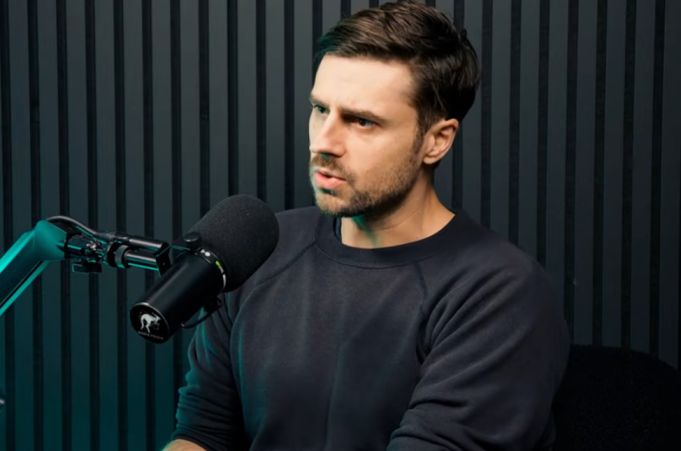
Here is the full transcript of artist Joshua Citarella’s interview: ‘Internet Culture and Gen Z Politics’, on Modern Wisdom Podcast with host Chris Williamson, December 13, 2025.
Brief Notes: Chris Williamson sits down with artist and internet culture researcher Joshua Citarella to explore the strange, often unseen subcultures that are shaping online politics today. Citarella explains how teens move from harmless memes to fringe ideologies, why Gen Z’s political engagement looks nothing like previous generations, and how “irony poisoning” turns jokes into genuine beliefs over time. The conversation breaks down how radicalisation actually works in practice, which small online communities end up punching far above their weight, and why right-wing populism has become so attractive to young men around the world. They also discuss whether internet creators really are a “pipeline” to extremism, how to stay informed without getting lost in doomscrolling, and why some people now see conservatism as the new punk rock.
Introduction
CHRIS WILLIAMSON: I really love what you do. I think it’s very interesting, very unique.
JOSHUA CITARELLA: That’s incredible. High praise from the greatest cinematic podcast that I think exists. I mean, there’s only so many people in the game that produce really beautiful video footage. And I think you seem to be in maybe the top spot there. So it’s a great honor.
CHRIS WILLIAMSON: Thank you. Some may accuse me of all style and no substance, but you know, I’ll take whatever I can get.
How do you describe what you do? You meet somebody at a cocktail party and they say, what is it that you’re interested in? What do you say?
JOSHUA CITARELLA: I suppose I first try to avoid the cocktail party if at all possible. But I used to say artist because that was what I did. I would show work in galleries and museums.
Now I say artist and Internet culture writer. I’m a podcaster, though most people know me for podcasting. So about a year ago, maybe a little over a year ago, I launched Doom Scroll. We’re now in episode 36, 35, something like that. And so it’s a real transformation in that. I used to publish to an audience of like 10,000 dedicated intellectuals and now it’s like 100,000 weekly viewers and it’s just a very different game.
CHRIS WILLIAMSON: And what is it that you’re interested in? What is it you focus on?
The Origins of Political Meme Research
JOSHUA CITARELLA: I mean, I guess it goes back to 2018. I wrote this book, it was a self-published book really. A long form essay called “Politogram: The Post Left” that was looking at the memetic activity of teenagers, 12 to 17 at that time, mostly people on what we would then call the post left.
That means a little bit of something different now, which you might associate with post-liberal new right. Previously, Bernie supporters, now people who’ve gone through that Bernie to Trump pipeline. That’s generally what we call post left.
At that time it meant eco anarchy, green anarchy, anarcho-primitivism, people who would reject industrial society and were 14 years old posting on Instagram. And I wrote a pretty extensive ethnography of how those people got into those politics.
CHRIS WILLIAMSON: That sounds niche.
JOSHUA CITARELLA: Yes. Yeah, it was extremely niche. I think it has held up pretty well considering that was eight years ago now and it laid kind of the foundation for a lot of the memetic ecosystem that we live in now.
So if you look at those early, you know, this is all primary sources of people who were meme makers, like teenagers who are posting on the bus to school. There are early inklings of how our media environment exists now.
So, yeah, I think while it was previously niche to audiences of hundreds or thousands, we now see those same narratives and in some cases, literally the same memes posted to audiences in the hundreds of thousands or millions. So the scale on these things, we call it early detection. How do you find something that is going to get big in the future? It’s like political trend casting.
CHRIS WILLIAMSON: Wow. Fascinating. What is it that predicts whether something is going to become big in the future or whether something is going to die a death, like most memes probably do?
Predicting Political Trends
JOSHUA CITARELLA: Well, this was part of the debate at that time whether this was part of a trend cycle that has, like a bell curve, right. Of early adopters, late adopters. It gets big and then it dies off.
And I think the key to that is the underlying analysis of knowing, what is a problem that won’t go away? Or what is a problem that won’t easily go away? What is the trend line that you’re following?
And if you’re looking at downward mobility in the United States for most working people, that’s been pretty steady for, like, 40 years. So I don’t think that’s a trend cycle.
And basically what I was mining at that time was kids in this Gen Z bracket who are looking at a life that is very different from millennials, very different from Gen X. They don’t have that same boomer upward mobility, where the future they’re looking towards is, in some cases, pretty grim. And so it was understandable about why they would want to reject technology or get into radical politics and do something to upend the status quo.
CHRIS WILLIAMSON: How do you come to think about what’s happening with young people in politics at the moment? I think I’ve heard you say that it’s qualitatively different than it was in the past.
JOSHUA CITARELLA: Yeah, there’s been moments where we go through kind of like a correction. You know, it’s like, oh, we swung too far in this direction, and now we’re going to go back this way for a while.
CHRIS WILLIAMSON: Right.
JOSHUA CITARELLA: And we kind of reach this center, equilibrium.
And so I think when you see something that reaches, I was a consultant on a project called Breaking Points, like, when do these narratives ultimately hit a point of no return? And they have to make a pretty decisive transformation.
So I think we’re seeing some of that now. And this is kind of the interesting moment that we find ourselves in where, like, 1980, up until let’s say 2020, 2024, we were in a pretty consistent period where across the United States, across both parties, across most of the advanced world, there was a general consensus on how you were supposed to run an advanced political economy. And now that has been completely thrown to the wind.
And so there’s a period of, I think, renegotiation that we’re going through that has a lot of positive proposals coming out of it.
The Rise of Right-Wing Populism
CHRIS WILLIAMSON: What are some of the big trends that you’re sort of focused on now? You mentioned that there’s some that have started coming through. What are they?
JOSHUA CITARELLA: I mean, I think that the rise is clear. It’s right-wing populism across all of the advanced world. Right. Like you see this in Hungary, Poland, Italy, like too many countries to name, the United States obviously.
But basically the constituencies that in my parents’ generation used to vote with the interests of labor, the constituencies that used to form the Labor Party are now voting for these right-wing populist candidates. And that trend over the course of 40 years basically tracks with the neoliberal consensus.
And so the thing that has come out of it, to the great surprise of people on the left, is not like a renewed trade unionism and there is a strong push for social democracy, but it is this new international nationalism. We don’t yet know what to call it, but generally the rise of right-wing populism as a pushback to austerity, anti-immigration politics, this kind of stuff.
CHRIS WILLIAMSON: Is that something that you tracked early? Were you seeing this in the subcultures?
JOSHUA CITARELLA: I mean, and hitting a lot of pushback on it too. Because I think this will sound wild and crazy to Gen Z listeners, but for the period that you and I grew up, the general consensus of conservative parties was free market evangelism, they were all economically libertarian.
So when I started talking about the rise of right-wing populism eight years ago, and I was like, okay, no one under the age of 25 is a libertarian. That was people outright dismissed it because it was completely alien to their experience.
And now I think if you just look at the general alignment of conservative parties, very few of them are economically libertarian or perhaps globalist in their orientation. But that was very new. When I started talking about it, I think that that was correct.
Going Down the Rabbit Hole
CHRIS WILLIAMSON: So going back to your original research, 2018, and then that must have kick-started a little bit of an obsession. And also once you’ve paid the price of learning how these subcultures work and sort of the structure of research, I suppose being able to go down rabbit holes appropriately, I imagine that the rabbit holes go pretty deep.
So just how extreme or bizarre are the depths that you’ve managed to find online?
JOSHUA CITARELLA: Yeah, I’ll lay out maybe a few different projects here, but just to talk about how really, I mean, incredibly granular this was, which was, I don’t think, to my credit. I didn’t really plan much going into this. I was just kind of following my curiosity.
I started with general, let’s say, lefty posters who were supporting Bernie Sanders in 2016. Previous guests on the podcast. You know, broad kind of, let’s say just lefty aligned, you know, not really well-formed politics with kids that were 13, 14 years old.
And then I follow them over the course of around two years, I watched them through various platform migrations, instances of deplatforming, moving between Discord, Reddit, Twitter, all of these different things.
At one point, towards the end of that text, they’re gathered in a pretty exclusive, very small Discord that’s probably around 100 people. And they’re distributing writings from active eco-terrorist groups alongside memes that include instructional manuals or how to make improvised explosive devices.
So to follow someone’s political journey from memetic activity that is reaching audiences of hundreds of thousands to this extremely niche subculture that, you know, hundred people participate in, there were not that many primary sources that would just follow the rabbit hole that deep.
And what I did during that time was just mostly because no one else was doing it. I was just spending an enormous amount of time in these communities and trying to catalog how wide the Overton window was.
If you’re 15, the acceptable parameters of political debate are not just Democrats and Republicans. And it extended to Trump and Sanders, and then it extended to primitivism and transhumanism. And before you know it, you’re zoomed out to some cosmic level.
And so the big philosophical questions that we’re asking, lo and behold, some of those things are just real-world politics now. So it became pretty interesting. And I’m kind of of the opinion that those 15-year-olds were right in some important ways.
CHRIS WILLIAMSON: How so?
JOSHUA CITARELLA: They had the foresight to recognize an important transformation technologically, politically, economically, when the traditional gatekeepers of legacy media, for example, were unable to. So, yeah, I think that that was an important insight and I’m inclined to agree with them on that.
Youth Political Engagement
CHRIS WILLIAMSON: Were you interested in politics at 12 or 13?
JOSHUA CITARELLA: God, no.
CHRIS WILLIAMSON: Me neither.
JOSHUA CITARELLA: Why would you be?
CHRIS WILLIAMSON: That’s the first question that comes to mind. And I don’t want to sound, I don’t know, like some patriarch telling the kids to go out and get on their bikes or something.
But I don’t think I was really even conscious of politics in any real way until probably my early 20s. And I still wasn’t that engaged. I might be a particularly disengaged person.
Is this new? Is the engagement of people in the early tweens in serious political ideas and sometimes extreme political ideas? Is that novel?
The Transformation of Media and Political Ideology
JOSHUA CITARELLA: Yeah. So this is a very important question. I tried to approach this. I think there are three kind of primary contributing factors here.
So number one is that with the transformation of our media environment, all of a sudden the infinite world of all text and history becomes accessible to everybody. Right. Like our accessibility going to the public library, wherever you grew up in, is substantially limited compared to everything on the Internet. Right. So number one is access to information.
Number two is, I think, the historical grounding, which is probably the most significant topic to address here. But a previous guest I had on the show last summer, Francis Fukuyama, political theorist, works at Stanford, incredibly celebrated, one of the most influential political theorists of the 20th century. He in 1992 published this book called “The End of History and the Last Man.”
What he famously argued in that text is, this is going to be a little bit of an arc here, so bear with me. As far back as Hegel, which is this obscure German philosopher, not really worth knowing about, there’s this idea of teleology, and this is the progression of socioeconomic forms that we’re familiar with. You know, feudalism, then capitalism, then socialism. There’s this kind of linear arc that society moves through. This is later extrapolated on by Marx and so on. And it was kind of the underlying idea that this rise of kind of competitive economic forms was somehow built into the development of human society.
And in 1989, in this essay and then later in the book, in 1992, Fukuyama says, no, actually the end point of human society, the final form of human government, is liberal democracy in not just the United States, example, but he points to Denmark, European countries. But the idea that socialism was a kind of historical inevitability in the Marxist sense, Fukuyama disagrees with that.
And that was right at the fall of the Berlin Wall. You get kind of a heyday there of like, let’s say, 1989, up until 2008, where there was a general consensus. And I think I’m quite sympathetic to the people who believe this. We grew up in this world that there was no other alternative. You know, this is not like the 1920s or 30s or like our parents maybe grew up with actually existing communism, actually existing fascism, that there were other forms of organizing society. And we thought, no, it was capitalism that won and that was it up until the future here on and forever.
What happens post 2008 is kind of a splintering of that consensus that ultimately reforms in the leftward flank of Sanders and the rightward flank of Trump in the United States. So you see a similar dichotomy in like every other country of a similar level of development.
But growing up in Gen Z, you don’t have that 1989 liberal democracy consensus that this is the final form, this is the way that things are going to be. Instead you are born into a world that has no political answers for you while you’re given the complete archive of the Internet to trudge through every possible meme and political text that’s ever written and to kind of hyperbolically churn these out.
The third thing I would just throw in here very quickly is that the way that teenagers are kind of freed from morality and are tempted to shitpost and exaggerate things, all three of those factors multiply to just the most kind of competitive, insane media ecosystem where you have like MAGA communism, anarcho primitivist caliphate-ism, queer anarcho-transhumanism, libertarian neo monarchism, just. They run ad infinitum.
CHRIS WILLIAMSON: Libertarian neo monarchism.
JOSHUA CITARELLA: That’s a more popular one nowadays. Yeah. Oh, okay.
CHRIS WILLIAMSON: That’s a more popular one. That’s in the ascendancy.
JOSHUA CITARELLA: That’s the. There’s a faction of the new right that I think is. Yeah, libertarian neo monarchists for sure.
Gen Z and the Absence of Political Consensus
CHRIS WILLIAMSON: Right. Jesus Christ. Okay, so because there wasn’t the consensus when Gen Z, who are currently in ascendancy on the Internet and have the most time on their hands and the most screens in front of them because there wasn’t an agreed upon “this is what the future is going to be like.” Plus probably a little bit of a golden era-ish. Back end of the golden era for us where questions weren’t really being asked. I guess living standards kept on rising.
JOSHUA CITARELLA: And.
CHRIS WILLIAMSON: That plus the fact that they can trawl through any infinite number of previous potential solutions to worlds that had similar problems where there wasn’t an outcome defined. This is the direction for the economy, for politics, for social cohesion, et cetera.
This has meant that people have a question and a f* ton of answers. And they’re now trying to retrofit one of an infinity of answers plus ones that they can create and mutate from existing answers into the question, which is still as yet non complete. Is that a fair way to assess?
JOSHUA CITARELLA: That’s perfect. Yeah. That’s a great synopsis of it. A friend of mine, the artist Daniel Keller, described this as a GAN, a generative adversarial network that if you look at the mimetic activity of teenagers, they are just brute forcing together combinations like monarcho syndicalism. Does this work as a political ideology? No. Okay, onto the next one.
And just trying to throw spaghetti at the wall to see what can scale to the crises of the 21st century. They’re not doing a great job so far, but they have started to form. Like there are now, I would say, young political blocs that are pretty influential. Right. There’s like a paleo conservative wing of the Internet that has like really shifted the Overton window in the US for example.
CHRIS WILLIAMSON: How so, how do. How have they come into contact with reality, the Paleo conservatives?
JOSHUA CITARELLA: I mean, you watch the rhetoric of a lot of the right wing pundits. They now track with stuff that Fuentes was saying like six years ago, for example.
CHRIS WILLIAMSON: What makes that Paleo? When I think Paleo, I think meat and fruit diet.
JOSHUA CITARELLA: Oh, so there’s paleoconservatism as like a proper political label, was something that was used by Pat Buchanan and has been kind of readopted by young conservatives that want to differentiate themselves from neoconservatism, which was generally the conservative way of operating, where paleo is a prefix for this.
CHRIS WILLIAMSON: It would not have surprised me if you said this is a wing of conservatism which is based fundamentally around your diet. Like it’s based around what you eat. You should be eating mostly whole grains, meats, fruits, nuts, and some tubers. And if you do that and you’re sort of right of center, you’re a paleo conservative.
JOSHUA CITARELLA: Body populism, I think that’s called.
CHRIS WILLIAMSON: Oh, is it? Okay, that’s cool.
JOSHUA CITARELLA: That’s a good one. Good advice. Yeah.
CHRIS WILLIAMSON: Holy shit. The context window that you need to keep in your mind.
JOSHUA CITARELLA: Yeah, yeah.
CHRIS WILLIAMSON: To hold all of this shit together.
JOSHUA CITARELLA: Yeah, yeah.
CHRIS WILLIAMSON: Mess. One way to put it. I was going to be more complimentary, but.
Political Engagement as Encyclopedia Collection
JOSHUA CITARELLA: That became part of the game where I think in a negative aspect, this is kind of like, oh, political engagement is collecting Pokemon, where there’s 150 different ideologies. And I’m going to make sure I know all of them and I can name them in like alphabetical order or something.
And so the type of like in the way that people would autistically approach rate your music, this encyclopedic knowledge bank of just knowing every album by every musician in a certain year that then replaces the political engagement with this kind of encyclopedic hobby. That can be a negative aspect of access to too much information as well. Yeah.
CHRIS WILLIAMSON: You optimize for sort of rote knowledge as opposed to understood wisdom in that way. Like there’s not really any applicability of this in terms of the understanding. If I’m to ask you about what it is beyond the glossary definition you’ve got from the other angle, or how it interlinks with. So tell me, who would be on the other side of this? Or what would be an example of a time that this has occurred in history? Or why do you think this came about?
All of those questions just sort of bounce off the wiki of this thing and sort of fall to the floor. That’s interesting.
So you mentioned there. I don’t know whether you use the word, but it sounds almost like a pipeline or a funnel of radicalization, of going from whatever the political equivalent of cute, fluffy dog and cat memes are to something more serious over time to improvise explosive devices. And then. Talk to me about that, Talk to me about the extremism radicalization funnel pipeline. Have you tracked this? Have you come up with a way that this sort of fits together?
The Pipeline Metaphor and Political Movement
JOSHUA CITARELLA: Well, there’s, I mean, there are think tank and university researchers that do, you know, enormous aggregate, lots of data points to kind of plot trajectories through media. And I think that that terminology is relatively well established. I think it is useful in some cases.
The great irony for me writing about these things, you know, I started writing in 2018, but the environment at that time was so incredibly hyper polarized that we approached politics with this idea that people who were on the progressive side or conservative side were like carved into stone and immovable. Right.
And so the great irony of like the pipeline metaphor to me was that belief systems are in motion. I think actually all belief systems are in motion and also the political coalitions and the parties themselves are in motion. Right. Like what the Democratic party was in 1970, very different from 2020. And so I see that actually as an opportunity. Right.
I think a lot of people have tried to. I’ll be more specific. I think the mainstream media has tried to opportunistically use the analogy of a funnel to lump in a whole variety of stuff that should not be there and to make connections between things that are, like, totally antagonistic and actually disagree on very important points.
And so when they talk very popular podcasts being a pipeline to extremist politics of people who want to go out and hurt someone in the real world, I think that that is a gross, gross mischaracterization. So correctly identifying that there are pathways for people to move through political belief systems, I think accurate and also an acknowledgement that there are contradictions within the current constellations of political beliefs that people have where they will hold kind of mutually exclusive positions on certain issues and that cognitive dissonance spurs growth. At some point, they have to kind of resolve it.
CHRIS WILLIAMSON: Oh, that’s interesting. It seems to me, especially over the last six months, we’ve seen a lot of friends of mine be accused of being some gateway drug to a more nefarious belief structure online. Is that an inaccurate characterization, in your opinion?
Mainstream Media and the Gatekeeping Crisis
JOSHUA CITARELLA: I would say that is grossly inaccurate. And those are criticisms being lobbed by people in the high tower who have newly been made precarious in their media positions. And they used to have a complete monopoly. They used to hold the gates for who could publish, and now they can’t.
So the best that they can do is try to slander everyone else who tries to compete with them. And quantitatively, these things are enormously popular. I think it’s not just because, you know, they happen to be on a certain accessible website or whatever. I think it’s because they’re talking about the right topics and they’re asking the right questions.
And so, yeah, I think getting rid of those gatekeepers is basically a political necessity to open up the conversations that we now need to have. And I think if you are going to deploy this was. I mean, the irony of this pipeline metaphor, if you’re going to deploy these things, it is left up to, you know, where you direct that flow of energy and inquiry. It can lead to alternative places.
And so I think there’s generally a productive line of questioning that we can introduce. And I think if we can’t discuss these things, then, you know, how are we possibly going to have consensus in a democratic society? Like, I don’t think they really have much of a plan right now.
I think basically who’s they? The media, mainstream media, narrative producers, blue check journalists, for lack of a better term. I think basically they’re trying to claw back as much of their precarious position as they can, but it’s rapidly, rapidly, eroding, before we continue.
CHRIS WILLIAMSON: I’ve been drinking AG1 every morning for as long as I can remember now because it is the simplest way I’ve found to cover my bases and not overthink nutrition. And that is why I partnered with them. Just one scoop gives you 75 vitamins, minerals, probiotics and whole food ingredients in a single drink. Now they’ve taken it a step further with AG1 Next Gen, the same one scoop once a day ritual, but this time backed by four clinical trials. In those trials, it was shown to fill common nutrient gaps, improve key nutrient levels in just three months, and increase healthy gut bacteria by 10 times. Even in people who already eat well, they’ve upgraded their formula with better probiotics, more bioavailable nutrients and clinical validation. Plus it’s still NSF certified for sport, so you know that the quality is legit right now. When you first subscribe, you can get a free bottle of D3K2 and AG1 welcome Kit, plus bonus AG1 travel packs. And for a limited time, US customers also get a sample of AGZ and a bottle of Omega 3s. Just go to the link in the description below or head to drinkag1.com/modernwisdom that’s frinkag1.com Modernwisdom and the Leviathan doesn’t go down without a fight or without slinging some mud and shit on the way out.
JOSHUA CITARELLA: A lot of it, yes.
CHRIS WILLIAMSON: Yeah, interesting.
JOSHUA CITARELLA: Well, I.
CHRIS WILLIAMSON: I’m glad in some ways I’m glad to hear you say that because it’s a much simpler explanation than some complex political ideology understanding that I’d maybe assumed. I understand human nature. I understand that the loss of status is something that is tantamount to death, destruction in some sort of a way, the threat from another incumbent.
As the incumbent, the threat from some ascendant new media is. I mean we saw this even more so now I’ve noticed that I’ll see a story appear on YouTube, beef between to creators, the reaction channel pipeline will kick in and that really explodes it. Right? That’s the real sort of supernova of this neutron star in the middle.
And now for the first time ever, I’ve seen mainstream media, like old school legacy media writing articles about the original issue and the subsequent fallout. And because previously the Internet would report on what the news was, but increasingly now the news is reporting on what’s happening on the Internet.
JOSHUA CITARELLA: Yeah, yeah, that’s where we’re watching. I mean this is kind of the irony of the alt Media term. Right. It’s quantitatively larger. How is it alternative? Yeah. And so now there’s a thing that’s flipped where, instead of the Internet being the counter narrative to the mainstream newspaper of record, it’s kind of the opposite. Yeah. Beautiful.
Do Online Subcultures Shape Real Politics?
CHRIS WILLIAMSON: So are the online subcultures that you’ve spent time researching, are they actually real political spaces? How much do fringe Internet communities shape young people’s real beliefs? Does this come into contact with reality at some point?
JOSHUA CITARELLA: Yeah, yeah. So part of the work in, you know, it’s been many years now, so I’ve kept up with a lot of these people that I’ve interviewed. Right. Some of them want to be in contact, some of them not. But there’s a kind of gradation of different outcomes.
So part of that is also following how those groups manifest in the real world. One easy example is that there was a, I won’t mention the name of this group because they were very small, but they were a lefty kind of anarcho communist discord organization that during the pandemic, because they were all non contiguous, spread out over different chapters in the US, they turned into mini mutual aid, food pantry things over Covid. So that’s one kind of direct manifestation, I think.
The other more abstract thing that I think is very interesting to follow and has been kind of my primary point of interest is when these media entities kind of cross over into political organizations. I would say that AFPAC, America First Political Action Conference. This is Nick Fuentes’s annual dinner, get together and speeches conference. That that is a kind of example of this reverse downloading life from the Internet rather than uploading your life to the Internet. So I like to point to that.
And then also I think Destiny has done some groundbreaking work in this field where I wrote about this for the Guardian. It was six months late to it. I just mentioned it passingly in an article. But during the Georgia Senate runoff, he mobilized his Twitch followers and had more people canvassing and knocking doors than the Capital D Democratic Party.
I remember that you got basically no mainstream press for this whatsoever. But that to me is a pretty important turning point where the call to action from a media entity is larger than a proper political party. So, yeah, watching that convergence, I think is really, really important.
There’s all sorts of ways of measuring the discourse too, and who has mimetic influence and who’s moving the Overton window or whatever. And I would point to those things as maybe the best example, I think, anything else of influencers running for office has not been very successful, and I’m pretty negative on that.
CHRIS WILLIAMSON: Okay, so radical online communities, or just online communities in general, can shape policy. It’s not just aesthetics. Yeah, yeah, that’s interesting. That is interesting. I knew about the destiny thing. Destiny’s been on the show a bunch of. You mentioned the F word or the N word, I guess Nick Fuentes.
JOSHUA CITARELLA: It.
The Rise of Nick Fuentes
CHRIS WILLIAMSON: Seems to me, I mean, Tucker Carlson did a breakdown with someone’s son. First off, had Nick on and then had a conversation explaining, yes, f*, I can’t remember who it was. God damn it. Somebody’s son came on. Young guy, son of politician, you type, cultural commentator person to explain why Nick Fuentes is popular and has impact among young people or whatever.
If I was to think about what is sort of Internet first meme adjacent, radical shitposty subculture that appears to be in the ascendancy, he would be the first person that I would think of. What have you come to. He must be a pretty canonical example given sort of what you’ve been tracking over the last few years.
JOSHUA CITARELLA: Yeah, yeah, I wrote. I think it was in 2020. I measured some metrics of the top two streamers on right and left, which were at the time Hasan Piker and Nick Fuentes on their respective platforms, and how many monthly active users Twitch versus. I forget if he was on Cozy or Odyssey or whatever one of these things. He was.
But as per proportionately for the monthly active users of that platform, Fuentes was outperforming even Piker at that point. And so that to me, on such a small platform that was able to get such an enormous number of proportionate views that demonstrated, oh, wow, there’s a lot of influence in here.
I think maybe important to backtrack a little bit of the history is that his particular rise as the avatar of the young far right also has to deal with what was on the right described as the optics debate, which was in the fallout of, we’re going way back here. But the Unite the Right rally in Charlottesville, where a lot of people were just plainly put off by the literal NSM National Socialist movement of people walking around with swastikas and shields.
That is pretty grotesque to an American audience. And there’s a tolerance for racism and stuff like that. But when you start to invoke pagan iconography and European, Americans are, we’re f*ing cowboys, you know, they get turned off by that. And so the optics debate, this kind of infra right dispute was about how do we further the far right political project, but not get trapped in the kind of campy, larpy aesthetics of these guys dressing up as medieval knights with pagan iconography.
CHRIS WILLIAMSON: It’s giving me a little bit of the mirroring that some splinter factions of the less insane left seem to be looking at now in the wake of. Look at how much of a known goal identity politics was. “Kamala is today then Trump is for you” was the most effective ad of the 2024 campaign. We need to create some daylight in between ourselves and that.
I think that might be blowing with the wind a little bit more than a principle based approach. This seems to be some people that were sort of. They had a bit of a revulsion response, principle ethical issue with it. But also if you look around and you go, everyone else find this okay? No, they don’t seem to. You’ll blow with the wind a little too. But I’m seeing a little, at least somewhat of a symmetry between those two situations.
JOSHUA CITARELLA: Yeah, I mean, any political group of, you know, small to large is going to have to police and moderate itself about, all right, well, what are we putting out? Can anybody from this group say anything? Right? Is there some form of hierarchy, discipline or moderation? What do we as a group stand for? Can any single individual just say, okay, yeah, we’re all about this now?
I guess the primary difference that I would split hairs over here is that the far right group at that time is small is probably in the hundreds to thousands, whereas the kind of woke infra left dispute now is in the scale of millions, where a lot of people just in the general election, I think were really turned off by some of that militant activist rhetoric that has been extremely damaging to the social democratic cause, particularly in the U.S. but it’s the U.S. kind of exports this now. Right? Everybody has started talking like American college campuses, which is pretty wild.
CHRIS WILLIAMSON: Okay, so you’ve got Charlottesville fallout, splinter factions. How does that lead to what we’re seeing currently with Nick Fuentes?
JOSHUA CITARELLA: I mean, I think the Israel’s genocide in Gaza has really just gassed up his social media presence, as it has done for a lot of dissident commenters all over the political spectrum. You also didn’t have anyone, I think, step into the forefront that was openly antagonistic to the political establishment and the inheritor of the Internet zeitgeist that had been kind of bubbling up since basically gamergate in 2013ish. Right.
So you have at that point, good five years of people who have become politicized and are looking for an avatar. Yeah. And then it’s just kind of there’s a hoovering effect. Right. Of people who are in a similar industry. And let’s say you have four competitors. Media is going to name one person, Opportunities are going to be given to one person, and there’s a kind of redundancy, you know, if they’re around a similar size.
And so one person kind of tends to win. And then there’s just this kind of avalanche momentum that, oh, that person continues to grow. So there were other competitors in that field. One of them is now addicted to opioids. I saw on Twitter the other day. So he’s not important anymore, so I wouldn’t name him. But there were other people that, I mean, we would have seen.
CHRIS WILLIAMSON: Had it have been only a few years earlier, you’d have seen someone like Milo Yiannopoulos would have probably been that. But I guess his cancellation, plus as.
JOSHUA CITARELLA: Long as their primary avatar is a gay man, that’s probably. That’s what they need for.
CHRIS WILLIAMSON: Right, that’s true.
JOSHUA CITARELLA: Yeah.
The Most Influential People You’ve Never Heard Of
CHRIS WILLIAMSON: Who else? Again, all of this has been foreplay for me to get to the real point, which is if Nick is my. I’m like a brown belt normie. Right. I’m just about on the cusp of understanding what’s happening in some sort of corners of the Internet. But I’m speaking to somebody who sort of lives and breathes in the cobwebs.
JOSHUA CITARELLA: Yeah, yeah.
CHRIS WILLIAMSON: Who are some of the most politically influential people on the Internet that most normies wouldn’t know about? Nick being an example of someone I think that’s broken through way too much to be said. Most normies would not know about. Once you’ve been on Tucker Carlson and done 5 million plays, I think that you, you know, you can class yourself as Main Street.
JOSHUA CITARELLA: Well, New York Times writes about him, too. Yeah.
CHRIS WILLIAMSON: So I’m interested in who. Not necessarily the Munich, but that. Who are the guys that are really. And girls that are really politically influential online that most people wouldn’t know about.
JOSHUA CITARELLA: Yeah. Yeah. Okay. So a few things will kind of work our way down as we talk about style here.
CHRIS WILLIAMSON: Let’s go.
JOSHUA CITARELLA: Yeah. Yeah. I would say Yarvin was a huge one. You know, blogging in the 2000 and tens. That was niche intellectual commentary, which now has a direct philosophical link to some aspect of the administration. Who’s to say whether they’re following his advice or how much? JD Vance takes this into his political program. But there’s a kind of creeping influence from these things.
I would say that a person who immediately comes to mind as being quietly influential is a Twitter account. Raw egg nationalist, actually. I think he’s basically propagated a lot of memes that have been quietly influential and kind of seeped through. You hear them bubble up a little bit on the podcasting circuit. But he himself is not so much of a media figure. He’s kind of just a poster. Yeah, he comes to mind as an.
CHRIS WILLIAMSON: Example, I don’t know what turning point in the Internet occurred where I missed it, but Bronze Age pervert, Raw egg nationalist.
JOSHUA CITARELLA: Yeah, yeah.
The Evolution of Online Influence
CHRIS WILLIAMSON: Alpaca Aurelius, although he’s more based in the sort of health and fitness side of this. Yeah, the anon, pseudo-anon, like, sort of poster scenario. That’s interesting that that’s broken through.
JOSHUA CITARELLA: He was quietly influential for a long time. Yeah. But now you see, like, I mean, mainstream people are talking about seed oils.
CHRIS WILLIAMSON: That is true. That is true, indeed. You’ve kept on using the word “meme.” Are you talking about it in the Richard Dawkins sense, or are you talking about it in the “made it on Tumblr” sense?
Memes as Transmittable Narratives
JOSHUA CITARELLA: Yeah. So this is like the slippage, right. It’s like any academic conversation that you have about memes. It’s like, are we talking about square JPEGs, or are we talking about, like, a transmittable unit of information or patterns and stories that humans repeat?
And I think you kind of have to resort to the Dawkins definition, where one way of instantiating it is very transmittable JPEGs and PNGs and what have you. But then there’s also vertical videos. It’s basically any transmittable narrative.
And as silly as that may sound, that is basically the way, after having done many extensive interviews of young people who are politicized, but then also adults, like, we basically just carry these stories that either a professor told us or our dad told us, or, like, we’re some amalgamation of all of these little tidbits of narrative that we piece together into an ideological view of the world.
So, yeah, the study of memes looks really silly because the Internet is hilarious and silly, but it is actually this kind of deep investigation into, like, how humans piece together a worldview. We do that. We do that through narratives. Because, like, if you’re ever crunching, you know, enormous amounts of data to, like, look at the economy or look at these big abstract patterns, it doesn’t really make sense until you tell a short story about it. Right. Like, that’s…
CHRIS WILLIAMSON: That’s how we come into contact with reality.
JOSHUA CITARELLA: It’s almost a layer of abstraction because you need to exclude. This is going to get very silly and granular for a second. But, like, there’s a general arc you can draw through the data. Right. Purely quantitative data is going to be spread over this grid. And then there’s outliers that to draw a coherent synopsis or executive summary of, you have to exclude certain data points. And so it’s, yeah, maybe less information, but makes it more digestible.
Shitposting vs. Earnestness
CHRIS WILLIAMSON: That’s interesting. How much of this is shitposting versus being, like, actually earnest? You know, Poe’s law keeps on getting more and more poey.
JOSHUA CITARELLA: Yeah, yeah. How much is shitposting? I think, well, I think it changed because one of the things that drew me in many years ago was that this was very hilarious and people didn’t mean it.
And then now you see this kind of negative polarization and doubling down where a lot of people have kind of irony poisoned themselves in one direction or another. Irony poisoning is when you float something that is a joke and then you say, “This is not what I really believe, but I’m posting it to, like, piss off the libs or something like that.” And then a few years later, you kind of, like, work your way up to it and you’re like, “Actually, yeah, this is what I believe.” Okay, okay, yeah, yeah, yeah.
CHRIS WILLIAMSON: We’ll get back to talking in just one second. But first, if you have been feeling a bit sluggish, your testosterone levels might be the problem. They play a huge role in your energy, your focus, and your performance. But most people have no idea where theirs are or what to do if something’s off.
Which is why I partnered with Function, because I wanted a smarter and more comprehensive way to actually understand what’s happening inside of my body. Twice a year, they run lab tests that monitor over 100 biomarkers. They’ve got a team of expert physicians that analyze the data and give you actionable advice and to improve your health and lifespan.
And seeing your testosterone levels and tons of other biomarkers charted over the course of a year with actionable insights to actually improve them gives you a clear path to making your life better. Getting a blood work drawn and analyzed like this would usually cost thousands, but with Function, it’s just $499. And right now, you can get $100 off bringing it down to $399.
Get the exact same blood panels that I get and save that $100 by going to the link in the description below or heading to functionhealth.com. That’s functionhealth.com/modernwisdom.
The Gym as Metaphor
There’s one of the reasons that I’m really going to speak to my expertise here. One of the reasons that people go to the gym, I think, is that it’s one of the very few pursuits where in the practice of the thing you briefly see where you will get to with mastery of the thing. You get a pump, right? Hey, if I keep doing this, in six months time, me walking around will look like me right now.
Yeah, that’s not the same. That’s true when trying to learn Italian or something like, you suck at Italian now and you will get better at Italian in six months time. You don’t briefly become you in six…
JOSHUA CITARELLA: Months.
CHRIS WILLIAMSON: To then revert back to how sh*t you were yesterday, plus 1%. And this is kind of like an equivalent of that, which is I’m going to project out this thing, which isn’t where I am now. Or maybe it is. Maybe it’s like leaky. I guess we’re not fully transparent to ourselves. And then you end up arriving at that destination in future, either through fluke or predestination. I don’t know.
JOSHUA CITARELLA: You know, I talked to Dr. Mike on an episode a few months back and something kind of slipped out in the podcast and it was a joke, but it has kind of stuck with me. It’s that you can’t redistribute the gains and that it is one of the only, the only experiences in your life where you can put in work and gain the full benefit of it to yourself.
I mean, if you’re, maybe you’re a small business owner, like, you can feel that all the time, but most people are not in that position. And so it is like one of the rare experiences of putting in hard work and then getting all of the benefits. And that is kind of this, you know, self, you know, restoring mechanism that keeps you coming back.
CHRIS WILLIAMSON: The one-to-one relationship of input versus reward is something that is really important. I played a sport for my entire teenage years. I was obsessed with the game of cricket. I played at a very high level. And it took me until I was probably 25 to make the link that if I practice more and more diligently and more frequently, I get better outcomes.
I just hadn’t made that link. Practice was just something that I did for fun and I was like working on stuff or whatever, but I hadn’t made the, “Oh, units of effort in equals units of output out.” Like, isn’t that great? Like, wouldn’t that be lovely?
Okay, so shitposting versus being honest. You mentioned that some people test the parentheses of the Overton window.
JOSHUA CITARELLA: And…
CHRIS WILLIAMSON: That presumably is like, if you’re pushing that, is that really where your opinion lies or are you just playing with words and images to see what sort of a reaction occurs? So how do you work out whether or not somebody is being earnest? And how do you work out what this is going to form itself into over time?
Testing the Overton Window
JOSHUA CITARELLA: So there’s a few different strategies at play here. And I’ve interviewed some people who are progressive liberal in every walk of life, in their job, in their marriage, and how they move through the world. And then they run this anonymous repulsive shitposting account that says all sorts of things that they don’t even believe, but they know it upsets people.
And so that thing exists. These are not fringe cases. It’s kind of common occurrence. And there’s some kind of psychological venting mechanism at work there. I think most of those people don’t believe these things, or they at least keep it quarantined in a certain way that it doesn’t impact their political activity.
The other part of this is that in a media environment or in a political environment that is constrained or gatekept in some way, irony is a great way of kind of testing the fences for changes that kind of need to happen. Right? So there’s a lot of political growth.
I think this is one of the reasons why comedy has kind of been exempt from a lot of the speech policing that was so prevalent among liberal circles for a while, because it was one of the only safe places. Ironically, it’s a safe space in which you could discuss these things, you could transgress, you could break the rules, right?
So like, that is basically the social function of art, is to like break society’s rules, to transgress and then to find out why they were there in the first place and the rules that we should do away with.
But I think the kind of final thing to throw in here is that the media environment that we have now is that people can put out certain opinions that they may or may not believe and entertain different non-overlapping conversations. So it can get really, really messy where, you know, I’ll post something that’s, you know, ridiculous and conspiratorial and someone will mention like, “Oh, this is terrible. How could you post such a thing?” I’d be like, “Yeah, yeah, I only meant it as a joke.”
And then you send me a DM and you’re like, “No, bro, I’m on the same page.” And I’m like, “Yeah, me too.” Oh. So there’s this kind of weird split that people can have with their politics in like kind of secret chambers of conversation. And eventually those things can slowly come out. So, yeah, that ability to, like, test things spurs the transformation.
CHRIS WILLIAMSON: I mean, man, Poe’s law is very f*ing poey now.
JOSHUA CITARELLA: Yeah.
Drawing D*cks in the School Bathroom
CHRIS WILLIAMSON: How do you know that? Young people always blow off steam, right. Whether it was when we were going to school and somebody just writing something reprehensible…
JOSHUA CITARELLA: Yeah.
CHRIS WILLIAMSON: You know, scoring it with a compass on the underside of the desk or something like that. Is this markedly different? Is there, like more meaning behind this? I don’t want to say that your entire body of work is you looking at compass etchings on the underside of a desk.
JOSHUA CITARELLA: It’s not dissimilar.
CHRIS WILLIAMSON: A good amount of it will be. And you’re sort of trawling through this stuff, looking for, “This is an important indication of what’s going to come next.”
JOSHUA CITARELLA: Yeah.
CHRIS WILLIAMSON: And just trying to work out, okay, well, how do you decipher between those two?
JOSHUA CITARELLA: Yeah, I mean, at risk of being crude, a lot of this early Internet activity is people drawing dcks in Sharpie in the school bathroom. And a lot of the arguments that I would have with mainstream journalists at the early years, they would take something as being like, “This is definitive proof that this young person holds reprehensible views about subject X, Y or Z.” And I would have to tell them, “This kid is 15, they’re drawing dcks in Sharpie in the school bathroom.”
CHRIS WILLIAMSON: Let him.
JOSHUA CITARELLA: Yeah. I think the other thing that is kind of, you know, difficult to deal with now is that tracing those early inklings of when a political transformation was going to happen, the ones that were important to point out and to talk about and to study, basically the people who were institutional gatekeepers had their own intellectual biases that they would not look at those things.
And so if you were looking at the work of a young person, the work, I mean, like the memes that they produce. Excuse me, I come from the art world, so I’m talking about the oeuvre of this 15-year-old shitposter.
But if you look at the insights that they were trying to relay, and that included saying, like, “The liberal democratic model is over,” people who worked in mainstream journalistic institutions would be like, “That’s not important. Clearly this is, you know, the establishment consensus, and those things are beyond the pale.”
So they had, like all the alarms raised around things that were insignificant and were unable to pay attention to the things that were really important at that time.
Ideologies in Ascendancy
CHRIS WILLIAMSON: That’s fascinating. What are then the ideologies that are in ascendancy that aren’t neo-anarcho-capitalist monarchistic, like f*ing paganism or whatever it is? What are the ones I mentioned? Who are some of the people that are maybe sort of in the ascendancy? What are some of the ideas that you think are going to be important over the next few years?
The Left’s Path Forward
JOSHUA CITARELLA: I mean, I think we’re in a period of productive growth on the left right now where a lot of the militant activist rhetoric has been popularly rejected. And so whatever kind of rise there is of this new social democratic movement is organizing itself in a way that I think is broadly appealing to a lot of people, and it needs to win their votes in a democratic society.
The thing that I’m interested in and I think is less commonly discussed is that in the heyday of the social democratic period, let’s say, you know, post war, up until the mid-70s, kind of the golden age of liberalism. Right. Like, people were a lot more comfortable then as compared to the, you know, declining material status of Gen X, millennials and now Z.
There weren’t things like the Internet or crypto or, you know, iterations of stateless capital and a kind of transgressing of borders where the economy is now global, international, and immaterial. So it’s a lot more difficult and weird to build those economic models in a world that is completely scattered and patchworks and kind of crisscrossed around the globe.
Yeah. So I see basically there’s a rise of a few different factions, but the meeting of a few of them is this kind of, you know, network state exitarian impulse on the right and where that meets with the kind of rise of renewed social democratic state. And I basically think that that is the meaningful conflict our time right now.
CHRIS WILLIAMSON: That’s interesting. People love to talk about how the left got lost. What’s your perspective on that?
When Did the Left Get Lost?
JOSHUA CITARELLA: I’ve asked people this question of, like, when did it get lost? Right. Was it. Because they’ll give you different answers too, and actually where they pick the answer is important. I think it got somewhat lost in 1968, where we had incredibly privileged boomers who did a summer job and then bought a home and basically, you know, retired at age 35.
Yeah. And then really, I think what started to happen in the universities in the 90s is that there was this kind of turn away from the class conflict, from questions of trade unionism, from wages and all of the material concerns that had constituted discourse on the left. Towards this identity politics stuff, which is, you know, definitionally marginal, but then also was coded in this elite academic rhetoric that was basically used to scare off people who hadn’t spent, you know, a quarter of their lives in fancy universities.
So the rebuilding work is quite significant. What needs to happen. It’s probably a generational project. Wow. I don’t think it resolves itself overnight because it didn’t get that way overnight. But we basically have a lot of intellectual baggage to bring the most popular, in an electoral sense, the most popular policies in the world to meet any electoral coalition that could enact them. Right. So how you get from one to the other is a long time of discipline, organization.
Radicalization on the Left
CHRIS WILLIAMSON: I think when at least most normal people consider sort of radicalization, they think about far right people that are armed. Charlottesville almost certainly would come up as one of those examples. And then there was almost a chicken and egg like you did X, so we’re going to do Y. Calling out of. Look at antifa, look at black bloc, look at sort of the way that people behave through BLM, riots, protests, etc.
Are. Given that you’ve done your deep dives, just how sort of dark does the left go? I think we have a pretty good. It’s one of Jordan Peterson’s famous questions, which is we understand when the right has gone too far, sort of easy for us to define, that we have kind of some canonical examples of that. What have you learned about sort of the darker, more extreme sides of the left, just beyond like boys and girls locker rooms and stuff like.
JOSHUA CITARELLA: Yeah, I mean, I often get a question like this about the right. And I think people think of me as being so like researcher for right wing pipelines and stuff like this. But the most extensive thing that I wrote was about people on the left getting radicalized into what I think are really bad ideas and kind of rejecting general humanist values.
And so the eco extremism, I think is probably the most likely endpoint for people who have not only concluded that there’s no possibility for utopia, revolution, reform, basically any chance to improve the world, you’re standing in it, all these types of things. But that also we’ve been on this slow trajectory since the rise of agriculture, since the Industrial revolution, that we need to like do away with organized society whatsoever.
They bring on these kind of antinatalist politics, this kind of the supremacy of Earth, the planet and nature over human beings. There was a kind of dispute in the early era of liberalism with Malthus, who hypothesized that there would be an overgrowth of the peasantry and the proletariat and all of the underlings who are not the ruler, the ruling class of society.
And he genuinely argued that we were going to run out of food and people would starve to death. And so there’s a kind of rise of neo Malthusian politics where people see the kind of scarcity and the limited carbon budget and so on and so forth. And they, similar to Malthus in like the 1700s, say, well, the solution is to get rid of a lot of people.
CHRIS WILLIAMSON: Right, okay. Sort of antinatalist approach to this. Yeah, that’s interesting.
JOSHUA CITARELLA: Kind of political nihilism.
CHRIS WILLIAMSON: So the, at least one of the more extreme sides of this has to do with the environment. It has to do with the future of the world from an environmental perspective.
JOSHUA CITARELLA: For any young person, I think that’s a very serious. It’s a very serious consideration. And those used to be politics that were impossible to discuss on the right, but now environmentalism on the right is a rising current.
CHRIS WILLIAMSON: Is that right?
JOSHUA CITARELLA: Is it correct? Yeah, yeah. I mean, I think there’s a kind of rising understanding that the influx of climate refugees is going to be one of the main thing that like American nationalists or European nationalists are going to be dealing with.
CHRIS WILLIAMSON: We’re interested in climate as soon as climate comes into contact with immigration.
JOSHUA CITARELLA: Exactly, exactly right.
The Horseshoe Effect
CHRIS WILLIAMSON: That’s interesting, isn’t it? Funny how I don’t think that I would have predicted. Again, I’m completely an idiot in most of this stuff, but how Horseshoey the Horseshoe has got over the last few years. Anti Big pharma vaccines, stuff like that. I think that was a surprise for people. That was one of the first ones that I noticed.
The Middle east conflict. Like, you guys could not be further apart and yet you’re right next to each other somehow you guys are not in. You have nothing to agree on, except for the thing that you both find to be the most important thing in the world. It’s just, it’s. It’s real interesting to me.
The modular nature perhaps of people’s beliefs. Got this thing and it sort of slots in here. And I arrived at it from one direction and you arrived at it from a completely other direction. But I do find that very interesting.
JOSHUA CITARELLA: So having done so many of these interviews with young people who are looking at, let’s just say, counter narratives, right? Like things from the left, right up, down, sideways, all over, they will be genuinely sympathetic to a lot of explanations so long as they are not at the establishment center. And I think that’s very hard for people.
CHRIS WILLIAMSON: What does that mean?
JOSHUA CITARELLA: As long as you are not part of the general bipartisan consensus, the neoliberal hegemony, for lack of a better term. How most people have thought about politics who are in, you know, government or positions of the ruling elite. If you’re giving them a counter narrative from either the right or the left, a lot of people will listen to both and they’ll find points of truth. I think a great example of this is Breaking Points.
CHRIS WILLIAMSON: The news show I love, Crystal, Crystal.
JOSHUA CITARELLA: And Sager are fantastic. And them having a crossover audience should not exist. And yet it does. And it’s not just a niche slice of the pie. This is a top 10 politics podcast.
So the degree to which most people in a democratic society are open to these explanations from either right or left is, I think, not insubstantial. And basically the problem that we’ve been troubleshooting is that our political mechanisms, the people who are in office, have been able to insulate themselves from the democratic will.
And then you get these surprising election results where somebody who is, you know, we just had Mamdani elected in New York City and I was slicing through the numbers and this enormous shift of young men towards Trump. In 2024, Mamdani has a plus 40 margin with men 18 to 29.
So there is a non insignificant portion of the population that voted for Trump in 2024 and Mamdani in 2025. Wow. Those people exist.
CHRIS WILLIAMSON: That’s so crazy.
JOSHUA CITARELLA: They’re open. They’re open to a lot of ideas.
CHRIS WILLIAMSON: Thread the needle of that Venn diagram for me.
JOSHUA CITARELLA: Anybody who represents the Clinton consensus, let’s say the establishment status quo, those people cannot be trusted because they’ve overseen 40 years of downward mobility for Americans. And I’m open to anybody who tells me they’re going to change it. So anti establishmentarianism over specifically right or left.
CHRIS WILLIAMSON: That’s so again, like the horseshoe, dude. Like how the f*. And that’s one person, right? It’s one guy jumping from one side of the horseshoe to the other.
Building Broad Coalitions
JOSHUA CITARELLA: Well, so a lot of people in my corner of the political spectrum would say that that’s a problem and we need to get the right wing media stuff out of their media diet, out of their newsfeed and whatever. And I’ve made the very unpopular argument for like almost a decade now that actually this represents an opportunity to build the coalition that will win the policies that you want. Right.
CHRIS WILLIAMSON: Because it allows you to absorb more people than just already kind of agree with you, but might not quite agree with you. You actually get to take from the other side.
JOSHUA CITARELLA: Exactly, exactly. Yeah. How do we get a single payer National Health Service in the United States? Are we going to do that with a minority of votes of people who are all ideologically on the same very narrow page? No. We’re going to need an overwhelmingly broad coalition.
A lot of those people now are Trump voters or Marjorie Taylor Greene voters. You know, they’re ready to no longer. Yeah. But they’re ready to dissent from the status quo and they need to be won over. They need to be persuaded. Yeah.
CHRIS WILLIAMSON: And not lambasted or shamed into sort of changing their beliefs because they’re insufficiently pure or well educated or understanding of this particular thing. Like people, it’s much easier to just align the incentives.
And I think if you have someone like Mandani that comes in and says, looks like you’re being screwed over. I felt screwed over. He speaks to me because that was exactly what Trump said. Just again, two people arrive at it’s a much better example than my f*ing vaccine. 12 people arriving at very similar sort of sounding rhetorics from the complete opposite sides of the spectrum.
So I guess if you were to think about like, the mean president would be Trump. Right. I saw a video the other day. Yeah, I saw a screen recording. It was on Sam Harris’s show of the White House, the White House website tracking the development of the West Wing or something. And in it is Clinton getting a blowjob and Hunter Biden doing crack on the official White House website.
JOSHUA CITARELLA: Oh, yeah, they do. They have all these elaborate graphically designed things as well. We got to know. I mean, at the end of this administration, like, who is the department of posting over there? Right. Because they have to be employed that.
CHRIS WILLIAMSON: Graphic design point them in a different direction.
JOSHUA CITARELLA: Yeah, I mean, they’re posting a lot of material. It’s hyper literate in all of the aesthetics. Like they made these kind of snappy videos and shit like that. So there’s somebody over there who’s a very talented poster. Trump himself is maybe one of the greatest posters of all time. I think the power of that is actually very underestimated.
CHRIS WILLIAMSON: Well, that was the reason that I said it, that you have somebody who is maybe the meme president. Has the Internet leet speak being shown by the guy that has the most power. Has that legitimized or galvanized the communities that you guys are seeing more? I have to assume it would do.
JOSHUA CITARELLA: The last few years has lent a lot of credibility and importance to these things that were maybe casually toyed with before, often dismissed. I’m trying to think if there are people who are now organizing themselves with that in mind.
There have been targeted meme campaigns a few years ago, like something called a baking kit, for example, which is a zip file that gives you transparent PNGs that you can drag and drop into different meme formats. Andrew Yang was an example of this where you get a discord of like 100 to 1,000 people and be like, all right, today we’re making memes about X Topic, and then they flood the Internet with it. Those things exist. Wow. I wouldn’t be surprised if they’re happening now. But I think, you know, if the actual government is doing it, the seat of power is. Yeah, yeah, yeah.
Politics as Performance
CHRIS WILLIAMSON: It’s a little bit different. So we have this meeting between Mamdani and Trump, and I think a lot of politics feels like kayfabe, right? It’s this playing of the game, the pretending of the pantomime as the real. But for a moment we saw kind of maybe because Trump was in a good mood and that did seem a little disarming that day. Like, you know, not taking things so personally. We saw kind of the real push the kayfabe to one side. It’s okay. You can call me a fascist, I can call you communist, it doesn’t matter.
JOSHUA CITARELLA: Wild.
CHRIS WILLIAMSON: Yeah. But to do that, they will go back to within the space of a week saying that each other is the biggest threat to democracy or the future of America. But at the time, they’re almost able to break the fourth wall and call out what the meta is that sits above it. Or does that make sense? Yeah, and I just thought that was so interesting to see, to see the game break briefly like a before our eyes. And then you do know that within the space of two weeks it’s going to be. He’s the biggest threat to da da da da da.
JOSHUA CITARELLA: Yeah. I couldn’t really wrap my head around maybe you’ve got a theory about this, but I was like, I expected some kind of like, you know, big clash and Zelensky style. Yeah, yeah. And then they did the exact opposite. There’s got to be some brilliant art of the deal strategy or just f*ing up people’s expectations.
CHRIS WILLIAMSON: I don’t know, there must be a name for this. But like, do not attribute to pre planned genius that which can be explained by a good night’s sleep. You know, just, I woke up on the right side of the bed that day. Like I was feeling pretty regulated. This thing happened and I just thought, you know what, like it’s okay. And that’s on both sides and it becomes recursive as well.
JOSHUA CITARELLA: Right.
CHRIS WILLIAMSON: You’ve been in the room. Well, I learned this wonderful idea a couple of weeks ago called vagal authority. So vagal, Vagal authority.
JOSHUA CITARELLA: Like, like the nerve.
CHRIS WILLIAMSON: Vagus nerve. Okay, so vagal authority describes in any room that somebody walked into or any interaction that somebody’s having, one person’s nervous system is dictating the rats. So you walk into a room, you’re calm, Somebody else gets angry. Do you get angry too? Do you follow their authority, their vagal authority, or does your calmness seep into them?
The wonderful idea that you have so much spare regulation in your system that other people can almost borrow it from you that you’re able to. And this isn’t always good.
JOSHUA CITARELLA: Right.
CHRIS WILLIAMSON: You have so much spare anger in your system. You can encourage people to be angry. You have so much but excitement or agitation in your system. Et cetera et cetera. And I don’t know which direction the authority was coming from in the sort of Mamdani Trump interaction. I’m not saying that this is Trump, you know, like, dictating the nervous system of the room, but it was interesting and I just get the sense that maybe the guys were both, you know, what’s the f*ing point of shouting and hooting and hollering? And also, you don’t look silly, you don’t look petty. There will be a lot of gamesmanship in there.
JOSHUA CITARELLA: Yeah, yeah, yeah. I think Crystal said that he likes a winner. It could.
CHRIS WILLIAMSON: That’s a great point. Yeah. I got to respect him.
JOSHUA CITARELLA: First place. Yeah.
CHRIS WILLIAMSON: I mean, it was. What did somebody write it as? There were just two guys. I don’t know whether they’re from the Bronx, but wherever they’re from, like, they’re just two guys from New York. Oh, yeah, I can think of that.
JOSHUA CITARELLA: But yeah, yeah, two guys from New York.
CHRIS WILLIAMSON: York just shooting the shit.
JOSHUA CITARELLA: I mean, it seems like there’s a big crossover that happens to, like, both of them. So, yeah, I think there’s a lot of potential in there.
Young People and Political Ideology
CHRIS WILLIAMSON: I’ve heard you say that young people are highly ideological and politically ineffective sometimes.
JOSHUA CITARELLA: That sounds like something I would say. Yeah.
CHRIS WILLIAMSON: Greta regularly in the news, would she be an example of somebody highly ideological and politically at least, attention grabbing?
JOSHUA CITARELLA: You know, I didn’t follow her. So it was a comparison that was made very early on because I wrote about all these kids that were super concerned about climate change. And she came out right around the same time. Oh, wow. She was like.
CHRIS WILLIAMSON: It was like the f*ing Hunger Games. Yeah, eco people. And she won.
JOSHUA CITARELLA: Well, she was basically, if you were talking about this topic, she was the pop culture association of a young person, you know, climate activists. I think she has gotten much more, like, properly politicized, where I think, you know, a few years ago, like Amber Lee Frost, previous guest in the podcast, she makes this great point in her book that we often look to young people for political solutions.
And if you would approach that in any other context, like in, you know, a job environment in a university, it’s like, wait, these are the people who know the least? Why are we putting the people who have the least experience in charge of the job in the world?
CHRIS WILLIAMSON: What a wonderful idea.
JOSHUA CITARELLA: And so, yeah, I don’t hold it against her that the early stuff was like, a little bit silly and activist y but she does seem to be, to her clear material detriment, very committed to the causes she’s involved in now. So she’s kind of won me over. Yeah.
CHRIS WILLIAMSON: But did you dye the rivers of Venice green this week?
JOSHUA CITARELLA: I didn’t see that yet. Yeah. So why are they green?
CHRIS WILLIAMSON: To protest Europe’s lack of removal of carbon based fuels, fossil fuels. So they. She was in Venice and poured. You would love it. It was. It was performance art. They had these people.
JOSHUA CITARELLA: I mean, it probably looks pretty good.
CHRIS WILLIAMSON: Yeah, well, that looked good. And then there were all of these people dressed like geishas. They represent something.
JOSHUA CITARELLA: I don’t know what, like a extinction rebellion, production thing, Right? Yeah, yeah.
CHRIS WILLIAMSON: There was music and they were sort of walking and doing this. Yeah, their hands back and forth doing that.
JOSHUA CITARELLA: And they were all.
CHRIS WILLIAMSON: They were draped. They had the white faces, the masks and stuff. She wasn’t one of those. She was on the sidelines. She wasn’t trusted to be one of the performers. But yeah, they dumped 10 rivers around Italy. Venice being the sort of real pinnacle example.
JOSHUA CITARELLA: Why isn’t it like red with blood? Why is it green?
CHRIS WILLIAMSON: I don’t know. It was apparently eco friendly, but they got a 48 hour ban and $170 fine.
JOSHUA CITARELLA: $170. That’s very affordable.
CHRIS WILLIAMSON: I do it every day. It’s a cost of doing business. You know what I mean?
Climate Activism and Public Goods
JOSHUA CITARELLA: I should say I’m a little. I haven’t seen this particular example, but I’m pretty negative on climate activists. Like doing these stunts, destroying artworks, the roads.
CHRIS WILLIAMSON: Well, I imagine that that must be.
JOSHUA CITARELLA: Soup over a Van Gogh controversy in the art world. I mean, you take climate as a very serious issue, but, like, these are public goods. Right? Like, we should not celebrate people. And obviously just behind glass it’s not damaged and whatever, but like we should not celebrate people destroying something that is like, held in the public’s trust and is available to people. Like, this is something that we all have a shared history, even the sacredness of it.
CHRIS WILLIAMSON: Right. Regardless of whether or not there’s real damage done, there is. There is an essence of this thing.
JOSHUA CITARELLA: And it’s like spitting in the face of a public treasure. Yeah, yeah. And yeah, there were people who came down on different sides of that. I was one of the more outspoken. This should not be tolerated and definitely not encouraged. Mmm. Yeah, I.
CHRIS WILLIAMSON: Look, I had this conversation with Rogan and I said, I think I understand why. Do you ever see the movie don’t look up Leonardo DiCaprio?
JOSHUA CITARELLA: Yeah, there’s a Meteor.
CHRIS WILLIAMSON: Well remembered. It was a little bit of a forgettable film, but you got some. You got the big bit things coming towards Earth. You can use that as a stand in for any existential risk or looming crisis that you want. Meteor is coming toward earth. Educated, scientisty people say this is a big deal. The media makes light of it, makes jokes of it. They’re not paying sufficient attention. They’re not treating it with the appropriate level of scrutiny and care that it needs. And, you know, drama and what happens over time.
There’s a scene halfway, two thirds of the way through the movie where they’re on a news story at a news station and they’re sort of trying to explain how big of a deal this is. And the newscasters are just sort of making more jokes about it. It’s pop culture reference after half meme, ironic speech, shit post after, da, da, da, da da. And then one of the characters just like starts screaming on tv.
JOSHUA CITARELLA: I remember this. Yeah.
CHRIS WILLIAMSON: And goes, you need to listen. You’re not listening. Just completely breaks the frame.
JOSHUA CITARELLA: Right.
CHRIS WILLIAMSON: They’re playing in improv. You would say that they punked the game. So you’re not. You’re no longer playing tennis. You hit the ball in the air or you whack it out of the stands or whatever, and they break the whole frame of the thing. I understand why people behave like that. And if you really, really care about an issue, if you believe in an issue a lot and people aren’t listening, you talk more loudly, and they’re still not listening. So you talk more loudly and it just keeps on going and keeps on going.
The problem with this is that, as you said before, it’s very important to understand that we need to get people to move cognitively, one step at a time. Going to sort of track you through this understanding as opposed to taking you from 0 to 10.
JOSHUA CITARELLA: Yeah.
CHRIS WILLIAMSON: Because if I do that, you don’t have all of the requisite steps in between to be able to understand how I got there. And if I do that, you’re probably going to dig your heels in more. Very few people get scoffed, patronized, or mocked into changing their mind. In fact, if anything, that causes them to dig their heels in.
And I saw this with Richard Reeves, who was sat there and American Institute of Boys and Men. I think he’s wonderful. Very policy wonky, you know, like publicly acceptable face of boys and men.
JOSHUA CITARELLA: Yeah.
The Problem with Political Messaging
CHRIS WILLIAMSON: And I realized that a lot of the guys that talk about men’s issues online feel like they’re not being listened to, so they dial up the volume and the vociferousness of the way that they speak. And they might be doing it in a slightly different way, but it’s the exact same dynamic that causes Greta to dye the rivers of Venice green.
People aren’t listening to me. I must speak louder. People still aren’t listening to me. I’m going to speak even louder still. And the problem is that if you start shouting and ranting and raving, you look like a lunatic to a lot of people. It turns lots of them off.
So I think that if you really care about changing minds, even though it’s less sexy and even though you need to do some regulation yourself because you’re like, there’s a f*ing asteroid. You need to listen. You’re not listening. It is in your interests to remember how behavior change and belief change happens, which is one step at a time.
It’s rarely as skies opening. And I saw at that moment the Earth was going to… It’s not. You take people along one step at a time. And I think that throwing soup over a Van Gogh or gluing yourself to the M25, or pouring green dye into the rivers of Venice, I think that those things do the opposite. I think that they’re taking you, taking somebody from 1 to 10 as opposed to just keep on working away.
Because you have to assume if the argument is fundamentally compelling, if you get somebody from zero to one or two, the pipeline of their belief will continue. The momentum, the inertia will get them to roll downhill in any case. And yeah, I just… If you want to change minds, that’s not the way to go about it.
JOSHUA CITARELLA: I think this is maybe what you had brought up before about young people being politically ineffective is that I think a lot of the politics that people have now are basically adapted from the university and from elite media positions where in those halls, you can pretty effectively shame someone and kind of force them to shift their rhetoric or beliefs, because you have a total monopoly on where they’re employed and they spend their time and all things like that.
But when you try to take that outside of the university setting, people are like, oh, I’m just going to leave. This is not for me. And so if you join some political organization and all they can tell you is, well, no airplanes, no hamburgers. We’re going to take stuff away from people. And you’re like, I’m already going to work every day and trying to just make ends meet. I don’t want to have less stuff. This is actually not for me. That doesn’t work anymore.
And so they voluntarily just exit those types of movements. And so I think we’re basically right now grasping for what is an actual lever of power in society. And going back to some of these early foundational questions, I think power is, well, one, it’s at the voting booth, but two, it’s in the workplace.
And we have not had a lot of power in the workplace in the United States for basically as long as I’ve been alive, the past 40 years of 1980 up until 2024, this neoliberal block. So yeah, I mean, you shouldn’t be surprised that these kind of activists, performance art stunts are not politically effective.
The State of Young Men
CHRIS WILLIAMSON: You did, speaking of other pipelines, I suppose sort of the man problem, the stuff that Richard Reeves talks about. I’ve spoken about it too. What has been your perspective on the state of young men at the moment? Especially if you’re paying a little bit of attention to the left.
We often talk about the left’s problem with masculinity with men. Why they’re so ineffectual at talking to and galvanizing men to be able to be seen. I certainly think that there are some pretty strong evidence that there are big blind spots. Not even blind spots, purposeful sort of omissions. Because if we were to decolize this particular group, it would look like we’re taking it away from some more deserving groups.
What have you learned? What are you seeing? What’s the cutting edge of sort of how boys and men are doing on the Internet at the moment?
JOSHUA CITARELLA: Yeah, yeah, there’s a lot of talk about this, right, of the problem for men on the left. And you know, I think whatever we have today, that constitutes today’s left, take it or leave it. I don’t think that thing has room for men. I don’t think it has room for much of anybody. It’s a few people in kind of their academic or media positions desperately clawing onto eroding power.
I like to call them mangoes. Media, academics and NGOs. Elite sectors of society. But the left that I see, that is scalable and has won historically, the demands of the left is more similar to what existed in the 1970s, which was robust trade union organizations, people on their shop floor. And we had a historic high Union density of 31% in the US. Right now it’s 11.
You know, you look at the divergent wages and productivity, it happens right around the 1970s, around the neoliberal turn. And yeah, it’s no surprise why there hasn’t the left, so to speak, this kind of niche clique of academics has not been able to invite in the people that they necessarily need to win over.
And this was just such an incredibly uphill battle for the last few years. But I was writing and interviewing these people and you know, I talked to people from all across the political spectrum, all different backgrounds, but there are a lot of young men in there. And I would hear, just because I participate in these elite circles, endless kind of casual misandry, and these people’s political needs are not important and it’s their turn to take a back seat.
It’s like, this is really going to bubble over. This is not good. They are actively, I’m literally interviewing them and watching them move. I’ve had relationships with these young men over the course of years. I’ve watched them drift further and further into these other political worldviews.
And in some cases they would try to join left wing groups and be like, I want to organize my workplace, I want to learn about this stuff. And they would just be met with this kind of vicious activist rhetoric that was meant to basically scare them off from joining the meeting or the reading group or the organization, what have you.
And so, yeah, against the odds, socially that was an unpopular opinion, but I think it was right. And then post 2024 election results, now that has been the thing that everyone is talking about how to win these people over. But they haven’t come up with a solution. They haven’t come up with a solution because I think the 1970s, let’s say New Deal liberalism in the American model or social democratic organization in the European model that is very antagonistic to the immense concentration of wealth that we have right now.
So yeah, there’s few politicians outside of maybe the Sanders Mamdani variety that are actually going to be able to build together that coalition. We also have, not to belabor this, but we have an economic problem of offshoring the types of jobs that men used to do and the types of jobs that were organizable where you can organize your shop floor. You can’t organize your slack channel in the same way.
When people are remote and working from home and they’re doing knowledge work like moving numbers on an Excel spreadsheet or something, that’s a lot more difficult than when people are unloading crates, for example. So there’s just types of work that can be organized and can lift the floor of wages and it can improve people’s material well being. And there’s other types of jobs that just are not.
And so I think there’s, you know, you have to kind of approach these things in the long term and sequentially otherwise. Yeah, I don’t think that young men are going to kowtow towards a political coalition that puts their interests at the end of the priorities.
The Hyper Masculinity Experiment
CHRIS WILLIAMSON: How did trying to become hyper masculine go? You tried to do the physical first.
JOSHUA CITARELLA: Well, I only got so far.
CHRIS WILLIAMSON: You tried to do the physical first to right wing pipeline. Tell me about that.
JOSHUA CITARELLA: I mean, in the world that I come from, where everyone’s an artist or an academic, the bell curve goes from twink to skinny fat. So if you go to the gym at all, there’s a marked difference.
But yeah, I mean, generally the meme goes something like, you know, having left wing political beliefs or orientation is a personal failure on your side where you haven’t challenged yourself enough. And if you did lift these weights and eat this way and do whatever, then you would realize that you’ve been incorrect about, you know, whatever whole slew of different things.
So I just did all that stuff. I still work out. I lift four times a week, I sunned my balls, I took the Infowars supplements, I did mewing. I just, I experimented one by one. I published this piece called “Auto Experiment Hyper Masculinity.” And it’s probably five years ago now, but anytime I have a piece that appears in legacy media or do an appearance somewhere else, first question is, so what was sunning your balls like?
CHRIS WILLIAMSON: Ah, I see. You’ve got to be careful what you make a name for, dude.
JOSHUA CITARELLA: Well, it was very memorable, especially in the corners of my world where a lot of people were totally blown away by that stuff and had not heard of it before.
But I guess, you know, at the end of this, my political position was basically unchanged. I think the thing that I’m interested in now is the unique ways in which a social democratic organization of the economy, having a national health service, for example, certain key industries, natural monopolies being nationalized, the ways in which those things are more competitive than the neoliberal economy.
So that sounds a little bit abstract, but basically through going through this process of lifting all these weights, you’re going to realize that you were wrong and that the redistribution of resources, that was because you were at the bottom of the hierarchy, which was your own personal failure.
So I think there’s actually an argument now which is a pretty narrow window to go through, but this is what I’m trying to focus on in a few key podcasts, is that the NHS, for example, is more competitive than the US model as a percentage of what each individual in the society expends for their healthcare. Meaning that 2 to 1 in the United States, we outspend most of our European counterpoints that are a similar point of industrialization and development.
Yeah. So how is redistribution of resources actually more competitive and cost saving? I think that there’s a strong argument to be made there and it’s basically going to be a necessity for doing social democracy again in the 21st century.
CHRIS WILLIAMSON: Yeah, well, look, I understand the idea of agency, of internalizing your locus of control is something that particularly speaks to young men that have an upward aim. I want to, I don’t feel like life’s very good. Every young person, especially young guy that’s got big dreams doesn’t.
And if the first answer is unlucky for you, dude, you have no control over that. Oh, right, that doesn’t seem very reassuring to me. That doesn’t make me feel very good. Whereas if it’s, well, depending on how hard and how thoroughly you pick your bootstraps up, you can go wherever you want. I understand why that would be a significantly more compelling narrative. I think that it makes sense that the other way around would be.
Health, Empathy, and Political Worldview
JOSHUA CITARELLA: Well, it was possible also, right? Like, the other thing was off limits in that there was this general erosion of the welfare state, for lack of a better term. And so the only route that you had to improving your stake in the world was by bootstrapping. And so that was often good advice because that was the only possible advice that you could implement.
But I think what is really interesting, and this was what I wrote in a project in 2020 where I interviewed 10 young people from the left, 10 from the right, kind of extensive ideological map. But they had shifted in their political orientation, their economic policies, from libertarianism to populism. So when the right is saying that the market organization of society’s resources is too asymmetrical, there’s too much inequality, that’s a pretty big sign that something is going on.
So I guess when you’re doing this kind of work, you’re kind of searching for these weak signals that you think are going to be important. Having a little bit of foresight about what will in a few years from now be proportionally much, much larger. That was one of those, I think, really good predictions.
CHRIS WILLIAMSON: Yeah, you’re like a bleeding edge cultural qualitative Nate Silver. You know what I mean? Like, what’s the most important trend? We’ll piece these things together in this very particular way, and then out pops some prescientness.
JOSHUA CITARELLA: Did you ever hear of normcore?
CHRIS WILLIAMSON: No.
JOSHUA CITARELLA: It was a meme that spread probably many years ago now. But friends of mine were trendcasters, consultants for advertising for all sorts of trends. What jeans are going to be popular, what music’s going to be popular. And in my corner of art and academia, we just kind of drifted into politics, where now a lot of those people write about what is the new mimetic trend that’s rising, analyzing aesthetics and ideas and stuff like that.
CHRIS WILLIAMSON: I saw cottage core communism.
JOSHUA CITARELLA: Okay, nice.
CHRIS WILLIAMSON: I saw that one. I also saw what else was interesting to me. Tradwife nationalism.
JOSHUA CITARELLA: Okay.
Aesthetics and Politics
CHRIS WILLIAMSON: So a lot of these things seem to be aesthetic movements first, as opposed to some underlying ethical or political movement.
JOSHUA CITARELLA: Yeah, well, that is the question that’s underlying a lot of this stuff. What is the role that aesthetics play in politics? And what is the substantive difference that two nearly identical policies might have with each other? Two nearly identical candidates, but one who’s willing to be brash, or one who posts certain memes.
Gavin Newsom maybe as an example of this, where he’s basically posing the neoliberal slop that every other Democrat is proposing. But he’s doing it in an edgy way. And for some people that’s kind of enough. I don’t think it’s going to be enough.
I came with a question for you though, if you’re open to it. I wanted to ask about your health because that’s something I’ve been following and I had a similar experience when I was younger that I had Lyme’s disease undiagnosed for six, seven years. And so I wanted to, if how in your understanding has that experience of having to struggle more impacted your worldview for politics, philosophy? What has that experience been like?
The Impact of Illness
CHRIS WILLIAMSON: Great question. Health stuff’s up and down, dude. Some weeks it’s good, some weeks it’s bad. It’s strange to be in your 30s and to feel like your sort of better self is slipping through your fingers.
It’s so, all of the cliches about health are so trite. The f*ing “well man wants a thousand things, the sick man only wants one.” But it is so front and center of your experience that if you are dealing with something, especially something that affects your energy or your cognition or your mood, it’s the window through which you experience the world. It’s like looking at the world through a dirty window.
And it’s f*ing kicked me in the nuts. It’s given me a huge appreciation for good days. It’s made me an awful lot more empathetic to people. You know, anybody that’s in good health most of the time takes a degree of sort of self-righteous self-development glow from their own health as if they authored it themselves.
JOSHUA CITARELLA: Sure.
CHRIS WILLIAMSON: Which in many ways you do. You have an awful lot of impact over that. But then there’s other stuff that comes along. I didn’t choose to get f*ing Lyme disease, dude. Neither did you. I didn’t choose to be in a house that was filled with mold. I didn’t choose to have the genetics that mean that that’s something that I’m particularly susceptible to.
JOSHUA CITARELLA: Yeah.
CHRIS WILLIAMSON: And it starts to get you to see the lives of other people, especially people that are going through unfortunate circumstances. I’m already pretty high on the empathy scale as it is. But this really sort of brought it into reality. It wasn’t just an abstract idea. It was something that really sort of had grown corn in terms of my sort of political opinions.
I still, mercifully, comedians have the “I’m just a comedian” thing. I have the “I’m just an idiot” or “I’m just a bro” thing. I wouldn’t say it’s influenced my politics massively. It would influence some policy stuff.
Healthcare and Inequality
I’ve always been, especially coming from the UK, has been the single biggest determining factor in terms of how I think about healthcare. I think that it’s f*ing barbaric that every country doesn’t have a nationalized health service.
For me, I remember I went to New Orleans 2019, and I was given this ghost tour from this lovely man, and it was so fun. And we finished up and he was telling me about how him and his girlfriend have both got cracked teeth or something. And he was working, you know, got a good bit of tips. Working a pretty good job. And he has a day job. And he said, “If you get hit by a bus, you’d better walk it off.”
JOSHUA CITARELLA: Yeah.
CHRIS WILLIAMSON: And what he was highlighting is something I would learn five years later, which is the number one reason for bankruptcy in America is medical.
JOSHUA CITARELLA: Yeah, right.
CHRIS WILLIAMSON: I’m like, okay, so you get injured and you need to decide whether or not you get fixed. That seems insane.
And for me, you know, I’m very fortunate that I’ve got time and resources and friends that I can text to help me work out how to deal with complex environmental illness, but not many other people do. And that really sort of highlighted to me, well, f*ing hell. I’m in such a fortunate position that I clambered my way one half rung at a time up to. And even I have had my ass kicked by this thing.
JOSHUA CITARELLA: Yeah.
CHRIS WILLIAMSON: So it really, really brought into land just how much more work needs to be done, I think, to try and help people with regards to that.
Finding Joy in Small Things
In terms of my worldview, trying to see small victories and small pleasures as big wins, not being ashamed by the smallness of my life. If I see a golden retriever and that’s the best part of my day, that’s worthwhile. That’s cool.
JOSHUA CITARELLA: It’s pretty good.
CHRIS WILLIAMSON: Yeah, that’s pretty good. As opposed to holding my happiness hostage until I play the main stage at Glastonbury or I sell out a tour. I get to sit down with Joshua. I get to do the hit 4 million subscription.
It’s just trying to see and enjoy more beauty in every day, I think, to touch with something approximating mortality. And you go, oh, f*ing hell. I didn’t stare into the abyss. But I sort of peered over the top a couple of times and it wasn’t very nice.
JOSHUA CITARELLA: Yeah, well, I mean, I’m sure you hear this all the time, but you’re performing at the highest level in the world for what you do. So to hear that you are suffering so extensively was a great surprise to many of us.
CHRIS WILLIAMSON: Still, I’m…
JOSHUA CITARELLA: Yeah, yeah, yeah. And I guess it’s those moments in which, and I felt like either side of this at different points, but one, wow, this suffering is so intense. There must be other people going through this all the time of which I was previously unaware, right? Because now I know how extreme it is.
And then on the flip side, it’s, well, I’m performing this high and I’m suffering this much. Everyone else must really suck. Those people, they’re not, because I’m pushing through all of this. And so people get even more kind of ruthless about…
CHRIS WILLIAMSON: Wow, I’ve never even thought of that.
JOSHUA CITARELLA: I’ve watched people come out on either side too.
CHRIS WILLIAMSON: That’s a fascinating perspective.
JOSHUA CITARELLA: No, I’ve…
CHRIS WILLIAMSON: That’s the first time I’ve ever thought about it. I can see how you do it. That I am able to keep doing the thing that I’ve been doing. And I feel this shitty. Other people feel less shitty than me and can’t do the thing that I can do, therefore they’re losers.
JOSHUA CITARELLA: Exactly.
CHRIS WILLIAMSON: How interesting. No, that was not a part for me almost exclusively. Just an increase in softness and empathy. People have different tolerances for these things. And you don’t know what somebody’s experience is like. And you get perilously close here to opening the door to a victim mindset.
JOSHUA CITARELLA: Right.
Tolerance for Discomfort
CHRIS WILLIAMSON: That some people have bigger stomachs, some people have more ghrelin release, some people don’t like exercise, some people need more sleep. Those people are going to be fatter. Those people are going to find it harder to lose weight. Fine. Does that mean that you have no control over your body weight? No. Does that mean that some people find it harder?
JOSHUA CITARELLA: Yes.
CHRIS WILLIAMSON: And managing to work out how to balance those two things in the same way as this, which is some people’s tolerance for discomfort is just less or more than others. And in some ways, we pedestalize the person that’s more of an outlier on the side of a positive trait. Wow, look at how much pain that person can endure.
JOSHUA CITARELLA: Right, right. Why not?
CHRIS WILLIAMSON: Wow, look at how little pain that person can endure. It’s not majestic.
JOSHUA CITARELLA: Right.
CHRIS WILLIAMSON: And I suppose that one of the reasons for this is that you can fake sadness and negative emotions, but you can’t fake results. So you can pretend to be in lots of pain, but you can’t pretend to be successful. You can only be successful.
It’s a difference between what’s referred to as a cheap and an expensive signal, a reliable signal of authenticity. And I suppose that the typical things people are attracted to: resilience, overcoming obstacles, motivation, discipline, orderliness, conscientiousness, and even empathy. It’s very hard to fake empathy.
And I think this is why when people like Ellen DeGeneres or whatever get called out as sort of being all nicey nicey up front, but you know, f*ing Dolores Umbridge behind the scenes, people have an issue with that.
And yeah, I can see how that might be the case, but for me, no, I have not used the fact that I haven’t stopped going, doing the thing that I do as an excuse to say that other people are being pussies.
The Intangible Quality of Effort
JOSHUA CITARELLA: Do you think that, okay, so there’s an uneven distribution of how hard people have to try to certain thing, right? So that’s true for careers. It’s also true for fitness.
And I can think of, I’m thinking of fitness primarily here, but I have a friend who will, he’ll always tell me that, oh, I’m on the lower end of the distribution. I can’t put on that much mass. It’s very hard for me to work out.
And I think there’s some intangible thing that just maybe it’s how he carries himself or something like that, that although people may look indistinguishable, when one person has to try harder, there’s some kind of air about it where it’s like, oh, I know. He’s really putting in the work. And that is a very impressive feature where someone else who has almost the identical physique but is not working very hard for it, they don’t have that same intangible air about them.
CHRIS WILLIAMSON: Well, because all of us want the belief that with sufficient effort, we, too, can overcome whatever our shortcomings are.
JOSHUA CITARELLA: Mm.
CHRIS WILLIAMSON: And what you’re seeing with the guy that just, you know, I lift once a week, dude, you look great. It’s like, yeah, yeah, yeah. You’re the genetic equivalent of a Nepo baby.
JOSHUA CITARELLA: Yeah, yeah, literally.
CHRIS WILLIAMSON: And we don’t like seeing people that have gotten something that we don’t think that they earned. Because largely, what’s the story that you take away from that? There isn’t really a story that you can take away from that, one that is encouraging to yourself.
And maybe this is, maybe it would be different if it wasn’t a meritocracy, but that’s the world that we live in. If your successes are yours to bear, then what does that mean about your failures there too? And if you see somebody who it seems sort of managed to climb up one of the ladders, meanwhile you had to move one square at a time and everybody else did.
JOSHUA CITARELLA: Right.
CHRIS WILLIAMSON: You have a bit of an ache around you.
JOSHUA CITARELLA: Yeah. I mean, I felt like that at different times. You know, like growing up sick, it was harder to do certain things. And I was thinking about that in advance of this where there have been periods in my life where I have not worked very hard and I’ve f*ed off and it has not worked out very well.
But also there’s been periods where I’ve been like, superhumanly productive. And so I wonder if that kind of just regular day to day struggle of having to push through more fatigue and more pain and, you know, brain damage and s* like this, if that somehow gave me the resolve to try harder later.
CHRIS WILLIAMSON: Oh wow. How interesting.
JOSHUA CITARELLA: Yeah.
CHRIS WILLIAMSON: Like those athletes that run with parachutes behind them and then they take the parachute off and they can run faster.
JOSHUA CITARELLA: Right? Yeah. Was all of that kind of struggle at the beginning just getting you in good shape to perform when it really mattered?
CHRIS WILLIAMSON: It’s a wonderful way to alchemize something that’s horrible into something that’s beautiful.
JOSHUA CITARELLA: Right.
CHRIS WILLIAMSON: What a great way to say, “You didn’t get me and I’m going to use you as fuel to make sure that I have an even better life afterward.” I think that’s what people hope for, you know. That’s why the story of the soldier that comes back and his friends have been blown up and there’s an IED and he needs to do his rehab and then he wins the thing, he gets the girl, he does whatever.
That’s why those stories are compelling. Because you see somebody who had it, lost it, and got it back. What a romantic, enthralling narrative that is. I think it’s great. But yeah, certainly getting kicked in the nuts a lot will either cause you to keel over or sometimes give you the resilience to be able to be kicked in the nuts in future. And sometimes both.
JOSHUA CITARELLA: Right.
CHRIS WILLIAMSON: Like, that’s certainly something else that I’ve learned. That there’s been times where I’ve broken down, there’s been times where I’ve cried. There’s been times like lots, lots and lots and lots of times I’ve just stared at the ceiling fan in my bedroom for hours while I haven’t been able to sleep, while I’ve been worried about this thing happening.
JOSHUA CITARELLA: Yeah.
CHRIS WILLIAMSON: And like that’s, it’s not romantic, it’s not cool, it’s not sexy. There’s no Rocky montage music playing in the background.
JOSHUA CITARELLA: Right.
CHRIS WILLIAMSON: Just kind of the earning of the keep of health can be a little bit of a wiggly thing sometimes and the path isn’t straight. And yeah, when you look back you don’t see a massive amount of glory in this. It wasn’t you fighting off some f*ing alien horde or a bunch of orcs or something. It was you dealing with your own internal doubt, your own sort of lack of self belief, your own fears. Yeah, it makes for an interesting reframe I think.
Self-Doubt and Building Confidence
JOSHUA CITARELLA: Well that was, if you don’t mind, this is not the job that I signed up for, you know, 20 years ago when I moved to New York. And I have had to ask a lot of questions on the show of like literally the guests I’m talking to but then also of myself of like, “Do I know enough to do this?”
Like I’m in a field that, you know, there’s university researchers and s* like this but their studies don’t make sense. Like when do you accumulate enough confidence and wisdom to know that you’re correct by, I guess, just having these long form conversations? You kind of build up the stamina and confidence and yeah, faith in the strength of your answer to withstand different critiques.
But maybe there’s a connection here where of like the self doubt and having to try really hard, like I have just kind of uncovered these big open questions that are unresolved.
CHRIS WILLIAMSON: Well I think there’s a difference. There’s a difference between being a person who comes up with answers and being a person who identifies questions.
JOSHUA CITARELLA: And.
CHRIS WILLIAMSON: You seem pretty good at doing both but particularly good at the questions thing. And I’m not too bad at the questions thing too. I’ve had some alright ideas about like the state of signaling behind body positivity movement and what happened when Ozempic came in, like mismatch function from f*ing evolutionary psychology. These are not world changing insights.
But what I’m not bad at is saying, “Huh, there’s like a membrane.” This is what it feels like in a conversation sometimes to me. And I wonder whether you’ve had this too. It’s like running your hand across the top of a balloon and every so often there’s a little divot in the balloon or there’s a little hole, or there’s a little bit of grid. You go, “Huh, what’s that?”
And it’s usually the intersection of two or three or four different things. And you go, “Hang on a second. Like Mamdani and Trump. Isn’t that an interesting horseshoe?” Just like the horseshoe that we just said there. Well, what do we think about, well, Kayfabes is, you know, like build these things together and then why.
JOSHUA CITARELLA: Right.
CHRIS WILLIAMSON: Like it’s not, I don’t think that it is necessarily, and it is for lots of people, lots of content creators online proselytize about their thing. “This is my position and I’m doing that.” There’s some stuff that I hold really, really strongly, but for the most part, I’m just trying to ask good questions.
The “I’m just asking questions” excuse, I’m aware, is a difficult one. But I think that that became a meme because people who said, “I’m just asking questions” were asking questions with an agenda as opposed to just genuinely following their curiosity.
JOSHUA CITARELLA: Sure.
CHRIS WILLIAMSON: The problem is that you can’t ever tell whether somebody is doing it with an ulterior motive or whether they’re doing it in a genuine manner.
Necessary Conversations on the Left
JOSHUA CITARELLA: Well, this is an unpopular opinion, but in my corner of the left and of politics, I think that those are necessary things to be interrogated, basically. To give it a specific example here, if you were to talk about the potential earnings of young men in the labor market that are losing market share to young women, that would be off limits as a discussion.
But then here I am, I’m just literally seeing the young men to which that applies. And then they’re trying to get involved in left wing movements and then they’re being told that their needs are not possible to address. And so I think if we do not allow those conversations to happen, there’s no way to build the coalition to get the stuff that I want.
So I think the pathway actually runs through very unpleasantly for the way that the academic left has been organized basically for my adult lifetime. But we need to be able to discuss those things in an open forum or we’re just simply going to lose the coalition that we need to build.
CHRIS WILLIAMSON: Especially if I was to give advice to the left, I think the purity spiral thing is just so self defeating. Like to bind your group together over the mutual scapegoating and shaving off of people who are insufficiently pure to be a part of it, like is a, it’s a self destructive, like inherently self destructive. Like you’re reducing your coalition. The way that you bind your coalition together is by reducing it.
JOSHUA CITARELLA: Right.
CHRIS WILLIAMSON: Which can only last until the one purest person left on planet Earth.
JOSHUA CITARELLA: Utopia.
CHRIS WILLIAMSON: Yeah, I don’t fully understand how that would work. So the purity thing, because think about how many people do the “Why I Left the Left” pivot. People that used to be on one side will go, can you name anybody that’s done a “Why I Left the Right” pivot?
JOSHUA CITARELLA: There was one guy a few years ago, but I don’t think he was really that right leaning. I think he was just like, if you scroll back far enough in YouTube, everybody was annoyed by SJWs on Tumblr. So I don’t think there’s that many.
CHRIS WILLIAMSON: Well, I think again with that, it’s just, it’s not particularly welcoming. It doesn’t seem very welcoming.
JOSHUA CITARELLA: Yeah, right.
CHRIS WILLIAMSON: Forget what the policies are. But it’s like if you’re unprepared to accept somebody who maybe has a fettered past or you would consider to be a fettered past, that would be, that’d be a pretty bad idea.
And yeah, look, I don’t think at no point have I ever claimed, thankfully, to be an expert on really anything. But after you do a thousand conversations, you end up being able to ask people questions that they maybe haven’t thought of before because you’re starting to draw together 20 similar conversations you’ve had in the past and you go, “Huh, isn’t that interesting? Why is that the case? Or why is whatever the case?”
And sometimes you end up asking something that you’re like, “Oh yeah, this is one of the most important,” which also kind of means one of the most obvious questions that somebody needs to. But maybe it’s coming at it from a slightly different angle or whatever.
JOSHUA CITARELLA: I mean a thousand is, it’s unimaginable right now, but that’s, yeah, I guess you to draw a kind of s*ty crypto analogy here, like, “How do you know that the answer is right?” Proof of work. Yeah, up to it.
The other anecdote that made me think of is a friend of mine, Jreg, was in this group chat over Covid, which was pretty big at the beginning. And then people started drifting towards like, you know, they’re sharing a lot of s*posty memes or whatever. And then group chat’s getting more and more right wing and it’s getting more and more racist.
And then they slowly started to like people would just quit leaving it. And towards the end of it, it was just like three racist people in a group chat together. They’re like shedding everyone else for being a f*ing subhuman. There’s ways in which people narrow down their splinter groups on the other side too.
CHRIS WILLIAMSON: How funny.
JOSHUA CITARELLA: They’re quite good at it too. Of like, what specific strand of English heritage or Scottish or whatever. Gaul.
CHRIS WILLIAMSON: I’m sure that even I would be insufficiently pure.
JOSHUA CITARELLA: No one can read it until it’s just you left in the group chat. The racist.
CHRIS WILLIAMSON: I actually am.
JOSHUA CITARELLA: I am.
CHRIS WILLIAMSON: I am the Chris supremacist. That’s correct. Yeah, I would be top of the tree.
Joshua Citarella, ladies and gentlemen. Josh, I think you’re f*ing fantastic, dude. I love your work, I love your presentation. I think you’re very, very well researched. And yeah, I adore your show. Where should people go? They’re going to check out all of the things that you do.
JOSHUA CITARELLA: Yeah, I think the best place here on YouTube. Doomscroll podcast. We’re putting out episodes every week. Every other week. I’m also on Substack and Patreon. Yeah, this has been fantastic. I’m just, I’m such an immense fan and it’s the best looking podcast and as someone who studied photography, I have a degree in this stuff. It really is extraordinary.
CHRIS WILLIAMSON: I’ve got a seal of approval.
JOSHUA CITARELLA: The conversations you’re having are worth being recorded in this quality. So I really, really admire that and it’s been a great pleasure.
CHRIS WILLIAMSON: I appreciate you, man. Until next time.
JOSHUA CITARELLA: Next time.
Related Posts
- Transcript: Why Adaptability Beats Planning in an Unpredictable World? – Mr. Sanjeev Sanyal
- Transcript of Dr. Prathosh AP Lecture: AI Is Making Intelligence Cheap
- Transcript: Stanford’s Chad Jones on The Future of Jobs in an AI World
- Jared Isaacman: A New Era for NASA and American Space Exploration (Transcript)
- Transcript of Bill Gurley: Searching for Feynman at All-In Summit 2026