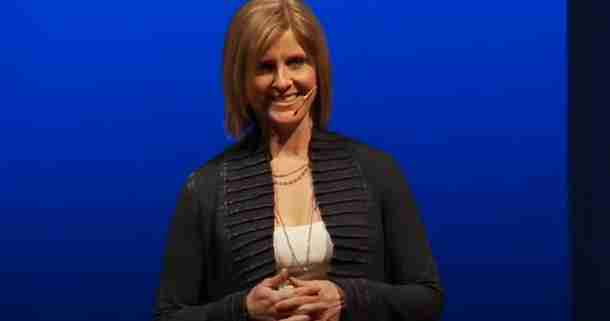
Here is the full text and summary of psychotherapist Kris Prochaska’s talk titled “How to Get Your Kids to Listen and Engage” at TEDxBend conference.
Listen to the audio version here:
TRANSCRIPT:
Sometimes I have conversations with my kids that go like this.
‘Mom, can I play on the computer?’
‘No.’
‘Why not?’
Because… And the four… Because why? And the four words that kill that conversation faster than you can blink? Because I said so. You know that conversation, don’t you? It’s really just a variation on the theme of not now, go ask your mother, and just do what I said.
Why is it okay for me to talk to my kids that way? When with every other adult in my life, I would never say because I said so. I would say because my gut says no, or because I have other plans, or because I tried this, and it worked for me, and I thought of you.
I talk this way to other adults because I respect them. I see them as equal, as having a stake in the conversation, and deserving of something more than a one-sided conversation, like because I said so. I assume you’re having respectful conversations with the adults in your life too, and if you’re not, I’m guessing those interactions don’t feel so good.
So why is it that we think it’s okay to talk to our kids like this? Or when is it? When do kids become deserving of more than just a pat answer? Is it when they start puberty, when they learn to drive, when they vote for president? Is it their level of education, their life experience? Why don’t we see kids this way? Don’t they have a stake in the conversation too?
What if you and your child have equal value, neither of you better or less than the other? What if you saw your child as equal to you in their capacity for creativity, intuition, intelligence, even if it’s not yet fully formed? Kids, they need guidance. They don’t have the same abilities and the same privileges that we do as adults, but that doesn’t mean they don’t have equal value. I wouldn’t give my 10-year-old the car keys, but that doesn’t mean he’s not equal to me.
Why don’t we see our kids as equal?
Here are a few reasons that I came up with, and I’m embarrassed to say that during my 10-year parenting career, I think I’ve said or thought just about all of them. I’m the adult, you’re the child, I know better. Don’t ask me right now, I’m too busy, just do what I said, I don’t have time to explain it.
Why bother? Kids never listen anyway. That’s how I was talked to, that’s just how you talk to kids. Or I don’t think kids understand if you were to explain it, they’re too young.
I’m the adult, you’re the child, you got to listen to me. What are the potential long-term consequences of talking to our kids with this orientation? In my work with my clients who are finding their natural genius, their authentic voice, several themes arise over and over again.
They sound like this, I don’t know what I want, I don’t know what’s best for me. What I want and need doesn’t matter, what I have to say doesn’t count. I want to get it right, I don’t want to be wrong, so I’m scared to just start it. An overarching pattern that I see in their lives is that they accommodate everyone else at their own expense.
Yesterday I had the opportunity to spend some time with some students here at Bend High and I asked them, why do you think your parents don’t see you as equal? And they gave me a lot of different answers, but there were three that stuck out. One of them was, ‘I don’t think they’re paying attention, I think they’re on autopilot, they don’t care.’
Another one said, ‘They’re lying.’ I said, ‘They’re lying, tell me more about that?’ Well they say you can’t do this or do that or say this or say that, but then they go ahead and do it themselves. I said, oh, so they’re a hypocrite, and they said, no, they’re a liar, I’ll give you that.
And finally, the last one was this attitude of, oh, I already know where you’re going with this, I’ve been down this road before, you just need to listen to me because I’ve already been there. But what if we saw our kids as just foraging on this road for the first time, that they’re asking questions of us, and they’re seeking validation because they need navigation. I told those kids I was scared as hell to stand on this spot today because I was afraid, I’m afraid I would forget and screw up, which I already got that out of the way, so that’s good.
But I was scared because I was afraid this idea didn’t matter, that it didn’t have value, and I felt a lot like my clients feel. I was scared because this idea of equality is still changing me. It touches something deep and raw and vulnerable in me. Something where I’d like to believe that I always saw my kids as equal to me in value, but I realized that I don’t always speak to them that way.
I saw parenting as a role, not a relationship, and certainly not a relationship of equality, but more like, I’m the mom, just listen. What if you saw your kids not as empty vessels to fill with all your wisdom and knowledge, and that if they didn’t follow it, you somehow failed?
Or that their behavior is a poor reflection upon you, and instead perceive them as individual sovereign beings who have inherent value and preferences? What if, instead of feeling like you had to have all the answers, you said, I don’t know what’s going on here, but I’m pretty sure we can figure it out together.
What if, instead of blaming your parents for what you didn’t get when you were growing up, you looked at your kid and you just gave it to them anyway?