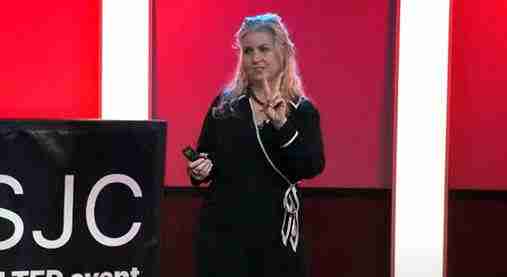
Read the full transcript of Dr. Suzanne Uhl’s talk titled “Five Strategies To Defeat Your Inner Critic” at TEDxMSJC Studio 2024 conference.
Listen to the audio version here:
TRANSCRIPT:
The World of Fear and Public Speaking
I live in a world of fear. Not that I’m afraid, but I’m the instigator of fear. In fact, some days I think I trigger fear for a living. I’m not kidding.
I walk in the room and heart rates start to pound, palms get sweaty, stomach juices move about rather uncomfortably. It’s true. I teach public speaking. From slight trembling to uncontrollable fits of giggles, from tears to passing out and throwing up, I have had a front row seat to fear for nearly 40 years.
Now, some of you might know that the fear of public speaking is otherwise known as glossophobia. This TEDx has the theme of legacy. So what is the connection between legacy and glossophobia? Well, it’s not glossophobia.
I’m focusing on fear. And think of it this way, how many legacies never happen because of fear? And there’s your connection. This goes well beyond public speaking.
Legacy Thieves and Their Impact
In the next few minutes, I’m going to give you some internal saboteurs, legacy thieves, and I’m going to talk to you about some strategies for overcoming them. So first, legacy thieves. What I have come to call as legacy thieves, you might know as fear, worry, anxiety, doubt, limiting beliefs, your inner critic. Any of that sounds familiar?
It’s true. Now, these things are not always negative. In fact, my doubt has led me to double-check the stove only to discover I left the burner on. My doubt led me to double-check a conversation with a friend to discover that I’d unintentionally offended my friend. So doubt led me to apologize. Doubt led me to heal a hurt. Doubt led me to protect a friend. Those are great things.
But many of us know that these legacy thieves have a negative connotation because we’ve seen them dominate people. We’ve seen them crush and destroy dreams. Ironically, about this time, I asked an AI image generator to come up with a depiction, a graphic of these legacy thieves. And this is what it gave me. Yikes. So ironically, Yoda said, “Fear is the path to the dark side.” Even he saw the dangers in these legacy thieves.
The Prevalence of Fear
I asked on Facebook, my friends and family, randomly, what do they think is the internal thing that stops people from living out their dreams, from becoming everything that they desire to be?
The overall answer? Not surprising. Fear. Fear of failing. Fear of succeeding. Fear that it’s too early. Fear that it’s too late. Fear of rejection. Fear of change. Fear of the unknown. Fear even that they know too much. Fear.
Now, granted, Facebook’s not the most prestigious of polls out there, so I dug into some of the literature about fear. And let me tell you, there is a lot written on this subject. So I focused on the question, how much of what you and I fear is real? How much comes true?
I was familiar with Mark Twain’s quote, “I’ve had a lot of worries in my life, most of which never happened.” So I dug in. I was on the website of the National Institute of Mental Health, and they have a green pamphlet on GAD. GAD is an acronym for generalized anxiety disorder. It is defined as a constant feeling of dread and anxiety. Sounds awful.
In 2019, researchers from Penn State followed 29 patients who were diagnosed with GAD to determine what percentage of what they worry about actually happened. Preliminary results, 91.4% of their fears never came true. And there are a lot of studies that replicate similar results. Bottom line, most of what you and I worry about never happens.
Now, a lot of the research that’s out there is on something called cognitive labels. The argument goes like this: that you must first label something as fearful in order to feel fear. So what if we took butterflies in my stomach, and instead of calling this nerves or fear, I’m going to call it adrenaline. I’m going to call it excitement. I’m pumped. Is that going to change the outcome?
Research says, absolutely. Absolutely. You cannot overstate the power of cognitive labels. In a sense, if we become more aware of our cognitive labels and our limiting beliefs, we can radically reduce our experience with these legacy things.
Limiting Beliefs and Their Impact
So what’s a limiting belief? I’m going to give you a circular definition. The academic in me is not real happy about this, but it’s the best definition out there, in my opinion. A limiting belief is a belief that limits.
It stops you from achieving because you believe something to be true, and so it becomes a boundary. Imagine a student who is absolutely convinced that he or she cannot give a speech successfully. They can’t do it. And maybe everybody else can do it. They cannot give a speech, and they are absolutely, confidently solid on that conviction. How much effort is somebody going to put into a presentation if they believe they’re going to fail it?
When that person actually gets up to deliver their presentation, and they hold that conviction that it’s going to bomb because they cannot do it, how’s their eye contact? How’s their energy, their delivery, their vocal dynamics? If they truly have the conviction, they’re going to fail. And sadly, in the end, their negative self-fulfilling prophecy, the conviction with which they held that limiting belief, comes true simply because they believed in it.
The Inner Critic
Now, oftentimes, we will refer to a collection of limiting beliefs. This sort of has a personality. We’ll call it your inner critic.
How many of you think you have an inner critic? Yeah, I’ve got a nasty one, too.
One of the best books on this subject is a 1983 classic written by Rick Carson. It’s called “Taming Your Gremlin.” It was given to me last summer, just last summer, by a dear friend because I came head to head in a hardcore confrontation with my inner critic. And after last summer, I decided I was going to dig down dirty and study my inner critic out. And so I did.
I can tell you that she was born when I was in third grade. I was about eight years old. I named her. Her name is Anassis. It’s backwards of Suzanne. What happened in third grade? I failed. I went to a small school. And in a small school, there are no secrets. Everybody knew I failed third grade. That opened up a season of bullying that was pretty intense. I fully believed everything Anassis was whispering to me.
My nickname on campus was Dog. I never questioned it. And a funny thing happens. When you believe you’re trash, you start to let other people treat you like trash. I really believed I was broken. Things did not change for me until I got to my community college. And two powerful things happened. One, I was asked to join the speech and debate team, something that absolutely floored me. Two, I had a very deep personal faith encounter. And both of those events taught me I had value. That was the opposite of the message Anassis was whispering in my ear. And that initiated and began my journey of refuting and battling my inner critic.
I tell you that story simply to say you’re not alone. Whether you have a full-fledged gremlin like I do, or whether you just have that nagging belief that maybe you can’t accomplish your dreams after all, you’re not alone. And there are things you can do, strategies that you can take to help battle.
So let’s jump to that. Let’s start talking about change. Now, before I get into the five strategies I want to give you today, and all five of these, by the way, I have incorporated and I find them very useful in my life. But before I jump into them, I need to acknowledge professional therapy. There is no shame and no condemnation in professional therapy.
I think it’s an amazing thing. I have benefited from professionals in my life. Imagine having a skilled, trained professional in your corner with no hidden agenda other than wanting the best for you, wanting your wellness. It’s an amazing, amazing thing.
But you’re not limited to professional therapy for help. There are things you can do on your own. So let’s talk about these strategies.
1. Focus Outward, Not Inward
What we focus on tends to grow. So hear me, what we focus on tends to grow. If we’re focused on our fear, on our anxiety, on our worry, on our doubts, those things are just going to get larger. That’s why many authors, many scholars focus on subtle things like create a gratitude list. Why? Because it focuses on what you have rather than what you don’t have. It begins to shift the narrative.
I’ve read articles that focus on things like doing random acts of kindness or service for other people when you’re really in that low spot because it shifts the narrative. Now you might think that choosing not to focus directly with these legacy thieves, hey, that’s not a strategy. But I’m going to tell you, yes, it is because you are reducing the amount of time that those legacy thieves dominate you. And that is a win. They will come through eventually.
2. Be a Student of Yourself, Not a Judge
There’s enough judgment in the world. We don’t need to condemn ourselves. Watch yourself. Do you have patterns? Are there certain things that trigger you that set you off? And then when you are triggered, do you have typical patterns of responses?
Eckhart Tolle called this being an observer of yourself. Rick Carson, that author of the Gremlin book, said the key to taming your gremlin is to start by noticing your gremlin. What does this do? It begins the process of separation.
Many of us tend to intertwine the voice of our inner critic with ourselves. And we think I am this. It’s like a book I have at home. It’s called “You Are Not Your Brain.” There’s a difference between your brain and your mind. For me to name Anassis, to draw her picture, began that process of separating her. I am not her. Her voice is not mine. And that was key to my healing and moving on and overcoming.
3. Learn to Reframe
I can give you two very different versions of my childhood, and both have elements of truth in them. But only one version empowers me. And that’s the version I focus on. You can reframe your past. You can reframe the present. You can reframe the future.
For me to think about Anassis as a great opportunity for me to connect with people that have similar experiences is a wonderful, powerful thing for me. I’ve reframed even her. Take the present. It’s one thing to say, “I can’t do this. I can’t do it, period.” Very present focus, very grounded, and pretty darn certain with that period on the end. We get rid of the period and put the word “yet.” I can’t do this yet. And suddenly I’ve reframed not only the present, but I’ve reframed the future. And by the way, this connects directly to what I talked to you earlier about cognitive labels.
What voices are you listening to? Are they voices of condemnation, focusing on your weaknesses, tearing you down, telling you what you cannot do, what you cannot be? You need to surround yourself with a positive tribe. In this era of social media, comparison is huge. And we often find ourselves on the short end of the comparison stick.
You need to surround yourself with voices that focus on your strengths to affirm you. This has been a game-changer for me, for me to find a group of people that can focus on everything good about me and help me through the tough times. And me do the same for them has really been huge.
5. Legacy is Now
It’s more of an understanding. If you focus only on the past or the future, that actually can enhance fear and it can get larger. If you’re dwelling in uncertainty on tomorrow, it leads to greater fear and you’re missing out on the present, what’s right in front of you. If you’re stuck in the past, ruminating on yesterday, you can’t change that and you’re missing the now, what’s right in front of you.
There are things you do today that directly connect to your legacy tomorrow. Your legacy is not only about tomorrow, it’s about the choices you make today. So what are you going to do today? Be present right now.
Conclusion
And truthfully my goal here is not to promote one strategy over another, nor is it to give you a magic pill. I wish I could shut down fear forever. I wish I could lock the door on your inner critic and you never hear from him or her again. But you know as well as I do that you are not a light switch. It’s a journey. I still hear Anassis. I frequently picture her over my right shoulder and she’s talking smack, whatever. Like I don’t have time for her. I’m going to focus ahead.
So what about you? What label, what identity do you need to get rid of? How can you take back your power? How can you stop feeding and start reframing? How do you make choices today? Think about that. In the end my goal here is to have you understand you’re not alone.
The vast majority of us encounter fear in some form. Whether it’s a full-fledged gremlin like Anassis or that nagging doubt that just says that maybe you can’t do it. We all have this in common. And for many of us this goes well beyond giving a speech.
One thing we have in common predominantly is we have one life to live and that’s ours. It’s our journey and it’s our life. If we don’t take the first step it’s not going to be much of a journey. So if you need help, get it. Medical, professional, get it. No shame, no condemnation. But if you know there are things that you need and you can do today to begin to confront those fears then find your baby step and take it. The battle is worth fighting because it is your battle. It is your life. It is your future.
So in the end live your legacy. Know that you’re worth it. Take back your power. Silence the saboteurs and live your legacy.