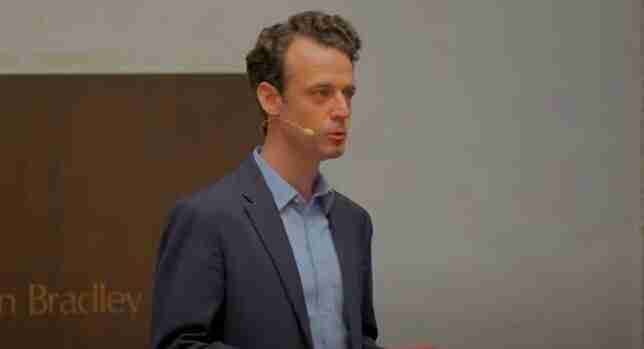
Read the full transcript of renowned pianist George Lepauw’s talk titled “Can Music Actually Foster Peace?” at TEDxWrigleyville 2024 conference.
Listen to the audio version here:
TRANSCRIPT:
The Christmas Truce of 1914
Soldiers are not musicians. Yet, on Christmas Eve 1914, a miracle took place. The Great War had broken out at summer’s end, and soon the front had become a vast gravesite. Dug into a deep, cold, sloppy trench in the frozen fields of Flanders, and as the pallid winter sun dimmed into darkness, a German soldier began to sing, “Stille Nacht” (Silent Night), interrupting the shots coming from all sides.
Hearing this, British soldiers cowering in the mud across deadly no-man’s land began to sing along. The shooting stopped, and slowly but surely, brave and bewildered men on both sides crept out of their holes and hesitantly made their way across the open battlefield, singing in unison. Meeting in the middle, they ended up spending the whole night together in brotherly camaraderie, exchanging smokes, schnapps, songs, and stories during what was one of the deadliest wars in human history. Music had brought peace to enemies. If it hadn’t been for the orders of generals to resume fighting the next day, this conflict would have been over right then and there.
The other day, my hairdresser remarked that if everyone made music, there would be no wars. I think he’s on to something. Imagine if instead of guns, we gave soldiers instruments.
The Power of Music
My personal experiences as a concert pianist, teacher, organizer, and cultural activist have convinced me of music’s boundless power to inspire and to unite. The great American poet and 19th-century abolitionist Henry Wadsworth Longfellow aptly observed that music was the universal language of mankind. Music is widely recognized as a natural human art form, evolving at the same time as language itself. Music touches directly upon our emotions, whereas language speaks to our minds.
The combination of both creates an explosive reaction upon the human psyche. From the very dawn of humanity, music has served as an instrument of social bonding and mutual understanding, reinforcing tribal unity and cooperation necessary for the survival of the group. From hunting and gathering to migrating, ritual and entertainment, music has been ever-present in our human experience. Music in our times today follows upon these early traditions, the main difference being that we can now enjoy it at will.
This is both a huge luxury and an unfortunate disincentive to making music ourselves. Up until the advent of the phonograph and radio, everyone partook in music making. Today, we just pick up our phones and press play. But our deep-seated urge to make music remains as strong as ever.
The Natural Musician in All of Us
A luminous insight is revealed by this. In each one of us lies a natural musician. And while talent is unevenly distributed, I’m convinced that we all have a gene for music. Don’t we all have experiences singing in the shower, humming along to the radio, whistling while walking, chanting at church or even at a sporting event?
Even clapping and dancing at a concert are instinctual acts of music making. Not a single culture on earth has evolved without music, unless it’s been unnaturally restricted or banned, as it has most recently in Afghanistan and Chechnya. Music is such a deep-seated part of our human identity that even NASA sent a representative sample from around the world into its deep space Voyager probe in case curious aliens encountered it and wanted to know more about us.
And while it’s great to listen to music, making music at any level is essential. It brings unlimited joy and solace, builds empathy and compassion. It reconnects us to ourselves and to our fellow human beings at a time when our digital lives are disconnecting us. Instead of letting division reign supreme, music moves us toward love supreme.
Music’s Power to Change the World
Music is extremely powerful. And when it’s harnessed for good, it can change the world. Ludwig van Beethoven’s Ninth Symphony, with its famous “Ode to Joy” finale on a poem by Friedrich Schiller about fraternity and freedom, has done just that for the last two centuries. The “Ode to Joy” remains one of the most beloved tunes known to all up until today. But perhaps its most famous performance was when Leonard Bernstein conducted it shortly after the fall of the Berlin Wall in 1989, with the chorus and orchestra made of both East and West Germans.
This concert, broadcast to millions, celebrated the end of a divided Germany, sending a resounding message of hope and unity across the world. The “Ode to Joy” has been used at many key moments in history. Chinese students blasted it as they stood tall in front of tanks in Tiananmen Square. Chilean protesters sang it as they took down the Pinochet regime after decades of dictatorship.
The Japanese performed it to bring solace to their nation after the devastating earthquake and tsunami of 2011. Teens in Africa managed to perform it on makeshift instruments. Even Jews and Muslims have done it together as part of the West-Eastern Divan Orchestra, led by Israeli conductor Daniel Barenboim and Palestinian scholar Edward Said. And more recently, it has been used to shine a light on the plight of Ukraine.
The “Ode to Joy” is also the official anthem of the European Union. Twenty-seven countries, which with their different cultures, languages, and religions have rarely been at peace over the last centuries. The “Ode to Joy” symbolizes the unity achieved under joint democratic institutions.
Music and Civil Rights in America
In the USA, “My Country, ‘Tis of Thee,” penned in 1831 by Samuel Francis Smith, remains a potent and unifying, if unofficial, anthem beloved by all Americans. While this hymn was performed at Barack Obama’s inauguration by none other than Aretha Franklin, its most significant historical performance was when world-famous opera singer Marian Anderson sang it on the National Mall in Washington, D.C., in front of 75,000 people of all colors in 1939.
It’s an interesting story.