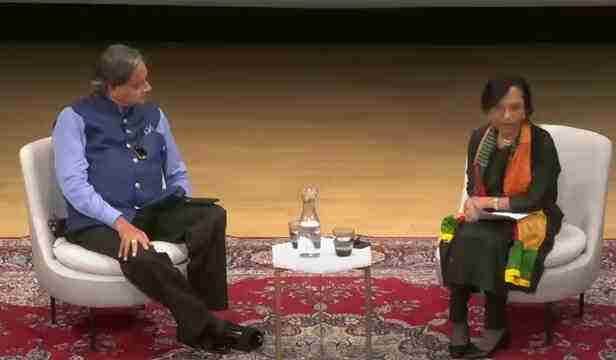
Read the full transcript of politician and acclaimed author Shashi Tharoor’s interview titled “The Paradoxes of India” at Jaipur Literature Festival 2023. The interviewer is author Seema Sirohi.
Listen to the audio version here:
TRANSCRIPT:
SEEMA SIROHI: Welcome everyone, and a very good evening to you. I promise this is going to be scintillating and provocative. How can it be otherwise when Shashi Tharoor is my guest? A renaissance man with interests so wide and repertoire of books so large that if I were to talk about just a few of them, I think it would exhaust our time. So, but I am sure you will refer to some of your books in the answers.
SHASHI THAROOR: Depends on what you ask even.
SEEMA SIROHI: To give a flavor to our audience, this evening we are going to discuss the complexities of India, the tensions and harmonies within. Is it India or Bharat? I am sure you are familiar with the latest controversy over the name which itself wraps many paradoxes. But for the ease of doing business this evening, we are going to stick to India. Is that okay?
Mark Twain’s India and Modern Democracy
SHASHI THAROOR: Sure, but I would be very happy to address that controversy. A totally unnecessary controversy, I might add.
SEEMA SIROHI: Mark Twain famously described India as the cradle of the human race, the land of dreams and romance, of fabulous wealth and fabulous poverty, of splendor and rags, of palaces and hovels, the country of hundred nations and a hundred tongues. The sole one country under the sun that is endowed with an imperishable interest for alien prince and alien peasant, for the lettered and ignorant, the wise and the fool, rich and poor and so on.
Fast forward to modern times, and we have a rather prosaic version of the same idea in the words of Cambridge economist Joan Robinson who said, “Whatever you can rightly say about India, the opposite is also true.”
Let’s try to unpack some of it. India has grown, shown quite powerfully how democracy can flourish despite a multitude of languages, religions, ethnicities. After seven decades of largely successful democratic experience, democracy has gone deep into our society. The electoral system is institutionalized. There is peaceful transfer of power and candidates don’t question election results unlike in some other places that we know of. So there’s better representation of marginalized groups, more devolution of power to the village level.
Yet there is a parallel trend these days. A certain erosion of liberal democratic values. One top government official tried to explain and tried to justify this by saying the backsliding as a case of too much democracy and too much federalism too quickly. Now are these phenomenon interlinked? Does one lead to another? Or has democracy not gone deep enough? What would you say?
Democracy and Its Challenges
SHASHI THAROOR: Well, I think it was in the process of going pretty deep. But, you know, Seema, I’ll be very honest. What the international professional observers of democracy have seen in India recently is what has led the VDEM Institute, the Varieties of Democracy Institute in Stockholm, to actually declare India an electoral autocracy. That is, if the elections are free and fair, but how the government conducts itself between elections is a good deal less than democratic.
Media and Institutional Challenges
SHASHI THAROOR: Now, what does that mean? It means there is unfortunately pressure on the media, which we’ve seen repeatedly. There’s an Indian-American editor who lost his job after he ran a hate tracker in a daily newspaper. There is, I’m afraid, example after example of stories disappearing from websites of major national publications. Yesterday, an NDTV journalist was fired for tweeting about a story that was suppressed.
I mean, you’ve got issues up and down in the media. The autonomous institutions, which were meant to be the repositories of neutrality and integrity above the political fray, have all been to a greater or lesser degree brought to heel by the government of the day. To the extent that their autonomy has been hollowed out, their credibility to uphold democratic values is in question.
And with all of this going on, we’ve also seen some fundamental challenges to the basic assumptions of Indian nationhood that people like me grew up with, which is that we’re seeing the othering of a particular minority, the Muslim community, in ways that was unthinkable.
I mean, things that would not have been said in private behind closed doors are now being declaimed loudly from political platforms in public. And that sort of thing is frankly shame-making and has led many of us to question whether we are indeed the land that, as a true democracy, offers a home to people of every stripe, every complexion, every language, every religion, and every kind of political opinion.
That’s what’s become worrying. I mean, you’ve seen think tanks coming under terrible pressure, civil society organizations losing their tax status, their funding, their right to obtain foreign contributions. All of these things have also undermined the ability of other voices to grow and flourish in our policy.
You asked for it, so I’m giving you a very candid answer. We’re going around talking of ourselves as a mother of democracy, which is a claim others can also make, the Greeks in particular. But I don’t think there are too many mothers who would treat their children this way.
The Caste System and Politics
SEEMA SIROHI: True. So let’s look at politics for a minute. On the one hand, since you are a politician, I think we need to talk about politics also. On the one hand, there is a commitment by all political parties to sort of reduce the pernicious effects of the caste system. Yet, come election time, and parties will choose candidates based mostly on caste calculations.
SHASHI THAROOR: Well, there’s been an amazing change from the assumptions about caste in our country. In the 1950s, I think it’s fair to say that people like Jawaharlal Nehru assumed caste would simply disappear. Dr. Ambedkar could write and speak of the annihilation of caste as a practice.
Today, we are very far from all of that because what’s happened is indeed that political parties discovered that caste could be mobilized as an instrument of political loyalty and political support. As a result of anything, the Indian electorate and the Indian public are more conscious of caste than ever.
We’ve also had the expansion of the reservation facility initially written into the constitution for 10 years and only for the scheduled castes and tribes, the former Dalits and the aboriginal people of India, the Adivasis. They had reservations. Initially, the reservations, by the way, for the Americans here are quotas, guaranteeing places in government jobs, parliament, in universities and medical colleges and so on to members of those communities.
So that’s been extended indefinitely. But in 1989-90, you had the addition of reservations for the so-called other backward classes, which are in fact intermediate castes by caste name. And the result now is that there’s a tremendously solid vested interest in all of this, which means that far from caste disappearing, political parties are now calling for a caste census. They say, since our privileges and rights are being encoded through caste, let’s know exactly how many of us there are. And for many, this is a potentially explosive issue.
SEEMA SIROHI: So it will never go away, you think?
SHASHI THAROOR: It doesn’t look like it. I remember saying to an American friend, all of you live in New York and you know the subway system and the third rail. Well, talking about getting rid of caste from Indian politics, it would be the third rail of Indian politics. Touch it, you get electrified, electrocuted instantly. So everyone, frankly, sits around accepting that this is part of the idiom now.
There will be appeals to voters on the basis of caste. As you said, you know, candidates will be identified based on how much support their caste might mobilize for them. You also have the cliché now that when you cast your vote, you vote your caste. That isn’t totally accurate because obviously no caste functions as a monolith. Individuals of a certain caste affiliation could still have other political preferences. But it becomes a very significant factor. And of course, you might have an election in which two people of the same caste representing different parties are competing against each other. And then caste alone is not enough.
Caste in the United States
SEEMA SIROHI: And it’s showing up here in the United States as well. Problems of caste.
SHASHI THAROOR: Well, yeah, I know that’s become a major controversy now. But I think the idea that you should not discriminate against people on the basis of anything, including caste, is to me unexceptionable. But I think some have seen the use of caste in anti-discrimination legislation as actually a way of discriminating against the Hindu community. And that’s got to be resolved, I think, within the Indian-American community before it’s settled and before it’s taken out into the wider community.
But discrimination of any sort is wrong. And the Indian Constitution says the same thing. So recognizing, for example, people of the former unculturable caste for the purposes of positive affirmative action is fine. We have the world’s oldest and farthest reaching affirmative action program. But discriminating against them is unconstitutional. So you can actually draw a line between identifying a caste identity and at the same time using it negatively against people.
But it’s not an easy minefield to navigate. And I agree with you that certainly that would be one of the paradoxes we’re sort of thrusting madly forward into the 21st century. But we are still very mired socially in a 2,000-year-old institution.
Economic Inequality
SEEMA SIROHI: Right. Now let’s look at the economic picture. India has some of the richest and some of the poorest people living within eyesight of each other. The disparity is stark. India has become one of the most unequal countries in the world. Just 5% of Indians own about 60% of the country’s wealth, according to Oxfam. And more than 40% of the wealth created from 2012 to 2021 went to 1% of the population. And only 3% of the wealth trickled down to about 50% at the bottom. The combined wealth of India’s 100 richest has touched a staggering $660 billion.
This is perhaps the most troubling of all paradoxes, at least to me. The surprising thing is not how violent India is, but how peaceful, given the inequalities. I mean, what’s going on?
SHASHI THAROOR: I mean, you’re totally right in all the facts you’ve cited. I can add to those. In fact, I believe the wealth of the four richest Indians combined exceeds that of the majority of member states of the United Nations. Because the combined GDPs of a majority of member states of the United Nations. And, of course, while we have more dollar billionaires in any country in Asia, including China and including Japan, which has been richer for longer, nonetheless, we have more people living below the poverty line than would Japan and China combined.
So we’ve got these paradoxes. You mentioned figures for inequality. Why is it all peaceful? Well, I think partially, of course, the electoral democracy aspect does help. Because you have a periodic sort of valve to let off pressure in the pressure cooker. And that’s a very useful role that democracy can always play, is that if people have reason to be unhappy and they want to seek change, they can vote for it. They don’t have to pick up guns to fight for it. And that’s always a worthwhile thing.
But I was thinking, as you were reading that Mark Twain quote, how little of those paradoxes have actually changed in 100 years. I mean, everything you’ve said, I’m afraid, still remains true. And we can add to a few more. I mean, the fact that we are shooting rockets off into space, while a lot of people are still trundling around in bullock carts, that we have some of the world’s leading software engineers and technologists in the cutting edge fields that Silicon Valley is famous for.
Living with Contradictions
SHASHI THAROOR: And we also have farmers who are using agricultural techniques that haven’t changed much in a thousand years, with the kind of implements and animals and carts and so on that they would have used a thousand years ago. That’s still going on. So we’ve got all of these paradoxes that we can talk about. It’s a situation that is not easy always to explain.
But partially we have learned, I think, over the years to live with various contradictions. In fact, I mean, it’s often amusing that if you walked on an Indian street, you’d think everybody’s in a hurry. And yet no one ever seems to be on time. That’s also part of the paradoxes of India, where an uncle of mine could bitterly remark, “In this country you can’t go forward unless you’re a backward.”
And in fact, there’s the opposite as well, as we’ve talked about in our earlier question. There is, frankly, a real challenge when it comes to the questions you’ve tried to talk about. But we can also talk about our society and the paradoxes. Somebody once said, and I’m sure you can bleep this out when I quote it, but India is the only country in the world where you can piss in public but can’t kiss in public.
And that’s also part of us, part of the paradoxes of our society. And as a woman pointed out, ours is the only country where it’s dangerous to talk to strangers, but OK to marry one. So when you talked about the paradoxes of India, I mean, we live with all of these contradictions, and that’s just some more.
SEEMA SIROHI: So is it something in our DNA that allows us to live kind of somewhat comfortably? What is it? Is it our religion? Is it like Hindus think a different way? What is it?
Religious and Social Paradoxes
SHASHI THAROOR: Yeah, but the Hindus think a different way, I think, can be taken too far. I mean, I’ve always been a bit skeptical about Hindu fatalism, because Hindus go to temples and pray for their kids to ace the exams and get a good job at all of those things.
SEEMA SIROHI: And they also go to church.
SHASHI THAROOR: Yeah, and churches and mosques and gurudwaras and everything. What I’m saying is that people want the same things everywhere. I don’t really think that if you’re born a Hindu, you just accept your fate. So you work as hard as you can. We’re a very competitive society, as you know, particularly when it comes to things like examinations and so on.
As I think Mr. Narayana Murthy famously pointed out in the 60 Minutes interview, Harvard has an acceptance rate of 10 percent. The IITs have an acceptance rate of 0.001 percent. So, I mean, you know, we have an intensely competitive society. People are striving. People are working hard. I wouldn’t say that Hindus think that way, but we do have paradoxes. I mean, Hindus worship goddesses all over the country and yet seem to despise having daughters.
There’s a built-in societal preference for a son every time, and the way in which daughters are often mistreated as they’re brought up is startling. In a country where, you know, the worship of the goddess in her various forms is so widespread. So that’s a contradiction. Don’t we see that? We don’t, apparently.
SEEMA SIROHI: Yes. Okay, moving on.
SHASHI THAROOR: I knew I was crossing some lines.
Foreign Policy Paradoxes
SEEMA SIROHI: So, we look at India’s foreign policy for a minute. There again, you notice the contradictions right from the early days. India was non-aligned, but during the Cold War, it was able to maintain a working relationship with both the United States and the Soviet Union. Today, it’s a member of the Quad or the Quadrilateral Security Dialogue, which is made up of the U.S., Japan, Australia, and India.
It’s also a member of I2U2, which is Israel, U.S., India, and the United Arab Emirates. Both groups attempt to create a favorable balance of power. On the other hand, India has this old friendship with Russia and is buying oil like there’s no tomorrow. So, I know the foreign minister has tried to explain it as India has to look after its people, its economy, its national interests. Yet, in the West, there is a lot of difficulty with that position.
SHASHI THAROOR: Not really.
SEEMA SIROHI: I was coming to that. I was coming to that. We just had a G20 summit where President Biden seemed to have, and the West in general, seemed to have climbed down a bit from their position. So, this brings me to, like, how has India managed to straddle the middle, to walk on this tightrope? Has it managed to educate the big powers on how to live with contradictions? Is it deft diplomacy? I mean, why are major powers willing to accommodate India?
Multi-alignment and Global Politics
SHASHI THAROOR: Okay, well, there’s a lot of things in what you said that need to be unpacked. First, on the question of non-alignment and so on, as far back as my last years in the U.N., I started talking about the world moving away from notions of non-alignment to those of multi-alignment. And I’m very pleased that, though I floated that when I was a minister in the government, and it didn’t quite catch on at the time, subsequently, it does seem to have begun to come into vogue.
And Foreign Minister Jaishankar is using that word. And the first time he did so, he attributed it to me. So, I’m very happy to take credit for it. What I meant by that is…
SEEMA SIROHI: It’s good for him that he attributed it. Remember to attribute it to him.
SHASHI THAROOR: That’s right. But let me explain what I meant and why I think it’s exactly what’s happening.
We’ve moved away from the binary world of the Cold War era. We are in a world that is really much more like the World Wide Web, this networked world in which, you know, I’m connected to you, and then you’re connected to him, but I’m not necessarily connected to him unless there’s some other issues in which we need to be connected. We all have these multiple connections all over the place. And that, in a very simple way, gives us a world where multiple alignments are possible.
India’s Global Role
SHASHI THAROOR: Now, in India’s case, for example, the paradoxes that Seema was hinting at include not just the one she’s mentioned, but also, for example, the fact that we were a leading voice in the G77, which is one of the global trade union of developing countries, as well as a key player in the G20, which is the management, as it were, of the world macroeconomy, that we were a loud voice in the non-aligned movement railing against the colonial oppressors of the Western world. And now, at the same time as we were doing that, we were also a loud voice in the community of democracies alongside the very Western countries that we were criticizing in the non-aligned movement.
We’ve been fighting for some years now a permanent seat on the Security Council, but at the same time, we have an understandable focus on our immediate neighborhood with all the dangers and challenges that represent. So these paradoxes are widespread.
And if you look at the way in which we’ve been trying to navigate this multi-aligned world, our foreign minister meets every year with his counterparts from Russia and China in something called RIC. Then he adds the Brazilians and South Africans to it, and he gets BRICS. Then he takes out the Russians and the Chinese, and he gets IBSA for South-South cooperation. And to that, he adds China, but not Russia, and he gets BASIC for environmental negotiations.
And these are all formulations in which India has a vital role to play, not merely because its name so conveniently begins with that indispensable element in every acronym, a vowel, at least until today, but also because, obviously, India has something to contribute to each of these groups and has something to gain from each of them.
The Russian Oil Question
So that’s the kind of multi-alignment that I see taking place in the world. And in that, yes, we do live with a lot of contradictions. Now, on your specific example of Russia, Ukraine, oil, and so on, frankly, I think the West, after their initial protestations, very quickly accepted what was going on for two reasons. I mean, the assumption always was that the West was tolerating this because India was indispensable in the larger, bigger picture as a counterweight against China.
But it’s much more than that. There are economic reasons as well. India buys a dramatically larger quantity of Russian oil and gas. But as a result, it keeps global oil prices stable. Because if India wasn’t a customer for all of this Russian oil and gas, and that was taken off the market, the sanctions were upheld everywhere, the remaining oil would have more people, including India, demanding for it, and the prices would go up. So all of us would be paying more at the pump, even in New York, if India wasn’t buying Russian oil. That’s one very important consideration which the West has realized. The second thing you don’t realize, wait, is that all this comes into India, is then refined and processed in India, and you know who’s been buying all the increased refined output? The U.S. and the U.K. Forget the European, the U.S. too.
India’s Diplomatic Position
SHASHI THAROOR: So the fact is that there are contradictions also in the way in which the world has been reacting to all of this. But in many ways, in diplomacy, it is considered a virtue to be acceptable to both sides of an equation, if you can talk to both people. I certainly feel that at the appropriate time, India should leverage its decent relations with both sides to try and promote peace in this conflict. At the moment, I’m not sure the time, the situation is ripe for peace right now.
But certainly, India would be in a position to make more of a difference as a peacemaker, precisely because it hasn’t burnt its bridges with either side. That’s the only good thing. I was a bit of a heretic in the Indian political space as the one Indian parliamentarian, in fact the only one in the debates in parliament on Ukraine, who criticized the government’s policy, and particularly its somewhat mealy-mouthed articulation of its policy initially at the U.N. The articulation has improved considerably since then.
And I had justified my reasons in an article in Foreign Affairs magazine about a year ago. So there’s a lot there that I don’t fully subscribe to. But I’ve understood why a year later the policy still holds good and why it’s broadly consensual with India. It just needs to be put across in a way that’s perhaps less belligerent or hostile to other countries and much more willing to accommodate everyone’s concerns and point of view on this.
Changing Global Dynamics
SEEMA SIROHI: I think I would add to that that the way the world has changed, especially geopolitically, that the West no longer dismisses a country like India and the global south anymore like it once used to. You know, the Americans used to just dismiss India as, oh, you’re in the Soviet camp, and you’ve nothing to add except to complain you’re a giant headache in our head, and just go away somehow. Pakistan is so much better, easier, et cetera. But today I see a real dramatic change. The West is actually listening to how India is articulating the needs and compulsions of the global south, which the war has exacerbated.
SHASHI THAROOR: Absolutely. In fact, the war has affected countries far, far away. Many African countries have had a crisis when it comes to the rise in commodity prices, the difficulty of obtaining enough wheat, because Ukraine and Russia put together used to account for 40 percent of the world’s grain exports and wheat exports in particular.
And given all of that, many, many countries have suffered. There’s a food crisis. There’s also a debt crisis in many developing countries. So all of this undoubtedly, Seema, you know, is definitely exacerbated by the war.
One could talk about a number of other aspects of India’s foreign policy as embodying paradoxes, but I would say that broadly speaking, what’s interesting is that this has been effectively leveraged into what the government is able to portray to its voting public as a success story, most recently at the G20. So we’ll have to wait and see how that all plays out.
But on the global level, I don’t see much public criticism anymore of India’s stances on all this. Ukraine was not happy, I understand, with the daily declaration, but they will probably end up swallowing their disappointment because the rest of the countries that went along with the declaration account for an enormously large percentage of their own support base as well in Ukraine.
SEEMA SIROHI: Right. I mean, they’ll have to swallow this one because the G7, Europe, America, they joined hands mainly because they wanted this G20 presidency to be successful. And because if India had not produced a communique, a joint declaration, that would have been India’s failure and that would have meant another country’s victory, we shall not name that country, but you know what I mean. You didn’t mention anything about your books in any of the answers.
SHASHI THAROOR: Look at that, how modest I’ve been.
SEEMA SIROHI: I know.
SHASHI THAROOR: Well, one person I mentioned in one of my answers, Dr. Ambedkar, was the subject of my last book published in the U.S., which was brought out by Manchester University Press, the life of Dr. Ambedkar and his extraordinary contributions as somebody coming from the Dalit community and at the same time being sort of India’s James Madison, the Chairman of the Drafting Committee of the Indian Constitution. His legacy is what that’s all about. It’s striking many Americans don’t realize this, but Dr. Ambedkar today has become perhaps the only figure I can think of in Indian contemporary politics who has grown in stature since his death.
Dr. Ambedkar’s Legacy
SHASHI THAROOR: He died 67 years ago as a fairly controversial figure who’d lost more elections than he’d won, and today he is, literally you can put a halo around him because he is unchallengeable. Every party tries to lay claim to his legacy, and it’s quite striking when you think about how much, there’s another paradox, if you like, of how much he has grown in stature.
There was a poll that two television channels conducted about 10 years ago for the greatest Indian of the 20th century, and none of the names that you might predict, you know, Gandhi, Nehru, et cetera, made it. It was Dr. Ambedkar who was elected in a poll in which 20 million Indians voted.
So there’s something there, and there’s probably more statues of him in India than any other Indian with the possible exception of Mahatma Gandhi, but somebody has to go and do a statue census to confirm that. But certainly every village, every street corner, not every street corner, but every neighborhood and every city will have a bust at least of Dr. Ambedkar somewhere. If not a full-fledged statue of him standing in a three-piece suit with a constitution in his hand. And that’s been quite striking as well. Do you want to talk about Bharat versus India?
The India vs Bharat Debate
SEEMA SIROHI: Yes, yes.
SHASHI THAROOR: No, I think first of all the controversy is totally unnecessary because the constitution actually resolved this issue. The constituent assembly debated it because the nativists wanted Bharat, and the sort of more dominant voices led by Nehru wanted to preserve India. So they settled on a perfect compromise.
The constitution speaks of India, that is Bharat. So both names are equally valid. And there’s Article 52 that says there shall be a president of India. And the Hindi version says Bharat ke Rashtrapati, that is the president of India in Hindi. And many Indian languages use Bharat or a form of Bharat and so on as the name for the country. So it was actually working perfectly well.
And I think one of the great things that Nehru understood, or two of the great things that he understood at that time, was that by remaining India, India established itself as a successor state to the British Raj in India, from which Pakistan was seceding. If we had adopted the name Bharat and Pakistan being Pakistan, then India would have been the name for the collective subcontinent, but no longer for any one country. And even legally that would have been problematic.
Secondly, there is the undoubted fact that India is a name that’s been around for a very long time and that is redolent with history and with various associations. The defenders of this proposed change in the ruling party say that India was imposed on us by British colonialism and it’s part of our colonized mindsets we need to get rid of. I’m sorry to say they’re completely wrong.
The name India exists for a couple of thousand years. When the British were still running around in skins, far from colonizing any of us. And if you go back to 2,000 years ago to the writings of Herodotus, Magasthenes, the Greek historians, they spoke of India.
The idea is that the river Sindhu or Indus was the defining element. What lay beyond was India. And interestingly enough, the Persians couldn’t pronounce the S. So the Sindhu, the people beyond the Sindhu, they wanted to call them by some name. So they said they’re the Hindus.
Now, if you start abolishing the name India, you’ll have to start abolishing the term Hindu as well. And no longer will the BJP be able to announce, you know, say with pride that you are Hindu. That’s exactly the same etymology as saying, say with pride that I’m Indian, which I do. And we’ve all been doing for 75 years.
SEEMA SIROHI: I think the idea is because I was listening to the foreign minister explain it in one of the TV interviews. The idea is just to introduce Bharat more prominently in the national discourse. He was saying that many countries have two names, right?
SHASHI THAROOR: Germany and Deutschland. But it’s Germany in English and internationally and it’s Deutschland in German.
SEEMA SIROHI: I think what he was hinting at is that like the Japanese call their country Nippon. And so we call our country Bharat. But for outside purposes, for the rest of the world, it will remain India. Because if you change India to Bharat officially in the UN, the Pakistanis will lay claim to the name. That will be the biggest irony of it all. So who knows? I think it’s mainly.
SHASHI THAROOR: But in that case, the entire thing is completely pointless because we already have the right to use both names.
SEEMA SIROHI: They’re introducing it into the public discourse. I think that’s how I read it. I don’t know, but I could be wrong.
SHASHI THAROOR: It’s just the mix up. You know, Mr. Modi sitting behind the nameplates at the G20 that said Bharat in Roman letters, which frankly made no sense because the president issuing her official invitations as the president of Bharat. I mean, that’s actually a contradiction of Article 52 of the Constitution.
She’s the president of India. If she wants to write her invitation card in Hindi, she’s the Rashtrapati of Bharat. But she can’t possibly mix the two up. It really doesn’t make any sense.
Political Distractions and the G20
And that’s the flaw in this nativist assertion of Bharat.
SEEMA SIROHI: But you know, the BJP is pretty good at mixing things up.
SHASHI THAROOR: It is a weapon of mass distraction, I have to tell you. You know, they love coming up with these controversies that take us away from the real problems facing the country today. A few months before a general election, when they issued the unemployment.
SEEMA SIROHI: Look at the G20. The symbol was the lotus, which happens to also be that of the ruling party.
SHASHI THAROOR: And in fact, Mr. Modi’s picture, some journalists calculated, occurred every 50 meters in every corner of India. I’m sorry, every corner of the capital, Delhi. Every 50 meters, you can see Mr. Modi’s picture as part of the G20 promotion.
Do you know that we spent 10 times more than the Germans did to run our G20? And, you know, we have one seventh of per capita income of Germany. So it really seems a bit, it seems a bit extravagant. But it again is being weaponized as publicity for the ruling party.
And I’m sure the Cricket World Cup, where all the key matches are taking place in the Narendra Modi Stadium, will also be an instrument of ruling party publicity. And that’s the way it works. But, you know, we’re going to see how effective all this is when the voters actually cast their ballots.
SEEMA SIROHI: But, I mean, to be fair, they did manage to push India’s foreign policy forward in many, many areas. I mean, I know it was weaponized as if nobody else ever had the presidency of G20. India is the first country to do so. But they did manage it well. I’ll have to acknowledge that.
SHASHI THAROOR: Yeah, no, no, I have acknowledged the fact that particularly pulling off the agreed declaration, which many people thought would not be possible, was a very, very successful act of adroit diplomacy. I think you’re getting the signal that it’s time for you to open up to the audience.
Audience Questions
SEEMA SIROHI: Yes. So, questions, please? Okay, a gentleman right there in a Nehru jacket — Modi jacket.
AUDIENCE MEMBER (Sohail): Thank you. Hello, my name is Sohail.
SHASHI THAROOR: I think what you might need really is a flak jacket more than anything else.
SOHAIL: Fair enough. Thank you so much for your words and your incisiveness dealing with these murky topics that we’re all trying to parse. My name is Sohail. I’m from Kerala. And my question is about another paradox, the paradox of Kerala. Kerala recently has been subject of a lot of attacks and criticism from certain quarters of Indian political discourse.
Now, how much of that criticism do you think is warranted and people from Kerala, you and myself, should take seriously? And how much of that do you think is completely unwarranted? And if at all, are there any lessons that maybe Kerala can teach?
The Kerala Paradox
SHASHI THAROOR: Well, you know, it depends on the point of view that the critic is coming from. So, for example, you know, if you look at those who sort of denounce the place as a hotbed of communism, literally they’re right. It’s the only state in India ruled by the Communist Party and the communists have won re-election. But if you look at what they actually practice, there isn’t a, you know, a communist practice in their entire repertoire. So, what are we talking about?
This is a party that’s stuck to an old label but which is very much moved with the times and is extremely in bed with the capitalist classes as it were. So, that’s again a question. There is the other criticism that Kerala is a place where you can’t do business because we have the most advanced labor rights in the country and, of course, we also have the most hyperactive unions who will show up with red flags the moment you try and start a factory and so on.
Now, there, there is some justice in that criticism because I’ve actually spent some time trying to promote investments in Kerala and a heck of a lot of investors including people like you of Malayali origin living abroad have refused to invest in Kerala because they don’t believe their investments will be safe.
And that’s something I believe desperately needs changing because what I’m seeing today is young people like you leaving the state in very large numbers. They can’t wait to graduate and get out of there because they feel their prospects for jobs, for advancement are so much more limited in Kerala. I remember a young man when I asked him why he felt he needed to go outside the state. He said, what’s there for me here? Isn’t it a retirement home? Isn’t Kerala an old age home is what he actually said.
And that kind of concern is real. I believe all criticism should be taken seriously. Look behind it to understand what exactly people are saying and see whether some of it can be addressed. I mean the great Kerala model we’ve all talked about sometimes does rest on some illusions. For example, we have the country’s highest literacy rate. That’s not illusory. That goes back a couple of hundred years of practice in Kerala.
We have a very well organized civil society and a lot of excellent community responses and so on and so forth, all of which works very well. But it’s also true that as you look at the way in which Kerala has grown up and developed, there are a number of things that are sustained entirely by remittances from us having exported our unemployment. Our people have gone off and worked in the Gulf, have worked in other cities in India, sent money home, and that’s what sustained this higher ranking in the Human Development Index.
The day those countries decide they don’t need Keralites anymore or expatriate labor anymore, we would be in very, very serious trouble. And we should actually take this window to try and create the institutions and practices that would make Kerala viable even if tomorrow all our expatriates had to come back.
SEEMA SIROHI: The lady there on the left, please.
AUDIENCE MEMBER (Manju Kak): Thank you. My name is Manju Kak. I come from Delhi. My question is that it is well known that the centrist approach of the Congress Party, which Patel symbolized, had its roots in a very Hindu consciousness. Somewhere along the line, the Congress Party abandoned that for vote bank politics.
That was obviously harnessed by the current dispensation through a genuine sense of grievance of the aspirational, what you call, people who occupy Bharat and not India. Why has your party not been able to harness that, considering it is important and topical, and relegated that political space only to the domination of the RSS? Is there any genuine political reason? I’m not talking about the philosophical reason, but any genuine political reason for that?
Hindu Identity and Politics
SHASHI THAROOR: Well, I mean, you are asking, in a sense, the wrong person, because I actually have written a book called “Why I’m a Hindu,” which is available in the U.S., and Seema has been accusing me of not prophesizing my own books enough. Let me flag this one to you. It actually explains my Hinduism, and I believe the Hinduism of the vast majority of people who have grown up in the Hindu faith in India.
But I think it’s also because of my political conviction that you can’t win the argument with Hindutva from a purely secular standpoint, that you really do have to enter into the discourse, as I have done, to argue that Hindutva is a distortion of real Hinduism.
And the Hinduism of Swami Vivekananda and others that I have tried to articulate and that most Hindus have grown up with is actually a very inclusive Hinduism and not the Hinduism that these chaps practice, which has reduced the soaring majesty of the faith into something akin to the petty parochialism of the British football hooligan, who goes on saying, if you don’t support my team, I’m going to bang you on the head with my placard.
Now, going back to your question of why has the Congress not stuck to that, it’s partially because secularism has become an article of faith. I don’t accept the notion of vote bank politics being an exclusively Congress failing, because every party was playing this game.
Current Political Issues
As Seema mentioned, some were appealing to certain castes, some were appealing to certain linguistic groups, some to certain religious groups, and some were trying to see if they could construct coalitions of different interests, and perhaps it’s not entirely wrong to say that at some stage, Congress politicians may have thought it useful to appeal to Muslim votes by appeasing, quote unquote, a word I don’t like either, the most sort of conservative elements in those communities and telling them that they would be safe as long as they voted for the Congress.
Be that as it may, obviously the shelf life of that approach has ended with the elections of 2014, if not even earlier. By the 90s already, you saw a significant shift in the voting pattern. I think what the Congress is now trying to do, rightly in my view, is to move the debate beyond Hinduism and its practice, since 80% of the population is Hindu anyway, into the issues that matter to all people whether you’re Hindu or not.
The fact that you don’t have jobs right now, we have the highest recorded rate of unemployment ever since figures began to be kept. The fact that in India, which is a low tolerance country when it comes to inflation, we have a pretty high inflation rate. That means that most people are no longer able to afford the regular purchases that they went to the marketplace for, even fruit and vegetables.
So all of these issues, which cut across into sort of the, I mean, what the West would call bread and butter issues for people, those are the issues in which we want to run rather than enter into sterile debates about faith, about whether we are appeasing one group or another group, whatever else.
Everybody at the end of the day needs to eat, needs to live, needs a job, needs a chance to thrive. And we will, of course, insist that that should be irrespective of their religious origins. So the Congress’s attitude is very much that, yes, every Muslim should feel safe with the Congress, but so too should every Hindu. As far as we are concerned, we would like to remain the party of all Indians as we were during the freedom struggle.
Final Questions
SEEMA SIROHI: Okay, we’ll go to this side of the auditorium. There’s a gentleman. Last question. Right for me.
AUDIENCE MEMBER (Puneet): Hi. Good evening, Mr. Tharoor. Thank you for coming to New York and giving me the opportunity to at least see you face to face.
My name is Puneet. I live in New York, probably connected to India a lot more than I need to be. So I’d like to address that unnecessary controversy of Bharat that you pointed out correctly. Well, there’s a method to the madness, in my opinion, at least.
Since the coalition left the name UPA and started INDIA India, the psyche behind every Indian would be to vote for India. And if I’m not mistaken, what BJP is doing is what every other party would do at the same time, which is use the terminology that is already in there to hit subliminally and work around it. So how is it so controversial? I mean, to me, it’s not.
SHASHI THAROOR: No, it wouldn’t be if they were doing it in Indian languages. I speak of Bharat all the time when I make my speeches in Kerala and Malayalam. And the same logic applies in Hindi. It’s this deliberate sort of mixing up by using Bharat where the word India used to be used that creates this problem.
Actually, I did mischievously suggest that if their problem was with the opposition alliance calling itself India, then we could call ourselves the alliance for betterment, harmony, and the sort of reconstruction of a better tomorrow or whatever that would give us Bharat at the end, a reconstruction, sorry, and the revival of advancement for tomorrow or responsible advancement for tomorrow.
And you get Bharat, and then we can have both Bharat and India as our acronyms in English, and then we’ll see whether the BJP will change the name of the country one more time. I mean, you know, it becomes a bit fatuous, doesn’t it, to get into this game? I think we were doing perfectly well for 75 years using India in English and Bharat in Indian languages, and I think we should continue doing that.
The fact that we call ourselves India in every language as an opposition alliance, even though the term is originally in English, is merely a happenstance. It’s going to last six or eight or nine months. After all, Mr. Modi, as the prime minister of India, has many, many slogans using the word India, including digital India, make in India, start up India, stand up India, sit down India. I’m not sure it’s going to make that much of a difference at the end of the day, but I suspect this bubble too will burst before too long, and we’ll move on to grapple with the real issues facing the country.
SEEMA SIROHI: Do you think the name of the alliance India got the BJP’s goat a little bit?
SHASHI THAROOR: It seems to have got under their skin because, you know, the same prime minister who used so many slogans with India in it started comparing the opposition alliance to the Indian Mujahideen and other sort of terrorist groups that used India in their names, which frankly seemed a bit over the top, wouldn’t you say?
SEEMA SIROHI: I would. That was a little much.
Related Posts
- Andrew O’Donohue’s Graduate English Address – Harvard Commencement 2026 (Transcript)
- Zohran Mamdani’s BMCC 2026 Commencement Address (Transcript)
- ‘I Am The Son Of Immigrants’: Astronaut Jonny Kim At Harvard Alumni Event (Transcript)
- Hamza Masoud’s Speech: Harvard Class Day Ivy Oration 2026 (Transcript)
- Daniel Pink 2026 Commencement Address: Columbus College of Art & Design (Transcript)