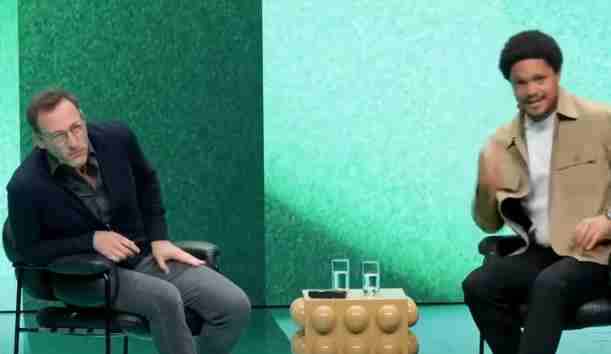
Read the full transcript of a conversation between Simon Sinek and Trevor Noah on Friendship, Loneliness, Vulnerability, and More… at Brilliant Minds, June 2024, in conversation with @trevornoah.
Listen to the audio version here:
TRANSCRIPT:
TREVOR NOAH: Good afternoon, everybody. How are you doing? As you can see, there’s nothing up here because there was nothing here. I’ll tell you how this came to be.
So, first of all, thank you, and I hate you, Anastasia. But we were having a conversation in the little courtyard yesterday, and I bumped into Simon. I’ve seen him around a bunch. I love him. I always tell you I have, like, the biggest brain crush on you. But we were having the discussion, and then Sarah came up from the team and was like, “Are you guys speaking?” “No, we’re not.” Blah, blah, blah. “Would you like to?” I said, “I’ll speak if he does something. I just want to listen to him.” And then Anastasia was like, “I heard you,” and now here we are.
So, I’m not going to waste anybody’s time, because I’m sure many of you will agree with me, but if you don’t know, this man right here is honestly one of the greatest thinkers of our generation. I love how his mind works. I love how he challenges us, how he thinks about thinking, and really, all I wanted to know, and the genesis was yesterday, is what are you fascinated by right now? Because I know you’re always working on something, or you’re always drilling into something.
Simon’s Current Fascination
SIMON SINEK: Well, it’s interesting, because the common theme that we’ve been hearing from all the talks today, which is the passion isn’t some manufactured thing, where you sort of find the passion and do what you’re passionate about. Passion is an output, not an input. And what we hear is somebody finds an obsession for something, and that then becomes their passion.
And the same is definitely true, I’m sure, for you, and definitely true for me. So, the thing that I’m sort of obsessing about right now is friendship. There is an entire industry to help us be better leaders. There’s an entire industry to help us be better parents. There’s an entire industry to help us eat better, exercise better, sleep better. And yet, there’s barely anything on how to be a friend. And if you think about all the mental health challenges that so many of us are facing today, whether it’s coping with stress, depression, anxiety, addiction, even obsession with longevity, friendship is the ultimate biohack that literally fixes all those things.
TREVOR NOAH: It’s interesting that you said this. So, I’ve always felt like, you know, I’m not a very superstitious person, grew up very religious, but I do believe in some sort of magic in the universe. And every time I bump into you, I feel like we’re thinking about the same thing, but on a slightly different path. And usually, other people are forced to listen to us, just talk about that slightly different path. I apologize.
Friendship and Sacrifice
But the reason this is fascinating is because I’ve been thinking a lot about friendship and what it means. A friend of mine actually said to me on a trip recently, she said, “In successful spaces, oftentimes people will use the word sacrifice.” You know, we heard many people. We had Martin. We had so many people up on the stage saying, “Sacrifice, sacrifice, sacrifice, sacrifice.” And she said one of the most powerful things ever to me.
She said, “When we say we’ve sacrificed something for our career, we shouldn’t be afraid to put a name to who that sacrifice was because oftentimes it was the people in our lives that we call friends.” And I wanted to know, have you been thinking about that? What is the balance? What is the confluence? How do you think of friendship and then the sacrifice that brings you here to sit with people where you may make new friends or not?
SIMON SINEK: Well, I think definitely for me, and I can’t speak for anybody else, but definitely for me, I think the sacrifice was lopsided. And I think especially for high performers who I think later on in life, you start to realize that that network of friends sometimes isn’t there because you’ve sacrificed. You know, the number of us who have canceled on friends because a meeting comes up, because they’ll understand, right? And yet the reverse is very rarely true, that we’ll say to somebody for a meeting, “Can we meet on Friday instead of Thursday? Because in my calendar, we wouldn’t say it, but in my calendar is a friend.”
And definitely for me, the times where I have tripped, slipped, fell, hit rock bottom, felt alone, any of those spaces, my work wasn’t going to rescue me. And it was by the grace of some higher power that there was always a friend who saw it and recognized it in me, who picked me up. And so I realized that we talk about investing. We talk about, you know, this is a different kind of investment.
You and I were talking about it the other day, you know, which is people are moving to, in the United States, you know, people are moving from California and New York to Texas and Florida to avoid paying taxes because they want to save time. And yet, where else? I want it to be the reverse. Like, I want to, like, I’m not worried about, like, saving the money, you know, to be in a place I don’t want to live. I want to live with the people I love and if it costs more. And by the way, by cost, I mean that maybe I won’t achieve that thing or maybe I’ll miss that deadline or maybe I’ll miss that quarter, you know. It’s a different kind of sacrifice. We think of sacrifice as always against people, but I can make a sacrifice for my career, for my friends, and it’s about striking that right balance because your friends will be there for you, your work won’t.
The Truffle Pig of Ideas
TREVOR NOAH: Yeah, you see, I love that line.
“Your friends will be there for you, your work won’t.” I was talking to a friend about this conversation and my friend was like, “What do you like, what do you love about Simon so much?” And I said, “What I love about Simon is this, is I feel like you’re a truffle pig of, like, ideas that will shape the world.” And what I mean by that is, what I mean by that is like, so I’m French. Whatever you choose to take from it, take from it.
What I choose to say by saying that is, I love seeing what you’re sniffing around in because I believe it’s connected to something far greater. You know what I mean? It’s not the truffle, but it’s the meal that is now going to influence and the restaurant that it’s now going to shape. You have that brain. It’s friendship, yes, but why would you care about friendship? Friendship is like, yeah, go out with your friends, hang out with your friends. Why would you care about friendship on, like, a global scale? What’s in it, Simon? What’s happening?
SIMON SINEK: So let me take one step back and try and get to an answer. Our understanding of addiction largely comes from an experiment that was done, I think, in, like, the 50s or 60s where they put a rat in a cage. There was one thing of water where it was plain water and one thing that was laced with drugs. And in short order, the rat discovered the drug-laced beverage and loved it, drank more and more until it killed itself. And our understanding of addiction largely comes from this study.
There was a guy named, I think his name was Bruce Alexander, who said, “Hold on, it’s flawed, the whole study is flawed because rats, like us, are social animals.” And we put a rat by itself in solitude, of course it became an addict. But that’s not what you’re supposed to do with social animals. So he recreated the experiment where he put, like, first of all, he put lots of rats in the cage, so a social community. They put, like, wheels and mazes and they were having kids and babies and two waters, a plain water and the drug-laced water.
And they could see from the data, they knew which ones, and they all tried enough of the drug-laced water to get addicted, but they didn’t. They’re taking in of the water declined and they only drank the plain water. Which starts to give evidence that if we have close friendships and if we live in community, perhaps we’re less susceptible to all addiction.
And I know that there’s a lot being talked about about the addiction of social media, the addiction of cell phones, which is true, which is true. It is a highly dopamine-producing device. And that is causing loneliness. And I would argue that if we worked on the friendships, and more important, if we taught our children how to be friends, that perhaps they are less likely to get addicted.
TREVOR NOAH: And I think… Yes. And I think…
Working on Friendships
SIMON SINEK: So when you talk about what’s the global responsibility, we’re teaching people how to do everything. We’re finding the hacks for everything. The one thing we aren’t doing is the old-fashioned, hard, slow thing of making friends.
TREVOR NOAH: Okay, so here’s what I’ve been thinking about. Over the past two years, I’ve been traveling, spending most of my time traveling. And in that time, I’ve been thinking about how you maintain a friendship, how you keep a friendship, and how you build a friendship. And in that, I came to realize, most of our friendships, we sort of leave to coincidence. I bumped into this person, I went to the same school as them, we were in the same church, the same company, and that defines our friendships. And to what you’re saying now, working on, I realize that no one has ever taught us how to work on a friendship. Like, actually work on a friendship.
SIMON SINEK: And most people think they’re good friends. If you ask most people, “Are you a good friend?” Most people would say, “Yeah, I’m a good friend.” And so I said, “Have you sacrificed that meeting to hang out with a friend? Do you call your friends on their birthday and sing them happy birthday? Or do you just put a thing on social media saying happy birthday because you saw everybody else bright on social media?
When a friend is depressed, do you go over to their house and climb into bed with them and sit and watch movies and eat ice cream all day and be depressed with them? Have you done all those things? Have you ever said to your friend, ‘I love you?’ Not ‘love ya,’ not ‘love you,’ ‘I love you.’ Have you done those things? Are you a good friend?”
And the way to prove that those things matter, has anybody ever done that for you? When you’ve been depressed, have they come and just sat and been depressed with you? Not trying to fix you, not trying to pull you out of the mud, just been depressed with you. Have they said “I love you” to you? I learned this from a friend of mine who’s a warrior. He’s active duty military, multiple tours. He’s risked his life to save the lives of others. He’s a badass. He’s a warrior. You and I have colleagues and co-workers. They have brothers and sisters.
I remember the first time he called me brother. I remember it was real. “Hey, brother.” What really stood out was the first time we got off the phone and he ended the phone call with, “I love you.” Again, not “love ya,” not “love you,” “I love you.” I remember what that felt like.
TREVOR NOAH: What did it feel like?
SIMON SINEK: I felt hugged. I felt safe. I felt that I knew that I could tell him and be anything and he wouldn’t judge me or look down on me. It was so powerful that I decided to start experimenting and saying it to the people who I loved. I have some friends who are good people, kind people, generous people, but most would describe them as cold, not warm people.
I remember thinking of one friend in particular and I decided to say, like I left his house, I was like, “I love you.” I remember watching him sort of be struck by it. In very short order, maybe two or three times after I saw him, he started saying “I love you” back. He started hugging me in a way that he’s never hugged me. I gave him a kiss on the cheek, he kissed me back. That’s where the line is.
Maintaining Friendships on the Road
But you live a life where you’re away a lot, you’re on the road a lot. Your career necessitates you to be on the road. How has that affected your friendships? More important, what have you done to maintain the closeness of those friendships with the crazy life that you live?
TREVOR NOAH: I believe in uranium-enriched friendships. That’s how I think about it. I’ve tried to study friendships as much as I can over the past. I’ve really focused on it over the past four or five years.
I remember once I was in an interview and somebody said, “Hey, what’s your goal, what’s your dream?” It was actually Forbes magazine. I said “I would love to be successful, but I wish there was a top ten list for somebody who has a friend’s net worth.” Because that’s honestly what I’m trying to do. Maybe it’s confirmation bias, but I find that that answer keeps coming back to me. I was on a trip to Greece a few years ago.
If you’ve ever been to any of these places where people are on boats and having a great time in the water, it hypnotizes you. I turned to one of the Greek guys I was with and I said, “Nick, if I was trying to get a boat, what boat should I get?” I’ll never forget this. His friend jumped in and he said, “Ella, Ella, Ella, Trevor, Ella, let me tell you something. The best boat is your friend’s boat.” It was a joke that had so many layers to me. The one was, yeah, it’s true. If you own a boat, there’s a lot of stress. You don’t want to own a boat unless you really love boats. But the thing I found profound was this, was the fact that everybody who has a boat needs friends to be on that boat with them.
If everybody works to get the boat, no one has time to have friends to come on the boat with them. Every boat I know is full of friends who are on that boat. Amen. You know what I mean? To answer your question, what I’ve been doing is, I recently got back from Japan. We did a 10-day trip with 16 of my friends.
Working on Friendship
That group has grown. And all I try to do, it is so meticulous, it is meaningful. My friends sometimes get irritated with me because they go like, “Why are you so controlled about it?” And I go, “Because we have to work on our friendship.” I know it seems like it’s just going to happen, but we have to work on it.
When are we having this dinner? We have a song that we sing, which is called “Are You Ready For The Question?” And we sing it maybe like the fourth or fifth night of every hangout.
SIMON SINEK: In the restaurant?
TREVOR NOAH: Yeah, we sing it. We sing it. “Are you ready for the question? Are you ready for the question?” And then we ask ourselves a question that we’ve been struggling with. Because you realize sometimes you can even become a superhero to your own friend group, and then you stop releasing or letting go or digging in or scraping away. You’ll find your friend will be sitting next to you laughing and going through the worst depression they’ve ever been through in their lives until you say, “Hey, is everything okay? What are you struggling with?” And then they open up and you go, “Why didn’t you tell me?” They go, “Because I didn’t want to burden you. I love you as my friend.” And so that’s what I try to do more than anything in the world. That’s my greatest joy.
Building Trust
SIMON SINEK: That’s such a common misunderstanding. “I didn’t want to burden you. I didn’t want to bother you with my problems.” And I think people don’t realize that we don’t build trust by offering help. We build trust by asking for it.
TREVOR NOAH: Say that again.
SIMON SINEK: We don’t build trust by offering help. We build trust by asking for it.
TREVOR NOAH: Damn. Why is that?
SIMON SINEK: Because it’s your example. And I’m sure everyone in this room has had this experience where someone was in pain, didn’t call you for fear of bothering you or disrupting you. You’re a busy person. And then you find out once they’re okay.
And again, I’ll just speak from personal experience. A friend of mine went through something. He wasn’t completely out of it, but he was doing better. And I’m like, have a talk in a couple of weeks. And he sort of like slowly started to say, “I’ve been struggling.” And I said, “Why didn’t you call me?” He says, “I didn’t want to bother you.” And my immediate reaction was, “You asshole. How dare you be so selfish to deny me the honor of being there for you in your time of need. Of showing up for you.” And that’s what it is. It’s the incredible, that’s when you know a friend is a friend. When you, it is an absolute honor to be there at the time they least want to call you.
Gender Differences in Friendship
TREVOR NOAH: Do you think that women have a better grasp of friendship than men?
SIMON SINEK: 100%. I think for that reason, women make better CEOs. I think, I do. I mean, it was, we’ve heard it from multiple female entrepreneurs on the stage today. Yeah. There is a better understanding of the human dynamic.
Women come up to me more often than men. And they get my work much better. Men come up to me and ask for case studies. That’s interesting. Men want me to prove that trusting people, loving people, taking care of people is a good thing for business. Women inherently understand that and make decisions accordingly. So yeah, I do think women are better at it. I think women are less afraid to say “I love you” to their friends too.
The Rise of Anger and Loneliness in Young Men
TREVOR NOAH: One of the conversations I had recently was about the rise of the right in the world. And it’s funny, we were talking to Anastasia yesterday about the state of the world. And I mean, there’s so many things happening that you can’t really call it the state of the world. But one of the big things I’ve been worried about recently is young men and how angry they’ve become. How angry they’ve become, how alone they’ve become, how isolated they’ve become. And then ironically, how they’ve turned that anger isolation into a community. And it’s weird because it’s literally the communities of young men online who have formed communities based in and around loneliness, based in and around anger. And they don’t try and become… It’s interesting that you’re saying all these things.
They don’t try and become friends. They don’t try and teach each other to hug and to love and to feel. No, they sort of foment these feelings and they go, “This is why we should hate women and this is why we should hate the government and this is why we should hate society and this is why we should hate.” And I wonder if this world that you’re speaking about, we’re sort of seeing the effects of it now. It’s like men going, “What am I beyond what I do?” Because a lot of these men aren’t employed. And “Who am I because of who I am around?”
SIMON SINEK: I mean, it’s a huge insight. You asked before, “What does this conversation have to do with the bigger world?” And I don’t think I’ve ever heard a serious discussion about understanding a 20-something-year-old virgin who lives with their parents and without a job and connects to global terrorism or moving to violence to solve my problems. And especially if you come from a shame-based society. And when you find other people who are suffering what you’re suffering or who get you, it’s incredibly compelling and you feel seen and you feel understood.
And the work of Deeyah Khan, the British documentarian, she talks about this. Whether you’re talking about white supremacists or we’re talking about jihadis, they are not driven by hate. They are driven by love. And her work is all about it. And this is what we don’t understand, which is it’s people who are missing love, desperately looking for love and desperately looking for belonging.
And when our nations don’t provide us… This is getting into much sort of like… When our leaders… And you and I have talked about this, which is in the world today, I think there’s been a total loss of idealism. Our leaders used to talk about world peace and peace on earth. You and I having a conversation about world peace right now would sound cheesy and corny and weird. And I think there’s been a loss of idealism.
And when there’s a loss of idealism and something to feel like we belong to larger than ourselves, larger than our nation, larger than the work that we do, if that’s missing, we still look for that. We still look for that belonging, but unfortunately we find it down here. And I think we’re witnessing the loss of idealism in the world right now, how we’re finding community at low levels and tearing each other apart.
Balancing Relationships, Work, and Friendship
TREVOR NOAH: Before we run out of time, there’s one other thing I wanted to dig in and learn from your mind. During Jay’s presentation, it was really cool to see that moment where he asked the question, he said, “What is the thing you wish you had done or you spent more time doing?” And she said, “I wish it was… I’d spent more time with my friends.” And that stuck with me, partially knowing what we’re going to talk about in a way, but I was like, man, friends.
And I’ve spoken to some of you in the audience here, by the way, some of the most successful people, venture capital, et cetera, et cetera, et cetera, and our parents and everything. And at some of the dinners and some of the moments that we’ve had together, I’ve asked some of you and I won’t single you out, but a lot of people have said, “Hey, how’s your friend group?” And they go, “Oh man, I actually haven’t seen my friends in a while and I haven’t and you don’t know.”
Do you think there is a way to find the balance between showing up as a family person, showing up as a mother, showing up as a father, showing up as that nuclear unit, showing up as a CEO, showing up as a president, showing up… Do you think it’s possible to show up in those worlds and then still make room for what society has deemed a nice to have? Because friendship is never seen as the thing.
I came here last year with a friend as a plus one and I remember a few people like, “Who’s this?” And I was like, “My friend.” They’re like, “But what does he do?” I was like, “He’s my friend.” And they’re like, “For a living?” I was like, “Yeah, I’d like to think so.” Yeah. And obviously he does things, but to me, he’s my friend. I don’t know what he does. Obviously I do, but I don’t care.
And I wonder if you think about that for rooms like this, where people are so high powered and so intense and they focus and they go, “Family business.” I hear a lot of people say that. I hear very people say, “Friends, I really, really work hard on my friendships.” What do you say to that?
SIMON SINEK: It is more amazing to have amazing experience with someone than by yourself. You can go do it by yourself and say, “Look what I did,” versus “Do you remember that time we did that?” And I think that we, especially for leaders, and I criticize, I think leaders bear greater responsibility because people follow their leaders. So goes the leader, so goes the organization. So goes the leader, so goes the country, always. So goes the parents, so go the children.
Put your phones away. Mom and dad are on their phone the whole time at dinner. And I think if the leader publicly said, “I just want everybody to know it’s Monday. Friday I’m leaving a little early. It’s my friend’s birthday and we’re going to go celebrate.” You’ll find people prioritizing their friends more. I think it’s a leadership problem. I think it’s something we all have to work on.
The Impact on Romantic Relationships
TREVOR NOAH: And one other thing that I’ve realized in talking to people, just anecdotally, and then therapists who are really good at studying in this space is, I think we shouldn’t take for granted how much the abandoning or the ignoring of friendships has affected romantic relationships. Because people have now shifted all of the expectation, all of the support, all of the love that they got from a community of friends, and they’ve moved it onto one person.
And I think there’s a few studies that have actually shown, even having a friend where you can talk shit about your partner too, which is healthy, by the way, actually improves your chances of staying with your partner.
SIMON SINEK: No, no, I’m having an insight here. Thank you for being the truffle pig and uncovering this magical little insight that the same thing that’s happening at work is happening in our relationships. So it used to be where we sort of had bowling leagues and we got our community from there, we got our sense of belief from church, work was the place we made our living, we had barbecues with our neighbors, and over time those things have disappeared and now we demand of our work that you be the place of purpose, you be the place of community, you be the place of my social life, now you be the place that matches my politics.
We’re putting all this pressure on work to fulfill every desire I have and we’re doing the exact same thing in our relationships, which is we seem to abandon those outside places and we’re asking of our partners to be everything all the time, always, which is an unreasonable and unfair standard to put on someone or be put on us.
TREVOR NOAH: I’ve never thought about it from the workplace as well and that’s why you’re my favorite truffle pig. I know Anastasia has time to run, so I’ll leave you with one thing that really, you know, for me, was perfectly apt for this conversation and it’s a saying that we have in South Africa, in Zulu, which is “umuntu ngumuntu ngabantu” which means a person is a person only because of the people and I want to say that I’m genuinely a better person because of you, my friend. Thank you for being here with me. Thanks for sharing this with us. We appreciate it.